Facilitating partnerships and institutional engagements for
effective implementation: An Update
Denis Mujibi
Institute of People Innovation and Change in Organizations -
Eastern Africa (PICO-EA)
Second ACGG Program Management Team Meeting,
Arusha, 27-28 January 2016
Innovation Platform
Innovation systems theory
• According to innovation system theory, institutional innovation
results from a complex set of relationships among actors in the
system
Innovation Platform Rationale
• ‘System’ as a machine – one dysfunctional part (e.g. fuel
system) renders the whole machine useless
• When ‘system’ is sub-optimal in some aspects all actors may
potentially lose out
Innovation Platform
• Systematic processes or mechanisms, usually involving on-
going face to face and/or virtual interactions, through which
stakeholders engage to identify issues that affect their common
interest and to co-create system-level innovative solutions
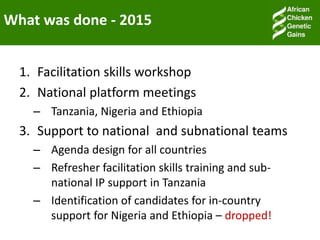
What was done - 2015
1. Facilitation skills workshop
2. National platform meetings
– Tanzania, Nigeria and Ethiopia
3. Support to national and subnational teams
– Agenda design for all countries
– Refresher facilitation skills training and sub-
national IP support in Tanzania
– Identification of candidates for in-country
support for Nigeria and Ethiopia – dropped!
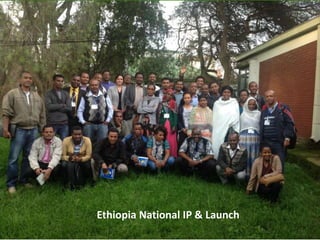
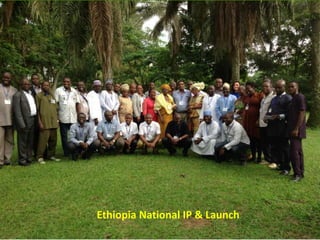
Ethiopia National IP & Launch
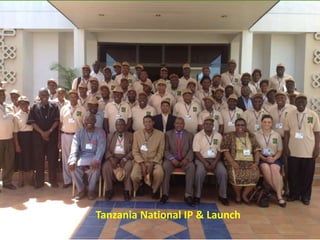
Tanzania National IP & Launch
Achievements
Some outputs and inspirations
1. Development of an implementable work plan
for the 1st year by SNC’s
2. Realization that facilitation skills are life skills
“These are skills we should use more, even at
home”
3. The impact of facilitation skills and style on
attaining a common objective
“The PI’s and Co-PI’s should have been present
at the meeting”
Achievements
4. A deeper understanding of the project goals
and activities
“We received more than facilitation training. We
now understand a lot more about the project, and
aspects of planning for forthcoming activities”
5. Value chain diagnosis and identification of
opportunities to catalyze VC transformation –
Priority Action Areas :
Achievements
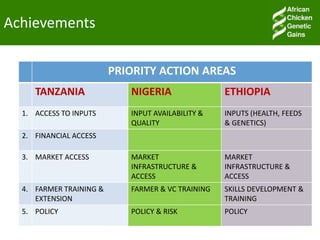
PRIORITY ACTION AREAS
TANZANIA NIGERIA ETHIOPIA
1. ACCESS TO INPUTS INPUT AVAILABILITY &
QUALITY
INPUTS (HEALTH, FEEDS
& GENETICS)
2. FINANCIAL ACCESS
3. MARKET ACCESS MARKET
INFRASTRUCTURE &
ACCESS
MARKET
INFRASTRUCTURE &
ACCESS
4. FARMER TRAINING &
EXTENSION
FARMER & VC TRAINING SKILLS DEVELOPMENT &
TRAINING
5. POLICY POLICY & RISK POLICY
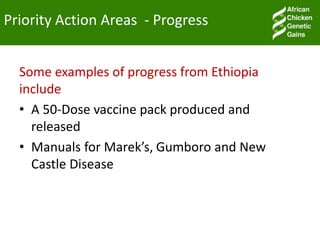
Priority Action Areas - Progress
Some examples of progress from Ethiopia
include
• A 50-Dose vaccine pack produced and
released
• Manuals for Marek’s, Gumboro and New
Castle Disease
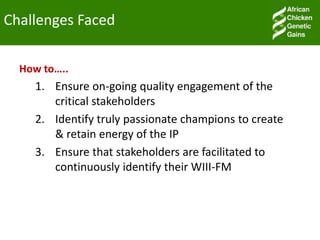
Challenges Faced
How to…..
1. Ensure on-going quality engagement of the
critical stakeholders
2. Identify truly passionate champions to create
& retain energy of the IP
3. Ensure that stakeholders are facilitated to
continuously identify their WIII-FM
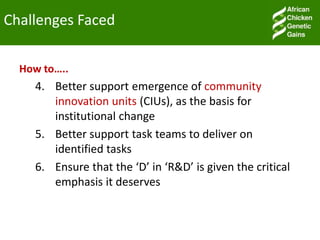
Challenges Faced
How to…..
4. Better support emergence of community
innovation units (CIUs), as the basis for
institutional change
5. Better support task teams to deliver on
identified tasks
6. Ensure that the ‘D’ in ‘R&D’ is given the critical
emphasis it deserves
Lessons Learnt
1. Stakeholders are hungry for transformative
change
“We can create miracles if we develop a functional innovation platform;
let us emulate the flower industry”
“We have started well. We should continue like this and we should be
able to reach the farmers”
2. The quality of stakeholder engagement
matters – a lot!
3. We need ongoing injection of inspiration into
the system, e.g. celebrating wins as they come
Lessons learnt
4. Progress will significantly depend on
passion and energy of the country teams
5. There is a need to ensure greater
participation and engagement of youth and
women
6. Innovative use of emerging ICT could
catalyze increased participation and sharing
within the IP – e.g. WhatsApp in Tanzania
Plans for 2016
1. Virtual support of task teams between IP
meetings
2. Periodic Skype calls with country teams as
needed and requested
3. Support SNCs in designing engagement at
Community Innovation Units
4. Collaborate with RMG on broader
sensitization by field officers, of farmers to
catalyze change
Convenings in 2016
What When Where
Nigeria 2nd National Platform 15 – 16 Mar 2016 OAU, Ila Ife
Ethiopia 2nd National Platform 22 – 23 Mar 2016
Tanzania 2nd National Platform 18 -19 Apr 2016 Dar Es Salaam, TZ
Tanzania 3rd National Platform 6 – 7 Sep 2016
Nigeria 3rd National Platform 20 – 21 Sep 2016
Ethiopia 3rd National Platform 17 – 18 Oct 2016
AND: On-going virtual support between convenings
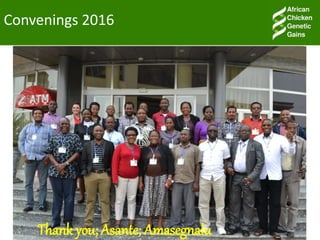
Convenings 2016
Thank you; Asante; Amasegnalu
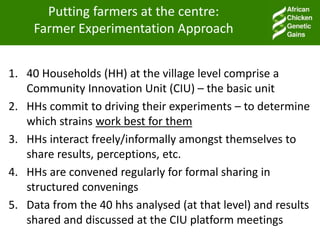
Putting farmers at the centre:
Farmer Experimentation Approach
1. 40 Households (HH) at the village level comprise a
Community Innovation Unit (CIU) – the basic unit
2. HHs commit to driving their experiments – to determine
which strains work best for them
3. HHs interact freely/informally amongst themselves to
share results, perceptions, etc.
4. HHs are convened regularly for formal sharing in
structured convenings
5. Data from the 40 hhs analysed (at that level) and results
shared and discussed at the CIU platform meetings
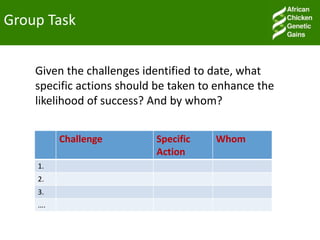
Group Task
Given the challenges identified to date, what
specific actions should be taken to enhance the
likelihood of success? And by whom?
Challenge Specific
Action
Whom
1.
2.
3.
….
more productive chickens for
Africa’s smallholders
http://africacgg.net
The presentation has a Creative Commons licence. You are free to re-use or distribute this work, provided credit is given to ILRI.

Facilitating partnerships and institutional engagements for effective implementation: An update

  • 1.
    Facilitating partnerships andinstitutional engagements for effective implementation: An Update Denis Mujibi Institute of People Innovation and Change in Organizations - Eastern Africa (PICO-EA) Second ACGG Program Management Team Meeting, Arusha, 27-28 January 2016
  • 2.
    Innovation Platform Innovation systemstheory • According to innovation system theory, institutional innovation results from a complex set of relationships among actors in the system Innovation Platform Rationale • ‘System’ as a machine – one dysfunctional part (e.g. fuel system) renders the whole machine useless • When ‘system’ is sub-optimal in some aspects all actors may potentially lose out Innovation Platform • Systematic processes or mechanisms, usually involving on- going face to face and/or virtual interactions, through which stakeholders engage to identify issues that affect their common interest and to co-create system-level innovative solutions
  • 3.
    What was done- 2015 1. Facilitation skills workshop 2. National platform meetings – Tanzania, Nigeria and Ethiopia 3. Support to national and subnational teams – Agenda design for all countries – Refresher facilitation skills training and sub- national IP support in Tanzania – Identification of candidates for in-country support for Nigeria and Ethiopia – dropped!
  • 4.
  • 5.
  • 6.
  • 7.
    Achievements Some outputs andinspirations 1. Development of an implementable work plan for the 1st year by SNC’s 2. Realization that facilitation skills are life skills “These are skills we should use more, even at home” 3. The impact of facilitation skills and style on attaining a common objective “The PI’s and Co-PI’s should have been present at the meeting”
  • 8.
    Achievements 4. A deeperunderstanding of the project goals and activities “We received more than facilitation training. We now understand a lot more about the project, and aspects of planning for forthcoming activities” 5. Value chain diagnosis and identification of opportunities to catalyze VC transformation – Priority Action Areas :
  • 9.
    Achievements PRIORITY ACTION AREAS TANZANIANIGERIA ETHIOPIA 1. ACCESS TO INPUTS INPUT AVAILABILITY & QUALITY INPUTS (HEALTH, FEEDS & GENETICS) 2. FINANCIAL ACCESS 3. MARKET ACCESS MARKET INFRASTRUCTURE & ACCESS MARKET INFRASTRUCTURE & ACCESS 4. FARMER TRAINING & EXTENSION FARMER & VC TRAINING SKILLS DEVELOPMENT & TRAINING 5. POLICY POLICY & RISK POLICY
  • 10.
    Priority Action Areas- Progress Some examples of progress from Ethiopia include • A 50-Dose vaccine pack produced and released • Manuals for Marek’s, Gumboro and New Castle Disease
  • 11.
    Challenges Faced How to….. 1.Ensure on-going quality engagement of the critical stakeholders 2. Identify truly passionate champions to create & retain energy of the IP 3. Ensure that stakeholders are facilitated to continuously identify their WIII-FM
  • 12.
    Challenges Faced How to….. 4.Better support emergence of community innovation units (CIUs), as the basis for institutional change 5. Better support task teams to deliver on identified tasks 6. Ensure that the ‘D’ in ‘R&D’ is given the critical emphasis it deserves
  • 13.
    Lessons Learnt 1. Stakeholdersare hungry for transformative change “We can create miracles if we develop a functional innovation platform; let us emulate the flower industry” “We have started well. We should continue like this and we should be able to reach the farmers” 2. The quality of stakeholder engagement matters – a lot! 3. We need ongoing injection of inspiration into the system, e.g. celebrating wins as they come
  • 14.
    Lessons learnt 4. Progresswill significantly depend on passion and energy of the country teams 5. There is a need to ensure greater participation and engagement of youth and women 6. Innovative use of emerging ICT could catalyze increased participation and sharing within the IP – e.g. WhatsApp in Tanzania
  • 15.
    Plans for 2016 1.Virtual support of task teams between IP meetings 2. Periodic Skype calls with country teams as needed and requested 3. Support SNCs in designing engagement at Community Innovation Units 4. Collaborate with RMG on broader sensitization by field officers, of farmers to catalyze change
  • 16.
    Convenings in 2016 WhatWhen Where Nigeria 2nd National Platform 15 – 16 Mar 2016 OAU, Ila Ife Ethiopia 2nd National Platform 22 – 23 Mar 2016 Tanzania 2nd National Platform 18 -19 Apr 2016 Dar Es Salaam, TZ Tanzania 3rd National Platform 6 – 7 Sep 2016 Nigeria 3rd National Platform 20 – 21 Sep 2016 Ethiopia 3rd National Platform 17 – 18 Oct 2016 AND: On-going virtual support between convenings
  • 17.
    Convenings 2016 Thank you;Asante; Amasegnalu
  • 19.
    Putting farmers atthe centre: Farmer Experimentation Approach 1. 40 Households (HH) at the village level comprise a Community Innovation Unit (CIU) – the basic unit 2. HHs commit to driving their experiments – to determine which strains work best for them 3. HHs interact freely/informally amongst themselves to share results, perceptions, etc. 4. HHs are convened regularly for formal sharing in structured convenings 5. Data from the 40 hhs analysed (at that level) and results shared and discussed at the CIU platform meetings
  • 20.
    Group Task Given thechallenges identified to date, what specific actions should be taken to enhance the likelihood of success? And by whom? Challenge Specific Action Whom 1. 2. 3. ….
  • 22.
    more productive chickensfor Africa’s smallholders http://africacgg.net The presentation has a Creative Commons licence. You are free to re-use or distribute this work, provided credit is given to ILRI.