

US GAAP
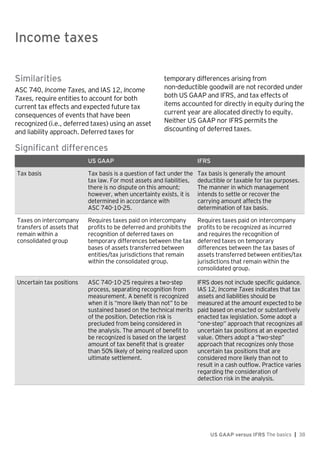
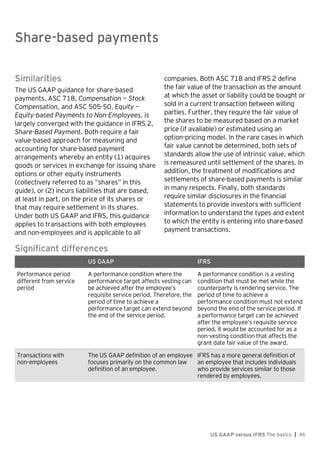
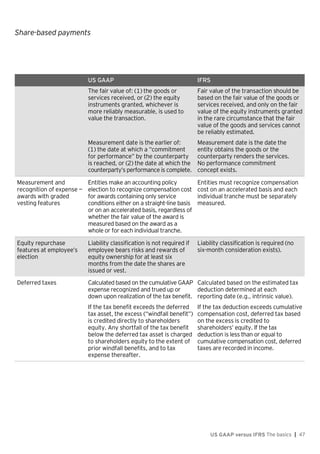
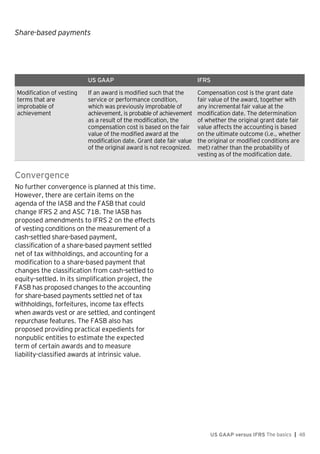
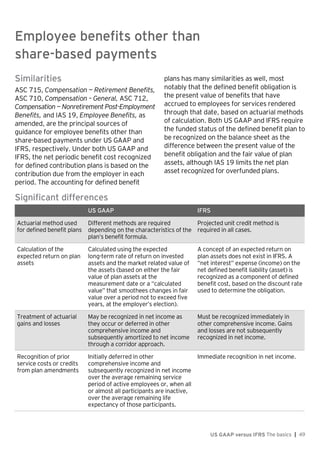
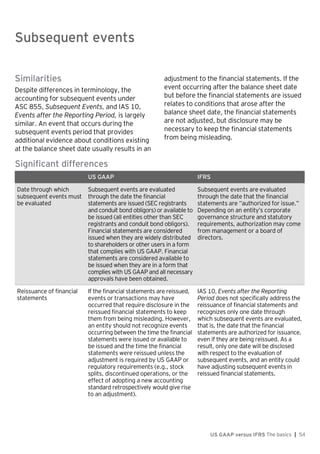
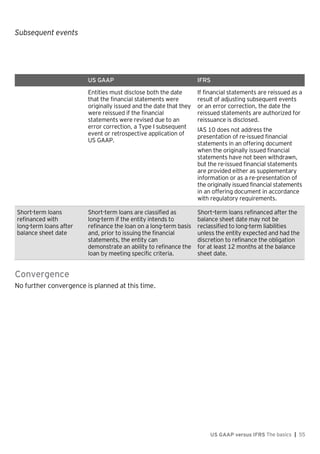
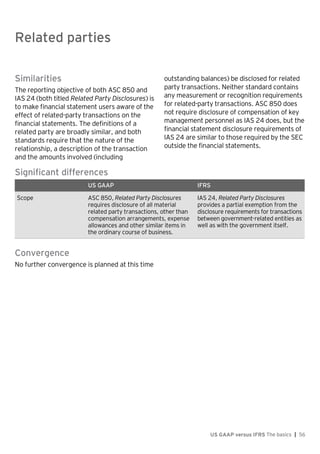
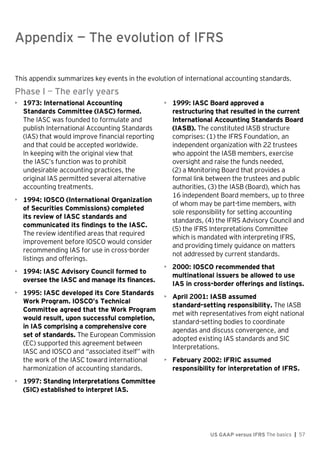
versus IFRS
The basics
December 2015
US GAAP versus IFRS The basics 1
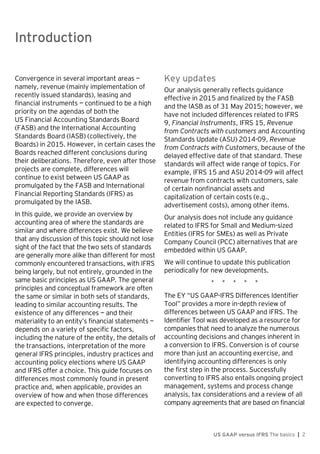
Introduction.....................................................................2
Financial statement presentation..................................... 4
Interim financial reporting................................................ 7
Consolidation, joint venture accounting and equity
method investees/associates........................................... 8
Business combinations................................................... 14
Inventory.......................................................................17
Long-lived assets........................................................... 19
Intangible assets............................................................ 21
Impairment of long-lived assets, goodwill and
intangible assets............................................................ 23
Financial instruments..................................................... 26
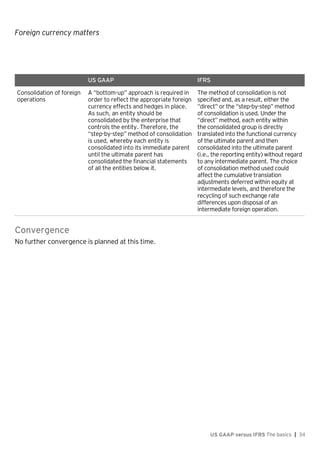
Foreign currency matters .............................................. 33
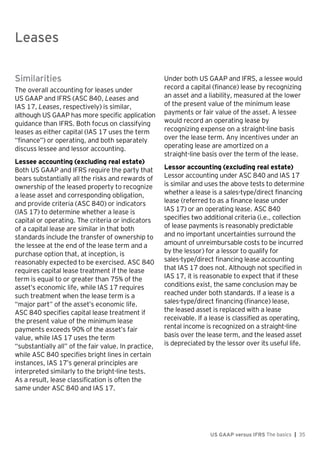
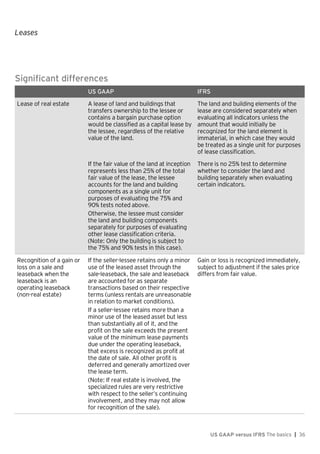
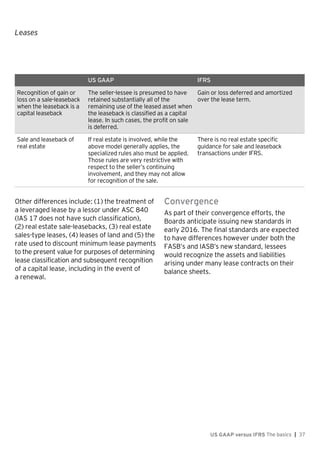
Leases...........................................................................35
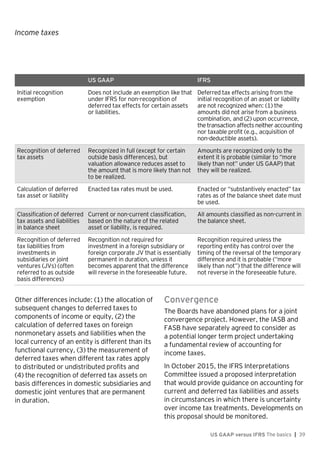
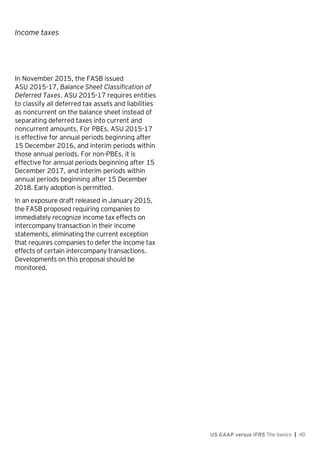
Income taxes .................................................................38
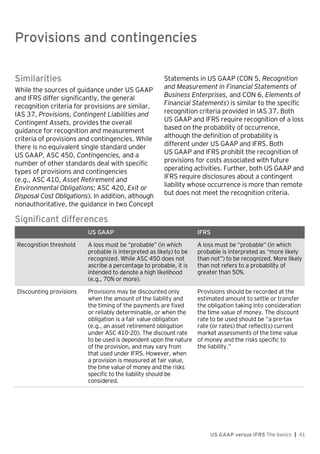
Provisions and contingencies ......................................... 41
Revenue recognition...................................................... 43
Share-based payments................................................... 46
Employee benefits other than share-based payments ..... 49
Earnings per share......................................................... 51
Segment reporting......................................................... 53
Subsequent events ........................................................ 54
Related parties .............................................................. 56
Appendix — The evolution of IFRS................................... 57
Table of contents
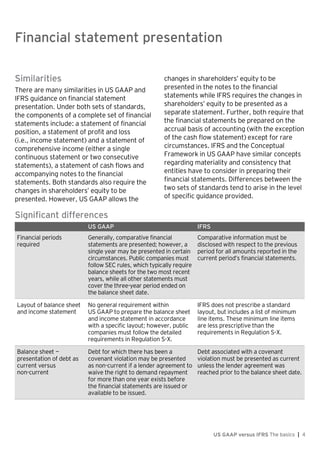
Introduction
US GAAP versus IFRS The basics | 2
Convergence in several important areas —
namely, revenue (mainly implementation of
recently issued standards), leasing and
financial instruments — continued to be a high
priority on the agendas of both the
US Financial Accounting Standards Board
(FASB) and the International Accounting
Standards Board (IASB) (collectively, the
Boards) in 2015. However, in certain cases the
Boards reached different conclusions during
their deliberations. Therefore, even after those
projects are complete, differences will
continue to exist between US GAAP as
promulgated by the FASB and International
Financial Reporting Standards (IFRS) as
promulgated by the IASB.
In this guide, we provide an overview by
accounting area of where the standards are
similar and where differences exist. We believe
that any discussion of this topic should not lose
sight of the fact that the two sets of standards
are generally more alike than different for most
commonly encountered transactions, with IFRS
being largely, but not entirely, grounded in the
same basic principles as US GAAP. The general
principles and conceptual framework are often
the same or similar in both sets of standards,
leading to similar accounting results. The
existence of any differences — and their
materiality to an entity’s financial statements —
depends on a variety of specific factors,
including the nature of the entity, the details of
the transactions, interpretation of the more
general IFRS principles, industry practices and
accounting policy elections where US GAAP
and IFRS offer a choice. This guide focuses on
differences most commonly found in present
practice and, when applicable, provides an
overview of how and when those differences
are expected to converge.
Key updates
Our analysis generally reflects guidance
effective in 2015 and finalized by the FASB
and the IASB as of 31 May 2015; however, we
have not included differences related to IFRS
9, Financial Instruments, IFRS 15, Revenue
from Contracts with customers and Accounting
Standards Update (ASU) 2014-09, Revenue
from Contracts with Customers, because of the
delayed effective date of that standard. These
standards will affect wide range of topics. For
example, IFRS 15 and ASU 2014-09 will affect
revenue from contracts with customers, sale
of certain nonfinancial assets and
capitalization of certain costs (e.g.,
advertisement costs), among other items.
Our analysis does not include any guidance
related to IFRS for Small and Medium-sized
Entities (IFRS for SMEs) as well as Private
Company Council (PCC) alternatives that are
embedded within US GAAP.
We will continue to update this publication
periodically for new developments.
* * * * *
The EY “US GAAP-IFRS Differences Identifier
Tool” provides a more in-depth review of
differences between US GAAP and IFRS. The
Identifier Tool was developed as a resource for
companies that need to analyze the numerous
accounting decisions and changes inherent in
a conversion to IFRS. Conversion is of course
more than just an accounting exercise, and
identifying accounting differences is only
the first step in the process. Successfully
converting to IFRS also entails ongoing project
management, systems and process change
analysis, tax considerations and a review of all
company agreements that are based on financial
Introduction
Introduction
US GAAP versus IFRS The basics | 3
data and measures. EY assurance, tax and
advisory professionals are available to share
their experiences and to assist companies in
analyzing all aspects of the conversion process,
from the earliest diagnostic stages through
ultimate adoption of the international standards.
To learn more about the Identifier Tool, please
contact your local EY professional.
December 2015
Financial statement presentation
US GAAP versus IFRS The basics | 4
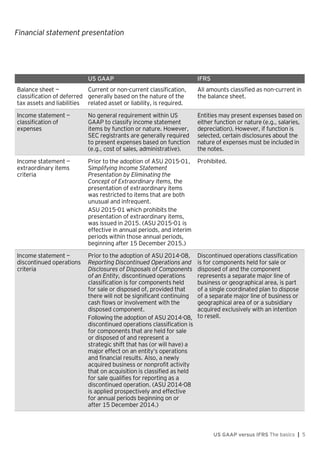
Similarities
There are many similarities in US GAAP and
IFRS guidance on financial statement
presentation. Under both sets of standards,
the components of a complete set of financial
statements include: a statement of financial
position, a statement of profit and loss
(i.e., income statement) and a statement of
comprehensive income (either a single
continuous statement or two consecutive
statements), a statement of cash flows and
accompanying notes to the financial
statements. Both standards also require the
changes in shareholders’ equity to be
presented. However, US GAAP allows the
changes in shareholders’ equity to be
presented in the notes to the financial
statements while IFRS requires the changes in
shareholders’ equity to be presented as a
separate statement. Further, both require that
the financial statements be prepared on the
accrual basis of accounting (with the exception
of the cash flow statement) except for rare
circumstances. IFRS and the Conceptual
Framework in US GAAP have similar concepts
regarding materiality and consistency that
entities have to consider in preparing their
financial statements. Differences between the
two sets of standards tend to arise in the level
of specific guidance provided.
Significant differences
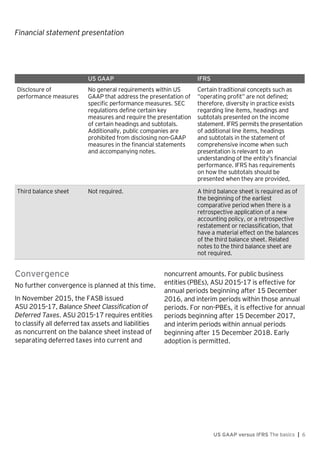
US GAAP IFRS
Financial periods
required
Generally, comparative financial
statements are presented; however, a
single year may be presented in certain
circumstances. Public companies must
follow SEC rules, which typically require
balance sheets for the two most recent
years, while all other statements must
cover the three-year period ended on
the balance sheet date.
Comparative information must be
disclosed with respect to the previous
period for all amounts reported in the
current period’s financial statements.
Layout of balance sheet
and income statement
No general requirement within
US GAAP to prepare the balance sheet
and income statement in accordance
with a specific layout; however, public
companies must follow the detailed
requirements in Regulation S-X.
IFRS does not prescribe a standard
layout, but includes a list of minimum
line items. These minimum line items
are less prescriptive than the
requirements in Regulation S-X.
Balance sheet —
presentation of debt as
current versus
non-current
Debt for which there has been a
covenant violation may be presented
as non-current if a lender agreement to
waive the right to demand repayment
for more than one year exists before
the financial statements are issued or
available to be issued.
Debt associated with a covenant
violation must be presented as current
unless the lender agreement was
reached prior to the balance sheet date.
Financial statement presentation
US GAAP versus IFRS The basics | 5
US GAAP IFRS
Balance sheet —
classification of deferred
tax assets and liabilities
Current or non-current classification,
generally based on the nature of the
related asset or liability, is required.
All amounts classified as non-current in
the balance sheet.
Income statement —
classification of
expenses
No general requirement within US
GAAP to classify income statement
items by function or nature. However,
SEC registrants are generally required
to present expenses based on function
(e.g., cost of sales, administrative).
Entities may present expenses based on
either function or nature (e.g., salaries,
depreciation). However, if function is
selected, certain disclosures about the
nature of expenses must be included in
the notes.
Income statement —
extraordinary items
criteria
Prior to the adoption of ASU 2015-01,
Simplifying Income Statement
Presentation by Eliminating the
Concept of Extraordinary Items, the
presentation of extraordinary items
was restricted to items that are both
unusual and infrequent.
ASU 2015-01 which prohibits the
presentation of extraordinary items,
was issued in 2015. (ASU 2015-01 is
effective in annual periods, and interim
periods within those annual periods,
beginning after 15 December 2015.)
Prohibited.
Income statement —
discontinued operations
criteria
Prior to the adoption of ASU 2014-08,
Reporting Discontinued Operations and
Disclosures of Disposals of Components
of an Entity, discontinued operations
classification is for components held
for sale or disposed of, provided that
there will not be significant continuing
cash flows or involvement with the
disposed component.
Following the adoption of ASU 2014-08,
discontinued operations classification is
for components that are held for sale
or disposed of and represent a
strategic shift that has (or will have) a
major effect on an entity’s operations
and financial results. Also, a newly
acquired business or nonprofit activity
that on acquisition is classified as held
for sale qualifies for reporting as a
discontinued operation. (ASU 2014-08
is applied prospectively and effective
for annual periods beginning on or
after 15 December 2014.)
Discontinued operations classification
is for components held for sale or
disposed of and the component
represents a separate major line of
business or geographical area, is part
of a single coordinated plan to dispose
of a separate major line of business or
geographical area of or a subsidiary
acquired exclusively with an intention
to resell.
Financial statement presentation
US GAAP versus IFRS The basics | 6
US GAAP IFRS
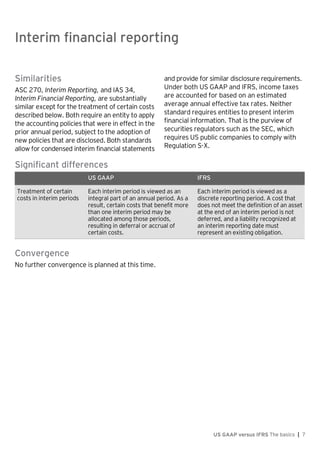
Disclosure of
performance measures
No general requirements within US
GAAP that address the presentation of
specific performance measures. SEC
regulations define certain key
measures and require the presentation
of certain headings and subtotals.
Additionally, public companies are
prohibited from disclosing non-GAAP
measures in the financial statements
and accompanying notes.
Certain traditional concepts such as
“operating profit” are not defined;
therefore, diversity in practice exists
regarding line items, headings and
subtotals presented on the income
statement. IFRS permits the presentation
of additional line items, headings
and subtotals in the statement of
comprehensive income when such
presentation is relevant to an
understanding of the entity’s financial
performance. IFRS has requirements
on how the subtotals should be
presented when they are provided,
Third balance sheet Not required. A third balance sheet is required as of
the beginning of the earliest
comparative period when there is a
retrospective application of a new
accounting policy, or a retrospective
restatement or reclassification, that
have a material effect on the balances
of the third balance sheet. Related
notes to the third balance sheet are
not required.
Convergence
No further convergence is planned at this time.
In November 2015, the FASB issued
ASU 2015-17, Balance Sheet Classification of
Deferred Taxes. ASU 2015-17 requires entities
to classify all deferred tax assets and liabilities
as noncurrent on the balance sheet instead of
separating deferred taxes into current and
noncurrent amounts. For public business
entities (PBEs), ASU 2015-17 is effective for
annual periods beginning after 15 December
2016, and interim periods within those annual
periods. For non-PBEs, it is effective for annual
periods beginning after 15 December 2017,
and interim periods within annual periods
beginning after 15 December 2018. Early
adoption is permitted.
Interim financial reporting
US GAAP versus IFRS The basics | 7
Similarities
ASC 270, Interim Reporting, and IAS 34,
Interim Financial Reporting, are substantially
similar except for the treatment of certain costs
described below. Both require an entity to apply
the accounting policies that were in effect in the
prior annual period, subject to the adoption of
new policies that are disclosed. Both standards
allow for condensed interim financial statements
and provide for similar disclosure requirements.
Under both US GAAP and IFRS, income taxes
are accounted for based on an estimated
average annual effective tax rates. Neither
standard requires entities to present interim
financial information. That is the purview of
securities regulators such as the SEC, which
requires US public companies to comply with
Regulation S-X.
Significant differences
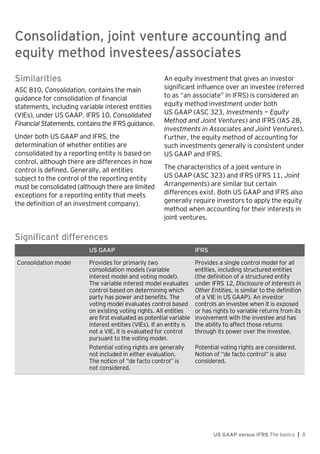
US GAAP IFRS
Treatment of certain
costs in interim periods
Each interim period is viewed as an
integral part of an annual period. As a
result, certain costs that benefit more
than one interim period may be
allocated among those periods,
resulting in deferral or accrual of
certain costs.
Each interim period is viewed as a
discrete reporting period. A cost that
does not meet the definition of an asset
at the end of an interim period is not
deferred, and a liability recognized at
an interim reporting date must
represent an existing obligation.
Convergence
No further convergence is planned at this time.
Interim financial reporting
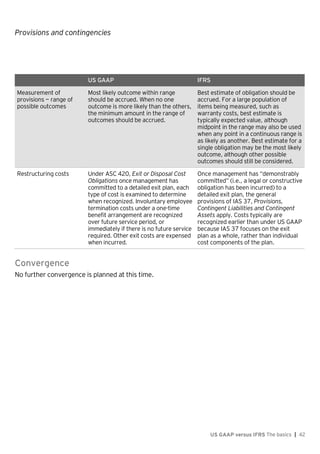
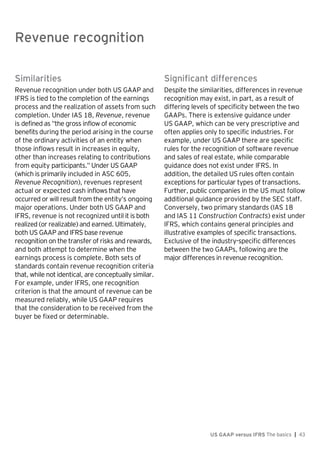
Consolidation, joint venture accounting and equity method investees/associates
US GAAP versus IFRS The basics | 8
Similarities
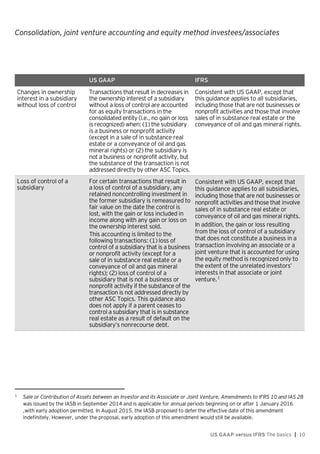
ASC 810, Consolidation, contains the main
guidance for consolidation of financial
statements, including variable interest entities
(VIEs), under US GAAP. IFRS 10, Consolidated
Financial Statements, contains the IFRS guidance.
Under both US GAAP and IFRS, the
determination of whether entities are
consolidated by a reporting entity is based on
control, although there are differences in how
control is defined. Generally, all entities
subject to the control of the reporting entity
must be consolidated (although there are limited
exceptions for a reporting entity that meets
the definition of an investment company).
An equity investment that gives an investor
significant influence over an investee (referred
to as “an associate” in IFRS) is considered an
equity method investment under both
US GAAP (ASC 323, Investments — Equity
Method and Joint Ventures) and IFRS (IAS 28,
Investments in Associates and Joint Ventures).
Further, the equity method of accounting for
such investments generally is consistent under
US GAAP and IFRS.
The characteristics of a joint venture in
US GAAP (ASC 323) and IFRS (IFRS 11, Joint
Arrangements) are similar but certain
differences exist. Both US GAAP and IFRS also
generally require investors to apply the equity
method when accounting for their interests in
joint ventures.
Significant differences
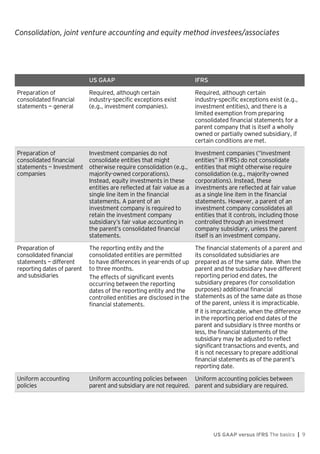
US GAAP IFRS
Consolidation model Provides for primarily two
consolidation models (variable
interest model and voting model).
The variable interest model evaluates
control based on determining which
party has power and benefits. The
voting model evaluates control based
on existing voting rights. All entities
are first evaluated as potential variable
interest entities (VIEs). If an entity is
not a VIE, it is evaluated for control
pursuant to the voting model.
Provides a single control model for all
entities, including structured entities
(the definition of a structured entity
under IFRS 12, Disclosure of Interests in
Other Entities, is similar to the definition
of a VIE in US GAAP). An investor
controls an investee when it is exposed
or has rights to variable returns from its
involvement with the investee and has
the ability to affect those returns
through its power over the investee.
Potential voting rights are generally
not included in either evaluation.
The notion of “de facto control” is
not considered.
Potential voting rights are considered.
Notion of “de facto control” is also
considered.
Consolidation, joint venture accounting and
equity method investees/associates
Consolidation, joint venture accounting and equity method investees/associates
US GAAP versus IFRS The basics | 9
US GAAP IFRS
Preparation of
consolidated financial
statements — general
Required, although certain
industry-specific exceptions exist
(e.g., investment companies).
Required, although certain
industry-specific exceptions exist (e.g.,
investment entities), and there is a
limited exemption from preparing
consolidated financial statements for a
parent company that is itself a wholly
owned or partially owned subsidiary, if
certain conditions are met.
Preparation of
consolidated financial
statements — Investment
companies
Investment companies do not
consolidate entities that might
otherwise require consolidation (e.g.,
majority-owned corporations).
Instead, equity investments in these
entities are reflected at fair value as a
single line item in the financial
statements. A parent of an
investment company is required to
retain the investment company
subsidiary’s fair value accounting in
the parent’s consolidated financial
statements.
Investment companies (“investment
entities” in IFRS) do not consolidate
entities that might otherwise require
consolidation (e.g., majority-owned
corporations). Instead, these
investments are reflected at fair value
as a single line item in the financial
statements. However, a parent of an
investment company consolidates all
entities that it controls, including those
controlled through an investment
company subsidiary, unless the parent
itself is an investment company.
Preparation of
consolidated financial
statements — different
reporting dates of parent
and subsidiaries
The reporting entity and the
consolidated entities are permitted
to have differences in year-ends of up
to three months.
The effects of significant events
occurring between the reporting
dates of the reporting entity and the
controlled entities are disclosed in the
financial statements.
The financial statements of a parent and
its consolidated subsidiaries are
prepared as of the same date. When the
parent and the subsidiary have different
reporting period end dates, the
subsidiary prepares (for consolidation
purposes) additional financial
statements as of the same date as those
of the parent, unless it is impracticable.
If it is impracticable, when the difference
in the reporting period end dates of the
parent and subsidiary is three months or
less, the financial statements of the
subsidiary may be adjusted to reflect
significant transactions and events, and
it is not necessary to prepare additional
financial statements as of the parent’s
reporting date.
Uniform accounting
policies
Uniform accounting policies between
parent and subsidiary are not required.
Uniform accounting policies between
parent and subsidiary are required.
Consolidation, joint venture accounting and equity method investees/associates
US GAAP versus IFRS The basics | 10
US GAAP IFRS
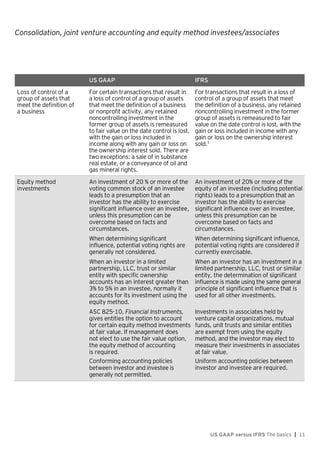
Changes in ownership
interest in a subsidiary
without loss of control
Transactions that result in decreases in
the ownership interest of a subsidiary
without a loss of control are accounted
for as equity transactions in the
consolidated entity (i.e., no gain or loss
is recognized) when: (1) the subsidiary
is a business or nonprofit activity
(except in a sale of in substance real
estate or a conveyance of oil and gas
mineral rights) or (2) the subsidiary is
not a business or nonprofit activity, but
the substance of the transaction is not
addressed directly by other ASC Topics.
Consistent with US GAAP, except that
this guidance applies to all subsidiaries,
including those that are not businesses or
nonprofit activities and those that involve
sales of in substance real estate or the
conveyance of oil and gas mineral rights.
Loss of control of a
subsidiary
For certain transactions that result in
a loss of control of a subsidiary, any
retained noncontrolling investment in
the former subsidiary is remeasured to
fair value on the date the control is
lost, with the gain or loss included in
income along with any gain or loss on
the ownership interest sold.
This accounting is limited to the
following transactions: (1) loss of
control of a subsidiary that is a business
or nonprofit activity (except for a
sale of in substance real estate or a
conveyance of oil and gas mineral
rights); (2) loss of control of a
subsidiary that is not a business or
nonprofit activity if the substance of the
transaction is not addressed directly by
other ASC Topics. This guidance also
does not apply if a parent ceases to
control a subsidiary that is in substance
real estate as a result of default on the
subsidiary’s nonrecourse debt.
Consistent with US GAAP, except that
this guidance applies to all subsidiaries,
including those that are not businesses or
nonprofit activities and those that involve
sales of in substance real estate or
conveyance of oil and gas mineral rights.
In addition, the gain or loss resulting
from the loss of control of a subsidiary
that does not constitute a business in a
transaction involving an associate or a
joint venture that is accounted for using
the equity method is recognized only to
the extent of the unrelated investors’
interests in that associate or joint
venture.1
1
Sale or Contribution of Assets between an Investor and its Associate or Joint Venture, Amendments to IFRS 10 and IAS 28
was issued by the IASB in September 2014 and is applicable for annual periods beginning on or after 1 January 2016
,with early adoption permitted. In August 2015, the IASB proposed to defer the effective date of this amendment
indefinitely. However, under the proposal, early adoption of this amendment would still be available.
Consolidation, joint venture accounting and equity method investees/associates
US GAAP versus IFRS The basics | 11
US GAAP IFRS
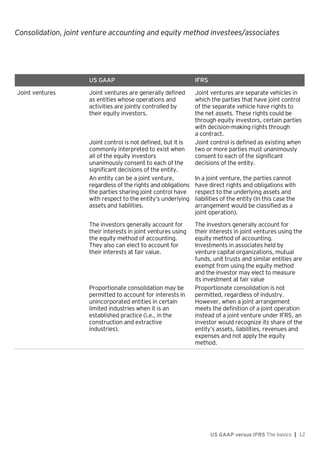
Loss of control of a
group of assets that
meet the definition of
a business
For certain transactions that result in
a loss of control of a group of assets
that meet the definition of a business
or nonprofit activity, any retained
noncontrolling investment in the
former group of assets is remeasured
to fair value on the date control is lost,
with the gain or loss included in
income along with any gain or loss on
the ownership interest sold. There are
two exceptions: a sale of in substance
real estate, or a conveyance of oil and
gas mineral rights.
For transactions that result in a loss of
control of a group of assets that meet
the definition of a business, any retained
noncontrolling investment in the former
group of assets is remeasured to fair
value on the date control is lost, with the
gain or loss included in income with any
gain or loss on the ownership interest
sold.1
Equity method
investments
An investment of 20 % or more of the
voting common stock of an investee
leads to a presumption that an
investor has the ability to exercise
significant influence over an investee,
unless this presumption can be
overcome based on facts and
circumstances.
When determining significant
influence, potential voting rights are
generally not considered.
When an investor in a limited
partnership, LLC, trust or similar
entity with specific ownership
accounts has an interest greater than
3% to 5% in an investee, normally it
accounts for its investment using the
equity method.
ASC 825-10, Financial Instruments,
gives entities the option to account
for certain equity method investments
at fair value. If management does
not elect to use the fair value option,
the equity method of accounting
is required.
An investment of 20% or more of the
equity of an investee (including potential
rights) leads to a presumption that an
investor has the ability to exercise
significant influence over an investee,
unless this presumption can be
overcome based on facts and
circumstances.
When determining significant influence,
potential voting rights are considered if
currently exercisable.
When an investor has an investment in a
limited partnership, LLC, trust or similar
entity, the determination of significant
influence is made using the same general
principle of significant influence that is
used for all other investments.
Investments in associates held by
venture capital organizations, mutual
funds, unit trusts and similar entities
are exempt from using the equity
method, and the investor may elect to
measure their investments in associates
at fair value.
Conforming accounting policies
between investor and investee is
generally not permitted.
Uniform accounting policies between
investor and investee are required.
Consolidation, joint venture accounting and equity method investees/associates
US GAAP versus IFRS The basics | 12
US GAAP IFRS
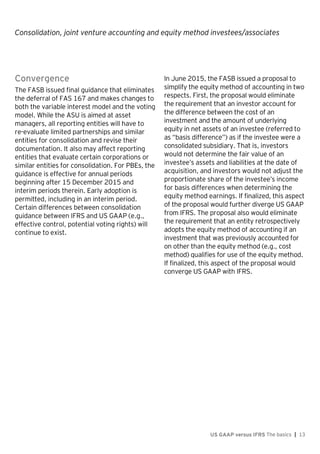
Joint ventures Joint ventures are generally defined
as entities whose operations and
activities are jointly controlled by
their equity investors.
Joint control is not defined, but it is
commonly interpreted to exist when
all of the equity investors
unanimously consent to each of the
significant decisions of the entity.
An entity can be a joint venture,
regardless of the rights and obligations
the parties sharing joint control have
with respect to the entity’s underlying
assets and liabilities.
Joint ventures are separate vehicles in
which the parties that have joint control
of the separate vehicle have rights to
the net assets. These rights could be
through equity investors, certain parties
with decision-making rights through
a contract.
Joint control is defined as existing when
two or more parties must unanimously
consent to each of the significant
decisions of the entity.
In a joint venture, the parties cannot
have direct rights and obligations with
respect to the underlying assets and
liabilities of the entity (In this case the
arrangement would be classified as a
joint operation).
The investors generally account for
their interests in joint ventures using
the equity method of accounting.
They also can elect to account for
their interests at fair value.
Proportionate consolidation may be
permitted to account for interests in
unincorporated entities in certain
limited industries when it is an
established practice (i.e., in the
construction and extractive
industries).
The investors generally account for
their interests in joint ventures using the
equity method of accounting.
Investments in associates held by
venture capital organizations, mutual
funds, unit trusts and similar entities are
exempt from using the equity method
and the investor may elect to measure
its investment at fair value
Proportionate consolidation is not
permitted, regardless of industry.
However, when a joint arrangement
meets the definition of a joint operation
instead of a joint venture under IFRS, an
investor would recognize its share of the
entity’s assets, liabilities, revenues and
expenses and not apply the equity
method.
Consolidation, joint venture accounting and equity method investees/associates
US GAAP versus IFRS The basics | 13
Convergence
The FASB issued final guidance that eliminates
the deferral of FAS 167 and makes changes to
both the variable interest model and the voting
model. While the ASU is aimed at asset
managers, all reporting entities will have to
re-evaluate limited partnerships and similar
entities for consolidation and revise their
documentation. It also may affect reporting
entities that evaluate certain corporations or
similar entities for consolidation. For PBEs, the
guidance is effective for annual periods
beginning after 15 December 2015 and
interim periods therein. Early adoption is
permitted, including in an interim period.
Certain differences between consolidation
guidance between IFRS and US GAAP (e.g.,
effective control, potential voting rights) will
continue to exist.
In June 2015, the FASB issued a proposal to
simplify the equity method of accounting in two
respects. First, the proposal would eliminate
the requirement that an investor account for
the difference between the cost of an
investment and the amount of underlying
equity in net assets of an investee (referred to
as “basis difference”) as if the investee were a
consolidated subsidiary. That is, investors
would not determine the fair value of an
investee’s assets and liabilities at the date of
acquisition, and investors would not adjust the
proportionate share of the investee’s income
for basis differences when determining the
equity method earnings. If finalized, this aspect
of the proposal would further diverge US GAAP
from IFRS. The proposal also would eliminate
the requirement that an entity retrospectively
adopts the equity method of accounting if an
investment that was previously accounted for
on other than the equity method (e.g., cost
method) qualifies for use of the equity method.
If finalized, this aspect of the proposal would
converge US GAAP with IFRS.
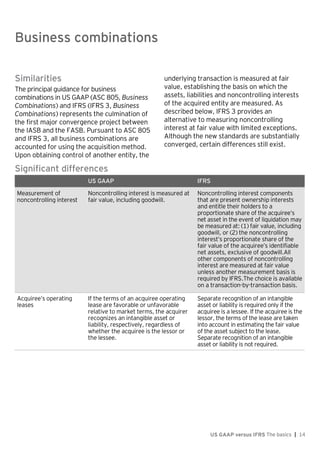
Business combinations
US GAAP versus IFRS The basics | 14
Similarities
The principal guidance for business
combinations in US GAAP (ASC 805, Business
Combinations) and IFRS (IFRS 3, Business
Combinations) represents the culmination of
the first major convergence project between
the IASB and the FASB. Pursuant to ASC 805
and IFRS 3, all business combinations are
accounted for using the acquisition method.
Upon obtaining control of another entity, the
underlying transaction is measured at fair
value, establishing the basis on which the
assets, liabilities and noncontrolling interests
of the acquired entity are measured. As
described below, IFRS 3 provides an
alternative to measuring noncontrolling
interest at fair value with limited exceptions.
Although the new standards are substantially
converged, certain differences still exist.
Significant differences
US GAAP IFRS
Measurement of
noncontrolling interest
Noncontrolling interest is measured at
fair value, including goodwill.
Noncontrolling interest components
that are present ownership interests
and entitle their holders to a
proportionate share of the acquiree’s
net asset in the event of liquidation may
be measured at: (1) fair value, including
goodwill, or (2) the noncontrolling
interest’s proportionate share of the
fair value of the acquiree’s identifiable
net assets, exclusive of goodwill.All
other components of noncontrolling
interest are measured at fair value
unless another measurement basis is
required by IFRS.The choice is available
on a transaction-by-transaction basis.
Acquiree’s operating
leases
If the terms of an acquiree operating
lease are favorable or unfavorable
relative to market terms, the acquirer
recognizes an intangible asset or
liability, respectively, regardless of
whether the acquiree is the lessor or
the lessee.
Separate recognition of an intangible
asset or liability is required only if the
acquiree is a lessee. If the acquiree is the
lessor, the terms of the lease are taken
into account in estimating the fair value
of the asset subject to the lease.
Separate recognition of an intangible
asset or liability is not required.
Business combinations
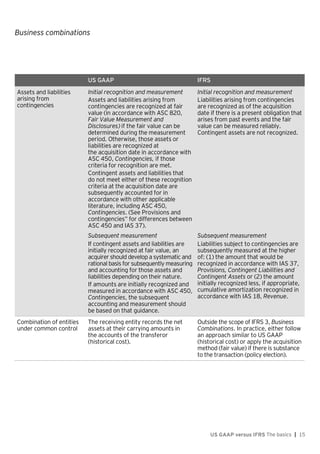
US GAAP versus IFRS The basics | 15
US GAAP IFRS
Assets and liabilities
arising from
contingencies
Initial recognition and measurement
Assets and liabilities arising from
contingencies are recognized at fair
value (in accordance with ASC 820,
Fair Value Measurement and
Disclosures) if the fair value can be
determined during the measurement
period. Otherwise, those assets or
liabilities are recognized at
the acquisition date in accordance with
ASC 450, Contingencies, if those
criteria for recognition are met.
Contingent assets and liabilities that
do not meet either of these recognition
criteria at the acquisition date are
subsequently accounted for in
accordance with other applicable
literature, including ASC 450,
Contingencies. (See Provisions and
contingencies” for differences between
ASC 450 and IAS 37).
Initial recognition and measurement
Liabilities arising from contingencies
are recognized as of the acquisition
date if there is a present obligation that
arises from past events and the fair
value can be measured reliably.
Contingent assets are not recognized.
Subsequent measurement
If contingent assets and liabilities are
initially recognized at fair value, an
acquirer should develop a systematic and
rational basis for subsequently measuring
and accounting for those assets and
liabilities depending on their nature.
If amounts are initially recognized and
measured in accordance with ASC 450,
Contingencies, the subsequent
accounting and measurement should
be based on that guidance.
Subsequent measurement
Liabilities subject to contingencies are
subsequently measured at the higher
of: (1) the amount that would be
recognized in accordance with IAS 37,
Provisions, Contingent Liabilities and
Contingent Assets or (2) the amount
initially recognized less, if appropriate,
cumulative amortization recognized in
accordance with IAS 18, Revenue.
Combination of entities
under common control
The receiving entity records the net
assets at their carrying amounts in
the accounts of the transferor
(historical cost).
Outside the scope of IFRS 3, Business
Combinations. In practice, either follow
an approach similar to US GAAP
(historical cost) or apply the acquisition
method (fair value) if there is substance
to the transaction (policy election).
Business combinations
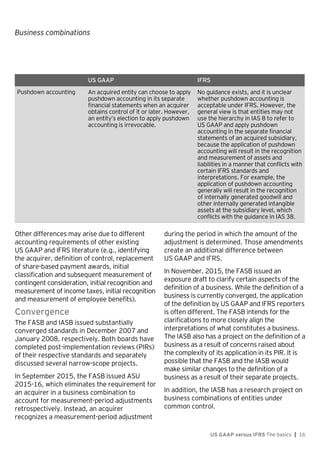
US GAAP versus IFRS The basics | 16
US GAAP IFRS
Pushdown accounting An acquired entity can choose to apply
pushdown accounting in its separate
financial statements when an acquirer
obtains control of it or later. However,
an entity’s election to apply pushdown
accounting is irrevocable.
No guidance exists, and it is unclear
whether pushdown accounting is
acceptable under IFRS. However, the
general view is that entities may not
use the hierarchy in IAS 8 to refer to
US GAAP and apply pushdown
accounting in the separate financial
statements of an acquired subsidiary,
because the application of pushdown
accounting will result in the recognition
and measurement of assets and
liabilities in a manner that conflicts with
certain IFRS standards and
interpretations. For example, the
application of pushdown accounting
generally will result in the recognition
of internally generated goodwill and
other internally generated intangible
assets at the subsidiary level, which
conflicts with the guidance in IAS 38.
Other differences may arise due to different
accounting requirements of other existing
US GAAP and IFRS literature (e.g., identifying
the acquirer, definition of control, replacement
of share-based payment awards, initial
classification and subsequent measurement of
contingent consideration, initial recognition and
measurement of income taxes, initial recognition
and measurement of employee benefits).
Convergence
The FASB and IASB issued substantially
converged standards in December 2007 and
January 2008, respectively. Both boards have
completed post-implementation reviews (PIRs)
of their respective standards and separately
discussed several narrow-scope projects.
In September 2015, the FASB issued ASU
2015-16, which eliminates the requirement for
an acquirer in a business combination to
account for measurement-period adjustments
retrospectively. Instead, an acquirer
recognizes a measurement-period adjustment
during the period in which the amount of the
adjustment is determined. Those amendments
create an additional difference between
US GAAP and IFRS.
In November, 2015, the FASB issued an
exposure draft to clarify certain aspects of the
definition of a business. While the definition of a
business is currently converged, the application
of the definition by US GAAP and IFRS reporters
is often different. The FASB intends for the
clarifications to more closely align the
interpretations of what constitutes a business.
The IASB also has a project on the definition of a
business as a result of concerns raised about
the complexity of its application in its PIR. It is
possible that the FASB and the IASB would
make similar changes to the definition of a
business as a result of their separate projects.
In addition, the IASB has a research project on
business combinations of entities under
common control.
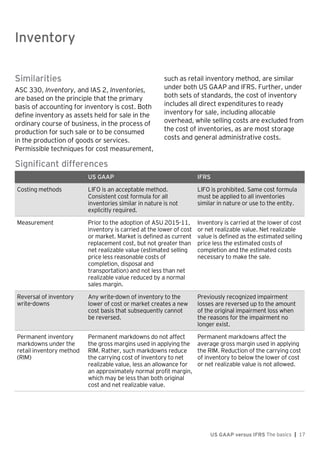
Inventory
US GAAP versus IFRS The basics | 17
Similarities
ASC 330, Inventory, and IAS 2, Inventories,
are based on the principle that the primary
basis of accounting for inventory is cost. Both
define inventory as assets held for sale in the
ordinary course of business, in the process of
production for such sale or to be consumed
in the production of goods or services.
Permissible techniques for cost measurement,
such as retail inventory method, are similar
under both US GAAP and IFRS. Further, under
both sets of standards, the cost of inventory
includes all direct expenditures to ready
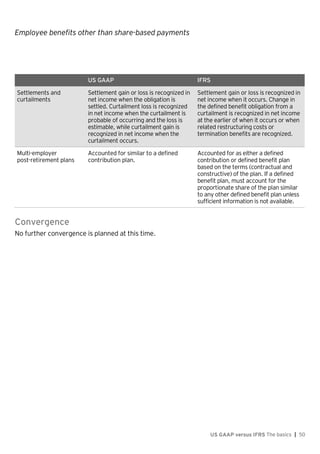
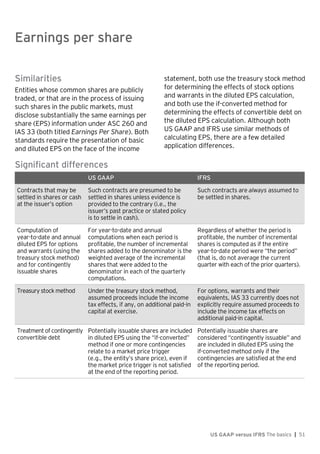
inventory for sale, including allocable
overhead, while selling costs are excluded from
the cost of inventories, as are most storage
costs and general administrative costs.
Significant differences
US GAAP IFRS
Costing methods LIFO is an acceptable method.
Consistent cost formula for all
inventories similar in nature is not
explicitly required.
LIFO is prohibited. Same cost formula
must be applied to all inventories
similar in nature or use to the entity.
Measurement Prior to the adoption of ASU 2015-11,
inventory is carried at the lower of cost
or market. Market is defined as current
replacement cost, but not greater than
net realizable value (estimated selling
price less reasonable costs of
completion, disposal and
transportation) and not less than net
realizable value reduced by a normal
sales margin.
Inventory is carried at the lower of cost
or net realizable value. Net realizable
value is defined as the estimated selling
price less the estimated costs of
completion and the estimated costs
necessary to make the sale.
Reversal of inventory
write-downs
Any write-down of inventory to the
lower of cost or market creates a new
cost basis that subsequently cannot
be reversed.
Previously recognized impairment
losses are reversed up to the amount
of the original impairment loss when
the reasons for the impairment no
longer exist.
Permanent inventory
markdowns under the
retail inventory method
(RIM)
Permanent markdowns do not affect
the gross margins used in applying the
RIM. Rather, such markdowns reduce
the carrying cost of inventory to net
realizable value, less an allowance for
an approximately normal profit margin,
which may be less than both original
cost and net realizable value.
Permanent markdowns affect the
average gross margin used in applying
the RIM. Reduction of the carrying cost
of inventory to below the lower of cost
or net realizable value is not allowed.
Inventory
Inventory
US GAAP versus IFRS The basics | 18
Convergence
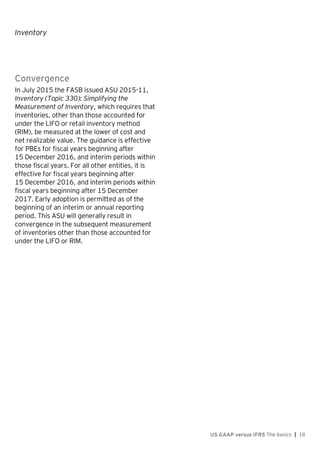
In July 2015 the FASB issued ASU 2015-11,
Inventory (Topic 330): Simplifying the
Measurement of Inventory, which requires that
inventories, other than those accounted for
under the LIFO or retail inventory method
(RIM), be measured at the lower of cost and
net realizable value. The guidance is effective
for PBEs for fiscal years beginning after
15 December 2016, and interim periods within
those fiscal years. For all other entities, it is
effective for fiscal years beginning after
15 December 2016, and interim periods within
fiscal years beginning after 15 December
2017. Early adoption is permitted as of the
beginning of an interim or annual reporting
period. This ASU will generally result in
convergence in the subsequent measurement
of inventories other than those accounted for
under the LIFO or RIM.
Long-lived assets
US GAAP versus IFRS The basics | 19
Similarities
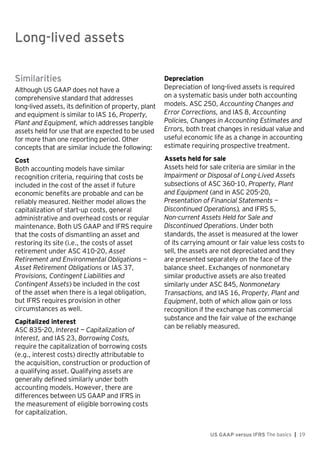
Although US GAAP does not have a
comprehensive standard that addresses
long-lived assets, its definition of property, plant
and equipment is similar to IAS 16, Property,
Plant and Equipment, which addresses tangible
assets held for use that are expected to be used
for more than one reporting period. Other
concepts that are similar include the following:
Cost
Both accounting models have similar
recognition criteria, requiring that costs be
included in the cost of the asset if future
economic benefits are probable and can be
reliably measured. Neither model allows the
capitalization of start-up costs, general
administrative and overhead costs or regular
maintenance. Both US GAAP and IFRS require
that the costs of dismantling an asset and
restoring its site (i.e., the costs of asset
retirement under ASC 410-20, Asset
Retirement and Environmental Obligations —
Asset Retirement Obligations or IAS 37,
Provisions, Contingent Liabilities and
Contingent Assets) be included in the cost
of the asset when there is a legal obligation,
but IFRS requires provision in other
circumstances as well.
Capitalized interest
ASC 835-20, Interest — Capitalization of
Interest, and IAS 23, Borrowing Costs,
require the capitalization of borrowing costs
(e.g., interest costs) directly attributable to
the acquisition, construction or production of
a qualifying asset. Qualifying assets are
generally defined similarly under both
accounting models. However, there are
differences between US GAAP and IFRS in
the measurement of eligible borrowing costs
for capitalization.
Depreciation
Depreciation of long-lived assets is required
on a systematic basis under both accounting
models. ASC 250, Accounting Changes and
Error Corrections, and IAS 8, Accounting
Policies, Changes in Accounting Estimates and
Errors, both treat changes in residual value and
useful economic life as a change in accounting
estimate requiring prospective treatment.
Assets held for sale
Assets held for sale criteria are similar in the
Impairment or Disposal of Long-Lived Assets
subsections of ASC 360-10, Property, Plant
and Equipment (and in ASC 205-20,
Presentation of Financial Statements —
Discontinued Operations), and IFRS 5,
Non-current Assets Held for Sale and
Discontinued Operations. Under both
standards, the asset is measured at the lower
of its carrying amount or fair value less costs to
sell, the assets are not depreciated and they
are presented separately on the face of the
balance sheet. Exchanges of nonmonetary
similar productive assets are also treated
similarly under ASC 845, Nonmonetary
Transactions, and IAS 16, Property, Plant and
Equipment, both of which allow gain or loss
recognition if the exchange has commercial
substance and the fair value of the exchange
can be reliably measured.
Long-lived assets
Long-lived assets
US GAAP versus IFRS The basics | 20
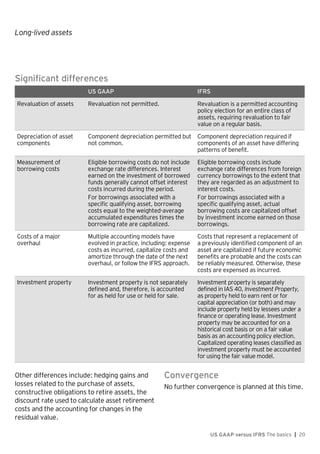
Significant differences
US GAAP IFRS
Revaluation of assets Revaluation not permitted. Revaluation is a permitted accounting
policy election for an entire class of
assets, requiring revaluation to fair
value on a regular basis.
Depreciation of asset
components
Component depreciation permitted but
not common.
Component depreciation required if
components of an asset have differing
patterns of benefit.
Measurement of
borrowing costs
Eligible borrowing costs do not include
exchange rate differences. Interest
earned on the investment of borrowed
funds generally cannot offset interest
costs incurred during the period.
For borrowings associated with a
specific qualifying asset, borrowing
costs equal to the weighted-average
accumulated expenditures times the
borrowing rate are capitalized.
Eligible borrowing costs include
exchange rate differences from foreign
currency borrowings to the extent that
they are regarded as an adjustment to
interest costs.
For borrowings associated with a
specific qualifying asset, actual
borrowing costs are capitalized offset
by investment income earned on those
borrowings.
Costs of a major
overhaul
Multiple accounting models have
evolved in practice, including: expense
costs as incurred, capitalize costs and
amortize through the date of the next
overhaul, or follow the IFRS approach.
Costs that represent a replacement of
a previously identified component of an
asset are capitalized if future economic
benefits are probable and the costs can
be reliably measured. Otherwise, these
costs are expensed as incurred.
Investment property Investment property is not separately
defined and, therefore, is accounted
for as held for use or held for sale.
Investment property is separately
defined in IAS 40, Investment Property,
as property held to earn rent or for
capital appreciation (or both) and may
include property held by lessees under a
finance or operating lease. Investment
property may be accounted for on a
historical cost basis or on a fair value
basis as an accounting policy election.
Capitalized operating leases classified as
investment property must be accounted
for using the fair value model.
Other differences include: hedging gains and
losses related to the purchase of assets,
constructive obligations to retire assets, the
discount rate used to calculate asset retirement
costs and the accounting for changes in the
residual value.
Convergence
No further convergence is planned at this time.
Intangible assets
US GAAP versus IFRS The basics | 21
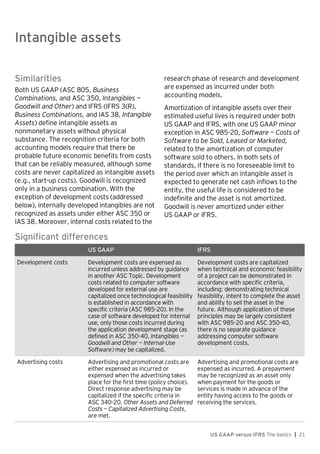
Similarities
Both US GAAP (ASC 805, Business
Combinations, and ASC 350, Intangibles —
Goodwill and Other) and IFRS (IFRS 3(R),
Business Combinations, and IAS 38, Intangible
Assets) define intangible assets as
nonmonetary assets without physical
substance. The recognition criteria for both
accounting models require that there be
probable future economic benefits from costs
that can be reliably measured, although some
costs are never capitalized as intangible assets
(e.g., start-up costs). Goodwill is recognized
only in a business combination. With the
exception of development costs (addressed
below), internally developed intangibles are not
recognized as assets under either ASC 350 or
IAS 38. Moreover, internal costs related to the
research phase of research and development
are expensed as incurred under both
accounting models.
Amortization of intangible assets over their
estimated useful lives is required under both
US GAAP and IFRS, with one US GAAP minor
exception in ASC 985-20, Software — Costs of
Software to be Sold, Leased or Marketed,
related to the amortization of computer
software sold to others. In both sets of
standards, if there is no foreseeable limit to
the period over which an intangible asset is
expected to generate net cash inflows to the
entity, the useful life is considered to be
indefinite and the asset is not amortized.
Goodwill is never amortized under either
US GAAP or IFRS.
Significant differences
US GAAP IFRS
Development costs Development costs are expensed as
incurred unless addressed by guidance
in another ASC Topic. Development
costs related to computer software
developed for external use are
capitalized once technological feasibility
is established in accordance with
specific criteria (ASC 985-20). In the
case of software developed for internal
use, only those costs incurred during
the application development stage (as
defined in ASC 350-40, Intangibles —
Goodwill and Other — Internal-Use
Software) may be capitalized.
Development costs are capitalized
when technical and economic feasibility
of a project can be demonstrated in
accordance with specific criteria,
including: demonstrating technical
feasibility, intent to complete the asset
and ability to sell the asset in the
future. Although application of these
principles may be largely consistent
with ASC 985-20 and ASC 350-40,
there is no separate guidance
addressing computer software
development costs.
Advertising costs Advertising and promotional costs are
either expensed as incurred or
expensed when the advertising takes
place for the first time (policy choice).
Direct response advertising may be
capitalized if the specific criteria in
ASC 340-20, Other Assets and Deferred
Costs — Capitalized Advertising Costs,
are met.
Advertising and promotional costs are
expensed as incurred. A prepayment
may be recognized as an asset only
when payment for the goods or
services is made in advance of the
entity having access to the goods or
receiving the services.
Intangible assets
Intangible assets
US GAAP versus IFRS The basics | 22
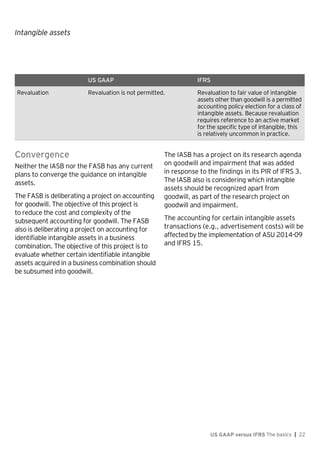
US GAAP IFRS
Revaluation Revaluation is not permitted. Revaluation to fair value of intangible
assets other than goodwill is a permitted
accounting policy election for a class of
intangible assets. Because revaluation
requires reference to an active market
for the specific type of intangible, this
is relatively uncommon in practice.
Convergence
Neither the IASB nor the FASB has any current
plans to converge the guidance on intangible
assets.
The FASB is deliberating a project on accounting
for goodwill. The objective of this project is
to reduce the cost and complexity of the
subsequent accounting for goodwill. The FASB
also is deliberating a project on accounting for
identifiable intangible assets in a business
combination. The objective of this project is to
evaluate whether certain identifiable intangible
assets acquired in a business combination should
be subsumed into goodwill.
The IASB has a project on its research agenda
on goodwill and impairment that was added
in response to the findings in its PIR of IFRS 3.
The IASB also is considering which intangible
assets should be recognized apart from
goodwill, as part of the research project on
goodwill and impairment.
The accounting for certain intangible assets
transactions (e.g., advertisement costs) will be
affected by the implementation of ASU 2014-09
and IFRS 15.
Impairment of long-lived assets, goodwill and intangible assets
US GAAP versus IFRS The basics | 23
Similarities
Under both US GAAP and IFRS, long-lived
assets are not tested annually, but rather when
there are similarly defined indicators of
impairment. Both standards require goodwill
and intangible assets with indefinite useful lives
to be tested at least annually for impairment
and more frequently if impairment indicators
are present. In addition, both US GAAP and
IFRS require that the impaired asset be written
down and an impairment loss recognized.
ASC 350, Intangibles — Goodwill and Other,
Impairment or Disposal of Long-Lived Assets
subsections of ASC 360-10, Property, Plant
and Equipment, and IAS 36, Impairment of
Assets, apply to most long-lived and intangible
assets, although some of the scope exceptions
listed in the standards differ. Despite the
similarity in overall objectives, differences exist
in the way impairment is tested, recognized
and measured.
Significant differences
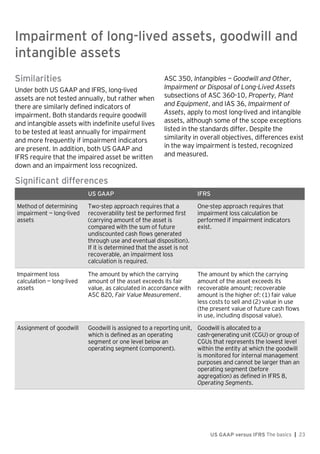
US GAAP IFRS
Method of determining
impairment — long-lived
assets
Two-step approach requires that a
recoverability test be performed first
(carrying amount of the asset is
compared with the sum of future
undiscounted cash flows generated
through use and eventual disposition).
If it is determined that the asset is not
recoverable, an impairment loss
calculation is required.
One-step approach requires that
impairment loss calculation be
performed if impairment indicators
exist.
Impairment loss
calculation — long-lived
assets
The amount by which the carrying
amount of the asset exceeds its fair
value, as calculated in accordance with
ASC 820, Fair Value Measurement.
The amount by which the carrying
amount of the asset exceeds its
recoverable amount; recoverable
amount is the higher of: (1) fair value
less costs to sell and (2) value in use
(the present value of future cash flows
in use, including disposal value).
Assignment of goodwill Goodwill is assigned to a reporting unit,
which is defined as an operating
segment or one level below an
operating segment (component).
Goodwill is allocated to a
cash-generating unit (CGU) or group of
CGUs that represents the lowest level
within the entity at which the goodwill
is monitored for internal management
purposes and cannot be larger than an
operating segment (before
aggregation) as defined in IFRS 8,
Operating Segments.
Impairment of long-lived assets, goodwill and
intangible assets
Impairment of long-lived assets, goodwill and intangible assets
US GAAP versus IFRS The basics | 24
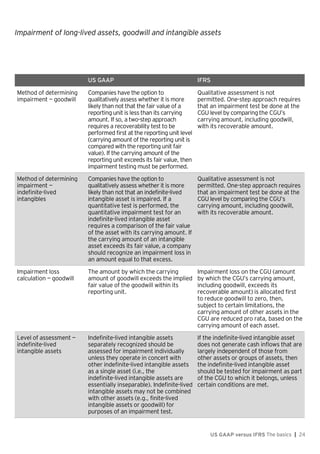
US GAAP IFRS
Method of determining
impairment — goodwill
Companies have the option to
qualitatively assess whether it is more
likely than not that the fair value of a
reporting unit is less than its carrying
amount. If so, a two-step approach
requires a recoverability test to be
performed first at the reporting unit level
(carrying amount of the reporting unit is
compared with the reporting unit fair
value). If the carrying amount of the
reporting unit exceeds its fair value, then
impairment testing must be performed.
Qualitative assessment is not
permitted. One-step approach requires
that an impairment test be done at the
CGU level by comparing the CGU’s
carrying amount, including goodwill,
with its recoverable amount.
Method of determining
impairment —
indefinite-lived
intangibles
Companies have the option to
qualitatively assess whether it is more
likely than not that an indefinite-lived
intangible asset is impaired. If a
quantitative test is performed, the
quantitative impairment test for an
indefinite-lived intangible asset
requires a comparison of the fair value
of the asset with its carrying amount. If
the carrying amount of an intangible
asset exceeds its fair value, a company
should recognize an impairment loss in
an amount equal to that excess.
Qualitative assessment is not
permitted. One-step approach requires
that an impairment test be done at the
CGU level by comparing the CGU’s
carrying amount, including goodwill,
with its recoverable amount.
Impairment loss
calculation — goodwill
The amount by which the carrying
amount of goodwill exceeds the implied
fair value of the goodwill within its
reporting unit.
Impairment loss on the CGU (amount
by which the CGU’s carrying amount,
including goodwill, exceeds its
recoverable amount) is allocated first
to reduce goodwill to zero, then,
subject to certain limitations, the
carrying amount of other assets in the
CGU are reduced pro rata, based on the
carrying amount of each asset.
Level of assessment —
indefinite-lived
intangible assets
Indefinite-lived intangible assets
separately recognized should be
assessed for impairment individually
unless they operate in concert with
other indefinite-lived intangible assets
as a single asset (i.e., the
indefinite-lived intangible assets are
essentially inseparable). Indefinite-lived
intangible assets may not be combined
with other assets (e.g., finite-lived
intangible assets or goodwill) for
purposes of an impairment test.
If the indefinite-lived intangible asset
does not generate cash inflows that are
largely independent of those from
other assets or groups of assets, then
the indefinite-lived intangible asset
should be tested for impairment as part
of the CGU to which it belongs, unless
certain conditions are met.
Impairment of long-lived assets, goodwill and intangible assets
US GAAP versus IFRS The basics | 25
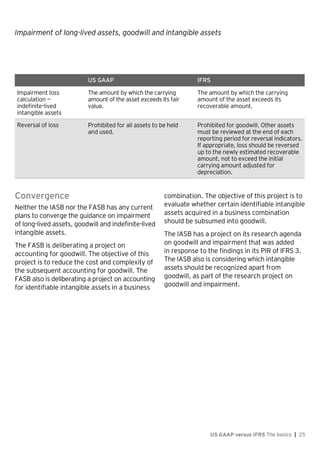
US GAAP IFRS
Impairment loss
calculation —
indefinite-lived
intangible assets
The amount by which the carrying
amount of the asset exceeds its fair
value.
The amount by which the carrying
amount of the asset exceeds its
recoverable amount.
Reversal of loss Prohibited for all assets to be held
and used.
Prohibited for goodwill. Other assets
must be reviewed at the end of each
reporting period for reversal indicators.
If appropriate, loss should be reversed
up to the newly estimated recoverable
amount, not to exceed the initial
carrying amount adjusted for
depreciation.
Convergence
Neither the IASB nor the FASB has any current
plans to converge the guidance on impairment
of long-lived assets, goodwill and indefinite-lived
intangible assets.
The FASB is deliberating a project on
accounting for goodwill. The objective of this
project is to reduce the cost and complexity of
the subsequent accounting for goodwill. The
FASB also is deliberating a project on accounting
for identifiable intangible assets in a business
combination. The objective of this project is to
evaluate whether certain identifiable intangible
assets acquired in a business combination
should be subsumed into goodwill.
The IASB has a project on its research agenda
on goodwill and impairment that was added
in response to the findings in its PIR of IFRS 3.
The IASB also is considering which intangible
assets should be recognized apart from
goodwill, as part of the research project on
goodwill and impairment.
Financial instruments
US GAAP versus IFRS The basics | 26
Similarities
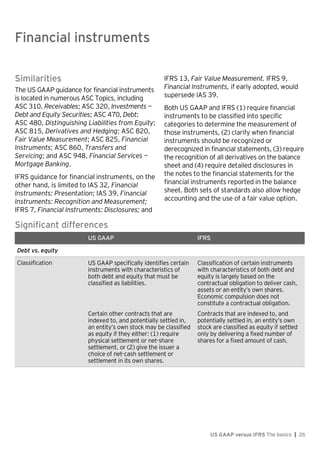
The US GAAP guidance for financial instruments
is located in numerous ASC Topics, including
ASC 310, Receivables; ASC 320, Investments —
Debt and Equity Securities; ASC 470, Debt;
ASC 480, Distinguishing Liabilities from Equity;
ASC 815, Derivatives and Hedging; ASC 820,
Fair Value Measurement; ASC 825, Financial
Instruments; ASC 860, Transfers and
Servicing; and ASC 948, Financial Services —
Mortgage Banking.
IFRS guidance for financial instruments, on the
other hand, is limited to IAS 32, Financial
Instruments: Presentation; IAS 39, Financial
Instruments: Recognition and Measurement;
IFRS 7, Financial Instruments: Disclosures; and
IFRS 13, Fair Value Measurement. IFRS 9,
Financial Instruments, if early adopted, would
supersede IAS 39.
Both US GAAP and IFRS (1) require financial
instruments to be classified into specific
categories to determine the measurement of
those instruments, (2) clarify when financial
instruments should be recognized or
derecognized in financial statements, (3) require
the recognition of all derivatives on the balance
sheet and (4) require detailed disclosures in
the notes to the financial statements for the
financial instruments reported in the balance
sheet. Both sets of standards also allow hedge
accounting and the use of a fair value option.
Significant differences
US GAAP IFRS
Debt vs. equity
Classification US GAAP specifically identifies certain
instruments with characteristics of
both debt and equity that must be
classified as liabilities.
Classification of certain instruments
with characteristics of both debt and
equity is largely based on the
contractual obligation to deliver cash,
assets or an entity’s own shares.
Economic compulsion does not
constitute a contractual obligation.
Certain other contracts that are
indexed to, and potentially settled in,
an entity’s own stock may be classified
as equity if they either: (1) require
physical settlement or net-share
settlement, or (2) give the issuer a
choice of net-cash settlement or
settlement in its own shares.
Contracts that are indexed to, and
potentially settled in, an entity’s own
stock are classified as equity if settled
only by delivering a fixed number of
shares for a fixed amount of cash.
Financial instruments
US GAAP versus IFRS The basics | 27
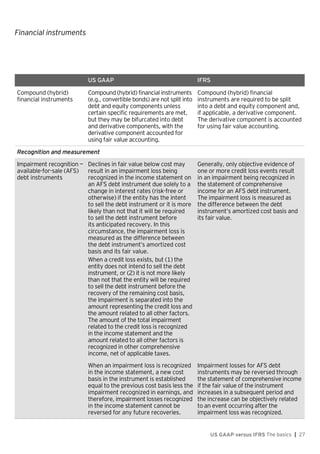
US GAAP IFRS
Compound (hybrid)
financial instruments
Compound (hybrid) financial instruments
(e.g., convertible bonds) are not split into
debt and equity components unless
certain specific requirements are met,
but they may be bifurcated into debt
and derivative components, with the
derivative component accounted for
using fair value accounting.
Compound (hybrid) financial
instruments are required to be split
into a debt and equity component and,
if applicable, a derivative component.
The derivative component is accounted
for using fair value accounting.
Recognition and measurement
Impairment recognition —
available-for-sale (AFS)
debt instruments
Declines in fair value below cost may
result in an impairment loss being
recognized in the income statement on
an AFS debt instrument due solely to a
change in interest rates (risk-free or
otherwise) if the entity has the intent
to sell the debt instrument or it is more
likely than not that it will be required
to sell the debt instrument before
its anticipated recovery. In this
circumstance, the impairment loss is
measured as the difference between
the debt instrument’s amortized cost
basis and its fair value.
When a credit loss exists, but (1) the
entity does not intend to sell the debt
instrument, or (2) it is not more likely
than not that the entity will be required
to sell the debt instrument before the
recovery of the remaining cost basis,
the impairment is separated into the
amount representing the credit loss and
the amount related to all other factors.
The amount of the total impairment
related to the credit loss is recognized
in the income statement and the
amount related to all other factors is
recognized in other comprehensive
income, net of applicable taxes.
Generally, only objective evidence of
one or more credit loss events result
in an impairment being recognized in
the statement of comprehensive
income for an AFS debt instrument.
The impairment loss is measured as
the difference between the debt
instrument’s amortized cost basis and
its fair value.
When an impairment loss is recognized
in the income statement, a new cost
basis in the instrument is established
equal to the previous cost basis less the
impairment recognized in earnings, and
therefore, impairment losses recognized
in the income statement cannot be
reversed for any future recoveries.
Impairment losses for AFS debt
instruments may be reversed through
the statement of comprehensive income
if the fair value of the instrument
increases in a subsequent period and
the increase can be objectively related
to an event occurring after the
impairment loss was recognized.
Financial instruments
US GAAP versus IFRS The basics | 28
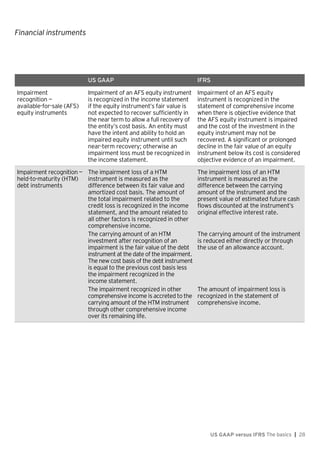
US GAAP IFRS
Impairment
recognition —
available-for-sale (AFS)
equity instruments
Impairment of an AFS equity instrument
is recognized in the income statement
if the equity instrument’s fair value is
not expected to recover sufficiently in
the near term to allow a full recovery of
the entity’s cost basis. An entity must
have the intent and ability to hold an
impaired equity instrument until such
near-term recovery; otherwise an
impairment loss must be recognized in
the income statement.
Impairment of an AFS equity
instrument is recognized in the
statement of comprehensive income
when there is objective evidence that
the AFS equity instrument is impaired
and the cost of the investment in the
equity instrument may not be
recovered. A significant or prolonged
decline in the fair value of an equity
instrument below its cost is considered
objective evidence of an impairment.
Impairment recognition —
held-to-maturity (HTM)
debt instruments
The impairment loss of a HTM
instrument is measured as the
difference between its fair value and
amortized cost basis. The amount of
the total impairment related to the
credit loss is recognized in the income
statement, and the amount related to
all other factors is recognized in other
comprehensive income.
The carrying amount of an HTM
investment after recognition of an
impairment is the fair value of the debt
instrument at the date of the impairment.
The new cost basis of the debt instrument
is equal to the previous cost basis less
the impairment recognized in the
income statement.
The impairment recognized in other
comprehensive income is accreted to the
carrying amount of the HTM instrument
through other comprehensive income
over its remaining life.
The impairment loss of an HTM
instrument is measured as the
difference between the carrying
amount of the instrument and the
present value of estimated future cash
flows discounted at the instrument’s
original effective interest rate.
The carrying amount of the instrument
is reduced either directly or through
the use of an allowance account.
The amount of impairment loss is
recognized in the statement of
comprehensive income.
Financial instruments
US GAAP versus IFRS The basics | 29
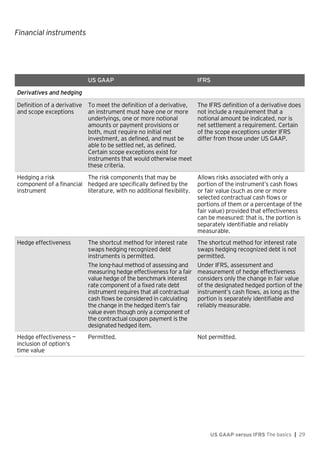
US GAAP IFRS
Derivatives and hedging
Definition of a derivative
and scope exceptions
To meet the definition of a derivative,
an instrument must have one or more
underlyings, one or more notional
amounts or payment provisions or
both, must require no initial net
investment, as defined, and must be
able to be settled net, as defined.
Certain scope exceptions exist for
instruments that would otherwise meet
these criteria.
The IFRS definition of a derivative does
not include a requirement that a
notional amount be indicated, nor is
net settlement a requirement. Certain
of the scope exceptions under IFRS
differ from those under US GAAP.
Hedging a risk
component of a financial
instrument
The risk components that may be
hedged are specifically defined by the
literature, with no additional flexibility.
Allows risks associated with only a
portion of the instrument’s cash flows
or fair value (such as one or more
selected contractual cash flows or
portions of them or a percentage of the
fair value) provided that effectiveness
can be measured: that is, the portion is
separately identifiable and reliably
measurable.
Hedge effectiveness The shortcut method for interest rate
swaps hedging recognized debt
instruments is permitted.
The long-haul method of assessing and
measuring hedge effectiveness for a fair
value hedge of the benchmark interest
rate component of a fixed rate debt
instrument requires that all contractual
cash flows be considered in calculating
the change in the hedged item’s fair
value even though only a component of
the contractual coupon payment is the
designated hedged item.
The shortcut method for interest rate
swaps hedging recognized debt is not
permitted.
Under IFRS, assessment and
measurement of hedge effectiveness
considers only the change in fair value
of the designated hedged portion of the
instrument’s cash flows, as long as the
portion is separately identifiable and
reliably measurable.
Hedge effectiveness —
inclusion of option’s
time value
Permitted. Not permitted.
Financial instruments
US GAAP versus IFRS The basics | 30
US GAAP IFRS
Derecognition
Derecognition of
financial assets
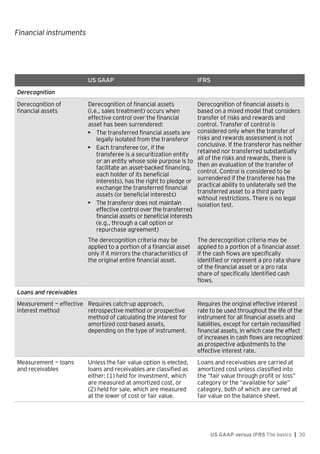
Derecognition of financial assets
(i.e., sales treatment) occurs when
effective control over the financial
asset has been surrendered:
• The transferred financial assets are
legally isolated from the transferor
• Each transferee (or, if the
transferee is a securitization entity
or an entity whose sole purpose is to
facilitate an asset-backed financing,
each holder of its beneficial
interests), has the right to pledge or
exchange the transferred financial
assets (or beneficial interests)
• The transferor does not maintain
effective control over the transferred
financial assets or beneficial interests
(e.g., through a call option or
repurchase agreement)
Derecognition of financial assets is
based on a mixed model that considers
transfer of risks and rewards and
control. Transfer of control is
considered only when the transfer of
risks and rewards assessment is not
conclusive. If the transferor has neither
retained nor transferred substantially
all of the risks and rewards, there is
then an evaluation of the transfer of
control. Control is considered to be
surrendered if the transferee has the
practical ability to unilaterally sell the
transferred asset to a third party
without restrictions. There is no legal
isolation test.
The derecognition criteria may be
applied to a portion of a financial asset
only if it mirrors the characteristics of
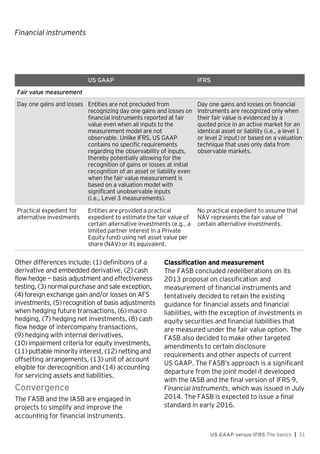
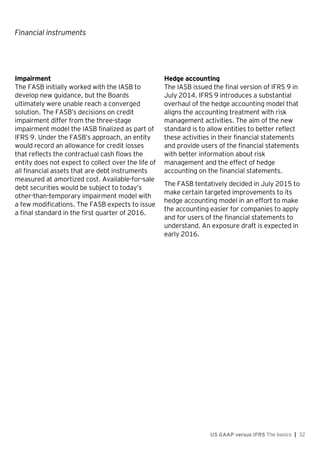
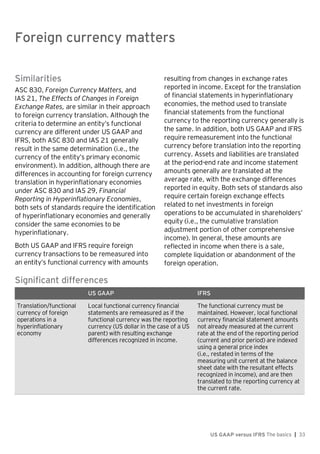
the original entire financial asset.
The derecognition criteria may be
applied to a portion of a financial asset
if the cash flows are specifically
identified or represent a pro rata share
of the financial asset or a pro rata
share of specifically identified cash
flows.
Loans and receivables
Measurement — effective
interest method
Requires catch-up approach,
retrospective method or prospective
method of calculating the interest for
amortized cost-based assets,
depending on the type of instrument.
Requires the original effective interest
rate to be used throughout the life of the
instrument for all financial assets and
liabilities, except for certain reclassified
financial assets, in which case the effect
of increases in cash flows are recognized
as prospective adjustments to the
effective interest rate.
Measurement — loans
and receivables
Unless the fair value option is elected,
loans and receivables are classified as
either: (1) held for investment, which
are measured at amortized cost, or
(2) held for sale, which are measured
at the lower of cost or fair value.
Loans and receivables are carried at
amortized cost unless classified into
the “fair value through profit or loss”
category or the “available for sale”
category, both of which are carried at
fair value on the balance sheet.
Financial instruments
US GAAP versus IFRS The basics | 31
US GAAP IFRS
Fair value measurement
Day one gains and losses Entities are not precluded from
recognizing day one gains and losses on
financial instruments reported at fair
value even when all inputs to the
measurement model are not
observable. Unlike IFRS, US GAAP
contains no specific requirements
regarding the observability of inputs,
thereby potentially allowing for the
recognition of gains or losses at initial
recognition of an asset or liability even
when the fair value measurement is
based on a valuation model with
significant unobservable inputs
(i.e., Level 3 measurements).
Day one gains and losses on financial
instruments are recognized only when
their fair value is evidenced by a
quoted price in an active market for an
identical asset or liability (i.e., a level 1
or level 2 input) or based on a valuation
technique that uses only data from
observable markets.
Practical expedient for
alternative investments
Entities are provided a practical
expedient to estimate the fair value of
certain alternative investments (e.g., a
limited partner interest in a Private
Equity fund) using net asset value per
share (NAV) or its equivalent.
No practical expedient to assume that
NAV represents the fair value of
certain alternative investments.
Other differences include: (1) definitions of a
derivative and embedded derivative, (2) cash
flow hedge — basis adjustment and effectiveness
testing, (3) normal purchase and sale exception,
(4) foreign exchange gain and/or losses on AFS
investments, (5) recognition of basis adjustments
when hedging future transactions, (6) macro
hedging, (7) hedging net investments, (8) cash
flow hedge of intercompany transactions,
(9) hedging with internal derivatives,
(10) impairment criteria for equity investments,
(11) puttable minority interest, (12) netting and
offsetting arrangements, (13) unit of account
eligible for derecognition and (14) accounting
for servicing assets and liabilities.
Convergence
The FASB and the IASB are engaged in
projects to simplify and improve the
accounting for financial instruments.
Classification and measurement
The FASB concluded redeliberations on its
2013 proposal on classification and
measurement of financial instruments and
tentatively decided to retain the existing
guidance for financial assets and financial
liabilities, with the exception of investments in
equity securities and financial liabilities that
are measured under the fair value option. The
FASB also decided to make other targeted
amendments to certain disclosure
requirements and other aspects of current
US GAAP. The FASB’s approach is a significant
departure from the joint model it developed
with the IASB and the final version of IFRS 9,
Financial Instruments, which was issued in July
2014. The FASB is expected to issue a final
standard in early 2016.
Financial instruments
US GAAP versus IFRS The basics | 32
Impairment
The FASB initially worked with the IASB to
develop new guidance, but the Boards
ultimately were unable reach a converged
solution. The FASB’s decisions on credit
impairment differ from the three-stage
impairment model the IASB finalized as part of
IFRS 9. Under the FASB’s approach, an entity
would record an allowance for credit losses
that reflects the contractual cash flows the
entity does not expect to collect over the life of
all financial assets that are debt instruments
measured at amortized cost. Available-for-sale
debt securities would be subject to today’s
other-than-temporary impairment model with
a few modifications. The FASB expects to issue
a final standard in the first quarter of 2016.
Hedge accounting
The IASB issued the final version of IFRS 9 in
July 2014. IFRS 9 introduces a substantial
overhaul of the hedge accounting model that
aligns the accounting treatment with risk
management activities. The aim of the new
standard is to allow entities to better reflect
these activities in their financial statements
and provide users of the financial statements
with better information about risk
management and the effect of hedge
accounting on the financial statements.
The FASB tentatively decided in July 2015 to
make certain targeted improvements to its
hedge accounting model in an effort to make
the accounting easier for companies to apply
and for users of the financial statements to
understand. An exposure draft is expected in
early 2016.
Foreign currency matters
US GAAP versus IFRS The basics | 33
Similarities
ASC 830, Foreign Currency Matters, and
IAS 21, The Effects of Changes in Foreign
Exchange Rates, are similar in their approach
to foreign currency translation. Although the
criteria to determine an entity’s functional
currency are different under US GAAP and
IFRS, both ASC 830 and IAS 21 generally
result in the same determination (i.e., the
currency of the entity’s primary economic
environment). In addition, although there are
differences in accounting for foreign currency
translation in hyperinflationary economies
under ASC 830 and IAS 29, Financial
Reporting in Hyperinflationary Economies,
both sets of standards require the identification
of hyperinflationary economies and generally
consider the same economies to be
hyperinflationary.
Both US GAAP and IFRS require foreign
currency transactions to be remeasured into
an entity’s functional currency with amounts
resulting from changes in exchange rates
reported in income. Except for the translation
of financial statements in hyperinflationary
economies, the method used to translate
financial statements from the functional
currency to the reporting currency generally is
the same. In addition, both US GAAP and IFRS
require remeasurement into the functional
currency before translation into the reporting
currency. Assets and liabilities are translated
at the period-end rate and income statement
amounts generally are translated at the
average rate, with the exchange differences
reported in equity. Both sets of standards also
require certain foreign exchange effects
related to net investments in foreign
operations to be accumulated in shareholders’
equity (i.e., the cumulative translation
adjustment portion of other comprehensive
income). In general, these amounts are
reflected in income when there is a sale,
complete liquidation or abandonment of the
foreign operation.
Significant differences
US GAAP IFRS
Translation/functional
currency of foreign
operations in a
hyperinflationary
economy
Local functional currency financial
statements are remeasured as if the
functional currency was the reporting
currency (US dollar in the case of a US
parent) with resulting exchange
differences recognized in income.
The functional currency must be
maintained. However, local functional
currency financial statement amounts
not already measured at the current
rate at the end of the reporting period
(current and prior period) are indexed
using a general price index
(i.e., restated in terms of the
measuring unit current at the balance
sheet date with the resultant effects
recognized in income), and are then
translated to the reporting currency at
the current rate.
Foreign currency matters
US GAAP versus IFRS The basics | 34
US GAAP IFRS
Consolidation of foreign
operations
A “bottom-up” approach is required in
order to reflect the appropriate foreign
currency effects and hedges in place.
As such, an entity should be
consolidated by the enterprise that
controls the entity. Therefore, the
“step-by-step” method of consolidation
is used, whereby each entity is
consolidated into its immediate parent
until the ultimate parent has
consolidated the financial statements
of all the entities below it.
The method of consolidation is not
specified and, as a result, either the
“direct” or the “step-by-step” method
of consolidation is used. Under the
“direct” method, each entity within
the consolidated group is directly
translated into the functional currency
of the ultimate parent and then
consolidated into the ultimate parent
(i.e., the reporting entity) without regard
to any intermediate parent. The choice
of consolidation method used could
affect the cumulative translation
adjustments deferred within equity at
intermediate levels, and therefore the
recycling of such exchange rate
differences upon disposal of an
intermediate foreign operation.
Convergence
No further convergence is planned at this time.
Leases
US GAAP versus IFRS The basics | 35
Similarities
The overall accounting for leases under
US GAAP and IFRS (ASC 840, Leases and
IAS 17, Leases, respectively) is similar,
although US GAAP has more specific application
guidance than IFRS. Both focus on classifying
leases as either capital (IAS 17 uses the term
“finance”) or operating, and both separately
discuss lessee and lessor accounting.
Lessee accounting (excluding real estate)
Both US GAAP and IFRS require the party that
bears substantially all the risks and rewards of
ownership of the leased property to recognize
a lease asset and corresponding obligation,
and provide criteria (ASC 840) or indicators
(IAS 17) to determine whether a lease is
capital or operating. The criteria or indicators
of a capital lease are similar in that both
standards include the transfer of ownership to
the lessee at the end of the lease term and a
purchase option that, at inception, is
reasonably expected to be exercised. ASC 840
requires capital lease treatment if the lease
term is equal to or greater than 75% of the
asset’s economic life, while IAS 17 requires
such treatment when the lease term is a
“major part” of the asset’s economic life.
ASC 840 specifies capital lease treatment if
the present value of the minimum lease
payments exceeds 90% of the asset’s fair
value, while IAS 17 uses the term
“substantially all” of the fair value. In practice,
while ASC 840 specifies bright lines in certain
instances, IAS 17’s general principles are
interpreted similarly to the bright-line tests.
As a result, lease classification is often the
same under ASC 840 and IAS 17.
Under both US GAAP and IFRS, a lessee would
record a capital (finance) lease by recognizing
an asset and a liability, measured at the lower
of the present value of the minimum lease
payments or fair value of the asset. A lessee
would record an operating lease by
recognizing expense on a straight-line basis
over the lease term. Any incentives under an
operating lease are amortized on a
straight-line basis over the term of the lease.
Lessor accounting (excluding real estate)
Lessor accounting under ASC 840 and IAS 17
is similar and uses the above tests to determine
whether a lease is a sales-type/direct financing
lease (referred to as a finance lease under
IAS 17) or an operating lease. ASC 840
specifies two additional criteria (i.e., collection
of lease payments is reasonably predictable
and no important uncertainties surround the
amount of unreimbursable costs to be incurred
by the lessor) for a lessor to qualify for
sales-type/direct financing lease accounting
that IAS 17 does not. Although not specified in
IAS 17, it is reasonable to expect that if these
conditions exist, the same conclusion may be
reached under both standards. If a lease is a
sales-type/direct financing (finance) lease,
the leased asset is replaced with a lease
receivable. If a lease is classified as operating,
rental income is recognized on a straight-line
basis over the lease term, and the leased asset
is depreciated by the lessor over its useful life.
Leases
Leases
US GAAP versus IFRS The basics | 36
Significant differences
US GAAP IFRS
Lease of real estate A lease of land and buildings that
transfers ownership to the lessee or
contains a bargain purchase option
would be classified as a capital lease by
the lessee, regardless of the relative
value of the land.
The land and building elements of the
lease are considered separately when
evaluating all indicators unless the
amount that would initially be
recognized for the land element is
immaterial, in which case they would
be treated as a single unit for purposes
of lease classification.
If the fair value of the land at inception
represents less than 25% of the total
fair value of the lease, the lessee
accounts for the land and building
components as a single unit for
purposes of evaluating the 75% and
90% tests noted above.
Otherwise, the lessee must consider
the land and building components
separately for purposes of evaluating
other lease classification criteria.
(Note: Only the building is subject to
the 75% and 90% tests in this case).
There is no 25% test to determine
whether to consider the land and
building separately when evaluating
certain indicators.
Recognition of a gain or
loss on a sale and
leaseback when the
leaseback is an
operating leaseback
(non-real estate)
If the seller-lessee retains only a minor
use of the leased asset through the
sale-leaseback, the sale and leaseback
are accounted for as separate
transactions based on their respective
terms (unless rentals are unreasonable
in relation to market conditions).
If a seller-lessee retains more than a
minor use of the leased asset but less
than substantially all of it, and the
profit on the sale exceeds the present
value of the minimum lease payments
due under the operating leaseback,
that excess is recognized as profit at
the date of sale. All other profit is
deferred and generally amortized over
the lease term.
(Note: If real estate is involved, the
specialized rules are very restrictive
with respect to the seller’s continuing
involvement, and they may not allow
for recognition of the sale).
Gain or loss is recognized immediately,
subject to adjustment if the sales price
differs from fair value.
Leases
US GAAP versus IFRS The basics | 37
US GAAP IFRS
Recognition of gain or
loss on a sale-leaseback
when the leaseback is a
capital leaseback
The seller-lessee is presumed to have
retained substantially all of the
remaining use of the leased asset when
the leaseback is classified as a capital
lease. In such cases, the profit on sale
is deferred.
Gain or loss deferred and amortized
over the lease term.
Sale and leaseback of
real estate
If real estate is involved, while the
above model generally applies, the
specialized rules also must be applied.
Those rules are very restrictive with
respect to the seller’s continuing
involvement, and they may not allow
for recognition of the sale.
There is no real estate specific
guidance for sale and leaseback
transactions under IFRS.
Other differences include: (1) the treatment of
a leveraged lease by a lessor under ASC 840
(IAS 17 does not have such classification),
(2) real estate sale-leasebacks, (3) real estate
sales-type leases, (4) leases of land and (5) the
rate used to discount minimum lease payments
to the present value for purposes of determining
lease classification and subsequent recognition
of a capital lease, including in the event of
a renewal.
Convergence
As part of their convergence efforts, the
Boards anticipate issuing new standards in
early 2016. The final standards are expected
to have differences however under both the
FASB’s and IASB’s new standard, lessees
would recognize the assets and liabilities
arising under many lease contracts on their
balance sheets.
Income taxes
US GAAP versus IFRS The basics | 38
Similarities
ASC 740, Income Taxes, and IAS 12, Income
Taxes, require entities to account for both
current tax effects and expected future tax
consequences of events that have been
recognized (i.e., deferred taxes) using an asset
and liability approach. Deferred taxes for
temporary differences arising from
non-deductible goodwill are not recorded under
both US GAAP and IFRS, and tax effects of
items accounted for directly in equity during the
current year are allocated directly to equity.
Neither US GAAP nor IFRS permits the
discounting of deferred taxes.
Significant differences
US GAAP IFRS
Tax basis Tax basis is a question of fact under the
tax law. For most assets and liabilities,
there is no dispute on this amount;
however, when uncertainty exists, it is
determined in accordance with
ASC 740-10-25.
Tax basis is generally the amount
deductible or taxable for tax purposes.
The manner in which management
intends to settle or recover the
carrying amount affects the
determination of tax basis.
Taxes on intercompany
transfers of assets that
remain within a
consolidated group
Requires taxes paid on intercompany
profits to be deferred and prohibits the
recognition of deferred taxes on
temporary differences between the tax
bases of assets transferred between
entities/tax jurisdictions that remain
within the consolidated group.
Requires taxes paid on intercompany
profits to be recognized as incurred
and requires the recognition of
deferred taxes on temporary
differences between the tax bases of
assets transferred between entities/tax
jurisdictions that remain within the
consolidated group.
Uncertain tax positions ASC 740-10-25 requires a two-step
process, separating recognition from
measurement. A benefit is recognized
when it is “more likely than not” to be
sustained based on the technical merits
of the position. Detection risk is
precluded from being considered in
the analysis. The amount of benefit to
be recognized is based on the largest
amount of tax benefit that is greater
than 50% likely of being realized upon
ultimate settlement.
IFRS does not include specific guidance.
IAS 12, Income Taxes indicates that tax
assets and liabilities should be
measured at the amount expected to be
paid based on enacted or substantively
enacted tax legislation. Some adopt a
“one-step” approach that recognizes all
uncertain tax positions at an expected
value. Others adopt a “two-step”
approach that recognizes only those
uncertain tax positions that are
considered more likely than not to
result in a cash outflow. Practice varies
regarding the consideration of
detection risk in the analysis.
Income taxes
Income taxes
US GAAP versus IFRS The basics | 39
US GAAP IFRS
Initial recognition
exemption
Does not include an exemption like that
under IFRS for non-recognition of
deferred tax effects for certain assets
or liabilities.
Deferred tax effects arising from the
initial recognition of an asset or liability
are not recognized when: (1) the
amounts did not arise from a business
combination, and (2) upon occurrence,
the transaction affects neither accounting
nor taxable profit (e.g., acquisition of
non-deductible assets).
Recognition of deferred
tax assets
Recognized in full (except for certain
outside basis differences), but
valuation allowance reduces asset to
the amount that is more likely than not
to be realized.
Amounts are recognized only to the
extent it is probable (similar to “more
likely than not” under US GAAP) that
they will be realized.
Calculation of deferred
tax asset or liability
Enacted tax rates must be used. Enacted or “substantively enacted” tax
rates as of the balance sheet date must
be used.
Classification of deferred
tax assets and liabilities
in balance sheet
Current or non-current classification,
based on the nature of the related
asset or liability, is required.
All amounts classified as non-current in
the balance sheet.
Recognition of deferred
tax liabilities from
investments in
subsidiaries or joint
ventures (JVs) (often
referred to as outside
basis differences)
Recognition not required for
investment in a foreign subsidiary or
foreign corporate JV that is essentially
permanent in duration, unless it
becomes apparent that the difference
will reverse in the foreseeable future.
Recognition required unless the
reporting entity has control over the
timing of the reversal of the temporary
difference and it is probable (“more
likely than not”) that the difference will
not reverse in the foreseeable future.
Other differences include: (1) the allocation of
subsequent changes to deferred taxes to
components of income or equity, (2) the
calculation of deferred taxes on foreign
nonmonetary assets and liabilities when the
local currency of an entity is different than its
functional currency, (3) the measurement of
deferred taxes when different tax rates apply
to distributed or undistributed profits and
(4) the recognition of deferred tax assets on
basis differences in domestic subsidiaries and
domestic joint ventures that are permanent
in duration.
Convergence
The Boards have abandoned plans for a joint
convergence project. However, the IASB and
FASB have separately agreed to consider as
a potential longer term project undertaking
a fundamental review of accounting for
income taxes.
In October 2015, the IFRS Interpretations
Committee issued a proposed interpretation
that would provide guidance on accounting for
current and deferred tax liabilities and assets
in circumstances in which there is uncertainty
over income tax treatments. Developments on
this proposal should be monitored.
Income taxes
US GAAP versus IFRS The basics | 40
In November 2015, the FASB issued
ASU 2015-17, Balance Sheet Classification of
Deferred Taxes. ASU 2015-17 requires entities
to classify all deferred tax assets and liabilities
as noncurrent on the balance sheet instead of
separating deferred taxes into current and
noncurrent amounts. For PBEs, ASU 2015-17
is effective for annual periods beginning after
15 December 2016, and interim periods within
those annual periods. For non-PBEs, it is
effective for annual periods beginning after 15
December 2017, and interim periods within
annual periods beginning after 15 December
2018. Early adoption is permitted.
In an exposure draft released in January 2015,
the FASB proposed requiring companies to
immediately recognize income tax effects on
intercompany transaction in their income
statements, eliminating the current exception
that requires companies to defer the income tax
effects of certain intercompany transactions.
Developments on this proposal should be
monitored.
Provisions and contingencies
US GAAP versus IFRS The basics | 41
Similarities
While the sources of guidance under US GAAP
and IFRS differ significantly, the general
recognition criteria for provisions are similar.
IAS 37, Provisions, Contingent Liabilities and
Contingent Assets, provides the overall
guidance for recognition and measurement
criteria of provisions and contingencies. While
there is no equivalent single standard under
US GAAP, ASC 450, Contingencies, and a
number of other standards deal with specific
types of provisions and contingencies
(e.g., ASC 410, Asset Retirement and
Environmental Obligations; ASC 420, Exit or
Disposal Cost Obligations). In addition, although
nonauthoritative, the guidance in two Concept
Statements in US GAAP (CON 5, Recognition
and Measurement in Financial Statements of
Business Enterprises, and CON 6, Elements of
Financial Statements) is similar to the specific
recognition criteria provided in IAS 37. Both
US GAAP and IFRS require recognition of a loss
based on the probability of occurrence,
although the definition of probability is
different under US GAAP and IFRS. Both
US GAAP and IFRS prohibit the recognition of
provisions for costs associated with future
operating activities. Further, both US GAAP and
IFRS require disclosures about a contingent
liability whose occurrence is more than remote
but does not meet the recognition criteria.
Significant differences
US GAAP IFRS
Recognition threshold A loss must be “probable” (in which
probable is interpreted as likely) to be
recognized. While ASC 450 does not
ascribe a percentage to probable, it is
intended to denote a high likelihood
(e.g., 70% or more).
A loss must be “probable” (in which
probable is interpreted as “more likely
than not”) to be recognized. More likely
than not refers to a probability of
greater than 50%.
Discounting provisions Provisions may be discounted only
when the amount of the liability and
the timing of the payments are fixed
or reliably determinable, or when the
obligation is a fair value obligation
(e.g., an asset retirement obligation
under ASC 410-20). The discount rate
to be used is dependent upon the nature
of the provision, and may vary from
that used under IFRS. However, when
a provision is measured at fair value,
the time value of money and the risks
specific to the liability should be
considered.
Provisions should be recorded at the
estimated amount to settle or transfer
the obligation taking into consideration
the time value of money. The discount
rate to be used should be “a pre-tax
rate (or rates) that reflect(s) current
market assessments of the time value
of money and the risks specific to
the liability.”
Provisions and contingencies
US GAAP versus IFRS The basics | 42
US GAAP IFRS
Measurement of
provisions — range of
possible outcomes
Most likely outcome within range
should be accrued. When no one
outcome is more likely than the others,
the minimum amount in the range of
outcomes should be accrued.
Best estimate of obligation should be
accrued. For a large population of
items being measured, such as
warranty costs, best estimate is
typically expected value, although
midpoint in the range may also be used
when any point in a continuous range is
as likely as another. Best estimate for a
single obligation may be the most likely
outcome, although other possible
outcomes should still be considered.
Restructuring costs Under ASC 420, Exit or Disposal Cost
Obligations once management has
committed to a detailed exit plan, each
type of cost is examined to determine
when recognized. Involuntary employee
termination costs under a one-time
benefit arrangement are recognized
over future service period, or
immediately if there is no future service
required. Other exit costs are expensed
when incurred.
Once management has “demonstrably
committed” (i.e., a legal or constructive
obligation has been incurred) to a
detailed exit plan, the general
provisions of IAS 37, Provisions,
Contingent Liabilities and Contingent
Assets apply. Costs typically are
recognized earlier than under US GAAP
because IAS 37 focuses on the exit
plan as a whole, rather than individual
cost components of the plan.
Convergence
No further convergence is planned at this time.
Revenue recognition
US GAAP versus IFRS The basics | 43
Similarities
Revenue recognition under both US GAAP and
IFRS is tied to the completion of the earnings
process and the realization of assets from such
completion. Under IAS 18, Revenue, revenue
is defined as “the gross inflow of economic
benefits during the period arising in the course
of the ordinary activities of an entity when
those inflows result in increases in equity,
other than increases relating to contributions
from equity participants.” Under US GAAP
(which is primarily included in ASC 605,
Revenue Recognition), revenues represent
actual or expected cash inflows that have
occurred or will result from the entity’s ongoing
major operations. Under both US GAAP and
IFRS, revenue is not recognized until it is both
realized (or realizable) and earned. Ultimately,
both US GAAP and IFRS base revenue
recognition on the transfer of risks and rewards,
and both attempt to determine when the
earnings process is complete. Both sets of
standards contain revenue recognition criteria
that, while not identical, are conceptually similar.
For example, under IFRS, one recognition
criterion is that the amount of revenue can be
measured reliably, while US GAAP requires
that the consideration to be received from the
buyer be fixed or determinable.
Significant differences
Despite the similarities, differences in revenue
recognition may exist, in part, as a result of
differing levels of specificity between the two
GAAPs. There is extensive guidance under
US GAAP, which can be very prescriptive and
often applies only to specific industries. For
example, under US GAAP there are specific
rules for the recognition of software revenue
and sales of real estate, while comparable
guidance does not exist under IFRS. In
addition, the detailed US rules often contain
exceptions for particular types of transactions.
Further, public companies in the US must follow
additional guidance provided by the SEC staff.
Conversely, two primary standards (IAS 18
and IAS 11 Construction Contracts) exist under
IFRS, which contains general principles and
illustrative examples of specific transactions.
Exclusive of the industry-specific differences
between the two GAAPs, following are the
major differences in revenue recognition.
Revenue recognition
Revenue recognition
US GAAP versus IFRS The basics | 44
US GAAP IFRS
Sale of goods Public companies must follow SAB
Topic 13, Revenue Recognition, which
requires that delivery has occurred (the
risks and rewards of ownership have
been transferred), there is persuasive
evidence of an arrangement, the fee is
fixed or determinable and collectibility
is reasonably assured.
Revenue is recognized only when risks
and rewards of ownership have been
transferred, the seller retains neither
continuing managerial involvement to
the degree usually associated with
ownership nor effective control over
the goods sold, revenues can be
measured reliably, it is probable that
the economic benefits will flow to the
company and the costs incurred or to
be incurred in respect of the
transaction can be measured reliably.
Rendering of services Certain types of service revenue,
primarily relating to services sold
with software, have been addressed
separately in US GAAP literature.
All other service revenue should
follow SAB Topic 13. Application of
long-term contract accounting
(ASC 605-35, Revenue Recognition —
Construction-Type and Production-Type
Contracts) generally is not permitted for
non-construction services.
Revenue may be recognized in
accordance with long-term contract
accounting whenever revenues, costs
and the stage of completion can be
measured reliably and it is probable
that economic benefits will flow to
the company.
Multiple elements Specific criteria are required in order
for each element to be a separate unit
of accounting, including delivered
elements must have standalone value.
If those criteria are met, revenue for
each element of the transaction may be
recognizedwhenthe element is delivered.
IAS 18 requires recognition of revenue
for each separately identifiable
component of a single transaction if
separation reflects the substance of the
transaction; conversely, two or more
transactions may be grouped together
when their commercial effects are
linked. IAS 18 does not provide specific
criteria for making the determination on
how to identify separate components in
a single transaction.
Deferred receipt of
receivables
Discounting to present value is
required only in limited situations.
Considered to be a financing
agreement. The value of revenue to be
recognized is determined by
discounting all future receipts using an
imputed rate of interest.
Revenue recognition
US GAAP versus IFRS The basics | 45
US GAAP IFRS
Construction contracts Construction contracts are accounted
for using the percentage-of-completion
method if certain criteria are met.
Otherwise, the completed contract
method must be used.
Construction contracts may be, but
are not required to be, combined or
segmented if certain criteria are met.
Under IAS 11, construction contracts
are accounted for using the
percentage-of-completion method if
certain criteria are met. Otherwise,
revenue recognition is limited to
recoverable costs incurred. The
completed contract method is
not permitted.
Construction contracts are combined
or segmented if certain criteria are
met. Criteria under IFRS differ from
those in US GAAP.
Convergence
The FASB and the IASB issued substantially
converged standards in May 2014 that will
supersede virtually all existing revenue
guidance under US GAAP and IFRS, which is
described above. The core principle is that an
entity would recognize revenue to depict the
transfer of goods or services to customers at
an amount that reflects the consideration the
entity expects to receive in exchange for those
goods or services. As part of implementation,
the Boards are making certain amendments to
these standards, not all of which are the same.
Share-based payments
US GAAP versus IFRS The basics | 46
Similarities
The US GAAP guidance for share-based
payments, ASC 718, Compensation — Stock
Compensation, and ASC 505-50, Equity —
Equity-based Payments to Non-Employees, is
largely converged with the guidance in IFRS 2,
Share-Based Payment. Both require a fair
value-based approach for measuring and
accounting for share-based payment
arrangements whereby an entity (1) acquires
goods or services in exchange for issuing share
options or other equity instruments
(collectively referred to as “shares” in this
guide), or (2) incurs liabilities that are based,
at least in part, on the price of its shares or
that may require settlement in its shares.
Under both US GAAP and IFRS, this guidance
applies to transactions with both employees
and non-employees and is applicable to all
companies. Both ASC 718 and IFRS 2 define
the fair value of the transaction as the amount
at which the asset or liability could be bought or
sold in a current transaction between willing
parties. Further, they require the fair value of
the shares to be measured based on a market
price (if available) or estimated using an
option-pricing model. In the rare cases in which
fair value cannot be determined, both sets of
standards allow the use of intrinsic value, which
is remeasured until settlement of the shares. In
addition, the treatment of modifications and
settlements of share-based payments is similar
in many respects. Finally, both standards
require similar disclosures in the financial
statements to provide investors with sufficient
information to understand the types and extent
to which the entity is entering into share-based
payment transactions.
Significant differences
US GAAP IFRS
Performance period
different from service
period
A performance condition where the
performance target affects vesting can
be achieved after the employee’s
requisite service period. Therefore, the
period of time to achieve a
performance target can extend beyond
the end of the service period.
A performance condition is a vesting
condition that must be met while the
counterparty is rendering service. The
period of time to achieve a
performance condition must not extend
beyond the end of the service period. If
a performance target can be achieved
after the employee’s requisite service
period, it would be accounted for as a
non-vesting condition that affects the
grant date fair value of the award.
Transactions with
non-employees
The US GAAP definition of an employee
focuses primarily on the common law
definition of an employee.
IFRS has a more general definition of
an employee that includes individuals
who provide services similar to those
rendered by employees.
Share-based payments
US GAAP versus IFRS The basics | 47
US GAAP IFRS
The fair value of: (1) the goods or
services received, or (2) the equity
instruments granted, whichever is
more reliably measurable, is used to
value the transaction.
Fair value of the transaction should be
based on the fair value of the goods or
services received, and only on the fair
value of the equity instruments granted
in the rare circumstance that the fair
value of the goods and services cannot
be reliably estimated.
Measurement date is the earlier of:
(1) the date at which a “commitment
for performance” by the counterparty
is reached, or (2) the date at which the
counterparty’s performance is complete.
Measurement date is the date the
entity obtains the goods or the
counterparty renders the services.
No performance commitment
concept exists.
Measurement and
recognition of expense —
awards with graded
vesting features
Entities make an accounting policy
election to recognize compensation cost
for awards containing only service
conditions either on a straight-line basis
or on an accelerated basis, regardless of
whether the fair value of the award is
measured based on the award as a
whole or for each individual tranche.
Entities must recognize compensation
cost on an accelerated basis and each
individual tranche must be separately
measured.
Equity repurchase
features at employee’s
election
Liability classification is not required if
employee bears risks and rewards of
equity ownership for at least six
months from the date the shares are
issued or vest.
Liability classification is required (no
six-month consideration exists).
Deferred taxes Calculated based on the cumulative GAAP
expense recognized and trued up or
down upon realization of the tax benefit.
Calculated based on the estimated tax
deduction determined at each
reporting date (e.g., intrinsic value).
If the tax benefit exceeds the deferred
tax asset, the excess (“windfall benefit”)
is credited directly to shareholders
equity. Any shortfall of the tax benefit
below the deferred tax asset is charged
to shareholders equity to the extent of
prior windfall benefits, and to tax
expense thereafter.
If the tax deduction exceeds cumulative
compensation cost, deferred tax based
on the excess is credited to
shareholders’ equity. If the tax
deduction is less than or equal to
cumulative compensation cost, deferred
taxes are recorded in income.
Share-based payments
US GAAP versus IFRS The basics | 48
US GAAP IFRS
Modification of vesting
terms that are
improbable of
achievement
If an award is modified such that the
service or performance condition,
which was previously improbable of
achievement, is probable of achievement
as a result of the modification, the
compensation cost is based on the fair
value of the modified award at the
modification date. Grant date fair value
of the original award is not recognized.
Compensation cost is the grant date
fair value of the award, together with
any incremental fair value at the
modification date. The determination
of whether the original grant date fair
value affects the accounting is based
on the ultimate outcome (i.e., whether
the original or modified conditions are
met) rather than the probability of
vesting as of the modification date.
Convergence
No further convergence is planned at this time.
However, there are certain items on the
agenda of the IASB and the FASB that could
change IFRS 2 and ASC 718. The IASB has
proposed amendments to IFRS 2 on the effects
of vesting conditions on the measurement of a
cash-settled share-based payment,
classification of a share-based payment settled
net of tax withholdings, and accounting for a
modification to a share-based payment that
changes the classification from cash-settled to
equity-settled. In its simplification project, the
FASB has proposed changes to the accounting
for share-based payments settled net of tax
withholdings, forfeitures, income tax effects
when awards vest or are settled, and contingent
repurchase features. The FASB also has
proposed providing practical expedients for
nonpublic entities to estimate the expected
term of certain awards and to measure
liability-classified awards at intrinsic value.
Employee benefits other than share-based payments
US GAAP versus IFRS The basics | 49
Similarities
ASC 715, Compensation — Retirement Benefits,
ASC 710, Compensation – General, ASC 712,
Compensation — Nonretirement Post-Employment
Benefits, and IAS 19, Employee Benefits, as
amended, are the principal sources of
guidance for employee benefits other than
share-based payments under US GAAP and
IFRS, respectively. Under both US GAAP and
IFRS, the net periodic benefit cost recognized
for defined contribution plans is based on the
contribution due from the employer in each
period. The accounting for defined benefit
plans has many similarities as well, most
notably that the defined benefit obligation is
the present value of benefits that have
accrued to employees for services rendered
through that date, based on actuarial methods
of calculation. Both US GAAP and IFRS require
the funded status of the defined benefit plan to
be recognized on the balance sheet as the
difference between the present value of the
benefit obligation and the fair value of plan
assets, although IAS 19 limits the net plan
asset recognized for overfunded plans.
Significant differences
US GAAP IFRS
Actuarial method used
for defined benefit plans
Different methods are required
depending on the characteristics of the
plan’s benefit formula.
Projected unit credit method is
required in all cases.
Calculation of the
expected return on plan
assets
Calculated using the expected
long-term rate of return on invested
assets and the market related value of
the assets (based on either the fair
value of plan assets at the
measurement date or a “calculated
value” that smoothees changes in fair
value over a period not to exceed five
years, at the employer’s election).
A concept of an expected return on
plan assets does not exist in IFRS. A
“net interest” expense (income) on the
net defined benefit liability (asset) is
recognized as a component of defined
benefit cost, based on the discount rate
used to determine the obligation.
Treatment of actuarial
gains and losses
May be recognized in net income as
they occur or deferred in other
comprehensive income and
subsequently amortized to net income
through a corridor approach.
Must be recognized immediately in
other comprehensive income. Gains
and losses are not subsequently
recognized in net income.
Recognition of prior
service costs or credits
from plan amendments
Initially deferred in other
comprehensive income and
subsequently recognized in net income
over the average remaining service
period of active employees or, when all
or almost all participants are inactive,
over the average remaining life
expectancy of those participants.
Immediate recognition in net income.
Employee benefits other than
share-based payments
Employee benefits other than share-based payments
US GAAP versus IFRS The basics | 50
US GAAP IFRS
Settlements and
curtailments
Settlement gain or loss is recognized in
net income when the obligation is
settled. Curtailment loss is recognized
in net income when the curtailment is
probable of occurring and the loss is
estimable, while curtailment gain is
recognized in net income when the
curtailment occurs.
Settlement gain or loss is recognized in
net income when it occurs. Change in
the defined benefit obligation from a
curtailment is recognized in net income
at the earlier of when it occurs or when
related restructuring costs or
termination benefits are recognized.
Multi-employer
post-retirement plans
Accounted for similar to a defined
contribution plan.
Accounted for as either a defined
contribution or defined benefit plan
based on the terms (contractual and
constructive) of the plan. If a defined
benefit plan, must account for the
proportionate share of the plan similar
to any other defined benefit plan unless
sufficient information is not available.
Convergence
No further convergence is planned at this time.
Earnings per share
US GAAP versus IFRS The basics | 51
Similarities
Entities whose common shares are publicly
traded, or that are in the process of issuing
such shares in the public markets, must
disclose substantially the same earnings per
share (EPS) information under ASC 260 and
IAS 33 (both titled Earnings Per Share). Both
standards require the presentation of basic
and diluted EPS on the face of the income
statement, both use the treasury stock method
for determining the effects of stock options
and warrants in the diluted EPS calculation,
and both use the if-converted method for
determining the effects of convertible debt on
the diluted EPS calculation. Although both
US GAAP and IFRS use similar methods of
calculating EPS, there are a few detailed
application differences.
Significant differences
US GAAP IFRS
Contracts that may be
settled in shares or cash
at the issuer’s option
Such contracts are presumed to be
settled in shares unless evidence is
provided to the contrary (i.e., the
issuer’s past practice or stated policy
is to settle in cash).
Such contracts are always assumed to
be settled in shares.
Computation of
year-to-date and annual
diluted EPS for options
and warrants (using the
treasury stock method)
and for contingently
issuable shares
For year-to-date and annual
computations when each period is
profitable, the number of incremental
shares added to the denominator is the
weighted average of the incremental
shares that were added to the
denominator in each of the quarterly
computations.
Regardless of whether the period is
profitable, the number of incremental
shares is computed as if the entire
year-to-date period were “the period”
(that is, do not average the current
quarter with each of the prior quarters).
Treasury stock method Under the treasury stock method,
assumed proceeds include the income
tax effects, if any, on additional paid-in
capital at exercise.
For options, warrants and their
equivalents, IAS 33 currently does not
explicitly require assumed proceeds to
include the income tax effects on
additional paid-in capital.
Treatment of contingently
convertible debt
Potentially issuable shares are included
in diluted EPS using the “if-converted”
method if one or more contingencies
relate to a market price trigger
(e.g., the entity’s share price), even if
the market price trigger is not satisfied
at the end of the reporting period.
Potentially issuable shares are
considered “contingently issuable” and
are included in diluted EPS using the
if-converted method only if the
contingencies are satisfied at the end
of the reporting period.
Earnings per share
Earnings per share
US GAAP versus IFRS The basics | 52
Convergence
In June 2015, the FASB issued an exposure
draft to make improvements to employee
share-based payment accounting. The
proposal would change how the treasury stock
method is applied. Under the treasury stock
method, assumed proceeds include the income
tax effects, if any, on additional paid in capital
at exercise. The proposal would eliminate
consideration of income tax effects in the
calculation of assumed proceeds under the
treasury stock method. IAS 33 currently does
not explicitly require the income tax effects of
such awards in the calculation of the treasury
stock method.
Segment reporting
US GAAP versus IFRS The basics | 53
Similarities
The requirements for segment reporting under
both ASC 280, Segment Reporting, and
IFRS 8, Operating Segments, apply to entities
with public reporting requirements and are
based on a “management approach” in
identifying the reportable segments. The two
standards are largely converged, and only
limited differences exist.
Significant differences
US GAAP IFRS
Determination of
segments
Entities with a “matrix” form of
organization (i.e., in some public
entities, the chief operating decision
maker (CODM) is responsible for
different product and service lines
worldwide, while other CODMs are
responsible for specific geographic
areas) must determine segments based
on products and services.
All entities determine segments based
on the management approach,
regardless of form of organization.
Disclosure of segment
liabilities
Entities are not required to disclose
segment liabilities even if reported to
the CODM.
If regularly reported to the CODM,
segment liabilities are a required
disclosure.
Disclosure of long-lived
assets
For the purposes of entity-wide
geographic area disclosures, the
definition of long-lived assets implies
hard assets that cannot be readily
removed, which would exclude
intangible assets.
If a balance sheet is classified
according to liquidity, non-current
assets are assets that include amounts
expected to be recovered more than
12 months after the balance sheet
date.These non-current assets often
includes intangible assets.
Disclosure of
aggregation
Entities must disclose whether
operating segments have been
aggregated.
Entities must disclose whether
operating segments have been
aggregated and the judgments made in
applying the aggregation criteria,
including a brief description of the
operating segments that have been
aggregated and the economic
indicators that have been assessed in
determining economic similarity.
Convergence
No further convergence is planned at this time.
Segment reporting
Subsequent events
US GAAP versus IFRS The basics | 54
Similarities
Despite differences in terminology, the
accounting for subsequent events under
ASC 855, Subsequent Events, and IAS 10,
Events after the Reporting Period, is largely
similar. An event that occurs during the
subsequent events period that provides
additional evidence about conditions existing
at the balance sheet date usually results in an
adjustment to the financial statements. If the
event occurring after the balance sheet date
but before the financial statements are issued
relates to conditions that arose after the
balance sheet date, the financial statements
are not adjusted, but disclosure may be
necessary to keep the financial statements
from being misleading.
Significant differences
US GAAP IFRS
Date through which
subsequent events must
be evaluated
Subsequent events are evaluated
through the date the financial
statements are issued (SEC registrants
and conduit bond obligors) or available to
be issued (all entities other than SEC
registrants and conduit bond obligors).
Financial statements are considered
issued when they are widely distributed
to shareholders or other users in a form
that complies with US GAAP. Financial
statements are considered available to
be issued when they are in a form that
complies with US GAAP and all necessary
approvals have been obtained.
Subsequent events are evaluated
through the date that the financial
statements are “authorized for issue.”
Depending on an entity’s corporate
governance structure and statutory
requirements, authorization may come
from management or a board of
directors.
Reissuance of financial
statements
If the financial statements are reissued,
events or transactions may have
occurred that require disclosure in the
reissued financial statements to keep
them from being misleading. However,
an entity should not recognize events
occurring between the time the financial
statements were issued or available to
be issued and the time the financial
statements were reissued unless the
adjustment is required by US GAAP or
regulatory requirements (e.g., stock
splits, discontinued operations, or the
effect of adopting a new accounting
standard retrospectively would give rise
to an adjustment).
IAS 10, Events after the Reporting
Period does not specifically address the
reissuance of financial statements and
recognizes only one date through
which subsequent events are evaluated,
that is, the date that the financial
statements are authorized for issuance,
even if they are being reissued. As a
result, only one date will be disclosed
with respect to the evaluation of
subsequent events, and an entity could
have adjusting subsequent events in
reissued financial statements.
Subsequent events
Subsequent events
US GAAP versus IFRS The basics | 55
US GAAP IFRS
Entities must disclose both the date
that the financial statements were
originally issued and the date that they
were reissued if the financial
statements were revised due to an
error correction, a Type I subsequent
event or retrospective application of
US GAAP.
If financial statements are reissued as a
result of adjusting subsequent events
or an error correction, the date the
reissued statements are authorized for
reissuance is disclosed.
IAS 10 does not address the
presentation of re-issued financial
statements in an offering document
when the originally issued financial
statements have not been withdrawn,
but the re-issued financial statements
are provided either as supplementary
information or as a re-presentation of
the originally issued financial statements
in an offering document in accordance
with regulatory requirements.
Short-term loans
refinanced with
long-term loans after
balance sheet date
Short-term loans are classified as
long-term if the entity intends to
refinance the loan on a long-term basis
and, prior to issuing the financial
statements, the entity can
demonstrate an ability to refinance the
loan by meeting specific criteria.
Short–term loans refinanced after the
balance sheet date may not be
reclassified to long-term liabilities
unless the entity expected and had the
discretion to refinance the obligation
for at least 12 months at the balance
sheet date.
Convergence
No further convergence is planned at this time.
Related parties
US GAAP versus IFRS The basics | 56
Similarities
The reporting objective of both ASC 850 and
IAS 24 (both titled Related Party Disclosures) is
to make financial statement users aware of the
effect of related-party transactions on the
financial statements. The definitions of a
related party are broadly similar, and both
standards require that the nature of the
relationship, a description of the transaction
and the amounts involved (including
outstanding balances) be disclosed for related
party transactions. Neither standard contains
any measurement or recognition requirements
for related-party transactions. ASC 850 does
not require disclosure of compensation of key
management personnel as IAS 24 does, but the
financial statement disclosure requirements of
IAS 24 are similar to those required by the SEC
outside the financial statements.
Significant differences
US GAAP IFRS
Scope ASC 850, Related Party Disclosures
requires disclosure of all material
related party transactions, other than
compensation arrangements, expense
allowances and other similar items in
the ordinary course of business.
IAS 24, Related Party Disclosures
provides a partial exemption from the
disclosure requirements for transactions
between government-related entities as
well as with the government itself.
Convergence
No further convergence is planned at this time
Related parties
Appendix — The evolution of IFRS
US GAAP versus IFRS The basics | 57
This appendix summarizes key events in the evolution of international accounting standards.
Phase I — The early years
• 1973: International Accounting
Standards Committee (IASC) formed.
The IASC was founded to formulate and
publish International Accounting Standards
(IAS) that would improve financial reporting
and that could be accepted worldwide.
In keeping with the original view that
the IASC’s function was to prohibit
undesirable accounting practices, the
original IAS permitted several alternative
accounting treatments.
• 1994: IOSCO (International Organization
of Securities Commissions) completed
its review of IASC standards and
communicated its findings to the IASC.
The review identified areas that required
improvement before IOSCO would consider
recommending IAS for use in cross-border
listings and offerings.
• 1994: IASC Advisory Council formed to
oversee the IASC and manage its finances.
• 1995: IASC developed its Core Standards
Work Program. IOSCO’s Technical
Committee agreed that the Work Program
would result, upon successful completion,
in IAS comprising a comprehensive core
set of standards. The European Commission
(EC) supported this agreement between
IASC and IOSCO and “associated itself” with
the work of the IASC toward international
harmonization of accounting standards.
• 1997: Standing Interpretations Committee
(SIC) established to interpret IAS.
• 1999: IASC Board approved a
restructuring that resulted in the current
International Accounting Standards Board
(IASB). The constituted IASB structure
comprises: (1) the IFRS Foundation, an
independent organization with 22 trustees
who appoint the IASB members, exercise
oversight and raise the funds needed,
(2) a Monitoring Board that provides a
formal link between the trustees and public
authorities, (3) the IASB (Board), which has
16 independent Board members, up to three
of whom may be part-time members, with
sole responsibility for setting accounting
standards, (4) the IFRS Advisory Council and
(5) the IFRS Interpretations Committee
which is mandated with interpreting IFRS,
and providing timely guidance on matters
not addressed by current standards.
• 2000: IOSCO recommended that
multinational issuers be allowed to use
IAS in cross-border offerings and listings.
• April 2001: IASB assumed
standard-setting responsibility. The IASB
met with representatives from eight national
standard-setting bodies to coordinate
agendas and discuss convergence, and
adopted existing IAS standards and SIC
Interpretations.
• February 2002: IFRIC assumed
responsibility for interpretation of IFRS.
Appendix — The evolution of IFRS
US GAAP versus IFRS The basics | 58
Phase II — 2002 to 2005
• July 2002: EC required EU-listed
companies to prepare their consolidated
financial statements in accordance with
IFRS as endorsed by the EC, generally
from 2005 onward. This was a critical
milestone that drove the expanded use
of IFRS.
• September 2002: FASB and IASB
execute the Norwalk Agreement and
document a Memorandum of
Understanding. The Boards agreed to use
best efforts to make their existing standards
fully compatible as soon as practicable and
to coordinate future work programs.
• December 2004: EC issued its
Transparency Directive. This directive
required non-EU companies with listings on
an EU exchange to use IFRS unless the
Committee of European Securities
Regulators (CESR) determined that national
GAAP was “equivalent” to IFRS. CESR said
in 2005 that US GAAP was “equivalent,”
subject to certain additional disclosure
requirements.
• April 2005: SEC published the
“Roadmap.” An article published by the
SEC Chief Accountant discussed the
possible elimination of the US GAAP
reconciliation for foreign private issuers
that use IFRS by 2009, if not sooner.
Phase III — 2006 to present
• February 2006: FASB and IASB published
a Memorandum of Understanding (MOU).
The MOU reaffirmed the Boards’ shared
objective to develop high quality, common
accounting standards, and further
elaborated on the Norwalk Agreement. The
Boards agreed to proceed along two tracks:
(1) a series of short-term projects designed
to eliminate major differences in focused
areas and (2) the development of new
common standards for accounting practices
regarded as candidates for improvement.
• August 2006: CESR/SEC published a
joint work plan. The regulators agreed that
they could share issuer-specific matters,
following set protocols, and that their
regular reviews of issuer filings would be
used to identify IFRS and US GAAP areas
that raise questions about quality and
consistent application.
• November 2007: SEC eliminated the
US GAAP reconciliation for foreign
private issuers that use IFRS to file their
financial statements with the SEC.
• Mid-2007, through 2008: SEC explored
the use of IFRS by US companies. The SEC
issued a Concept Release seeking comment
on the possible use of IFRS by US domestic
registrants. In November 2008 the SEC
issued for comment an updated proposed
Roadmap.
Appendix — The evolution of IFRS
US GAAP versus IFRS The basics | 59
• February 2010: SEC reaffirmed its
commitment to a single set of high-quality
global accounting standards. In February
2010, the SEC voted unanimously to publish
a statement reaffirming its commitment to
the goal of a single set of high-quality global
accounting standards and expressing support
for the continued convergence of US GAAP
and IFRS. The SEC said that after executing a
Work Plan to address certain questions, it
would be able to make an informed decision
about whether and, if so, how and when to
further incorporate IFRS into the US financial
reporting system.
• October 2010: SEC issued a Progress
Report on its Work Plan.
• May 2011: SEC staff published a paper
detailing a possible approach for
incorporating IFRS into the US financial
reporting system. The SEC staff said the
approach could achieve the goal of a single
set of high-quality accounting standards and
could minimize the cost and effort needed
to incorporate IFRS into the US financial
reporting system.
• Spring through fall 2011: Convergence
schedule delayed. The FASB and the IASB
extend their timetables for completing their
priority convergence projects beyond their
target of June 2011. The Boards decided
to re-expose proposals on revenue
recognition and leases.
• July 2011: SEC staff sponsored a
roundtable to discuss benefits or
challenges in potentially incorporating
IFRS into the financial reporting system
for US issuers. The participants discussed
investors’ understanding of IFRS, the impact
on smaller public companies and on the
benefits and challenges in potentially
incorporating IFRS into the financial
reporting system for US issuers.
• November 2011: SEC staff issued
two papers as part of its Work Plan:
An Analysis of IFRS in Practice and
A Comparison of US GAAP and IFRS.
The SEC staff papers provide additional
information for the SEC to review before it
makes its decision.
• July 2012: SEC staff issued its final
progress report on its Work Plan for
the Consideration of Incorporating
International Financial Reporting
Standards into the Financial Reporting
System for U.S. Issuers (The Final Report).
The report summarized what the staff
learned in carrying out the work plan.
The report does not include a
recommendation to the Commission about
whether or how to incorporate IFRS into the
US financial reporting system.
The report notes that the Commission still
needs to analyze and consider the threshold
question — whether and, if so, how and
when IFRS should be incorporated into the
US financial reporting system.
As a result, we do not expect a decision
from the Commission in the near term.
• December 2014: SEC Chief Accountant
expressed an interest in voluntary
disclosure of IFRS information. In his
speech at the 2014 AICPA National
Conference on Current SEC and PCAOB
Developments, the SEC Chief Accountant
said the SEC staff is exploring a new
alternative that would allow US issuers to
voluntarily disclose IFRS information as a
supplement to their US GAAP financial
statements without including reconciliation
to the most directly comparable US GAAP
measure.
Appendix — The evolution of IFRS
US GAAP versus IFRS The basics | 61
EY offers a variety of online resources that provide more detail about IFRS as well as things to
consider as you research the potential impact of IFRS on your company.
www.ey.com/ifrs
EY’s global website contains a variety of free
resources, including:
• IFRS Developments — announces significant
decisions on technical topics that have a
broad audience, application or appeal.
• Applying IFRS — Applying IFRS provides more
detailed analyses of proposals, standards or
interpretations and discussion of how to
apply them.
• Other technical publications  —  including a
variety of publications focused on specific
standards and industries.
• International GAAP® Illustrative Financial
Statements  — a set of illustrative interim
and annual financial statements that
incorporates applicable presentation and
disclosure requirements. Also provided is a
range of industry-specific illustrative
financial statements.
• International GAAP® Disclosure checklist —
a checklist designed to assist in the
preparation of financial statements in
accordance with IFRS, as issued by the
IASB, and in compliance with the disclosure
requirements of IFRS.
• From here you can also locate information
about free web-based IFRS training and our
Thought center webcast series.
AccountingLink
AccountingLink, at ey.com/us/accountinglink, is
a virtual newsstand of US technical accounting
guidance and financial reporting thought
leadership. It is a fast and easy way to get
access to the publications produced by EY’s
US Professional Practice Group as well as the
latest guidance proposed by the standard setters.
AccountingLink is available free of charge.
Global Accounting & Auditing
Information Tool (GAAIT)
GAAIT-Client Edition contains EY’s comprehensive
proprietary technical guidance, as well as all
standard setter content. GAAIT-Client Edition
is available through a paid subscription.
International GAAP®
Written by EY and updated annually, this is a
comprehensive guide to interpreting and
implementing IFRS and provides insights into
how complex practical issues should be resolved
in the real world of global financial reporting.
Please contact your local EY representative for information about any of these resources.
IFRS resources
EY | Assurance | Tax | Transactions | Advisory
About EY
EY is a global leader in assurance, tax, transaction and advisory services.
The insights and quality services we deliver help build trust and confidence
in the capital markets and in economies the world over. We develop
outstanding leaders who team to deliver on our promises to all of our
stakeholders. In so doing, we play a critical role in building a better working
world for our people, for our clients and for our communities.
EY refers to the global organization, and may refer to one or more, of the
member firms of Ernst & Young Global Limited, each of which is a separate
legal entity. Ernst & Young Global Limited, a UK company limited by
guarantee, does not provide services to clients. For more information about
our organization, please visit ey.com.
Ernst & Young LLP is a client-serving member firm of Ernst & Young Global
Limited operating in the US.
About EY’s International Financial Reporting Standards Group
A global set of accounting standards provides the global economy with one
measure to assess and compare the performance of companies. For
companies applying or transitioning to International Financial Reporting
Standards (IFRS), authoritative and timely guidance is essential as the
standards continue to change. The impact stretches beyond accounting and
reporting, to key business decisions you make. We have developed
extensive global resources — people and knowledge — to support our clients
applying IFRS and to help our client teams. Because we understand that
you need a tailored service as much as consistent methodologies, we work
to give you the benefit of our deep subject matter knowledge, our broad
sector experience and the latest insights from our work worldwide.
© 2015 Ernst & Young LLP.
All Rights Reserved.
SCORE no. BB3119
This material has been prepared for general informational purposes only and is not intended to be
relied upon as accounting, tax, or other professional advice. Please refer to your advisors for
specific advice.
ey.com/US/en/Issues/IFRS
ED None

IFRS vs USGAAP dec2015

  • 1.
    US GAAP versus IFRS Thebasics December 2015
  • 2.
    US GAAP versusIFRS The basics 1 Introduction.....................................................................2 Financial statement presentation..................................... 4 Interim financial reporting................................................ 7 Consolidation, joint venture accounting and equity method investees/associates........................................... 8 Business combinations................................................... 14 Inventory.......................................................................17 Long-lived assets........................................................... 19 Intangible assets............................................................ 21 Impairment of long-lived assets, goodwill and intangible assets............................................................ 23 Financial instruments..................................................... 26 Foreign currency matters .............................................. 33 Leases...........................................................................35 Income taxes .................................................................38 Provisions and contingencies ......................................... 41 Revenue recognition...................................................... 43 Share-based payments................................................... 46 Employee benefits other than share-based payments ..... 49 Earnings per share......................................................... 51 Segment reporting......................................................... 53 Subsequent events ........................................................ 54 Related parties .............................................................. 56 Appendix — The evolution of IFRS................................... 57 Table of contents
  • 3.
    Introduction US GAAP versusIFRS The basics | 2 Convergence in several important areas — namely, revenue (mainly implementation of recently issued standards), leasing and financial instruments — continued to be a high priority on the agendas of both the US Financial Accounting Standards Board (FASB) and the International Accounting Standards Board (IASB) (collectively, the Boards) in 2015. However, in certain cases the Boards reached different conclusions during their deliberations. Therefore, even after those projects are complete, differences will continue to exist between US GAAP as promulgated by the FASB and International Financial Reporting Standards (IFRS) as promulgated by the IASB. In this guide, we provide an overview by accounting area of where the standards are similar and where differences exist. We believe that any discussion of this topic should not lose sight of the fact that the two sets of standards are generally more alike than different for most commonly encountered transactions, with IFRS being largely, but not entirely, grounded in the same basic principles as US GAAP. The general principles and conceptual framework are often the same or similar in both sets of standards, leading to similar accounting results. The existence of any differences — and their materiality to an entity’s financial statements — depends on a variety of specific factors, including the nature of the entity, the details of the transactions, interpretation of the more general IFRS principles, industry practices and accounting policy elections where US GAAP and IFRS offer a choice. This guide focuses on differences most commonly found in present practice and, when applicable, provides an overview of how and when those differences are expected to converge. Key updates Our analysis generally reflects guidance effective in 2015 and finalized by the FASB and the IASB as of 31 May 2015; however, we have not included differences related to IFRS 9, Financial Instruments, IFRS 15, Revenue from Contracts with customers and Accounting Standards Update (ASU) 2014-09, Revenue from Contracts with Customers, because of the delayed effective date of that standard. These standards will affect wide range of topics. For example, IFRS 15 and ASU 2014-09 will affect revenue from contracts with customers, sale of certain nonfinancial assets and capitalization of certain costs (e.g., advertisement costs), among other items. Our analysis does not include any guidance related to IFRS for Small and Medium-sized Entities (IFRS for SMEs) as well as Private Company Council (PCC) alternatives that are embedded within US GAAP. We will continue to update this publication periodically for new developments. * * * * * The EY “US GAAP-IFRS Differences Identifier Tool” provides a more in-depth review of differences between US GAAP and IFRS. The Identifier Tool was developed as a resource for companies that need to analyze the numerous accounting decisions and changes inherent in a conversion to IFRS. Conversion is of course more than just an accounting exercise, and identifying accounting differences is only the first step in the process. Successfully converting to IFRS also entails ongoing project management, systems and process change analysis, tax considerations and a review of all company agreements that are based on financial Introduction
  • 4.
    Introduction US GAAP versusIFRS The basics | 3 data and measures. EY assurance, tax and advisory professionals are available to share their experiences and to assist companies in analyzing all aspects of the conversion process, from the earliest diagnostic stages through ultimate adoption of the international standards. To learn more about the Identifier Tool, please contact your local EY professional. December 2015
  • 5.
    Financial statement presentation USGAAP versus IFRS The basics | 4 Similarities There are many similarities in US GAAP and IFRS guidance on financial statement presentation. Under both sets of standards, the components of a complete set of financial statements include: a statement of financial position, a statement of profit and loss (i.e., income statement) and a statement of comprehensive income (either a single continuous statement or two consecutive statements), a statement of cash flows and accompanying notes to the financial statements. Both standards also require the changes in shareholders’ equity to be presented. However, US GAAP allows the changes in shareholders’ equity to be presented in the notes to the financial statements while IFRS requires the changes in shareholders’ equity to be presented as a separate statement. Further, both require that the financial statements be prepared on the accrual basis of accounting (with the exception of the cash flow statement) except for rare circumstances. IFRS and the Conceptual Framework in US GAAP have similar concepts regarding materiality and consistency that entities have to consider in preparing their financial statements. Differences between the two sets of standards tend to arise in the level of specific guidance provided. Significant differences US GAAP IFRS Financial periods required Generally, comparative financial statements are presented; however, a single year may be presented in certain circumstances. Public companies must follow SEC rules, which typically require balance sheets for the two most recent years, while all other statements must cover the three-year period ended on the balance sheet date. Comparative information must be disclosed with respect to the previous period for all amounts reported in the current period’s financial statements. Layout of balance sheet and income statement No general requirement within US GAAP to prepare the balance sheet and income statement in accordance with a specific layout; however, public companies must follow the detailed requirements in Regulation S-X. IFRS does not prescribe a standard layout, but includes a list of minimum line items. These minimum line items are less prescriptive than the requirements in Regulation S-X. Balance sheet — presentation of debt as current versus non-current Debt for which there has been a covenant violation may be presented as non-current if a lender agreement to waive the right to demand repayment for more than one year exists before the financial statements are issued or available to be issued. Debt associated with a covenant violation must be presented as current unless the lender agreement was reached prior to the balance sheet date. Financial statement presentation
  • 6.
    Financial statement presentation USGAAP versus IFRS The basics | 5 US GAAP IFRS Balance sheet — classification of deferred tax assets and liabilities Current or non-current classification, generally based on the nature of the related asset or liability, is required. All amounts classified as non-current in the balance sheet. Income statement — classification of expenses No general requirement within US GAAP to classify income statement items by function or nature. However, SEC registrants are generally required to present expenses based on function (e.g., cost of sales, administrative). Entities may present expenses based on either function or nature (e.g., salaries, depreciation). However, if function is selected, certain disclosures about the nature of expenses must be included in the notes. Income statement — extraordinary items criteria Prior to the adoption of ASU 2015-01, Simplifying Income Statement Presentation by Eliminating the Concept of Extraordinary Items, the presentation of extraordinary items was restricted to items that are both unusual and infrequent. ASU 2015-01 which prohibits the presentation of extraordinary items, was issued in 2015. (ASU 2015-01 is effective in annual periods, and interim periods within those annual periods, beginning after 15 December 2015.) Prohibited. Income statement — discontinued operations criteria Prior to the adoption of ASU 2014-08, Reporting Discontinued Operations and Disclosures of Disposals of Components of an Entity, discontinued operations classification is for components held for sale or disposed of, provided that there will not be significant continuing cash flows or involvement with the disposed component. Following the adoption of ASU 2014-08, discontinued operations classification is for components that are held for sale or disposed of and represent a strategic shift that has (or will have) a major effect on an entity’s operations and financial results. Also, a newly acquired business or nonprofit activity that on acquisition is classified as held for sale qualifies for reporting as a discontinued operation. (ASU 2014-08 is applied prospectively and effective for annual periods beginning on or after 15 December 2014.) Discontinued operations classification is for components held for sale or disposed of and the component represents a separate major line of business or geographical area, is part of a single coordinated plan to dispose of a separate major line of business or geographical area of or a subsidiary acquired exclusively with an intention to resell.
  • 7.
    Financial statement presentation USGAAP versus IFRS The basics | 6 US GAAP IFRS Disclosure of performance measures No general requirements within US GAAP that address the presentation of specific performance measures. SEC regulations define certain key measures and require the presentation of certain headings and subtotals. Additionally, public companies are prohibited from disclosing non-GAAP measures in the financial statements and accompanying notes. Certain traditional concepts such as “operating profit” are not defined; therefore, diversity in practice exists regarding line items, headings and subtotals presented on the income statement. IFRS permits the presentation of additional line items, headings and subtotals in the statement of comprehensive income when such presentation is relevant to an understanding of the entity’s financial performance. IFRS has requirements on how the subtotals should be presented when they are provided, Third balance sheet Not required. A third balance sheet is required as of the beginning of the earliest comparative period when there is a retrospective application of a new accounting policy, or a retrospective restatement or reclassification, that have a material effect on the balances of the third balance sheet. Related notes to the third balance sheet are not required. Convergence No further convergence is planned at this time. In November 2015, the FASB issued ASU 2015-17, Balance Sheet Classification of Deferred Taxes. ASU 2015-17 requires entities to classify all deferred tax assets and liabilities as noncurrent on the balance sheet instead of separating deferred taxes into current and noncurrent amounts. For public business entities (PBEs), ASU 2015-17 is effective for annual periods beginning after 15 December 2016, and interim periods within those annual periods. For non-PBEs, it is effective for annual periods beginning after 15 December 2017, and interim periods within annual periods beginning after 15 December 2018. Early adoption is permitted.
  • 8.
    Interim financial reporting USGAAP versus IFRS The basics | 7 Similarities ASC 270, Interim Reporting, and IAS 34, Interim Financial Reporting, are substantially similar except for the treatment of certain costs described below. Both require an entity to apply the accounting policies that were in effect in the prior annual period, subject to the adoption of new policies that are disclosed. Both standards allow for condensed interim financial statements and provide for similar disclosure requirements. Under both US GAAP and IFRS, income taxes are accounted for based on an estimated average annual effective tax rates. Neither standard requires entities to present interim financial information. That is the purview of securities regulators such as the SEC, which requires US public companies to comply with Regulation S-X. Significant differences US GAAP IFRS Treatment of certain costs in interim periods Each interim period is viewed as an integral part of an annual period. As a result, certain costs that benefit more than one interim period may be allocated among those periods, resulting in deferral or accrual of certain costs. Each interim period is viewed as a discrete reporting period. A cost that does not meet the definition of an asset at the end of an interim period is not deferred, and a liability recognized at an interim reporting date must represent an existing obligation. Convergence No further convergence is planned at this time. Interim financial reporting
  • 9.
    Consolidation, joint ventureaccounting and equity method investees/associates US GAAP versus IFRS The basics | 8 Similarities ASC 810, Consolidation, contains the main guidance for consolidation of financial statements, including variable interest entities (VIEs), under US GAAP. IFRS 10, Consolidated Financial Statements, contains the IFRS guidance. Under both US GAAP and IFRS, the determination of whether entities are consolidated by a reporting entity is based on control, although there are differences in how control is defined. Generally, all entities subject to the control of the reporting entity must be consolidated (although there are limited exceptions for a reporting entity that meets the definition of an investment company). An equity investment that gives an investor significant influence over an investee (referred to as “an associate” in IFRS) is considered an equity method investment under both US GAAP (ASC 323, Investments — Equity Method and Joint Ventures) and IFRS (IAS 28, Investments in Associates and Joint Ventures). Further, the equity method of accounting for such investments generally is consistent under US GAAP and IFRS. The characteristics of a joint venture in US GAAP (ASC 323) and IFRS (IFRS 11, Joint Arrangements) are similar but certain differences exist. Both US GAAP and IFRS also generally require investors to apply the equity method when accounting for their interests in joint ventures. Significant differences US GAAP IFRS Consolidation model Provides for primarily two consolidation models (variable interest model and voting model). The variable interest model evaluates control based on determining which party has power and benefits. The voting model evaluates control based on existing voting rights. All entities are first evaluated as potential variable interest entities (VIEs). If an entity is not a VIE, it is evaluated for control pursuant to the voting model. Provides a single control model for all entities, including structured entities (the definition of a structured entity under IFRS 12, Disclosure of Interests in Other Entities, is similar to the definition of a VIE in US GAAP). An investor controls an investee when it is exposed or has rights to variable returns from its involvement with the investee and has the ability to affect those returns through its power over the investee. Potential voting rights are generally not included in either evaluation. The notion of “de facto control” is not considered. Potential voting rights are considered. Notion of “de facto control” is also considered. Consolidation, joint venture accounting and equity method investees/associates
  • 10.
    Consolidation, joint ventureaccounting and equity method investees/associates US GAAP versus IFRS The basics | 9 US GAAP IFRS Preparation of consolidated financial statements — general Required, although certain industry-specific exceptions exist (e.g., investment companies). Required, although certain industry-specific exceptions exist (e.g., investment entities), and there is a limited exemption from preparing consolidated financial statements for a parent company that is itself a wholly owned or partially owned subsidiary, if certain conditions are met. Preparation of consolidated financial statements — Investment companies Investment companies do not consolidate entities that might otherwise require consolidation (e.g., majority-owned corporations). Instead, equity investments in these entities are reflected at fair value as a single line item in the financial statements. A parent of an investment company is required to retain the investment company subsidiary’s fair value accounting in the parent’s consolidated financial statements. Investment companies (“investment entities” in IFRS) do not consolidate entities that might otherwise require consolidation (e.g., majority-owned corporations). Instead, these investments are reflected at fair value as a single line item in the financial statements. However, a parent of an investment company consolidates all entities that it controls, including those controlled through an investment company subsidiary, unless the parent itself is an investment company. Preparation of consolidated financial statements — different reporting dates of parent and subsidiaries The reporting entity and the consolidated entities are permitted to have differences in year-ends of up to three months. The effects of significant events occurring between the reporting dates of the reporting entity and the controlled entities are disclosed in the financial statements. The financial statements of a parent and its consolidated subsidiaries are prepared as of the same date. When the parent and the subsidiary have different reporting period end dates, the subsidiary prepares (for consolidation purposes) additional financial statements as of the same date as those of the parent, unless it is impracticable. If it is impracticable, when the difference in the reporting period end dates of the parent and subsidiary is three months or less, the financial statements of the subsidiary may be adjusted to reflect significant transactions and events, and it is not necessary to prepare additional financial statements as of the parent’s reporting date. Uniform accounting policies Uniform accounting policies between parent and subsidiary are not required. Uniform accounting policies between parent and subsidiary are required.
  • 11.
    Consolidation, joint ventureaccounting and equity method investees/associates US GAAP versus IFRS The basics | 10 US GAAP IFRS Changes in ownership interest in a subsidiary without loss of control Transactions that result in decreases in the ownership interest of a subsidiary without a loss of control are accounted for as equity transactions in the consolidated entity (i.e., no gain or loss is recognized) when: (1) the subsidiary is a business or nonprofit activity (except in a sale of in substance real estate or a conveyance of oil and gas mineral rights) or (2) the subsidiary is not a business or nonprofit activity, but the substance of the transaction is not addressed directly by other ASC Topics. Consistent with US GAAP, except that this guidance applies to all subsidiaries, including those that are not businesses or nonprofit activities and those that involve sales of in substance real estate or the conveyance of oil and gas mineral rights. Loss of control of a subsidiary For certain transactions that result in a loss of control of a subsidiary, any retained noncontrolling investment in the former subsidiary is remeasured to fair value on the date the control is lost, with the gain or loss included in income along with any gain or loss on the ownership interest sold. This accounting is limited to the following transactions: (1) loss of control of a subsidiary that is a business or nonprofit activity (except for a sale of in substance real estate or a conveyance of oil and gas mineral rights); (2) loss of control of a subsidiary that is not a business or nonprofit activity if the substance of the transaction is not addressed directly by other ASC Topics. This guidance also does not apply if a parent ceases to control a subsidiary that is in substance real estate as a result of default on the subsidiary’s nonrecourse debt. Consistent with US GAAP, except that this guidance applies to all subsidiaries, including those that are not businesses or nonprofit activities and those that involve sales of in substance real estate or conveyance of oil and gas mineral rights. In addition, the gain or loss resulting from the loss of control of a subsidiary that does not constitute a business in a transaction involving an associate or a joint venture that is accounted for using the equity method is recognized only to the extent of the unrelated investors’ interests in that associate or joint venture.1 1 Sale or Contribution of Assets between an Investor and its Associate or Joint Venture, Amendments to IFRS 10 and IAS 28 was issued by the IASB in September 2014 and is applicable for annual periods beginning on or after 1 January 2016 ,with early adoption permitted. In August 2015, the IASB proposed to defer the effective date of this amendment indefinitely. However, under the proposal, early adoption of this amendment would still be available.
  • 12.
    Consolidation, joint ventureaccounting and equity method investees/associates US GAAP versus IFRS The basics | 11 US GAAP IFRS Loss of control of a group of assets that meet the definition of a business For certain transactions that result in a loss of control of a group of assets that meet the definition of a business or nonprofit activity, any retained noncontrolling investment in the former group of assets is remeasured to fair value on the date control is lost, with the gain or loss included in income along with any gain or loss on the ownership interest sold. There are two exceptions: a sale of in substance real estate, or a conveyance of oil and gas mineral rights. For transactions that result in a loss of control of a group of assets that meet the definition of a business, any retained noncontrolling investment in the former group of assets is remeasured to fair value on the date control is lost, with the gain or loss included in income with any gain or loss on the ownership interest sold.1 Equity method investments An investment of 20 % or more of the voting common stock of an investee leads to a presumption that an investor has the ability to exercise significant influence over an investee, unless this presumption can be overcome based on facts and circumstances. When determining significant influence, potential voting rights are generally not considered. When an investor in a limited partnership, LLC, trust or similar entity with specific ownership accounts has an interest greater than 3% to 5% in an investee, normally it accounts for its investment using the equity method. ASC 825-10, Financial Instruments, gives entities the option to account for certain equity method investments at fair value. If management does not elect to use the fair value option, the equity method of accounting is required. An investment of 20% or more of the equity of an investee (including potential rights) leads to a presumption that an investor has the ability to exercise significant influence over an investee, unless this presumption can be overcome based on facts and circumstances. When determining significant influence, potential voting rights are considered if currently exercisable. When an investor has an investment in a limited partnership, LLC, trust or similar entity, the determination of significant influence is made using the same general principle of significant influence that is used for all other investments. Investments in associates held by venture capital organizations, mutual funds, unit trusts and similar entities are exempt from using the equity method, and the investor may elect to measure their investments in associates at fair value. Conforming accounting policies between investor and investee is generally not permitted. Uniform accounting policies between investor and investee are required.
  • 13.
    Consolidation, joint ventureaccounting and equity method investees/associates US GAAP versus IFRS The basics | 12 US GAAP IFRS Joint ventures Joint ventures are generally defined as entities whose operations and activities are jointly controlled by their equity investors. Joint control is not defined, but it is commonly interpreted to exist when all of the equity investors unanimously consent to each of the significant decisions of the entity. An entity can be a joint venture, regardless of the rights and obligations the parties sharing joint control have with respect to the entity’s underlying assets and liabilities. Joint ventures are separate vehicles in which the parties that have joint control of the separate vehicle have rights to the net assets. These rights could be through equity investors, certain parties with decision-making rights through a contract. Joint control is defined as existing when two or more parties must unanimously consent to each of the significant decisions of the entity. In a joint venture, the parties cannot have direct rights and obligations with respect to the underlying assets and liabilities of the entity (In this case the arrangement would be classified as a joint operation). The investors generally account for their interests in joint ventures using the equity method of accounting. They also can elect to account for their interests at fair value. Proportionate consolidation may be permitted to account for interests in unincorporated entities in certain limited industries when it is an established practice (i.e., in the construction and extractive industries). The investors generally account for their interests in joint ventures using the equity method of accounting. Investments in associates held by venture capital organizations, mutual funds, unit trusts and similar entities are exempt from using the equity method and the investor may elect to measure its investment at fair value Proportionate consolidation is not permitted, regardless of industry. However, when a joint arrangement meets the definition of a joint operation instead of a joint venture under IFRS, an investor would recognize its share of the entity’s assets, liabilities, revenues and expenses and not apply the equity method.
  • 14.
    Consolidation, joint ventureaccounting and equity method investees/associates US GAAP versus IFRS The basics | 13 Convergence The FASB issued final guidance that eliminates the deferral of FAS 167 and makes changes to both the variable interest model and the voting model. While the ASU is aimed at asset managers, all reporting entities will have to re-evaluate limited partnerships and similar entities for consolidation and revise their documentation. It also may affect reporting entities that evaluate certain corporations or similar entities for consolidation. For PBEs, the guidance is effective for annual periods beginning after 15 December 2015 and interim periods therein. Early adoption is permitted, including in an interim period. Certain differences between consolidation guidance between IFRS and US GAAP (e.g., effective control, potential voting rights) will continue to exist. In June 2015, the FASB issued a proposal to simplify the equity method of accounting in two respects. First, the proposal would eliminate the requirement that an investor account for the difference between the cost of an investment and the amount of underlying equity in net assets of an investee (referred to as “basis difference”) as if the investee were a consolidated subsidiary. That is, investors would not determine the fair value of an investee’s assets and liabilities at the date of acquisition, and investors would not adjust the proportionate share of the investee’s income for basis differences when determining the equity method earnings. If finalized, this aspect of the proposal would further diverge US GAAP from IFRS. The proposal also would eliminate the requirement that an entity retrospectively adopts the equity method of accounting if an investment that was previously accounted for on other than the equity method (e.g., cost method) qualifies for use of the equity method. If finalized, this aspect of the proposal would converge US GAAP with IFRS.
  • 15.
    Business combinations US GAAPversus IFRS The basics | 14 Similarities The principal guidance for business combinations in US GAAP (ASC 805, Business Combinations) and IFRS (IFRS 3, Business Combinations) represents the culmination of the first major convergence project between the IASB and the FASB. Pursuant to ASC 805 and IFRS 3, all business combinations are accounted for using the acquisition method. Upon obtaining control of another entity, the underlying transaction is measured at fair value, establishing the basis on which the assets, liabilities and noncontrolling interests of the acquired entity are measured. As described below, IFRS 3 provides an alternative to measuring noncontrolling interest at fair value with limited exceptions. Although the new standards are substantially converged, certain differences still exist. Significant differences US GAAP IFRS Measurement of noncontrolling interest Noncontrolling interest is measured at fair value, including goodwill. Noncontrolling interest components that are present ownership interests and entitle their holders to a proportionate share of the acquiree’s net asset in the event of liquidation may be measured at: (1) fair value, including goodwill, or (2) the noncontrolling interest’s proportionate share of the fair value of the acquiree’s identifiable net assets, exclusive of goodwill.All other components of noncontrolling interest are measured at fair value unless another measurement basis is required by IFRS.The choice is available on a transaction-by-transaction basis. Acquiree’s operating leases If the terms of an acquiree operating lease are favorable or unfavorable relative to market terms, the acquirer recognizes an intangible asset or liability, respectively, regardless of whether the acquiree is the lessor or the lessee. Separate recognition of an intangible asset or liability is required only if the acquiree is a lessee. If the acquiree is the lessor, the terms of the lease are taken into account in estimating the fair value of the asset subject to the lease. Separate recognition of an intangible asset or liability is not required. Business combinations
  • 16.
    Business combinations US GAAPversus IFRS The basics | 15 US GAAP IFRS Assets and liabilities arising from contingencies Initial recognition and measurement Assets and liabilities arising from contingencies are recognized at fair value (in accordance with ASC 820, Fair Value Measurement and Disclosures) if the fair value can be determined during the measurement period. Otherwise, those assets or liabilities are recognized at the acquisition date in accordance with ASC 450, Contingencies, if those criteria for recognition are met. Contingent assets and liabilities that do not meet either of these recognition criteria at the acquisition date are subsequently accounted for in accordance with other applicable literature, including ASC 450, Contingencies. (See Provisions and contingencies” for differences between ASC 450 and IAS 37). Initial recognition and measurement Liabilities arising from contingencies are recognized as of the acquisition date if there is a present obligation that arises from past events and the fair value can be measured reliably. Contingent assets are not recognized. Subsequent measurement If contingent assets and liabilities are initially recognized at fair value, an acquirer should develop a systematic and rational basis for subsequently measuring and accounting for those assets and liabilities depending on their nature. If amounts are initially recognized and measured in accordance with ASC 450, Contingencies, the subsequent accounting and measurement should be based on that guidance. Subsequent measurement Liabilities subject to contingencies are subsequently measured at the higher of: (1) the amount that would be recognized in accordance with IAS 37, Provisions, Contingent Liabilities and Contingent Assets or (2) the amount initially recognized less, if appropriate, cumulative amortization recognized in accordance with IAS 18, Revenue. Combination of entities under common control The receiving entity records the net assets at their carrying amounts in the accounts of the transferor (historical cost). Outside the scope of IFRS 3, Business Combinations. In practice, either follow an approach similar to US GAAP (historical cost) or apply the acquisition method (fair value) if there is substance to the transaction (policy election).
  • 17.
    Business combinations US GAAPversus IFRS The basics | 16 US GAAP IFRS Pushdown accounting An acquired entity can choose to apply pushdown accounting in its separate financial statements when an acquirer obtains control of it or later. However, an entity’s election to apply pushdown accounting is irrevocable. No guidance exists, and it is unclear whether pushdown accounting is acceptable under IFRS. However, the general view is that entities may not use the hierarchy in IAS 8 to refer to US GAAP and apply pushdown accounting in the separate financial statements of an acquired subsidiary, because the application of pushdown accounting will result in the recognition and measurement of assets and liabilities in a manner that conflicts with certain IFRS standards and interpretations. For example, the application of pushdown accounting generally will result in the recognition of internally generated goodwill and other internally generated intangible assets at the subsidiary level, which conflicts with the guidance in IAS 38. Other differences may arise due to different accounting requirements of other existing US GAAP and IFRS literature (e.g., identifying the acquirer, definition of control, replacement of share-based payment awards, initial classification and subsequent measurement of contingent consideration, initial recognition and measurement of income taxes, initial recognition and measurement of employee benefits). Convergence The FASB and IASB issued substantially converged standards in December 2007 and January 2008, respectively. Both boards have completed post-implementation reviews (PIRs) of their respective standards and separately discussed several narrow-scope projects. In September 2015, the FASB issued ASU 2015-16, which eliminates the requirement for an acquirer in a business combination to account for measurement-period adjustments retrospectively. Instead, an acquirer recognizes a measurement-period adjustment during the period in which the amount of the adjustment is determined. Those amendments create an additional difference between US GAAP and IFRS. In November, 2015, the FASB issued an exposure draft to clarify certain aspects of the definition of a business. While the definition of a business is currently converged, the application of the definition by US GAAP and IFRS reporters is often different. The FASB intends for the clarifications to more closely align the interpretations of what constitutes a business. The IASB also has a project on the definition of a business as a result of concerns raised about the complexity of its application in its PIR. It is possible that the FASB and the IASB would make similar changes to the definition of a business as a result of their separate projects. In addition, the IASB has a research project on business combinations of entities under common control.
  • 18.
    Inventory US GAAP versusIFRS The basics | 17 Similarities ASC 330, Inventory, and IAS 2, Inventories, are based on the principle that the primary basis of accounting for inventory is cost. Both define inventory as assets held for sale in the ordinary course of business, in the process of production for such sale or to be consumed in the production of goods or services. Permissible techniques for cost measurement, such as retail inventory method, are similar under both US GAAP and IFRS. Further, under both sets of standards, the cost of inventory includes all direct expenditures to ready inventory for sale, including allocable overhead, while selling costs are excluded from the cost of inventories, as are most storage costs and general administrative costs. Significant differences US GAAP IFRS Costing methods LIFO is an acceptable method. Consistent cost formula for all inventories similar in nature is not explicitly required. LIFO is prohibited. Same cost formula must be applied to all inventories similar in nature or use to the entity. Measurement Prior to the adoption of ASU 2015-11, inventory is carried at the lower of cost or market. Market is defined as current replacement cost, but not greater than net realizable value (estimated selling price less reasonable costs of completion, disposal and transportation) and not less than net realizable value reduced by a normal sales margin. Inventory is carried at the lower of cost or net realizable value. Net realizable value is defined as the estimated selling price less the estimated costs of completion and the estimated costs necessary to make the sale. Reversal of inventory write-downs Any write-down of inventory to the lower of cost or market creates a new cost basis that subsequently cannot be reversed. Previously recognized impairment losses are reversed up to the amount of the original impairment loss when the reasons for the impairment no longer exist. Permanent inventory markdowns under the retail inventory method (RIM) Permanent markdowns do not affect the gross margins used in applying the RIM. Rather, such markdowns reduce the carrying cost of inventory to net realizable value, less an allowance for an approximately normal profit margin, which may be less than both original cost and net realizable value. Permanent markdowns affect the average gross margin used in applying the RIM. Reduction of the carrying cost of inventory to below the lower of cost or net realizable value is not allowed. Inventory
  • 19.
    Inventory US GAAP versusIFRS The basics | 18 Convergence In July 2015 the FASB issued ASU 2015-11, Inventory (Topic 330): Simplifying the Measurement of Inventory, which requires that inventories, other than those accounted for under the LIFO or retail inventory method (RIM), be measured at the lower of cost and net realizable value. The guidance is effective for PBEs for fiscal years beginning after 15 December 2016, and interim periods within those fiscal years. For all other entities, it is effective for fiscal years beginning after 15 December 2016, and interim periods within fiscal years beginning after 15 December 2017. Early adoption is permitted as of the beginning of an interim or annual reporting period. This ASU will generally result in convergence in the subsequent measurement of inventories other than those accounted for under the LIFO or RIM.
  • 20.
    Long-lived assets US GAAPversus IFRS The basics | 19 Similarities Although US GAAP does not have a comprehensive standard that addresses long-lived assets, its definition of property, plant and equipment is similar to IAS 16, Property, Plant and Equipment, which addresses tangible assets held for use that are expected to be used for more than one reporting period. Other concepts that are similar include the following: Cost Both accounting models have similar recognition criteria, requiring that costs be included in the cost of the asset if future economic benefits are probable and can be reliably measured. Neither model allows the capitalization of start-up costs, general administrative and overhead costs or regular maintenance. Both US GAAP and IFRS require that the costs of dismantling an asset and restoring its site (i.e., the costs of asset retirement under ASC 410-20, Asset Retirement and Environmental Obligations — Asset Retirement Obligations or IAS 37, Provisions, Contingent Liabilities and Contingent Assets) be included in the cost of the asset when there is a legal obligation, but IFRS requires provision in other circumstances as well. Capitalized interest ASC 835-20, Interest — Capitalization of Interest, and IAS 23, Borrowing Costs, require the capitalization of borrowing costs (e.g., interest costs) directly attributable to the acquisition, construction or production of a qualifying asset. Qualifying assets are generally defined similarly under both accounting models. However, there are differences between US GAAP and IFRS in the measurement of eligible borrowing costs for capitalization. Depreciation Depreciation of long-lived assets is required on a systematic basis under both accounting models. ASC 250, Accounting Changes and Error Corrections, and IAS 8, Accounting Policies, Changes in Accounting Estimates and Errors, both treat changes in residual value and useful economic life as a change in accounting estimate requiring prospective treatment. Assets held for sale Assets held for sale criteria are similar in the Impairment or Disposal of Long-Lived Assets subsections of ASC 360-10, Property, Plant and Equipment (and in ASC 205-20, Presentation of Financial Statements — Discontinued Operations), and IFRS 5, Non-current Assets Held for Sale and Discontinued Operations. Under both standards, the asset is measured at the lower of its carrying amount or fair value less costs to sell, the assets are not depreciated and they are presented separately on the face of the balance sheet. Exchanges of nonmonetary similar productive assets are also treated similarly under ASC 845, Nonmonetary Transactions, and IAS 16, Property, Plant and Equipment, both of which allow gain or loss recognition if the exchange has commercial substance and the fair value of the exchange can be reliably measured. Long-lived assets
  • 21.
    Long-lived assets US GAAPversus IFRS The basics | 20 Significant differences US GAAP IFRS Revaluation of assets Revaluation not permitted. Revaluation is a permitted accounting policy election for an entire class of assets, requiring revaluation to fair value on a regular basis. Depreciation of asset components Component depreciation permitted but not common. Component depreciation required if components of an asset have differing patterns of benefit. Measurement of borrowing costs Eligible borrowing costs do not include exchange rate differences. Interest earned on the investment of borrowed funds generally cannot offset interest costs incurred during the period. For borrowings associated with a specific qualifying asset, borrowing costs equal to the weighted-average accumulated expenditures times the borrowing rate are capitalized. Eligible borrowing costs include exchange rate differences from foreign currency borrowings to the extent that they are regarded as an adjustment to interest costs. For borrowings associated with a specific qualifying asset, actual borrowing costs are capitalized offset by investment income earned on those borrowings. Costs of a major overhaul Multiple accounting models have evolved in practice, including: expense costs as incurred, capitalize costs and amortize through the date of the next overhaul, or follow the IFRS approach. Costs that represent a replacement of a previously identified component of an asset are capitalized if future economic benefits are probable and the costs can be reliably measured. Otherwise, these costs are expensed as incurred. Investment property Investment property is not separately defined and, therefore, is accounted for as held for use or held for sale. Investment property is separately defined in IAS 40, Investment Property, as property held to earn rent or for capital appreciation (or both) and may include property held by lessees under a finance or operating lease. Investment property may be accounted for on a historical cost basis or on a fair value basis as an accounting policy election. Capitalized operating leases classified as investment property must be accounted for using the fair value model. Other differences include: hedging gains and losses related to the purchase of assets, constructive obligations to retire assets, the discount rate used to calculate asset retirement costs and the accounting for changes in the residual value. Convergence No further convergence is planned at this time.
  • 22.
    Intangible assets US GAAPversus IFRS The basics | 21 Similarities Both US GAAP (ASC 805, Business Combinations, and ASC 350, Intangibles — Goodwill and Other) and IFRS (IFRS 3(R), Business Combinations, and IAS 38, Intangible Assets) define intangible assets as nonmonetary assets without physical substance. The recognition criteria for both accounting models require that there be probable future economic benefits from costs that can be reliably measured, although some costs are never capitalized as intangible assets (e.g., start-up costs). Goodwill is recognized only in a business combination. With the exception of development costs (addressed below), internally developed intangibles are not recognized as assets under either ASC 350 or IAS 38. Moreover, internal costs related to the research phase of research and development are expensed as incurred under both accounting models. Amortization of intangible assets over their estimated useful lives is required under both US GAAP and IFRS, with one US GAAP minor exception in ASC 985-20, Software — Costs of Software to be Sold, Leased or Marketed, related to the amortization of computer software sold to others. In both sets of standards, if there is no foreseeable limit to the period over which an intangible asset is expected to generate net cash inflows to the entity, the useful life is considered to be indefinite and the asset is not amortized. Goodwill is never amortized under either US GAAP or IFRS. Significant differences US GAAP IFRS Development costs Development costs are expensed as incurred unless addressed by guidance in another ASC Topic. Development costs related to computer software developed for external use are capitalized once technological feasibility is established in accordance with specific criteria (ASC 985-20). In the case of software developed for internal use, only those costs incurred during the application development stage (as defined in ASC 350-40, Intangibles — Goodwill and Other — Internal-Use Software) may be capitalized. Development costs are capitalized when technical and economic feasibility of a project can be demonstrated in accordance with specific criteria, including: demonstrating technical feasibility, intent to complete the asset and ability to sell the asset in the future. Although application of these principles may be largely consistent with ASC 985-20 and ASC 350-40, there is no separate guidance addressing computer software development costs. Advertising costs Advertising and promotional costs are either expensed as incurred or expensed when the advertising takes place for the first time (policy choice). Direct response advertising may be capitalized if the specific criteria in ASC 340-20, Other Assets and Deferred Costs — Capitalized Advertising Costs, are met. Advertising and promotional costs are expensed as incurred. A prepayment may be recognized as an asset only when payment for the goods or services is made in advance of the entity having access to the goods or receiving the services. Intangible assets
  • 23.
    Intangible assets US GAAPversus IFRS The basics | 22 US GAAP IFRS Revaluation Revaluation is not permitted. Revaluation to fair value of intangible assets other than goodwill is a permitted accounting policy election for a class of intangible assets. Because revaluation requires reference to an active market for the specific type of intangible, this is relatively uncommon in practice. Convergence Neither the IASB nor the FASB has any current plans to converge the guidance on intangible assets. The FASB is deliberating a project on accounting for goodwill. The objective of this project is to reduce the cost and complexity of the subsequent accounting for goodwill. The FASB also is deliberating a project on accounting for identifiable intangible assets in a business combination. The objective of this project is to evaluate whether certain identifiable intangible assets acquired in a business combination should be subsumed into goodwill. The IASB has a project on its research agenda on goodwill and impairment that was added in response to the findings in its PIR of IFRS 3. The IASB also is considering which intangible assets should be recognized apart from goodwill, as part of the research project on goodwill and impairment. The accounting for certain intangible assets transactions (e.g., advertisement costs) will be affected by the implementation of ASU 2014-09 and IFRS 15.
  • 24.
    Impairment of long-livedassets, goodwill and intangible assets US GAAP versus IFRS The basics | 23 Similarities Under both US GAAP and IFRS, long-lived assets are not tested annually, but rather when there are similarly defined indicators of impairment. Both standards require goodwill and intangible assets with indefinite useful lives to be tested at least annually for impairment and more frequently if impairment indicators are present. In addition, both US GAAP and IFRS require that the impaired asset be written down and an impairment loss recognized. ASC 350, Intangibles — Goodwill and Other, Impairment or Disposal of Long-Lived Assets subsections of ASC 360-10, Property, Plant and Equipment, and IAS 36, Impairment of Assets, apply to most long-lived and intangible assets, although some of the scope exceptions listed in the standards differ. Despite the similarity in overall objectives, differences exist in the way impairment is tested, recognized and measured. Significant differences US GAAP IFRS Method of determining impairment — long-lived assets Two-step approach requires that a recoverability test be performed first (carrying amount of the asset is compared with the sum of future undiscounted cash flows generated through use and eventual disposition). If it is determined that the asset is not recoverable, an impairment loss calculation is required. One-step approach requires that impairment loss calculation be performed if impairment indicators exist. Impairment loss calculation — long-lived assets The amount by which the carrying amount of the asset exceeds its fair value, as calculated in accordance with ASC 820, Fair Value Measurement. The amount by which the carrying amount of the asset exceeds its recoverable amount; recoverable amount is the higher of: (1) fair value less costs to sell and (2) value in use (the present value of future cash flows in use, including disposal value). Assignment of goodwill Goodwill is assigned to a reporting unit, which is defined as an operating segment or one level below an operating segment (component). Goodwill is allocated to a cash-generating unit (CGU) or group of CGUs that represents the lowest level within the entity at which the goodwill is monitored for internal management purposes and cannot be larger than an operating segment (before aggregation) as defined in IFRS 8, Operating Segments. Impairment of long-lived assets, goodwill and intangible assets
  • 25.
    Impairment of long-livedassets, goodwill and intangible assets US GAAP versus IFRS The basics | 24 US GAAP IFRS Method of determining impairment — goodwill Companies have the option to qualitatively assess whether it is more likely than not that the fair value of a reporting unit is less than its carrying amount. If so, a two-step approach requires a recoverability test to be performed first at the reporting unit level (carrying amount of the reporting unit is compared with the reporting unit fair value). If the carrying amount of the reporting unit exceeds its fair value, then impairment testing must be performed. Qualitative assessment is not permitted. One-step approach requires that an impairment test be done at the CGU level by comparing the CGU’s carrying amount, including goodwill, with its recoverable amount. Method of determining impairment — indefinite-lived intangibles Companies have the option to qualitatively assess whether it is more likely than not that an indefinite-lived intangible asset is impaired. If a quantitative test is performed, the quantitative impairment test for an indefinite-lived intangible asset requires a comparison of the fair value of the asset with its carrying amount. If the carrying amount of an intangible asset exceeds its fair value, a company should recognize an impairment loss in an amount equal to that excess. Qualitative assessment is not permitted. One-step approach requires that an impairment test be done at the CGU level by comparing the CGU’s carrying amount, including goodwill, with its recoverable amount. Impairment loss calculation — goodwill The amount by which the carrying amount of goodwill exceeds the implied fair value of the goodwill within its reporting unit. Impairment loss on the CGU (amount by which the CGU’s carrying amount, including goodwill, exceeds its recoverable amount) is allocated first to reduce goodwill to zero, then, subject to certain limitations, the carrying amount of other assets in the CGU are reduced pro rata, based on the carrying amount of each asset. Level of assessment — indefinite-lived intangible assets Indefinite-lived intangible assets separately recognized should be assessed for impairment individually unless they operate in concert with other indefinite-lived intangible assets as a single asset (i.e., the indefinite-lived intangible assets are essentially inseparable). Indefinite-lived intangible assets may not be combined with other assets (e.g., finite-lived intangible assets or goodwill) for purposes of an impairment test. If the indefinite-lived intangible asset does not generate cash inflows that are largely independent of those from other assets or groups of assets, then the indefinite-lived intangible asset should be tested for impairment as part of the CGU to which it belongs, unless certain conditions are met.
  • 26.
    Impairment of long-livedassets, goodwill and intangible assets US GAAP versus IFRS The basics | 25 US GAAP IFRS Impairment loss calculation — indefinite-lived intangible assets The amount by which the carrying amount of the asset exceeds its fair value. The amount by which the carrying amount of the asset exceeds its recoverable amount. Reversal of loss Prohibited for all assets to be held and used. Prohibited for goodwill. Other assets must be reviewed at the end of each reporting period for reversal indicators. If appropriate, loss should be reversed up to the newly estimated recoverable amount, not to exceed the initial carrying amount adjusted for depreciation. Convergence Neither the IASB nor the FASB has any current plans to converge the guidance on impairment of long-lived assets, goodwill and indefinite-lived intangible assets. The FASB is deliberating a project on accounting for goodwill. The objective of this project is to reduce the cost and complexity of the subsequent accounting for goodwill. The FASB also is deliberating a project on accounting for identifiable intangible assets in a business combination. The objective of this project is to evaluate whether certain identifiable intangible assets acquired in a business combination should be subsumed into goodwill. The IASB has a project on its research agenda on goodwill and impairment that was added in response to the findings in its PIR of IFRS 3. The IASB also is considering which intangible assets should be recognized apart from goodwill, as part of the research project on goodwill and impairment.
  • 27.
    Financial instruments US GAAPversus IFRS The basics | 26 Similarities The US GAAP guidance for financial instruments is located in numerous ASC Topics, including ASC 310, Receivables; ASC 320, Investments — Debt and Equity Securities; ASC 470, Debt; ASC 480, Distinguishing Liabilities from Equity; ASC 815, Derivatives and Hedging; ASC 820, Fair Value Measurement; ASC 825, Financial Instruments; ASC 860, Transfers and Servicing; and ASC 948, Financial Services — Mortgage Banking. IFRS guidance for financial instruments, on the other hand, is limited to IAS 32, Financial Instruments: Presentation; IAS 39, Financial Instruments: Recognition and Measurement; IFRS 7, Financial Instruments: Disclosures; and IFRS 13, Fair Value Measurement. IFRS 9, Financial Instruments, if early adopted, would supersede IAS 39. Both US GAAP and IFRS (1) require financial instruments to be classified into specific categories to determine the measurement of those instruments, (2) clarify when financial instruments should be recognized or derecognized in financial statements, (3) require the recognition of all derivatives on the balance sheet and (4) require detailed disclosures in the notes to the financial statements for the financial instruments reported in the balance sheet. Both sets of standards also allow hedge accounting and the use of a fair value option. Significant differences US GAAP IFRS Debt vs. equity Classification US GAAP specifically identifies certain instruments with characteristics of both debt and equity that must be classified as liabilities. Classification of certain instruments with characteristics of both debt and equity is largely based on the contractual obligation to deliver cash, assets or an entity’s own shares. Economic compulsion does not constitute a contractual obligation. Certain other contracts that are indexed to, and potentially settled in, an entity’s own stock may be classified as equity if they either: (1) require physical settlement or net-share settlement, or (2) give the issuer a choice of net-cash settlement or settlement in its own shares. Contracts that are indexed to, and potentially settled in, an entity’s own stock are classified as equity if settled only by delivering a fixed number of shares for a fixed amount of cash. Financial instruments
  • 28.
    Financial instruments US GAAPversus IFRS The basics | 27 US GAAP IFRS Compound (hybrid) financial instruments Compound (hybrid) financial instruments (e.g., convertible bonds) are not split into debt and equity components unless certain specific requirements are met, but they may be bifurcated into debt and derivative components, with the derivative component accounted for using fair value accounting. Compound (hybrid) financial instruments are required to be split into a debt and equity component and, if applicable, a derivative component. The derivative component is accounted for using fair value accounting. Recognition and measurement Impairment recognition — available-for-sale (AFS) debt instruments Declines in fair value below cost may result in an impairment loss being recognized in the income statement on an AFS debt instrument due solely to a change in interest rates (risk-free or otherwise) if the entity has the intent to sell the debt instrument or it is more likely than not that it will be required to sell the debt instrument before its anticipated recovery. In this circumstance, the impairment loss is measured as the difference between the debt instrument’s amortized cost basis and its fair value. When a credit loss exists, but (1) the entity does not intend to sell the debt instrument, or (2) it is not more likely than not that the entity will be required to sell the debt instrument before the recovery of the remaining cost basis, the impairment is separated into the amount representing the credit loss and the amount related to all other factors. The amount of the total impairment related to the credit loss is recognized in the income statement and the amount related to all other factors is recognized in other comprehensive income, net of applicable taxes. Generally, only objective evidence of one or more credit loss events result in an impairment being recognized in the statement of comprehensive income for an AFS debt instrument. The impairment loss is measured as the difference between the debt instrument’s amortized cost basis and its fair value. When an impairment loss is recognized in the income statement, a new cost basis in the instrument is established equal to the previous cost basis less the impairment recognized in earnings, and therefore, impairment losses recognized in the income statement cannot be reversed for any future recoveries. Impairment losses for AFS debt instruments may be reversed through the statement of comprehensive income if the fair value of the instrument increases in a subsequent period and the increase can be objectively related to an event occurring after the impairment loss was recognized.
  • 29.
    Financial instruments US GAAPversus IFRS The basics | 28 US GAAP IFRS Impairment recognition — available-for-sale (AFS) equity instruments Impairment of an AFS equity instrument is recognized in the income statement if the equity instrument’s fair value is not expected to recover sufficiently in the near term to allow a full recovery of the entity’s cost basis. An entity must have the intent and ability to hold an impaired equity instrument until such near-term recovery; otherwise an impairment loss must be recognized in the income statement. Impairment of an AFS equity instrument is recognized in the statement of comprehensive income when there is objective evidence that the AFS equity instrument is impaired and the cost of the investment in the equity instrument may not be recovered. A significant or prolonged decline in the fair value of an equity instrument below its cost is considered objective evidence of an impairment. Impairment recognition — held-to-maturity (HTM) debt instruments The impairment loss of a HTM instrument is measured as the difference between its fair value and amortized cost basis. The amount of the total impairment related to the credit loss is recognized in the income statement, and the amount related to all other factors is recognized in other comprehensive income. The carrying amount of an HTM investment after recognition of an impairment is the fair value of the debt instrument at the date of the impairment. The new cost basis of the debt instrument is equal to the previous cost basis less the impairment recognized in the income statement. The impairment recognized in other comprehensive income is accreted to the carrying amount of the HTM instrument through other comprehensive income over its remaining life. The impairment loss of an HTM instrument is measured as the difference between the carrying amount of the instrument and the present value of estimated future cash flows discounted at the instrument’s original effective interest rate. The carrying amount of the instrument is reduced either directly or through the use of an allowance account. The amount of impairment loss is recognized in the statement of comprehensive income.
  • 30.
    Financial instruments US GAAPversus IFRS The basics | 29 US GAAP IFRS Derivatives and hedging Definition of a derivative and scope exceptions To meet the definition of a derivative, an instrument must have one or more underlyings, one or more notional amounts or payment provisions or both, must require no initial net investment, as defined, and must be able to be settled net, as defined. Certain scope exceptions exist for instruments that would otherwise meet these criteria. The IFRS definition of a derivative does not include a requirement that a notional amount be indicated, nor is net settlement a requirement. Certain of the scope exceptions under IFRS differ from those under US GAAP. Hedging a risk component of a financial instrument The risk components that may be hedged are specifically defined by the literature, with no additional flexibility. Allows risks associated with only a portion of the instrument’s cash flows or fair value (such as one or more selected contractual cash flows or portions of them or a percentage of the fair value) provided that effectiveness can be measured: that is, the portion is separately identifiable and reliably measurable. Hedge effectiveness The shortcut method for interest rate swaps hedging recognized debt instruments is permitted. The long-haul method of assessing and measuring hedge effectiveness for a fair value hedge of the benchmark interest rate component of a fixed rate debt instrument requires that all contractual cash flows be considered in calculating the change in the hedged item’s fair value even though only a component of the contractual coupon payment is the designated hedged item. The shortcut method for interest rate swaps hedging recognized debt is not permitted. Under IFRS, assessment and measurement of hedge effectiveness considers only the change in fair value of the designated hedged portion of the instrument’s cash flows, as long as the portion is separately identifiable and reliably measurable. Hedge effectiveness — inclusion of option’s time value Permitted. Not permitted.
  • 31.
    Financial instruments US GAAPversus IFRS The basics | 30 US GAAP IFRS Derecognition Derecognition of financial assets Derecognition of financial assets (i.e., sales treatment) occurs when effective control over the financial asset has been surrendered: • The transferred financial assets are legally isolated from the transferor • Each transferee (or, if the transferee is a securitization entity or an entity whose sole purpose is to facilitate an asset-backed financing, each holder of its beneficial interests), has the right to pledge or exchange the transferred financial assets (or beneficial interests) • The transferor does not maintain effective control over the transferred financial assets or beneficial interests (e.g., through a call option or repurchase agreement) Derecognition of financial assets is based on a mixed model that considers transfer of risks and rewards and control. Transfer of control is considered only when the transfer of risks and rewards assessment is not conclusive. If the transferor has neither retained nor transferred substantially all of the risks and rewards, there is then an evaluation of the transfer of control. Control is considered to be surrendered if the transferee has the practical ability to unilaterally sell the transferred asset to a third party without restrictions. There is no legal isolation test. The derecognition criteria may be applied to a portion of a financial asset only if it mirrors the characteristics of the original entire financial asset. The derecognition criteria may be applied to a portion of a financial asset if the cash flows are specifically identified or represent a pro rata share of the financial asset or a pro rata share of specifically identified cash flows. Loans and receivables Measurement — effective interest method Requires catch-up approach, retrospective method or prospective method of calculating the interest for amortized cost-based assets, depending on the type of instrument. Requires the original effective interest rate to be used throughout the life of the instrument for all financial assets and liabilities, except for certain reclassified financial assets, in which case the effect of increases in cash flows are recognized as prospective adjustments to the effective interest rate. Measurement — loans and receivables Unless the fair value option is elected, loans and receivables are classified as either: (1) held for investment, which are measured at amortized cost, or (2) held for sale, which are measured at the lower of cost or fair value. Loans and receivables are carried at amortized cost unless classified into the “fair value through profit or loss” category or the “available for sale” category, both of which are carried at fair value on the balance sheet.
  • 32.
    Financial instruments US GAAPversus IFRS The basics | 31 US GAAP IFRS Fair value measurement Day one gains and losses Entities are not precluded from recognizing day one gains and losses on financial instruments reported at fair value even when all inputs to the measurement model are not observable. Unlike IFRS, US GAAP contains no specific requirements regarding the observability of inputs, thereby potentially allowing for the recognition of gains or losses at initial recognition of an asset or liability even when the fair value measurement is based on a valuation model with significant unobservable inputs (i.e., Level 3 measurements). Day one gains and losses on financial instruments are recognized only when their fair value is evidenced by a quoted price in an active market for an identical asset or liability (i.e., a level 1 or level 2 input) or based on a valuation technique that uses only data from observable markets. Practical expedient for alternative investments Entities are provided a practical expedient to estimate the fair value of certain alternative investments (e.g., a limited partner interest in a Private Equity fund) using net asset value per share (NAV) or its equivalent. No practical expedient to assume that NAV represents the fair value of certain alternative investments. Other differences include: (1) definitions of a derivative and embedded derivative, (2) cash flow hedge — basis adjustment and effectiveness testing, (3) normal purchase and sale exception, (4) foreign exchange gain and/or losses on AFS investments, (5) recognition of basis adjustments when hedging future transactions, (6) macro hedging, (7) hedging net investments, (8) cash flow hedge of intercompany transactions, (9) hedging with internal derivatives, (10) impairment criteria for equity investments, (11) puttable minority interest, (12) netting and offsetting arrangements, (13) unit of account eligible for derecognition and (14) accounting for servicing assets and liabilities. Convergence The FASB and the IASB are engaged in projects to simplify and improve the accounting for financial instruments. Classification and measurement The FASB concluded redeliberations on its 2013 proposal on classification and measurement of financial instruments and tentatively decided to retain the existing guidance for financial assets and financial liabilities, with the exception of investments in equity securities and financial liabilities that are measured under the fair value option. The FASB also decided to make other targeted amendments to certain disclosure requirements and other aspects of current US GAAP. The FASB’s approach is a significant departure from the joint model it developed with the IASB and the final version of IFRS 9, Financial Instruments, which was issued in July 2014. The FASB is expected to issue a final standard in early 2016.
  • 33.
    Financial instruments US GAAPversus IFRS The basics | 32 Impairment The FASB initially worked with the IASB to develop new guidance, but the Boards ultimately were unable reach a converged solution. The FASB’s decisions on credit impairment differ from the three-stage impairment model the IASB finalized as part of IFRS 9. Under the FASB’s approach, an entity would record an allowance for credit losses that reflects the contractual cash flows the entity does not expect to collect over the life of all financial assets that are debt instruments measured at amortized cost. Available-for-sale debt securities would be subject to today’s other-than-temporary impairment model with a few modifications. The FASB expects to issue a final standard in the first quarter of 2016. Hedge accounting The IASB issued the final version of IFRS 9 in July 2014. IFRS 9 introduces a substantial overhaul of the hedge accounting model that aligns the accounting treatment with risk management activities. The aim of the new standard is to allow entities to better reflect these activities in their financial statements and provide users of the financial statements with better information about risk management and the effect of hedge accounting on the financial statements. The FASB tentatively decided in July 2015 to make certain targeted improvements to its hedge accounting model in an effort to make the accounting easier for companies to apply and for users of the financial statements to understand. An exposure draft is expected in early 2016.
  • 34.
    Foreign currency matters USGAAP versus IFRS The basics | 33 Similarities ASC 830, Foreign Currency Matters, and IAS 21, The Effects of Changes in Foreign Exchange Rates, are similar in their approach to foreign currency translation. Although the criteria to determine an entity’s functional currency are different under US GAAP and IFRS, both ASC 830 and IAS 21 generally result in the same determination (i.e., the currency of the entity’s primary economic environment). In addition, although there are differences in accounting for foreign currency translation in hyperinflationary economies under ASC 830 and IAS 29, Financial Reporting in Hyperinflationary Economies, both sets of standards require the identification of hyperinflationary economies and generally consider the same economies to be hyperinflationary. Both US GAAP and IFRS require foreign currency transactions to be remeasured into an entity’s functional currency with amounts resulting from changes in exchange rates reported in income. Except for the translation of financial statements in hyperinflationary economies, the method used to translate financial statements from the functional currency to the reporting currency generally is the same. In addition, both US GAAP and IFRS require remeasurement into the functional currency before translation into the reporting currency. Assets and liabilities are translated at the period-end rate and income statement amounts generally are translated at the average rate, with the exchange differences reported in equity. Both sets of standards also require certain foreign exchange effects related to net investments in foreign operations to be accumulated in shareholders’ equity (i.e., the cumulative translation adjustment portion of other comprehensive income). In general, these amounts are reflected in income when there is a sale, complete liquidation or abandonment of the foreign operation. Significant differences US GAAP IFRS Translation/functional currency of foreign operations in a hyperinflationary economy Local functional currency financial statements are remeasured as if the functional currency was the reporting currency (US dollar in the case of a US parent) with resulting exchange differences recognized in income. The functional currency must be maintained. However, local functional currency financial statement amounts not already measured at the current rate at the end of the reporting period (current and prior period) are indexed using a general price index (i.e., restated in terms of the measuring unit current at the balance sheet date with the resultant effects recognized in income), and are then translated to the reporting currency at the current rate. Foreign currency matters
  • 35.
    Foreign currency matters USGAAP versus IFRS The basics | 34 US GAAP IFRS Consolidation of foreign operations A “bottom-up” approach is required in order to reflect the appropriate foreign currency effects and hedges in place. As such, an entity should be consolidated by the enterprise that controls the entity. Therefore, the “step-by-step” method of consolidation is used, whereby each entity is consolidated into its immediate parent until the ultimate parent has consolidated the financial statements of all the entities below it. The method of consolidation is not specified and, as a result, either the “direct” or the “step-by-step” method of consolidation is used. Under the “direct” method, each entity within the consolidated group is directly translated into the functional currency of the ultimate parent and then consolidated into the ultimate parent (i.e., the reporting entity) without regard to any intermediate parent. The choice of consolidation method used could affect the cumulative translation adjustments deferred within equity at intermediate levels, and therefore the recycling of such exchange rate differences upon disposal of an intermediate foreign operation. Convergence No further convergence is planned at this time.
  • 36.
    Leases US GAAP versusIFRS The basics | 35 Similarities The overall accounting for leases under US GAAP and IFRS (ASC 840, Leases and IAS 17, Leases, respectively) is similar, although US GAAP has more specific application guidance than IFRS. Both focus on classifying leases as either capital (IAS 17 uses the term “finance”) or operating, and both separately discuss lessee and lessor accounting. Lessee accounting (excluding real estate) Both US GAAP and IFRS require the party that bears substantially all the risks and rewards of ownership of the leased property to recognize a lease asset and corresponding obligation, and provide criteria (ASC 840) or indicators (IAS 17) to determine whether a lease is capital or operating. The criteria or indicators of a capital lease are similar in that both standards include the transfer of ownership to the lessee at the end of the lease term and a purchase option that, at inception, is reasonably expected to be exercised. ASC 840 requires capital lease treatment if the lease term is equal to or greater than 75% of the asset’s economic life, while IAS 17 requires such treatment when the lease term is a “major part” of the asset’s economic life. ASC 840 specifies capital lease treatment if the present value of the minimum lease payments exceeds 90% of the asset’s fair value, while IAS 17 uses the term “substantially all” of the fair value. In practice, while ASC 840 specifies bright lines in certain instances, IAS 17’s general principles are interpreted similarly to the bright-line tests. As a result, lease classification is often the same under ASC 840 and IAS 17. Under both US GAAP and IFRS, a lessee would record a capital (finance) lease by recognizing an asset and a liability, measured at the lower of the present value of the minimum lease payments or fair value of the asset. A lessee would record an operating lease by recognizing expense on a straight-line basis over the lease term. Any incentives under an operating lease are amortized on a straight-line basis over the term of the lease. Lessor accounting (excluding real estate) Lessor accounting under ASC 840 and IAS 17 is similar and uses the above tests to determine whether a lease is a sales-type/direct financing lease (referred to as a finance lease under IAS 17) or an operating lease. ASC 840 specifies two additional criteria (i.e., collection of lease payments is reasonably predictable and no important uncertainties surround the amount of unreimbursable costs to be incurred by the lessor) for a lessor to qualify for sales-type/direct financing lease accounting that IAS 17 does not. Although not specified in IAS 17, it is reasonable to expect that if these conditions exist, the same conclusion may be reached under both standards. If a lease is a sales-type/direct financing (finance) lease, the leased asset is replaced with a lease receivable. If a lease is classified as operating, rental income is recognized on a straight-line basis over the lease term, and the leased asset is depreciated by the lessor over its useful life. Leases
  • 37.
    Leases US GAAP versusIFRS The basics | 36 Significant differences US GAAP IFRS Lease of real estate A lease of land and buildings that transfers ownership to the lessee or contains a bargain purchase option would be classified as a capital lease by the lessee, regardless of the relative value of the land. The land and building elements of the lease are considered separately when evaluating all indicators unless the amount that would initially be recognized for the land element is immaterial, in which case they would be treated as a single unit for purposes of lease classification. If the fair value of the land at inception represents less than 25% of the total fair value of the lease, the lessee accounts for the land and building components as a single unit for purposes of evaluating the 75% and 90% tests noted above. Otherwise, the lessee must consider the land and building components separately for purposes of evaluating other lease classification criteria. (Note: Only the building is subject to the 75% and 90% tests in this case). There is no 25% test to determine whether to consider the land and building separately when evaluating certain indicators. Recognition of a gain or loss on a sale and leaseback when the leaseback is an operating leaseback (non-real estate) If the seller-lessee retains only a minor use of the leased asset through the sale-leaseback, the sale and leaseback are accounted for as separate transactions based on their respective terms (unless rentals are unreasonable in relation to market conditions). If a seller-lessee retains more than a minor use of the leased asset but less than substantially all of it, and the profit on the sale exceeds the present value of the minimum lease payments due under the operating leaseback, that excess is recognized as profit at the date of sale. All other profit is deferred and generally amortized over the lease term. (Note: If real estate is involved, the specialized rules are very restrictive with respect to the seller’s continuing involvement, and they may not allow for recognition of the sale). Gain or loss is recognized immediately, subject to adjustment if the sales price differs from fair value.
  • 38.
    Leases US GAAP versusIFRS The basics | 37 US GAAP IFRS Recognition of gain or loss on a sale-leaseback when the leaseback is a capital leaseback The seller-lessee is presumed to have retained substantially all of the remaining use of the leased asset when the leaseback is classified as a capital lease. In such cases, the profit on sale is deferred. Gain or loss deferred and amortized over the lease term. Sale and leaseback of real estate If real estate is involved, while the above model generally applies, the specialized rules also must be applied. Those rules are very restrictive with respect to the seller’s continuing involvement, and they may not allow for recognition of the sale. There is no real estate specific guidance for sale and leaseback transactions under IFRS. Other differences include: (1) the treatment of a leveraged lease by a lessor under ASC 840 (IAS 17 does not have such classification), (2) real estate sale-leasebacks, (3) real estate sales-type leases, (4) leases of land and (5) the rate used to discount minimum lease payments to the present value for purposes of determining lease classification and subsequent recognition of a capital lease, including in the event of a renewal. Convergence As part of their convergence efforts, the Boards anticipate issuing new standards in early 2016. The final standards are expected to have differences however under both the FASB’s and IASB’s new standard, lessees would recognize the assets and liabilities arising under many lease contracts on their balance sheets.
  • 39.
    Income taxes US GAAPversus IFRS The basics | 38 Similarities ASC 740, Income Taxes, and IAS 12, Income Taxes, require entities to account for both current tax effects and expected future tax consequences of events that have been recognized (i.e., deferred taxes) using an asset and liability approach. Deferred taxes for temporary differences arising from non-deductible goodwill are not recorded under both US GAAP and IFRS, and tax effects of items accounted for directly in equity during the current year are allocated directly to equity. Neither US GAAP nor IFRS permits the discounting of deferred taxes. Significant differences US GAAP IFRS Tax basis Tax basis is a question of fact under the tax law. For most assets and liabilities, there is no dispute on this amount; however, when uncertainty exists, it is determined in accordance with ASC 740-10-25. Tax basis is generally the amount deductible or taxable for tax purposes. The manner in which management intends to settle or recover the carrying amount affects the determination of tax basis. Taxes on intercompany transfers of assets that remain within a consolidated group Requires taxes paid on intercompany profits to be deferred and prohibits the recognition of deferred taxes on temporary differences between the tax bases of assets transferred between entities/tax jurisdictions that remain within the consolidated group. Requires taxes paid on intercompany profits to be recognized as incurred and requires the recognition of deferred taxes on temporary differences between the tax bases of assets transferred between entities/tax jurisdictions that remain within the consolidated group. Uncertain tax positions ASC 740-10-25 requires a two-step process, separating recognition from measurement. A benefit is recognized when it is “more likely than not” to be sustained based on the technical merits of the position. Detection risk is precluded from being considered in the analysis. The amount of benefit to be recognized is based on the largest amount of tax benefit that is greater than 50% likely of being realized upon ultimate settlement. IFRS does not include specific guidance. IAS 12, Income Taxes indicates that tax assets and liabilities should be measured at the amount expected to be paid based on enacted or substantively enacted tax legislation. Some adopt a “one-step” approach that recognizes all uncertain tax positions at an expected value. Others adopt a “two-step” approach that recognizes only those uncertain tax positions that are considered more likely than not to result in a cash outflow. Practice varies regarding the consideration of detection risk in the analysis. Income taxes
  • 40.
    Income taxes US GAAPversus IFRS The basics | 39 US GAAP IFRS Initial recognition exemption Does not include an exemption like that under IFRS for non-recognition of deferred tax effects for certain assets or liabilities. Deferred tax effects arising from the initial recognition of an asset or liability are not recognized when: (1) the amounts did not arise from a business combination, and (2) upon occurrence, the transaction affects neither accounting nor taxable profit (e.g., acquisition of non-deductible assets). Recognition of deferred tax assets Recognized in full (except for certain outside basis differences), but valuation allowance reduces asset to the amount that is more likely than not to be realized. Amounts are recognized only to the extent it is probable (similar to “more likely than not” under US GAAP) that they will be realized. Calculation of deferred tax asset or liability Enacted tax rates must be used. Enacted or “substantively enacted” tax rates as of the balance sheet date must be used. Classification of deferred tax assets and liabilities in balance sheet Current or non-current classification, based on the nature of the related asset or liability, is required. All amounts classified as non-current in the balance sheet. Recognition of deferred tax liabilities from investments in subsidiaries or joint ventures (JVs) (often referred to as outside basis differences) Recognition not required for investment in a foreign subsidiary or foreign corporate JV that is essentially permanent in duration, unless it becomes apparent that the difference will reverse in the foreseeable future. Recognition required unless the reporting entity has control over the timing of the reversal of the temporary difference and it is probable (“more likely than not”) that the difference will not reverse in the foreseeable future. Other differences include: (1) the allocation of subsequent changes to deferred taxes to components of income or equity, (2) the calculation of deferred taxes on foreign nonmonetary assets and liabilities when the local currency of an entity is different than its functional currency, (3) the measurement of deferred taxes when different tax rates apply to distributed or undistributed profits and (4) the recognition of deferred tax assets on basis differences in domestic subsidiaries and domestic joint ventures that are permanent in duration. Convergence The Boards have abandoned plans for a joint convergence project. However, the IASB and FASB have separately agreed to consider as a potential longer term project undertaking a fundamental review of accounting for income taxes. In October 2015, the IFRS Interpretations Committee issued a proposed interpretation that would provide guidance on accounting for current and deferred tax liabilities and assets in circumstances in which there is uncertainty over income tax treatments. Developments on this proposal should be monitored.
  • 41.
    Income taxes US GAAPversus IFRS The basics | 40 In November 2015, the FASB issued ASU 2015-17, Balance Sheet Classification of Deferred Taxes. ASU 2015-17 requires entities to classify all deferred tax assets and liabilities as noncurrent on the balance sheet instead of separating deferred taxes into current and noncurrent amounts. For PBEs, ASU 2015-17 is effective for annual periods beginning after 15 December 2016, and interim periods within those annual periods. For non-PBEs, it is effective for annual periods beginning after 15 December 2017, and interim periods within annual periods beginning after 15 December 2018. Early adoption is permitted. In an exposure draft released in January 2015, the FASB proposed requiring companies to immediately recognize income tax effects on intercompany transaction in their income statements, eliminating the current exception that requires companies to defer the income tax effects of certain intercompany transactions. Developments on this proposal should be monitored.
  • 42.
    Provisions and contingencies USGAAP versus IFRS The basics | 41 Similarities While the sources of guidance under US GAAP and IFRS differ significantly, the general recognition criteria for provisions are similar. IAS 37, Provisions, Contingent Liabilities and Contingent Assets, provides the overall guidance for recognition and measurement criteria of provisions and contingencies. While there is no equivalent single standard under US GAAP, ASC 450, Contingencies, and a number of other standards deal with specific types of provisions and contingencies (e.g., ASC 410, Asset Retirement and Environmental Obligations; ASC 420, Exit or Disposal Cost Obligations). In addition, although nonauthoritative, the guidance in two Concept Statements in US GAAP (CON 5, Recognition and Measurement in Financial Statements of Business Enterprises, and CON 6, Elements of Financial Statements) is similar to the specific recognition criteria provided in IAS 37. Both US GAAP and IFRS require recognition of a loss based on the probability of occurrence, although the definition of probability is different under US GAAP and IFRS. Both US GAAP and IFRS prohibit the recognition of provisions for costs associated with future operating activities. Further, both US GAAP and IFRS require disclosures about a contingent liability whose occurrence is more than remote but does not meet the recognition criteria. Significant differences US GAAP IFRS Recognition threshold A loss must be “probable” (in which probable is interpreted as likely) to be recognized. While ASC 450 does not ascribe a percentage to probable, it is intended to denote a high likelihood (e.g., 70% or more). A loss must be “probable” (in which probable is interpreted as “more likely than not”) to be recognized. More likely than not refers to a probability of greater than 50%. Discounting provisions Provisions may be discounted only when the amount of the liability and the timing of the payments are fixed or reliably determinable, or when the obligation is a fair value obligation (e.g., an asset retirement obligation under ASC 410-20). The discount rate to be used is dependent upon the nature of the provision, and may vary from that used under IFRS. However, when a provision is measured at fair value, the time value of money and the risks specific to the liability should be considered. Provisions should be recorded at the estimated amount to settle or transfer the obligation taking into consideration the time value of money. The discount rate to be used should be “a pre-tax rate (or rates) that reflect(s) current market assessments of the time value of money and the risks specific to the liability.” Provisions and contingencies
  • 43.
    Provisions and contingencies USGAAP versus IFRS The basics | 42 US GAAP IFRS Measurement of provisions — range of possible outcomes Most likely outcome within range should be accrued. When no one outcome is more likely than the others, the minimum amount in the range of outcomes should be accrued. Best estimate of obligation should be accrued. For a large population of items being measured, such as warranty costs, best estimate is typically expected value, although midpoint in the range may also be used when any point in a continuous range is as likely as another. Best estimate for a single obligation may be the most likely outcome, although other possible outcomes should still be considered. Restructuring costs Under ASC 420, Exit or Disposal Cost Obligations once management has committed to a detailed exit plan, each type of cost is examined to determine when recognized. Involuntary employee termination costs under a one-time benefit arrangement are recognized over future service period, or immediately if there is no future service required. Other exit costs are expensed when incurred. Once management has “demonstrably committed” (i.e., a legal or constructive obligation has been incurred) to a detailed exit plan, the general provisions of IAS 37, Provisions, Contingent Liabilities and Contingent Assets apply. Costs typically are recognized earlier than under US GAAP because IAS 37 focuses on the exit plan as a whole, rather than individual cost components of the plan. Convergence No further convergence is planned at this time.
  • 44.
    Revenue recognition US GAAPversus IFRS The basics | 43 Similarities Revenue recognition under both US GAAP and IFRS is tied to the completion of the earnings process and the realization of assets from such completion. Under IAS 18, Revenue, revenue is defined as “the gross inflow of economic benefits during the period arising in the course of the ordinary activities of an entity when those inflows result in increases in equity, other than increases relating to contributions from equity participants.” Under US GAAP (which is primarily included in ASC 605, Revenue Recognition), revenues represent actual or expected cash inflows that have occurred or will result from the entity’s ongoing major operations. Under both US GAAP and IFRS, revenue is not recognized until it is both realized (or realizable) and earned. Ultimately, both US GAAP and IFRS base revenue recognition on the transfer of risks and rewards, and both attempt to determine when the earnings process is complete. Both sets of standards contain revenue recognition criteria that, while not identical, are conceptually similar. For example, under IFRS, one recognition criterion is that the amount of revenue can be measured reliably, while US GAAP requires that the consideration to be received from the buyer be fixed or determinable. Significant differences Despite the similarities, differences in revenue recognition may exist, in part, as a result of differing levels of specificity between the two GAAPs. There is extensive guidance under US GAAP, which can be very prescriptive and often applies only to specific industries. For example, under US GAAP there are specific rules for the recognition of software revenue and sales of real estate, while comparable guidance does not exist under IFRS. In addition, the detailed US rules often contain exceptions for particular types of transactions. Further, public companies in the US must follow additional guidance provided by the SEC staff. Conversely, two primary standards (IAS 18 and IAS 11 Construction Contracts) exist under IFRS, which contains general principles and illustrative examples of specific transactions. Exclusive of the industry-specific differences between the two GAAPs, following are the major differences in revenue recognition. Revenue recognition
  • 45.
    Revenue recognition US GAAPversus IFRS The basics | 44 US GAAP IFRS Sale of goods Public companies must follow SAB Topic 13, Revenue Recognition, which requires that delivery has occurred (the risks and rewards of ownership have been transferred), there is persuasive evidence of an arrangement, the fee is fixed or determinable and collectibility is reasonably assured. Revenue is recognized only when risks and rewards of ownership have been transferred, the seller retains neither continuing managerial involvement to the degree usually associated with ownership nor effective control over the goods sold, revenues can be measured reliably, it is probable that the economic benefits will flow to the company and the costs incurred or to be incurred in respect of the transaction can be measured reliably. Rendering of services Certain types of service revenue, primarily relating to services sold with software, have been addressed separately in US GAAP literature. All other service revenue should follow SAB Topic 13. Application of long-term contract accounting (ASC 605-35, Revenue Recognition — Construction-Type and Production-Type Contracts) generally is not permitted for non-construction services. Revenue may be recognized in accordance with long-term contract accounting whenever revenues, costs and the stage of completion can be measured reliably and it is probable that economic benefits will flow to the company. Multiple elements Specific criteria are required in order for each element to be a separate unit of accounting, including delivered elements must have standalone value. If those criteria are met, revenue for each element of the transaction may be recognizedwhenthe element is delivered. IAS 18 requires recognition of revenue for each separately identifiable component of a single transaction if separation reflects the substance of the transaction; conversely, two or more transactions may be grouped together when their commercial effects are linked. IAS 18 does not provide specific criteria for making the determination on how to identify separate components in a single transaction. Deferred receipt of receivables Discounting to present value is required only in limited situations. Considered to be a financing agreement. The value of revenue to be recognized is determined by discounting all future receipts using an imputed rate of interest.
  • 46.
    Revenue recognition US GAAPversus IFRS The basics | 45 US GAAP IFRS Construction contracts Construction contracts are accounted for using the percentage-of-completion method if certain criteria are met. Otherwise, the completed contract method must be used. Construction contracts may be, but are not required to be, combined or segmented if certain criteria are met. Under IAS 11, construction contracts are accounted for using the percentage-of-completion method if certain criteria are met. Otherwise, revenue recognition is limited to recoverable costs incurred. The completed contract method is not permitted. Construction contracts are combined or segmented if certain criteria are met. Criteria under IFRS differ from those in US GAAP. Convergence The FASB and the IASB issued substantially converged standards in May 2014 that will supersede virtually all existing revenue guidance under US GAAP and IFRS, which is described above. The core principle is that an entity would recognize revenue to depict the transfer of goods or services to customers at an amount that reflects the consideration the entity expects to receive in exchange for those goods or services. As part of implementation, the Boards are making certain amendments to these standards, not all of which are the same.
  • 47.
    Share-based payments US GAAPversus IFRS The basics | 46 Similarities The US GAAP guidance for share-based payments, ASC 718, Compensation — Stock Compensation, and ASC 505-50, Equity — Equity-based Payments to Non-Employees, is largely converged with the guidance in IFRS 2, Share-Based Payment. Both require a fair value-based approach for measuring and accounting for share-based payment arrangements whereby an entity (1) acquires goods or services in exchange for issuing share options or other equity instruments (collectively referred to as “shares” in this guide), or (2) incurs liabilities that are based, at least in part, on the price of its shares or that may require settlement in its shares. Under both US GAAP and IFRS, this guidance applies to transactions with both employees and non-employees and is applicable to all companies. Both ASC 718 and IFRS 2 define the fair value of the transaction as the amount at which the asset or liability could be bought or sold in a current transaction between willing parties. Further, they require the fair value of the shares to be measured based on a market price (if available) or estimated using an option-pricing model. In the rare cases in which fair value cannot be determined, both sets of standards allow the use of intrinsic value, which is remeasured until settlement of the shares. In addition, the treatment of modifications and settlements of share-based payments is similar in many respects. Finally, both standards require similar disclosures in the financial statements to provide investors with sufficient information to understand the types and extent to which the entity is entering into share-based payment transactions. Significant differences US GAAP IFRS Performance period different from service period A performance condition where the performance target affects vesting can be achieved after the employee’s requisite service period. Therefore, the period of time to achieve a performance target can extend beyond the end of the service period. A performance condition is a vesting condition that must be met while the counterparty is rendering service. The period of time to achieve a performance condition must not extend beyond the end of the service period. If a performance target can be achieved after the employee’s requisite service period, it would be accounted for as a non-vesting condition that affects the grant date fair value of the award. Transactions with non-employees The US GAAP definition of an employee focuses primarily on the common law definition of an employee. IFRS has a more general definition of an employee that includes individuals who provide services similar to those rendered by employees. Share-based payments
  • 48.
    Share-based payments US GAAPversus IFRS The basics | 47 US GAAP IFRS The fair value of: (1) the goods or services received, or (2) the equity instruments granted, whichever is more reliably measurable, is used to value the transaction. Fair value of the transaction should be based on the fair value of the goods or services received, and only on the fair value of the equity instruments granted in the rare circumstance that the fair value of the goods and services cannot be reliably estimated. Measurement date is the earlier of: (1) the date at which a “commitment for performance” by the counterparty is reached, or (2) the date at which the counterparty’s performance is complete. Measurement date is the date the entity obtains the goods or the counterparty renders the services. No performance commitment concept exists. Measurement and recognition of expense — awards with graded vesting features Entities make an accounting policy election to recognize compensation cost for awards containing only service conditions either on a straight-line basis or on an accelerated basis, regardless of whether the fair value of the award is measured based on the award as a whole or for each individual tranche. Entities must recognize compensation cost on an accelerated basis and each individual tranche must be separately measured. Equity repurchase features at employee’s election Liability classification is not required if employee bears risks and rewards of equity ownership for at least six months from the date the shares are issued or vest. Liability classification is required (no six-month consideration exists). Deferred taxes Calculated based on the cumulative GAAP expense recognized and trued up or down upon realization of the tax benefit. Calculated based on the estimated tax deduction determined at each reporting date (e.g., intrinsic value). If the tax benefit exceeds the deferred tax asset, the excess (“windfall benefit”) is credited directly to shareholders equity. Any shortfall of the tax benefit below the deferred tax asset is charged to shareholders equity to the extent of prior windfall benefits, and to tax expense thereafter. If the tax deduction exceeds cumulative compensation cost, deferred tax based on the excess is credited to shareholders’ equity. If the tax deduction is less than or equal to cumulative compensation cost, deferred taxes are recorded in income.
  • 49.
    Share-based payments US GAAPversus IFRS The basics | 48 US GAAP IFRS Modification of vesting terms that are improbable of achievement If an award is modified such that the service or performance condition, which was previously improbable of achievement, is probable of achievement as a result of the modification, the compensation cost is based on the fair value of the modified award at the modification date. Grant date fair value of the original award is not recognized. Compensation cost is the grant date fair value of the award, together with any incremental fair value at the modification date. The determination of whether the original grant date fair value affects the accounting is based on the ultimate outcome (i.e., whether the original or modified conditions are met) rather than the probability of vesting as of the modification date. Convergence No further convergence is planned at this time. However, there are certain items on the agenda of the IASB and the FASB that could change IFRS 2 and ASC 718. The IASB has proposed amendments to IFRS 2 on the effects of vesting conditions on the measurement of a cash-settled share-based payment, classification of a share-based payment settled net of tax withholdings, and accounting for a modification to a share-based payment that changes the classification from cash-settled to equity-settled. In its simplification project, the FASB has proposed changes to the accounting for share-based payments settled net of tax withholdings, forfeitures, income tax effects when awards vest or are settled, and contingent repurchase features. The FASB also has proposed providing practical expedients for nonpublic entities to estimate the expected term of certain awards and to measure liability-classified awards at intrinsic value.
  • 50.
    Employee benefits otherthan share-based payments US GAAP versus IFRS The basics | 49 Similarities ASC 715, Compensation — Retirement Benefits, ASC 710, Compensation – General, ASC 712, Compensation — Nonretirement Post-Employment Benefits, and IAS 19, Employee Benefits, as amended, are the principal sources of guidance for employee benefits other than share-based payments under US GAAP and IFRS, respectively. Under both US GAAP and IFRS, the net periodic benefit cost recognized for defined contribution plans is based on the contribution due from the employer in each period. The accounting for defined benefit plans has many similarities as well, most notably that the defined benefit obligation is the present value of benefits that have accrued to employees for services rendered through that date, based on actuarial methods of calculation. Both US GAAP and IFRS require the funded status of the defined benefit plan to be recognized on the balance sheet as the difference between the present value of the benefit obligation and the fair value of plan assets, although IAS 19 limits the net plan asset recognized for overfunded plans. Significant differences US GAAP IFRS Actuarial method used for defined benefit plans Different methods are required depending on the characteristics of the plan’s benefit formula. Projected unit credit method is required in all cases. Calculation of the expected return on plan assets Calculated using the expected long-term rate of return on invested assets and the market related value of the assets (based on either the fair value of plan assets at the measurement date or a “calculated value” that smoothees changes in fair value over a period not to exceed five years, at the employer’s election). A concept of an expected return on plan assets does not exist in IFRS. A “net interest” expense (income) on the net defined benefit liability (asset) is recognized as a component of defined benefit cost, based on the discount rate used to determine the obligation. Treatment of actuarial gains and losses May be recognized in net income as they occur or deferred in other comprehensive income and subsequently amortized to net income through a corridor approach. Must be recognized immediately in other comprehensive income. Gains and losses are not subsequently recognized in net income. Recognition of prior service costs or credits from plan amendments Initially deferred in other comprehensive income and subsequently recognized in net income over the average remaining service period of active employees or, when all or almost all participants are inactive, over the average remaining life expectancy of those participants. Immediate recognition in net income. Employee benefits other than share-based payments
  • 51.
    Employee benefits otherthan share-based payments US GAAP versus IFRS The basics | 50 US GAAP IFRS Settlements and curtailments Settlement gain or loss is recognized in net income when the obligation is settled. Curtailment loss is recognized in net income when the curtailment is probable of occurring and the loss is estimable, while curtailment gain is recognized in net income when the curtailment occurs. Settlement gain or loss is recognized in net income when it occurs. Change in the defined benefit obligation from a curtailment is recognized in net income at the earlier of when it occurs or when related restructuring costs or termination benefits are recognized. Multi-employer post-retirement plans Accounted for similar to a defined contribution plan. Accounted for as either a defined contribution or defined benefit plan based on the terms (contractual and constructive) of the plan. If a defined benefit plan, must account for the proportionate share of the plan similar to any other defined benefit plan unless sufficient information is not available. Convergence No further convergence is planned at this time.
  • 52.
    Earnings per share USGAAP versus IFRS The basics | 51 Similarities Entities whose common shares are publicly traded, or that are in the process of issuing such shares in the public markets, must disclose substantially the same earnings per share (EPS) information under ASC 260 and IAS 33 (both titled Earnings Per Share). Both standards require the presentation of basic and diluted EPS on the face of the income statement, both use the treasury stock method for determining the effects of stock options and warrants in the diluted EPS calculation, and both use the if-converted method for determining the effects of convertible debt on the diluted EPS calculation. Although both US GAAP and IFRS use similar methods of calculating EPS, there are a few detailed application differences. Significant differences US GAAP IFRS Contracts that may be settled in shares or cash at the issuer’s option Such contracts are presumed to be settled in shares unless evidence is provided to the contrary (i.e., the issuer’s past practice or stated policy is to settle in cash). Such contracts are always assumed to be settled in shares. Computation of year-to-date and annual diluted EPS for options and warrants (using the treasury stock method) and for contingently issuable shares For year-to-date and annual computations when each period is profitable, the number of incremental shares added to the denominator is the weighted average of the incremental shares that were added to the denominator in each of the quarterly computations. Regardless of whether the period is profitable, the number of incremental shares is computed as if the entire year-to-date period were “the period” (that is, do not average the current quarter with each of the prior quarters). Treasury stock method Under the treasury stock method, assumed proceeds include the income tax effects, if any, on additional paid-in capital at exercise. For options, warrants and their equivalents, IAS 33 currently does not explicitly require assumed proceeds to include the income tax effects on additional paid-in capital. Treatment of contingently convertible debt Potentially issuable shares are included in diluted EPS using the “if-converted” method if one or more contingencies relate to a market price trigger (e.g., the entity’s share price), even if the market price trigger is not satisfied at the end of the reporting period. Potentially issuable shares are considered “contingently issuable” and are included in diluted EPS using the if-converted method only if the contingencies are satisfied at the end of the reporting period. Earnings per share
  • 53.
    Earnings per share USGAAP versus IFRS The basics | 52 Convergence In June 2015, the FASB issued an exposure draft to make improvements to employee share-based payment accounting. The proposal would change how the treasury stock method is applied. Under the treasury stock method, assumed proceeds include the income tax effects, if any, on additional paid in capital at exercise. The proposal would eliminate consideration of income tax effects in the calculation of assumed proceeds under the treasury stock method. IAS 33 currently does not explicitly require the income tax effects of such awards in the calculation of the treasury stock method.
  • 54.
    Segment reporting US GAAPversus IFRS The basics | 53 Similarities The requirements for segment reporting under both ASC 280, Segment Reporting, and IFRS 8, Operating Segments, apply to entities with public reporting requirements and are based on a “management approach” in identifying the reportable segments. The two standards are largely converged, and only limited differences exist. Significant differences US GAAP IFRS Determination of segments Entities with a “matrix” form of organization (i.e., in some public entities, the chief operating decision maker (CODM) is responsible for different product and service lines worldwide, while other CODMs are responsible for specific geographic areas) must determine segments based on products and services. All entities determine segments based on the management approach, regardless of form of organization. Disclosure of segment liabilities Entities are not required to disclose segment liabilities even if reported to the CODM. If regularly reported to the CODM, segment liabilities are a required disclosure. Disclosure of long-lived assets For the purposes of entity-wide geographic area disclosures, the definition of long-lived assets implies hard assets that cannot be readily removed, which would exclude intangible assets. If a balance sheet is classified according to liquidity, non-current assets are assets that include amounts expected to be recovered more than 12 months after the balance sheet date.These non-current assets often includes intangible assets. Disclosure of aggregation Entities must disclose whether operating segments have been aggregated. Entities must disclose whether operating segments have been aggregated and the judgments made in applying the aggregation criteria, including a brief description of the operating segments that have been aggregated and the economic indicators that have been assessed in determining economic similarity. Convergence No further convergence is planned at this time. Segment reporting
  • 55.
    Subsequent events US GAAPversus IFRS The basics | 54 Similarities Despite differences in terminology, the accounting for subsequent events under ASC 855, Subsequent Events, and IAS 10, Events after the Reporting Period, is largely similar. An event that occurs during the subsequent events period that provides additional evidence about conditions existing at the balance sheet date usually results in an adjustment to the financial statements. If the event occurring after the balance sheet date but before the financial statements are issued relates to conditions that arose after the balance sheet date, the financial statements are not adjusted, but disclosure may be necessary to keep the financial statements from being misleading. Significant differences US GAAP IFRS Date through which subsequent events must be evaluated Subsequent events are evaluated through the date the financial statements are issued (SEC registrants and conduit bond obligors) or available to be issued (all entities other than SEC registrants and conduit bond obligors). Financial statements are considered issued when they are widely distributed to shareholders or other users in a form that complies with US GAAP. Financial statements are considered available to be issued when they are in a form that complies with US GAAP and all necessary approvals have been obtained. Subsequent events are evaluated through the date that the financial statements are “authorized for issue.” Depending on an entity’s corporate governance structure and statutory requirements, authorization may come from management or a board of directors. Reissuance of financial statements If the financial statements are reissued, events or transactions may have occurred that require disclosure in the reissued financial statements to keep them from being misleading. However, an entity should not recognize events occurring between the time the financial statements were issued or available to be issued and the time the financial statements were reissued unless the adjustment is required by US GAAP or regulatory requirements (e.g., stock splits, discontinued operations, or the effect of adopting a new accounting standard retrospectively would give rise to an adjustment). IAS 10, Events after the Reporting Period does not specifically address the reissuance of financial statements and recognizes only one date through which subsequent events are evaluated, that is, the date that the financial statements are authorized for issuance, even if they are being reissued. As a result, only one date will be disclosed with respect to the evaluation of subsequent events, and an entity could have adjusting subsequent events in reissued financial statements. Subsequent events
  • 56.
    Subsequent events US GAAPversus IFRS The basics | 55 US GAAP IFRS Entities must disclose both the date that the financial statements were originally issued and the date that they were reissued if the financial statements were revised due to an error correction, a Type I subsequent event or retrospective application of US GAAP. If financial statements are reissued as a result of adjusting subsequent events or an error correction, the date the reissued statements are authorized for reissuance is disclosed. IAS 10 does not address the presentation of re-issued financial statements in an offering document when the originally issued financial statements have not been withdrawn, but the re-issued financial statements are provided either as supplementary information or as a re-presentation of the originally issued financial statements in an offering document in accordance with regulatory requirements. Short-term loans refinanced with long-term loans after balance sheet date Short-term loans are classified as long-term if the entity intends to refinance the loan on a long-term basis and, prior to issuing the financial statements, the entity can demonstrate an ability to refinance the loan by meeting specific criteria. Short–term loans refinanced after the balance sheet date may not be reclassified to long-term liabilities unless the entity expected and had the discretion to refinance the obligation for at least 12 months at the balance sheet date. Convergence No further convergence is planned at this time.
  • 57.
    Related parties US GAAPversus IFRS The basics | 56 Similarities The reporting objective of both ASC 850 and IAS 24 (both titled Related Party Disclosures) is to make financial statement users aware of the effect of related-party transactions on the financial statements. The definitions of a related party are broadly similar, and both standards require that the nature of the relationship, a description of the transaction and the amounts involved (including outstanding balances) be disclosed for related party transactions. Neither standard contains any measurement or recognition requirements for related-party transactions. ASC 850 does not require disclosure of compensation of key management personnel as IAS 24 does, but the financial statement disclosure requirements of IAS 24 are similar to those required by the SEC outside the financial statements. Significant differences US GAAP IFRS Scope ASC 850, Related Party Disclosures requires disclosure of all material related party transactions, other than compensation arrangements, expense allowances and other similar items in the ordinary course of business. IAS 24, Related Party Disclosures provides a partial exemption from the disclosure requirements for transactions between government-related entities as well as with the government itself. Convergence No further convergence is planned at this time Related parties
  • 58.
    Appendix — Theevolution of IFRS US GAAP versus IFRS The basics | 57 This appendix summarizes key events in the evolution of international accounting standards. Phase I — The early years • 1973: International Accounting Standards Committee (IASC) formed. The IASC was founded to formulate and publish International Accounting Standards (IAS) that would improve financial reporting and that could be accepted worldwide. In keeping with the original view that the IASC’s function was to prohibit undesirable accounting practices, the original IAS permitted several alternative accounting treatments. • 1994: IOSCO (International Organization of Securities Commissions) completed its review of IASC standards and communicated its findings to the IASC. The review identified areas that required improvement before IOSCO would consider recommending IAS for use in cross-border listings and offerings. • 1994: IASC Advisory Council formed to oversee the IASC and manage its finances. • 1995: IASC developed its Core Standards Work Program. IOSCO’s Technical Committee agreed that the Work Program would result, upon successful completion, in IAS comprising a comprehensive core set of standards. The European Commission (EC) supported this agreement between IASC and IOSCO and “associated itself” with the work of the IASC toward international harmonization of accounting standards. • 1997: Standing Interpretations Committee (SIC) established to interpret IAS. • 1999: IASC Board approved a restructuring that resulted in the current International Accounting Standards Board (IASB). The constituted IASB structure comprises: (1) the IFRS Foundation, an independent organization with 22 trustees who appoint the IASB members, exercise oversight and raise the funds needed, (2) a Monitoring Board that provides a formal link between the trustees and public authorities, (3) the IASB (Board), which has 16 independent Board members, up to three of whom may be part-time members, with sole responsibility for setting accounting standards, (4) the IFRS Advisory Council and (5) the IFRS Interpretations Committee which is mandated with interpreting IFRS, and providing timely guidance on matters not addressed by current standards. • 2000: IOSCO recommended that multinational issuers be allowed to use IAS in cross-border offerings and listings. • April 2001: IASB assumed standard-setting responsibility. The IASB met with representatives from eight national standard-setting bodies to coordinate agendas and discuss convergence, and adopted existing IAS standards and SIC Interpretations. • February 2002: IFRIC assumed responsibility for interpretation of IFRS. Appendix — The evolution of IFRS
  • 59.
    Appendix — Theevolution of IFRS US GAAP versus IFRS The basics | 58 Phase II — 2002 to 2005 • July 2002: EC required EU-listed companies to prepare their consolidated financial statements in accordance with IFRS as endorsed by the EC, generally from 2005 onward. This was a critical milestone that drove the expanded use of IFRS. • September 2002: FASB and IASB execute the Norwalk Agreement and document a Memorandum of Understanding. The Boards agreed to use best efforts to make their existing standards fully compatible as soon as practicable and to coordinate future work programs. • December 2004: EC issued its Transparency Directive. This directive required non-EU companies with listings on an EU exchange to use IFRS unless the Committee of European Securities Regulators (CESR) determined that national GAAP was “equivalent” to IFRS. CESR said in 2005 that US GAAP was “equivalent,” subject to certain additional disclosure requirements. • April 2005: SEC published the “Roadmap.” An article published by the SEC Chief Accountant discussed the possible elimination of the US GAAP reconciliation for foreign private issuers that use IFRS by 2009, if not sooner. Phase III — 2006 to present • February 2006: FASB and IASB published a Memorandum of Understanding (MOU). The MOU reaffirmed the Boards’ shared objective to develop high quality, common accounting standards, and further elaborated on the Norwalk Agreement. The Boards agreed to proceed along two tracks: (1) a series of short-term projects designed to eliminate major differences in focused areas and (2) the development of new common standards for accounting practices regarded as candidates for improvement. • August 2006: CESR/SEC published a joint work plan. The regulators agreed that they could share issuer-specific matters, following set protocols, and that their regular reviews of issuer filings would be used to identify IFRS and US GAAP areas that raise questions about quality and consistent application. • November 2007: SEC eliminated the US GAAP reconciliation for foreign private issuers that use IFRS to file their financial statements with the SEC. • Mid-2007, through 2008: SEC explored the use of IFRS by US companies. The SEC issued a Concept Release seeking comment on the possible use of IFRS by US domestic registrants. In November 2008 the SEC issued for comment an updated proposed Roadmap.
  • 60.
    Appendix — Theevolution of IFRS US GAAP versus IFRS The basics | 59 • February 2010: SEC reaffirmed its commitment to a single set of high-quality global accounting standards. In February 2010, the SEC voted unanimously to publish a statement reaffirming its commitment to the goal of a single set of high-quality global accounting standards and expressing support for the continued convergence of US GAAP and IFRS. The SEC said that after executing a Work Plan to address certain questions, it would be able to make an informed decision about whether and, if so, how and when to further incorporate IFRS into the US financial reporting system. • October 2010: SEC issued a Progress Report on its Work Plan. • May 2011: SEC staff published a paper detailing a possible approach for incorporating IFRS into the US financial reporting system. The SEC staff said the approach could achieve the goal of a single set of high-quality accounting standards and could minimize the cost and effort needed to incorporate IFRS into the US financial reporting system. • Spring through fall 2011: Convergence schedule delayed. The FASB and the IASB extend their timetables for completing their priority convergence projects beyond their target of June 2011. The Boards decided to re-expose proposals on revenue recognition and leases. • July 2011: SEC staff sponsored a roundtable to discuss benefits or challenges in potentially incorporating IFRS into the financial reporting system for US issuers. The participants discussed investors’ understanding of IFRS, the impact on smaller public companies and on the benefits and challenges in potentially incorporating IFRS into the financial reporting system for US issuers. • November 2011: SEC staff issued two papers as part of its Work Plan: An Analysis of IFRS in Practice and A Comparison of US GAAP and IFRS. The SEC staff papers provide additional information for the SEC to review before it makes its decision. • July 2012: SEC staff issued its final progress report on its Work Plan for the Consideration of Incorporating International Financial Reporting Standards into the Financial Reporting System for U.S. Issuers (The Final Report). The report summarized what the staff learned in carrying out the work plan. The report does not include a recommendation to the Commission about whether or how to incorporate IFRS into the US financial reporting system. The report notes that the Commission still needs to analyze and consider the threshold question — whether and, if so, how and when IFRS should be incorporated into the US financial reporting system. As a result, we do not expect a decision from the Commission in the near term. • December 2014: SEC Chief Accountant expressed an interest in voluntary disclosure of IFRS information. In his speech at the 2014 AICPA National Conference on Current SEC and PCAOB Developments, the SEC Chief Accountant said the SEC staff is exploring a new alternative that would allow US issuers to voluntarily disclose IFRS information as a supplement to their US GAAP financial statements without including reconciliation to the most directly comparable US GAAP measure.
  • 61.
    Appendix — Theevolution of IFRS US GAAP versus IFRS The basics | 61 EY offers a variety of online resources that provide more detail about IFRS as well as things to consider as you research the potential impact of IFRS on your company. www.ey.com/ifrs EY’s global website contains a variety of free resources, including: • IFRS Developments — announces significant decisions on technical topics that have a broad audience, application or appeal. • Applying IFRS — Applying IFRS provides more detailed analyses of proposals, standards or interpretations and discussion of how to apply them. • Other technical publications  —  including a variety of publications focused on specific standards and industries. • International GAAP® Illustrative Financial Statements  — a set of illustrative interim and annual financial statements that incorporates applicable presentation and disclosure requirements. Also provided is a range of industry-specific illustrative financial statements. • International GAAP® Disclosure checklist — a checklist designed to assist in the preparation of financial statements in accordance with IFRS, as issued by the IASB, and in compliance with the disclosure requirements of IFRS. • From here you can also locate information about free web-based IFRS training and our Thought center webcast series. AccountingLink AccountingLink, at ey.com/us/accountinglink, is a virtual newsstand of US technical accounting guidance and financial reporting thought leadership. It is a fast and easy way to get access to the publications produced by EY’s US Professional Practice Group as well as the latest guidance proposed by the standard setters. AccountingLink is available free of charge. Global Accounting & Auditing Information Tool (GAAIT) GAAIT-Client Edition contains EY’s comprehensive proprietary technical guidance, as well as all standard setter content. GAAIT-Client Edition is available through a paid subscription. International GAAP® Written by EY and updated annually, this is a comprehensive guide to interpreting and implementing IFRS and provides insights into how complex practical issues should be resolved in the real world of global financial reporting. Please contact your local EY representative for information about any of these resources. IFRS resources
  • 62.
    EY | Assurance| Tax | Transactions | Advisory About EY EY is a global leader in assurance, tax, transaction and advisory services. The insights and quality services we deliver help build trust and confidence in the capital markets and in economies the world over. We develop outstanding leaders who team to deliver on our promises to all of our stakeholders. In so doing, we play a critical role in building a better working world for our people, for our clients and for our communities. EY refers to the global organization, and may refer to one or more, of the member firms of Ernst & Young Global Limited, each of which is a separate legal entity. Ernst & Young Global Limited, a UK company limited by guarantee, does not provide services to clients. For more information about our organization, please visit ey.com. Ernst & Young LLP is a client-serving member firm of Ernst & Young Global Limited operating in the US. About EY’s International Financial Reporting Standards Group A global set of accounting standards provides the global economy with one measure to assess and compare the performance of companies. For companies applying or transitioning to International Financial Reporting Standards (IFRS), authoritative and timely guidance is essential as the standards continue to change. The impact stretches beyond accounting and reporting, to key business decisions you make. We have developed extensive global resources — people and knowledge — to support our clients applying IFRS and to help our client teams. Because we understand that you need a tailored service as much as consistent methodologies, we work to give you the benefit of our deep subject matter knowledge, our broad sector experience and the latest insights from our work worldwide. © 2015 Ernst & Young LLP. All Rights Reserved. SCORE no. BB3119 This material has been prepared for general informational purposes only and is not intended to be relied upon as accounting, tax, or other professional advice. Please refer to your advisors for specific advice. ey.com/US/en/Issues/IFRS ED None