Latest Developments in IFRS  4 th  Annual Hot Topics Seminar October 4, 2011 Stephen G. Austin, CPA, MBA Firm Managing Partner Swenson Advisors, LLP
New IASB Leader  Hans Hoogervorst Background Political issues U.S. adoption option Risk of non-U.S. commitment XBRL
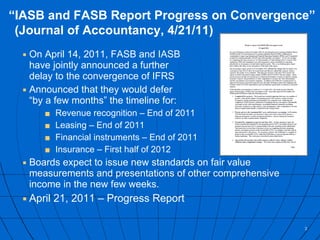
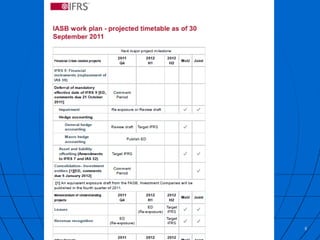
On April 14, 2011, FASB and IASB  have jointly announced a further  delay to the convergence of IFRS  Announced that they would defer  “by a few months” the timeline for: Revenue recognition – End of 2011 Leasing – End of 2011 Financial instruments – End of 2011 Insurance – First half of 2012 Boards expect to issue new standards on fair value measurements and presentations of other comprehensive income in the new few weeks. April 21, 2011 – Progress Report “ IASB and FASB Report Progress on Convergence” (Journal of Accountancy, 4/21/11)
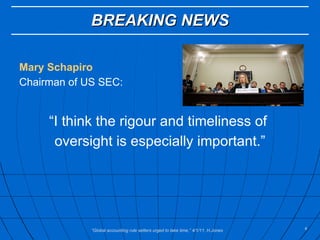
Mary Schapiro Chairman of US SEC: “ I think the rigour and timeliness of  oversight is especially important.” BREAKING NEWS “ Global accounting rule setters urged to take time,” 4/1/11, H.Jones
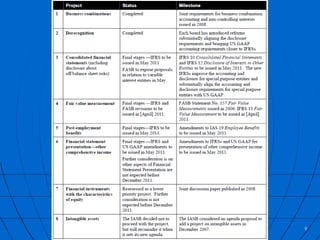
Overview of  Convergence Process
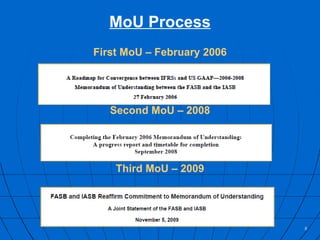
MoU Process First MoU – February 2006 Second MoU – 2008 Third MoU – 2009
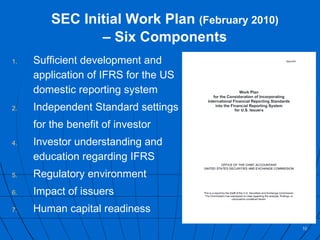
SEC Initial Work Plan  (February 2010) –  Six Components Sufficient development and application of IFRS for the US domestic reporting system Independent Standard settings  for the benefit of investor Investor understanding and education regarding IFRS Regulatory environment Impact of issuers Human capital readiness
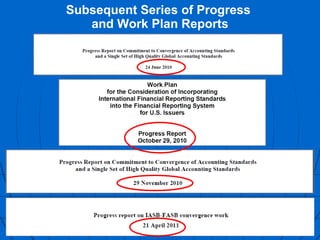
Subsequent Series of Progress  and Work Plan Reports
2010-2011  New Pronouncements and Updates
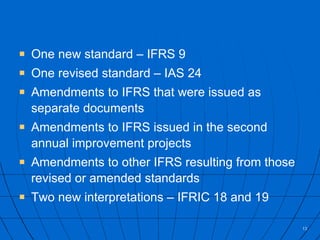
One new standard – IFRS 9 One revised standard – IAS 24 Amendments to IFRS that were issued as separate documents Amendments to IFRS issued in the second annual improvement projects Amendments to other IFRS resulting from those revised or amended standards Two new interpretations – IFRIC 18 and 19
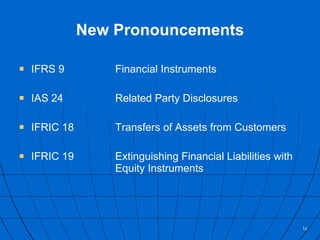
IFRS 9 Financial Instruments IAS 24 Related Party Disclosures IFRIC 18 Transfers of Assets from Customers IFRIC 19 Extinguishing Financial Liabilities with  Equity Instruments New Pronouncements
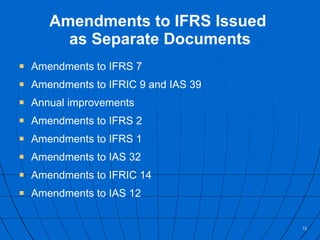
Amendments to IFRS Issued  as Separate Documents Amendments to IFRS 7 Amendments to IFRIC 9 and IAS 39 Annual improvements Amendments to IFRS 2 Amendments to IFRS 1 Amendments to IAS 32 Amendments to IFRIC 14 Amendments to IAS 12
New IFRS for SMEs September 2011
Overview of the  New Revenue Recognition Model
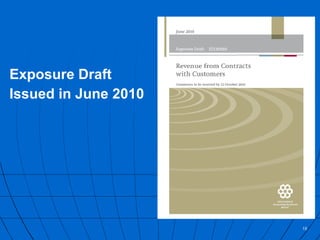
Exposure Draft  Issued in June 2010
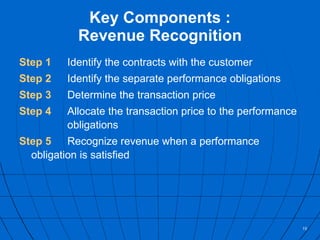
Key Components : Revenue Recognition Step 1 Identify the contracts with the customer Step 2 Identify the separate performance obligations Step 3 Determine the transaction price Step 4 Allocate the transaction price to the performance  obligations Step 5  Recognize revenue when a performance   obligation is satisfied
Expanded Footnote Disclosures
Work Plan for Remaining Priority Convergence Projects Leasing: The objective of this project is to improve financial reporting by ensuring that all assets and liabilities arising from lease contracts are recognized in the statement of financial position The boards published a joint exposure draft in August 2010 The boards have been considering the feedback received from comment letters and the boards’ extensive outreach activities  They intend to develop a draft of the new standard, which will be: Made generally available, via the boards’ websites, for interested parties to review; Used as the basis for outreach with parties that are most affected by the proposed new requirements; and Subjected to a detailed drafting review with selected parties, as part of the fatal flaw review process each board is required to undertake
Work Plan for Remaining Priority Convergence Projects Financial instruments: Efforts to improve our requirements and to reach a common solution have been complicated by differing imperatives that pushed our respective development timetables out of alignment Strategy for addressing those differences remains the same – each board has been publishing its proposals while also soliciting comment on those of the other board, as a way of giving interested parties the opportunity to compare and assess the relative merits of both boards’ proposals
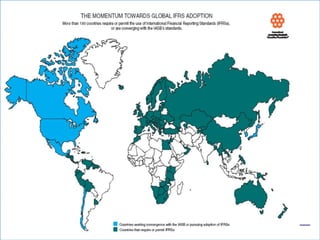
Top 10 Industrialized countries  and their Use of IFRS and How they Have Implemented  the New Standards
Understanding the  Differences between  “ Adoption ”  VS “ Adapting ”
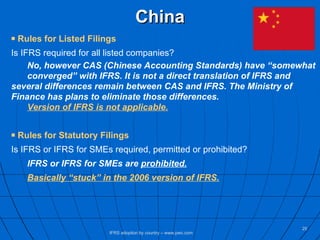
China Rules for Listed Filings Is IFRS required for all listed companies? No, however CAS (Chinese Accounting Standards) have “somewhat  converged” with IFRS. It is not a direct translation of IFRS and  several differences remain between CAS and IFRS. The Ministry of  Finance has plans to eliminate those differences.  Version of IFRS is not applicable. Rules for Statutory Filings Is IFRS or IFRS for SMEs required, permitted or prohibited? IFRS or IFRS for SMEs are  prohibited. Basically “stuck” in the 2006 version of IFRS. IFRS adoption by country – www.pwc.com
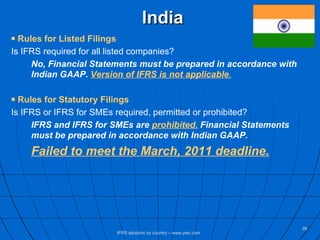
India Rules for Listed Filings Is IFRS required for all listed companies? No, Financial Statements must be prepared in accordance with  Indian GAAP.  Version of IFRS is not applicable . Rules for Statutory Filings Is IFRS or IFRS for SMEs required, permitted or prohibited? IFRS and IFRS for SMEs are  prohibited.  Financial Statements  must be prepared in accordance with Indian GAAP. Failed to meet the March, 2011 deadline. IFRS adoption by country – www.pwc.com
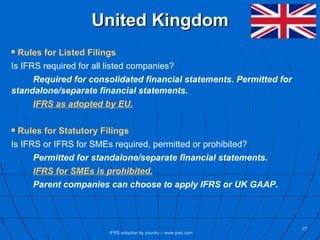
United Kingdom Rules for Listed Filings Is IFRS required for all listed companies? Required for consolidated financial statements. Permitted for  standalone/separate financial statements. IFRS as adopted by EU. Rules for Statutory Filings Is IFRS or IFRS for SMEs required, permitted or prohibited? Permitted for standalone/separate financial statements.  IFRS for SMEs is prohibited. Parent companies can choose to apply IFRS or UK GAAP.  IFRS adoption by country – www.pwc.com
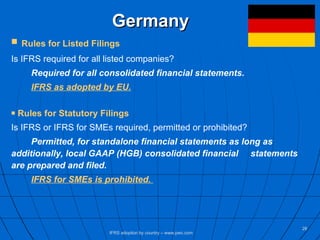
Germany Rules for Listed Filings Is IFRS required for all listed companies? Required for all consolidated financial statements. IFRS as adopted by EU. Rules for Statutory Filings Is IFRS or IFRS for SMEs required, permitted or prohibited? Permitted, for standalone financial statements as long as  additionally, local GAAP (HGB) consolidated financial  statements are prepared and filed. IFRS for SMEs is prohibited.  IFRS adoption by country – www.pwc.com
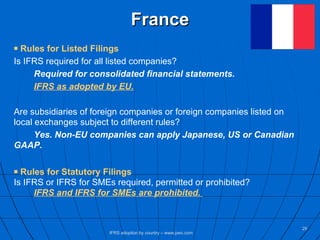
France Rules for Listed Filings Is IFRS required for all listed companies? Required for consolidated financial statements. IFRS as adopted by EU. Are subsidiaries of foreign companies or foreign companies listed on local exchanges subject to different rules?  Yes. Non-EU companies can apply Japanese, US or Canadian  GAAP.   Rules for Statutory Filings Is IFRS or IFRS for SMEs required, permitted or prohibited? IFRS and IFRS for SMEs are prohibited.   IFRS adoption by country – www.pwc.com
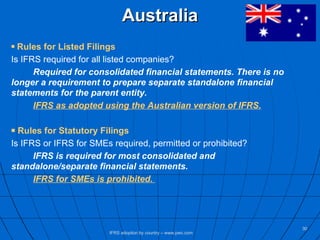
Australia Rules for Listed Filings Is IFRS required for all listed companies? Required for consolidated financial statements. There is no  longer a requirement to prepare separate standalone financial  statements for the parent entity.   IFRS as adopted using the Australian version of IFRS. Rules for Statutory Filings Is IFRS or IFRS for SMEs required, permitted or prohibited? IFRS is required for most consolidated and  standalone/separate financial statements. IFRS for SMEs is prohibited.   IFRS adoption by country – www.pwc.com
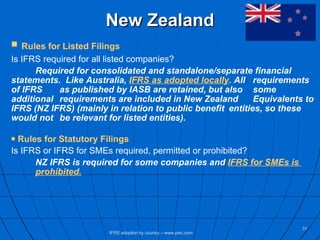
New Zealand Rules for Listed Filings Is IFRS required for all listed companies? Required for consolidated and standalone/separate financial  statements.  Like Australia,  IFRS as adopted locally .  All  requirements of IFRS  as published by IASB are retained, but also  some additional  requirements are included in New Zealand  Equivalents to IFRS (NZ IFRS) (mainly in relation to public benefit  entities, so these would not  be relevant for listed entities).   Rules for Statutory Filings Is IFRS or IFRS for SMEs required, permitted or prohibited? NZ IFRS is required for some companies and  IFRS for SMEs is  prohibited. IFRS adoption by country – www.pwc.com
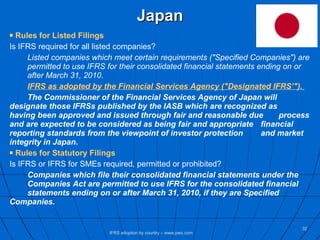
Japan Rules for Listed Filings Is IFRS required for all listed companies? Listed companies which meet certain requirements ("Specified Companies") are  permitted to use IFRS for their consolidated financial statements ending on or  after March 31, 2010.   IFRS as adopted by the Financial Services Agency ("Designated IFRS’").   The Commissioner of the Financial Services Agency of Japan will  designate those IFRSs published by the IASB which are recognized as  having been approved and issued through fair and reasonable due  process and are expected to be considered as being fair and appropriate  financial reporting standards from the viewpoint of investor protection  and market integrity in Japan . Rules for Statutory Filings Is IFRS or IFRS for SMEs required, permitted or prohibited? Companies which file their consolidated financial statements under the  Companies Act are permitted to use IFRS for the consolidated financial  statements ending on or after March 31, 2010, if they are Specified  Companies. IFRS adoption by country – www.pwc.com
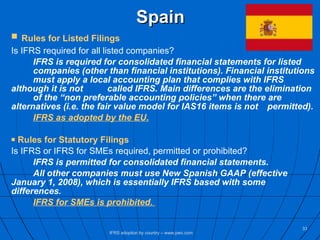
Spain Rules for Listed Filings Is IFRS required for all listed companies? IFRS is required for consolidated financial statements for listed  companies (other than financial institutions). Financial institutions  must apply a local accounting plan that complies with IFRS  although it is not  called IFRS. Main differences are the elimination  of the “non preferable accounting policies” when there are  alternatives (i.e. the fair value model for IAS16 items is not  permitted).   IFRS as adopted by the EU . Rules for Statutory Filings Is IFRS or IFRS for SMEs required, permitted or prohibited? IFRS is permitted for consolidated financial statements.  All other companies must use New Spanish GAAP (effective  January 1, 2008), which is essentially IFRS based with some  differences.  IFRS for SMEs is prohibited.  IFRS adoption by country – www.pwc.com
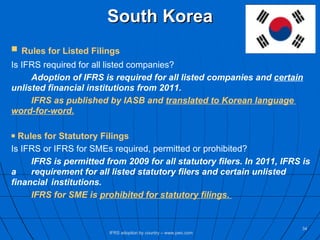
South Korea Rules for Listed Filings Is IFRS required for all listed companies? Adoption of IFRS is required for all listed companies and  certain   unlisted financial institutions from 2011.   IFRS as published by IASB and  translated to Korean language  word-for-word. Rules for Statutory Filings Is IFRS or IFRS for SMEs required, permitted or prohibited? IFRS is permitted from 2009 for all statutory filers. In 2011, IFRS is a  requirement for all listed statutory filers and certain unlisted  financial  institutions.  IFRS for SME is  prohibited for statutory filings.   IFRS adoption by country – www.pwc.com
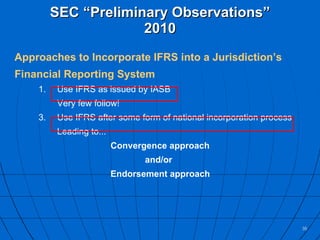
SEC “Preliminary Observations” 2010 Approaches to Incorporate IFRS into a Jurisdiction’s Financial Reporting System Use IFRS as issued by IASB Very few follow! Use IFRS after some form of national incorporation process  Leading to... Convergence approach   and/or Endorsement approach
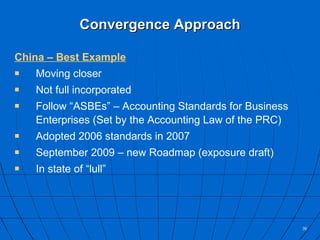
Convergence Approach China – Best Example Moving closer Not full incorporated Follow “ASBEs” – Accounting Standards for Business Enterprises (Set by the Accounting Law of the PRC) Adopted 2006 standards in 2007 September 2009 – new Roadmap (exposure draft) In state of “lull”
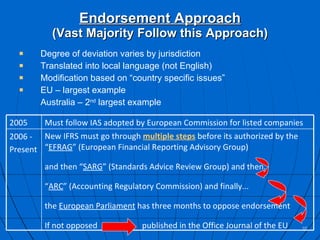
Endorsement Approach (Vast Majority Follow this Approach) Degree of deviation varies by jurisdiction Translated into local language (not English) Modification based on “country specific issues” EU – largest example Australia – 2 nd  largest example 2005 Must follow IAS adopted by European Commission for listed companies 2006 -  Present New IFRS must go through  multiple steps  before its authorized by the “ EFRAG ” (European Financial Reporting Advisory Group)  and then “ SARG ” (Standards Advice Review Group) and then.. “ ARC ” (Accounting Regulatory Commission) and finally... the  European Parliament  has three months to oppose endorsement If not opposed  published in the Office Journal of the EU
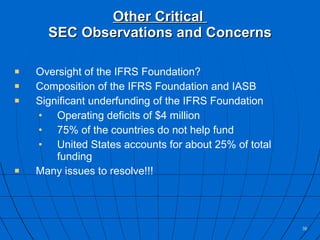
Other Critical  SEC Observations and Concerns Oversight of the IFRS Foundation? Composition of the IFRS Foundation and IASB Significant underfunding of the IFRS Foundation Operating deficits of $4 million 75% of the countries do not help fund United States accounts for about 25% of total funding Many issues to resolve!!!
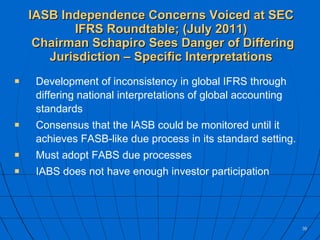
IASB Independence Concerns Voiced at SEC IFRS Roundtable; (July 2011)  Chairman Schapiro Sees Danger of Differing Jurisdiction – Specific Interpretations Development of inconsistency in global IFRS through differing national interpretations of global accounting standards  Consensus that the IASB could be monitored until it achieves FASB-like due process in its standard setting.  Must adopt FABS due processes IABS does not have enough investor participation
Personal Experience in 2011 Teaching IFRS to the Chinese  at the MBA Level  at Shanghai University  of Finance and Economics
AICPA Recommendations to the SEC August 19, 2011 Option to Adopt IFRS Future Framework Supports the Endorsement Supports Prospective Application Transition Concerns PCAOB needs to harmonize Audit Standards with International Audit Standards
SEC White Papers- Fall 2011 Quality of Accountancy under IFRS Remaining Differences yet unresolved  Recent PWC Poll
What to Expect from the SEC  in the Next 75 Days December_2011    
Thank You Stephen G. Austin, MBA, CPA [email_address] www.SwensonAdvisors.com www.swentrack.com www.swensonforensic.com

Latest IFRS Developments

  • 1.
    Latest Developments inIFRS 4 th Annual Hot Topics Seminar October 4, 2011 Stephen G. Austin, CPA, MBA Firm Managing Partner Swenson Advisors, LLP
  • 2.
    New IASB Leader Hans Hoogervorst Background Political issues U.S. adoption option Risk of non-U.S. commitment XBRL
  • 3.
    On April 14,2011, FASB and IASB have jointly announced a further delay to the convergence of IFRS Announced that they would defer “by a few months” the timeline for: Revenue recognition – End of 2011 Leasing – End of 2011 Financial instruments – End of 2011 Insurance – First half of 2012 Boards expect to issue new standards on fair value measurements and presentations of other comprehensive income in the new few weeks. April 21, 2011 – Progress Report “ IASB and FASB Report Progress on Convergence” (Journal of Accountancy, 4/21/11)
  • 4.
    Mary Schapiro Chairmanof US SEC: “ I think the rigour and timeliness of oversight is especially important.” BREAKING NEWS “ Global accounting rule setters urged to take time,” 4/1/11, H.Jones
  • 7.
    Overview of Convergence Process
  • 8.
    MoU Process FirstMoU – February 2006 Second MoU – 2008 Third MoU – 2009
  • 10.
    SEC Initial WorkPlan (February 2010) – Six Components Sufficient development and application of IFRS for the US domestic reporting system Independent Standard settings for the benefit of investor Investor understanding and education regarding IFRS Regulatory environment Impact of issuers Human capital readiness
  • 11.
    Subsequent Series ofProgress and Work Plan Reports
  • 12.
    2010-2011 NewPronouncements and Updates
  • 13.
    One new standard– IFRS 9 One revised standard – IAS 24 Amendments to IFRS that were issued as separate documents Amendments to IFRS issued in the second annual improvement projects Amendments to other IFRS resulting from those revised or amended standards Two new interpretations – IFRIC 18 and 19
  • 14.
    IFRS 9 FinancialInstruments IAS 24 Related Party Disclosures IFRIC 18 Transfers of Assets from Customers IFRIC 19 Extinguishing Financial Liabilities with Equity Instruments New Pronouncements
  • 15.
    Amendments to IFRSIssued as Separate Documents Amendments to IFRS 7 Amendments to IFRIC 9 and IAS 39 Annual improvements Amendments to IFRS 2 Amendments to IFRS 1 Amendments to IAS 32 Amendments to IFRIC 14 Amendments to IAS 12
  • 16.
    New IFRS forSMEs September 2011
  • 17.
    Overview of the New Revenue Recognition Model
  • 18.
    Exposure Draft Issued in June 2010
  • 19.
    Key Components :Revenue Recognition Step 1 Identify the contracts with the customer Step 2 Identify the separate performance obligations Step 3 Determine the transaction price Step 4 Allocate the transaction price to the performance obligations Step 5 Recognize revenue when a performance obligation is satisfied
  • 20.
  • 21.
    Work Plan forRemaining Priority Convergence Projects Leasing: The objective of this project is to improve financial reporting by ensuring that all assets and liabilities arising from lease contracts are recognized in the statement of financial position The boards published a joint exposure draft in August 2010 The boards have been considering the feedback received from comment letters and the boards’ extensive outreach activities They intend to develop a draft of the new standard, which will be: Made generally available, via the boards’ websites, for interested parties to review; Used as the basis for outreach with parties that are most affected by the proposed new requirements; and Subjected to a detailed drafting review with selected parties, as part of the fatal flaw review process each board is required to undertake
  • 22.
    Work Plan forRemaining Priority Convergence Projects Financial instruments: Efforts to improve our requirements and to reach a common solution have been complicated by differing imperatives that pushed our respective development timetables out of alignment Strategy for addressing those differences remains the same – each board has been publishing its proposals while also soliciting comment on those of the other board, as a way of giving interested parties the opportunity to compare and assess the relative merits of both boards’ proposals
  • 23.
    Top 10 Industrializedcountries and their Use of IFRS and How they Have Implemented the New Standards
  • 24.
    Understanding the Differences between “ Adoption ” VS “ Adapting ”
  • 25.
    China Rules forListed Filings Is IFRS required for all listed companies? No, however CAS (Chinese Accounting Standards) have “somewhat converged” with IFRS. It is not a direct translation of IFRS and several differences remain between CAS and IFRS. The Ministry of Finance has plans to eliminate those differences. Version of IFRS is not applicable. Rules for Statutory Filings Is IFRS or IFRS for SMEs required, permitted or prohibited? IFRS or IFRS for SMEs are prohibited. Basically “stuck” in the 2006 version of IFRS. IFRS adoption by country – www.pwc.com
  • 26.
    India Rules forListed Filings Is IFRS required for all listed companies? No, Financial Statements must be prepared in accordance with Indian GAAP. Version of IFRS is not applicable . Rules for Statutory Filings Is IFRS or IFRS for SMEs required, permitted or prohibited? IFRS and IFRS for SMEs are prohibited. Financial Statements must be prepared in accordance with Indian GAAP. Failed to meet the March, 2011 deadline. IFRS adoption by country – www.pwc.com
  • 27.
    United Kingdom Rulesfor Listed Filings Is IFRS required for all listed companies? Required for consolidated financial statements. Permitted for standalone/separate financial statements. IFRS as adopted by EU. Rules for Statutory Filings Is IFRS or IFRS for SMEs required, permitted or prohibited? Permitted for standalone/separate financial statements. IFRS for SMEs is prohibited. Parent companies can choose to apply IFRS or UK GAAP. IFRS adoption by country – www.pwc.com
  • 28.
    Germany Rules forListed Filings Is IFRS required for all listed companies? Required for all consolidated financial statements. IFRS as adopted by EU. Rules for Statutory Filings Is IFRS or IFRS for SMEs required, permitted or prohibited? Permitted, for standalone financial statements as long as additionally, local GAAP (HGB) consolidated financial statements are prepared and filed. IFRS for SMEs is prohibited. IFRS adoption by country – www.pwc.com
  • 29.
    France Rules forListed Filings Is IFRS required for all listed companies? Required for consolidated financial statements. IFRS as adopted by EU. Are subsidiaries of foreign companies or foreign companies listed on local exchanges subject to different rules? Yes. Non-EU companies can apply Japanese, US or Canadian GAAP. Rules for Statutory Filings Is IFRS or IFRS for SMEs required, permitted or prohibited? IFRS and IFRS for SMEs are prohibited. IFRS adoption by country – www.pwc.com
  • 30.
    Australia Rules forListed Filings Is IFRS required for all listed companies? Required for consolidated financial statements. There is no longer a requirement to prepare separate standalone financial statements for the parent entity. IFRS as adopted using the Australian version of IFRS. Rules for Statutory Filings Is IFRS or IFRS for SMEs required, permitted or prohibited? IFRS is required for most consolidated and standalone/separate financial statements. IFRS for SMEs is prohibited. IFRS adoption by country – www.pwc.com
  • 31.
    New Zealand Rulesfor Listed Filings Is IFRS required for all listed companies? Required for consolidated and standalone/separate financial statements. Like Australia, IFRS as adopted locally . All requirements of IFRS as published by IASB are retained, but also some additional requirements are included in New Zealand Equivalents to IFRS (NZ IFRS) (mainly in relation to public benefit entities, so these would not be relevant for listed entities). Rules for Statutory Filings Is IFRS or IFRS for SMEs required, permitted or prohibited? NZ IFRS is required for some companies and IFRS for SMEs is prohibited. IFRS adoption by country – www.pwc.com
  • 32.
    Japan Rules forListed Filings Is IFRS required for all listed companies? Listed companies which meet certain requirements ("Specified Companies") are permitted to use IFRS for their consolidated financial statements ending on or after March 31, 2010. IFRS as adopted by the Financial Services Agency ("Designated IFRS’"). The Commissioner of the Financial Services Agency of Japan will designate those IFRSs published by the IASB which are recognized as having been approved and issued through fair and reasonable due process and are expected to be considered as being fair and appropriate financial reporting standards from the viewpoint of investor protection and market integrity in Japan . Rules for Statutory Filings Is IFRS or IFRS for SMEs required, permitted or prohibited? Companies which file their consolidated financial statements under the Companies Act are permitted to use IFRS for the consolidated financial statements ending on or after March 31, 2010, if they are Specified Companies. IFRS adoption by country – www.pwc.com
  • 33.
    Spain Rules forListed Filings Is IFRS required for all listed companies? IFRS is required for consolidated financial statements for listed companies (other than financial institutions). Financial institutions must apply a local accounting plan that complies with IFRS although it is not called IFRS. Main differences are the elimination of the “non preferable accounting policies” when there are alternatives (i.e. the fair value model for IAS16 items is not permitted). IFRS as adopted by the EU . Rules for Statutory Filings Is IFRS or IFRS for SMEs required, permitted or prohibited? IFRS is permitted for consolidated financial statements. All other companies must use New Spanish GAAP (effective January 1, 2008), which is essentially IFRS based with some differences. IFRS for SMEs is prohibited. IFRS adoption by country – www.pwc.com
  • 34.
    South Korea Rulesfor Listed Filings Is IFRS required for all listed companies? Adoption of IFRS is required for all listed companies and certain unlisted financial institutions from 2011. IFRS as published by IASB and translated to Korean language word-for-word. Rules for Statutory Filings Is IFRS or IFRS for SMEs required, permitted or prohibited? IFRS is permitted from 2009 for all statutory filers. In 2011, IFRS is a requirement for all listed statutory filers and certain unlisted financial institutions. IFRS for SME is prohibited for statutory filings. IFRS adoption by country – www.pwc.com
  • 35.
    SEC “Preliminary Observations”2010 Approaches to Incorporate IFRS into a Jurisdiction’s Financial Reporting System Use IFRS as issued by IASB Very few follow! Use IFRS after some form of national incorporation process Leading to... Convergence approach and/or Endorsement approach
  • 36.
    Convergence Approach China– Best Example Moving closer Not full incorporated Follow “ASBEs” – Accounting Standards for Business Enterprises (Set by the Accounting Law of the PRC) Adopted 2006 standards in 2007 September 2009 – new Roadmap (exposure draft) In state of “lull”
  • 37.
    Endorsement Approach (VastMajority Follow this Approach) Degree of deviation varies by jurisdiction Translated into local language (not English) Modification based on “country specific issues” EU – largest example Australia – 2 nd largest example 2005 Must follow IAS adopted by European Commission for listed companies 2006 - Present New IFRS must go through multiple steps before its authorized by the “ EFRAG ” (European Financial Reporting Advisory Group) and then “ SARG ” (Standards Advice Review Group) and then.. “ ARC ” (Accounting Regulatory Commission) and finally... the European Parliament has three months to oppose endorsement If not opposed published in the Office Journal of the EU
  • 38.
    Other Critical SEC Observations and Concerns Oversight of the IFRS Foundation? Composition of the IFRS Foundation and IASB Significant underfunding of the IFRS Foundation Operating deficits of $4 million 75% of the countries do not help fund United States accounts for about 25% of total funding Many issues to resolve!!!
  • 39.
    IASB Independence ConcernsVoiced at SEC IFRS Roundtable; (July 2011) Chairman Schapiro Sees Danger of Differing Jurisdiction – Specific Interpretations Development of inconsistency in global IFRS through differing national interpretations of global accounting standards Consensus that the IASB could be monitored until it achieves FASB-like due process in its standard setting. Must adopt FABS due processes IABS does not have enough investor participation
  • 40.
    Personal Experience in2011 Teaching IFRS to the Chinese at the MBA Level at Shanghai University of Finance and Economics
  • 41.
    AICPA Recommendations tothe SEC August 19, 2011 Option to Adopt IFRS Future Framework Supports the Endorsement Supports Prospective Application Transition Concerns PCAOB needs to harmonize Audit Standards with International Audit Standards
  • 42.
    SEC White Papers-Fall 2011 Quality of Accountancy under IFRS Remaining Differences yet unresolved Recent PWC Poll
  • 43.
    What to Expectfrom the SEC in the Next 75 Days December_2011  
  • 44.
    Thank You StephenG. Austin, MBA, CPA [email_address] www.SwensonAdvisors.com www.swentrack.com www.swensonforensic.com