Accounting
Study Guide
Grade
12
© Department of Basic Education 2014
Accounting
Study Guide
Grade
12
This content may not be sold or used for commercial purposes.
Curriculum and Assessment Policy Statement (CAPS) Mind the Gap Grade 12 Study
Guide Accounting
ISBN 978-1-4315-1950--7
This publication has a Creative Commons Attribution NonCommercial Sharealike
license. You can use, modify, upload, download, and share content, but you must
acknowledge the Department of Basic Education, the authors and contributors. If you
make any changes to the content you must send the changes to the Department of
Basic Education. This content may not be sold or used for commercial purposes. For
more information about the terms of the license please see:
http://creativecommons.org/licenses/by-nc-sa/3.0/.
Copyright © Department of Basic Education 2014
222 Struben Street, Pretoria, South Africa
Contact person: Dr Patricia Watson
Email: watson.p@dbe.gov.za
Tel: (012) 357 4502
http://www.education.gov.za
Call Centre: 0800202933
The first edition published in 2012 Revised National Curriculum Statement (RNCS)
Mind the Gap Grade 12 Study Guide Accounting: ISBN 978 0 621 40908 6
Second edition published in 2014 Curriculum and Assessment Policy Statement
(CAPS) Mind the Gap Grade 12 Study Guide Accounting : ISBN 978-1-4315-1950--7
Mind the Gap team
Series managing editor: Dr Patricia Watson
Production co-ordinator for CAPS edition: Lisa Treffry-Goatley and Radha Pillay
Authors: Anthony Ash, Kirsti Chapman, Lesiba Sydney Leso, Tracey Megom, Florence
Nxumalo, Glynis Schreuder, Estelle van Schie, Barbara Wies
Expert readers: Johnson Adekoya, Sali Ameen, Trevor Hall, Eugenia Maila, Melanie
Marchbank, Jacqualine Ndlovu, Joe Ramsamy, Thandi Sindane
Study skills: Margarita Karnasopoulos
Editors: Julia Grey, Herbert Opland
Proofreader: Jenny de Wet
Designers: Alicia Arntzen, Philisiwe Nkosi, Michele Dean, Nomalizo Ngwenya
Illustrators: Michele Dean, Kenneth Kunene, Vusi Malindi, Bié Venter
Cover illustration: Alastair Findlay
Onsite writers’workshop support: Wayne Cussons Quick
© Department of Basic Education 2014
Ministerial foreword
The Department of Basic Education has pleasure in releasing the second
edition of Mind the Gap study guides for Grade 12 learners. These study
guides continue the innovative and committed attempt by the Department
of Basic Education to improve the academic performance of Grade 12
candidates in the National Senior Certificate (NSC) examination.
The study guides have been written by subject expert teams comprised
of teachers, examiners, moderators, subject advisors and subject co-
ordinators. Research started in 2012 shows that the Mind the Gap series
has, without doubt, had a positive impact in improving grades. It is my
fervent wish that the Mind the Gap study guides take us all closer towards
ensuring that no learner is left behind, especially as we move forward in
our celebration of 20 years of democracy.
The second edition of Mind the Gap is aligned to the 2014 Curriculum and
Assessment Policy Statement (CAPS). This means that the writers have
considered the National Policy pertaining to the programme, promotion
requirements and protocol for assessment of the National Curriculum
Statement for Grade 12 in 2014.
The Mind the Gap CAPS study guides take their brief in part from the 2013
National Diagnostic report on learner performance and draws on the
2014 Grade 12 Examination Guidelines. Each of the Mind the Gap study
guides provides explanations of key terminology, simple explanations
and examples of the types of questions that learners can expect to be
asked in an exam. M a r k i n g m e m o r a n d a are included to assist
learners in building their understanding. Learners are also referred to
specific questions in past national exam papers and examination memos
that are available on the Department’s website – www.education.gov.za.
The CAPS edition include Accounting, Economics, Geography, Life
Sciences, Mathematics, Mathematical Literacy and Physical Sciences.
The series is produced in both English and Afrikaans. There are also nine
English First Additional Language study guides. They include EFAL Paper
1 (Language); EFAL Paper 3 (Writing); and a study guide for each of the
Grade 12 prescribed literature set works.
The study guides have been designed to assist those learners who
have been underperforming due to a lack of exposure to the content
requirements of the curriculum and aims to mind-the-gap between failing
and passing, by bridging the gap in learners’ understanding of commonly
tested concepts so candidates can pass.
All that is now required is for our Grade 12 learners to put in the hours
preparing for the examinations. Learners make us proud – study hard. We
wish each and every one of you good luck for your Grade 12 examinations.
_________________________________
Matsie Angelina Motshekga, MP
Minister of Basic Education
May 2014
Matsie Angelina Motshekga, MP
Minister of Basic Education
© Department of Basic Education 2014
Mind the Gap CAPS Grade 12 Accounting contents v

Table of contents
Dear Grade 12 learner ........................................................................................................ vi
How to use this study guide............................................................................................... vii
Top 10 study tips................................................................................................................ viii
Study skills to boost your learning..................................................................................... ix
On the day of the exam ….................................................................................................. xii
Question words to help you answer questions............................................................... xiii
Learner’s checklist..............................................................................................................xiv
Chapter 1:	Basic Accounting concepts........................................................... 1
1.1	 Basic concepts........................................................................................................1
1.2	 Rules of Accounting.................................................................................................2
1.3	 Classification of accounts.......................................................................................3
1.4	 Steps to recording transactions.............................................................................5
Chapter 2:	Companies....................................................................................... 6
2.1	 Concepts relating to companies.............................................................................6
2.2	 Company General Ledger accounts.......................................................................8
2.3	 Preparation of Financial Statements for companies......................................... 15
2.4	 Cash Flow Statements......................................................................................... 40
2.5	 Analysis and interpretation of Financial Statements......................................... 46
2.6	 Comments on an audit report............................................................................. 54
Chapter 3:	Manufacturing............................................................................... 60
3.1	 Important concepts of manufacturing................................................................ 61
3.2	 Production Cost Statement..................................................................................64
Chapter 4:	Budgets.......................................................................................... 71
4.1	 Key concepts........................................................................................................ 71
4.2	 Debtors’ collection schedule............................................................................... 72
4.3	 Creditors’ payment schedule (creditors’ budget)................................................74
4.4	 Analysis of cash budget....................................................................................... 78
Chapter 5:	Reconciliations.............................................................................. 82
5.1	 Bank reconciliation ............................................................................................. 83
5.2	 Debtors’ reconciliation......................................................................................... 86
5.3	 Debtors’ age analysis .......................................................................................... 91
5.4	 Creditors’ reconciliation with the creditor’s statemennt................................... 94
Chapter 6:	Inventories..................................................................................... 99
6.1	 Inventory systems................................................................................................. 99
6.2	 Inventory valuation methods.............................................................................100
Chapter 7:	Value Added Tax (VAT)................................................................ 119
7.1	 VAT calculations..................................................................................................120
7.2	 VAT Control Account...........................................................................................123
Chapter 8: Fixed assets................................................................................. 127
8.1	 Introduction to Fixed assets..............................................................................127
8.2	 Asset register......................................................................................................128
8.3	 Residual value/called scrap value of R1..........................................................129
8.4	 Note to the Balance Sheet and Asset disposal................................................131
Appendix: Past Grade 12 exam papers........................................................ 138
© Department of Basic Education 2014
vi introduction Mind the Gap CAPS Grade 12 Accounting
© Department of Basic Education 2014
Dear Grade 12 learner
This Mind the Gap study guide has been CAPS aligned and helps you to
prepare for the end-of-year Accounting Grade 12 examination.
This study guide does not cover the entire curriculum, but it does focus on
core content of each knowledge area and points out where you can earn
easy marks.
You must work your way through this study guide to improve your
understanding, identify your areas of weaknesses and correct your own
mistakes.
We are confident that this Mind the Gap can help you to prepare well so
that you pass the end-of-year exams. To ensure a high quality pass, you
should also cover the remaining aspects of the curriculum using other
textbooks and your class notes.
Also pay special attention to the way the workings have been shown in the
worked examples. This is the best way for you to earn maximum marks.
In order for you to be successful in Accounting you must:
•	 Ensure that you know the formats or layouts of the:
–– Income Statement
–– Balance Sheet
–– Cash Flow Statement
–– Production Cost Statement
–– General Ledger accounts
•	 Understand the concepts explained in this guide and know how to do
calculations.
•	 Work through as many past examination papers as you can (use the
explanations and steps in this guide to assist you). There are some
suggested questions from past papers at the end of each section for
extra practice. Be careful when working through questions relating
to Companies of past papers as there are some aspects that are
treated differently under CAPS.
Remember, your success in the final exam will depend on how much extra
time you put into preparing.
Overview of the CAPS Accounting
Grade 12 exam
•	 There is one exam of 3 hours for 300 marks.
•	 All questions are compulsory (no choice questions).
•	 There are no different sections.
•	 All past papers have had 6 questions.
•	 Each question covers different levels so all learners should be able
to gain some marks in every question.
•	 All questions should be attempted.
•	 Questions will include conceptual understanding, application,
interpretation and reflective type questions.
•	 Learners will be provided with a specially prepared answer book for
their answers. This is specially designed for the Accounting exam. The
answer booklet provides space for every question. All calculations,
workings and final answers will be done in this answer booklet.
Another
name for a Balance
Sheet is a Statement of
Financial Position. An
Income Statement is
also known as a
Statement of Financial
Performance.
© Department of Basic Education 2014
Mind the Gap CAPS Grade 12 Accounting introduction vii

© Department of Basic Education 2014
How to use this study guide
This study guide covers selected parts of the different topics of the Grade
12 Accounting curriculum. The selected parts of each topic are presented
in the following way:
•	 An explanation of terms and concepts
•	 Worked examples to explain and demonstrate
•	 Activities with questions for you to answer
•	 Answers for you to use to check your own work
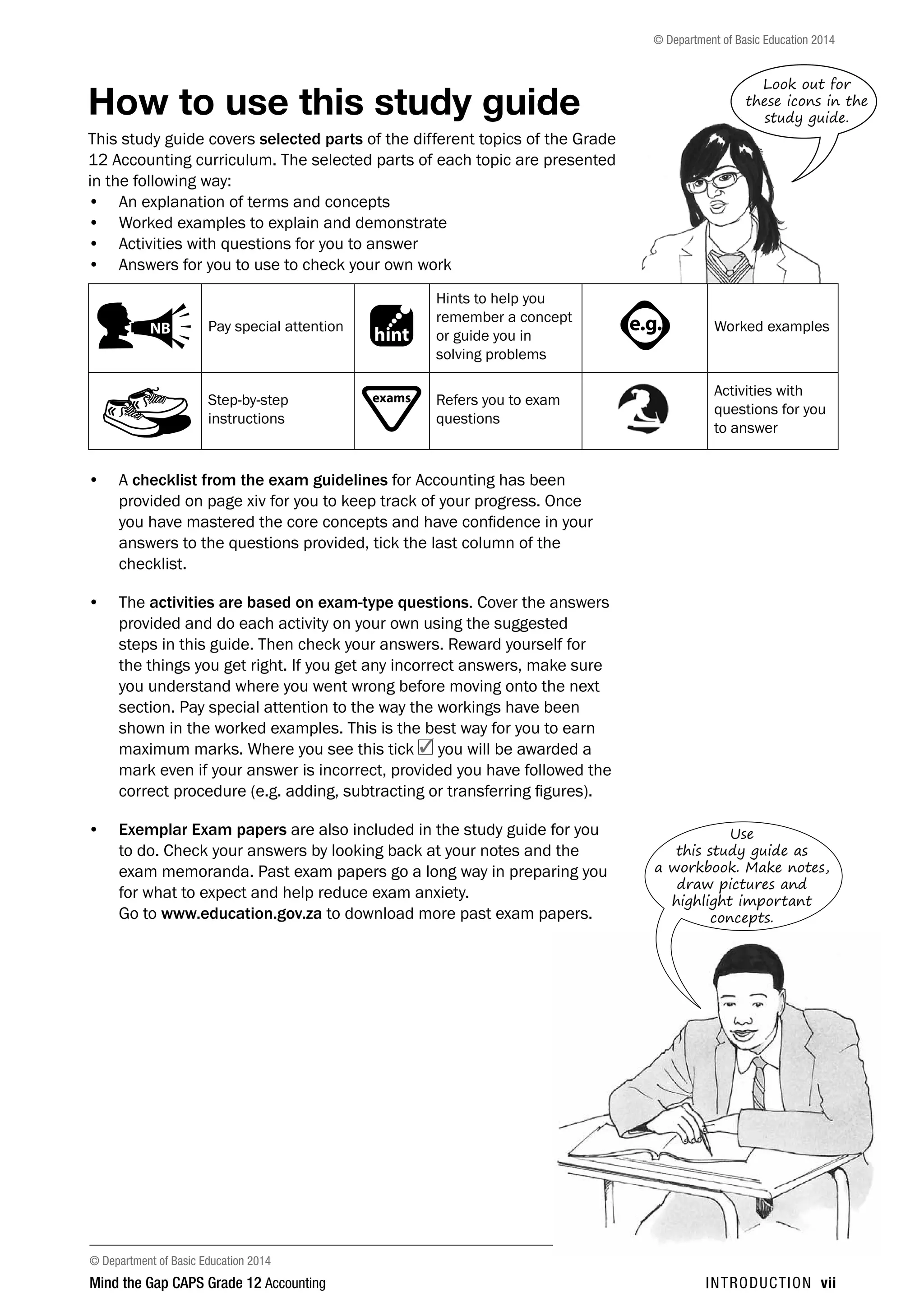
PAY SPECIAL ATTENTION
ACTIVITIES boy
and girl-left and
right of page
Step by step comment
EG - worked examples
HINT!
e.g.
NB NB
hint
activity
activity
comment
exams
Pay special attention
PAY SPECIAL ATTENTION
ACTIVITIES boy
and girl-left and
right of page
Step by step comment
EG - worked examples
HINT!
e.g.
NB NB
hint
activity
activity
comment
exams
Hints to help you
remember a concept
or guide you in
solving problems
PAY SPECIAL ATTENTION
ACTIVITIES boy
and girl-left and
right of page
Step by step comment
EG - worked examples
HINT!
e.g.
NB NB
hint
activity
activity
comment
exams
Worked examples
Step-by-step
instructions
PAY SPECIAL ATTENTION
ACTIVITIES boy
and girl-left and
right of page
Step by step comment
EG - worked examples
HINT!
e.g.
NB NB
hint
activity
activity
comment
exams Refers you to exam
questions
Activities with
questions for you
to answer
•	 A checklist from the exam guidelines for Accounting has been
provided on page xiv for you to keep track of your progress. Once
you have mastered the core concepts and have confidence in your
answers to the questions provided, tick the last column of the
checklist.
•	 The activities are based on exam-type questions. Cover the answers
provided and do each activity on your own using the suggested
steps in this guide. Then check your answers. Reward yourself for
the things you get right. If you get any incorrect answers, make sure
you understand where you went wrong before moving onto the next
section. Pay special attention to the way the workings have been
shown in the worked examples. This is the best way for you to earn
maximum marks. Where you see this tick you will be awarded a
mark even if your answer is incorrect, provided you have followed the
correct procedure (e.g. adding, subtracting or transferring figures).
•	 Exemplar Exam papers are also included in the study guide for you
to do. Check your answers by looking back at your notes and the
exam memoranda. Past exam papers go a long way in preparing you
for what to expect and help reduce exam anxiety.
Go to www.education.gov.za to download more past exam papers.
Look out for
these icons in the
study guide.
Use
this study guide as
a workbook. Make notes,
draw pictures and
highlight important
concepts.
© Department of Basic Education 2014
viii introduction Mind the Gap CAPS Grade 12 Accounting
© Department of Basic Education 2014
Top 10 study tips
1.	 Have all your materials ready before you begin studying –
pencils, pens, highlighters, paper, etc.
2.	 Be positive. Make sure your brain holds onto the information
you are learning by reminding yourself how important it is to
remember the work and get the marks.
3.	 Take a walk outside. A change of scenery will stimulate your
learning. You’ll be surprised at how much more you take in after
being outside in the fresh air.
4.	 Break up your learning sections into manageable parts. Trying to
learn too much at one time will only result in a tired, unfocused
and anxious brain.
5.	 Keep your study sessions short but effective and reward yourself
with short, constructive breaks.
6.	 Teach your concepts to anyone who will listen. It might feel
strange at first, but it is definitely worth reading your revision
notes aloud.
7.	 Your brain learns well with colours and pictures. Try to use them
whenever you can.
8.	 Be confident with the learning areas you know well and focus
your brain energy on the sections that you find more difficult
to take in.
9.	 Repetition is the key to retaining information you have to learn.
Keep going – don’t give up!
10.	 Sleeping at least 8 hours every night, eating properly and
drinking plenty of water are all important things you need to
do for your brain. Studying for exams is like strenuous exercise,
so you must be physically prepared.
Try these
study tips to
make learning
easier.
© Department of Basic Education 2014
Mind the Gap CAPS Grade 12 Accounting introduction ix

© Department of Basic Education 2014
Study skills to boost your
learning
This guide makes use of 3 study techniques you can use to help you learn
the material:
1.	 Mobile notes
2.	 Mnemonics
3.	 Mind maps
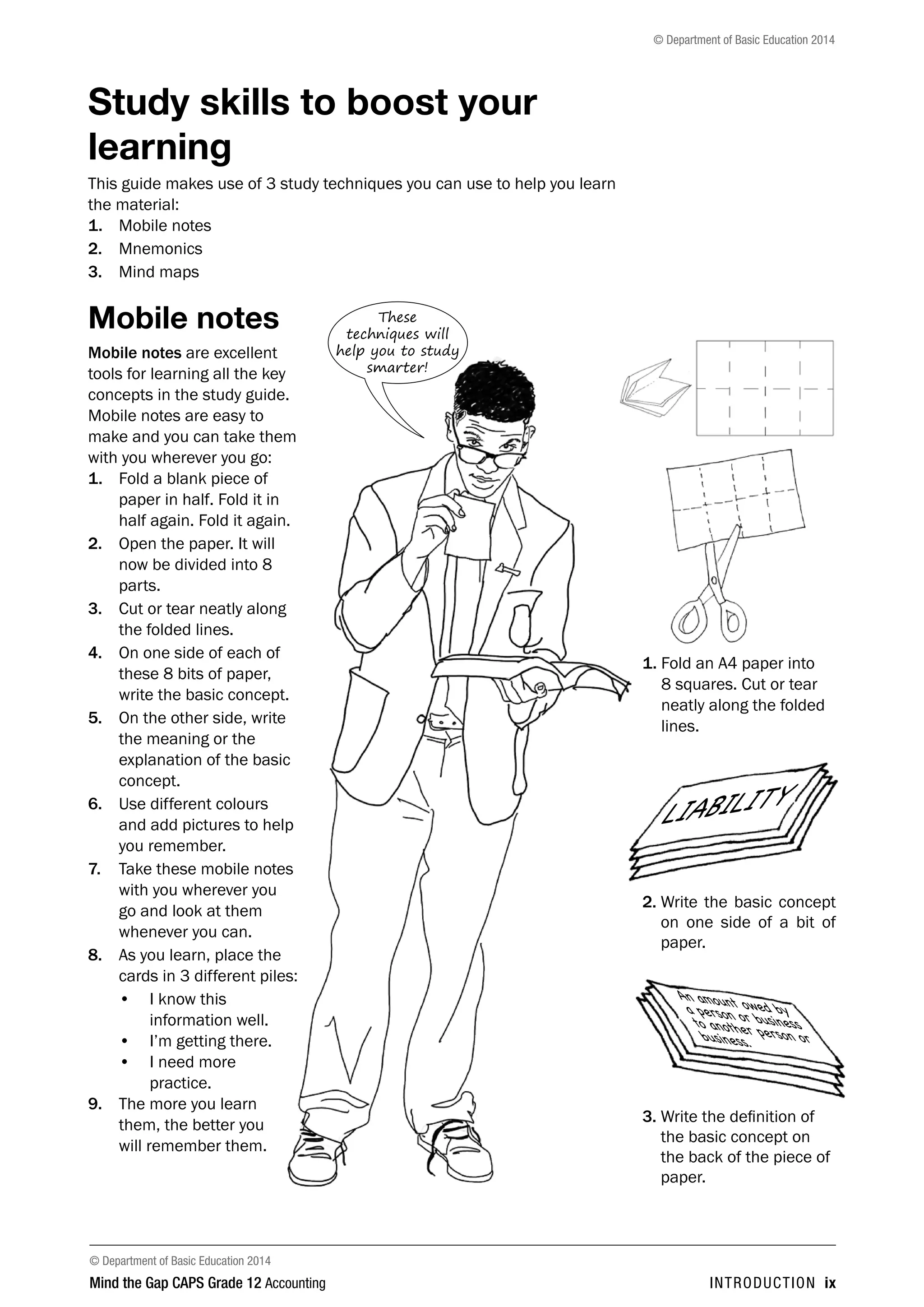
Mobile notes
Mobile notes are excellent
tools for learning all the key
concepts in the study guide.
Mobile notes are easy to
make and you can take them
with you wherever you go:
1.	 Fold a blank piece of
paper in half. Fold it in
half again. Fold it again.
2.	 Open the paper. It will
now be divided into 8
parts.
3.	 Cut or tear neatly along
the folded lines.
4.	 On one side of each of
these 8 bits of paper,
write the basic concept.
5.	 On the other side, write
the meaning or the
explanation of the basic
concept.
6.	 Use different colours
and add pictures to help
you remember.
7.	 Take these mobile notes
with you wherever you
go and look at them
whenever you can.
8.	 As you learn, place the
cards in 3 different piles:
•	 I know this
information well.
•	 I’m getting there.
•	 I need more
practice.
9.	 The more you learn
them, the better you
will remember them.
1. Fold an A4 paper into
8 squares. Cut or tear
neatly along the folded
lines.
2. Write the basic concept
on one side of a bit of
paper.
3. Write the definition of
the basic concept on
the back of the piece of
paper.
liability
An amount owed bya person or businessto another person orbusiness.
These
techniques will
help you to study
smarter!
© Department of Basic Education 2014
x introduction Mind the Gap CAPS Grade 12 Accounting
© Department of Basic Education 2014
Mnemonics
A mnemonic code is a useful technique for learning information that is
difficult to remember. This is an example of a word mnemonic using the
word BALANCE where each letter of the word stands for something else:
B	–	Best – doing your best is more 			
important than being the best.
A 	 – 	Attitude – always have a positive attitude.
L 	 – 	Load – spread the load so you don’t leave
everything to the last minute. Use a study
timetable to plan.
A 	 – 	Attention – pay attention to detail. Only
answer what is required.
N 	 – 	 Never give up! Try, try and try again!
C	 – 	Calm – stay calm even when the
questions seem difficult.
E 	 – 	Early – sleep early the night before your
exam. If you prepare well you will not need
to cram the night before.
Mnemonics are code information and make it easier to remember.
The more creative you are and the more you link your ‘codes’ to familiar
things, the more helpful your mnemonics will be.
This guide provides several ideas for using mnemonics. Be sure to make
up your own.
Neither you nor the world knows what you
can do until you have tried.
Ralph Waldo Emerson
Success
in Accounting
is a balancing
act!
© Department of Basic Education 2014
Mind the Gap CAPS Grade 12 Accounting introduction xi

© Department of Basic Education 2014
Mind maps
There are several mind maps included in this guide, summarising some of
the sections.
Have a look at the following pictures of a brain cell (neuron) and, below it,
a mind map:
Figure 1: Brain cell or neuron
Figure 2: Mind map rules
Mind maps work because they show information that we have to learn in
the same way that our brains ‘see’ information.
As you study the mind maps in the guide, add pictures to each of the
branches to help you remember the content.
You can make your own mind maps as you finish each section.
How to make your own mind maps:
1.	 Turn your paper sideways so your brain has space to spread out in all
directions.
2.	 Decide on a name for your mind map that summarises the
information you are going to put on it.
3.	 Write the name in the middle and draw a circle, bubble or
picture around it.
4.	 Write only key words on your branches, not whole
sentences. Keep it short and simple.
5.	 Each branch should show a different idea. Use a different
colour for each idea. Connect the information that belongs
together. This will help build your understanding of the
learning areas.
6.	 Have fun adding pictures wherever you can. It does not
matter if you can’t draw well.
Mind
mapping
your notes makes
them more interesting
and easier to
remember.
© Department of Basic Education 2014
xii introduction Mind the Gap CAPS Grade 12 Accounting
© Department of Basic Education 2014
On the day of the exam …
1.	 Make sure you have all the necessary stationery for your exam,
i.e. pens, pencils, eraser and calculator (with new batteries).
Make sure you bring your ID document and examination
admission letter.
2.	 Arrive on time, at least one hour before the start of the exam.
3.	 Go to the toilet before entering the exam room. You don’t want to
waste valuable time going to the toilet during the exam.
4.	 Use the 10 minutes reading time to read the instructions carefully.
This helps to ‘open’ the information in your brain. All questions in
Accounting are compulsory, but you do not have to answer them
in order. Start with the question you think is the easiest to get the
flow going.
5.	 Break the questions down to make sure you understand what is
being asked. If you don’t answer the question properly you won’t
get any marks for it. Look for the key words in the question to
know how to answer it. A list of question words is on page ix of
this study guide.
6.	 Try all the questions. Each question has some easy marks in it so
make sure that you do all the questions in the exam.
7.	 Never panic, even if the question seems difficult at first. It will be
linked to something you have covered. Find the connection.
8.	 Manage your time properly. Don’t waste time on questions you are
unsure of. Move on and come back if time allows.
9.	 Check weighting – how many marks have been allocated for your
answer? Take note of the ticks in this study guide as examples
of marks allocated. Do not give more or less information than is
required.
10.	 Write big and bold and clearly. You will get more marks if the
marker can read your answer clearly. Show workings in brackets
for Accounting as suggested in this study guide.
GOOD
LUCK!
© Department of Basic Education 2014
Mind the Gap CAPS Grade 12 Accounting introduction xiii

© Department of Basic Education 2014
Question words to help you
answer questions
It is important to look for the question words (the words that tell you what
to do) to correctly understand what the examiner is asking. Use the words
in the following table as a guide when answering questions.
Question word What is required of you
Analyse Separate, examine and interpret
Classify
Divide into groups or types so that things that are similar
are in the same group
Comment Write generally about
Compare Point out or show both similarities or differences
Define Give a clear meaning
Describe List the main characteristics of something
Discuss Consider all information and reach a conclusion
Evaluate Express an opinion based on your findings
Explain Make clear, interpret and spell out
Forecast Say what you think will happen in the future
Give/provide Write down only facts
Identify Name the essential characteristics
Interpret Give the intended meaning of
List Write a list of items
Mention Refer to relevant points
Name State something – give, identify or mention
State Write down information without discussion
Suggest Offer an explanation or solution
PAY SPECIAL ATTENTION
ACTIVITIES boy
and girl-left and
right of page
Step by step comment
EG - worked examples
HINT!
e.g.
NB NB
hint
activity
activity
comment
exams
Examples of question words
Choose a definition from COLUMN B that matches the type of account
in COLUMN A.
Draw a line from COLUMN A to COLUMN B to match the definitions.
Column A Column B
1. 	Fixed/tangible
assets
A 	 This increases profit and therefore increases
owner’s equity.
2. 	Current assets B 	 This decreases profit and therefore decreases
owner’s equity.
3. 	Non-current
liabilities
C 	 Amounts owing that will take longer than 12 months
to pay off.
4. 	Current
liabilities
D 	 Assets which are expected to be kept for a long
period of time, usually longer than a year. Without
them the business will not exist or earn a profit.
5. 	Income E 	 The value (net worth) of the business at any point in
time (total assets – total liabilities).
6. 	Expenses F 	 Amounts owing that will be paid back within 12
months.
7. 	 Owner’s
equity
G 	 Assets which are expected to be converted into cash
in a short period of time (i.e. less than a year).
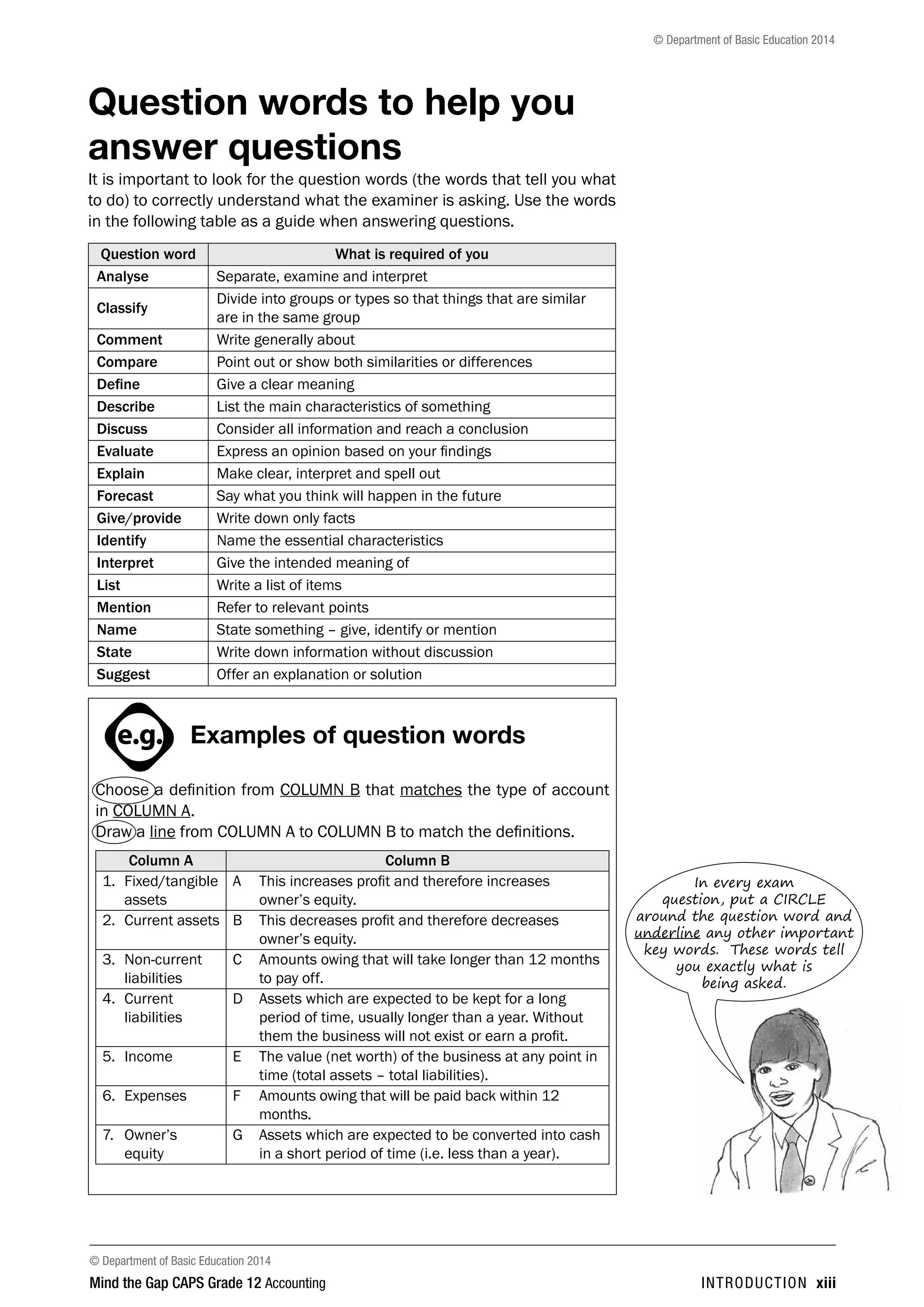
In every exam
question, put a CIRCLE
around the question word and
underline any other important
key words. These words tell
you exactly what is
being asked.
© Department of Basic Education 2014
xiv introduction Mind the Gap CAPS Grade 12 Accounting
© Department of Basic Education 2014
Learner’s Checklist
Use this checklist to monitor your progress when preparing for your
examination.
Topic
Coveredin
theStudy
Guide
Idonot
understand
I
understand
1. Basic Accounting Concepts 3
2. Companies
Accounting equation 3
Company concepts 3
GAAP principles 3
Company ledger accounts 3
Final accounts of companies:
Trading account 3
Profit and loss account 3
Appropriation account 3
Financial statements with adjustments: 	 Income Statement 3
	 Balance Sheet 3
	 Cash Flow Statement 3
Notes to the financial statements 3
Analysis and Interpretation of financial statements 3
Comment on an audit report 3
3. Manufacturing
Manufacturing concepts 3
Production Cost Statement with notes 3
Cost calculations 3
Break-even point 3
Trading and Profit and Loss Statements *
4. Budgets
Budgeting concepts 3
Debtors’ collection schedule 3
Creditors’ payment schedule 3
Cash budget (analyse and interpret) 3
Projected Income Statement (analyse and interpret) 3
5. Reconciliations
Bank reconciliation 3
Debtors reconciliation 3
Age analysis 3
Creditors reconciliation 3
6. Inventories
Inventory concepts 3
Inventory valuation – specific identification, FIFO and weight average methods 3
7. VAT
Concepts and calculations 3
VAT control account 3
8. Fixed Assets
Asset disposal 3
© Department of Basic Education 2014
Mind the Gap CAPS Grade 12 Accounting chapter 1 Basic accounting concepts 1
Chapter 1
Basic accounting
concepts
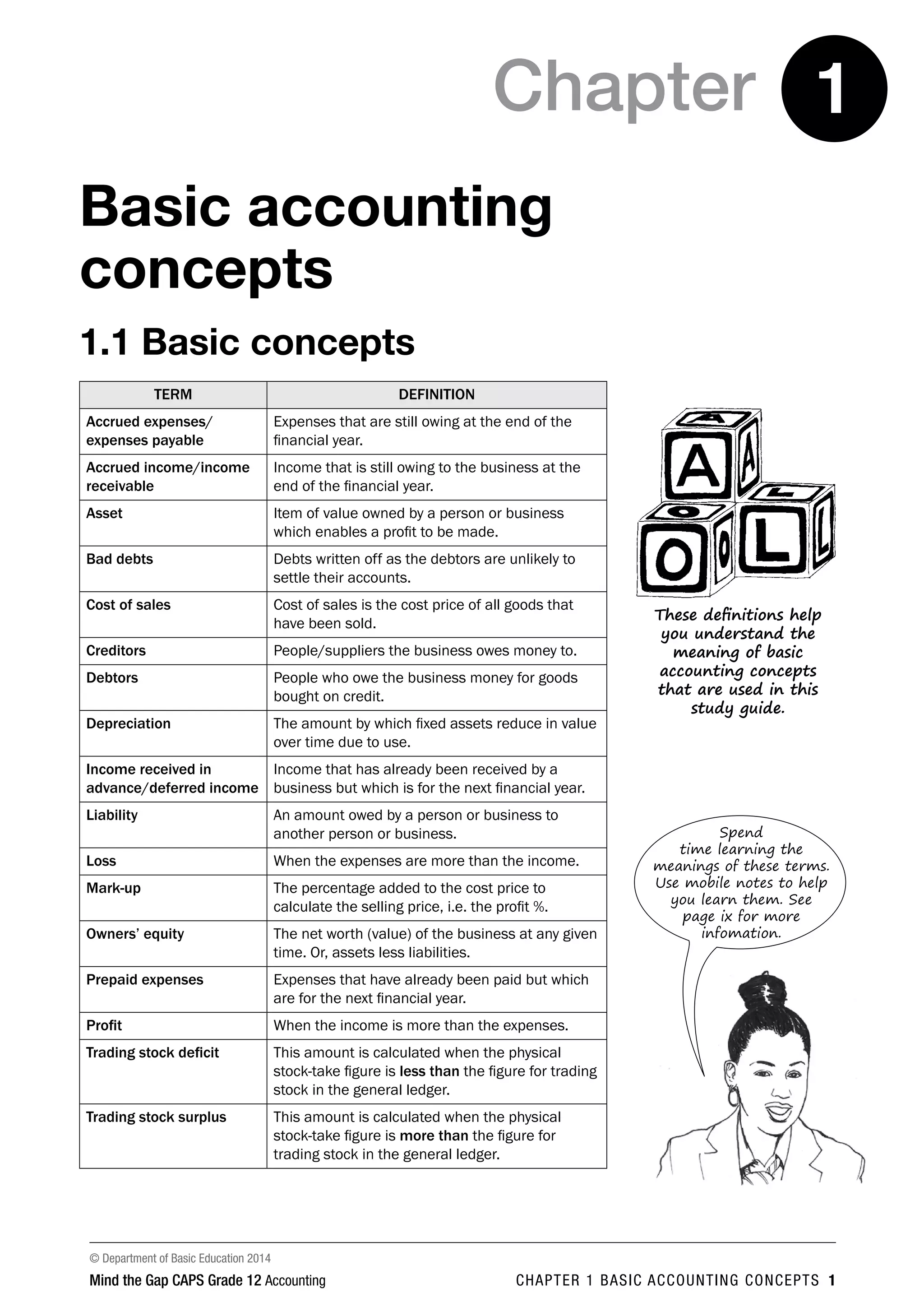
1.1 Basic concepts
Term Definition
Accrued expenses/
expenses payable
Expenses that are still owing at the end of the
financial year.
Accrued income/income
receivable
Income that is still owing to the business at the
end of the financial year.
Asset Item of value owned by a person or business
which enables a profit to be made.
Bad debts Debts written off as the debtors are unlikely to
settle their accounts.
Cost of sales Cost of sales is the cost price of all goods that
have been sold.
Creditors People/suppliers the business owes money to.
Debtors People who owe the business money for goods
bought on credit.
Depreciation The amount by which fixed assets reduce in value
over time due to use.
Income received in
advance/deferred income
Income that has already been received by a
business but which is for the next financial year.
Liability An amount owed by a person or business to
another person or business.
Loss When the expenses are more than the income.
Mark-up The percentage added to the cost price to
calculate the selling price, i.e. the profit %.
Owners’ equity The net worth (value) of the business at any given
time. Or, assets less liabilities.
Prepaid expenses Expenses that have already been paid but which
are for the next financial year.
Profit When the income is more than the expenses.
Trading stock deficit This amount is calculated when the physical
stock-take figure is less than the figure for trading
stock in the general ledger.
Trading stock surplus This amount is calculated when the physical
stock-take figure is more than the figure for
trading stock in the general ledger.
These definitions help
you understand the
meaning of basic
accounting concepts
that are used in this
study guide.
Spend
time learning the
meanings of these terms.
Use mobile notes to help
you learn them. See
page ix for more
infomation.
© Department of Basic Education 2014
2 chapter 1 basic accounting concepts Mind the Gap CAPS Grade 12 Accounting
Chapter1
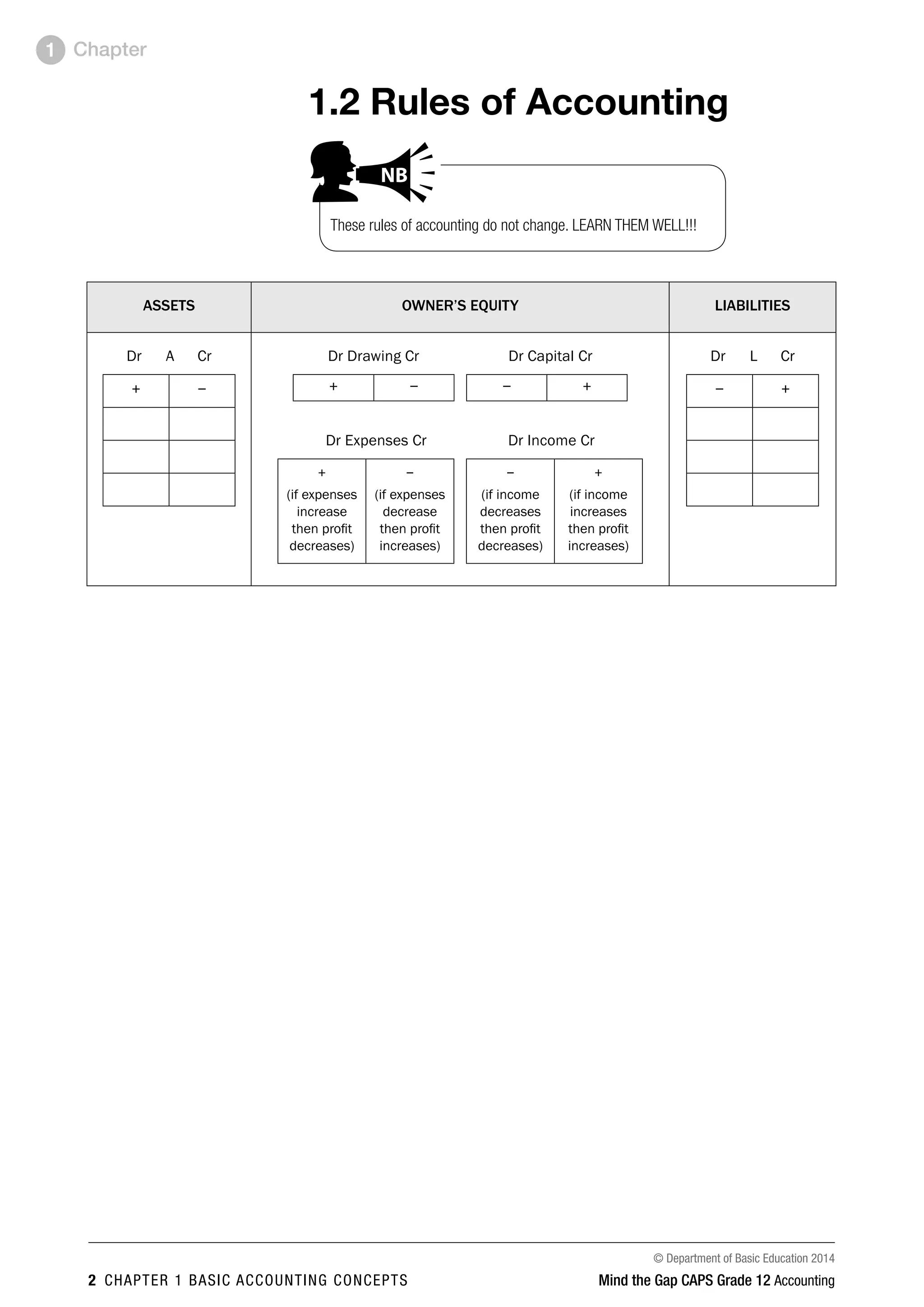
1.2 Rules of Accounting
Assets Owner’s equity Liabilities
Dr A Cr
+ −
Dr Drawing Cr Dr Capital Cr
+ − − +
Dr Expenses Cr Dr Income Cr
+
(if expenses
increase
then profit
decreases)
−
(if expenses
decrease
then profit
increases)
−
(if income
decreases
then profit
decreases)
+
(if income
increases
then profit
increases)
Dr L Cr
− +
These rules of accounting do not change. LEARN THEM WELL!!!
PAY SPECIAL ATTENTION
ACTIVITIES boy
and girl-left and
right of page
Step by step comment
EG - worked examples
HINT!
e.g.
NB NB
hint
activity
activity
comment
exams
© Department of Basic Education 2014
Mind the Gap CAPS Grade 12 Accounting chapter 1 Basic accounting concepts 3
Chapter 1
1.3 Classification of accounts
NON-CURRENT ASSETS
Tangible/fixed assets
•	 Land and buildings
•	 Equipment
•	 Vehicles
Financial assets
•	 Fixed deposit (longer than
12 months)
CURRENT ASSETS
Inventories
•	 Trading stock
•	 Consumable stores on hand
Trade and other receivables
•	 Debtors’ control
•	 Accrued income/income receivable
•	 Prepaid expenses
Cash and cash equivalents
•	 Bank (DR)
•	 Petty cash
•	 Cash float
•	 Fixed deposit (less than 12 months)
OWNER’S EQUITY
Expenses Income
•	 Cost of sales
•	 Interest expense
•	 Rent expense
•	 Salaries and wages
•	 Stationery
•	 Fuel
•	 Packing material
•	 Repairs
•	 Insurance
•	 Advertising
•	 Discount allowed
•	 Telephone
•	 Water and
electricity
•	 Loss on sale of
asset
•	 Bad debts
•	 Depreciation
•	 Trading stock deficit
•	 Provision for bad
debts adjustment
(+)
•	 Sales
•	 Current income
•	 Interest income
•	 Rent income
•	 Discount
received
•	 Bad debts
recovered
•	 Profit on sale of
asset
•	 Trading stock
surplus
•	 Provision for
bad debts
adjustment (–)
NON-CURRENT
LIABILITIES
(to be paid over more
than 12 months)
•	 Mortgage bond
•	 Loans
CURRENT LIABILITIES
(to be paid in less than
12 months)
•	 Trade creditors
•	 Bank overdraft (CR)
•	 Short term portion
of loan
•	 Accrued expenses/
expenses payable
•	 Income received in
advance/deferred
income
Activity 1: Matching items
Choose a definition from COLUMN B that matches the type of account in
COLUMN A.
Draw a line from COLUMN A to COLUMN B to match the definitions.
Column A Column B
1. 	Fixed/tangible
assets
A 	 This increases profit and therefore increases owner’s equity.
2. 	Current assets B 	 This decreases profit and therefore decreases owner’s equity.
3. 	Non-current
liabilities
C 	 Amounts owing that will take longer than 12 months to pay off.
4. 	Current
liabilities
D 	 Assets which are expected to be kept for a long period of time, usually longer than a
year. Without them the business will not exist or earn a profit.
5. 	Income E 	 The value (net worth) of the business at any point in time (total assets – total liabilities).
6. 	Expenses F 	 Amounts owing that will be paid back within 12 months.
7. 	 Owner’s equity G 	 Assets which are expected to be converted into cash in a short period of time (i.e. less
than a year).
[7]
© Department of Basic Education 2014
4 chapter 1 basic accounting concepts Mind the Gap CAPS Grade 12 Accounting
Chapter1
Answers to activity 1
Column A Column B
1 D
2 G
3 C
4 F
5 A
6 B
7 E
[7]
Activity 2: Multiple-choice questions
Three options are provided as possible answers to the following questions.
Circle the correct answer.
1. 	 Bank overdraft is classified as a... 2. 	 Consumable stores on hand is
classified as...
A 	 Non-current liability A 	 Owner’s equity
B 	 Current asset B 	 Current asset
C 	 Current liability C 	 An expense
[2]
Answers to activity 2
1 C This is a current liability because it will be paid back within
1 year (short-term).
2 B This is a current asset because the business will use them
within the next 12 months.
 [2]
© Department of Basic Education 2014
Mind the Gap CAPS Grade 12 Accounting chapter 1 Basic accounting concepts 5
Chapter 1
1.4 Steps to recording transactions
Refer to Rules of Accounting and Classification of accounts on page 2.
1.	 Read the transaction/adjustment.
Bought stationery and paid by cheque, R150.
2.	 Identify the two accounts affected – (double entry principle).
1. Stationery 2. Bank
3.	 Decide what type of accounts these are (classify).
	 Stationery = expense and therefore affects owner’s equity
Bank = current asset
4.	 Decide which account is debited and which account is credited.
The expense is increasing therefore DR stationery
The asset is decreasing therefore CR bank
5.	 Record your answer showing the effect on Assets (A), Owners’ equity (O) and Liabilities (L):
Account debit Account Credit A = O + L
Stationery Bank −150 −150 0
A zero indicates no effect. DO
NOT leave blank!
Three questions that will assist
you:
1. 	If an Asset: is it increasing
or decreasing my
possessions?
2. 	If a liability: is it increasing
or decreasing my debt?
3. 	If an Owners’ equity: it is
increasing or decreasing
the interest of the owner?
When a bank is favourable
it means it is an asset of the
business and remains in a
debit balance.
Keep going!
Activity 3: Accounting equation
Refer to Steps to recording transactions 1–4 above.
Record the transactions in the Table below assuming bank is favourable
(Dr) at all times.
1.	 Wrote off a debtor’s account of R500 as a bad debt.
2.	 Sent a cheque to a creditor to settle our account of R2 000.
3.	 Received rent of R5 000 from a tenant.
4.	 Bought trading stock on credit for R1 800.
5.	 Bought equipment for R600 and paid by cheque.
Account debit Account credit A = O + L
1
2
3
4
5
 [5]
Answers to activity 3
Account debit Account Credit A = O + L
1 Bad debts (expense
increasing)
Debtors control
(asset decreasing)
−500 −500 0
2 Creditors control
(liability decreasing)
Bank (asset
decreasing)
−2 000 0 −2 000
3 Bank (asset
increasing)
Rent income
(income increasing)
+5000 +5000 0
4 Trading stock (asset
increasing)
Creditors control
(liability increasing)
+1800 0 +1 800
5 Equipment (asset
increasing)
Bank (asset
decreasing)
±600 0 0
 [5]
© Department of Basic Education 2014
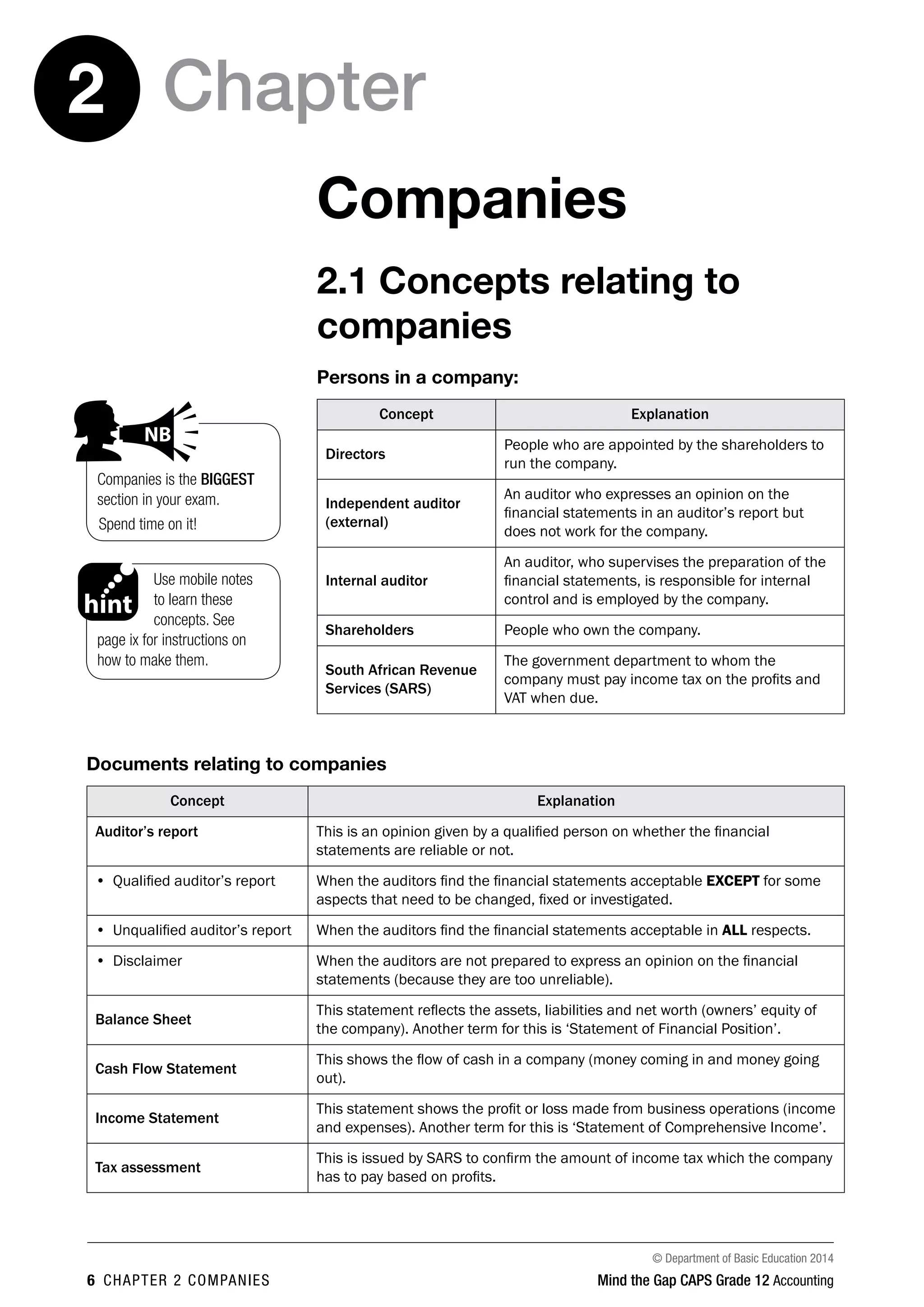
6 chapter 2 companies Mind the Gap CAPS Grade 12 Accounting
Chapter2
Companies
2.1 Concepts relating to
companies
Persons in a company:
Concept Explanation
Directors
People who are appointed by the shareholders to
run the company.
Independent auditor
(external)
An auditor who expresses an opinion on the
financial statements in an auditor’s report but
does not work for the company.
Internal auditor
An auditor, who supervises the preparation of the
financial statements, is responsible for internal
control and is employed by the company.
Shareholders People who own the company.
South African Revenue
Services (SARS)
The government department to whom the
company must pay income tax on the profits and
VAT when due.
Documents relating to companies
Concept Explanation
Auditor’s report This is an opinion given by a qualified person on whether the financial
statements are reliable or not.
•	 Qualified auditor’s report When the auditors find the financial statements acceptable EXCEPT for some
aspects that need to be changed, fixed or investigated.
•	 Unqualified auditor’s report When the auditors find the financial statements acceptable in ALL respects.
•	 Disclaimer When the auditors are not prepared to express an opinion on the financial
statements (because they are too unreliable).
Balance Sheet
This statement reflects the assets, liabilities and net worth (owners’ equity of
the company). Another term for this is ‘Statement of Financial Position’.
Cash Flow Statement
This shows the flow of cash in a company (money coming in and money going
out).
Income Statement
This statement shows the profit or loss made from business operations (income
and expenses). Another term for this is ‘Statement of Comprehensive Income’.
Tax assessment
This is issued by SARS to confirm the amount of income tax which the company
has to pay based on profits.
Use mobile notes
to learn these
concepts. See
page ix for instructions on
how to make them.
PAY SPECIAL ATTENTION
ACTIVITIES boy
and girl-left and
right of page
Step by step comment
EG - worked examples
HINT!
e.g.
NB NB
hint
activity
activity
comment
exams
Companies is the BIGGEST
section in your exam.
Spend time on it!
AL ATTENTION
ACTIVITIES boy
and girl-left and
right of page
p comment
d examples
NB
comment
© Department of Basic Education 2014
Mind the Gap CAPS Grade 12 Accounting chapter 2 companies 7
Chapter 2
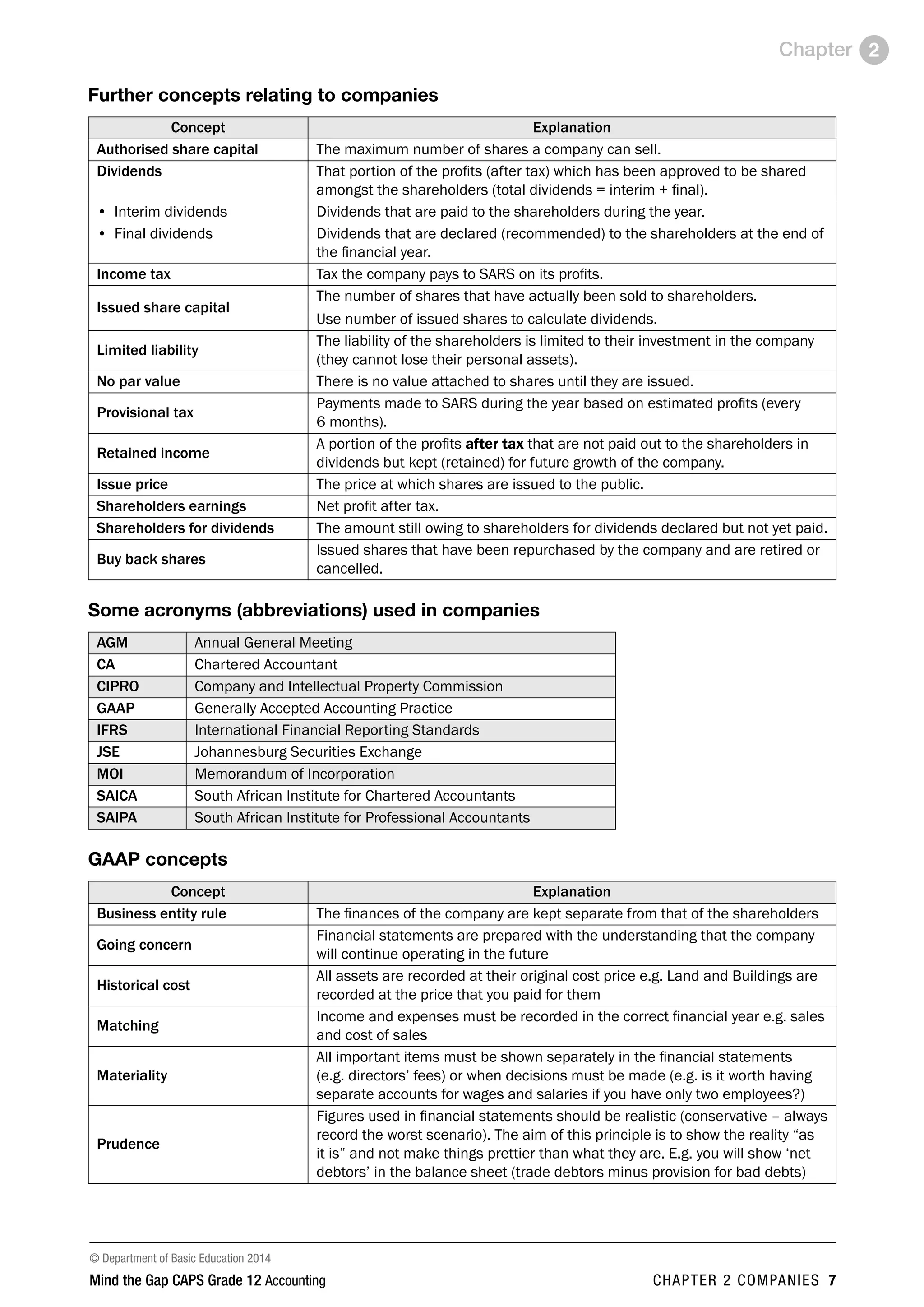
Further concepts relating to companies
Concept Explanation
Authorised share capital The maximum number of shares a company can sell.
Dividends That portion of the profits (after tax) which has been approved to be shared
amongst the shareholders (total dividends = interim + final).
•	 Interim dividends Dividends that are paid to the shareholders during the year.
•	 Final dividends Dividends that are declared (recommended) to the shareholders at the end of
the financial year.
Income tax Tax the company pays to SARS on its profits.
Issued share capital
The number of shares that have actually been sold to shareholders.
Use number of issued shares to calculate dividends.
Limited liability
The liability of the shareholders is limited to their investment in the company
(they cannot lose their personal assets).
No par value There is no value attached to shares until they are issued.
Provisional tax
Payments made to SARS during the year based on estimated profits (every
6 months).
Retained income
A portion of the profits after tax that are not paid out to the shareholders in
dividends but kept (retained) for future growth of the company.
Issue price The price at which shares are issued to the public.
Shareholders earnings Net profit after tax.
Shareholders for dividends The amount still owing to shareholders for dividends declared but not yet paid.
Buy back shares
Issued shares that have been repurchased by the company and are retired or
cancelled.
Some acronyms (abbreviations) used in companies
AGM Annual General Meeting
CA Chartered Accountant
CIPRO Company and Intellectual Property Commission
GAAP Generally Accepted Accounting Practice
IFRS International Financial Reporting Standards
JSE Johannesburg Securities Exchange
MOI Memorandum of Incorporation
SAICA South African Institute for Chartered Accountants
SAIPA South African Institute for Professional Accountants
Gaap concepts
Concept Explanation
Business entity rule The finances of the company are kept separate from that of the shareholders
Going concern
Financial statements are prepared with the understanding that the company
will continue operating in the future
Historical cost
All assets are recorded at their original cost price e.g. Land and Buildings are
recorded at the price that you paid for them
Matching
Income and expenses must be recorded in the correct financial year e.g. sales
and cost of sales
Materiality
All important items must be shown separately in the financial statements
(e.g. directors’ fees) or when decisions must be made (e.g. is it worth having
separate accounts for wages and salaries if you have only two employees?)
Prudence
Figures used in financial statements should be realistic (conservative – always
record the worst scenario). The aim of this principle is to show the reality “as
it is” and not make things prettier than what they are. E.g. you will show ‘net
debtors’ in the balance sheet (trade debtors minus provision for bad debts)
© Department of Basic Education 2014
8 chapter 2 companies Mind the Gap CAPS Grade 12 Accounting
Chapter2
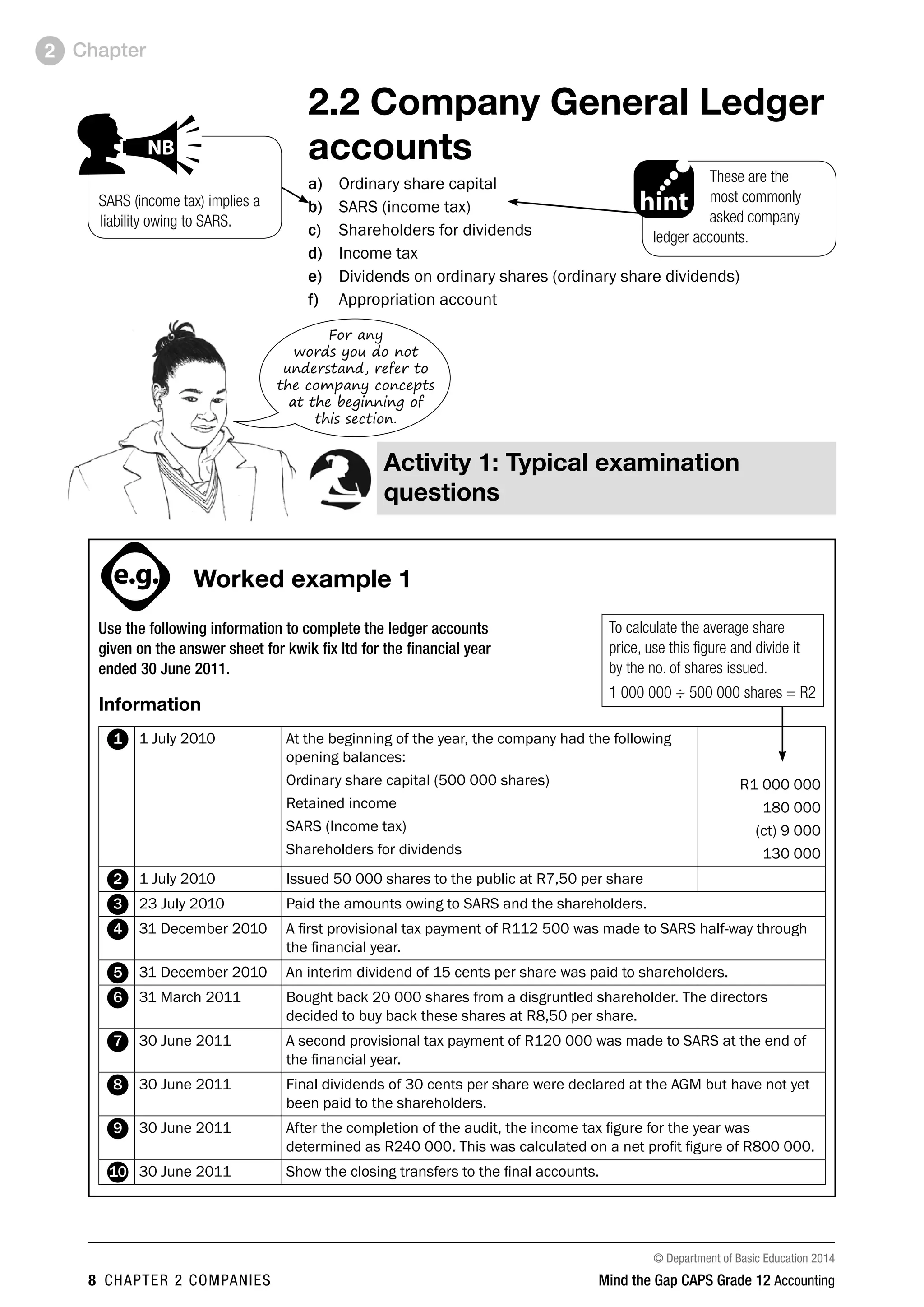
2.2 Company General Ledger
accounts
a)	 Ordinary share capital
b)	 sars (income tax)
c)	 Shareholders for dividends
d)	 Income tax
e)	 Dividends on ordinary shares (ordinary share dividends)
f)	 Appropriation account
Activity 1: Typical examination
questions
PAY SPECIAL ATTENTION
ACTIVITIES boy
and girl-left and
right of page
Step by step comment
EG - worked examples
HINT!
e.g.
NB NB
hint
activity
activity
comment
exams
Worked example 1
Use the following information to complete the ledger accounts
given on the answer sheet for kwik fix ltd for the financial year
ended 30 June 2011.
Information
1 1 July 2010 At the beginning of the year, the company had the following
opening balances:
Ordinary share capital (500 000 shares)
Retained income
SARS (Income tax)
Shareholders for dividends
R1 000 000
180 000
(ct) 9 000
130 000
2 1 July 2010 Issued 50 000 shares to the public at R7,50 per share
3 23 July 2010 Paid the amounts owing to SARS and the shareholders.
4 31 December 2010 A first provisional tax payment of R112 500 was made to SARS half-way through
the financial year.
5 31 December 2010 An interim dividend of 15 cents per share was paid to shareholders.
6 31 March 2011 Bought back 20 000 shares from a disgruntled shareholder. The directors
decided to buy back these shares at R8,50 per share.
7 30 June 2011 A second provisional tax payment of R120 000 was made to SARS at the end of
the financial year.
8 30 June 2011 Final dividends of 30 cents per share were declared at the AGM but have not yet
been paid to the shareholders.
9 30 June 2011 After the completion of the audit, the income tax figure for the year was
determined as R240 000. This was calculated on a net profit figure of R800 000.
10 30 June 2011 Show the closing transfers to the final accounts.
These are the
most commonly
asked company
ledger accounts.
PAY SPECIAL ATTENTION
ACTIVITIES boy
and girl-left and
right of page
Step by step comment
EG - worked examples
HINT!
e.g.
NB
hint
activity
activity
exams
To calculate the average share
price, use this figure and divide it
by the no. of shares issued.
1 000 000 ÷ 500 000 shares = R2
For any
words you do not
understand, refer to
the company concepts
at the beginning of
this section.
SARS (income tax) implies a
liability owing to SARS.
PAY SPECIAL ATTENTION
ACTIVITIES boy
and girl-left and
right of page
Step by step comment
EG - worked examples
HINT!
e.g.
NB NB
hint
activity
activity
comment
exams
© Department of Basic Education 2014
Mind the Gap CAPS Grade 12 Accounting chapter 2 companies 9
Chapter 2
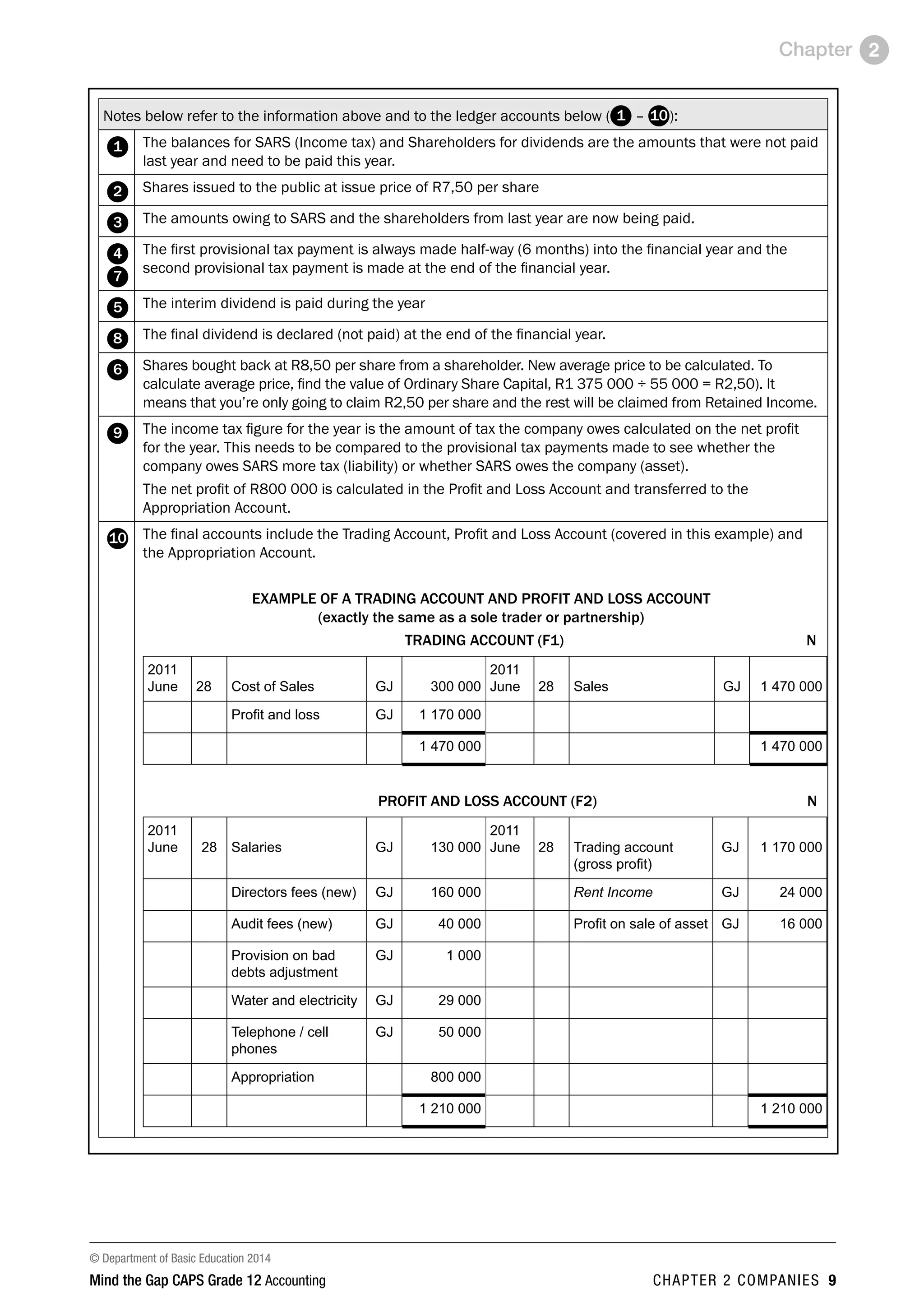
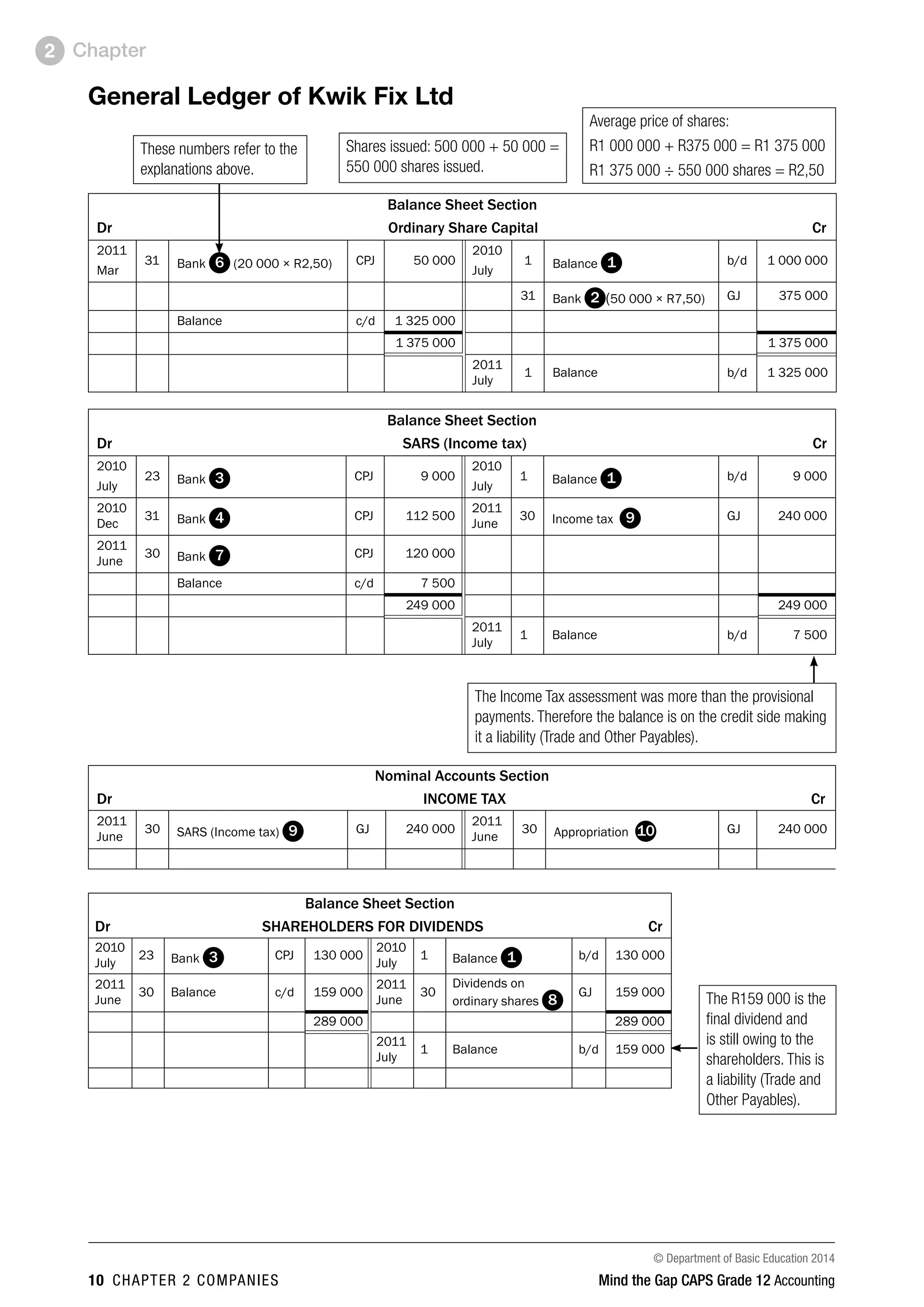
Notes below refer to the information above and to the ledger accounts below ( 1 – 10):
1 The balances for SARS (Income tax) and Shareholders for dividends are the amounts that were not paid
last year and need to be paid this year.
2 Shares issued to the public at issue price of R7,50 per share
3 The amounts owing to SARS and the shareholders from last year are now being paid.
4
7
The first provisional tax payment is always made half-way (6 months) into the financial year and the
second provisional tax payment is made at the end of the financial year.
5 The interim dividend is paid during the year
8 The final dividend is declared (not paid) at the end of the financial year.
6 Shares bought back at R8,50 per share from a shareholder. New average price to be calculated. To
calculate average price, find the value of Ordinary Share Capital, R1 375 000 ÷ 55 000 = R2,50). It
means that you’re only going to claim R2,50 per share and the rest will be claimed from Retained Income.
9 The income tax figure for the year is the amount of tax the company owes calculated on the net profit
for the year. This needs to be compared to the provisional tax payments made to see whether the
company owes SARS more tax (liability) or whether SARS owes the company (asset).
The net profit of R800 000 is calculated in the Profit and Loss Account and transferred to the
Appropriation Account.
10 The final accounts include the Trading Account, Profit and Loss Account (covered in this example) and
the Appropriation Account.
EXAMPLE OF A TRADING ACCOUNT AND PROFIT AND LOSS ACCOUNT
(exactly the same as a sole trader or partnership)
	TRADING ACCOUNT (F1)	 N
2011
June 28 Cost of Sales GJ 300 000
2011
June 28 Sales GJ 1 470 000
Profit and loss GJ 1 170 000
1 470 000 1 470 000
	 PROFIT AND LOSS ACCOUNT (F2)	 N
2011
June 28 Salaries GJ 130 000
2011
June 28 Trading account
(gross profit)
GJ 1 170 000
Directors fees (new) GJ 160 000 Rent Income GJ 24 000
Audit fees (new) GJ 40 000 Profit on sale of asset GJ 16 000
Provision on bad
debts adjustment
GJ 1 000
Water and electricity GJ 29 000
Telephone / cell
phones
GJ 50 000
Appropriation 800 000
1 210 000 1 210 000
© Department of Basic Education 2014
10 chapter 2 companies Mind the Gap CAPS Grade 12 Accounting
Chapter2
General Ledger of Kwik Fix Ltd
Balance Sheet Section
Dr	 Ordinary Share Capital 	 Cr
2011
Mar
31 Bank 6 (20 000 × R2,50) CPJ 50 000
2010
July
1 Balance 1 b/d 1 000 000
31 Bank 2 (50 000 × R7,50) GJ 375 000
Balance c/d 1 325 000
1 375 000 1 375 000
2011
July
1 Balance b/d 1 325 000
Balance Sheet Section
Dr	 SARS (Income tax)	 Cr
2010
July
23 Bank 3 CPJ 9 000
2010
July
1 Balance 1 b/d 9 000
2010
Dec
31 Bank 4 CPJ 112 500
2011
June
30 Income tax 9 GJ 240 000
2011
June
30 Bank 7 CPJ 120 000
Balance c/d 7 500
249 000 249 000
2011
July
1 Balance b/d 7 500
Nominal Accounts Section
Dr	INCOME TAX	 Cr
2011
June
30 SARS (Income tax) 9 GJ 240 000
2011
June
30 Appropriation 10 GJ 240 000
Balance Sheet Section
Dr	 SHAREHOLDERS FOR DIVIDENDS	 Cr
2010
July
23 Bank 3 CPJ 130 000
2010
July
1 Balance 1 b/d 130 000
2011
June
30 Balance c/d 159 000
2011
June
30
Dividends on
ordinary shares 8
GJ 159 000
289 000 289 000
2011
July
1 Balance b/d 159 000
The R159 000 is the
final dividend and
is still owing to the
shareholders. This is
a liability (Trade and
Other Payables).
These numbers refer to the
explanations above.
Average price of shares:
R1 000 000 + R375 000 = R1 375 000
R1 375 000 ÷ 550 000 shares = R2,50
The Income Tax assessment was more than the provisional
payments. Therefore the balance is on the credit side making
it a liability (Trade and Other Payables).
Shares issued: 500 000 + 50 000 =
550 000 shares issued.
© Department of Basic Education 2014
Mind the Gap CAPS Grade 12 Accounting chapter 2 companies 11
Chapter 2
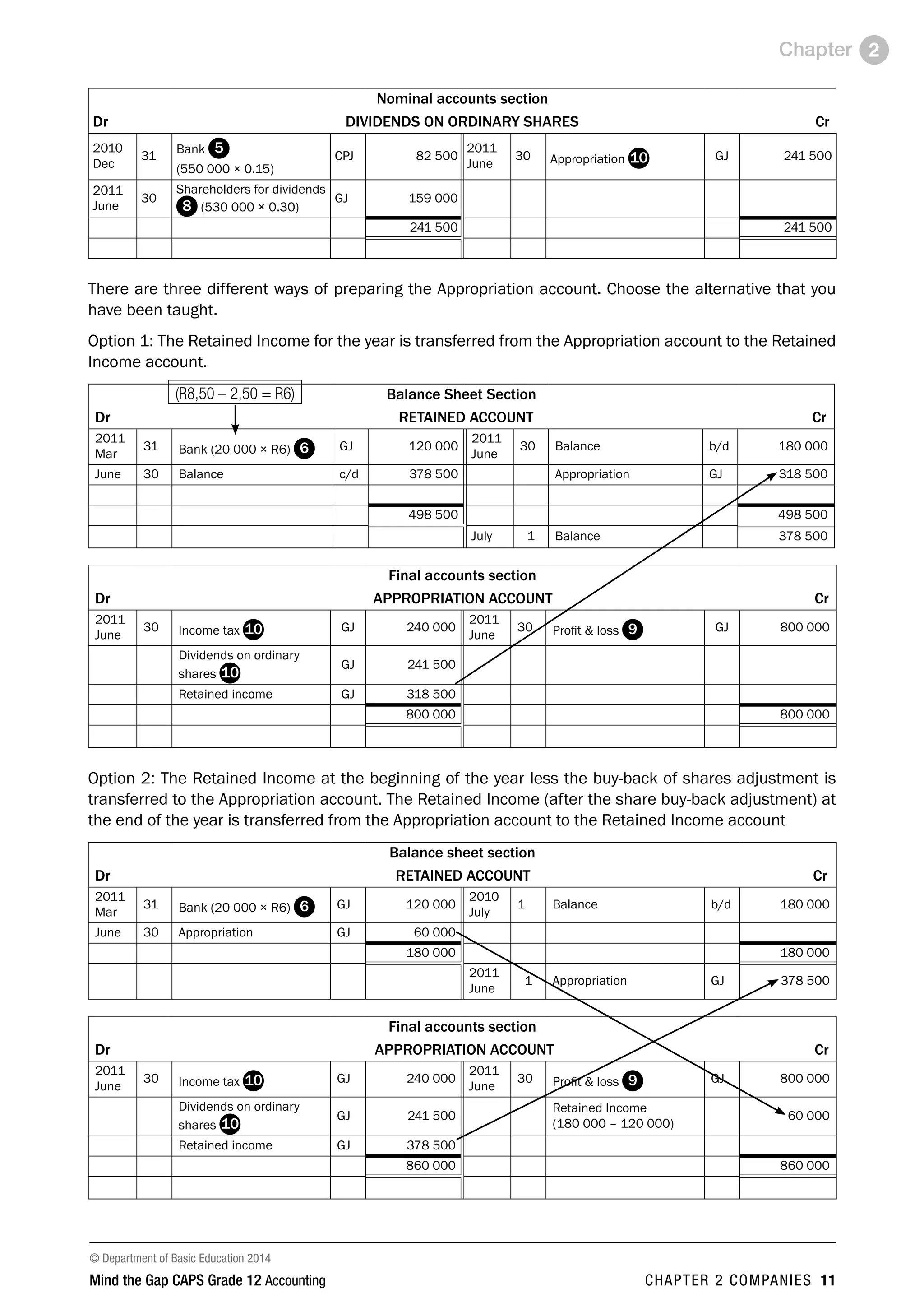
Nominal accounts section
Dr	DIVIDENDS ON ORDINARY SHARES	 Cr
2010
Dec
31
Bank 5
(550 000 × 0.15)
CPJ 82 500
2011
June
30 Appropriation 10 GJ 241 500
2011
June
30
Shareholders for dividends
8 (530 000 × 0.30)
GJ 159 000
241 500 241 500
There are three different ways of preparing the Appropriation account. Choose the alternative that you
have been taught.
Option 1: The Retained Income for the year is transferred from the Appropriation account to the Retained
Income account.
Balance Sheet Section
Dr	 RETAINED ACCOUNT	 Cr
2011
Mar
31 Bank (20 000 × R6) 6 GJ 120 000
2011
June
30 Balance b/d 180 000
June 30 Balance c/d 378 500 Appropriation GJ 318 500
498 500 498 500
July 1 Balance 378 500
Final accounts section
Dr	 APPROPRIATION ACCOUNT	 Cr
2011
June
30 Income tax 10 GJ 240 000
2011
June
30 Profit  loss 9 GJ 800 000
Dividends on ordinary
shares 10
GJ 241 500
Retained income GJ 318 500
800 000 800 000
Option 2: The Retained Income at the beginning of the year less the buy-back of shares adjustment is
transferred to the Appropriation account. The Retained Income (after the share buy-back adjustment) at
the end of the year is transferred from the Appropriation account to the Retained Income account
Balance sheet section
Dr	 RETAINED ACCOUNT	 Cr
2011
Mar
31 Bank (20 000 × R6) 6 GJ 120 000
2010
July
1 Balance b/d 180 000
June 30 Appropriation GJ 60 000
180 000 180 000
2011
June
1 Appropriation GJ 378 500
Final accounts section
Dr	 APPROPRIATION ACCOUNT	 Cr
2011
June
30 Income tax 10 GJ 240 000
2011
June
30 Profit  loss 9 GJ 800 000
Dividends on ordinary
shares 10
GJ 241 500
Retained Income
(180 000 – 120 000)
60 000
Retained income GJ 378 500
860 000 860 000
(R8,50 – 2,50 = R6)
© Department of Basic Education 2014
12 chapter 2 companies Mind the Gap CAPS Grade 12 Accounting
Chapter2
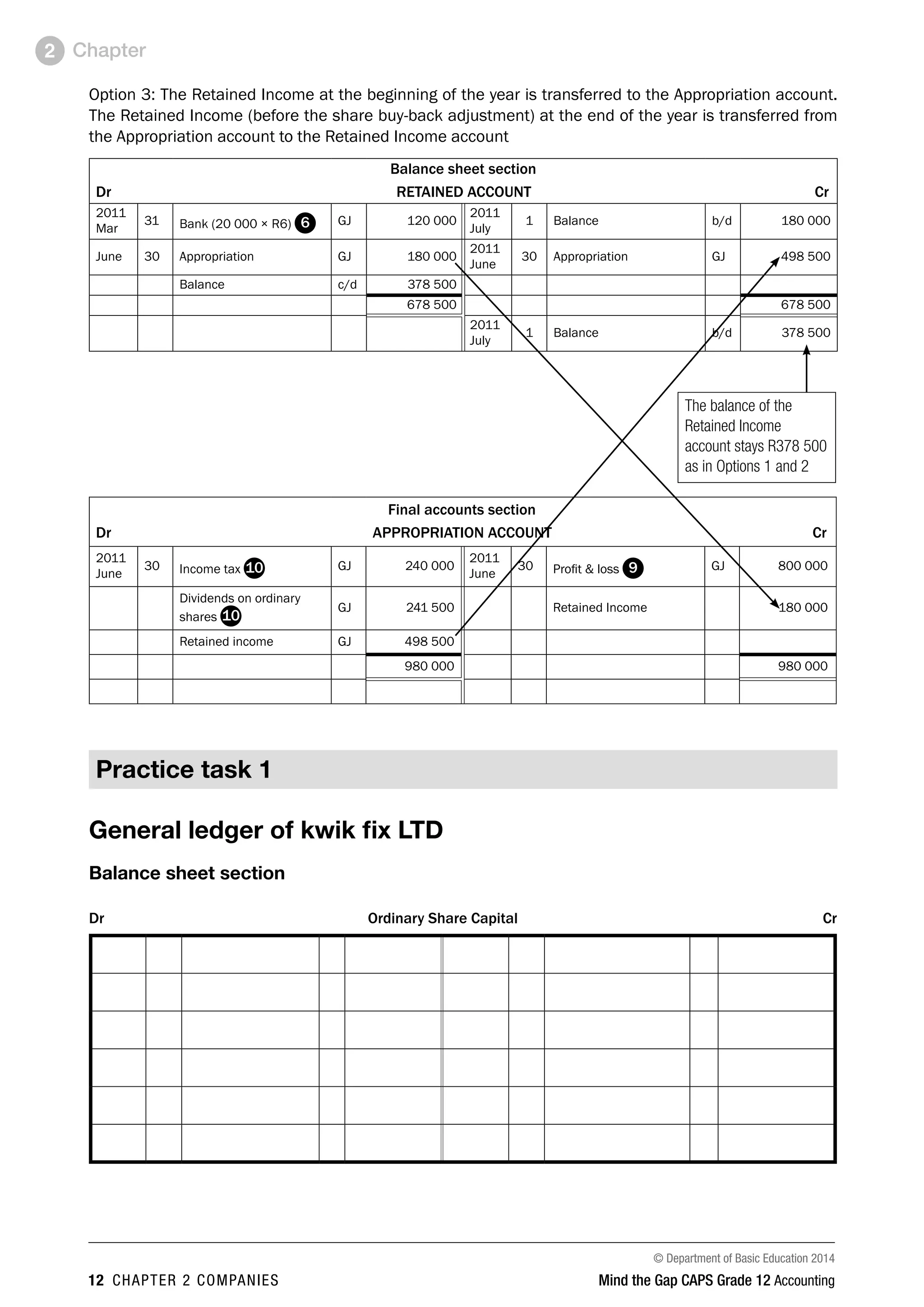
Option 3: The Retained Income at the beginning of the year is transferred to the Appropriation account.
The Retained Income (before the share buy-back adjustment) at the end of the year is transferred from
the Appropriation account to the Retained Income account
Balance sheet section
Dr	 RETAINED ACCOUNT	 Cr
2011
Mar
31 Bank (20 000 × R6) 6 GJ 120 000
2011
July
1 Balance b/d 180 000
June 30 Appropriation GJ 180 000
2011
June
30 Appropriation GJ 498 500
Balance c/d 378 500
678 500 678 500
2011
July
1 Balance b/d 378 500
Final accounts section
Dr	 APPROPRIATION ACCOUNT	 Cr
2011
June
30 Income tax 10 GJ 240 000
2011
June
30 Profit  loss 9 GJ 800 000
Dividends on ordinary
shares 10
GJ 241 500 Retained Income 180 000
Retained income GJ 498 500
980 000 980 000
Practice task 1
General ledger of kwik fix ltd
Balance sheet section
Dr	 Ordinary Share Capital	 Cr
The balance of the
Retained Income
account stays R378 500
as in Options 1 and 2
© Department of Basic Education 2014
Mind the Gap CAPS Grade 12 Accounting chapter 2 companies 13
Chapter 2
Dr	 Retained income	 Cr
Dr	 sars (Income tax)	 Cr
Dr	 Shareholders for Dividends	 Cr
Nominal section
Dr	Income Tax	 Cr
© Department of Basic Education 2014
14 chapter 2 companies Mind the Gap CAPS Grade 12 Accounting
Chapter2
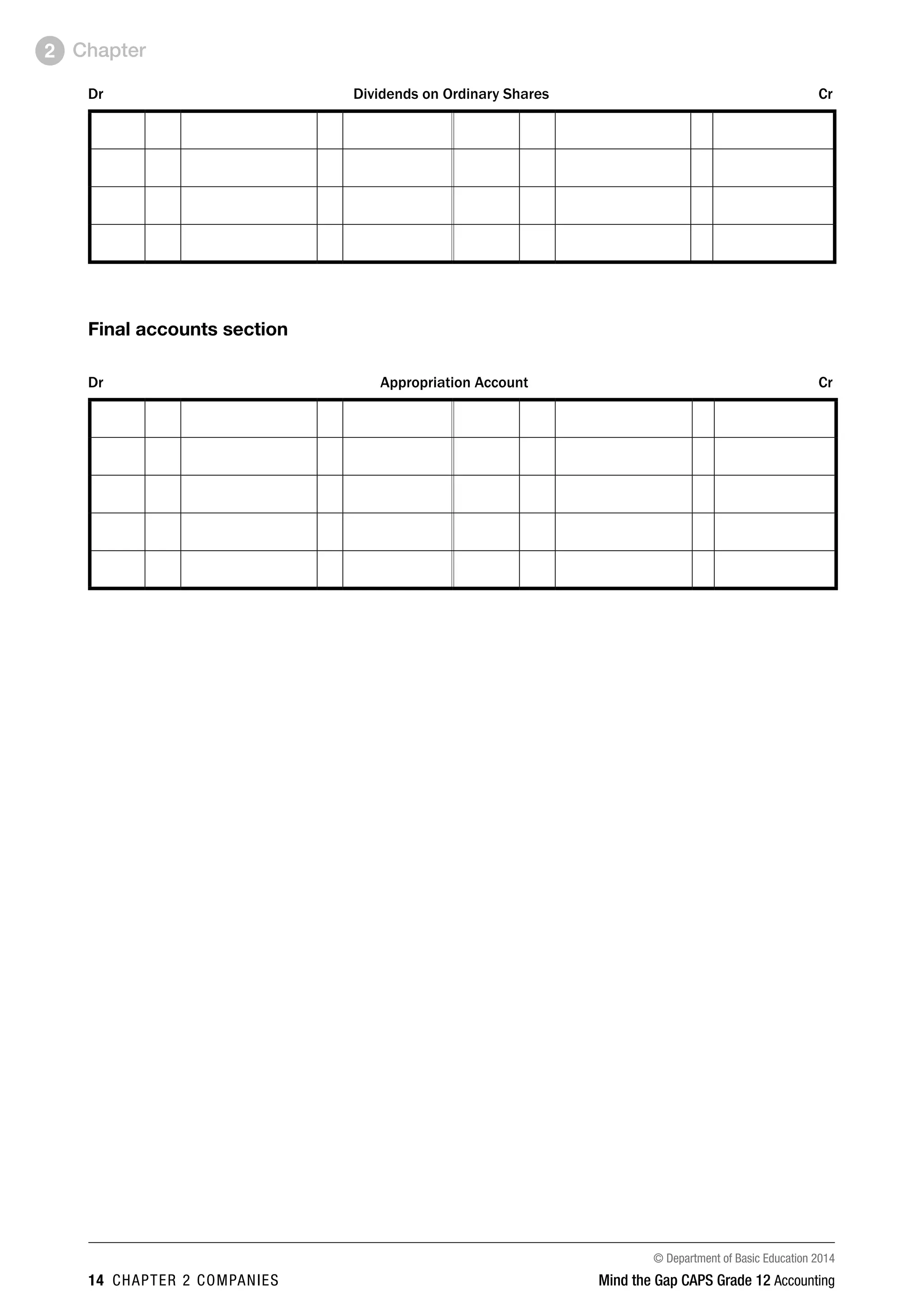
Dr	Dividends on Ordinary Shares	 Cr
Final accounts section
Dr	 Appropriation Account	 Cr
© Department of Basic Education 2014
Mind the Gap CAPS Grade 12 Accounting chapter 2 companies 15
Chapter 2
2.3 Preparation of Financial
Statements for companies
Income statement
Use the following steps to prepare an income statement
from a pre-adjustment trial balance:
1.	 Enter the pre-adjustment trial balance figures from the nominal
section onto the answer sheet next to the detail.
2.	 Read each adjustment:
a)	 If necessary calculate the adjustment amount
b)	 Decide on which account is to be debited and which account is
to be credited.
c)	 On your answer sheet reflect a (+) or a (–) in respect of each
adjustment next to the already entered pre-adjustment figure.
i)	 Outstanding/accrued amounts will be added (+) and
prepaid/received in advance amounts will be subtracted (–)
3.	 When all the adjustments have been done, calculate your final
figures and write them in the column.
Remember a pre-adjustment
trial balance refers to a trial
balance that is NOT final
and requires adjustments
(entries) to be made to finalise
the figures to be used in the
preparation of the annual
Financial Statements.
Look at
the format you have
been given. Do you notice
any missing details? Fill
them in. THESE ARE
EASY MARKS!
© Department of Basic Education 2014
16 chapter 2 companies Mind the Gap CAPS Grade 12 Accounting
Chapter2
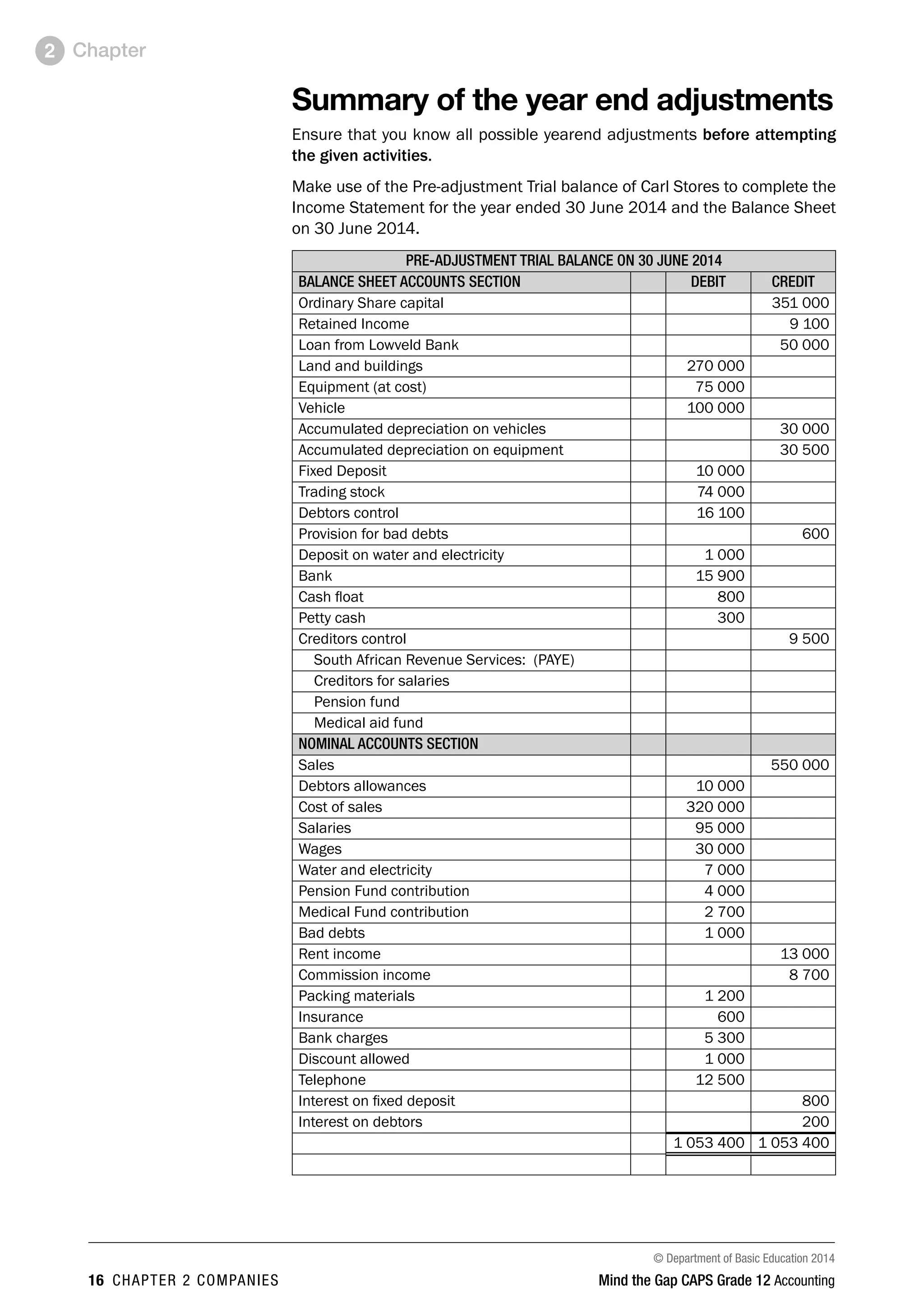
Summary of the year end adjustments
Ensure that you know all possible yearend adjustments before attempting
the given activities.
Make use of the Pre-adjustment Trial balance of Carl Stores to complete the
Income Statement for the year ended 30 June 2014 and the Balance Sheet
on 30 June 2014.
PRE-ADJUSTMENT TRIAL BALANCE ON 30 JUNE 2014
BALANCE SHEET ACCOUNTS SECTION DEBIT CREDIT
Ordinary Share capital 351 000
Retained Income 9 100
Loan from Lowveld Bank 50 000
Land and buildings 270 000
Equipment (at cost) 75 000
Vehicle 100 000
Accumulated depreciation on vehicles 30 000
Accumulated depreciation on equipment 30 500
Fixed Deposit 10 000
Trading stock 74 000
Debtors control 16 100
Provision for bad debts 600
Deposit on water and electricity 1 000
Bank 15 900
Cash float 800
Petty cash 300
Creditors control 9 500
South African Revenue Services: (PAYE)
Creditors for salaries
Pension fund
Medical aid fund
NOMINAL ACCOUNTS SECTION
Sales 550 000
Debtors allowances 10 000
Cost of sales 320 000
Salaries 95 000
Wages 30 000
Water and electricity 7 000
Pension Fund contribution 4 000
Medical Fund contribution 2 700
Bad debts 1 000
Rent income 13 000
Commission income 8 700
Packing materials 1 200
Insurance 600
Bank charges 5 300
Discount allowed 1 000
Telephone 12 500
Interest on fixed deposit 800
Interest on debtors 200
1 053 400 1 053 400
© Department of Basic Education 2014
Mind the Gap CAPS Grade 12 Accounting chapter 2 companies 17
Chapter 2
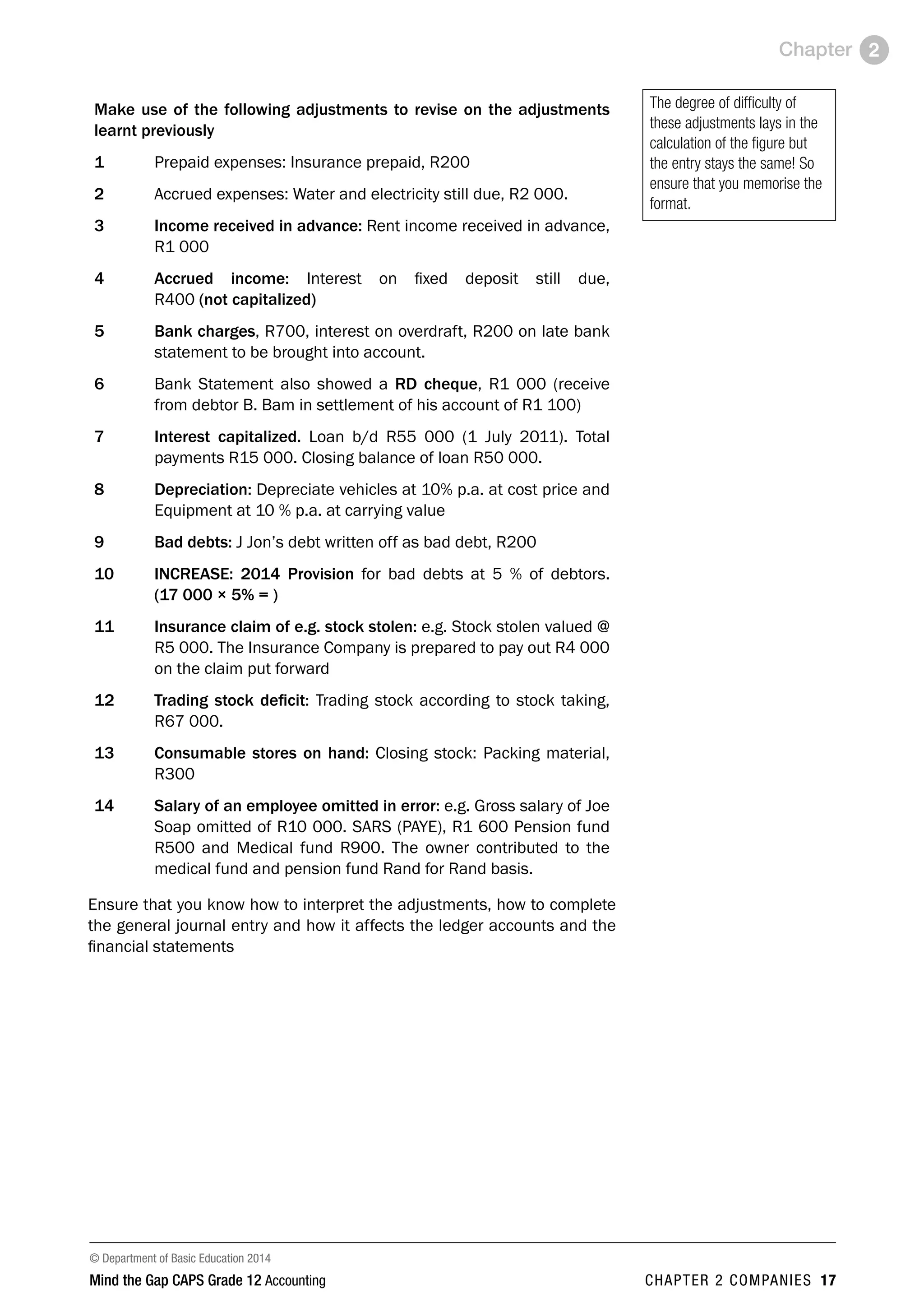
Make use of the following adjustments to revise on the adjustments
learnt previously
1 Prepaid expenses: Insurance prepaid, R200
2 Accrued expenses: Water and electricity still due, R2 000.
3 Income received in advance: Rent income received in advance,
R1 000
4 Accrued income: Interest on fixed deposit still due,
R400 (not capitalized)
5 Bank charges, R700, interest on overdraft, R200 on late bank
statement to be brought into account.
6 Bank Statement also showed a RD cheque, R1 000 (receive
from debtor B. Bam in settlement of his account of R1 100)
7 Interest capitalized. Loan b/d R55  000 (1 July 2011). Total
payments R15 000. Closing balance of loan R50 000.
8 Depreciation: Depreciate vehicles at 10% p.a. at cost price and
Equipment at 10 % p.a. at carrying value
9 Bad debts: J Jon’s debt written off as bad debt, R200
10 INCREASE: 2014 Provision for bad debts at 5 % of debtors.
(17 000 × 5% = )
11 Insurance claim of e.g. stock stolen: e.g. Stock stolen valued @
R5 000. The Insurance Company is prepared to pay out R4 000
on the claim put forward
12 Trading stock deficit: Trading stock according to stock taking,
R67 000.
13 Consumable stores on hand: Closing stock: Packing material,
R300
14 Salary of an employee omitted in error: e.g. Gross salary of Joe
Soap omitted of R10 000. SARS (PAYE), R1 600 Pension fund
R500 and Medical fund R900. The owner contributed to the
medical fund and pension fund Rand for Rand basis.
Ensure that you know how to interpret the adjustments, how to complete
the general journal entry and how it affects the ledger accounts and the
financial statements
The degree of difficulty of
these adjustments lays in the
calculation of the figure but
the entry stays the same! So
ensure that you memorise the
format.
© Department of Basic Education 2014
18 chapter 2 companies Mind the Gap CAPS Grade 12 Accounting
Chapter2
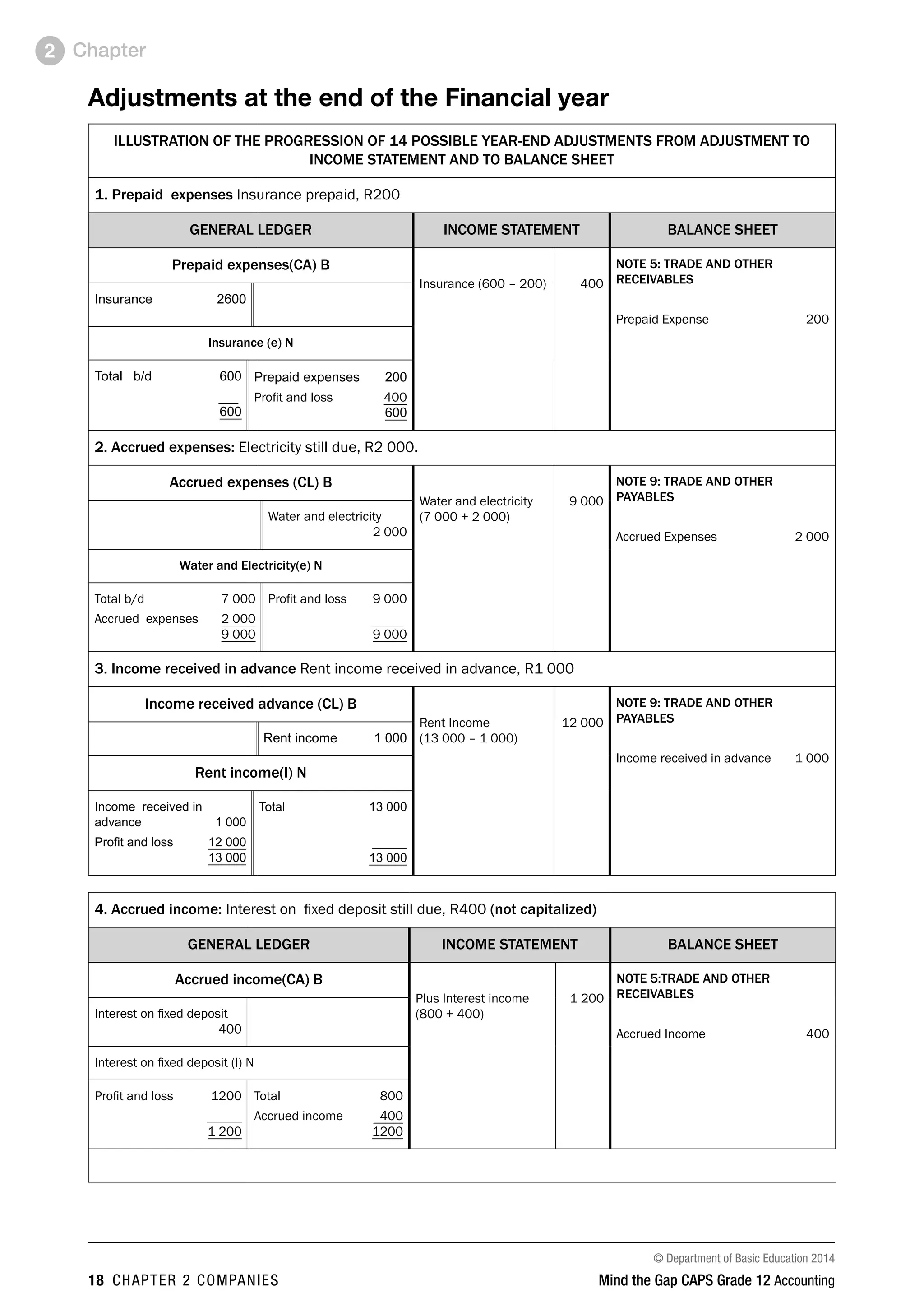
Adjustments at the end of the Financial year
ILLUSTRATION OF THE PROGRESSION OF 14 POSSIBLE YEAR-END ADJUSTMENTS FROM ADJUSTMENT TO
INCOME STATEMENT AND TO BALANCE SHEET
1. Prepaid expenses Insurance prepaid, R200
GENERAL LEDGER INCOME STATEMENT BALANCE SHEET
Prepaid expenses(CA) B
Insurance (600 – 200) 400
NOTE 5: TRADE AND OTHER
RECEIVABLES
Prepaid Expense 200
Insurance 2600
Insurance (e) N
Total b/d 600
 600
Prepaid expenses 200
Profit and loss 400
 600
2. Accrued expenses: Electricity still due, R2 000.
Accrued expenses (CL) B
Water and electricity
(7 000 + 2 000)
9 000
NOTE 9: TRADE AND OTHER
PAYABLES
Accrued Expenses 2 000
Water and electricity
 2 000
Water and Electricity(e) N
Total b/d 7 000
Accrued expenses 2 000
 9 000
Profit and loss 9 000
 9 000
3. Income received in advance Rent income received in advance, R1 000
Income received advance (CL) B
Rent Income
(13 000 – 1 000)
12 000
NOTE 9: TRADE AND OTHER
PAYABLES
Income received in advance 1 000
Rent income 1 000
Rent income(I) N
Income received in
advance 1 000
Profit and loss 12 000
 13 000
Total 13 000
 _____
 13 000
4. Accrued income: Interest on fixed deposit still due, R400 (not capitalized)
GENERAL LEDGER INCOME STATEMENT BALANCE SHEET
Accrued income(CA) B
Plus Interest income
(800 + 400)
1 200
NOTE 5:TRADE AND OTHER
RECEIVABLES
Accrued Income 400
Interest on fixed deposit
 400
Interest on fixed deposit (I) N
Profit and loss 1200
 _____
 1 200
Total 800
Accrued income 400
 1200
© Department of Basic Education 2014
Mind the Gap CAPS Grade 12 Accounting chapter 2 companies 19
Chapter 2
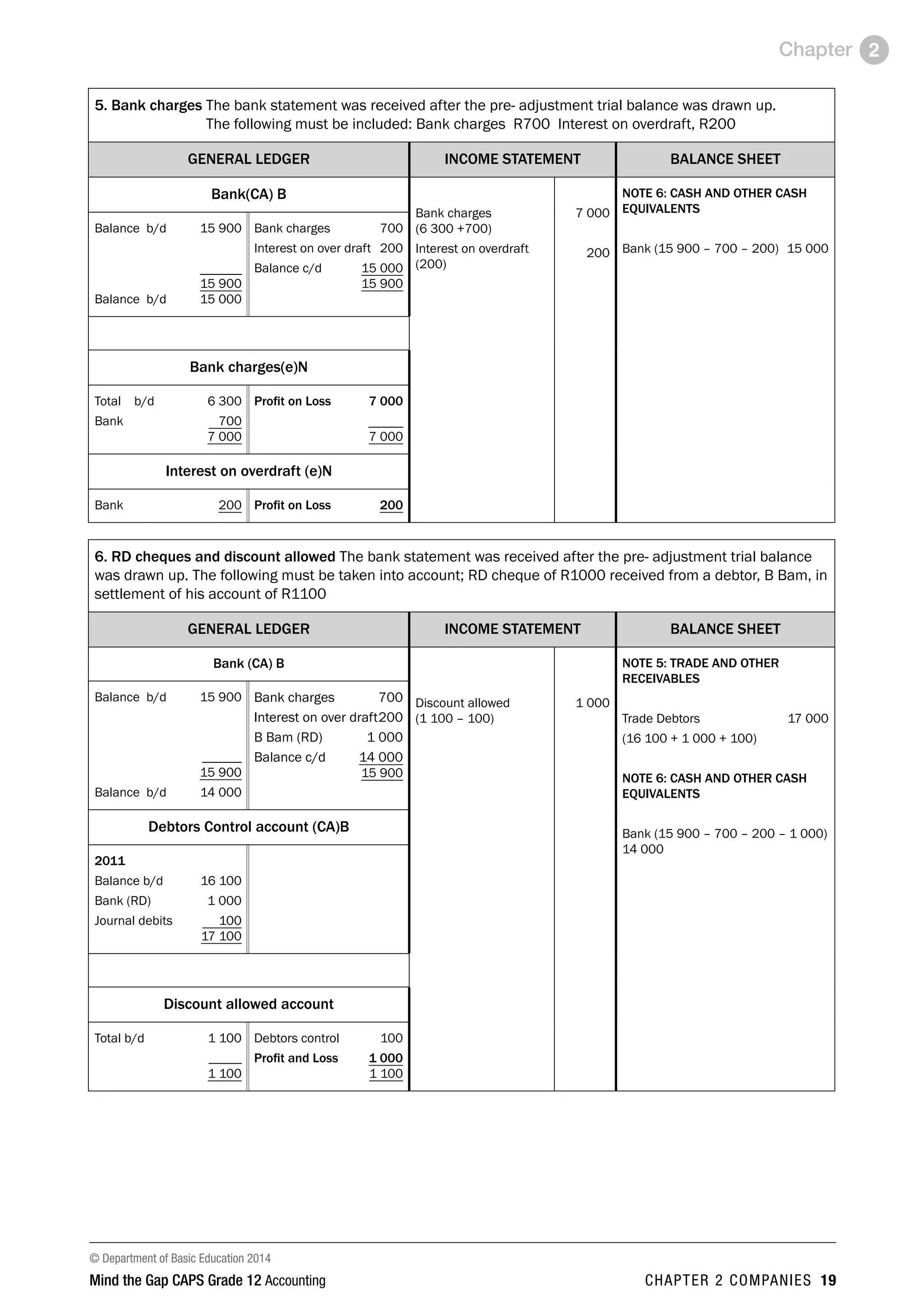
5. Bank charges The bank statement was received after the pre- adjustment trial balance was drawn up.
The following must be included: Bank charges R700 Interest on overdraft, R200
GENERAL LEDGER INCOME STATEMENT BALANCE SHEET
Bank(CA) B
Bank charges
(6 300 +700)
Interest on overdraft
(200)
7 000
200
NOTE 6: CASH AND OTHER CASH
EQUIVALENTS
Bank (15 900 – 700 – 200) 15 000
Balance b/d 15 900
 ______
 15 900
Balance b/d 15 000
Bank charges 700
Interest on over draft 200
Balance c/d 15 000
 15 900
Bank charges(e)N
Total b/d 6 300
Bank 700
 7 000
Profit on Loss 7 000
 _____
 7 000
Interest on overdraft (e)N
Bank 200 Profit on Loss 200
6. RD cheques and discount allowed The bank statement was received after the pre- adjustment trial balance
was drawn up. The following must be taken into account; RD cheque of R1000 received from a debtor, B Bam, in
settlement of his account of R1100
GENERAL LEDGER INCOME STATEMENT BALANCE SHEET
Bank (CA) B
Discount allowed
(1 100 – 100)
1 000
NOTE 5: TRADE AND OTHER
RECEIVABLES
Trade Debtors 17 000
(16 100 + 1 000 + 100)
NOTE 6: CASH AND OTHER CASH
EQUIVALENTS
Bank (15 900 – 700 – 200 – 1 000)
14 000
Balance b/d 15 900
 ______
 15 900
Balance b/d 14 000
Bank charges 700
Interest on over draft200
B Bam (RD) 1 000
Balance c/d 14 000
 15 900
Debtors Control account (CA)B
2011
Balance b/d 16 100
Bank (RD) 1 000
Journal debits 100
 17 100
Discount allowed account
Total b/d 1 100
 _____
 1 100
Debtors control 100
Profit and Loss 1 000
 1 100
© Department of Basic Education 2014
20 chapter 2 companies Mind the Gap CAPS Grade 12 Accounting
Chapter2
7. Interest capitalized. Loan b/d 55 000 (1 Jan 2009) Total payments R15 000 Closing balance of loan R50 000
GENERAL LEDGER INCOME STATEMENT BALANCE SHEET
Loan: Crazy Bank (CA) B
Interest on loan
(55 000 – 15000 –
50 000)
10 000 NON-CURRENT
LIABILITIES
Loan: Crazy Bank
(50 000 – 5 000)
CURRENT LIABILITIES
Short term loan
45 000
5 000
Bank (10 000+5 000)
 15 000
Balance c/d 50 000
 65 000
Balance b/d 55 000
Interest on loan 10 000
 65 000
Balance b/d 50 000
Interest on loan (I) N
Loan: Crazy Bank 10 000 Profit and loss 10 000
8. Depreciation
Vehicles: R100 000
Accumulated depreciation:R30 000
Depreciation at cost price: 100 000 × 10/100 = 10 000
Equipment: R75 000
Accumulated. Depreciation: R30 500
Depreciation at carrying value
75 000 – 30 500 = 44 500 × 10/100 = 4 450
GENERAL LEDGER INCOME STATEMENT BALANCE SHEET
Depreciation (e) N Depreciation
(10 000 + 4 450)
14 450 NOTE 3: FIXED ASSETS
Cost price
Accumulated depre.
Carrying value
Movements:
Depreciation
Carrying value
Cost price
Accumulated depre
75 000
(30 500)
44 500
(4 450)
39 050
75 000
(35 950
100 000
(30 000)
70 000
(10 000)
60 000
100 000
(40 000)
Accumulated
depreciation on Vehicle
 10 000
Accumulated
Depreciation on
equipment 4 450
 14 450
Profit on Loss 14 450
 _______
 14 450
Accumulated Depreciation on
Vehicles (–A) B
Balance b/d 30 000
Depreciation 10 000
 40 000
Accumulated Depreciation on
Equipment (–A) B
Balance b/d 30 500
Depreciation 4 450
 34 950
The total payments for the year
includes the interest charged
(R10 000) for the year
© Department of Basic Education 2014
Mind the Gap CAPS Grade 12 Accounting chapter 2 companies 21
Chapter 2
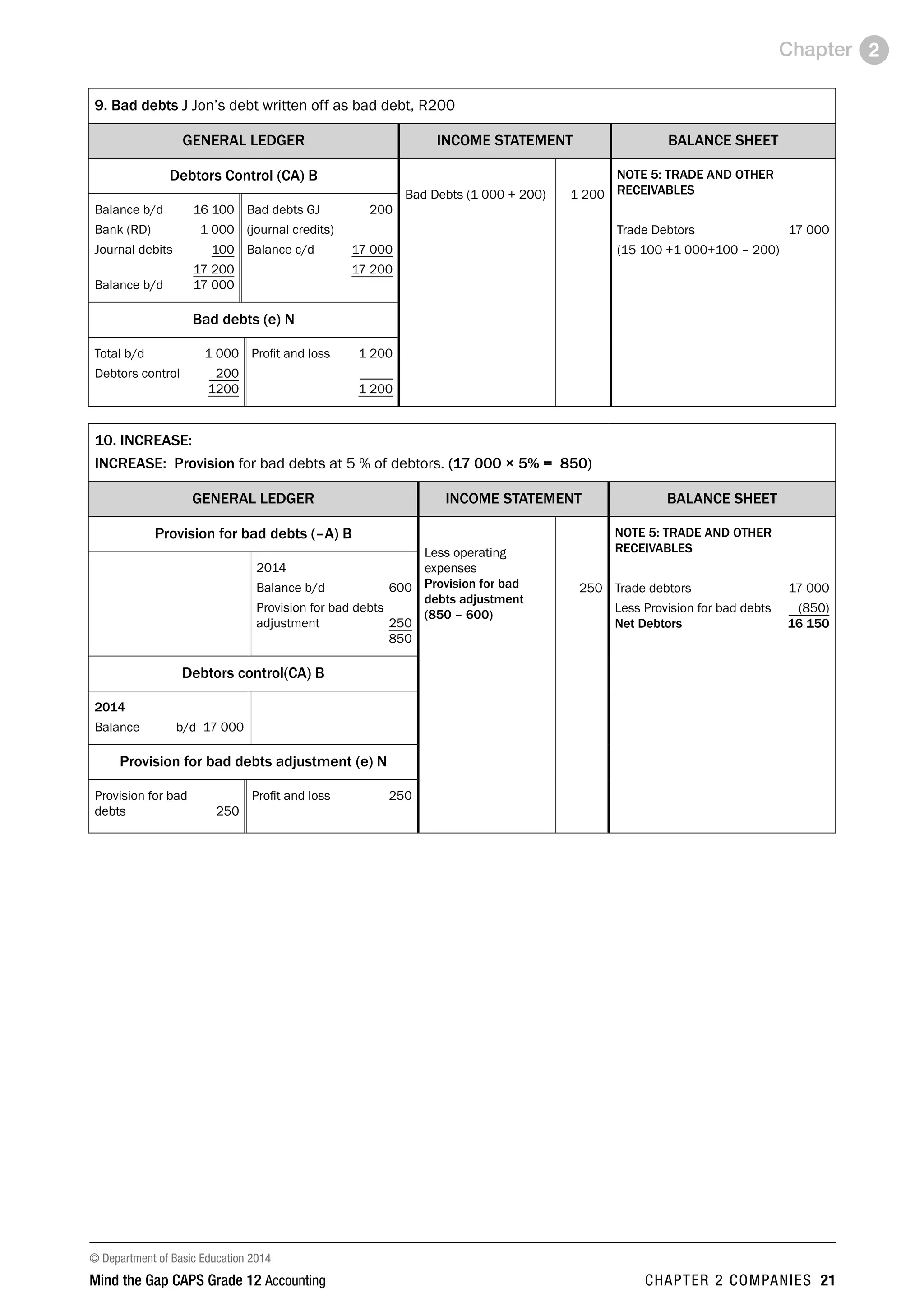
9. Bad debts J Jon’s debt written off as bad debt, R200
GENERAL LEDGER INCOME STATEMENT BALANCE SHEET
Debtors Control (CA) B
Bad Debts (1 000 + 200) 1 200
NOTE 5: TRADE AND OTHER
RECEIVABLES
Trade Debtors 17 000
(15 100 +1 000+100 – 200)
Balance b/d 16 100
Bank (RD) 1 000
Journal debits 100
 17 200
Balance b/d 17 000
Bad debts GJ 200
(journal credits)
Balance c/d  17 000
 17 200
Bad debts (e) N
Total b/d 1 000
Debtors control 200
 1200
Profit and loss 1 200
 _____
 1 200
10. INCREASE:
INCREASE: Provision for bad debts at 5 % of debtors. (17 000 × 5% = 850)
GENERAL LEDGER INCOME STATEMENT BALANCE SHEET
Provision for bad debts (–A) B
Less operating
expenses
Provision for bad
debts adjustment
(850 – 600)
250
NOTE 5: TRADE AND OTHER
RECEIVABLES
Trade debtors 17 000
Less Provision for bad debts (850)
Net Debtors 16 150
2014
Balance b/d 600
Provision for bad debts
adjustment 250
 850
Debtors control(CA) B
2014
Balance b/d 17 000
Provision for bad debts adjustment (e) N
Provision for bad
debts 250
Profit and loss 250
© Department of Basic Education 2014
22 chapter 2 companies Mind the Gap CAPS Grade 12 Accounting
Chapter2
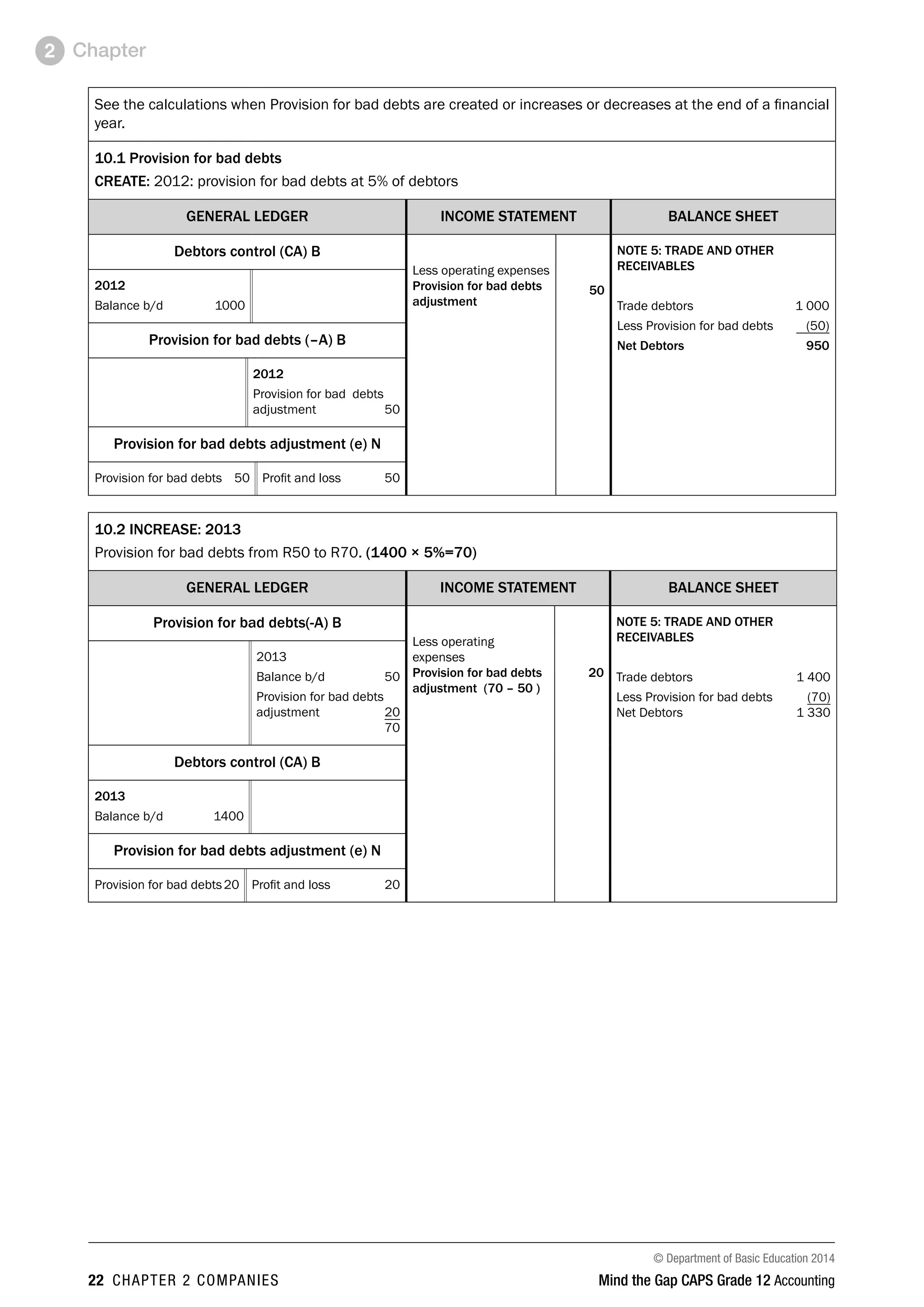
See the calculations when Provision for bad debts are created or increases or decreases at the end of a financial
year.
10.1 Provision for bad debts
CREATE: 2012: provision for bad debts at 5% of debtors
GENERAL LEDGER INCOME STATEMENT BALANCE SHEET
Debtors control (CA) B
Less operating expenses
Provision for bad debts
adjustment
50
NOTE 5: TRADE AND OTHER
RECEIVABLES
Trade debtors 1 000
Less Provision for bad debts (50)
Net Debtors 950
2012
Balance b/d 1000
Provision for bad debts (–A) B
2012
Provision for bad debts
adjustment 50
Provision for bad debts adjustment (e) N
Provision for bad debts 50 Profit and loss 50
10.2 INCREASE: 2013
Provision for bad debts from R50 to R70. (1400 × 5%=70)
GENERAL LEDGER INCOME STATEMENT BALANCE SHEET
Provision for bad debts(-A) B
Less operating
expenses
Provision for bad debts
adjustment (70 – 50 )
20
NOTE 5: TRADE AND OTHER
RECEIVABLES
Trade debtors 1 400
Less Provision for bad debts (70)
Net Debtors 1 330
2013
Balance b/d 50
Provision for bad debts
adjustment 20
 70
Debtors control (CA) B
2013
Balance b/d 1400
Provision for bad debts adjustment (e) N
Provision for bad debts20 Profit and loss 20
© Department of Basic Education 2014
Mind the Gap CAPS Grade 12 Accounting chapter 2 companies 23
Chapter 2
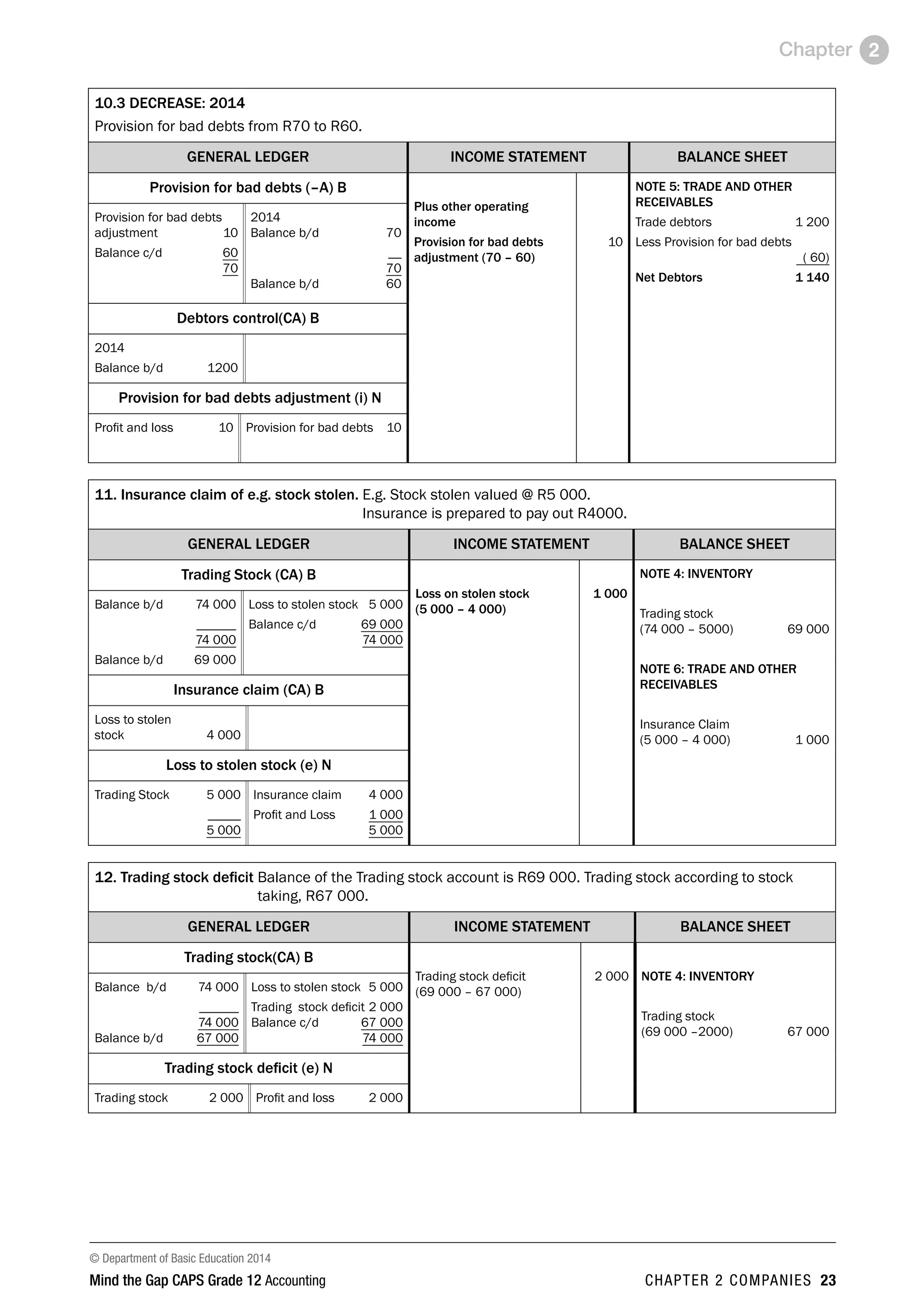
10.3 DECREASE: 2014
Provision for bad debts from R70 to R60.
GENERAL LEDGER INCOME STATEMENT BALANCE SHEET
Provision for bad debts (–A) B
Plus other operating
income
Provision for bad debts
adjustment (70 – 60)
10
NOTE 5: TRADE AND OTHER
RECEIVABLES
Trade debtors 1 200
Less Provision for bad debts
 ( 60)
Net Debtors 1 140
Provision for bad debts
adjustment 10
Balance c/d 60
 70
2014
Balance b/d 70
 __
 70
Balance b/d 60
Debtors control(CA) B
2014
Balance b/d 1200
Provision for bad debts adjustment (i) N
Profit and loss 10 Provision for bad debts 10
11. Insurance claim of e.g. stock stolen. E.g. Stock stolen valued @ R5 000.
Insurance is prepared to pay out R4000.
GENERAL LEDGER INCOME STATEMENT BALANCE SHEET
Trading Stock (CA) B
Loss on stolen stock
(5 000 – 4 000)
1 000
NOTE 4: INVENTORY
Trading stock
(74 000 – 5000) 69 000
NOTE 6: TRADE AND OTHER
RECEIVABLES
Insurance Claim
(5 000 – 4 000) 1 000
Balance b/d 74 000
 ______
 74 000
Balance b/d 69 000
Loss to stolen stock 5 000
Balance c/d 69 000
 74 000
Insurance claim (CA) B
Loss to stolen
stock  4 000
Loss to stolen stock (e) N
Trading Stock 5 000
 _____
 5 000
Insurance claim 4 000
Profit and Loss 1 000
 5 000
12. Trading stock deficit Balance of the Trading stock account is R69 000. Trading stock according to stock
taking, R67 000.
GENERAL LEDGER INCOME STATEMENT BALANCE SHEET
Trading stock(CA) B
Trading stock deficit
(69 000 – 67 000)
2 000 NOTE 4: INVENTORY
Trading stock
(69 000 –2000) 67 000
Balance b/d 74 000
 ______
 74 000
Balance b/d 67 000
Loss to stolen stock 5 000
Trading stock deficit2 000
Balance c/d 67 000
 74 000
Trading stock deficit (e) N
Trading stock 2 000 Profit and loss 2 000
© Department of Basic Education 2014
24 chapter 2 companies Mind the Gap CAPS Grade 12 Accounting
Chapter2
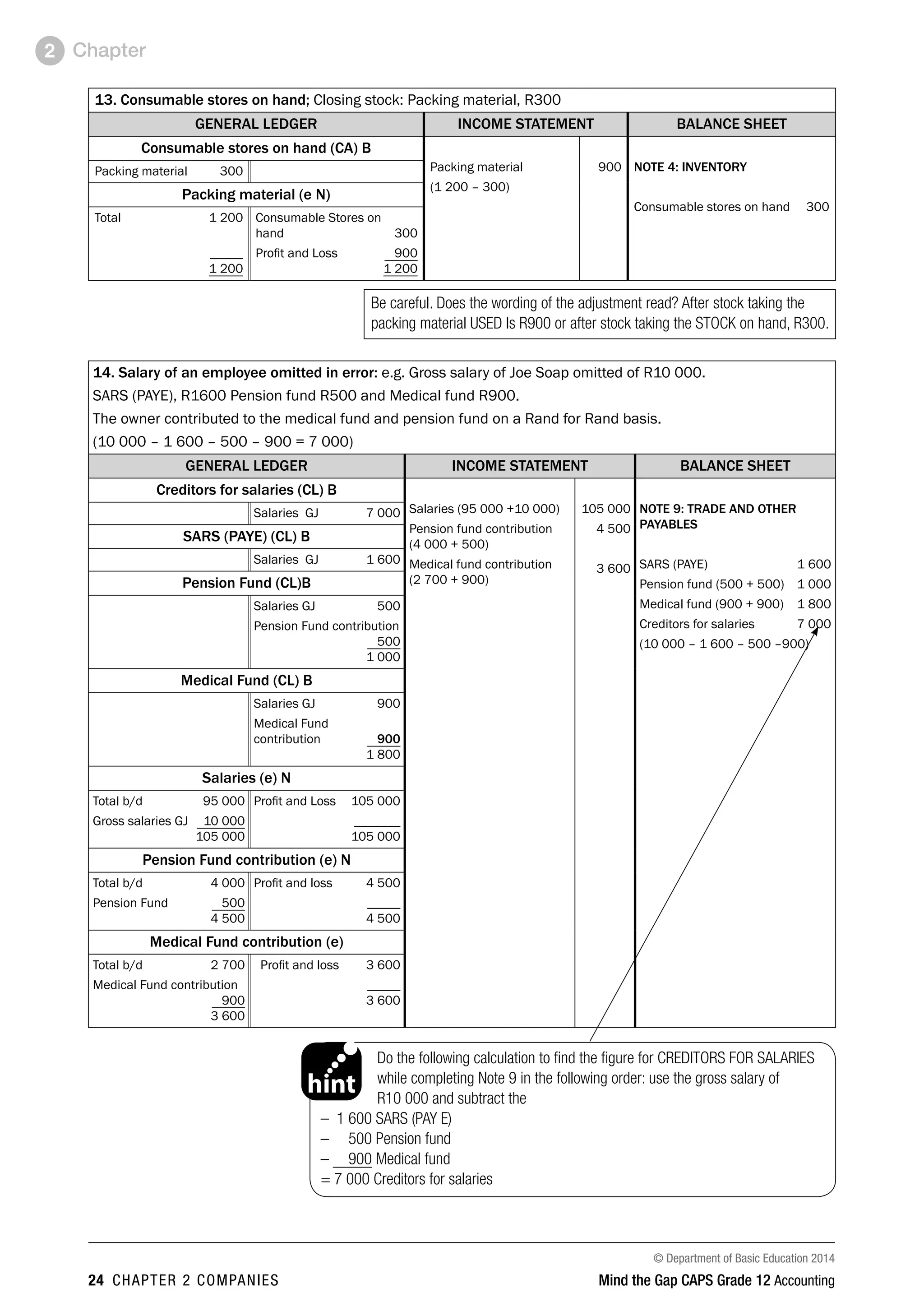
13. Consumable stores on hand; Closing stock: Packing material, R300
GENERAL LEDGER INCOME STATEMENT BALANCE SHEET
Consumable stores on hand (CA) B
Packing material
(1 200 – 300)
900 NOTE 4: INVENTORY
Consumable stores on hand 300
Packing material 300
Packing material (e N)
Total 1 200
 _____
 1 200
Consumable Stores on
hand 300
Profit and Loss 900
 1 200
14. Salary of an employee omitted in error: e.g. Gross salary of Joe Soap omitted of R10 000.
SARS (PAYE), R1600 Pension fund R500 and Medical fund R900.
The owner contributed to the medical fund and pension fund on a Rand for Rand basis.
(10 000 – 1 600 – 500 – 900 = 7 000)
GENERAL LEDGER INCOME STATEMENT BALANCE SHEET
Creditors for salaries (CL) B
Salaries (95 000 +10 000)
Pension fund contribution
(4 000 + 500)
Medical fund contribution
(2 700 + 900)
105 000
4 500
3 600
NOTE 9: TRADE AND OTHER
PAYABLES
SARS (PAYE) 1 600
Pension fund (500 + 500) 1 000
Medical fund (900 + 900) 1 800
Creditors for salaries 7 000
(10 000 – 1 600 – 500 –900)
Salaries GJ 7 000
SARS (PAYE) (CL) B
Salaries GJ 1 600
Pension Fund (CL)B
Salaries GJ 500
Pension Fund contribution
 500
 1 000
Medical Fund (CL) B
Salaries GJ 900
Medical Fund
contribution 900
 1 800
Salaries (e) N
Total b/d 95 000
Gross salaries GJ  10 000
 105 000
Profit and Loss 105 000
 _______
 105 000
Pension Fund contribution (e) N
Total b/d 4 000
Pension Fund 500
 4 500
Profit and loss 4 500
 _____
 4 500
Medical Fund contribution (e)
Total b/d 2 700
Medical Fund contribution
 900
 3 600
Profit and loss 3 600
 _____
 3 600
Be careful. Does the wording of the adjustment read? After stock taking the
packing material USED Is R900 or after stock taking the STOCK on hand, R300.
Do the following calculation to find the figure for CREDITORS FOR SALARIES
while completing Note 9 in the following order: use the gross salary of
R10 000 and subtract the
– 1 600 SARS (PAY E)
– 500 Pension fund
– 900 Medical fund
= 7 000 Creditors for salaries
PAY SPECIAL ATTENTION
EG - worked examples
HINT!
e.g.
NB NB
hint
exams
© Department of Basic Education 2014
Mind the Gap CAPS Grade 12 Accounting chapter 2 companies 25
Chapter 2
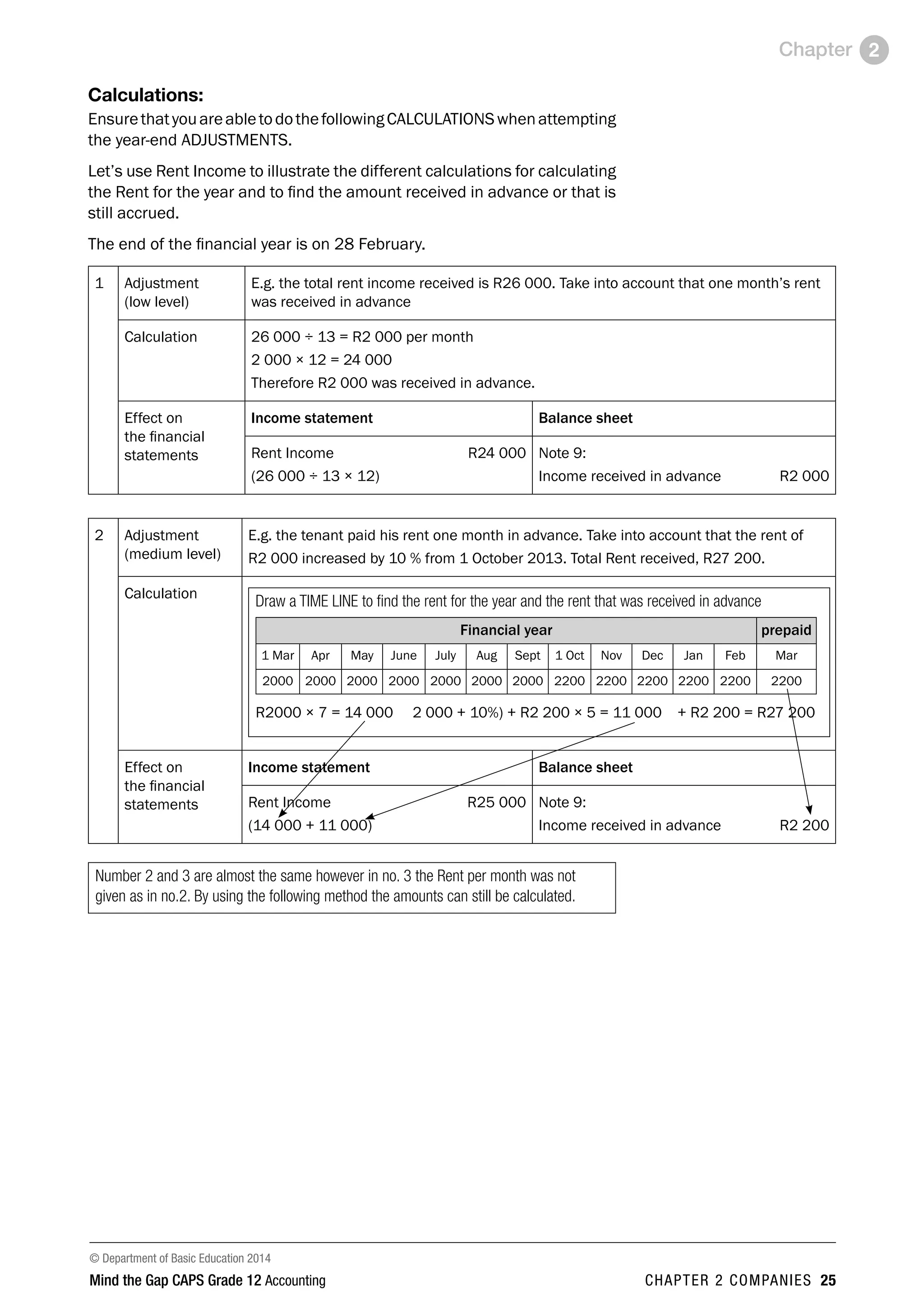
Calculations:
EnsurethatyouareabletodothefollowingCALCULATIONSwhenattempting
the year-end ADJUSTMENTS.
Let’s use Rent Income to illustrate the different calculations for calculating
the Rent for the year and to find the amount received in advance or that is
still accrued.
The end of the financial year is on 28 February.
1 Adjustment
(low level)
E.g. the total rent income received is R26 000. Take into account that one month’s rent
was received in advance
Calculation 26 000 ÷ 13 = R2 000 per month
2 000 × 12 = 24 000
Therefore R2 000 was received in advance.
Effect on
the financial
statements
Income statement Balance sheet
Rent Income R24 000
(26 000 ÷ 13 × 12)
Note 9:
Income received in advance R2 000
2 Adjustment
(medium level)
E.g. the tenant paid his rent one month in advance. Take into account that the rent of
R2 000 increased by 10 % from 1 October 2013. Total Rent received, R27 200.
Calculation
Draw a TIME LINE to find the rent for the year and the rent that was received in advance
Financial year prepaid
1 Mar Apr May June July Aug Sept 1 Oct Nov Dec Jan Feb Mar
2000 2000 2000 2000 2000 2000 2000 2200 2200 2200 2200 2200 2200
R2000 × 7 = 14 000 2 000 + 10%) + R2 200 × 5 = 11 000 + R2 200 = R27 200
Effect on
the financial
statements
Income statement Balance sheet
Rent Income R25 000
(14 000 + 11 000)
Note 9:
Income received in advance R2 200
Number 2 and 3 are almost the same however in no. 3 the Rent per month was not
given as in no.2. By using the following method the amounts can still be calculated.
© Department of Basic Education 2014
26 chapter 2 companies Mind the Gap CAPS Grade 12 Accounting
Chapter2
3 Adjustment
(high level)
E.g. The total amount received during the year, R27 200. Take into account that rent
increased by 10% on 1 October 2013 and the tenant paid the rent for March during
February 2014.
Calculation
Draw a TIME LINE to find the rent for the year and the rent that was received in advance
Financial year prepaid
1 Mar Apr May June July Aug Sept 1 Oct Nov Dec Jan Feb
100% 100% 100% 100% 100% 100% 100% 110% 110% 110% 110% 110%
CALCULATION: (100% × 7) + (110% × 5) + (110% × 1) = 27 200
700% + 550% + 110% = 27 200
1360% (known) = 27 200 (known)
MAKE USE OF THE FORMULA:
Unknown %
Known %
UNKNOWN is the amount prepaid and KNOWN is the total rent received
110% × 27 200 = R2 200 received in advance
1360% 1
Or 27 200 – 2 200 = R25 000 rent income for the year.
Effect on
the financial
statements
Income statement Balance sheet
Rent Income R25 000
(27 200 – 2 200)
Note 9:
Income received in advance R2 200
4 Adjustment
(high level)
E.g. The total mount received during the year, R22 800. Take into account that the
rent increased by 10% on 1 October 2013 and the tenant hasn’t yet paid the rent for
February 2014
Calculation
Draw a TIME LINE to find the rent for the year and the accrued rent.
Financial year accrued
1 Mar Apr May June July Aug Sept 1 Oct Nov Dec Jan Feb Mar
100% 100% 100% 100% 100% 100% 100% 110% 110% 110% 110% 110% 110%
CALCULATION: (100% × 7) + (110% × 4) = 22 800
700% + 440% = 22 800
1140% = 22 800
MAKE USE OF THE FORMULA: UNKNOWN is the amount accrued and KNOWN is the total rent
received
Unknown %
Known %
110% × 22 800 = R2 200 accrued income
1140% 1
Or 22 800 + 2 200 = R25 000 rent income for the year.
Effect on
the financial
statements
Income statement Balance sheet
Rent Income R25 000
(22 800+ 2 200)
Note 5:
Accrued income R2 200
© Department of Basic Education 2014
Mind the Gap CAPS Grade 12 Accounting chapter 2 companies 27
Chapter 2
5 Adjustment
(High level)
E.g. The total mount received during the year, R22 800. Take into account that the
rent DECREASED BY 10% on 1 October 2013 and the tenant hasn’t yet paid the rent
for February 2014
Calculation
Draw a TIME LINE to find the rent for the year and the rent that was received in advance
Financial year accrued
1 Mar Apr May June July Aug Sept 1 Oct Nov Dec Jan Feb
100% 100% 100% 100% 100% 100% 100% 90% 90% 90% 90% 90%
CALCULATION: (100% × 7) + (90% × 4) = 22 800
700% + 360% = 27 200
1060% = 27 200
MAKE USE OF THE FORMULA:
Unknown %
Known %
UNKNOWN is the (%) amount accrued and KNOWN is the total rent received (%)
90% × 22 800 = R2 200 accrued income
1360% 1
Or 22 800 – 2 200 = R25 000 rent income for the year.
Effect on
the financial
statements
Income statement Balance sheet
Rent Income R25 000
(22 800 + 2 200)
Note 5:
Accrued Income R2 200
© Department of Basic Education 2014
28 chapter 2 companies Mind the Gap CAPS Grade 12 Accounting
Chapter2
Example adapted from November 2011 ncs Exam paper
ACTIVITIES boy
and girl-left and
right of page
Step by step comment
EG - worked examples
HINT!
e.g.
hint
activity
activity
comment
exams
Worked example 2
Prepare the Income statement for the year ended 30 June 2011.
Information
1.	 ANEESA LTD
	 PRE-ADJUSTMENT TRIAL BALANCE AS AT 30 JUNE 2011
DEBIT CREDIT
Balance Sheet Accounts Section R R
Ordinary share capital 2 820 000
Retained income 684 460
Mortgage loan: Joy Bank 804 500
Land and buildings 2 097 000
Vehicles 814 000
Equipment 616 000
Accumulated depreciation on vehicles 294 800
Accumulated depreciation on equipment 341 000
Trading stock 955 000
Consumable stores on hand 15 000
Bank 313 100
Petty cash 3 300
Debtors' control 396 000
Creditors' control 487 300
SARS (Income tax) 261 800
Provision for bad debts 18 000
Fixed deposit: Broad Bank (8% p.a.) 495 000
Nominal Accounts Section
Sales 10 500 000
Debtors’ allowances 145 200
Cost of sales 7 487 000
Rent income 176 880
Interest income (on fixed deposit) 26 630
Bad debts recovered 2 300
Directors' fees 840 000
Audit fees 73 800
Salaries and wages 660 000
Packing material 23 100
Marketing expenses 480 000
Sundry expenses 63 770
Bad debts 12 000
Ordinary share dividends 404 800
16 155 870 16 155 870
This is the interim dividend.
DO NOT include on the
Income Statement!
This amount is the
provisional tax payment.
Remember to subtract
debtors’ allowances from
sales.
© Department of Basic Education 2014
Mind the Gap CAPS Grade 12 Accounting chapter 2 companies 29
Chapter 2
2.	 ADJUSTMENTS
A.	 A physical stock-taking on 30 June 2011 revealed the following inventories on
hand:
	 Trading stock	 R902 150
	 Packing material	 R4 260
B.	 Directors' fees of R22 500 are outstanding at the end of the financial period.
C.	 Make provision for outstanding interest on a fixed deposit. This investment has
been in existence for the entire year. Interest is not capitalised.
D.	 A debtor who owes us R32 000 has been declared insolvent. His estate paid 40
cents in every rand and this has been correctly recorded. The remaining balance
must be written off as irrecoverable.
E.	 Provision for bad debts must be adjusted to 5% of debtors.
F.	 The rent included R14 520 for July 2011. Adjust accordingly.
G.	 Make provision for depreciation as follows:
•	 Vehicles at 15% p.a. on cost price
•	 Equipment at 10% p.a. on the diminishing balance method.
•	 New equipment to the value of R48 000 was purchased on 1 September
2010. This has been correctly recorded.
H.	 The loan statement received from Joy Bank on 30 June 2011 reflected the
following:
R
Balance at the beginning of the financial year 1 125 000
Repayments during the year 458 000
Interest capitalised ?
Balance at the end of the financial year 804 500
I.	 Income tax for the year, R150 285.
Capitalised means the
interest is added onto the
loan. You need to calculate
this figure.
The total interest forms part
of the repayment during the
year.
© Department of Basic Education 2014
30 chapter 2 companies Mind the Gap CAPS Grade 12 Accounting
Chapter2
Answer to worked example 2
1.	 aneesa ltd: income statement for the year ended
30 june 2011
Sales (10 500 0003 – 145 2003 )	 3 10 354 800
Cost of sales (7 487 000) 3 (7 487 000)
Gross profit 	 2 867 800
Other operating income		 164 660
F Rent income (176 8803 – 14 52033) 162 360
Bad debt recovered (2 300) 3 2 300
Gross operating income 3 032 460
Operating expenses (2 392 600)
B Directors fees (840 0003 + 22 5003) 3 862 500
Audit fees (73 800) 3 73 800
Salaries and wages (660 000) 3 660 000
A Packing material (23 1003 – 4 2603) 3 18 840
Marketing expenses (480 000) 3 480 000
Sundry expenses (63 770) 3 63 770
D Bad debts (12 0003 +19 20033) 31 200
E Provision for bad debts adjustment
(18 840 3– 18 000)
840
G Depreciation 		
V: 122 100 3
E: 4 0003 + 22 700 33
148 800
A Trading stock deficit 		 33 52 850
Operating profit		 639 860
C Interest income3 (26 6303 + 12 9703)	 39 600
Profit before interest expenses/finance
cost3
679 460
H Interest expenses/finance cost 3 	
(458 000 + 804 500 – 1 125 000) or
(1 125 0003 – 458 0003 – 804 5003)
(137 500)
Profit before tax		 541 960
I Income tax 3 		 3 (150 285)
Net profit after tax	 391 675
[52]
The letters in this column refer to the explanations
on the next page.
This is the total of the
operating expenses.
REMEMBER to subtract this
from gross operating income.
FORMAT
It is VERY important to know
the format of the Income
Statement!
PAY SPECIAL ATTENTION
ACTIVITIES boy
and girl-left and
right of page
Step by step comment
EG - worked examples
HINT!
e.g.
NB NB
hint
activity
activity
comment
exams
FORMAT
Note where these 3
items appear on the
Income Statement.
PAY SPECIAL ATTENTION
EG - worked examples
HINT!
e.g.
NB
hint
activity
exams
Always
show your calculation
work in brackets for
part marks.
© Department of Basic Education 2014
Mind the Gap CAPS Grade 12 Accounting chapter 2 companies 31
Chapter 2
2.	 Explanations of each adjustment
A. Trading stock:
The physical stocktaking of R902 150 is less than the amount in the pre-
adjustment trial balance of R955 000. This means that there is a trading
stock deficit of R52 850 (R955 000 – R902 150).
Trading stock deficit = expense item on Income Statement
Packing material:
The amount on hand is subtracted from the pre-adjustment trial balance
amount.
B. Directors’ fees are outstanding and therefore get added to pre-adjustment
figure.
C. Interest on fixed deposit = R495 000 × 8% = R39 600 for the year.
The difference must be added to pre-adjustment trial balance figure.
D. Calculation of bad debts:
The estate paid 40 cents therefore 60 cents in every rand must be written
off. R32 000 × 0,6 = R19 200. This must be added to the pre-adjustment
figure.
E. Provision for bad debts adjustments calculation.
Calculate final debtors amount taking adjustment D into account:
R396 000 – R19 200 = R376 800
5% of R376 800 = R18 840
Provision for bad debts must be adjusted to R18 840. It is currently
R18 000. The amount of R840 by which it must be adjusted must be shown
in the income statement as an expense.
F. Rent was received in advance and therefore must be subtracted from the
pre-adjustment figure.
G. Depreciation on vehicles: 814 000 × 15% = R122 100
Depreciation on equipment:
New equipment
Bought on 1 September. The cost of the new equipment must be subtracted
from the equipment balance
R616 000 – R48 000 = R568 000
10% of R48 000 × 10 ÷ 12 = R4 000
Old equipment
Using the diminishing balance method, subtract the accumulated
depreciation from the cost price (excluding the new equipment) to
determine carrying value
R568 000 – R341 000 = R227 000
10% of R227 000 = R22 700
Depreciation is recorded as an expense in the income statement:
R122 100 + R22 700 + R4 000 = R148 800
H. To calculate the interest
on loan on the Loan
Statement:
R1 125 000 – R458 000
– R804 500
= R137 500
Interest on loan =
137 500
Loan: Joy bank
Bank CPJ	 458 000 Balance b/d	1 125 000
Balance c/d	 804 500 Int. on loan GJ	137 500
	 1 262 500 	 1 262 000
Balance b/d 804 500
I. Income tax for the year is subtracted from the net profit before tax
All pre-adjust-ment trial
balance figures have been
entered in bold on the
Income Statement before
entering the adjustments.
PAY SPECIAL ATTENTION
ACTIVITIES boy
and girl-left and
right of page
Step by step comment
EG - worked examples
HINT!
e.g.
NB NB
hint
activity
activity
comment
exams
PLEASE NOTE:
Depreciation is normally
an involved calculation
affecting both vehicles and
equipment. For this reason many
marks are awarded for the
depreciation figure. Show all your
workings so that even if one or
two of your figures are wrong,
you can still get some
marks for calculating
correctly.
© Department of Basic Education 2014
32 chapter 2 companies Mind the Gap CAPS Grade 12 Accounting
Chapter2
Use this
blank income statement
to practice doing the task
again on your own. Once you
have completed the task,
compare your answer to the
worked example on
the previous pages.
Practice task 2
Aneesa ltd: Income Statement for the year ended 30 June 2011
Sales
Cost of sales
Gross profit 	
Other operating income		
Gross operating income
Operating expenses
Operating profit
Profit before tax
Net profit after tax
[52]
© Department of Basic Education 2014
Mind the Gap CAPS Grade 12 Accounting chapter 2 companies 33
Chapter 2
ACTIVITIES boy
and girl-left and
right of page
Step by step comment
EG - worked examples
HINT!
e.g.
hint
activity
activity
comment
exams
Worked example 3
Balance Sheet and notes
Use the following steps to prepare a balance sheet from the
given information:
1.	 Enter the figures from the information given onto the answer sheet next to the
details.
2.	 Read the additional information:
a)	 If necessary calculate the adjustment amount.
b)	 Decide on which account is to be debited and which account is to be credited.
c)	 On your answer sheet reflect a (+) or a (–) in respect of each item next to the
already entered pre-adjustment figure.
3.	 When all the additional information has been considered, calculate the final figures
and write them in the column.
Example adapted from November 2009 NCS exam paper
Practice task 3
You are provided with information relating to Qwando Limited for the
financial year ended 30 June 2011.
Prepare the Retained income note. (18)
Prepare the Balance Sheet on 30 June 2011. (36)
Information
1.	 The following figures were taken from the financial records of the
financial year ended 30 June 2011.
R
Ordinary share capital (see information 2 below) 2 400 000
Retained income (on 1 July 2010) 	
738 000
Shareholders for dividends (see information 4 below) ?
Fixed deposit at Supa Bank (see information 5 below) 60 000
Mortgage Bond from Supa Bank (see information 7 below) ?
Fixed/tangible assets 3 881 000
Debtors’ control 45 000
Creditors’ control 85 200
Creditors for salaries 12 300
Provision for bad debts (see Information 6 below) ?
SARS (Income tax – provisional tax payments) 400 000
SARS (PAYE) 6 650
Expenses payable (accrued) 7 200
Income receivable (accrued) 7 950
Bank (favourable balance) 168 450
Trading stock 129 600
Consumable stores on hand 5 600
Look at
the format you
have been given. Do
you notice any missing
details? Fill them in.
THESE ARE EASY
MARKS!
© Department of Basic Education 2014
34 chapter 2 companies Mind the Gap CAPS Grade 12 Accounting
Chapter2
2.	 Shares:
•	 There were 700 000 ordinary shares in issue at the beginning of
the financial year.
•	 On 1 January 2011, 100 000 ordinary shares were issued to
the public at R3,80 cents per share. This has been correctly
recorded and is included in the figures above.
•	 On 1 June 2011, 40 000 were repurchased from a shareholder
at R4,50 per share. A direct transfer was put through from the
Bank account but no entry has been made in the books.
3.	 The net profit before tax for the year ended 30 June 2011 was
calculated as R1 250 000. No entry for income tax calculated at a
rate of 30% of the net profit has been made.
4.	 Dividends were as follows:
•	 Interim dividends of 20 cents per share were paid on
31 December 2010.
•	 Final dividends of 35 cents per share were declared on 30 June
2011. All shareholders at this date qualify for dividends.
5.	 One third of the total fixed deposits mature on 31 August 2011.
6.	 Provision for bad debts must be adjusted to 5% of debtors.
7.	 The loan statement from Supa Bank on 30 June 2011 reflects the
following:
SUPA BANK
LOAN STATEMENT ON 30 JUNE 2011
Balance on 1 July 2010 R384 000
Interest charged 57 600
Monthly instalments in terms of the loan agreement
(12 × R8 800)
(These monthly instalments include interest on the
capital repayments of the loan)
105 600
Balance on 30 June 2011 R336 000
Answers to practice task 3
RETAINED INCOME R
Balance on the last day of the previous year 3738 000
3 Net profit after tax for the period3 (1 250 000 – 30%) 33 875 000
2 Retained income on 40 000 shares repurchased
(40 000 × R1,50)
3 3 (60 000)
Ordinary share dividends3 (406 000)
4 Paid3 (interim)
(700 00033 shares × 20c3)
140 000
2 
4
Recommended3 (final)
(760 0003 shares × 35c3)
266 000
Balance on the last day of the current year 1 147 000
[16]
Total dividends (interim and
final) are shown here.
The monthly capital
repayments on the loan will
remain constant until the
loan has been paid in full on
30 June 2019.
Use the issued shares to
calculate the dividends.
PAY SPECIAL ATTENTION
ACTIVITIES boy
and girl-left and
right of page
Step by step comment
EG - worked examples
HINT!
e.g.
NB NB
hint
activity
activity
comment
exams
© Department of Basic Education 2014
Mind the Gap CAPS Grade 12 Accounting chapter 2 companies 35
Chapter 2
Qwando Limited
Balance Sheet on 30 June 2011
ASSETS
NON CURRENT ASSETS 3 921 000
Fixed / tangible assets (4 021 000) 33 881 000
Financial assets
5 Fixed deposit: Supra Bank
(60 0003 – 20 0003)
340 000
CURRENT ASSETS 219 350
Inventories
(129 6003 + 5 600)
3 135 200
6 Trade and other receivables
(45 0003 + 7 9503 – 2 2503 + 25 000)3
3 75 700
5 Cash and cash equivalents
(168 450 + 20 000 – 120 000- 60 000)
8 450
TOTAL ASSETS 4 140 350
EQUITY AND LIABILITIES
CAPITAL AND RESERVES 3 427 000
2 Ordinary share capital (2 400 000 – 120 000) 3 2 280 000
2 Retained income (see note on previous page) 3 1 147 000
NON-CURRENT LIABILITIES 288 000
7 Mortgage loan: Supa Bank
(336 0003 – 48 0003)
288 000
CURRENT LIABILITIES 425 350
Trade and other payables
(85 2003 + 12 300 + 6 6503 + 7 2003)
3111 350
4 Shareholders for dividends 3 266 000
7 Current portion of loan 3 48 000
TOTAL EQUITY AND LIABILITIES 4 140 350
[38]
Amount owed by SARS to
the business. This implies
the business overpaid its
taxes to SARS.
This is the final dividend
declared at the end of the
year.
The numbers in this column refer to the explanations on
the next page.
Fixed assets are always
shown at book value on the
Balance Sheet.
FORMAT
It is VERY important to know
the format of the Balance
Sheet and notes!
PAY SPECIAL ATTENTION
ACTIVITIES boy
and girl-left and
right of page
Step by step comment
EG - worked examples
HINT!
e.g.
NB NB
hint
activity
activity
comment
exams
If the notes
are not required,
show all your calculation
work in brackets on
the Balance Sheet
© Department of Basic Education 2014
36 chapter 2 companies Mind the Gap CAPS Grade 12 Accounting
Chapter2
Explanations of each adjustment
2. Shares:
The new issue of shares have been properly recorded. The repurchase
of 40 000 shares at R4,50. The ordinary share capital account
must be reduced by the average share price (2 400 000 ÷ 800 000
shares = R3)
The retained income account will be reduced by the difference between
the buyback price and average price ( R4,50 – R3 = R1,50 × 40 000
shares)
3. Net profit after tax must be calculated by subtracting income tax from
net profit before tax. This must be entered in the retained income note.
Tax calculation = (R1 250 000 × 30% = R375 000).
Net profit after tax = R1 250 000 – R375 000 = R875 000).
4. Dividends:
Calculation of interim/paid dividends = 700 000 × 20 cents =
R140 000
Calculation of final/declared dividends = 700 000 + 100 000 (issued)
– 40 000 (repurchased) = 760 000 shares
760 000 × 35 cents = R266 000
Total dividends = R140 000 + R266 000 = R406 000
5.
Calculation of short term portion of fixed deposit:
The portion of the fixed deposit that will be received within the next
12 months must be subtracted from financial assets and shown under
cash and cash equivalents under current assets on the balance sheet.
(1/3 of R60 000 = R20 000)
6. Provision for bad debts is calculated at 5% of debtors control:
5% of R45 000 = R2 250.
Provision for bad debts must be subtracted from trade and other
receivables.
7. Repayments of the capital amount of the loan that will be made in the
next 12 months must be subtracted from the non-current liabilities and
shown under current liabilities as a ‘current portion of loan’.
R105 600 (total repayments) – R57 600 (interest) = R48 000 (capital
portion of repayments for the year.
All given figures in
information 1 have been
entered in bold before
entering the information
2 to 7.
PAY SPECIAL ATTENTION
ACTIVITIES boy
and girl-left and
right of page
Step by step comment
EG - worked examples
HINT!
e.g.
NB NB
hint
activity
activity
comment
exams
© Department of Basic Education 2014
Mind the Gap CAPS Grade 12 Accounting chapter 2 companies 37
Chapter 2
Practice task 3 (continued)
RETAINED INCOME R
Balance on the last day of the previous year
Balance on the last day of the current year
QWANDO LIMITED
BALANCE SHEET ON 30 JUNE 2011
ASSETS	
NON CURRENT ASSETS
Fixed/tangible assets
Financial assets		
Fixed deposit: Supra Bank
CURRENT ASSETS
TOTAL ASSETS
EQUITY AND LIABILITIES
CAPITAL AND RESERVES
NON-CURRENT LIABILITIES
Mortgage loan: Supa Bank
CURRENT LIABILITIES
TOTAL EQUITY AND LIABILITIES
[38]
Photocopy
this blank Balance
Sheet and use it to
practise doing the worked
example 3 again on your own.
Once you have completed the
task, compare your answer
to the worked example
on the previous
page.
© Department of Basic Education 2014
38 chapter 2 companies Mind the Gap CAPS Grade 12 Accounting
Chapter2
Some important
notes to the financial
statements
TANGIBLE/FIXED ASSETS Land 
Buildings
Vehicles Total
Carrying value at beginning of year C C C
Cost A A A
Accumulated depreciation (B) = 0 (B) (B)
Movements
Additions D D D
Disposals at carrying value (E) (E) (E)
Depreciation (F) = 0 (F) (F)
Carrying value at end of year J J J
Cost H H H
Accumulated depreciation (I) = 0 (I) (I)
TRADE  OTHER RECEIVABLES
Net trade debtors M
Trade debtors K
Provision for bad debts (L)
SARS (income tax) N
Expenses prepaid O
Income accrued (receivable) P
Q
A – B = C
C + D – E – F = J
OR
H – I = J
LAND AND BUILDINGS ARE
NOT DEPRECIATED. A zero
will always be shown in
these blocks.
The total
carrying
value gets
transferred to
the Balance
Sheet.
K – L = M
Amount overpaid to SARS.
M + N + O + P = Q
Transfer Q to the current
assets section in the
Balance Sheet.
FORMAT
It is VERY
important to know the format of the
notes to the Financial Statements.
Some of them are explained below.
PAY SPECIAL ATTENTION
ACTIVITIES boy
and girl-left and
right of page
Step by step comment
EG - worked examples
HINT!
e.g.
NB
hint
activity
activity
exams
© Department of Basic Education 2014
Mind the Gap CAPS Grade 12 Accounting chapter 2 companies 39
Chapter 2
TRADE  OTHER PAYABLES
Trade creditors R
Expenses accrued (payable) S
Income received in advance T
Shareholders for dividends U
SARS (income tax) V
Creditors for salaries W
Unemployment insurance fund X
Pension fund Y
Medical aid fund Z
AA
AA: Total transferred to current
liabilities section of the Balance
Sheet.
Dividend declared but not yet paid
(final dividend).
Gross salaries less deductions.
Amount still owing to SARS.
Deductions + contributions.
© Department of Basic Education 2014
40 chapter 2 companies Mind the Gap CAPS Grade 12 Accounting
Chapter2
PAY SPECIAL ATTENTION
ACTIVITIES boy
and girl-left and
right of page
Step by step comment
EG - worked examples
HINT!
e.g.
NB NB
hint
activity
activity
comment
exams
Worked example 4
Preparation of the cash flow statement
Practice task 4
Prepare the cash flow statement
(all relevant notes have been done
for you).  (15)
Additional information
Extract from balance sheet
2012 2011 Flow of cash
Ordinary share capital R471 600 R410 000 **see note below
Retained income R10 400 R9 000 This has no effect on a cash flow statement.
Fixed deposit R28 000 R23 000 (R5 000) (Outflow)
Loan from Beta Bank (interest
is not capitalised)
R74 000 R80 000 (R6 000) (Outflow)
Bank R35 300 R10 040 R25 260 Inflow
Cash float R2 000 R2 000 R0 No change
** During the year the following transactions took place regarding share capital:
•	 8 000 Shares were issued and the company received R79 600 from shareholders.
•	 Repurchased 3 000 shares at 820 cents per share
2.4 Cash Flow Statements
Purpose of a Cash Flow Statement
The Income Statement shows the result of business’ operations (net profit).
The Balance Sheet shows the financial position of the business on a specific day (ie how
much the business is worth).
Neither of them shows where the business gets its funds from or how the funds are
used. The emphasis is on the cash aspects/components.
The Cash Flow Statement is prepared for this purpose and shows where the
funds come from and how they are used.
Basic concepts and terminology
Concept Definition
Cash inflow
Money coming into the business. This amount does NOT
have brackets. (e.g. sale of shares)
Cash outflow
Money going out of the business. This amount HAS
brackets. (e.g. bought a fixed asset for cash)
All the information needed for a cash flow statement and notes can be
found on the income statement, balance sheet and notes.
Remember we are looking for the flow of cash. This
means you will need to calculate the difference
between this year’s and last year’s figures, to
determine the figures to place on the Cash Flow
Statement.
Cash Flow
Statements focus
on all aspects
of CASH surrounding a
business. Remember CASH
IS KING for Cash Flow
Statements.
PAY SPECIAL ATTENTION
ACTIVITIES boy
and girl-left and
right of page
Step by step comment
EG - worked examples
HINT!
e.g.
NB NB
hint
activity
activity
comment
exams
FORMAT
It is VERY important to know
the format of the Cash Flow
Statement and notes!
Certain figures have been given on the answer sheet
(in bold). In order to calculate the missing figures A to
L, refer to additional information provided below.
PAY SPECIAL ATTENTION
ACTIVITIES boy
and girl-left and
right of page
Step by step comment
EG - worked examples
HINT!
e.g.
NB NB
hint
activity
activity
comment
exams
PAY SPECIAL ATTENTION
ACTIVITIES boy
and girl-left and
right of page
Step by step comment
EG - worked examples
HINT!
e.g.
NB NB
hint
activity
activity
comment
exams
© Department of Basic Education 2014
Mind the Gap CAPS Grade 12 Accounting chapter 2 companies 41
Chapter 2
These figures are taken
DIRECTLY from the Income
Statement and are ADDED to
the profit before tax to give
you the operating profit before
changes in working capital.
Also, depreciation is NOT a
cash expense.
Notes to the cash flow statement
Note 1: Reconciliation between profit before tax and cash generated
from operations:
R
Profit before tax 30 000
Adjustments i.r.o. (in respect of): 21 200
Depreciation 12 000
Interest expense 9 200
Operating profit before changes in
working capital
51 200
Changes in working capital 5 000
(Increase)/Decrease in inventory (3 000)
(Increase)/Decrease in debtors 5 600
Increase/(Decrease) in creditors 2 400
Cash generated from operations 56 200
Note 2: Cash and cash equivalents
Net
change
2012 2011
Bank 25 260 35 300 10 040
Cash float 0 2 000 2 000
25 260 37 300 12 040
Difference between last
year’s and this year’s figures.
Remember to exclude amounts
owed to shareholders, accrued
interest and amounts owed to
or by SARS for income tax.
Net change is calculated
as the difference between
last year’s and this year’s
figures.
Make sure you use the profit
before tax from the Income
Statement. If profit after tax is
given, remember to add back
the tax.
Transfer these figures to the Cash
Flow Statement (net change in cash
and cash equivalents).
These amounts come
DIRECTLY from cash and cash
equivalents on the Balance
Sheet.
Transfer this figure to
the Cash Flow Statement
(cash flow from operating
activities).
ATTENTION: Watch your dates!
Make sure you are using the
figures from the correct year.
PAY SPECIAL ATTENTION
ACTIVITIES boy
and girl-left and
right of page
Step by step comment
EG - worked examples
HINT!
e.g.
NB NB
hint
activity
activity
comment
exams
© Department of Basic Education 2014
42 chapter 2 companies Mind the Gap CAPS Grade 12 Accounting
Chapter2
This is the total amount paid out for
dividends this year. This figure is shown in
brackets on the Cash Flow Statement (cash
flow from operating activities)
Last year’s shareholders’
for dividends amount. This
figure is shown in brackets
because it was paid during
the year.
This figure is always shown
in brackets.
This year’s shareholders for
dividends amount. This figure
is NOT shown in brackets
because it is still not paid.
The income tax figure from
the Income Statement. This
figure is shown in brackets.
This year’s SARS income tax
balance. If the figure is under
trade and other payables
it will not have brackets.
If the figure is under trade
and other receivables it will
have brackets. [(dr) cr]
Last year’s SARS income tax
balance. If the figure is under
trade and other payables
it will have brackets. If the
figure is under trade and
other receivables it will not
have brackets. [dr (cr)]
Note 3: Dividends paid
Total dividends for the year (interim + final) (R10 000)
Amount due at the beginning of the year [dr (cr)] (R4 500)
Amount due at the end of the year (final) [(dr) cr] R6 000
Dividends paid (R8 500)
Note 4: Taxation paid
Total tax for the year (R13 500)
Balance due at the beginning of the year [dr (cr)] (R1 600)
Balance due at the end of the year [(dr) cr] R1 200
Tax paid (R13 900)
Before you attempt a Cash Flow Statement question, ensure that
you can identify the information that is given to you to determine if
you have to complete notes or simply show all your working calculations.
SARS can have a debit
or credit balance at the
beginning of the year and at
the end of the year.
This is the total amount paid out for tax this year.
This figure is shown in brackets on the Cash Flow
Statement (cash flow from operating activities) as
this was the actual cash that was paid.
The notes
for dividends paid and
tax paid can be done using
either the format given below
or the ledger account
(not required in this
question).
PAY SPECIAL ATTENTION
ACTIVITIES boy
and girl-left and
right of page
Step by step comment
EG - worked examples
HINT!
e.g.
NB NB
hint
activity
activity
comment
exams
PAY SPECIAL ATTENTION
ACTIVITIES boy
and girl-left and
right of page
Step by step comment
EG - worked examples
HINT!
e.g.
NB NB
hint
activity
activity
comment
exams
© Department of Basic Education 2014
Mind the Gap CAPS Grade 12 Accounting chapter 2 companies 43
Chapter 2
Cash Flow Statement for the year ended …
NOTES R
Cash flow from operating activities 24 960 A
Cash generated from operations 1 3 56 200 B
Interest paid (8 840)
Dividends paid 3 3 (8 500) C
Income tax paid 4 3 (13 900) D
Cash flow from investing activities (48 700) E
Purchase of fixed assets (48 500)
Proceeds from sale of fixed assets 4 800
Increase of investment 33 (5 000) F
Decrease of investment –
Cash flow from financing activities 49 000 G
Proceeds from shares issued 3 79 600 H
Repurchase of shares (24 600) I
Proceeds from long-term loans –
Payment of long-term loans 3 (6 000) J
Net change in cash and cash equivalents 2 25 260 K
Cash and cash equivalents at the beginning of
the year
2 3 12 040 L
Cash and cash equivalents at the end of the year 2 3 37 300 M
[15]
Operating activities:
The most common source
of cash for a company. It
not only involves the buying
and selling of stock, but also
includes paying creditors,
receiving money from debtors
and paying expenses.
Investing activities:
The activities that focus on
the buying and selling of fixed
assets and the increasing and
decreasing of investments
(e.g. fixed deposits).
Financing activities:
How a company is funded
through loans and capital:
•	 The issuing of shares
•	 The repurchase of shares
•	 The obtaining of a loan
•	 The repayment of a loan
To check your answer, see
K, L + M:
•	 If both balances are
favourable you subtract,
eg. 37 300 – 12 040 =
25 260.
•	 If one of the balances is
an overdraft, then you
add, eg. M + (L).
•	 An overdraft is shown in
brackets ( ). Memorise the
following to determine if K
is in brackets or not:
(K) K
L or (L)
(M) M
The letters
in this column refer
to the explanations
in the Table on
page 28.
© Department of Basic Education 2014
44 chapter 2 companies Mind the Gap CAPS Grade 12 Accounting
Chapter2
Explanations of A to L
A. Cash generated from operations – interest paid – dividends paid – income tax paid = A
R56 200 – R8 840 – R8 500 – R12 900 = R24 960
Inflow (Outflow) (Outflow) (Outflow) Inflow
B. Cash generated from operations transferred from Note 1 (under Notes to the Cash Flow Statement).
C. Dividends paid transferred from Note 3 (under Notes to the Cash Flow Statement).
D. Income tax paid transferred from Note 4 (under Notes to the Cash Flow Statement).
E. Purchase of fixed assets – proceeds from sale of fixed assets – increase in investment = E
– R48 500 + R4 800 – R5 000 = – R48 700
(Outflow) Inflow (Outflow) (Outflow)
F. This figure comes from the Extract from the Balance Sheet and is calculated by finding the difference
between this year’s and last year’s figures:
R25 000 – R20 000 = R5 000
(Outflow)
Increasing the fixed deposit is an outflow as money is moving out of the bank account and into the
fixed deposit account.
G. Proceeds from shares issued – repurchase of shares - payment of long-term loans = G
R79 600 – R24 600 – R6 000 = R49 000
Inflow (Outflow) – (Outflow)
H. Issue of new shares: The amount of R79 000 was given (inflow)
I. Repurchase of shares: 3 000 × R8,20 = R24 600 (outflow)
J. This figure comes from the Extract from the Balance Sheet and is calculated by finding the difference
between this year’s and last year’s figures:
R74 000 – R80000 = –R6 000 (Outflow)
K. A – E + G = K (R24 960 – R48 700 + R49 000 = R25 260)
To verify this figure check the Net Change Total in Note 2 (Cash and Cash Equivalents)
under Notes to the Cash Flow Statement
L. This figure comes from the extract from the Balance Sheet, calculated by adding the Bank figure and
Cash Float figure from last year i.e. 2011.
To verify this figure check the total of the Bank and Cash Float figure for 2011 in Note 2 (Cash and
Cash Equivalents) under Notes to the Cash Flow Statement.
M. This figure comes from the extract from the Balance Sheet, calculated by adding the Bank figure and
Cash Float figure from this year i.e. 2012.
To verify this figure check the total of the Bank and Cash Float figures for 2012 in Note 2 (Cash and
Cash Equivalents) under Notes to the Cash Flow Statement.
© Department of Basic Education 2014
Mind the Gap CAPS Grade 12 Accounting chapter 2 companies 45
Chapter 2
Cash flow statement for the year ended ……..
Notes R
Cash flow from operating activities
Cash generated from operations 1
Interest paid (8 840)
Dividends paid 3
Income tax paid 4
Cash flow from investing activities
Purchase of fixed assets (48 500)
Proceeds from sale of fixed assets 4 800
Increase of investment
Decrease of investment –
Cash flow from financing activities
Proceeds from shares issued
Repurchase of shares
Proceeds from long-term loans
Payment of long-term loans –
Net change in cash and cash equivalents 2
Cash and cash equivalents at beginning of the
year
2
Cash and cash equivalents at the end of the
year
2
[15]
Photocopy this
blank Cash Flow
Statement and use it to
practise doing the worked
example 4 again on your own.
Once you have completed the
task, compare your answer
to the worked example on
pages 27
and 28.
© Department of Basic Education 2014
46 chapter 2 companies Mind the Gap CAPS Grade 12 Accounting
Chapter2
2.5 Analysis and
interpretation of Financial
Statements
Area of analysis Description Related financial indicators
Profitability
How efficient the company
is in its normal operating
activities
% Gross profit on sales
% Net profit on sales
% Operating expenses on
sales
% Operating profit on sales
% Gross profit on cost of
sales (mark-up)
Liquidity
The ability of a company
to pay off its immediate
(short-term) debts
Current ratio
Acid test ratio
Net current assets (net
working capital)
Turnover rate of stock
Debtors’ collection period
Creditors’ payment period
Average period of stock on
hand
Solvency
The ability of a company to
pay off all its debts
Solvency ratio
Net assets
Return
Are the shareholders
earning a fair amount on
their investment?
% Return on average
shareholders’ equity
Earnings per share
Dividends per share
Net asset value
Financial risk
Gearing
To what extent is the
company financed by
loans (borrowed money)
compared to its own capital
Debt / equity ratio
% Return on total capital
employed
Follow these steps when commenting on the
financial indicators:
1.	 Consider what the question is asking you to analyse (e.g. Liquidity).
Decide on the relevant financial indicator(s).
2.	 Name the financial indicator(s) giving figures or ratios or
percentages.
3.	 Compare the current year’s indicator(s) with that of the previous year.
Say whether it has increased or decreased.
4.	 If possible provide a general comment.
Make sure you can calculate
these indicators. See page
35 for formulae.
AL ATTENTION
ACTIVITIES boy
and girl-left and
right of page
p comment
ed examples
NB
comment
© Department of Basic Education 2014
Mind the Gap CAPS Grade 12 Accounting chapter 2 companies 47
Chapter 2
© Department of Basic Education 2014
48 chapter 2 companies Mind the Gap CAPS Grade 12 Accounting
Chapter2
ACTIVITIES boy
and girl-left and
right of page
Step by step comment
EG - worked examples
HINT!
e.g.
hint
activity
activity
comment
exams
Worked example 5: Comment on the
liquidity position of the company
Financial indicator 2010 2011
Current ratio 1,3 : 1 2,1 : 1
Acid test ratio 0,6 : 1 1,4 : 1
•	 Current ratio 3 has improved from 1,3 : 1 to 2,1 : 1 3
•	 Acid test ratio 3 has also improved from 0,6 : 1 to 1,4 : 1 3
•	 This company is in a good liquidity position and should be able to pay its short-term
debt easily. 3
 [5]
PAY SPECIAL ATTENTION
ACTIVITIES boy
and girl-left and
right of page
Step by step comment
EG - worked examples
HINT!
e.g.
NB NB
hint
activity
activity
comment
exams
Worked example 6: Comment on the
earnings per share (EPS) and
dividends per share (DPS) of the
company
Financial indicator 2010 2011
Earnings per share (EPS) 35c per share 15c per share
Dividends per share (DPS) 25c per share 20c per share
•	 EPS has declined from 35c to 15c per share. 3
•	 DPS has declined from 25c to 20c per share. 3
•	 In 2010 their EPS was 35c while the DPS was only 25c per share.This means that the
company retained 10c per share for future growth. 33
•	 In 2011 they only earned 15c per share but gave the shareholders 20c per share meaning
that none of this year’s profits were retained. 33
[6]
PAY SPECIAL ATTENTION
ACTIVITIES boy
and girl-left and
right of page
Step by step comment
EG - worked examples
HINT!
e.g.
NB NB
hint
activity
activity
comment
exams
Worked example 7: Comment on the
debt/equity ratio of the company
Financial indicator 2010 2011
Debt/equity ratio 0.6:1 0,4:1
•	 Debt/equity ratio decreased3 by 0,2 from 0,6 : 1 to 0,4 : 1. 3
•	 By repaying the loan the company has a lower financial risk. 3
 [3]
PAY SPECIAL ATTENTION
ACTIVITIES boy
and girl-left and
right of page
EG - worked examples
HINT!
e.g.
NB NB
hint
activity
activity
exams
Worked example 8: Comment on the
percentage return on shareholders’
equity (ROSHE) of the company
Financial indicator 2010 2011
% return on shareholders’ equity (ROSHE) 18 % 24 %
•	 ROSHE improved3 by 6 % from 18 % to 24 %.3
•	 The shareholders should be pleased as a return of 24 % is higher than an alternative
investment (e.g. fixed deposit). 3
 [3]
ATTENTION: Watch your
dates! Make sure you use the
figures from the correct year.
It means that the company has
current assets of R2,10 for every
R1 debt.
Earnings per share is the ‘if’;
if all the profit after tax was
declared as dividends, the
earnings would have been
35c per share. However
what “really happened” is
that dividends were declared
of only 25c per share. The
difference is the profit that the
company kept called ‘retained
income’.
It’s the ‘if’! If all the profit after
tax was declared a dividend,
they would have earned
15c per share. However,
the shareholders received
more, being 20c per share.
That means that some of
the retained income of the
previous year was used to
finance the difference.
PAY SPECIAL ATTENTION
ACTIVITIES boy
and girl-left and
right of page
Step by step comment
EG - worked examples
HINT!
e.g.
NB NB
hint
activity
activity
comment
exams
Use point form
instead of long
sentences to
comment.
PAY SPECIAL ATTENTION
ACTIVITIES boy
EG - worked examples
HINT!
e.g.
NB NB
hint
activity
exams
© Department of Basic Education 2014
Mind the Gap CAPS Grade 12 Accounting chapter 2 companies 49
Chapter 2
Formulae: Financial indicators
Financial indicator How it is calculated - formula Answer shown as/in
1 Gross profit on cost of sales
(mark-up)
Gross profit 	
×
	 100
Cost of sales		 1
%
2 Gross profit on sales Gross profit 	
×
	 100
	 Sales		 1
%
3 Operating expenses on sales Operating expenses	
×
	 100
	 Sales		 1
%
4 Operating profit on sales Operating profit	
×
	 100
	 Sales		 1
%
5 Net profit after tax on sales Net profit after tax	
×
	 100
	 Sales		 1
%
6 Solvency ratio Total assets : Total liabilities Ratio ( : 1)
7 Net assets (shareholders’
equity)
Total assets − Total liabilities Rands
8 Current ratio Current assets : Current liabilities Ratio ( : 1)
9 Acid-test ratio (Receivables + cash) : Current liabilities
OR
(Current assets – inventories) : Current liabilities
Ratio ( : 1)
10 Turnover rate of stock Cost of sales
Average stock
Times per year
11 Period for which enough stock
is on hand/period of stock on
hand (stock holding period)
Average stock	
×
	 365
Cost of sales	 1
Number of days
12 Debtors average collection
period
Average debtors	
×
	 365
	 Credit sales		 1
Number of days
13 Creditors average payment
period
Average creditors	
×
	 365
	 Credit sales	 	 1
Number of days
14 Debt/equity ratio Non-current liabilities : Shareholders’ equity Ratio ( : 1)
15 Return on equity
(shareholders’ equity)
Net profit after tax 	
×
	 100
Average shareholders’ equity		 1
%
16 Return on total capital
employed
Net profit before tax + interest on loans 	
×
	 100
Average shareholders’ equity + average loans		 1
%
17 Earnings per share (‘if’) Net profit after tax 	
×
	100
Number of issued shares		 1
Cents
18 Dividends per share (what
really happened)
Interim  final dividends 	
×
	100
Number of issued shares		 1
Cents
19 Net asset value per share (this
is the real value of the share)
Shareholders’ equity 	
×
	 100
Number of issued shares 		 1
Cents
The formula for
many of these
indicators is given
in the name of the indicator.
PAY SPECIAL ATTENTION
ACTIVITIES boy
and girl-left and
right of page
Step by step comment
EG - worked examples
HINT!
e.g.
NB
hint
activity
activity
exams
OTHER IMPORTANT FORMULAE:
To calculate the selling price (SP):	 Shareholders’ equity =
SP = CP ×	100 + mark-up	 Ordinary share capital
	 100	 + Retained income
		
To calculate the cost price (CP):
CP = SP × 100 	
	 100 + mark-up
PAY SPECIAL ATTENTION
EG - worked examples
HINT!
e.g.
NB NB
hint
exams
© Department of Basic Education 2014
50 chapter 2 companies Mind the Gap CAPS Grade 12 Accounting
Chapter2
ACTIVITIES boy
and girl-left and
right of page
Step by step comment
EG - worked examples
HINT!
e.g.
hint
activity
activity
comment
exams
Worked example 9
(This question shows some of the basic financial indicators that will help you earn easy
marks)
You are provided with information relating to Glebo Limited for the year ended 30 June
2011.
Practice task 5
Use the given information to calculate the following financial indicators
for 2011. (31)
1.	 % Gross profit on cost of sales (mark-up)
2.	 % Net profit on sales
3.	 % Operating profit on sales
4.	 Current ratio
5.	 Acid test ratio
6.	 Debt/equity ratio
7.	 Solvency ratio
8.	 Net asset value per share
9.	 Earnings per share
Information
Glebo Limited
Extract from income statement for the year ended 30 june
2011
2011
Sales 9 000 000
Cost of sales 5 625 000
Operating profit 1 423 200
Income tax 426 000
Net profit after tax 904 000
This calculation uses figures
taken from BOTH the Income
Statement and the Balance
Sheet.
These calculations use
figures taken from the Income
Statement ONLY.
These calculations use figures
taken from the Balance Sheet
ONLY.
© Department of Basic Education 2014
Mind the Gap CAPS Grade 12 Accounting chapter 2 companies 51
Chapter 2
Glebo limited
Balance sheet as at 30 june 2011
2011
ASSETS
Non-current assets 4 626 000
Fixed assets 4 326 000
Financial assets 300 000
Current assets 2 557 000
Inventories (all trading stock) 1 640 000
Trade and other receivables (all trade debtors) 810 000
SARS (Income tax) 0
Cash and cash equivalents 107 000
TOTAL ASSETS 7 183 000
EQUITY AND LIABILITIES
Ordinary shareholders’ equity 4 123 000
Ordinary share capital (1 100 000 shares ) 2 910 000
Retained income 1 213 000
Non-current liabilities 1 980 000
Mortgage loan: Jozi Bank (13% p.a.) 1 980 000
Current liabilities 1 080 000
Trade and other payables (all trade creditors) 705 000
SARS (Income tax) 32 000
Shareholders for dividends 275 000
Bank overdraft 0
Current portion of loan 68 000
TOTAL EQUITY AND LIABILITIES 7 183 000
© Department of Basic Education 2014
52 chapter 2 companies Mind the Gap CAPS Grade 12 Accounting
Chapter2
Answer to practice task 5
1. Calculate % gross profit on cost of sales (mark-up)  [4]
(Sales – cost of sales)
× 100 =
9 000 0003 – 5 625 0003
× 100
	 Cost of sales 	 5 625 0003
	 = 3 375 000
× 100
	 5 625 000
	 = 60%3
2. Calculate % net profit on sales [3]
Net profit after tax
× 100 =
904 0003
× 100
	 Sales	 9 000 0003
	 = 10%3
3. Calculate % operating profit on sales [3]
Operating profit
× 100 =
1 423 0003
× 100
	 Sales	 9 000 0003
	 = 15,8%3
4. Calculate current ratio [3]
Current assets ÷ current liabilities
= 2 557 0003 ÷ 1 080 0003
= 2,4 : 1 3
5. Calculate acid-test ratio [4]
(Current assets – stock) ÷ current liabilities
= (2 557 0003 – 1 640 0003) ÷ 1 080 0003
= 917 000 ÷ 1 080 000
= 0,85 : 13
6. Calculate debt/equity ratio [3]
Non-current liabilities ÷ ordinary shareholders’ equity
= 1 980 0003 ÷ 4 123 0003
= 0,48 : 13
In order to get the answer
as a percentage, multiply
by 100.
When asked to calculate
a ratio, always show your
answer as x : 1
Gross profit = sales – cost
of sales
This means that the
company has R2,40 to pay
off R1 debt.
This means that 10c of
every R1 sales becomes net
profit.
© Department of Basic Education 2014
Mind the Gap CAPS Grade 12 Accounting chapter 2 companies 53
Chapter 2
Answers to practice task 5 (continued)
7. Calculate solvency ratio [4]
Total assets ÷ total liabilities
= 7 183 0003 ÷ (1 980 0003 + 1 080 0003 )
= 7 183 000 ÷ 3 060 000
= 2,3: 13
8. Calculate net asset value per share [4]
Ordinary shareholders’ equity
×
100
=
4 123 0003
×
100
	 Number of shares issued	 1	 1 100 0003	 1
	 = 374,8 cents per share3
9. Calculate earnings per share [3]
Net profit after tax
×
100
=
904 0003
×
100
Number of shares issued	 1	 1 100 000 3	 1
	 = 82,2 cents per share3
Ordinary share capital ÷ par
value of shares
Multiply by 100 in order to
get the answer in cents per
share.
© Department of Basic Education 2014
54 chapter 2 companies Mind the Gap CAPS Grade 12 Accounting
Chapter2
2.6 Comments on an audit
report
The need for financial statements: there are several groups of people who
will be interested in the financial statements of a business.
Several groups of people who will be interested Reasons why they are interested in the financial results
•	 The owners of the business (shareholders). •	 owners are interested in the overall health of the
business.
•	 A potential owner. •	 may be interested in investing money in the business.
•	 The management of the business (board of
directors).
•	 use the report for planning purposes, to maintain certain
good practices and to improve on areas of weakness.
•	 Banks who have lent money to the business. •	 Banks are interested in whether there are enough
assets in the business to cover their loans. These assets
can be sold to repay the loans.
•	 The employees of the business and trade unions. •	 They are interested in whether the business is profitable
and in negotiating wage increases.
•	 SARS, because the company is a legal person
and has to pay tax.
•	 SARS is interested in the profit or loss made and the tax
that is paid on this.
•	 The auditor who has to report to the shareholders
by giving his opinion on whether he thinks the
financial statements are a fair reflection of the
business during the financial year.
Function of the independent auditor
•	 The auditor must sign an Auditors Report which serves as an
assurance to the shareholders that the financial statements are
reliable.
•	 The auditor is not required to check every transaction or to
check for fraud. Her function is to give the shareholders her
opinion on whether or not the financial records are a true and fair
representation of the company’s operations for that year at a specific
date at the end of that financial year.
•	 The shareholders use the true and fair financial statements to make
their decisions.
•	 If the auditor becomes aware of fraud, then he has a duty to report
this to the shareholders.
•	 Auditors are bound by very high ethical standards and can face
disciplinary proceedings if they are found to have been negligent in
their work.
Quality of auditors
External Auditors should be registered professionals with professional
bodies such as South African Institute of Chartered Accountants (SAICA)
and the Independent Regulatory Board for Auditors (IRBA). Advantages of
companies engaging registered Auditors:
•	 Auditors are guided by a professional code of ethics.
•	 Companies are assured of high quality work from qualified Auditors.
•	 High professional standards are maintained since auditors are
answerable to their affiliate bodies.
•	 Disciplinary measures can be taken against Auditors who are
negligent in performing their duties.
•	 Auditors may be deregistered from professional bodies if they commit
any act of misconduct.
The role
of the auditor is
very important for the
shareholders because
shareholders are not
involved in the running
of the business
© Department of Basic Education 2014
Mind the Gap CAPS Grade 12 Accounting chapter 2 companies 55
Chapter 2
•	 Auditors can be sued for producing a misleading report.
•	 Auditors may lose future contracts due to the production of
substandard work.
The independent auditor and the audit report
An auditor is a person who expresses an opinion on financial information
and accounting controls. The independent auditor cannot be an employee
of the company. She is appointed at the AGM (annual general meeting) by
the shareholders, and not by the directors. She charges fees according to
the number of hours she expects to spend on the audit.
The opinion of the independent auditor must be based on an assessment
of whether the financial statements:
•	 Have been prepared in such a way as to give a fair representation of
the company’s activity
•	 Are understandable and not confusing to the reader
•	 Are prepared in accordance with GAAP
•	 Are prepared in accordance with the requirements of the Companies
Act.
The role of internal auditors
The internal auditors ensure that the internal controls are tested and play
an important role in looking for fraud or mistakes in the business. They
need to check, for example, debtors, wages or computer entries in every
aspect of the business.
The internal auditor will be an employee of the business organisation and
will earn a salary from the company.
The independent auditor (external) will consider the checks carried out by
an internal auditor.
Audit reports
Auditors will issue a report after they have completed their work to express
an opinion on their findings. Such a report is addressed to the shareholders
(owners of the company).The report could be:
•	 Qualified – a bad report with some irregularities, in which auditors
have to state the kind of irregularity noted to the shareholders
(qualify their statements).
•	 Unqualified – good report with minor irregularities if any.
•	 Withheld/Disclaimer – very bad report in which auditors may
recommend further investigations on certain outstanding
irregularities before issuing a report.
KING CODE: CODE OF GOOD GOVERNANCE: “STARDIF”
S T A R D I F
Social
responsibilities
Transparencies Accountability Responsible
management
Discipline Independence Fairness
•	 Contributing
to community
in which the
business
operate
•	 Does things
in an open
manner
(no hidden
agenda).
•	 Able to
explain your
actions
when called
to as a
business
•	 Showing
critical
consideration
for certain
aspects for
example taking
care of the
environment
•	 Business
must stick to
its principles
and ethics.
•	 Business
must operate
without
influence
from outside
•	 Being
considerate
to your
stakeholders
and giving
them what
they deserve.
The word, “STARDIF” will help
you to remember what the
Code of good governance
stands for!
© Department of Basic Education 2014
56 chapter 2 companies Mind the Gap CAPS Grade 12 Accounting
Chapter2
ACTIVITIES boy
and girl-left and
right of page
Step by step comment
EG - worked examples
HINT!
e.g.
hint
activity
activity
comment
exams
Worked example 6
EXAMPLE OF AN UNQUALIFIED REPORT
(GOOD REPORT):
You are provided with an extract from the report of the independent auditors:
Audit opinion – To the shareholders:
We have examined the financial statements set out on pages 8 to 20.
In our opinion, the financial statements fairly present, in all material respects,
the financial position of the company at 30 June 2009 and the results of their
operations and cash flows for the year ended, in accordance with International
Financial Reporting Standards (IFRS), and in the manner required by the Companies
Act in South Africa.
Barlow  Bokwe
Chartered Accountants (SA)
Registered Accountants and Auditors
Cape Town 6 September 2009
The following questions are normally asked in an examination.
Make sure that you study the above information before answering
the questions.
PAY SPECIAL ATTENTION
ACTIVITIES boy
and girl-left and
right of page
Step by step comment
EG - worked examples
HINT!
e.g.
NB NB
hint
activity
activity
comment
exams
1	 State whether the shareholders would be satisfied or dissatisfied
with this audit report. Give a reason for your answer. [3]
2	 Explain why the auditors found it necessary to stipulate the page
numbers (that is 8 to 20) in this report. [2]
3	 Explain why the Companies Act makes it a requirement for public
companies to be audited by an independent auditor. [2]
4	 Explain TWO major consequences for Barlow and Bokwe should
they be negligent in performing their duties. [4]
5	 What actions would Barlow and Bokwe have to perform to verify the
Fixed/Tangible Assets figure in the Balance Sheet? Provide THREE
points. [3]
6	 Quinton Qwando, the major shareholder and managing director,
has informed the auditors that he intends to buy the unissued
shares himself next year without advertising the new issue to the
other shareholders or the public. What advice should the auditors
give to Quinton? Briefly explain. [4]
The auditor’s function is to
give the shareholders who
appointed him at the AGM his
opinion.
The auditor is not required to
check every transaction or to
check for fraud.
An auditor only expresses an
opinion whether or not the
financial records are a true
and fair representation of the
company’s operations for that
year at a specific date at the
end of that financial year.
PAY SPECIAL ATTENTION
ACTIVITIES boy
and girl-left and
right of page
Step by step comment
EG - worked examples
HINT!
e.g.
NB NB
hint
activity
activity
comment
exams
© Department of Basic Education 2014
Mind the Gap CAPS Grade 12 Accounting chapter 2 companies 57
Chapter 2
Memorandum
1.	 State whether the shareholders would be satisfied or dissatisfied
with this audit report. Give a reason for your answer.
	 Satisfied 3
	 Any valid reason 33
	 Possible responses
•	 The financial statements are fairly presented - this is a
positive report
•	 This is an unqualified report
•	 The auditors did not mention any irregularities
2	Explain why the auditors found it necessary to stipulate the page
numbers (i.e. 8 to 20) in this report.
	 They are only responsible for the pages that have been stipulated
in the auditors' report 33
3	Explain why the Companies Act makes it a requirement for public
companies to be audited by an independent auditor.
	 The shareholders of a company need to have confidence in the
company’s ability to look after the investment 33
4	 Name TWO major consequences for Barlow and Bokwe should
they be negligent in performing their duties.
	 Any two valid consequences 33
	 Possible responses
•	 Can be sued
•	 Not be re-appointed as auditors
•	 Face disciplinary procedures by the professional body
5	 What actions would Barlow and Bokwe have to perform to verify
the Fixed/Tangible Assets figure in the Balance Sheet? Provide
THREE points.
	 Three actions333
	 Possible responses
•	 Examine the financial records of the business – external audit
•	 Assess the internal control of the business
•	 Assess the accounting principles used by the business
•	 Inspect the fixed asset register
6	 Quinton Qwando, the major shareholder and managing director,
has informed the auditors that he intends to buy the unissued
shares himself next year without advertising the new issue to
the other shareholders or the public. What advice should the
auditors give to Quinton? Briefly explain.
	 Advice: This is unethical and the issue of new shares should be
advertised to all according to the Memorandum and Articles of
Association, as this is a public company. 33
	 Explanation: The other shareholders will be disadvantaged, as
Quinton will be increasing his shareholding percentage, which will
effectively reduce the returns and dividends that the others are
earning. By offering the shares on the open market the company
could raise more money than if they sold at an agreed price to one
buyer.33
	 Any valid explanation.
External Auditors should be
registered professionals with
professional bodies such
as South African Institute
of Chartered Accountants
(SAICA). This is to protect the
shareholders and to ensure
that continuous training takes
place.
Remember that all fixed assets
are recorded in an Asset
register. Every fixed asset
has its own entry in the asset
register from the time bought,
the yearly depreciation till the
date of disposal.
It’s a good idea to learn and
understand “STARDIF” for this
type of question:
•	 Transparency
•	 Accountability
•	 Responsible management
•	 Discipline
•	 Fairness
© Department of Basic Education 2014
58 chapter 2 companies Mind the Gap CAPS Grade 12 Accounting
Chapter2
ACTIVITIES boy
and girl-left and
right of page
Step by step comment
EG - worked examples
HINT!
e.g.
hint
activity
activity
comment
exams
EXAMPLES OF AN UNQUALIFIED AND A
QUALIFIED AUDIT REPORT
You are provided with extracts from the independent audit reports of
Kwela Ltd and Pomi Ltd.
Extract from audit report of Kwela Ltd:
In our opinion, the financial statements fairly present, in all material respects, the
financial position of this company at 28 February 2012 and the results of their
operations and cash flows for the year ended in accordance with International
Financial Reporting Standards, and in the manner required by the Companies Act of
South Africa.
Extract from audit report of Pomi Ltd:
In our opinion, except for the effects of the company’s overvaluation of its fixed
assets, the financial statements fairly present the financial position of the company
on 29 February 2012 and the results of their operations and cash flows for the year
ended in accordance with International Financial Reporting Standards, and in the
manner required by the Companies Act of South Africa.
REQUIRED:
Consider the audit reports of Kwela Ltd and Pomi Ltd.
How would these audit reports influence James in deciding in which
company to buy shares? Explain in respect of each company.
Memorandum
1.	 How would these audit reports influence James in deciding in
which company to buy shares?
	Explanation on the audit report of Kwela Ltd 33
•	 James will know that he can rely on the figures in the
financial statements as the company has received an
unqualified audit report
•	 James will know that he can rely on the figures in the
financial statements as there is fair presentation in all
material respects
•	 The report is unqualified – it is a good (i.e. reliable) report.
	Explanation on the audit report of Pomi Ltd 333
•	 James will know that he cannot rely on the figures in the
financial statements as the company has received an
qualified audit report
•	 James will know that he cannot rely on the figures in the
financial statements as they drew attention to shortcomings
in the financial statements
•	 James will be unhappy because the fixed assets had been
overvalued in the opinion of the auditors (which means that
the true value of his possible investment is not certain as
indicated by the net asset value).
Unqualified – good report
in which there are minor
irregularities if any.
Qualified – a bad report with
some irregularities in which
auditors have to state the
kind of irregularity noted to
the shareholders (qualify their
statements).
© Department of Basic Education 2014
Mind the Gap CAPS Grade 12 Accounting chapter 2 companies 59
Chapter 2
ACTIVITIES boy
and girl-left and
right of page
Step by step comment
EG - worked examples
HINT!
e.g.
hint
activity
activity
comment
exams
EXAMPLE OF A WITHHELD /DISCLAIMER
AUDIT REPORT
MAR 2009
Refer to the newspaper article provided.
JSE suspends Woodview Ltd over no annual report
By Ima Snoop, 12 Feb 2009
The trading of shares of furniture company Woodview Ltd were suspended by the
JSE Securities Exchange yesterday after the company failed to publish its annual
report three months after the end of their financial year-end.
The CEO of Woodview Ltd put out a statement explaining that the auditors had
withheld their report and that this was causing a delay.
The company postponed its AGM. The shareholders have not been informed of the
reason for the postponement.
Prior to the JSE’s action, the share price of Woodview Ltd dropped 30% to 140 cents
per share.
The directors of Bhaga Toys Ltd are worried that a similar problem could occur in their
company. Briefly explain why this would be a serious problem for the company. Provide
two points
Memorandum
Refer to the newspaper article provided. The directors of Bhaga Toys
Ltd are worried that a similar problem could occur in their company.
Briefly explain why this would be a serious problem for the company.
Provide two points.
Any two valid explanations 333 333
•	 A delay would cause shareholders to become suspicious
•	 Shareholders would not vote for these directors next year
•	 New shareholders will avoid the company and share prices could
drop
•	 The directors would be guilty of a criminal offence. In terms of the
Companies Act they have to produce financial statements within
three months
•	 It will affect the ability to raise capital/loans in future as investors
will be suspicious
If the auditor becomes aware
of fraud, then he has a duty to
report this to the shareholders.
Auditors are bound by very
high ethical standards and can
face disciplinary proceedings
if they are found to have been
negligent in their work.
Withheld – very bad report in
which auditors may recommend
further investigations on certain
outstanding irregularities before
issuing a report.
Keep going!
© Department of Basic Education 2014
60 chapter 3 manufacturing Mind the Gap CAPS Grade 12 Accounting
Chapter3
Manufacturing
The manufacturing process is divided into 3 departments:
Administration department Factory Selling and distribution department
Office duties are performed in this
department and include financing
and investing activities.
Raw materials are taken through
the manufacturing process in order
to produce finished goods.
This department is responsible for
the advertising, selling and delivery
of the finished goods to customers.
Related costs
Administration department Factory Selling and distribution department
Accountant’s salary
Bookkeeper’s salary
Receptionist’s salary
Cleaning staff wages
Office stationery
Office rent
Insurance on office equipment
Depreciation on office equipment
Office telephone
Direct costs
Raw/direct materials
Factory workers’ wages/salaries
(direct labour)
Indirect costs/factory overheads
Factory foreman’s salary (indirect
labour)
Cleaning staff wages/salary
(indirect labour)
Indirect materials/consumable
stores
Factory rent
Factory maintenance
Factory insurance
Depreciation on factory equipment
Sales manager’s salary
Sales representative’s commission
Salary of deliverymen
Bad debts
Advertising
Stationery costs
Rent
Depreciation on delivery vehicle
Cellphone costs of sales staff
© Department of Basic Education 2014
Mind the Gap CAPS Grade 12 Accounting chapter 3 manufacturing 61
Chapter 3
3.1 Important concepts of
manufacturing
Costs in the manufacturing process
Concept Explanation
Direct labour cost Wages and salaries of those employees physically
making the product or operating the machines making
the product.
Direct/raw
materials cost
Raw materials that have been issued to the factory and
have been used to manufacture the finished goods.
E.g. leather and rubber soles in the making of shoes.
Factory overhead
costs
All other costs involved in the manufacturing process
which increase the cost of producing the product.
Stocks in a manufacturing business
Concept Explanation
Finished goods stock Products that are completely finished and are ready
for sale.
Factory indirect
materials/consumable
stores stock
The indirect materials that have not yet been used
and are still available to be used, e.g. cleaning
materials left over.
Raw materials stock The raw materials left over that have not yet been
issued to the factory but are stored safely in the
warehouse for future use.
Work-in-process stock Products that have not been completely turned into
finished goods and are still in the manufacturing
process.
Fixed costs These are costs that do not change according to
number of products made. For example, the rent of
the factory plant will be the same no matter whether
1 000 units are made or 100 000 units are made.
Variable Costs These costs will increase when production increases.
For example, the cost of raw materials used will
be far less if 1 000 units are made compared to if
100 000 units are made.
Flow from the raw material in the store room through the factory to the
finished goods in the show room.
a)	 Study the following illustration and see the horizontal flow of funds
from the storeroom to the factory and then to the show room.
b)	 Now study the illustration vertically.
i.	 See how the STORE ROOM is presented in the general ledger as
the Raw Material stock account and in Note 1 of the Production
Cost Statement.
II.	 See how the FACTORY is presented in the general ledger account
as Work in Process stock account and as the PRODUCTION COST
STATEMENT.
III.	 See how the SHOW ROOM is presented in the general ledger
account as the Finished Goods stock account and in Note 4 of
the Production Cost Statement. ­
For exam purposes it will
be assumed that all factory
overhead costs and admin
costs will be fixed costs,
unless otherwise stated.
For exam purposes it will be
assumed that raw materials,
direct labour and selling
and distribution costs will
be variable costs, unless
otherwise stated.
Use mobile
notes to help you learn
these manufacturing
concepts. See
page ix for more
informaiton.
It is important to understand
that costs can be further
divided into: fixed costs and
variable costs.
PAY SPECIAL ATTENTION
ACTIVITI
and girl-
right of p
Step by step com
EG - worked examples
HINT!
e.g.
NB
hint
activity
activity
exams
© Department of Basic Education 2014
62 chapter 3 manufacturing Mind the Gap CAPS Grade 12 Accounting
Chapter3
Storeroom Factory Show room
In the storeroom the raw material and the
consumable stores on hand are kept
1.	 You have stock on hand
2.	 You purchase new raw materials- cash
or credit
3.	 You transfer raw materials to
the factory (called COST OF RAW
MATERIAL ISSUED TO FACTORY)
1.	 You have uncompleted stock on hand.
2.	 In the factory the raw materials that
you received from the storeroom are
taken through the manufacturing
process.
3.	 You have a manager, cleaners and
security- indirect labour
4.	 You have employees who are directly
involved in the product- direct labour
5.	 You have overhead cost; rent expense,
water and electricity, depreciation, etc.
6.	 Then you have the completed goods
that are transferred out of the factory to
the selling and distribution department.
This figure is the COST OF PRODUCTION
OF FINISHED GOODS
1.	 You have finished goods on hand
2.	 Received finished goods from the
factory,
3.	 You sell goods and the finished goods
decreased at cost price. (Cost of
Sales)
ILLUSTRATION OF ABOVE IN THE GENERAL LEDGER ACCOUNTS
Raw Material stock account Work in Process stock account Finished goods stock account
Balance 1 b/d 10 Creditors CAJ 5 Balance 1  b/d 150 Finished
Goods 6 GJ
205 Balance 1 b/d 100 Cost of sales 250
Bank 2  CPJ 20 Work in process 3 40 Raw material GJ
2 
40 Balance c/d 45 Work in process
2
205 Balance c/d 55
Creditors 2 CJ 30 Balance c/d 15 Direct Labour GJ
4 
85 305 305
60 60 Factory GJ
overheads
35 Balance b/d 55
Balance b/d 15 250 250
Balance b/d 45
Consumable stores on hand account Factory overheads account Cost of Sales account
Consumable
stores on
hand GJ
3 Creditors  CAJ 3 Consumable
stores (used)
5 Work in
Process
35 Finished Goods 250
Bank CPJ 4 Factory overheads
(used)
5 Indirect Labour 3 15
Creditors CJ 5 Consumable stores
on hand
4 Water and Elec 5
12 12 Rent expense 5
Depreciation 5
35
ILLUSTRATION OF ABOVE IN THE FINANCIAL STATEMENTS
Note 1 Factory
Production Cost Statement
Note 4
NOTE :1
Opening stock
Plus Purchases (net)(20 + 30 – 5)
Plus carriage on purchases
Less Closing stock
= Raw material issued to factory
If you know the ledger accounts, you
know the Production Cost Statement
as well!
10
45
0
(15)
40
Direct materials cost
+ Direct labour cost
= Prime/Direct cost
+ Factory overhead cost
= Total cost of production
+ Work-in process at the
beginning of the year
– Work-in process at the end of
the year
= Total cost of production of
finished goods
The Work in Process Account is the
Production Cost Statement
40
85
125
35
160
150
(45)
205
NOTE 4
Opening stock
Plus Cost of Production of finished
goods
Minus Closing stock
= Cost of sales
100
205
(55)
250
© Department of Basic Education 2014
Mind the Gap CAPS Grade 12 Accounting chapter 3 manufacturing 63
Chapter 3
Study the following template and see the similarities between the General
ledger accounts and the Production Statement.
If you understand the flow of the ledger accounts from the raw materials
to the finished goods, you will be able to learn the format and understand
the Production Statement well.
GENERAL LEDGER ACCOUNTS PRODUCTION COST STATEMENT
Dr	 Raw material stock	 Cr
Balance b/d 10 20 Creditors contr. CAJ 5
Bank CPJ 30 Work in process GJ 40
Creditors contr CJ Balance c/d 15
60 60
Balance b/d 15
Note 1: Raw material/ Direct material cost
Opening stock
+ Purchases(net) (20 + 30 – 5)
+ Carriage on purchases
+ Custom duties
– Closing stock
= Stock issued (Direct material cost)
10
45
–
–
(15)
40
Dr	 Work in process	 Cr
Balance b/d 150 Finished goods GJ 205
Raw material GJ 40 Balance c/d 45
Direct labour GJ 85
Factory
overheads
GJ 35
250 250
Balance b/d 45
PRODUCTION COST STATEMENT
Direct materials cost
+ Direct labour cost
= Prime/Direct cost
+ Factory overhead cost
= Total cost of production
+ Work-in process at the beginning of the year
– Work-in process at the end of the year
= Cost of production of finished goods
40
85
125
35
160
150
(45)
205
Dr	 Finished Goods	 Cr
Balance b/d 100 Cost of Sales GJ 250
Work in
process
GJ 205 Balance c/d 55
305 305
Balance b/d 55
Note 4: Cost of finished goods(Cost of sales)
Opening stock
+ Cost of Production of finished goods
Closing stock
= Cost of sales
100
205
(55)
250
Dr	 Factory overheads	 Cr
Consumable stores 5 Work in process 35
Indirect labour 15
Water and elec. 5
Rent expense 5
Depreciation 5
35 35
Note 3 Factory overhead costs
Consumable stores (3 + 4 + 5 – 3 – 4)
Indirect labour
Water and electricity
Rent expense
Depreciation
Total factory overheads used
5
15
5
5
5
35
© Department of Basic Education 2014
64 chapter 3 manufacturing Mind the Gap CAPS Grade 12 Accounting
Chapter3
3.2 Production Cost
Statement
PAY SPECIAL ATTENTION
ACTIVITIES boy
and girl-left and
right of page
Step by step comment
EG - worked examples
HINT!
e.g.
NB NB
hint
activity
activity
comment
exams
Worked example 1
Example adapted from November 2010 NSC Exam Paper
You are provided with information (balances, transactions and adjustments)
relating to Fatima Manufacturers owned by Fatima Fala. The business
manufactures shoes.
Required
1.	 Calculate the value of the raw materials that were issued to the factory for
the year ended 28 February 2010. [6]
2. 	 Prepare the following notes to the Production Cost Statement for the year
ended 28 February 2010:
2a)	Direct labour cost [5]
2b)	Factory overhead cost [16]
3. 	 Prepare the Production Cost Statement for the year ended 28 February 2010. [12]
4.	 Using the figures in the Production Cost Statement you have just prepared,
calculate the following (show your workings):
4a)	Raw materials cost per unit [3]
4b)	Total cost per unit [3]
5.	 You are provided with the number of units produced and the break-even point
calculated for the past two years:
2010 2009
Break-even point 19 548 units 11 300 units
Number of units produced 20 000 units 24 000 units
5a)	Briefly explain what the term break-even point means. [2]
5b)	Explain whether Fatima should be concerned about the break-even point for
2010. Quote figures to support your answer. [4]
Information
Fatima Manufacturers
1. 	 OPENING BALANCES ON 1 MARCH 2009:
Raw materials stock R160 000
Work-in-process stock 158 000
Finished goods stock 120 000
Consumable stores stock: Factory 6 000
Factory plant and equipment at cost 2 225 000
Accumulated depreciation on factory plant and equipment 450 000
This is direct materials cost
(see definition on page 39).
© Department of Basic Education 2014
Mind the Gap CAPS Grade 12 Accounting chapter 3 manufacturing 65
Chapter 3
2.	 SUMMARY OF TRANSACTIONS FOR THE YEAR ENDED
28 FEBRUARY 2010:
Purchases of raw materials on credit R1 023 475
Carriage on purchases of raw materials 22 500
Consumable stores purchased for the factory 43 000
Cleaning materials purchased for the office 12 000
Factory plant and equipment purchased on
1 September 2009
250 000
Production wages 723 800
UIF – contribution for factory employees
Salaries: 	 Factory foreman 150 000
	 Administration 400 000
	 Sales staff 250 000
Water and electricity 163 000
Sundry expenses: 	 Factory 194 680
	 Administration 530 000
	 Sales department 340 000
3.	 CLOSING BALANCES ON 28 FEBRUARY 2010:
Raw materials stock R259 125
Work-in-process stock 122 900
Finished goods stock 142 500
Consumable stores stock: factory 7 000
4.	 ADDITIONAL INFORMATION AND ADJUSTMENTS:
a)	 No entry was made for the transport of raw materials by Pops
Carriers to the factory, R3 750.
b)	 No entry was made for the following in respect of the production
wages for the last week of February 2010. The entry was omitted
(left out) from the wages journal:
	 Gross wages	 R6 200
	 Deductions: Unemployment Insurance Fund	 62
	 PAYE	 1 240
	 The employer contributes 1% to the UIF.
c)	 An amount of R4 200 was still outstanding on the water and
electricity account for February 2010. Sixty per cent (60%) of
all the water and electricity was used in the factory.
d)	 Depreciation on factory plant and equipment must be brought
into account at 10% per annum, according to the diminishing
balance method.
e)	 During the year 20 000 pairs of shoes were manufactured.
Direct labour cost
© Department of Basic Education 2014
66 chapter 3 manufacturing Mind the Gap CAPS Grade 12 Accounting
Chapter3
If there are any returns
of purchases (creditors
allowances), they would be
subtracted from purchases.
Production wages for the
year + gross wage figure in
adjustment B.
As per adjustment B, the
UIF contribution is 1% of the
R730 000 above.
Opening balance of
consumable stores stock
+ consumable stores
purchases – closing balance of
consumable stores stock.
R2 225 000 – R450 000
= R1 775 000 × 10 %
= R177 500
R250 000 × 10 % × 6/12
= R12 500
Answers to worked example 1
(see pages 40–41)
1. 	 Value of raw materials issued:
Direct Materials Cost
Opening balance of raw material stock R160 000 3
Add: Purchase of raw materials + R1 023 475 3
Add: Carriage on purchases of raw materials + R22 500 3
Add: Transport of raw materials (adjustment A) + R3 750 3
Less: Closing balance of raw material stock – (R259 125) 3
Equals: Raw materials issued to the factory = R950 600
[6]
2. 	 NOTES TO THE PRODUCTION COST STATEMENT
2a
DIRECT LABOUR COST R
Production wages (723 8003 + 6 2003) 730 000 3
UIF contribution 7 300
737 300
[5]
2b
FACTORY OVERHEAD COST R
Salary of foreman 150 000 3
Consumable stores: factory
(6 0003 + 43 0003 − 7 0003) 42 000
Depreciation (177 50033 + 12 50033) 190 000
Water and Electricity (163 0003 + [4 2003 × 60%]3) 100 320
Sundry expenses: factory 194 680 3
677 000
[16]
(Total water and electricity
already paid during the year
+ the amount that still has
to be paid as per adjustment
C) × only the portion used
in the factory (60% as per
adjustment C).
Only use FACTORY COSTS
on the Production Cost
Statement. No administration
and selling, and distribution
costs appear on this
statement.
There are a number of costs that may need to be split between factory,
administration and selling, and distribution.
For example: water and electricity could be split in the ratio 3 : 2 : 1.
PAY SPECIAL ATTENTION
EG - worked examples
HINT!
e.g.
NB NB
hint
exams
AL ATTENTION
ACTIVITIES boy
and girl-left and
right of page
p comment
ed examples
NB
comment
© Department of Basic Education 2014
Mind the Gap CAPS Grade 12 Accounting chapter 3 manufacturing 67
Chapter 3
3. 	 PRODUCTION COST STATEMENT OF FATIMA MANUFACTURERS
FOR THE YEAR ENDED 28 FEBRUARY 2010
TOTAL
Direct materials cost3 	 950 600
Direct labour cost3 737 300
Prime/direct cost 1 687 900
Factory overhead cost3 	 677 000
Total cost of production 2 364 900
Work-in process at the beginning of the year3 158 0003
2 522 900
Work-in process at the end of the year3 (122 900)3
Total cost of production of finished goods 2 400 000
[12]
4. 	 a)	 Raw materials cost per unit
	 R950 600 ÷ 20 0003 units = R47,53  [3]
b)	 Total cost per unit
	 R2 400 000 ÷ 20 0003 units = R1203  [3]
Direct materials cost + Direct
labour cost = Prime costs
This figure comes from the
answer in the factory overhead
cost note in part 2 of this
question.
This final figure provides the
accountant with the total cost
of making the 20 000 pairs
of shoes during the year (see
additional information E).
This figure comes from the
answer you calculated in part
1 of this question.
This figure comes from the
answer in the direct labour
note in part 2 of this question.
This figure comes from closing
balances at the end of the
financial year.
This figure comes from
opening balances at the
beginning of the financial year.
Direct materials costs (see
Production Cost Statement)
÷ number of shoes
manufactured as per additional
information E.
Total cost of production of
finished goods (see Production
Cost Statement) ÷ number of
shoes manufactured as per
additional information E.
It is VERY important to know
the format of the Production
Cost Statement!
PAY SPECIAL ATTENTION
ACTIVITI
and girl-
right of
Step by step com
EG - worked examples
HINT!
e.g.
NB
hint
activity
activity
exams
© Department of Basic Education 2014
68 chapter 3 manufacturing Mind the Gap CAPS Grade 12 Accounting
Chapter3
5. 	 a)	 It tells you how many items you must make and sell
	 before you can start making a profit.33  [2]
b)	Explanation:
Yes,3 she should be concerned as units produced are close3
to BEP; or Yes, as the BEP has increased significantly from the
previous year; or No, she is still exceeding the BEP.
Quoting of figures:
Compare 20 0003 units produced to BEP3 of 19 548 or
BEP is 97,7% of total units; or Compare BEP 19 548 to
11 300 of the previous year; or Compare units of 20 000
to 24 000 of the previous year – affects BEP  [4]
Do not be afraid to give your
own opinion when answering
this type of question.
Note that there are various
possible answers that could
be accepted.
PAY SPECIAL ATTENTION
ACTIVITIES boy
and girl-left and
right of page
Step by step comment
EG - worked examples
HINT!
e.g.
NB NB
hint
activity
activity
comment
exams
Learn this! Formula to calculate break-even point (BEP):
Total fixed costs
Selling price per unit – Variable cost per unit
PAY SPECIAL ATTENTION
ACTIVITIES boy
and girl-left and
right of page
Step by step comment
EG - worked examples
HINT!
e.g.
NB NB
hint
activity
activity
comment
exams
© Department of Basic Education 2014
Mind the Gap CAPS Grade 12 Accounting chapter 3 manufacturing 69
Chapter 3
Practice task 1
1. 	 Production Cost Statement calculations:
Opening balance of raw material stock
Add: Purchase of raw materials +
Add: Carriage on purchases of raw materials +
Add: Transport of raw materials +
Less: Closing balance of raw material stock –
Equals: Raw materials issued to the factory =
[6]
2. 	 NOTES TO THE PRODUCTION COST STATEMENT
DIRECT LABOUR COST R
[5]
FACTORY OVERHEAD COST R
[16]
Photocopy this
blank Production
Cost Statement and use it
to practise doing the worked
example 1 again on your own.
Once you have completed the
task, compare your answer
to the worked example
on the previous
pages.
© Department of Basic Education 2014
70 chapter 3 manufacturing Mind the Gap CAPS Grade 12 Accounting
Chapter3
3. 	PRODUCTION COST STATEMENT OF FATIMA MANUFACTURERS
FOR THE YEAR ENDED 28 FEBRUARY 2010
TOTAL
Primed/direct cost
Total cost of production
Total cost of production of finished goods
[12]
Keep going!
Below is a list of suggested past examination questions for extra
practice:
Topic Paper Question
Costing calculations and
Production Cost Statement
November 2008 3
Production Cost Statement November 2009 3
Costing calculations February/March 2010 4
Multiple choice November 2010 3.1
Costing calculations and
concepts
February/March 2012 2
Production Cost Statement November 2013 2.1
Break even point November 2013 2.3
Re-do
questions 4
and 5 on paper,
for added
practice.
© Department of Basic Education 2014
Mind the Gap CAPS Grade 12 Accounting chapter 4 budgets 71
Chapter 4
Budgets
Budgeting is an important tool for internal control in any business.
Budgets are prepared to forecast what will happen in the future.
4.1 Key concepts
Concept Explanation Purpose
Cash budget A forecast of cash receipts and cash
payments.
To forecast future receipts and
payments.
Projected Income Statement A forecast of income and expenses. To forecast future profits or losses.
Debtors’ collection schedule A schedule (plan) of how the business will
collect money from its debtors.
To forecast receipts from debtors.
Creditors’ payment schedule A schedule (plan) of how the business will
pay its creditors.
To forecast payments to creditors.
Sales
a)	 A business’ main source of income is sales. These can be for cash or on credit.
b)	 Cash sales are received immediately and will be entered as a receipt on the cash
budget in the month of sale.
c)	 The money from credit sales will be collected from debtors in the future.
d)	 The cash and credit sales may need to be calculated from the given information.
See
page ix for more
informaiton.
Use mobile
notes to help
you learn these key
budget concepts.
© Department of Basic Education 2014
72 chapter 4 budgets Mind the Gap CAPS Grade 12 Accounting
Chapter4
4.2 Debtors’ collection
schedule
Use the following steps when preparing a debtors’ collection schedule:
1.	 Calculate and enter the credit sales.
2.	 Take each month and insert the percentage that will be received in
that month.
3.	 Do the calculations using credit sales to work out the amount to be
received from debtors.
4.	 Total the columns for each month.
PAY SPECIAL ATTENTION
ACTIVITIES boy
and girl-left and
right of page
Step by step comment
EG - worked examples
HINT!
e.g.
NB NB
hint
activity
activity
comment
exams
Worked example 1
Prepare the debtors’ collection schedule for July, August and September 2011 from the
information below:
1.	 60% of total sales are for cash.
2.	 Debtors are expected to pay as follows:
•	 50% in the same month as the credit sale transactions subject to a 10%
discount
•	 30% in the month following the credit sales transaction month
•	 17% in the second month following the credit sale transaction month
•	 3% is expected to be written off
3.	 Total sales:
•	 Actual
–– June 2011		 R160 000
•	 Budgeted
–– July 2011		 R150 000
–– August 2011		 R180 000
–– September 2011		 R200 000
This 3% is written off as a
bad debt and will not form
part of the debtors’ collection
schedule as no cash will be
received from bad debts.
ACTUAL SALES:
These are sales that
have taken place in the
months before the budget period.
A portion of the credit sales may
be collected in the budget period.
BUDGETED SALES:
These are the estimated
sales for the budget
period.
© Department of Basic Education 2014
Mind the Gap CAPS Grade 12 Accounting chapter 4 budgets 73
Chapter 4
Answer to worked example 1 (see page 64)
Credit sales July August September
June 2011 R64 000 30% 19 200 17% 10 880
July 2011 R60 000 50% − 10% 27 000 30% 18 000 17% 10 200
Aug 2011 R72 000 50% − 10% 32 400 30% 21 600
Sep 2011 R80 000 50% − 10% 36 000
R46 200 R61 280 R67 800
Explanations
Step 1 Step 2 Step 3
Calculate and enter credit sales.
Cash sales = 60%
Credit sales = 40%
Insert % to be collected in
each month.
Do the calculations to work out the amount
of credit sales collected in each month.
June: R160 000 × 40% =
R64 000
July: R150 000 × 40% = R60 000
August: R180 000 × 40% =
R72 000
Sept: R200 000 × 40% =
R80 000
See answer above. June credit sales: No calculation as they
are not part of this collection period
July: R64 000 × 30% = R19 200
August: R64 000 × 17% = R10 880
July credit sales:
July: R60 000 × 50% = R30 000
R30 000 − 10% = R27 000
August: R60 000 × 30% = R18 000
Sept: R60 000 × 17% = R10 200
August credit sales:
August: R72 000 × 50% = R36 000
R36 000 − 10% = R32 400
Sept: R72 000 × 30% = R21 600
September credit sales:
Sept: R80 000 × 50% = R40 000
R40 000 − 10% = R36 000
First calculate 50%
of the credit sales
and then subtract
the 10% discount
from this figure
[50% − 10% is not
40%].
Although June is not in the budget period, some of June’s credit
sales will be collected in July and August.
© Department of Basic Education 2014
74 chapter 4 budgets Mind the Gap CAPS Grade 12 Accounting
Chapter4
4.3 Creditors’ payment
schedule (creditors’ budget)
The following must be considered when the Creditors’ budget is calculated:
•	 when and how much stock is purchased on credit and
•	 When is the payment due?
This forms part of the second step in the preparation of the main budget.
ILLUSTRATIVE ACTIVITY:
REQUIRED:
Calculate the expected payments to creditors for credit purchases for the
budged period January to March 2014.
The Opening stock balance will be maintained as the stock basis.
PAY SPECIAL ATTENTION
ACTIVITIES boy
and girl-left and
right of page
Step by step comment
EG - worked examples
HINT!
e.g.
NB NB
hint
activity
activity
comment
exams
INFORMATION:
•	 Creditors are paid in full in the month following purchases
ACTUAL CASH purchases of trading stock November 2013 R10 000
December 2014 R12 000
BUDGETED CASH purchases of trading
stock
January 2014 R10 000
February 2014 R13 000
March 2014 R14 500
ACTUAL CREDIT purchases of trading
stock
November 2013 R14 000
December 2013 R12 000
BUDGETED CREDIT purchases of trading
stock
January 2014 R10 000
February 2014 R12 000
March 2014 R13 000
That means that the purchasing
on credit during December will
be paid at the end of January.
This info has a twofold
understanding:
•	 That the stock balance at
the beginning of the month
will be the same, every
month, and
•	 That total purchases are
equal to Cost of Sales when
purchases are not given.
© Department of Basic Education 2014
Mind the Gap CAPS Grade 12 Accounting chapter 4 budgets 75
Chapter 4
The following template is the interpretation of the instruction that the
Creditors will be paid in full the following month:
1 NOV 14 000 This amount will be paid at the end of December, however this amount is
not part of the budget month
2 DEC 12 000 R12 000 will be paid at the end January and forms part of the budget
months
3 JAN 10 000 R10 000 will be paid at the end of January and February forms part of the
budget months
4 FEB 12 000 R12 000 will be paid at the end of February and March forms part of the
budget months
5 MAR 13 000 This amount will be paid at the end of April and does not form part of the
budget months
SOLUTION:
CREDITORS PAYMENTS SCHEDULE: Budgeted period: Jan – Mar 2014
MONTH
CREDIT
PURCHASES
BUDGETED PERIOD
NOV DEC JAN FEB MAR
1 NOV 14 000
2 DEC 12 000 12 000
3 JAN 10 000 10 000
4 FEB 12 000 12 000
5 MAR 13 000
Payments to creditors * 12 000 * 10 000 * 12 000
* Creditors are paid in full in the month following purchases
EXTRACT OF THE CASH BUDGET:
CASH PAYMENTS:
CASH PAYMENTS JANUARY FEBRUARY MARCH
Cash Purchases 10 000 13 000 14 500
Payments to Creditors 12 000 10 000 12 000
Example of creditor’s payment schedule:
REQUIRED:
Prepare a Purchases Payment Schedule of KIMA TRADERS for January
2014 to March 2014.
INFORMATION:
SALES FORECAST: BALANCES AT 31 DECEMBER 2013
January R126 000 Trading Stock R75 000
February R130 000 Creditors R60 000
March R144 000
Whenever the credit
purchases are not given,
calculate the cost of sales
from the given total sales
(R6000)
E.g. Cost of Sales = 50 %
on cost
Calculation:
Sales × 100/150 =
Cost of sales (Purchases)
6000 × 100/150 =
PAY SPECIAL ATTENTION
ACTIVITI
and girl-
right of p
Step by step com
EG - worked examples
HINT!
e.g.
NB
hint
activity
activity
exams
© Department of Basic Education 2014
76 chapter 4 budgets Mind the Gap CAPS Grade 12 Accounting
Chapter4
ADDITIONAL INFORMATION:
1.	 Mark-up is equal to 100% on Cost price
2.	 Cash purchases of trading stock amount to only 20% of all purchases
3.	 All credit purchases are payable in the month following the month of
Purchase.
4.	 Stock replenishment will take place on a monthly basis and the
opening balance will be maintained as a base stock.
PROCEDURE TO FOLLOW:
1.	 Determine the budget months:
	 Answer: January to March 2014.
2.	 Does the question give you the purchases of stock?
	 Answer: No, therefore Cost of sales is equal to purchases of stock.
EXPLANATIONS:
1 Mark-up is equal to
100% on Cost price.
Formula:
Cost price:	 100%
+ Profit:	 100%
=Sales:	 200%
The purchases of stock is not given therefore
you have to calculate the cost of sales amount
to determine the purchases of stock:
January: Creditors’ balance will be paid in
January: R60 000. (the balance was the credit
purchases during December)
February: Make use of the sales figure of
January to calculate the cost of sales that is
equal to purchases:
126 000 × 100/200 = R63 000 (Cost of sales)
March: Make use of the sales figure of February
to calculate the cost of sales: 130 000 ×
100/200 = R 65 000 (Cost of sales)
Cash purchases for March: Make use of the
March sales figure to calculate the cost of
sales. Need this figure to determine the cash
purchases for March: 144 000 × 100/200 =
R72 000(cost of sales)
2 Cash purchases of
trading stock amount
to only 20 % of all
purchases. Therefore
credit purchase is 80%
of all purchases
January:	63 000 × 20%= R12 600 cash
purchases in January
	(63 000 × 80%= R50 400 payment
of account in February)
February:	65 000 × 20%= R13 000 cash
purchases for February
	65 000 × 80% = R52 000 payment of
account in March
March: 	72 000 × 20% = R14 000 cash
purchases for March
3 All credit purchases are
payable in the month
following the month of
Purchase.
This means that the creditors will be paid the
next month. Anything bought during January will
be paid at the end of February.
4 Stock replenishment
will take place on a
monthly basis and the
opening balance will be
maintained as a base
stock.
This means that the opening stock will stay the
same every month.
See the illustration below
You need
to make use of the
Sales figures to
calculate the cost
of sales per
month
© Department of Basic Education 2014
Mind the Gap CAPS Grade 12 Accounting chapter 4 budgets 77
Chapter 4
ILLUSTRATION: CALCULATION OF THE PURCHASES AMOUNT OF STOCK.
“STOCK REPLENISHMENT WILL TAKE PLACE ON A MONTHLY BASIS AND THE
OPENING BALANCE WILL BE MAINTAINED AS A BASE STOCK.”
Here is an illustration what it means:
•	 If the opening balance is the same at every given month, then the Cost of sales will
automatically be equal to the total purchases.
•	 So, when the stock purchased is not given, calculate cost of sales.
•	 Cost of Sales is equal to total purchases.
•	 Find the ratio between credit (eg. 80%) and cash purchases (eg. 20%) and calculate
•	 Complete the Creditors Payment schedule
GENERAL LEDGER OF KIMA TRADERS
DR	TRADING STOCK ACCOUNT	 N	 CR
Jan 1 Balance B/d 75 000 Jan 31 (126 000 × 100/200)
Cost of sales
63 000
Bank (63 000 × 20%) 12 600 Balance C/d 75 000
63 000 × 80%
Creditors control
50 400
138 000 138 000
Feb 1 Balance B/d 75 000 Feb 28 (130 000 × 100/200)
Cost of sales
65 000
Bank (65 000 × 20%) 13 000 Balance C/d 75 000
Creditors control (80%) 52 000
Mar 1 Balance B/d 75 000 Mar 31 (144 000 × 100/200)
Cost of sales 72 000
Bank (72 000 × 20%) 14 400 Balance C/d 75 000
Creditors control (80%) 57 600
Apr 1 Balance B/d 75 000
SOLUTION:
CREDITORS PAYMENTS SCHEDULE: Budgeted period: January to March 2014
MONTH PURCHASES CREDIT
PURCHASES
BUDGETED PERIOD
NOV DEC JAN FEB MARCH
Balance of creditors 60 000
JAN 63 000 50 400 50 400
FEB 65 000 52 000 52 000
MAR 72 000 57 600
Payments to creditors 60 000 50 400 52 000
EXTRACT OF THE CASH BUDGET:
CASH PAYMENTS:
CASH PAYMENTS JANUARY FEBRUARY MARCH
Cash Purchases 12 600 13 000 14 400
Payments to Creditors 60 000 50 400 52 000
© Department of Basic Education 2014
78 chapter 4 budgets Mind the Gap CAPS Grade 12 Accounting
Chapter4
4.4 Analysis of cash budget
ACTIVITIES boy
and girl-left and
right of page
Step by step comment
EG - worked examples
HINT!
e.g.
hint
activity
activity
comment
exams
Worked example 2
Example adapted from March 2010 NSC question paper – see FEB/MARCH 2010
Paper 1 at:
http://www.education.gov.za/Examinations/PastExamPapers/AccountingPapers2010/
tabid/507/Default.aspx
You are provided with the Projected Income Statement and additional information
relating to Helen’s Hair Stylists for the period April to June 2010. The business is owned
by Helen Davids. Helen has also prepared a cash budget for the same time period. The
financial year-end is 31 March.
Required
Answer the questions that follow.
Information
Helen’s hair stylists
Projected Income Statement for April to June 2010
APRIL MAY JUNE
R R R
Sales of hair products 87 500 105 000 122 500
Cost of sales 50 000 60 000 70 000
Gross profit 37 500 45 000 52 500
Other operating income 122 000 122 000 162 000
Fee income from customers 120 000 120 000 160 000
Sundry income 2 000 2 000 2 000
       
OPERATING EXPENSES 95 350 120 072 127 372
Salary of hairdressing assistants 25 500 25 500 34 000
Wages of cleaner 3 400 3 672 3 672
Rent of premises 24 600 30 750 30 750
Consumable stores 14 400 14 400 19 200
Water  electricity 6 000 6 000 7 000
Telephone 2 200 2 200 2 200
Advertising 8 000 15 000 8 000
Motor vehicle expenses 1 400 5 600 5 600
Repairs  maintenance of
equipment 3 500 3 500 3 500
Sundry expenses 2 300 2 300 2 300
Depreciation on vehicle 2 000 9 100 9 100
Depreciation on equipment 2 050 2 050 2 050
       
OPERATING PROFIT 64 150 46 928 87 128
Interest income 3 315 0  0 
  67 465 46 928 87 128
Interest on loan 750 625 500
NET PROFIT 66 715 46 303 86 628
Depreciation
and bad debts will be
included in the projected
income statement but NOT on
the cash budget because they
are non-cash items (i.e. they
do not affect the cash
flow of the
business).
© Department of Basic Education 2014
Mind the Gap CAPS Grade 12 Accounting chapter 4 budgets 79
Chapter 4
Additional information
1.	 Line of business:
	 Helen gave up her job to start this business in 2004. She invested her life savings of
R800 000 in this business. The business styles hair for its customers. They also sell
hair products to the public.
2.	 Employees:
	 Helen employs three hair stylists. She has planned to expand the business by
employing a fourth stylist from 1 June 2010. She also employs a cleaner.
3.	 Business premises rented:
	 The rent is calculated on a fixed amount per square metre. She currently rents
60 square metres, but will increase this floor space as from 1 May 2010 due to
expansion.
4.	 Fixed deposit:
	 The fixed deposit of R468 000 is for 12 months and will mature on the 30 April
2010.
Questions
Refer to the Projected Income Statement to identify/calculate the following:
1.	 The monthly salary paid to each hair stylist. (2)
2.	 The % increase in wages that the cleaner will receive during the
projected period. (2)
3.	 The % interest rate on the fixed deposit. (4)
4.	 The rental per square metre, and the number of additional square
metres she will rent from 1 May 2010. (4)
5.	 As the internal auditor you compare the following projected figures to
the actual figures at the end of April. Provide four comments that you
would include in your internal auditor’s report in respect of scenarios
A, B and C below.
Projected April
2010
Actual April 2010
A Telephone 2 200 4 150
B Water  electricity 6 000 4 900
C Fee income 120 000 136 800
Consumable stores 14 400 15 120
Answers to worked example 2 (see page 78)
1.	 Calculation of monthly salary paid to each hair stylist: [2]
	 R25 500 ÷ 3 = R8 50033
	 or R34 000 ÷ 4 = R8 500
Explanation to help you understand how to get to the answer above:
•	 There are 3 hairstylists in April and May and 4 hairstylists in June.
•	 Therefore divide salary (April or May) by 3 hairstylists (R25 500 ÷ 3 =
R8 500)
•	 OR Divide salary (June) by 4 hairstylists (R34 000 ÷ 4 = R8 500)
© Department of Basic Education 2014
80 chapter 4 budgets Mind the Gap CAPS Grade 12 Accounting
Chapter4
2.	 Calculation of the % increase in wages that the cleaner will receive
during the projected period: [2]
	 272 ÷ 3 400 × 100 = 8%33
Explanation to help you understand how to get to the answer above:
•	 Calculate the increase in wages by deducting the wage of May from wage
of April (R3 672 – R3 400 = R272)
•	 Calculate the % increase (R272 ÷ R3 400 × 100 = 8%)
3.	 Calculation of % interest rate on the fixed deposit: [4]
	 3 3153 ÷ 468 0003 × 12 months3 × 100 = 8,5%3
	 OR
	 3 315 × 12 months = R39 780
	 39 780 × 100 = 8,5%
	 468 000
Explanation to help you understand how to get to the answer above:
Interest on fixed deposit = R3 315 (interest income in Projected Income
Statement)
Fixed deposit = R468 000 (see information no. 4)
3 315 × 100 × 12 (months)
468 000 1
= 8,5%
4.	 Calculation of rental per square metre: [2]
	 24 600 ÷ 60 = R410 33
Explanation to help you understand how to get to the answer above:
Rent expense for April = R24 600 (see Projected Income Statement)
R24 600 is the amount paid for 60 square metres.
To calculate rental per square metre you have to divide the total rent by 60
R24 600 ÷ 60 = R410
	 Calculation of the number of additional square metres she will
rent from 1 May 2010: [2]
	 30 750 ÷ 410 = 75 sq metres or 60 × 30 750 ÷ 24 600 = 75 sq
metres
	 Increase = 75 – 60 = 15 sq metres 33
Explanation to help you understand how to get to the answer above:
Rent expense for May = R30 750 (see Projected Income Statement)
R30 750 ÷ R410 = 75 square metres
75 – 60 (original square metres) = 15 additional square metres
For internal
control purposes it
is important to compare
actual with budgeted
figures. In this way
possible problems relating
to expenses or income
can be corrected.
© Department of Basic Education 2014
Mind the Gap CAPS Grade 12 Accounting chapter 4 budgets 81
Chapter 4
5.	 Provide four comments that you would include in your internal
auditor’s report in respect of scenarios A, B and C above. [8]
A Comment on telephone:
The telephone costs are higher than the expected amount by
R1 950. 33
B Comment on water  electricity:
The water  electricity costs are R1 100 less than the expected
amount. 33
C Comment on fee income  consumable stores:
There was a good increase3 in fee income of R16 800 3
(R136 800 – R120 000) which shows that the business is
popular with its customers.
The consumable stores (e.g. shampoos, conditioners) increased
slightly by R720 (R15 120 – R14 400) because the business had
more customers.33
When commenting on actual figures use the
following steps:
1.	 Compare actual with budgeted figures and state whether the actual
figure is more or less than the budgeted figure.
2.	 Decide and state whether the expense or income item has been well
controlled or not (within budget or not).
You will get a mark for
steps 1 and 2. These
are easy marks.
PAY SPECIAL ATTENTION
ACTIVITIES boy
and girl-left and
right of page
Step by step comment
EG - worked examples
HINT!
e.g.
NB
hint
activity
activity
exams
Keep going!
Below is a list of suggested past examination questions for extra
practice:
Topic Paper Question
Projected Income Statement February/March 2009 3
Projected Income Statement February/March 2010 6
Cash Budget February/March 2011 1
Cash Budget February/March 2012 5
Cash Budget November 2013 5.2
Re-do
questions 1–5
on paper, for
extra practice.
© Department of Basic Education 2014
82 chapter 5 reconciliations Mind the Gap CAPS Grade 12 Accounting
Chapter5
Reconciliations
Reconciliation is a form of internal control where two sets of information
are compared and, when there are differences, these are corrected or
explained.
Bank reconciliation Debtors’ reconciliation Creditors’ reconciliation
The balance in the bank
account in the business’
general ledger should be
the same as the balance
on the bank statement
received from the bank.
When these are not the
same, they need to be
reconciled.
The balance of the
debtors’ control account
should be the same as
the total of the debtors
list. When these are not
the same, they need to
be reconciled.
The balance of the
creditors’ control
account should be the
same as the total of
the creditors’ list. The
statements received
from the creditors must
match each creditors
balance in the business’
books. When these are
not the same, they need
to be reconciled.
Use
mobile notes to
help you learn these
reconciliation concepts.
See page ix for more
information.
© Department of Basic Education 2014
Mind the Gap CAPS Grade 12 Accounting chapter 5 reconciliations 83
Chapter 5
5.1 Bank reconciliation
A summary of all possible DIFFERENCES between the CRJ/CPJ and the Bank Statement. Make sure that
you know how to record all the different transactions before attempting to answer the Grade 12 CAPS
Reconciliation questions.
1.	 Bank Charges and interest
charged on the Bank
Statement–
The ABSA Bank charged the
following:
Tax levy	 R10
Service fees	 R20
Cash deposit fee	 R30
Interest	 R40
CPJ – May 2014
BS
BS
ABSA Bank
(10 + 20 + 30)
ABSA Bank
60
40
60
40
Bank charges
Interest on overdraft
2.	Interest earned/received on the
Bank Statement
The bank statement showed interest
received on current account, R50
CRJ – May 2014
BS ABSA Bank 50 50 Interest on current
account
3.	Direct deposit on the Bank
Statement
E.g. A tenant, E Baloyi, paid his
rent directly into the bank account,
R800.
CRJ – May 2014
BS E Baloyi 800 800 Rent Income
4.	 Stop orders/Debit orders on the
Bank Statement
The bank statement showed a stop
order, R367, in favour of Santam
for a payment on an insurance
premium.
CPJ – May 2014
BS Santam 367 367 Insurance
5.	 Cheques issued in CPJ but not
presented for payment
The following cheques do not appear
on the bank statement no. 67, R200
and no. 69, R300.
Bank Reconciliation statement – May 2014
Debit outstanding cheques:
67
69
Debit Credit
200
300
6.	Deposits in CRJ but do not
appear on Bank Statement
The deposit made on the last day of
month does not appear on the bank
statement, R9000
Bank Reconciliation statement – May 2014
Credit late deposit
Debit Credit
9 000
7.	 CHEQUES DISHONOURED –
insufficient funds
Unpaid cheque, R170 – this cheque
was received from P Pillay in
settlement of his account of R183
and deposited on 24 May 2002.
It was dishonoured because of
insufficient funds
CPJ – May 2014
DS P Pillay (RD cheque) 170 170 Debtors control
© Department of Basic Education 2014
84 chapter 5 reconciliations Mind the Gap CAPS Grade 12 Accounting
Chapter5
8.	 POST-DATED CHEQUES: received
and deposited
Unpaid cheque, R157 – this cheque
was received from a tenant, B Bud
and deposited inadvertently on
21 May 2014 It was dishonoured
because it was dated 21 July 2014
CPJ – May 2014 – May 2014
BS B Bud (RD cheque) 157 157 Rent Income
9.	 POST-DATED CHEQUES: Issued
Entry in the CPJ which did not
appear on the Bank Statement:
The business issued a post-dated
cheque no. 303 to a Factory to
secure the popular stock to be
delivered, R6 000, dated 25 July.
Bank Reconciliation statement – May 2014
Debit outstanding cheques:
303 (25 July 2014)
Debit Credit
6 000
10.	STALE CHEQUE: Cheque issued,
(cheque is older than 6 months)
Entry on Bank Reconciliation
statement on 30 April 2014
which did not appear on the Bank
Statement: May 2014
Cheque no 120 was issued to Shezi
Stat on 20 November 2013 for
Stationery, R100.
CRJ – May 2014
120 Shezi Stat (Cancel stale cheque) 100 100 Stationery
11.	STALE CHEQUE: Received and
dishonoured
	 Entry on Bank Statement which
did not appear in CRJ or CPJ:
Unpaid cheque, R160 – this cheque
was received from a debtor, J. Nel
and deposited inadvertently on
25 May 2014. It was dishonoured
because it was dated 25 May 2013
CPJ – May 2014
DS J Nel (RD cheque) 160 160 Debtors control
12.	LOST CHEQUE: issued
	 (Only issue new cheque if
instructed to do so →)
a.	 cancel lost cheque in CRJ
b.	 issue new cheque in CPJ
c.	 record new cheque as “debit
outstanding cheque” in the Bank
Reconciliation Statement
Cheque no. 255, R500 was lost
by PNA and they asked for a new
cheque. Cheque no 255 to be
cancelled and replaced by cheque
365. The cheque was a payment for
Printing made
CRJ – May 2014 (a) cancel lost cheque
255 PNA (Cancel lost cheque) 500 500 Printing
CPJ – May 2014 (b) Issue a new cheque
365 PNA 500 500 Printing
Bank Reconciliation Statement – May 2014
(c) Record the new cheque as outstanding
Debit outstanding cheques
Debit Credit
500
© Department of Basic Education 2014
Mind the Gap CAPS Grade 12 Accounting chapter 5 reconciliations 85
Chapter 5
ERRORS MADE BY BUSINESS IN THE
CRJ AND CPJ
13.	ERRORS IN CRJ/ or CPJ :
Amount less than it should be →
Cheque no 253 on Bank Statement
showed and amount of R664, while
the amount in the CPJ was R646. It
was a payment to Makro for goods.
CPJ – May 2014
453 Makro (understated, 654-545) 18 18 Trading stock
14.	ERRORS IN CRJ/ or CPJ :
	 Amount more than it should be
→
Cheque no 244 on Bank Statement
showed and amount of R250, while
the amount in the CPJ was R258. It
was a payment to Investec for rent.
CRJ – May 2014
244 Investec (overstated,258 - 250) 8 8 Rent Expense
ERRORS MADE BY BANK ON BANK
STATEMENT
15.	Cheque drawn by other client
and erroneously debited to our
bank account.
Cheque no.2 230, R1500, on the
Bank Statement was a cheque drawn
by another client, ZITHA Stores,
debited to our account.
Bank reconciliation statement – May 2014
Credit cheque no. 2230 wrongly debited
Dr. Cr.
1500
16.	Deposit wrongly credited to our
bank account
The deposit on the 15 May 2014,
R2000, showed on the Bank
Statement was a deposit made by the
owner into his own bank account and
the Bank has erroneously recorded the
deposit in his business’ Bank account
Bank reconciliation statement – May 2014
Debit deposit wrongly credited	
Dr. Cr.
2 000
C
Format of the Bank Reconciliation statement
BANK RECONCILIATION STATEMENT ON 31 March 2012
DEBIT CREDIT
Credit balance as per Bank Statement 8 000
Credit deposit not credited by bank 3 000
Debit outstanding cheques:
	 124 4 000
	 170 1 000
Debit deposit wrongly credited
(errors made by Bank)
1 500
Credit cheque wrongly debited 500
Debit balance as per Bank account 5 000
11 500 11 500
Always start with the balance
of the Bank Statement and end
with the calculated balance of
the Bank account
The debit and credit totals
of the Bank Reconciliation
statement must be equal e.g.
R11 500
© Department of Basic Education 2014
86 chapter 5 reconciliations Mind the Gap CAPS Grade 12 Accounting
Chapter5
5.2 Debtors’ reconciliation
These are the steps the bookkeeper will need to follow to correctdifferences
between the debtors’ control account and debtors’ list:
a)	 Check entries in the journals against the source documents.
b)	 Check casting (totalling) of journals.
c)	 Check posting from journals to general and debtors ledgers.
A.	 Procedure to follow when the balance of the debtors control
account and the debtor’s account do not correlate.
1.	 The ENTRY in the journal will be posted on a daily basis to the
debtors ledger and the TOTAL at the bottom of the journal will be
posted at the end of the month to the control account
2.	 When the balance in the Debtors control account does not correlate
with the total of the Debtors list, you need to establish where the
error is. Is the error in the control account or in the list of debtors?
3.	 Is the error in the original ENTRY or is it in the TOTAL of the Journal?
If the ENTRY is incorrect the TOTAL will also be wrong, so the control
account and the list must be corrected.
4.	 Study the following examples.
	 The following rules will assist you when you compare the Debtors
Control account with the list of Debtors. The list of debtors is made
up by the balances of the debtors from the Debtors Ledger.
4.1	Example: The ENTRY is posted daily to the Debtors ledger
(Debtor’s list) and the TOTAL is posted to the control account at
the end of the month.
Debtors ledger
Journal Name of debtor Dr Cr B/d
Name entry
total Dr.	 Debtors Control	 Cr.
4.2	Example: Sold goods to Monki for R10 and issued an invoice.
Debtors ledger
Debtors Journal Name of debtor Dr Cr B/d
Monki 10 Invoice 10
10 Dr.	Debtors Control	 Cr.
Sales	 Dj	 10
5.	 The following are some of the types of errors and omissions that
could arise:
–– Errors on source documents
–– Recording errors in Subsidiary Journals
–– Incorrect posting from the Journals to the General ledger and
Debtors- or Creditors ledger.
–– Incorrect additions in the lists of debtors and creditors.
–– Incorrect addition of Journal totals – too much (overcast) – too
little (undercast)
The TOTAL of the Debtors
Journal is posted to the Control
account at the end of the
month.
The ENTRY goes to the debtors
ledger or/to the List of Debtors
© Department of Basic Education 2014
Mind the Gap CAPS Grade 12 Accounting chapter 5 reconciliations 87
Chapter 5
Basic rule:
Debtors Ledger (Debtors List)
Debtors Journal Dr Cr Balance
Entry
50
60
Invoice
Entry
50
Total
110
GENERAL LEDGER:
Dr.	Debtors Control (A)	 Cr.
total
Sales	 110
BASIC RULES:
1.	 The individual entry goes to the debtor’s account in the Debtors
Ledger.
2.	 The Total of the journal will be posted to the Debtors Control account.
•	 The entry goes to the Debtors Ledger on a daily basis.
•	 The Total is posted to the Debtors Control account at the end of
the month.
3. 	 When reading the transaction, you need to establish where the error
occurred.
–– If the error is the entry, then the total will automatically be
incorrect as well. Then the Debtors list and the Debtors Control
must be corrected. E.g. The entry in the DJ was incorrectly
recorded as R56 instead of R50.
Debtors Ledger (Debtors List)
Debtors Journal Dr Cr Balance
Entry
56 X
60
Invoice
Entry
56 X – 6
Total
116 X
GENERAL LEDGER:
Dr.	Debtors Control (A)	 Cr.
total
Sales	 116 X
	 (116 – 6)
–– If the Total was incorrectly added, then there is no error in the entry
and the error will be only corrected in the Debtors control account.
	 E.g. The total of the DJ was incorrectly totaled as R100 instead
of R110.
Debtors Ledger (Debtors List)
Debtors Journal Dr Cr Balance
Entry
50
60
Invoice
Entry
50
Total
100 X
GENERAL LEDGER:
Dr.	Debtors Control (A)	 Cr.
total
Sales	 100 X
	 (100 + 10)
© Department of Basic Education 2014
88 chapter 5 reconciliations Mind the Gap CAPS Grade 12 Accounting
Chapter5
–– If the entry is correct then the Total will also be correct. So
you need to establish where the error is. The error will be in the
posting to the ledgers.
–– If the entry was not posted to the Debtor ledger, then the
entry will be recorded.
	 E.g. The amount of R50 in the DJ was not posted to the debtor’s
account.
Debtors Ledger (Debtors List)
Debtors Journal Dr Cr Balance
Entry
50
60
Entry
– X
50
Total
110
Dr.	Debtors Control (A)	 Cr.
Sales	 total
	 110
–– If the entry was recorded but the amount was wrongly
recorded. UNDER CAST:
	 E.g. The amount of R50 in the DJ was posted to the debtor’s
account as R30.
	 (therefore the account was undercasted by R50 + R30 = R20)
Debtors Ledger (Debtors List)
Debtors Journal Dr Cr Balance
Entry
50
60
Entry
30 X
+ 20
Total
110
Dr.	Debtors Control (A)	 Cr.
Sales	 total
	 110
–– If the entry was recorded but the amount was wrongly
recorded. OVER CAST:
	 E.g. The amount was R50 in the DJ was posted to the debtor’s
account as R59.
(therefore the account was over casted by R59 – R50 = R9)
Debtors Ledger (Debtors List)
Debtors Journal Dr Cr Balance
Entry
50
60
Entry
59 X – 9
Total
110
Dr.	Debtors Control (A)	 Cr.
Sales	 total
	 110
–– If the entry was posted but to the wrong side of the account.
The entry was recorded on the credit side instead of the debit
side therefore the entry will be recorded on the debit side twice
– cancel the wrong entry on the credit side and once more to
have the entry on the correct side.
© Department of Basic Education 2014
Mind the Gap CAPS Grade 12 Accounting chapter 5 reconciliations 89
Chapter 5
	 E.g.: The amount of R50 in the DJ was posted to the debtor’s
account in the Debtors Ledger however the entry was recorded
on the credit side of the account (or the wording can read; the
R50 was recorded on the credit side.)
Debtors Ledger (Debtors List)
Debtors Journal Dr Cr Balance
Entry
50
60
Entry
50 +
50
50 X
Total
110
Dr.	Debtors Control (A)	 Cr.
Sales	 total
	 110
PAY SPECIAL ATTENTION
ACTIVITIES boy
and girl-left and
right of page
Step by step comment
EG - worked examples
HINT!
e.g.
NB NB
hint
activity
activity
comment
exams
Worked example 1
Example adapted from March 2012 NSC question paper.
Crystal Traders sells glassware for cash and on credit.
Required
Study the information provided and answer the questions that follow.
1.	 Calculate the correct closing balance of the debtors’ control account on
31 March 2011. [5]
2. 	 Calculate the correct amounts owing by the following debtors of Crystal Traders:
a)	 R Jansen
b)	 S Wonder
c)	 P Collins [12]
Information
1.	 Balance of debtors’ control account on 31 March 2011 is R200 000
2.	 Balances per Debtors’ Ledger on 31 March 2011:
M Carey R64 500
R Jansen R41 200
S Wonder R23 000
C Dion R51 500
P Collins R7 900
TOTAL R188 100
3.	 The following errors and omissions were discovered and must be corrected:
A.	 The debtors’ journal has been overcast by R2 600.
B.	 An invoice issued to S Wonder for R1 800 had not yet been recorded in the
books of Crystal Traders.
C.	 Stock sold on credit to P Collins was incorrectly charged to the account of R
Jansen, R8 300.
D.	 An invoice issued to P Collins for R6 000 had been posted to the wrong side of
his account.
E.	 A cheque of R13 500, originally received from R Jansen in settlement of an
invoice of R15 000, was returned by the bank due to insufficient funds. No
entries have yet been made.
Overcast means that the
journal has been added up
incorrectly and the amount is
too big.
Undercast means that the
journal has been added up
incorrectly and the amount is
too small.
Can you see that the Debtors’
control account and the
Debtors’ Ledger are not the
same?
© Department of Basic Education 2014
90 chapter 5 reconciliations Mind the Gap CAPS Grade 12 Accounting
Chapter5
F.	 Goods sold on credit to S Wonder for R5 800 were correctly recorded in the
debtors’ journal but incorrectly posted as R8 500 to S Wonder’s account in the
Debtors’ Ledger.
Answers to worked example 1 (see page 89)
1. 	 Calculate the correct closing balance of the debtors’ control account on 31 March 2011.
	 200 0003 – 2 6003 (A) + 1 8003 (B) + 15 0003 (E)
= 214 200  [5]
2. 	 Calculate the correct amounts owing by the following debtors of Crystal Traders:
Workings Answer
R Jansen R41 200 + 15 00033 (E) – 8 3003 (C)	 =	 R47 900 3
S Wonder R23 000 + R1 8003 (B) – 2 70033 (F)	 =	 R22 1003
P Collins R7 900 + 12 00033 (D) + 8 3003 (C)	 =	 R28 200 3
 [12]
3.
ERROR Explanation
A The debtors’ journal has been
overcast by R2 600.
The debtors’ control balance is R2 600 too much.
This must be deducted from the debtors’ control balance.
B An invoice issued to S Wonder
for R1 800 had not yet been
recorded in the books of Crystal
Traders.
This was not recorded so it needs to be entered in the debtors’ control
account and in the account of S Wonder on the debtors’ list.
Debtors’ control (+R1 800)
S Wonder (+R1 800)
C Stock sold on credit to P Collins
was incorrectly charged to the
account of R Jansen, R8 300.
This must be removed from R Jansen and added to P Collins on the debtors’
list.
R Jansen (−R8 300)
P Collins (+R8 300)
D An invoice issued to P Collins for
R6 000 had been posted to the
wrong side of his account.
Correct it on P Collins’ account in the debtors’ list.
It should have been entered on the debit side but was entered on the credit
side.
Cancel the credit of R6 000 by debiting (+R6 000)
Record the correct entry on debit side (+R6 000)
E A cheque of R13 500, originally
received from R Jansen in
settlement of an invoice of
R15 000, was returned by the
bank due to insufficient funds.
No entries have yet been made.
No entries were made.
This needs to be recorded in the debtors’ control account and in the
account of R Jansen in the debtors’ list.
Debtors’ control (+R13 500) → bank amount
Debtors’ control (+R1 500) → discount cancelled
R Jansen (+R15 000)
F Goods sold on credit to S Wonder
for R5 800 were correctly
recorded in the debtors’ journal
but incorrectly posted as R8 500
to S Wonder’s account in the
Debtors’ Ledger.
Debtors’ control account is correct.
S Wonder’s account is incorrect and must be corrected.
It was entered in the Debtors’ Ledger as R8 500 instead of R5 800. Too
much was posted to the debit side of S Wonder’s account in the Debtors’
Ledger. The difference of R2 700 must be credited (subtracted) from
S Wonder’s account.
© Department of Basic Education 2014
Mind the Gap CAPS Grade 12 Accounting chapter 5 reconciliations 91
Chapter 5
5.3 Debtors’ age analysis
Introduction
Any business must keep a careful control of all the accounts in the
Debtors Ledger. The debtor’s credit controller has the responsibility to
monitor a debtor’s credit rating before extending any credit to the debtor.
The debtor’s clerk’s responsibility includes that no debtors exceed their
credit limit and that payments are regularly received according to their
agreement with them.
Before any order can be despatched to a debtor, the debtor’s clerk must
first approve of the credit sale. The debtor’s clerk must verify the balance
of the debtor’s account and the agreed credit limit allowed for that debtor.
Debtor’s Age analysis is used where the debtor’s ledger account is broken
down into time periods so that it is clear how long an amount has been
outstanding.
When calculating age analysis there are TWO RULES to apply:
•	 Returns are subtracted from the latest sale.
•	 Payments are subtracted from the oldest outstanding balance.
Reasons for debtors age analysis
•	 To ensure that Debtors honour the agreement of e.g. 30 days.
•	 To charge interest on overdue balances according to the agreement.
•	 To take legal action if the account is not settled within a certain
period, e.g. more than 90 days.
•	 To minimise debts to be written off.
•	 To ensure liquidity in the business and a proper cash flow.
•	 To be aware of debtors who honour their credit agreement and those
who do not.
•	 To follow up on those debtors who signed a payment plan due to
previous late payments.
•	 To follow up on possible errors that could be on a debtor’s statement
where the debtor paid the correct amount without letting the
business know of the statement error.
Example of a debtor’s statement and age analysis
Study the following statement to understand the calculation of age
analysis. A possible format was used for the breaking down of Moja and
Sons account into time periods, February to May. Take into account the
TWO RULES.
•	 Returns are subtracted from the most recent invoice
•	 Payments are subtracted from the oldest outstanding balance
A credit note is subtracted
from the most recent invoice
issued because goods usually
can be returned within a
certain number of days, e.g.
7 days.
A receipt will be issued for
the payment and for discount
allowed. This amount will be
subtracted from the oldest
amount owed by the debtor.
© Department of Basic Education 2014
92 chapter 5 reconciliations Mind the Gap CAPS Grade 12 Accounting
Chapter5
(TAX NO: 456123)
	 KIMA WHOLESALERS	 NO. 77
45 Dove street,
Pretoria 1000
STATEMENT OF ACCOUNT
TO: Moja and Sons
Mahlangu Street
Timbato	 DATE: 31 May 2014
TERMS: CREDIT PERIOD: 30 days	 CREDIT LIMIT: R5 000
•	 10% discount on settlement of account within 14 days of purchase
•	 Interest at 5% per month will be charged on amounts owing for 60 days or
more
Date Description Debit Credit Balance
01-03-2014 Balance brought
forward
800
07-03-2014 Invoice 102 2 500 3 300
28-03-2014 Receipt no 533 500 2 800
03-04-2014 Invoice 125 2 400 5 200
08-04-2014 Credit note C66 600 4 600
29-04-2014 Receipt 575 400 4 200
01-05-2014 Invoice 130 1 200 5 400
09-05-2014 Invoice 131 700 6 100
30-05-2014 Receipt 621 1500 4 600
Receipt 621 (discount) 150 4 450
Age
Analysis:
Current 30 Days 60 Days 90 Days 120 Days
1 900 1 800 800 0 0
Steps to follow to see how the Age analysis was calculated:
Transactions: May April March February
Balance 800
Invoices 1 200
+ 700
2 400 2 500
Returns (600)
Total purchases per month 1 900 1 800 2 500 800
Receipts and discounts
Mar: payment by debtor
R500
– – – (R500)
Apr: payment by debtor
R400
- (100) (300)
May: R1 500 + 150 - - (1 650) -
Balance 1 900 1 800 750 0
Check your answer: 1 900 + 1 800 + 750 = R4 450
Take note: The total of the analysis must be equal to the total balance on
the statement and debtor’s ledger account.
Current month means the
month of the statement
The Table below was used to
calculate the age analysis
Draw a template with months
Record the invoices according
to the month that you have
received the stock
The payment of R500 (March)
must pay off the balance of
R800. (800 – 500 = 300 still
outstanding) So R300 will come
off from the next payment.
The R400 (April) receipt must
1st pay off the R300 in Feb
(400-300 = R100) The R100
paid some of the debt of
March
The R1500 and discount R150
(May), paid off some of the
debt of March
Remember the rule:
Subtract payments from the
longest outstanding balance.
IAL ATTENTION
ACTIVITIES boy
and girl-left and
right of page
ep comment
ed examples
NB
comment
© Department of Basic Education 2014
Mind the Gap CAPS Grade 12 Accounting chapter 5 reconciliations 93
Chapter 5
ACTIVITIES boy
and girl-left and
right of page
Step by step comment
EG - worked examples
HINT!
e.g.
hint
activity
activity
comment
exams
Worked example 2:
Debtors’ age analysis
Study the debtors’ age analysis below and answer the questions that follow:
Total Current 30-60
days
61–90
days
More than
90 days
B Barney R5 900 R1 800 R2 400 R1 200 R500
D Donald R4 600 R1 400 R3 200
Z Ndlovu R3 000 R3 000
Total R13 500 R6 200 R5 600 R1 200 R500
Credit terms
•	 Debtors are given 60 days from statement date (end of the month) in which to
settle their debts.
•	 Debtors settling within 60 days will be granted a discount of 10%.
•	 Debtors older than 60 days are charged interest of 12.5% p.a.
Required
1.	 Which debtor(s) are not adhering to (meeting) the credit terms?
	 Why? (2)
2. 	 If Z Ndlovu settled her account after receiving her statement, and within the
credit terms, how much would she be required to pay?  (4)
3. 	 If these were the only 3 debtors, what would the balance on
the debtors’ control account be? (2)
4.	 Is this business controlling their debtors effectively?
Explain, quoting figures.  (4)
[12]
This is the balance of the
debtors’ control account in the
general ledger.
© Department of Basic Education 2014
94 chapter 5 reconciliations Mind the Gap CAPS Grade 12 Accounting
Chapter5
Answers to worked example 2
(see page 93)
1. 	 Which debtor(s) is/are not adhering to (meeting) the credit
terms? Why?
	 B. Barney3
	 He owes amounts for longer than the credit terms of 60 days. 3
 [2]
2. 	 If Z Ndlovu settled her account after receiving her statement,
and within the credit terms, how much would she be required
to pay?
	 R3 0003 – 10% (R300) 33 = R2 700  [4]
3. 	 If these were the only 3 debtors, what would the balance on
the debtors’ control account be?
	 Total of debtors’ accounts = balance on debtors’ control
account.
	 R13 50033 [2]
4. 	 Is this business controlling their debtors effectively? Explain,
quoting figures.
	 The answer to this question could be yes or no.
	 Yes3, because only one of the 3 debtors is outstanding. 333
	 or
	 No3, because the amount outstanding for more than 60
days is R1 700 out of the total of R13 500 owed by the
debtors. 333 [4]
5.4 Creditors reconciliation
with the creditor’s statement
a)	 At the end of each month a creditor’s reconciliation is drawn up when
the statement is received from a creditor and compared against the
creditor’s ledger account in the Creditors Ledger.
b)	 The comparison must be done to ensure that all the details of the
transactions with the creditor are correct prior to any payments being
done.
c)	 Ensure that you are aware that in the books of the creditor you are
a debtor. So when you interpret the statement received from the
Creditor, you read it as if you read a Debtors control account. In that
way this section becomes very easy. Look and see that for every
debit entry in your books, the creditor will credit the transaction. So,
know the FORMAT of both the CONTROL ACCOUNTS and know the
SOURCE DOCUMENTS.
It is
important for you to
answer “yes” or “no”
BUT it is your explanation
that will get you
the marks.
Re-do
questions 1 – 4 on
paper, for extra
practice.
© Department of Basic Education 2014
Mind the Gap CAPS Grade 12 Accounting chapter 5 reconciliations 95
Chapter 5
ACTIVITIES boy
and girl-left and
right of page
Step by step comment
EG - worked examples
HINT!
e.g.
hint
activity
activity
comment
exams
Example
•	 Creditor gives you an invoice and you receive the invoice (renumber the invoice)
•	 You sent goods back to Creditor and issue a debit note and the creditor
acknowledges the return and issues a credit note
•	 You pay your account by cheque and the Creditor acknowledges it by issuing a
receipt
Study the following schematic illustration
CREDITOR’S LEDGER
In the books of the business
Bongi  Co
Folio Debit – Credit + Balance
Account Rendered 1 000
Invoice received CJ 2 000 3 000
Debit note issued CAJ 250 2 750
Cheque counter foil CPJ 880 1 870
CREDITORS STATEMENT OF BONGI AND CO
In the books of the Creditor:
Kima Wholesalers
Folio Debit + Credit – Balance
Balance brought forward 1 000
Invoice issued DJ 2 000 3 000
Credit note issued DAJ 250 2 750
Receipt issued CRJ 880 1 870
© Department of Basic Education 2014
96 chapter 5 reconciliations Mind the Gap CAPS Grade 12 Accounting
Chapter5
SCHEMATIC ILLUSTRATION OF THE CORRELATION
BETWEEN THE CREDITOR AND DEBTOR
CREDITORS LEDGER OR CREDITORS LIST
Dr.	 Creditors Control account	 Cr
Bank and discount	 CPJ	 880 Balance	 b/d	 1 000
Sundry allowances	 CAJ	 250 Sundry Purchases	 CJ	 2 000
Journal debits- Journal credits – interest
and cancel discount	 20
Bank (RD)	 200
Versus
CREDITORS STATEMENT FROM THE CREDITOR
+	Debtors Control account	 –
Balance	 b/d	 1 000 Bank and discount	 CRJ	 880
Sales	 DJ	 2 000 Debtors allowances	 DAJ	 250
Bank (RD)	 CPJ Journal credit – bad debts
Journal debits	 20
(interest and cancel discount )
Remember the source documents will not be the same used by the debtor
and the creditor. The one receives and the other one issues.
PAY SPECIAL ATTENTION
ACTIVITIES boy
and girl-left and
right of page
Step by step comment
EG - worked examples
HINT!
e.g.
NB NB
hint
activity
activity
comment
exams
Example
Example adapted from November 2011 NSC question paper
CREDITORS’ RECONCILIATION
A statement received from a creditor, Kairo Suppliers, on 28 February 2011, reflects that
Ace Traders owes them R11 390. According to Ace Traders, the amount outstanding is
only R7 910.
REQUIRED:
Use the Table in the ANSWER BOOK to indicate the differences that were discovered
when comparing the account in the Creditors’ Ledger with the statement received from
Kairo Suppliers.
Write only the amounts in the appropriate column and a plus (+) or minus (–) sign to
indicate an increase or decrease in the balance. Calculate the correct balance/total at
the end.
Issued a cheque
Journal
voucher
Debit slip
Received the
original invoice
The creditor
issued a
receipt to
acknowledge
your payment
The creditor
acknowledges
the return
by sending a
credit note
Issued a debit
note to the
supplier
The creditor
issued an invoice
Debit slip
Cancel discount
allowed on a
RD cheque or
charged interest
by creditor
The creditor
views you as a
debtor therefore
your statement
is in the form of
a Debtors control
account
© Department of Basic Education 2014
Mind the Gap CAPS Grade 12 Accounting chapter 5 reconciliations 97
Chapter 5
INFORMATION:
On investigation, it was found that:
1.	 A cheque for R3 000 issued by Ace Traders has not yet been recorded in the
statement received from Kairo Suppliers.
2.	 The cheque in settlement of the January account was not received by Kairo
Suppliers within 7 days; therefore the discount of R500 recorded by Ace Traders in
the Creditors’ Ledger must be cancelled.
3.	 Returns recorded as R810 in the Creditors’ Ledger of Ace Traders were recorded as
R900 in the statement received from Kairo Suppliers. Ace Traders had miscalculated
the cost of goods returned.
4.	 An invoice received from Kairo Suppliers was correctly recorded as R7 700 by Ace
Traders. However, in the statement received from Kairo Suppliers it was incorrectly
recorded as R770.
5.	 An invoice for R3 500 received from Kairo Suppliers was incorrectly recorded as a
credit note by Ace Traders.
Explanation of the transactions:
Error Explanation
1. A cheque for R3 000 issued by Ace
Traders has not yet been recorded in
the statement received from Kairo
Suppliers.
This cheque was paid to the creditor however the amount has
not been subtracted yet from the balance on the statement.
The balance owing to the Creditor, Kairo Suppliers, must
decrease by R3 000. (The statement is like the Debtors Control
account. Increase on the dr side and decrease on the cr side)
This payment must be deducted in the Reconciliation/Creditors
Statement (–R3 000)
2. The cheque in settlement of the
January account was not received
by Kairo Suppliers within 7 days;
therefore the discount of R500
recorded by Ace Traders in the
Creditors' Ledger must be cancelled.
Ace Traders claimed R500 discount when he settled his account.
(Bank and discount is on the debit side of the creditors control
account).
Kairo Suppliers refused the discount because the payment was
received after 7 days. To cancel the discount the amount must
be credited. (Creditors control increases on the credit side)
The entry must be done in the debtors ledger and added
3. Returns recorded as R810 in the
Creditors' Ledger of Ace Traders were
recorded as R900 in the statement
received from Kairo Suppliers. Ace
Traders had miscalculated the cost of
goods returned.
Ace Traders has recorded R810 in the Creditors ledger instead of
R900.Undercasted by 900 – 810 = R90.
Returns are recorded on the debit side of Creditors control
account. (Creditors control account decreases on the debit side.)
R90 must be subtracted in the Creditors ledger
4. An invoice received from Kairo
Suppliers was correctly recorded as
R7 700 by Ace Traders. However, in
the statement received from Kairo
Suppliers it was incorrectly recorded
as R770.
The creditors ledger was correct but the statement is wrong/
undercast by R7700 – R770 = R6 930. Any mistakes on the
statement are corrected in the Reconciliation statement however
the question reads that the Statement must be corrected.
The statement must increase; (+R6 930)
© Department of Basic Education 2014
98 chapter 5 reconciliations Mind the Gap CAPS Grade 12 Accounting
Chapter5
E. An invoice for R3 500 received from
Kairo Suppliers was incorrectly
recorded as a credit note by Ace
Traders.
The Creditors statement is correct.
The Creditors ledger is incorrect; the invoice of R3 500 received
is recorded as returns. This means the correct amount was
recorded on the wrong side of the account, To cancel the R3
500 on the debit side, R3 500 must be credited to cancel the
wrong entry and another R3 500 must be recorded to record the
invoice received.
No entries were made.
This double entry (R3 500 +R3 500 = R7 000) needs to be
recorded on the credit side of the Creditors ledger
Use the Table to indicate the differences that were discovered when
comparing the account in the Creditors’ Ledger with the statement received
from Kairo Suppliers.
Write only the amounts in the appropriate column and a plus (+) or minus
(–) sign to indicate an increase or decrease in the balance. Calculate the
correct balance/total at the end.
Creditors’ Ledger of Ace
Traders
Statement from Kairo
Suppliers
Balance R7 910 R11 390
1 – 3 000
2 +500
3 – 90
4 + 6 930
5 +3 500 3 +3 500 3
OR
+7 000
Balance/Total 15 320 15 320
Keep going!
Below is a list of suggested past examination questions for extra
practice:
Topic Paper Question
Bank reconciliation February/March 2009 1.1
Bank reconciliation November 2010 2
Creditors reconciliation February/March 2009 1.2
Debtors control account and
Age analysis
February/March 2010
1
Debtors reconciliation, age
analysis and internal control
February/March 2012
6
Debtors reconciliation November 2013 1.3
© Department of Basic Education 2014
Mind the Gap CAPS Grade 12 Accounting chapter 6 inventories 99
Chapter 6
Inventories
6.1 Inventory systems
A business can decide which of the following two inventory systems to use
to record and control their inventory:
SYSTEM IMPORTANT POINTS
Perpetual
a)	 Entries are made in a Balance Sheet account called trading
stock (an asset account) every time goods are bought and
sold.
b)	 Cost of sales needs to be calculated and recorded every
time goods are sold.
c)	 When stock is purchased the trading stock account is
debited with the cost price (the asset is increasing).
d)	 When stock is sold the trading stock account is credited
with the cost price (the asset is decreasing).
e)	 Any additional costs when purchasing stock are debited to
the trading stock account (e.g. carriage on purchases).
f)	 This system is better for the internal control of inventory.
Periodic
a)	 Businesses would decide to use this system when it is not
always feasible to calculate cost of sales every time goods
are sold.
b)	 Stock purchases are recorded in a nominal account called
purchases (an expense account).
c)	 Additional expenses when purchasing stock (e.g. carriage
on purchases) are recorded separately in a nominal
account called carriage on purchases (an expenses
account).
d)	 Cost of sales is therefore only calculated periodically by
using the formula:
	 Opening stock + purchases + carriage on purchases +
import duties + customs duties – closing stock =
cost of sales.
Inventories (trading
stock) are goods
that are bought in
order to be resold at a profit.
Stock is always recorded in
the books at cost price.
PAY SPECIAL ATTENTION
ACTIVITIES boy
and girl-left and
right of page
Step by step comment
EG - worked examples
HINT!
e.g.
NB
hint
activity
activity
exams
© Department of Basic Education 2014
100 chapter 6 inventories Mind the Gap CAPS Grade 12 Accounting
Chapter6
6.2 Inventory valuation
methods
A business can decide which of the following two stock valuation methods
to use in order to value its inventory:
method IMPORTANT POINTS
Specific
Identification
method
a)	 This is the simplest form of stock validation, where every
item is assigned a specific cost price.
b)	 This system is relevant when large commodities are
sold and every unit has its own cost price, e.g. vehicles,
machinery, etc.
c)	 That means that this system requires that the cost price
must be identified of every commodity sold or when
stocktaking is done.
d)	 Specific identification is a more manually intensive
method in managing the stock.
e)	 So every item in stock will be recorded at the specific
price originally bought.
f)	 The disadvantage of this method is that the price of a
vehicle can be manipulated. For example a red Ford 1.6
was bought at the beginning of the year for R100 000
and during the year the dealer bought a white Ford 1.6
at an increased cost price of R130 000. When the red
car got sold the dealers can manipulate the price by
recording the cost price as R130 000. So the profit was
manipulated by showing a smaller profit than the true
profit. The dealers can do the opposite as well when
they want to show a higher profit.
FIFO
a)	 FIFO stands for First In First Out.
b)	 Businesses that sell goods which have a limited shelf
life
(e.g. milk or cellphones) often prefer to use this system.
c)	 This means that the oldest stock is sold first and that
the stock left at the end will always be the most recently
bought stock.
d)	 Under this method the stock on hand will be valued at
the most recent prices.
Weighted
average
a)	 Under this system the value of the stock on hand is not
calculated on the most recent prices because all prices
on stock purchased are averaged.
b)	 Weighted average is calculated by dividing the total
cost of stock purchased by the total number of units
purchased.
c)	 Under this method the stock on hand will not be valued
at the most recent prices.
The business may not change
its stock valuation method
unless the business has a very
good reason to do so (e.g. the
change will ensure that the
inventory is better valued).
The business may not change
its stock valuation method
unless the business has a very
good reason to do so (e.g. the
change will ensure that the
inventory is better valued).
© Department of Basic Education 2014
Mind the Gap CAPS Grade 12 Accounting chapter 6 inventories 101
Chapter 6
ACTIVITIES boy
and girl-left and
right of page
Step by step comment
EG - worked examples
HINT!
e.g.
hint
activity
activity
comment
exams
Worked example 1
You are provided with the information relating to Kima Appliances. The following stock appeared on their stock cards.
Study the template of the number of stock bought at purchase price and the selling price of all the stock sold.
INFORMATION
The items below were in stock and some sold: January to December 2014
Date
LG Samsung Bosch Total value
of stockNo Cost
price
Total No Cost
price
Total No Cost price Total
Jan Opening stock 2 @R1 000 R2 000 3 @R2 000 R6 000 4 @R3 000 R12 000 = R 20 000
April Purchases 3 @R1 200 R3 600 2 @R2 100 R4 200 2 @R3 300 R6 600 = R 14 400
Value of total stock R 34 400
No Cost
price
Selling
price
No Cost
price
Selling
price
No Cost
price
Selling
price
Jan to Sales 1 @R1 000 R2 000 3 @R2 000 R12 000 3 @R3 000 R18 000 = R 32 000
Dec. Sales 2 @R1 200 R4 800 1 @R3 300 R6 600 = R 11 400
Value of total sales R 43 400
*REQUIRED:
Make use of the Specific Identification stock method to calculate:
1.	 Number of unsold units.
2.	 Value of unsold units
3.	 Cost of Sales
4.	 Gross profit
Answers to worked example 1
1.	 Number of unsold units:
LG: 1 @ R1 000 (1 sold)
LG: 1 @ R1 200 (2 sold)
Samsung: 2 @ R2 100
Bosch: 1 @ R3 000 (3 sold)
1 @ R3 300 (1 sold)
6 unsold units
2.	 Value of unsold units:
LG: 1 @ R1 000(1 sold) R 1 000
LG: 1 @R1 200 (2 sold) R 1 200
Samsung: 2 @R2 100 R 4 200
Bosch: 1 @R3 000 (3 sold) R 3 000
1 @R3 300 (1 sold) R 3 300
6 unsold units R12 700
You need to tick off the stock sold to
calculate the stock on hand. (Closing stock)
© Department of Basic Education 2014
102 chapter 6 inventories Mind the Gap CAPS Grade 12 Accounting
Chapter6
Answers to worked example 1 continued
(see page 101)
3.	 Cost of Sales (Goods sold at cost price)
LG: sold 1 @ R1 000 R 1 000
LG: sold 2 @R1 200 R 2 400
Samsung: sold 3 @R2 000 R 6 000
Bosch: sold 3 @R3 000 R 9 000
1 @R3 300 R 3 300
Cost of sales of 10 sold units R21 700
4.	 Gross profit:
	 Sales – Cost of Sales	 = Gross profit
	 R43 400 – 21 700	 = R21 700
PAY SPECIAL ATTENTION
ACTIVITIES boy
and girl-left and
right of page
Step by step comment
EG - worked examples
HINT!
e.g.
NB NB
hint
activity
activity
comment
exams
Worked example 2
Example adapted from March 2011 NSC question paper.
You are provided with information relating to Energy World for the year ended 28
February 2010. They sell energy drinks to retailers.
Required
Refer to the information relating to the energy drinks and calculate the following:
1.	 Value of the closing stock using the FIFO and weighted-average methods. [14]
2. 	 Cost of sales using the FIFO and weighted-average methods. [11]
3. 	 Gross profit using the FIFO and weighted-average methods. [6]
Information
Manager: Dirk Product: Energy drinks
Units Rand Amount
Sales 2 720 R21,20 R57 664
Opening stock 320 R9,00 R2 880
Purchases 4 800 R58 560
April 2008 1 100 R10,50 R11 550
October 2009 2 500 R12,42 R31 050
January 2010 1 200 R13,30 R15 960
Closing stock 2 400 ? ?
© Department of Basic Education 2014
Mind the Gap CAPS Grade 12 Accounting chapter 6 inventories 103
Chapter 6
Answers to worked example 2 (see page 102)
1. 	 Calculate the value of the closing stock using the FIFO and weighted-average method.
FIFO WEIGHTED AVERAGE
(Jan 2010) 	1 200 units × R13,30 = R15 96033
(Oct 2009) 	1 200 units × R12,42 = R14 90433
	 2 400 units (closing stock)
	 = R30 864
The most recent stock bought is what is left
(closing stock).
Step 1 	 Opening stock 	= 	 R2 8803
	 Purchases 	 = 	R58 5603
	 Total cost 	 = 	R61 4403
Weighted average 	= R61 440 ÷ (320 + 4 800 units)
	 = R61 4403 ÷ 5 1203 units
	 = R123 per unit
Step 2  2 4003 units (closing stock) × R12
= R28 800
Explanation of the calculations above
•	 The closing stock is 2 400 units.
•	 Using the FIFO method means that 1 200 units
bought in January 2010 and 1 200 units of the
2 500 units bought in October 2009 are left in
stock, representing the closing stock of 2 400
units.
•	 Step 1 is to calculate the weighted average by
dividing the total cost of stock purchased by the
total number of units purchased.
•	 Step 2 uses the weighted average to calculate the
value of the closing stock by multiplying the cost
per unit by 2 400.
[14]
2. 	 Cost of sales using the FIFO and weighted-average method.
FIFO WEIGHTED AVERAGE
320 units × R9	 = R 2 8803
1 100 units × R10,50 	 = R11 5503
1 300 units × R12.42 	 = R16 1463
Cost of sales	 R30 5763
OR
Opening stock	 R2 880
+ Purchases	 R58 560
– Closing stock	 (R30 864)
= Cost of sales	 R30 576
Step 1 3203 units + 4 8003 units – 2 4003 units
	 = 2 7203 units sold
Step 2  2 720 units sold × R12 (weighted
average)
	 = R32 640 Cost of sales
Explanation of the calculations above
•	 Using the FIFO method means that the oldest
stock has been sold first, that is 320 units
of opening stock + 1 100 units purchased in
April 2008 + 1 300 units of the 2 500 units
purchased in October 2009 making up the
total of 2 720 units sold.
•	 Step 1 is the calculation of the number of units
sold.
•	 Step 2 uses the weighted average to calculate
the value of the stock that has been sold, namely
2 720 units.
[11]
The cost of sales is the cost price of all the goods that have been sold.
PAY SPECIAL ATTENTION
EG - worked examples
HINT!
e.g.
NB NB
hint
© Department of Basic Education 2014
104 chapter 6 inventories Mind the Gap CAPS Grade 12 Accounting
Chapter6
3. 	 Gross profit using the FIFO and weighted-average method.
FIFO WEIGHTED AVERAGE
Gross profit = sales – cost of sales
R57 6643− R30 576 = R27 088 R57 6643 − R32 640 = R25 024
Explanation of the calculations above
The sales figure was given in the question and is the same in both methods.
The cost of sales figures were calculated by you in question 2 on page 67.
You will notice that the gross profit figure is different in the 2 methods because the cost of sales was
calculated differently.
[6]
Method to approach
examination questions on
stock validation
Learners do not know how to extract and record the relevant information
from the stock validation question.
Learners usually know how to calculate gross profit and cost of sales, etc.
however they cannot apply that knowledge to the information that is given.
The following is found to assist and to make this question in the examination
a breeze:
•	 It is important that you memorise the format of the TRADING
ACCOUNT using the periodic stock method
•	 It doesn’t matter how they present the question in the exam, after
drawing up the Trading account with two columns on the debit and
on the credit side, just find the opening stock and closing stock and
all the other figures and record the figures on your template.
Calculations
DR	 TRADING ACCOUNT	 CR
Amount Units Amount Units
+ Opening stock Closing stock = Cost of sales
(units)
+ Purchases (net) Sales(net) = gross profit
+ Carriage on purchases
+ Custom Duties
Total amount and snits
of all the stock that could
be sold
•	 To be able to answer all the questions, you need to draw the Trading
account with TWO COLUMNS; ONE FOR THE RAND AMOUNT AND
ONE FOR THE UNITS.
© Department of Basic Education 2014
Mind the Gap CAPS Grade 12 Accounting chapter 6 inventories 105
Chapter 6
•	 Need to memorise that opening stock
–– plus net purchases (purchases minus Creditors allowances)
–– plus carriage on purchases
–– plus custom duties
–– minus closing stock is equal to COST OF SALES
•	 Need to memorise that Opening stock
–– plus net purchases
–– plus carriage on purchases
–– plus custom duties
–– minus closing stock
–– minus net sales (sales minus debtors allowances)
–– is equal to GROSS PROFIT.
	 OR Sales (net) – Cost of sales = Gross profit.
Record all the figures from the question in the Trading account and then
start to answer the questions.
Draw the following before attempting the question on stock
validation
Dr.	 Trading account	 Cr
R units R units
+ Opening stock R10 100 10 – Closing stock ? 25 = Cost of sales
10 + 90 – 25 = 75
+ Purchases (net)
@R12
@R15
@R20
1 330 90 – Sales (net)
@40 × 75
3 000 75 = gross profit
480
450
400
40
30
20
+ Carriage on purchases
@ R2 p unit × 90 180
+ Custom duties
@ 0,50c per unit × 90 45
1 655 100
Stock validation is all
about the calculation of
the closing stock! Number of items in stockSales minus returns
‘(Net)’ reminds you to
subtract returns from
the purchases
Total value of all the
items that can be sold
Total units that can be
sold are 10 + 90 = 100
75 units should be sold. Compare it
with the Sales units sold to detect if
any units were stolen
© Department of Basic Education 2014
106 chapter 6 inventories Mind the Gap CAPS Grade 12 Accounting
Chapter6
Possible questions: Learn formats and understand
Value of the closing stock:
FIFO
25 units: Start with the stock purchased
recently.
20 × R20 =	 400
5 × R15 =	 75
25 × R2 =	 50 	 Carriage on
		 purchases per unit
25 × R0,50 = 	 13	 (12,50) custom
		 duties per unit
Closing stock =	 R538
Value of closing stock:
Weighted Average
Total the debit side’s amount and unit column
R1655 ÷ 100 units = R16,55 average price
per unit
Closing stock is 25 × R16,55 = R413,75
(R414)
Cost of sales: Need to
memorise the format! FIFO
Opening stock + Purchases(net) + Carriage on
purchases + Custom duties – closing stock =
Cost of sales
100 + 1330 + 180+45 – 538 = R1117 (FIFO)
Gross profit: FIFO Sales (net) – cost of sales = Gross profit
3 000 – R1117 = R1 883
5. Mark –up: know the
formula
Gross profit
×
100
= %
Cost of sales 1
1883
×
100
= 168,58 %
1117 1
Most of the times you need to explain why the
profit markup was not achieved of e.g. 200
%. Reason is because of seasonal sales and
cash discounts.
Rate of stock turnover
Cost of sales
= times
Average stock
1117
=
(100 + 538)/2
1117
= 3,5 times
319
The stock is replaced 3,5 times per year
Period of stock on hand
Average stock
×
365
= days
Cost of sales 1
319
×
365
= 104,24 days
1117 1
Stock is on the shelf for 104 days before
it is sold. This ratio assists a business to
determine when to order stock.
(NSC FEB/MARCH 2009 Exam paper)
Activity 1
Inventory regulation (35 marks; 20 minutes)
You are provided with information in respect of Magic Soccer Balls Shop for
the year ended 28 February 2009. The business is owned by Peter Pule.
The business uses the perpetual inventory system and the FIFO method of
valuing stock.
© Department of Basic Education 2014
Mind the Gap CAPS Grade 12 Accounting chapter 6 inventories 107
Chapter 6
REQUIRED:
2.1	Explain the meaning of the term ‘FIFO’. (2)
2.2	The selling price of soccer balls was kept constant throughout the
year. Calculate the selling price per soccer ball. (3)
2.3	The owner, Peter Pule, is aware that some soccer balls were stolen
from the storeroom in April 2008. No entry has been made.
•	 Calculate the number of balls that are missing. (stock stolen
from the opening stock @ R110) (5)
•	 What entry would you make in the books to record this? (2)
2.4	Value the stock on hand at the year-end according to the FIFO
method. (7)
2.5	Calculate following:
•	 Cost of sales (5)
•	 Gross profit for the year. (3)
2.6	Peter is not sure when to place his next order of soccer balls.
•	 How long can he expect the closing stock to last? Provide figures
or a calculation to support your answer. (4)
•	 What advice will you offer Peter about his purchases of stock?
Provide two points. (4)
INFORMATION:
Accounting records relating to the soccer balls:
Details Date No. of balls Unit price Total
Opening stock 1 March 2008 750 R110 R 82 500
Purchases
2 480 R 340 800
20 May 2008 800 R150 R 120 000
25 October 2008 1 200 R120 R 144 000
16 December
2008
480 R160 R 76 800
Closing stock 28 February 2009 1 100 ? ?
Sales
1 March 2008 to
28 February 2009
2 100 ? R 430 500
[35]
ANSWER
2.1 Explain the meaning of the term ‘FIFO’.
2
2.2 Thesellingpriceofsoccerballswaskeptconstantthroughout
the year. Calculate the selling price per soccer ball.
3
Get all the info from the
Trading account
© Department of Basic Education 2014
108 chapter 6 inventories Mind the Gap CAPS Grade 12 Accounting
Chapter6
2.3 Calculate the number of balls that are missing.
What entry would you make in the books to record this?
7
2.4 Value the stock on hand at the end of the year according to
the FIFO method.
7
2.5 Calculate cost of sales.
Calculate gross profit for the year.
8
2.6 How long can he expect the closing stock to last? Provide
figures or a calculation to support your answer.
What advice would you offer Peter about his purchases of
stock? Provide two points.
8
TOTAL MARKS
35
Calculate the total number
units that can be sold minus
closing stock and compare
that with the sales units.
The Closing stock will be the
stock that you recently bought.
Opening stock + Purchases
(net) + Carriage on purchases
+ custom duties – closing
stock = cost of sales (make
sure you memorised the
formula)
Stock stolen must be taken
into account when you
calculate the Cost of sales
amount.
Stock holding period or called
Period of stock on hand
© Department of Basic Education 2014
Mind the Gap CAPS Grade 12 Accounting chapter 6 inventories 109
Chapter 6
(NSC FEB/MARCH 2009 Exam paper)
Calculations for Activity 1
1.	 Draw the Trading account
2.	 Record the figures from the question in the trading account
3.	 Do you need to calculate on FIFO or weighted average method?
4.	 If Weighted average: add the totals at the bottom for the Rand and
units and divide to find the average price to calculate the value of the
closing stock
5.	 If FIFO: find number of units of stock and see which stock is last
purchased
6.	 If FIFO: need to calculate the carriage on purchases per unit to be
added on to the closing stock per unit.
Trading account for calculation purposes
R units R units
+ Opening stock @
R110
82 500 750 – Closing stock
@160
@120
FIFO
151 200 1 100 = Cost of sales
750 + 2 480 – 1 100 =
2 130 units supposed
to be sold
76 800
74 400
480
620
+
Purchases (net)
@R150
@R120
@R160
340 800 2 480 – Sales(net)
R430 500
÷ 2 100 =
R205
430 500 2 100 = gross profit
120 000
144 000
76 800
800
1 200
480
+ Carriage on
purchases
@R
+ Custom duties@
Total units at cost
price that can be
sold
423 300 3 130
Any stock stolen? Yes,
according to the stock 2 130
must be sold but the Sales
shows only 2100 were sold
Possible format for all the
calculations.
© Department of Basic Education 2014
110 chapter 6 inventories Mind the Gap CAPS Grade 12 Accounting
Chapter6
The following is part of your rough work and possible
calculations
2.1	First in first out
2.2	Sales per unit; R430 500 ÷ 2 100 unit = R205
2.3	A. 	 Opening stock units:	 750
	 	 Purchases units	 + 2 480
	 	 Closing stock units	 – (1 100)
	 	 Equals to the 2 130 units that must be sold however the actual
	 sales were 2 100 units.
	 	 So 2 130 – 2 100 = 30 soccer balls stolen.
	 B.	 Debit stolen stock and credit purchases
2.4	1 100 stock on hand:	480 units × R160 	 = R76 800
	 	 1 100 – 480 = 620 units × R120 	 = R74 400
	 	 Value of closing stock	 = 151 200
2.5	Cost of sales: 82 500 + 340 800 – 151 200 – (30 × 110 = 3 300) =
268 800
	 Gross profit: 430 500 – 268 800 = 161 700
2.6	Period of stock on hand ratio:
	 (Most of the time these questions are asked in the examination
questions. Therefore: know your formula! See Solutions of this
activity.)
ANSWER
QUESTION 2
2.1 Explain the meaning of the term ‘FIFO’.
First-in first-out33
OR
The oldest soccer balls are the ones that are sold first 2
2.2 The selling price of soccer balls was kept constant throughout
the year. Calculate the selling price per soccer ball.
3 3 3
R430 500/2 100 balls = R205 each 3
2.3 Calculate the number of balls that are missing.
Total balls available 	= 750 3 + 2 480 3 – 1 100 3
	 = 2 130 balls
Number sold 	 = 2 100 balls 3
Number stolen	 = 30 balls 3
What entry would you make in the books to record this?
3 Debit Trading stock deficit/Loss due to theft R3 300
3 Credit Trading stock R3 300 7
2.4 Value the stock on hand at the end of the year according to
the FIFO method.
3 480 balls at R160 3 	 = R 76 800 3
3 620 balls at R120	 3	 = R 74 400 3
TOTAL			 = R151 200 3 7
© Department of Basic Education 2014
Mind the Gap CAPS Grade 12 Accounting chapter 6 inventories 111
Chapter 6
2.5 Calculate cost of sales
Opening stock	 R 82 500	3
Purchases	 340 800	3
Stolen	 – 3 300	3
Closing stock	 – 151 200	3
Cost of sales	 R268 800	3
Calculate gross profit for the year.
Sales	 R430 500	3
Cost of sales	 –268 800	3
Gross profit	 161 700	3 8
2.6 How long can he expect the closing stock to last? Provide
figures or a calculation to support your answer.
Any valid evidence
provided e.g. 33
Figures 33
On average, 175 balls
are sold per month – stock will last 6,3 months
OR
Cost of sales for the year is R268 800 (R22 400) – final
stock is R151 200 – stock could last 6,8 months
What advice will you offer Peter about his purchases of
stock? Provide two points.
Any two valid points, e.g. 33 33
•	 Purchase in smaller quantities more often
•	 Only order when they reach their minimum stock level
(re-order level)
•	 They are holding too much stock. 8
(NSC NOVEMBER 2009 exam paper)
Activity 2
Inventory valuation and control (40 marks; 24 minutes)
You are provided with information relating to Banyana Traders, owned
by David Hambeck, for the financial year ended 28 February 2009. The
business is situated in Johannesburg.
David buys and sells soccer balls and jerseys. The business uses the
periodic inventory system.
The soccer balls are bought from South African suppliers, and the soccer
jerseys of different clubs and countries are imported from overseas.
David employs salespersons to control each item of stock:
•	 James controls and sells the soccer balls
•	 Cyril controls and sells the soccer jerseys
Closing stock × 365 = days
Cost of sales 1
151 200 × 365 = 205 days/6,7 months
268 800 1
© Department of Basic Education 2014
112 chapter 6 inventories Mind the Gap CAPS Grade 12 Accounting
Chapter6
David has decidedonthefollowing accountingpolicies forvaluing inventory:
•	 Soccer balls – Weighted-average method
•	 Soccer jerseys – First-in-first-out method (FIFO)
REQUIRED:
2..1	 Although this business has done well; David is considering closing
it down and investing his capital in fixed property. State TWO
points that he should consider before making a final decision. (4)
2.2	David suspects that a number of soccer balls have been shoplifted.
Calculate the number of soccer balls stolen. (5)
2.3	Use the relevant information to calculate the closing stock value of:
•	 Soccer balls (using the weighted-average method) (6)
•	 Soccer jerseys (using the FIFO method)
	 Show your workings to earn part-marks. (5)
2.4	Calculate the following for soccer jerseys (you may prepare a
Trading Account to calculate these figures):
•	 Cost of sales
•	 Mark-up % on cost
•	 Stock turnover rate
2.5	If David decides to continue with this business, what advice would
you offer him? State TWO points and quote financial indicators or
specific information from the question to support your answer. (6)
INFORMATION:
1.	 Inventories:
The stocks were
valued as follows at
the beginning and
end of the financial
year: Date
Soccer balls Soccer jerseys
No. of
units
Per
unit
Total
value
No. of
units
Per
unit
Total
value
01/03/08 1 200 R120 R144 000 520 R320 R166 400
28/02/09 900 ? ? 250 ? ?
2.	 Purchases:
During the financial year ended 28 February 2009, the following stock items
were purchased:
Date of
purchases
Soccer balls Soccer jerseys
No. of
units
Per
unit
Total
value
No. of
units
Per unit Total
value
31/03/08 1 300 R120 R156 000 400 R200 R 80 000
30/06/08 900 R150 R135 000 600 R225 R135 000
30/09/08 1 000 R175 R175 000 1 400 R255 R357 000
02/01/09 200 R180 R 36 000 100 R300 R 30 000
Totals 3 400 R502 000 2 500 R602 000
© Department of Basic Education 2014
Mind the Gap CAPS Grade 12 Accounting chapter 6 inventories 113
Chapter 6
3.	 Carriage on purchases:
During the year, the business paid a total of R30 200 to transport soccer balls
to the shop. The price of the soccer jerseys includes carriage.
4.	 Sales:
Items Details Total
Soccer balls 3 500 units at R320 each R1 120 000
Soccer jerseys 2 770 units at R400 each R1 108 000
5.	 Financial indicators:
Items Mark-up % on cost Stock turnover rate
Soccer balls 48,5% 3,9 times p.a.
Soccer jerseys ? ? times p.a.
[40]
Calculations for Activity 2
•	 Draw the Trading account
•	 Record the figures from the question in the trading account
•	 Do you need to calculate on FIFO or weighted average method?
•	 If Weighted average: add the totals at the bottom for the Rand and
units and divide to find the average price to calculate the value of the
closing stock
•	 If FIFO: find number of units of stock and see which stock is last
purchased
•	 If FIFO: need to calculate the carriage on purchases per unit to be
added on to the closing stock per unit.
ANSWER SHEET
2.1 Although this business has done well, David is considering
closing it down and investing his capital in fixed property.
State TWO points that he should consider before making a
final decision.
4
© Department of Basic Education 2014
114 chapter 6 inventories Mind the Gap CAPS Grade 12 Accounting
Chapter6
2.2 Calculate the number of soccer balls stolen.
5
2.3 Calculate the closing stock value of soccer balls using the
weighted average method:
11
© Department of Basic Education 2014
Mind the Gap CAPS Grade 12 Accounting chapter 6 inventories 115
Chapter 6
2.4 Calculate the following for Soccer jerseys (you may prepare
a Trading Account to calculate these figures):
Calculate cost of sales:
Calculate mark-up% on cost:
Calculate stock turnover rate:
14
2.5 If David decides to continue with this business, what advice
would you offer him? State TWO points and quote financial
indicators or specific information from the question to
support your answer.
6
TOTAL MARKS
40
© Department of Basic Education 2014
116 chapter 6 inventories Mind the Gap CAPS Grade 12 Accounting
Chapter6
Calculations for Activity 2
SOCCER BALLS	 Trading account	 WEIGHTED AVERAGE
R units R units
+ Opening stock @R 144 000 1 200 – Closing stock
900 × R147
132 300 900 = Cost of sales
Units
1 200 + 3 400 – 900
= 3 700 (SUPPOSED
TO BE SOLD)
+
Purchases(net)
@R120
@R150
@R175
@R180
502 000 3 400 – Sales (net) @
R320
1 120 000 3 500 = gross profit
156 000
135 000
175 000
36 000
1 300
900
1 000
200
+ Carriage on purchases
@R
30 200
+ Custom duties @ R
Total units at cost price
that can be sold
676 200 ÷ 4 600 = R147 weighted average per unit
Calculations for Activity 2
SOCCER JERSEYS	 Trading account	 FIFO
R units R units
+ Opening stock @R 166 400 520 – Closing stock:
@R300 × 100
@R255 × 150
68 250 250 = Cost of sales units
30 000
38 250
100
150
+
Purchases(net)
@R200
@R225
@R255
@R300
602 000 2 500 – Sales (net)
@R400 ×
2 772
1 108 000 2 772 = gross profit
80 000
135 000
357 000
30 000
400
600
1 400
100
+ Carriage on purchases
@R
– –
+ Custom duties @ – –
Total units at cost price
that can be sold
768 400 3 020
3 700 – 3 500 = 200 stolen
© Department of Basic Education 2014
Mind the Gap CAPS Grade 12 Accounting chapter 6 inventories 117
Chapter 6
Answers for Activity 2
QUESTION 2
2.1 Although this business has done well, David is considering
closing it down and investing his capital in fixed property.
State TWO points that he should consider before making a
final decision.
Good answer = 2 marks; Poor answer = 1 mark; Incorrect =
0 marks 33 33
Any two valid points, e.g.
Soccer World Cup will be in SA soon – keep the business
operational until then.
Property prices are not doing well at the moment – move into
this later.
Financial implication to the business, future prospects
Implications for staff – retrenchment 4
2.2 Calculate the number of soccer balls stolen.
1 200 3 + 3 400 3 – 3 500 3 – 900 3 = 200 3 5
2.3 Calculate the closing stock value of soccer balls using the
average method:
Stock at beginning of year	 R144 000		 1 200
Purchases during the year	 R502 000		 3 400
Carriage on purchases	 R 30 200	 –	
	 R676 200 3	÷	 4 600 3= R147
= 900 3 × 147 3 = R132 300 3
Calculate the closing stock value of soccer jerseys using the
FIFO method:
100 × R300 = R30 000 33
150 × R255 = R38 250 33
250	 R68 250 3 11
2.4 Calculate the following for Soccer jerseys (you may prepare a
Trading Account to calculate these figures):
Calculate cost of sales:
Opening stock3	 166 400
Purchases 3	 602 000
Less closing stock 3	 (68 250)
Cost of sales 3	 700 150
Calculate mark-up% on cost:
= (1 108 000 3 – 700 150 3) × 100
700 150 3 1
© Department of Basic Education 2014
118 chapter 6 inventories Mind the Gap CAPS Grade 12 Accounting
Chapter6
OR
407 850 × 100
700 150 1
= 58,3 % 33
Calculate stock turnover rate:
Cost of sales
Average stock
= 7 00 150 3
(68 250 3+ 166 400 3) / 2
= 700 150 = 5,97 times 33
117 325 14
2.5 If David decides to continue with this business, what advice
would you offer him? State TWO points and quote financial
indicators or specific information from the question to
support your answer.
Good answer = 2 marks; Satisfactory answer = 1 mark;
Incorrect = 0 marks
Appropriate financial indicator/figures = 1 each
Any two valid points 333 333
•	 Implement tighter control measures over soccer balls –
200 balls were stolen
•	 The business is carrying a lot of stock, particularly
soccer balls – 900 on hand at end of year
•	 Selling price must change if cost increases
•	 The stock for soccer balls must be turned over quicker –
3,9 times per annum. 6
Below is a list of suggested past examination questions for extra
practice:
Topic Paper Question
FIFO and weighted average February/March 2010 2
Weighted average calculations November 2010 1.2
FIFO calculations February/March 2012 1.2
Stock validation November 2013 6.2
Keep going!
Re-do
questions 1 – 3 on
paper, for extra
practice.
© Department of Basic Education 2014
Mind the Gap CAPS Grade 12 Accounting chapter 7 value added tax 119
Chapter 7
Value Added Tax
Value Added Tax (VAT) is the tax charged on goods and services supplied and is charged
at the current rate (standard rate) of 14%. VAT is an important part of the income
generated by the government to cover government expenditure.
Who has to register as a VAT Vendor?
A person or business that supplies goods or services can register as a
vendor (trader).
All businesses with a turnover of more than R1-million must register as a
vendor (trader). This is COMPULSORY REGISTRATION.
Businesses with a turnover of less than R1-million can register if they want
to. This is VOLUNTARY REGISTRATION.
The benefits of registering as a VAT Vendor
The business is able to claim back the amount of VAT paid on goods and
services bought (VAT input).
Items on which VAT is not charged
Zero-rated items: Items charged at 0% VAT, but this can be changed by the
government at any time. Examples are fresh fruit and vegetables, brown
bread, milk, maize, rice, lentils and cooking oil.
VAT-exempt items: Items on which no VAT is charged. Examples are interest,
rates, export services, educational services and childcare services.
VAT input
VAT input is the VAT paid by a business on the purchases of goods and
services (which can be claimed back from SARS).
VAT output
VAT output is the VAT collected by the business on the sale of all goods and
services (which needs to be paid over to SARS).
Use
mobile notes
to help you learn
these key VAT
concepts.
© Department of Basic Education 2014
120 chapter 7 value added tax Mind the Gap CAPS Grade 12 Accounting
Chapter7
7.1 VAT calculations
VAT output – VAT input = amount payable to SARS (see example 2, page 72)
VAT inclusive calculations: 	 When VAT is included in an amount
(see example 1 below)	(VAT inclusive) the calculation for VAT will
be the amount × 14
			 114
VAT exclusive calculations: 	 When VAT is excluded (VAT exclusive)
(see example 1 below)	the calculation for VAT will be
the amount × 14
			 100
PAY SPECIAL ATTENTION
ACTIVITIES boy
and girl-left and
right of page
Step by step comment
EG - worked examples
HINT!
e.g.
NB NB
hint
activity
activity
comment
exams
Worked example 1: Trendy
Suppliers
Trendy Suppliers uses a fixed mark up of 40% on cost. The business is registered
as a VAT vendor. The current VAT rate is 14%.
Calculate the following:
1.	 VAT charged by Trendy Suppliers on one dress. [3]
2.	 Selling price of one dress exclusive of VAT.  [6]
3.	 VAT charged to the customer on one dress. [3]
4.	 VAT charged by Trendy Suppliers on one pair of jeans.  [3]
5.	 Selling price of one pair of takkies inclusive of VAT.  [9]
Information
The following items were purchased during the month from Trendy Suppliers.
100 dresses @ R285 each (VAT inclusive)
80 pairs of jeans @ R180 each (VAT exclusive)
60 pairs of takkies @ R110 per pair (VAT exclusive)
Answers to worked example 1
1. 	 VAT charged by Trendy Suppliers on one dress. [3]
	 R285 3 ×	 14 3
= R35 3
	 	 114
2. 	 Selling price of one dress exclusive of VAT.
	 Cost price = R285 3 – R35 (VAT) = R250
	 Selling price = R250 × 140 3 = R350
	 100 [6]
Remember:
Inclusive is 14 ÷ 114
Remember:
Mark up = 40% on
cost price
The following calculations
are very important. LEARN
THEM WELL!
PAY SPECIAL ATTENTION
ACTIVITIES boy
and girl-left and
right of page
Step by step comment
EG - worked examples
HINT!
e.g.
NB NB
hint
activity
activity
comment
exams
© Department of Basic Education 2014
Mind the Gap CAPS Grade 12 Accounting chapter 7 value added tax 121
Chapter 7
Answers to worked example 1 (continued
from page 120)
3. 	 VAT charged to the customer on one dress:
	 Selling price = R350 (as calculated in No 2 above)
	 VAT charged = R350 × 14 3 = R49
	 100 [3]
4. 	 VAT charged by Trendy Suppliers on one pair of jeans:
	 R1803 × 14 3 = R25,203
	 100 [3]
5. 	 Selling price of one pair of takkies inclusive of VAT:
	 Cost price = R110
	 Selling price = R1103 × 1403 = R1543 (exclusive of VAT)
	 100
	 VAT = R154 3 × 14 3 = R21,56
	 100
	 VAT inclusive amount = R154 + R21,56 = R175,56  [9]
Remember:
Exclusive is 14 ÷ 100
Remember:
Exclusive is 14 ÷ 100
Re-do
questions 1 – 5
on paper, for
extra practice.
© Department of Basic Education 2014
122 chapter 7 value added tax Mind the Gap CAPS Grade 12 Accounting
Chapter7
ACTIVITIES boy
and girl-left and
right of page
Step by step comment
EG - worked examples
HINT!
e.g.
hint
activity
activity
comment
exams
Worked example 2: Mizi Stores
Mizi Stores, owned by Mia Mizi, is registered for VAT.
Calculate the amount of VAT to be paid over to SARS for the period ending
28 February 2011. [17]
Information for this period ending 28 February 2011
a)	 Total sales (cash and credit) (VAT inclusive)	 R60 000
b)	 New computer bought (for office use) (VAT inclusive)	 R12 000
c)	 Trading stock bought (VAT exclusive)	 R20 000
d)	 Credit notes issued to customers (VAT inclusive)	 R 1 500
Answers to worked example 2
VAT output VAT input
a) Total sales: 60 0003 × 14 3
	 114
R7 368,423
b) New computer bought: 12 000 3 ×
14 3
	 114
R1 473,683
c) Trading stock bought: 20 0003 ×
14 3
	 100
R2 8003
d) Credit notes issued: 1 5003 ×
14 3
	 114
R184,213
R7 368,423 R4 457,893
VAT payable to SARS:
R7 368,423 − R4 457,893 = R2 910,53
Total VAT output – Total VAT input = VAT payable to SARS
[17]
Re-do
this question on
paper, for extra
practice.
© Department of Basic Education 2014
Mind the Gap CAPS Grade 12 Accounting chapter 7 value added tax 123
Chapter 7
7.2 VAT Control Account
There are different formats of completing the Input and Output VAT
accounts however the correct information does end up in the VAT Control
account. It is not likely you will be asked to do the Input or Output VAT
account in the examination. The VAT Control Account is more likely to be
asked.
Learners need to be able to complete the VAT Control account with all the
relevant transactions without completing the Input VAT Control and Output
VAT Control accounts.
Format of possible entries in the VAT control account
GENERAL LEDGER
Dr.	 VAT CONTROL ACCOUNT (CL)	 B	 Cr.
2014
May
3 Debtors Control DAJ 56 2014
May
1 Bank CRJ 4 200
8 Discount allowed (claim
VAT back from discount allowed
amount)
GJ 8 2 Debtors Control DJ 1 400
12 Bad debts GJ 28 9 Discount allowed
(cancel the VAT claim )
GJ 8
4 Bank CPJ 700 10 Drawings GJ 126
6 Creditors control CJ 280 11 Donations GJ 42
5 Petty cash PCJ 21 7 Creditors control CAJ 98
31 Balance c/d 4 781
5 874 5 874
2014
June
1 Balance b/d 4 781
•	 VAT Control account can have a debit balance or a credit balance.
•	 A debit balance means that SARS owes the business money and that
your Input VAT was more than your Output VAT.
•	 A credit balance means that the business owes SARS money.
Amount owing to SARS
© Department of Basic Education 2014
124 chapter 7 value added tax Mind the Gap CAPS Grade 12 Accounting
Chapter7
SchematicillustrationofhowalltheentriesfromOutputVATAccountandInputVATaccountarerecordedintheVATControlAccount
DR	OUTPUTVATACCOUNT()	B	CR
2014
May
31Debtors
Control
DAJ562014
May
31BankCRJ4200
Discount
allowed(claim
VATbackfrom
discountallowed
amount)
GJ8Debtors
Control
DJ1400
BaddebtsGJ28Discount
allowed(cancel
theVATclaim)
GJ8
VATcontrolDrawingsGJ126
DonationsGJ42
•	TheoutputVATaccountisacurrentliability.
•	ItistheamountowingtoSARS
•	Theaccountincreasesonthecreditside
DR.	INPUTVATCONTROL	B	DR
2014
May
31BankCPJ7002014
May
31Creditors
control
CAJ98
Creditors
control
CJ280
PettycashPCJ21
•	TheInputVATaccountisacurrentasset.
•	ItistheamountthatSARSowesthebusiness.
•	TheInputVATaccountincreasesonthedebitside.
DR	VATCONTROLACCOUNT()	B	CR
2014
May
31DebtorsControlDAJ562014
May
31BankCRJ4200
Discountallowed(claim
VATbackfromdiscountallowed
amount)
GJ8DebtorsControlDJ1400
BaddebtsGJ28Discountallowed
(canceltheVATclaim)
GJ8
BankCPJ700DrawingsGJ126
CreditorscontrolCJ280DonationsGJ42
PettycashPCJ21CreditorscontrolCAJ98
Balancec/d4781
58745874
2014
Jun
1Balanceb/d4781
EnsurethatyouknowallthepossibletransactionsandhowthetransactionsarerecordedintheVATControlaccount.
© Department of Basic Education 2014
Mind the Gap CAPS Grade 12 Accounting chapter 7 value added tax 125
Chapter 7
Conclusionofthevatcontrolaccountwithallpossibleentries
TakeintoaccountthattheVATCONTROLACCOUNTisdonetoestablishiftheamount
collectedonbehalfofSARSismorethantheamountclaimedfromSARS.
•	VATCOLLECTEDISOUTPUTVAT
•	VATAMOUNTCLAIMEDISINPUTVAT
	DR	VATCONTROLACCOUNT()	B	CR
DebtorsControlDAJ56BankCRJ4200
Discountallowed(claimVATback
fromdiscountallowedamount)
GJ8DebtorsControlDJ1400
BaddebtsGJ28Discountallowed
(canceltheVATclaim)
GJ8
BankCPJ700DrawingsGJ126
CreditorscontrolCJ280DonationsGJ42
PettycashPCJ21CreditorscontrolCAJ98
Balancec/d4781
58745874
Balanceb/d4781
ClaimtheVATwhengoods
arebought:withpettycash
money:ClaimbackInput
VAT
CanceltheVATwhen
goodsarereturnedbackto
supplier:CancelinputVAT
SARSallowsabusinessto
claimbacktheVATpartof
discountallowedwhena
debtorpayshisaccounton
time:CanceloutputVAT
CanceltheoutputVAT
claimedwhengoodsare
returnedbydebtors
Whenabusiness
experiencedbaddebts,
SARSallowsyoutoclaim
backtheVATpartofbad
debts:CanceloutputVAT
ClaimtheVATwhengoods
areboughtoncredit:Claim
backInputVAT
ClaimtheVATwhengoods
areboughtandpaidfor:
ClaimbackInputVAT
Cashsales:collectoutput
VATonbehalfofSARS
CreditSales:Collect
outputVATonbehalfof
SARS
Cancelofthediscount
claimedontheRD
cheque:outputVAT
MustchargeVATwhen
ownertakesstockfor
ownuse:Collectoutput
VATonbehalfofSARS
VATchargedondonated
stock:CollectoutputVAT
© Department of Basic Education 2014
126 chapter 7 value added tax Mind the Gap CAPS Grade 12 Accounting
Chapter7
Below is a list of suggested past examination questions for extra
practice:
Topic Paper Question
Calculations using
General Ledger accounts
November 2010
1.3
Concepts and calculations February/March 2012 1.1
Keep going!
© Department of Basic Education 2014
Mind the Gap CAPS Grade 12 Accounting chapter 8 fixed assets 127
Chapter 8
Fixed assets
8.1 Introduction to Fixed assets
•	 All fixed assets purchased by a business are not intended for resale but to
be used in the operation of the business to assist in generating a profit.
•	 Fixed assets are recorded at the price the asset was purchased called
COST PRICE (GAAP principle, called Historical cost.)
•	 Separate records are kept for every fixed asset purchased in an asset
register. Full details of very asset is recorded on the asset register and the
depreciation for the financial year is calculated and recorded in the asset
register and kept up to date at all times.
•	 Fixed assets are depreciated at cost price/ straight line method or at
carrying value/ diminishing balance/ or called book value method.
•	 For internal control purposes, the assets and the registers are regularly
monitored.
•	 When the asset is sold the asset register is updated; additional depreciation
calculated, to whom it was sold and closed off as the asset does not belong
to the business anymore.
•	 At the end of each financial year all the relevant fixed assets are
depreciated. Any depreciation on assets sold during the year, form part of
the depreciation amount disclosed in the Income Statement.
© Department of Basic Education 2014
128 chapter 8 fixed assets Mind the Gap CAPS Grade 12 Accounting
Chapter8
8.2 Asset register
Required:
Complete the following asset registers.
Information:
PAY SPECIAL ATTENTION
ACTIVITIES boy
and girl-left and
right of page
Step by step comment
EG - worked examples
HINT!
e.g.
NB NB
hint
activity
activity
comment
exams
Example
Vehicle purchased: 	 Cost price R80 000
Equipment:	 Cost price: R20 000
Transaction:
A.	 Depreciation on vehicles must be brought into account at 20% per annum on cost
price.
B.	 Depreciation on equipment must be calculated at 10% per annum on carrying
value.
A. DEPRECIATION AT COST PRICE:
	 Schie Traders	 No.1
Asset register
General ledger account: Vehicle account (B 6)
Item: TOYOTA delivery van 3 litre	 Date purchased: 1 March 2009
From whom purchased: Toyota Whiteriver	 Cost price: R80 000
Percentage Depreciation: 20 % p.a. at cost price/straight line method
Details of depreciation
Details Annual
depreciation
calculations
Accumulated
depreciation
Book value
or known as
“Carrying value”
End of first year
End of second year
End of third year
End of fourth year
End of fifth year
Cost price –
accumulated
depreciation =
book value/CARRYING VALUE
PAY SPECIAL ATTENTION
ACTIVITIES boy
and girl-left and
right of page
Step by step comment
EG - worked examples
HINT!
e.g.
NB NB
hint
activity
activity
comment
exams
Fixed assets
can only be depreciated
till the fixed asset reach the
scrap value of R1, therefore
the CARRYING VALUE of the
fixed asset cannot be
less than R1.
© Department of Basic Education 2014
Mind the Gap CAPS Grade 12 Accounting chapter 8 fixed assets 129
Chapter 8
DEPRECIATION AT CARRYING VALUE:
	 Schie Traders	 No.2
Asset register
General ledger account: Equipment account (B 7)
Item: Office computer	 Date purchased:
From whom purchased: DARRYN FURNITURES	 Cost price: R20 000
Percentage Depreciation: 10% p.a. at carrying value/book value or called
diminishing value
Details of depreciation
Details Annual
depreciation
calculations
Accumulated
depreciation
Book value
or known as
“Carrying value”
End of first year
End of second year
End of third year
End of fourth year
End of fifth year
8.3 Residual value/or called
scrap value of R1
Introduction
At the end of each financial year the asset register will be updated by
calculating depreciation on all fixed assets. The total depreciation will
then be recorded in the General Journal as the depreciation for the year.
Depreciation is a legal way of decreasing the net profit so that less tax can
be paid. However when the fixed asset reaches the end of its lifespan no
more depreciation can be calculated. Depreciation can only be calculated
till the asset reaches a carrying value of R1.
(Cost price minus Accumulated depreciation = carrying value)
© Department of Basic Education 2014
130 chapter 8 fixed assets Mind the Gap CAPS Grade 12 Accounting
Chapter8
1.	 The R1 scrap value applies when an asset is depreciated. A Vehicle
with a carrying value of RI cannot be depreciated the following year.
	 (cost price minus accumulated depreciation = carrying value
	 R100 000 – R 99 999 = R1
DR VEHICLE ACCOUNT CR DR ACCUMULATED DEPRECIATION CR
Balance b/d 100 000 Balance b/d 99 999
2.	 When an asset is sold that has a carrying value of R1, the cost price
and the total accumulated depreciation of the vehicle sold will be
closed off to the Asset disposal account.
ASSET DISPOSAL
Vehicle
Profit on sale of asset
100 000
39 999
Accum. depreciation
Bank
99 999
40 000
139 999 139 999
3.	 However when an asset is sold that has not reached its carrying
value of R1 yet but will soon, the scrap value principle (carrying value
of R1) is not applied in practice.
PAY SPECIAL ATTENTION
ACTIVITIES boy
and girl-left and
right of page
Step by step comment
EG - worked examples
HINT!
e.g.
NB NB
hint
activity
activity
comment
exams
Example
Vehicle is sold for R40 000 cash.
Cost price of vehicle:	 R100 000
Accumulated depreciation: 	 R 90 000
Carrying value	 = R 10 000
Depreciation is calculated at 20% on Cost price
•	 Additional depreciation: 100 000 × 20% = R20 000
•	 The carrying value is already R10 000 and that means that depreciation can only be
R10 000.
•	 A fixed asset cannot be depreciated less than the cost price of the vehicle. (And not
R9 999!)
ASSET DISPOSAL
Vehicle
Profit on sale of asset
100 000
40 000
Accum. depreciation
Bank
100 000
40 000
140 000 140 000
Because of the scrap value
of R1, the profit is R39 999
In practice the scrap value
principle is NOT applied when
a fixed asset is sold that has
not reached its R1 carrying
value yet.
Because the principle of R1 is
not applied, the profit is R40 000
PAY SPECIAL ATTENTION
ACTIVITIES boy
and girl-left and
right of page
Step by step comment
EG - worked examples
HINT!
e.g.
NB NB
hint
activity
activity
comment
exams
Take note of the following
scenarios.
© Department of Basic Education 2014
Mind the Gap CAPS Grade 12 Accounting chapter 8 fixed assets 131
Chapter 8
8.4 Note to the Balance Sheet
and Asset disposal
1.	 Know the format and the steps to follow when an asset is sold.
2.	 Know all the ledger accounts involved in calculating the
•	 Additional depreciation when an asset is sold;
•	 Depreciation of all the existing fixed assets at the end of the
financial year (except Land and buildings).
•	 Completion of Note 3 in the Balance sheet
Note 3 to the Balance sheet:
3. Property , plant and equipment Land and
buildings
Vehicles Equipment Total
Cost Price 60 000
– Accumulated Depreciation (20 000)
= Carrying value on the last day of
the previous year
40 000
Movements:
+ Additions at cost price 30 000
– Disposals at carrying value
(book value)
(5 000)
– Depreciation for the year (15 000)
= Carrying value on the last day of
current year
50 000
Cost Price 85 000
– Accumulated Depreciation at
end of year
(35 000)
= Carrying value on the last day of
current year
50 000
Steps to follow when disposing a
fixed asset:
1.	 Find the cost price of fixed asset sold and move/transfer it to the
Asset Disposal account.
2.	 Calculate any additional depreciation on fixed asset sold
3.	 Move/Transfer the total depreciation on fixed asset sold to Asset
Disposal account.
4.	 Record the selling price of fixed asset sold in the Asset Disposal
account.
5.	 Calculate the profit or the loss on sale of fixed asset sold.
6.	 At end of year, record the depreciation of the remaining fixed assets
and new assets at the end of financial year.
General Ledger accounts
•	 Study the following General Ledger accounts.
•	 Ensure that you understand all the ledger accounts well.
•	 The entries are examples of all possible transactions in the applic-
able general ledger accounts when fixed assets are bought or sold.
There are
different formats of
Note 3; however they have
the same entries. Make sure
that you use the format of
one of the approved
text books.
© Department of Basic Education 2014
132 chapter 8 fixed assets Mind the Gap CAPS Grade 12 Accounting
Chapter8
•	 The procedure at the end of the financial year is also illustrated.
General Ledger of Star Traders
DR	 VEHICLES (FA )	 B1	 CR
2013
Mar 1 Balance B/d 180 000
2013
Dec 31 Asset disposal GJ
1
100 000
May 10 Creditors control CJ 150 000
2014
Feb 28 Balance c/d 280 000
Oct 10 Bank CPJ 50 000
380 000 380 000
2014
Mar 1 Balance B/d 280 000
DR	 ACCUMULATED DEPRECIATION ON VEHICLES (-A)	 B2	 CR
2013
Dec 31 Asset Disposal (20000 + 5000) GJ
3
25 000
2013
Mar 1 Balance B/d 60 000
Balance C/d 40 000 Dec 31 Depreciation (additional) GJ
2
5 000
65 000 65 000
2014
Feb 28 Balance C/d 50 000
Balance (Accu. Depreciation. of
the remaining vehicles) B/d 40 000
2014
Feb 28 Depreciation (end of year) GJ
6
10 000
50 000 50 000
Mar 1 Balance b/d 50 000
DR	 ASSET DISPOSAL (calculation)	 B3	 CR
2013
Dec 31 Vehicles GJ
1
100 000
2013
Dec 31
Accumulated depreciation on
vehicles GJ
3
25 000
Profit on sale of asset GJ
5
5 000 Debtors control GJ
4
80 000
105 000 105 000
NOTE:	 Debtors control	 – when a vehicle was sold on credit
	 Bank	 – when a vehicle was sold for cash
	 Creditors control	 – when a vehicle was traded in to a second-
		 hand dealer
	 Drawings	 – When owner took asset for own purposes
	 Donation	 – When a vehicle was donated.
DR	DEPRECIATION (e)	 N	 CR
2013
Dec 31
Accumulated depreciation on
vehicles (additional) GJ
2
5 000
2014
Feb 28
Profit and loss (depreciation for
the whole year) GJ 35 000
2014
Feb 28
Accumulated depreciation on
vehicles (end of year) GJ
6
10 000
Accumulated depreciation on
equipment GJ 20 000
35 000 35 000
DR	 PROFIT ON SALE OF ASSET (i)	 N	 CR
2013
Dec 31 Profit and loss account GJ 5 000
2014
Feb 28 Asset disposal GJ
5
5 000
OR
DR	 LOSS ON SALE OF ASSET (e)	 N	 CR
2013
Dec 31 Asset disposal GJ 0
2014
Dec 31 Profit and loss account GJ 0
Asset Disposal
account must be
closed off. (The Asset Disposal account
will never have a balance because the
difference will either be a profit on sale
of asset or a loss on sale of asset)
PAY SPECIAL ATTENTION
ACTIVITIES boy
and girl-left and
right of page
EG - worked examples
HINT!
e.g.
NB NB
hint
activity
activity
exams
© Department of Basic Education 2014
Mind the Gap CAPS Grade 12 Accounting chapter 8 fixed assets 133
Chapter 8
Example 2 on note 3 in the Financial
Statements
REQUIRED:
Complete Note 3 of the Balance sheet
INFORMATION:
Make use of the format and complete Note 3 from the financial Statements.
Name of Company _________________________________
BALANCE SHEET AT ________________________________
Notes
ASSETS
Non-current assets
Property, plant and equipment 3
NOTES TO THE BALANCE SHEET
3. Property, plant and equipment Vehicles
Cost Price
Accumulated Depreciation
Carrying value on the last day of the previous year
Movements:
Additions at cost
Disposals at carrying value (book value)
Depreciation for the year
Carrying value on the last day of current year
Cost Price
Accumulated Depreciation
Carrying value on the last day of current year
© Department of Basic Education 2014
134 chapter 8 fixed assets Mind the Gap CAPS Grade 12 Accounting
Chapter8
Memorandum of example 1
Calculation of Depreciation and cost price and carrying
value
SCHIE TRADERS NO.1
Asset register
Percentage Depreciation: 20 % p.a. at cost price/straight line method
Details of depreciation
Details Annual depreciation
Calculations
Accumulated
depreciation
Book value
or known as
“Carrying value”
End of first
year 80 000 × 20%= 16 000 16 000 64 000
End of
second
year 80 000 × 20%= 16 000 32 000
(80 000 – 32 000)
48 000
End of third
year 80 000 × 20%= 16 000 48 000 32 000
End of
fourth year 80 000 × 20%= 16 000 64 000 16 000
End of fifth
year
80 000 × 20%= 16 000
15 999
(64 000 + 15 999)
79 999
(80 000 – 79 999)
R1
SCHIE TRADERS NO.2
Asset register
Percentage Depreciation: 10 % p.a. at carrying value/ book value or
called diminishing value
Details of depreciation
Details Annual depreciation
Calculations
Accumulated
depreciation
Book value
or known as
“Carrying value”
Cost price
R20 000
End of first
year
20 000 × 10% × 6/12
= 1 000 1 000 19 000
End of
second year 19 000 × 10% = 1 900
(2 000 + 1 900)
2 900
(20 000 – 2 900)
17 100
End of third
year 17 100 × 10% = 1 710 4 610 15 390
End of
fourth year 15 390 × 10% = 1 539 6  149 13 851
End of fifth
year
13 851 × 10% –
1 385, 10 7 534,10 12 465,90
(80 000 – 16 000)
Cannot depreciate R16 000,
because of the scrap value
of R1. Therefore can only
depreciate R15 999
© Department of Basic Education 2014
Mind the Gap CAPS Grade 12 Accounting chapter 8 fixed assets 135
Chapter 8
Memorandum of example 2
REQUIRED:
Complete the note to the financial statements by using the given ledger
accounts
Name of Company _________________________________
BALANCE SHEET AT ________________________________
Notes
ASSETS
Non-current assets 230 000
Property, plant and equipment (at carrying value) 3 230 000
NOTES TO THE BALANCE SHEET
3. Property, plant and equipment Vehicles
Cost Price	 180 000
Accumulated Depreciation (60 000)
Carrying value on the last day of the previous year 120 000
Movements:
Additions at cost (150 000 + 50 000) 200 000
Disposals at carrying value (100 000 – 25000) (75 000)
Depreciation for the year (5 000 + 10 000) (15 000)
Carrying value on the last day of current year 230 000
Cost Price 280 000
Accumulated Depreciation (50 000)
Carrying value on the last day of current year 230 000
Check your answer!
These must be the same.
© Department of Basic Education 2014
136 chapter 8 fixed assets Mind the Gap CAPS Grade 12 Accounting
Chapter8
SCHEMATICILLUSTRATIONOFFIXEDASSETSINABUSINESS
ASSETREGISTERSGENERALLEDGERACCOUNTSBALANCESHEET
DEPRECIATIONATCOSTPRICEVEHICLESASSETS
Balanceb/d100 000AssetdisposalGJ130 000Non-CurrentAssets
ASSETREGISTEROFVEHICLESOLDCreditorsconCJ50 000Balancec/d120000FixedassetsatCV76120
Costprice:R30 000Depreciation:20%atCostprice150000150000
DateDepreciationAccuDeprCVBalanceb/d120000NOTESTOTHEBALANCESHEET
28Feb’10
30 000×20%×8/12=
4000400026000Note3:FIXEDASSETSVehicles
Equip-
mentTotal
28Feb’11
30 000×20%×12/12
=60001000020000ACCUMULATEDDEPRECIATIONONVEHICLE(-A)Costprice10000010000110000
1Sept’11
30 000×20%×6/12=
300021300017000Assetdisposal313000Balanceb/d40000–Accumulateddepreciation(40 000)(3 600)43600
(10 000+3 000)Depreciation23000=Carryingvalueatbegin60000640066400
ASSETREGISTEROFREMAININGVEHICLEBalancec/d49000Depreciation19000Movements
Costprice:R70 000Accumulateddepreciation:R30000(14000+5000)+AdditionsatCostprice50000-50000
DateDepreciationAccuDeprCV6200062000–Disposalsatcarryingvalue(17 000)-(17 000)
28Feb’12
70 000×20%×12/12=
1400064400026000Balanceb/d49000–Depreciation2+6(22000)(1 280)(23280)
=Carryingvalueatend71000512076120
ASSETREGISTEROFREMAININGNEWVEHICLEASSETDISPOSALCostpriceatend12000010000130000
Costprice:R50 000bought6monthsagoVehicleGJ130000Accum.depre313000–Accumulateddepreciation(49 000)(4 880)(53 880)
DateDepreciationAccuDeprCVProfitsaleofasset51000Bank418000=Carryingvalueatend71000512076120
28Feb’12
50 000×20%×6/12=
500065000450003100031000
Knowthestepstodisposeofafixedassetwell:
DEPRECIATIONATCARRYINGVALUEDEPRECIATIONStep1TransferthecostpricetoAssetdisposal
Accumdepre:V23000Profitandloss23280Step2Calculateadditionaldepreciation
ASSETREGISTEROFCOMPUTER/EQUIPMENTAccumdepre:V619000Step3TransfertotaldepreciationtoAssetdisposal
Costprice:R10 000depreciation:20%onCVAccumdepre:Eq61280Step4RecordthesellingpriceinAssetdisposal
DateDepreciationAccuDeprCV2328023280aCashBank
28Feb’10
10 000×20%×12/12
=200020008000OnCreditDebtorscontrol
28Feb’11
8 000×20%×12/12=
160036006400PROFITONSALEOFASSETTradeinCreditorsControl
28Feb’12
6400×20%×12/12=
1280648805120Profitandloss1000Assetdisposal51000ByownerDrawings
DonatedDonation
PROFITANDLOSSACCOUNT(F2)NStep5Calculatetheprofitorlossonsaleofasset
Depreciation26280TradingaccountxxxxATTHEENDOFTHEYEAR:
Profitonsale1000Step6Calculatethedepreciationofalloldremainingand
thenewfixedassets
© Department of Basic Education 2014
Mind the Gap CAPS Grade 12 Accounting chapter 8 fixed assets 137
Chapter 8
You are there,
well done!
© Department of Basic Education 2014
138 appendix Mind the Gap CAPS Grade 12 Accounting
Appendix
Appendix: Past Grade 12
exam papers
The 2014 Life Sciences exams have a new format in line with CAPS. The
Department of Basic Education has offered an example of the Accounting
Paper, Answer Book and marking memoranda.
Use the exam paper, answer book and marking memoranda to help you
prepare for your exams:
1.	 Before attempting the exam, photocopy the Answer Books so that
you can use it more than once. Remember: if you want to succeed at
Accounting, you must practise, practise, practise!
2.	 Answer the questions in the Accounting exam paper. Write your
answers in the Answer Book.
3.	 Treat them as “real” exams by preparing yourself as if these were
real exams, so have pens, pencils, an eraser and a calculator with
you. Time yourself so you complete each paper within the 3 hours
that is allocated to it.
4.	 This exercise is meant to test your own knowledge – so don’t cheat
yourself by looking up the answers in the memo before you’ve
finished each exam.
5.	 Use the memoranda to check whether or not your answers are
correct. Note where you have got answers wrong – these are the
sections of the curriculum on which you need to do more work. Go
back to your textbooks and to the relevant sections of this study
guide, and spend time learning the sections for which you got the
lowest marks.
6.	 When you feel you have improved your knowledge in the areas you
were weakest in in your first attempt, go through each exam again,
using your photocopied Answer Books to record your answers. Check
the memo again to see if you’ve improved.
7.	 And remember: Accounting success depends on practise, practise,
practise. Repeat this exercise as often as you can so that you fly in
your year-end exams!
Appendix
Accounting2DBE/2014
NSC–Grade12Exemplar
CopyrightreservedPleaseturnover
INSTRUCTIONSANDINFORMATION
Readthefollowinginstructionscarefullyandfollowthemprecisely.
1.
2.
3.
4.
5.
AnswerALLthequestions.
AspecialANSWERBOOKisprovidedinwhichtoanswerALLthequestions.
Showworkingsinordertoachievepart-marks.
Youmayuseanon-programmablecalculator.
Youmayuseadarkpencilorblue/blackinktoanswerthequestions.
NOTETOTEACHERS
ThisExemplarisintendedtogiveteachersandlearnersanunderstandingofthe
standardandformatofquestionsthatareregardedasvalidfortheGrade12NSC
Accountingexaminations(CAPS)from2014.
Teachersarealsoreferredto:
•TheExaminationGuidelinesforfurtherinformationonstructureandstandards
required
•Theanalysisgridsforevidenceofcompliancewithweightingofcontent,cognitive
levelsanddegreesofchallenge
NEWCAPSCONTENT
ThefollowingquestionscontainnewcontentaccordingtotheCAPS:
•QUESTION2coversCreditors'Reconciliation,thepreparationofwhichisaGrade
11topicwhichmaybeexaminedinGrade12
•QUESTION3coversaCompanyCashBudgetandincludesrepurchase(buy-back)
ofshares
•QUESTION4focusesonrepurchase(buy-back)ofsharesanditseffectonthe
BalanceSheet,Notesandrelevantfinancialindicators
•QUESTION5isastandardcashflowandinterpretationquestionwhichincludes
aspectsrelatingtorepurchase(buy-back)ofshares
DOUBLETESTING
Itisnotdesirablepracticeforquestionpaperstocontain'doubletesting'oftopics
acrossquestions.However,asthetopicofrepurchase(buy-back)ofsharesmightgive
risetoconcernsorqueriesfromteachersregardingacceptabletreatment,thistopic
hasbeenrepeatedinseveralcontextsinthisExemplar.RefertotheExamination
Guidelinesforfurtherexplanation.
© Department of Basic Education 2014
140 appendix Mind the Gap CAPS Grade 12 Accounting
Appendix
Accounting3DBE/2014
NSC–Grade12Exemplar
CopyrightreservedPleaseturnover
6.Usetheinformationinthetablebelowasaguidewhenansweringthe
questionpaper.TryNOTtodeviatefromit.
QUESTION1:40marks;25minutes
Maintopicofthequestion:Thisquestionintegrates:
Manufacturing
Managerialaccounting
ProductionCostStatement
Analysisandinterpretationofunitcostsandbreak-even
point
Managingresources
Internalcontrolandinternalaudit
Ethics
QUESTION2:30marks;20minutes
Maintopicofthequestion:Thisquestionintegrates:
Creditors'Reconciliation
Financialaccounting
ReconcilingaCreditors'LedgerAccounttoaCreditors'
Statement
Managingresources
Internalcontrolandinternalaudit
QUESTION3:50marks;30minutes
Maintopicofthequestion:Thisquestionintegrates:
CashBudget
Managerialaccounting
Analyseandinterpretacashbudget
Managingresources
Internalcontrolandinternalaudit
QUESTION4:50marks;30minutes
Maintopicofthequestion:Thisquestionintegrates:
Repurchase(buy-back)of
shares
Financialaccounting
Shareholders'equitysectionofBalanceSheetandNotes
Analysisandinterpretation:Netassetvalue
QUESTION5:70marks;40minutes
Maintopicofthequestion:Thisquestionintegrates:
Cashflowandinterpretationof
information
Financialaccounting
CashFlowStatement
Analysisandinterpretationoffinancialinformation
Independentauditor'sreport
Internalcontrol
Ethicsandprofessionalbody
QUESTION6:60marks;35minutes
Maintopicofthequestion:Thisquestionintegrates:
IncomeStatement,fixed
assetsandstock
Financialaccounting
PreparationofIncomeStatement
Managingresources
Assetdisposalaccount
Inventoryvaluation:FIFOandweightedaverage
Internalcontrolproblem-solving
Accounting4DBE/2014
NSC–Grade12Exemplar
CopyrightreservedPleaseturnover
1.1ACECALCULATORS
Thebusinessproducesonetypeofbasicschoolcalculator.Thebusiness
usestheperiodicinventorysystem.
REQUIRED:
1.1.1Indicatethecostaccountsthatwouldbeaffectedbythefollowing
inamanufacturingbusiness:
(a)Rentpaidforfactorybuildings
(b)Overtimepaidtofactoryworkers
(c)Commissionpaidtosalespersons
(d)Costofrawmaterialsusedintheproduction
(e)Salaryofinternalauditor(5)
1.1.2PreparetheProductionCostStatementfortheyearended
28February2013.(10)
1.1.330000calculatorswereproducedduringthefinancialyear.
Calculatethecostofproductionperunit.(3)
INFORMATION:
Informationextractedfromthefinancialrecordson28February2013:
R
Administrationcost485000
Direct/Rawmaterialcost1161000
Factoryoverheadcost810000
Sellinganddistributioncost245000
Directlabourcost?
Primecost1797000
Totalcostofproductionoffinishedgoods2460000
Work-in-process(1March2012)102000
Work-in-process(28February2013)?
Finishedgoodsstock(1March2012)202800
Finishedgoodsstock(28February2013)500200
Sales(26500calculatorsatR130each)3445000
Costofsales?
QUESTION1:MANUFACTURING(40marks;25minutes)
© Department of Basic Education 2014
Mind the Gap CAPS Grade 12 Accounting appendix 141
Appendix
Accounting5DBE/2014
NSC–Grade12Exemplar
CopyrightreservedPleaseturnover
1.2MALOMADAIRY
Youareprovidedwithinformationfortheyearended28February2013.This
dairyisownedbyMarkMaloma.Thebusinessproducesflavouredmilkwhich
issoldinbottles.
INFORMATION:
Thenumberofunitsproducedandsoldincreasedfrom420000bottlesin
2012to540000bottlesin2013.
Thefollowingfiguresapplytothe2013financialyear:
TOTALPERUNIT
Sales(540000xR6,60)R3564000R6,60
VariablecostsR1458000R2,70
FixedcostsR972000R1,80
1.2.1Calculatethebreak-evenpointandcommentonthelevelof
productionfortheyear.(7)
1.2.2Despitethefactthatthefactoryworkersweregivena10%wage
increase,thedirectmaterialcostperunithasdroppedby50cents
perunit.Whatcouldhavecausedthedifference?Whatcomment
wouldyoumaketoMarkaboutthecontrolofthisitem?(3)
1.2.3ThefixedcostsperunitdroppedfromR1,90in2012toR1,80in
2013.ShouldMarkbesatisfiedwiththis?Whatcommentwould
youmaketoMarkaboutthecontrolofthisitem?Providefiguresto
supportyouranswer.(4)
1.2.4Youaretheinternalauditorandyouhavenoticedthatthebusiness
isusingbottlesboughtfromApexProductsascontainersforthe
flavouredmilk.ThecontractwithApexProductswassignedbythe
officemanager,AlexFynn.Whileworkinglateonenight,you
noticedthatApexProductsdeliveredalaptoptoMrFynn.
•Willthisbeaconcerntoyou?Giveareasonforyouranswer.
•Explainwhatactionyouwouldtakeasinternalauditor.State
THREEpoints.(8)
40
Accounting6DBE/2014
NSC–Grade12Exemplar
CopyrightreservedPleaseturnover
OrganicTradersbuysandsellsorganicproducts.Astatementreceivedon
28July2013fromacreditor,AquaWholesalers,reflectsadifferentamountowingby
OrganicTradersthantheamountintheCreditors'LedgerofOrganicTraders.
REQUIRED:
2.1MakealistofthechangestoAquaWholesalers'accountintheCreditors'
Ledger,whichthebookkeepershouldprocesstocorrecttheerrorsor
omissions.GiveabriefdescriptionintheDetailscolumnandshowthe
changestothebalancesintheAmountcolumn.(12)
2.2PrepareaCreditor'sReconciliationStatementinrespectofAquaWholesalers
forJuly2013.(10)
2.3TheownerofOrganicTradersisunhappywiththeerrorswhichoccurredand
resultedininaccuraterecordsintheirbooks.BrieflyexplainTWOmeasures
thatOrganicTraderscanimplementinordertomaintaingoodcontrolover
theircreditorsandtoavoidthisfromhappeninginfuture.(4)
2.4OrganicTradersisexperiencingcashproblemsandiscurrentlyinaposition
wheretheyarenotabletopaytheircreditorsontime.AquaWholesalershas
grantedthemacreditlimitofR40000.Alltheircurrentcreditorsrequirethem
topaywithin30daysandtheyallowtheircustomerscredittermsof60days.
SuggestTWOwaysinwhichtheliquiditypositioncanbeimproved.(4)
INFORMATION:
CREDITORS'LEDGEROFORGANICTRADERS
CL4.AQUAWHOLESALERS
DebitCreditBalance
2013
July1Balancebroughtforward
Credit
17680
July6Cheque632116796884
Discount884NIL
July8Invoice25901793217932
July10Debitnote8959317339
July14Invoice28102549042829
July16JournalVoucher450180041029
July17Debitnote102148239457
July19Invoice106742039967
July22Cheque64101800011967
July29Invoice30563260444571
QUESTION2:CREDITORS'RECONCILIATIONANDINTERNALCONTROL
(30marks;20minutes)
© Department of Basic Education 2014
142 appendix Mind the Gap CAPS Grade 12 Accounting
Appendix
Accounting7DBE/2014
NSC–Grade12Exemplar
CopyrightreservedPleaseturnover
StatementreceivedfromAquaWholesalers:
AquaWholesalers
POBox453;Stellenbosch7599;Tel:0218515679
OrganicTraders
POBox219
Stellenberg,7550
Dateofstatement:25July2013
Creditlimit:R40000
DebitCreditAmount
2013
July1Balancebroughtforward17680
July6Receipt143616796884
July8Invoice25901793218816
July10Creditnote103853918277
July10Creditnote1042390014377
July16Invoice28102590440281
July17Debitnote102148238799
July19Creditnote14142038379
July22Cheque64101800020379
Discount90019479
ADDITIONALINFORMATION:
1.AquaWholesalersrejectedthediscountclaimedbyOrganicTraderson6July
andindicatedthatthepaymentwasreceivedtoolatetoqualifyforthediscount.
2.ThereisadisagreementoverthegoodsreturnedbyOrganicTradersasper
debitnoteDN89.TheerrorhasbeenmadebyOrganicTraders.Aqua
Wholesalers'creditnoteCN1038iscorrect.
3.AquaWholesalershavereflectedcreditnote1042on10July.This,however,
relatestoanotheroneoftheircustomers,OrgoStores,andnottoOrganic
Traders.
4.Invoice2810wascorrectlyrecordedbyOrganicTraders.
5.AquaWholesalerspurchasedgoodsoncreditfromOrganicTraders.The
bookkeeperwasinstructedtotransfertheirdebitbalanceofR1800inthe
Debtors'LedgertotheAquaWholesalersaccountintheCreditors'Ledger.
However,shedidtheentrywrong(refertoJournalVoucher450.Aqua
Wholesalershavealsoforgottentorecordthisentry.
6.Creditnote141forR420receivedfromAquaWholesalerswasincorrectly
recordedasInvoice141intheCreditors'Ledger.
7.OrganicTradershaveforgottentoclaimtheirdiscounton22July.Therewas
alsoasubtractionerrorofR10000intheCreditors'Ledgeraccounton22July.
8.NotethatAquaWholesalers'statementispreparedon25July2013.
30
Accounting8DBE/2014
NSC–Grade12Exemplar
CopyrightreservedPleaseturnover
AstheaccountantofBlossomTradersLtdyouarereviewingtheCashBudgetforthe
threemonthsending30September2013,whichwillbepresentedtothedirectors.
REQUIRED:
3.1Explaintotheshareholderswhatthemaindifferenceisbetweenaprojected
incomestatementandaCashBudget.(2)
3.2NameTWOitemsthatcouldbeincludedin'otheroperatingexpenses'.(2)
3.3CompletetheDebtors'CollectionScheduleforJulyandAugust2013.(8)
3.4Calculatethefollowing:
3.4.1The%increaseinsalesinSeptember2013(3)
3.4.2TherentincomeamountforSeptember2013.Notethatthe
companyisbudgetingfora12%increaseinrentstarting
1September2013.(2)
3.4.3ThetotalsalesforAugust2013(4)
3.4.4TheamountthatwillbepaidtocreditorsduringSeptember(4)
3.4.5Theamountthatwillbepaidforinterimdividendsin
September2013(4)
3.4.6Whatthebuy-backofshareswillcostthecompanyin
September2013(3)
3.4.7TheinterestthatwillbereceivedforSeptember2013(4)
3.5InAugust,thereisanamountthatwillbepaidforincometax.
3.5.1Whatdoesthisamountrepresent,sincethefinancialyear-endof
thiscompanyisannuallyattheendofFebruary?(2)
3.5.2Howwillthisamountbecalculated?(2)
3.6Theshareholdersareunhappywiththewaythecollectionofdebtorshas
beenhandled.
3.6.1Explainwhyyoubelievetheshareholdersfeelthiswayregardingthe
collectionfromdebtors.(2)
3.6.2SuggestTWOmeasuresthatcanbeintroducedtoimprovethe
situation.(2)
QUESTION3:CASHBUDGET(50marks;30minutes)
© Department of Basic Education 2014
Mind the Gap CAPS Grade 12 Accounting appendix 143
Appendix
Accounting9DBE/2014
NSC–Grade12Exemplar
CopyrightreservedPleaseturnover
3.7AttheendofJune,thefollowingfigureswereidentified.Thedirectorshave
askedthatyouexplaintothemwhythebudgetedandactualamountsof
certainitemsdiffersignificantly.Explainwhatyouwouldsaytothemabout
eachofthefollowingitems.ExplainONEpointofadviceineachcase.
JUNE2013
BudgetedActual
AdvertisingR5200R8000
TrainingofemployeesR12000NIL
RentincomeR8500R2000(6)
INFORMATION:
1.Creditsales:40%ofallsalesareoncredit.
Debtorsaregiven30daysinwhichtosettletheirdebts.However,trendsover
thepastyearrevealthatdebtorspayasfollows:
•40%withinthesamemonthofsale,subjecttoa5%discount
•35%inthemonthfollowingthesale,thatis30days
•20%inthesecondmonthfollowingthesale,thatis60days
•5%ofdebtsarewrittenoffafter60days
2.Stockpurchases:
•Thebusinessworksonafixedstockbasewherethestocksoldinamonth
isreplacedattheendofthatmonth.
•Thebusinessusesamark-upof60%oncost.
•80%ofstockispurchasedoncreditandcreditorsarepaidin30days.
3.Fixeddeposit:
ThebusinesshasthreefixeddepositswithReliableBanktothevalueof
R675000ataninterestrateof8,0%.Oneofthesefixeddeposits,worth
R375000,maturesinSeptember.
4.Shares:
•Thecompanyhas250000sharesinissueandtheauthorisedshare
capitalhasabalanceofR1500000.
•Thecompanyisplanningonissuingafurther40000sharesduring
August2013atapriceofR10,00pershare.
•Oneoftheshareholderspassedawayearlierintheyear.Thisshareholder
owns55000shares.Itwasdecidedtobuybackthesharesfromthe
deceasedestateduringSeptember2013atapriceofR15,50each.
5.Dividends:
AttheendofSeptember,aninterimdividendof40centspersharewillbe
paidonsharesheldattheendofSeptember.
Accounting10DBE/2014
NSC–Grade12Exemplar
CopyrightreservedPleaseturnover
BLOSSOMTRADERSLTD
CASHBUDGETFORTHREEMONTHSENDING30SEPTEMBER2013
2013
JULY
2013
AUGUST
2013
SEPTEMBER
RECEIPTS
Cashsales120000012000001440000
Collectionsfromdebtors??804800
Ordinarysharecapital(newshares)400000
Rentincome85008500?
Fixeddepositmaturing375000
Interestonfixeddeposit45004500?
Sundryincome?
189330023390002635700
PAYMENTS
Purchaseofstock??300000
Paymentstocreditors??
Directors'fees600060006000
Salariesandwages520000520000520000
Auditfees750075007500
Incometax46000
Advertising520052005200
Dividendsonordinaryshares?
Buy-backofshares?
Otheroperatingexpenses???
175870018047002835200
Surplus(deficit)134600534300(199500)
Openingbankbalance(28000)106600640900
Closingbankbalance106600640900441400
50
© Department of Basic Education 2014
144 appendix Mind the Gap CAPS Grade 12 Accounting
Appendix
Accounting11DBE/2014
NSC–Grade12Exemplar
CopyrightreservedPleaseturnover
KEEPTHISPAGEBLANK.
Accounting12DBE/2014
NSC–Grade12Exemplar
CopyrightreservedPleaseturnover
YouareprovidedwithinformationrelatingtoProspectLimitedfortheyearended
31March2013.TheCEO,RonniePhosa,togetherwithhischildren,owns150000
sharesinthecompany.
Whereexplanationsorcommentsarerequired,youarerequiredtoquotefigures
orfinancialindicatorstosupportyourexplanations.
REQUIRED:
4.1Shareholders'equitysectionoftheBalanceSheeton31March2013.(6)
4.2Notesto:
•Ordinarysharecapital
•Retainedincome
(13)
(15)
4.3Calculatethenetassetvaluepershareon31March2013afterthe
repurchaseofthesharesfromtheGaptufamily.(4)
4.4TheGaptufamilywerekeentoselltheirsharesbecausetheywereunhappy
withthelowpay-outpolicythatthedirectorswerefollowingindecidingon
dividends.Inyouropinion,aretheircomplaintsvalid,ornot?Explain.(4)
4.5HavetheGaptufamilybeenofferedafairvaluefortheirshares?Explain.(3)
4.6Inyouropinion,willtherepurchaseofthesharesfromtheGaptufamily
benefittheremainingshareholders,ornot?Explain.(5)
INFORMATION:
1.Theordinarysharecapitalon1April2012consistedof:
•250000ordinarysharesissuedinthe2010financialyearatR5,00per
share
•150000ordinarysharesissuedinthe2011financialyearatR7,00per
share.
2.Retainedincomeon1April2012amountedtoR1960000.
3.Thefollowingchangesoccurredtosharecapitalduringthe2013financial
year:
•On1October2012,100000newordinaryshareswereissuedatR9,00
pershare.Theseshareholdersarenotentitledtointerimdividends.
•On31March2013,thedirectorsdecidedtorepurchase220000ordinary
sharesfrommembersoftheGaptufamilywhowerenolongerinterested
inbeingshareholders.Theseshareholdershadoriginallyboughtmostof
theirsharesontheJSEatdifferentpricesandatdifferenttimes.The
repurchasepricewasR10,70pershare.Theseshareholdersareentitled
toalldividendsforthe2013financialyear.
QUESTION4:REPURCHASEOFSHARESANDINTERPRETATION
(50marks;30minutes)
© Department of Basic Education 2014
Mind the Gap CAPS Grade 12 Accounting appendix 145
Appendix
Accounting13DBE/2014
NSC–Grade12Exemplar
CopyrightreservedPleaseturnover
4.Additionalinformationforthepasttwofinancialyears:
FINANCIALYEARENDED:
31March
2013
31March
2012
NetincomeaftertaxR1600000R2200000
Ordinaryshareholders'equityat
year-end
?R4260000
Numberofsharesinissueat
year-end
?
400000
shares
MarketpricepershareontheJSE1040cents1040cents
Netassetvaluepershare?1065cents
Earningspershare356,6cents488,9cents
Interimdividends70cents90cents
Finaldividends102cents140cents
50
Accounting14DBE/2014
NSC–Grade12Exemplar
CopyrightreservedPleaseturnover
YouareprovidedwithinformationrelatingtoBellcoLimitedfortheyearended
31August2013.
5.1Acompany'spublishedannualreportcomprisesfivemainparts.
ChooseadescriptionfromCOLUMNBthatmatchesacomponentin
COLUMNA.Writeonlytheletter(A–E)nexttothequestionnumber
(5.1.1–5.1.5)intheANSWERBOOK.
COLUMNA
(Componentsoftheannualreport)
COLUMNB
(Description)
5.1.1
5.1.2
5.1.3
5.1.4
5.1.5
IncomeStatement
BalanceSheet
CashFlowStatement
Directors'report
Independentauditor'sreport
A
B
C
D
E
awrittenverbalexplanationof
operationsofthecompany
duringafinancialyear
reflectswhetherornotthe
shareholderscanrelyonthe
financialstatements
reflectstheprofit/lossofthe
company
reflectstheeffectofthe
operating,financialand
investingactivitiesonthecash
resources
reflectsthenetworthofthe
company
(5x1)(5)
5.2CompletetheCashFlowStatementfortheyear.Showworkingsinbrackets.(22)
5.3Calculatethefollowingfinancialindicatorsfor2013:
5.3.1Acid-testratio
5.3.2%returnonaverageshareholders'equity
5.3.3Debt-equityratio
5.3.4%returnonaveragecapitalemployed(usenetincomebeforetax)
(4)
(4)
(3)
(4)
5.4Thedirectorsarepleasedthattheoperatingefficiencyofthebusinesshas
improved.QuoteandexplainTWOfinancialindicatorstosupporttheir
opinion.(4)
QUESTION5:CASHFLOWANDINTERPRETATION(70marks;40minutes)
© Department of Basic Education 2014
146 appendix Mind the Gap CAPS Grade 12 Accounting
Appendix
Accounting15DBE/2014
NSC–Grade12Exemplar
CopyrightreservedPleaseturnover
5.5AccordingtotheCompaniesAct(Act61of1973),thedirectorsmay
repurchasesharesonlyiftheliquidityofthebusinessisacceptable.Quoteand
explainTHREEfinancialindicatorsthatprovideevidencethattheyhave
compliedwiththeAct.(6)
5.6Thedirectorswanttoestablishanotherbranchinadifferentareanextyear.
TheywillneedfinanceofR1,5milliontodothis.Oneofthedirectorshas
suggestedthattheyfinancetheexpansionbyincreasingloansinsteadof
issuingnewshares.
•QuoteandexplainTWOfinancialindicatorstosupporthisopinion.
•ExplainTWOotherfactors,withadvice,thatthedirectorsshouldconsider
beforeembarkingonthisexpansion.(10)
5.7Refertotheextractoftheindependentauditor'sreportunderInformation6:
•Explaininyourownwordswhyitisnecessaryfortheindependentauditors
tomentioninternalcontrolsunderthesectiononDirectors'Responsibility.
•UnderthesectiononIndependentAuditor'sResponsibility,theymention
somethingabout'ethicalrequirements'.Giveapracticalexampleofthis.
•Istheirfinalopiniongood,ornot?Explain.
•WhyisitnecessaryfortheindependentauditortohavethequalificationCA
(SA)behindhisname?Explain.
(2)
(2)
(2)
(2)
INFORMATION:
1.ExtractfromtheBalanceSheetfortheyearended31August:
20132012
Fixedassets1213800012357000
Investments(4%p.a.)250000600000
Currentassets34650003200000
Tradingstock17200002250000
SARS(Incometax)650000
Tradeandotherreceivables(excludingSARS)1140000940000
Cashandcashequivalents54000010000
TOTALASSETS1585300016157000
Shareholders'equity110114008595000
Sharecapital89600006360000
Retainedincome20514002235000
LoanfromUnityBank(11%p.a.)30000005400000
Currentliabilities18416002162000
Tradeandotherpayables(excludingSARSand
shareholders)9200001260000
SARS(incometax)072000
Shareholdersfordividends921600620000
Bankoverdraft0210000
TOTALEQUITYANDLIABILITIES1585300016157000
Accounting16DBE/2014
NSC–Grade12Exemplar
CopyrightreservedPleaseturnover
2.ExtractsfromtheIncomeStatementandNotesfortheyearended
31August2013:
DepreciationR1010000
Operatingprofit3062000
Interestexpense462000
Netprofitbeforetax2600000
Netprofitaftertax1820000
Interimdividendspaid770000
Finaldividendsdeclared921600
3.Sharesissuedandrepurchased:
•1000000ordinaryshareswereinissueattheendofthepreviousfinancial
year,31August2012.
•400000ordinaryshareswereissuedon1September2012.
•120000ordinaryshareswererepurchasedon28February2013fromthe
estateofashareholderwhohaddied.Theshareswererepurchasedat
R2,60abovetheaverageissueprice.
4.Changestofixedassets:
NewvehiclesandequipmentwereboughtduringtheyearforR880000.
Unusedvehiclesweresoldatbookvalueduringtheyear.
5.Financialindicatorsforthepasttwoyears:
20132012
Solvencyratio3,3:12,1:1
Currentratio1,9:11,5:1
Acid-testratio?0,4:1
Turnoverrateofstock8,7times6,6times
%returnonaverageshareholders'
equity
?15,6%
Netassetvaluepershare860,3cents859,5cents
Earningspershare135,8cents114,2cents
Dividendspershare127cents30cents
Debt-equityratio?0,6:1
%returnonaveragecapital
employed
?12,4%
%grossprofitoncostofsales62,2%58,3%
%operatingexpensesonsales37,9%44,5%
%operatingprofitonsales10,1%7,3%
© Department of Basic Education 2014
Mind the Gap CAPS Grade 12 Accounting appendix 147
Appendix
Accounting17DBE/2014
NSC–Grade12Exemplar
CopyrightreservedPleaseturnover
6.Extractfromtheindependentauditor'sreport.NotethatthisisNOTa
completereport.
REPORTOFTHEINDEPENDENTAUDITOR
WehaveauditedtheannualfinancialstatementsofBellcoLimited…asset
outonpages52to64.
Directors'ResponsibilityfortheFinancialStatements
Thecompany'sdirectorsareresponsibleforthepreparationandfair
presentationofthesefinancialstatementsinaccordancewithInternational
FinancialReportingStandardsandtherequirementsoftheCompaniesActof
SouthAfrica,andforsuchinternalcontrolasthedirectorsdetermineis
necessarytoenablethepreparationoffinancialstatementsthatarefreefrom
materialmisstatement,whetherduetofraudorerror.
IndependentAuditor'sResponsibility
Ourresponsibilityistoexpressanopiniononthefinancialstatementsbased
onouraudit.
WeconductedourauditinaccordancewithInternationalStandardson
Auditing.Thosestandardsrequirethatwecomplywithethicalrequirements
andplanandperformtheaudittoobtainreasonableassuranceaboutwhether
thefinancialstatementsarefreefrommaterialmisstatement.
Opinion
Inouropinion,theannualfinancialstatementspresentfairly,inallmaterial
respects,thefinancialpositionofBellcoLimitedasat31August2013,andits
financialperformanceandcashflowsforthe52weeksthenendedin
accordancewithInternationalFinancialReportingStandardsandthe
requirementsoftheCompaniesActofSouthAfrica.
MSANECHARTER
Director:MPJMsane
RegisteredAuditor;CharteredAccountant(SA)
15September2013
70
Accounting18DBE/2014
NSC–Grade12Exemplar
CopyrightreservedPleaseturnover
6.1KLOOFCOMPUTERS(PTY)LTD
YouareprovidedwithinformationrelatingtoKloofComputers(Pty)Ltdforthe
yearended30June2013.
REQUIRED:
6.1.1RefertoAdjustmentsandAdditionalInformation5.Calculatethe
profit/lossonthedisposaloftheofficecomputerssoldon
31March2013.(6)
6.1.2RefertoAdjustmentsandAdditionalInformation6.Calculatethe
valueofstockonhandofthe:
•Hypalaptops,accordingtothespecificidentificationmethod
•ABXprinters,accordingtotheFIFOmethod
•Silvoprintingpaper,accordingtotheweighted-averagemethod
(3)
(5)
(5)
6.1.3PreparetheIncomeStatementfortheyearended30June2013.(32)
INFORMATION:
(a)ItemsextractedfromthePre-adjustmentTrialBalanceon30June2013:
BalanceSheetaccountssectionDebitCredit
Landandbuildings930000
Equipment510100
Accumulateddepreciationonequipment231000
Tradingstock281000
LoanfromHighwayLenders(13%p.a.)300000
SARS(provisionaltax)194000
Debtors'control32000
Provisionforbaddebts2000
Nominalaccountssection
Sales3700000
Costofsales2100000
Staffcosts(salaries,wagesandcommission)180000
Directors'fees120000
Commissionincome36000
Interestonloan29000
Sundryexpenses(includingpacking
materials)45000
Assetdisposal7000
QUESTION6:INCOMESTATEMENT,FIXEDASSETSANDSTOCK
(60marks;35minutes)
© Department of Basic Education 2014
148 appendix Mind the Gap CAPS Grade 12 Accounting
Appendix
Accounting19DBE/2014
NSC–Grade12Exemplar
CopyrightreservedPleaseturnover
(b)Adjustmentsandadditionalinformation:
1.CommissionincomeofR2350isowedtothebusiness.
2.PackingmaterialsofR1700areonhandattheendoftheyear.
PackingmaterialsareincludedinSundryexpenses.
3.Oneofthetwodirectorshasbeenpaidhisfeesfor6months.Thefees
wereincreasedby10%half-waythroughthefinancialyear.Providefor
feesowing.Bothdirectorsearnthesameannualfees.
4.Interestat13%p.a.isowedontheloan.Thisinterestisnotcapitalised.
Theloanwastakenoutseveralyearsago.ApaymentofR100000
wasmadeon31December2012.Thishasbeenproperlyrecorded.
5.Equipmentcomprises:
Coston
30June2013
Accumulated
depreciation
on
1July2012
Depreciation
rate
General
equipment418000183000
20%on
diminishing-
balancemethod
Officecomputers921004800033⅓%oncost
R510100R231000
NOTE:Oneoftheofficecomputerswassoldon31March2013.The
sellingpricewascreditedtotheAssetDisposalaccountbut
nootherentryhasbeenmade.Thecostpriceofthis
computerwasR18600andtheaccumulateddepreciationat
thebeginningoftheyearwasR9400.
Depreciationistobewrittenoffattheratesreflectedabove.
6.Thebusinessusestheperpetualinventorysystem.Stockrecords
show:
ItemValuation
method
Stockonhandon
30June2013
Valueon
30June2013
Hypa
laptops
Specific
identification:
R10500each
20computers?
ABX
printers
FIFO46printers?
Silvo
printing
paper
Weighted
average
600reams?
© Department of Basic Education 2014
Mind the Gap CAPS Grade 12 Accounting appendix 149
Appendix
Accounting21DBE/2014
NSC–Grade12Exemplar
Copyrightreserved
REQUIRED:
•ExplainONEproblemrelatingtoeachsalesperson.Providefigurestosupportyour
explanations.
•Whatadvicewouldyouofferthedirectorsinrespectoftheplantoemploythese
salespersons?
(6)
(3)
INFORMATION:
Nameofsalesperson:GUGUMANNYJIM
Numberoflaptopsdrawnfrom
stockatthebeginningofthemonth
202020
Numberoflaptopssoldforcash91611
Numberoflaptopsreturnedto
stockattheendofthemonth
1148
DiscountsallowedtocustomersR0R8000R5000
Cashfromsalesdepositedbyeach
salespersonintothebankaccount
R148500R207000R193000
Grossprofitearnedbefore
discountsandotherexpenses
R54000R90000R72000
BasicsalaryR7000R7000R7000
Commissionpaidtoeach
salesperson
R14850R25200R17850
Travelallowanceclaimed(R2,00
perkm)
R3000R1000R1000
60
GRANDTOTAL:300
© Department of Basic Education 2014
150 appendix Mind the Gap CAPS Grade 12 Accounting
Appendix
Accounting2DBE/2014
NSC–Grade12Exemplar–AnswerBook
CopyrightreservedPleaseturnover
QUESTION1
1.1.1Indicatethecostaccountsthatwouldbeaffectedbythefollowingina
manufacturingbusiness:
Details:Costaccountaffected:
(a)Rentpaidforfactorybuildings
(b)Overtimepaidtofactory
workers
(c)Commissionpaidto
salespersons
(d)Costofrawmaterialsusedin
theproduction
(e)Salaryofinternalauditor
5
1.1.2ACECALCULATORS
ProductionCostStatementfortheyearended28February2013
10
1.1.3Calculatethecostofproductionperunit.
3
© Department of Basic Education 2014
Mind the Gap CAPS Grade 12 Accounting appendix 151
Appendix
Accounting3DBE/2014
NSC–Grade12Exemplar–AnswerBook
CopyrightreservedPleaseturnover
1.2.1Calculatethebreak-evenpointfortheyear.
Commentonthelevelofproductionfortheyear.
7
1.2.2Despitethefactthatthefactoryworkersweregivena10%wage
increase,thedirectmaterialcostperunithasdroppedby50centsper
unit.
Whatcouldhavecausedthedifference?
WhatcommentwouldyoumaketoMarkaboutthecontrolofthisitem?
3
1.2.3ThefixedcostsperunitdroppedfromR1,90in2012toR1,80in2013.
ShouldMarkbesatisfiedwiththis?YES/NO
WhatcommentwouldyoumaketoMarkaboutthecontrolofthisitem?
Providefigurestosupportyouranswer.
4
Accounting4DBE/2014
NSC–Grade12Exemplar–AnswerBook
CopyrightreservedPleaseturnover
1.2.4Regardingtheincidentconcerningtheofficemanager,AlexFynn:
Willthisbeaconcerntoyou?Giveareasonforyouranswer:
Explainwhatactionyouwouldtakeasinternalauditor.StateTHREE
points.
8
40
© Department of Basic Education 2014
152 appendix Mind the Gap CAPS Grade 12 Accounting
Appendix
Accounting5DBE/2014
NSC–Grade12Exemplar–AnswerBook
CopyrightreservedPleaseturnover
QUESTION2
2.1MakealistofthechangestoAquaWholesalers'accountinthe
Creditors'Ledger,whichthebookkeepershouldprocesstocorrectthe
errorsoromissions.GiveabriefdescriptionintheDetailscolumnand
showthechangestothebalancesintheAmountcolumn.
DetailsAmount
Pre-adjustmentbalanceinCreditors'Ledger
Correctbalance
12
2.2Creditor'sReconciliationStatementofAquaWholesalerson
31July2013
DetailsAmount
BalanceperstatementreceivedfromAqua
Wholesalers
Correctbalance
10
Accounting6DBE/2014
NSC–Grade12Exemplar–AnswerBook
CopyrightreservedPleaseturnover
2.3TheownerofOrganicTradersisunhappywiththeerrorswhich
occurredandresultedininaccuraterecordsintheirbooks.Briefly
explainTWOmeasuresthatOrganicTraderscanimplementinorderto
maintaingoodcontrolovertheircreditorsandtoavoidthisfrom
happeninginfuture.
4
2.4OrganicTradersisexperiencingcashproblemsandiscurrentlyina
positionwheretheyarenotabletopaytheircreditorsontime.Aqua
WholesalershasgrantedthemacreditlimitofR40000.Alltheircurrent
creditorsrequirethemtopaywithin30daysandtheyallowtheir
customerscredittermsof60days.SuggestTWOwaysinwhichthe
liquiditypositioncanbeimproved.
4
30
© Department of Basic Education 2014
Mind the Gap CAPS Grade 12 Accounting appendix 153
Appendix
Accounting7DBE/2014
NSC–Grade12Exemplar–AnswerBook
CopyrightreservedPleaseturnover
QUESTION3
3.1Explaintotheshareholderswhatthemaindifferenceisbetweena
projectedincomestatementandaCashBudget.
2
3.2NameTWOitemsthatcouldbeincludedin'otheroperatingexpenses'.
2
3.3Debtors'CollectionScheduleforJulyandAugust2013
Creditsales
July
collections
August
collections
MayR660000
JuneR680000
JulyR800000
AugustR800000
TOTAL
8
Accounting8DBE/2014
NSC–Grade12Exemplar–AnswerBook
CopyrightreservedPleaseturnover
3.4.1Calculatethe%increaseinsalesinSeptember2013.
3
3.4.2CalculatetherentincomeamountforSeptember2013.Notethatthe
companyisbudgetingfora12%increaseinrentstarting
1September2013.
2
3.4.3CalculatethetotalsalesforAugust2013.
4
3.4.4CalculatetheamountthatwillbepaidtocreditorsduringSeptember.
4
3.4.5Calculatetheamountthatwillbepaidforinterimdividendsin
September2013.
4
3.4.6Calculatewhatthebuy-backofshareswillcostthecompanyin
September2013.
3
3.4.7CalculatetheinterestthatwillbereceivedforSeptember2013.
4
© Department of Basic Education 2014
154 appendix Mind the Gap CAPS Grade 12 Accounting
Appendix
Accounting9DBE/2014
NSC–Grade12Exemplar–AnswerBook
CopyrightreservedPleaseturnover
3.5.1Whatdoesthisamountrepresent,sincethefinancialyear-endofthis
companyisannuallyattheendofFebruary?
2
3.5.2Howwillthisamountbecalculated?
2
3.6.1Explainwhyyoubelievetheshareholdersfeelthiswayregardingthe
collectionfromdebtors.
2
3.6.2SuggestTWOmeasuresthatcanbeintroducedtoimprovethesituation.
2
3.7Explainwhatyouwouldsaytothedirectorsabouteachofthefollowing
items.ExplainONEpointofadviceineachcase.
COMMENTTO
DIRECTORS
ADVICE
Advertising
Trainingof
employees
Rentincome
6
50
Accounting10DBE/2014
NSC–Grade12Exemplar–AnswerBook
CopyrightreservedPleaseturnover
QUESTION4
4.1PROSPECTLIMITED
EXTRACTFROMTHEBALANCESHEETON31MARCH2013
Note
6
4.2NOTESTOTHEFINANCIALSTATEMENTS
Note7.ORDINARYSHARECAPITAL
(ISSUED)
13
Note8.RETAINEDINCOME
Balanceatbeginningofyear
15Balanceatendofyear
4.3Netassetvalueon31March2013aftertherepurchaseofshares
4
© Department of Basic Education 2014
Mind the Gap CAPS Grade 12 Accounting appendix 155
Appendix
Accounting11DBE/2014
NSC–Grade12Exemplar–AnswerBook
CopyrightreservedPleaseturnover
4.4Inyouropinion,arethecomplaintsbytheGaptufamilyaboutthe
dividendsvalid,ornot?Explain.
4
4.5HavetheGaptufamilybeenofferedafairvaluefortheirshares?
Explain.
3
4.6Inyouropinion,willtherepurchaseofthesharesfromtheGaptufamily
benefittheremainingshareholders,ornot?Explain.
5
50
Accounting12DBE/2014
NSC–Grade12Exemplar–AnswerBook
CopyrightreservedPleaseturnover
QUESTION5
5.1
5.1.1
5.1.2
5.1.3
5.1.4
5.1.5
5
5.2BELLCOLIMITED
CASHFLOWSTATEMENTFORTHEYEARENDED31AUGUST2013
Casheffectsofoperatingactivities1293000
Cashgeneratedfromoperations4062000
Interestpaid(462000)
Casheffectsofinvestingactivities
Casheffectsoffinancingactivities
Netchangeincashcashequivalents
Cashcashequivalentsatbeginningofyear
Cashcashequivalentsatendofyear
54000022
© Department of Basic Education 2014
156 appendix Mind the Gap CAPS Grade 12 Accounting
Appendix
Accounting13DBE/2014
NSC–Grade12Exemplar–AnswerBook
CopyrightreservedPleaseturnover
5.3.1Calculationofacid-testratio
4
5.3.2Calculationof%returnonaverageshareholders'equity
4
5.3.3Calculationofdebt-equityratio
3
5.3.4Calculationof%returnonaveragecapitalemployed(usenetincome
beforetax)
4
5.4Thedirectorsarepleasedthattheoperatingefficiencyofthebusiness
hasimproved.QuoteandexplainTWOfinancialindicatorstosupport
theiropinion.
4
Accounting14DBE/2014
NSC–Grade12Exemplar–AnswerBook
CopyrightreservedPleaseturnover
5.5AccordingtotheCompaniesAct(Act61of1973),thedirectorsmay
repurchasesharesonlyiftheliquidityofthebusinessisacceptable.
QuoteandexplainTHREEfinancialindicatorsthatprovideevidencethat
theyhavecompliedwiththeAct.
6
5.6Oneofthedirectorshassuggestedthattheyfinancetheexpansionby
increasingloansinsteadofissuingnewshares.
QuoteandexplainTWOfinancialindicatorstosupporthisopinion.
ExplainTWOotherfactors,withadvice,thatthedirectorsshould
considerbeforeembarkingonthisexpansion.
FactorAdvice
10
© Department of Basic Education 2014
Mind the Gap CAPS Grade 12 Accounting appendix 157
Appendix
Accounting15DBE/2014
NSC–Grade12Exemplar–AnswerBook
CopyrightreservedPleaseturnover
5.7Explaininyourownwordswhyitisnecessaryfortheindependent
auditorstomentioninternalcontrolsunderthesectiononDirectors'
Responsibility.
UnderthesectiononIndependentAuditor'sResponsibility,they
mentionsomethingabout'ethicalrequirements'.Giveapractical
exampleofthis.
Istheirfinalopinionagoodoneornot?Explain.
WhyisitnecessaryfortheIndependentAuditortohavethequalification
CA(SA)behindhimname?Explain.
8
70
Accounting16DBE/2014
NSC–Grade12Exemplar–AnswerBook
CopyrightreservedPleaseturnover
QUESTION6
6.1.1Calculatetheprofit/lossonthedisposaloftheofficecomputerssoldon
31March2013.
6
6.1.2Calculatethevalueofstockonhandofthe:
Hypalaptops,accordingtothespecificidentificationmethod:
ABXPrinters,accordingtotheFIFOmethod:
Silvoprintingpaper,accordingtotheweighted-averagemethod:
13
© Department of Basic Education 2014
158 appendix Mind the Gap CAPS Grade 12 Accounting
Appendix
Accounting17DBE/2014
NSC–Grade12Exemplar–AnswerBook
CopyrightreservedPleaseturnover
6.1.3KLOOFCOMPUTERS(PTY)LTD
IncomeStatementfortheyearended30June2013
Sales3700000
Costofsales(2100000)
Grossprofit1600000
Otherincome
Operatingexpenses
Staffcosts180000
32
Accounting18DBE/2014
NSC–Grade12Exemplar–AnswerBook
Copyrightreserved
6.2ExplainONEproblemrelatingtoeachsalesperson.Providefiguresto
supportyourexplanations.
Explanationofproblem(withfigure(s))
GUGU
MANNY
JIM
6
Whatadvicewouldyouofferthedirectorsinrespectoftheplanto
employthesesalespersons?
3
60
GRANDTOTAL:300
© Department of Basic Education 2014
Mind the Gap CAPS Grade 12 Accounting appendix 159
Appendix
© Department of Basic Education 2014
160 appendix Mind the Gap CAPS Grade 12 Accounting
Appendix
© Department of Basic Education 2014
Mind the Gap CAPS Grade 12 Accounting appendix 161
Appendix
Accounting5DBE/2014
NSC–Grade12Exemplar–Memorandum
CopyrightreservedPleaseturnover
QUESTION2
2.1MakealistofthechangestoAquaWholesalers'accountinthe
Creditors'Ledger,whichthebookkeepershouldprocesstocorrectthe
errorsoromissions.GiveabriefdescriptionintheDetailscolumnand
showthechangestothebalancesintheAmountcolumn.
DetailsAmount
Pre-adjustmentbalanceinCreditors'Ledger#44571
Discountcancelled884
CorrectionofDebitnote8954
CorrectionofInvoice141(840)
Discounton22July(900)
Correctionofsubtractionerror#10000
Correctbalance53769
#R10000couldbeaddedtotheopeningbalance(i.e.R54571for3marks).
12
2.2Creditor'sReconciliationStatementofAquaWholesalerson
31July2013
DetailsAmount
BalanceperstatementreceivedfromAqua
Wholesalers
19479
CorrectionofCN10423900
CorrectionofInvoice2810(414)
Transferofbalance(JV450)(1800)
Invoice305632604
Correctbalance53769
10
Accounting6DBE/2014
NSC–Grade12Exemplar–Memorandum
CopyrightreservedPleaseturnover
2.3TheownerofOrganicTradersisunhappywiththeerrorswhich
occurredandresultedininaccuraterecordsintheirbooks.Briefly
explainTWOmeasuresthatOrganicTraderscanimplementinorderto
maintaingoodcontrolovertheircreditorsandtoavoidthisfrom
happeninginfuture.
AnyTWOvalidmeasures
•Divisionofduties:Thedutyperformedbyoneemployeeservesasacheck
onanotheremployee,e.g.thepersondoingthepaymentsisnotthesame
personrecordingtheentriesororderingthestock
•Accuratedocumentation:Ensurethatalldocumentsarecorrectlyrecorded
andcheckrecordingagainstsourcedocument
•Continuedoingregularreconciliationstocreditors'statements.This
processisintendedasacontrolmeasuretopickuperrorssuchasthis.
4
2.4OrganicTradersisexperiencingcashproblemsandiscurrentlyina
positionwheretheyarenotabletopaytheircreditorsontime.Aqua
WholesalershasgrantedthemacreditlimitofR40000.Alltheircurrent
creditorsrequirethemtopaywithin30daysandtheyallowtheir
customerscredittermsof60days.SuggestTWOwaysinwhichthe
liquiditypositioncanbeimproved.
TWOvalidpoints
•Heneedstonegotiatelongertermswithhiscreditors.
•Findothersupplierswhoallowlongercreditterms.
•Negotiateahighercreditlimitwithhissuppliers.
•Encouragecustomerstopaysooner,e.g.discountsonpromptpayments.
4
30
© Department of Basic Education 2014
162 appendix Mind the Gap CAPS Grade 12 Accounting
Appendix
© Department of Basic Education 2014
Mind the Gap CAPS Grade 12 Accounting appendix 163
Appendix
© Department of Basic Education 2014
164 appendix Mind the Gap CAPS Grade 12 Accounting
Appendix
© Department of Basic Education 2014
Mind the Gap CAPS Grade 12 Accounting appendix 165
Appendix
© Department of Basic Education 2014
166 appendix Mind the Gap CAPS Grade 12 Accounting
Appendix
© Department of Basic Education 2014
Mind the Gap CAPS Grade 12 Accounting appendix 167
Appendix
The Mind the Gap study guide series assists you to make the leap by studying
hard to achieve success in the Grade 12 exam.
This publication is not for sale.
© Copyright Department of Basic Education www.education.gov.za
Call Centre 0800 202 933

Accounting study guide grade 12

  • 1.
  • 3.
    © Department ofBasic Education 2014 Accounting Study Guide Grade 12
  • 4.
    This content maynot be sold or used for commercial purposes. Curriculum and Assessment Policy Statement (CAPS) Mind the Gap Grade 12 Study Guide Accounting ISBN 978-1-4315-1950--7 This publication has a Creative Commons Attribution NonCommercial Sharealike license. You can use, modify, upload, download, and share content, but you must acknowledge the Department of Basic Education, the authors and contributors. If you make any changes to the content you must send the changes to the Department of Basic Education. This content may not be sold or used for commercial purposes. For more information about the terms of the license please see: http://creativecommons.org/licenses/by-nc-sa/3.0/. Copyright © Department of Basic Education 2014 222 Struben Street, Pretoria, South Africa Contact person: Dr Patricia Watson Email: watson.p@dbe.gov.za Tel: (012) 357 4502 http://www.education.gov.za Call Centre: 0800202933 The first edition published in 2012 Revised National Curriculum Statement (RNCS) Mind the Gap Grade 12 Study Guide Accounting: ISBN 978 0 621 40908 6 Second edition published in 2014 Curriculum and Assessment Policy Statement (CAPS) Mind the Gap Grade 12 Study Guide Accounting : ISBN 978-1-4315-1950--7 Mind the Gap team Series managing editor: Dr Patricia Watson Production co-ordinator for CAPS edition: Lisa Treffry-Goatley and Radha Pillay Authors: Anthony Ash, Kirsti Chapman, Lesiba Sydney Leso, Tracey Megom, Florence Nxumalo, Glynis Schreuder, Estelle van Schie, Barbara Wies Expert readers: Johnson Adekoya, Sali Ameen, Trevor Hall, Eugenia Maila, Melanie Marchbank, Jacqualine Ndlovu, Joe Ramsamy, Thandi Sindane Study skills: Margarita Karnasopoulos Editors: Julia Grey, Herbert Opland Proofreader: Jenny de Wet Designers: Alicia Arntzen, Philisiwe Nkosi, Michele Dean, Nomalizo Ngwenya Illustrators: Michele Dean, Kenneth Kunene, Vusi Malindi, Bié Venter Cover illustration: Alastair Findlay Onsite writers’workshop support: Wayne Cussons Quick © Department of Basic Education 2014
  • 5.
    Ministerial foreword The Departmentof Basic Education has pleasure in releasing the second edition of Mind the Gap study guides for Grade 12 learners. These study guides continue the innovative and committed attempt by the Department of Basic Education to improve the academic performance of Grade 12 candidates in the National Senior Certificate (NSC) examination. The study guides have been written by subject expert teams comprised of teachers, examiners, moderators, subject advisors and subject co- ordinators. Research started in 2012 shows that the Mind the Gap series has, without doubt, had a positive impact in improving grades. It is my fervent wish that the Mind the Gap study guides take us all closer towards ensuring that no learner is left behind, especially as we move forward in our celebration of 20 years of democracy. The second edition of Mind the Gap is aligned to the 2014 Curriculum and Assessment Policy Statement (CAPS). This means that the writers have considered the National Policy pertaining to the programme, promotion requirements and protocol for assessment of the National Curriculum Statement for Grade 12 in 2014. The Mind the Gap CAPS study guides take their brief in part from the 2013 National Diagnostic report on learner performance and draws on the 2014 Grade 12 Examination Guidelines. Each of the Mind the Gap study guides provides explanations of key terminology, simple explanations and examples of the types of questions that learners can expect to be asked in an exam. M a r k i n g m e m o r a n d a are included to assist learners in building their understanding. Learners are also referred to specific questions in past national exam papers and examination memos that are available on the Department’s website – www.education.gov.za. The CAPS edition include Accounting, Economics, Geography, Life Sciences, Mathematics, Mathematical Literacy and Physical Sciences. The series is produced in both English and Afrikaans. There are also nine English First Additional Language study guides. They include EFAL Paper 1 (Language); EFAL Paper 3 (Writing); and a study guide for each of the Grade 12 prescribed literature set works. The study guides have been designed to assist those learners who have been underperforming due to a lack of exposure to the content requirements of the curriculum and aims to mind-the-gap between failing and passing, by bridging the gap in learners’ understanding of commonly tested concepts so candidates can pass. All that is now required is for our Grade 12 learners to put in the hours preparing for the examinations. Learners make us proud – study hard. We wish each and every one of you good luck for your Grade 12 examinations. _________________________________ Matsie Angelina Motshekga, MP Minister of Basic Education May 2014 Matsie Angelina Motshekga, MP Minister of Basic Education © Department of Basic Education 2014
  • 7.
    © Department ofBasic Education 2014 Mind the Gap CAPS Grade 12 Accounting contents v Table of contents Dear Grade 12 learner ........................................................................................................ vi How to use this study guide............................................................................................... vii Top 10 study tips................................................................................................................ viii Study skills to boost your learning..................................................................................... ix On the day of the exam ….................................................................................................. xii Question words to help you answer questions............................................................... xiii Learner’s checklist..............................................................................................................xiv Chapter 1: Basic Accounting concepts........................................................... 1 1.1 Basic concepts........................................................................................................1 1.2 Rules of Accounting.................................................................................................2 1.3 Classification of accounts.......................................................................................3 1.4 Steps to recording transactions.............................................................................5 Chapter 2: Companies....................................................................................... 6 2.1 Concepts relating to companies.............................................................................6 2.2 Company General Ledger accounts.......................................................................8 2.3 Preparation of Financial Statements for companies......................................... 15 2.4 Cash Flow Statements......................................................................................... 40 2.5 Analysis and interpretation of Financial Statements......................................... 46 2.6 Comments on an audit report............................................................................. 54 Chapter 3: Manufacturing............................................................................... 60 3.1 Important concepts of manufacturing................................................................ 61 3.2 Production Cost Statement..................................................................................64 Chapter 4: Budgets.......................................................................................... 71 4.1 Key concepts........................................................................................................ 71 4.2 Debtors’ collection schedule............................................................................... 72 4.3 Creditors’ payment schedule (creditors’ budget)................................................74 4.4 Analysis of cash budget....................................................................................... 78 Chapter 5: Reconciliations.............................................................................. 82 5.1 Bank reconciliation ............................................................................................. 83 5.2 Debtors’ reconciliation......................................................................................... 86 5.3 Debtors’ age analysis .......................................................................................... 91 5.4 Creditors’ reconciliation with the creditor’s statemennt................................... 94 Chapter 6: Inventories..................................................................................... 99 6.1 Inventory systems................................................................................................. 99 6.2 Inventory valuation methods.............................................................................100 Chapter 7: Value Added Tax (VAT)................................................................ 119 7.1 VAT calculations..................................................................................................120 7.2 VAT Control Account...........................................................................................123 Chapter 8: Fixed assets................................................................................. 127 8.1 Introduction to Fixed assets..............................................................................127 8.2 Asset register......................................................................................................128 8.3 Residual value/called scrap value of R1..........................................................129 8.4 Note to the Balance Sheet and Asset disposal................................................131 Appendix: Past Grade 12 exam papers........................................................ 138
  • 8.
    © Department ofBasic Education 2014 vi introduction Mind the Gap CAPS Grade 12 Accounting © Department of Basic Education 2014 Dear Grade 12 learner This Mind the Gap study guide has been CAPS aligned and helps you to prepare for the end-of-year Accounting Grade 12 examination. This study guide does not cover the entire curriculum, but it does focus on core content of each knowledge area and points out where you can earn easy marks. You must work your way through this study guide to improve your understanding, identify your areas of weaknesses and correct your own mistakes. We are confident that this Mind the Gap can help you to prepare well so that you pass the end-of-year exams. To ensure a high quality pass, you should also cover the remaining aspects of the curriculum using other textbooks and your class notes. Also pay special attention to the way the workings have been shown in the worked examples. This is the best way for you to earn maximum marks. In order for you to be successful in Accounting you must: • Ensure that you know the formats or layouts of the: –– Income Statement –– Balance Sheet –– Cash Flow Statement –– Production Cost Statement –– General Ledger accounts • Understand the concepts explained in this guide and know how to do calculations. • Work through as many past examination papers as you can (use the explanations and steps in this guide to assist you). There are some suggested questions from past papers at the end of each section for extra practice. Be careful when working through questions relating to Companies of past papers as there are some aspects that are treated differently under CAPS. Remember, your success in the final exam will depend on how much extra time you put into preparing. Overview of the CAPS Accounting Grade 12 exam • There is one exam of 3 hours for 300 marks. • All questions are compulsory (no choice questions). • There are no different sections. • All past papers have had 6 questions. • Each question covers different levels so all learners should be able to gain some marks in every question. • All questions should be attempted. • Questions will include conceptual understanding, application, interpretation and reflective type questions. • Learners will be provided with a specially prepared answer book for their answers. This is specially designed for the Accounting exam. The answer booklet provides space for every question. All calculations, workings and final answers will be done in this answer booklet. Another name for a Balance Sheet is a Statement of Financial Position. An Income Statement is also known as a Statement of Financial Performance.
  • 9.
    © Department ofBasic Education 2014 Mind the Gap CAPS Grade 12 Accounting introduction vii © Department of Basic Education 2014 How to use this study guide This study guide covers selected parts of the different topics of the Grade 12 Accounting curriculum. The selected parts of each topic are presented in the following way: • An explanation of terms and concepts • Worked examples to explain and demonstrate • Activities with questions for you to answer • Answers for you to use to check your own work PAY SPECIAL ATTENTION ACTIVITIES boy and girl-left and right of page Step by step comment EG - worked examples HINT! e.g. NB NB hint activity activity comment exams Pay special attention PAY SPECIAL ATTENTION ACTIVITIES boy and girl-left and right of page Step by step comment EG - worked examples HINT! e.g. NB NB hint activity activity comment exams Hints to help you remember a concept or guide you in solving problems PAY SPECIAL ATTENTION ACTIVITIES boy and girl-left and right of page Step by step comment EG - worked examples HINT! e.g. NB NB hint activity activity comment exams Worked examples Step-by-step instructions PAY SPECIAL ATTENTION ACTIVITIES boy and girl-left and right of page Step by step comment EG - worked examples HINT! e.g. NB NB hint activity activity comment exams Refers you to exam questions Activities with questions for you to answer • A checklist from the exam guidelines for Accounting has been provided on page xiv for you to keep track of your progress. Once you have mastered the core concepts and have confidence in your answers to the questions provided, tick the last column of the checklist. • The activities are based on exam-type questions. Cover the answers provided and do each activity on your own using the suggested steps in this guide. Then check your answers. Reward yourself for the things you get right. If you get any incorrect answers, make sure you understand where you went wrong before moving onto the next section. Pay special attention to the way the workings have been shown in the worked examples. This is the best way for you to earn maximum marks. Where you see this tick you will be awarded a mark even if your answer is incorrect, provided you have followed the correct procedure (e.g. adding, subtracting or transferring figures). • Exemplar Exam papers are also included in the study guide for you to do. Check your answers by looking back at your notes and the exam memoranda. Past exam papers go a long way in preparing you for what to expect and help reduce exam anxiety. Go to www.education.gov.za to download more past exam papers. Look out for these icons in the study guide. Use this study guide as a workbook. Make notes, draw pictures and highlight important concepts.
  • 10.
    © Department ofBasic Education 2014 viii introduction Mind the Gap CAPS Grade 12 Accounting © Department of Basic Education 2014 Top 10 study tips 1. Have all your materials ready before you begin studying – pencils, pens, highlighters, paper, etc. 2. Be positive. Make sure your brain holds onto the information you are learning by reminding yourself how important it is to remember the work and get the marks. 3. Take a walk outside. A change of scenery will stimulate your learning. You’ll be surprised at how much more you take in after being outside in the fresh air. 4. Break up your learning sections into manageable parts. Trying to learn too much at one time will only result in a tired, unfocused and anxious brain. 5. Keep your study sessions short but effective and reward yourself with short, constructive breaks. 6. Teach your concepts to anyone who will listen. It might feel strange at first, but it is definitely worth reading your revision notes aloud. 7. Your brain learns well with colours and pictures. Try to use them whenever you can. 8. Be confident with the learning areas you know well and focus your brain energy on the sections that you find more difficult to take in. 9. Repetition is the key to retaining information you have to learn. Keep going – don’t give up! 10. Sleeping at least 8 hours every night, eating properly and drinking plenty of water are all important things you need to do for your brain. Studying for exams is like strenuous exercise, so you must be physically prepared. Try these study tips to make learning easier.
  • 11.
    © Department ofBasic Education 2014 Mind the Gap CAPS Grade 12 Accounting introduction ix © Department of Basic Education 2014 Study skills to boost your learning This guide makes use of 3 study techniques you can use to help you learn the material: 1. Mobile notes 2. Mnemonics 3. Mind maps Mobile notes Mobile notes are excellent tools for learning all the key concepts in the study guide. Mobile notes are easy to make and you can take them with you wherever you go: 1. Fold a blank piece of paper in half. Fold it in half again. Fold it again. 2. Open the paper. It will now be divided into 8 parts. 3. Cut or tear neatly along the folded lines. 4. On one side of each of these 8 bits of paper, write the basic concept. 5. On the other side, write the meaning or the explanation of the basic concept. 6. Use different colours and add pictures to help you remember. 7. Take these mobile notes with you wherever you go and look at them whenever you can. 8. As you learn, place the cards in 3 different piles: • I know this information well. • I’m getting there. • I need more practice. 9. The more you learn them, the better you will remember them. 1. Fold an A4 paper into 8 squares. Cut or tear neatly along the folded lines. 2. Write the basic concept on one side of a bit of paper. 3. Write the definition of the basic concept on the back of the piece of paper. liability An amount owed bya person or businessto another person orbusiness. These techniques will help you to study smarter!
  • 12.
    © Department ofBasic Education 2014 x introduction Mind the Gap CAPS Grade 12 Accounting © Department of Basic Education 2014 Mnemonics A mnemonic code is a useful technique for learning information that is difficult to remember. This is an example of a word mnemonic using the word BALANCE where each letter of the word stands for something else: B – Best – doing your best is more important than being the best. A – Attitude – always have a positive attitude. L – Load – spread the load so you don’t leave everything to the last minute. Use a study timetable to plan. A – Attention – pay attention to detail. Only answer what is required. N – Never give up! Try, try and try again! C – Calm – stay calm even when the questions seem difficult. E – Early – sleep early the night before your exam. If you prepare well you will not need to cram the night before. Mnemonics are code information and make it easier to remember. The more creative you are and the more you link your ‘codes’ to familiar things, the more helpful your mnemonics will be. This guide provides several ideas for using mnemonics. Be sure to make up your own. Neither you nor the world knows what you can do until you have tried. Ralph Waldo Emerson Success in Accounting is a balancing act!
  • 13.
    © Department ofBasic Education 2014 Mind the Gap CAPS Grade 12 Accounting introduction xi © Department of Basic Education 2014 Mind maps There are several mind maps included in this guide, summarising some of the sections. Have a look at the following pictures of a brain cell (neuron) and, below it, a mind map: Figure 1: Brain cell or neuron Figure 2: Mind map rules Mind maps work because they show information that we have to learn in the same way that our brains ‘see’ information. As you study the mind maps in the guide, add pictures to each of the branches to help you remember the content. You can make your own mind maps as you finish each section. How to make your own mind maps: 1. Turn your paper sideways so your brain has space to spread out in all directions. 2. Decide on a name for your mind map that summarises the information you are going to put on it. 3. Write the name in the middle and draw a circle, bubble or picture around it. 4. Write only key words on your branches, not whole sentences. Keep it short and simple. 5. Each branch should show a different idea. Use a different colour for each idea. Connect the information that belongs together. This will help build your understanding of the learning areas. 6. Have fun adding pictures wherever you can. It does not matter if you can’t draw well. Mind mapping your notes makes them more interesting and easier to remember.
  • 14.
    © Department ofBasic Education 2014 xii introduction Mind the Gap CAPS Grade 12 Accounting © Department of Basic Education 2014 On the day of the exam … 1. Make sure you have all the necessary stationery for your exam, i.e. pens, pencils, eraser and calculator (with new batteries). Make sure you bring your ID document and examination admission letter. 2. Arrive on time, at least one hour before the start of the exam. 3. Go to the toilet before entering the exam room. You don’t want to waste valuable time going to the toilet during the exam. 4. Use the 10 minutes reading time to read the instructions carefully. This helps to ‘open’ the information in your brain. All questions in Accounting are compulsory, but you do not have to answer them in order. Start with the question you think is the easiest to get the flow going. 5. Break the questions down to make sure you understand what is being asked. If you don’t answer the question properly you won’t get any marks for it. Look for the key words in the question to know how to answer it. A list of question words is on page ix of this study guide. 6. Try all the questions. Each question has some easy marks in it so make sure that you do all the questions in the exam. 7. Never panic, even if the question seems difficult at first. It will be linked to something you have covered. Find the connection. 8. Manage your time properly. Don’t waste time on questions you are unsure of. Move on and come back if time allows. 9. Check weighting – how many marks have been allocated for your answer? Take note of the ticks in this study guide as examples of marks allocated. Do not give more or less information than is required. 10. Write big and bold and clearly. You will get more marks if the marker can read your answer clearly. Show workings in brackets for Accounting as suggested in this study guide. GOOD LUCK!
  • 15.
    © Department ofBasic Education 2014 Mind the Gap CAPS Grade 12 Accounting introduction xiii © Department of Basic Education 2014 Question words to help you answer questions It is important to look for the question words (the words that tell you what to do) to correctly understand what the examiner is asking. Use the words in the following table as a guide when answering questions. Question word What is required of you Analyse Separate, examine and interpret Classify Divide into groups or types so that things that are similar are in the same group Comment Write generally about Compare Point out or show both similarities or differences Define Give a clear meaning Describe List the main characteristics of something Discuss Consider all information and reach a conclusion Evaluate Express an opinion based on your findings Explain Make clear, interpret and spell out Forecast Say what you think will happen in the future Give/provide Write down only facts Identify Name the essential characteristics Interpret Give the intended meaning of List Write a list of items Mention Refer to relevant points Name State something – give, identify or mention State Write down information without discussion Suggest Offer an explanation or solution PAY SPECIAL ATTENTION ACTIVITIES boy and girl-left and right of page Step by step comment EG - worked examples HINT! e.g. NB NB hint activity activity comment exams Examples of question words Choose a definition from COLUMN B that matches the type of account in COLUMN A. Draw a line from COLUMN A to COLUMN B to match the definitions. Column A Column B 1. Fixed/tangible assets A This increases profit and therefore increases owner’s equity. 2. Current assets B This decreases profit and therefore decreases owner’s equity. 3. Non-current liabilities C Amounts owing that will take longer than 12 months to pay off. 4. Current liabilities D Assets which are expected to be kept for a long period of time, usually longer than a year. Without them the business will not exist or earn a profit. 5. Income E The value (net worth) of the business at any point in time (total assets – total liabilities). 6. Expenses F Amounts owing that will be paid back within 12 months. 7. Owner’s equity G Assets which are expected to be converted into cash in a short period of time (i.e. less than a year). In every exam question, put a CIRCLE around the question word and underline any other important key words. These words tell you exactly what is being asked.
  • 16.
    © Department ofBasic Education 2014 xiv introduction Mind the Gap CAPS Grade 12 Accounting © Department of Basic Education 2014 Learner’s Checklist Use this checklist to monitor your progress when preparing for your examination. Topic Coveredin theStudy Guide Idonot understand I understand 1. Basic Accounting Concepts 3 2. Companies Accounting equation 3 Company concepts 3 GAAP principles 3 Company ledger accounts 3 Final accounts of companies: Trading account 3 Profit and loss account 3 Appropriation account 3 Financial statements with adjustments: Income Statement 3 Balance Sheet 3 Cash Flow Statement 3 Notes to the financial statements 3 Analysis and Interpretation of financial statements 3 Comment on an audit report 3 3. Manufacturing Manufacturing concepts 3 Production Cost Statement with notes 3 Cost calculations 3 Break-even point 3 Trading and Profit and Loss Statements * 4. Budgets Budgeting concepts 3 Debtors’ collection schedule 3 Creditors’ payment schedule 3 Cash budget (analyse and interpret) 3 Projected Income Statement (analyse and interpret) 3 5. Reconciliations Bank reconciliation 3 Debtors reconciliation 3 Age analysis 3 Creditors reconciliation 3 6. Inventories Inventory concepts 3 Inventory valuation – specific identification, FIFO and weight average methods 3 7. VAT Concepts and calculations 3 VAT control account 3 8. Fixed Assets Asset disposal 3
  • 17.
    © Department ofBasic Education 2014 Mind the Gap CAPS Grade 12 Accounting chapter 1 Basic accounting concepts 1 Chapter 1 Basic accounting concepts 1.1 Basic concepts Term Definition Accrued expenses/ expenses payable Expenses that are still owing at the end of the financial year. Accrued income/income receivable Income that is still owing to the business at the end of the financial year. Asset Item of value owned by a person or business which enables a profit to be made. Bad debts Debts written off as the debtors are unlikely to settle their accounts. Cost of sales Cost of sales is the cost price of all goods that have been sold. Creditors People/suppliers the business owes money to. Debtors People who owe the business money for goods bought on credit. Depreciation The amount by which fixed assets reduce in value over time due to use. Income received in advance/deferred income Income that has already been received by a business but which is for the next financial year. Liability An amount owed by a person or business to another person or business. Loss When the expenses are more than the income. Mark-up The percentage added to the cost price to calculate the selling price, i.e. the profit %. Owners’ equity The net worth (value) of the business at any given time. Or, assets less liabilities. Prepaid expenses Expenses that have already been paid but which are for the next financial year. Profit When the income is more than the expenses. Trading stock deficit This amount is calculated when the physical stock-take figure is less than the figure for trading stock in the general ledger. Trading stock surplus This amount is calculated when the physical stock-take figure is more than the figure for trading stock in the general ledger. These definitions help you understand the meaning of basic accounting concepts that are used in this study guide. Spend time learning the meanings of these terms. Use mobile notes to help you learn them. See page ix for more infomation.
  • 18.
    © Department ofBasic Education 2014 2 chapter 1 basic accounting concepts Mind the Gap CAPS Grade 12 Accounting Chapter1 1.2 Rules of Accounting Assets Owner’s equity Liabilities Dr A Cr + − Dr Drawing Cr Dr Capital Cr + − − + Dr Expenses Cr Dr Income Cr + (if expenses increase then profit decreases) − (if expenses decrease then profit increases) − (if income decreases then profit decreases) + (if income increases then profit increases) Dr L Cr − + These rules of accounting do not change. LEARN THEM WELL!!! PAY SPECIAL ATTENTION ACTIVITIES boy and girl-left and right of page Step by step comment EG - worked examples HINT! e.g. NB NB hint activity activity comment exams
  • 19.
    © Department ofBasic Education 2014 Mind the Gap CAPS Grade 12 Accounting chapter 1 Basic accounting concepts 3 Chapter 1 1.3 Classification of accounts NON-CURRENT ASSETS Tangible/fixed assets • Land and buildings • Equipment • Vehicles Financial assets • Fixed deposit (longer than 12 months) CURRENT ASSETS Inventories • Trading stock • Consumable stores on hand Trade and other receivables • Debtors’ control • Accrued income/income receivable • Prepaid expenses Cash and cash equivalents • Bank (DR) • Petty cash • Cash float • Fixed deposit (less than 12 months) OWNER’S EQUITY Expenses Income • Cost of sales • Interest expense • Rent expense • Salaries and wages • Stationery • Fuel • Packing material • Repairs • Insurance • Advertising • Discount allowed • Telephone • Water and electricity • Loss on sale of asset • Bad debts • Depreciation • Trading stock deficit • Provision for bad debts adjustment (+) • Sales • Current income • Interest income • Rent income • Discount received • Bad debts recovered • Profit on sale of asset • Trading stock surplus • Provision for bad debts adjustment (–) NON-CURRENT LIABILITIES (to be paid over more than 12 months) • Mortgage bond • Loans CURRENT LIABILITIES (to be paid in less than 12 months) • Trade creditors • Bank overdraft (CR) • Short term portion of loan • Accrued expenses/ expenses payable • Income received in advance/deferred income Activity 1: Matching items Choose a definition from COLUMN B that matches the type of account in COLUMN A. Draw a line from COLUMN A to COLUMN B to match the definitions. Column A Column B 1. Fixed/tangible assets A This increases profit and therefore increases owner’s equity. 2. Current assets B This decreases profit and therefore decreases owner’s equity. 3. Non-current liabilities C Amounts owing that will take longer than 12 months to pay off. 4. Current liabilities D Assets which are expected to be kept for a long period of time, usually longer than a year. Without them the business will not exist or earn a profit. 5. Income E The value (net worth) of the business at any point in time (total assets – total liabilities). 6. Expenses F Amounts owing that will be paid back within 12 months. 7. Owner’s equity G Assets which are expected to be converted into cash in a short period of time (i.e. less than a year). [7]
  • 20.
    © Department ofBasic Education 2014 4 chapter 1 basic accounting concepts Mind the Gap CAPS Grade 12 Accounting Chapter1 Answers to activity 1 Column A Column B 1 D 2 G 3 C 4 F 5 A 6 B 7 E [7] Activity 2: Multiple-choice questions Three options are provided as possible answers to the following questions. Circle the correct answer. 1. Bank overdraft is classified as a... 2. Consumable stores on hand is classified as... A Non-current liability A Owner’s equity B Current asset B Current asset C Current liability C An expense [2] Answers to activity 2 1 C This is a current liability because it will be paid back within 1 year (short-term). 2 B This is a current asset because the business will use them within the next 12 months. [2]
  • 21.
    © Department ofBasic Education 2014 Mind the Gap CAPS Grade 12 Accounting chapter 1 Basic accounting concepts 5 Chapter 1 1.4 Steps to recording transactions Refer to Rules of Accounting and Classification of accounts on page 2. 1. Read the transaction/adjustment. Bought stationery and paid by cheque, R150. 2. Identify the two accounts affected – (double entry principle). 1. Stationery 2. Bank 3. Decide what type of accounts these are (classify). Stationery = expense and therefore affects owner’s equity Bank = current asset 4. Decide which account is debited and which account is credited. The expense is increasing therefore DR stationery The asset is decreasing therefore CR bank 5. Record your answer showing the effect on Assets (A), Owners’ equity (O) and Liabilities (L): Account debit Account Credit A = O + L Stationery Bank −150 −150 0 A zero indicates no effect. DO NOT leave blank! Three questions that will assist you: 1. If an Asset: is it increasing or decreasing my possessions? 2. If a liability: is it increasing or decreasing my debt? 3. If an Owners’ equity: it is increasing or decreasing the interest of the owner? When a bank is favourable it means it is an asset of the business and remains in a debit balance. Keep going! Activity 3: Accounting equation Refer to Steps to recording transactions 1–4 above. Record the transactions in the Table below assuming bank is favourable (Dr) at all times. 1. Wrote off a debtor’s account of R500 as a bad debt. 2. Sent a cheque to a creditor to settle our account of R2 000. 3. Received rent of R5 000 from a tenant. 4. Bought trading stock on credit for R1 800. 5. Bought equipment for R600 and paid by cheque. Account debit Account credit A = O + L 1 2 3 4 5 [5] Answers to activity 3 Account debit Account Credit A = O + L 1 Bad debts (expense increasing) Debtors control (asset decreasing) −500 −500 0 2 Creditors control (liability decreasing) Bank (asset decreasing) −2 000 0 −2 000 3 Bank (asset increasing) Rent income (income increasing) +5000 +5000 0 4 Trading stock (asset increasing) Creditors control (liability increasing) +1800 0 +1 800 5 Equipment (asset increasing) Bank (asset decreasing) ±600 0 0 [5]
  • 22.
    © Department ofBasic Education 2014 6 chapter 2 companies Mind the Gap CAPS Grade 12 Accounting Chapter2 Companies 2.1 Concepts relating to companies Persons in a company: Concept Explanation Directors People who are appointed by the shareholders to run the company. Independent auditor (external) An auditor who expresses an opinion on the financial statements in an auditor’s report but does not work for the company. Internal auditor An auditor, who supervises the preparation of the financial statements, is responsible for internal control and is employed by the company. Shareholders People who own the company. South African Revenue Services (SARS) The government department to whom the company must pay income tax on the profits and VAT when due. Documents relating to companies Concept Explanation Auditor’s report This is an opinion given by a qualified person on whether the financial statements are reliable or not. • Qualified auditor’s report When the auditors find the financial statements acceptable EXCEPT for some aspects that need to be changed, fixed or investigated. • Unqualified auditor’s report When the auditors find the financial statements acceptable in ALL respects. • Disclaimer When the auditors are not prepared to express an opinion on the financial statements (because they are too unreliable). Balance Sheet This statement reflects the assets, liabilities and net worth (owners’ equity of the company). Another term for this is ‘Statement of Financial Position’. Cash Flow Statement This shows the flow of cash in a company (money coming in and money going out). Income Statement This statement shows the profit or loss made from business operations (income and expenses). Another term for this is ‘Statement of Comprehensive Income’. Tax assessment This is issued by SARS to confirm the amount of income tax which the company has to pay based on profits. Use mobile notes to learn these concepts. See page ix for instructions on how to make them. PAY SPECIAL ATTENTION ACTIVITIES boy and girl-left and right of page Step by step comment EG - worked examples HINT! e.g. NB NB hint activity activity comment exams Companies is the BIGGEST section in your exam. Spend time on it! AL ATTENTION ACTIVITIES boy and girl-left and right of page p comment d examples NB comment
  • 23.
    © Department ofBasic Education 2014 Mind the Gap CAPS Grade 12 Accounting chapter 2 companies 7 Chapter 2 Further concepts relating to companies Concept Explanation Authorised share capital The maximum number of shares a company can sell. Dividends That portion of the profits (after tax) which has been approved to be shared amongst the shareholders (total dividends = interim + final). • Interim dividends Dividends that are paid to the shareholders during the year. • Final dividends Dividends that are declared (recommended) to the shareholders at the end of the financial year. Income tax Tax the company pays to SARS on its profits. Issued share capital The number of shares that have actually been sold to shareholders. Use number of issued shares to calculate dividends. Limited liability The liability of the shareholders is limited to their investment in the company (they cannot lose their personal assets). No par value There is no value attached to shares until they are issued. Provisional tax Payments made to SARS during the year based on estimated profits (every 6 months). Retained income A portion of the profits after tax that are not paid out to the shareholders in dividends but kept (retained) for future growth of the company. Issue price The price at which shares are issued to the public. Shareholders earnings Net profit after tax. Shareholders for dividends The amount still owing to shareholders for dividends declared but not yet paid. Buy back shares Issued shares that have been repurchased by the company and are retired or cancelled. Some acronyms (abbreviations) used in companies AGM Annual General Meeting CA Chartered Accountant CIPRO Company and Intellectual Property Commission GAAP Generally Accepted Accounting Practice IFRS International Financial Reporting Standards JSE Johannesburg Securities Exchange MOI Memorandum of Incorporation SAICA South African Institute for Chartered Accountants SAIPA South African Institute for Professional Accountants Gaap concepts Concept Explanation Business entity rule The finances of the company are kept separate from that of the shareholders Going concern Financial statements are prepared with the understanding that the company will continue operating in the future Historical cost All assets are recorded at their original cost price e.g. Land and Buildings are recorded at the price that you paid for them Matching Income and expenses must be recorded in the correct financial year e.g. sales and cost of sales Materiality All important items must be shown separately in the financial statements (e.g. directors’ fees) or when decisions must be made (e.g. is it worth having separate accounts for wages and salaries if you have only two employees?) Prudence Figures used in financial statements should be realistic (conservative – always record the worst scenario). The aim of this principle is to show the reality “as it is” and not make things prettier than what they are. E.g. you will show ‘net debtors’ in the balance sheet (trade debtors minus provision for bad debts)
  • 24.
    © Department ofBasic Education 2014 8 chapter 2 companies Mind the Gap CAPS Grade 12 Accounting Chapter2 2.2 Company General Ledger accounts a) Ordinary share capital b) sars (income tax) c) Shareholders for dividends d) Income tax e) Dividends on ordinary shares (ordinary share dividends) f) Appropriation account Activity 1: Typical examination questions PAY SPECIAL ATTENTION ACTIVITIES boy and girl-left and right of page Step by step comment EG - worked examples HINT! e.g. NB NB hint activity activity comment exams Worked example 1 Use the following information to complete the ledger accounts given on the answer sheet for kwik fix ltd for the financial year ended 30 June 2011. Information 1 1 July 2010 At the beginning of the year, the company had the following opening balances: Ordinary share capital (500 000 shares) Retained income SARS (Income tax) Shareholders for dividends R1 000 000 180 000 (ct) 9 000 130 000 2 1 July 2010 Issued 50 000 shares to the public at R7,50 per share 3 23 July 2010 Paid the amounts owing to SARS and the shareholders. 4 31 December 2010 A first provisional tax payment of R112 500 was made to SARS half-way through the financial year. 5 31 December 2010 An interim dividend of 15 cents per share was paid to shareholders. 6 31 March 2011 Bought back 20 000 shares from a disgruntled shareholder. The directors decided to buy back these shares at R8,50 per share. 7 30 June 2011 A second provisional tax payment of R120 000 was made to SARS at the end of the financial year. 8 30 June 2011 Final dividends of 30 cents per share were declared at the AGM but have not yet been paid to the shareholders. 9 30 June 2011 After the completion of the audit, the income tax figure for the year was determined as R240 000. This was calculated on a net profit figure of R800 000. 10 30 June 2011 Show the closing transfers to the final accounts. These are the most commonly asked company ledger accounts. PAY SPECIAL ATTENTION ACTIVITIES boy and girl-left and right of page Step by step comment EG - worked examples HINT! e.g. NB hint activity activity exams To calculate the average share price, use this figure and divide it by the no. of shares issued. 1 000 000 ÷ 500 000 shares = R2 For any words you do not understand, refer to the company concepts at the beginning of this section. SARS (income tax) implies a liability owing to SARS. PAY SPECIAL ATTENTION ACTIVITIES boy and girl-left and right of page Step by step comment EG - worked examples HINT! e.g. NB NB hint activity activity comment exams
  • 25.
    © Department ofBasic Education 2014 Mind the Gap CAPS Grade 12 Accounting chapter 2 companies 9 Chapter 2 Notes below refer to the information above and to the ledger accounts below ( 1 – 10): 1 The balances for SARS (Income tax) and Shareholders for dividends are the amounts that were not paid last year and need to be paid this year. 2 Shares issued to the public at issue price of R7,50 per share 3 The amounts owing to SARS and the shareholders from last year are now being paid. 4 7 The first provisional tax payment is always made half-way (6 months) into the financial year and the second provisional tax payment is made at the end of the financial year. 5 The interim dividend is paid during the year 8 The final dividend is declared (not paid) at the end of the financial year. 6 Shares bought back at R8,50 per share from a shareholder. New average price to be calculated. To calculate average price, find the value of Ordinary Share Capital, R1 375 000 ÷ 55 000 = R2,50). It means that you’re only going to claim R2,50 per share and the rest will be claimed from Retained Income. 9 The income tax figure for the year is the amount of tax the company owes calculated on the net profit for the year. This needs to be compared to the provisional tax payments made to see whether the company owes SARS more tax (liability) or whether SARS owes the company (asset). The net profit of R800 000 is calculated in the Profit and Loss Account and transferred to the Appropriation Account. 10 The final accounts include the Trading Account, Profit and Loss Account (covered in this example) and the Appropriation Account. EXAMPLE OF A TRADING ACCOUNT AND PROFIT AND LOSS ACCOUNT (exactly the same as a sole trader or partnership) TRADING ACCOUNT (F1) N 2011 June 28 Cost of Sales GJ 300 000 2011 June 28 Sales GJ 1 470 000 Profit and loss GJ 1 170 000 1 470 000 1 470 000 PROFIT AND LOSS ACCOUNT (F2) N 2011 June 28 Salaries GJ 130 000 2011 June 28 Trading account (gross profit) GJ 1 170 000 Directors fees (new) GJ 160 000 Rent Income GJ 24 000 Audit fees (new) GJ 40 000 Profit on sale of asset GJ 16 000 Provision on bad debts adjustment GJ 1 000 Water and electricity GJ 29 000 Telephone / cell phones GJ 50 000 Appropriation 800 000 1 210 000 1 210 000
  • 26.
    © Department ofBasic Education 2014 10 chapter 2 companies Mind the Gap CAPS Grade 12 Accounting Chapter2 General Ledger of Kwik Fix Ltd Balance Sheet Section Dr Ordinary Share Capital Cr 2011 Mar 31 Bank 6 (20 000 × R2,50) CPJ 50 000 2010 July 1 Balance 1 b/d 1 000 000 31 Bank 2 (50 000 × R7,50) GJ 375 000 Balance c/d 1 325 000 1 375 000 1 375 000 2011 July 1 Balance b/d 1 325 000 Balance Sheet Section Dr SARS (Income tax) Cr 2010 July 23 Bank 3 CPJ 9 000 2010 July 1 Balance 1 b/d 9 000 2010 Dec 31 Bank 4 CPJ 112 500 2011 June 30 Income tax 9 GJ 240 000 2011 June 30 Bank 7 CPJ 120 000 Balance c/d 7 500 249 000 249 000 2011 July 1 Balance b/d 7 500 Nominal Accounts Section Dr INCOME TAX Cr 2011 June 30 SARS (Income tax) 9 GJ 240 000 2011 June 30 Appropriation 10 GJ 240 000 Balance Sheet Section Dr SHAREHOLDERS FOR DIVIDENDS Cr 2010 July 23 Bank 3 CPJ 130 000 2010 July 1 Balance 1 b/d 130 000 2011 June 30 Balance c/d 159 000 2011 June 30 Dividends on ordinary shares 8 GJ 159 000 289 000 289 000 2011 July 1 Balance b/d 159 000 The R159 000 is the final dividend and is still owing to the shareholders. This is a liability (Trade and Other Payables). These numbers refer to the explanations above. Average price of shares: R1 000 000 + R375 000 = R1 375 000 R1 375 000 ÷ 550 000 shares = R2,50 The Income Tax assessment was more than the provisional payments. Therefore the balance is on the credit side making it a liability (Trade and Other Payables). Shares issued: 500 000 + 50 000 = 550 000 shares issued.
  • 27.
    © Department ofBasic Education 2014 Mind the Gap CAPS Grade 12 Accounting chapter 2 companies 11 Chapter 2 Nominal accounts section Dr DIVIDENDS ON ORDINARY SHARES Cr 2010 Dec 31 Bank 5 (550 000 × 0.15) CPJ 82 500 2011 June 30 Appropriation 10 GJ 241 500 2011 June 30 Shareholders for dividends 8 (530 000 × 0.30) GJ 159 000 241 500 241 500 There are three different ways of preparing the Appropriation account. Choose the alternative that you have been taught. Option 1: The Retained Income for the year is transferred from the Appropriation account to the Retained Income account. Balance Sheet Section Dr RETAINED ACCOUNT Cr 2011 Mar 31 Bank (20 000 × R6) 6 GJ 120 000 2011 June 30 Balance b/d 180 000 June 30 Balance c/d 378 500 Appropriation GJ 318 500 498 500 498 500 July 1 Balance 378 500 Final accounts section Dr APPROPRIATION ACCOUNT Cr 2011 June 30 Income tax 10 GJ 240 000 2011 June 30 Profit loss 9 GJ 800 000 Dividends on ordinary shares 10 GJ 241 500 Retained income GJ 318 500 800 000 800 000 Option 2: The Retained Income at the beginning of the year less the buy-back of shares adjustment is transferred to the Appropriation account. The Retained Income (after the share buy-back adjustment) at the end of the year is transferred from the Appropriation account to the Retained Income account Balance sheet section Dr RETAINED ACCOUNT Cr 2011 Mar 31 Bank (20 000 × R6) 6 GJ 120 000 2010 July 1 Balance b/d 180 000 June 30 Appropriation GJ 60 000 180 000 180 000 2011 June 1 Appropriation GJ 378 500 Final accounts section Dr APPROPRIATION ACCOUNT Cr 2011 June 30 Income tax 10 GJ 240 000 2011 June 30 Profit loss 9 GJ 800 000 Dividends on ordinary shares 10 GJ 241 500 Retained Income (180 000 – 120 000) 60 000 Retained income GJ 378 500 860 000 860 000 (R8,50 – 2,50 = R6)
  • 28.
    © Department ofBasic Education 2014 12 chapter 2 companies Mind the Gap CAPS Grade 12 Accounting Chapter2 Option 3: The Retained Income at the beginning of the year is transferred to the Appropriation account. The Retained Income (before the share buy-back adjustment) at the end of the year is transferred from the Appropriation account to the Retained Income account Balance sheet section Dr RETAINED ACCOUNT Cr 2011 Mar 31 Bank (20 000 × R6) 6 GJ 120 000 2011 July 1 Balance b/d 180 000 June 30 Appropriation GJ 180 000 2011 June 30 Appropriation GJ 498 500 Balance c/d 378 500 678 500 678 500 2011 July 1 Balance b/d 378 500 Final accounts section Dr APPROPRIATION ACCOUNT Cr 2011 June 30 Income tax 10 GJ 240 000 2011 June 30 Profit loss 9 GJ 800 000 Dividends on ordinary shares 10 GJ 241 500 Retained Income 180 000 Retained income GJ 498 500 980 000 980 000 Practice task 1 General ledger of kwik fix ltd Balance sheet section Dr Ordinary Share Capital Cr The balance of the Retained Income account stays R378 500 as in Options 1 and 2
  • 29.
    © Department ofBasic Education 2014 Mind the Gap CAPS Grade 12 Accounting chapter 2 companies 13 Chapter 2 Dr Retained income Cr Dr sars (Income tax) Cr Dr Shareholders for Dividends Cr Nominal section Dr Income Tax Cr
  • 30.
    © Department ofBasic Education 2014 14 chapter 2 companies Mind the Gap CAPS Grade 12 Accounting Chapter2 Dr Dividends on Ordinary Shares Cr Final accounts section Dr Appropriation Account Cr
  • 31.
    © Department ofBasic Education 2014 Mind the Gap CAPS Grade 12 Accounting chapter 2 companies 15 Chapter 2 2.3 Preparation of Financial Statements for companies Income statement Use the following steps to prepare an income statement from a pre-adjustment trial balance: 1. Enter the pre-adjustment trial balance figures from the nominal section onto the answer sheet next to the detail. 2. Read each adjustment: a) If necessary calculate the adjustment amount b) Decide on which account is to be debited and which account is to be credited. c) On your answer sheet reflect a (+) or a (–) in respect of each adjustment next to the already entered pre-adjustment figure. i) Outstanding/accrued amounts will be added (+) and prepaid/received in advance amounts will be subtracted (–) 3. When all the adjustments have been done, calculate your final figures and write them in the column. Remember a pre-adjustment trial balance refers to a trial balance that is NOT final and requires adjustments (entries) to be made to finalise the figures to be used in the preparation of the annual Financial Statements. Look at the format you have been given. Do you notice any missing details? Fill them in. THESE ARE EASY MARKS!
  • 32.
    © Department ofBasic Education 2014 16 chapter 2 companies Mind the Gap CAPS Grade 12 Accounting Chapter2 Summary of the year end adjustments Ensure that you know all possible yearend adjustments before attempting the given activities. Make use of the Pre-adjustment Trial balance of Carl Stores to complete the Income Statement for the year ended 30 June 2014 and the Balance Sheet on 30 June 2014. PRE-ADJUSTMENT TRIAL BALANCE ON 30 JUNE 2014 BALANCE SHEET ACCOUNTS SECTION DEBIT CREDIT Ordinary Share capital 351 000 Retained Income 9 100 Loan from Lowveld Bank 50 000 Land and buildings 270 000 Equipment (at cost) 75 000 Vehicle 100 000 Accumulated depreciation on vehicles 30 000 Accumulated depreciation on equipment 30 500 Fixed Deposit 10 000 Trading stock 74 000 Debtors control 16 100 Provision for bad debts 600 Deposit on water and electricity 1 000 Bank 15 900 Cash float 800 Petty cash 300 Creditors control 9 500 South African Revenue Services: (PAYE) Creditors for salaries Pension fund Medical aid fund NOMINAL ACCOUNTS SECTION Sales 550 000 Debtors allowances 10 000 Cost of sales 320 000 Salaries 95 000 Wages 30 000 Water and electricity 7 000 Pension Fund contribution 4 000 Medical Fund contribution 2 700 Bad debts 1 000 Rent income 13 000 Commission income 8 700 Packing materials 1 200 Insurance 600 Bank charges 5 300 Discount allowed 1 000 Telephone 12 500 Interest on fixed deposit 800 Interest on debtors 200 1 053 400 1 053 400
  • 33.
    © Department ofBasic Education 2014 Mind the Gap CAPS Grade 12 Accounting chapter 2 companies 17 Chapter 2 Make use of the following adjustments to revise on the adjustments learnt previously 1 Prepaid expenses: Insurance prepaid, R200 2 Accrued expenses: Water and electricity still due, R2 000. 3 Income received in advance: Rent income received in advance, R1 000 4 Accrued income: Interest on fixed deposit still due, R400 (not capitalized) 5 Bank charges, R700, interest on overdraft, R200 on late bank statement to be brought into account. 6 Bank Statement also showed a RD cheque, R1 000 (receive from debtor B. Bam in settlement of his account of R1 100) 7 Interest capitalized. Loan b/d R55  000 (1 July 2011). Total payments R15 000. Closing balance of loan R50 000. 8 Depreciation: Depreciate vehicles at 10% p.a. at cost price and Equipment at 10 % p.a. at carrying value 9 Bad debts: J Jon’s debt written off as bad debt, R200 10 INCREASE: 2014 Provision for bad debts at 5 % of debtors. (17 000 × 5% = ) 11 Insurance claim of e.g. stock stolen: e.g. Stock stolen valued @ R5 000. The Insurance Company is prepared to pay out R4 000 on the claim put forward 12 Trading stock deficit: Trading stock according to stock taking, R67 000. 13 Consumable stores on hand: Closing stock: Packing material, R300 14 Salary of an employee omitted in error: e.g. Gross salary of Joe Soap omitted of R10 000. SARS (PAYE), R1 600 Pension fund R500 and Medical fund R900. The owner contributed to the medical fund and pension fund Rand for Rand basis. Ensure that you know how to interpret the adjustments, how to complete the general journal entry and how it affects the ledger accounts and the financial statements The degree of difficulty of these adjustments lays in the calculation of the figure but the entry stays the same! So ensure that you memorise the format.
  • 34.
    © Department ofBasic Education 2014 18 chapter 2 companies Mind the Gap CAPS Grade 12 Accounting Chapter2 Adjustments at the end of the Financial year ILLUSTRATION OF THE PROGRESSION OF 14 POSSIBLE YEAR-END ADJUSTMENTS FROM ADJUSTMENT TO INCOME STATEMENT AND TO BALANCE SHEET 1. Prepaid expenses Insurance prepaid, R200 GENERAL LEDGER INCOME STATEMENT BALANCE SHEET Prepaid expenses(CA) B Insurance (600 – 200) 400 NOTE 5: TRADE AND OTHER RECEIVABLES Prepaid Expense 200 Insurance 2600 Insurance (e) N Total b/d 600 600 Prepaid expenses 200 Profit and loss 400 600 2. Accrued expenses: Electricity still due, R2 000. Accrued expenses (CL) B Water and electricity (7 000 + 2 000) 9 000 NOTE 9: TRADE AND OTHER PAYABLES Accrued Expenses 2 000 Water and electricity 2 000 Water and Electricity(e) N Total b/d 7 000 Accrued expenses 2 000 9 000 Profit and loss 9 000 9 000 3. Income received in advance Rent income received in advance, R1 000 Income received advance (CL) B Rent Income (13 000 – 1 000) 12 000 NOTE 9: TRADE AND OTHER PAYABLES Income received in advance 1 000 Rent income 1 000 Rent income(I) N Income received in advance 1 000 Profit and loss 12 000 13 000 Total 13 000 _____ 13 000 4. Accrued income: Interest on fixed deposit still due, R400 (not capitalized) GENERAL LEDGER INCOME STATEMENT BALANCE SHEET Accrued income(CA) B Plus Interest income (800 + 400) 1 200 NOTE 5:TRADE AND OTHER RECEIVABLES Accrued Income 400 Interest on fixed deposit 400 Interest on fixed deposit (I) N Profit and loss 1200 _____ 1 200 Total 800 Accrued income 400 1200
  • 35.
    © Department ofBasic Education 2014 Mind the Gap CAPS Grade 12 Accounting chapter 2 companies 19 Chapter 2 5. Bank charges The bank statement was received after the pre- adjustment trial balance was drawn up. The following must be included: Bank charges R700 Interest on overdraft, R200 GENERAL LEDGER INCOME STATEMENT BALANCE SHEET Bank(CA) B Bank charges (6 300 +700) Interest on overdraft (200) 7 000 200 NOTE 6: CASH AND OTHER CASH EQUIVALENTS Bank (15 900 – 700 – 200) 15 000 Balance b/d 15 900 ______ 15 900 Balance b/d 15 000 Bank charges 700 Interest on over draft 200 Balance c/d 15 000 15 900 Bank charges(e)N Total b/d 6 300 Bank 700 7 000 Profit on Loss 7 000 _____ 7 000 Interest on overdraft (e)N Bank 200 Profit on Loss 200 6. RD cheques and discount allowed The bank statement was received after the pre- adjustment trial balance was drawn up. The following must be taken into account; RD cheque of R1000 received from a debtor, B Bam, in settlement of his account of R1100 GENERAL LEDGER INCOME STATEMENT BALANCE SHEET Bank (CA) B Discount allowed (1 100 – 100) 1 000 NOTE 5: TRADE AND OTHER RECEIVABLES Trade Debtors 17 000 (16 100 + 1 000 + 100) NOTE 6: CASH AND OTHER CASH EQUIVALENTS Bank (15 900 – 700 – 200 – 1 000) 14 000 Balance b/d 15 900 ______ 15 900 Balance b/d 14 000 Bank charges 700 Interest on over draft200 B Bam (RD) 1 000 Balance c/d 14 000 15 900 Debtors Control account (CA)B 2011 Balance b/d 16 100 Bank (RD) 1 000 Journal debits 100 17 100 Discount allowed account Total b/d 1 100 _____ 1 100 Debtors control 100 Profit and Loss 1 000 1 100
  • 36.
    © Department ofBasic Education 2014 20 chapter 2 companies Mind the Gap CAPS Grade 12 Accounting Chapter2 7. Interest capitalized. Loan b/d 55 000 (1 Jan 2009) Total payments R15 000 Closing balance of loan R50 000 GENERAL LEDGER INCOME STATEMENT BALANCE SHEET Loan: Crazy Bank (CA) B Interest on loan (55 000 – 15000 – 50 000) 10 000 NON-CURRENT LIABILITIES Loan: Crazy Bank (50 000 – 5 000) CURRENT LIABILITIES Short term loan 45 000 5 000 Bank (10 000+5 000) 15 000 Balance c/d 50 000 65 000 Balance b/d 55 000 Interest on loan 10 000 65 000 Balance b/d 50 000 Interest on loan (I) N Loan: Crazy Bank 10 000 Profit and loss 10 000 8. Depreciation Vehicles: R100 000 Accumulated depreciation:R30 000 Depreciation at cost price: 100 000 × 10/100 = 10 000 Equipment: R75 000 Accumulated. Depreciation: R30 500 Depreciation at carrying value 75 000 – 30 500 = 44 500 × 10/100 = 4 450 GENERAL LEDGER INCOME STATEMENT BALANCE SHEET Depreciation (e) N Depreciation (10 000 + 4 450) 14 450 NOTE 3: FIXED ASSETS Cost price Accumulated depre. Carrying value Movements: Depreciation Carrying value Cost price Accumulated depre 75 000 (30 500) 44 500 (4 450) 39 050 75 000 (35 950 100 000 (30 000) 70 000 (10 000) 60 000 100 000 (40 000) Accumulated depreciation on Vehicle 10 000 Accumulated Depreciation on equipment 4 450 14 450 Profit on Loss 14 450 _______ 14 450 Accumulated Depreciation on Vehicles (–A) B Balance b/d 30 000 Depreciation 10 000 40 000 Accumulated Depreciation on Equipment (–A) B Balance b/d 30 500 Depreciation 4 450 34 950 The total payments for the year includes the interest charged (R10 000) for the year
  • 37.
    © Department ofBasic Education 2014 Mind the Gap CAPS Grade 12 Accounting chapter 2 companies 21 Chapter 2 9. Bad debts J Jon’s debt written off as bad debt, R200 GENERAL LEDGER INCOME STATEMENT BALANCE SHEET Debtors Control (CA) B Bad Debts (1 000 + 200) 1 200 NOTE 5: TRADE AND OTHER RECEIVABLES Trade Debtors 17 000 (15 100 +1 000+100 – 200) Balance b/d 16 100 Bank (RD) 1 000 Journal debits 100 17 200 Balance b/d 17 000 Bad debts GJ 200 (journal credits) Balance c/d 17 000 17 200 Bad debts (e) N Total b/d 1 000 Debtors control 200 1200 Profit and loss 1 200 _____ 1 200 10. INCREASE: INCREASE: Provision for bad debts at 5 % of debtors. (17 000 × 5% = 850) GENERAL LEDGER INCOME STATEMENT BALANCE SHEET Provision for bad debts (–A) B Less operating expenses Provision for bad debts adjustment (850 – 600) 250 NOTE 5: TRADE AND OTHER RECEIVABLES Trade debtors 17 000 Less Provision for bad debts (850) Net Debtors 16 150 2014 Balance b/d 600 Provision for bad debts adjustment 250 850 Debtors control(CA) B 2014 Balance b/d 17 000 Provision for bad debts adjustment (e) N Provision for bad debts 250 Profit and loss 250
  • 38.
    © Department ofBasic Education 2014 22 chapter 2 companies Mind the Gap CAPS Grade 12 Accounting Chapter2 See the calculations when Provision for bad debts are created or increases or decreases at the end of a financial year. 10.1 Provision for bad debts CREATE: 2012: provision for bad debts at 5% of debtors GENERAL LEDGER INCOME STATEMENT BALANCE SHEET Debtors control (CA) B Less operating expenses Provision for bad debts adjustment 50 NOTE 5: TRADE AND OTHER RECEIVABLES Trade debtors 1 000 Less Provision for bad debts (50) Net Debtors 950 2012 Balance b/d 1000 Provision for bad debts (–A) B 2012 Provision for bad debts adjustment 50 Provision for bad debts adjustment (e) N Provision for bad debts 50 Profit and loss 50 10.2 INCREASE: 2013 Provision for bad debts from R50 to R70. (1400 × 5%=70) GENERAL LEDGER INCOME STATEMENT BALANCE SHEET Provision for bad debts(-A) B Less operating expenses Provision for bad debts adjustment (70 – 50 ) 20 NOTE 5: TRADE AND OTHER RECEIVABLES Trade debtors 1 400 Less Provision for bad debts (70) Net Debtors 1 330 2013 Balance b/d 50 Provision for bad debts adjustment 20 70 Debtors control (CA) B 2013 Balance b/d 1400 Provision for bad debts adjustment (e) N Provision for bad debts20 Profit and loss 20
  • 39.
    © Department ofBasic Education 2014 Mind the Gap CAPS Grade 12 Accounting chapter 2 companies 23 Chapter 2 10.3 DECREASE: 2014 Provision for bad debts from R70 to R60. GENERAL LEDGER INCOME STATEMENT BALANCE SHEET Provision for bad debts (–A) B Plus other operating income Provision for bad debts adjustment (70 – 60) 10 NOTE 5: TRADE AND OTHER RECEIVABLES Trade debtors 1 200 Less Provision for bad debts ( 60) Net Debtors 1 140 Provision for bad debts adjustment 10 Balance c/d 60 70 2014 Balance b/d 70 __ 70 Balance b/d 60 Debtors control(CA) B 2014 Balance b/d 1200 Provision for bad debts adjustment (i) N Profit and loss 10 Provision for bad debts 10 11. Insurance claim of e.g. stock stolen. E.g. Stock stolen valued @ R5 000. Insurance is prepared to pay out R4000. GENERAL LEDGER INCOME STATEMENT BALANCE SHEET Trading Stock (CA) B Loss on stolen stock (5 000 – 4 000) 1 000 NOTE 4: INVENTORY Trading stock (74 000 – 5000) 69 000 NOTE 6: TRADE AND OTHER RECEIVABLES Insurance Claim (5 000 – 4 000) 1 000 Balance b/d 74 000 ______ 74 000 Balance b/d 69 000 Loss to stolen stock 5 000 Balance c/d 69 000 74 000 Insurance claim (CA) B Loss to stolen stock 4 000 Loss to stolen stock (e) N Trading Stock 5 000 _____ 5 000 Insurance claim 4 000 Profit and Loss 1 000 5 000 12. Trading stock deficit Balance of the Trading stock account is R69 000. Trading stock according to stock taking, R67 000. GENERAL LEDGER INCOME STATEMENT BALANCE SHEET Trading stock(CA) B Trading stock deficit (69 000 – 67 000) 2 000 NOTE 4: INVENTORY Trading stock (69 000 –2000) 67 000 Balance b/d 74 000 ______ 74 000 Balance b/d 67 000 Loss to stolen stock 5 000 Trading stock deficit2 000 Balance c/d 67 000 74 000 Trading stock deficit (e) N Trading stock 2 000 Profit and loss 2 000
  • 40.
    © Department ofBasic Education 2014 24 chapter 2 companies Mind the Gap CAPS Grade 12 Accounting Chapter2 13. Consumable stores on hand; Closing stock: Packing material, R300 GENERAL LEDGER INCOME STATEMENT BALANCE SHEET Consumable stores on hand (CA) B Packing material (1 200 – 300) 900 NOTE 4: INVENTORY Consumable stores on hand 300 Packing material 300 Packing material (e N) Total 1 200 _____ 1 200 Consumable Stores on hand 300 Profit and Loss 900 1 200 14. Salary of an employee omitted in error: e.g. Gross salary of Joe Soap omitted of R10 000. SARS (PAYE), R1600 Pension fund R500 and Medical fund R900. The owner contributed to the medical fund and pension fund on a Rand for Rand basis. (10 000 – 1 600 – 500 – 900 = 7 000) GENERAL LEDGER INCOME STATEMENT BALANCE SHEET Creditors for salaries (CL) B Salaries (95 000 +10 000) Pension fund contribution (4 000 + 500) Medical fund contribution (2 700 + 900) 105 000 4 500 3 600 NOTE 9: TRADE AND OTHER PAYABLES SARS (PAYE) 1 600 Pension fund (500 + 500) 1 000 Medical fund (900 + 900) 1 800 Creditors for salaries 7 000 (10 000 – 1 600 – 500 –900) Salaries GJ 7 000 SARS (PAYE) (CL) B Salaries GJ 1 600 Pension Fund (CL)B Salaries GJ 500 Pension Fund contribution 500 1 000 Medical Fund (CL) B Salaries GJ 900 Medical Fund contribution 900 1 800 Salaries (e) N Total b/d 95 000 Gross salaries GJ 10 000 105 000 Profit and Loss 105 000 _______ 105 000 Pension Fund contribution (e) N Total b/d 4 000 Pension Fund 500 4 500 Profit and loss 4 500 _____ 4 500 Medical Fund contribution (e) Total b/d 2 700 Medical Fund contribution 900 3 600 Profit and loss 3 600 _____ 3 600 Be careful. Does the wording of the adjustment read? After stock taking the packing material USED Is R900 or after stock taking the STOCK on hand, R300. Do the following calculation to find the figure for CREDITORS FOR SALARIES while completing Note 9 in the following order: use the gross salary of R10 000 and subtract the – 1 600 SARS (PAY E) – 500 Pension fund – 900 Medical fund = 7 000 Creditors for salaries PAY SPECIAL ATTENTION EG - worked examples HINT! e.g. NB NB hint exams
  • 41.
    © Department ofBasic Education 2014 Mind the Gap CAPS Grade 12 Accounting chapter 2 companies 25 Chapter 2 Calculations: EnsurethatyouareabletodothefollowingCALCULATIONSwhenattempting the year-end ADJUSTMENTS. Let’s use Rent Income to illustrate the different calculations for calculating the Rent for the year and to find the amount received in advance or that is still accrued. The end of the financial year is on 28 February. 1 Adjustment (low level) E.g. the total rent income received is R26 000. Take into account that one month’s rent was received in advance Calculation 26 000 ÷ 13 = R2 000 per month 2 000 × 12 = 24 000 Therefore R2 000 was received in advance. Effect on the financial statements Income statement Balance sheet Rent Income R24 000 (26 000 ÷ 13 × 12) Note 9: Income received in advance R2 000 2 Adjustment (medium level) E.g. the tenant paid his rent one month in advance. Take into account that the rent of R2 000 increased by 10 % from 1 October 2013. Total Rent received, R27 200. Calculation Draw a TIME LINE to find the rent for the year and the rent that was received in advance Financial year prepaid 1 Mar Apr May June July Aug Sept 1 Oct Nov Dec Jan Feb Mar 2000 2000 2000 2000 2000 2000 2000 2200 2200 2200 2200 2200 2200 R2000 × 7 = 14 000 2 000 + 10%) + R2 200 × 5 = 11 000 + R2 200 = R27 200 Effect on the financial statements Income statement Balance sheet Rent Income R25 000 (14 000 + 11 000) Note 9: Income received in advance R2 200 Number 2 and 3 are almost the same however in no. 3 the Rent per month was not given as in no.2. By using the following method the amounts can still be calculated.
  • 42.
    © Department ofBasic Education 2014 26 chapter 2 companies Mind the Gap CAPS Grade 12 Accounting Chapter2 3 Adjustment (high level) E.g. The total amount received during the year, R27 200. Take into account that rent increased by 10% on 1 October 2013 and the tenant paid the rent for March during February 2014. Calculation Draw a TIME LINE to find the rent for the year and the rent that was received in advance Financial year prepaid 1 Mar Apr May June July Aug Sept 1 Oct Nov Dec Jan Feb 100% 100% 100% 100% 100% 100% 100% 110% 110% 110% 110% 110% CALCULATION: (100% × 7) + (110% × 5) + (110% × 1) = 27 200 700% + 550% + 110% = 27 200 1360% (known) = 27 200 (known) MAKE USE OF THE FORMULA: Unknown % Known % UNKNOWN is the amount prepaid and KNOWN is the total rent received 110% × 27 200 = R2 200 received in advance 1360% 1 Or 27 200 – 2 200 = R25 000 rent income for the year. Effect on the financial statements Income statement Balance sheet Rent Income R25 000 (27 200 – 2 200) Note 9: Income received in advance R2 200 4 Adjustment (high level) E.g. The total mount received during the year, R22 800. Take into account that the rent increased by 10% on 1 October 2013 and the tenant hasn’t yet paid the rent for February 2014 Calculation Draw a TIME LINE to find the rent for the year and the accrued rent. Financial year accrued 1 Mar Apr May June July Aug Sept 1 Oct Nov Dec Jan Feb Mar 100% 100% 100% 100% 100% 100% 100% 110% 110% 110% 110% 110% 110% CALCULATION: (100% × 7) + (110% × 4) = 22 800 700% + 440% = 22 800 1140% = 22 800 MAKE USE OF THE FORMULA: UNKNOWN is the amount accrued and KNOWN is the total rent received Unknown % Known % 110% × 22 800 = R2 200 accrued income 1140% 1 Or 22 800 + 2 200 = R25 000 rent income for the year. Effect on the financial statements Income statement Balance sheet Rent Income R25 000 (22 800+ 2 200) Note 5: Accrued income R2 200
  • 43.
    © Department ofBasic Education 2014 Mind the Gap CAPS Grade 12 Accounting chapter 2 companies 27 Chapter 2 5 Adjustment (High level) E.g. The total mount received during the year, R22 800. Take into account that the rent DECREASED BY 10% on 1 October 2013 and the tenant hasn’t yet paid the rent for February 2014 Calculation Draw a TIME LINE to find the rent for the year and the rent that was received in advance Financial year accrued 1 Mar Apr May June July Aug Sept 1 Oct Nov Dec Jan Feb 100% 100% 100% 100% 100% 100% 100% 90% 90% 90% 90% 90% CALCULATION: (100% × 7) + (90% × 4) = 22 800 700% + 360% = 27 200 1060% = 27 200 MAKE USE OF THE FORMULA: Unknown % Known % UNKNOWN is the (%) amount accrued and KNOWN is the total rent received (%) 90% × 22 800 = R2 200 accrued income 1360% 1 Or 22 800 – 2 200 = R25 000 rent income for the year. Effect on the financial statements Income statement Balance sheet Rent Income R25 000 (22 800 + 2 200) Note 5: Accrued Income R2 200
  • 44.
    © Department ofBasic Education 2014 28 chapter 2 companies Mind the Gap CAPS Grade 12 Accounting Chapter2 Example adapted from November 2011 ncs Exam paper ACTIVITIES boy and girl-left and right of page Step by step comment EG - worked examples HINT! e.g. hint activity activity comment exams Worked example 2 Prepare the Income statement for the year ended 30 June 2011. Information 1. ANEESA LTD PRE-ADJUSTMENT TRIAL BALANCE AS AT 30 JUNE 2011 DEBIT CREDIT Balance Sheet Accounts Section R R Ordinary share capital 2 820 000 Retained income 684 460 Mortgage loan: Joy Bank 804 500 Land and buildings 2 097 000 Vehicles 814 000 Equipment 616 000 Accumulated depreciation on vehicles 294 800 Accumulated depreciation on equipment 341 000 Trading stock 955 000 Consumable stores on hand 15 000 Bank 313 100 Petty cash 3 300 Debtors' control 396 000 Creditors' control 487 300 SARS (Income tax) 261 800 Provision for bad debts 18 000 Fixed deposit: Broad Bank (8% p.a.) 495 000 Nominal Accounts Section Sales 10 500 000 Debtors’ allowances 145 200 Cost of sales 7 487 000 Rent income 176 880 Interest income (on fixed deposit) 26 630 Bad debts recovered 2 300 Directors' fees 840 000 Audit fees 73 800 Salaries and wages 660 000 Packing material 23 100 Marketing expenses 480 000 Sundry expenses 63 770 Bad debts 12 000 Ordinary share dividends 404 800 16 155 870 16 155 870 This is the interim dividend. DO NOT include on the Income Statement! This amount is the provisional tax payment. Remember to subtract debtors’ allowances from sales.
  • 45.
    © Department ofBasic Education 2014 Mind the Gap CAPS Grade 12 Accounting chapter 2 companies 29 Chapter 2 2. ADJUSTMENTS A. A physical stock-taking on 30 June 2011 revealed the following inventories on hand: Trading stock R902 150 Packing material R4 260 B. Directors' fees of R22 500 are outstanding at the end of the financial period. C. Make provision for outstanding interest on a fixed deposit. This investment has been in existence for the entire year. Interest is not capitalised. D. A debtor who owes us R32 000 has been declared insolvent. His estate paid 40 cents in every rand and this has been correctly recorded. The remaining balance must be written off as irrecoverable. E. Provision for bad debts must be adjusted to 5% of debtors. F. The rent included R14 520 for July 2011. Adjust accordingly. G. Make provision for depreciation as follows: • Vehicles at 15% p.a. on cost price • Equipment at 10% p.a. on the diminishing balance method. • New equipment to the value of R48 000 was purchased on 1 September 2010. This has been correctly recorded. H. The loan statement received from Joy Bank on 30 June 2011 reflected the following: R Balance at the beginning of the financial year 1 125 000 Repayments during the year 458 000 Interest capitalised ? Balance at the end of the financial year 804 500 I. Income tax for the year, R150 285. Capitalised means the interest is added onto the loan. You need to calculate this figure. The total interest forms part of the repayment during the year.
  • 46.
    © Department ofBasic Education 2014 30 chapter 2 companies Mind the Gap CAPS Grade 12 Accounting Chapter2 Answer to worked example 2 1. aneesa ltd: income statement for the year ended 30 june 2011 Sales (10 500 0003 – 145 2003 ) 3 10 354 800 Cost of sales (7 487 000) 3 (7 487 000) Gross profit 2 867 800 Other operating income 164 660 F Rent income (176 8803 – 14 52033) 162 360 Bad debt recovered (2 300) 3 2 300 Gross operating income 3 032 460 Operating expenses (2 392 600) B Directors fees (840 0003 + 22 5003) 3 862 500 Audit fees (73 800) 3 73 800 Salaries and wages (660 000) 3 660 000 A Packing material (23 1003 – 4 2603) 3 18 840 Marketing expenses (480 000) 3 480 000 Sundry expenses (63 770) 3 63 770 D Bad debts (12 0003 +19 20033) 31 200 E Provision for bad debts adjustment (18 840 3– 18 000) 840 G Depreciation V: 122 100 3 E: 4 0003 + 22 700 33 148 800 A Trading stock deficit 33 52 850 Operating profit 639 860 C Interest income3 (26 6303 + 12 9703) 39 600 Profit before interest expenses/finance cost3 679 460 H Interest expenses/finance cost 3 (458 000 + 804 500 – 1 125 000) or (1 125 0003 – 458 0003 – 804 5003) (137 500) Profit before tax 541 960 I Income tax 3 3 (150 285) Net profit after tax 391 675 [52] The letters in this column refer to the explanations on the next page. This is the total of the operating expenses. REMEMBER to subtract this from gross operating income. FORMAT It is VERY important to know the format of the Income Statement! PAY SPECIAL ATTENTION ACTIVITIES boy and girl-left and right of page Step by step comment EG - worked examples HINT! e.g. NB NB hint activity activity comment exams FORMAT Note where these 3 items appear on the Income Statement. PAY SPECIAL ATTENTION EG - worked examples HINT! e.g. NB hint activity exams Always show your calculation work in brackets for part marks.
  • 47.
    © Department ofBasic Education 2014 Mind the Gap CAPS Grade 12 Accounting chapter 2 companies 31 Chapter 2 2. Explanations of each adjustment A. Trading stock: The physical stocktaking of R902 150 is less than the amount in the pre- adjustment trial balance of R955 000. This means that there is a trading stock deficit of R52 850 (R955 000 – R902 150). Trading stock deficit = expense item on Income Statement Packing material: The amount on hand is subtracted from the pre-adjustment trial balance amount. B. Directors’ fees are outstanding and therefore get added to pre-adjustment figure. C. Interest on fixed deposit = R495 000 × 8% = R39 600 for the year. The difference must be added to pre-adjustment trial balance figure. D. Calculation of bad debts: The estate paid 40 cents therefore 60 cents in every rand must be written off. R32 000 × 0,6 = R19 200. This must be added to the pre-adjustment figure. E. Provision for bad debts adjustments calculation. Calculate final debtors amount taking adjustment D into account: R396 000 – R19 200 = R376 800 5% of R376 800 = R18 840 Provision for bad debts must be adjusted to R18 840. It is currently R18 000. The amount of R840 by which it must be adjusted must be shown in the income statement as an expense. F. Rent was received in advance and therefore must be subtracted from the pre-adjustment figure. G. Depreciation on vehicles: 814 000 × 15% = R122 100 Depreciation on equipment: New equipment Bought on 1 September. The cost of the new equipment must be subtracted from the equipment balance R616 000 – R48 000 = R568 000 10% of R48 000 × 10 ÷ 12 = R4 000 Old equipment Using the diminishing balance method, subtract the accumulated depreciation from the cost price (excluding the new equipment) to determine carrying value R568 000 – R341 000 = R227 000 10% of R227 000 = R22 700 Depreciation is recorded as an expense in the income statement: R122 100 + R22 700 + R4 000 = R148 800 H. To calculate the interest on loan on the Loan Statement: R1 125 000 – R458 000 – R804 500 = R137 500 Interest on loan = 137 500 Loan: Joy bank Bank CPJ 458 000 Balance b/d 1 125 000 Balance c/d 804 500 Int. on loan GJ 137 500 1 262 500 1 262 000 Balance b/d 804 500 I. Income tax for the year is subtracted from the net profit before tax All pre-adjust-ment trial balance figures have been entered in bold on the Income Statement before entering the adjustments. PAY SPECIAL ATTENTION ACTIVITIES boy and girl-left and right of page Step by step comment EG - worked examples HINT! e.g. NB NB hint activity activity comment exams PLEASE NOTE: Depreciation is normally an involved calculation affecting both vehicles and equipment. For this reason many marks are awarded for the depreciation figure. Show all your workings so that even if one or two of your figures are wrong, you can still get some marks for calculating correctly.
  • 48.
    © Department ofBasic Education 2014 32 chapter 2 companies Mind the Gap CAPS Grade 12 Accounting Chapter2 Use this blank income statement to practice doing the task again on your own. Once you have completed the task, compare your answer to the worked example on the previous pages. Practice task 2 Aneesa ltd: Income Statement for the year ended 30 June 2011 Sales Cost of sales Gross profit Other operating income Gross operating income Operating expenses Operating profit Profit before tax Net profit after tax [52]
  • 49.
    © Department ofBasic Education 2014 Mind the Gap CAPS Grade 12 Accounting chapter 2 companies 33 Chapter 2 ACTIVITIES boy and girl-left and right of page Step by step comment EG - worked examples HINT! e.g. hint activity activity comment exams Worked example 3 Balance Sheet and notes Use the following steps to prepare a balance sheet from the given information: 1. Enter the figures from the information given onto the answer sheet next to the details. 2. Read the additional information: a) If necessary calculate the adjustment amount. b) Decide on which account is to be debited and which account is to be credited. c) On your answer sheet reflect a (+) or a (–) in respect of each item next to the already entered pre-adjustment figure. 3. When all the additional information has been considered, calculate the final figures and write them in the column. Example adapted from November 2009 NCS exam paper Practice task 3 You are provided with information relating to Qwando Limited for the financial year ended 30 June 2011. Prepare the Retained income note. (18) Prepare the Balance Sheet on 30 June 2011. (36) Information 1. The following figures were taken from the financial records of the financial year ended 30 June 2011. R Ordinary share capital (see information 2 below) 2 400 000 Retained income (on 1 July 2010) 738 000 Shareholders for dividends (see information 4 below) ? Fixed deposit at Supa Bank (see information 5 below) 60 000 Mortgage Bond from Supa Bank (see information 7 below) ? Fixed/tangible assets 3 881 000 Debtors’ control 45 000 Creditors’ control 85 200 Creditors for salaries 12 300 Provision for bad debts (see Information 6 below) ? SARS (Income tax – provisional tax payments) 400 000 SARS (PAYE) 6 650 Expenses payable (accrued) 7 200 Income receivable (accrued) 7 950 Bank (favourable balance) 168 450 Trading stock 129 600 Consumable stores on hand 5 600 Look at the format you have been given. Do you notice any missing details? Fill them in. THESE ARE EASY MARKS!
  • 50.
    © Department ofBasic Education 2014 34 chapter 2 companies Mind the Gap CAPS Grade 12 Accounting Chapter2 2. Shares: • There were 700 000 ordinary shares in issue at the beginning of the financial year. • On 1 January 2011, 100 000 ordinary shares were issued to the public at R3,80 cents per share. This has been correctly recorded and is included in the figures above. • On 1 June 2011, 40 000 were repurchased from a shareholder at R4,50 per share. A direct transfer was put through from the Bank account but no entry has been made in the books. 3. The net profit before tax for the year ended 30 June 2011 was calculated as R1 250 000. No entry for income tax calculated at a rate of 30% of the net profit has been made. 4. Dividends were as follows: • Interim dividends of 20 cents per share were paid on 31 December 2010. • Final dividends of 35 cents per share were declared on 30 June 2011. All shareholders at this date qualify for dividends. 5. One third of the total fixed deposits mature on 31 August 2011. 6. Provision for bad debts must be adjusted to 5% of debtors. 7. The loan statement from Supa Bank on 30 June 2011 reflects the following: SUPA BANK LOAN STATEMENT ON 30 JUNE 2011 Balance on 1 July 2010 R384 000 Interest charged 57 600 Monthly instalments in terms of the loan agreement (12 × R8 800) (These monthly instalments include interest on the capital repayments of the loan) 105 600 Balance on 30 June 2011 R336 000 Answers to practice task 3 RETAINED INCOME R Balance on the last day of the previous year 3738 000 3 Net profit after tax for the period3 (1 250 000 – 30%) 33 875 000 2 Retained income on 40 000 shares repurchased (40 000 × R1,50) 3 3 (60 000) Ordinary share dividends3 (406 000) 4 Paid3 (interim) (700 00033 shares × 20c3) 140 000 2 4 Recommended3 (final) (760 0003 shares × 35c3) 266 000 Balance on the last day of the current year 1 147 000 [16] Total dividends (interim and final) are shown here. The monthly capital repayments on the loan will remain constant until the loan has been paid in full on 30 June 2019. Use the issued shares to calculate the dividends. PAY SPECIAL ATTENTION ACTIVITIES boy and girl-left and right of page Step by step comment EG - worked examples HINT! e.g. NB NB hint activity activity comment exams
  • 51.
    © Department ofBasic Education 2014 Mind the Gap CAPS Grade 12 Accounting chapter 2 companies 35 Chapter 2 Qwando Limited Balance Sheet on 30 June 2011 ASSETS NON CURRENT ASSETS 3 921 000 Fixed / tangible assets (4 021 000) 33 881 000 Financial assets 5 Fixed deposit: Supra Bank (60 0003 – 20 0003) 340 000 CURRENT ASSETS 219 350 Inventories (129 6003 + 5 600) 3 135 200 6 Trade and other receivables (45 0003 + 7 9503 – 2 2503 + 25 000)3 3 75 700 5 Cash and cash equivalents (168 450 + 20 000 – 120 000- 60 000) 8 450 TOTAL ASSETS 4 140 350 EQUITY AND LIABILITIES CAPITAL AND RESERVES 3 427 000 2 Ordinary share capital (2 400 000 – 120 000) 3 2 280 000 2 Retained income (see note on previous page) 3 1 147 000 NON-CURRENT LIABILITIES 288 000 7 Mortgage loan: Supa Bank (336 0003 – 48 0003) 288 000 CURRENT LIABILITIES 425 350 Trade and other payables (85 2003 + 12 300 + 6 6503 + 7 2003) 3111 350 4 Shareholders for dividends 3 266 000 7 Current portion of loan 3 48 000 TOTAL EQUITY AND LIABILITIES 4 140 350 [38] Amount owed by SARS to the business. This implies the business overpaid its taxes to SARS. This is the final dividend declared at the end of the year. The numbers in this column refer to the explanations on the next page. Fixed assets are always shown at book value on the Balance Sheet. FORMAT It is VERY important to know the format of the Balance Sheet and notes! PAY SPECIAL ATTENTION ACTIVITIES boy and girl-left and right of page Step by step comment EG - worked examples HINT! e.g. NB NB hint activity activity comment exams If the notes are not required, show all your calculation work in brackets on the Balance Sheet
  • 52.
    © Department ofBasic Education 2014 36 chapter 2 companies Mind the Gap CAPS Grade 12 Accounting Chapter2 Explanations of each adjustment 2. Shares: The new issue of shares have been properly recorded. The repurchase of 40 000 shares at R4,50. The ordinary share capital account must be reduced by the average share price (2 400 000 ÷ 800 000 shares = R3) The retained income account will be reduced by the difference between the buyback price and average price ( R4,50 – R3 = R1,50 × 40 000 shares) 3. Net profit after tax must be calculated by subtracting income tax from net profit before tax. This must be entered in the retained income note. Tax calculation = (R1 250 000 × 30% = R375 000). Net profit after tax = R1 250 000 – R375 000 = R875 000). 4. Dividends: Calculation of interim/paid dividends = 700 000 × 20 cents = R140 000 Calculation of final/declared dividends = 700 000 + 100 000 (issued) – 40 000 (repurchased) = 760 000 shares 760 000 × 35 cents = R266 000 Total dividends = R140 000 + R266 000 = R406 000 5. Calculation of short term portion of fixed deposit: The portion of the fixed deposit that will be received within the next 12 months must be subtracted from financial assets and shown under cash and cash equivalents under current assets on the balance sheet. (1/3 of R60 000 = R20 000) 6. Provision for bad debts is calculated at 5% of debtors control: 5% of R45 000 = R2 250. Provision for bad debts must be subtracted from trade and other receivables. 7. Repayments of the capital amount of the loan that will be made in the next 12 months must be subtracted from the non-current liabilities and shown under current liabilities as a ‘current portion of loan’. R105 600 (total repayments) – R57 600 (interest) = R48 000 (capital portion of repayments for the year. All given figures in information 1 have been entered in bold before entering the information 2 to 7. PAY SPECIAL ATTENTION ACTIVITIES boy and girl-left and right of page Step by step comment EG - worked examples HINT! e.g. NB NB hint activity activity comment exams
  • 53.
    © Department ofBasic Education 2014 Mind the Gap CAPS Grade 12 Accounting chapter 2 companies 37 Chapter 2 Practice task 3 (continued) RETAINED INCOME R Balance on the last day of the previous year Balance on the last day of the current year QWANDO LIMITED BALANCE SHEET ON 30 JUNE 2011 ASSETS NON CURRENT ASSETS Fixed/tangible assets Financial assets Fixed deposit: Supra Bank CURRENT ASSETS TOTAL ASSETS EQUITY AND LIABILITIES CAPITAL AND RESERVES NON-CURRENT LIABILITIES Mortgage loan: Supa Bank CURRENT LIABILITIES TOTAL EQUITY AND LIABILITIES [38] Photocopy this blank Balance Sheet and use it to practise doing the worked example 3 again on your own. Once you have completed the task, compare your answer to the worked example on the previous page.
  • 54.
    © Department ofBasic Education 2014 38 chapter 2 companies Mind the Gap CAPS Grade 12 Accounting Chapter2 Some important notes to the financial statements TANGIBLE/FIXED ASSETS Land Buildings Vehicles Total Carrying value at beginning of year C C C Cost A A A Accumulated depreciation (B) = 0 (B) (B) Movements Additions D D D Disposals at carrying value (E) (E) (E) Depreciation (F) = 0 (F) (F) Carrying value at end of year J J J Cost H H H Accumulated depreciation (I) = 0 (I) (I) TRADE OTHER RECEIVABLES Net trade debtors M Trade debtors K Provision for bad debts (L) SARS (income tax) N Expenses prepaid O Income accrued (receivable) P Q A – B = C C + D – E – F = J OR H – I = J LAND AND BUILDINGS ARE NOT DEPRECIATED. A zero will always be shown in these blocks. The total carrying value gets transferred to the Balance Sheet. K – L = M Amount overpaid to SARS. M + N + O + P = Q Transfer Q to the current assets section in the Balance Sheet. FORMAT It is VERY important to know the format of the notes to the Financial Statements. Some of them are explained below. PAY SPECIAL ATTENTION ACTIVITIES boy and girl-left and right of page Step by step comment EG - worked examples HINT! e.g. NB hint activity activity exams
  • 55.
    © Department ofBasic Education 2014 Mind the Gap CAPS Grade 12 Accounting chapter 2 companies 39 Chapter 2 TRADE OTHER PAYABLES Trade creditors R Expenses accrued (payable) S Income received in advance T Shareholders for dividends U SARS (income tax) V Creditors for salaries W Unemployment insurance fund X Pension fund Y Medical aid fund Z AA AA: Total transferred to current liabilities section of the Balance Sheet. Dividend declared but not yet paid (final dividend). Gross salaries less deductions. Amount still owing to SARS. Deductions + contributions.
  • 56.
    © Department ofBasic Education 2014 40 chapter 2 companies Mind the Gap CAPS Grade 12 Accounting Chapter2 PAY SPECIAL ATTENTION ACTIVITIES boy and girl-left and right of page Step by step comment EG - worked examples HINT! e.g. NB NB hint activity activity comment exams Worked example 4 Preparation of the cash flow statement Practice task 4 Prepare the cash flow statement (all relevant notes have been done for you). (15) Additional information Extract from balance sheet 2012 2011 Flow of cash Ordinary share capital R471 600 R410 000 **see note below Retained income R10 400 R9 000 This has no effect on a cash flow statement. Fixed deposit R28 000 R23 000 (R5 000) (Outflow) Loan from Beta Bank (interest is not capitalised) R74 000 R80 000 (R6 000) (Outflow) Bank R35 300 R10 040 R25 260 Inflow Cash float R2 000 R2 000 R0 No change ** During the year the following transactions took place regarding share capital: • 8 000 Shares were issued and the company received R79 600 from shareholders. • Repurchased 3 000 shares at 820 cents per share 2.4 Cash Flow Statements Purpose of a Cash Flow Statement The Income Statement shows the result of business’ operations (net profit). The Balance Sheet shows the financial position of the business on a specific day (ie how much the business is worth). Neither of them shows where the business gets its funds from or how the funds are used. The emphasis is on the cash aspects/components. The Cash Flow Statement is prepared for this purpose and shows where the funds come from and how they are used. Basic concepts and terminology Concept Definition Cash inflow Money coming into the business. This amount does NOT have brackets. (e.g. sale of shares) Cash outflow Money going out of the business. This amount HAS brackets. (e.g. bought a fixed asset for cash) All the information needed for a cash flow statement and notes can be found on the income statement, balance sheet and notes. Remember we are looking for the flow of cash. This means you will need to calculate the difference between this year’s and last year’s figures, to determine the figures to place on the Cash Flow Statement. Cash Flow Statements focus on all aspects of CASH surrounding a business. Remember CASH IS KING for Cash Flow Statements. PAY SPECIAL ATTENTION ACTIVITIES boy and girl-left and right of page Step by step comment EG - worked examples HINT! e.g. NB NB hint activity activity comment exams FORMAT It is VERY important to know the format of the Cash Flow Statement and notes! Certain figures have been given on the answer sheet (in bold). In order to calculate the missing figures A to L, refer to additional information provided below. PAY SPECIAL ATTENTION ACTIVITIES boy and girl-left and right of page Step by step comment EG - worked examples HINT! e.g. NB NB hint activity activity comment exams PAY SPECIAL ATTENTION ACTIVITIES boy and girl-left and right of page Step by step comment EG - worked examples HINT! e.g. NB NB hint activity activity comment exams
  • 57.
    © Department ofBasic Education 2014 Mind the Gap CAPS Grade 12 Accounting chapter 2 companies 41 Chapter 2 These figures are taken DIRECTLY from the Income Statement and are ADDED to the profit before tax to give you the operating profit before changes in working capital. Also, depreciation is NOT a cash expense. Notes to the cash flow statement Note 1: Reconciliation between profit before tax and cash generated from operations: R Profit before tax 30 000 Adjustments i.r.o. (in respect of): 21 200 Depreciation 12 000 Interest expense 9 200 Operating profit before changes in working capital 51 200 Changes in working capital 5 000 (Increase)/Decrease in inventory (3 000) (Increase)/Decrease in debtors 5 600 Increase/(Decrease) in creditors 2 400 Cash generated from operations 56 200 Note 2: Cash and cash equivalents Net change 2012 2011 Bank 25 260 35 300 10 040 Cash float 0 2 000 2 000 25 260 37 300 12 040 Difference between last year’s and this year’s figures. Remember to exclude amounts owed to shareholders, accrued interest and amounts owed to or by SARS for income tax. Net change is calculated as the difference between last year’s and this year’s figures. Make sure you use the profit before tax from the Income Statement. If profit after tax is given, remember to add back the tax. Transfer these figures to the Cash Flow Statement (net change in cash and cash equivalents). These amounts come DIRECTLY from cash and cash equivalents on the Balance Sheet. Transfer this figure to the Cash Flow Statement (cash flow from operating activities). ATTENTION: Watch your dates! Make sure you are using the figures from the correct year. PAY SPECIAL ATTENTION ACTIVITIES boy and girl-left and right of page Step by step comment EG - worked examples HINT! e.g. NB NB hint activity activity comment exams
  • 58.
    © Department ofBasic Education 2014 42 chapter 2 companies Mind the Gap CAPS Grade 12 Accounting Chapter2 This is the total amount paid out for dividends this year. This figure is shown in brackets on the Cash Flow Statement (cash flow from operating activities) Last year’s shareholders’ for dividends amount. This figure is shown in brackets because it was paid during the year. This figure is always shown in brackets. This year’s shareholders for dividends amount. This figure is NOT shown in brackets because it is still not paid. The income tax figure from the Income Statement. This figure is shown in brackets. This year’s SARS income tax balance. If the figure is under trade and other payables it will not have brackets. If the figure is under trade and other receivables it will have brackets. [(dr) cr] Last year’s SARS income tax balance. If the figure is under trade and other payables it will have brackets. If the figure is under trade and other receivables it will not have brackets. [dr (cr)] Note 3: Dividends paid Total dividends for the year (interim + final) (R10 000) Amount due at the beginning of the year [dr (cr)] (R4 500) Amount due at the end of the year (final) [(dr) cr] R6 000 Dividends paid (R8 500) Note 4: Taxation paid Total tax for the year (R13 500) Balance due at the beginning of the year [dr (cr)] (R1 600) Balance due at the end of the year [(dr) cr] R1 200 Tax paid (R13 900) Before you attempt a Cash Flow Statement question, ensure that you can identify the information that is given to you to determine if you have to complete notes or simply show all your working calculations. SARS can have a debit or credit balance at the beginning of the year and at the end of the year. This is the total amount paid out for tax this year. This figure is shown in brackets on the Cash Flow Statement (cash flow from operating activities) as this was the actual cash that was paid. The notes for dividends paid and tax paid can be done using either the format given below or the ledger account (not required in this question). PAY SPECIAL ATTENTION ACTIVITIES boy and girl-left and right of page Step by step comment EG - worked examples HINT! e.g. NB NB hint activity activity comment exams PAY SPECIAL ATTENTION ACTIVITIES boy and girl-left and right of page Step by step comment EG - worked examples HINT! e.g. NB NB hint activity activity comment exams
  • 59.
    © Department ofBasic Education 2014 Mind the Gap CAPS Grade 12 Accounting chapter 2 companies 43 Chapter 2 Cash Flow Statement for the year ended … NOTES R Cash flow from operating activities 24 960 A Cash generated from operations 1 3 56 200 B Interest paid (8 840) Dividends paid 3 3 (8 500) C Income tax paid 4 3 (13 900) D Cash flow from investing activities (48 700) E Purchase of fixed assets (48 500) Proceeds from sale of fixed assets 4 800 Increase of investment 33 (5 000) F Decrease of investment – Cash flow from financing activities 49 000 G Proceeds from shares issued 3 79 600 H Repurchase of shares (24 600) I Proceeds from long-term loans – Payment of long-term loans 3 (6 000) J Net change in cash and cash equivalents 2 25 260 K Cash and cash equivalents at the beginning of the year 2 3 12 040 L Cash and cash equivalents at the end of the year 2 3 37 300 M [15] Operating activities: The most common source of cash for a company. It not only involves the buying and selling of stock, but also includes paying creditors, receiving money from debtors and paying expenses. Investing activities: The activities that focus on the buying and selling of fixed assets and the increasing and decreasing of investments (e.g. fixed deposits). Financing activities: How a company is funded through loans and capital: • The issuing of shares • The repurchase of shares • The obtaining of a loan • The repayment of a loan To check your answer, see K, L + M: • If both balances are favourable you subtract, eg. 37 300 – 12 040 = 25 260. • If one of the balances is an overdraft, then you add, eg. M + (L). • An overdraft is shown in brackets ( ). Memorise the following to determine if K is in brackets or not: (K) K L or (L) (M) M The letters in this column refer to the explanations in the Table on page 28.
  • 60.
    © Department ofBasic Education 2014 44 chapter 2 companies Mind the Gap CAPS Grade 12 Accounting Chapter2 Explanations of A to L A. Cash generated from operations – interest paid – dividends paid – income tax paid = A R56 200 – R8 840 – R8 500 – R12 900 = R24 960 Inflow (Outflow) (Outflow) (Outflow) Inflow B. Cash generated from operations transferred from Note 1 (under Notes to the Cash Flow Statement). C. Dividends paid transferred from Note 3 (under Notes to the Cash Flow Statement). D. Income tax paid transferred from Note 4 (under Notes to the Cash Flow Statement). E. Purchase of fixed assets – proceeds from sale of fixed assets – increase in investment = E – R48 500 + R4 800 – R5 000 = – R48 700 (Outflow) Inflow (Outflow) (Outflow) F. This figure comes from the Extract from the Balance Sheet and is calculated by finding the difference between this year’s and last year’s figures: R25 000 – R20 000 = R5 000 (Outflow) Increasing the fixed deposit is an outflow as money is moving out of the bank account and into the fixed deposit account. G. Proceeds from shares issued – repurchase of shares - payment of long-term loans = G R79 600 – R24 600 – R6 000 = R49 000 Inflow (Outflow) – (Outflow) H. Issue of new shares: The amount of R79 000 was given (inflow) I. Repurchase of shares: 3 000 × R8,20 = R24 600 (outflow) J. This figure comes from the Extract from the Balance Sheet and is calculated by finding the difference between this year’s and last year’s figures: R74 000 – R80000 = –R6 000 (Outflow) K. A – E + G = K (R24 960 – R48 700 + R49 000 = R25 260) To verify this figure check the Net Change Total in Note 2 (Cash and Cash Equivalents) under Notes to the Cash Flow Statement L. This figure comes from the extract from the Balance Sheet, calculated by adding the Bank figure and Cash Float figure from last year i.e. 2011. To verify this figure check the total of the Bank and Cash Float figure for 2011 in Note 2 (Cash and Cash Equivalents) under Notes to the Cash Flow Statement. M. This figure comes from the extract from the Balance Sheet, calculated by adding the Bank figure and Cash Float figure from this year i.e. 2012. To verify this figure check the total of the Bank and Cash Float figures for 2012 in Note 2 (Cash and Cash Equivalents) under Notes to the Cash Flow Statement.
  • 61.
    © Department ofBasic Education 2014 Mind the Gap CAPS Grade 12 Accounting chapter 2 companies 45 Chapter 2 Cash flow statement for the year ended …….. Notes R Cash flow from operating activities Cash generated from operations 1 Interest paid (8 840) Dividends paid 3 Income tax paid 4 Cash flow from investing activities Purchase of fixed assets (48 500) Proceeds from sale of fixed assets 4 800 Increase of investment Decrease of investment – Cash flow from financing activities Proceeds from shares issued Repurchase of shares Proceeds from long-term loans Payment of long-term loans – Net change in cash and cash equivalents 2 Cash and cash equivalents at beginning of the year 2 Cash and cash equivalents at the end of the year 2 [15] Photocopy this blank Cash Flow Statement and use it to practise doing the worked example 4 again on your own. Once you have completed the task, compare your answer to the worked example on pages 27 and 28.
  • 62.
    © Department ofBasic Education 2014 46 chapter 2 companies Mind the Gap CAPS Grade 12 Accounting Chapter2 2.5 Analysis and interpretation of Financial Statements Area of analysis Description Related financial indicators Profitability How efficient the company is in its normal operating activities % Gross profit on sales % Net profit on sales % Operating expenses on sales % Operating profit on sales % Gross profit on cost of sales (mark-up) Liquidity The ability of a company to pay off its immediate (short-term) debts Current ratio Acid test ratio Net current assets (net working capital) Turnover rate of stock Debtors’ collection period Creditors’ payment period Average period of stock on hand Solvency The ability of a company to pay off all its debts Solvency ratio Net assets Return Are the shareholders earning a fair amount on their investment? % Return on average shareholders’ equity Earnings per share Dividends per share Net asset value Financial risk Gearing To what extent is the company financed by loans (borrowed money) compared to its own capital Debt / equity ratio % Return on total capital employed Follow these steps when commenting on the financial indicators: 1. Consider what the question is asking you to analyse (e.g. Liquidity). Decide on the relevant financial indicator(s). 2. Name the financial indicator(s) giving figures or ratios or percentages. 3. Compare the current year’s indicator(s) with that of the previous year. Say whether it has increased or decreased. 4. If possible provide a general comment. Make sure you can calculate these indicators. See page 35 for formulae. AL ATTENTION ACTIVITIES boy and girl-left and right of page p comment ed examples NB comment
  • 63.
    © Department ofBasic Education 2014 Mind the Gap CAPS Grade 12 Accounting chapter 2 companies 47 Chapter 2
  • 64.
    © Department ofBasic Education 2014 48 chapter 2 companies Mind the Gap CAPS Grade 12 Accounting Chapter2 ACTIVITIES boy and girl-left and right of page Step by step comment EG - worked examples HINT! e.g. hint activity activity comment exams Worked example 5: Comment on the liquidity position of the company Financial indicator 2010 2011 Current ratio 1,3 : 1 2,1 : 1 Acid test ratio 0,6 : 1 1,4 : 1 • Current ratio 3 has improved from 1,3 : 1 to 2,1 : 1 3 • Acid test ratio 3 has also improved from 0,6 : 1 to 1,4 : 1 3 • This company is in a good liquidity position and should be able to pay its short-term debt easily. 3 [5] PAY SPECIAL ATTENTION ACTIVITIES boy and girl-left and right of page Step by step comment EG - worked examples HINT! e.g. NB NB hint activity activity comment exams Worked example 6: Comment on the earnings per share (EPS) and dividends per share (DPS) of the company Financial indicator 2010 2011 Earnings per share (EPS) 35c per share 15c per share Dividends per share (DPS) 25c per share 20c per share • EPS has declined from 35c to 15c per share. 3 • DPS has declined from 25c to 20c per share. 3 • In 2010 their EPS was 35c while the DPS was only 25c per share.This means that the company retained 10c per share for future growth. 33 • In 2011 they only earned 15c per share but gave the shareholders 20c per share meaning that none of this year’s profits were retained. 33 [6] PAY SPECIAL ATTENTION ACTIVITIES boy and girl-left and right of page Step by step comment EG - worked examples HINT! e.g. NB NB hint activity activity comment exams Worked example 7: Comment on the debt/equity ratio of the company Financial indicator 2010 2011 Debt/equity ratio 0.6:1 0,4:1 • Debt/equity ratio decreased3 by 0,2 from 0,6 : 1 to 0,4 : 1. 3 • By repaying the loan the company has a lower financial risk. 3 [3] PAY SPECIAL ATTENTION ACTIVITIES boy and girl-left and right of page EG - worked examples HINT! e.g. NB NB hint activity activity exams Worked example 8: Comment on the percentage return on shareholders’ equity (ROSHE) of the company Financial indicator 2010 2011 % return on shareholders’ equity (ROSHE) 18 % 24 % • ROSHE improved3 by 6 % from 18 % to 24 %.3 • The shareholders should be pleased as a return of 24 % is higher than an alternative investment (e.g. fixed deposit). 3 [3] ATTENTION: Watch your dates! Make sure you use the figures from the correct year. It means that the company has current assets of R2,10 for every R1 debt. Earnings per share is the ‘if’; if all the profit after tax was declared as dividends, the earnings would have been 35c per share. However what “really happened” is that dividends were declared of only 25c per share. The difference is the profit that the company kept called ‘retained income’. It’s the ‘if’! If all the profit after tax was declared a dividend, they would have earned 15c per share. However, the shareholders received more, being 20c per share. That means that some of the retained income of the previous year was used to finance the difference. PAY SPECIAL ATTENTION ACTIVITIES boy and girl-left and right of page Step by step comment EG - worked examples HINT! e.g. NB NB hint activity activity comment exams Use point form instead of long sentences to comment. PAY SPECIAL ATTENTION ACTIVITIES boy EG - worked examples HINT! e.g. NB NB hint activity exams
  • 65.
    © Department ofBasic Education 2014 Mind the Gap CAPS Grade 12 Accounting chapter 2 companies 49 Chapter 2 Formulae: Financial indicators Financial indicator How it is calculated - formula Answer shown as/in 1 Gross profit on cost of sales (mark-up) Gross profit × 100 Cost of sales 1 % 2 Gross profit on sales Gross profit × 100 Sales 1 % 3 Operating expenses on sales Operating expenses × 100 Sales 1 % 4 Operating profit on sales Operating profit × 100 Sales 1 % 5 Net profit after tax on sales Net profit after tax × 100 Sales 1 % 6 Solvency ratio Total assets : Total liabilities Ratio ( : 1) 7 Net assets (shareholders’ equity) Total assets − Total liabilities Rands 8 Current ratio Current assets : Current liabilities Ratio ( : 1) 9 Acid-test ratio (Receivables + cash) : Current liabilities OR (Current assets – inventories) : Current liabilities Ratio ( : 1) 10 Turnover rate of stock Cost of sales Average stock Times per year 11 Period for which enough stock is on hand/period of stock on hand (stock holding period) Average stock × 365 Cost of sales 1 Number of days 12 Debtors average collection period Average debtors × 365 Credit sales 1 Number of days 13 Creditors average payment period Average creditors × 365 Credit sales 1 Number of days 14 Debt/equity ratio Non-current liabilities : Shareholders’ equity Ratio ( : 1) 15 Return on equity (shareholders’ equity) Net profit after tax × 100 Average shareholders’ equity 1 % 16 Return on total capital employed Net profit before tax + interest on loans × 100 Average shareholders’ equity + average loans 1 % 17 Earnings per share (‘if’) Net profit after tax × 100 Number of issued shares 1 Cents 18 Dividends per share (what really happened) Interim final dividends × 100 Number of issued shares 1 Cents 19 Net asset value per share (this is the real value of the share) Shareholders’ equity × 100 Number of issued shares 1 Cents The formula for many of these indicators is given in the name of the indicator. PAY SPECIAL ATTENTION ACTIVITIES boy and girl-left and right of page Step by step comment EG - worked examples HINT! e.g. NB hint activity activity exams OTHER IMPORTANT FORMULAE: To calculate the selling price (SP): Shareholders’ equity = SP = CP × 100 + mark-up Ordinary share capital 100 + Retained income To calculate the cost price (CP): CP = SP × 100 100 + mark-up PAY SPECIAL ATTENTION EG - worked examples HINT! e.g. NB NB hint exams
  • 66.
    © Department ofBasic Education 2014 50 chapter 2 companies Mind the Gap CAPS Grade 12 Accounting Chapter2 ACTIVITIES boy and girl-left and right of page Step by step comment EG - worked examples HINT! e.g. hint activity activity comment exams Worked example 9 (This question shows some of the basic financial indicators that will help you earn easy marks) You are provided with information relating to Glebo Limited for the year ended 30 June 2011. Practice task 5 Use the given information to calculate the following financial indicators for 2011. (31) 1. % Gross profit on cost of sales (mark-up) 2. % Net profit on sales 3. % Operating profit on sales 4. Current ratio 5. Acid test ratio 6. Debt/equity ratio 7. Solvency ratio 8. Net asset value per share 9. Earnings per share Information Glebo Limited Extract from income statement for the year ended 30 june 2011 2011 Sales 9 000 000 Cost of sales 5 625 000 Operating profit 1 423 200 Income tax 426 000 Net profit after tax 904 000 This calculation uses figures taken from BOTH the Income Statement and the Balance Sheet. These calculations use figures taken from the Income Statement ONLY. These calculations use figures taken from the Balance Sheet ONLY.
  • 67.
    © Department ofBasic Education 2014 Mind the Gap CAPS Grade 12 Accounting chapter 2 companies 51 Chapter 2 Glebo limited Balance sheet as at 30 june 2011 2011 ASSETS Non-current assets 4 626 000 Fixed assets 4 326 000 Financial assets 300 000 Current assets 2 557 000 Inventories (all trading stock) 1 640 000 Trade and other receivables (all trade debtors) 810 000 SARS (Income tax) 0 Cash and cash equivalents 107 000 TOTAL ASSETS 7 183 000 EQUITY AND LIABILITIES Ordinary shareholders’ equity 4 123 000 Ordinary share capital (1 100 000 shares ) 2 910 000 Retained income 1 213 000 Non-current liabilities 1 980 000 Mortgage loan: Jozi Bank (13% p.a.) 1 980 000 Current liabilities 1 080 000 Trade and other payables (all trade creditors) 705 000 SARS (Income tax) 32 000 Shareholders for dividends 275 000 Bank overdraft 0 Current portion of loan 68 000 TOTAL EQUITY AND LIABILITIES 7 183 000
  • 68.
    © Department ofBasic Education 2014 52 chapter 2 companies Mind the Gap CAPS Grade 12 Accounting Chapter2 Answer to practice task 5 1. Calculate % gross profit on cost of sales (mark-up) [4] (Sales – cost of sales) × 100 = 9 000 0003 – 5 625 0003 × 100 Cost of sales 5 625 0003 = 3 375 000 × 100 5 625 000 = 60%3 2. Calculate % net profit on sales [3] Net profit after tax × 100 = 904 0003 × 100 Sales 9 000 0003 = 10%3 3. Calculate % operating profit on sales [3] Operating profit × 100 = 1 423 0003 × 100 Sales 9 000 0003 = 15,8%3 4. Calculate current ratio [3] Current assets ÷ current liabilities = 2 557 0003 ÷ 1 080 0003 = 2,4 : 1 3 5. Calculate acid-test ratio [4] (Current assets – stock) ÷ current liabilities = (2 557 0003 – 1 640 0003) ÷ 1 080 0003 = 917 000 ÷ 1 080 000 = 0,85 : 13 6. Calculate debt/equity ratio [3] Non-current liabilities ÷ ordinary shareholders’ equity = 1 980 0003 ÷ 4 123 0003 = 0,48 : 13 In order to get the answer as a percentage, multiply by 100. When asked to calculate a ratio, always show your answer as x : 1 Gross profit = sales – cost of sales This means that the company has R2,40 to pay off R1 debt. This means that 10c of every R1 sales becomes net profit.
  • 69.
    © Department ofBasic Education 2014 Mind the Gap CAPS Grade 12 Accounting chapter 2 companies 53 Chapter 2 Answers to practice task 5 (continued) 7. Calculate solvency ratio [4] Total assets ÷ total liabilities = 7 183 0003 ÷ (1 980 0003 + 1 080 0003 ) = 7 183 000 ÷ 3 060 000 = 2,3: 13 8. Calculate net asset value per share [4] Ordinary shareholders’ equity × 100 = 4 123 0003 × 100 Number of shares issued 1 1 100 0003 1 = 374,8 cents per share3 9. Calculate earnings per share [3] Net profit after tax × 100 = 904 0003 × 100 Number of shares issued 1 1 100 000 3 1 = 82,2 cents per share3 Ordinary share capital ÷ par value of shares Multiply by 100 in order to get the answer in cents per share.
  • 70.
    © Department ofBasic Education 2014 54 chapter 2 companies Mind the Gap CAPS Grade 12 Accounting Chapter2 2.6 Comments on an audit report The need for financial statements: there are several groups of people who will be interested in the financial statements of a business. Several groups of people who will be interested Reasons why they are interested in the financial results • The owners of the business (shareholders). • owners are interested in the overall health of the business. • A potential owner. • may be interested in investing money in the business. • The management of the business (board of directors). • use the report for planning purposes, to maintain certain good practices and to improve on areas of weakness. • Banks who have lent money to the business. • Banks are interested in whether there are enough assets in the business to cover their loans. These assets can be sold to repay the loans. • The employees of the business and trade unions. • They are interested in whether the business is profitable and in negotiating wage increases. • SARS, because the company is a legal person and has to pay tax. • SARS is interested in the profit or loss made and the tax that is paid on this. • The auditor who has to report to the shareholders by giving his opinion on whether he thinks the financial statements are a fair reflection of the business during the financial year. Function of the independent auditor • The auditor must sign an Auditors Report which serves as an assurance to the shareholders that the financial statements are reliable. • The auditor is not required to check every transaction or to check for fraud. Her function is to give the shareholders her opinion on whether or not the financial records are a true and fair representation of the company’s operations for that year at a specific date at the end of that financial year. • The shareholders use the true and fair financial statements to make their decisions. • If the auditor becomes aware of fraud, then he has a duty to report this to the shareholders. • Auditors are bound by very high ethical standards and can face disciplinary proceedings if they are found to have been negligent in their work. Quality of auditors External Auditors should be registered professionals with professional bodies such as South African Institute of Chartered Accountants (SAICA) and the Independent Regulatory Board for Auditors (IRBA). Advantages of companies engaging registered Auditors: • Auditors are guided by a professional code of ethics. • Companies are assured of high quality work from qualified Auditors. • High professional standards are maintained since auditors are answerable to their affiliate bodies. • Disciplinary measures can be taken against Auditors who are negligent in performing their duties. • Auditors may be deregistered from professional bodies if they commit any act of misconduct. The role of the auditor is very important for the shareholders because shareholders are not involved in the running of the business
  • 71.
    © Department ofBasic Education 2014 Mind the Gap CAPS Grade 12 Accounting chapter 2 companies 55 Chapter 2 • Auditors can be sued for producing a misleading report. • Auditors may lose future contracts due to the production of substandard work. The independent auditor and the audit report An auditor is a person who expresses an opinion on financial information and accounting controls. The independent auditor cannot be an employee of the company. She is appointed at the AGM (annual general meeting) by the shareholders, and not by the directors. She charges fees according to the number of hours she expects to spend on the audit. The opinion of the independent auditor must be based on an assessment of whether the financial statements: • Have been prepared in such a way as to give a fair representation of the company’s activity • Are understandable and not confusing to the reader • Are prepared in accordance with GAAP • Are prepared in accordance with the requirements of the Companies Act. The role of internal auditors The internal auditors ensure that the internal controls are tested and play an important role in looking for fraud or mistakes in the business. They need to check, for example, debtors, wages or computer entries in every aspect of the business. The internal auditor will be an employee of the business organisation and will earn a salary from the company. The independent auditor (external) will consider the checks carried out by an internal auditor. Audit reports Auditors will issue a report after they have completed their work to express an opinion on their findings. Such a report is addressed to the shareholders (owners of the company).The report could be: • Qualified – a bad report with some irregularities, in which auditors have to state the kind of irregularity noted to the shareholders (qualify their statements). • Unqualified – good report with minor irregularities if any. • Withheld/Disclaimer – very bad report in which auditors may recommend further investigations on certain outstanding irregularities before issuing a report. KING CODE: CODE OF GOOD GOVERNANCE: “STARDIF” S T A R D I F Social responsibilities Transparencies Accountability Responsible management Discipline Independence Fairness • Contributing to community in which the business operate • Does things in an open manner (no hidden agenda). • Able to explain your actions when called to as a business • Showing critical consideration for certain aspects for example taking care of the environment • Business must stick to its principles and ethics. • Business must operate without influence from outside • Being considerate to your stakeholders and giving them what they deserve. The word, “STARDIF” will help you to remember what the Code of good governance stands for!
  • 72.
    © Department ofBasic Education 2014 56 chapter 2 companies Mind the Gap CAPS Grade 12 Accounting Chapter2 ACTIVITIES boy and girl-left and right of page Step by step comment EG - worked examples HINT! e.g. hint activity activity comment exams Worked example 6 EXAMPLE OF AN UNQUALIFIED REPORT (GOOD REPORT): You are provided with an extract from the report of the independent auditors: Audit opinion – To the shareholders: We have examined the financial statements set out on pages 8 to 20. In our opinion, the financial statements fairly present, in all material respects, the financial position of the company at 30 June 2009 and the results of their operations and cash flows for the year ended, in accordance with International Financial Reporting Standards (IFRS), and in the manner required by the Companies Act in South Africa. Barlow Bokwe Chartered Accountants (SA) Registered Accountants and Auditors Cape Town 6 September 2009 The following questions are normally asked in an examination. Make sure that you study the above information before answering the questions. PAY SPECIAL ATTENTION ACTIVITIES boy and girl-left and right of page Step by step comment EG - worked examples HINT! e.g. NB NB hint activity activity comment exams 1 State whether the shareholders would be satisfied or dissatisfied with this audit report. Give a reason for your answer. [3] 2 Explain why the auditors found it necessary to stipulate the page numbers (that is 8 to 20) in this report. [2] 3 Explain why the Companies Act makes it a requirement for public companies to be audited by an independent auditor. [2] 4 Explain TWO major consequences for Barlow and Bokwe should they be negligent in performing their duties. [4] 5 What actions would Barlow and Bokwe have to perform to verify the Fixed/Tangible Assets figure in the Balance Sheet? Provide THREE points. [3] 6 Quinton Qwando, the major shareholder and managing director, has informed the auditors that he intends to buy the unissued shares himself next year without advertising the new issue to the other shareholders or the public. What advice should the auditors give to Quinton? Briefly explain. [4] The auditor’s function is to give the shareholders who appointed him at the AGM his opinion. The auditor is not required to check every transaction or to check for fraud. An auditor only expresses an opinion whether or not the financial records are a true and fair representation of the company’s operations for that year at a specific date at the end of that financial year. PAY SPECIAL ATTENTION ACTIVITIES boy and girl-left and right of page Step by step comment EG - worked examples HINT! e.g. NB NB hint activity activity comment exams
  • 73.
    © Department ofBasic Education 2014 Mind the Gap CAPS Grade 12 Accounting chapter 2 companies 57 Chapter 2 Memorandum 1. State whether the shareholders would be satisfied or dissatisfied with this audit report. Give a reason for your answer. Satisfied 3 Any valid reason 33 Possible responses • The financial statements are fairly presented - this is a positive report • This is an unqualified report • The auditors did not mention any irregularities 2 Explain why the auditors found it necessary to stipulate the page numbers (i.e. 8 to 20) in this report. They are only responsible for the pages that have been stipulated in the auditors' report 33 3 Explain why the Companies Act makes it a requirement for public companies to be audited by an independent auditor. The shareholders of a company need to have confidence in the company’s ability to look after the investment 33 4 Name TWO major consequences for Barlow and Bokwe should they be negligent in performing their duties. Any two valid consequences 33 Possible responses • Can be sued • Not be re-appointed as auditors • Face disciplinary procedures by the professional body 5 What actions would Barlow and Bokwe have to perform to verify the Fixed/Tangible Assets figure in the Balance Sheet? Provide THREE points. Three actions333 Possible responses • Examine the financial records of the business – external audit • Assess the internal control of the business • Assess the accounting principles used by the business • Inspect the fixed asset register 6 Quinton Qwando, the major shareholder and managing director, has informed the auditors that he intends to buy the unissued shares himself next year without advertising the new issue to the other shareholders or the public. What advice should the auditors give to Quinton? Briefly explain. Advice: This is unethical and the issue of new shares should be advertised to all according to the Memorandum and Articles of Association, as this is a public company. 33 Explanation: The other shareholders will be disadvantaged, as Quinton will be increasing his shareholding percentage, which will effectively reduce the returns and dividends that the others are earning. By offering the shares on the open market the company could raise more money than if they sold at an agreed price to one buyer.33 Any valid explanation. External Auditors should be registered professionals with professional bodies such as South African Institute of Chartered Accountants (SAICA). This is to protect the shareholders and to ensure that continuous training takes place. Remember that all fixed assets are recorded in an Asset register. Every fixed asset has its own entry in the asset register from the time bought, the yearly depreciation till the date of disposal. It’s a good idea to learn and understand “STARDIF” for this type of question: • Transparency • Accountability • Responsible management • Discipline • Fairness
  • 74.
    © Department ofBasic Education 2014 58 chapter 2 companies Mind the Gap CAPS Grade 12 Accounting Chapter2 ACTIVITIES boy and girl-left and right of page Step by step comment EG - worked examples HINT! e.g. hint activity activity comment exams EXAMPLES OF AN UNQUALIFIED AND A QUALIFIED AUDIT REPORT You are provided with extracts from the independent audit reports of Kwela Ltd and Pomi Ltd. Extract from audit report of Kwela Ltd: In our opinion, the financial statements fairly present, in all material respects, the financial position of this company at 28 February 2012 and the results of their operations and cash flows for the year ended in accordance with International Financial Reporting Standards, and in the manner required by the Companies Act of South Africa. Extract from audit report of Pomi Ltd: In our opinion, except for the effects of the company’s overvaluation of its fixed assets, the financial statements fairly present the financial position of the company on 29 February 2012 and the results of their operations and cash flows for the year ended in accordance with International Financial Reporting Standards, and in the manner required by the Companies Act of South Africa. REQUIRED: Consider the audit reports of Kwela Ltd and Pomi Ltd. How would these audit reports influence James in deciding in which company to buy shares? Explain in respect of each company. Memorandum 1. How would these audit reports influence James in deciding in which company to buy shares? Explanation on the audit report of Kwela Ltd 33 • James will know that he can rely on the figures in the financial statements as the company has received an unqualified audit report • James will know that he can rely on the figures in the financial statements as there is fair presentation in all material respects • The report is unqualified – it is a good (i.e. reliable) report. Explanation on the audit report of Pomi Ltd 333 • James will know that he cannot rely on the figures in the financial statements as the company has received an qualified audit report • James will know that he cannot rely on the figures in the financial statements as they drew attention to shortcomings in the financial statements • James will be unhappy because the fixed assets had been overvalued in the opinion of the auditors (which means that the true value of his possible investment is not certain as indicated by the net asset value). Unqualified – good report in which there are minor irregularities if any. Qualified – a bad report with some irregularities in which auditors have to state the kind of irregularity noted to the shareholders (qualify their statements).
  • 75.
    © Department ofBasic Education 2014 Mind the Gap CAPS Grade 12 Accounting chapter 2 companies 59 Chapter 2 ACTIVITIES boy and girl-left and right of page Step by step comment EG - worked examples HINT! e.g. hint activity activity comment exams EXAMPLE OF A WITHHELD /DISCLAIMER AUDIT REPORT MAR 2009 Refer to the newspaper article provided. JSE suspends Woodview Ltd over no annual report By Ima Snoop, 12 Feb 2009 The trading of shares of furniture company Woodview Ltd were suspended by the JSE Securities Exchange yesterday after the company failed to publish its annual report three months after the end of their financial year-end. The CEO of Woodview Ltd put out a statement explaining that the auditors had withheld their report and that this was causing a delay. The company postponed its AGM. The shareholders have not been informed of the reason for the postponement. Prior to the JSE’s action, the share price of Woodview Ltd dropped 30% to 140 cents per share. The directors of Bhaga Toys Ltd are worried that a similar problem could occur in their company. Briefly explain why this would be a serious problem for the company. Provide two points Memorandum Refer to the newspaper article provided. The directors of Bhaga Toys Ltd are worried that a similar problem could occur in their company. Briefly explain why this would be a serious problem for the company. Provide two points. Any two valid explanations 333 333 • A delay would cause shareholders to become suspicious • Shareholders would not vote for these directors next year • New shareholders will avoid the company and share prices could drop • The directors would be guilty of a criminal offence. In terms of the Companies Act they have to produce financial statements within three months • It will affect the ability to raise capital/loans in future as investors will be suspicious If the auditor becomes aware of fraud, then he has a duty to report this to the shareholders. Auditors are bound by very high ethical standards and can face disciplinary proceedings if they are found to have been negligent in their work. Withheld – very bad report in which auditors may recommend further investigations on certain outstanding irregularities before issuing a report. Keep going!
  • 76.
    © Department ofBasic Education 2014 60 chapter 3 manufacturing Mind the Gap CAPS Grade 12 Accounting Chapter3 Manufacturing The manufacturing process is divided into 3 departments: Administration department Factory Selling and distribution department Office duties are performed in this department and include financing and investing activities. Raw materials are taken through the manufacturing process in order to produce finished goods. This department is responsible for the advertising, selling and delivery of the finished goods to customers. Related costs Administration department Factory Selling and distribution department Accountant’s salary Bookkeeper’s salary Receptionist’s salary Cleaning staff wages Office stationery Office rent Insurance on office equipment Depreciation on office equipment Office telephone Direct costs Raw/direct materials Factory workers’ wages/salaries (direct labour) Indirect costs/factory overheads Factory foreman’s salary (indirect labour) Cleaning staff wages/salary (indirect labour) Indirect materials/consumable stores Factory rent Factory maintenance Factory insurance Depreciation on factory equipment Sales manager’s salary Sales representative’s commission Salary of deliverymen Bad debts Advertising Stationery costs Rent Depreciation on delivery vehicle Cellphone costs of sales staff
  • 77.
    © Department ofBasic Education 2014 Mind the Gap CAPS Grade 12 Accounting chapter 3 manufacturing 61 Chapter 3 3.1 Important concepts of manufacturing Costs in the manufacturing process Concept Explanation Direct labour cost Wages and salaries of those employees physically making the product or operating the machines making the product. Direct/raw materials cost Raw materials that have been issued to the factory and have been used to manufacture the finished goods. E.g. leather and rubber soles in the making of shoes. Factory overhead costs All other costs involved in the manufacturing process which increase the cost of producing the product. Stocks in a manufacturing business Concept Explanation Finished goods stock Products that are completely finished and are ready for sale. Factory indirect materials/consumable stores stock The indirect materials that have not yet been used and are still available to be used, e.g. cleaning materials left over. Raw materials stock The raw materials left over that have not yet been issued to the factory but are stored safely in the warehouse for future use. Work-in-process stock Products that have not been completely turned into finished goods and are still in the manufacturing process. Fixed costs These are costs that do not change according to number of products made. For example, the rent of the factory plant will be the same no matter whether 1 000 units are made or 100 000 units are made. Variable Costs These costs will increase when production increases. For example, the cost of raw materials used will be far less if 1 000 units are made compared to if 100 000 units are made. Flow from the raw material in the store room through the factory to the finished goods in the show room. a) Study the following illustration and see the horizontal flow of funds from the storeroom to the factory and then to the show room. b) Now study the illustration vertically. i. See how the STORE ROOM is presented in the general ledger as the Raw Material stock account and in Note 1 of the Production Cost Statement. II. See how the FACTORY is presented in the general ledger account as Work in Process stock account and as the PRODUCTION COST STATEMENT. III. See how the SHOW ROOM is presented in the general ledger account as the Finished Goods stock account and in Note 4 of the Production Cost Statement. ­ For exam purposes it will be assumed that all factory overhead costs and admin costs will be fixed costs, unless otherwise stated. For exam purposes it will be assumed that raw materials, direct labour and selling and distribution costs will be variable costs, unless otherwise stated. Use mobile notes to help you learn these manufacturing concepts. See page ix for more informaiton. It is important to understand that costs can be further divided into: fixed costs and variable costs. PAY SPECIAL ATTENTION ACTIVITI and girl- right of p Step by step com EG - worked examples HINT! e.g. NB hint activity activity exams
  • 78.
    © Department ofBasic Education 2014 62 chapter 3 manufacturing Mind the Gap CAPS Grade 12 Accounting Chapter3 Storeroom Factory Show room In the storeroom the raw material and the consumable stores on hand are kept 1. You have stock on hand 2. You purchase new raw materials- cash or credit 3. You transfer raw materials to the factory (called COST OF RAW MATERIAL ISSUED TO FACTORY) 1. You have uncompleted stock on hand. 2. In the factory the raw materials that you received from the storeroom are taken through the manufacturing process. 3. You have a manager, cleaners and security- indirect labour 4. You have employees who are directly involved in the product- direct labour 5. You have overhead cost; rent expense, water and electricity, depreciation, etc. 6. Then you have the completed goods that are transferred out of the factory to the selling and distribution department. This figure is the COST OF PRODUCTION OF FINISHED GOODS 1. You have finished goods on hand 2. Received finished goods from the factory, 3. You sell goods and the finished goods decreased at cost price. (Cost of Sales) ILLUSTRATION OF ABOVE IN THE GENERAL LEDGER ACCOUNTS Raw Material stock account Work in Process stock account Finished goods stock account Balance 1 b/d 10 Creditors CAJ 5 Balance 1 b/d 150 Finished Goods 6 GJ 205 Balance 1 b/d 100 Cost of sales 250 Bank 2 CPJ 20 Work in process 3 40 Raw material GJ 2 40 Balance c/d 45 Work in process 2 205 Balance c/d 55 Creditors 2 CJ 30 Balance c/d 15 Direct Labour GJ 4 85 305 305 60 60 Factory GJ overheads 35 Balance b/d 55 Balance b/d 15 250 250 Balance b/d 45 Consumable stores on hand account Factory overheads account Cost of Sales account Consumable stores on hand GJ 3 Creditors CAJ 3 Consumable stores (used) 5 Work in Process 35 Finished Goods 250 Bank CPJ 4 Factory overheads (used) 5 Indirect Labour 3 15 Creditors CJ 5 Consumable stores on hand 4 Water and Elec 5 12 12 Rent expense 5 Depreciation 5 35 ILLUSTRATION OF ABOVE IN THE FINANCIAL STATEMENTS Note 1 Factory Production Cost Statement Note 4 NOTE :1 Opening stock Plus Purchases (net)(20 + 30 – 5) Plus carriage on purchases Less Closing stock = Raw material issued to factory If you know the ledger accounts, you know the Production Cost Statement as well! 10 45 0 (15) 40 Direct materials cost + Direct labour cost = Prime/Direct cost + Factory overhead cost = Total cost of production + Work-in process at the beginning of the year – Work-in process at the end of the year = Total cost of production of finished goods The Work in Process Account is the Production Cost Statement 40 85 125 35 160 150 (45) 205 NOTE 4 Opening stock Plus Cost of Production of finished goods Minus Closing stock = Cost of sales 100 205 (55) 250
  • 79.
    © Department ofBasic Education 2014 Mind the Gap CAPS Grade 12 Accounting chapter 3 manufacturing 63 Chapter 3 Study the following template and see the similarities between the General ledger accounts and the Production Statement. If you understand the flow of the ledger accounts from the raw materials to the finished goods, you will be able to learn the format and understand the Production Statement well. GENERAL LEDGER ACCOUNTS PRODUCTION COST STATEMENT Dr Raw material stock Cr Balance b/d 10 20 Creditors contr. CAJ 5 Bank CPJ 30 Work in process GJ 40 Creditors contr CJ Balance c/d 15 60 60 Balance b/d 15 Note 1: Raw material/ Direct material cost Opening stock + Purchases(net) (20 + 30 – 5) + Carriage on purchases + Custom duties – Closing stock = Stock issued (Direct material cost) 10 45 – – (15) 40 Dr Work in process Cr Balance b/d 150 Finished goods GJ 205 Raw material GJ 40 Balance c/d 45 Direct labour GJ 85 Factory overheads GJ 35 250 250 Balance b/d 45 PRODUCTION COST STATEMENT Direct materials cost + Direct labour cost = Prime/Direct cost + Factory overhead cost = Total cost of production + Work-in process at the beginning of the year – Work-in process at the end of the year = Cost of production of finished goods 40 85 125 35 160 150 (45) 205 Dr Finished Goods Cr Balance b/d 100 Cost of Sales GJ 250 Work in process GJ 205 Balance c/d 55 305 305 Balance b/d 55 Note 4: Cost of finished goods(Cost of sales) Opening stock + Cost of Production of finished goods Closing stock = Cost of sales 100 205 (55) 250 Dr Factory overheads Cr Consumable stores 5 Work in process 35 Indirect labour 15 Water and elec. 5 Rent expense 5 Depreciation 5 35 35 Note 3 Factory overhead costs Consumable stores (3 + 4 + 5 – 3 – 4) Indirect labour Water and electricity Rent expense Depreciation Total factory overheads used 5 15 5 5 5 35
  • 80.
    © Department ofBasic Education 2014 64 chapter 3 manufacturing Mind the Gap CAPS Grade 12 Accounting Chapter3 3.2 Production Cost Statement PAY SPECIAL ATTENTION ACTIVITIES boy and girl-left and right of page Step by step comment EG - worked examples HINT! e.g. NB NB hint activity activity comment exams Worked example 1 Example adapted from November 2010 NSC Exam Paper You are provided with information (balances, transactions and adjustments) relating to Fatima Manufacturers owned by Fatima Fala. The business manufactures shoes. Required 1. Calculate the value of the raw materials that were issued to the factory for the year ended 28 February 2010. [6] 2. Prepare the following notes to the Production Cost Statement for the year ended 28 February 2010: 2a) Direct labour cost [5] 2b) Factory overhead cost [16] 3. Prepare the Production Cost Statement for the year ended 28 February 2010. [12] 4. Using the figures in the Production Cost Statement you have just prepared, calculate the following (show your workings): 4a) Raw materials cost per unit [3] 4b) Total cost per unit [3] 5. You are provided with the number of units produced and the break-even point calculated for the past two years: 2010 2009 Break-even point 19 548 units 11 300 units Number of units produced 20 000 units 24 000 units 5a) Briefly explain what the term break-even point means. [2] 5b) Explain whether Fatima should be concerned about the break-even point for 2010. Quote figures to support your answer. [4] Information Fatima Manufacturers 1. OPENING BALANCES ON 1 MARCH 2009: Raw materials stock R160 000 Work-in-process stock 158 000 Finished goods stock 120 000 Consumable stores stock: Factory 6 000 Factory plant and equipment at cost 2 225 000 Accumulated depreciation on factory plant and equipment 450 000 This is direct materials cost (see definition on page 39).
  • 81.
    © Department ofBasic Education 2014 Mind the Gap CAPS Grade 12 Accounting chapter 3 manufacturing 65 Chapter 3 2. SUMMARY OF TRANSACTIONS FOR THE YEAR ENDED 28 FEBRUARY 2010: Purchases of raw materials on credit R1 023 475 Carriage on purchases of raw materials 22 500 Consumable stores purchased for the factory 43 000 Cleaning materials purchased for the office 12 000 Factory plant and equipment purchased on 1 September 2009 250 000 Production wages 723 800 UIF – contribution for factory employees Salaries: Factory foreman 150 000 Administration 400 000 Sales staff 250 000 Water and electricity 163 000 Sundry expenses: Factory 194 680 Administration 530 000 Sales department 340 000 3. CLOSING BALANCES ON 28 FEBRUARY 2010: Raw materials stock R259 125 Work-in-process stock 122 900 Finished goods stock 142 500 Consumable stores stock: factory 7 000 4. ADDITIONAL INFORMATION AND ADJUSTMENTS: a) No entry was made for the transport of raw materials by Pops Carriers to the factory, R3 750. b) No entry was made for the following in respect of the production wages for the last week of February 2010. The entry was omitted (left out) from the wages journal: Gross wages R6 200 Deductions: Unemployment Insurance Fund 62 PAYE 1 240 The employer contributes 1% to the UIF. c) An amount of R4 200 was still outstanding on the water and electricity account for February 2010. Sixty per cent (60%) of all the water and electricity was used in the factory. d) Depreciation on factory plant and equipment must be brought into account at 10% per annum, according to the diminishing balance method. e) During the year 20 000 pairs of shoes were manufactured. Direct labour cost
  • 82.
    © Department ofBasic Education 2014 66 chapter 3 manufacturing Mind the Gap CAPS Grade 12 Accounting Chapter3 If there are any returns of purchases (creditors allowances), they would be subtracted from purchases. Production wages for the year + gross wage figure in adjustment B. As per adjustment B, the UIF contribution is 1% of the R730 000 above. Opening balance of consumable stores stock + consumable stores purchases – closing balance of consumable stores stock. R2 225 000 – R450 000 = R1 775 000 × 10 % = R177 500 R250 000 × 10 % × 6/12 = R12 500 Answers to worked example 1 (see pages 40–41) 1. Value of raw materials issued: Direct Materials Cost Opening balance of raw material stock R160 000 3 Add: Purchase of raw materials + R1 023 475 3 Add: Carriage on purchases of raw materials + R22 500 3 Add: Transport of raw materials (adjustment A) + R3 750 3 Less: Closing balance of raw material stock – (R259 125) 3 Equals: Raw materials issued to the factory = R950 600 [6] 2. NOTES TO THE PRODUCTION COST STATEMENT 2a DIRECT LABOUR COST R Production wages (723 8003 + 6 2003) 730 000 3 UIF contribution 7 300 737 300 [5] 2b FACTORY OVERHEAD COST R Salary of foreman 150 000 3 Consumable stores: factory (6 0003 + 43 0003 − 7 0003) 42 000 Depreciation (177 50033 + 12 50033) 190 000 Water and Electricity (163 0003 + [4 2003 × 60%]3) 100 320 Sundry expenses: factory 194 680 3 677 000 [16] (Total water and electricity already paid during the year + the amount that still has to be paid as per adjustment C) × only the portion used in the factory (60% as per adjustment C). Only use FACTORY COSTS on the Production Cost Statement. No administration and selling, and distribution costs appear on this statement. There are a number of costs that may need to be split between factory, administration and selling, and distribution. For example: water and electricity could be split in the ratio 3 : 2 : 1. PAY SPECIAL ATTENTION EG - worked examples HINT! e.g. NB NB hint exams AL ATTENTION ACTIVITIES boy and girl-left and right of page p comment ed examples NB comment
  • 83.
    © Department ofBasic Education 2014 Mind the Gap CAPS Grade 12 Accounting chapter 3 manufacturing 67 Chapter 3 3. PRODUCTION COST STATEMENT OF FATIMA MANUFACTURERS FOR THE YEAR ENDED 28 FEBRUARY 2010 TOTAL Direct materials cost3 950 600 Direct labour cost3 737 300 Prime/direct cost 1 687 900 Factory overhead cost3 677 000 Total cost of production 2 364 900 Work-in process at the beginning of the year3 158 0003 2 522 900 Work-in process at the end of the year3 (122 900)3 Total cost of production of finished goods 2 400 000 [12] 4. a) Raw materials cost per unit R950 600 ÷ 20 0003 units = R47,53 [3] b) Total cost per unit R2 400 000 ÷ 20 0003 units = R1203 [3] Direct materials cost + Direct labour cost = Prime costs This figure comes from the answer in the factory overhead cost note in part 2 of this question. This final figure provides the accountant with the total cost of making the 20 000 pairs of shoes during the year (see additional information E). This figure comes from the answer you calculated in part 1 of this question. This figure comes from the answer in the direct labour note in part 2 of this question. This figure comes from closing balances at the end of the financial year. This figure comes from opening balances at the beginning of the financial year. Direct materials costs (see Production Cost Statement) ÷ number of shoes manufactured as per additional information E. Total cost of production of finished goods (see Production Cost Statement) ÷ number of shoes manufactured as per additional information E. It is VERY important to know the format of the Production Cost Statement! PAY SPECIAL ATTENTION ACTIVITI and girl- right of Step by step com EG - worked examples HINT! e.g. NB hint activity activity exams
  • 84.
    © Department ofBasic Education 2014 68 chapter 3 manufacturing Mind the Gap CAPS Grade 12 Accounting Chapter3 5. a) It tells you how many items you must make and sell before you can start making a profit.33 [2] b) Explanation: Yes,3 she should be concerned as units produced are close3 to BEP; or Yes, as the BEP has increased significantly from the previous year; or No, she is still exceeding the BEP. Quoting of figures: Compare 20 0003 units produced to BEP3 of 19 548 or BEP is 97,7% of total units; or Compare BEP 19 548 to 11 300 of the previous year; or Compare units of 20 000 to 24 000 of the previous year – affects BEP [4] Do not be afraid to give your own opinion when answering this type of question. Note that there are various possible answers that could be accepted. PAY SPECIAL ATTENTION ACTIVITIES boy and girl-left and right of page Step by step comment EG - worked examples HINT! e.g. NB NB hint activity activity comment exams Learn this! Formula to calculate break-even point (BEP): Total fixed costs Selling price per unit – Variable cost per unit PAY SPECIAL ATTENTION ACTIVITIES boy and girl-left and right of page Step by step comment EG - worked examples HINT! e.g. NB NB hint activity activity comment exams
  • 85.
    © Department ofBasic Education 2014 Mind the Gap CAPS Grade 12 Accounting chapter 3 manufacturing 69 Chapter 3 Practice task 1 1. Production Cost Statement calculations: Opening balance of raw material stock Add: Purchase of raw materials + Add: Carriage on purchases of raw materials + Add: Transport of raw materials + Less: Closing balance of raw material stock – Equals: Raw materials issued to the factory = [6] 2. NOTES TO THE PRODUCTION COST STATEMENT DIRECT LABOUR COST R [5] FACTORY OVERHEAD COST R [16] Photocopy this blank Production Cost Statement and use it to practise doing the worked example 1 again on your own. Once you have completed the task, compare your answer to the worked example on the previous pages.
  • 86.
    © Department ofBasic Education 2014 70 chapter 3 manufacturing Mind the Gap CAPS Grade 12 Accounting Chapter3 3. PRODUCTION COST STATEMENT OF FATIMA MANUFACTURERS FOR THE YEAR ENDED 28 FEBRUARY 2010 TOTAL Primed/direct cost Total cost of production Total cost of production of finished goods [12] Keep going! Below is a list of suggested past examination questions for extra practice: Topic Paper Question Costing calculations and Production Cost Statement November 2008 3 Production Cost Statement November 2009 3 Costing calculations February/March 2010 4 Multiple choice November 2010 3.1 Costing calculations and concepts February/March 2012 2 Production Cost Statement November 2013 2.1 Break even point November 2013 2.3 Re-do questions 4 and 5 on paper, for added practice.
  • 87.
    © Department ofBasic Education 2014 Mind the Gap CAPS Grade 12 Accounting chapter 4 budgets 71 Chapter 4 Budgets Budgeting is an important tool for internal control in any business. Budgets are prepared to forecast what will happen in the future. 4.1 Key concepts Concept Explanation Purpose Cash budget A forecast of cash receipts and cash payments. To forecast future receipts and payments. Projected Income Statement A forecast of income and expenses. To forecast future profits or losses. Debtors’ collection schedule A schedule (plan) of how the business will collect money from its debtors. To forecast receipts from debtors. Creditors’ payment schedule A schedule (plan) of how the business will pay its creditors. To forecast payments to creditors. Sales a) A business’ main source of income is sales. These can be for cash or on credit. b) Cash sales are received immediately and will be entered as a receipt on the cash budget in the month of sale. c) The money from credit sales will be collected from debtors in the future. d) The cash and credit sales may need to be calculated from the given information. See page ix for more informaiton. Use mobile notes to help you learn these key budget concepts.
  • 88.
    © Department ofBasic Education 2014 72 chapter 4 budgets Mind the Gap CAPS Grade 12 Accounting Chapter4 4.2 Debtors’ collection schedule Use the following steps when preparing a debtors’ collection schedule: 1. Calculate and enter the credit sales. 2. Take each month and insert the percentage that will be received in that month. 3. Do the calculations using credit sales to work out the amount to be received from debtors. 4. Total the columns for each month. PAY SPECIAL ATTENTION ACTIVITIES boy and girl-left and right of page Step by step comment EG - worked examples HINT! e.g. NB NB hint activity activity comment exams Worked example 1 Prepare the debtors’ collection schedule for July, August and September 2011 from the information below: 1. 60% of total sales are for cash. 2. Debtors are expected to pay as follows: • 50% in the same month as the credit sale transactions subject to a 10% discount • 30% in the month following the credit sales transaction month • 17% in the second month following the credit sale transaction month • 3% is expected to be written off 3. Total sales: • Actual –– June 2011 R160 000 • Budgeted –– July 2011 R150 000 –– August 2011 R180 000 –– September 2011 R200 000 This 3% is written off as a bad debt and will not form part of the debtors’ collection schedule as no cash will be received from bad debts. ACTUAL SALES: These are sales that have taken place in the months before the budget period. A portion of the credit sales may be collected in the budget period. BUDGETED SALES: These are the estimated sales for the budget period.
  • 89.
    © Department ofBasic Education 2014 Mind the Gap CAPS Grade 12 Accounting chapter 4 budgets 73 Chapter 4 Answer to worked example 1 (see page 64) Credit sales July August September June 2011 R64 000 30% 19 200 17% 10 880 July 2011 R60 000 50% − 10% 27 000 30% 18 000 17% 10 200 Aug 2011 R72 000 50% − 10% 32 400 30% 21 600 Sep 2011 R80 000 50% − 10% 36 000 R46 200 R61 280 R67 800 Explanations Step 1 Step 2 Step 3 Calculate and enter credit sales. Cash sales = 60% Credit sales = 40% Insert % to be collected in each month. Do the calculations to work out the amount of credit sales collected in each month. June: R160 000 × 40% = R64 000 July: R150 000 × 40% = R60 000 August: R180 000 × 40% = R72 000 Sept: R200 000 × 40% = R80 000 See answer above. June credit sales: No calculation as they are not part of this collection period July: R64 000 × 30% = R19 200 August: R64 000 × 17% = R10 880 July credit sales: July: R60 000 × 50% = R30 000 R30 000 − 10% = R27 000 August: R60 000 × 30% = R18 000 Sept: R60 000 × 17% = R10 200 August credit sales: August: R72 000 × 50% = R36 000 R36 000 − 10% = R32 400 Sept: R72 000 × 30% = R21 600 September credit sales: Sept: R80 000 × 50% = R40 000 R40 000 − 10% = R36 000 First calculate 50% of the credit sales and then subtract the 10% discount from this figure [50% − 10% is not 40%]. Although June is not in the budget period, some of June’s credit sales will be collected in July and August.
  • 90.
    © Department ofBasic Education 2014 74 chapter 4 budgets Mind the Gap CAPS Grade 12 Accounting Chapter4 4.3 Creditors’ payment schedule (creditors’ budget) The following must be considered when the Creditors’ budget is calculated: • when and how much stock is purchased on credit and • When is the payment due? This forms part of the second step in the preparation of the main budget. ILLUSTRATIVE ACTIVITY: REQUIRED: Calculate the expected payments to creditors for credit purchases for the budged period January to March 2014. The Opening stock balance will be maintained as the stock basis. PAY SPECIAL ATTENTION ACTIVITIES boy and girl-left and right of page Step by step comment EG - worked examples HINT! e.g. NB NB hint activity activity comment exams INFORMATION: • Creditors are paid in full in the month following purchases ACTUAL CASH purchases of trading stock November 2013 R10 000 December 2014 R12 000 BUDGETED CASH purchases of trading stock January 2014 R10 000 February 2014 R13 000 March 2014 R14 500 ACTUAL CREDIT purchases of trading stock November 2013 R14 000 December 2013 R12 000 BUDGETED CREDIT purchases of trading stock January 2014 R10 000 February 2014 R12 000 March 2014 R13 000 That means that the purchasing on credit during December will be paid at the end of January. This info has a twofold understanding: • That the stock balance at the beginning of the month will be the same, every month, and • That total purchases are equal to Cost of Sales when purchases are not given.
  • 91.
    © Department ofBasic Education 2014 Mind the Gap CAPS Grade 12 Accounting chapter 4 budgets 75 Chapter 4 The following template is the interpretation of the instruction that the Creditors will be paid in full the following month: 1 NOV 14 000 This amount will be paid at the end of December, however this amount is not part of the budget month 2 DEC 12 000 R12 000 will be paid at the end January and forms part of the budget months 3 JAN 10 000 R10 000 will be paid at the end of January and February forms part of the budget months 4 FEB 12 000 R12 000 will be paid at the end of February and March forms part of the budget months 5 MAR 13 000 This amount will be paid at the end of April and does not form part of the budget months SOLUTION: CREDITORS PAYMENTS SCHEDULE: Budgeted period: Jan – Mar 2014 MONTH CREDIT PURCHASES BUDGETED PERIOD NOV DEC JAN FEB MAR 1 NOV 14 000 2 DEC 12 000 12 000 3 JAN 10 000 10 000 4 FEB 12 000 12 000 5 MAR 13 000 Payments to creditors * 12 000 * 10 000 * 12 000 * Creditors are paid in full in the month following purchases EXTRACT OF THE CASH BUDGET: CASH PAYMENTS: CASH PAYMENTS JANUARY FEBRUARY MARCH Cash Purchases 10 000 13 000 14 500 Payments to Creditors 12 000 10 000 12 000 Example of creditor’s payment schedule: REQUIRED: Prepare a Purchases Payment Schedule of KIMA TRADERS for January 2014 to March 2014. INFORMATION: SALES FORECAST: BALANCES AT 31 DECEMBER 2013 January R126 000 Trading Stock R75 000 February R130 000 Creditors R60 000 March R144 000 Whenever the credit purchases are not given, calculate the cost of sales from the given total sales (R6000) E.g. Cost of Sales = 50 % on cost Calculation: Sales × 100/150 = Cost of sales (Purchases) 6000 × 100/150 = PAY SPECIAL ATTENTION ACTIVITI and girl- right of p Step by step com EG - worked examples HINT! e.g. NB hint activity activity exams
  • 92.
    © Department ofBasic Education 2014 76 chapter 4 budgets Mind the Gap CAPS Grade 12 Accounting Chapter4 ADDITIONAL INFORMATION: 1. Mark-up is equal to 100% on Cost price 2. Cash purchases of trading stock amount to only 20% of all purchases 3. All credit purchases are payable in the month following the month of Purchase. 4. Stock replenishment will take place on a monthly basis and the opening balance will be maintained as a base stock. PROCEDURE TO FOLLOW: 1. Determine the budget months: Answer: January to March 2014. 2. Does the question give you the purchases of stock? Answer: No, therefore Cost of sales is equal to purchases of stock. EXPLANATIONS: 1 Mark-up is equal to 100% on Cost price. Formula: Cost price: 100% + Profit: 100% =Sales: 200% The purchases of stock is not given therefore you have to calculate the cost of sales amount to determine the purchases of stock: January: Creditors’ balance will be paid in January: R60 000. (the balance was the credit purchases during December) February: Make use of the sales figure of January to calculate the cost of sales that is equal to purchases: 126 000 × 100/200 = R63 000 (Cost of sales) March: Make use of the sales figure of February to calculate the cost of sales: 130 000 × 100/200 = R 65 000 (Cost of sales) Cash purchases for March: Make use of the March sales figure to calculate the cost of sales. Need this figure to determine the cash purchases for March: 144 000 × 100/200 = R72 000(cost of sales) 2 Cash purchases of trading stock amount to only 20 % of all purchases. Therefore credit purchase is 80% of all purchases January: 63 000 × 20%= R12 600 cash purchases in January (63 000 × 80%= R50 400 payment of account in February) February: 65 000 × 20%= R13 000 cash purchases for February 65 000 × 80% = R52 000 payment of account in March March: 72 000 × 20% = R14 000 cash purchases for March 3 All credit purchases are payable in the month following the month of Purchase. This means that the creditors will be paid the next month. Anything bought during January will be paid at the end of February. 4 Stock replenishment will take place on a monthly basis and the opening balance will be maintained as a base stock. This means that the opening stock will stay the same every month. See the illustration below You need to make use of the Sales figures to calculate the cost of sales per month
  • 93.
    © Department ofBasic Education 2014 Mind the Gap CAPS Grade 12 Accounting chapter 4 budgets 77 Chapter 4 ILLUSTRATION: CALCULATION OF THE PURCHASES AMOUNT OF STOCK. “STOCK REPLENISHMENT WILL TAKE PLACE ON A MONTHLY BASIS AND THE OPENING BALANCE WILL BE MAINTAINED AS A BASE STOCK.” Here is an illustration what it means: • If the opening balance is the same at every given month, then the Cost of sales will automatically be equal to the total purchases. • So, when the stock purchased is not given, calculate cost of sales. • Cost of Sales is equal to total purchases. • Find the ratio between credit (eg. 80%) and cash purchases (eg. 20%) and calculate • Complete the Creditors Payment schedule GENERAL LEDGER OF KIMA TRADERS DR TRADING STOCK ACCOUNT N CR Jan 1 Balance B/d 75 000 Jan 31 (126 000 × 100/200) Cost of sales 63 000 Bank (63 000 × 20%) 12 600 Balance C/d 75 000 63 000 × 80% Creditors control 50 400 138 000 138 000 Feb 1 Balance B/d 75 000 Feb 28 (130 000 × 100/200) Cost of sales 65 000 Bank (65 000 × 20%) 13 000 Balance C/d 75 000 Creditors control (80%) 52 000 Mar 1 Balance B/d 75 000 Mar 31 (144 000 × 100/200) Cost of sales 72 000 Bank (72 000 × 20%) 14 400 Balance C/d 75 000 Creditors control (80%) 57 600 Apr 1 Balance B/d 75 000 SOLUTION: CREDITORS PAYMENTS SCHEDULE: Budgeted period: January to March 2014 MONTH PURCHASES CREDIT PURCHASES BUDGETED PERIOD NOV DEC JAN FEB MARCH Balance of creditors 60 000 JAN 63 000 50 400 50 400 FEB 65 000 52 000 52 000 MAR 72 000 57 600 Payments to creditors 60 000 50 400 52 000 EXTRACT OF THE CASH BUDGET: CASH PAYMENTS: CASH PAYMENTS JANUARY FEBRUARY MARCH Cash Purchases 12 600 13 000 14 400 Payments to Creditors 60 000 50 400 52 000
  • 94.
    © Department ofBasic Education 2014 78 chapter 4 budgets Mind the Gap CAPS Grade 12 Accounting Chapter4 4.4 Analysis of cash budget ACTIVITIES boy and girl-left and right of page Step by step comment EG - worked examples HINT! e.g. hint activity activity comment exams Worked example 2 Example adapted from March 2010 NSC question paper – see FEB/MARCH 2010 Paper 1 at: http://www.education.gov.za/Examinations/PastExamPapers/AccountingPapers2010/ tabid/507/Default.aspx You are provided with the Projected Income Statement and additional information relating to Helen’s Hair Stylists for the period April to June 2010. The business is owned by Helen Davids. Helen has also prepared a cash budget for the same time period. The financial year-end is 31 March. Required Answer the questions that follow. Information Helen’s hair stylists Projected Income Statement for April to June 2010 APRIL MAY JUNE R R R Sales of hair products 87 500 105 000 122 500 Cost of sales 50 000 60 000 70 000 Gross profit 37 500 45 000 52 500 Other operating income 122 000 122 000 162 000 Fee income from customers 120 000 120 000 160 000 Sundry income 2 000 2 000 2 000         OPERATING EXPENSES 95 350 120 072 127 372 Salary of hairdressing assistants 25 500 25 500 34 000 Wages of cleaner 3 400 3 672 3 672 Rent of premises 24 600 30 750 30 750 Consumable stores 14 400 14 400 19 200 Water electricity 6 000 6 000 7 000 Telephone 2 200 2 200 2 200 Advertising 8 000 15 000 8 000 Motor vehicle expenses 1 400 5 600 5 600 Repairs maintenance of equipment 3 500 3 500 3 500 Sundry expenses 2 300 2 300 2 300 Depreciation on vehicle 2 000 9 100 9 100 Depreciation on equipment 2 050 2 050 2 050         OPERATING PROFIT 64 150 46 928 87 128 Interest income 3 315 0  0    67 465 46 928 87 128 Interest on loan 750 625 500 NET PROFIT 66 715 46 303 86 628 Depreciation and bad debts will be included in the projected income statement but NOT on the cash budget because they are non-cash items (i.e. they do not affect the cash flow of the business).
  • 95.
    © Department ofBasic Education 2014 Mind the Gap CAPS Grade 12 Accounting chapter 4 budgets 79 Chapter 4 Additional information 1. Line of business: Helen gave up her job to start this business in 2004. She invested her life savings of R800 000 in this business. The business styles hair for its customers. They also sell hair products to the public. 2. Employees: Helen employs three hair stylists. She has planned to expand the business by employing a fourth stylist from 1 June 2010. She also employs a cleaner. 3. Business premises rented: The rent is calculated on a fixed amount per square metre. She currently rents 60 square metres, but will increase this floor space as from 1 May 2010 due to expansion. 4. Fixed deposit: The fixed deposit of R468 000 is for 12 months and will mature on the 30 April 2010. Questions Refer to the Projected Income Statement to identify/calculate the following: 1. The monthly salary paid to each hair stylist. (2) 2. The % increase in wages that the cleaner will receive during the projected period. (2) 3. The % interest rate on the fixed deposit. (4) 4. The rental per square metre, and the number of additional square metres she will rent from 1 May 2010. (4) 5. As the internal auditor you compare the following projected figures to the actual figures at the end of April. Provide four comments that you would include in your internal auditor’s report in respect of scenarios A, B and C below. Projected April 2010 Actual April 2010 A Telephone 2 200 4 150 B Water electricity 6 000 4 900 C Fee income 120 000 136 800 Consumable stores 14 400 15 120 Answers to worked example 2 (see page 78) 1. Calculation of monthly salary paid to each hair stylist: [2] R25 500 ÷ 3 = R8 50033 or R34 000 ÷ 4 = R8 500 Explanation to help you understand how to get to the answer above: • There are 3 hairstylists in April and May and 4 hairstylists in June. • Therefore divide salary (April or May) by 3 hairstylists (R25 500 ÷ 3 = R8 500) • OR Divide salary (June) by 4 hairstylists (R34 000 ÷ 4 = R8 500)
  • 96.
    © Department ofBasic Education 2014 80 chapter 4 budgets Mind the Gap CAPS Grade 12 Accounting Chapter4 2. Calculation of the % increase in wages that the cleaner will receive during the projected period: [2] 272 ÷ 3 400 × 100 = 8%33 Explanation to help you understand how to get to the answer above: • Calculate the increase in wages by deducting the wage of May from wage of April (R3 672 – R3 400 = R272) • Calculate the % increase (R272 ÷ R3 400 × 100 = 8%) 3. Calculation of % interest rate on the fixed deposit: [4] 3 3153 ÷ 468 0003 × 12 months3 × 100 = 8,5%3 OR 3 315 × 12 months = R39 780 39 780 × 100 = 8,5% 468 000 Explanation to help you understand how to get to the answer above: Interest on fixed deposit = R3 315 (interest income in Projected Income Statement) Fixed deposit = R468 000 (see information no. 4) 3 315 × 100 × 12 (months) 468 000 1 = 8,5% 4. Calculation of rental per square metre: [2] 24 600 ÷ 60 = R410 33 Explanation to help you understand how to get to the answer above: Rent expense for April = R24 600 (see Projected Income Statement) R24 600 is the amount paid for 60 square metres. To calculate rental per square metre you have to divide the total rent by 60 R24 600 ÷ 60 = R410 Calculation of the number of additional square metres she will rent from 1 May 2010: [2] 30 750 ÷ 410 = 75 sq metres or 60 × 30 750 ÷ 24 600 = 75 sq metres Increase = 75 – 60 = 15 sq metres 33 Explanation to help you understand how to get to the answer above: Rent expense for May = R30 750 (see Projected Income Statement) R30 750 ÷ R410 = 75 square metres 75 – 60 (original square metres) = 15 additional square metres For internal control purposes it is important to compare actual with budgeted figures. In this way possible problems relating to expenses or income can be corrected.
  • 97.
    © Department ofBasic Education 2014 Mind the Gap CAPS Grade 12 Accounting chapter 4 budgets 81 Chapter 4 5. Provide four comments that you would include in your internal auditor’s report in respect of scenarios A, B and C above. [8] A Comment on telephone: The telephone costs are higher than the expected amount by R1 950. 33 B Comment on water electricity: The water electricity costs are R1 100 less than the expected amount. 33 C Comment on fee income consumable stores: There was a good increase3 in fee income of R16 800 3 (R136 800 – R120 000) which shows that the business is popular with its customers. The consumable stores (e.g. shampoos, conditioners) increased slightly by R720 (R15 120 – R14 400) because the business had more customers.33 When commenting on actual figures use the following steps: 1. Compare actual with budgeted figures and state whether the actual figure is more or less than the budgeted figure. 2. Decide and state whether the expense or income item has been well controlled or not (within budget or not). You will get a mark for steps 1 and 2. These are easy marks. PAY SPECIAL ATTENTION ACTIVITIES boy and girl-left and right of page Step by step comment EG - worked examples HINT! e.g. NB hint activity activity exams Keep going! Below is a list of suggested past examination questions for extra practice: Topic Paper Question Projected Income Statement February/March 2009 3 Projected Income Statement February/March 2010 6 Cash Budget February/March 2011 1 Cash Budget February/March 2012 5 Cash Budget November 2013 5.2 Re-do questions 1–5 on paper, for extra practice.
  • 98.
    © Department ofBasic Education 2014 82 chapter 5 reconciliations Mind the Gap CAPS Grade 12 Accounting Chapter5 Reconciliations Reconciliation is a form of internal control where two sets of information are compared and, when there are differences, these are corrected or explained. Bank reconciliation Debtors’ reconciliation Creditors’ reconciliation The balance in the bank account in the business’ general ledger should be the same as the balance on the bank statement received from the bank. When these are not the same, they need to be reconciled. The balance of the debtors’ control account should be the same as the total of the debtors list. When these are not the same, they need to be reconciled. The balance of the creditors’ control account should be the same as the total of the creditors’ list. The statements received from the creditors must match each creditors balance in the business’ books. When these are not the same, they need to be reconciled. Use mobile notes to help you learn these reconciliation concepts. See page ix for more information.
  • 99.
    © Department ofBasic Education 2014 Mind the Gap CAPS Grade 12 Accounting chapter 5 reconciliations 83 Chapter 5 5.1 Bank reconciliation A summary of all possible DIFFERENCES between the CRJ/CPJ and the Bank Statement. Make sure that you know how to record all the different transactions before attempting to answer the Grade 12 CAPS Reconciliation questions. 1. Bank Charges and interest charged on the Bank Statement– The ABSA Bank charged the following: Tax levy R10 Service fees R20 Cash deposit fee R30 Interest R40 CPJ – May 2014 BS BS ABSA Bank (10 + 20 + 30) ABSA Bank 60 40 60 40 Bank charges Interest on overdraft 2. Interest earned/received on the Bank Statement The bank statement showed interest received on current account, R50 CRJ – May 2014 BS ABSA Bank 50 50 Interest on current account 3. Direct deposit on the Bank Statement E.g. A tenant, E Baloyi, paid his rent directly into the bank account, R800. CRJ – May 2014 BS E Baloyi 800 800 Rent Income 4. Stop orders/Debit orders on the Bank Statement The bank statement showed a stop order, R367, in favour of Santam for a payment on an insurance premium. CPJ – May 2014 BS Santam 367 367 Insurance 5. Cheques issued in CPJ but not presented for payment The following cheques do not appear on the bank statement no. 67, R200 and no. 69, R300. Bank Reconciliation statement – May 2014 Debit outstanding cheques: 67 69 Debit Credit 200 300 6. Deposits in CRJ but do not appear on Bank Statement The deposit made on the last day of month does not appear on the bank statement, R9000 Bank Reconciliation statement – May 2014 Credit late deposit Debit Credit 9 000 7. CHEQUES DISHONOURED – insufficient funds Unpaid cheque, R170 – this cheque was received from P Pillay in settlement of his account of R183 and deposited on 24 May 2002. It was dishonoured because of insufficient funds CPJ – May 2014 DS P Pillay (RD cheque) 170 170 Debtors control
  • 100.
    © Department ofBasic Education 2014 84 chapter 5 reconciliations Mind the Gap CAPS Grade 12 Accounting Chapter5 8. POST-DATED CHEQUES: received and deposited Unpaid cheque, R157 – this cheque was received from a tenant, B Bud and deposited inadvertently on 21 May 2014 It was dishonoured because it was dated 21 July 2014 CPJ – May 2014 – May 2014 BS B Bud (RD cheque) 157 157 Rent Income 9. POST-DATED CHEQUES: Issued Entry in the CPJ which did not appear on the Bank Statement: The business issued a post-dated cheque no. 303 to a Factory to secure the popular stock to be delivered, R6 000, dated 25 July. Bank Reconciliation statement – May 2014 Debit outstanding cheques: 303 (25 July 2014) Debit Credit 6 000 10. STALE CHEQUE: Cheque issued, (cheque is older than 6 months) Entry on Bank Reconciliation statement on 30 April 2014 which did not appear on the Bank Statement: May 2014 Cheque no 120 was issued to Shezi Stat on 20 November 2013 for Stationery, R100. CRJ – May 2014 120 Shezi Stat (Cancel stale cheque) 100 100 Stationery 11. STALE CHEQUE: Received and dishonoured Entry on Bank Statement which did not appear in CRJ or CPJ: Unpaid cheque, R160 – this cheque was received from a debtor, J. Nel and deposited inadvertently on 25 May 2014. It was dishonoured because it was dated 25 May 2013 CPJ – May 2014 DS J Nel (RD cheque) 160 160 Debtors control 12. LOST CHEQUE: issued (Only issue new cheque if instructed to do so →) a. cancel lost cheque in CRJ b. issue new cheque in CPJ c. record new cheque as “debit outstanding cheque” in the Bank Reconciliation Statement Cheque no. 255, R500 was lost by PNA and they asked for a new cheque. Cheque no 255 to be cancelled and replaced by cheque 365. The cheque was a payment for Printing made CRJ – May 2014 (a) cancel lost cheque 255 PNA (Cancel lost cheque) 500 500 Printing CPJ – May 2014 (b) Issue a new cheque 365 PNA 500 500 Printing Bank Reconciliation Statement – May 2014 (c) Record the new cheque as outstanding Debit outstanding cheques Debit Credit 500
  • 101.
    © Department ofBasic Education 2014 Mind the Gap CAPS Grade 12 Accounting chapter 5 reconciliations 85 Chapter 5 ERRORS MADE BY BUSINESS IN THE CRJ AND CPJ 13. ERRORS IN CRJ/ or CPJ : Amount less than it should be → Cheque no 253 on Bank Statement showed and amount of R664, while the amount in the CPJ was R646. It was a payment to Makro for goods. CPJ – May 2014 453 Makro (understated, 654-545) 18 18 Trading stock 14. ERRORS IN CRJ/ or CPJ : Amount more than it should be → Cheque no 244 on Bank Statement showed and amount of R250, while the amount in the CPJ was R258. It was a payment to Investec for rent. CRJ – May 2014 244 Investec (overstated,258 - 250) 8 8 Rent Expense ERRORS MADE BY BANK ON BANK STATEMENT 15. Cheque drawn by other client and erroneously debited to our bank account. Cheque no.2 230, R1500, on the Bank Statement was a cheque drawn by another client, ZITHA Stores, debited to our account. Bank reconciliation statement – May 2014 Credit cheque no. 2230 wrongly debited Dr. Cr. 1500 16. Deposit wrongly credited to our bank account The deposit on the 15 May 2014, R2000, showed on the Bank Statement was a deposit made by the owner into his own bank account and the Bank has erroneously recorded the deposit in his business’ Bank account Bank reconciliation statement – May 2014 Debit deposit wrongly credited Dr. Cr. 2 000 C Format of the Bank Reconciliation statement BANK RECONCILIATION STATEMENT ON 31 March 2012 DEBIT CREDIT Credit balance as per Bank Statement 8 000 Credit deposit not credited by bank 3 000 Debit outstanding cheques: 124 4 000 170 1 000 Debit deposit wrongly credited (errors made by Bank) 1 500 Credit cheque wrongly debited 500 Debit balance as per Bank account 5 000 11 500 11 500 Always start with the balance of the Bank Statement and end with the calculated balance of the Bank account The debit and credit totals of the Bank Reconciliation statement must be equal e.g. R11 500
  • 102.
    © Department ofBasic Education 2014 86 chapter 5 reconciliations Mind the Gap CAPS Grade 12 Accounting Chapter5 5.2 Debtors’ reconciliation These are the steps the bookkeeper will need to follow to correctdifferences between the debtors’ control account and debtors’ list: a) Check entries in the journals against the source documents. b) Check casting (totalling) of journals. c) Check posting from journals to general and debtors ledgers. A. Procedure to follow when the balance of the debtors control account and the debtor’s account do not correlate. 1. The ENTRY in the journal will be posted on a daily basis to the debtors ledger and the TOTAL at the bottom of the journal will be posted at the end of the month to the control account 2. When the balance in the Debtors control account does not correlate with the total of the Debtors list, you need to establish where the error is. Is the error in the control account or in the list of debtors? 3. Is the error in the original ENTRY or is it in the TOTAL of the Journal? If the ENTRY is incorrect the TOTAL will also be wrong, so the control account and the list must be corrected. 4. Study the following examples. The following rules will assist you when you compare the Debtors Control account with the list of Debtors. The list of debtors is made up by the balances of the debtors from the Debtors Ledger. 4.1 Example: The ENTRY is posted daily to the Debtors ledger (Debtor’s list) and the TOTAL is posted to the control account at the end of the month. Debtors ledger Journal Name of debtor Dr Cr B/d Name entry total Dr. Debtors Control Cr. 4.2 Example: Sold goods to Monki for R10 and issued an invoice. Debtors ledger Debtors Journal Name of debtor Dr Cr B/d Monki 10 Invoice 10 10 Dr. Debtors Control Cr. Sales Dj 10 5. The following are some of the types of errors and omissions that could arise: –– Errors on source documents –– Recording errors in Subsidiary Journals –– Incorrect posting from the Journals to the General ledger and Debtors- or Creditors ledger. –– Incorrect additions in the lists of debtors and creditors. –– Incorrect addition of Journal totals – too much (overcast) – too little (undercast) The TOTAL of the Debtors Journal is posted to the Control account at the end of the month. The ENTRY goes to the debtors ledger or/to the List of Debtors
  • 103.
    © Department ofBasic Education 2014 Mind the Gap CAPS Grade 12 Accounting chapter 5 reconciliations 87 Chapter 5 Basic rule: Debtors Ledger (Debtors List) Debtors Journal Dr Cr Balance Entry 50 60 Invoice Entry 50 Total 110 GENERAL LEDGER: Dr. Debtors Control (A) Cr. total Sales 110 BASIC RULES: 1. The individual entry goes to the debtor’s account in the Debtors Ledger. 2. The Total of the journal will be posted to the Debtors Control account. • The entry goes to the Debtors Ledger on a daily basis. • The Total is posted to the Debtors Control account at the end of the month. 3. When reading the transaction, you need to establish where the error occurred. –– If the error is the entry, then the total will automatically be incorrect as well. Then the Debtors list and the Debtors Control must be corrected. E.g. The entry in the DJ was incorrectly recorded as R56 instead of R50. Debtors Ledger (Debtors List) Debtors Journal Dr Cr Balance Entry 56 X 60 Invoice Entry 56 X – 6 Total 116 X GENERAL LEDGER: Dr. Debtors Control (A) Cr. total Sales 116 X (116 – 6) –– If the Total was incorrectly added, then there is no error in the entry and the error will be only corrected in the Debtors control account. E.g. The total of the DJ was incorrectly totaled as R100 instead of R110. Debtors Ledger (Debtors List) Debtors Journal Dr Cr Balance Entry 50 60 Invoice Entry 50 Total 100 X GENERAL LEDGER: Dr. Debtors Control (A) Cr. total Sales 100 X (100 + 10)
  • 104.
    © Department ofBasic Education 2014 88 chapter 5 reconciliations Mind the Gap CAPS Grade 12 Accounting Chapter5 –– If the entry is correct then the Total will also be correct. So you need to establish where the error is. The error will be in the posting to the ledgers. –– If the entry was not posted to the Debtor ledger, then the entry will be recorded. E.g. The amount of R50 in the DJ was not posted to the debtor’s account. Debtors Ledger (Debtors List) Debtors Journal Dr Cr Balance Entry 50 60 Entry – X 50 Total 110 Dr. Debtors Control (A) Cr. Sales total 110 –– If the entry was recorded but the amount was wrongly recorded. UNDER CAST: E.g. The amount of R50 in the DJ was posted to the debtor’s account as R30. (therefore the account was undercasted by R50 + R30 = R20) Debtors Ledger (Debtors List) Debtors Journal Dr Cr Balance Entry 50 60 Entry 30 X + 20 Total 110 Dr. Debtors Control (A) Cr. Sales total 110 –– If the entry was recorded but the amount was wrongly recorded. OVER CAST: E.g. The amount was R50 in the DJ was posted to the debtor’s account as R59. (therefore the account was over casted by R59 – R50 = R9) Debtors Ledger (Debtors List) Debtors Journal Dr Cr Balance Entry 50 60 Entry 59 X – 9 Total 110 Dr. Debtors Control (A) Cr. Sales total 110 –– If the entry was posted but to the wrong side of the account. The entry was recorded on the credit side instead of the debit side therefore the entry will be recorded on the debit side twice – cancel the wrong entry on the credit side and once more to have the entry on the correct side.
  • 105.
    © Department ofBasic Education 2014 Mind the Gap CAPS Grade 12 Accounting chapter 5 reconciliations 89 Chapter 5 E.g.: The amount of R50 in the DJ was posted to the debtor’s account in the Debtors Ledger however the entry was recorded on the credit side of the account (or the wording can read; the R50 was recorded on the credit side.) Debtors Ledger (Debtors List) Debtors Journal Dr Cr Balance Entry 50 60 Entry 50 + 50 50 X Total 110 Dr. Debtors Control (A) Cr. Sales total 110 PAY SPECIAL ATTENTION ACTIVITIES boy and girl-left and right of page Step by step comment EG - worked examples HINT! e.g. NB NB hint activity activity comment exams Worked example 1 Example adapted from March 2012 NSC question paper. Crystal Traders sells glassware for cash and on credit. Required Study the information provided and answer the questions that follow. 1. Calculate the correct closing balance of the debtors’ control account on 31 March 2011. [5] 2. Calculate the correct amounts owing by the following debtors of Crystal Traders: a) R Jansen b) S Wonder c) P Collins [12] Information 1. Balance of debtors’ control account on 31 March 2011 is R200 000 2. Balances per Debtors’ Ledger on 31 March 2011: M Carey R64 500 R Jansen R41 200 S Wonder R23 000 C Dion R51 500 P Collins R7 900 TOTAL R188 100 3. The following errors and omissions were discovered and must be corrected: A. The debtors’ journal has been overcast by R2 600. B. An invoice issued to S Wonder for R1 800 had not yet been recorded in the books of Crystal Traders. C. Stock sold on credit to P Collins was incorrectly charged to the account of R Jansen, R8 300. D. An invoice issued to P Collins for R6 000 had been posted to the wrong side of his account. E. A cheque of R13 500, originally received from R Jansen in settlement of an invoice of R15 000, was returned by the bank due to insufficient funds. No entries have yet been made. Overcast means that the journal has been added up incorrectly and the amount is too big. Undercast means that the journal has been added up incorrectly and the amount is too small. Can you see that the Debtors’ control account and the Debtors’ Ledger are not the same?
  • 106.
    © Department ofBasic Education 2014 90 chapter 5 reconciliations Mind the Gap CAPS Grade 12 Accounting Chapter5 F. Goods sold on credit to S Wonder for R5 800 were correctly recorded in the debtors’ journal but incorrectly posted as R8 500 to S Wonder’s account in the Debtors’ Ledger. Answers to worked example 1 (see page 89) 1. Calculate the correct closing balance of the debtors’ control account on 31 March 2011. 200 0003 – 2 6003 (A) + 1 8003 (B) + 15 0003 (E) = 214 200 [5] 2. Calculate the correct amounts owing by the following debtors of Crystal Traders: Workings Answer R Jansen R41 200 + 15 00033 (E) – 8 3003 (C) = R47 900 3 S Wonder R23 000 + R1 8003 (B) – 2 70033 (F) = R22 1003 P Collins R7 900 + 12 00033 (D) + 8 3003 (C) = R28 200 3 [12] 3. ERROR Explanation A The debtors’ journal has been overcast by R2 600. The debtors’ control balance is R2 600 too much. This must be deducted from the debtors’ control balance. B An invoice issued to S Wonder for R1 800 had not yet been recorded in the books of Crystal Traders. This was not recorded so it needs to be entered in the debtors’ control account and in the account of S Wonder on the debtors’ list. Debtors’ control (+R1 800) S Wonder (+R1 800) C Stock sold on credit to P Collins was incorrectly charged to the account of R Jansen, R8 300. This must be removed from R Jansen and added to P Collins on the debtors’ list. R Jansen (−R8 300) P Collins (+R8 300) D An invoice issued to P Collins for R6 000 had been posted to the wrong side of his account. Correct it on P Collins’ account in the debtors’ list. It should have been entered on the debit side but was entered on the credit side. Cancel the credit of R6 000 by debiting (+R6 000) Record the correct entry on debit side (+R6 000) E A cheque of R13 500, originally received from R Jansen in settlement of an invoice of R15 000, was returned by the bank due to insufficient funds. No entries have yet been made. No entries were made. This needs to be recorded in the debtors’ control account and in the account of R Jansen in the debtors’ list. Debtors’ control (+R13 500) → bank amount Debtors’ control (+R1 500) → discount cancelled R Jansen (+R15 000) F Goods sold on credit to S Wonder for R5 800 were correctly recorded in the debtors’ journal but incorrectly posted as R8 500 to S Wonder’s account in the Debtors’ Ledger. Debtors’ control account is correct. S Wonder’s account is incorrect and must be corrected. It was entered in the Debtors’ Ledger as R8 500 instead of R5 800. Too much was posted to the debit side of S Wonder’s account in the Debtors’ Ledger. The difference of R2 700 must be credited (subtracted) from S Wonder’s account.
  • 107.
    © Department ofBasic Education 2014 Mind the Gap CAPS Grade 12 Accounting chapter 5 reconciliations 91 Chapter 5 5.3 Debtors’ age analysis Introduction Any business must keep a careful control of all the accounts in the Debtors Ledger. The debtor’s credit controller has the responsibility to monitor a debtor’s credit rating before extending any credit to the debtor. The debtor’s clerk’s responsibility includes that no debtors exceed their credit limit and that payments are regularly received according to their agreement with them. Before any order can be despatched to a debtor, the debtor’s clerk must first approve of the credit sale. The debtor’s clerk must verify the balance of the debtor’s account and the agreed credit limit allowed for that debtor. Debtor’s Age analysis is used where the debtor’s ledger account is broken down into time periods so that it is clear how long an amount has been outstanding. When calculating age analysis there are TWO RULES to apply: • Returns are subtracted from the latest sale. • Payments are subtracted from the oldest outstanding balance. Reasons for debtors age analysis • To ensure that Debtors honour the agreement of e.g. 30 days. • To charge interest on overdue balances according to the agreement. • To take legal action if the account is not settled within a certain period, e.g. more than 90 days. • To minimise debts to be written off. • To ensure liquidity in the business and a proper cash flow. • To be aware of debtors who honour their credit agreement and those who do not. • To follow up on those debtors who signed a payment plan due to previous late payments. • To follow up on possible errors that could be on a debtor’s statement where the debtor paid the correct amount without letting the business know of the statement error. Example of a debtor’s statement and age analysis Study the following statement to understand the calculation of age analysis. A possible format was used for the breaking down of Moja and Sons account into time periods, February to May. Take into account the TWO RULES. • Returns are subtracted from the most recent invoice • Payments are subtracted from the oldest outstanding balance A credit note is subtracted from the most recent invoice issued because goods usually can be returned within a certain number of days, e.g. 7 days. A receipt will be issued for the payment and for discount allowed. This amount will be subtracted from the oldest amount owed by the debtor.
  • 108.
    © Department ofBasic Education 2014 92 chapter 5 reconciliations Mind the Gap CAPS Grade 12 Accounting Chapter5 (TAX NO: 456123) KIMA WHOLESALERS NO. 77 45 Dove street, Pretoria 1000 STATEMENT OF ACCOUNT TO: Moja and Sons Mahlangu Street Timbato DATE: 31 May 2014 TERMS: CREDIT PERIOD: 30 days CREDIT LIMIT: R5 000 • 10% discount on settlement of account within 14 days of purchase • Interest at 5% per month will be charged on amounts owing for 60 days or more Date Description Debit Credit Balance 01-03-2014 Balance brought forward 800 07-03-2014 Invoice 102 2 500 3 300 28-03-2014 Receipt no 533 500 2 800 03-04-2014 Invoice 125 2 400 5 200 08-04-2014 Credit note C66 600 4 600 29-04-2014 Receipt 575 400 4 200 01-05-2014 Invoice 130 1 200 5 400 09-05-2014 Invoice 131 700 6 100 30-05-2014 Receipt 621 1500 4 600 Receipt 621 (discount) 150 4 450 Age Analysis: Current 30 Days 60 Days 90 Days 120 Days 1 900 1 800 800 0 0 Steps to follow to see how the Age analysis was calculated: Transactions: May April March February Balance 800 Invoices 1 200 + 700 2 400 2 500 Returns (600) Total purchases per month 1 900 1 800 2 500 800 Receipts and discounts Mar: payment by debtor R500 – – – (R500) Apr: payment by debtor R400 - (100) (300) May: R1 500 + 150 - - (1 650) - Balance 1 900 1 800 750 0 Check your answer: 1 900 + 1 800 + 750 = R4 450 Take note: The total of the analysis must be equal to the total balance on the statement and debtor’s ledger account. Current month means the month of the statement The Table below was used to calculate the age analysis Draw a template with months Record the invoices according to the month that you have received the stock The payment of R500 (March) must pay off the balance of R800. (800 – 500 = 300 still outstanding) So R300 will come off from the next payment. The R400 (April) receipt must 1st pay off the R300 in Feb (400-300 = R100) The R100 paid some of the debt of March The R1500 and discount R150 (May), paid off some of the debt of March Remember the rule: Subtract payments from the longest outstanding balance. IAL ATTENTION ACTIVITIES boy and girl-left and right of page ep comment ed examples NB comment
  • 109.
    © Department ofBasic Education 2014 Mind the Gap CAPS Grade 12 Accounting chapter 5 reconciliations 93 Chapter 5 ACTIVITIES boy and girl-left and right of page Step by step comment EG - worked examples HINT! e.g. hint activity activity comment exams Worked example 2: Debtors’ age analysis Study the debtors’ age analysis below and answer the questions that follow: Total Current 30-60 days 61–90 days More than 90 days B Barney R5 900 R1 800 R2 400 R1 200 R500 D Donald R4 600 R1 400 R3 200 Z Ndlovu R3 000 R3 000 Total R13 500 R6 200 R5 600 R1 200 R500 Credit terms • Debtors are given 60 days from statement date (end of the month) in which to settle their debts. • Debtors settling within 60 days will be granted a discount of 10%. • Debtors older than 60 days are charged interest of 12.5% p.a. Required 1. Which debtor(s) are not adhering to (meeting) the credit terms? Why? (2) 2. If Z Ndlovu settled her account after receiving her statement, and within the credit terms, how much would she be required to pay? (4) 3. If these were the only 3 debtors, what would the balance on the debtors’ control account be? (2) 4. Is this business controlling their debtors effectively? Explain, quoting figures. (4) [12] This is the balance of the debtors’ control account in the general ledger.
  • 110.
    © Department ofBasic Education 2014 94 chapter 5 reconciliations Mind the Gap CAPS Grade 12 Accounting Chapter5 Answers to worked example 2 (see page 93) 1. Which debtor(s) is/are not adhering to (meeting) the credit terms? Why? B. Barney3 He owes amounts for longer than the credit terms of 60 days. 3 [2] 2. If Z Ndlovu settled her account after receiving her statement, and within the credit terms, how much would she be required to pay? R3 0003 – 10% (R300) 33 = R2 700 [4] 3. If these were the only 3 debtors, what would the balance on the debtors’ control account be? Total of debtors’ accounts = balance on debtors’ control account. R13 50033 [2] 4. Is this business controlling their debtors effectively? Explain, quoting figures. The answer to this question could be yes or no. Yes3, because only one of the 3 debtors is outstanding. 333 or No3, because the amount outstanding for more than 60 days is R1 700 out of the total of R13 500 owed by the debtors. 333 [4] 5.4 Creditors reconciliation with the creditor’s statement a) At the end of each month a creditor’s reconciliation is drawn up when the statement is received from a creditor and compared against the creditor’s ledger account in the Creditors Ledger. b) The comparison must be done to ensure that all the details of the transactions with the creditor are correct prior to any payments being done. c) Ensure that you are aware that in the books of the creditor you are a debtor. So when you interpret the statement received from the Creditor, you read it as if you read a Debtors control account. In that way this section becomes very easy. Look and see that for every debit entry in your books, the creditor will credit the transaction. So, know the FORMAT of both the CONTROL ACCOUNTS and know the SOURCE DOCUMENTS. It is important for you to answer “yes” or “no” BUT it is your explanation that will get you the marks. Re-do questions 1 – 4 on paper, for extra practice.
  • 111.
    © Department ofBasic Education 2014 Mind the Gap CAPS Grade 12 Accounting chapter 5 reconciliations 95 Chapter 5 ACTIVITIES boy and girl-left and right of page Step by step comment EG - worked examples HINT! e.g. hint activity activity comment exams Example • Creditor gives you an invoice and you receive the invoice (renumber the invoice) • You sent goods back to Creditor and issue a debit note and the creditor acknowledges the return and issues a credit note • You pay your account by cheque and the Creditor acknowledges it by issuing a receipt Study the following schematic illustration CREDITOR’S LEDGER In the books of the business Bongi Co Folio Debit – Credit + Balance Account Rendered 1 000 Invoice received CJ 2 000 3 000 Debit note issued CAJ 250 2 750 Cheque counter foil CPJ 880 1 870 CREDITORS STATEMENT OF BONGI AND CO In the books of the Creditor: Kima Wholesalers Folio Debit + Credit – Balance Balance brought forward 1 000 Invoice issued DJ 2 000 3 000 Credit note issued DAJ 250 2 750 Receipt issued CRJ 880 1 870
  • 112.
    © Department ofBasic Education 2014 96 chapter 5 reconciliations Mind the Gap CAPS Grade 12 Accounting Chapter5 SCHEMATIC ILLUSTRATION OF THE CORRELATION BETWEEN THE CREDITOR AND DEBTOR CREDITORS LEDGER OR CREDITORS LIST Dr. Creditors Control account Cr Bank and discount CPJ 880 Balance b/d 1 000 Sundry allowances CAJ 250 Sundry Purchases CJ 2 000 Journal debits- Journal credits – interest and cancel discount 20 Bank (RD) 200 Versus CREDITORS STATEMENT FROM THE CREDITOR + Debtors Control account – Balance b/d 1 000 Bank and discount CRJ 880 Sales DJ 2 000 Debtors allowances DAJ 250 Bank (RD) CPJ Journal credit – bad debts Journal debits 20 (interest and cancel discount ) Remember the source documents will not be the same used by the debtor and the creditor. The one receives and the other one issues. PAY SPECIAL ATTENTION ACTIVITIES boy and girl-left and right of page Step by step comment EG - worked examples HINT! e.g. NB NB hint activity activity comment exams Example Example adapted from November 2011 NSC question paper CREDITORS’ RECONCILIATION A statement received from a creditor, Kairo Suppliers, on 28 February 2011, reflects that Ace Traders owes them R11 390. According to Ace Traders, the amount outstanding is only R7 910. REQUIRED: Use the Table in the ANSWER BOOK to indicate the differences that were discovered when comparing the account in the Creditors’ Ledger with the statement received from Kairo Suppliers. Write only the amounts in the appropriate column and a plus (+) or minus (–) sign to indicate an increase or decrease in the balance. Calculate the correct balance/total at the end. Issued a cheque Journal voucher Debit slip Received the original invoice The creditor issued a receipt to acknowledge your payment The creditor acknowledges the return by sending a credit note Issued a debit note to the supplier The creditor issued an invoice Debit slip Cancel discount allowed on a RD cheque or charged interest by creditor The creditor views you as a debtor therefore your statement is in the form of a Debtors control account
  • 113.
    © Department ofBasic Education 2014 Mind the Gap CAPS Grade 12 Accounting chapter 5 reconciliations 97 Chapter 5 INFORMATION: On investigation, it was found that: 1. A cheque for R3 000 issued by Ace Traders has not yet been recorded in the statement received from Kairo Suppliers. 2. The cheque in settlement of the January account was not received by Kairo Suppliers within 7 days; therefore the discount of R500 recorded by Ace Traders in the Creditors’ Ledger must be cancelled. 3. Returns recorded as R810 in the Creditors’ Ledger of Ace Traders were recorded as R900 in the statement received from Kairo Suppliers. Ace Traders had miscalculated the cost of goods returned. 4. An invoice received from Kairo Suppliers was correctly recorded as R7 700 by Ace Traders. However, in the statement received from Kairo Suppliers it was incorrectly recorded as R770. 5. An invoice for R3 500 received from Kairo Suppliers was incorrectly recorded as a credit note by Ace Traders. Explanation of the transactions: Error Explanation 1. A cheque for R3 000 issued by Ace Traders has not yet been recorded in the statement received from Kairo Suppliers. This cheque was paid to the creditor however the amount has not been subtracted yet from the balance on the statement. The balance owing to the Creditor, Kairo Suppliers, must decrease by R3 000. (The statement is like the Debtors Control account. Increase on the dr side and decrease on the cr side) This payment must be deducted in the Reconciliation/Creditors Statement (–R3 000) 2. The cheque in settlement of the January account was not received by Kairo Suppliers within 7 days; therefore the discount of R500 recorded by Ace Traders in the Creditors' Ledger must be cancelled. Ace Traders claimed R500 discount when he settled his account. (Bank and discount is on the debit side of the creditors control account). Kairo Suppliers refused the discount because the payment was received after 7 days. To cancel the discount the amount must be credited. (Creditors control increases on the credit side) The entry must be done in the debtors ledger and added 3. Returns recorded as R810 in the Creditors' Ledger of Ace Traders were recorded as R900 in the statement received from Kairo Suppliers. Ace Traders had miscalculated the cost of goods returned. Ace Traders has recorded R810 in the Creditors ledger instead of R900.Undercasted by 900 – 810 = R90. Returns are recorded on the debit side of Creditors control account. (Creditors control account decreases on the debit side.) R90 must be subtracted in the Creditors ledger 4. An invoice received from Kairo Suppliers was correctly recorded as R7 700 by Ace Traders. However, in the statement received from Kairo Suppliers it was incorrectly recorded as R770. The creditors ledger was correct but the statement is wrong/ undercast by R7700 – R770 = R6 930. Any mistakes on the statement are corrected in the Reconciliation statement however the question reads that the Statement must be corrected. The statement must increase; (+R6 930)
  • 114.
    © Department ofBasic Education 2014 98 chapter 5 reconciliations Mind the Gap CAPS Grade 12 Accounting Chapter5 E. An invoice for R3 500 received from Kairo Suppliers was incorrectly recorded as a credit note by Ace Traders. The Creditors statement is correct. The Creditors ledger is incorrect; the invoice of R3 500 received is recorded as returns. This means the correct amount was recorded on the wrong side of the account, To cancel the R3 500 on the debit side, R3 500 must be credited to cancel the wrong entry and another R3 500 must be recorded to record the invoice received. No entries were made. This double entry (R3 500 +R3 500 = R7 000) needs to be recorded on the credit side of the Creditors ledger Use the Table to indicate the differences that were discovered when comparing the account in the Creditors’ Ledger with the statement received from Kairo Suppliers. Write only the amounts in the appropriate column and a plus (+) or minus (–) sign to indicate an increase or decrease in the balance. Calculate the correct balance/total at the end. Creditors’ Ledger of Ace Traders Statement from Kairo Suppliers Balance R7 910 R11 390 1 – 3 000 2 +500 3 – 90 4 + 6 930 5 +3 500 3 +3 500 3 OR +7 000 Balance/Total 15 320 15 320 Keep going! Below is a list of suggested past examination questions for extra practice: Topic Paper Question Bank reconciliation February/March 2009 1.1 Bank reconciliation November 2010 2 Creditors reconciliation February/March 2009 1.2 Debtors control account and Age analysis February/March 2010 1 Debtors reconciliation, age analysis and internal control February/March 2012 6 Debtors reconciliation November 2013 1.3
  • 115.
    © Department ofBasic Education 2014 Mind the Gap CAPS Grade 12 Accounting chapter 6 inventories 99 Chapter 6 Inventories 6.1 Inventory systems A business can decide which of the following two inventory systems to use to record and control their inventory: SYSTEM IMPORTANT POINTS Perpetual a) Entries are made in a Balance Sheet account called trading stock (an asset account) every time goods are bought and sold. b) Cost of sales needs to be calculated and recorded every time goods are sold. c) When stock is purchased the trading stock account is debited with the cost price (the asset is increasing). d) When stock is sold the trading stock account is credited with the cost price (the asset is decreasing). e) Any additional costs when purchasing stock are debited to the trading stock account (e.g. carriage on purchases). f) This system is better for the internal control of inventory. Periodic a) Businesses would decide to use this system when it is not always feasible to calculate cost of sales every time goods are sold. b) Stock purchases are recorded in a nominal account called purchases (an expense account). c) Additional expenses when purchasing stock (e.g. carriage on purchases) are recorded separately in a nominal account called carriage on purchases (an expenses account). d) Cost of sales is therefore only calculated periodically by using the formula: Opening stock + purchases + carriage on purchases + import duties + customs duties – closing stock = cost of sales. Inventories (trading stock) are goods that are bought in order to be resold at a profit. Stock is always recorded in the books at cost price. PAY SPECIAL ATTENTION ACTIVITIES boy and girl-left and right of page Step by step comment EG - worked examples HINT! e.g. NB hint activity activity exams
  • 116.
    © Department ofBasic Education 2014 100 chapter 6 inventories Mind the Gap CAPS Grade 12 Accounting Chapter6 6.2 Inventory valuation methods A business can decide which of the following two stock valuation methods to use in order to value its inventory: method IMPORTANT POINTS Specific Identification method a) This is the simplest form of stock validation, where every item is assigned a specific cost price. b) This system is relevant when large commodities are sold and every unit has its own cost price, e.g. vehicles, machinery, etc. c) That means that this system requires that the cost price must be identified of every commodity sold or when stocktaking is done. d) Specific identification is a more manually intensive method in managing the stock. e) So every item in stock will be recorded at the specific price originally bought. f) The disadvantage of this method is that the price of a vehicle can be manipulated. For example a red Ford 1.6 was bought at the beginning of the year for R100 000 and during the year the dealer bought a white Ford 1.6 at an increased cost price of R130 000. When the red car got sold the dealers can manipulate the price by recording the cost price as R130 000. So the profit was manipulated by showing a smaller profit than the true profit. The dealers can do the opposite as well when they want to show a higher profit. FIFO a) FIFO stands for First In First Out. b) Businesses that sell goods which have a limited shelf life (e.g. milk or cellphones) often prefer to use this system. c) This means that the oldest stock is sold first and that the stock left at the end will always be the most recently bought stock. d) Under this method the stock on hand will be valued at the most recent prices. Weighted average a) Under this system the value of the stock on hand is not calculated on the most recent prices because all prices on stock purchased are averaged. b) Weighted average is calculated by dividing the total cost of stock purchased by the total number of units purchased. c) Under this method the stock on hand will not be valued at the most recent prices. The business may not change its stock valuation method unless the business has a very good reason to do so (e.g. the change will ensure that the inventory is better valued). The business may not change its stock valuation method unless the business has a very good reason to do so (e.g. the change will ensure that the inventory is better valued).
  • 117.
    © Department ofBasic Education 2014 Mind the Gap CAPS Grade 12 Accounting chapter 6 inventories 101 Chapter 6 ACTIVITIES boy and girl-left and right of page Step by step comment EG - worked examples HINT! e.g. hint activity activity comment exams Worked example 1 You are provided with the information relating to Kima Appliances. The following stock appeared on their stock cards. Study the template of the number of stock bought at purchase price and the selling price of all the stock sold. INFORMATION The items below were in stock and some sold: January to December 2014 Date LG Samsung Bosch Total value of stockNo Cost price Total No Cost price Total No Cost price Total Jan Opening stock 2 @R1 000 R2 000 3 @R2 000 R6 000 4 @R3 000 R12 000 = R 20 000 April Purchases 3 @R1 200 R3 600 2 @R2 100 R4 200 2 @R3 300 R6 600 = R 14 400 Value of total stock R 34 400 No Cost price Selling price No Cost price Selling price No Cost price Selling price Jan to Sales 1 @R1 000 R2 000 3 @R2 000 R12 000 3 @R3 000 R18 000 = R 32 000 Dec. Sales 2 @R1 200 R4 800 1 @R3 300 R6 600 = R 11 400 Value of total sales R 43 400 *REQUIRED: Make use of the Specific Identification stock method to calculate: 1. Number of unsold units. 2. Value of unsold units 3. Cost of Sales 4. Gross profit Answers to worked example 1 1. Number of unsold units: LG: 1 @ R1 000 (1 sold) LG: 1 @ R1 200 (2 sold) Samsung: 2 @ R2 100 Bosch: 1 @ R3 000 (3 sold) 1 @ R3 300 (1 sold) 6 unsold units 2. Value of unsold units: LG: 1 @ R1 000(1 sold) R 1 000 LG: 1 @R1 200 (2 sold) R 1 200 Samsung: 2 @R2 100 R 4 200 Bosch: 1 @R3 000 (3 sold) R 3 000 1 @R3 300 (1 sold) R 3 300 6 unsold units R12 700 You need to tick off the stock sold to calculate the stock on hand. (Closing stock)
  • 118.
    © Department ofBasic Education 2014 102 chapter 6 inventories Mind the Gap CAPS Grade 12 Accounting Chapter6 Answers to worked example 1 continued (see page 101) 3. Cost of Sales (Goods sold at cost price) LG: sold 1 @ R1 000 R 1 000 LG: sold 2 @R1 200 R 2 400 Samsung: sold 3 @R2 000 R 6 000 Bosch: sold 3 @R3 000 R 9 000 1 @R3 300 R 3 300 Cost of sales of 10 sold units R21 700 4. Gross profit: Sales – Cost of Sales = Gross profit R43 400 – 21 700 = R21 700 PAY SPECIAL ATTENTION ACTIVITIES boy and girl-left and right of page Step by step comment EG - worked examples HINT! e.g. NB NB hint activity activity comment exams Worked example 2 Example adapted from March 2011 NSC question paper. You are provided with information relating to Energy World for the year ended 28 February 2010. They sell energy drinks to retailers. Required Refer to the information relating to the energy drinks and calculate the following: 1. Value of the closing stock using the FIFO and weighted-average methods. [14] 2. Cost of sales using the FIFO and weighted-average methods. [11] 3. Gross profit using the FIFO and weighted-average methods. [6] Information Manager: Dirk Product: Energy drinks Units Rand Amount Sales 2 720 R21,20 R57 664 Opening stock 320 R9,00 R2 880 Purchases 4 800 R58 560 April 2008 1 100 R10,50 R11 550 October 2009 2 500 R12,42 R31 050 January 2010 1 200 R13,30 R15 960 Closing stock 2 400 ? ?
  • 119.
    © Department ofBasic Education 2014 Mind the Gap CAPS Grade 12 Accounting chapter 6 inventories 103 Chapter 6 Answers to worked example 2 (see page 102) 1. Calculate the value of the closing stock using the FIFO and weighted-average method. FIFO WEIGHTED AVERAGE (Jan 2010) 1 200 units × R13,30 = R15 96033 (Oct 2009) 1 200 units × R12,42 = R14 90433 2 400 units (closing stock) = R30 864 The most recent stock bought is what is left (closing stock). Step 1 Opening stock = R2 8803 Purchases = R58 5603 Total cost = R61 4403 Weighted average = R61 440 ÷ (320 + 4 800 units) = R61 4403 ÷ 5 1203 units = R123 per unit Step 2  2 4003 units (closing stock) × R12 = R28 800 Explanation of the calculations above • The closing stock is 2 400 units. • Using the FIFO method means that 1 200 units bought in January 2010 and 1 200 units of the 2 500 units bought in October 2009 are left in stock, representing the closing stock of 2 400 units. • Step 1 is to calculate the weighted average by dividing the total cost of stock purchased by the total number of units purchased. • Step 2 uses the weighted average to calculate the value of the closing stock by multiplying the cost per unit by 2 400. [14] 2. Cost of sales using the FIFO and weighted-average method. FIFO WEIGHTED AVERAGE 320 units × R9 = R 2 8803 1 100 units × R10,50 = R11 5503 1 300 units × R12.42 = R16 1463 Cost of sales R30 5763 OR Opening stock R2 880 + Purchases R58 560 – Closing stock (R30 864) = Cost of sales R30 576 Step 1 3203 units + 4 8003 units – 2 4003 units = 2 7203 units sold Step 2  2 720 units sold × R12 (weighted average) = R32 640 Cost of sales Explanation of the calculations above • Using the FIFO method means that the oldest stock has been sold first, that is 320 units of opening stock + 1 100 units purchased in April 2008 + 1 300 units of the 2 500 units purchased in October 2009 making up the total of 2 720 units sold. • Step 1 is the calculation of the number of units sold. • Step 2 uses the weighted average to calculate the value of the stock that has been sold, namely 2 720 units. [11] The cost of sales is the cost price of all the goods that have been sold. PAY SPECIAL ATTENTION EG - worked examples HINT! e.g. NB NB hint
  • 120.
    © Department ofBasic Education 2014 104 chapter 6 inventories Mind the Gap CAPS Grade 12 Accounting Chapter6 3. Gross profit using the FIFO and weighted-average method. FIFO WEIGHTED AVERAGE Gross profit = sales – cost of sales R57 6643− R30 576 = R27 088 R57 6643 − R32 640 = R25 024 Explanation of the calculations above The sales figure was given in the question and is the same in both methods. The cost of sales figures were calculated by you in question 2 on page 67. You will notice that the gross profit figure is different in the 2 methods because the cost of sales was calculated differently. [6] Method to approach examination questions on stock validation Learners do not know how to extract and record the relevant information from the stock validation question. Learners usually know how to calculate gross profit and cost of sales, etc. however they cannot apply that knowledge to the information that is given. The following is found to assist and to make this question in the examination a breeze: • It is important that you memorise the format of the TRADING ACCOUNT using the periodic stock method • It doesn’t matter how they present the question in the exam, after drawing up the Trading account with two columns on the debit and on the credit side, just find the opening stock and closing stock and all the other figures and record the figures on your template. Calculations DR TRADING ACCOUNT CR Amount Units Amount Units + Opening stock Closing stock = Cost of sales (units) + Purchases (net) Sales(net) = gross profit + Carriage on purchases + Custom Duties Total amount and snits of all the stock that could be sold • To be able to answer all the questions, you need to draw the Trading account with TWO COLUMNS; ONE FOR THE RAND AMOUNT AND ONE FOR THE UNITS.
  • 121.
    © Department ofBasic Education 2014 Mind the Gap CAPS Grade 12 Accounting chapter 6 inventories 105 Chapter 6 • Need to memorise that opening stock –– plus net purchases (purchases minus Creditors allowances) –– plus carriage on purchases –– plus custom duties –– minus closing stock is equal to COST OF SALES • Need to memorise that Opening stock –– plus net purchases –– plus carriage on purchases –– plus custom duties –– minus closing stock –– minus net sales (sales minus debtors allowances) –– is equal to GROSS PROFIT. OR Sales (net) – Cost of sales = Gross profit. Record all the figures from the question in the Trading account and then start to answer the questions. Draw the following before attempting the question on stock validation Dr. Trading account Cr R units R units + Opening stock R10 100 10 – Closing stock ? 25 = Cost of sales 10 + 90 – 25 = 75 + Purchases (net) @R12 @R15 @R20 1 330 90 – Sales (net) @40 × 75 3 000 75 = gross profit 480 450 400 40 30 20 + Carriage on purchases @ R2 p unit × 90 180 + Custom duties @ 0,50c per unit × 90 45 1 655 100 Stock validation is all about the calculation of the closing stock! Number of items in stockSales minus returns ‘(Net)’ reminds you to subtract returns from the purchases Total value of all the items that can be sold Total units that can be sold are 10 + 90 = 100 75 units should be sold. Compare it with the Sales units sold to detect if any units were stolen
  • 122.
    © Department ofBasic Education 2014 106 chapter 6 inventories Mind the Gap CAPS Grade 12 Accounting Chapter6 Possible questions: Learn formats and understand Value of the closing stock: FIFO 25 units: Start with the stock purchased recently. 20 × R20 = 400 5 × R15 = 75 25 × R2 = 50 Carriage on purchases per unit 25 × R0,50 = 13 (12,50) custom duties per unit Closing stock = R538 Value of closing stock: Weighted Average Total the debit side’s amount and unit column R1655 ÷ 100 units = R16,55 average price per unit Closing stock is 25 × R16,55 = R413,75 (R414) Cost of sales: Need to memorise the format! FIFO Opening stock + Purchases(net) + Carriage on purchases + Custom duties – closing stock = Cost of sales 100 + 1330 + 180+45 – 538 = R1117 (FIFO) Gross profit: FIFO Sales (net) – cost of sales = Gross profit 3 000 – R1117 = R1 883 5. Mark –up: know the formula Gross profit × 100 = % Cost of sales 1 1883 × 100 = 168,58 % 1117 1 Most of the times you need to explain why the profit markup was not achieved of e.g. 200 %. Reason is because of seasonal sales and cash discounts. Rate of stock turnover Cost of sales = times Average stock 1117 = (100 + 538)/2 1117 = 3,5 times 319 The stock is replaced 3,5 times per year Period of stock on hand Average stock × 365 = days Cost of sales 1 319 × 365 = 104,24 days 1117 1 Stock is on the shelf for 104 days before it is sold. This ratio assists a business to determine when to order stock. (NSC FEB/MARCH 2009 Exam paper) Activity 1 Inventory regulation (35 marks; 20 minutes) You are provided with information in respect of Magic Soccer Balls Shop for the year ended 28 February 2009. The business is owned by Peter Pule. The business uses the perpetual inventory system and the FIFO method of valuing stock.
  • 123.
    © Department ofBasic Education 2014 Mind the Gap CAPS Grade 12 Accounting chapter 6 inventories 107 Chapter 6 REQUIRED: 2.1 Explain the meaning of the term ‘FIFO’. (2) 2.2 The selling price of soccer balls was kept constant throughout the year. Calculate the selling price per soccer ball. (3) 2.3 The owner, Peter Pule, is aware that some soccer balls were stolen from the storeroom in April 2008. No entry has been made. • Calculate the number of balls that are missing. (stock stolen from the opening stock @ R110) (5) • What entry would you make in the books to record this? (2) 2.4 Value the stock on hand at the year-end according to the FIFO method. (7) 2.5 Calculate following: • Cost of sales (5) • Gross profit for the year. (3) 2.6 Peter is not sure when to place his next order of soccer balls. • How long can he expect the closing stock to last? Provide figures or a calculation to support your answer. (4) • What advice will you offer Peter about his purchases of stock? Provide two points. (4) INFORMATION: Accounting records relating to the soccer balls: Details Date No. of balls Unit price Total Opening stock 1 March 2008 750 R110 R 82 500 Purchases 2 480 R 340 800 20 May 2008 800 R150 R 120 000 25 October 2008 1 200 R120 R 144 000 16 December 2008 480 R160 R 76 800 Closing stock 28 February 2009 1 100 ? ? Sales 1 March 2008 to 28 February 2009 2 100 ? R 430 500 [35] ANSWER 2.1 Explain the meaning of the term ‘FIFO’. 2 2.2 Thesellingpriceofsoccerballswaskeptconstantthroughout the year. Calculate the selling price per soccer ball. 3 Get all the info from the Trading account
  • 124.
    © Department ofBasic Education 2014 108 chapter 6 inventories Mind the Gap CAPS Grade 12 Accounting Chapter6 2.3 Calculate the number of balls that are missing. What entry would you make in the books to record this? 7 2.4 Value the stock on hand at the end of the year according to the FIFO method. 7 2.5 Calculate cost of sales. Calculate gross profit for the year. 8 2.6 How long can he expect the closing stock to last? Provide figures or a calculation to support your answer. What advice would you offer Peter about his purchases of stock? Provide two points. 8 TOTAL MARKS 35 Calculate the total number units that can be sold minus closing stock and compare that with the sales units. The Closing stock will be the stock that you recently bought. Opening stock + Purchases (net) + Carriage on purchases + custom duties – closing stock = cost of sales (make sure you memorised the formula) Stock stolen must be taken into account when you calculate the Cost of sales amount. Stock holding period or called Period of stock on hand
  • 125.
    © Department ofBasic Education 2014 Mind the Gap CAPS Grade 12 Accounting chapter 6 inventories 109 Chapter 6 (NSC FEB/MARCH 2009 Exam paper) Calculations for Activity 1 1. Draw the Trading account 2. Record the figures from the question in the trading account 3. Do you need to calculate on FIFO or weighted average method? 4. If Weighted average: add the totals at the bottom for the Rand and units and divide to find the average price to calculate the value of the closing stock 5. If FIFO: find number of units of stock and see which stock is last purchased 6. If FIFO: need to calculate the carriage on purchases per unit to be added on to the closing stock per unit. Trading account for calculation purposes R units R units + Opening stock @ R110 82 500 750 – Closing stock @160 @120 FIFO 151 200 1 100 = Cost of sales 750 + 2 480 – 1 100 = 2 130 units supposed to be sold 76 800 74 400 480 620 + Purchases (net) @R150 @R120 @R160 340 800 2 480 – Sales(net) R430 500 ÷ 2 100 = R205 430 500 2 100 = gross profit 120 000 144 000 76 800 800 1 200 480 + Carriage on purchases @R + Custom duties@ Total units at cost price that can be sold 423 300 3 130 Any stock stolen? Yes, according to the stock 2 130 must be sold but the Sales shows only 2100 were sold Possible format for all the calculations.
  • 126.
    © Department ofBasic Education 2014 110 chapter 6 inventories Mind the Gap CAPS Grade 12 Accounting Chapter6 The following is part of your rough work and possible calculations 2.1 First in first out 2.2 Sales per unit; R430 500 ÷ 2 100 unit = R205 2.3 A. Opening stock units: 750 Purchases units + 2 480 Closing stock units – (1 100) Equals to the 2 130 units that must be sold however the actual sales were 2 100 units. So 2 130 – 2 100 = 30 soccer balls stolen. B. Debit stolen stock and credit purchases 2.4 1 100 stock on hand: 480 units × R160 = R76 800 1 100 – 480 = 620 units × R120 = R74 400 Value of closing stock = 151 200 2.5 Cost of sales: 82 500 + 340 800 – 151 200 – (30 × 110 = 3 300) = 268 800 Gross profit: 430 500 – 268 800 = 161 700 2.6 Period of stock on hand ratio: (Most of the time these questions are asked in the examination questions. Therefore: know your formula! See Solutions of this activity.) ANSWER QUESTION 2 2.1 Explain the meaning of the term ‘FIFO’. First-in first-out33 OR The oldest soccer balls are the ones that are sold first 2 2.2 The selling price of soccer balls was kept constant throughout the year. Calculate the selling price per soccer ball. 3 3 3 R430 500/2 100 balls = R205 each 3 2.3 Calculate the number of balls that are missing. Total balls available = 750 3 + 2 480 3 – 1 100 3 = 2 130 balls Number sold = 2 100 balls 3 Number stolen = 30 balls 3 What entry would you make in the books to record this? 3 Debit Trading stock deficit/Loss due to theft R3 300 3 Credit Trading stock R3 300 7 2.4 Value the stock on hand at the end of the year according to the FIFO method. 3 480 balls at R160 3 = R 76 800 3 3 620 balls at R120 3 = R 74 400 3 TOTAL = R151 200 3 7
  • 127.
    © Department ofBasic Education 2014 Mind the Gap CAPS Grade 12 Accounting chapter 6 inventories 111 Chapter 6 2.5 Calculate cost of sales Opening stock R 82 500 3 Purchases 340 800 3 Stolen – 3 300 3 Closing stock – 151 200 3 Cost of sales R268 800 3 Calculate gross profit for the year. Sales R430 500 3 Cost of sales –268 800 3 Gross profit 161 700 3 8 2.6 How long can he expect the closing stock to last? Provide figures or a calculation to support your answer. Any valid evidence provided e.g. 33 Figures 33 On average, 175 balls are sold per month – stock will last 6,3 months OR Cost of sales for the year is R268 800 (R22 400) – final stock is R151 200 – stock could last 6,8 months What advice will you offer Peter about his purchases of stock? Provide two points. Any two valid points, e.g. 33 33 • Purchase in smaller quantities more often • Only order when they reach their minimum stock level (re-order level) • They are holding too much stock. 8 (NSC NOVEMBER 2009 exam paper) Activity 2 Inventory valuation and control (40 marks; 24 minutes) You are provided with information relating to Banyana Traders, owned by David Hambeck, for the financial year ended 28 February 2009. The business is situated in Johannesburg. David buys and sells soccer balls and jerseys. The business uses the periodic inventory system. The soccer balls are bought from South African suppliers, and the soccer jerseys of different clubs and countries are imported from overseas. David employs salespersons to control each item of stock: • James controls and sells the soccer balls • Cyril controls and sells the soccer jerseys Closing stock × 365 = days Cost of sales 1 151 200 × 365 = 205 days/6,7 months 268 800 1
  • 128.
    © Department ofBasic Education 2014 112 chapter 6 inventories Mind the Gap CAPS Grade 12 Accounting Chapter6 David has decidedonthefollowing accountingpolicies forvaluing inventory: • Soccer balls – Weighted-average method • Soccer jerseys – First-in-first-out method (FIFO) REQUIRED: 2..1 Although this business has done well; David is considering closing it down and investing his capital in fixed property. State TWO points that he should consider before making a final decision. (4) 2.2 David suspects that a number of soccer balls have been shoplifted. Calculate the number of soccer balls stolen. (5) 2.3 Use the relevant information to calculate the closing stock value of: • Soccer balls (using the weighted-average method) (6) • Soccer jerseys (using the FIFO method) Show your workings to earn part-marks. (5) 2.4 Calculate the following for soccer jerseys (you may prepare a Trading Account to calculate these figures): • Cost of sales • Mark-up % on cost • Stock turnover rate 2.5 If David decides to continue with this business, what advice would you offer him? State TWO points and quote financial indicators or specific information from the question to support your answer. (6) INFORMATION: 1. Inventories: The stocks were valued as follows at the beginning and end of the financial year: Date Soccer balls Soccer jerseys No. of units Per unit Total value No. of units Per unit Total value 01/03/08 1 200 R120 R144 000 520 R320 R166 400 28/02/09 900 ? ? 250 ? ? 2. Purchases: During the financial year ended 28 February 2009, the following stock items were purchased: Date of purchases Soccer balls Soccer jerseys No. of units Per unit Total value No. of units Per unit Total value 31/03/08 1 300 R120 R156 000 400 R200 R 80 000 30/06/08 900 R150 R135 000 600 R225 R135 000 30/09/08 1 000 R175 R175 000 1 400 R255 R357 000 02/01/09 200 R180 R 36 000 100 R300 R 30 000 Totals 3 400 R502 000 2 500 R602 000
  • 129.
    © Department ofBasic Education 2014 Mind the Gap CAPS Grade 12 Accounting chapter 6 inventories 113 Chapter 6 3. Carriage on purchases: During the year, the business paid a total of R30 200 to transport soccer balls to the shop. The price of the soccer jerseys includes carriage. 4. Sales: Items Details Total Soccer balls 3 500 units at R320 each R1 120 000 Soccer jerseys 2 770 units at R400 each R1 108 000 5. Financial indicators: Items Mark-up % on cost Stock turnover rate Soccer balls 48,5% 3,9 times p.a. Soccer jerseys ? ? times p.a. [40] Calculations for Activity 2 • Draw the Trading account • Record the figures from the question in the trading account • Do you need to calculate on FIFO or weighted average method? • If Weighted average: add the totals at the bottom for the Rand and units and divide to find the average price to calculate the value of the closing stock • If FIFO: find number of units of stock and see which stock is last purchased • If FIFO: need to calculate the carriage on purchases per unit to be added on to the closing stock per unit. ANSWER SHEET 2.1 Although this business has done well, David is considering closing it down and investing his capital in fixed property. State TWO points that he should consider before making a final decision. 4
  • 130.
    © Department ofBasic Education 2014 114 chapter 6 inventories Mind the Gap CAPS Grade 12 Accounting Chapter6 2.2 Calculate the number of soccer balls stolen. 5 2.3 Calculate the closing stock value of soccer balls using the weighted average method: 11
  • 131.
    © Department ofBasic Education 2014 Mind the Gap CAPS Grade 12 Accounting chapter 6 inventories 115 Chapter 6 2.4 Calculate the following for Soccer jerseys (you may prepare a Trading Account to calculate these figures): Calculate cost of sales: Calculate mark-up% on cost: Calculate stock turnover rate: 14 2.5 If David decides to continue with this business, what advice would you offer him? State TWO points and quote financial indicators or specific information from the question to support your answer. 6 TOTAL MARKS 40
  • 132.
    © Department ofBasic Education 2014 116 chapter 6 inventories Mind the Gap CAPS Grade 12 Accounting Chapter6 Calculations for Activity 2 SOCCER BALLS Trading account WEIGHTED AVERAGE R units R units + Opening stock @R 144 000 1 200 – Closing stock 900 × R147 132 300 900 = Cost of sales Units 1 200 + 3 400 – 900 = 3 700 (SUPPOSED TO BE SOLD) + Purchases(net) @R120 @R150 @R175 @R180 502 000 3 400 – Sales (net) @ R320 1 120 000 3 500 = gross profit 156 000 135 000 175 000 36 000 1 300 900 1 000 200 + Carriage on purchases @R 30 200 + Custom duties @ R Total units at cost price that can be sold 676 200 ÷ 4 600 = R147 weighted average per unit Calculations for Activity 2 SOCCER JERSEYS Trading account FIFO R units R units + Opening stock @R 166 400 520 – Closing stock: @R300 × 100 @R255 × 150 68 250 250 = Cost of sales units 30 000 38 250 100 150 + Purchases(net) @R200 @R225 @R255 @R300 602 000 2 500 – Sales (net) @R400 × 2 772 1 108 000 2 772 = gross profit 80 000 135 000 357 000 30 000 400 600 1 400 100 + Carriage on purchases @R – – + Custom duties @ – – Total units at cost price that can be sold 768 400 3 020 3 700 – 3 500 = 200 stolen
  • 133.
    © Department ofBasic Education 2014 Mind the Gap CAPS Grade 12 Accounting chapter 6 inventories 117 Chapter 6 Answers for Activity 2 QUESTION 2 2.1 Although this business has done well, David is considering closing it down and investing his capital in fixed property. State TWO points that he should consider before making a final decision. Good answer = 2 marks; Poor answer = 1 mark; Incorrect = 0 marks 33 33 Any two valid points, e.g. Soccer World Cup will be in SA soon – keep the business operational until then. Property prices are not doing well at the moment – move into this later. Financial implication to the business, future prospects Implications for staff – retrenchment 4 2.2 Calculate the number of soccer balls stolen. 1 200 3 + 3 400 3 – 3 500 3 – 900 3 = 200 3 5 2.3 Calculate the closing stock value of soccer balls using the average method: Stock at beginning of year R144 000 1 200 Purchases during the year R502 000 3 400 Carriage on purchases R 30 200 – R676 200 3 ÷ 4 600 3= R147 = 900 3 × 147 3 = R132 300 3 Calculate the closing stock value of soccer jerseys using the FIFO method: 100 × R300 = R30 000 33 150 × R255 = R38 250 33 250 R68 250 3 11 2.4 Calculate the following for Soccer jerseys (you may prepare a Trading Account to calculate these figures): Calculate cost of sales: Opening stock3 166 400 Purchases 3 602 000 Less closing stock 3 (68 250) Cost of sales 3 700 150 Calculate mark-up% on cost: = (1 108 000 3 – 700 150 3) × 100 700 150 3 1
  • 134.
    © Department ofBasic Education 2014 118 chapter 6 inventories Mind the Gap CAPS Grade 12 Accounting Chapter6 OR 407 850 × 100 700 150 1 = 58,3 % 33 Calculate stock turnover rate: Cost of sales Average stock = 7 00 150 3 (68 250 3+ 166 400 3) / 2 = 700 150 = 5,97 times 33 117 325 14 2.5 If David decides to continue with this business, what advice would you offer him? State TWO points and quote financial indicators or specific information from the question to support your answer. Good answer = 2 marks; Satisfactory answer = 1 mark; Incorrect = 0 marks Appropriate financial indicator/figures = 1 each Any two valid points 333 333 • Implement tighter control measures over soccer balls – 200 balls were stolen • The business is carrying a lot of stock, particularly soccer balls – 900 on hand at end of year • Selling price must change if cost increases • The stock for soccer balls must be turned over quicker – 3,9 times per annum. 6 Below is a list of suggested past examination questions for extra practice: Topic Paper Question FIFO and weighted average February/March 2010 2 Weighted average calculations November 2010 1.2 FIFO calculations February/March 2012 1.2 Stock validation November 2013 6.2 Keep going! Re-do questions 1 – 3 on paper, for extra practice.
  • 135.
    © Department ofBasic Education 2014 Mind the Gap CAPS Grade 12 Accounting chapter 7 value added tax 119 Chapter 7 Value Added Tax Value Added Tax (VAT) is the tax charged on goods and services supplied and is charged at the current rate (standard rate) of 14%. VAT is an important part of the income generated by the government to cover government expenditure. Who has to register as a VAT Vendor? A person or business that supplies goods or services can register as a vendor (trader). All businesses with a turnover of more than R1-million must register as a vendor (trader). This is COMPULSORY REGISTRATION. Businesses with a turnover of less than R1-million can register if they want to. This is VOLUNTARY REGISTRATION. The benefits of registering as a VAT Vendor The business is able to claim back the amount of VAT paid on goods and services bought (VAT input). Items on which VAT is not charged Zero-rated items: Items charged at 0% VAT, but this can be changed by the government at any time. Examples are fresh fruit and vegetables, brown bread, milk, maize, rice, lentils and cooking oil. VAT-exempt items: Items on which no VAT is charged. Examples are interest, rates, export services, educational services and childcare services. VAT input VAT input is the VAT paid by a business on the purchases of goods and services (which can be claimed back from SARS). VAT output VAT output is the VAT collected by the business on the sale of all goods and services (which needs to be paid over to SARS). Use mobile notes to help you learn these key VAT concepts.
  • 136.
    © Department ofBasic Education 2014 120 chapter 7 value added tax Mind the Gap CAPS Grade 12 Accounting Chapter7 7.1 VAT calculations VAT output – VAT input = amount payable to SARS (see example 2, page 72) VAT inclusive calculations: When VAT is included in an amount (see example 1 below) (VAT inclusive) the calculation for VAT will be the amount × 14 114 VAT exclusive calculations: When VAT is excluded (VAT exclusive) (see example 1 below) the calculation for VAT will be the amount × 14 100 PAY SPECIAL ATTENTION ACTIVITIES boy and girl-left and right of page Step by step comment EG - worked examples HINT! e.g. NB NB hint activity activity comment exams Worked example 1: Trendy Suppliers Trendy Suppliers uses a fixed mark up of 40% on cost. The business is registered as a VAT vendor. The current VAT rate is 14%. Calculate the following: 1. VAT charged by Trendy Suppliers on one dress. [3] 2. Selling price of one dress exclusive of VAT. [6] 3. VAT charged to the customer on one dress. [3] 4. VAT charged by Trendy Suppliers on one pair of jeans. [3] 5. Selling price of one pair of takkies inclusive of VAT. [9] Information The following items were purchased during the month from Trendy Suppliers. 100 dresses @ R285 each (VAT inclusive) 80 pairs of jeans @ R180 each (VAT exclusive) 60 pairs of takkies @ R110 per pair (VAT exclusive) Answers to worked example 1 1. VAT charged by Trendy Suppliers on one dress. [3] R285 3 × 14 3 = R35 3 114 2. Selling price of one dress exclusive of VAT. Cost price = R285 3 – R35 (VAT) = R250 Selling price = R250 × 140 3 = R350 100 [6] Remember: Inclusive is 14 ÷ 114 Remember: Mark up = 40% on cost price The following calculations are very important. LEARN THEM WELL! PAY SPECIAL ATTENTION ACTIVITIES boy and girl-left and right of page Step by step comment EG - worked examples HINT! e.g. NB NB hint activity activity comment exams
  • 137.
    © Department ofBasic Education 2014 Mind the Gap CAPS Grade 12 Accounting chapter 7 value added tax 121 Chapter 7 Answers to worked example 1 (continued from page 120) 3. VAT charged to the customer on one dress: Selling price = R350 (as calculated in No 2 above) VAT charged = R350 × 14 3 = R49 100 [3] 4. VAT charged by Trendy Suppliers on one pair of jeans: R1803 × 14 3 = R25,203 100 [3] 5. Selling price of one pair of takkies inclusive of VAT: Cost price = R110 Selling price = R1103 × 1403 = R1543 (exclusive of VAT) 100 VAT = R154 3 × 14 3 = R21,56 100 VAT inclusive amount = R154 + R21,56 = R175,56 [9] Remember: Exclusive is 14 ÷ 100 Remember: Exclusive is 14 ÷ 100 Re-do questions 1 – 5 on paper, for extra practice.
  • 138.
    © Department ofBasic Education 2014 122 chapter 7 value added tax Mind the Gap CAPS Grade 12 Accounting Chapter7 ACTIVITIES boy and girl-left and right of page Step by step comment EG - worked examples HINT! e.g. hint activity activity comment exams Worked example 2: Mizi Stores Mizi Stores, owned by Mia Mizi, is registered for VAT. Calculate the amount of VAT to be paid over to SARS for the period ending 28 February 2011. [17] Information for this period ending 28 February 2011 a) Total sales (cash and credit) (VAT inclusive) R60 000 b) New computer bought (for office use) (VAT inclusive) R12 000 c) Trading stock bought (VAT exclusive) R20 000 d) Credit notes issued to customers (VAT inclusive) R 1 500 Answers to worked example 2 VAT output VAT input a) Total sales: 60 0003 × 14 3 114 R7 368,423 b) New computer bought: 12 000 3 × 14 3 114 R1 473,683 c) Trading stock bought: 20 0003 × 14 3 100 R2 8003 d) Credit notes issued: 1 5003 × 14 3 114 R184,213 R7 368,423 R4 457,893 VAT payable to SARS: R7 368,423 − R4 457,893 = R2 910,53 Total VAT output – Total VAT input = VAT payable to SARS [17] Re-do this question on paper, for extra practice.
  • 139.
    © Department ofBasic Education 2014 Mind the Gap CAPS Grade 12 Accounting chapter 7 value added tax 123 Chapter 7 7.2 VAT Control Account There are different formats of completing the Input and Output VAT accounts however the correct information does end up in the VAT Control account. It is not likely you will be asked to do the Input or Output VAT account in the examination. The VAT Control Account is more likely to be asked. Learners need to be able to complete the VAT Control account with all the relevant transactions without completing the Input VAT Control and Output VAT Control accounts. Format of possible entries in the VAT control account GENERAL LEDGER Dr. VAT CONTROL ACCOUNT (CL) B Cr. 2014 May 3 Debtors Control DAJ 56 2014 May 1 Bank CRJ 4 200 8 Discount allowed (claim VAT back from discount allowed amount) GJ 8 2 Debtors Control DJ 1 400 12 Bad debts GJ 28 9 Discount allowed (cancel the VAT claim ) GJ 8 4 Bank CPJ 700 10 Drawings GJ 126 6 Creditors control CJ 280 11 Donations GJ 42 5 Petty cash PCJ 21 7 Creditors control CAJ 98 31 Balance c/d 4 781 5 874 5 874 2014 June 1 Balance b/d 4 781 • VAT Control account can have a debit balance or a credit balance. • A debit balance means that SARS owes the business money and that your Input VAT was more than your Output VAT. • A credit balance means that the business owes SARS money. Amount owing to SARS
  • 140.
    © Department ofBasic Education 2014 124 chapter 7 value added tax Mind the Gap CAPS Grade 12 Accounting Chapter7 SchematicillustrationofhowalltheentriesfromOutputVATAccountandInputVATaccountarerecordedintheVATControlAccount DR OUTPUTVATACCOUNT() B CR 2014 May 31Debtors Control DAJ562014 May 31BankCRJ4200 Discount allowed(claim VATbackfrom discountallowed amount) GJ8Debtors Control DJ1400 BaddebtsGJ28Discount allowed(cancel theVATclaim) GJ8 VATcontrolDrawingsGJ126 DonationsGJ42 • TheoutputVATaccountisacurrentliability. • ItistheamountowingtoSARS • Theaccountincreasesonthecreditside DR. INPUTVATCONTROL B DR 2014 May 31BankCPJ7002014 May 31Creditors control CAJ98 Creditors control CJ280 PettycashPCJ21 • TheInputVATaccountisacurrentasset. • ItistheamountthatSARSowesthebusiness. • TheInputVATaccountincreasesonthedebitside. DR VATCONTROLACCOUNT() B CR 2014 May 31DebtorsControlDAJ562014 May 31BankCRJ4200 Discountallowed(claim VATbackfromdiscountallowed amount) GJ8DebtorsControlDJ1400 BaddebtsGJ28Discountallowed (canceltheVATclaim) GJ8 BankCPJ700DrawingsGJ126 CreditorscontrolCJ280DonationsGJ42 PettycashPCJ21CreditorscontrolCAJ98 Balancec/d4781 58745874 2014 Jun 1Balanceb/d4781 EnsurethatyouknowallthepossibletransactionsandhowthetransactionsarerecordedintheVATControlaccount.
  • 141.
    © Department ofBasic Education 2014 Mind the Gap CAPS Grade 12 Accounting chapter 7 value added tax 125 Chapter 7 Conclusionofthevatcontrolaccountwithallpossibleentries TakeintoaccountthattheVATCONTROLACCOUNTisdonetoestablishiftheamount collectedonbehalfofSARSismorethantheamountclaimedfromSARS. • VATCOLLECTEDISOUTPUTVAT • VATAMOUNTCLAIMEDISINPUTVAT DR VATCONTROLACCOUNT() B CR DebtorsControlDAJ56BankCRJ4200 Discountallowed(claimVATback fromdiscountallowedamount) GJ8DebtorsControlDJ1400 BaddebtsGJ28Discountallowed (canceltheVATclaim) GJ8 BankCPJ700DrawingsGJ126 CreditorscontrolCJ280DonationsGJ42 PettycashPCJ21CreditorscontrolCAJ98 Balancec/d4781 58745874 Balanceb/d4781 ClaimtheVATwhengoods arebought:withpettycash money:ClaimbackInput VAT CanceltheVATwhen goodsarereturnedbackto supplier:CancelinputVAT SARSallowsabusinessto claimbacktheVATpartof discountallowedwhena debtorpayshisaccounton time:CanceloutputVAT CanceltheoutputVAT claimedwhengoodsare returnedbydebtors Whenabusiness experiencedbaddebts, SARSallowsyoutoclaim backtheVATpartofbad debts:CanceloutputVAT ClaimtheVATwhengoods areboughtoncredit:Claim backInputVAT ClaimtheVATwhengoods areboughtandpaidfor: ClaimbackInputVAT Cashsales:collectoutput VATonbehalfofSARS CreditSales:Collect outputVATonbehalfof SARS Cancelofthediscount claimedontheRD cheque:outputVAT MustchargeVATwhen ownertakesstockfor ownuse:Collectoutput VATonbehalfofSARS VATchargedondonated stock:CollectoutputVAT
  • 142.
    © Department ofBasic Education 2014 126 chapter 7 value added tax Mind the Gap CAPS Grade 12 Accounting Chapter7 Below is a list of suggested past examination questions for extra practice: Topic Paper Question Calculations using General Ledger accounts November 2010 1.3 Concepts and calculations February/March 2012 1.1 Keep going!
  • 143.
    © Department ofBasic Education 2014 Mind the Gap CAPS Grade 12 Accounting chapter 8 fixed assets 127 Chapter 8 Fixed assets 8.1 Introduction to Fixed assets • All fixed assets purchased by a business are not intended for resale but to be used in the operation of the business to assist in generating a profit. • Fixed assets are recorded at the price the asset was purchased called COST PRICE (GAAP principle, called Historical cost.) • Separate records are kept for every fixed asset purchased in an asset register. Full details of very asset is recorded on the asset register and the depreciation for the financial year is calculated and recorded in the asset register and kept up to date at all times. • Fixed assets are depreciated at cost price/ straight line method or at carrying value/ diminishing balance/ or called book value method. • For internal control purposes, the assets and the registers are regularly monitored. • When the asset is sold the asset register is updated; additional depreciation calculated, to whom it was sold and closed off as the asset does not belong to the business anymore. • At the end of each financial year all the relevant fixed assets are depreciated. Any depreciation on assets sold during the year, form part of the depreciation amount disclosed in the Income Statement.
  • 144.
    © Department ofBasic Education 2014 128 chapter 8 fixed assets Mind the Gap CAPS Grade 12 Accounting Chapter8 8.2 Asset register Required: Complete the following asset registers. Information: PAY SPECIAL ATTENTION ACTIVITIES boy and girl-left and right of page Step by step comment EG - worked examples HINT! e.g. NB NB hint activity activity comment exams Example Vehicle purchased: Cost price R80 000 Equipment: Cost price: R20 000 Transaction: A. Depreciation on vehicles must be brought into account at 20% per annum on cost price. B. Depreciation on equipment must be calculated at 10% per annum on carrying value. A. DEPRECIATION AT COST PRICE: Schie Traders No.1 Asset register General ledger account: Vehicle account (B 6) Item: TOYOTA delivery van 3 litre Date purchased: 1 March 2009 From whom purchased: Toyota Whiteriver Cost price: R80 000 Percentage Depreciation: 20 % p.a. at cost price/straight line method Details of depreciation Details Annual depreciation calculations Accumulated depreciation Book value or known as “Carrying value” End of first year End of second year End of third year End of fourth year End of fifth year Cost price – accumulated depreciation = book value/CARRYING VALUE PAY SPECIAL ATTENTION ACTIVITIES boy and girl-left and right of page Step by step comment EG - worked examples HINT! e.g. NB NB hint activity activity comment exams Fixed assets can only be depreciated till the fixed asset reach the scrap value of R1, therefore the CARRYING VALUE of the fixed asset cannot be less than R1.
  • 145.
    © Department ofBasic Education 2014 Mind the Gap CAPS Grade 12 Accounting chapter 8 fixed assets 129 Chapter 8 DEPRECIATION AT CARRYING VALUE: Schie Traders No.2 Asset register General ledger account: Equipment account (B 7) Item: Office computer Date purchased: From whom purchased: DARRYN FURNITURES Cost price: R20 000 Percentage Depreciation: 10% p.a. at carrying value/book value or called diminishing value Details of depreciation Details Annual depreciation calculations Accumulated depreciation Book value or known as “Carrying value” End of first year End of second year End of third year End of fourth year End of fifth year 8.3 Residual value/or called scrap value of R1 Introduction At the end of each financial year the asset register will be updated by calculating depreciation on all fixed assets. The total depreciation will then be recorded in the General Journal as the depreciation for the year. Depreciation is a legal way of decreasing the net profit so that less tax can be paid. However when the fixed asset reaches the end of its lifespan no more depreciation can be calculated. Depreciation can only be calculated till the asset reaches a carrying value of R1. (Cost price minus Accumulated depreciation = carrying value)
  • 146.
    © Department ofBasic Education 2014 130 chapter 8 fixed assets Mind the Gap CAPS Grade 12 Accounting Chapter8 1. The R1 scrap value applies when an asset is depreciated. A Vehicle with a carrying value of RI cannot be depreciated the following year. (cost price minus accumulated depreciation = carrying value R100 000 – R 99 999 = R1 DR VEHICLE ACCOUNT CR DR ACCUMULATED DEPRECIATION CR Balance b/d 100 000 Balance b/d 99 999 2. When an asset is sold that has a carrying value of R1, the cost price and the total accumulated depreciation of the vehicle sold will be closed off to the Asset disposal account. ASSET DISPOSAL Vehicle Profit on sale of asset 100 000 39 999 Accum. depreciation Bank 99 999 40 000 139 999 139 999 3. However when an asset is sold that has not reached its carrying value of R1 yet but will soon, the scrap value principle (carrying value of R1) is not applied in practice. PAY SPECIAL ATTENTION ACTIVITIES boy and girl-left and right of page Step by step comment EG - worked examples HINT! e.g. NB NB hint activity activity comment exams Example Vehicle is sold for R40 000 cash. Cost price of vehicle: R100 000 Accumulated depreciation: R 90 000 Carrying value = R 10 000 Depreciation is calculated at 20% on Cost price • Additional depreciation: 100 000 × 20% = R20 000 • The carrying value is already R10 000 and that means that depreciation can only be R10 000. • A fixed asset cannot be depreciated less than the cost price of the vehicle. (And not R9 999!) ASSET DISPOSAL Vehicle Profit on sale of asset 100 000 40 000 Accum. depreciation Bank 100 000 40 000 140 000 140 000 Because of the scrap value of R1, the profit is R39 999 In practice the scrap value principle is NOT applied when a fixed asset is sold that has not reached its R1 carrying value yet. Because the principle of R1 is not applied, the profit is R40 000 PAY SPECIAL ATTENTION ACTIVITIES boy and girl-left and right of page Step by step comment EG - worked examples HINT! e.g. NB NB hint activity activity comment exams Take note of the following scenarios.
  • 147.
    © Department ofBasic Education 2014 Mind the Gap CAPS Grade 12 Accounting chapter 8 fixed assets 131 Chapter 8 8.4 Note to the Balance Sheet and Asset disposal 1. Know the format and the steps to follow when an asset is sold. 2. Know all the ledger accounts involved in calculating the • Additional depreciation when an asset is sold; • Depreciation of all the existing fixed assets at the end of the financial year (except Land and buildings). • Completion of Note 3 in the Balance sheet Note 3 to the Balance sheet: 3. Property , plant and equipment Land and buildings Vehicles Equipment Total Cost Price 60 000 – Accumulated Depreciation (20 000) = Carrying value on the last day of the previous year 40 000 Movements: + Additions at cost price 30 000 – Disposals at carrying value (book value) (5 000) – Depreciation for the year (15 000) = Carrying value on the last day of current year 50 000 Cost Price 85 000 – Accumulated Depreciation at end of year (35 000) = Carrying value on the last day of current year 50 000 Steps to follow when disposing a fixed asset: 1. Find the cost price of fixed asset sold and move/transfer it to the Asset Disposal account. 2. Calculate any additional depreciation on fixed asset sold 3. Move/Transfer the total depreciation on fixed asset sold to Asset Disposal account. 4. Record the selling price of fixed asset sold in the Asset Disposal account. 5. Calculate the profit or the loss on sale of fixed asset sold. 6. At end of year, record the depreciation of the remaining fixed assets and new assets at the end of financial year. General Ledger accounts • Study the following General Ledger accounts. • Ensure that you understand all the ledger accounts well. • The entries are examples of all possible transactions in the applic- able general ledger accounts when fixed assets are bought or sold. There are different formats of Note 3; however they have the same entries. Make sure that you use the format of one of the approved text books.
  • 148.
    © Department ofBasic Education 2014 132 chapter 8 fixed assets Mind the Gap CAPS Grade 12 Accounting Chapter8 • The procedure at the end of the financial year is also illustrated. General Ledger of Star Traders DR VEHICLES (FA ) B1 CR 2013 Mar 1 Balance B/d 180 000 2013 Dec 31 Asset disposal GJ 1 100 000 May 10 Creditors control CJ 150 000 2014 Feb 28 Balance c/d 280 000 Oct 10 Bank CPJ 50 000 380 000 380 000 2014 Mar 1 Balance B/d 280 000 DR ACCUMULATED DEPRECIATION ON VEHICLES (-A) B2 CR 2013 Dec 31 Asset Disposal (20000 + 5000) GJ 3 25 000 2013 Mar 1 Balance B/d 60 000 Balance C/d 40 000 Dec 31 Depreciation (additional) GJ 2 5 000 65 000 65 000 2014 Feb 28 Balance C/d 50 000 Balance (Accu. Depreciation. of the remaining vehicles) B/d 40 000 2014 Feb 28 Depreciation (end of year) GJ 6 10 000 50 000 50 000 Mar 1 Balance b/d 50 000 DR ASSET DISPOSAL (calculation) B3 CR 2013 Dec 31 Vehicles GJ 1 100 000 2013 Dec 31 Accumulated depreciation on vehicles GJ 3 25 000 Profit on sale of asset GJ 5 5 000 Debtors control GJ 4 80 000 105 000 105 000 NOTE: Debtors control – when a vehicle was sold on credit Bank – when a vehicle was sold for cash Creditors control – when a vehicle was traded in to a second- hand dealer Drawings – When owner took asset for own purposes Donation – When a vehicle was donated. DR DEPRECIATION (e) N CR 2013 Dec 31 Accumulated depreciation on vehicles (additional) GJ 2 5 000 2014 Feb 28 Profit and loss (depreciation for the whole year) GJ 35 000 2014 Feb 28 Accumulated depreciation on vehicles (end of year) GJ 6 10 000 Accumulated depreciation on equipment GJ 20 000 35 000 35 000 DR PROFIT ON SALE OF ASSET (i) N CR 2013 Dec 31 Profit and loss account GJ 5 000 2014 Feb 28 Asset disposal GJ 5 5 000 OR DR LOSS ON SALE OF ASSET (e) N CR 2013 Dec 31 Asset disposal GJ 0 2014 Dec 31 Profit and loss account GJ 0 Asset Disposal account must be closed off. (The Asset Disposal account will never have a balance because the difference will either be a profit on sale of asset or a loss on sale of asset) PAY SPECIAL ATTENTION ACTIVITIES boy and girl-left and right of page EG - worked examples HINT! e.g. NB NB hint activity activity exams
  • 149.
    © Department ofBasic Education 2014 Mind the Gap CAPS Grade 12 Accounting chapter 8 fixed assets 133 Chapter 8 Example 2 on note 3 in the Financial Statements REQUIRED: Complete Note 3 of the Balance sheet INFORMATION: Make use of the format and complete Note 3 from the financial Statements. Name of Company _________________________________ BALANCE SHEET AT ________________________________ Notes ASSETS Non-current assets Property, plant and equipment 3 NOTES TO THE BALANCE SHEET 3. Property, plant and equipment Vehicles Cost Price Accumulated Depreciation Carrying value on the last day of the previous year Movements: Additions at cost Disposals at carrying value (book value) Depreciation for the year Carrying value on the last day of current year Cost Price Accumulated Depreciation Carrying value on the last day of current year
  • 150.
    © Department ofBasic Education 2014 134 chapter 8 fixed assets Mind the Gap CAPS Grade 12 Accounting Chapter8 Memorandum of example 1 Calculation of Depreciation and cost price and carrying value SCHIE TRADERS NO.1 Asset register Percentage Depreciation: 20 % p.a. at cost price/straight line method Details of depreciation Details Annual depreciation Calculations Accumulated depreciation Book value or known as “Carrying value” End of first year 80 000 × 20%= 16 000 16 000 64 000 End of second year 80 000 × 20%= 16 000 32 000 (80 000 – 32 000) 48 000 End of third year 80 000 × 20%= 16 000 48 000 32 000 End of fourth year 80 000 × 20%= 16 000 64 000 16 000 End of fifth year 80 000 × 20%= 16 000 15 999 (64 000 + 15 999) 79 999 (80 000 – 79 999) R1 SCHIE TRADERS NO.2 Asset register Percentage Depreciation: 10 % p.a. at carrying value/ book value or called diminishing value Details of depreciation Details Annual depreciation Calculations Accumulated depreciation Book value or known as “Carrying value” Cost price R20 000 End of first year 20 000 × 10% × 6/12 = 1 000 1 000 19 000 End of second year 19 000 × 10% = 1 900 (2 000 + 1 900) 2 900 (20 000 – 2 900) 17 100 End of third year 17 100 × 10% = 1 710 4 610 15 390 End of fourth year 15 390 × 10% = 1 539 6  149 13 851 End of fifth year 13 851 × 10% – 1 385, 10 7 534,10 12 465,90 (80 000 – 16 000) Cannot depreciate R16 000, because of the scrap value of R1. Therefore can only depreciate R15 999
  • 151.
    © Department ofBasic Education 2014 Mind the Gap CAPS Grade 12 Accounting chapter 8 fixed assets 135 Chapter 8 Memorandum of example 2 REQUIRED: Complete the note to the financial statements by using the given ledger accounts Name of Company _________________________________ BALANCE SHEET AT ________________________________ Notes ASSETS Non-current assets 230 000 Property, plant and equipment (at carrying value) 3 230 000 NOTES TO THE BALANCE SHEET 3. Property, plant and equipment Vehicles Cost Price 180 000 Accumulated Depreciation (60 000) Carrying value on the last day of the previous year 120 000 Movements: Additions at cost (150 000 + 50 000) 200 000 Disposals at carrying value (100 000 – 25000) (75 000) Depreciation for the year (5 000 + 10 000) (15 000) Carrying value on the last day of current year 230 000 Cost Price 280 000 Accumulated Depreciation (50 000) Carrying value on the last day of current year 230 000 Check your answer! These must be the same.
  • 152.
    © Department ofBasic Education 2014 136 chapter 8 fixed assets Mind the Gap CAPS Grade 12 Accounting Chapter8 SCHEMATICILLUSTRATIONOFFIXEDASSETSINABUSINESS ASSETREGISTERSGENERALLEDGERACCOUNTSBALANCESHEET DEPRECIATIONATCOSTPRICEVEHICLESASSETS Balanceb/d100 000AssetdisposalGJ130 000Non-CurrentAssets ASSETREGISTEROFVEHICLESOLDCreditorsconCJ50 000Balancec/d120000FixedassetsatCV76120 Costprice:R30 000Depreciation:20%atCostprice150000150000 DateDepreciationAccuDeprCVBalanceb/d120000NOTESTOTHEBALANCESHEET 28Feb’10 30 000×20%×8/12= 4000400026000Note3:FIXEDASSETSVehicles Equip- mentTotal 28Feb’11 30 000×20%×12/12 =60001000020000ACCUMULATEDDEPRECIATIONONVEHICLE(-A)Costprice10000010000110000 1Sept’11 30 000×20%×6/12= 300021300017000Assetdisposal313000Balanceb/d40000–Accumulateddepreciation(40 000)(3 600)43600 (10 000+3 000)Depreciation23000=Carryingvalueatbegin60000640066400 ASSETREGISTEROFREMAININGVEHICLEBalancec/d49000Depreciation19000Movements Costprice:R70 000Accumulateddepreciation:R30000(14000+5000)+AdditionsatCostprice50000-50000 DateDepreciationAccuDeprCV6200062000–Disposalsatcarryingvalue(17 000)-(17 000) 28Feb’12 70 000×20%×12/12= 1400064400026000Balanceb/d49000–Depreciation2+6(22000)(1 280)(23280) =Carryingvalueatend71000512076120 ASSETREGISTEROFREMAININGNEWVEHICLEASSETDISPOSALCostpriceatend12000010000130000 Costprice:R50 000bought6monthsagoVehicleGJ130000Accum.depre313000–Accumulateddepreciation(49 000)(4 880)(53 880) DateDepreciationAccuDeprCVProfitsaleofasset51000Bank418000=Carryingvalueatend71000512076120 28Feb’12 50 000×20%×6/12= 500065000450003100031000 Knowthestepstodisposeofafixedassetwell: DEPRECIATIONATCARRYINGVALUEDEPRECIATIONStep1TransferthecostpricetoAssetdisposal Accumdepre:V23000Profitandloss23280Step2Calculateadditionaldepreciation ASSETREGISTEROFCOMPUTER/EQUIPMENTAccumdepre:V619000Step3TransfertotaldepreciationtoAssetdisposal Costprice:R10 000depreciation:20%onCVAccumdepre:Eq61280Step4RecordthesellingpriceinAssetdisposal DateDepreciationAccuDeprCV2328023280aCashBank 28Feb’10 10 000×20%×12/12 =200020008000OnCreditDebtorscontrol 28Feb’11 8 000×20%×12/12= 160036006400PROFITONSALEOFASSETTradeinCreditorsControl 28Feb’12 6400×20%×12/12= 1280648805120Profitandloss1000Assetdisposal51000ByownerDrawings DonatedDonation PROFITANDLOSSACCOUNT(F2)NStep5Calculatetheprofitorlossonsaleofasset Depreciation26280TradingaccountxxxxATTHEENDOFTHEYEAR: Profitonsale1000Step6Calculatethedepreciationofalloldremainingand thenewfixedassets
  • 153.
    © Department ofBasic Education 2014 Mind the Gap CAPS Grade 12 Accounting chapter 8 fixed assets 137 Chapter 8 You are there, well done!
  • 154.
    © Department ofBasic Education 2014 138 appendix Mind the Gap CAPS Grade 12 Accounting Appendix Appendix: Past Grade 12 exam papers The 2014 Life Sciences exams have a new format in line with CAPS. The Department of Basic Education has offered an example of the Accounting Paper, Answer Book and marking memoranda. Use the exam paper, answer book and marking memoranda to help you prepare for your exams: 1. Before attempting the exam, photocopy the Answer Books so that you can use it more than once. Remember: if you want to succeed at Accounting, you must practise, practise, practise! 2. Answer the questions in the Accounting exam paper. Write your answers in the Answer Book. 3. Treat them as “real” exams by preparing yourself as if these were real exams, so have pens, pencils, an eraser and a calculator with you. Time yourself so you complete each paper within the 3 hours that is allocated to it. 4. This exercise is meant to test your own knowledge – so don’t cheat yourself by looking up the answers in the memo before you’ve finished each exam. 5. Use the memoranda to check whether or not your answers are correct. Note where you have got answers wrong – these are the sections of the curriculum on which you need to do more work. Go back to your textbooks and to the relevant sections of this study guide, and spend time learning the sections for which you got the lowest marks. 6. When you feel you have improved your knowledge in the areas you were weakest in in your first attempt, go through each exam again, using your photocopied Answer Books to record your answers. Check the memo again to see if you’ve improved. 7. And remember: Accounting success depends on practise, practise, practise. Repeat this exercise as often as you can so that you fly in your year-end exams!
  • 155.
    Appendix Accounting2DBE/2014 NSC–Grade12Exemplar CopyrightreservedPleaseturnover INSTRUCTIONSANDINFORMATION Readthefollowinginstructionscarefullyandfollowthemprecisely. 1. 2. 3. 4. 5. AnswerALLthequestions. AspecialANSWERBOOKisprovidedinwhichtoanswerALLthequestions. Showworkingsinordertoachievepart-marks. Youmayuseanon-programmablecalculator. Youmayuseadarkpencilorblue/blackinktoanswerthequestions. NOTETOTEACHERS ThisExemplarisintendedtogiveteachersandlearnersanunderstandingofthe standardandformatofquestionsthatareregardedasvalidfortheGrade12NSC Accountingexaminations(CAPS)from2014. Teachersarealsoreferredto: •TheExaminationGuidelinesforfurtherinformationonstructureandstandards required •Theanalysisgridsforevidenceofcompliancewithweightingofcontent,cognitive levelsanddegreesofchallenge NEWCAPSCONTENT ThefollowingquestionscontainnewcontentaccordingtotheCAPS: •QUESTION2coversCreditors'Reconciliation,thepreparationofwhichisaGrade 11topicwhichmaybeexaminedinGrade12 •QUESTION3coversaCompanyCashBudgetandincludesrepurchase(buy-back) ofshares •QUESTION4focusesonrepurchase(buy-back)ofsharesanditseffectonthe BalanceSheet,Notesandrelevantfinancialindicators •QUESTION5isastandardcashflowandinterpretationquestionwhichincludes aspectsrelatingtorepurchase(buy-back)ofshares DOUBLETESTING Itisnotdesirablepracticeforquestionpaperstocontain'doubletesting'oftopics acrossquestions.However,asthetopicofrepurchase(buy-back)ofsharesmightgive risetoconcernsorqueriesfromteachersregardingacceptabletreatment,thistopic hasbeenrepeatedinseveralcontextsinthisExemplar.RefertotheExamination Guidelinesforfurtherexplanation.
  • 156.
    © Department ofBasic Education 2014 140 appendix Mind the Gap CAPS Grade 12 Accounting Appendix Accounting3DBE/2014 NSC–Grade12Exemplar CopyrightreservedPleaseturnover 6.Usetheinformationinthetablebelowasaguidewhenansweringthe questionpaper.TryNOTtodeviatefromit. QUESTION1:40marks;25minutes Maintopicofthequestion:Thisquestionintegrates: Manufacturing Managerialaccounting ProductionCostStatement Analysisandinterpretationofunitcostsandbreak-even point Managingresources Internalcontrolandinternalaudit Ethics QUESTION2:30marks;20minutes Maintopicofthequestion:Thisquestionintegrates: Creditors'Reconciliation Financialaccounting ReconcilingaCreditors'LedgerAccounttoaCreditors' Statement Managingresources Internalcontrolandinternalaudit QUESTION3:50marks;30minutes Maintopicofthequestion:Thisquestionintegrates: CashBudget Managerialaccounting Analyseandinterpretacashbudget Managingresources Internalcontrolandinternalaudit QUESTION4:50marks;30minutes Maintopicofthequestion:Thisquestionintegrates: Repurchase(buy-back)of shares Financialaccounting Shareholders'equitysectionofBalanceSheetandNotes Analysisandinterpretation:Netassetvalue QUESTION5:70marks;40minutes Maintopicofthequestion:Thisquestionintegrates: Cashflowandinterpretationof information Financialaccounting CashFlowStatement Analysisandinterpretationoffinancialinformation Independentauditor'sreport Internalcontrol Ethicsandprofessionalbody QUESTION6:60marks;35minutes Maintopicofthequestion:Thisquestionintegrates: IncomeStatement,fixed assetsandstock Financialaccounting PreparationofIncomeStatement Managingresources Assetdisposalaccount Inventoryvaluation:FIFOandweightedaverage Internalcontrolproblem-solving Accounting4DBE/2014 NSC–Grade12Exemplar CopyrightreservedPleaseturnover 1.1ACECALCULATORS Thebusinessproducesonetypeofbasicschoolcalculator.Thebusiness usestheperiodicinventorysystem. REQUIRED: 1.1.1Indicatethecostaccountsthatwouldbeaffectedbythefollowing inamanufacturingbusiness: (a)Rentpaidforfactorybuildings (b)Overtimepaidtofactoryworkers (c)Commissionpaidtosalespersons (d)Costofrawmaterialsusedintheproduction (e)Salaryofinternalauditor(5) 1.1.2PreparetheProductionCostStatementfortheyearended 28February2013.(10) 1.1.330000calculatorswereproducedduringthefinancialyear. Calculatethecostofproductionperunit.(3) INFORMATION: Informationextractedfromthefinancialrecordson28February2013: R Administrationcost485000 Direct/Rawmaterialcost1161000 Factoryoverheadcost810000 Sellinganddistributioncost245000 Directlabourcost? Primecost1797000 Totalcostofproductionoffinishedgoods2460000 Work-in-process(1March2012)102000 Work-in-process(28February2013)? Finishedgoodsstock(1March2012)202800 Finishedgoodsstock(28February2013)500200 Sales(26500calculatorsatR130each)3445000 Costofsales? QUESTION1:MANUFACTURING(40marks;25minutes)
  • 157.
    © Department ofBasic Education 2014 Mind the Gap CAPS Grade 12 Accounting appendix 141 Appendix Accounting5DBE/2014 NSC–Grade12Exemplar CopyrightreservedPleaseturnover 1.2MALOMADAIRY Youareprovidedwithinformationfortheyearended28February2013.This dairyisownedbyMarkMaloma.Thebusinessproducesflavouredmilkwhich issoldinbottles. INFORMATION: Thenumberofunitsproducedandsoldincreasedfrom420000bottlesin 2012to540000bottlesin2013. Thefollowingfiguresapplytothe2013financialyear: TOTALPERUNIT Sales(540000xR6,60)R3564000R6,60 VariablecostsR1458000R2,70 FixedcostsR972000R1,80 1.2.1Calculatethebreak-evenpointandcommentonthelevelof productionfortheyear.(7) 1.2.2Despitethefactthatthefactoryworkersweregivena10%wage increase,thedirectmaterialcostperunithasdroppedby50cents perunit.Whatcouldhavecausedthedifference?Whatcomment wouldyoumaketoMarkaboutthecontrolofthisitem?(3) 1.2.3ThefixedcostsperunitdroppedfromR1,90in2012toR1,80in 2013.ShouldMarkbesatisfiedwiththis?Whatcommentwould youmaketoMarkaboutthecontrolofthisitem?Providefiguresto supportyouranswer.(4) 1.2.4Youaretheinternalauditorandyouhavenoticedthatthebusiness isusingbottlesboughtfromApexProductsascontainersforthe flavouredmilk.ThecontractwithApexProductswassignedbythe officemanager,AlexFynn.Whileworkinglateonenight,you noticedthatApexProductsdeliveredalaptoptoMrFynn. •Willthisbeaconcerntoyou?Giveareasonforyouranswer. •Explainwhatactionyouwouldtakeasinternalauditor.State THREEpoints.(8) 40 Accounting6DBE/2014 NSC–Grade12Exemplar CopyrightreservedPleaseturnover OrganicTradersbuysandsellsorganicproducts.Astatementreceivedon 28July2013fromacreditor,AquaWholesalers,reflectsadifferentamountowingby OrganicTradersthantheamountintheCreditors'LedgerofOrganicTraders. REQUIRED: 2.1MakealistofthechangestoAquaWholesalers'accountintheCreditors' Ledger,whichthebookkeepershouldprocesstocorrecttheerrorsor omissions.GiveabriefdescriptionintheDetailscolumnandshowthe changestothebalancesintheAmountcolumn.(12) 2.2PrepareaCreditor'sReconciliationStatementinrespectofAquaWholesalers forJuly2013.(10) 2.3TheownerofOrganicTradersisunhappywiththeerrorswhichoccurredand resultedininaccuraterecordsintheirbooks.BrieflyexplainTWOmeasures thatOrganicTraderscanimplementinordertomaintaingoodcontrolover theircreditorsandtoavoidthisfromhappeninginfuture.(4) 2.4OrganicTradersisexperiencingcashproblemsandiscurrentlyinaposition wheretheyarenotabletopaytheircreditorsontime.AquaWholesalershas grantedthemacreditlimitofR40000.Alltheircurrentcreditorsrequirethem topaywithin30daysandtheyallowtheircustomerscredittermsof60days. SuggestTWOwaysinwhichtheliquiditypositioncanbeimproved.(4) INFORMATION: CREDITORS'LEDGEROFORGANICTRADERS CL4.AQUAWHOLESALERS DebitCreditBalance 2013 July1Balancebroughtforward Credit 17680 July6Cheque632116796884 Discount884NIL July8Invoice25901793217932 July10Debitnote8959317339 July14Invoice28102549042829 July16JournalVoucher450180041029 July17Debitnote102148239457 July19Invoice106742039967 July22Cheque64101800011967 July29Invoice30563260444571 QUESTION2:CREDITORS'RECONCILIATIONANDINTERNALCONTROL (30marks;20minutes)
  • 158.
    © Department ofBasic Education 2014 142 appendix Mind the Gap CAPS Grade 12 Accounting Appendix Accounting7DBE/2014 NSC–Grade12Exemplar CopyrightreservedPleaseturnover StatementreceivedfromAquaWholesalers: AquaWholesalers POBox453;Stellenbosch7599;Tel:0218515679 OrganicTraders POBox219 Stellenberg,7550 Dateofstatement:25July2013 Creditlimit:R40000 DebitCreditAmount 2013 July1Balancebroughtforward17680 July6Receipt143616796884 July8Invoice25901793218816 July10Creditnote103853918277 July10Creditnote1042390014377 July16Invoice28102590440281 July17Debitnote102148238799 July19Creditnote14142038379 July22Cheque64101800020379 Discount90019479 ADDITIONALINFORMATION: 1.AquaWholesalersrejectedthediscountclaimedbyOrganicTraderson6July andindicatedthatthepaymentwasreceivedtoolatetoqualifyforthediscount. 2.ThereisadisagreementoverthegoodsreturnedbyOrganicTradersasper debitnoteDN89.TheerrorhasbeenmadebyOrganicTraders.Aqua Wholesalers'creditnoteCN1038iscorrect. 3.AquaWholesalershavereflectedcreditnote1042on10July.This,however, relatestoanotheroneoftheircustomers,OrgoStores,andnottoOrganic Traders. 4.Invoice2810wascorrectlyrecordedbyOrganicTraders. 5.AquaWholesalerspurchasedgoodsoncreditfromOrganicTraders.The bookkeeperwasinstructedtotransfertheirdebitbalanceofR1800inthe Debtors'LedgertotheAquaWholesalersaccountintheCreditors'Ledger. However,shedidtheentrywrong(refertoJournalVoucher450.Aqua Wholesalershavealsoforgottentorecordthisentry. 6.Creditnote141forR420receivedfromAquaWholesalerswasincorrectly recordedasInvoice141intheCreditors'Ledger. 7.OrganicTradershaveforgottentoclaimtheirdiscounton22July.Therewas alsoasubtractionerrorofR10000intheCreditors'Ledgeraccounton22July. 8.NotethatAquaWholesalers'statementispreparedon25July2013. 30 Accounting8DBE/2014 NSC–Grade12Exemplar CopyrightreservedPleaseturnover AstheaccountantofBlossomTradersLtdyouarereviewingtheCashBudgetforthe threemonthsending30September2013,whichwillbepresentedtothedirectors. REQUIRED: 3.1Explaintotheshareholderswhatthemaindifferenceisbetweenaprojected incomestatementandaCashBudget.(2) 3.2NameTWOitemsthatcouldbeincludedin'otheroperatingexpenses'.(2) 3.3CompletetheDebtors'CollectionScheduleforJulyandAugust2013.(8) 3.4Calculatethefollowing: 3.4.1The%increaseinsalesinSeptember2013(3) 3.4.2TherentincomeamountforSeptember2013.Notethatthe companyisbudgetingfora12%increaseinrentstarting 1September2013.(2) 3.4.3ThetotalsalesforAugust2013(4) 3.4.4TheamountthatwillbepaidtocreditorsduringSeptember(4) 3.4.5Theamountthatwillbepaidforinterimdividendsin September2013(4) 3.4.6Whatthebuy-backofshareswillcostthecompanyin September2013(3) 3.4.7TheinterestthatwillbereceivedforSeptember2013(4) 3.5InAugust,thereisanamountthatwillbepaidforincometax. 3.5.1Whatdoesthisamountrepresent,sincethefinancialyear-endof thiscompanyisannuallyattheendofFebruary?(2) 3.5.2Howwillthisamountbecalculated?(2) 3.6Theshareholdersareunhappywiththewaythecollectionofdebtorshas beenhandled. 3.6.1Explainwhyyoubelievetheshareholdersfeelthiswayregardingthe collectionfromdebtors.(2) 3.6.2SuggestTWOmeasuresthatcanbeintroducedtoimprovethe situation.(2) QUESTION3:CASHBUDGET(50marks;30minutes)
  • 159.
    © Department ofBasic Education 2014 Mind the Gap CAPS Grade 12 Accounting appendix 143 Appendix Accounting9DBE/2014 NSC–Grade12Exemplar CopyrightreservedPleaseturnover 3.7AttheendofJune,thefollowingfigureswereidentified.Thedirectorshave askedthatyouexplaintothemwhythebudgetedandactualamountsof certainitemsdiffersignificantly.Explainwhatyouwouldsaytothemabout eachofthefollowingitems.ExplainONEpointofadviceineachcase. JUNE2013 BudgetedActual AdvertisingR5200R8000 TrainingofemployeesR12000NIL RentincomeR8500R2000(6) INFORMATION: 1.Creditsales:40%ofallsalesareoncredit. Debtorsaregiven30daysinwhichtosettletheirdebts.However,trendsover thepastyearrevealthatdebtorspayasfollows: •40%withinthesamemonthofsale,subjecttoa5%discount •35%inthemonthfollowingthesale,thatis30days •20%inthesecondmonthfollowingthesale,thatis60days •5%ofdebtsarewrittenoffafter60days 2.Stockpurchases: •Thebusinessworksonafixedstockbasewherethestocksoldinamonth isreplacedattheendofthatmonth. •Thebusinessusesamark-upof60%oncost. •80%ofstockispurchasedoncreditandcreditorsarepaidin30days. 3.Fixeddeposit: ThebusinesshasthreefixeddepositswithReliableBanktothevalueof R675000ataninterestrateof8,0%.Oneofthesefixeddeposits,worth R375000,maturesinSeptember. 4.Shares: •Thecompanyhas250000sharesinissueandtheauthorisedshare capitalhasabalanceofR1500000. •Thecompanyisplanningonissuingafurther40000sharesduring August2013atapriceofR10,00pershare. •Oneoftheshareholderspassedawayearlierintheyear.Thisshareholder owns55000shares.Itwasdecidedtobuybackthesharesfromthe deceasedestateduringSeptember2013atapriceofR15,50each. 5.Dividends: AttheendofSeptember,aninterimdividendof40centspersharewillbe paidonsharesheldattheendofSeptember. Accounting10DBE/2014 NSC–Grade12Exemplar CopyrightreservedPleaseturnover BLOSSOMTRADERSLTD CASHBUDGETFORTHREEMONTHSENDING30SEPTEMBER2013 2013 JULY 2013 AUGUST 2013 SEPTEMBER RECEIPTS Cashsales120000012000001440000 Collectionsfromdebtors??804800 Ordinarysharecapital(newshares)400000 Rentincome85008500? Fixeddepositmaturing375000 Interestonfixeddeposit45004500? Sundryincome? 189330023390002635700 PAYMENTS Purchaseofstock??300000 Paymentstocreditors?? Directors'fees600060006000 Salariesandwages520000520000520000 Auditfees750075007500 Incometax46000 Advertising520052005200 Dividendsonordinaryshares? Buy-backofshares? Otheroperatingexpenses??? 175870018047002835200 Surplus(deficit)134600534300(199500) Openingbankbalance(28000)106600640900 Closingbankbalance106600640900441400 50
  • 160.
    © Department ofBasic Education 2014 144 appendix Mind the Gap CAPS Grade 12 Accounting Appendix Accounting11DBE/2014 NSC–Grade12Exemplar CopyrightreservedPleaseturnover KEEPTHISPAGEBLANK. Accounting12DBE/2014 NSC–Grade12Exemplar CopyrightreservedPleaseturnover YouareprovidedwithinformationrelatingtoProspectLimitedfortheyearended 31March2013.TheCEO,RonniePhosa,togetherwithhischildren,owns150000 sharesinthecompany. Whereexplanationsorcommentsarerequired,youarerequiredtoquotefigures orfinancialindicatorstosupportyourexplanations. REQUIRED: 4.1Shareholders'equitysectionoftheBalanceSheeton31March2013.(6) 4.2Notesto: •Ordinarysharecapital •Retainedincome (13) (15) 4.3Calculatethenetassetvaluepershareon31March2013afterthe repurchaseofthesharesfromtheGaptufamily.(4) 4.4TheGaptufamilywerekeentoselltheirsharesbecausetheywereunhappy withthelowpay-outpolicythatthedirectorswerefollowingindecidingon dividends.Inyouropinion,aretheircomplaintsvalid,ornot?Explain.(4) 4.5HavetheGaptufamilybeenofferedafairvaluefortheirshares?Explain.(3) 4.6Inyouropinion,willtherepurchaseofthesharesfromtheGaptufamily benefittheremainingshareholders,ornot?Explain.(5) INFORMATION: 1.Theordinarysharecapitalon1April2012consistedof: •250000ordinarysharesissuedinthe2010financialyearatR5,00per share •150000ordinarysharesissuedinthe2011financialyearatR7,00per share. 2.Retainedincomeon1April2012amountedtoR1960000. 3.Thefollowingchangesoccurredtosharecapitalduringthe2013financial year: •On1October2012,100000newordinaryshareswereissuedatR9,00 pershare.Theseshareholdersarenotentitledtointerimdividends. •On31March2013,thedirectorsdecidedtorepurchase220000ordinary sharesfrommembersoftheGaptufamilywhowerenolongerinterested inbeingshareholders.Theseshareholdershadoriginallyboughtmostof theirsharesontheJSEatdifferentpricesandatdifferenttimes.The repurchasepricewasR10,70pershare.Theseshareholdersareentitled toalldividendsforthe2013financialyear. QUESTION4:REPURCHASEOFSHARESANDINTERPRETATION (50marks;30minutes)
  • 161.
    © Department ofBasic Education 2014 Mind the Gap CAPS Grade 12 Accounting appendix 145 Appendix Accounting13DBE/2014 NSC–Grade12Exemplar CopyrightreservedPleaseturnover 4.Additionalinformationforthepasttwofinancialyears: FINANCIALYEARENDED: 31March 2013 31March 2012 NetincomeaftertaxR1600000R2200000 Ordinaryshareholders'equityat year-end ?R4260000 Numberofsharesinissueat year-end ? 400000 shares MarketpricepershareontheJSE1040cents1040cents Netassetvaluepershare?1065cents Earningspershare356,6cents488,9cents Interimdividends70cents90cents Finaldividends102cents140cents 50 Accounting14DBE/2014 NSC–Grade12Exemplar CopyrightreservedPleaseturnover YouareprovidedwithinformationrelatingtoBellcoLimitedfortheyearended 31August2013. 5.1Acompany'spublishedannualreportcomprisesfivemainparts. ChooseadescriptionfromCOLUMNBthatmatchesacomponentin COLUMNA.Writeonlytheletter(A–E)nexttothequestionnumber (5.1.1–5.1.5)intheANSWERBOOK. COLUMNA (Componentsoftheannualreport) COLUMNB (Description) 5.1.1 5.1.2 5.1.3 5.1.4 5.1.5 IncomeStatement BalanceSheet CashFlowStatement Directors'report Independentauditor'sreport A B C D E awrittenverbalexplanationof operationsofthecompany duringafinancialyear reflectswhetherornotthe shareholderscanrelyonthe financialstatements reflectstheprofit/lossofthe company reflectstheeffectofthe operating,financialand investingactivitiesonthecash resources reflectsthenetworthofthe company (5x1)(5) 5.2CompletetheCashFlowStatementfortheyear.Showworkingsinbrackets.(22) 5.3Calculatethefollowingfinancialindicatorsfor2013: 5.3.1Acid-testratio 5.3.2%returnonaverageshareholders'equity 5.3.3Debt-equityratio 5.3.4%returnonaveragecapitalemployed(usenetincomebeforetax) (4) (4) (3) (4) 5.4Thedirectorsarepleasedthattheoperatingefficiencyofthebusinesshas improved.QuoteandexplainTWOfinancialindicatorstosupporttheir opinion.(4) QUESTION5:CASHFLOWANDINTERPRETATION(70marks;40minutes)
  • 162.
    © Department ofBasic Education 2014 146 appendix Mind the Gap CAPS Grade 12 Accounting Appendix Accounting15DBE/2014 NSC–Grade12Exemplar CopyrightreservedPleaseturnover 5.5AccordingtotheCompaniesAct(Act61of1973),thedirectorsmay repurchasesharesonlyiftheliquidityofthebusinessisacceptable.Quoteand explainTHREEfinancialindicatorsthatprovideevidencethattheyhave compliedwiththeAct.(6) 5.6Thedirectorswanttoestablishanotherbranchinadifferentareanextyear. TheywillneedfinanceofR1,5milliontodothis.Oneofthedirectorshas suggestedthattheyfinancetheexpansionbyincreasingloansinsteadof issuingnewshares. •QuoteandexplainTWOfinancialindicatorstosupporthisopinion. •ExplainTWOotherfactors,withadvice,thatthedirectorsshouldconsider beforeembarkingonthisexpansion.(10) 5.7Refertotheextractoftheindependentauditor'sreportunderInformation6: •Explaininyourownwordswhyitisnecessaryfortheindependentauditors tomentioninternalcontrolsunderthesectiononDirectors'Responsibility. •UnderthesectiononIndependentAuditor'sResponsibility,theymention somethingabout'ethicalrequirements'.Giveapracticalexampleofthis. •Istheirfinalopiniongood,ornot?Explain. •WhyisitnecessaryfortheindependentauditortohavethequalificationCA (SA)behindhisname?Explain. (2) (2) (2) (2) INFORMATION: 1.ExtractfromtheBalanceSheetfortheyearended31August: 20132012 Fixedassets1213800012357000 Investments(4%p.a.)250000600000 Currentassets34650003200000 Tradingstock17200002250000 SARS(Incometax)650000 Tradeandotherreceivables(excludingSARS)1140000940000 Cashandcashequivalents54000010000 TOTALASSETS1585300016157000 Shareholders'equity110114008595000 Sharecapital89600006360000 Retainedincome20514002235000 LoanfromUnityBank(11%p.a.)30000005400000 Currentliabilities18416002162000 Tradeandotherpayables(excludingSARSand shareholders)9200001260000 SARS(incometax)072000 Shareholdersfordividends921600620000 Bankoverdraft0210000 TOTALEQUITYANDLIABILITIES1585300016157000 Accounting16DBE/2014 NSC–Grade12Exemplar CopyrightreservedPleaseturnover 2.ExtractsfromtheIncomeStatementandNotesfortheyearended 31August2013: DepreciationR1010000 Operatingprofit3062000 Interestexpense462000 Netprofitbeforetax2600000 Netprofitaftertax1820000 Interimdividendspaid770000 Finaldividendsdeclared921600 3.Sharesissuedandrepurchased: •1000000ordinaryshareswereinissueattheendofthepreviousfinancial year,31August2012. •400000ordinaryshareswereissuedon1September2012. •120000ordinaryshareswererepurchasedon28February2013fromthe estateofashareholderwhohaddied.Theshareswererepurchasedat R2,60abovetheaverageissueprice. 4.Changestofixedassets: NewvehiclesandequipmentwereboughtduringtheyearforR880000. Unusedvehiclesweresoldatbookvalueduringtheyear. 5.Financialindicatorsforthepasttwoyears: 20132012 Solvencyratio3,3:12,1:1 Currentratio1,9:11,5:1 Acid-testratio?0,4:1 Turnoverrateofstock8,7times6,6times %returnonaverageshareholders' equity ?15,6% Netassetvaluepershare860,3cents859,5cents Earningspershare135,8cents114,2cents Dividendspershare127cents30cents Debt-equityratio?0,6:1 %returnonaveragecapital employed ?12,4% %grossprofitoncostofsales62,2%58,3% %operatingexpensesonsales37,9%44,5% %operatingprofitonsales10,1%7,3%
  • 163.
    © Department ofBasic Education 2014 Mind the Gap CAPS Grade 12 Accounting appendix 147 Appendix Accounting17DBE/2014 NSC–Grade12Exemplar CopyrightreservedPleaseturnover 6.Extractfromtheindependentauditor'sreport.NotethatthisisNOTa completereport. REPORTOFTHEINDEPENDENTAUDITOR WehaveauditedtheannualfinancialstatementsofBellcoLimited…asset outonpages52to64. Directors'ResponsibilityfortheFinancialStatements Thecompany'sdirectorsareresponsibleforthepreparationandfair presentationofthesefinancialstatementsinaccordancewithInternational FinancialReportingStandardsandtherequirementsoftheCompaniesActof SouthAfrica,andforsuchinternalcontrolasthedirectorsdetermineis necessarytoenablethepreparationoffinancialstatementsthatarefreefrom materialmisstatement,whetherduetofraudorerror. IndependentAuditor'sResponsibility Ourresponsibilityistoexpressanopiniononthefinancialstatementsbased onouraudit. WeconductedourauditinaccordancewithInternationalStandardson Auditing.Thosestandardsrequirethatwecomplywithethicalrequirements andplanandperformtheaudittoobtainreasonableassuranceaboutwhether thefinancialstatementsarefreefrommaterialmisstatement. Opinion Inouropinion,theannualfinancialstatementspresentfairly,inallmaterial respects,thefinancialpositionofBellcoLimitedasat31August2013,andits financialperformanceandcashflowsforthe52weeksthenendedin accordancewithInternationalFinancialReportingStandardsandthe requirementsoftheCompaniesActofSouthAfrica. MSANECHARTER Director:MPJMsane RegisteredAuditor;CharteredAccountant(SA) 15September2013 70 Accounting18DBE/2014 NSC–Grade12Exemplar CopyrightreservedPleaseturnover 6.1KLOOFCOMPUTERS(PTY)LTD YouareprovidedwithinformationrelatingtoKloofComputers(Pty)Ltdforthe yearended30June2013. REQUIRED: 6.1.1RefertoAdjustmentsandAdditionalInformation5.Calculatethe profit/lossonthedisposaloftheofficecomputerssoldon 31March2013.(6) 6.1.2RefertoAdjustmentsandAdditionalInformation6.Calculatethe valueofstockonhandofthe: •Hypalaptops,accordingtothespecificidentificationmethod •ABXprinters,accordingtotheFIFOmethod •Silvoprintingpaper,accordingtotheweighted-averagemethod (3) (5) (5) 6.1.3PreparetheIncomeStatementfortheyearended30June2013.(32) INFORMATION: (a)ItemsextractedfromthePre-adjustmentTrialBalanceon30June2013: BalanceSheetaccountssectionDebitCredit Landandbuildings930000 Equipment510100 Accumulateddepreciationonequipment231000 Tradingstock281000 LoanfromHighwayLenders(13%p.a.)300000 SARS(provisionaltax)194000 Debtors'control32000 Provisionforbaddebts2000 Nominalaccountssection Sales3700000 Costofsales2100000 Staffcosts(salaries,wagesandcommission)180000 Directors'fees120000 Commissionincome36000 Interestonloan29000 Sundryexpenses(includingpacking materials)45000 Assetdisposal7000 QUESTION6:INCOMESTATEMENT,FIXEDASSETSANDSTOCK (60marks;35minutes)
  • 164.
    © Department ofBasic Education 2014 148 appendix Mind the Gap CAPS Grade 12 Accounting Appendix Accounting19DBE/2014 NSC–Grade12Exemplar CopyrightreservedPleaseturnover (b)Adjustmentsandadditionalinformation: 1.CommissionincomeofR2350isowedtothebusiness. 2.PackingmaterialsofR1700areonhandattheendoftheyear. PackingmaterialsareincludedinSundryexpenses. 3.Oneofthetwodirectorshasbeenpaidhisfeesfor6months.Thefees wereincreasedby10%half-waythroughthefinancialyear.Providefor feesowing.Bothdirectorsearnthesameannualfees. 4.Interestat13%p.a.isowedontheloan.Thisinterestisnotcapitalised. Theloanwastakenoutseveralyearsago.ApaymentofR100000 wasmadeon31December2012.Thishasbeenproperlyrecorded. 5.Equipmentcomprises: Coston 30June2013 Accumulated depreciation on 1July2012 Depreciation rate General equipment418000183000 20%on diminishing- balancemethod Officecomputers921004800033⅓%oncost R510100R231000 NOTE:Oneoftheofficecomputerswassoldon31March2013.The sellingpricewascreditedtotheAssetDisposalaccountbut nootherentryhasbeenmade.Thecostpriceofthis computerwasR18600andtheaccumulateddepreciationat thebeginningoftheyearwasR9400. Depreciationistobewrittenoffattheratesreflectedabove. 6.Thebusinessusestheperpetualinventorysystem.Stockrecords show: ItemValuation method Stockonhandon 30June2013 Valueon 30June2013 Hypa laptops Specific identification: R10500each 20computers? ABX printers FIFO46printers? Silvo printing paper Weighted average 600reams?
  • 165.
    © Department ofBasic Education 2014 Mind the Gap CAPS Grade 12 Accounting appendix 149 Appendix Accounting21DBE/2014 NSC–Grade12Exemplar Copyrightreserved REQUIRED: •ExplainONEproblemrelatingtoeachsalesperson.Providefigurestosupportyour explanations. •Whatadvicewouldyouofferthedirectorsinrespectoftheplantoemploythese salespersons? (6) (3) INFORMATION: Nameofsalesperson:GUGUMANNYJIM Numberoflaptopsdrawnfrom stockatthebeginningofthemonth 202020 Numberoflaptopssoldforcash91611 Numberoflaptopsreturnedto stockattheendofthemonth 1148 DiscountsallowedtocustomersR0R8000R5000 Cashfromsalesdepositedbyeach salespersonintothebankaccount R148500R207000R193000 Grossprofitearnedbefore discountsandotherexpenses R54000R90000R72000 BasicsalaryR7000R7000R7000 Commissionpaidtoeach salesperson R14850R25200R17850 Travelallowanceclaimed(R2,00 perkm) R3000R1000R1000 60 GRANDTOTAL:300
  • 166.
    © Department ofBasic Education 2014 150 appendix Mind the Gap CAPS Grade 12 Accounting Appendix Accounting2DBE/2014 NSC–Grade12Exemplar–AnswerBook CopyrightreservedPleaseturnover QUESTION1 1.1.1Indicatethecostaccountsthatwouldbeaffectedbythefollowingina manufacturingbusiness: Details:Costaccountaffected: (a)Rentpaidforfactorybuildings (b)Overtimepaidtofactory workers (c)Commissionpaidto salespersons (d)Costofrawmaterialsusedin theproduction (e)Salaryofinternalauditor 5 1.1.2ACECALCULATORS ProductionCostStatementfortheyearended28February2013 10 1.1.3Calculatethecostofproductionperunit. 3
  • 167.
    © Department ofBasic Education 2014 Mind the Gap CAPS Grade 12 Accounting appendix 151 Appendix Accounting3DBE/2014 NSC–Grade12Exemplar–AnswerBook CopyrightreservedPleaseturnover 1.2.1Calculatethebreak-evenpointfortheyear. Commentonthelevelofproductionfortheyear. 7 1.2.2Despitethefactthatthefactoryworkersweregivena10%wage increase,thedirectmaterialcostperunithasdroppedby50centsper unit. Whatcouldhavecausedthedifference? WhatcommentwouldyoumaketoMarkaboutthecontrolofthisitem? 3 1.2.3ThefixedcostsperunitdroppedfromR1,90in2012toR1,80in2013. ShouldMarkbesatisfiedwiththis?YES/NO WhatcommentwouldyoumaketoMarkaboutthecontrolofthisitem? Providefigurestosupportyouranswer. 4 Accounting4DBE/2014 NSC–Grade12Exemplar–AnswerBook CopyrightreservedPleaseturnover 1.2.4Regardingtheincidentconcerningtheofficemanager,AlexFynn: Willthisbeaconcerntoyou?Giveareasonforyouranswer: Explainwhatactionyouwouldtakeasinternalauditor.StateTHREE points. 8 40
  • 168.
    © Department ofBasic Education 2014 152 appendix Mind the Gap CAPS Grade 12 Accounting Appendix Accounting5DBE/2014 NSC–Grade12Exemplar–AnswerBook CopyrightreservedPleaseturnover QUESTION2 2.1MakealistofthechangestoAquaWholesalers'accountinthe Creditors'Ledger,whichthebookkeepershouldprocesstocorrectthe errorsoromissions.GiveabriefdescriptionintheDetailscolumnand showthechangestothebalancesintheAmountcolumn. DetailsAmount Pre-adjustmentbalanceinCreditors'Ledger Correctbalance 12 2.2Creditor'sReconciliationStatementofAquaWholesalerson 31July2013 DetailsAmount BalanceperstatementreceivedfromAqua Wholesalers Correctbalance 10 Accounting6DBE/2014 NSC–Grade12Exemplar–AnswerBook CopyrightreservedPleaseturnover 2.3TheownerofOrganicTradersisunhappywiththeerrorswhich occurredandresultedininaccuraterecordsintheirbooks.Briefly explainTWOmeasuresthatOrganicTraderscanimplementinorderto maintaingoodcontrolovertheircreditorsandtoavoidthisfrom happeninginfuture. 4 2.4OrganicTradersisexperiencingcashproblemsandiscurrentlyina positionwheretheyarenotabletopaytheircreditorsontime.Aqua WholesalershasgrantedthemacreditlimitofR40000.Alltheircurrent creditorsrequirethemtopaywithin30daysandtheyallowtheir customerscredittermsof60days.SuggestTWOwaysinwhichthe liquiditypositioncanbeimproved. 4 30
  • 169.
    © Department ofBasic Education 2014 Mind the Gap CAPS Grade 12 Accounting appendix 153 Appendix Accounting7DBE/2014 NSC–Grade12Exemplar–AnswerBook CopyrightreservedPleaseturnover QUESTION3 3.1Explaintotheshareholderswhatthemaindifferenceisbetweena projectedincomestatementandaCashBudget. 2 3.2NameTWOitemsthatcouldbeincludedin'otheroperatingexpenses'. 2 3.3Debtors'CollectionScheduleforJulyandAugust2013 Creditsales July collections August collections MayR660000 JuneR680000 JulyR800000 AugustR800000 TOTAL 8 Accounting8DBE/2014 NSC–Grade12Exemplar–AnswerBook CopyrightreservedPleaseturnover 3.4.1Calculatethe%increaseinsalesinSeptember2013. 3 3.4.2CalculatetherentincomeamountforSeptember2013.Notethatthe companyisbudgetingfora12%increaseinrentstarting 1September2013. 2 3.4.3CalculatethetotalsalesforAugust2013. 4 3.4.4CalculatetheamountthatwillbepaidtocreditorsduringSeptember. 4 3.4.5Calculatetheamountthatwillbepaidforinterimdividendsin September2013. 4 3.4.6Calculatewhatthebuy-backofshareswillcostthecompanyin September2013. 3 3.4.7CalculatetheinterestthatwillbereceivedforSeptember2013. 4
  • 170.
    © Department ofBasic Education 2014 154 appendix Mind the Gap CAPS Grade 12 Accounting Appendix Accounting9DBE/2014 NSC–Grade12Exemplar–AnswerBook CopyrightreservedPleaseturnover 3.5.1Whatdoesthisamountrepresent,sincethefinancialyear-endofthis companyisannuallyattheendofFebruary? 2 3.5.2Howwillthisamountbecalculated? 2 3.6.1Explainwhyyoubelievetheshareholdersfeelthiswayregardingthe collectionfromdebtors. 2 3.6.2SuggestTWOmeasuresthatcanbeintroducedtoimprovethesituation. 2 3.7Explainwhatyouwouldsaytothedirectorsabouteachofthefollowing items.ExplainONEpointofadviceineachcase. COMMENTTO DIRECTORS ADVICE Advertising Trainingof employees Rentincome 6 50 Accounting10DBE/2014 NSC–Grade12Exemplar–AnswerBook CopyrightreservedPleaseturnover QUESTION4 4.1PROSPECTLIMITED EXTRACTFROMTHEBALANCESHEETON31MARCH2013 Note 6 4.2NOTESTOTHEFINANCIALSTATEMENTS Note7.ORDINARYSHARECAPITAL (ISSUED) 13 Note8.RETAINEDINCOME Balanceatbeginningofyear 15Balanceatendofyear 4.3Netassetvalueon31March2013aftertherepurchaseofshares 4
  • 171.
    © Department ofBasic Education 2014 Mind the Gap CAPS Grade 12 Accounting appendix 155 Appendix Accounting11DBE/2014 NSC–Grade12Exemplar–AnswerBook CopyrightreservedPleaseturnover 4.4Inyouropinion,arethecomplaintsbytheGaptufamilyaboutthe dividendsvalid,ornot?Explain. 4 4.5HavetheGaptufamilybeenofferedafairvaluefortheirshares? Explain. 3 4.6Inyouropinion,willtherepurchaseofthesharesfromtheGaptufamily benefittheremainingshareholders,ornot?Explain. 5 50 Accounting12DBE/2014 NSC–Grade12Exemplar–AnswerBook CopyrightreservedPleaseturnover QUESTION5 5.1 5.1.1 5.1.2 5.1.3 5.1.4 5.1.5 5 5.2BELLCOLIMITED CASHFLOWSTATEMENTFORTHEYEARENDED31AUGUST2013 Casheffectsofoperatingactivities1293000 Cashgeneratedfromoperations4062000 Interestpaid(462000) Casheffectsofinvestingactivities Casheffectsoffinancingactivities Netchangeincashcashequivalents Cashcashequivalentsatbeginningofyear Cashcashequivalentsatendofyear 54000022
  • 172.
    © Department ofBasic Education 2014 156 appendix Mind the Gap CAPS Grade 12 Accounting Appendix Accounting13DBE/2014 NSC–Grade12Exemplar–AnswerBook CopyrightreservedPleaseturnover 5.3.1Calculationofacid-testratio 4 5.3.2Calculationof%returnonaverageshareholders'equity 4 5.3.3Calculationofdebt-equityratio 3 5.3.4Calculationof%returnonaveragecapitalemployed(usenetincome beforetax) 4 5.4Thedirectorsarepleasedthattheoperatingefficiencyofthebusiness hasimproved.QuoteandexplainTWOfinancialindicatorstosupport theiropinion. 4 Accounting14DBE/2014 NSC–Grade12Exemplar–AnswerBook CopyrightreservedPleaseturnover 5.5AccordingtotheCompaniesAct(Act61of1973),thedirectorsmay repurchasesharesonlyiftheliquidityofthebusinessisacceptable. QuoteandexplainTHREEfinancialindicatorsthatprovideevidencethat theyhavecompliedwiththeAct. 6 5.6Oneofthedirectorshassuggestedthattheyfinancetheexpansionby increasingloansinsteadofissuingnewshares. QuoteandexplainTWOfinancialindicatorstosupporthisopinion. ExplainTWOotherfactors,withadvice,thatthedirectorsshould considerbeforeembarkingonthisexpansion. FactorAdvice 10
  • 173.
    © Department ofBasic Education 2014 Mind the Gap CAPS Grade 12 Accounting appendix 157 Appendix Accounting15DBE/2014 NSC–Grade12Exemplar–AnswerBook CopyrightreservedPleaseturnover 5.7Explaininyourownwordswhyitisnecessaryfortheindependent auditorstomentioninternalcontrolsunderthesectiononDirectors' Responsibility. UnderthesectiononIndependentAuditor'sResponsibility,they mentionsomethingabout'ethicalrequirements'.Giveapractical exampleofthis. Istheirfinalopinionagoodoneornot?Explain. WhyisitnecessaryfortheIndependentAuditortohavethequalification CA(SA)behindhimname?Explain. 8 70 Accounting16DBE/2014 NSC–Grade12Exemplar–AnswerBook CopyrightreservedPleaseturnover QUESTION6 6.1.1Calculatetheprofit/lossonthedisposaloftheofficecomputerssoldon 31March2013. 6 6.1.2Calculatethevalueofstockonhandofthe: Hypalaptops,accordingtothespecificidentificationmethod: ABXPrinters,accordingtotheFIFOmethod: Silvoprintingpaper,accordingtotheweighted-averagemethod: 13
  • 174.
    © Department ofBasic Education 2014 158 appendix Mind the Gap CAPS Grade 12 Accounting Appendix Accounting17DBE/2014 NSC–Grade12Exemplar–AnswerBook CopyrightreservedPleaseturnover 6.1.3KLOOFCOMPUTERS(PTY)LTD IncomeStatementfortheyearended30June2013 Sales3700000 Costofsales(2100000) Grossprofit1600000 Otherincome Operatingexpenses Staffcosts180000 32 Accounting18DBE/2014 NSC–Grade12Exemplar–AnswerBook Copyrightreserved 6.2ExplainONEproblemrelatingtoeachsalesperson.Providefiguresto supportyourexplanations. Explanationofproblem(withfigure(s)) GUGU MANNY JIM 6 Whatadvicewouldyouofferthedirectorsinrespectoftheplanto employthesesalespersons? 3 60 GRANDTOTAL:300
  • 175.
    © Department ofBasic Education 2014 Mind the Gap CAPS Grade 12 Accounting appendix 159 Appendix
  • 176.
    © Department ofBasic Education 2014 160 appendix Mind the Gap CAPS Grade 12 Accounting Appendix
  • 177.
    © Department ofBasic Education 2014 Mind the Gap CAPS Grade 12 Accounting appendix 161 Appendix Accounting5DBE/2014 NSC–Grade12Exemplar–Memorandum CopyrightreservedPleaseturnover QUESTION2 2.1MakealistofthechangestoAquaWholesalers'accountinthe Creditors'Ledger,whichthebookkeepershouldprocesstocorrectthe errorsoromissions.GiveabriefdescriptionintheDetailscolumnand showthechangestothebalancesintheAmountcolumn. DetailsAmount Pre-adjustmentbalanceinCreditors'Ledger#44571 Discountcancelled884 CorrectionofDebitnote8954 CorrectionofInvoice141(840) Discounton22July(900) Correctionofsubtractionerror#10000 Correctbalance53769 #R10000couldbeaddedtotheopeningbalance(i.e.R54571for3marks). 12 2.2Creditor'sReconciliationStatementofAquaWholesalerson 31July2013 DetailsAmount BalanceperstatementreceivedfromAqua Wholesalers 19479 CorrectionofCN10423900 CorrectionofInvoice2810(414) Transferofbalance(JV450)(1800) Invoice305632604 Correctbalance53769 10 Accounting6DBE/2014 NSC–Grade12Exemplar–Memorandum CopyrightreservedPleaseturnover 2.3TheownerofOrganicTradersisunhappywiththeerrorswhich occurredandresultedininaccuraterecordsintheirbooks.Briefly explainTWOmeasuresthatOrganicTraderscanimplementinorderto maintaingoodcontrolovertheircreditorsandtoavoidthisfrom happeninginfuture. AnyTWOvalidmeasures •Divisionofduties:Thedutyperformedbyoneemployeeservesasacheck onanotheremployee,e.g.thepersondoingthepaymentsisnotthesame personrecordingtheentriesororderingthestock •Accuratedocumentation:Ensurethatalldocumentsarecorrectlyrecorded andcheckrecordingagainstsourcedocument •Continuedoingregularreconciliationstocreditors'statements.This processisintendedasacontrolmeasuretopickuperrorssuchasthis. 4 2.4OrganicTradersisexperiencingcashproblemsandiscurrentlyina positionwheretheyarenotabletopaytheircreditorsontime.Aqua WholesalershasgrantedthemacreditlimitofR40000.Alltheircurrent creditorsrequirethemtopaywithin30daysandtheyallowtheir customerscredittermsof60days.SuggestTWOwaysinwhichthe liquiditypositioncanbeimproved. TWOvalidpoints •Heneedstonegotiatelongertermswithhiscreditors. •Findothersupplierswhoallowlongercreditterms. •Negotiateahighercreditlimitwithhissuppliers. •Encouragecustomerstopaysooner,e.g.discountsonpromptpayments. 4 30
  • 178.
    © Department ofBasic Education 2014 162 appendix Mind the Gap CAPS Grade 12 Accounting Appendix
  • 179.
    © Department ofBasic Education 2014 Mind the Gap CAPS Grade 12 Accounting appendix 163 Appendix
  • 180.
    © Department ofBasic Education 2014 164 appendix Mind the Gap CAPS Grade 12 Accounting Appendix
  • 181.
    © Department ofBasic Education 2014 Mind the Gap CAPS Grade 12 Accounting appendix 165 Appendix
  • 182.
    © Department ofBasic Education 2014 166 appendix Mind the Gap CAPS Grade 12 Accounting Appendix
  • 183.
    © Department ofBasic Education 2014 Mind the Gap CAPS Grade 12 Accounting appendix 167 Appendix
  • 184.
    The Mind theGap study guide series assists you to make the leap by studying hard to achieve success in the Grade 12 exam. This publication is not for sale. © Copyright Department of Basic Education www.education.gov.za Call Centre 0800 202 933