

Mba4help.com
Jose Cintron, MBA-CPC
(954) 374-8298
cintronj2@suagm.edu
Accounting Principles 1
www.mba4help.com
Accounting
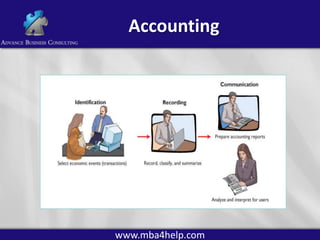
Accounting is the art of recording, summarizing, reporting, and
analyzing financial transactions.
Accountancy is the process of communicating financial information
about a business entity to users such as shareholders, owners, partners
and managers. The communication is generally in the form of financial
statements that show in money terms the economic resources under the
control of management; the art lies in selecting the information that is
relevant to the user. (wiki)
www.mba4help.com
Accountants
Accountants use the work done by bookkeepers to produce and analyze
financial reports. Although accounting follows the same principles and
rules as bookkeeping, an accountant can design a system that will
capture all of the details necessary to satisfy the needs of the
business managerial, financial reporting, projection, analysis, and tax
reporting. A good accountant will create a system of financial reporting
that gives a complete picture of a business. (wiki)
www.mba4help.com
Accounting
www.mba4help.com
Accrual vs. Cash
In accrual basis accounting, income is reported in the fiscal period it is
earned, regardless of when it is received, and expenses are deducted in
the fiscal period they are incurred, whether they are paid or not. In other
words, using accrual basis accounting, you record both revenues and
expenses when they occur. Use for all medium and larges businesses.
In cash basis accounting, revenues are recorded when cash is actually
received and expenses are recorded when they are actually paid (no
matter when they were actually invoiced). Mostly use by small
businesses like mom and dad.
www.mba4help.com
Internal vs. External
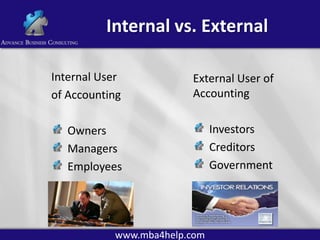
Internal User
of Accounting
Owners
Managers
Employees
External User of
Accounting
Investors
Creditors
Government
www.mba4help.com
Assets=liabilities+equity
www.mba4help.com
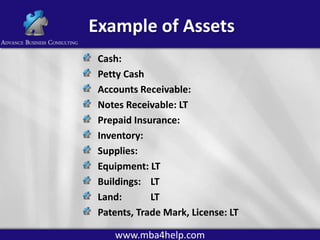
Example of Assets
Cash:
Petty Cash
Accounts Receivable:
Notes Receivable: LT
Prepaid Insurance:
Inventory:
Supplies:
Equipment: LT
Buildings: LT
Land: LT
Patents, Trade Mark, License: LT
www.mba4help.com
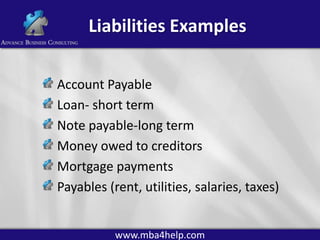
Liabilities Examples
Account Payable
Loan- short term
Note payable-long term
Money owed to creditors
Mortgage payments
Payables (rent, utilities, salaries, taxes)
www.mba4help.com
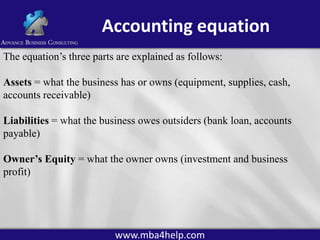
Accounting equation
The equation’s three parts are explained as follows:
Assets = what the business has or owns (equipment, supplies, cash,
accounts receivable)
Liabilities = what the business owes outsiders (bank loan, accounts
payable)
Owner’s Equity = what the owner owns (investment and business
profit)
www.mba4help.com
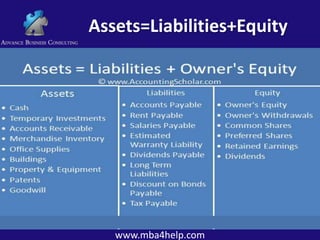
Assets=Liabilities+Equity
www.mba4help.com
Accounting equation
http://www.youtube.com/watch?v=G6vS1edTsV8&feature=BFp&list=W
L39082B4CE0E12CA1&index=4
www.mba4help.com
Accounting equation
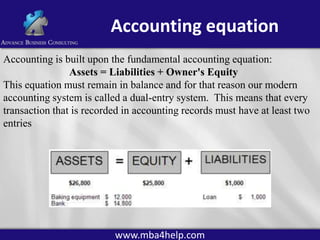
Accounting is built upon the fundamental accounting equation:
Assets = Liabilities + Owner's Equity
This equation must remain in balance and for that reason our modern
accounting system is called a dual-entry system. This means that every
transaction that is recorded in accounting records must have at least two
entries
www.mba4help.com
Accounting equation
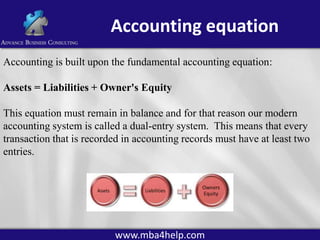
Accounting is built upon the fundamental accounting equation:
Assets = Liabilities + Owner's Equity
This equation must remain in balance and for that reason our modern
accounting system is called a dual-entry system. This means that every
transaction that is recorded in accounting records must have at least two
entries.
www.mba4help.com
Accounting T-accounts
www.mba4help.com
Credits and Debits Rules
Assets and Expenses
An increase is recorded as debit (left side)
A decrease is recorded as credit (right side)
Liabilities, Equities and Revenues
A decrease is recorded as debit (left side)
An increase is recorded as credit (right side)
Contra-accounts
Contra-accounts behave exactly in opposite way to the respective normal
accounts.
www.mba4help.com
Debits and Credits
Increases with Debits
The Debit side of an account
represents increases in asset
accounts, expense accounts, and
Drawing.
Increases with Credits
The Credit side of an account
represents increases in liability
accounts, revenue accounts,
and Capital.
www.mba4help.com
Debits and Credits
Decreases with Debits
Since credits represent increases in
liability accounts, revenue accounts, and
Capital, then debits must represent
decreases in these accounts.
Increases with Credits
The Credit side of an account represents
increases in liability accounts, revenue
accounts, and Capital.
www.mba4help.com
Natural Balance
Assets, Liabilities, Equities, Revenues, or Expenses. These account
types all have natural balances that are debits or credits.
The natural balances of each account type are:
Assets: Debit
Liabilities: Credit
Equities: Credit
Revenues: Credit
Expenses: Debit
www.mba4help.com
Summary of accounting cycle
www.mba4help.com
It is up to you!

Accounting principles 1a

  • 1.
    Mba4help.com Jose Cintron, MBA-CPC (954)374-8298 cintronj2@suagm.edu Accounting Principles 1
  • 2.
    www.mba4help.com Accounting Accounting is theart of recording, summarizing, reporting, and analyzing financial transactions. Accountancy is the process of communicating financial information about a business entity to users such as shareholders, owners, partners and managers. The communication is generally in the form of financial statements that show in money terms the economic resources under the control of management; the art lies in selecting the information that is relevant to the user. (wiki)
  • 3.
    www.mba4help.com Accountants Accountants use thework done by bookkeepers to produce and analyze financial reports. Although accounting follows the same principles and rules as bookkeeping, an accountant can design a system that will capture all of the details necessary to satisfy the needs of the business managerial, financial reporting, projection, analysis, and tax reporting. A good accountant will create a system of financial reporting that gives a complete picture of a business. (wiki)
  • 4.
  • 5.
    www.mba4help.com Accrual vs. Cash Inaccrual basis accounting, income is reported in the fiscal period it is earned, regardless of when it is received, and expenses are deducted in the fiscal period they are incurred, whether they are paid or not. In other words, using accrual basis accounting, you record both revenues and expenses when they occur. Use for all medium and larges businesses. In cash basis accounting, revenues are recorded when cash is actually received and expenses are recorded when they are actually paid (no matter when they were actually invoiced). Mostly use by small businesses like mom and dad.
  • 6.
    www.mba4help.com Internal vs. External InternalUser of Accounting Owners Managers Employees External User of Accounting Investors Creditors Government
  • 7.
  • 8.
    www.mba4help.com Example of Assets Cash: PettyCash Accounts Receivable: Notes Receivable: LT Prepaid Insurance: Inventory: Supplies: Equipment: LT Buildings: LT Land: LT Patents, Trade Mark, License: LT
  • 9.
    www.mba4help.com Liabilities Examples Account Payable Loan-short term Note payable-long term Money owed to creditors Mortgage payments Payables (rent, utilities, salaries, taxes)
  • 10.
    www.mba4help.com Accounting equation The equation’sthree parts are explained as follows: Assets = what the business has or owns (equipment, supplies, cash, accounts receivable) Liabilities = what the business owes outsiders (bank loan, accounts payable) Owner’s Equity = what the owner owns (investment and business profit)
  • 11.
  • 12.
  • 13.
    www.mba4help.com Accounting equation Accounting isbuilt upon the fundamental accounting equation: Assets = Liabilities + Owner's Equity This equation must remain in balance and for that reason our modern accounting system is called a dual-entry system. This means that every transaction that is recorded in accounting records must have at least two entries
  • 14.
    www.mba4help.com Accounting equation Accounting isbuilt upon the fundamental accounting equation: Assets = Liabilities + Owner's Equity This equation must remain in balance and for that reason our modern accounting system is called a dual-entry system. This means that every transaction that is recorded in accounting records must have at least two entries.
  • 15.
  • 16.
    www.mba4help.com Credits and DebitsRules Assets and Expenses An increase is recorded as debit (left side) A decrease is recorded as credit (right side) Liabilities, Equities and Revenues A decrease is recorded as debit (left side) An increase is recorded as credit (right side) Contra-accounts Contra-accounts behave exactly in opposite way to the respective normal accounts.
  • 17.
    www.mba4help.com Debits and Credits Increaseswith Debits The Debit side of an account represents increases in asset accounts, expense accounts, and Drawing. Increases with Credits The Credit side of an account represents increases in liability accounts, revenue accounts, and Capital.
  • 18.
    www.mba4help.com Debits and Credits Decreaseswith Debits Since credits represent increases in liability accounts, revenue accounts, and Capital, then debits must represent decreases in these accounts. Increases with Credits The Credit side of an account represents increases in liability accounts, revenue accounts, and Capital.
  • 19.
    www.mba4help.com Natural Balance Assets, Liabilities,Equities, Revenues, or Expenses. These account types all have natural balances that are debits or credits. The natural balances of each account type are: Assets: Debit Liabilities: Credit Equities: Credit Revenues: Credit Expenses: Debit
  • 20.
  • 21.