Accounting
Introduction and Overview
Learn Accounting Fast!
• This presentation is
from my book Learn
Accounting Fast!
• Available in paperback
or for the Kindle on
Amazon
Accounting
The numbers side of Business
• Quantitative: numbers
• Financial: money
• Useful: practical, not theoretical
• Decisions: use the past to change the future
• Accounting tracks the monetary aspects of a
business operation; where the money comes
from and where it goes.
• Operations
• Reporting
• Investing
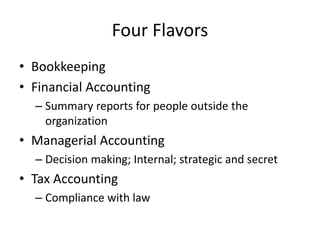
Four Flavors
• Bookkeeping
• Financial Accounting
– Summary reports for people outside the
organization
• Managerial Accounting
– Decision making; Internal; strategic and secret
• Tax Accounting
– Compliance with law
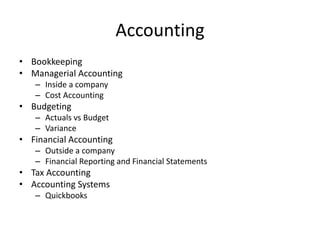
Accounting
• Bookkeeping
• Managerial Accounting
– Inside a company
– Cost Accounting
• Budgeting
– Actuals vs Budget
– Variance
• Financial Accounting
– Outside a company
– Financial Reporting and Financial Statements
• Tax Accounting
• Accounting Systems
– Quickbooks
• Glossary of Terms
• Accrual
• Accounting jobs
• GAAP
• SOX
• International
• Accounting is called a “practice” because you
get good at it by doing it.
• Accounting has evolved as a rational way of
keeping a record of transactions and creating
a clear presentation of those records.
How Old is Accounting?
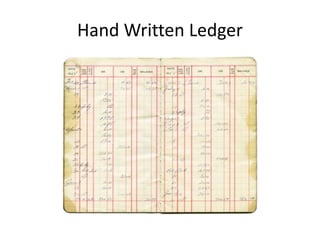
Hand Written Ledger
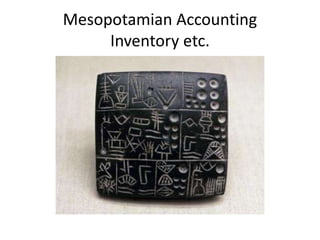
Mesopotamian Accounting
Inventory etc.
• Is bookkeeping the earliest form of writing?
• Accounting underlies all of modern
civilization.
Double Entry Bookkeeping
• Accounting is older than economics. Double entry
bookkeeping is an innovation dating to the beginning
of the Renaissance in the late 1400s and was a world
changing innovation. Accounting practice provided a
way to keep track of trade dealings and helped create
vast wealth for the newly minted banking families of
Florence. In fact, accounting allowed these families to
prosper and create the wealth that fueled the
Renaissance. As a form intellectual property,
accounting is one of the most important innovations in
the history of humankind.
• Computers have revolutionized accounting
and have made the practice easier and more
accurate in many ways. Spreadsheets such as
Excel and accounting software like Quickbooks
make our lives as accountants less error prone
and radically reduce the drudgery associated
with entering and adding long columns of
numbers. Take it from me: It is a good time to
be learning this subject.
• You will need to make determinations and
decisions about what level of detail is
adequate for effective reporting. You need a
clear understanding of who your audience is
and what information they need. Your
audience may include bankers, lawyers,
investors, and regulators, as well as bosses
and board members. There are sections that
will discuss these parties and what their needs
and interests are.
Accounting Basics
• Let’s dive into the underlying structure of
business: the numbers. You need to know the
basics of accounting and have a proper
accounting system in place in order to run a
business. It is the fundamental way that you
keep track of how your business is doing and
what you are doing. It is the most telling and
intimate record of a business.
You know accounting
• Every day you balance your checkbook, stretch
your paycheck, pay your bills, manage your
credit cards and car loan and mortgage and
rent. You are running a pretty complicated
enterprise! Though it may sometimes seem
like it, accounting is not an arcane exercise; it
is a foundational and practical part of
everyday life.
Two basic parts of Accounting
• There are two basic parts to accounting knowledge:
bookkeeping and financial statements. Bookkeeping is
how you enter business transaction information into
your accounting system and how you track these
entries. Financial statements are the reports that
organize the transactional information of bookkeeping
in standardized forms so an interested party can
quickly grasp the financial position and performance of
the enterprise. You will learn how to read financial
statements and how bookkeeping entries are made,
revised, and checked.
Accounting Systems
• Prior to the 1980s when personal computers
revolutionized accounting with software programs and
spreadsheets, accounting and bookkeeping required a
relatively high level of expertise, experience, and
concentration. Systems had to be essentially created
from scratch and each number and account was
generated, entered, and written by hand on ledger
sheets. You really had to know your debits from your
credits and be the calculator. Now computer systems
assist in creating the structure and guide the process of
making entries. This makes accounting practice much
more accessible and less cumbersome.
Innovations
• The twentieth century saw helpful innovations
in accounting before computers. Adding
machines and then hand held calculators were
huge helps in relieving the burden of adding
and subtracting columns of numbers and in
reducing errors. You can imagine how tedious
and mind-numbing accounting must have
been before that. Poor Bob Cratchet.
Computers, Spreadsheets and
Accounting Software
• In the past several decades the practice of accounting has
been transformed with spreadsheets and accounting
software. You are so lucky to be learning and becoming an
accounting user now! You can now add and subtract and
manipulate columns of numbers in spreadsheets and save
them as a handy record of your work. Accounting software
such as QuickBooks is easy to set up and use, and gives you
prompts for how to input numbers and helps check for
errors. We can also import and export between
spreadsheets and accounting software and word processors
to generate reports. These innovations have removed
some of the biggest barriers to starting a business and
running it professionally. Lucky us!
Bifurcating Accounting
• Accounting tracks the monetary aspects of a
business operation; where the money comes
from and where it goes.
• To paraphrase the humorist and actor Robert
Benchley: “there are two kinds of people: those
who divide things into two groups, and those
who don’t” To get a grasp of accounting let’s
break the field into two groups: Bookkeeping
and Financial Statements.
Bookkeeping
• Bookkeeping is the process of recording each and every
transaction that takes place within a business: every
check that is cut, every invoice received and entered,
all the money that comes in as Revenues and all the
money that goes out as Expenses; and all the assets
and liabilities. It is a record of all purchases, sales,
receipts and payments. These business transactions
occur on a daily basis and must be properly recorded in
“the books”. The books is a slang term referring to the
General Ledger and the various journals that are kept
by a business. The general ledger is a list of all the
accounts grouped by the types of transactions.
Financial Statements
• Financial Statements are the reports
generated of the aggregation of the
bookkeeping activity. There are three main
financial statements: Balance Sheet, Income
Statement, and Cash Flow Statement. The
two to focus on initially are the Balance Sheet
and Income Statement.
Cash
• The lifeblood of business is cash and keeping
track of your cash position is an absolute priority.
Things come to a grinding halt when the bank
accounts are empty. You need cash to pay bills,
purchase supplies, pay salaries (people become
ornery if they don’t get paid), and keep the lights
on. Your accounting system keeps track of how
much money is coming in (revenues) and how
much is going out (expenses); how much cash
you have is what is left over.
Accrual Accounting
• Under the accrual basis of accounting,
expenses are matched with the related
revenues and/or are reported when the
expense occurs, not when the cash is paid.
The result of accrual accounting is an income
statement that better measures the
profitability of a company during a specific
time period.
Budgets and Operations
• How much cash you have on hand is the measure of
how much business activity you can perform in the
foreseeable future. Based on your budget, you can
estimate how long you can operate with a certain
amount of cash in the bank. How much cash you need
to spend each month for your proposed operations is
called you “burn rate.” For operating businesses the
burn rate is extremely important, as is the forecasting
of when revenues will be received to replenish the
coffers. If you are in a pre-revenue start up phase of
developing a business, the conservation and disciplined
use of cash is paramount. The budget is your plan of
cash use.
Managerial
• The amount of cash you have, divided by your
burn rate is called your “runway”. It is a flight
metaphor related to how much time you have
before you need to “take off,” i.e. begin
replenishing cash with either revenues or a
round of funding. This metric is also called
your horizon to revenues.
Startups and Entrepreneurship
• Revenues from sales increase the cash position and
fund future activity. For Start-up enterprises, the
amount of cash raised is equivalent to how much
development activity you can perform before you will
need to achieve revenues and sales or go out and do
another round of fund raising. The “runway”
represents how long the enterprise can operate, based
on the budget (and disciplined execution and
adherence to that budget), before things come to a
grinding halt or more money is raised. Cash is your
main resource. You cannot be effective without it. A
slang term for thinking of cash in this way is called “dry
powder,” an old fashioned gun powder analogy.
Budget, Actual, and Variance
• Each month it is good operating and managerial
practice to compare your actual accounting
results to your previously prepared budget.
When you compare Actuals to Budget you are
looking for variances: differences between them.
These are the numbers that you need to
understand. Why were you over or under
budget? Was it a onetime unforeseen event or a
recurring expense that you overlooked in the
budgeting process? This kind of analysis forces
you to have detailed answers to these questions.
Strategic Focus
• If you are over budget it better be for a very good
reason like it accelerated timetables or expanded
opportunities. Caveat: expanding opportunities can
be seductive and not necessarily productive. What
seem to be expanded opportunities can dilute efforts
and actually reduce chances of success. You can’t
successfully chase all the possibilities that present
themselves. Part of disciplined execution and
management is focusing on the specific goals and
eliminating or reducing distractions; even if they seem
attractive. Remember the Sirens from the Odyssey…
Keeping Track
• Your computer-based accounting system helps keep
track of all of these considerations so you can report
and operate your business in an organized and planned
manner. In comparing actuals to budget you may
need to export or import data between your
accounting system and a spreadsheet program. The
current versions of software have easy functions to
accommodate import and export sharing between
programs.
• Now we will discuss bookkeeping and the basic process
of making journal entries, posting them, and creating
financial statements from that information.
Please Connect!
• Follow me on twitter @jjcousins http://bit.ly/2gQlamx
• Subscribe to my podcast MBA ASAP http://bit.ly/2fCWs8s
• Subscribe to my YouTube learning channel MBA ASAP http://bit.ly/2erywED
• Check out my blog at MBA-ASAP.com http://bit.ly/2nwYFl8
• Check out the MBA ASAP library at MBA-ASAP.com http://bit.ly/2uQbQjH
• Kindle, paperback, audio books at Amazon http://bit.ly/2uQbQjH
• audio books at Audible http://adbl.co/2xA7JJZ http://adbl.co/2w0CCHd
• Check my online courses at Udemy http://bit.ly/2xAjxRn http://bit.ly/2xK10hY
• and Teachable
• Connect with me on LinkedIn http://bit.ly/2sR1eQr
• Get the free eBook Understanding Financial Statements http://bit.ly/2kl6ADV
• Sign up for my email list at MBA-ASAP.com
• Check out my program at UNM Continuing Ed http://bit.ly/2A5Ah0w
• Check out my Patreon site http://bit.ly/2k1ebsb
•
• Subscribe via: YouTube, Podcast, Facebook, Twitter, iTunes
The End

Accounting Introduction and Overview

  • 1.
  • 2.
    Learn Accounting Fast! •This presentation is from my book Learn Accounting Fast! • Available in paperback or for the Kindle on Amazon
  • 3.
    Accounting The numbers sideof Business • Quantitative: numbers • Financial: money • Useful: practical, not theoretical • Decisions: use the past to change the future • Accounting tracks the monetary aspects of a business operation; where the money comes from and where it goes. • Operations • Reporting • Investing
  • 4.
    Four Flavors • Bookkeeping •Financial Accounting – Summary reports for people outside the organization • Managerial Accounting – Decision making; Internal; strategic and secret • Tax Accounting – Compliance with law
  • 6.
    Accounting • Bookkeeping • ManagerialAccounting – Inside a company – Cost Accounting • Budgeting – Actuals vs Budget – Variance • Financial Accounting – Outside a company – Financial Reporting and Financial Statements • Tax Accounting • Accounting Systems – Quickbooks
  • 7.
    • Glossary ofTerms • Accrual • Accounting jobs • GAAP • SOX • International
  • 8.
    • Accounting iscalled a “practice” because you get good at it by doing it. • Accounting has evolved as a rational way of keeping a record of transactions and creating a clear presentation of those records.
  • 9.
    How Old isAccounting?
  • 10.
  • 11.
  • 12.
    • Is bookkeepingthe earliest form of writing? • Accounting underlies all of modern civilization.
  • 13.
    Double Entry Bookkeeping •Accounting is older than economics. Double entry bookkeeping is an innovation dating to the beginning of the Renaissance in the late 1400s and was a world changing innovation. Accounting practice provided a way to keep track of trade dealings and helped create vast wealth for the newly minted banking families of Florence. In fact, accounting allowed these families to prosper and create the wealth that fueled the Renaissance. As a form intellectual property, accounting is one of the most important innovations in the history of humankind.
  • 14.
    • Computers haverevolutionized accounting and have made the practice easier and more accurate in many ways. Spreadsheets such as Excel and accounting software like Quickbooks make our lives as accountants less error prone and radically reduce the drudgery associated with entering and adding long columns of numbers. Take it from me: It is a good time to be learning this subject.
  • 15.
    • You willneed to make determinations and decisions about what level of detail is adequate for effective reporting. You need a clear understanding of who your audience is and what information they need. Your audience may include bankers, lawyers, investors, and regulators, as well as bosses and board members. There are sections that will discuss these parties and what their needs and interests are.
  • 16.
    Accounting Basics • Let’sdive into the underlying structure of business: the numbers. You need to know the basics of accounting and have a proper accounting system in place in order to run a business. It is the fundamental way that you keep track of how your business is doing and what you are doing. It is the most telling and intimate record of a business.
  • 17.
    You know accounting •Every day you balance your checkbook, stretch your paycheck, pay your bills, manage your credit cards and car loan and mortgage and rent. You are running a pretty complicated enterprise! Though it may sometimes seem like it, accounting is not an arcane exercise; it is a foundational and practical part of everyday life.
  • 18.
    Two basic partsof Accounting • There are two basic parts to accounting knowledge: bookkeeping and financial statements. Bookkeeping is how you enter business transaction information into your accounting system and how you track these entries. Financial statements are the reports that organize the transactional information of bookkeeping in standardized forms so an interested party can quickly grasp the financial position and performance of the enterprise. You will learn how to read financial statements and how bookkeeping entries are made, revised, and checked.
  • 19.
    Accounting Systems • Priorto the 1980s when personal computers revolutionized accounting with software programs and spreadsheets, accounting and bookkeeping required a relatively high level of expertise, experience, and concentration. Systems had to be essentially created from scratch and each number and account was generated, entered, and written by hand on ledger sheets. You really had to know your debits from your credits and be the calculator. Now computer systems assist in creating the structure and guide the process of making entries. This makes accounting practice much more accessible and less cumbersome.
  • 20.
    Innovations • The twentiethcentury saw helpful innovations in accounting before computers. Adding machines and then hand held calculators were huge helps in relieving the burden of adding and subtracting columns of numbers and in reducing errors. You can imagine how tedious and mind-numbing accounting must have been before that. Poor Bob Cratchet.
  • 21.
    Computers, Spreadsheets and AccountingSoftware • In the past several decades the practice of accounting has been transformed with spreadsheets and accounting software. You are so lucky to be learning and becoming an accounting user now! You can now add and subtract and manipulate columns of numbers in spreadsheets and save them as a handy record of your work. Accounting software such as QuickBooks is easy to set up and use, and gives you prompts for how to input numbers and helps check for errors. We can also import and export between spreadsheets and accounting software and word processors to generate reports. These innovations have removed some of the biggest barriers to starting a business and running it professionally. Lucky us!
  • 22.
    Bifurcating Accounting • Accountingtracks the monetary aspects of a business operation; where the money comes from and where it goes. • To paraphrase the humorist and actor Robert Benchley: “there are two kinds of people: those who divide things into two groups, and those who don’t” To get a grasp of accounting let’s break the field into two groups: Bookkeeping and Financial Statements.
  • 23.
    Bookkeeping • Bookkeeping isthe process of recording each and every transaction that takes place within a business: every check that is cut, every invoice received and entered, all the money that comes in as Revenues and all the money that goes out as Expenses; and all the assets and liabilities. It is a record of all purchases, sales, receipts and payments. These business transactions occur on a daily basis and must be properly recorded in “the books”. The books is a slang term referring to the General Ledger and the various journals that are kept by a business. The general ledger is a list of all the accounts grouped by the types of transactions.
  • 24.
    Financial Statements • FinancialStatements are the reports generated of the aggregation of the bookkeeping activity. There are three main financial statements: Balance Sheet, Income Statement, and Cash Flow Statement. The two to focus on initially are the Balance Sheet and Income Statement.
  • 25.
    Cash • The lifebloodof business is cash and keeping track of your cash position is an absolute priority. Things come to a grinding halt when the bank accounts are empty. You need cash to pay bills, purchase supplies, pay salaries (people become ornery if they don’t get paid), and keep the lights on. Your accounting system keeps track of how much money is coming in (revenues) and how much is going out (expenses); how much cash you have is what is left over.
  • 26.
    Accrual Accounting • Underthe accrual basis of accounting, expenses are matched with the related revenues and/or are reported when the expense occurs, not when the cash is paid. The result of accrual accounting is an income statement that better measures the profitability of a company during a specific time period.
  • 27.
    Budgets and Operations •How much cash you have on hand is the measure of how much business activity you can perform in the foreseeable future. Based on your budget, you can estimate how long you can operate with a certain amount of cash in the bank. How much cash you need to spend each month for your proposed operations is called you “burn rate.” For operating businesses the burn rate is extremely important, as is the forecasting of when revenues will be received to replenish the coffers. If you are in a pre-revenue start up phase of developing a business, the conservation and disciplined use of cash is paramount. The budget is your plan of cash use.
  • 28.
    Managerial • The amountof cash you have, divided by your burn rate is called your “runway”. It is a flight metaphor related to how much time you have before you need to “take off,” i.e. begin replenishing cash with either revenues or a round of funding. This metric is also called your horizon to revenues.
  • 29.
    Startups and Entrepreneurship •Revenues from sales increase the cash position and fund future activity. For Start-up enterprises, the amount of cash raised is equivalent to how much development activity you can perform before you will need to achieve revenues and sales or go out and do another round of fund raising. The “runway” represents how long the enterprise can operate, based on the budget (and disciplined execution and adherence to that budget), before things come to a grinding halt or more money is raised. Cash is your main resource. You cannot be effective without it. A slang term for thinking of cash in this way is called “dry powder,” an old fashioned gun powder analogy.
  • 30.
    Budget, Actual, andVariance • Each month it is good operating and managerial practice to compare your actual accounting results to your previously prepared budget. When you compare Actuals to Budget you are looking for variances: differences between them. These are the numbers that you need to understand. Why were you over or under budget? Was it a onetime unforeseen event or a recurring expense that you overlooked in the budgeting process? This kind of analysis forces you to have detailed answers to these questions.
  • 31.
    Strategic Focus • Ifyou are over budget it better be for a very good reason like it accelerated timetables or expanded opportunities. Caveat: expanding opportunities can be seductive and not necessarily productive. What seem to be expanded opportunities can dilute efforts and actually reduce chances of success. You can’t successfully chase all the possibilities that present themselves. Part of disciplined execution and management is focusing on the specific goals and eliminating or reducing distractions; even if they seem attractive. Remember the Sirens from the Odyssey…
  • 32.
    Keeping Track • Yourcomputer-based accounting system helps keep track of all of these considerations so you can report and operate your business in an organized and planned manner. In comparing actuals to budget you may need to export or import data between your accounting system and a spreadsheet program. The current versions of software have easy functions to accommodate import and export sharing between programs. • Now we will discuss bookkeeping and the basic process of making journal entries, posting them, and creating financial statements from that information.
  • 33.
    Please Connect! • Followme on twitter @jjcousins http://bit.ly/2gQlamx • Subscribe to my podcast MBA ASAP http://bit.ly/2fCWs8s • Subscribe to my YouTube learning channel MBA ASAP http://bit.ly/2erywED • Check out my blog at MBA-ASAP.com http://bit.ly/2nwYFl8 • Check out the MBA ASAP library at MBA-ASAP.com http://bit.ly/2uQbQjH • Kindle, paperback, audio books at Amazon http://bit.ly/2uQbQjH • audio books at Audible http://adbl.co/2xA7JJZ http://adbl.co/2w0CCHd • Check my online courses at Udemy http://bit.ly/2xAjxRn http://bit.ly/2xK10hY • and Teachable • Connect with me on LinkedIn http://bit.ly/2sR1eQr • Get the free eBook Understanding Financial Statements http://bit.ly/2kl6ADV • Sign up for my email list at MBA-ASAP.com • Check out my program at UNM Continuing Ed http://bit.ly/2A5Ah0w • Check out my Patreon site http://bit.ly/2k1ebsb • • Subscribe via: YouTube, Podcast, Facebook, Twitter, iTunes
  • 34.