ACTIVITY #1
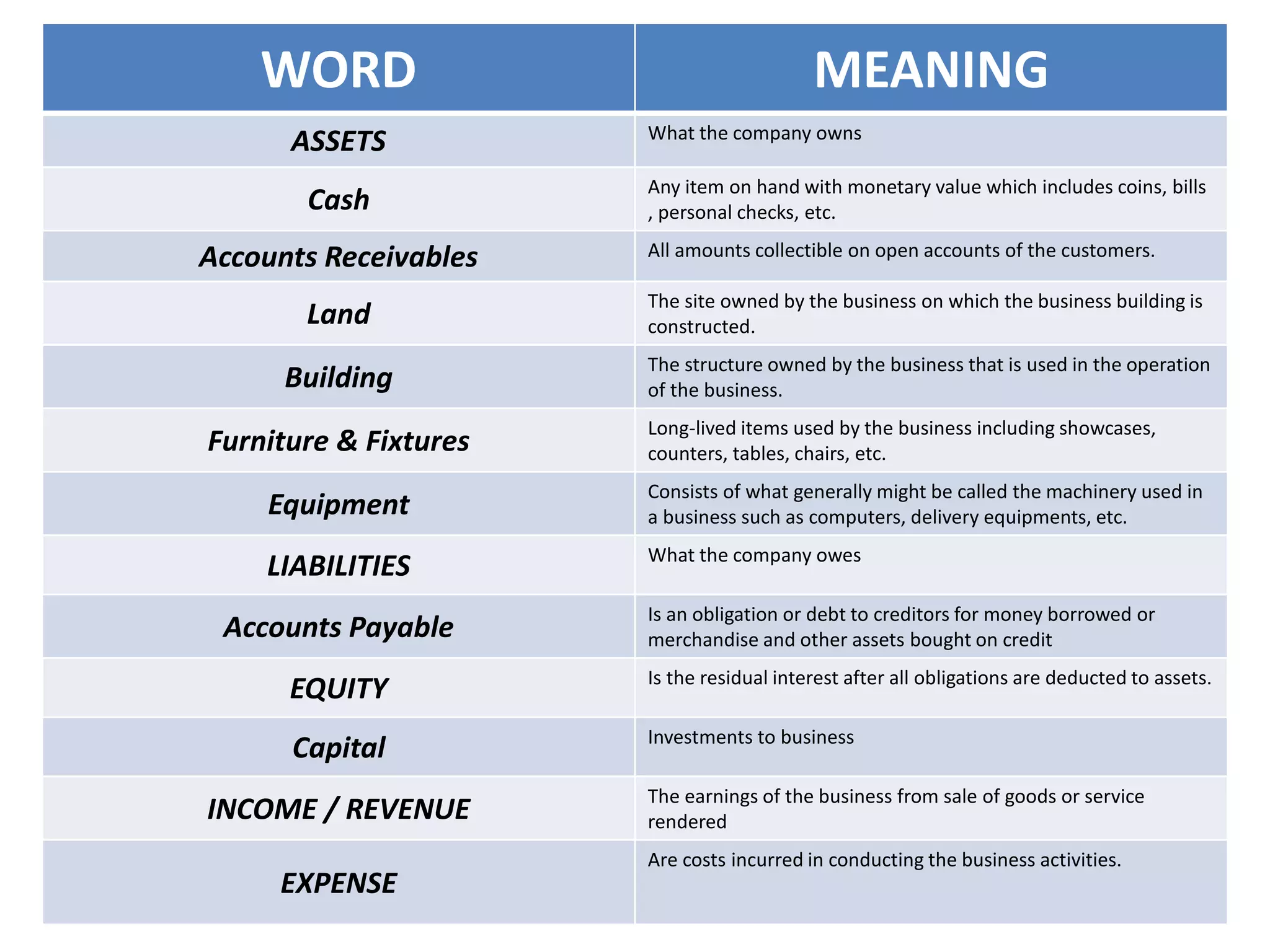
WORD MEANING
ASSETS What the company owns
Cash
Any item on hand with monetary value which includes coins, bills
, personal checks, etc.
Accounts Receivables All amounts collectible on open accounts of the customers.
Land
The site owned by the business on which the business building is
constructed.
Building
The structure owned by the business that is used in the operation
of the business.
Furniture & Fixtures
Long-lived items used by the business including showcases,
counters, tables, chairs, etc.
Equipment
Consists of what generally might be called the machinery used in
a business such as computers, delivery equipments, etc.
LIABILITIES What the company owes
Accounts Payable
Is an obligation or debt to creditors for money borrowed or
merchandise and other assets bought on credit
EQUITY Is the residual interest after all obligations are deducted to assets.
Capital Investments to business
INCOME / REVENUE
The earnings of the business from sale of goods or service
rendered
EXPENSE
Are costs incurred in conducting the business activities.
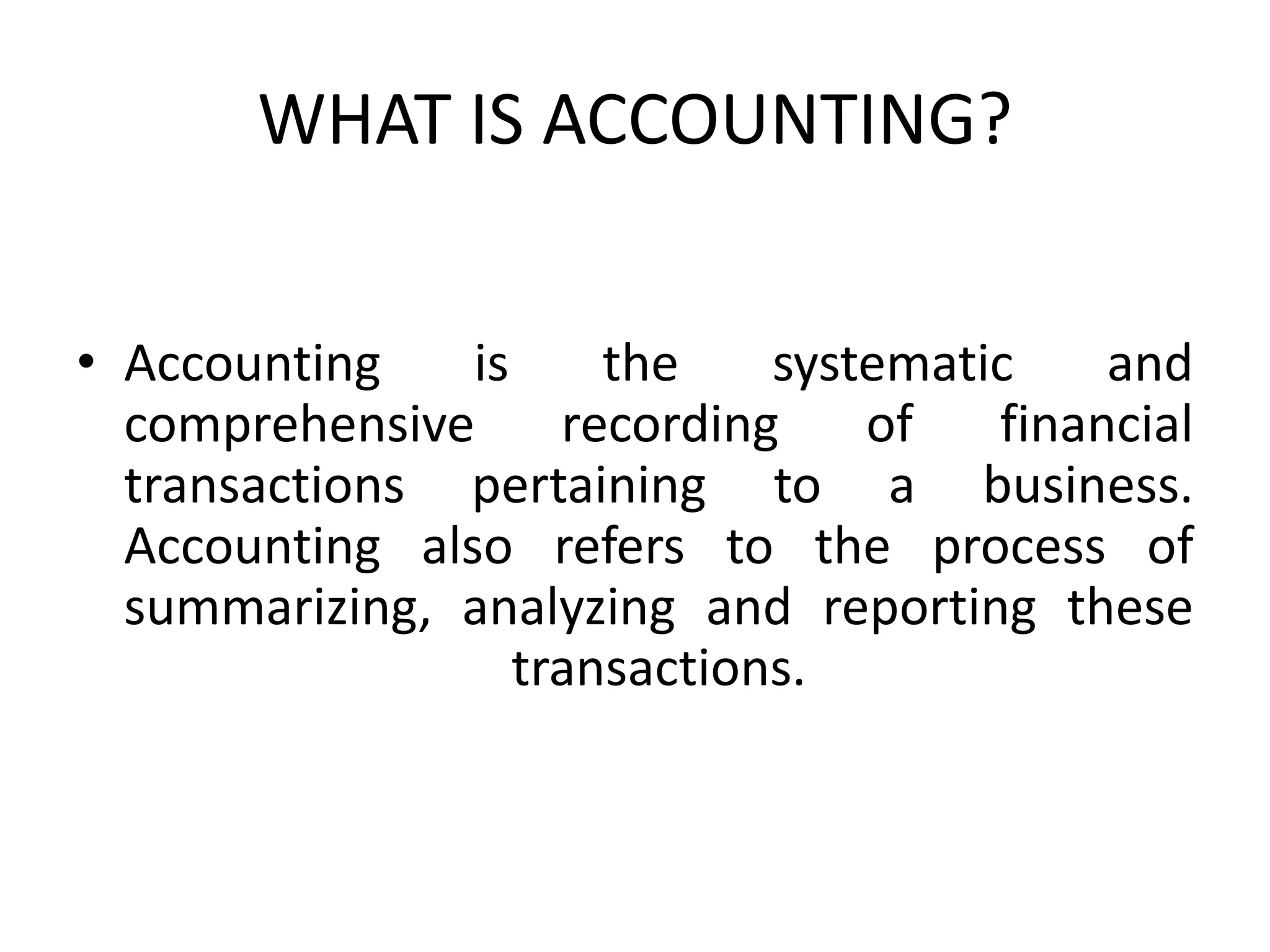
WHAT IS ACCOUNTING?
• Accounting is the systematic and
comprehensive recording of financial
transactions pertaining to a business.
Accounting also refers to the process of
summarizing, analyzing and reporting these
transactions.
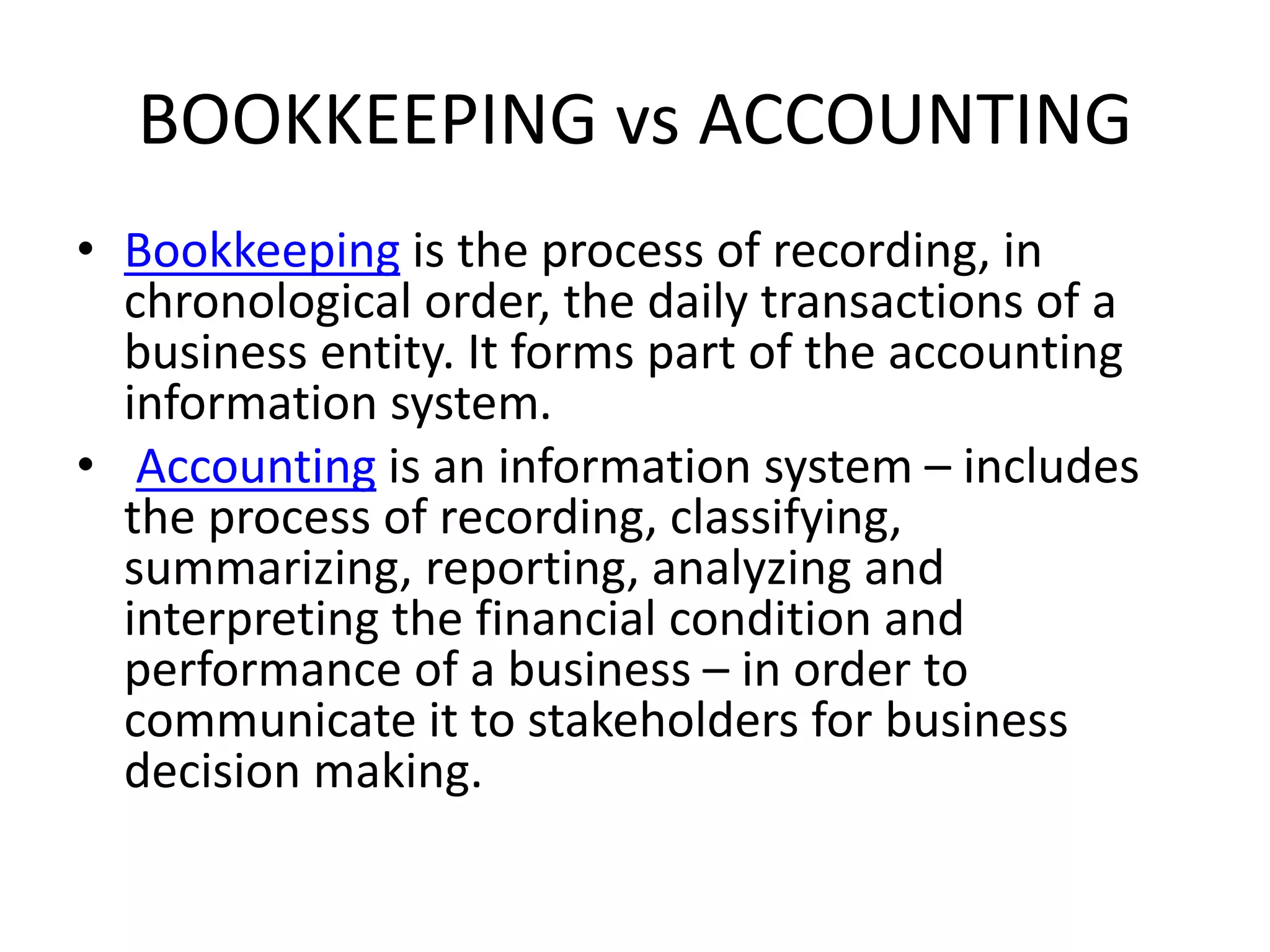
BOOKKEEPING vs ACCOUNTING
• Bookkeeping is the process of recording, in
chronological order, the daily transactions of a
business entity. It forms part of the accounting
information system.
• Accounting is an information system – includes
the process of recording, classifying,
summarizing, reporting, analyzing and
interpreting the financial condition and
performance of a business – in order to
communicate it to stakeholders for business
decision making.
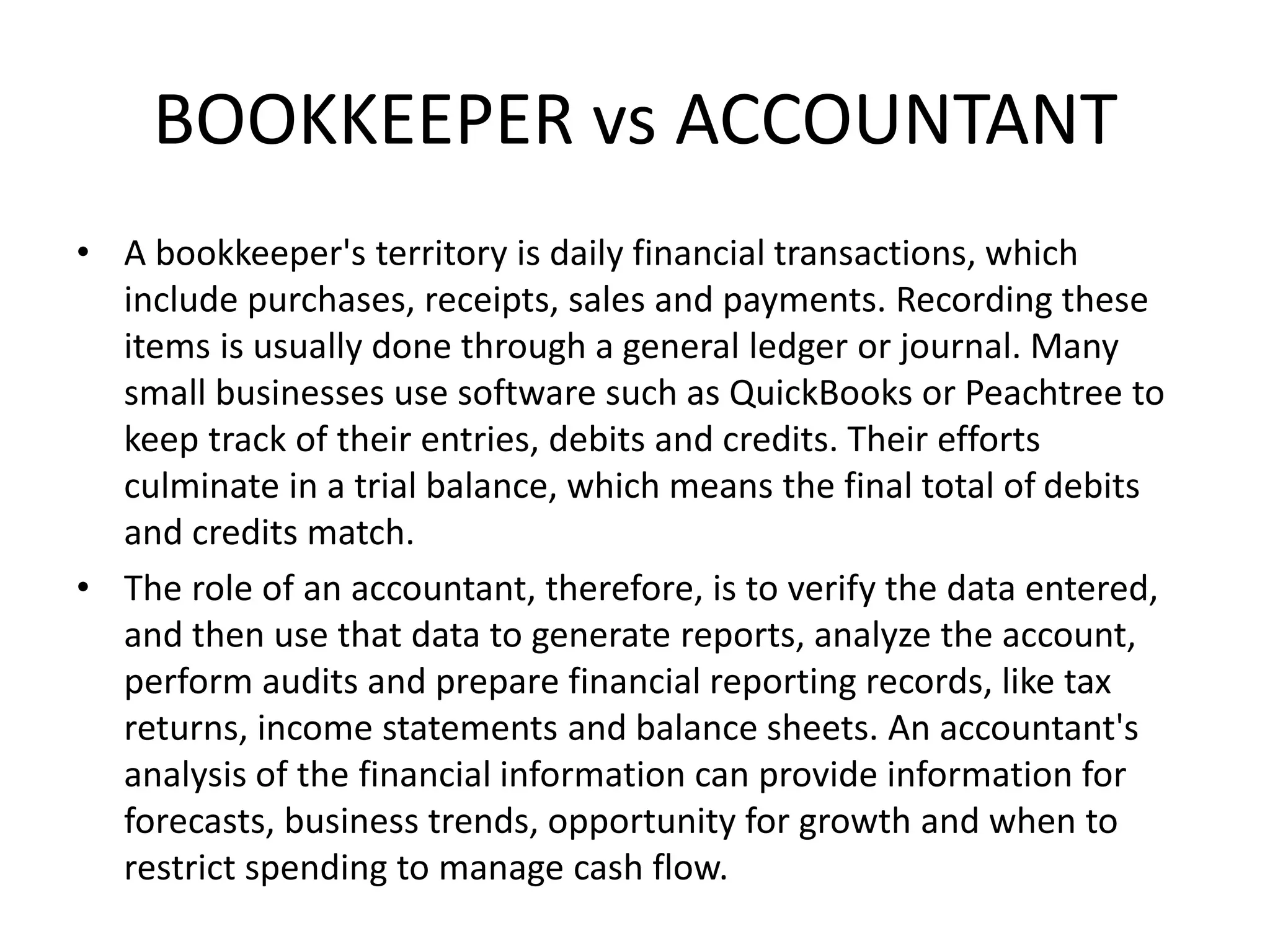
BOOKKEEPER vs ACCOUNTANT
• A bookkeeper's territory is daily financial transactions, which
include purchases, receipts, sales and payments. Recording these
items is usually done through a general ledger or journal. Many
small businesses use software such as QuickBooks or Peachtree to
keep track of their entries, debits and credits. Their efforts
culminate in a trial balance, which means the final total of debits
and credits match.
• The role of an accountant, therefore, is to verify the data entered,
and then use that data to generate reports, analyze the account,
perform audits and prepare financial reporting records, like tax
returns, income statements and balance sheets. An accountant's
analysis of the financial information can provide information for
forecasts, business trends, opportunity for growth and when to
restrict spending to manage cash flow.
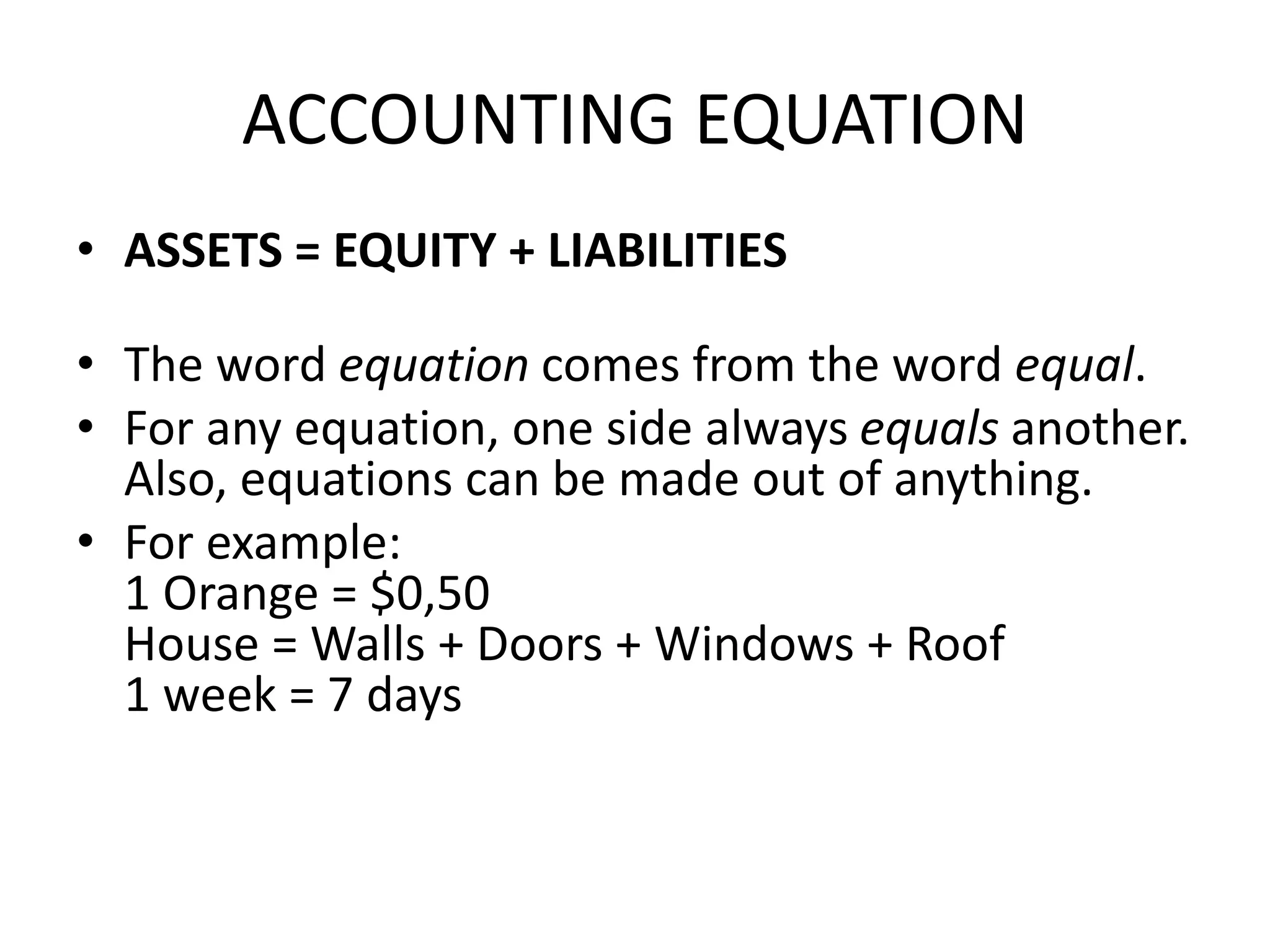
ACCOUNTING EQUATION
• ASSETS = EQUITY + LIABILITIES
• The word equation comes from the word equal.
• For any equation, one side always equals another.
Also, equations can be made out of anything.
• For example:
1 Orange = $0,50
House = Walls + Doors + Windows + Roof
1 week = 7 days
ASSETS
• Assets are possessions of the business. They
are things that add value to the business and
will bring it benefits in some form. For
example, furniture, machinery,
vehicles, computers, stationery or cash.
ASSETS
• EXAMPLES:
1. CASH
2. ACCOUNTS RECEIVABLES
3. LAND
4. BUILDING
5. FURNITURE AND FIXTURES
6. EQUIPMENT
LIABILITY
• Liabilities are basically debts. The amount of
liabilities represents the value of the business
assets that are owed to others. It is the value
of the assets that people outside the business
can lay claim to.
• EXAMPLE : Accounts Payable
EQUITY
• Equity, or owner's equity, is the value of the
assets that the owner owns. It is the value of
the business assets that the owner can lay
claim to.
• EXAMPLE: Capital
INCOME/REVENUE
• Represents the earnings of the business from
sale of goods or service rendered.
EXPENSE
• Represents the costs incurred in conducting
the business activities.
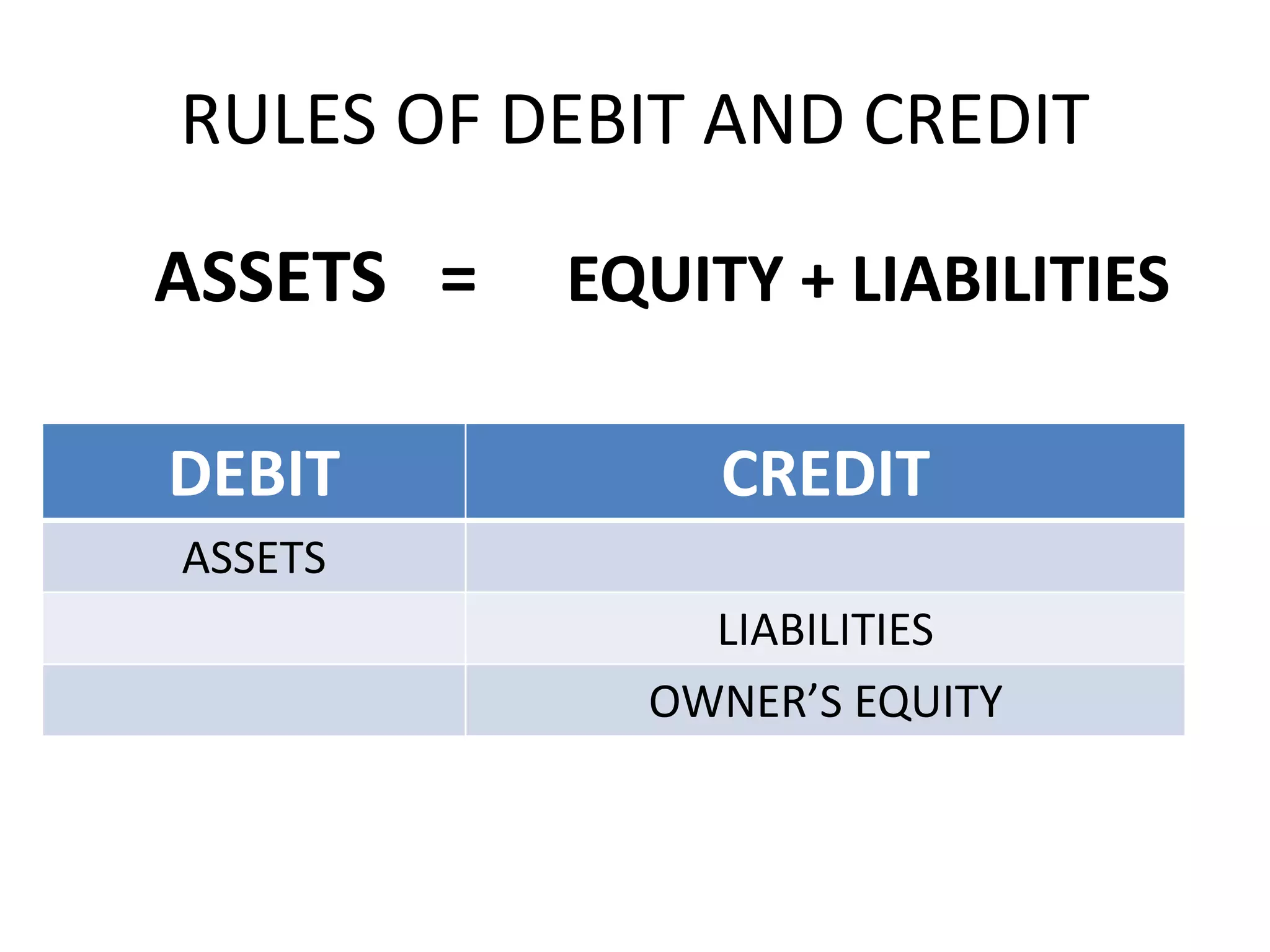
RULES OF DEBIT AND CREDIT
DEBIT
• Derived from a latin word “debitum” (debtor)
• The value received in a business transaction
which must be recorded in the journal.
• The left-hand side of the equation.
• The word “charge” in accounting would also
mean debit.
RULES OF DEBIT AND CREDIT
CREDIT
• Derived from the latin word “creditum”
(creditor)
• Is the value parted with in a business
transaction which must be recorded in the
journal
• The right-hand side of the equation.
RULES OF DEBIT AND CREDIT
DEBIT CREDIT
ASSETS
LIABILITIES
OWNER’S EQUITY
ASSETS = EQUITY + LIABILITIES
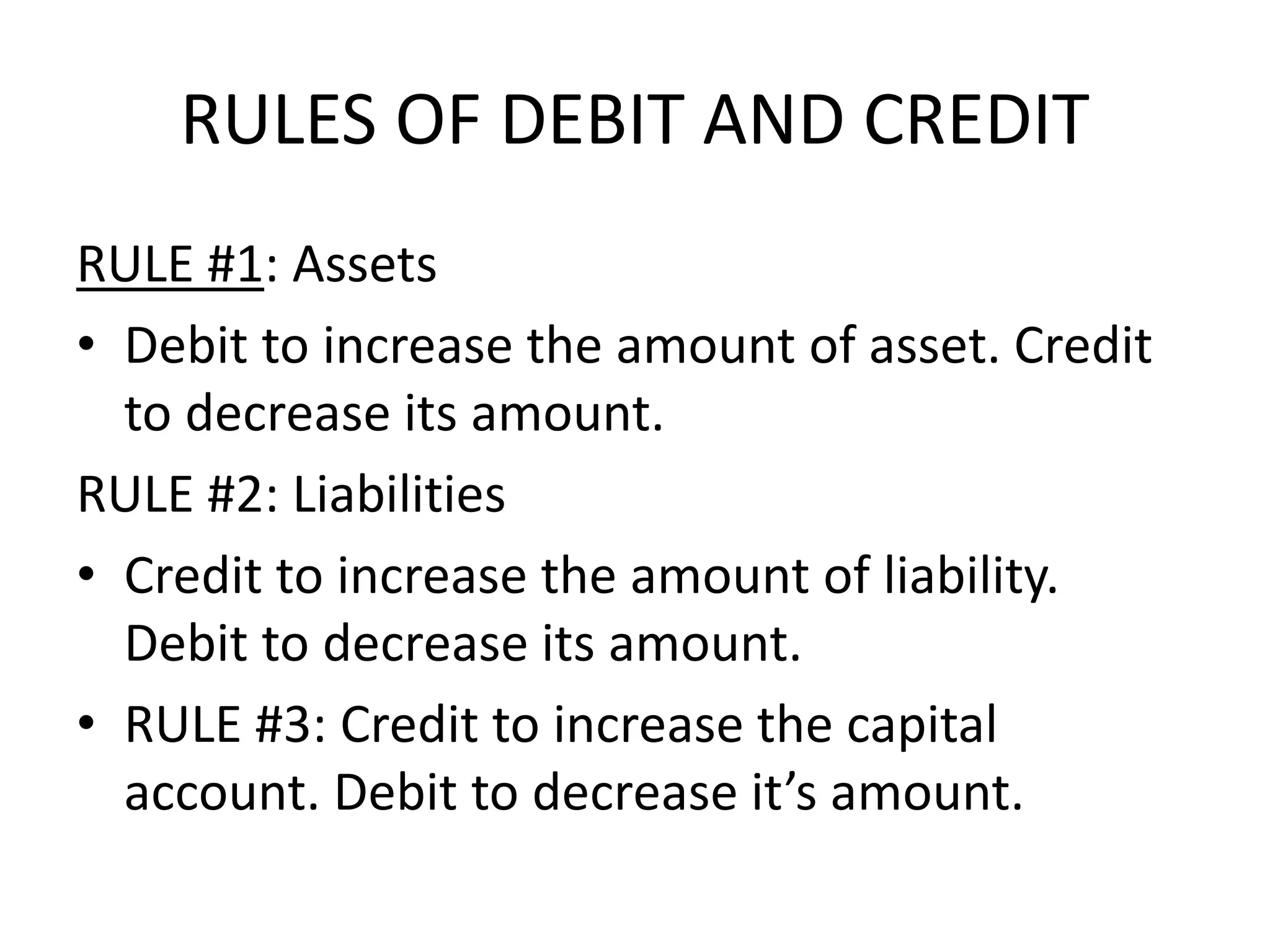
RULES OF DEBIT AND CREDIT
RULE #1: Assets
• Debit to increase the amount of asset. Credit
to decrease its amount.
RULE #2: Liabilities
• Credit to increase the amount of liability.
Debit to decrease its amount.
• RULE #3: Credit to increase the capital
account. Debit to decrease it’s amount.
ACTIVITY #2
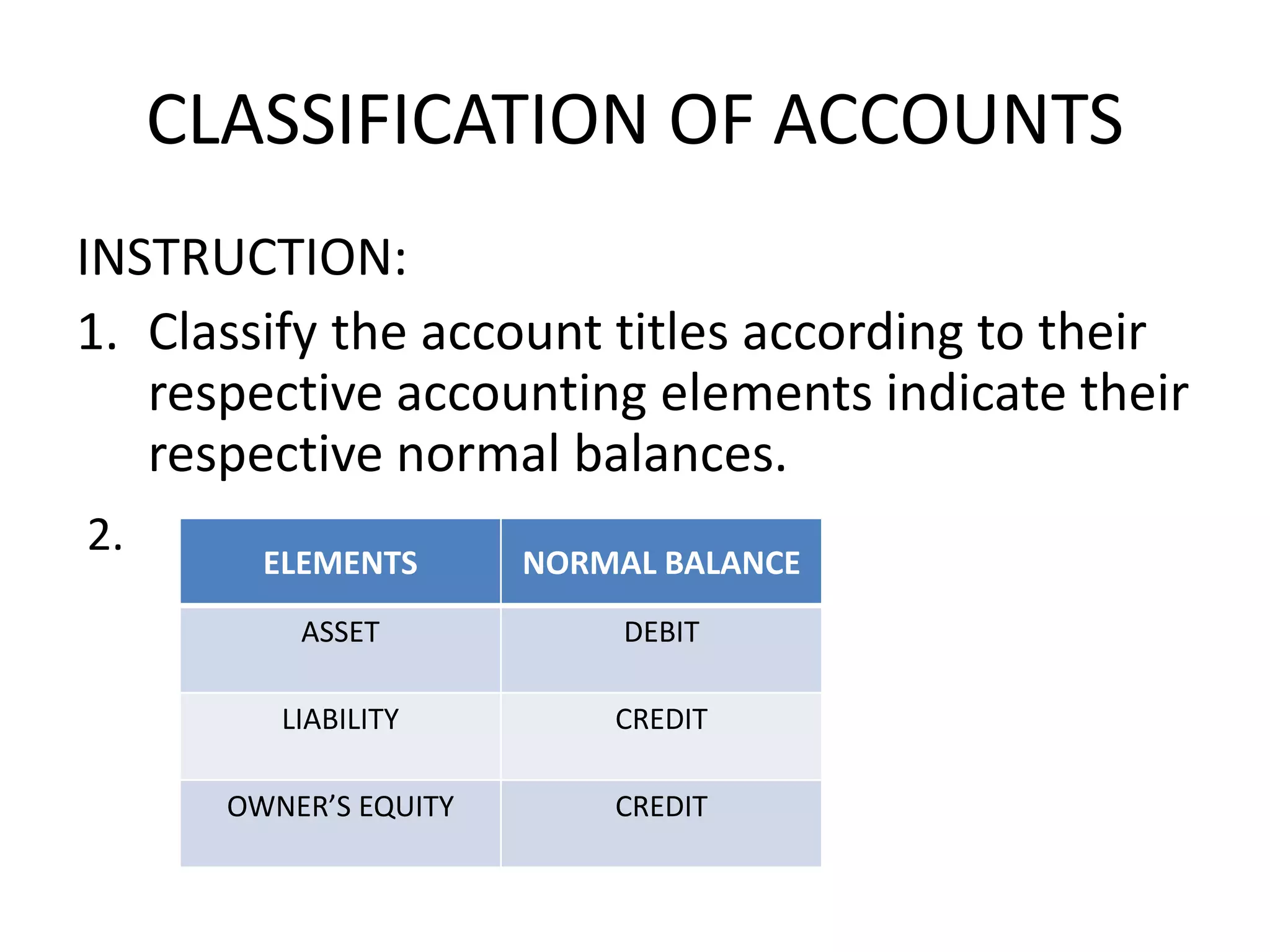
CLASSIFICATION OF ACCOUNTS
INSTRUCTION:
1. Classify the account titles according to their
respective accounting elements indicate their
respective normal balances.
ELEMENTS NORMAL BALANCE
ASSET DEBIT
LIABILITY CREDIT
OWNER’S EQUITY CREDIT
2.
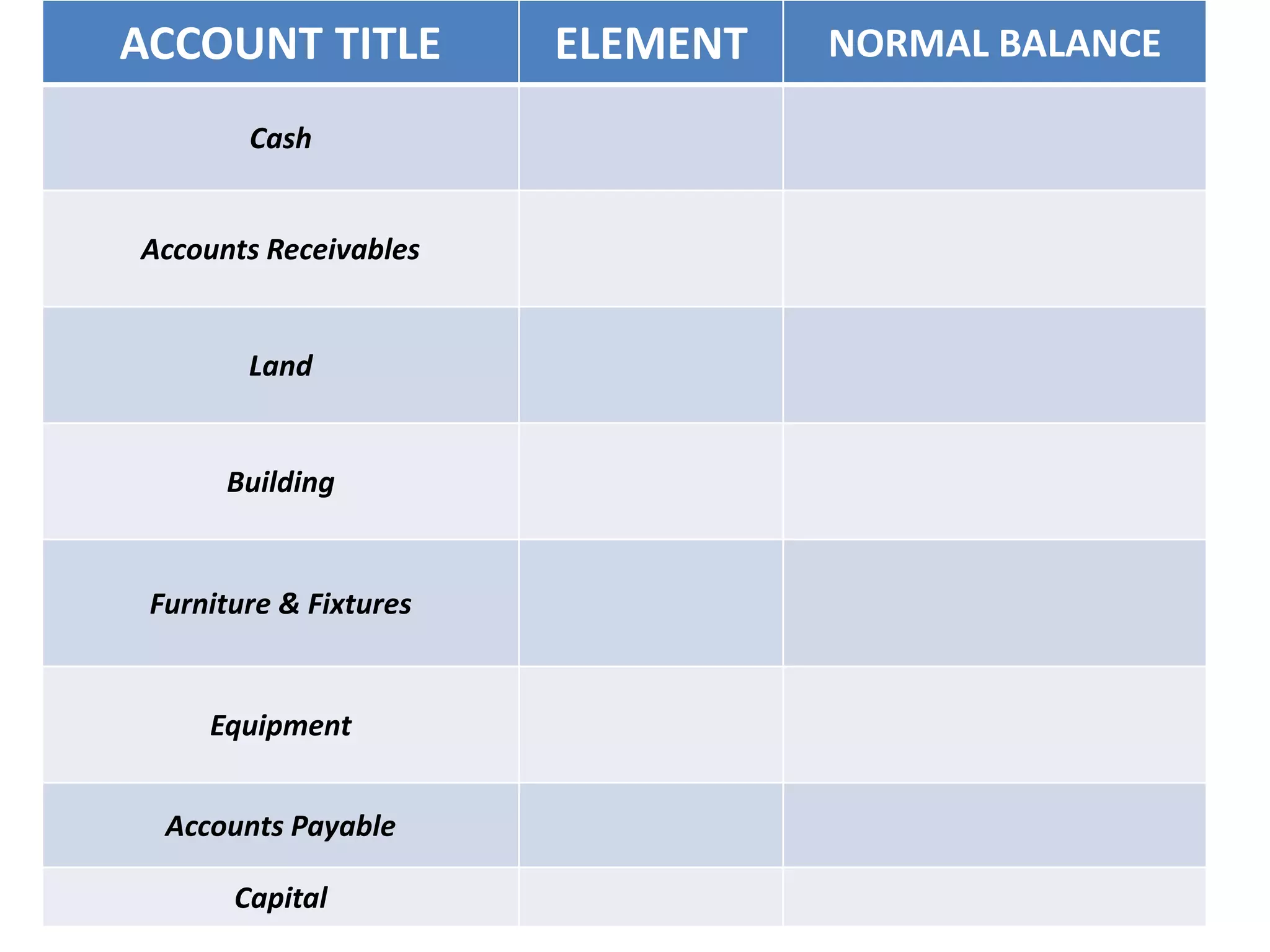
ACCOUNT TITLE ELEMENT NORMAL BALANCE
Cash
Accounts Receivables
Land
Building
Furniture & Fixtures
Equipment
Accounts Payable
Capital
ACCOUNTING TRANSACTIONS
• Are economic activities of the business
enterprise which affect any of the basic
accounting elements. These are generally
sourced from ordinary business activities,
such as selling, purchasing and producing.
ACCOUNTING EVENTS
• Refer to occurrences that affect any of the
basic accounting elements. These events may
be occasional to the business. Examples are
losses due to theft, calamity, etc.
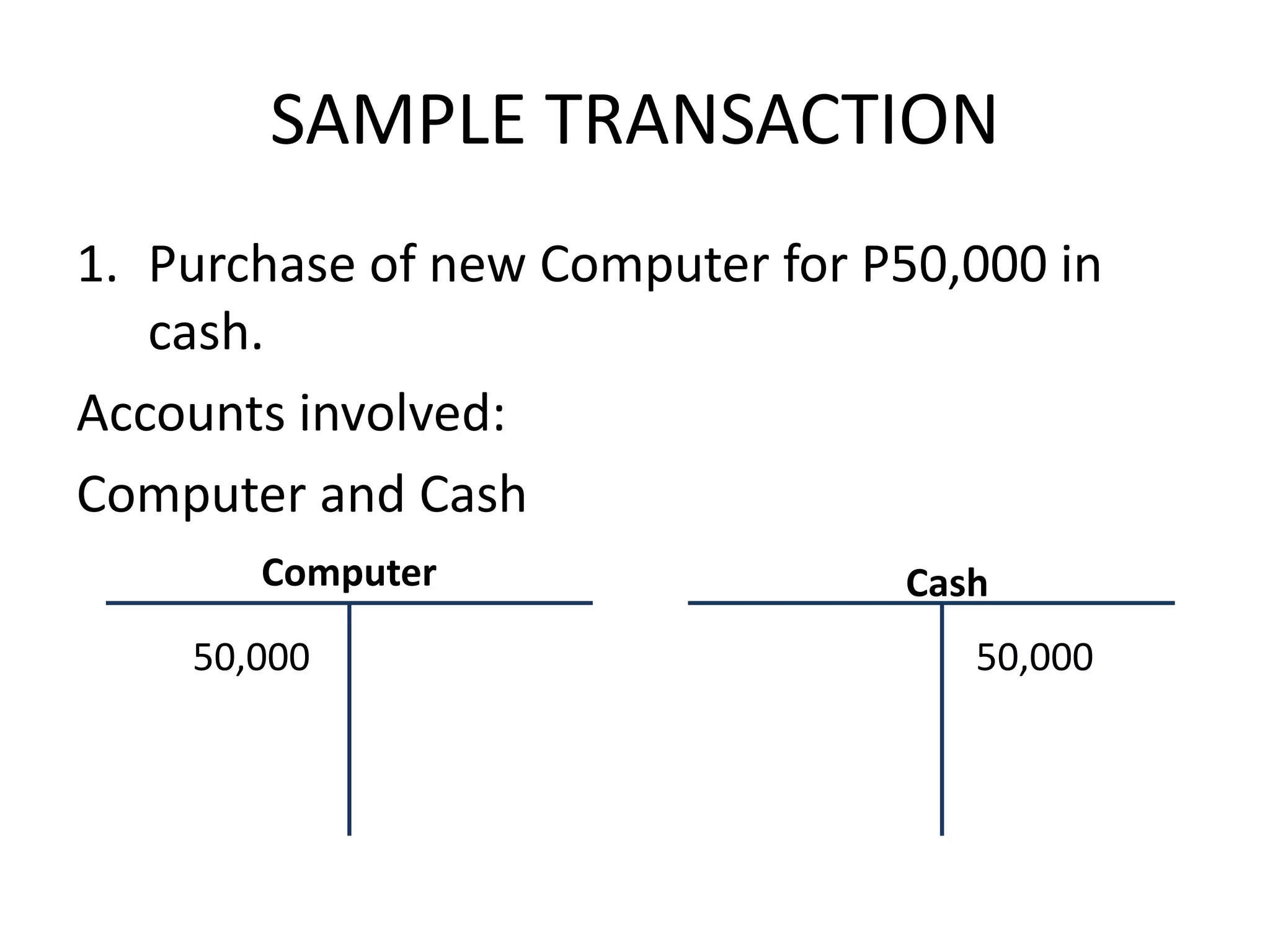
SAMPLE TRANSACTION
1. Purchase of new Computer for P50,000 in
cash.
Accounts involved:
Computer and Cash
T-ACCOUNT
• An account may be expressed in a “T” device
from where the debits are recorded on the
left-hand side and the credits are recorded on
the right-hand side of the letter T. As implied
in its form, this device is called a “T-account”.
SAMPLE TRANSACTION
1. Purchase of new Computer for P50,000 in
cash.
Accounts involved:
Computer and Cash
Computer Cash
50,000 50,000
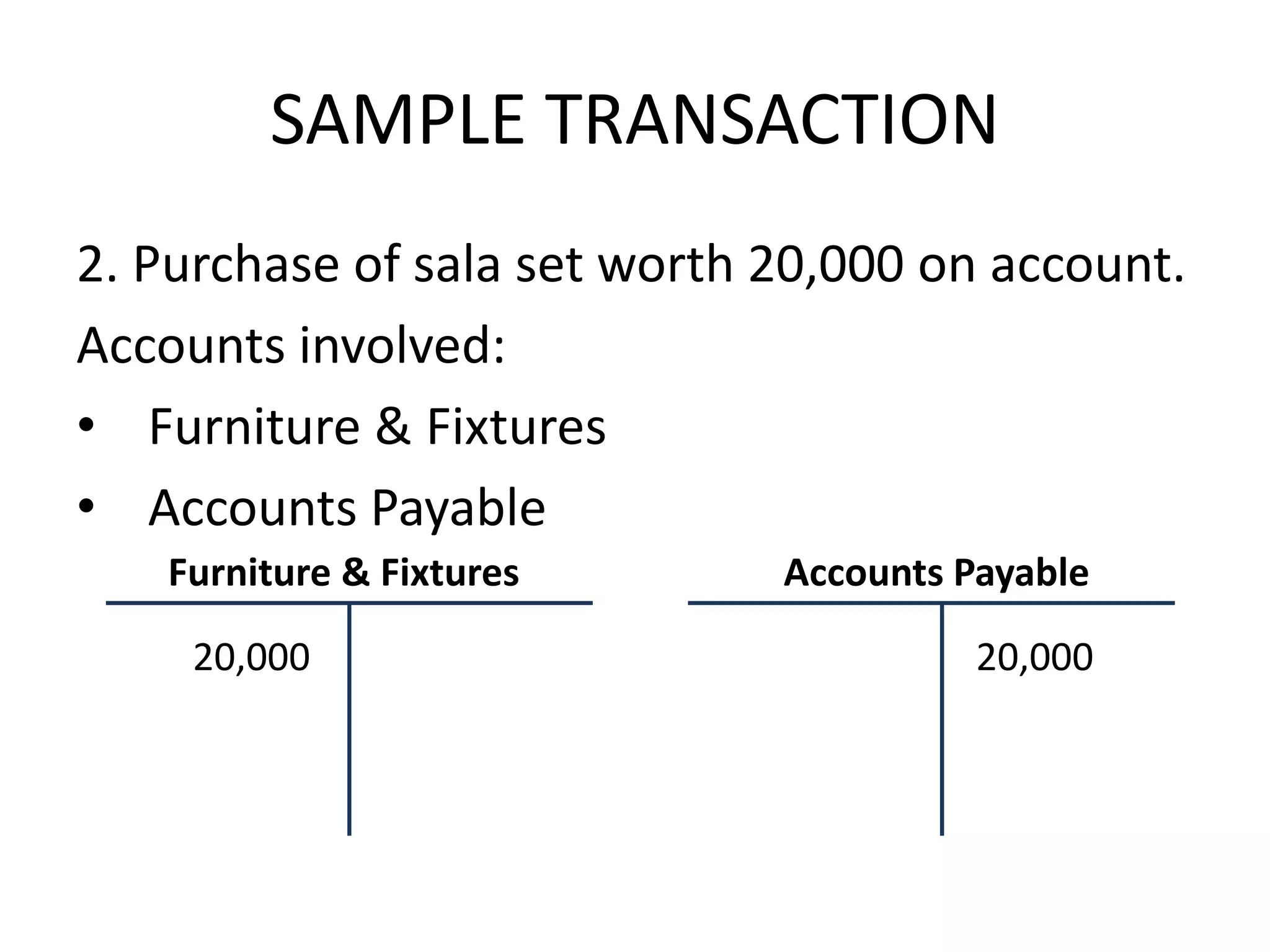
SAMPLE TRANSACTION
2. Purchase of sala set worth 20,000 on account.
Accounts involved:
• Furniture & Fixtures
• Accounts Payable
Furniture & Fixtures Accounts Payable
20,000 20,000
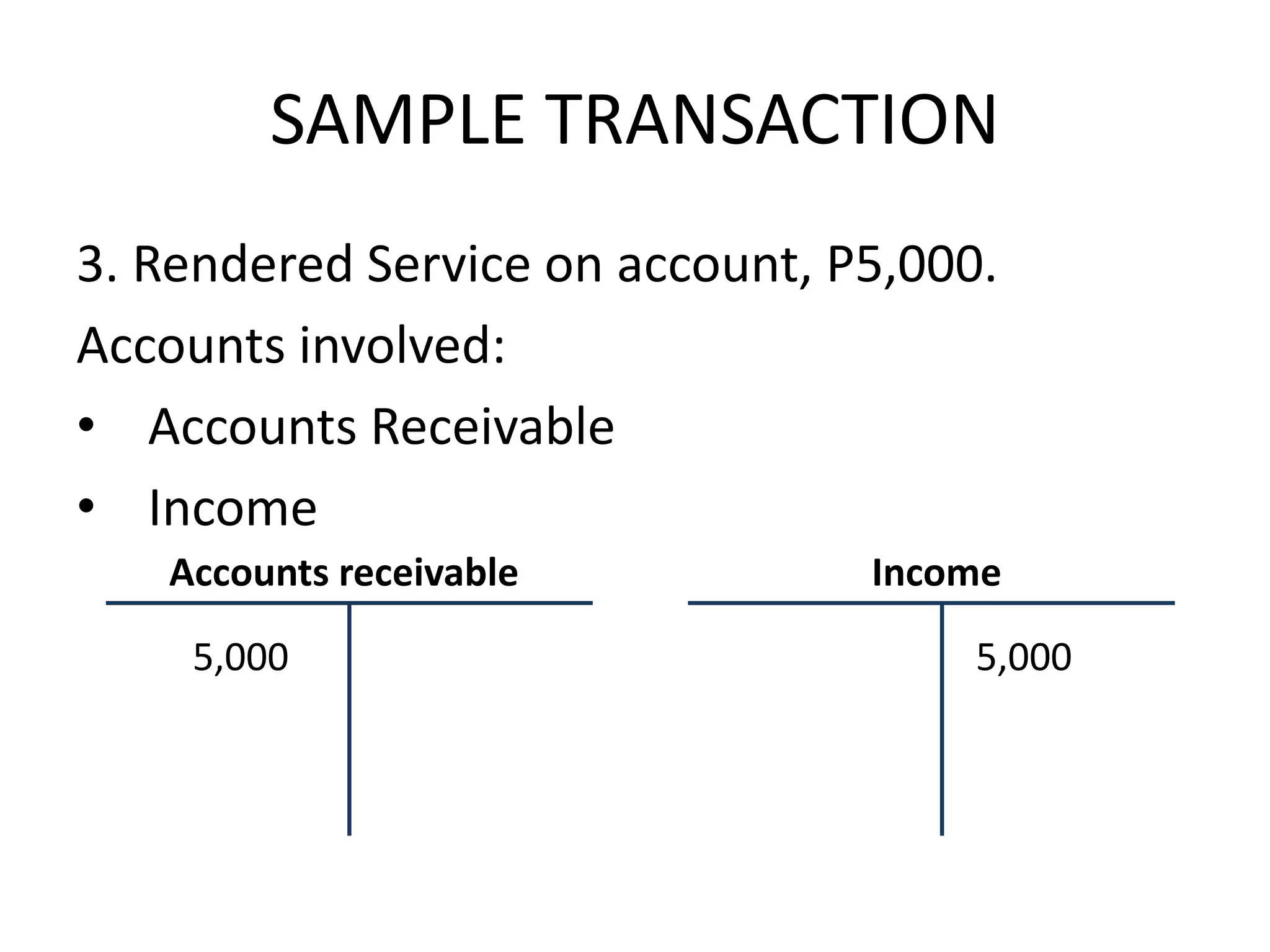
SAMPLE TRANSACTION
3. Rendered Service on account, P5,000.
Accounts involved:
• Accounts Receivable
• Income
Accounts receivable Income
5,000 5,000
ACTIVITY #3
INSTRUCTION: Identify the accounts involved in every transactions and
record each accounts to its respective “T-Account”.
1. Mr. A invested cash worth 500,000 as capital to
start a business.
2. Bought land for 300,000 in cash.
3. Constructed a building for 100,000, on account.
4. Purchased equipment worth 25,000 in cash
5. Acquired sofa for office use for 10,000 in cash
6. Rendered service on account, P5,000.
7. Paid Electric bills, P3,500.
8. Paid water bills, P1,500.
ASSIGNMENT
1. Using your answers on activity #3, foot the
T-accounts of each accounts.
2. After footing, total all the assets, liabilities,
owner’s equity, income and expenses.
3. Write a conclusion on the financial position
of the business and its net worth.
THANK YOU!!!

Demo

  • 1.
  • 2.
    WORD MEANING ASSETS Whatthe company owns Cash Any item on hand with monetary value which includes coins, bills , personal checks, etc. Accounts Receivables All amounts collectible on open accounts of the customers. Land The site owned by the business on which the business building is constructed. Building The structure owned by the business that is used in the operation of the business. Furniture & Fixtures Long-lived items used by the business including showcases, counters, tables, chairs, etc. Equipment Consists of what generally might be called the machinery used in a business such as computers, delivery equipments, etc. LIABILITIES What the company owes Accounts Payable Is an obligation or debt to creditors for money borrowed or merchandise and other assets bought on credit EQUITY Is the residual interest after all obligations are deducted to assets. Capital Investments to business INCOME / REVENUE The earnings of the business from sale of goods or service rendered EXPENSE Are costs incurred in conducting the business activities.
  • 3.
    WHAT IS ACCOUNTING? •Accounting is the systematic and comprehensive recording of financial transactions pertaining to a business. Accounting also refers to the process of summarizing, analyzing and reporting these transactions.
  • 4.
    BOOKKEEPING vs ACCOUNTING •Bookkeeping is the process of recording, in chronological order, the daily transactions of a business entity. It forms part of the accounting information system. • Accounting is an information system – includes the process of recording, classifying, summarizing, reporting, analyzing and interpreting the financial condition and performance of a business – in order to communicate it to stakeholders for business decision making.
  • 5.
    BOOKKEEPER vs ACCOUNTANT •A bookkeeper's territory is daily financial transactions, which include purchases, receipts, sales and payments. Recording these items is usually done through a general ledger or journal. Many small businesses use software such as QuickBooks or Peachtree to keep track of their entries, debits and credits. Their efforts culminate in a trial balance, which means the final total of debits and credits match. • The role of an accountant, therefore, is to verify the data entered, and then use that data to generate reports, analyze the account, perform audits and prepare financial reporting records, like tax returns, income statements and balance sheets. An accountant's analysis of the financial information can provide information for forecasts, business trends, opportunity for growth and when to restrict spending to manage cash flow.
  • 6.
    ACCOUNTING EQUATION • ASSETS= EQUITY + LIABILITIES • The word equation comes from the word equal. • For any equation, one side always equals another. Also, equations can be made out of anything. • For example: 1 Orange = $0,50 House = Walls + Doors + Windows + Roof 1 week = 7 days
  • 7.
    ASSETS • Assets arepossessions of the business. They are things that add value to the business and will bring it benefits in some form. For example, furniture, machinery, vehicles, computers, stationery or cash.
  • 8.
    ASSETS • EXAMPLES: 1. CASH 2.ACCOUNTS RECEIVABLES 3. LAND 4. BUILDING 5. FURNITURE AND FIXTURES 6. EQUIPMENT
  • 9.
    LIABILITY • Liabilities arebasically debts. The amount of liabilities represents the value of the business assets that are owed to others. It is the value of the assets that people outside the business can lay claim to. • EXAMPLE : Accounts Payable
  • 10.
    EQUITY • Equity, orowner's equity, is the value of the assets that the owner owns. It is the value of the business assets that the owner can lay claim to. • EXAMPLE: Capital
  • 11.
    INCOME/REVENUE • Represents theearnings of the business from sale of goods or service rendered. EXPENSE • Represents the costs incurred in conducting the business activities.
  • 12.
    RULES OF DEBITAND CREDIT DEBIT • Derived from a latin word “debitum” (debtor) • The value received in a business transaction which must be recorded in the journal. • The left-hand side of the equation. • The word “charge” in accounting would also mean debit.
  • 13.
    RULES OF DEBITAND CREDIT CREDIT • Derived from the latin word “creditum” (creditor) • Is the value parted with in a business transaction which must be recorded in the journal • The right-hand side of the equation.
  • 14.
    RULES OF DEBITAND CREDIT DEBIT CREDIT ASSETS LIABILITIES OWNER’S EQUITY ASSETS = EQUITY + LIABILITIES
  • 15.
    RULES OF DEBITAND CREDIT RULE #1: Assets • Debit to increase the amount of asset. Credit to decrease its amount. RULE #2: Liabilities • Credit to increase the amount of liability. Debit to decrease its amount. • RULE #3: Credit to increase the capital account. Debit to decrease it’s amount.
  • 16.
  • 17.
    CLASSIFICATION OF ACCOUNTS INSTRUCTION: 1.Classify the account titles according to their respective accounting elements indicate their respective normal balances. ELEMENTS NORMAL BALANCE ASSET DEBIT LIABILITY CREDIT OWNER’S EQUITY CREDIT 2.
  • 18.
    ACCOUNT TITLE ELEMENTNORMAL BALANCE Cash Accounts Receivables Land Building Furniture & Fixtures Equipment Accounts Payable Capital
  • 19.
    ACCOUNTING TRANSACTIONS • Areeconomic activities of the business enterprise which affect any of the basic accounting elements. These are generally sourced from ordinary business activities, such as selling, purchasing and producing.
  • 20.
    ACCOUNTING EVENTS • Referto occurrences that affect any of the basic accounting elements. These events may be occasional to the business. Examples are losses due to theft, calamity, etc.
  • 21.
    SAMPLE TRANSACTION 1. Purchaseof new Computer for P50,000 in cash. Accounts involved: Computer and Cash
  • 22.
    T-ACCOUNT • An accountmay be expressed in a “T” device from where the debits are recorded on the left-hand side and the credits are recorded on the right-hand side of the letter T. As implied in its form, this device is called a “T-account”.
  • 23.
    SAMPLE TRANSACTION 1. Purchaseof new Computer for P50,000 in cash. Accounts involved: Computer and Cash Computer Cash 50,000 50,000
  • 24.
    SAMPLE TRANSACTION 2. Purchaseof sala set worth 20,000 on account. Accounts involved: • Furniture & Fixtures • Accounts Payable Furniture & Fixtures Accounts Payable 20,000 20,000
  • 25.
    SAMPLE TRANSACTION 3. RenderedService on account, P5,000. Accounts involved: • Accounts Receivable • Income Accounts receivable Income 5,000 5,000
  • 26.
  • 27.
    INSTRUCTION: Identify theaccounts involved in every transactions and record each accounts to its respective “T-Account”. 1. Mr. A invested cash worth 500,000 as capital to start a business. 2. Bought land for 300,000 in cash. 3. Constructed a building for 100,000, on account. 4. Purchased equipment worth 25,000 in cash 5. Acquired sofa for office use for 10,000 in cash 6. Rendered service on account, P5,000. 7. Paid Electric bills, P3,500. 8. Paid water bills, P1,500.
  • 28.
    ASSIGNMENT 1. Using youranswers on activity #3, foot the T-accounts of each accounts. 2. After footing, total all the assets, liabilities, owner’s equity, income and expenses. 3. Write a conclusion on the financial position of the business and its net worth.
  • 29.