Introduction
What doyou understand by the following
terms?
Cost?
Price?
Expense?
A Cost Object?
4.
Introduction Cont…
Cancost data compiled for a particular
purpose be appropriate for other use? e.g.
Profit measurement?
Decision making
Since the word cost can mean different things
for different purposes – for cost information
to be at all useful it needs first to be classified
so that managers are able to understand it.
5.
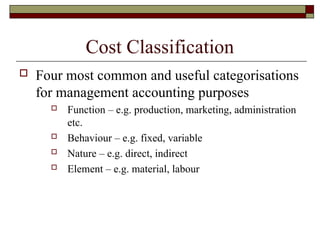
Cost Classification
Fourmost common and useful categorisations
for management accounting purposes
Function – e.g. production, marketing, administration
etc.
Behaviour – e.g. fixed, variable
Nature – e.g. direct, indirect
Element – e.g. material, labour
6.
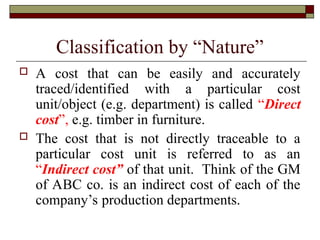
Classification by “Nature”
A cost that can be easily and accurately
traced/identified with a particular cost
unit/object (e.g. department) is called “Direct
cost”, e.g. timber in furniture.
The cost that is not directly traceable to a
particular cost unit is referred to as an
“Indirect cost” of that unit. Think of the GM
of ABC co. is an indirect cost of each of the
company’s production departments.
7.
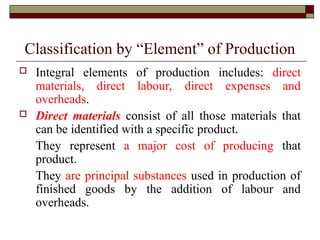
Classification by “Element”of Production
Integral elements of production includes: direct
materials, direct labour, direct expenses and
overheads.
Direct materials consist of all those materials that
can be identified with a specific product.
They represent a major cost of producing that
product.
They are principal substances used in production of
finished goods by the addition of labour and
overheads.
8.
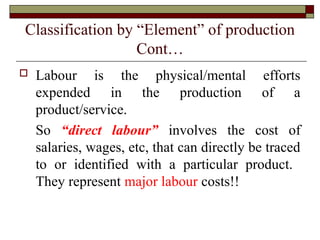
Classification by “Element”of production
Cont…
Labour is the physical/mental efforts
expended in the production of a
product/service.
So “direct labour” involves the cost of
salaries, wages, etc, that can directly be traced
to or identified with a particular product.
They represent major labour costs!!
9.
Classification by “Element”of production
Cont…
“Direct expenses” these represents costs that
are directly attributable to the production
process e.g.
hire of special machine tools for one-off jobs,
royalties for patents etc
10.
Overheads
All othercosts – other than direct materials,
labour and expenses – of producing a product.
For instances materials which does not become
an integral part of a finished product and the
cost of personnel who do not work directly on
the product, but whose services are necessary
for the production process are classified as
indirect material and labour respectively.
11.
Total Costs Structuredby Nature and by
Element
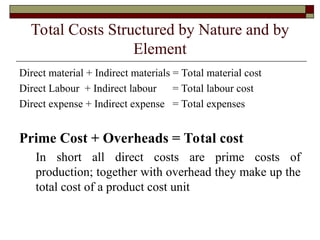
Direct material + Indirect materials = Total material cost
Direct Labour + Indirect labour = Total labour cost
Direct expense + Indirect expense = Total expenses
Prime Cost + Overheads = Total cost
In short all direct costs are prime costs of
production; together with overhead they make up the
total cost of a product cost unit
12.
Classification by “Behaviour”
When classifying costs by behaviour the major focus
rests on variable and fixed costs. Though other
‘hybrid’ pattern called step and semi-variable costs
exists.
Cost that is sensitive, and varies in proportion, to
corresponding changes in the activity level is known
as variable cost.
Cost that is insensitive to activity level fluctuations
but is determined by the influence of time (and its
passing) is called fixed cost.
13.
Variable Cost Behaviour
Variable cost comprises of the following:
Variable overheads + direct (prime) costs =
variable costs
Illustration
Assume a firm employs Wamachinga selling “Yebo-
yebo” for commission – only earnings door to door.
Wamachinga are paid a commission of 10% for each
product sold. Yebo-yebos are priced at Tshs. 400.
Required: Provide a graphical and algebraic expressions
of this variable cost pattern. (Linear, non-linear,
curvilinear)
14.
Fixed Cost Behaviour
Fixed (a.k.a period) - cost is said to be fixed
with respect to two factors:
Short-run time periods, i.e. up to and including a full year
Volume (although under very extreme circumstances, such
as complete shutdown where the volume is sustained at zero,
even fixed costs may change or be avoided entirely
All fixed costs are overhead and they are often
alternatively given the full title “fixed overhead costs”
The algebraic expression is Y = a; where ‘Y’ is cost and ‘a’
is a constant.
Fixed overheads are constant/fixed in total!!!
15.
Other Patterns ofCost Behaviour
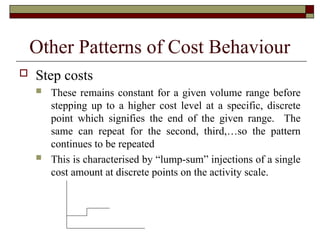
Step costs
These remains constant for a given volume range before
stepping up to a higher cost level at a specific, discrete
point which signifies the end of the given range. The
same can repeat for the second, third,…so the pattern
continues to be repeated
This is characterised by “lump-sum” injections of a single
cost amount at discrete points on the activity scale.
16.
Other Patterns ofCost Behaviour Cont..
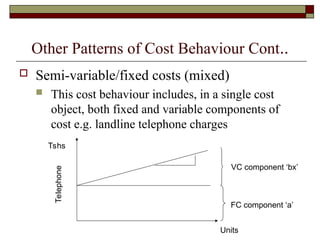
Semi-variable/fixed costs (mixed)
This cost behaviour includes, in a single cost
object, both fixed and variable components of
cost e.g. landline telephone charges
Units
FC component ‘a’
VC component ‘bx’
Tshs
Telephone
17.
Cost as Assetsand Expenses
The issue of timing i.e. when should the cost
of acquiring an asset be recognized as an
expense.
Expense - the cost incurred when an asset is used up or
sold for the purpose of generating revenue (when benefits
are received, the cost becomes an expense)
The timing with which various expenses are recognised is
described by the following terms:
Product costs
Period costs
18.
Product Costs
Productcost = a cost of goods purchased or
manufactured for resale (assets).
Are inventoriable costs for reporting on B/S and
P&L
Are used to decide which product to produce and
to determine selling prices
Once the goods are sold, product costs
becomes expenses – called cost of goods sold.
19.
Period Costs
Allcost that are not product costs are
called period costs.
Costs which are not necessary for
production (not inventoriable)
They are written of as expenses (in the
P&L) in the period in which these are
incurred – e.g. rent, salary of executives,
travel expenses etc.
20.
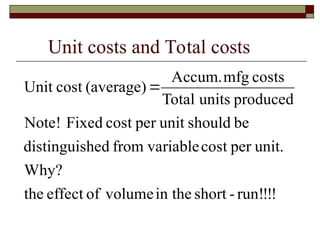
Unit costs andTotal costs
!
!
!
run!
-
short
in the
volume
of
effect
the
Why?
unit.
per
cost
variable
from
hed
distinguis
be
should
unit
per
cost
Fixed
Note!
produced
units
Total
costs
mfg
Accum.
(average)
cost
Unit
Editor's Notes
#3 Cost can also be defined as a benefit/sacrifice given up to acquire goods/services
A cost object is any activity for which a separate measurement of costs is desired i.e. the cost of something
#4 Cost can also be defined as a benefit/sacrifice given up to acquire goods/services
Different costs for different Purposes
Manufacturing organizations assign costs to products for two purposes:
First:
For internal profit measurement and external financial reporting requirements in order to allocate the mfg costs incurred during a period btn cost of goods sold and inventories.
Secondly:
To provide useful information for managerial decision-making requirements.
Different levels of accuracy , and different cost information is required for different purposes. For decision making purposes, more accurate product costs are required so that we can distinguish between profitable and unprofitable products. For external reporting it may not be necessary to accurately trace costs to individual products.
Again not all costs are relevant for decision making e.g. depreciation of machinery will not be affected by a decision to discontinue a product.
#6 A cost can be treated as direct for one cost object but indirect in respect of another. If the cost object is the product then the salary of the storekeeper or warehouse rent is indirect BUT IF the cost object is distribution channels – the salary of the storekeeper is regarded as direct cost for each distribution channel.
#13 Variable (linear segmental) cost behaviour – 25% for sales above 200 units; 40%(400)
The non-linear/curvilinear pattern of variable cost behaviour concurs with the economists’ approach to cost analysis




![7_C's_OF_COMMUNIOCATION[1].pptx](https://cdn.slidesharecdn.com/ss_thumbnails/7csofcommuniocation1-230801063320-9af405b3-thumbnail.jpg?width=640&height=640&fit=bounds)


