Accident Analysis
Models and Methods:
Guidance for Safety
Professionals
Peter Underwood and Dr. Patrick Waterson
May 2013
i
Copyright information
The information contained within this report is provided as guidance only.
While every reasonable care has been taken to ensure the accuracy of its
contents, the author and Loughborough University cannot accept any
responsibility for any action taken, or not taken, on the basis of this
information. The author and Loughborough University shall not be liable to
any person or organisation for any loss or damage which may arise from the
use of any of the information contained in this report.
© Loughborough University 2013
Contact information
Author contact details:
Peter Underwood, Loughborough Design School, CC.1.07, James France
Building, Loughborough University, Loughborough, Leicestershire, LE11 3TU,
UK.
E-mail address: p.j.underwood@lboro.ac.uk
ii
Copyright information ....................................................................................i
Contact information........................................................................................i
Foreword ........................................................................................................1
1. Introduction.............................................................................................2
1.1. Purpose and scope ...............................................................................2
2. Analysis models and methods ..............................................................3
2.1. Sequential techniques...........................................................................3
2.2. Epidemiological techniques...................................................................3
2.3. Systemic techniques .............................................................................4
2.4. Model and method category selection...................................................5
3. Influences on analysis model and method selection ........................10
3.1. Model and method awareness ............................................................10
3.2. Model and method adoption................................................................11
3.3. Model and method usage....................................................................11
3.4. Organisational and industry influences on model and method usage .13
3.5. Method and model selection summary................................................13
4. A useful analysis model.......................................................................15
4.1. Description of the ATSB model ...........................................................15
4.2. ATSB model terminology.....................................................................17
4.3. ATSB model usage .............................................................................18
References ...................................................................................................21
Appendix A – Useful sources of accident analysis information..............24
Free sources of information ...........................................................................24
Other sources of information..........................................................................25
1
Foreword
Accident analysis models and methods provide safety professionals with a
means of understanding why accidents occur. Choosing an analysis
technique is, however, not a simple process. A wide range of methods are
available; each offering various theoretical and practical benefits and
drawbacks. Furthermore, individuals engaged in accident investigation are
subjected to various factors, e.g. budgetary and time constraints, which can
influence their selection and usage of an analysis tool.
This report is based on an extensive review of the accident analysis literature
and an interview study conducted with 42 safety experts and has two aims.
Firstly, it provides an overview of the available analysis techniques and the
factors influencing an individual’s choice and usage of these methods. The
intention is to provide the reader with information that may enable them to
make a more informed selection of analysis tool. The second aim is to
present an analysis model currently used in industry. The intention is to
provide the reader with a validated method that can be readily employed, if
undertaking a detailed assessment of the available techniques is not
practicable.
2
1. Introduction
Understanding why accidents occur and how to prevent their recurrence is an
essential part of improving safety in any industry. Gaining this knowledge
requires determining why a certain combination of events, conditions and
actions lead to a specific outcome, i.e. accident analysis (Hollnagel et al.,
2008). Important tools used to achieve this understanding are the accident
causation model and accident analysis method. Analysis models provide a
conceptual representation of accident causation whereas analysis methods
provide a means of applying this theory.
The nature of accident causation has, however, become more complex over
time due to a number of factors, e.g. the rapid pace of technological advances
and more complex relationships between humans and technology (Leveson,
2011). Accident causation theory has also developed to capture this
increased complexity and numerous analysis models and methods have
emerged to apply this knowledge.
Selecting a technique to use from the wide range of analysis models and
methods presents a dilemma for any individual. The sheer number of
analysis tools (well in excess of 100) makes the task of assessing each one
impracticable. Other factors must, therefore, be considered when deciding
which technique is adopted and used, e.g. its usability and how well
established it is within industry.
1.1. Purpose and scope
The initial aim of this report is to provide an overview of the different
categories of analysis model and method which are available. The intention is
not to provide a detailed review of analysis techniques, as these are currently
available in the research and practitioner literature (e.g. Energy Institute,
2008; Johnson, 2003). Rather the purpose is to give the reader an
awareness of the general concepts underlying each category and provide a
focus for any further investigation they wish to undertake.
The report then presents a range of factors that influence an individual’s
approach to accident analysis and can prevent the adoption and usage of
analysis techniques. The aim is to provide the reader with an increased
awareness of the issues that shape their choice of method and provide a
framework to review their selection.
Finally, the report provides a description of an analysis technique that is
currently employed by a government accident investigation authority. The
method has been refined and validated over a period of years and enables
the application of accident causation theory in a practical and usable manner.
The purpose is to provide the reader with an ‘off-the-shelf’ analysis tool that
can be readily employed, if the identification and assessment of alternative
methods is not practicable.
3
2. Analysis models and methods
A key driver for the continued rise in analysis model and method numbers is
the ever-increasing complexity of socio-technical systems (which are
comprised of interacting human, technological and environmental
components) and the resulting change in accident causation mechanisms. As
researchers have sought to account for these changes, the ensuing
development of analysis techniques can be described as having gone through
three major phases, i.e. sequential, epidemiological and systemic. This
categorisation relates to the different underlying assumptions of accident
causation (Hollnagel and Goteman, 2004). This distinction is not obligatory
and other classification systems based on differing accident characteristics
exist (e.g. Kjellén, 2000) (Katsakiori et al., 2009). However, it helps explain
the desire of researchers to introduce systems theory concepts into accident
analysis, as detailed in the following sections.
2.1. Sequential techniques
The sequential class of models and methods describe accidents as the result
of time-ordered sequences of discrete events. They assume that an
undesirable event, i.e. a ‘root cause’, initiates a sequence of events which
lead to an accident and that the cause-effect relation between consecutive
events is linear and deterministic. This implies that the accident is the result
of this root cause which, if identified and removed, will prevent a recurrence of
the accident. Examples include the Domino model (Heinrich, 1931), Fault
Tree Analysis (Watson, 1961 cited in Ericson, 1999) and the Five Whys
method (Ohno, 1988).
These methods work well for losses caused by physical component failures or
the actions of humans in relatively simple systems and generally offer a good
description of the events leading up to an accident (Leveson, 2004). However,
the cause-effect relationship between the management, organisational and
human elements in a system is poorly defined by these techniques and they
are unable to depict how these causal factors triggered the accident
(Rathnayaka et al., 2011). From the end of the 1970’s it became apparent
that the sequential tools were unable to adequately explain a number of major
industrial accidents, e.g. Three Mile Island, Chernobyl and Bhopal.
Consideration for the role that organisational influences play in accidents was
required and resulted in the creation of the epidemiological class of analysis
tools.
2.2. Epidemiological techniques
Epidemiological models and methods view accidents as a combination of
‘latent’ and ‘active’ failures within a system, analogous to the spreading of a
disease (Qureshi, 2007). Latent conditions, e.g. management practices or
organisational culture, are likened to resident pathogens and can lie dormant
4
within a system for a long time (Reason et al., 2006). Such organisational
factors can create conditions at a local level, i.e. where operational tasks are
conducted, which negatively impact on an individual’s performance (e.g.
fatigue or high workload). The scene is then set for ‘unsafe acts’, such as
errors and violations, to occur. Therefore, the adverse consequences of
latent failures only become evident when they combine with unsafe acts, i.e.
active failures, to breach the defences of a system. The most well-known
epidemiological technique is the Swiss Cheese model (Reason, 1990, 1997),
which has formed the conceptual basis for various analysis methods, e.g. the
Human Factors Analysis & Classification System (HFACS) (Wiegmann and
Shappell, 2003) and Tripod Beta.
The epidemiological class of techniques better represent the influence of
organisational factors on accident causation, when compared with the
sequential tools. Given that they require an individual to look beyond the
proximal causes of an accident and examine the impact of a system’s latent
conditions, a more comprehensive understanding of an accident can be
achieved. However, many are still based on the cause-effect principles of the
sequential models, as they describe a linear direction of accident causation
(Hollnagel, 2004). From the late 1990’s, a number of researchers e.g.
(Rasmussen, 1997; Leveson, 2001; Svedung and Rasmussen, 2002) argued
that these epidemiological techniques were no longer able to account for the
increasingly complex nature of socio-technical system accidents. The
application of systems theory was subsequently proposed as a solution to this
issue.
2.3. Systemic techniques
Systems theory is designed to understand the structure and behaviour of any
type of system. Rather than treating accidents as a sequence of cause-effect
events, it describes losses as the unexpected behaviour of a system resulting
from uncontrolled relationships between its constituent parts. In other words,
accidents are not created by a combination of latent and active failures; they
are the result of humans and technology operating in ways that seem rational
at a local level but unknowingly create unsafe conditions within the system
that remain uncorrected. From this perspective, simply removing a ‘root
cause’ from a system will not prevent the accident from recurring. A holistic
approach is required whereby safety deficiencies throughout the entire system
must be identified and addressed. A range of systemic tools exist which
enable the application of the systems approach, e.g. the Systems Theoretic
Analysis Model and Processes model (STAMP) (Leveson, 2004, 2011), the
Functional Resonance Analysis Method (FRAM) (Hollnagel, 2004, 2012) and
the Accimap (Rasmussen, 1997).
Whilst these systemic techniques appear to provide a deeper understanding
of accident causation, various studies suggest they are more resource
5
intensive and require considerable amounts of domain and theoretical
knowledge to apply (e.g. Ferjencik, 2011; Johansson and Lindgren, 2008).
Furthermore, the latest version of the Swiss Cheese model (see Reason,
1997) acknowledges that active failures are not always required for an
accident to happen; long-standing latent conditions are sometimes all that is
required, as was the case in the Kings Cross, Piper Alpha and the space
shuttles Challenger and Columbia accidents (see Reason et al., 2006). It also
acknowledges that latent conditions can be better described as organisational
factors, rather than management failures. This represents top-level
managerial decisions as ‘normal behaviour’ influenced by the local conditions,
resource constraints and objectives of an organisation.
The distinction between the epidemiological and systemic perspective of
accidents, therefore, seems to be a subtle one. However, a number of
studies have compared systemic methods with established Swiss Cheese
based methods, such as HFACS (Salmon et al. 2012) and the Systemic
Occurrence Analysis Methodology (e.g. Arnold, 2009) and commented that
the systemic techniques do provide a deeper understanding of how the
behaviour of the entire system can contribute to an accident.
Whilst the ‘systems approach’ is arguably the dominant concept within
accident analysis research, systemic models and methods are yet to gain
widespread acceptance within the practitioner community (Underwood and
Waterson, 2013).
2.4. Model and method category selection
In order to choose which category of analysis technique best suits an
individual’s needs, a useful starting point is to consider the type of system
being analysed. Systemic techniques are designed to provide a depth of
understanding for complex accidents that is greater than the sequential and
epidemiological models and methods. However, it may be inefficient to use
these more complex and powerful methods to investigate accidents in simple
systems. Therefore, understanding the complexity of the system in question
will help to identify the most suitable method. Hollnagel (2008) provides a
means of characterising systems, based on the work of Perrow (1984), which
considers their coupling and tractability (manageability).
The coupling of a system can vary between being loose and tight and refers
to how subsystems and/or components are functionally connected or
dependent upon each other. Tightly coupled systems can be described as
follows:
• Buffers and redundancies are purposively part of the design
• Delays in processing are not possible
• Process sequences are invariant
6
• The substitution of supplies, equipment, personnel is limited and
anticipated in the design
• There is little slack possible in supplies, equipment, and personnel
• There is only one method to reach the goal
• Tightly coupled systems are difficult to control because an event in one
part of the system quickly will spread to other parts
A system’s manageability can vary from high (tractable) and low (intractable).
A tractable system can be characterised as:
• The principles of the system’s functioning are known
• System descriptions are simple and with few details
• The system does not change while it is being described, i.e. changes in
system activities are slow enough that the whole system can be described
completely and in detail
Hollnagel (2008) suggests that a good example of a tractable system is the
normal functioning of a post office, or the operation of a home furnace. He
also proposes that the outage at a nuclear power plant or the activities in a
hospital emergency department represent good examples of intractable
systems, given that their activities are not standardised and change so rapidly
that it is never possible to produce a detailed and complete description.
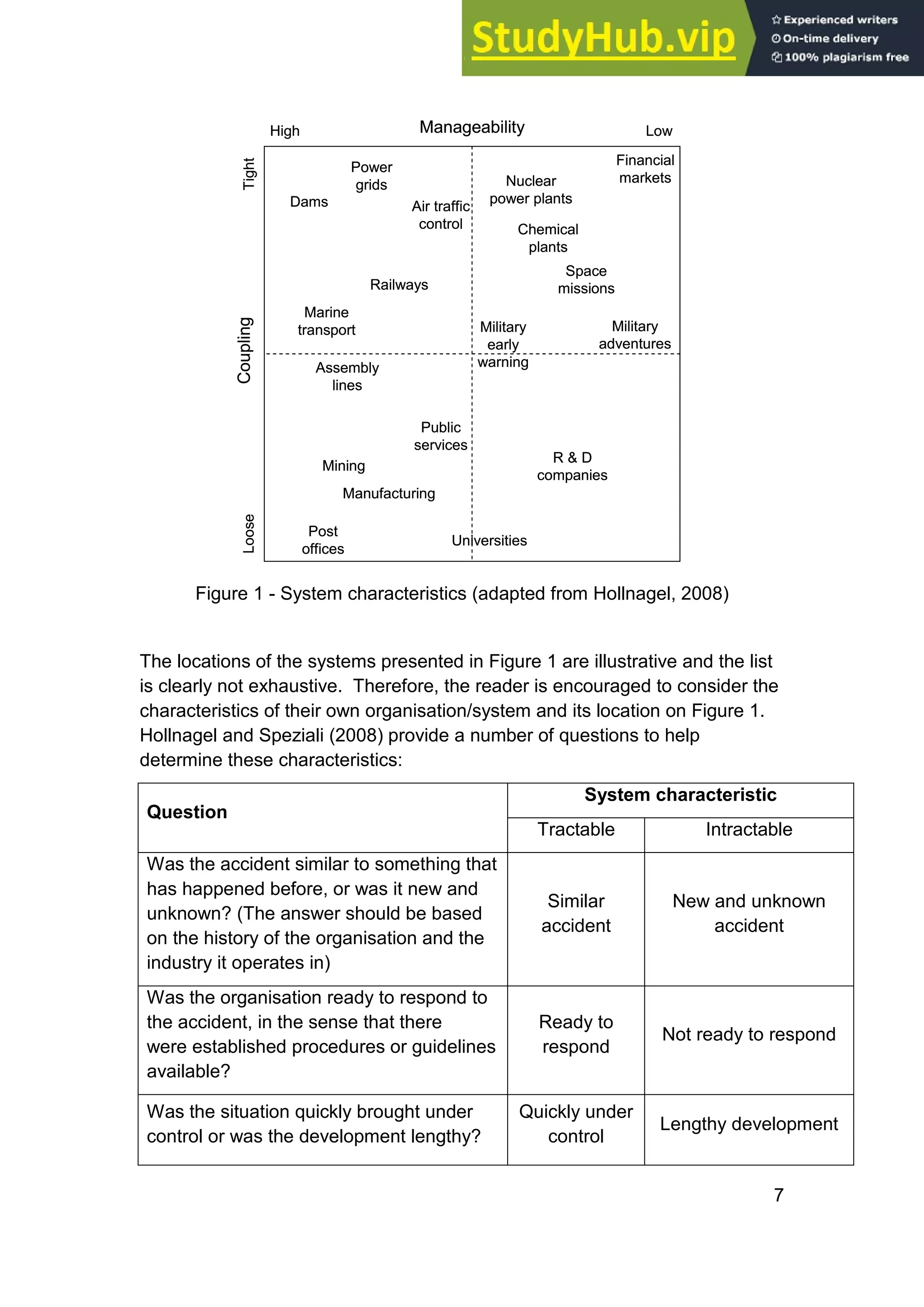
Using the dimensions of coupling and manageability, Hollnagel (2008)
characterises a number of systems (see Figure 1).
7
Manageability Low
High
Coupling
Tight
Loose
Dams
Power
grids
Air traffic
control
Railways
Marine
transport
Universities
Military
early
warning
Military
adventures
Space
missions
Chemical
plants
Financial
markets
Nuclear
power plants
Public
services
Manufacturing
Post
offices
Mining
Assembly
lines
R & D
companies
Manageability Low
High
Coupling
Tight
Loose
Dams
Power
grids
Air traffic
control
Railways
Marine
transport
Universities
Military
early
warning
Military
adventures
Space
missions
Chemical
plants
Financial
markets
Nuclear
power plants
Public
services
Manufacturing
Post
offices
Mining
Assembly
lines
R & D
companies
Figure 1 - System characteristics (adapted from Hollnagel, 2008)
The locations of the systems presented in Figure 1 are illustrative and the list
is clearly not exhaustive. Therefore, the reader is encouraged to consider the
characteristics of their own organisation/system and its location on Figure 1.
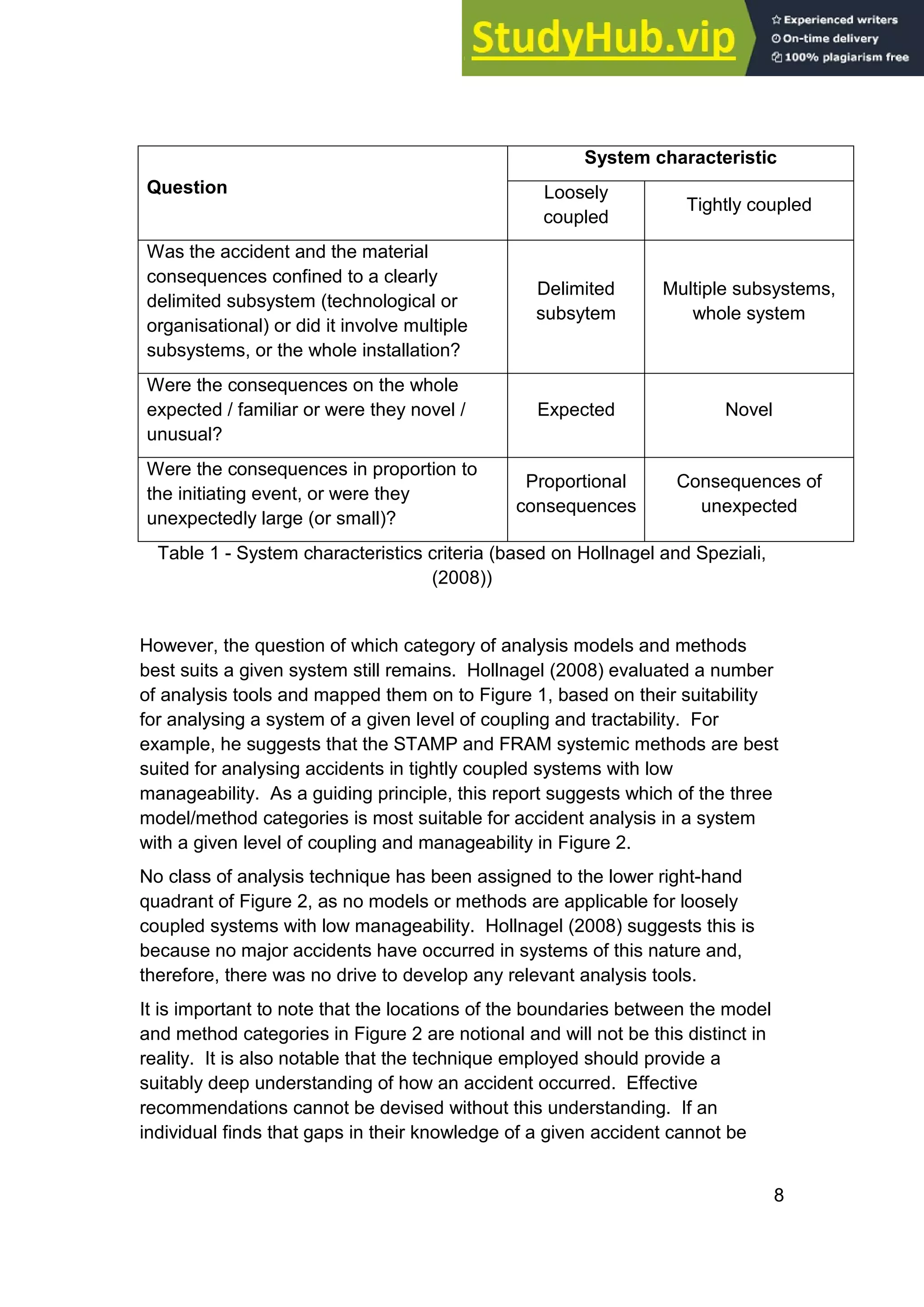
Hollnagel and Speziali (2008) provide a number of questions to help
determine these characteristics:
Question
System characteristic
Tractable Intractable
Was the accident similar to something that
has happened before, or was it new and
unknown? (The answer should be based
on the history of the organisation and the
industry it operates in)
Similar
accident
New and unknown
accident
Was the organisation ready to respond to
the accident, in the sense that there
were established procedures or guidelines
available?
Ready to
respond
Not ready to respond
Was the situation quickly brought under
control or was the development lengthy?
Quickly under
control
Lengthy development
8
Question
System characteristic
Loosely
coupled
Tightly coupled
Was the accident and the material
consequences confined to a clearly
delimited subsystem (technological or
organisational) or did it involve multiple
subsystems, or the whole installation?
Delimited
subsytem
Multiple subsystems,
whole system
Were the consequences on the whole
expected / familiar or were they novel /
unusual?
Expected Novel
Were the consequences in proportion to
the initiating event, or were they
unexpectedly large (or small)?
Proportional
consequences
Consequences of
unexpected
Table 1 - System characteristics criteria (based on Hollnagel and Speziali,
(2008))
However, the question of which category of analysis models and methods
best suits a given system still remains. Hollnagel (2008) evaluated a number
of analysis tools and mapped them on to Figure 1, based on their suitability
for analysing a system of a given level of coupling and tractability. For
example, he suggests that the STAMP and FRAM systemic methods are best
suited for analysing accidents in tightly coupled systems with low
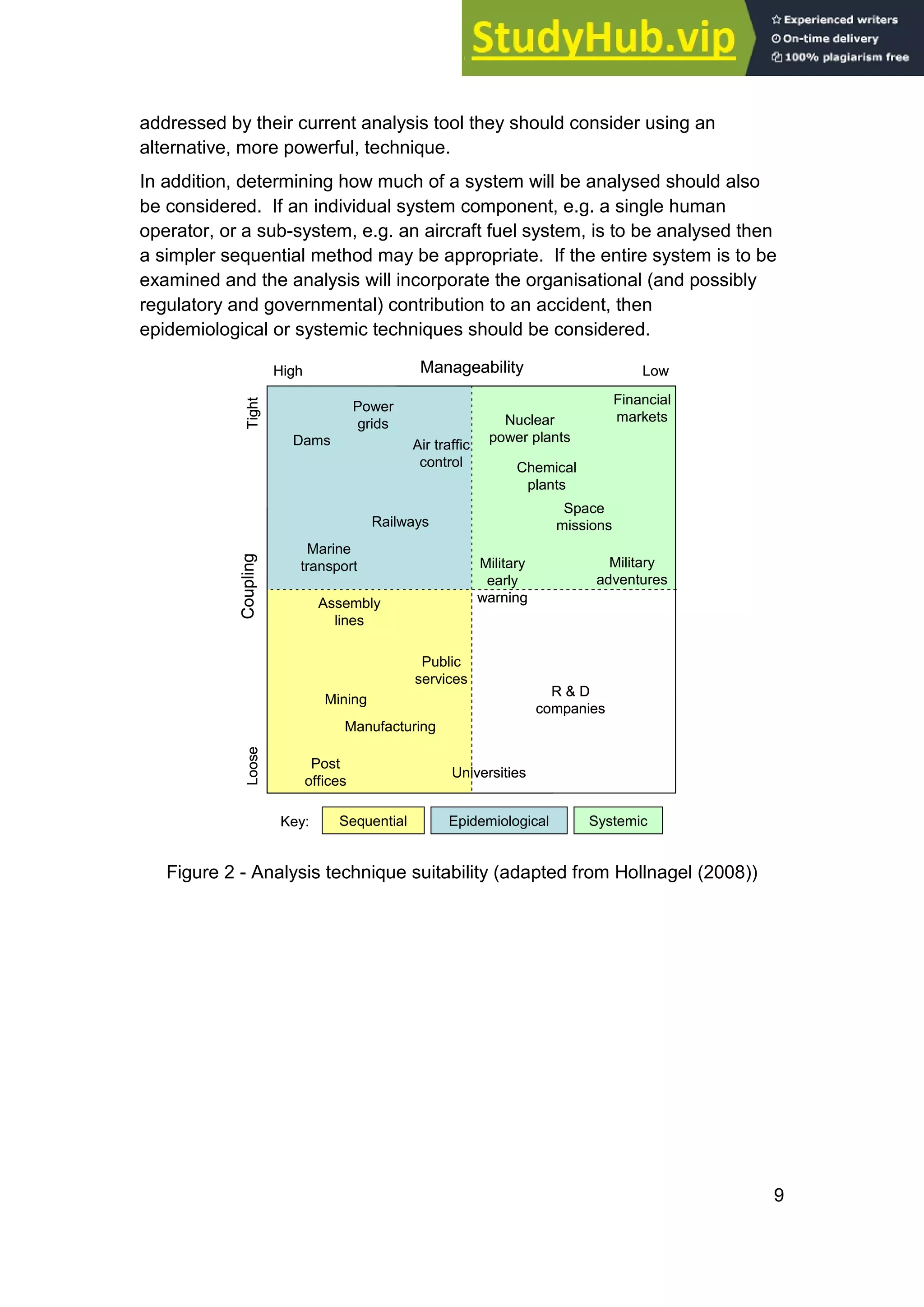
manageability. As a guiding principle, this report suggests which of the three
model/method categories is most suitable for accident analysis in a system
with a given level of coupling and manageability in Figure 2.
No class of analysis technique has been assigned to the lower right-hand
quadrant of Figure 2, as no models or methods are applicable for loosely
coupled systems with low manageability. Hollnagel (2008) suggests this is
because no major accidents have occurred in systems of this nature and,
therefore, there was no drive to develop any relevant analysis tools.
It is important to note that the locations of the boundaries between the model
and method categories in Figure 2 are notional and will not be this distinct in
reality. It is also notable that the technique employed should provide a
suitably deep understanding of how an accident occurred. Effective
recommendations cannot be devised without this understanding. If an
individual finds that gaps in their knowledge of a given accident cannot be
9
addressed by their current analysis tool they should consider using an
alternative, more powerful, technique.
In addition, determining how much of a system will be analysed should also
be considered. If an individual system component, e.g. a single human
operator, or a sub-system, e.g. an aircraft fuel system, is to be analysed then
a simpler sequential method may be appropriate. If the entire system is to be
examined and the analysis will incorporate the organisational (and possibly
regulatory and governmental) contribution to an accident, then
epidemiological or systemic techniques should be considered.
Manageability Low
High
Coupling
Tight
Loose
Dams
Power
grids
Air traffic
control
Railways
Marine
transport
Universities
Military
early
warning
Military
adventures
Space
missions
Chemical
plants
Financial
markets
Nuclear
power plants
Public
services
Manufacturing
Post
offices
Mining
Assembly
lines
R & D
companies
Sequential Systemic
Key: Epidemiological
Manageability Low
High
Coupling
Tight
Loose
Dams
Power
grids
Air traffic
control
Railways
Marine
transport
Universities
Military
early
warning
Military
adventures
Space
missions
Chemical
plants
Financial
markets
Nuclear
power plants
Public
services
Manufacturing
Post
offices
Mining
Assembly
lines
R & D
companies
Sequential Systemic
Key: Epidemiological
Figure 2 - Analysis technique suitability (adapted from Hollnagel (2008))
10
3. Influences on analysis model and method selection
Whilst the selection of an analysis technique may be affected by the
characteristics of the system in which it is employed, a number of other
influential factors exist. A range of these additional issues were identified in a
study carried out by Underwood and Waterson (2013). Interviews were
conducted with 42 safety professionals based in ten countries. The nine full
time accident investigators, 17 health and safety professionals, ten human
factors specialists and six researchers had experience of working in at least
one of 25 industries. The interviewees were asked about their current
approach to accident and/or risk analysis, their knowledge of analysis
techniques and their views on the communication between the researcher and
practitioner communities.
The factors that were considered to influence the selection of analysis
techniques are detailed in the remainder of Section 3.
3.1. Model and method awareness
In order to use an analysis technique it is clear that an individual must first
become aware of it. However, various issues exist which may prevent this
from occurring.
Some individual’s simply have no desire to change their current approach
and, therefore, have no need for new information. In this case it is important
that the individual has evidence that their chosen analysis method provides a
sufficient understanding of accidents to develop safety recommendations that
prevent recurrence. If the same accidents keep occurring, despite efforts to
prevent them, then the individual should consider using a more powerful
analysis tool to gain a deeper understanding of why this is so. If this tool
provides further insights into the causes of the accidents then more effective
recommendations may be devised.
Awareness of analysis methods is also dictated, at least in part, by the level of
training received by an individual. The extent of training received appears to
be role-dependent. Full-time investigators, for example, sometimes receive
extensive training via university-level courses, whereas practitioners with
varying degrees of involvement with accident investigation may receive less
training or none at all.
Individuals who are not provided with training and undertake a search for
information regarding analysis methods face issues which may limit their
awareness. Such issues include the cost of information and the time required
to gather and read it. In addition, some accident analysis information
presented in the academic literature maybe considered by some individuals to
be too conceptual and provide little or no practical benefit.
11
Providing usage guidance for the various analysis methods is beyond the
scope of this report. However, for those individuals who require information
about accident analysis techniques, the reader is referred to the material
listed in Appendix A.
3.2. Model and method adoption
Even if a sufficient awareness of analysis methods is obtained by an
individual, various barriers may prevent a technique from being adopted. For
example, the needs of end users may not have been successfully accounted
for during the development of an analysis method. An individual’s decision to
adopt a method can also be based on personal selection criteria, such as how
well the technique’s approach suits their way of thinking or whether they have
previously used the method.
The analysis approach taken by an individual can be influenced by their need
to assign liability for an accident. Some individuals prefer (or are mandated)
to avoid seeking blame in favour of focusing on safety improvements. This
may lead them to using methods which focus on safety deficiencies
throughout an entire system, e.g. a systemic method (see Section 2.3).
However, others more concerned with the commercial and legal implications
of accidents may select a method which simplifies the task of singling out a
‘root cause’ to blame for an accident, e.g. a sequential technique (see Section
2.1). This is particularly evident when those who are conducting an
investigation may be deemed culpable and are incentivised to apportion
liability elsewhere.
The track record of use within industry that a method has established plays an
important part in whether it is adopted by individuals and organisations.
Without a history of application in practice, there can be reluctance to trial new
analysis methods, as their credibility maybe questioned.
3.3. Model and method usage
The level of effort invested in an analysis will be based, at least in part, by the
resources available to an investigation team. Consequently this can affect
whether an individual/team employs more complex analysis techniques. In
addition to affecting which analysis method is used, the time and financial
constraints involved in accident investigation can also affect how it is used.
The depth of analysis that can be achieved, for example, is limited by the time
available to the investigation team.
The usability of an analysis method will affect whether an analysis is
performed effectively and efficiently. In order for a technique to have
adequate usability it must be easy to understand and apply. Consideration
should, therefore, be given to the availability and clarity of guidance material
as well as the training and resources required to use a given analysis method.
12
The graphical output of a method will affect the ability of an individual (or team
of investigators) to successfully perform an analysis. Graphically representing
an accident has been considered to be useful by both researchers (e.g. Sklet,
2004; Svedung and Rasmussen, 2002) and practitioners (e.g. Australian
Transport Safety Bureau, 2008) for a number of reasons. For example, it can
be easier to see the relationships between system components and identify
gaps/weaknesses in the analysis. Also, charting an accident can also be
useful for communicating the findings of complex investigations (Australian
Transport Safety Bureau, 2008). Therefore, it is important to consider if a
given method provides these benefits and the resources which are required to
graphically describe the accident. For example, does the analysis method
need specialised charting software or the simpler combination of sticky-notes
and a whiteboard?
A number of factors related to the reliability of a method (i.e. the consistency
of results obtained when a given accident is analysed separately by different
individuals or reanalysed by the same person) can also affect its usage. For
example, an individual’s background and experience can influence their
analysis approach and produce variation in investigation findings. Open
discussions and analysis reviews which result in a consensus on the
investigation findings can help minimise the biasing effects of individuals’
backgrounds; a process which is common with full-time investigators.
However, the qualitative nature of some analysis tools may increase the
difficulty of reaching such an agreement. The reliability of a method is further
affected by the availability and clarity of usage guidance. Less guidance
increases the flexibility of an analysis and gives an individual more freedom to
probe into different aspects of an event. Whilst this flexibility maybe suited to
an experienced investigator, a more structured approach may improve the
consistency of analysis outputs of less experienced individuals.
Reliability is particularly important if accident trend analysis is to be
performed. The greater the reliability of a method and its outputs, the more
the results of any trend analysis can be trusted. The use of causal factor
taxonomies can greatly enhance the reliability of an analysis method, if the
taxonomy is appropriate for the industry in which the accident of interest
occurred in. Some methods (e.g. HFACS) have been devised with industry-
specific taxonomies. However, taxonomies can be restrictive and may require
an investigator to ‘force fit’ a piece of information into the classification
system. Therefore, it is important to understand whether a given taxonomy
meets the needs of the investigation team.
Furthermore, individuals may not be able to gain access to the data required
for some of the more complex, e.g. systemic, methods. For example, such
information may exist outside of the organisation ‘affected‘ by the accident
(e.g. commercially sensitive documentation from an equipment supplier) or an
13
individual maybe in the ‘wrong‘ position within an organisation to address the
whole scope of an accident (e.g. unable to interview senior managers) (Dien
et al., 2012).
3.4. Organisational and industry influences on model and method usage
Some individuals have the freedom to choose which analysis technique they
adopt and use. However, in many cases, organisational policy dictates which
methods are used. Organisational policy can also impact on the resources
available for practitioners to learn and use new analysis methods.
The degree of regulation within a given industry can have a large influence on
what type of analysis techniques are used in accident investigation and risk
assessments. For example, regulation in the nuclear industry is prescriptive,
with regards to the use of analysis methods. Regulation in other industries
however, e.g. civil aviation, provides the investigator with a greater degree of
method selection flexibility, despite the adoption of a given analysis model by
the regulator (such as the Swiss Cheese model used by the International Civil
Aviation Organization).
The effort and cost of implementing a new analysis method within an
organisation, or throughout an industry, by means of new regulations can
create resistance to change. This inertia can also increase due to a number
of other factors, e.g. the level of industry regulation or the number of
stakeholders involved in effecting the change.
3.5. Method and model selection summary
Any of the factors described in Sections 3.1 – 3.4 may prevent an individual
from becoming aware of, adopting and/or using a new analysis technique.
However, it is likely that they all, to a greater or less extent, combine to inhibit
the application of new models and methods.
Some individuals may not be in a position to influence some/all of these
factors and, therefore, will have to continue using their current analysis
method. However, if the investigator has an opportunity to select which
technique they will use, considering the following questions may help them
reach a more informed decision.
• How complex is the system to be analysed, i.e. what is the level of
coupling and tractability of the system?
• How much of the system will be analysed?
• What is the type of method that I currently use (sequential, epidemiological
or systemic) and is it suitable for analysing the system I am interested in?
• What alternative methods are available and are they more suitable for the
current analysis?
14
• How easy is the method to understand and use?
• How much usage guidance material is available?
• What resources are required to use the method, e.g. specialist software?
• Does the graphical output of the method help facilitate the analysis, e.g.
identify evidence gaps?
• Does the method provide a useful means of communicating the findings of
an analysis with others, e.g. colleagues or non-experts?
• How reliable is the method?
• Does the method have a structured application process?
• Does the method have a taxonomy of factors which contribute to an
accident?
• Do I need to perform accident trend analysis and, if so, does a method
exist that uses a suitable taxonomy or do I need to devise my own
classification scheme?
An important point to note is that, while analysis methods enable an individual
to apply a given view of accident causation to their evidence, no single
technique can capture the complexity of a system. Indeed, by definition,
analysis models (and their associate methods) are only a representation of
reality.
Therefore, individuals engaged in accident analysis should not consider that
one technique is necessarily appropriate to analyse every aspect of every
accident. The analyst should not force fit evidence into their analysis, or
reject it, simply to comply with the application requirements of their chosen
method. While a method will guide the analyst to collect evidence and help
interpret the data, the analysis should not be constrained by the method.
Therefore, it maybe necessary to use more than one method so that the
strengths of one technique will compensate for the weaknesses of another.
For example, a sequential method maybe more suitable to analyse the
technical failures in a system, whereas a systemic technique maybe more
effective at analysing the wider organisational issues. This multi-method
approach has been has been successfully utilised by both researchers (e.g.
Ferjencik, 2012; Harris and Li; 2011) and practitioners (e.g. Australian
Transport Safety Bureau, 2008 p.38; Dutch Transport Safety Board, 2012)
15
4. A useful analysis model
As described in Section 1, there are many accident analysis models and
methods available. Whilst this report has so far provided some guidance on
how to select an appropriate analysis technique, it is acknowledged that
individuals may not have time to perform a comprehensive method
comparison. Therefore, this section provides the reader with an ‘off-the-shelf’
analysis tool that can be readily employed.
The analysis technique in question is the Australian Transport Safety Bureau
(ATSB) accident investigation model and has been used in transport accident
investigations by the ATSB since 2002 (ATSB, 2008). As such, the model
has been empirically validated by a governmental investigation agency, which
is highly regarded within the accident investigation community (ATSB, 2008).
Therefore, the ATSB model arguably represents a ‘tried and tested’ class-
leading analysis technique. Furthermore, a detailed (and publically available)
description of the model and its use is provided by the ATSB (2008).
Therefore, the user of the model has free access to guidance material which
can enhance the usability and reliability of the model.
4.1. Description of the ATSB model
The ATSB investigation analysis model (referred to hereafter as the ‘ATSB
model’) is a modified version of the well-known Swiss Cheese model (SCM).
As per the SCM, the ATSB model provides a general framework that can
guide data collection and analysis activities during an investigation (ATSB,
2008 p.36). However, various alterations to the original SCM were made by
the ATSB to improve its usability and the identification of potential safety
issues. Such changes include an enhanced ability to combine technical
issues into the overall analysis, the use of neutral language and emphasising
the impact of preventative, as well as reactive, risk controls. To highlight the
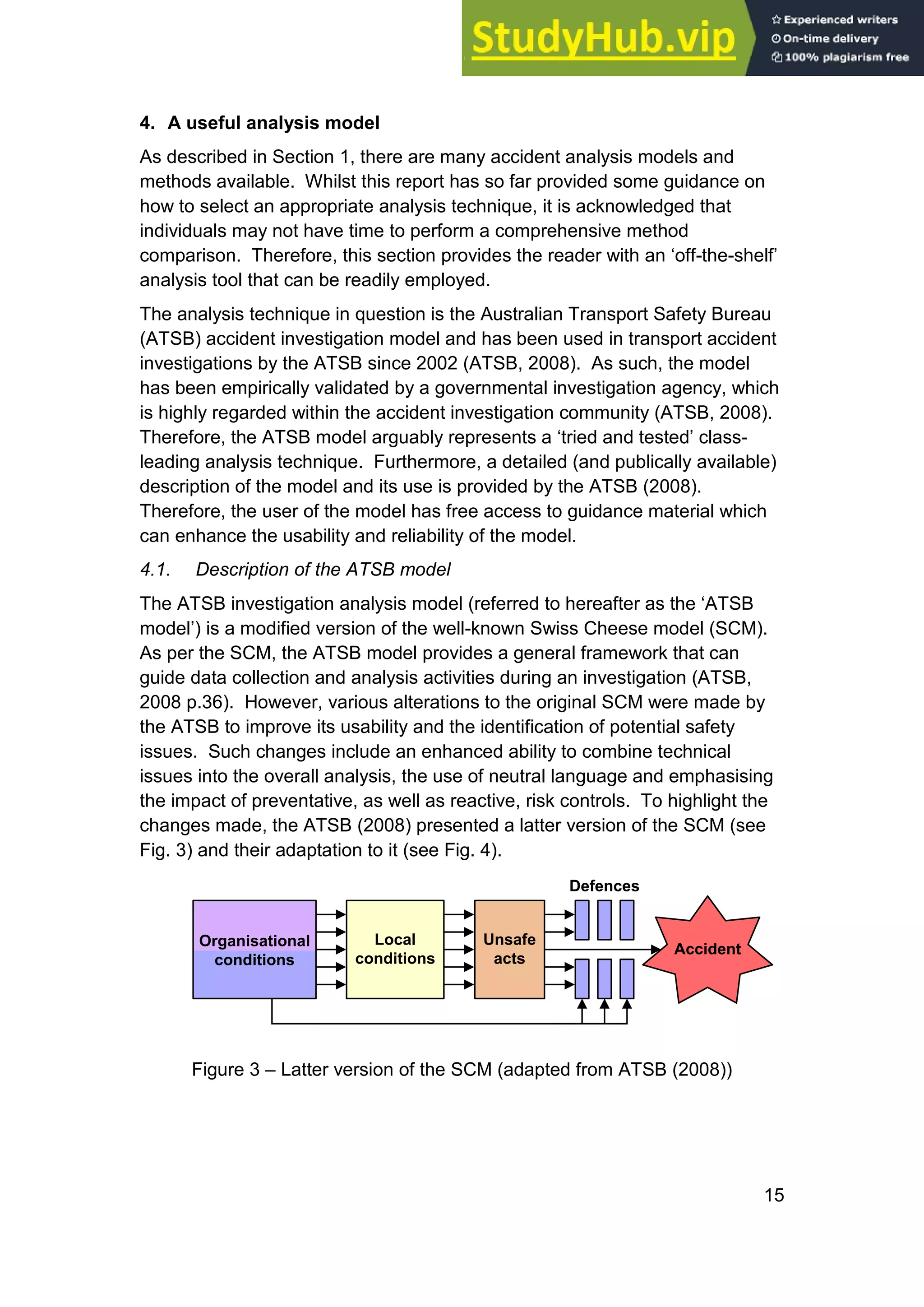
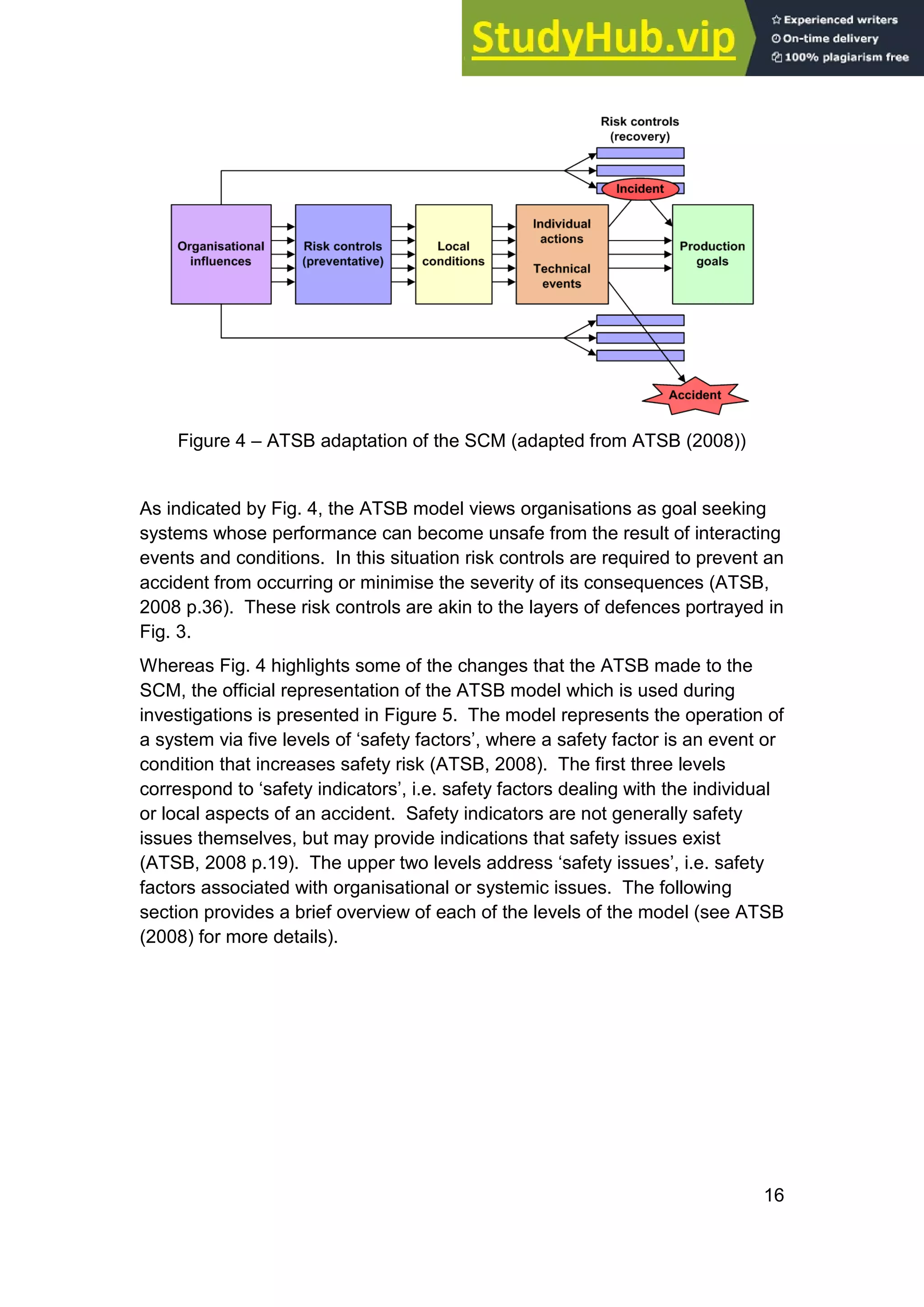
changes made, the ATSB (2008) presented a latter version of the SCM (see
Fig. 3) and their adaptation to it (see Fig. 4).
Unsafe
acts
Local
conditions
Organisational
conditions
Accident
Defences
Figure 3 – Latter version of the SCM (adapted from ATSB (2008))
16
Figure 4 – ATSB adaptation of the SCM (adapted from ATSB (2008))
As indicated by Fig. 4, the ATSB model views organisations as goal seeking
systems whose performance can become unsafe from the result of interacting
events and conditions. In this situation risk controls are required to prevent an
accident from occurring or minimise the severity of its consequences (ATSB,
2008 p.36). These risk controls are akin to the layers of defences portrayed in
Fig. 3.
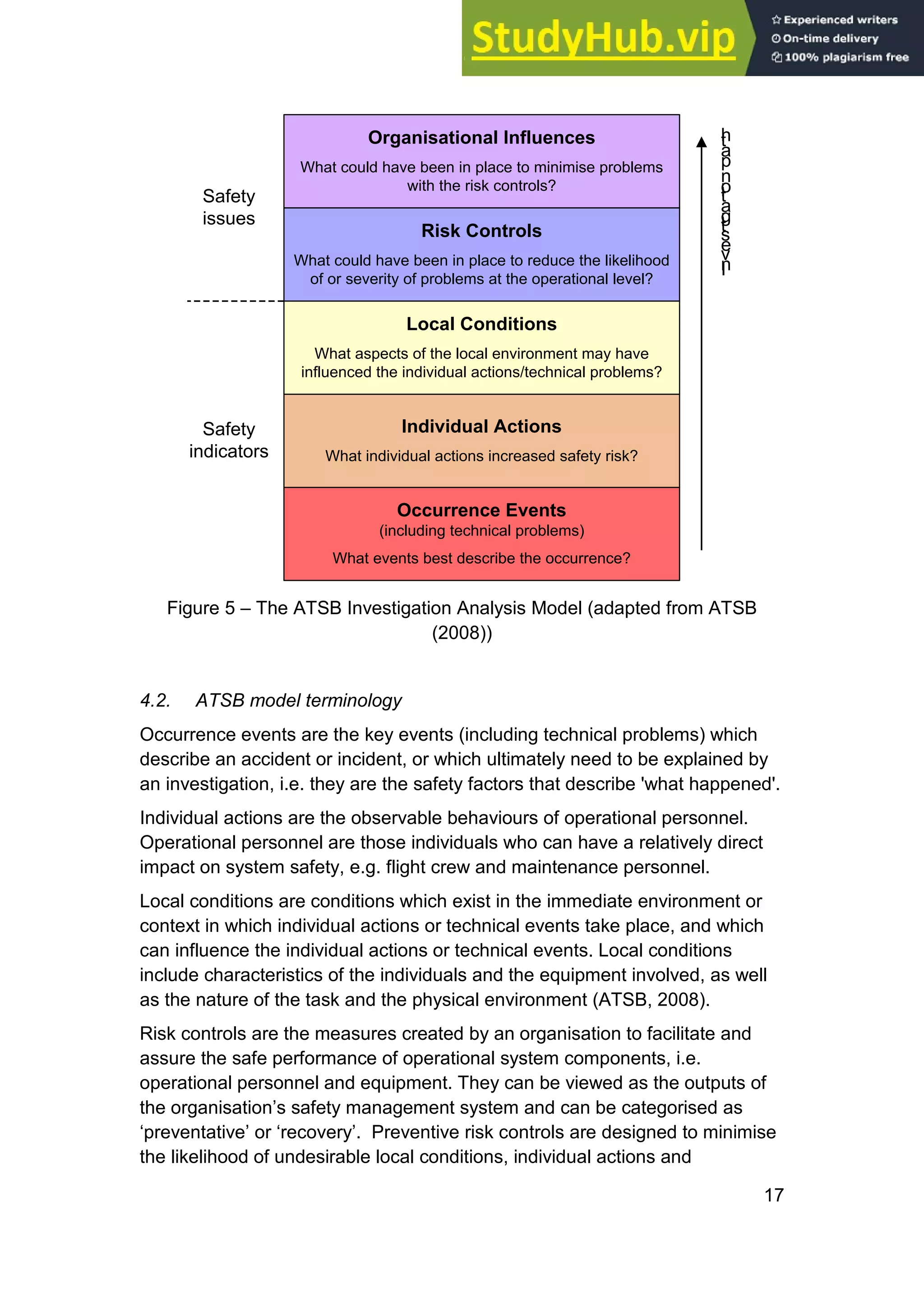
Whereas Fig. 4 highlights some of the changes that the ATSB made to the
SCM, the official representation of the ATSB model which is used during
investigations is presented in Figure 5. The model represents the operation of
a system via five levels of ‘safety factors’, where a safety factor is an event or
condition that increases safety risk (ATSB, 2008). The first three levels
correspond to ‘safety indicators’, i.e. safety factors dealing with the individual
or local aspects of an accident. Safety indicators are not generally safety
issues themselves, but may provide indications that safety issues exist
(ATSB, 2008 p.19). The upper two levels address ‘safety issues’, i.e. safety
factors associated with organisational or systemic issues. The following
section provides a brief overview of each of the levels of the model (see ATSB
(2008) for more details).
17
Occurrence Events
(including technical problems)
What events best describe the occurrence?
Individual Actions
What individual actions increased safety risk?
Local Conditions
What aspects of the local environment may have
influenced the individual actions/technical problems?
Risk Controls
What could have been in place to reduce the likelihood
of or severity of problems at the operational level?
Organisational Influences
What could have been in place to minimise problems
with the risk controls?
Safety
issues
Safety
indicators
I
n
v
e
s
t
i
g
a
t
i
o
n
p
a
t
h
Figure 5 – The ATSB Investigation Analysis Model (adapted from ATSB
(2008))
4.2. ATSB model terminology
Occurrence events are the key events (including technical problems) which
describe an accident or incident, or which ultimately need to be explained by
an investigation, i.e. they are the safety factors that describe 'what happened'.
Individual actions are the observable behaviours of operational personnel.
Operational personnel are those individuals who can have a relatively direct
impact on system safety, e.g. flight crew and maintenance personnel.
Local conditions are conditions which exist in the immediate environment or
context in which individual actions or technical events take place, and which
can influence the individual actions or technical events. Local conditions
include characteristics of the individuals and the equipment involved, as well
as the nature of the task and the physical environment (ATSB, 2008).
Risk controls are the measures created by an organisation to facilitate and
assure the safe performance of operational system components, i.e.
operational personnel and equipment. They can be viewed as the outputs of
the organisation’s safety management system and can be categorised as
‘preventative’ or ‘recovery’. Preventive risk controls are designed to minimise
the likelihood of undesirable local conditions, individual actions and
18
occurrence events. These controls facilitate and guide performance at the
operational level and can include procedures, training, equipment design and
work rosters. Recovery controls are put in place to detect and correct (or
otherwise minimise) the adverse effects of local conditions, individual actions
and occurrence events. These ‘last line’ controls include warning systems,
emergency equipment and emergency procedures.
Organisational influences are those conditions which influence the
effectiveness of an organisation’s risk controls and can be classed as internal
organisational conditions or external influences. Internal organisational
conditions are the safety management processes and other organisational
characteristics which influence the effectiveness of its risk controls. Examples
of safety management processes include hazard identification, risk
assessment, change management and training needs analysis. External
influences are the processes and characteristics of external organisations
which impact on an organisation’s risk controls and its internal organisational
conditions. Various external influences exist, e.g. regulatory standards and
surveillance or pressures and standards provided by industry associations
and international standards organisations.
4.3. ATSB model usage
The ATSB suggest that the most effective way of using the model to identify
potential safety factors is to start at the bottom level and work upwards,
asking a series of strategic questions. Broad questions for each level are
included in Fig. 5. The ATSB (2008 p.49-56) also provide detailed guidance
on their investigation approach and how potential safety factors can be tested
for their existence, their influence on an accident and whether they require
further analysis.
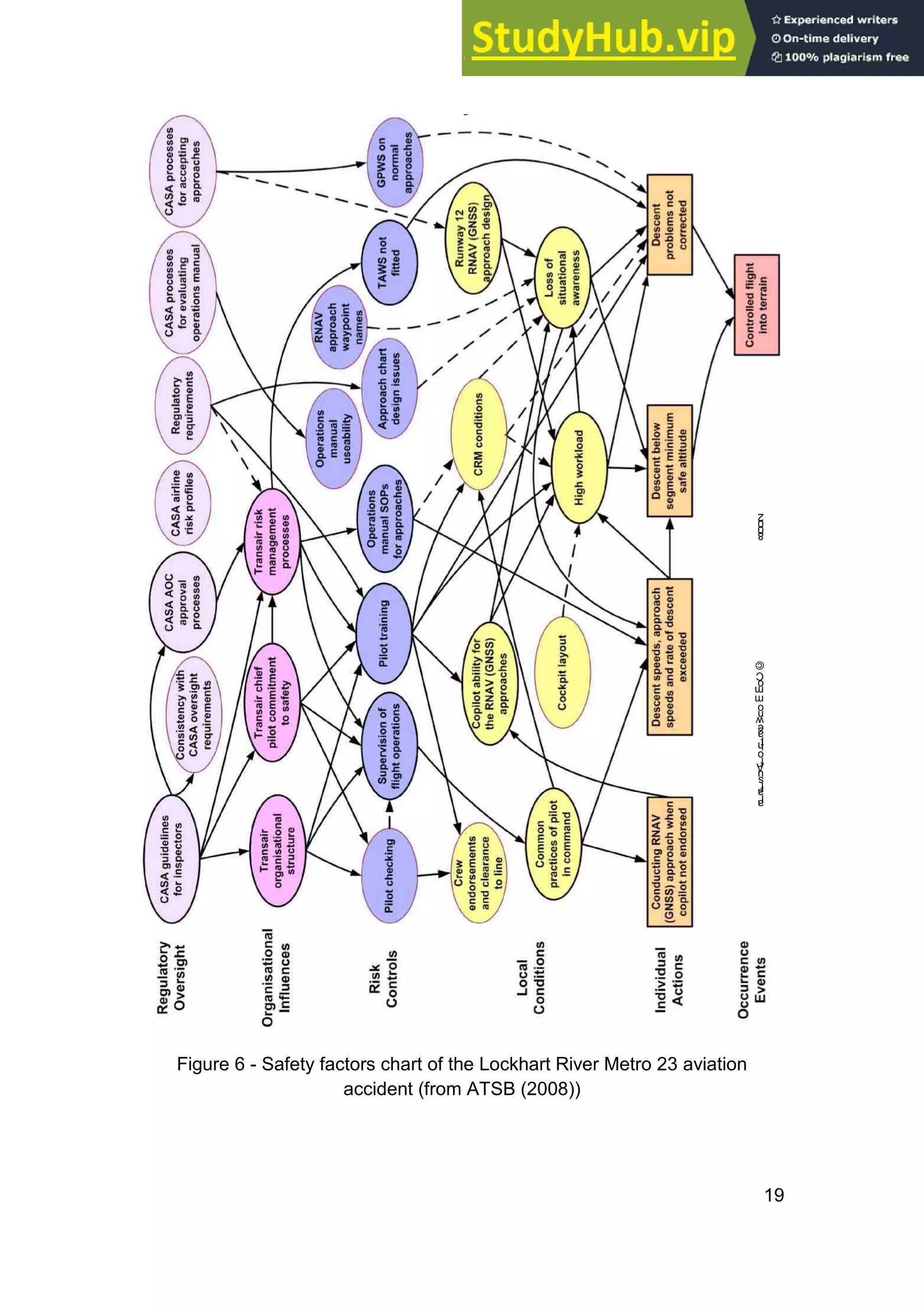
Many accident analysis techniques use charts to graphically represent the
findings of an investigation and the ATSB model is no exception. Use of
analysis charts can make it easier to see the potential relationships between
safety factors, identify gaps in the analysis which require further explanation.
Furthermore, charts can also be useful for communicating the findings of
complex investigations. A charting format preferred by the ATSB is based on
the Accimap method (Rasmussen, 1997). It shows the occurrence events
involved in an accident from left to right and adds the contributing safety
factors to these events in a series of hierarchical layers. The influence that a
given safety factor has on others is indicated by a connecting arrow. An
example of such an analysis chart is presented in Fig. 6. In the ATSB’s
experience, the use of this charting format has considerably helped the
explanation of complex accidents and incidents to industry personnel during
presentations and courses.
19
©
C
o
m
m
o
n
w
e
a
l
t
h
o
f
A
u
s
t
r
a
l
i
a
2
0
0
8
Figure 6 - Safety factors chart of the Lockhart River Metro 23 aviation
accident (from ATSB (2008))
20
As with any model of accident causation, the ATSB model has limitations. For
example, many safety factors can be proposed which do not neatly fall into
one of the levels. Furthermore, the limited descriptive nature of the model
does not fully explain the complex, dynamic nature of accident development.
An important example is the concept of local rationality. Actions and
decisions taken by people at all levels of a system are affected by their local
goals, resource constraints and external influences. To understand why an
individual (or team) took a decision or course of action, such activity must be
placed in context by examining the local conditions. The ATSB model
explicitly addresses this requirement at the operational level, however, the
context in which organisational influences were generated are not
incorporated into the model. Therefore, the user should investigate, if
possible, the local conditions that were present at the organisational level of a
system. This will help achieve a deeper understanding of an accident and
avoid the inappropriate blaming of an organisation’s management.
As well as investigating individual accidents and incidents, there is often a
need to analyse data from multiple events to identify trends in contributing
factors. The use of taxonomies to classify contributing factors is a convenient
way to achieve this, albeit that they restrict the flexibility of an analysis (see
Section 3.3). The ATSB model does not have a publically available taxonomy
so the user, if free to do so, would need to devise an appropriate classification
system for their organisation/industry. However, many users may already
have a given taxonomy in place, which is incorporated into an organisational
and/or regulatory database, and this may not be possible.
Despite these limitations, the ATSB (2008) state that their experience of using
the model has shown that it provides an appropriate balance between ease of
use and full realism when identifying potential safety factors and
communicating the findings of safety investigations.
21
References
Arnold, R., 2009. A qualitative comparative analysis of SOAM and STAMP in
ATM occurrence investigation. Lund University.
Australian Transport Safety Bureau, 2008. Analysis, causality and proof in
safety investigations Aviation Research and Analysis Report AR-2007-053.
Canberra City: Australian Transport Safety Bureau.
Dien, Y., Dechy, N. and Guillaume, E., 2012. Accident investigation: From
searching direct causes to finding in-depth causes – problem of analysis
or/and of analyst? Safety Science, 50(6), pp. 1398-1407.
Dutch Transport Safety Board, 2012. Experiences and challenges in using
STAMP for accident analysis, First STAMP/STPA Workshop at MIT, April
2012, Massachusetts Institute of Technology.
Energy Institute, 2008. Guidance on investigating and analysing human and
organisational factors aspects of incidents and accidents. London: Energy
Institute.
Ericson, C.A., 1999. Fault tree analysis - A history, 17th International System
Safety Conference, 16-21 Aug 1999, System Safety Society, pp. 1-9.
Ferjencik, M., 2011. An integrated approach to the analysis of incident
causes. Safety Science, 49(6), pp. 886-905.
Harris, D. and Li, W.-C., 2011. An extension of the human factors analysis
and classification system for use in open systems. Theoretical Issues in
Ergonomics Science, 12(2), pp. 108-128.
Heinrich, H.W., 1931. Industrial accident prevention. New York, NY: McGraw-
Hill.
Hollnagel, E., 2012. FRAM – the functional resonance analysis method.
Farnham: Ashgate.
Hollnagel, E., 2008. The changing nature of risks. Ergonomics Australia, 22(1-
2), pp. 33-46.
Hollnagel, E., 2004. Barriers and accident prevention. Aldershot: Ashgate
Publishing Limited.
Hollnagel, E. and Goteman, Ö., 2004. The Functional Resonance Accident
Model, Cognitive System Engineering in Process Control 2004, 4 - 5 Nov
2004, CSEPC, pp. 155-161.
Hollnagel, E., Pruchnicki, S., Woltjer, R. and Etcher, S., 2008. Analysis of
Comair flight 5191 with the Functional Resonance Accident Model, 8th
International Symposium of the Australian Aviation Psychology Association, 8
- 11 Apr 2008, Australian Aviation Psychology Association.
Hollnagel, E. and Speziali, J., 2008. Study on developments in accident
investigation methods: A survey of the'state-of-the-art. SKI Report 2008:50.
Sophia Antipolis, France: Ecole des Mines de Paris.
22
Johansson, B. and Lindgren, M., 2008. A quick and dirty evaluation of
resilience enhancing properties in safety critical systems, E. Hollnagel, F. Pieri
and E. Rigaud, eds. In: Third Symposium on Resilience Engineering, 28 - 30
Oct 2008, École des mines de Paris.
Johnson, C., 2003. Failure in safety critical systems: A handbook of incident
and accident reporting. Glasgow: Glasgow University Press.
Katsakiori, P., Sakellaropoulos, G. and Manatakis, E., 2009. Towards an
evaluation of accident investigation methods in terms of their alignment with
accident causation models. Safety Science, 47(7), pp. 1007-1015.
Kjellén, U., 2000. Prevention of accidents through experience feedback.
London: Taylor and Francis.
Leveson, N., 2011. Engineering a safer world: Systems thinking applied to
safety. London: The MIT Press.
Leveson, N., 2004. A new accident model for engineering safer systems.
Safety Science, 42(4), pp. 237-270.
Leveson, N., 2001. Evaluating accident models using recent aerospace
accidents. Part I: Event-Based Models. Cambridge, MA: Massachusetts
Institute of Technology.
Ohno, T., 1988. Toyota production system: Beyond large-scale production.
Portland, OR: Productivity Inc.
Perrow, C., 1984. Normal accidents: Living with high-risk technologies. New
York, NY: Basic Books.
Qureshi, Z.H., 2007. A review of accident modelling approaches for complex
socio-technical systems, T. Cant, ed. In: 12th Australian Workshop on Safety
Related Programmable Systems, 2007, Australian Computer Society, pp. 47-
59.
Rasmussen, J., 1997. Risk management in a dynamic society: A modelling
problem. Safety Science, 27(2-3), pp. 183-213.
Rathnayaka, S., Khan, F. and Amyotte, P., 2011. SHIPP methodology:
Predictive accident modeling approach. Part I: Methodology and model
description. Process Safety and Environmental Protection, 89(3), pp. 151-164.
Reason, J., 1997. Managing the risks of organizational accidents. Aldershot:
Ashgate Publishing Ltd.
Reason, J., 1990. Human error. Cambridge: Cambridge University Press.
Reason, J., Hollnagel, E. and Paries, J., 2006. Revisiting the «Swiss cheese»
model of accidents. EEC Note No. 13/06. Brétigny-sur-Orge, France:
EUROCONTROL Experimental Centre.
Salmon, P.M., Cornelissen, M. and Trotter, M.J., 2012. Systems-based
accident analysis methods: A comparison of accimap, HFACS, and STAMP.
Safety Science, 50(4), pp. 1158-1170.
23
Sklet, S., 2004. Comparison of some selected methods for accident
investigation. Journal of Hazardous Materials, 111, pp. 29-37.
Svedung, I. and Rasmussen, J., 2002. Graphic representation of accident
scenarios: Mapping system structure and the causation of accidents. Safety
Science, 40(5), pp. 397-417.
Underwood, P. and Waterson, P., 2013. Systemic accident analysis:
Examining the gap between research and practice. Accident Analysis &
Prevention, 55, pp. 154-164.
Watson, H.A., 1961. Launch control safety study. Section VII, Volume I.
Murray Hill: Bell Laboratories.
Wiegmann, D.A. and Shappell, S.A., 2003. A human error approach to
aviation accident analysis: The human factors analysis and classification
system. Burlington, Vermont, USA: Ashgate Publishing Ltd.
24
Appendix A – Useful sources of accident analysis information
The sources of information provided below give a general coverage of the
accident analysis and its associated methods.
Free sources of information
• Australian Transport Safety Bureau (2008) – Analysis, Causality and Proof
in Safety Investigations
This document provides an overview of how the ATSB conduct investigations
and the analysis model they have developed, as well as a useful summary of
the Swiss Cheese model and how suitable it is for accident analysis.
http://www.atsb.gov.au/media/27767/ar2007053.pdf
• Energy Institute (2008) – Guidance on investigating and analysing human
and organisational factors aspects of incidents and accidents
This document offers practitioner-focused guidance on accident investigation,
analysis method selection and an overview of a number of different analysis
tools.
http://www.energyinstpubs.org.uk/tfiles/1354473348/817.pdf
• Erik Hollnagel’s website
This website provides details about the FRAM systemic analysis method and
a list of publications utilising the technique.
http://www.functionalresonance.com/
• Hollnagel and Speziali (2008) – Study on Developments in Accident
Investigation Methods: A Survey of the “State-of-the-Art”
This report provides a useful overview of some accident analysis methods
and their suitability for analysing systems with different complexities.
http://hal.archives-ouvertes.fr/docs/00/56/94/24/PDF/SKI-Report2008_50.pdf
• Johnson (2003) - Failure in safety critical systems: A handbook of incident
and accident reporting
This book provides a detailed description of various facets of accident
investigation, including accident analysis methods.
http://www.dcs.gla.ac.uk/~johnson/book/
• Nancy Leveson’s website
This website provides numerous articles and presentations about the use of
the systemic STAMP method for accident and hazard analysis.
sunnyday.mit.edu/
25
• Qureshi (2007) - A review of accident modelling approaches for complex
socio-technical systems
This article provides a comprehensive overview of the development of
accident causation theory and techniques. It is available from the following
website (a free account must be set up in order access the full document).
http://dl.acm.org/citation.cfm?id=1387046&dl=ACM&coll=DL&CFID=2154499
66&CFTOKEN=66373980
• Reason et al. (2006) – Revisiting the Swiss Cheese model of accidents
This report, prepared for EUROCONTROL gives a detailed account about the
development and current status of the well known Swiss Cheese model.
http://www.eurocontrol.int/eec/gallery/content/public/document/eec/report/200
6/017_Swiss_Cheese_Model.pdf
Other sources of information
• Dekker, S., 2006. The field guide to understanding human error. Aldershot:
Ashgate Publishing Limited.
This book by Sydney Dekker provides an accessible introduction to the ‘new
view’ of accidents, which promotes the avoidance of hindsight and blame.
• Leveson, N., 2011. Engineering a Safer World: Systems Thinking Applied
to Safety. The MIT Press, London.
Comprehensive coverage of systems theory, STAMP and its various
applications is contained in this book. Also, a description is provided as to
why systemic accident analysis is required.
• Hollnagel, E., 2012. FRAM—The Functional Resonance Analysis Method.
Ashgate, Farnham.
The FRAM method is described and demonstrated in this book, along with
information about its underlying theory and the need for systemic accident
analysis.
• Salmon et al., 2011. Human factors methods and accident analysis:
practical guidance and case study applications. Farnham: Ashgate
Publishing Limited.
This book provides a number of examples of accident analysis methods and
how they are applied.

Accident Analysis Models And Methods Guidance For Safety Professionals

  • 1.
    Accident Analysis Models andMethods: Guidance for Safety Professionals Peter Underwood and Dr. Patrick Waterson May 2013
  • 2.
    i Copyright information The informationcontained within this report is provided as guidance only. While every reasonable care has been taken to ensure the accuracy of its contents, the author and Loughborough University cannot accept any responsibility for any action taken, or not taken, on the basis of this information. The author and Loughborough University shall not be liable to any person or organisation for any loss or damage which may arise from the use of any of the information contained in this report. © Loughborough University 2013 Contact information Author contact details: Peter Underwood, Loughborough Design School, CC.1.07, James France Building, Loughborough University, Loughborough, Leicestershire, LE11 3TU, UK. E-mail address: p.j.underwood@lboro.ac.uk
  • 3.
    ii Copyright information ....................................................................................i Contactinformation........................................................................................i Foreword ........................................................................................................1 1. Introduction.............................................................................................2 1.1. Purpose and scope ...............................................................................2 2. Analysis models and methods ..............................................................3 2.1. Sequential techniques...........................................................................3 2.2. Epidemiological techniques...................................................................3 2.3. Systemic techniques .............................................................................4 2.4. Model and method category selection...................................................5 3. Influences on analysis model and method selection ........................10 3.1. Model and method awareness ............................................................10 3.2. Model and method adoption................................................................11 3.3. Model and method usage....................................................................11 3.4. Organisational and industry influences on model and method usage .13 3.5. Method and model selection summary................................................13 4. A useful analysis model.......................................................................15 4.1. Description of the ATSB model ...........................................................15 4.2. ATSB model terminology.....................................................................17 4.3. ATSB model usage .............................................................................18 References ...................................................................................................21 Appendix A – Useful sources of accident analysis information..............24 Free sources of information ...........................................................................24 Other sources of information..........................................................................25
  • 4.
    1 Foreword Accident analysis modelsand methods provide safety professionals with a means of understanding why accidents occur. Choosing an analysis technique is, however, not a simple process. A wide range of methods are available; each offering various theoretical and practical benefits and drawbacks. Furthermore, individuals engaged in accident investigation are subjected to various factors, e.g. budgetary and time constraints, which can influence their selection and usage of an analysis tool. This report is based on an extensive review of the accident analysis literature and an interview study conducted with 42 safety experts and has two aims. Firstly, it provides an overview of the available analysis techniques and the factors influencing an individual’s choice and usage of these methods. The intention is to provide the reader with information that may enable them to make a more informed selection of analysis tool. The second aim is to present an analysis model currently used in industry. The intention is to provide the reader with a validated method that can be readily employed, if undertaking a detailed assessment of the available techniques is not practicable.
  • 5.
    2 1. Introduction Understanding whyaccidents occur and how to prevent their recurrence is an essential part of improving safety in any industry. Gaining this knowledge requires determining why a certain combination of events, conditions and actions lead to a specific outcome, i.e. accident analysis (Hollnagel et al., 2008). Important tools used to achieve this understanding are the accident causation model and accident analysis method. Analysis models provide a conceptual representation of accident causation whereas analysis methods provide a means of applying this theory. The nature of accident causation has, however, become more complex over time due to a number of factors, e.g. the rapid pace of technological advances and more complex relationships between humans and technology (Leveson, 2011). Accident causation theory has also developed to capture this increased complexity and numerous analysis models and methods have emerged to apply this knowledge. Selecting a technique to use from the wide range of analysis models and methods presents a dilemma for any individual. The sheer number of analysis tools (well in excess of 100) makes the task of assessing each one impracticable. Other factors must, therefore, be considered when deciding which technique is adopted and used, e.g. its usability and how well established it is within industry. 1.1. Purpose and scope The initial aim of this report is to provide an overview of the different categories of analysis model and method which are available. The intention is not to provide a detailed review of analysis techniques, as these are currently available in the research and practitioner literature (e.g. Energy Institute, 2008; Johnson, 2003). Rather the purpose is to give the reader an awareness of the general concepts underlying each category and provide a focus for any further investigation they wish to undertake. The report then presents a range of factors that influence an individual’s approach to accident analysis and can prevent the adoption and usage of analysis techniques. The aim is to provide the reader with an increased awareness of the issues that shape their choice of method and provide a framework to review their selection. Finally, the report provides a description of an analysis technique that is currently employed by a government accident investigation authority. The method has been refined and validated over a period of years and enables the application of accident causation theory in a practical and usable manner. The purpose is to provide the reader with an ‘off-the-shelf’ analysis tool that can be readily employed, if the identification and assessment of alternative methods is not practicable.
  • 6.
    3 2. Analysis modelsand methods A key driver for the continued rise in analysis model and method numbers is the ever-increasing complexity of socio-technical systems (which are comprised of interacting human, technological and environmental components) and the resulting change in accident causation mechanisms. As researchers have sought to account for these changes, the ensuing development of analysis techniques can be described as having gone through three major phases, i.e. sequential, epidemiological and systemic. This categorisation relates to the different underlying assumptions of accident causation (Hollnagel and Goteman, 2004). This distinction is not obligatory and other classification systems based on differing accident characteristics exist (e.g. Kjellén, 2000) (Katsakiori et al., 2009). However, it helps explain the desire of researchers to introduce systems theory concepts into accident analysis, as detailed in the following sections. 2.1. Sequential techniques The sequential class of models and methods describe accidents as the result of time-ordered sequences of discrete events. They assume that an undesirable event, i.e. a ‘root cause’, initiates a sequence of events which lead to an accident and that the cause-effect relation between consecutive events is linear and deterministic. This implies that the accident is the result of this root cause which, if identified and removed, will prevent a recurrence of the accident. Examples include the Domino model (Heinrich, 1931), Fault Tree Analysis (Watson, 1961 cited in Ericson, 1999) and the Five Whys method (Ohno, 1988). These methods work well for losses caused by physical component failures or the actions of humans in relatively simple systems and generally offer a good description of the events leading up to an accident (Leveson, 2004). However, the cause-effect relationship between the management, organisational and human elements in a system is poorly defined by these techniques and they are unable to depict how these causal factors triggered the accident (Rathnayaka et al., 2011). From the end of the 1970’s it became apparent that the sequential tools were unable to adequately explain a number of major industrial accidents, e.g. Three Mile Island, Chernobyl and Bhopal. Consideration for the role that organisational influences play in accidents was required and resulted in the creation of the epidemiological class of analysis tools. 2.2. Epidemiological techniques Epidemiological models and methods view accidents as a combination of ‘latent’ and ‘active’ failures within a system, analogous to the spreading of a disease (Qureshi, 2007). Latent conditions, e.g. management practices or organisational culture, are likened to resident pathogens and can lie dormant
  • 7.
    4 within a systemfor a long time (Reason et al., 2006). Such organisational factors can create conditions at a local level, i.e. where operational tasks are conducted, which negatively impact on an individual’s performance (e.g. fatigue or high workload). The scene is then set for ‘unsafe acts’, such as errors and violations, to occur. Therefore, the adverse consequences of latent failures only become evident when they combine with unsafe acts, i.e. active failures, to breach the defences of a system. The most well-known epidemiological technique is the Swiss Cheese model (Reason, 1990, 1997), which has formed the conceptual basis for various analysis methods, e.g. the Human Factors Analysis & Classification System (HFACS) (Wiegmann and Shappell, 2003) and Tripod Beta. The epidemiological class of techniques better represent the influence of organisational factors on accident causation, when compared with the sequential tools. Given that they require an individual to look beyond the proximal causes of an accident and examine the impact of a system’s latent conditions, a more comprehensive understanding of an accident can be achieved. However, many are still based on the cause-effect principles of the sequential models, as they describe a linear direction of accident causation (Hollnagel, 2004). From the late 1990’s, a number of researchers e.g. (Rasmussen, 1997; Leveson, 2001; Svedung and Rasmussen, 2002) argued that these epidemiological techniques were no longer able to account for the increasingly complex nature of socio-technical system accidents. The application of systems theory was subsequently proposed as a solution to this issue. 2.3. Systemic techniques Systems theory is designed to understand the structure and behaviour of any type of system. Rather than treating accidents as a sequence of cause-effect events, it describes losses as the unexpected behaviour of a system resulting from uncontrolled relationships between its constituent parts. In other words, accidents are not created by a combination of latent and active failures; they are the result of humans and technology operating in ways that seem rational at a local level but unknowingly create unsafe conditions within the system that remain uncorrected. From this perspective, simply removing a ‘root cause’ from a system will not prevent the accident from recurring. A holistic approach is required whereby safety deficiencies throughout the entire system must be identified and addressed. A range of systemic tools exist which enable the application of the systems approach, e.g. the Systems Theoretic Analysis Model and Processes model (STAMP) (Leveson, 2004, 2011), the Functional Resonance Analysis Method (FRAM) (Hollnagel, 2004, 2012) and the Accimap (Rasmussen, 1997). Whilst these systemic techniques appear to provide a deeper understanding of accident causation, various studies suggest they are more resource
  • 8.
    5 intensive and requireconsiderable amounts of domain and theoretical knowledge to apply (e.g. Ferjencik, 2011; Johansson and Lindgren, 2008). Furthermore, the latest version of the Swiss Cheese model (see Reason, 1997) acknowledges that active failures are not always required for an accident to happen; long-standing latent conditions are sometimes all that is required, as was the case in the Kings Cross, Piper Alpha and the space shuttles Challenger and Columbia accidents (see Reason et al., 2006). It also acknowledges that latent conditions can be better described as organisational factors, rather than management failures. This represents top-level managerial decisions as ‘normal behaviour’ influenced by the local conditions, resource constraints and objectives of an organisation. The distinction between the epidemiological and systemic perspective of accidents, therefore, seems to be a subtle one. However, a number of studies have compared systemic methods with established Swiss Cheese based methods, such as HFACS (Salmon et al. 2012) and the Systemic Occurrence Analysis Methodology (e.g. Arnold, 2009) and commented that the systemic techniques do provide a deeper understanding of how the behaviour of the entire system can contribute to an accident. Whilst the ‘systems approach’ is arguably the dominant concept within accident analysis research, systemic models and methods are yet to gain widespread acceptance within the practitioner community (Underwood and Waterson, 2013). 2.4. Model and method category selection In order to choose which category of analysis technique best suits an individual’s needs, a useful starting point is to consider the type of system being analysed. Systemic techniques are designed to provide a depth of understanding for complex accidents that is greater than the sequential and epidemiological models and methods. However, it may be inefficient to use these more complex and powerful methods to investigate accidents in simple systems. Therefore, understanding the complexity of the system in question will help to identify the most suitable method. Hollnagel (2008) provides a means of characterising systems, based on the work of Perrow (1984), which considers their coupling and tractability (manageability). The coupling of a system can vary between being loose and tight and refers to how subsystems and/or components are functionally connected or dependent upon each other. Tightly coupled systems can be described as follows: • Buffers and redundancies are purposively part of the design • Delays in processing are not possible • Process sequences are invariant
  • 9.
    6 • The substitutionof supplies, equipment, personnel is limited and anticipated in the design • There is little slack possible in supplies, equipment, and personnel • There is only one method to reach the goal • Tightly coupled systems are difficult to control because an event in one part of the system quickly will spread to other parts A system’s manageability can vary from high (tractable) and low (intractable). A tractable system can be characterised as: • The principles of the system’s functioning are known • System descriptions are simple and with few details • The system does not change while it is being described, i.e. changes in system activities are slow enough that the whole system can be described completely and in detail Hollnagel (2008) suggests that a good example of a tractable system is the normal functioning of a post office, or the operation of a home furnace. He also proposes that the outage at a nuclear power plant or the activities in a hospital emergency department represent good examples of intractable systems, given that their activities are not standardised and change so rapidly that it is never possible to produce a detailed and complete description. Using the dimensions of coupling and manageability, Hollnagel (2008) characterises a number of systems (see Figure 1).
  • 10.
    7 Manageability Low High Coupling Tight Loose Dams Power grids Air traffic control Railways Marine transport Universities Military early warning Military adventures Space missions Chemical plants Financial markets Nuclear powerplants Public services Manufacturing Post offices Mining Assembly lines R & D companies Manageability Low High Coupling Tight Loose Dams Power grids Air traffic control Railways Marine transport Universities Military early warning Military adventures Space missions Chemical plants Financial markets Nuclear power plants Public services Manufacturing Post offices Mining Assembly lines R & D companies Figure 1 - System characteristics (adapted from Hollnagel, 2008) The locations of the systems presented in Figure 1 are illustrative and the list is clearly not exhaustive. Therefore, the reader is encouraged to consider the characteristics of their own organisation/system and its location on Figure 1. Hollnagel and Speziali (2008) provide a number of questions to help determine these characteristics: Question System characteristic Tractable Intractable Was the accident similar to something that has happened before, or was it new and unknown? (The answer should be based on the history of the organisation and the industry it operates in) Similar accident New and unknown accident Was the organisation ready to respond to the accident, in the sense that there were established procedures or guidelines available? Ready to respond Not ready to respond Was the situation quickly brought under control or was the development lengthy? Quickly under control Lengthy development
  • 11.
    8 Question System characteristic Loosely coupled Tightly coupled Wasthe accident and the material consequences confined to a clearly delimited subsystem (technological or organisational) or did it involve multiple subsystems, or the whole installation? Delimited subsytem Multiple subsystems, whole system Were the consequences on the whole expected / familiar or were they novel / unusual? Expected Novel Were the consequences in proportion to the initiating event, or were they unexpectedly large (or small)? Proportional consequences Consequences of unexpected Table 1 - System characteristics criteria (based on Hollnagel and Speziali, (2008)) However, the question of which category of analysis models and methods best suits a given system still remains. Hollnagel (2008) evaluated a number of analysis tools and mapped them on to Figure 1, based on their suitability for analysing a system of a given level of coupling and tractability. For example, he suggests that the STAMP and FRAM systemic methods are best suited for analysing accidents in tightly coupled systems with low manageability. As a guiding principle, this report suggests which of the three model/method categories is most suitable for accident analysis in a system with a given level of coupling and manageability in Figure 2. No class of analysis technique has been assigned to the lower right-hand quadrant of Figure 2, as no models or methods are applicable for loosely coupled systems with low manageability. Hollnagel (2008) suggests this is because no major accidents have occurred in systems of this nature and, therefore, there was no drive to develop any relevant analysis tools. It is important to note that the locations of the boundaries between the model and method categories in Figure 2 are notional and will not be this distinct in reality. It is also notable that the technique employed should provide a suitably deep understanding of how an accident occurred. Effective recommendations cannot be devised without this understanding. If an individual finds that gaps in their knowledge of a given accident cannot be
  • 12.
    9 addressed by theircurrent analysis tool they should consider using an alternative, more powerful, technique. In addition, determining how much of a system will be analysed should also be considered. If an individual system component, e.g. a single human operator, or a sub-system, e.g. an aircraft fuel system, is to be analysed then a simpler sequential method may be appropriate. If the entire system is to be examined and the analysis will incorporate the organisational (and possibly regulatory and governmental) contribution to an accident, then epidemiological or systemic techniques should be considered. Manageability Low High Coupling Tight Loose Dams Power grids Air traffic control Railways Marine transport Universities Military early warning Military adventures Space missions Chemical plants Financial markets Nuclear power plants Public services Manufacturing Post offices Mining Assembly lines R & D companies Sequential Systemic Key: Epidemiological Manageability Low High Coupling Tight Loose Dams Power grids Air traffic control Railways Marine transport Universities Military early warning Military adventures Space missions Chemical plants Financial markets Nuclear power plants Public services Manufacturing Post offices Mining Assembly lines R & D companies Sequential Systemic Key: Epidemiological Figure 2 - Analysis technique suitability (adapted from Hollnagel (2008))
  • 13.
    10 3. Influences onanalysis model and method selection Whilst the selection of an analysis technique may be affected by the characteristics of the system in which it is employed, a number of other influential factors exist. A range of these additional issues were identified in a study carried out by Underwood and Waterson (2013). Interviews were conducted with 42 safety professionals based in ten countries. The nine full time accident investigators, 17 health and safety professionals, ten human factors specialists and six researchers had experience of working in at least one of 25 industries. The interviewees were asked about their current approach to accident and/or risk analysis, their knowledge of analysis techniques and their views on the communication between the researcher and practitioner communities. The factors that were considered to influence the selection of analysis techniques are detailed in the remainder of Section 3. 3.1. Model and method awareness In order to use an analysis technique it is clear that an individual must first become aware of it. However, various issues exist which may prevent this from occurring. Some individual’s simply have no desire to change their current approach and, therefore, have no need for new information. In this case it is important that the individual has evidence that their chosen analysis method provides a sufficient understanding of accidents to develop safety recommendations that prevent recurrence. If the same accidents keep occurring, despite efforts to prevent them, then the individual should consider using a more powerful analysis tool to gain a deeper understanding of why this is so. If this tool provides further insights into the causes of the accidents then more effective recommendations may be devised. Awareness of analysis methods is also dictated, at least in part, by the level of training received by an individual. The extent of training received appears to be role-dependent. Full-time investigators, for example, sometimes receive extensive training via university-level courses, whereas practitioners with varying degrees of involvement with accident investigation may receive less training or none at all. Individuals who are not provided with training and undertake a search for information regarding analysis methods face issues which may limit their awareness. Such issues include the cost of information and the time required to gather and read it. In addition, some accident analysis information presented in the academic literature maybe considered by some individuals to be too conceptual and provide little or no practical benefit.
  • 14.
    11 Providing usage guidancefor the various analysis methods is beyond the scope of this report. However, for those individuals who require information about accident analysis techniques, the reader is referred to the material listed in Appendix A. 3.2. Model and method adoption Even if a sufficient awareness of analysis methods is obtained by an individual, various barriers may prevent a technique from being adopted. For example, the needs of end users may not have been successfully accounted for during the development of an analysis method. An individual’s decision to adopt a method can also be based on personal selection criteria, such as how well the technique’s approach suits their way of thinking or whether they have previously used the method. The analysis approach taken by an individual can be influenced by their need to assign liability for an accident. Some individuals prefer (or are mandated) to avoid seeking blame in favour of focusing on safety improvements. This may lead them to using methods which focus on safety deficiencies throughout an entire system, e.g. a systemic method (see Section 2.3). However, others more concerned with the commercial and legal implications of accidents may select a method which simplifies the task of singling out a ‘root cause’ to blame for an accident, e.g. a sequential technique (see Section 2.1). This is particularly evident when those who are conducting an investigation may be deemed culpable and are incentivised to apportion liability elsewhere. The track record of use within industry that a method has established plays an important part in whether it is adopted by individuals and organisations. Without a history of application in practice, there can be reluctance to trial new analysis methods, as their credibility maybe questioned. 3.3. Model and method usage The level of effort invested in an analysis will be based, at least in part, by the resources available to an investigation team. Consequently this can affect whether an individual/team employs more complex analysis techniques. In addition to affecting which analysis method is used, the time and financial constraints involved in accident investigation can also affect how it is used. The depth of analysis that can be achieved, for example, is limited by the time available to the investigation team. The usability of an analysis method will affect whether an analysis is performed effectively and efficiently. In order for a technique to have adequate usability it must be easy to understand and apply. Consideration should, therefore, be given to the availability and clarity of guidance material as well as the training and resources required to use a given analysis method.
  • 15.
    12 The graphical outputof a method will affect the ability of an individual (or team of investigators) to successfully perform an analysis. Graphically representing an accident has been considered to be useful by both researchers (e.g. Sklet, 2004; Svedung and Rasmussen, 2002) and practitioners (e.g. Australian Transport Safety Bureau, 2008) for a number of reasons. For example, it can be easier to see the relationships between system components and identify gaps/weaknesses in the analysis. Also, charting an accident can also be useful for communicating the findings of complex investigations (Australian Transport Safety Bureau, 2008). Therefore, it is important to consider if a given method provides these benefits and the resources which are required to graphically describe the accident. For example, does the analysis method need specialised charting software or the simpler combination of sticky-notes and a whiteboard? A number of factors related to the reliability of a method (i.e. the consistency of results obtained when a given accident is analysed separately by different individuals or reanalysed by the same person) can also affect its usage. For example, an individual’s background and experience can influence their analysis approach and produce variation in investigation findings. Open discussions and analysis reviews which result in a consensus on the investigation findings can help minimise the biasing effects of individuals’ backgrounds; a process which is common with full-time investigators. However, the qualitative nature of some analysis tools may increase the difficulty of reaching such an agreement. The reliability of a method is further affected by the availability and clarity of usage guidance. Less guidance increases the flexibility of an analysis and gives an individual more freedom to probe into different aspects of an event. Whilst this flexibility maybe suited to an experienced investigator, a more structured approach may improve the consistency of analysis outputs of less experienced individuals. Reliability is particularly important if accident trend analysis is to be performed. The greater the reliability of a method and its outputs, the more the results of any trend analysis can be trusted. The use of causal factor taxonomies can greatly enhance the reliability of an analysis method, if the taxonomy is appropriate for the industry in which the accident of interest occurred in. Some methods (e.g. HFACS) have been devised with industry- specific taxonomies. However, taxonomies can be restrictive and may require an investigator to ‘force fit’ a piece of information into the classification system. Therefore, it is important to understand whether a given taxonomy meets the needs of the investigation team. Furthermore, individuals may not be able to gain access to the data required for some of the more complex, e.g. systemic, methods. For example, such information may exist outside of the organisation ‘affected‘ by the accident (e.g. commercially sensitive documentation from an equipment supplier) or an
  • 16.
    13 individual maybe inthe ‘wrong‘ position within an organisation to address the whole scope of an accident (e.g. unable to interview senior managers) (Dien et al., 2012). 3.4. Organisational and industry influences on model and method usage Some individuals have the freedom to choose which analysis technique they adopt and use. However, in many cases, organisational policy dictates which methods are used. Organisational policy can also impact on the resources available for practitioners to learn and use new analysis methods. The degree of regulation within a given industry can have a large influence on what type of analysis techniques are used in accident investigation and risk assessments. For example, regulation in the nuclear industry is prescriptive, with regards to the use of analysis methods. Regulation in other industries however, e.g. civil aviation, provides the investigator with a greater degree of method selection flexibility, despite the adoption of a given analysis model by the regulator (such as the Swiss Cheese model used by the International Civil Aviation Organization). The effort and cost of implementing a new analysis method within an organisation, or throughout an industry, by means of new regulations can create resistance to change. This inertia can also increase due to a number of other factors, e.g. the level of industry regulation or the number of stakeholders involved in effecting the change. 3.5. Method and model selection summary Any of the factors described in Sections 3.1 – 3.4 may prevent an individual from becoming aware of, adopting and/or using a new analysis technique. However, it is likely that they all, to a greater or less extent, combine to inhibit the application of new models and methods. Some individuals may not be in a position to influence some/all of these factors and, therefore, will have to continue using their current analysis method. However, if the investigator has an opportunity to select which technique they will use, considering the following questions may help them reach a more informed decision. • How complex is the system to be analysed, i.e. what is the level of coupling and tractability of the system? • How much of the system will be analysed? • What is the type of method that I currently use (sequential, epidemiological or systemic) and is it suitable for analysing the system I am interested in? • What alternative methods are available and are they more suitable for the current analysis?
  • 17.
    14 • How easyis the method to understand and use? • How much usage guidance material is available? • What resources are required to use the method, e.g. specialist software? • Does the graphical output of the method help facilitate the analysis, e.g. identify evidence gaps? • Does the method provide a useful means of communicating the findings of an analysis with others, e.g. colleagues or non-experts? • How reliable is the method? • Does the method have a structured application process? • Does the method have a taxonomy of factors which contribute to an accident? • Do I need to perform accident trend analysis and, if so, does a method exist that uses a suitable taxonomy or do I need to devise my own classification scheme? An important point to note is that, while analysis methods enable an individual to apply a given view of accident causation to their evidence, no single technique can capture the complexity of a system. Indeed, by definition, analysis models (and their associate methods) are only a representation of reality. Therefore, individuals engaged in accident analysis should not consider that one technique is necessarily appropriate to analyse every aspect of every accident. The analyst should not force fit evidence into their analysis, or reject it, simply to comply with the application requirements of their chosen method. While a method will guide the analyst to collect evidence and help interpret the data, the analysis should not be constrained by the method. Therefore, it maybe necessary to use more than one method so that the strengths of one technique will compensate for the weaknesses of another. For example, a sequential method maybe more suitable to analyse the technical failures in a system, whereas a systemic technique maybe more effective at analysing the wider organisational issues. This multi-method approach has been has been successfully utilised by both researchers (e.g. Ferjencik, 2012; Harris and Li; 2011) and practitioners (e.g. Australian Transport Safety Bureau, 2008 p.38; Dutch Transport Safety Board, 2012)
  • 18.
    15 4. A usefulanalysis model As described in Section 1, there are many accident analysis models and methods available. Whilst this report has so far provided some guidance on how to select an appropriate analysis technique, it is acknowledged that individuals may not have time to perform a comprehensive method comparison. Therefore, this section provides the reader with an ‘off-the-shelf’ analysis tool that can be readily employed. The analysis technique in question is the Australian Transport Safety Bureau (ATSB) accident investigation model and has been used in transport accident investigations by the ATSB since 2002 (ATSB, 2008). As such, the model has been empirically validated by a governmental investigation agency, which is highly regarded within the accident investigation community (ATSB, 2008). Therefore, the ATSB model arguably represents a ‘tried and tested’ class- leading analysis technique. Furthermore, a detailed (and publically available) description of the model and its use is provided by the ATSB (2008). Therefore, the user of the model has free access to guidance material which can enhance the usability and reliability of the model. 4.1. Description of the ATSB model The ATSB investigation analysis model (referred to hereafter as the ‘ATSB model’) is a modified version of the well-known Swiss Cheese model (SCM). As per the SCM, the ATSB model provides a general framework that can guide data collection and analysis activities during an investigation (ATSB, 2008 p.36). However, various alterations to the original SCM were made by the ATSB to improve its usability and the identification of potential safety issues. Such changes include an enhanced ability to combine technical issues into the overall analysis, the use of neutral language and emphasising the impact of preventative, as well as reactive, risk controls. To highlight the changes made, the ATSB (2008) presented a latter version of the SCM (see Fig. 3) and their adaptation to it (see Fig. 4). Unsafe acts Local conditions Organisational conditions Accident Defences Figure 3 – Latter version of the SCM (adapted from ATSB (2008))
  • 19.
    16 Figure 4 –ATSB adaptation of the SCM (adapted from ATSB (2008)) As indicated by Fig. 4, the ATSB model views organisations as goal seeking systems whose performance can become unsafe from the result of interacting events and conditions. In this situation risk controls are required to prevent an accident from occurring or minimise the severity of its consequences (ATSB, 2008 p.36). These risk controls are akin to the layers of defences portrayed in Fig. 3. Whereas Fig. 4 highlights some of the changes that the ATSB made to the SCM, the official representation of the ATSB model which is used during investigations is presented in Figure 5. The model represents the operation of a system via five levels of ‘safety factors’, where a safety factor is an event or condition that increases safety risk (ATSB, 2008). The first three levels correspond to ‘safety indicators’, i.e. safety factors dealing with the individual or local aspects of an accident. Safety indicators are not generally safety issues themselves, but may provide indications that safety issues exist (ATSB, 2008 p.19). The upper two levels address ‘safety issues’, i.e. safety factors associated with organisational or systemic issues. The following section provides a brief overview of each of the levels of the model (see ATSB (2008) for more details).
  • 20.
    17 Occurrence Events (including technicalproblems) What events best describe the occurrence? Individual Actions What individual actions increased safety risk? Local Conditions What aspects of the local environment may have influenced the individual actions/technical problems? Risk Controls What could have been in place to reduce the likelihood of or severity of problems at the operational level? Organisational Influences What could have been in place to minimise problems with the risk controls? Safety issues Safety indicators I n v e s t i g a t i o n p a t h Figure 5 – The ATSB Investigation Analysis Model (adapted from ATSB (2008)) 4.2. ATSB model terminology Occurrence events are the key events (including technical problems) which describe an accident or incident, or which ultimately need to be explained by an investigation, i.e. they are the safety factors that describe 'what happened'. Individual actions are the observable behaviours of operational personnel. Operational personnel are those individuals who can have a relatively direct impact on system safety, e.g. flight crew and maintenance personnel. Local conditions are conditions which exist in the immediate environment or context in which individual actions or technical events take place, and which can influence the individual actions or technical events. Local conditions include characteristics of the individuals and the equipment involved, as well as the nature of the task and the physical environment (ATSB, 2008). Risk controls are the measures created by an organisation to facilitate and assure the safe performance of operational system components, i.e. operational personnel and equipment. They can be viewed as the outputs of the organisation’s safety management system and can be categorised as ‘preventative’ or ‘recovery’. Preventive risk controls are designed to minimise the likelihood of undesirable local conditions, individual actions and
  • 21.
    18 occurrence events. Thesecontrols facilitate and guide performance at the operational level and can include procedures, training, equipment design and work rosters. Recovery controls are put in place to detect and correct (or otherwise minimise) the adverse effects of local conditions, individual actions and occurrence events. These ‘last line’ controls include warning systems, emergency equipment and emergency procedures. Organisational influences are those conditions which influence the effectiveness of an organisation’s risk controls and can be classed as internal organisational conditions or external influences. Internal organisational conditions are the safety management processes and other organisational characteristics which influence the effectiveness of its risk controls. Examples of safety management processes include hazard identification, risk assessment, change management and training needs analysis. External influences are the processes and characteristics of external organisations which impact on an organisation’s risk controls and its internal organisational conditions. Various external influences exist, e.g. regulatory standards and surveillance or pressures and standards provided by industry associations and international standards organisations. 4.3. ATSB model usage The ATSB suggest that the most effective way of using the model to identify potential safety factors is to start at the bottom level and work upwards, asking a series of strategic questions. Broad questions for each level are included in Fig. 5. The ATSB (2008 p.49-56) also provide detailed guidance on their investigation approach and how potential safety factors can be tested for their existence, their influence on an accident and whether they require further analysis. Many accident analysis techniques use charts to graphically represent the findings of an investigation and the ATSB model is no exception. Use of analysis charts can make it easier to see the potential relationships between safety factors, identify gaps in the analysis which require further explanation. Furthermore, charts can also be useful for communicating the findings of complex investigations. A charting format preferred by the ATSB is based on the Accimap method (Rasmussen, 1997). It shows the occurrence events involved in an accident from left to right and adds the contributing safety factors to these events in a series of hierarchical layers. The influence that a given safety factor has on others is indicated by a connecting arrow. An example of such an analysis chart is presented in Fig. 6. In the ATSB’s experience, the use of this charting format has considerably helped the explanation of complex accidents and incidents to industry personnel during presentations and courses.
  • 22.
    19 © C o m m o n w e a l t h o f A u s t r a l i a 2 0 0 8 Figure 6 -Safety factors chart of the Lockhart River Metro 23 aviation accident (from ATSB (2008))
  • 23.
    20 As with anymodel of accident causation, the ATSB model has limitations. For example, many safety factors can be proposed which do not neatly fall into one of the levels. Furthermore, the limited descriptive nature of the model does not fully explain the complex, dynamic nature of accident development. An important example is the concept of local rationality. Actions and decisions taken by people at all levels of a system are affected by their local goals, resource constraints and external influences. To understand why an individual (or team) took a decision or course of action, such activity must be placed in context by examining the local conditions. The ATSB model explicitly addresses this requirement at the operational level, however, the context in which organisational influences were generated are not incorporated into the model. Therefore, the user should investigate, if possible, the local conditions that were present at the organisational level of a system. This will help achieve a deeper understanding of an accident and avoid the inappropriate blaming of an organisation’s management. As well as investigating individual accidents and incidents, there is often a need to analyse data from multiple events to identify trends in contributing factors. The use of taxonomies to classify contributing factors is a convenient way to achieve this, albeit that they restrict the flexibility of an analysis (see Section 3.3). The ATSB model does not have a publically available taxonomy so the user, if free to do so, would need to devise an appropriate classification system for their organisation/industry. However, many users may already have a given taxonomy in place, which is incorporated into an organisational and/or regulatory database, and this may not be possible. Despite these limitations, the ATSB (2008) state that their experience of using the model has shown that it provides an appropriate balance between ease of use and full realism when identifying potential safety factors and communicating the findings of safety investigations.
  • 24.
    21 References Arnold, R., 2009.A qualitative comparative analysis of SOAM and STAMP in ATM occurrence investigation. Lund University. Australian Transport Safety Bureau, 2008. Analysis, causality and proof in safety investigations Aviation Research and Analysis Report AR-2007-053. Canberra City: Australian Transport Safety Bureau. Dien, Y., Dechy, N. and Guillaume, E., 2012. Accident investigation: From searching direct causes to finding in-depth causes – problem of analysis or/and of analyst? Safety Science, 50(6), pp. 1398-1407. Dutch Transport Safety Board, 2012. Experiences and challenges in using STAMP for accident analysis, First STAMP/STPA Workshop at MIT, April 2012, Massachusetts Institute of Technology. Energy Institute, 2008. Guidance on investigating and analysing human and organisational factors aspects of incidents and accidents. London: Energy Institute. Ericson, C.A., 1999. Fault tree analysis - A history, 17th International System Safety Conference, 16-21 Aug 1999, System Safety Society, pp. 1-9. Ferjencik, M., 2011. An integrated approach to the analysis of incident causes. Safety Science, 49(6), pp. 886-905. Harris, D. and Li, W.-C., 2011. An extension of the human factors analysis and classification system for use in open systems. Theoretical Issues in Ergonomics Science, 12(2), pp. 108-128. Heinrich, H.W., 1931. Industrial accident prevention. New York, NY: McGraw- Hill. Hollnagel, E., 2012. FRAM – the functional resonance analysis method. Farnham: Ashgate. Hollnagel, E., 2008. The changing nature of risks. Ergonomics Australia, 22(1- 2), pp. 33-46. Hollnagel, E., 2004. Barriers and accident prevention. Aldershot: Ashgate Publishing Limited. Hollnagel, E. and Goteman, Ö., 2004. The Functional Resonance Accident Model, Cognitive System Engineering in Process Control 2004, 4 - 5 Nov 2004, CSEPC, pp. 155-161. Hollnagel, E., Pruchnicki, S., Woltjer, R. and Etcher, S., 2008. Analysis of Comair flight 5191 with the Functional Resonance Accident Model, 8th International Symposium of the Australian Aviation Psychology Association, 8 - 11 Apr 2008, Australian Aviation Psychology Association. Hollnagel, E. and Speziali, J., 2008. Study on developments in accident investigation methods: A survey of the'state-of-the-art. SKI Report 2008:50. Sophia Antipolis, France: Ecole des Mines de Paris.
  • 25.
    22 Johansson, B. andLindgren, M., 2008. A quick and dirty evaluation of resilience enhancing properties in safety critical systems, E. Hollnagel, F. Pieri and E. Rigaud, eds. In: Third Symposium on Resilience Engineering, 28 - 30 Oct 2008, École des mines de Paris. Johnson, C., 2003. Failure in safety critical systems: A handbook of incident and accident reporting. Glasgow: Glasgow University Press. Katsakiori, P., Sakellaropoulos, G. and Manatakis, E., 2009. Towards an evaluation of accident investigation methods in terms of their alignment with accident causation models. Safety Science, 47(7), pp. 1007-1015. Kjellén, U., 2000. Prevention of accidents through experience feedback. London: Taylor and Francis. Leveson, N., 2011. Engineering a safer world: Systems thinking applied to safety. London: The MIT Press. Leveson, N., 2004. A new accident model for engineering safer systems. Safety Science, 42(4), pp. 237-270. Leveson, N., 2001. Evaluating accident models using recent aerospace accidents. Part I: Event-Based Models. Cambridge, MA: Massachusetts Institute of Technology. Ohno, T., 1988. Toyota production system: Beyond large-scale production. Portland, OR: Productivity Inc. Perrow, C., 1984. Normal accidents: Living with high-risk technologies. New York, NY: Basic Books. Qureshi, Z.H., 2007. A review of accident modelling approaches for complex socio-technical systems, T. Cant, ed. In: 12th Australian Workshop on Safety Related Programmable Systems, 2007, Australian Computer Society, pp. 47- 59. Rasmussen, J., 1997. Risk management in a dynamic society: A modelling problem. Safety Science, 27(2-3), pp. 183-213. Rathnayaka, S., Khan, F. and Amyotte, P., 2011. SHIPP methodology: Predictive accident modeling approach. Part I: Methodology and model description. Process Safety and Environmental Protection, 89(3), pp. 151-164. Reason, J., 1997. Managing the risks of organizational accidents. Aldershot: Ashgate Publishing Ltd. Reason, J., 1990. Human error. Cambridge: Cambridge University Press. Reason, J., Hollnagel, E. and Paries, J., 2006. Revisiting the «Swiss cheese» model of accidents. EEC Note No. 13/06. Brétigny-sur-Orge, France: EUROCONTROL Experimental Centre. Salmon, P.M., Cornelissen, M. and Trotter, M.J., 2012. Systems-based accident analysis methods: A comparison of accimap, HFACS, and STAMP. Safety Science, 50(4), pp. 1158-1170.
  • 26.
    23 Sklet, S., 2004.Comparison of some selected methods for accident investigation. Journal of Hazardous Materials, 111, pp. 29-37. Svedung, I. and Rasmussen, J., 2002. Graphic representation of accident scenarios: Mapping system structure and the causation of accidents. Safety Science, 40(5), pp. 397-417. Underwood, P. and Waterson, P., 2013. Systemic accident analysis: Examining the gap between research and practice. Accident Analysis & Prevention, 55, pp. 154-164. Watson, H.A., 1961. Launch control safety study. Section VII, Volume I. Murray Hill: Bell Laboratories. Wiegmann, D.A. and Shappell, S.A., 2003. A human error approach to aviation accident analysis: The human factors analysis and classification system. Burlington, Vermont, USA: Ashgate Publishing Ltd.
  • 27.
    24 Appendix A –Useful sources of accident analysis information The sources of information provided below give a general coverage of the accident analysis and its associated methods. Free sources of information • Australian Transport Safety Bureau (2008) – Analysis, Causality and Proof in Safety Investigations This document provides an overview of how the ATSB conduct investigations and the analysis model they have developed, as well as a useful summary of the Swiss Cheese model and how suitable it is for accident analysis. http://www.atsb.gov.au/media/27767/ar2007053.pdf • Energy Institute (2008) – Guidance on investigating and analysing human and organisational factors aspects of incidents and accidents This document offers practitioner-focused guidance on accident investigation, analysis method selection and an overview of a number of different analysis tools. http://www.energyinstpubs.org.uk/tfiles/1354473348/817.pdf • Erik Hollnagel’s website This website provides details about the FRAM systemic analysis method and a list of publications utilising the technique. http://www.functionalresonance.com/ • Hollnagel and Speziali (2008) – Study on Developments in Accident Investigation Methods: A Survey of the “State-of-the-Art” This report provides a useful overview of some accident analysis methods and their suitability for analysing systems with different complexities. http://hal.archives-ouvertes.fr/docs/00/56/94/24/PDF/SKI-Report2008_50.pdf • Johnson (2003) - Failure in safety critical systems: A handbook of incident and accident reporting This book provides a detailed description of various facets of accident investigation, including accident analysis methods. http://www.dcs.gla.ac.uk/~johnson/book/ • Nancy Leveson’s website This website provides numerous articles and presentations about the use of the systemic STAMP method for accident and hazard analysis. sunnyday.mit.edu/
  • 28.
    25 • Qureshi (2007)- A review of accident modelling approaches for complex socio-technical systems This article provides a comprehensive overview of the development of accident causation theory and techniques. It is available from the following website (a free account must be set up in order access the full document). http://dl.acm.org/citation.cfm?id=1387046&dl=ACM&coll=DL&CFID=2154499 66&CFTOKEN=66373980 • Reason et al. (2006) – Revisiting the Swiss Cheese model of accidents This report, prepared for EUROCONTROL gives a detailed account about the development and current status of the well known Swiss Cheese model. http://www.eurocontrol.int/eec/gallery/content/public/document/eec/report/200 6/017_Swiss_Cheese_Model.pdf Other sources of information • Dekker, S., 2006. The field guide to understanding human error. Aldershot: Ashgate Publishing Limited. This book by Sydney Dekker provides an accessible introduction to the ‘new view’ of accidents, which promotes the avoidance of hindsight and blame. • Leveson, N., 2011. Engineering a Safer World: Systems Thinking Applied to Safety. The MIT Press, London. Comprehensive coverage of systems theory, STAMP and its various applications is contained in this book. Also, a description is provided as to why systemic accident analysis is required. • Hollnagel, E., 2012. FRAM—The Functional Resonance Analysis Method. Ashgate, Farnham. The FRAM method is described and demonstrated in this book, along with information about its underlying theory and the need for systemic accident analysis. • Salmon et al., 2011. Human factors methods and accident analysis: practical guidance and case study applications. Farnham: Ashgate Publishing Limited. This book provides a number of examples of accident analysis methods and how they are applied.