Accent/DialectAccent/Dialect
FeaturesFeatures
A brief guide to theA brief guide to the
‘significant’ features of‘significant’ features of
accents and dialects.accents and dialects.
The difference betweenThe difference between
Accent and DialectAccent and Dialect
ACCENTACCENT
 Deals withDeals with
pronunciation.pronunciation.
 A way of speakingA way of speaking
that shows thethat shows the
speaker’s socialspeaker’s social
identity.identity.
DIALECTDIALECT
 Deals withDeals with
vocabulary andvocabulary and
grammar.grammar.
 A general term for aA general term for a
form of language.form of language.
ACCENT FEATURES (theACCENT FEATURES (the
major ones)major ones)
 SocialSocial: Relates to cultural & educational background. (eg: Relates to cultural & educational background. (eg
Hypercorrection with usage of RP)Hypercorrection with usage of RP)
 PersonalPersonal :an individual’s own range of pronunciations.:an individual’s own range of pronunciations.
 BroadBroad: A pronunciation that differs dramatically from RP.: A pronunciation that differs dramatically from RP.
 The Linguistic variable.(The choice of which depends on other factors.The Linguistic variable.(The choice of which depends on other factors.
Social class etc.)(e.g rhotic /r/ and glottal stop /t/.)Social class etc.)(e.g rhotic /r/ and glottal stop /t/.)
 Assimilation (eg green gate – gri:jgertAssimilation (eg green gate – gri:jgert
 Reduction (eg I could have done it – I could/hav/done it)Reduction (eg I could have done it – I could/hav/done it)
 RegionalRegional : Links a speaker to a specific area of the country. (eg glottal: Links a speaker to a specific area of the country. (eg glottal
stop for /t/ in Cockney.)stop for /t/ in Cockney.)
DIALECT FEATURESDIALECT FEATURES
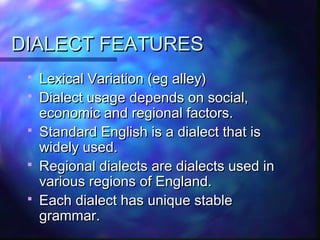
 Lexical Variation (eg alley)Lexical Variation (eg alley)
 Dialect usage depends on social,Dialect usage depends on social,
economic and regional factors.economic and regional factors.
 Standard English is a dialect that isStandard English is a dialect that is
widely used.widely used.
 Regional dialects are dialects used inRegional dialects are dialects used in
various regions of England.various regions of England.
 Each dialect has unique stableEach dialect has unique stable
grammar.grammar.
Grammatical VariationGrammatical Variation
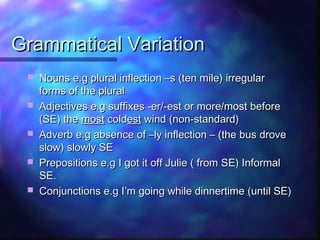
 Nouns e.g plural inflection –s (ten mile) irregularNouns e.g plural inflection –s (ten mile) irregular
forms of the pluralforms of the plural
 Adjectives e.g suffixes -er/-est or more/most beforeAdjectives e.g suffixes -er/-est or more/most before
(SE) the(SE) the mostmost coldcoldestest wind (non-standard)wind (non-standard)
 Adverb e.g absence of –ly inflection – (the bus droveAdverb e.g absence of –ly inflection – (the bus drove
slow) slowly SEslow) slowly SE
 Prepositions e.g I got it off Julie ( from SE) InformalPrepositions e.g I got it off Julie ( from SE) Informal
SE.SE.
 Conjunctions e.g I’m going while dinnertime (until SE)Conjunctions e.g I’m going while dinnertime (until SE)
PronounsPronouns
 Subject and object personal pronouns. The objectSubject and object personal pronouns. The object
tends to be used in subject site only when notends to be used in subject site only when no
emphasis needed.emphasis needed.
 Reflexive pronouns –self/-selves (SE) standardisationReflexive pronouns –self/-selves (SE) standardisation
of systemof system
 Relative pronouns e.g. the house what I live in is bigRelative pronouns e.g. the house what I live in is big
(that SE)(that SE)
 Demonstrative pronouns e.g. yon field used to be fullDemonstrative pronouns e.g. yon field used to be full
of horses (that SE)of horses (that SE)
 Verbs - regularisation - loss/addition -s inflectionVerbs - regularisation - loss/addition -s inflection
 Multiple negativesMultiple negatives
TrudgillTrudgill
Dropped ‘h’ studyDropped ‘h’ study
 Prestige – pronunciation of /h/Prestige – pronunciation of /h/
 Other accents omit /h/ consistentlyOther accents omit /h/ consistently
Norwich study - n/ng (e.g Walkin as opposed toNorwich study - n/ng (e.g Walkin as opposed to
walking.)walking.)
The above also studied by Mark Newbrook in the WirralThe above also studied by Mark Newbrook in the Wirral
study in conjunction with emphasis of /ing/.study in conjunction with emphasis of /ing/.
 Consistent increase in use of /n/ - informality – allConsistent increase in use of /n/ - informality – all
social levelssocial levels
 Over reporting of prestige accentsOver reporting of prestige accents
 Under report = covert prestigeUnder report = covert prestige
 LMC – hypercorrection – Saving face theoryLMC – hypercorrection – Saving face theory
Accent TrianglesAccent Triangles
 Proportion of RP 5% => 15%Proportion of RP 5% => 15%
 Non-pure RP as includes some regionalNon-pure RP as includes some regional
variation e.g. Newsreadersvariation e.g. Newsreaders
Regional accents
RP
1970s 1990s
Dialect and Speech varietiesDialect and Speech varieties
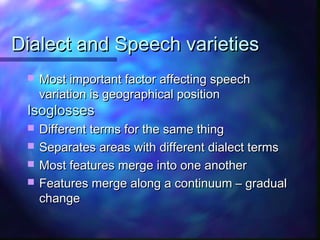
 Most important factor affecting speechMost important factor affecting speech
variation is geographical positionvariation is geographical position
IsoglossesIsoglosses
 Different terms for the same thingDifferent terms for the same thing
 Separates areas with different dialect termsSeparates areas with different dialect terms
 Most features merge into one anotherMost features merge into one another
 Features merge along a continuum – gradualFeatures merge along a continuum – gradual
changechange
Dialect and Speech varietiesDialect and Speech varieties
 Most important factor affecting speechMost important factor affecting speech
variation is geographical positionvariation is geographical position
IsoglossesIsoglosses
 Different terms for the same thingDifferent terms for the same thing
 Separates areas with different dialect termsSeparates areas with different dialect terms
 Most features merge into one anotherMost features merge into one another
 Features merge along a continuum – gradualFeatures merge along a continuum – gradual
changechange

Accent and dialect_features_ms _ls

  • 1.
    Accent/DialectAccent/Dialect FeaturesFeatures A brief guideto theA brief guide to the ‘significant’ features of‘significant’ features of accents and dialects.accents and dialects.
  • 2.
    The difference betweenThedifference between Accent and DialectAccent and Dialect ACCENTACCENT  Deals withDeals with pronunciation.pronunciation.  A way of speakingA way of speaking that shows thethat shows the speaker’s socialspeaker’s social identity.identity. DIALECTDIALECT  Deals withDeals with vocabulary andvocabulary and grammar.grammar.  A general term for aA general term for a form of language.form of language.
  • 3.
    ACCENT FEATURES (theACCENTFEATURES (the major ones)major ones)  SocialSocial: Relates to cultural & educational background. (eg: Relates to cultural & educational background. (eg Hypercorrection with usage of RP)Hypercorrection with usage of RP)  PersonalPersonal :an individual’s own range of pronunciations.:an individual’s own range of pronunciations.  BroadBroad: A pronunciation that differs dramatically from RP.: A pronunciation that differs dramatically from RP.  The Linguistic variable.(The choice of which depends on other factors.The Linguistic variable.(The choice of which depends on other factors. Social class etc.)(e.g rhotic /r/ and glottal stop /t/.)Social class etc.)(e.g rhotic /r/ and glottal stop /t/.)  Assimilation (eg green gate – gri:jgertAssimilation (eg green gate – gri:jgert  Reduction (eg I could have done it – I could/hav/done it)Reduction (eg I could have done it – I could/hav/done it)  RegionalRegional : Links a speaker to a specific area of the country. (eg glottal: Links a speaker to a specific area of the country. (eg glottal stop for /t/ in Cockney.)stop for /t/ in Cockney.)
  • 4.
    DIALECT FEATURESDIALECT FEATURES Lexical Variation (eg alley)Lexical Variation (eg alley)  Dialect usage depends on social,Dialect usage depends on social, economic and regional factors.economic and regional factors.  Standard English is a dialect that isStandard English is a dialect that is widely used.widely used.  Regional dialects are dialects used inRegional dialects are dialects used in various regions of England.various regions of England.  Each dialect has unique stableEach dialect has unique stable grammar.grammar.
  • 5.
    Grammatical VariationGrammatical Variation Nouns e.g plural inflection –s (ten mile) irregularNouns e.g plural inflection –s (ten mile) irregular forms of the pluralforms of the plural  Adjectives e.g suffixes -er/-est or more/most beforeAdjectives e.g suffixes -er/-est or more/most before (SE) the(SE) the mostmost coldcoldestest wind (non-standard)wind (non-standard)  Adverb e.g absence of –ly inflection – (the bus droveAdverb e.g absence of –ly inflection – (the bus drove slow) slowly SEslow) slowly SE  Prepositions e.g I got it off Julie ( from SE) InformalPrepositions e.g I got it off Julie ( from SE) Informal SE.SE.  Conjunctions e.g I’m going while dinnertime (until SE)Conjunctions e.g I’m going while dinnertime (until SE)
  • 6.
    PronounsPronouns  Subject andobject personal pronouns. The objectSubject and object personal pronouns. The object tends to be used in subject site only when notends to be used in subject site only when no emphasis needed.emphasis needed.  Reflexive pronouns –self/-selves (SE) standardisationReflexive pronouns –self/-selves (SE) standardisation of systemof system  Relative pronouns e.g. the house what I live in is bigRelative pronouns e.g. the house what I live in is big (that SE)(that SE)  Demonstrative pronouns e.g. yon field used to be fullDemonstrative pronouns e.g. yon field used to be full of horses (that SE)of horses (that SE)  Verbs - regularisation - loss/addition -s inflectionVerbs - regularisation - loss/addition -s inflection  Multiple negativesMultiple negatives
  • 7.
    TrudgillTrudgill Dropped ‘h’ studyDropped‘h’ study  Prestige – pronunciation of /h/Prestige – pronunciation of /h/  Other accents omit /h/ consistentlyOther accents omit /h/ consistently Norwich study - n/ng (e.g Walkin as opposed toNorwich study - n/ng (e.g Walkin as opposed to walking.)walking.) The above also studied by Mark Newbrook in the WirralThe above also studied by Mark Newbrook in the Wirral study in conjunction with emphasis of /ing/.study in conjunction with emphasis of /ing/.  Consistent increase in use of /n/ - informality – allConsistent increase in use of /n/ - informality – all social levelssocial levels  Over reporting of prestige accentsOver reporting of prestige accents  Under report = covert prestigeUnder report = covert prestige  LMC – hypercorrection – Saving face theoryLMC – hypercorrection – Saving face theory
  • 8.
    Accent TrianglesAccent Triangles Proportion of RP 5% => 15%Proportion of RP 5% => 15%  Non-pure RP as includes some regionalNon-pure RP as includes some regional variation e.g. Newsreadersvariation e.g. Newsreaders Regional accents RP 1970s 1990s
  • 9.
    Dialect and SpeechvarietiesDialect and Speech varieties  Most important factor affecting speechMost important factor affecting speech variation is geographical positionvariation is geographical position IsoglossesIsoglosses  Different terms for the same thingDifferent terms for the same thing  Separates areas with different dialect termsSeparates areas with different dialect terms  Most features merge into one anotherMost features merge into one another  Features merge along a continuum – gradualFeatures merge along a continuum – gradual changechange
  • 10.
    Dialect and SpeechvarietiesDialect and Speech varieties  Most important factor affecting speechMost important factor affecting speech variation is geographical positionvariation is geographical position IsoglossesIsoglosses  Different terms for the same thingDifferent terms for the same thing  Separates areas with different dialect termsSeparates areas with different dialect terms  Most features merge into one anotherMost features merge into one another  Features merge along a continuum – gradualFeatures merge along a continuum – gradual changechange