ACADEMIC WRITING
By Salman Wali
ADVANCE ACADEMIC WRITING
• Definitions
Academic writing is a style of writing that is used in
academic disciplines such as science, social science, and
humanities. It is a formal style of writing that is designed
to communicate complex ideas and arguments in a clear,
concise, and precise manner. Academic writing is often
used to communicate research findings, analyze
information, and present scholarly arguments and ideas.
CONT…
• Academic writing typically follows a structured format
that includes an introduction, body paragraphs, and a
conclusion. The writing is often evidence-based, and
writers are expected to provide supporting evidence for
their arguments using citations and references to
authoritative sources.
• Academic writing is the process of presenting ideas in a
rational, organized, systematic, reasonable, and logical
way.
STYLE
• There is not one set of rules for academic writing — it
depends on the setting you are in and the style guide
you are using. However, academic writing generally
includes these characteristics:
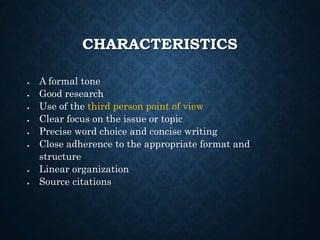
CHARACTERISTICS
 A formal tone
 Good research
 Use of the third person point of view
 Clear focus on the issue or topic
 Precise word choice and concise writing
 Close adherence to the appropriate format and
structure
 Linear organization
 Source citations
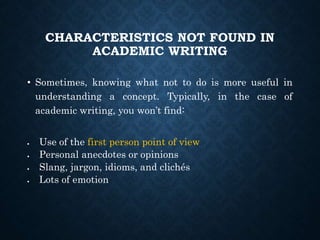
CHARACTERISTICS NOT FOUND IN
ACADEMIC WRITING
• Sometimes, knowing what not to do is more useful in
understanding a concept. Typically, in the case of
academic writing, you won’t find:
 Use of the first person point of view
 Personal anecdotes or opinions
 Slang, jargon, idioms, and clichés
 Lots of emotion
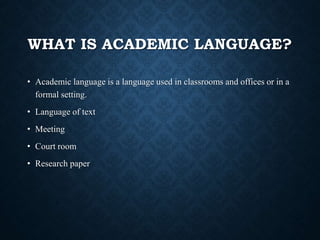
WHAT IS ACADEMIC LANGUAGE?
• Academic language is a language used in classrooms and offices or in a
formal setting.
• Language of text
• Meeting
• Court room
• Research paper
WHY IS ACADEMIC LANGUAGE
SO IMPORTANT?
• Students who master academic language are most likely to:
be successful in academic and professional settings
.Students who do not learn an academic language may:
struggle academically
be at higher risk of failure in professional settings
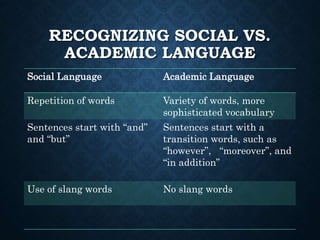
RECOGNIZING SOCIAL VS.
ACADEMIC LANGUAGE
Social Language Academic Language
Repetition of words Variety of words, more
sophisticated vocabulary
Sentences start with “and”
and “but”
Sentences start with a
transition words, such as
“however”, “moreover”, and
“in addition”
Use of slang words No slang words
ACADEMIC LANGUAGE IS USED
IN:
• Book reviews
• Essays
• Research Reports
• Research Proposal
• Academic Journal
• Dissertation and Thesis
• Abstract
TYPES OF ACADEMIC WRITING
• Descriptive: it tells how something looks, feels, smells,
tastes, or sounds. A good description is a word picture,
the reader can imagine the object.
• Narration: to give an account or tell the story of
something, someone, or an event. Use time order to
organize sentences.
• Argumentative or Persuasive: to induce readers to
believe in the writer’s opinion or views through
appealing reasons. To convince readers.
CHARACTERISTICS OF
ACADEMIC WRITING
• Planning- There is a certain amount of planning before
you write the paper, analytical and organized.
• Outline- A proper outline is crucial for academic writing.
It helps you to formulate your thoughts and makes you
aware of your topic. It will help you determine the
relevant information to be included.
• Tone- A formal tone is used. You do not use slang words,
abbreviations, and jargon.
FEATURES OF ACADEMIC
WRITING
• Complexity: The language is relatively more complex
and has longer sentences with a more varied vocabulary
and grammar complexity.
• Formality: Academic writing is relatively formal, it does
not include colloquial expressions or dialogue that we
use daily with friends and colleagues.
• Precision: Academic writing is precise. Factual
information, and figures of the chart, should be
provided, and nothing is written there should leave room
for interpretation.
CONT...
• Accuracy: Accurately using vocabulary is necessary for a
text that wants to be academic. Extra attention should
be paid when using words with a specific meaning.
• Objectivity: The main emphasis should be on the
information you want to give and the arguments you
want to make, rather than the writer getting involved
personally.
CONT…
• Responsibility: Academic writing should be treated with
responsibility. Everything stated should be accompanied
by proofs and justification and no assumptions are
allowed. Sources should also be mentioned.
• Explicitness: Explicitness in academic writing refers to
the clarity and precision with which ideas are expressed.
It involves stating ideas clearly, accurately, and in
sufficient detail for readers to understand. Transitional
words or phrases are used in academic writing to
establish connections between different parts of the text
and make the flow of ideas more explicit and clear.
Academic Writing.pptx

Academic Writing.pptx

  • 1.
  • 2.
    ADVANCE ACADEMIC WRITING •Definitions Academic writing is a style of writing that is used in academic disciplines such as science, social science, and humanities. It is a formal style of writing that is designed to communicate complex ideas and arguments in a clear, concise, and precise manner. Academic writing is often used to communicate research findings, analyze information, and present scholarly arguments and ideas.
  • 3.
    CONT… • Academic writingtypically follows a structured format that includes an introduction, body paragraphs, and a conclusion. The writing is often evidence-based, and writers are expected to provide supporting evidence for their arguments using citations and references to authoritative sources. • Academic writing is the process of presenting ideas in a rational, organized, systematic, reasonable, and logical way.
  • 4.
    STYLE • There isnot one set of rules for academic writing — it depends on the setting you are in and the style guide you are using. However, academic writing generally includes these characteristics:
  • 5.
    CHARACTERISTICS  A formaltone  Good research  Use of the third person point of view  Clear focus on the issue or topic  Precise word choice and concise writing  Close adherence to the appropriate format and structure  Linear organization  Source citations
  • 6.
    CHARACTERISTICS NOT FOUNDIN ACADEMIC WRITING • Sometimes, knowing what not to do is more useful in understanding a concept. Typically, in the case of academic writing, you won’t find:  Use of the first person point of view  Personal anecdotes or opinions  Slang, jargon, idioms, and clichés  Lots of emotion
  • 7.
    WHAT IS ACADEMICLANGUAGE? • Academic language is a language used in classrooms and offices or in a formal setting. • Language of text • Meeting • Court room • Research paper
  • 8.
    WHY IS ACADEMICLANGUAGE SO IMPORTANT? • Students who master academic language are most likely to: be successful in academic and professional settings .Students who do not learn an academic language may: struggle academically be at higher risk of failure in professional settings
  • 9.
    RECOGNIZING SOCIAL VS. ACADEMICLANGUAGE Social Language Academic Language Repetition of words Variety of words, more sophisticated vocabulary Sentences start with “and” and “but” Sentences start with a transition words, such as “however”, “moreover”, and “in addition” Use of slang words No slang words
  • 10.
    ACADEMIC LANGUAGE ISUSED IN: • Book reviews • Essays • Research Reports • Research Proposal • Academic Journal • Dissertation and Thesis • Abstract
  • 11.
    TYPES OF ACADEMICWRITING • Descriptive: it tells how something looks, feels, smells, tastes, or sounds. A good description is a word picture, the reader can imagine the object. • Narration: to give an account or tell the story of something, someone, or an event. Use time order to organize sentences. • Argumentative or Persuasive: to induce readers to believe in the writer’s opinion or views through appealing reasons. To convince readers.
  • 12.
    CHARACTERISTICS OF ACADEMIC WRITING •Planning- There is a certain amount of planning before you write the paper, analytical and organized. • Outline- A proper outline is crucial for academic writing. It helps you to formulate your thoughts and makes you aware of your topic. It will help you determine the relevant information to be included. • Tone- A formal tone is used. You do not use slang words, abbreviations, and jargon.
  • 13.
    FEATURES OF ACADEMIC WRITING •Complexity: The language is relatively more complex and has longer sentences with a more varied vocabulary and grammar complexity. • Formality: Academic writing is relatively formal, it does not include colloquial expressions or dialogue that we use daily with friends and colleagues. • Precision: Academic writing is precise. Factual information, and figures of the chart, should be provided, and nothing is written there should leave room for interpretation.
  • 14.
    CONT... • Accuracy: Accuratelyusing vocabulary is necessary for a text that wants to be academic. Extra attention should be paid when using words with a specific meaning. • Objectivity: The main emphasis should be on the information you want to give and the arguments you want to make, rather than the writer getting involved personally.
  • 15.
    CONT… • Responsibility: Academicwriting should be treated with responsibility. Everything stated should be accompanied by proofs and justification and no assumptions are allowed. Sources should also be mentioned. • Explicitness: Explicitness in academic writing refers to the clarity and precision with which ideas are expressed. It involves stating ideas clearly, accurately, and in sufficient detail for readers to understand. Transitional words or phrases are used in academic writing to establish connections between different parts of the text and make the flow of ideas more explicit and clear.