Academic Library
 Collection Development:
Current Landscape, Future
          Trends
      GALILEO Interconnected Libraries
            December 14, 2011

           Michael Levine-Clark
            Collections Librarian
            University of Denver
        michael.levine-clark@du.edu
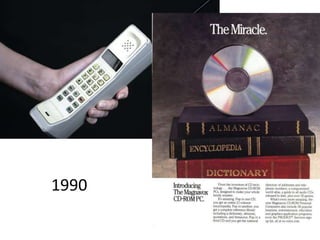
1990
1990
Looking into the Future

 5 years
  Monographs
    Print/electronic mix – still transitional
    DDA predominant for e-books
  Journals
    Fewer big deals
    More article-level purchasing
  Nontraditional stuff
    Images
    Data
Looking (a bit further)
             into the Future
 10 years
  Monographs
    Mostly electronic
    Mostly DDA
    Local POD
  Journals
    Medium deals
    Articles on-demand
  Smaller (and shrinking) print collections
Trends to Consider
E-Books
Slow Adoption of E-Books
 Scholarly content not yet there
  30% available simultaneously* as e/p
  Publisher fears
    Diminished sales
      Course adoption
  Librarian concerns
    DRM
    Patrons want print (or so we say)

 *Defined by YBP Library Services as 2 months
E-Book Developments
 Rapid expansion (even in scholarly
 publishing)
 Embrace of e-book readers
  Kindle! (and others)
 Demand-driven acquisition (DDA)
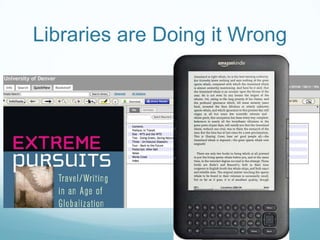
Libraries are Doing it Wrong
Demand-Driven Acquisition
        (DDA)
Definitions
 Patron-Driven Acquisition (PDA)
  Faculty Requests/Input
  Use Data
 Demand-Driven Acquisition (DDA)
  Meets immediate need
Why DDA?
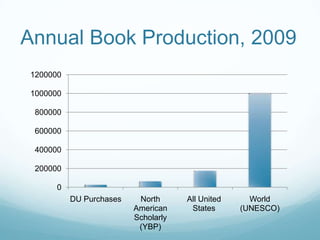
Annual Book Production, 2009
 1200000

 1000000

  800000

  600000

  400000

  200000

       0
           DU Purchases    North      All United     World
                          American     States      (UNESCO)
                          Scholarly
                           (YBP)
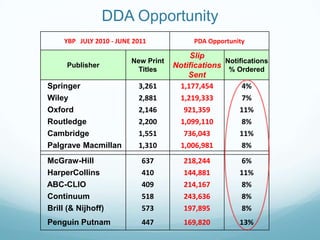
DDA Opportunity
     YBP JULY 2010 - JUNE 2011             PDA Opportunity

                                          Slip
                         New Print                 Notifications
     Publisher
                           Titles
                                     Notifications % Ordered
                                         Sent
Springer                   3,261      1,177,454         4%
Wiley                      2,881      1,219,333         7%
Oxford                     2,146       921,359         11%
Routledge                  2,200      1,099,110         8%
Cambridge                  1,551       736,043         11%
Palgrave Macmillan         1,310      1,006,981         8%
McGraw-Hill                 637         218,244         6%
HarperCollins               410         144,881         11%
ABC-CLIO                    409         214,167         8%
Continuum                   518         243,636         8%
Brill (& Nijhoff)           573         197,895         8%
Penguin Putnam              447         169,820         13%
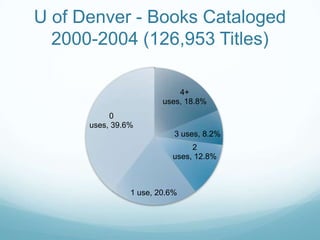
U of Denver - Books Cataloged
  2000-2004 (126,953 Titles)

                            4+
                        uses, 18.8%
           0
      uses, 39.6%
                           3 uses, 8.2%
                               2
                          uses, 12.8%


                1 use, 20.6%
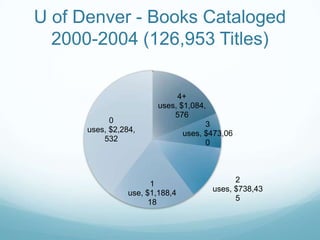
U of Denver - Books Cataloged
  2000-2004 (126,953 Titles)

                              4+
                         uses, $1,084,
                             576
            0                         3
      uses, $2,284,             uses, $473,06
          532                         0


                                             2
                       1
                                       uses, $738,43
                 use, $1,188,4
                                             5
                       18
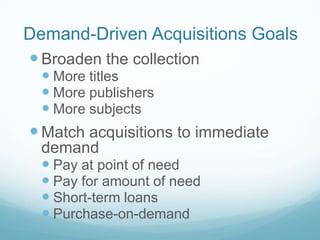
Demand-Driven Acquisitions Goals
 Broaden the collection
   More titles
   More publishers
   More subjects
 Match acquisitions to immediate
  demand
   Pay at point of need
   Pay for amount of need
   Short-term loans
   Purchase-on-demand
Redefining the Collection
 Everything we can provide in a
 timely manner
 Ultimately, bounded only by budget
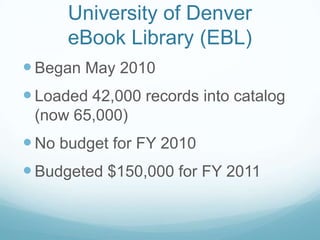
University of Denver
      eBook Library (EBL)
 Began May 2010
 Loaded 42,000 records into catalog
 (now 65,000)
 No budget for FY 2010
 Budgeted $150,000 for FY 2011
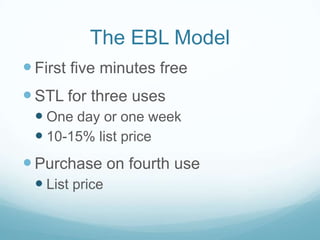
The EBL Model
 First five minutes free
 STL for three uses
  One day or one week
  10-15% list price
 Purchase on fourth use
  List price
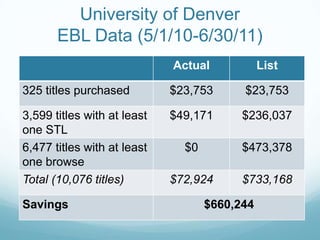
University of Denver
       EBL Data (5/1/10-6/30/11)
                             Actual            List

325 titles purchased         $23,753      $23,753

3,599 titles with at least   $49,171      $236,037
one STL
6,477 titles with at least     $0         $473,378
one browse
Total (10,076 titles)        $72,924      $733,168

Savings                             $660,244
DDA Implications
 Is there a role for consortia?
   Tension between shared discount/local
    needs
 Immediate access vs. stewardship of
  the cultural record
   Access
     Better served by DDA
   Stewardship of potential acquisitions
     Portico, LOCKSS, Publishers
DDA for the Long Haul
 The Consideration Pool
  Everything available for potential
   acquisition
  Linked to budget size
  Managed by broad rules (like approval
   plan)
    Titles move in/out of pool
      Records move in/out of discovery tools
E-Book Prediction
 Most monographs
  English-language approval plan
  Non-English approval (a bit further out)
 Acquire on demand
  As e-book
    STL or purchase
    By the chapter or volume
  As local print-on-demand
  Make accessible all that we can afford
A Book Discovery Problem
 Books                                             Articles
     Lots of words                                     Fewer words
     Not much metadata                                 More metadata
     Lost opportunity                                    Abstract
         Full-text searching
         Chapter-level
           metadata


Christopher C. Brown, “NextGen Information Environment: A Paradigm Shift in Information
Discovery,” Colorado Association of Libraries CALCON11, Loveland, Colorado, October 15, 2011.
E-Book Discovery
 Must take advantage of full-text
  Can drive users to print
    Users must have clear choice of
     format
 Will drive acquisition
 Must work with e-readers
DDA, E-Books, Scholarly
      Publishing
Implications for Publishers
 Campus-wide access to e-books might
  cannibalize sales
 DDA removes predictability
   Sales forecasts
   Cost of keeping e-books available
 Frontlist/backlist blur
 STL/ILL = new revenue stream
Journals Are Easy, Right?
We’ve Figured Out Journals
 Digital
 Packages
 Easily shared
Or Have We?
 Is the Big Deal sustainable?
  Based on a model of
    Consolidating subscriptions
    Maximizing market share

    At the expense of other
     publishers, monographs
    While our budgets shrink
A New Model
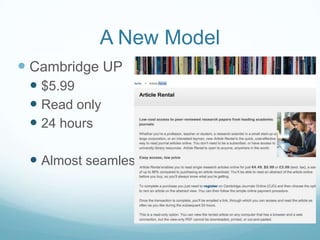
 Cambridge UP
  $5.99
  Read only
  24 hours

  Almost seamless
Other Options
 Article Purchasing         Medium Deal?
                             Small Deal?
 Purchase PDF            Limited title list
  $25.00+
  Multiple publishers    Rental/purchase of
  Copyright               many (most) (all)
   Clearance Center        articles
  Often seamless

  Too expensive?
Article Discovery
 We do this well
  Not dependent on ownership
  (Often) full-text
  Must integrate with discovery of owned
   content

  Local journal holdings should be
   replaced by all articles accessible by any
   seamless access method
Disaggregation
Journal/Book
          Article/Chapter
 Pay for amount used
 Requires discovery at the
 article/chapter level
 What about entries in reference
 works?
 Major implications for publishers
E-Resources and ILL
Does ILL Make Sense for E-
        Resources?
 ILL a means to an end = access to
 material not in collection
 For e-resources, a short-term loan is
 a faster means to the same end
  Potentially cheaper
STL and Discovery
 Clearinghouse(s) for STL of e-
 books/chapters/articles
 Integration into local discovery tools?
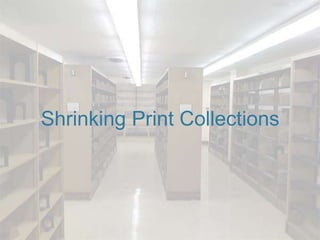
Shrinking Print Collections
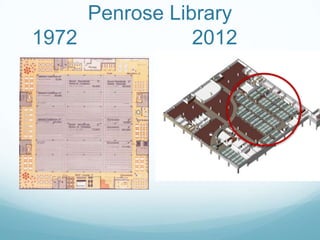
Penrose Library
1972            2012
The Decline of Legacy Print
        Collections
 Closing branch libraries
 Expansion of seating
 Loss of on-campus storage
 Full off-campus storage spaces
 Potential loss of off-campus storage
The Collective Print Collection
 Shared storage facilities/virtual shared
 storage
 Collaborative journal archiving
  WEST, etc.
  Notification about
    Retention decisions
    Holdings
    Completeness
  Local record of past holdings?
Storage and Serendipitous
          Discovery
 Low use monographs offsite
  Need for better discovery (“I can’t
   browse anymore.”)
    Digital surrogates
    Electronic browsing option


 A real need?
Withdrawing Monographs
 Low use
 Duplicated by e
   Hathi Trust
      Public domain
      Orphan works
 Duplicated elsewhere
 Readily purchasable
   Used
   POD
 How do users find the print?
Digital Collections – Issues and
            Concerns
Beyond Traditional
           Collections
 Institutional repositories
 Data sets
 Image collections
 Commercial primary source collections
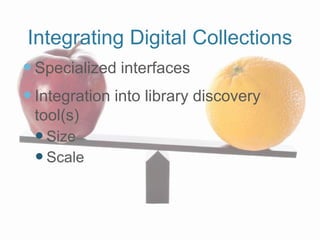
Integrating Digital Collections
 Specialized interfaces
 Integration into library discovery
 tool(s)
  Size
  Scale
Migration, Preservation
 Local content
  Data
  Software
  Metadata
 Licensed content
  Consideration pool
    Library, publisher, third party?
Use Data Can Help Us
Data-Driven Decisions
 Make DDA possible
 Help with weeding/storage
 Inform future collecting practices
 Have weight with the administration
Thank You
   Michael Levine-Clark
michael.levine-clark@du.edu

Academic Library Collection Development: Current Landscape, Future Trends

  • 1.
    Academic Library CollectionDevelopment: Current Landscape, Future Trends GALILEO Interconnected Libraries December 14, 2011 Michael Levine-Clark Collections Librarian University of Denver michael.levine-clark@du.edu
  • 2.
  • 4.
  • 5.
    Looking into theFuture  5 years  Monographs  Print/electronic mix – still transitional  DDA predominant for e-books  Journals  Fewer big deals  More article-level purchasing  Nontraditional stuff  Images  Data
  • 6.
    Looking (a bitfurther) into the Future  10 years  Monographs  Mostly electronic  Mostly DDA  Local POD  Journals  Medium deals  Articles on-demand  Smaller (and shrinking) print collections
  • 7.
  • 8.
  • 9.
    Slow Adoption ofE-Books  Scholarly content not yet there  30% available simultaneously* as e/p  Publisher fears  Diminished sales  Course adoption  Librarian concerns  DRM  Patrons want print (or so we say) *Defined by YBP Library Services as 2 months
  • 10.
    E-Book Developments  Rapidexpansion (even in scholarly publishing)  Embrace of e-book readers  Kindle! (and others)  Demand-driven acquisition (DDA)
  • 11.
  • 12.
  • 13.
    Definitions  Patron-Driven Acquisition(PDA)  Faculty Requests/Input  Use Data  Demand-Driven Acquisition (DDA)  Meets immediate need
  • 14.
  • 15.
    Annual Book Production,2009 1200000 1000000 800000 600000 400000 200000 0 DU Purchases North All United World American States (UNESCO) Scholarly (YBP)
  • 16.
    DDA Opportunity YBP JULY 2010 - JUNE 2011 PDA Opportunity Slip New Print Notifications Publisher Titles Notifications % Ordered Sent Springer 3,261 1,177,454 4% Wiley 2,881 1,219,333 7% Oxford 2,146 921,359 11% Routledge 2,200 1,099,110 8% Cambridge 1,551 736,043 11% Palgrave Macmillan 1,310 1,006,981 8% McGraw-Hill 637 218,244 6% HarperCollins 410 144,881 11% ABC-CLIO 409 214,167 8% Continuum 518 243,636 8% Brill (& Nijhoff) 573 197,895 8% Penguin Putnam 447 169,820 13%
  • 17.
    U of Denver- Books Cataloged 2000-2004 (126,953 Titles) 4+ uses, 18.8% 0 uses, 39.6% 3 uses, 8.2% 2 uses, 12.8% 1 use, 20.6%
  • 18.
    U of Denver- Books Cataloged 2000-2004 (126,953 Titles) 4+ uses, $1,084, 576 0 3 uses, $2,284, uses, $473,06 532 0 2 1 uses, $738,43 use, $1,188,4 5 18
  • 19.
    Demand-Driven Acquisitions Goals Broaden the collection  More titles  More publishers  More subjects  Match acquisitions to immediate demand  Pay at point of need  Pay for amount of need  Short-term loans  Purchase-on-demand
  • 20.
    Redefining the Collection Everything we can provide in a timely manner  Ultimately, bounded only by budget
  • 21.
    University of Denver eBook Library (EBL)  Began May 2010  Loaded 42,000 records into catalog (now 65,000)  No budget for FY 2010  Budgeted $150,000 for FY 2011
  • 22.
    The EBL Model First five minutes free  STL for three uses  One day or one week  10-15% list price  Purchase on fourth use  List price
  • 23.
    University of Denver EBL Data (5/1/10-6/30/11) Actual List 325 titles purchased $23,753 $23,753 3,599 titles with at least $49,171 $236,037 one STL 6,477 titles with at least $0 $473,378 one browse Total (10,076 titles) $72,924 $733,168 Savings $660,244
  • 24.
    DDA Implications  Isthere a role for consortia?  Tension between shared discount/local needs  Immediate access vs. stewardship of the cultural record  Access  Better served by DDA  Stewardship of potential acquisitions  Portico, LOCKSS, Publishers
  • 25.
    DDA for theLong Haul  The Consideration Pool  Everything available for potential acquisition  Linked to budget size  Managed by broad rules (like approval plan)  Titles move in/out of pool  Records move in/out of discovery tools
  • 26.
    E-Book Prediction  Mostmonographs  English-language approval plan  Non-English approval (a bit further out)  Acquire on demand  As e-book  STL or purchase  By the chapter or volume  As local print-on-demand  Make accessible all that we can afford
  • 27.
    A Book DiscoveryProblem  Books  Articles  Lots of words  Fewer words  Not much metadata  More metadata  Lost opportunity  Abstract  Full-text searching  Chapter-level metadata Christopher C. Brown, “NextGen Information Environment: A Paradigm Shift in Information Discovery,” Colorado Association of Libraries CALCON11, Loveland, Colorado, October 15, 2011.
  • 28.
    E-Book Discovery  Musttake advantage of full-text  Can drive users to print  Users must have clear choice of format  Will drive acquisition  Must work with e-readers
  • 29.
  • 30.
    Implications for Publishers Campus-wide access to e-books might cannibalize sales  DDA removes predictability  Sales forecasts  Cost of keeping e-books available  Frontlist/backlist blur  STL/ILL = new revenue stream
  • 31.
  • 32.
    We’ve Figured OutJournals  Digital  Packages  Easily shared
  • 33.
    Or Have We? Is the Big Deal sustainable?  Based on a model of  Consolidating subscriptions  Maximizing market share  At the expense of other publishers, monographs  While our budgets shrink
  • 34.
    A New Model Cambridge UP  $5.99  Read only  24 hours  Almost seamless
  • 35.
    Other Options ArticlePurchasing Medium Deal? Small Deal?  Purchase PDF  Limited title list  $25.00+  Multiple publishers  Rental/purchase of  Copyright many (most) (all) Clearance Center articles  Often seamless  Too expensive?
  • 36.
    Article Discovery  Wedo this well  Not dependent on ownership  (Often) full-text  Must integrate with discovery of owned content  Local journal holdings should be replaced by all articles accessible by any seamless access method
  • 37.
  • 38.
    Journal/Book Article/Chapter  Pay for amount used  Requires discovery at the article/chapter level  What about entries in reference works?  Major implications for publishers
  • 39.
  • 40.
    Does ILL MakeSense for E- Resources?  ILL a means to an end = access to material not in collection  For e-resources, a short-term loan is a faster means to the same end  Potentially cheaper
  • 41.
    STL and Discovery Clearinghouse(s) for STL of e- books/chapters/articles  Integration into local discovery tools?
  • 42.
  • 43.
  • 44.
    The Decline ofLegacy Print Collections  Closing branch libraries  Expansion of seating  Loss of on-campus storage  Full off-campus storage spaces  Potential loss of off-campus storage
  • 45.
    The Collective PrintCollection  Shared storage facilities/virtual shared storage  Collaborative journal archiving  WEST, etc.  Notification about  Retention decisions  Holdings  Completeness  Local record of past holdings?
  • 46.
    Storage and Serendipitous Discovery  Low use monographs offsite  Need for better discovery (“I can’t browse anymore.”)  Digital surrogates  Electronic browsing option  A real need?
  • 47.
    Withdrawing Monographs  Lowuse  Duplicated by e  Hathi Trust  Public domain  Orphan works  Duplicated elsewhere  Readily purchasable  Used  POD  How do users find the print?
  • 48.
    Digital Collections –Issues and Concerns
  • 49.
    Beyond Traditional Collections  Institutional repositories  Data sets  Image collections  Commercial primary source collections
  • 50.
    Integrating Digital Collections Specialized interfaces  Integration into library discovery tool(s)  Size  Scale
  • 51.
    Migration, Preservation  Localcontent  Data  Software  Metadata  Licensed content  Consideration pool  Library, publisher, third party?
  • 52.
    Use Data CanHelp Us
  • 53.
    Data-Driven Decisions  MakeDDA possible  Help with weeding/storage  Inform future collecting practices  Have weight with the administration
  • 54.
    Thank You Michael Levine-Clark michael.levine-clark@du.edu

Editor's Notes

  • #16 US – Library and Book Trade Almanac 2010, p. 485. 2009 preliminary data.
  • #17 Data from Michael Zeoli, YBP Library Services.
  • #24 325 titles purchased – not included in Total (10,076) since they are also part of the list of titles with at least one STL. 3,599 titles with at least one STL. Total Number of STLs is 5,337 across those 3,599 titlesCalculations of list price are based on the average cost of the 325 books actually purchased ($73.09)