Josh Petrusa
Assoc. Dean for Technical Services
                   Butler University
                 ILF, Ft. Wayne, IN
               November 16, 2011
What‟s that got to do
with…?
Patron-Driven Acquisition (PDA):
   “any system whereby documents are
   acquired by the library in response to
   patrons' direct requests or selections,
   rather than in response to librarians'
   speculations about which specific
   documents patrons are going to need”
   Rick Anderson, University of Utah
http://www.alaeditions.org/blog/181/patron-driven-acquisition-rick-
    anderson-answers-your-questions
Why is this important?
 Relevancy
 Patron demands
 Limits of traditional collection
  development
 What is the purpose of our collection?
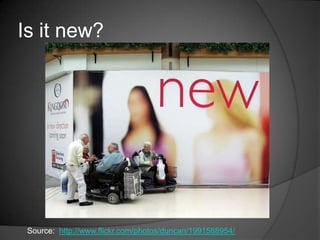
Is it new?


 Source: http://www.flickr.com/photos/duncan/1991588954/
“While most librarians seriously
  considered users‟ requests for
  specific titles… in general librarians
  selected the vast majority of titles. To
  borrow a term from industry, librarians
  historically built collections on the „just
  in case‟ inventory model.

Nixon, Judith, Robert Freeman, and Suzanne Ward . "Patron-Driven
   Acquisitions: An Introduction and Literature Review." Collection
   Management. 35. (2010): 119-124.
“Is Selection Dead? The Rise of
Collection Management and the
Twilight of Selection,”

 ALCTS/Collection Management &
 Development Section (CMDS) at ALA‟s
 2011 Midwinter Conference
Anderson on Collections
    “Recently and quite suddenly, this fundamental
    reality of the information world has
    changed. Now, the documents that our
    patrons need are very frequently available in
    digital formats that make them easy to find and
    make near-instantaneous acquisition of them
    possible for the first time in human history... At
    the same time, library acquisition budgets are
    under unprecedented pressure. These two
    facts should lead us to rethink our traditional
    collection-building practices at a pretty radical
    level.”
http://www.against-the-grain.com/2011/05/v-23-2-is-selection-dead-the-rise-of-
collection-management-and-the-twilight-of-selection/
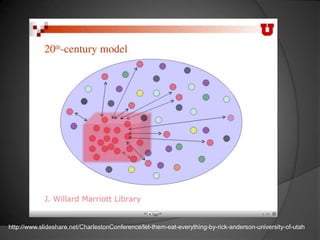
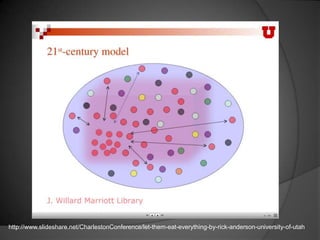
http://www.slideshare.net/CharlestonConference/let-them-eat-everything-by-rick-anderson-university-of-utah
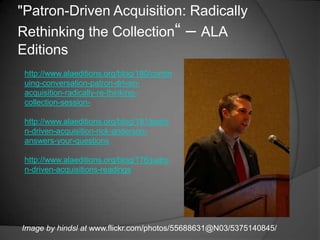
"Patron-Driven Acquisition: Radically
Rethinking the Collection“ – ALA
Editions
 http://www.alaeditions.org/blog/180/contin
 uing-conversation-patron-driven-
 acquisition-radically-re-thinking-
 collection-session-

 http://www.alaeditions.org/blog/181/patro
 n-driven-acquisition-rick-anderson-
 answers-your-questions

 http://www.alaeditions.org/blog/176/patro
 n-driven-acquisitions-readings


Image by hindsl at www.flickr.com/photos/55688631@N03/5375140845/
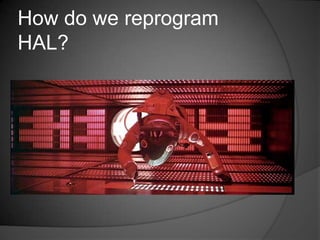
How do we reprogram
HAL?
How can PDA work?
 Where do patrons discover items?
 Is that data pre-selected?
 Are the purchase requests mediated?
 How will payment/fund accounting work
  for the user and the library?
 What can the user do with purchased
  items?
 What does this mean for
  ownership/preservation?
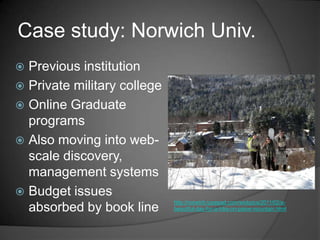
Case study: Norwich Univ.
 Previous institution
 Private military college
 Online Graduate
  programs
 Also moving into web-
  scale discovery,
  management systems
 Budget issues
                             http://norwich.typepad.com/wickpics/2011/02/a-
  absorbed by book line      beautiful-day-for-a-hike-on-paine-mountain.html
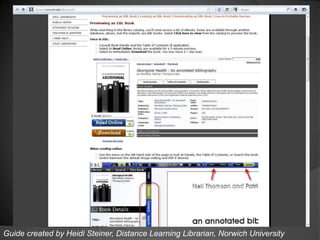
Ebook Library (EBL)
www.eblib.com
 Good selection of academic content
 Short –term loans (rental option)
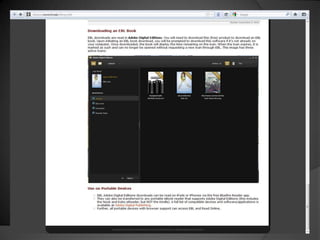
 Downloading available
 Mediated vs Non-Mediated option
 MARC in OCLC; decent interface
 Usage terms for ownership titles
 Integration with Ezproxy for
  authentication
Discovery - How will patrons
find?
 Local MARC or direct to vendor
  interface?
 LOTS of data
 OCLC WMS in 2011
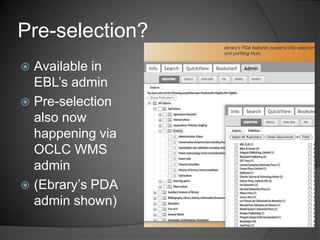
Pre-selection?
 Available in
  EBL‟s admin
 Pre-selection
  also now
  happening via
  OCLC WMS
  admin
 (Ebrary‟s PDA
  admin shown)
Mediation
 Mediation – do requests need to be
  approved?
 Time/price negotiation
 Email?
 Direct Purchase?
 Norwich has moved to an automatic 7
  day loan when one is requested
The money stuff
 Short term loans/rentals – cost savings
  of % from full price purchase
 Move to purchase on the fourth 7 day
  loan of an item (less than 2% of activity)
 Originally intended for online students,
  on-campus use has increased, now 50-
  50 with distance
 Expect to spend $25,000 this year,
  funding from E-Res, Books, SGS
  support lines
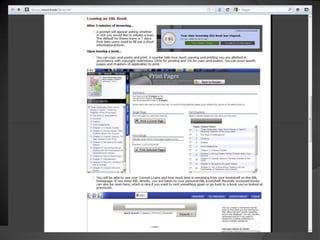
Guide created by Heidi Steiner, Distance Learning Librarian, Norwich University
Success at Norwich?
 Increased on-campus use
 Increase in total usage
 Complement to declining book budget
 Students silently happy?
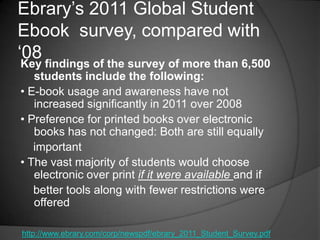
Ebrary‟s 2011 Global Student
Ebook survey, compared with
„08
Key findings of the survey of more than 6,500
   students include the following:
• E-book usage and awareness have not
   increased significantly in 2011 over 2008
• Preference for printed books over electronic
   books has not changed: Both are still equally
   important
• The vast majority of students would choose
   electronic over print if it were available and if
   better tools along with fewer restrictions were
   offered

http://www.ebrary.com/corp/newspdf/ebrary_2011_Student_Survey.pdf
“Tools and Restrictions”
 DRM – Adobe? Epub?
 Downloading available for MY device?
 Publishers in the way?
 Ebrary announces downloading; Wayne
  Bivens-Tatum blogs the 18 Easy Steps
  (at http://bit.ly/tpeHHr)
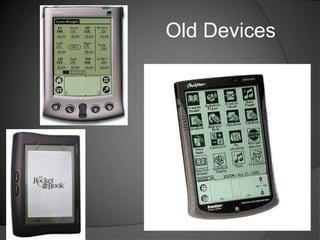
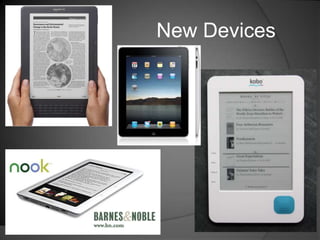
 About those devices…
Old Devices
New Devices
“If it were available”
 Ebooks available as PDA have changed
  the game.
 We will still pre-select and buy print
  books (just in case & preservation)
 Library no longer the only place to
  discover information
 Patrons are connected to data without
  us; we need to insert the library into their
  workflow
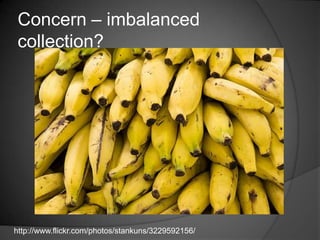
Concern – imbalanced
 collection?


http://www.flickr.com/photos/stankuns/3229592156/
Usage Study – Quality?
 Does PDA allow unwanted content?
 Ebook Library (EBL) PDA at 5 schools
 PDA titles used twice as often as
  librarian selected ebooks
 PDA ebooks saw more users per title
  than pre-selected ebooks
 PDA collection had fewer “no use” titles
  than pre-selected

J. McDonald and J. Price, “Beguiled by Bananas”, Charleston
Conference 2009 http://bit.ly/u04u9y
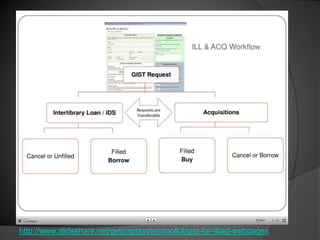
Getting It System Toolkit
(GIST)
  Developed at SUNY Geneseo
 Add-on for ILLiad
 Enables user requests to become loans or
   purchases
 Improved patron interface
 Integrations with WorldCat API, Google Books,
   HathiTrust
http://gettingitsystemtoolkit.wordpress.com/about/
http://www.slideshare.net/gettingitsystemtoolkit/gist-for-illiad-webpages
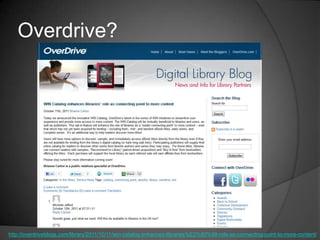
Overdrive?


http://overdriveblogs.com/library/2011/10/11/win-catalog-enhances-libraries%E2%80%99-role-as-connecting-point-to-more-content/
Academic / Public differences
 Content availability – pre-selection?
 High-use/demand items
 Digital divide issues
 Publishers and their, um… tactics
 Preservation questions – question of
  mission?
More from Anderson
 “The purpose of a collection is not to be a
   wonderful collection; the purpose of a
   collection is to meet the information needs
   of library users. If it is now possible to
   meet those needs by means other than
   traditional collection-building (perhaps by
   means of patron-driven, just-in-time
   acquisition), and if budget cuts increase the
   opportunity cost of every dollar spent on a
   book, then don‟t we have a professional
   duty to explore those other means? ”
http://www.against-the-grain.com/2011/05/v-23-2-is-selection-dead-the-rise-of-
collection-management-and-the-twilight-of-selection/
What‟s stopping us?


 Traditional collection philosophy
 Catalogs/systems that don‟t support
  information about non-owned items
 Reluctance to support multiple
  unfamiliar devices we don‟t own
Thank You

Josh Petrusa
jpetrusa@butler.edu
HAL 9000 in the library clip at
http://youtu.be/WG2xeJ2j5OE


Presentation at

Open the collection doors, please, Hal

  • 1.
    Josh Petrusa Assoc. Deanfor Technical Services Butler University ILF, Ft. Wayne, IN November 16, 2011
  • 3.
    What‟s that gotto do with…? Patron-Driven Acquisition (PDA): “any system whereby documents are acquired by the library in response to patrons' direct requests or selections, rather than in response to librarians' speculations about which specific documents patrons are going to need” Rick Anderson, University of Utah http://www.alaeditions.org/blog/181/patron-driven-acquisition-rick- anderson-answers-your-questions
  • 5.
    Why is thisimportant?  Relevancy  Patron demands  Limits of traditional collection development  What is the purpose of our collection?
  • 6.
    Is it new? Source: http://www.flickr.com/photos/duncan/1991588954/
  • 7.
    “While most librariansseriously considered users‟ requests for specific titles… in general librarians selected the vast majority of titles. To borrow a term from industry, librarians historically built collections on the „just in case‟ inventory model. Nixon, Judith, Robert Freeman, and Suzanne Ward . "Patron-Driven Acquisitions: An Introduction and Literature Review." Collection Management. 35. (2010): 119-124.
  • 8.
    “Is Selection Dead?The Rise of Collection Management and the Twilight of Selection,” ALCTS/Collection Management & Development Section (CMDS) at ALA‟s 2011 Midwinter Conference
  • 9.
    Anderson on Collections “Recently and quite suddenly, this fundamental reality of the information world has changed. Now, the documents that our patrons need are very frequently available in digital formats that make them easy to find and make near-instantaneous acquisition of them possible for the first time in human history... At the same time, library acquisition budgets are under unprecedented pressure. These two facts should lead us to rethink our traditional collection-building practices at a pretty radical level.” http://www.against-the-grain.com/2011/05/v-23-2-is-selection-dead-the-rise-of- collection-management-and-the-twilight-of-selection/
  • 10.
  • 11.
  • 12.
    "Patron-Driven Acquisition: Radically Rethinkingthe Collection“ – ALA Editions http://www.alaeditions.org/blog/180/contin uing-conversation-patron-driven- acquisition-radically-re-thinking- collection-session- http://www.alaeditions.org/blog/181/patro n-driven-acquisition-rick-anderson- answers-your-questions http://www.alaeditions.org/blog/176/patro n-driven-acquisitions-readings Image by hindsl at www.flickr.com/photos/55688631@N03/5375140845/
  • 13.
    How do wereprogram HAL?
  • 14.
    How can PDAwork?  Where do patrons discover items?  Is that data pre-selected?  Are the purchase requests mediated?  How will payment/fund accounting work for the user and the library?  What can the user do with purchased items?  What does this mean for ownership/preservation?
  • 15.
    Case study: NorwichUniv.  Previous institution  Private military college  Online Graduate programs  Also moving into web- scale discovery, management systems  Budget issues http://norwich.typepad.com/wickpics/2011/02/a- absorbed by book line beautiful-day-for-a-hike-on-paine-mountain.html
  • 16.
    Ebook Library (EBL) www.eblib.com Good selection of academic content  Short –term loans (rental option)  Downloading available  Mediated vs Non-Mediated option  MARC in OCLC; decent interface  Usage terms for ownership titles  Integration with Ezproxy for authentication
  • 17.
    Discovery - Howwill patrons find?  Local MARC or direct to vendor interface?  LOTS of data  OCLC WMS in 2011
  • 18.
    Pre-selection?  Available in EBL‟s admin  Pre-selection also now happening via OCLC WMS admin  (Ebrary‟s PDA admin shown)
  • 19.
    Mediation  Mediation –do requests need to be approved?  Time/price negotiation  Email?  Direct Purchase?  Norwich has moved to an automatic 7 day loan when one is requested
  • 20.
    The money stuff Short term loans/rentals – cost savings of % from full price purchase  Move to purchase on the fourth 7 day loan of an item (less than 2% of activity)  Originally intended for online students, on-campus use has increased, now 50- 50 with distance  Expect to spend $25,000 this year, funding from E-Res, Books, SGS support lines
  • 21.
    Guide created byHeidi Steiner, Distance Learning Librarian, Norwich University
  • 24.
    Success at Norwich? Increased on-campus use  Increase in total usage  Complement to declining book budget  Students silently happy?
  • 25.
    Ebrary‟s 2011 GlobalStudent Ebook survey, compared with „08 Key findings of the survey of more than 6,500 students include the following: • E-book usage and awareness have not increased significantly in 2011 over 2008 • Preference for printed books over electronic books has not changed: Both are still equally important • The vast majority of students would choose electronic over print if it were available and if better tools along with fewer restrictions were offered http://www.ebrary.com/corp/newspdf/ebrary_2011_Student_Survey.pdf
  • 26.
    “Tools and Restrictions” DRM – Adobe? Epub?  Downloading available for MY device?  Publishers in the way?  Ebrary announces downloading; Wayne Bivens-Tatum blogs the 18 Easy Steps (at http://bit.ly/tpeHHr)  About those devices…
  • 27.
  • 28.
  • 29.
    “If it wereavailable”  Ebooks available as PDA have changed the game.  We will still pre-select and buy print books (just in case & preservation)  Library no longer the only place to discover information  Patrons are connected to data without us; we need to insert the library into their workflow
  • 30.
    Concern – imbalanced collection? http://www.flickr.com/photos/stankuns/3229592156/
  • 31.
    Usage Study –Quality?  Does PDA allow unwanted content?  Ebook Library (EBL) PDA at 5 schools  PDA titles used twice as often as librarian selected ebooks  PDA ebooks saw more users per title than pre-selected ebooks  PDA collection had fewer “no use” titles than pre-selected J. McDonald and J. Price, “Beguiled by Bananas”, Charleston Conference 2009 http://bit.ly/u04u9y
  • 32.
    Getting It SystemToolkit (GIST)  Developed at SUNY Geneseo  Add-on for ILLiad  Enables user requests to become loans or purchases  Improved patron interface  Integrations with WorldCat API, Google Books, HathiTrust http://gettingitsystemtoolkit.wordpress.com/about/
  • 33.
  • 34.
  • 35.
    Academic / Publicdifferences  Content availability – pre-selection?  High-use/demand items  Digital divide issues  Publishers and their, um… tactics  Preservation questions – question of mission?
  • 36.
    More from Anderson “The purpose of a collection is not to be a wonderful collection; the purpose of a collection is to meet the information needs of library users. If it is now possible to meet those needs by means other than traditional collection-building (perhaps by means of patron-driven, just-in-time acquisition), and if budget cuts increase the opportunity cost of every dollar spent on a book, then don‟t we have a professional duty to explore those other means? ” http://www.against-the-grain.com/2011/05/v-23-2-is-selection-dead-the-rise-of- collection-management-and-the-twilight-of-selection/
  • 37.
    What‟s stopping us? Traditional collection philosophy  Catalogs/systems that don‟t support information about non-owned items  Reluctance to support multiple unfamiliar devices we don‟t own
  • 38.
    Thank You Josh Petrusa jpetrusa@butler.edu HAL9000 in the library clip at http://youtu.be/WG2xeJ2j5OE Presentation at