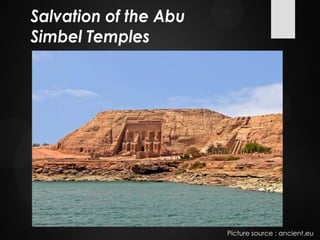
Picture source : ancient.eu
About the temples
 Abu Simbel temples are a set of two rock cut
temples located in Nubia, southern Egypt.
 Carved from a Sandstone mountain
 They were originally built in 13th century during
the reign of Ramesses II
 It resembles his victory in Battle of Kadesh.
Satellite location
Picture credits : triphistoric.com
Discovery
 Until 1813, the temples were buried in sand,
when the Swiss orientalist JL Burckhardt
discovered it with the help of a boy named
Abu Simbel.
 He spoke about his discovery with Italian
explorer Giovanni Belzoni.
 In 1817 they were able to uncover the
entrance and the great monument was
rediscovered.
Picture source : Brooklyn Museum
Picture credits : John Beasley
Greene
Picture source : Brooklyn Museum
The Great Temple.
• It is 98feet high and 115feet long
• Facade faces east. Picture source :
wallpaperclicker.com
• Though the temple is dedicated to Gods
Amon-Re, Ptha and Re-Horakhte, the front
facade of the temple has 4 seated mega
statues of Remesses II which are 65feet tall.
Picture source : Brooklyn
Museum
Source : Brooklyn Museum.website?
• Beneath the statutes are small figures of
his conquered enemies, his family
members, various gods and symbols of
powers.
• The interiors show him paying homage to
different gods and also his victory in the
battle of Kadesh.
Picture source :
dilemmadotnet.files.wordpress.comPicture source : w:en:Than217
Picture credits : Christain
Zesewitz
Picture credits : Christain
Zesewitz
Picture credits : UNESCO
The small temple
Picture source :
amedia.britannica.com
•It is 40feet high and 92feet long .
•The front facade has 6 statues two each of
Queen Nefertari and the reaming of Paraoh
Remesses II.
• Each statue is 32feet tall.
•It dedicated to queen Nefertari and the
goddess of love, Hathor.
Relocation
 Due to the construction of
Aswan High Dam there
were severe chances of
rise in the water level of Nile
river which would
submerge the monument.
 The only solution of
preserving these massive
structures was relocating
them.
Picture source : sv:Froskning &
Framsteg 1967 issue3, page 16
 Due to which the entire site was dismantled into
large blocks and reassembled to a new site which
was 65 m high and 200 m back from the river Nile.
Picture credits : Zurek (taken at Nubian
Museum)
•It costed over 40
million US Dollars.
•The entire relocation
lasted for around four
years that is from 1964-
1968.
Picture source : i.imgur.com
Pictute source : https://youtu.be/2SxLufRZr4c
Did the salvation of the Abu
Simbel Temples affect it’s
Cultural and Architectural
value ?
Research
 Various processes were looked upon before they reached to
the relocation method.
 Some of them are listed below
I. Construction of a colossal aquarium around it and allowing
the water to flood in.
II. Lifting the whole monument by hydraulic tanks.
III. Enclosing the monument in a concrete barge and letting it
float on the water.
But none of them we possible due to the huge size if the
monument, the structure weighed 250,000 tons.
Process
 A coffer dam was constructed to buy
more amount of time.
 They had to move not only the temple
but also the whole mountain so that it
did not loose its essence.
Picture source :
https://youtu.be/oZ9jewecEK8
• They removed the rock using steel wire
and chain saw.
• It took about 500 men and almost 7
months to move only the mountain.
Picture source :
https://youtu.be/oZ9jewecEK8
Precautions
 The cutting of the facade and internal walls were
done using handsaw, the cuts were made up of
less then 8 mm thickness.
Picture source :
https://youtu.be/oZ9jewecEK8
• While cutting the
face of the Pharaoh
they covered each
cut line with a
bandage and resin
to stop the edges
from crumbling. Picture source :
https://youtu.be/oZ9jewecEK8
 The statues were cut in
such a way that the
cutting did not interfere
with the faces of
Pharaoh and intricate
carving and so as to
minimise the damage.
Pictute source : https://youtu.be/2SxLufRZr4c
 Metal rods were drilled into the blocks and filled
with grout and ice water
 The blocks were lifted using cranes and transported
to storage yard using trucks
 All the blocks were numbered so that they can be
re assembled as they were.
Picture source :
https://youtu.be/oZ9jewecEK8
 In order to assemble the face of the statue to the
head an L shaped counter weight was attached to
the body of the face using steel rods.
Pictute source : https://youtu.be/2SxLufRZr4c
 To replicate the mountain
and to carry the weight of
the rocks, a concrete
dome was built above the
temple at the new site.
Picture source :
https://youtu.be/oZ9jewecEK8
• Sandstone and rocks were pilled on top of the
dome to replicate the surrounding of the original
temple.
• It also supports the front facade.
Picture source :
https://youtu.be/oZ9jewecEK8
 The joints are filled with a mixture
of sand and cement to match
the colour of the sand stone.
 Grounded stone mixed with
paint was used to restore the
paintings.
Picture source :
https://youtu.be/oZ9jewecEK8
 To protect the stone from further damage synthetic
resins were applied to the statues.
 Steel section frames were used to hold the internal
walls and roof till they are relocated.
Picture source :
https://youtu.be/oZ9jewecEK8
How did it affect
culturally?
 The original site where temples stood was
considered sacred to Goddess Hathor. Keeping this
in mind, Pharaoh Remesses built the great Temples
there. But after the relocation of the temples the
sacredness of the site was lost.
 The design of the mega structure was
aligned in such a way that twice a year
on 21st February and 21st October the sun
ray illuminated the three of the four
statues in the inner sanctum of the great
temple. This was preserved while
relocating the temple.
How did it affect
architecturally?
 There was introduction of modern
materials like steel, concrete, plastic and
cement mortar.
 Originally it was carved in a sand stone,
but due to the relocation they had to
make several changes to the structure
like construction of concrete dome and
introduction of steel framework for the
roof to increase its stability.
 Since the monument was now open to
general public, modern installations such
as electrical lighting and mechanical
ventilation was introduced.
 The ventilation provided the visitors with
comfort as well as protected the
monument from increasing humidity.
Significance
 Though all the new introductions were
done during the relocation of the great
monument, neither did they change the
appearance of the temple nor did it
loose its essence.
 This project of relocation united the
whole world for a cause. This monument
is looked upon as “the monument which
got the whole world together”.
Bibliography
Sources we used for our research and presentation :
 https://youtu.be/oZ9jewecEK8
 https://youtu.be/2SxLufRZr4c
 https://sciencing.com/did-egyptian-government-relocate-temples-
abu-simbel-6930.html
 http://anthropology.msu.edu/anp363-ss13/2013/02/06/abu-simbel-
temples-relocation-due-to-aswan-dam/
 https://en.unesco.org/70years/abu_simbel_safeguarding_heritage
 http://onlinelibrary.wiley.com/doi/10.1002/j.2326-
1951.1964.tb00752.x/abstract
 https://www.google.co.in/url?sa=t&source=web&rct=j&url=https://m
ashable.com/2015/05/26/abu-simbel-
relocation/&ved=0ahUKEwjY2Lya5uPZAhUHQ48KHWx2CLoQFgivATAc
&usg=AOvVaw1uAa4bugkMNzn43Rm-G0dY
 http://www.livescience.com/37360-abu-simbel.html
Presented By
ANANDI KUNDARIA
SANAD PARAB
SIYA PRABHU DESSAI
YASHDEEP RANE
 abu simbel temple
 abu simbel temple

abu simbel temple

  • 1.
    Picture source :ancient.eu
  • 2.
    About the temples Abu Simbel temples are a set of two rock cut temples located in Nubia, southern Egypt.  Carved from a Sandstone mountain  They were originally built in 13th century during the reign of Ramesses II  It resembles his victory in Battle of Kadesh.
  • 3.
  • 4.
    Discovery  Until 1813,the temples were buried in sand, when the Swiss orientalist JL Burckhardt discovered it with the help of a boy named Abu Simbel.  He spoke about his discovery with Italian explorer Giovanni Belzoni.  In 1817 they were able to uncover the entrance and the great monument was rediscovered.
  • 5.
    Picture source :Brooklyn Museum Picture credits : John Beasley Greene Picture source : Brooklyn Museum
  • 6.
    The Great Temple. •It is 98feet high and 115feet long • Facade faces east. Picture source : wallpaperclicker.com
  • 7.
    • Though thetemple is dedicated to Gods Amon-Re, Ptha and Re-Horakhte, the front facade of the temple has 4 seated mega statues of Remesses II which are 65feet tall. Picture source : Brooklyn Museum Source : Brooklyn Museum.website?
  • 8.
    • Beneath thestatutes are small figures of his conquered enemies, his family members, various gods and symbols of powers. • The interiors show him paying homage to different gods and also his victory in the battle of Kadesh. Picture source : dilemmadotnet.files.wordpress.comPicture source : w:en:Than217
  • 9.
    Picture credits :Christain Zesewitz
  • 10.
    Picture credits :Christain Zesewitz Picture credits : UNESCO
  • 11.
    The small temple Picturesource : amedia.britannica.com
  • 12.
    •It is 40feethigh and 92feet long . •The front facade has 6 statues two each of Queen Nefertari and the reaming of Paraoh Remesses II. • Each statue is 32feet tall. •It dedicated to queen Nefertari and the goddess of love, Hathor.
  • 13.
    Relocation  Due tothe construction of Aswan High Dam there were severe chances of rise in the water level of Nile river which would submerge the monument.  The only solution of preserving these massive structures was relocating them. Picture source : sv:Froskning & Framsteg 1967 issue3, page 16
  • 14.
     Due towhich the entire site was dismantled into large blocks and reassembled to a new site which was 65 m high and 200 m back from the river Nile. Picture credits : Zurek (taken at Nubian Museum)
  • 15.
    •It costed over40 million US Dollars. •The entire relocation lasted for around four years that is from 1964- 1968. Picture source : i.imgur.com Pictute source : https://youtu.be/2SxLufRZr4c
  • 16.
    Did the salvationof the Abu Simbel Temples affect it’s Cultural and Architectural value ?
  • 17.
    Research  Various processeswere looked upon before they reached to the relocation method.  Some of them are listed below I. Construction of a colossal aquarium around it and allowing the water to flood in. II. Lifting the whole monument by hydraulic tanks. III. Enclosing the monument in a concrete barge and letting it float on the water. But none of them we possible due to the huge size if the monument, the structure weighed 250,000 tons.
  • 18.
    Process  A cofferdam was constructed to buy more amount of time.  They had to move not only the temple but also the whole mountain so that it did not loose its essence. Picture source : https://youtu.be/oZ9jewecEK8
  • 19.
    • They removedthe rock using steel wire and chain saw. • It took about 500 men and almost 7 months to move only the mountain. Picture source : https://youtu.be/oZ9jewecEK8
  • 20.
    Precautions  The cuttingof the facade and internal walls were done using handsaw, the cuts were made up of less then 8 mm thickness. Picture source : https://youtu.be/oZ9jewecEK8
  • 21.
    • While cuttingthe face of the Pharaoh they covered each cut line with a bandage and resin to stop the edges from crumbling. Picture source : https://youtu.be/oZ9jewecEK8
  • 22.
     The statueswere cut in such a way that the cutting did not interfere with the faces of Pharaoh and intricate carving and so as to minimise the damage. Pictute source : https://youtu.be/2SxLufRZr4c
  • 23.
     Metal rodswere drilled into the blocks and filled with grout and ice water  The blocks were lifted using cranes and transported to storage yard using trucks  All the blocks were numbered so that they can be re assembled as they were. Picture source : https://youtu.be/oZ9jewecEK8
  • 24.
     In orderto assemble the face of the statue to the head an L shaped counter weight was attached to the body of the face using steel rods. Pictute source : https://youtu.be/2SxLufRZr4c
  • 25.
     To replicatethe mountain and to carry the weight of the rocks, a concrete dome was built above the temple at the new site. Picture source : https://youtu.be/oZ9jewecEK8
  • 26.
    • Sandstone androcks were pilled on top of the dome to replicate the surrounding of the original temple. • It also supports the front facade. Picture source : https://youtu.be/oZ9jewecEK8
  • 27.
     The jointsare filled with a mixture of sand and cement to match the colour of the sand stone.  Grounded stone mixed with paint was used to restore the paintings. Picture source : https://youtu.be/oZ9jewecEK8
  • 28.
     To protectthe stone from further damage synthetic resins were applied to the statues.  Steel section frames were used to hold the internal walls and roof till they are relocated. Picture source : https://youtu.be/oZ9jewecEK8
  • 29.
    How did itaffect culturally?  The original site where temples stood was considered sacred to Goddess Hathor. Keeping this in mind, Pharaoh Remesses built the great Temples there. But after the relocation of the temples the sacredness of the site was lost.
  • 30.
     The designof the mega structure was aligned in such a way that twice a year on 21st February and 21st October the sun ray illuminated the three of the four statues in the inner sanctum of the great temple. This was preserved while relocating the temple.
  • 31.
    How did itaffect architecturally?  There was introduction of modern materials like steel, concrete, plastic and cement mortar.  Originally it was carved in a sand stone, but due to the relocation they had to make several changes to the structure like construction of concrete dome and introduction of steel framework for the roof to increase its stability.
  • 32.
     Since themonument was now open to general public, modern installations such as electrical lighting and mechanical ventilation was introduced.  The ventilation provided the visitors with comfort as well as protected the monument from increasing humidity.
  • 33.
    Significance  Though allthe new introductions were done during the relocation of the great monument, neither did they change the appearance of the temple nor did it loose its essence.  This project of relocation united the whole world for a cause. This monument is looked upon as “the monument which got the whole world together”.
  • 34.
    Bibliography Sources we usedfor our research and presentation :  https://youtu.be/oZ9jewecEK8  https://youtu.be/2SxLufRZr4c  https://sciencing.com/did-egyptian-government-relocate-temples- abu-simbel-6930.html  http://anthropology.msu.edu/anp363-ss13/2013/02/06/abu-simbel- temples-relocation-due-to-aswan-dam/  https://en.unesco.org/70years/abu_simbel_safeguarding_heritage  http://onlinelibrary.wiley.com/doi/10.1002/j.2326- 1951.1964.tb00752.x/abstract  https://www.google.co.in/url?sa=t&source=web&rct=j&url=https://m ashable.com/2015/05/26/abu-simbel- relocation/&ved=0ahUKEwjY2Lya5uPZAhUHQ48KHWx2CLoQFgivATAc &usg=AOvVaw1uAa4bugkMNzn43Rm-G0dY  http://www.livescience.com/37360-abu-simbel.html
  • 35.
    Presented By ANANDI KUNDARIA SANADPARAB SIYA PRABHU DESSAI YASHDEEP RANE