Managing Absence
“2.2 million days lost to sickness”
Facilitated by (your name)
Objectives
• Identify key causes of absence
• Define the Top 10 reasons for sickness/absence
Understand the cost of absence
• Understand how to utilise the organisation’s
policies effectively
• Identify the difference between conduct related
absence and capability
• Understand what constitutes capability and how
it relates to DDA
Objectives
• Define what constitutes a disability under DDA
• How to identify the difference between short
term and long term absence
• Define what constitutes an underlying medical
problem
• Define the Line Manager’s role in absence
management
• Define action plans to reduce sickness/absence
Absence statistics
• Average absence levels increased across
all the main sectors
• Public services organisations recorded the
highest average cost of absence
• Minor illness is the number one cause of
short term absence
The meaning of absence
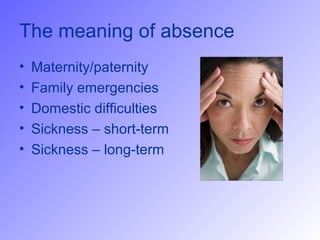
• Maternity/paternity
• Family emergencies
• Domestic difficulties
• Sickness – short-term
• Sickness – long-term
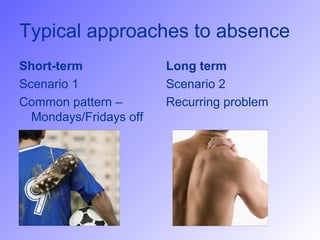
Typical approaches to absence
Short-term
Scenario 1
Common pattern –
Mondays/Fridays off
Long term
Scenario 2
Recurring problem
Absence management tools
• Disciplinary procedures
• Return to work interviews
• Case management
• Working time arrangements
The role of management
Effective communication
• 1:1 meetings
• Return to work
• Attendance reviews
• Home visits
Effective communication
Benchmarking absence
Benchmarking externally:
• Transport, distribution & storage:
• Media:
• Central Government:
• Housing associations:
• Manufacturing & production:
4.5%
1.5%
4.9%
4.6%
2.9%
The way forward
• Tightening policies
• Return-to-work interviews
• Involving occupational health
The way forward – practical measures
• Effective communication
• Prompt action
• Supportive management
• Effective monitoring
Case study 1
Case study 2
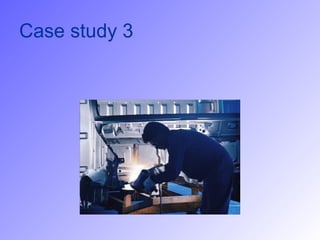
Case study 3
Case Study 4
Learning review
State two things:
• That you have profited from today
• That you will now do to develop your
learning
• That you will take back to the work place
and implement
Thank you
Your details

Absence management slides

  • 1.
    Managing Absence “2.2 milliondays lost to sickness” Facilitated by (your name)
  • 2.
    Objectives • Identify keycauses of absence • Define the Top 10 reasons for sickness/absence Understand the cost of absence • Understand how to utilise the organisation’s policies effectively • Identify the difference between conduct related absence and capability • Understand what constitutes capability and how it relates to DDA
  • 3.
    Objectives • Define whatconstitutes a disability under DDA • How to identify the difference between short term and long term absence • Define what constitutes an underlying medical problem • Define the Line Manager’s role in absence management • Define action plans to reduce sickness/absence
  • 4.
    Absence statistics • Averageabsence levels increased across all the main sectors • Public services organisations recorded the highest average cost of absence • Minor illness is the number one cause of short term absence
  • 5.
    The meaning ofabsence • Maternity/paternity • Family emergencies • Domestic difficulties • Sickness – short-term • Sickness – long-term
  • 6.
    Typical approaches toabsence Short-term Scenario 1 Common pattern – Mondays/Fridays off Long term Scenario 2 Recurring problem
  • 7.
    Absence management tools •Disciplinary procedures • Return to work interviews • Case management • Working time arrangements
  • 8.
    The role ofmanagement
  • 9.
    Effective communication • 1:1meetings • Return to work • Attendance reviews • Home visits
  • 10.
  • 11.
    Benchmarking absence Benchmarking externally: •Transport, distribution & storage: • Media: • Central Government: • Housing associations: • Manufacturing & production: 4.5% 1.5% 4.9% 4.6% 2.9%
  • 12.
    The way forward •Tightening policies • Return-to-work interviews • Involving occupational health
  • 13.
    The way forward– practical measures • Effective communication • Prompt action • Supportive management • Effective monitoring
  • 14.
  • 15.
  • 16.
  • 17.
  • 18.
    Learning review State twothings: • That you have profited from today • That you will now do to develop your learning • That you will take back to the work place and implement
  • 19.

Editor's Notes

  • #2 Statistics on absence from: Trends and sources of data on sickness absenceTrends and patterns of sickness absence in the UK and the available sources and measures. Authors: Catherine Barham,  Joanne LeonardLabour Market Trends, vol 110, no 4ISSN: 1361-4819 Available on line from www. statistics.gov.uk/
  • #3 Identify key causes of absence in organisations within the UK. Define the Top 10 reasons for sickness/absence within the organisation Understand the cost of absence for UK organisations and the need to manage it Understand how to utilise the organisation’s S&A policy/Procedures effectively Identify the difference between conduct related absence and capability Understand what constitutes capability and how it relates to DDA Define what constitutes a disability under DDA How to identify the difference between short term and long term absence and different ways of dealing with them Define what constitutes an underlying medical problem and how to deal with it Define the Line Managers role in absence management Define action plans to reduce sickness/absence within the organisation
  • #4 What are your objectives for the session?
  • #10 Asking the right questions Open/closed/probing Active listening Keeping records Providing opportunities for the employee to ‘open up’ Building rapport and the power of the pause Behaving appropriately according to the circumstances One size does not fit all
  • #11 Non verbal noises   Non verbal noises are a useful way of letting the speaker know that you are really listening to what they are saying and, more than that, that you are sufficiently interested to hear more. Such noises are indications of attention and, together with appropriate facial expressions (smiles, raised eyebrows etc.) Head movements and body posture, are a positive encouragement to the speaker to continue talking. The variety of encouraging noises which can be produced are extensive and the skilled listener, in varying the use of ‘Humm’, ‘Ah’, ‘Uhh’ and other similar noises can encourage a speaker to continue indefinitely.   Supportive statements   Supportive statements are the verbal equivalent of non-verbal noises. Phrases like ‘I see…?’ ‘And then…..?’ ‘That’s interesting…..?’ are merely ways of saying ‘Go on, I’m with you – tell me more’. Used sensitively such expressions will produce the same results as non-verbal noises. Used an an encouragement for the speaker to go on.
  • #13 Tightening policies for reviewing attendance is a major influence on falling absence levels Back pain is cited as the leading cause of long-term absence for manual workers, while stress is the leading cause for non-manual workers. Return-to-work interviews are regarded as the most effective way of managing short-term absence. Involving occupational health professionals is seen as the most effective tool for managing long-term absence
  • #19 Notes:
  • #20 Useful web references: http://www.statistics.gov.uk/CCI/nugget.asp?ID=1577&Pos=3&ColRank=1&Rank=208 Reading List: Managing Absence (Jaluch Management Skills Pocketbooks) (Jaluch Management Skills Pocketbooks) (Paperback) by Helen Clarke (Author, Editor), Katie Dawkins (Illustrator) Paperback: 112 pages Publisher: Jaluch Limited; First edition (20 Nov 2006) ISBN-10: 0955426405 ISBN-13: 978-0955426407 Absence Management (Paperback) by Trevor Bolton (Author), Susan Hughes (Author) Paperback: 218 pages Publisher: Spiro Press; New Ed edition (31 Jan 2003) ISBN-10: 1904298249 ISBN-13: 978-1904298243