54 www.cepmagazine.org December 2002 CEP
Fluids/Solids Handling
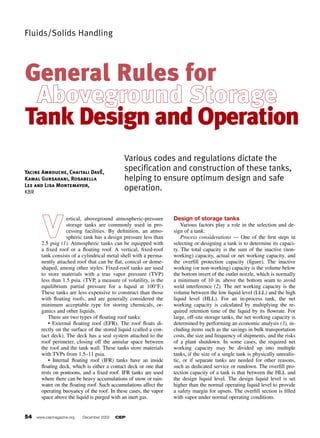
ertical, aboveground atmospheric-pressure
storage tanks are commonly used in pro-
cessing facilities. By definition, an atmo-
spheric tank has a design pressure less than
2.5 psig (1). Atmospheric tanks can be equipped with
a fixed roof or a floating roof. A vertical, fixed-roof
tank consists of a cylindrical metal shell with a perma-
nently attached roof that can be flat, conical or dome-
shaped, among other styles. Fixed-roof tanks are used
to store materials with a true vapor pressure (TVP)
less than 1.5 psia. (TVP, a measure of volatility, is the
equilibrium partial pressure for a liquid at 100°F.)
These tanks are less expensive to construct than those
with floating roofs, and are generally considered the
minimum acceptable type for storing chemicals, or-
ganics and other liquids.
There are two types of floating roof tanks:
• External floating roof (EFR). The roof floats di-
rectly on the surface of the stored liquid (called a con-
tact deck). The deck has a seal system attached to the
roof perimeter, closing off the annular space between
the roof and the tank wall. These tanks store materials
with TVPs from 1.5–11 psia.
• Internal floating roof (IFR) tanks have an inside
floating deck, which is either a contact deck or one that
rests on pontoons, and a fixed roof. IFR tanks are used
where there can be heavy accumulations of snow or rain-
water on the floating roof. Such accumulations affect the
operating buoyancy of the roof. In these cases, the vapor
space above the liquid is purged with an inert gas.
Design of storage tanks
Various factors play a role in the selection and de-
sign of a tank:
Process considerations — One of the first steps in
selecting or designing a tank is to determine its capaci-
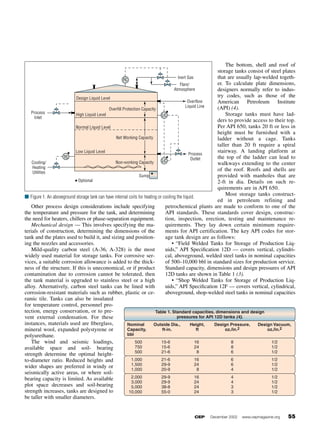
ty. The total capacity is the sum of the inactive (non-
working) capacity, actual or net working capacity, and
the overfill protection capacity (figure). The inactive
working (or non-working) capacity is the volume below
the bottom invert of the outlet nozzle, which is normally
a minimum of 10 in. above the bottom seam to avoid
weld interference (2). The net working capacity is the
volume between the low liquid level (LLL) and the high
liquid level (HLL). For an in-process tank, the net
working capacity is calculated by multiplying the re-
quired retention time of the liquid by its flowrate. For
large, off-site storage tanks, the net working capacity is
determined by performing an economic analysis (3), in-
cluding items such as the savings in bulk transportation
costs, the size and frequency of shipments, and the risks
of a plant shutdown. In some cases, the required net
working capacity may be divided up into multiple
tanks, if the size of a single tank is physically unrealis-
tic, or if separate tanks are needed for other reasons,
such as dedicated service or rundown. The overfill pro-
tection capacity of a tank is that between the HLL and
the design liquid level. The design liquid level is set
higher than the normal operating liquid level to provide
a safety margin for upsets. The overfill section is filled
with vapor under normal operating conditions.
Various codes and regulations dictate the
specification and construction of these tanks,
helping to ensure optimum design and safe
operation.
General Rules for
A
Ab
bo
ov
ve
eg
gr
ro
ou
un
nd
d S
St
to
or
ra
ag
ge
e
Tank Design and Operation
V
V
Yacine Amrouche, Chaitali DavÈ,
Kamal Gursahani, Rosabella
Lee and Lisa Montemayor,
KBR
CEP December 2002 www.cepmagazine.org 55
Other process design considerations include specifying
the temperature and pressure for the tank, and determining
the need for heaters, chillers or phase-separation equipment.
Mechanical design — This involves specifying the ma-
terials of construction, determining the dimensions of the
tank and the plates used to build it, and sizing and position-
ing the nozzles and accessories.
Mild-quality carbon steel (A-36, A-328) is the most
widely used material for storage tanks. For corrosive ser-
vices, a suitable corrosion allowance is added to the thick-
ness of the structure. If this is uneconomical, or if product
contamination due to corrosion cannot be tolerated, then
the tank material is upgraded to stainless steel or a high
alloy. Alternatively, carbon steel tanks can be lined with
corrosion-resistant materials such as rubber, plastic or ce-
ramic tile. Tanks can also be insulated
for temperature control, personnel pro-
tection, energy conservation, or to pre-
vent external condensation. For these
instances, materials used are fiberglass,
mineral wool, expanded polystyrene or
polyurethane.
The wind and seismic loadings,
available space and soil- bearing
strength determine the optimal height-
to-diameter ratio. Reduced heights and
wider shapes are preferred in windy or
seismically active areas, or where soil-
bearing capacity is limited. As available
plot space decreases and soil-bearing
strength increases, tanks are designed to
be taller with smaller diameters.
The bottom, shell and roof of
storage tanks consist of steel plates
that are usually lap-welded togeth-
er. To calculate plate dimensions,
designers normally refer to indus-
try codes, such as those of the
American Petroleum Institute
(API) (4).
Storage tanks must have lad-
ders to provide access to their top.
Per API 650, tanks 20 ft or less in
height must be furnished with a
ladder without a cage. Tanks
taller than 20 ft require a spiral
stairway. A landing platform at
the top of the ladder can lead to
walkways extending to the center
of the roof. Roofs and shells are
provided with manholes that are
2-ft in dia. Details on such re-
quirements are in API 650.
Most storage tanks construct-
ed in petroleum refining and
petrochemical plants are made to conform to one of the
API standards. These standards cover design, construc-
tion, inspection, erection, testing and maintenance re-
quirements. They lay down certain minimum require-
ments for API certification. The key API codes for stor-
age tank design are as follows:
• “Field Welded Tanks for Storage of Production Liq-
uids,” API Specification 12D — covers vertical, cylindri-
cal, aboveground, welded steel tanks in nominal capacities
of 500–10,000 bbl in standard sizes for production service.
Standard capacity, dimensions and design pressures of API
12D tanks are shown in Table 1 (3).
• “Shop Welded Tanks for Storage of Production Liq-
uids,” API Specification 12F — covers vertical, cylindrical,
aboveground, shop-welded steel tanks in nominal capacities
Nominal Outside Dia., Height, Design Pressure, Design Vacuum,
Capacity, ft-in. ft oz./in.2 oz./in.2
bbl
500 15-6 16 8 1/2
750 15-6 24 8 1/2
500 21-6 8 6 1/2
1,000 21-6 16 6 1/2
1,500 29-9 24 6 1/2
1,000 20-9 8 4 1/2
2,000 29-9 16 4 1/2
3,000 29-9 24 4 1/2
5,000 38-8 24 3 1/2
10,000 55-0 24 3 1/2
Table 1. Standard capacities, dimensions and design
pressures for API 12D tanks (4).
Sump
Optional
Process
Outlet
Non-working Capacity
Net Working Capacity
Overfill Protection Capacity
Overflow
Liquid Line
Flare/
Atmosphere
Inert Gas
Low Liquid Level
Normal Liquid Level
Cooling/
Heating
Utilities
High Liquid Level
Design Liquid Level
Process
Inlet
FC
LC
LC
TC
■ Figure 1. An aboveground storage tank can have internal coils for heating or cooling the liquid.
of 90–500 bbl in standard sizes for production service.
• “Large, Field Welded, Low-Pressure Storage Tanks,”
API Standard 620 — covers vertical, cylindrical, above-
ground, field-welded steel tanks for oil storage with maxi-
mum operating temperatures not greater than 200°F and
pressures in the vapor space less than 2.5 psig.
• “Large, Field Welded, Storage Tanks,” API Standard
650 — covers vertical, cylindrical, aboveground, field-
welded steel tanks for oil storage with maximum operating
temperatures not greater than 250°F and pressures in the
vapor space less than 1.5 psig.
Although API standards cover many aspects of storage
tank design and operation, they are not all-inclusive. There
are several other organizations that publish standards on tank
design, fabrication, installation, inspection, and repair that
supplement the API standards.
These include the American Society of Mechanical Engi-
neers (ASME; www.asme.org); American Society for Test-
ing and Materials (ASTM; www.astm.org); American Water
Works Association (AWWA; www.awwa.org); Building Of-
ficials and Code Administrators International (BOCA;
www.bocai.org); (NACE International; www.nace.org); Na-
tional Fire Protection Association (NFPA; www.nfpa.org);
Petroleum Equipment Institute (PEI; www.pei.org); Steel
Tank Institute (STI; www.steeltank.com) Underwriters Lab-
oratories (UL; ulstandardsinfonet.ul.com); and the Interna-
tional Fire Code Institute (Uniform Fire Code;
www.ifci.com).
Environmental requirements
Storage tanks are considered a source of air emissions
due to losses of vapor (5). Emissions from tanks must be
addressed in obtaining the air permit. Volatile organic com-
pounds (VOCs) are the major pollutants of concern for air
emissions. In addition, specific organics that are toxic or
hazardous are also regulated, e.g., benzene. Adequate con-
trol and proper management and maintenance are neces-
sary to prevent releases of tank contents.
In preparing an application for an air-quality operating
permit, a review of all applicable regulations must be com-
pleted. Environmental regulations often dictate the type of
emissions-control device that must be used in a particular
application. Minimum emission-control requirements de-
pend upon the material stored, when the tank was con-
structed or modified, its capacity, the TVP of the com-
pound at storage conditions, and the location of the facility.
Ref. 5 lists some of the national regulatory codes and stan-
dards used for the design of storage tanks and control of air
emissions. Among these is the “New Source Performance
Standards (NSPS), Standards for Performance for Storage
Vessels for Petroleum Liquids,” from the U.S. Environ-
mental Protection Agency’s regulation 40 CFR, Part 60,
Subparts K, Ka and Kb. This standard sets rules for the
systems to control emissions. Emissions-control devices
include internal and external floating roofs, seals, vents to
flares, vapor recovery systems (such as a thermal oxidizer
or scrubber) and disposal systems, such as pressure or vac-
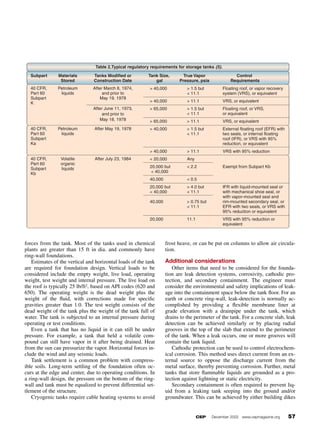
uum vents. Table 2 lists examples of the different types of
requirements and their basis for applicability, taken from
40 CFR, Part 60.
Information for the permit includes properties of materi-
al stored, operating conditions, TVP, tank physical charac-
teristics, tank construction and rim-seal system, roof type,
fittings, deck characteristics, estimated emissions, and
chemical identification. EPA has guidelines, “Compilation
of Air Pollutant Emission Factors,” API-42, that present
models for estimating air emissions for organic-liquid stor-
age tanks, and include emissions estimation equations de-
veloped by API. An EPA-developed program called
TANKS Version 4.09 calculates tank emissions based on
API 42 – Chapter 12 methodology. The software is avail-
able at www.epa.gov/ttn/chief/software/tanks/index.html.
Vent control measures are included in the operating air
permit as permit conditions. Some examples of possible
operating permit conditions include (5):
• For storage and loading of VOCs — An internal float-
ing deck or equivalent control must be installed in all
tanks. The floating roof must have one of the following
closure devices between the wall and the edge of the deck:
(1) a liquid-mounted seal; (2) two continuous seals mount-
ed one above the other; or (3) a mechanical shoe seal. In-
stallation of an equivalent control system requires review
and approval. (A shoe seal is a type of rim seal that closes
the space between the floating roof rim and the tank shell.)
• For any tank equipped with a floating roof, the holder
of the permit has to follow the tests and procedures to veri-
fy the seal integrity, as given in 40 CFR 60.113b. There are
reporting and recordkeeping requirements for the dates that
the seals are inspected, their integrity, and any corrective
actions taken.
• Uninsulated tanks exposed to the sun have to be paint-
ed white or made of aluminum.
Structural requirements
Tank type and size, the soil conditions at the site, tank
loading and tank settlement are critical factors for the de-
sign of the tank foundation. Examples of foundation types
include earth or crushed stone, concrete slabs, slabs sup-
ported by piles and concrete ring-walls.
Earth or crushed stone foundations are simply rings of
material that support the tank walls. These foundations are
typically used in locations with in-situ soil conditions, and
can only be used when anchor bolts are not required. A
concrete slab set under the entire surface area of the tank is
used for tanks less than 15 ft in dia. If soil conditions are
poor or the tank needs insulation, piles may needed.
A concrete ring-wall is constructed by pouring a con-
crete mixture around the tank to support it. Ring-wall
foundations are an economical way to support tanks, are
typically used for large tanks and can withstand uplift
Fluids/Solids Handling
56 www.cepmagazine.org December 2002 CEP
forces from the tank. Most of the tanks used in chemical
plants are greater than 15 ft in dia. and commonly have
ring-wall foundations.
Estimates of the vertical and horizontal loads of the tank
are required for foundation design. Vertical loads to be
considered include the empty weight, live load, operating
weight, test weight and internal pressure. The live load on
the roof is typically 25 lb/ft2, based on API codes (620 and
650). The operating weight is the dead weight plus the
weight of the fluid, with corrections made for specific
gravities greater than 1.0. The test weight consists of the
dead weight of the tank plus the weight of the tank full of
water. The tank is subjected to an internal pressure during
operating or test conditions.
Even a tank that has no liquid in it can still be under
pressure. For example, a tank that held a volatile com-
pound can still have vapor in it after being drained. Heat
from the sun can pressurize the vapor. Horizontal forces in-
clude the wind and any seismic loads.
Tank settlement is a common problem with compress-
ible soils. Long-term settling of the foundation often oc-
curs at the edge and center, due to operating conditions. In
a ring-wall design, the pressure on the bottom of the ring-
wall and tank must be equalized to prevent differential set-
tlement of the structure.
Cryogenic tanks require cable heating systems to avoid
frost heave, or can be put on columns to allow air circula-
tion.
Additional considerations
Other items that need to be considered for the founda-
tion are leak detection systems, corrosivity, cathodic pro-
tection, and secondary containment. The engineer must
consider the environmental and safety implications of leak-
age into the containment space below the tank floor. For an
earth or concrete ring-wall, leak-detection is normally ac-
complished by providing a flexible membrane liner at
grade elevation with a drainpipe under the tank, which
drains to the perimeter of the tank. For a concrete slab, leak
detection can be achieved similarly or by placing radial
grooves in the top of the slab that extend to the perimeter
of the tank. When a leak occurs, one or more grooves will
contain the tank liquid.
Cathodic protection can be used to control electrochem-
ical corrosion. This method uses direct current from an ex-
ternal source to oppose the discharge current from the
metal surface, thereby preventing corrosion. Further, metal
tanks that store flammable liquids are grounded as a pro-
tection against lightning or static electricity.
Secondary containment is often required to prevent liq-
uid from a leaking tank seeping into the ground and/or
groundwater. This can be achieved by either building dikes
CEP December 2002 www.cepmagazine.org 57
Table 2.Typical regulatory requirements for storage tanks (5).
Subpart Materials Tanks Modified or Tank Size, True Vapor Control
Stored Construction Date gal Pressure, psia Requirements
40 CFR, Petroleum After March 8, 1974,
Part 60 liquids and prior to
Subpart May 19, 1978
K
After June 11, 1973,
and prior to
May 18, 1978
40 CFR, Petroleum After May 19, 1978
Part 60 liquids
Subpart
Ka
40 CFR, Volatile After July 23, 1984
Part 60 organic
Subpart liquids
Kb
> 40,000 > 1.5 but Floating roof, or vapor recovery
< 11.1 system (VRS), or equivalent
> 40,000 > 11.1 VRS, or equivalent
> 65,000 > 1.5 but Floating roof, or VRS,
< 11.1 or equivalent
> 65,000 > 11.1 VRS, or equivalent
> 40,000 > 1.5 but External floating roof (EFR) with
< 11.1 two seals, or internal floating
roof (IFR), or VRS with 95%
reduction, or equivalent
> 40,000 > 11.1 VRS with 95% reduction
< 20,000 Any
20,000 but < 2.2 Exempt from Subpart Kb
< 40,000
40,000 < 0.5
20,000 but > 4.0 but IFR with liquid-mounted seal or
< 40,000 < 11.1 with mechanical shoe seal, or
with vapor-mounted seal and
40,000 > 0.75 but rim-mounted secondary seal, or
< 11.1 EFR with two seals, or VRS with
95% reduction or equivalent
20,000 11.1 VRS with 95% reduction or
equivalent
with liners made of high-density polyethylene (HDPE), or
by adding concrete walls and slabs, along with a leak de-
tection system. Curb and dike containment are covered by
many regulations that govern the volume, area, height and
spacing between multiple tanks and process units. Area
sumps may also be required to contain possible leakage.
Provisions must be made for removing water or debris
from the sumps.
Operation and control
Pressure control — The design of a tank must take into
account both normal operations and certain upset condi-
tions. Normal operations are filling, emptying and storing.
When filling a tank, the displaced vapor must be vented,
typically to an emission-control device (or to atmosphere,
if allowed by environmental regulations). When withdraw-
ing liquid, the vacuum that is created must be counter-bal-
anced by the infusion of an inert gas, such as nitrogen,
through a breathing valve.
Vapor “surplus” or “deficit” can also occur in an idle
tank as a result of ambient temperature changes or chemi-
cal reactions taking place within the liquid inventory. The
venting of excess vapor or the infusion of an inert gas for
all normal operating conditions is carried out automatical-
ly, typically through self-regulating valves.
Level control — Level-measuring devices are based on
differential pressure, or sonic, capacitance, displacer velocity
or liquid-conductivity measurements. Sonar or radar level
measurements have recently gained popularity. These de-
vices are usually mounted on the roof of a tank. They send
out a signal, which is reflected off the liquid level. The time
it takes for the reflected signal to be received is used to mea-
sure the liquid height. A major advantage of these instru-
ments is that they can be used with corrosive liquids.
The level is then adjusted by closing or opening the ap-
propriate valves. When precise level control is not re-
quired, the liquid level is maintained between the HLL and
the LLL. Automatic emergency cut-offs are applied when
the liquid level is at the overfill level to avoid overflow, or
when it is below the LLL to avoid cavitation of a pump.
Temperature control — A thermocouple, which is
mounted below the LLL of the tank, provides a continu-
ous readout of the temperature. Multiple measurement
points are sometimes required to ensure representative
temperature readings when the tank is large, there are
different feeds at different temperatures, or there is a
heating coil. The tank temperature can be maintained by
adjusting the flowrate of a cooling or heating medium in
an internal coil.
Upsets and safety — Typical upsets include overpres-
sure, overflow, boil-over, over-temperature, water ingress,
floating-roof failure, unexpected phase separation, light-
ning, static-charge buildup, steam coil failure and fires.
Adequate monitoring can help to ensure safety during
upsets and other incidents. Control and prevention of such
situations include the use of: sprays, deluge or foam sys-
tems; pressure-, temperature-, level- and fire-monitoring
devices; pressure-relief systems; and ensuring proper
preventative maintenance. CEP
Fluids/Solids Handling
58 www.cepmagazine.org December 2002 CEP
Y
YA
AC
CI
IN
NE
E A
AM
MR
RO
OU
UC
CH
HE
E is a process engineer at KBR (601 Jefferson Ave.,
Houston, TX 77002; Phone: (713) 753-7028; Fax: (713) 753-6097; E-mail:
yacine.amrouche@halliburton.com). He is a junior-level engineer with two
years of experience in process engineering and is a member of KBR’s
young professional network, IMPACT. Amrouche holds a BS in chemical
engineering from the Univ. of Sussex, U.K., with a specialization in
polymer science.
CHAITALI DAVE` is an environmental engineer at KBR (Phone: (713) 753-
3572; Fax: (713) 753-3123; E-mail: chaitali.dave@halliburton.com). She is
a junior-level engineer with four years of experience in environmental
engineering and is a member of KBR’s young professional network,
IMPACT. Dave’ holds a BS in chemical engineering from the Univ. of South
Florida and is a member of the Environmental Div. of AIChE.
KAMAL GURSAHANI is a process engineer at KBR (Phone: (281) 492-5787;
Fax: (281) 492-5832; E-mail: kamal.gursahani@halliburton.com). He is a
junior-level engineer with one year of experience and is a member of
KBR’s young professional network, IMPACT. Gursahani holds a BS in
chemical engineering from Bombay Univ. and an MS in chemical
engineering from the Univ. of Wisconsin – Madison.
ROSABELLA LEE is a process engineer at KBR (Phone: (713) 753-2238; Fax:
(713) 753-5353; E-mail: rosabella.lee@halliburton.com). She is a junior-
level engineer with four years of experience and is a member of KBR’s
young professional network, IMPACT. Lee holds a BS degree in chemical
engineering and mathematics from the Univ. of Houston.
LISA MONTEMAYOR is a civil engineer at KBR (Phone: (713) 753-5355;
Fax: (713) 753-5897; E-mail: lisa.montemayor@halliburton.com).
She is a junior level engineer with four years of experience in civil
engineering and is a member of KBR’s young professional network,
IMPACT. Montemayor holds a BS in civil engineering from Texas A&M Univ.
Literature Cited
1. Mead, J., “The Encyclopedia of Chemical Process Equipment,”
Reinhold Publishing, New York, pp. 941–956 (1964).
2. Burk, H. S., et. al., “Conceptual Design of Refinery Tankage,”
Chem. Eng., 88 (17), pp. 107–110 (Aug. 24, 1981).
3. Newton, P., et al., “Liquid Storage in the CPI,” Chem. Eng. (Desk-
book), 85 (8), pp. 9–15 (April 3, 1978).
4. “Welded Steel Tanks for Oil Storage,” 10th ed., Standard 650,
American Petroleum Institute (API), Washington, DC (1998).
5. “Technical Guidance Package for Chemical Sources: Storage
Tanks,” Texas Natural Resources Conservation Commission
(TNRCC), Air Permits Div. (Feb. 2001). Available at
http://www.tnrcc.state.tx.us/.
Acknowledgment
The authors would like to thank Ahmed Allawi, Benson Pair and the
KBR Publications Committee for their guidance and support in
writing this article.

Aboveground_storage_tank_design_and_operation.pdf

  • 1.
    54 www.cepmagazine.org December2002 CEP Fluids/Solids Handling ertical, aboveground atmospheric-pressure storage tanks are commonly used in pro- cessing facilities. By definition, an atmo- spheric tank has a design pressure less than 2.5 psig (1). Atmospheric tanks can be equipped with a fixed roof or a floating roof. A vertical, fixed-roof tank consists of a cylindrical metal shell with a perma- nently attached roof that can be flat, conical or dome- shaped, among other styles. Fixed-roof tanks are used to store materials with a true vapor pressure (TVP) less than 1.5 psia. (TVP, a measure of volatility, is the equilibrium partial pressure for a liquid at 100°F.) These tanks are less expensive to construct than those with floating roofs, and are generally considered the minimum acceptable type for storing chemicals, or- ganics and other liquids. There are two types of floating roof tanks: • External floating roof (EFR). The roof floats di- rectly on the surface of the stored liquid (called a con- tact deck). The deck has a seal system attached to the roof perimeter, closing off the annular space between the roof and the tank wall. These tanks store materials with TVPs from 1.5–11 psia. • Internal floating roof (IFR) tanks have an inside floating deck, which is either a contact deck or one that rests on pontoons, and a fixed roof. IFR tanks are used where there can be heavy accumulations of snow or rain- water on the floating roof. Such accumulations affect the operating buoyancy of the roof. In these cases, the vapor space above the liquid is purged with an inert gas. Design of storage tanks Various factors play a role in the selection and de- sign of a tank: Process considerations — One of the first steps in selecting or designing a tank is to determine its capaci- ty. The total capacity is the sum of the inactive (non- working) capacity, actual or net working capacity, and the overfill protection capacity (figure). The inactive working (or non-working) capacity is the volume below the bottom invert of the outlet nozzle, which is normally a minimum of 10 in. above the bottom seam to avoid weld interference (2). The net working capacity is the volume between the low liquid level (LLL) and the high liquid level (HLL). For an in-process tank, the net working capacity is calculated by multiplying the re- quired retention time of the liquid by its flowrate. For large, off-site storage tanks, the net working capacity is determined by performing an economic analysis (3), in- cluding items such as the savings in bulk transportation costs, the size and frequency of shipments, and the risks of a plant shutdown. In some cases, the required net working capacity may be divided up into multiple tanks, if the size of a single tank is physically unrealis- tic, or if separate tanks are needed for other reasons, such as dedicated service or rundown. The overfill pro- tection capacity of a tank is that between the HLL and the design liquid level. The design liquid level is set higher than the normal operating liquid level to provide a safety margin for upsets. The overfill section is filled with vapor under normal operating conditions. Various codes and regulations dictate the specification and construction of these tanks, helping to ensure optimum design and safe operation. General Rules for A Ab bo ov ve eg gr ro ou un nd d S St to or ra ag ge e Tank Design and Operation V V Yacine Amrouche, Chaitali DavÈ, Kamal Gursahani, Rosabella Lee and Lisa Montemayor, KBR
  • 2.
    CEP December 2002www.cepmagazine.org 55 Other process design considerations include specifying the temperature and pressure for the tank, and determining the need for heaters, chillers or phase-separation equipment. Mechanical design — This involves specifying the ma- terials of construction, determining the dimensions of the tank and the plates used to build it, and sizing and position- ing the nozzles and accessories. Mild-quality carbon steel (A-36, A-328) is the most widely used material for storage tanks. For corrosive ser- vices, a suitable corrosion allowance is added to the thick- ness of the structure. If this is uneconomical, or if product contamination due to corrosion cannot be tolerated, then the tank material is upgraded to stainless steel or a high alloy. Alternatively, carbon steel tanks can be lined with corrosion-resistant materials such as rubber, plastic or ce- ramic tile. Tanks can also be insulated for temperature control, personnel pro- tection, energy conservation, or to pre- vent external condensation. For these instances, materials used are fiberglass, mineral wool, expanded polystyrene or polyurethane. The wind and seismic loadings, available space and soil- bearing strength determine the optimal height- to-diameter ratio. Reduced heights and wider shapes are preferred in windy or seismically active areas, or where soil- bearing capacity is limited. As available plot space decreases and soil-bearing strength increases, tanks are designed to be taller with smaller diameters. The bottom, shell and roof of storage tanks consist of steel plates that are usually lap-welded togeth- er. To calculate plate dimensions, designers normally refer to indus- try codes, such as those of the American Petroleum Institute (API) (4). Storage tanks must have lad- ders to provide access to their top. Per API 650, tanks 20 ft or less in height must be furnished with a ladder without a cage. Tanks taller than 20 ft require a spiral stairway. A landing platform at the top of the ladder can lead to walkways extending to the center of the roof. Roofs and shells are provided with manholes that are 2-ft in dia. Details on such re- quirements are in API 650. Most storage tanks construct- ed in petroleum refining and petrochemical plants are made to conform to one of the API standards. These standards cover design, construc- tion, inspection, erection, testing and maintenance re- quirements. They lay down certain minimum require- ments for API certification. The key API codes for stor- age tank design are as follows: • “Field Welded Tanks for Storage of Production Liq- uids,” API Specification 12D — covers vertical, cylindri- cal, aboveground, welded steel tanks in nominal capacities of 500–10,000 bbl in standard sizes for production service. Standard capacity, dimensions and design pressures of API 12D tanks are shown in Table 1 (3). • “Shop Welded Tanks for Storage of Production Liq- uids,” API Specification 12F — covers vertical, cylindrical, aboveground, shop-welded steel tanks in nominal capacities Nominal Outside Dia., Height, Design Pressure, Design Vacuum, Capacity, ft-in. ft oz./in.2 oz./in.2 bbl 500 15-6 16 8 1/2 750 15-6 24 8 1/2 500 21-6 8 6 1/2 1,000 21-6 16 6 1/2 1,500 29-9 24 6 1/2 1,000 20-9 8 4 1/2 2,000 29-9 16 4 1/2 3,000 29-9 24 4 1/2 5,000 38-8 24 3 1/2 10,000 55-0 24 3 1/2 Table 1. Standard capacities, dimensions and design pressures for API 12D tanks (4). Sump Optional Process Outlet Non-working Capacity Net Working Capacity Overfill Protection Capacity Overflow Liquid Line Flare/ Atmosphere Inert Gas Low Liquid Level Normal Liquid Level Cooling/ Heating Utilities High Liquid Level Design Liquid Level Process Inlet FC LC LC TC ■ Figure 1. An aboveground storage tank can have internal coils for heating or cooling the liquid.
  • 3.
    of 90–500 bblin standard sizes for production service. • “Large, Field Welded, Low-Pressure Storage Tanks,” API Standard 620 — covers vertical, cylindrical, above- ground, field-welded steel tanks for oil storage with maxi- mum operating temperatures not greater than 200°F and pressures in the vapor space less than 2.5 psig. • “Large, Field Welded, Storage Tanks,” API Standard 650 — covers vertical, cylindrical, aboveground, field- welded steel tanks for oil storage with maximum operating temperatures not greater than 250°F and pressures in the vapor space less than 1.5 psig. Although API standards cover many aspects of storage tank design and operation, they are not all-inclusive. There are several other organizations that publish standards on tank design, fabrication, installation, inspection, and repair that supplement the API standards. These include the American Society of Mechanical Engi- neers (ASME; www.asme.org); American Society for Test- ing and Materials (ASTM; www.astm.org); American Water Works Association (AWWA; www.awwa.org); Building Of- ficials and Code Administrators International (BOCA; www.bocai.org); (NACE International; www.nace.org); Na- tional Fire Protection Association (NFPA; www.nfpa.org); Petroleum Equipment Institute (PEI; www.pei.org); Steel Tank Institute (STI; www.steeltank.com) Underwriters Lab- oratories (UL; ulstandardsinfonet.ul.com); and the Interna- tional Fire Code Institute (Uniform Fire Code; www.ifci.com). Environmental requirements Storage tanks are considered a source of air emissions due to losses of vapor (5). Emissions from tanks must be addressed in obtaining the air permit. Volatile organic com- pounds (VOCs) are the major pollutants of concern for air emissions. In addition, specific organics that are toxic or hazardous are also regulated, e.g., benzene. Adequate con- trol and proper management and maintenance are neces- sary to prevent releases of tank contents. In preparing an application for an air-quality operating permit, a review of all applicable regulations must be com- pleted. Environmental regulations often dictate the type of emissions-control device that must be used in a particular application. Minimum emission-control requirements de- pend upon the material stored, when the tank was con- structed or modified, its capacity, the TVP of the com- pound at storage conditions, and the location of the facility. Ref. 5 lists some of the national regulatory codes and stan- dards used for the design of storage tanks and control of air emissions. Among these is the “New Source Performance Standards (NSPS), Standards for Performance for Storage Vessels for Petroleum Liquids,” from the U.S. Environ- mental Protection Agency’s regulation 40 CFR, Part 60, Subparts K, Ka and Kb. This standard sets rules for the systems to control emissions. Emissions-control devices include internal and external floating roofs, seals, vents to flares, vapor recovery systems (such as a thermal oxidizer or scrubber) and disposal systems, such as pressure or vac- uum vents. Table 2 lists examples of the different types of requirements and their basis for applicability, taken from 40 CFR, Part 60. Information for the permit includes properties of materi- al stored, operating conditions, TVP, tank physical charac- teristics, tank construction and rim-seal system, roof type, fittings, deck characteristics, estimated emissions, and chemical identification. EPA has guidelines, “Compilation of Air Pollutant Emission Factors,” API-42, that present models for estimating air emissions for organic-liquid stor- age tanks, and include emissions estimation equations de- veloped by API. An EPA-developed program called TANKS Version 4.09 calculates tank emissions based on API 42 – Chapter 12 methodology. The software is avail- able at www.epa.gov/ttn/chief/software/tanks/index.html. Vent control measures are included in the operating air permit as permit conditions. Some examples of possible operating permit conditions include (5): • For storage and loading of VOCs — An internal float- ing deck or equivalent control must be installed in all tanks. The floating roof must have one of the following closure devices between the wall and the edge of the deck: (1) a liquid-mounted seal; (2) two continuous seals mount- ed one above the other; or (3) a mechanical shoe seal. In- stallation of an equivalent control system requires review and approval. (A shoe seal is a type of rim seal that closes the space between the floating roof rim and the tank shell.) • For any tank equipped with a floating roof, the holder of the permit has to follow the tests and procedures to veri- fy the seal integrity, as given in 40 CFR 60.113b. There are reporting and recordkeeping requirements for the dates that the seals are inspected, their integrity, and any corrective actions taken. • Uninsulated tanks exposed to the sun have to be paint- ed white or made of aluminum. Structural requirements Tank type and size, the soil conditions at the site, tank loading and tank settlement are critical factors for the de- sign of the tank foundation. Examples of foundation types include earth or crushed stone, concrete slabs, slabs sup- ported by piles and concrete ring-walls. Earth or crushed stone foundations are simply rings of material that support the tank walls. These foundations are typically used in locations with in-situ soil conditions, and can only be used when anchor bolts are not required. A concrete slab set under the entire surface area of the tank is used for tanks less than 15 ft in dia. If soil conditions are poor or the tank needs insulation, piles may needed. A concrete ring-wall is constructed by pouring a con- crete mixture around the tank to support it. Ring-wall foundations are an economical way to support tanks, are typically used for large tanks and can withstand uplift Fluids/Solids Handling 56 www.cepmagazine.org December 2002 CEP
  • 4.
    forces from thetank. Most of the tanks used in chemical plants are greater than 15 ft in dia. and commonly have ring-wall foundations. Estimates of the vertical and horizontal loads of the tank are required for foundation design. Vertical loads to be considered include the empty weight, live load, operating weight, test weight and internal pressure. The live load on the roof is typically 25 lb/ft2, based on API codes (620 and 650). The operating weight is the dead weight plus the weight of the fluid, with corrections made for specific gravities greater than 1.0. The test weight consists of the dead weight of the tank plus the weight of the tank full of water. The tank is subjected to an internal pressure during operating or test conditions. Even a tank that has no liquid in it can still be under pressure. For example, a tank that held a volatile com- pound can still have vapor in it after being drained. Heat from the sun can pressurize the vapor. Horizontal forces in- clude the wind and any seismic loads. Tank settlement is a common problem with compress- ible soils. Long-term settling of the foundation often oc- curs at the edge and center, due to operating conditions. In a ring-wall design, the pressure on the bottom of the ring- wall and tank must be equalized to prevent differential set- tlement of the structure. Cryogenic tanks require cable heating systems to avoid frost heave, or can be put on columns to allow air circula- tion. Additional considerations Other items that need to be considered for the founda- tion are leak detection systems, corrosivity, cathodic pro- tection, and secondary containment. The engineer must consider the environmental and safety implications of leak- age into the containment space below the tank floor. For an earth or concrete ring-wall, leak-detection is normally ac- complished by providing a flexible membrane liner at grade elevation with a drainpipe under the tank, which drains to the perimeter of the tank. For a concrete slab, leak detection can be achieved similarly or by placing radial grooves in the top of the slab that extend to the perimeter of the tank. When a leak occurs, one or more grooves will contain the tank liquid. Cathodic protection can be used to control electrochem- ical corrosion. This method uses direct current from an ex- ternal source to oppose the discharge current from the metal surface, thereby preventing corrosion. Further, metal tanks that store flammable liquids are grounded as a pro- tection against lightning or static electricity. Secondary containment is often required to prevent liq- uid from a leaking tank seeping into the ground and/or groundwater. This can be achieved by either building dikes CEP December 2002 www.cepmagazine.org 57 Table 2.Typical regulatory requirements for storage tanks (5). Subpart Materials Tanks Modified or Tank Size, True Vapor Control Stored Construction Date gal Pressure, psia Requirements 40 CFR, Petroleum After March 8, 1974, Part 60 liquids and prior to Subpart May 19, 1978 K After June 11, 1973, and prior to May 18, 1978 40 CFR, Petroleum After May 19, 1978 Part 60 liquids Subpart Ka 40 CFR, Volatile After July 23, 1984 Part 60 organic Subpart liquids Kb > 40,000 > 1.5 but Floating roof, or vapor recovery < 11.1 system (VRS), or equivalent > 40,000 > 11.1 VRS, or equivalent > 65,000 > 1.5 but Floating roof, or VRS, < 11.1 or equivalent > 65,000 > 11.1 VRS, or equivalent > 40,000 > 1.5 but External floating roof (EFR) with < 11.1 two seals, or internal floating roof (IFR), or VRS with 95% reduction, or equivalent > 40,000 > 11.1 VRS with 95% reduction < 20,000 Any 20,000 but < 2.2 Exempt from Subpart Kb < 40,000 40,000 < 0.5 20,000 but > 4.0 but IFR with liquid-mounted seal or < 40,000 < 11.1 with mechanical shoe seal, or with vapor-mounted seal and 40,000 > 0.75 but rim-mounted secondary seal, or < 11.1 EFR with two seals, or VRS with 95% reduction or equivalent 20,000 11.1 VRS with 95% reduction or equivalent
  • 5.
    with liners madeof high-density polyethylene (HDPE), or by adding concrete walls and slabs, along with a leak de- tection system. Curb and dike containment are covered by many regulations that govern the volume, area, height and spacing between multiple tanks and process units. Area sumps may also be required to contain possible leakage. Provisions must be made for removing water or debris from the sumps. Operation and control Pressure control — The design of a tank must take into account both normal operations and certain upset condi- tions. Normal operations are filling, emptying and storing. When filling a tank, the displaced vapor must be vented, typically to an emission-control device (or to atmosphere, if allowed by environmental regulations). When withdraw- ing liquid, the vacuum that is created must be counter-bal- anced by the infusion of an inert gas, such as nitrogen, through a breathing valve. Vapor “surplus” or “deficit” can also occur in an idle tank as a result of ambient temperature changes or chemi- cal reactions taking place within the liquid inventory. The venting of excess vapor or the infusion of an inert gas for all normal operating conditions is carried out automatical- ly, typically through self-regulating valves. Level control — Level-measuring devices are based on differential pressure, or sonic, capacitance, displacer velocity or liquid-conductivity measurements. Sonar or radar level measurements have recently gained popularity. These de- vices are usually mounted on the roof of a tank. They send out a signal, which is reflected off the liquid level. The time it takes for the reflected signal to be received is used to mea- sure the liquid height. A major advantage of these instru- ments is that they can be used with corrosive liquids. The level is then adjusted by closing or opening the ap- propriate valves. When precise level control is not re- quired, the liquid level is maintained between the HLL and the LLL. Automatic emergency cut-offs are applied when the liquid level is at the overfill level to avoid overflow, or when it is below the LLL to avoid cavitation of a pump. Temperature control — A thermocouple, which is mounted below the LLL of the tank, provides a continu- ous readout of the temperature. Multiple measurement points are sometimes required to ensure representative temperature readings when the tank is large, there are different feeds at different temperatures, or there is a heating coil. The tank temperature can be maintained by adjusting the flowrate of a cooling or heating medium in an internal coil. Upsets and safety — Typical upsets include overpres- sure, overflow, boil-over, over-temperature, water ingress, floating-roof failure, unexpected phase separation, light- ning, static-charge buildup, steam coil failure and fires. Adequate monitoring can help to ensure safety during upsets and other incidents. Control and prevention of such situations include the use of: sprays, deluge or foam sys- tems; pressure-, temperature-, level- and fire-monitoring devices; pressure-relief systems; and ensuring proper preventative maintenance. CEP Fluids/Solids Handling 58 www.cepmagazine.org December 2002 CEP Y YA AC CI IN NE E A AM MR RO OU UC CH HE E is a process engineer at KBR (601 Jefferson Ave., Houston, TX 77002; Phone: (713) 753-7028; Fax: (713) 753-6097; E-mail: yacine.amrouche@halliburton.com). He is a junior-level engineer with two years of experience in process engineering and is a member of KBR’s young professional network, IMPACT. Amrouche holds a BS in chemical engineering from the Univ. of Sussex, U.K., with a specialization in polymer science. CHAITALI DAVE` is an environmental engineer at KBR (Phone: (713) 753- 3572; Fax: (713) 753-3123; E-mail: chaitali.dave@halliburton.com). She is a junior-level engineer with four years of experience in environmental engineering and is a member of KBR’s young professional network, IMPACT. Dave’ holds a BS in chemical engineering from the Univ. of South Florida and is a member of the Environmental Div. of AIChE. KAMAL GURSAHANI is a process engineer at KBR (Phone: (281) 492-5787; Fax: (281) 492-5832; E-mail: kamal.gursahani@halliburton.com). He is a junior-level engineer with one year of experience and is a member of KBR’s young professional network, IMPACT. Gursahani holds a BS in chemical engineering from Bombay Univ. and an MS in chemical engineering from the Univ. of Wisconsin – Madison. ROSABELLA LEE is a process engineer at KBR (Phone: (713) 753-2238; Fax: (713) 753-5353; E-mail: rosabella.lee@halliburton.com). She is a junior- level engineer with four years of experience and is a member of KBR’s young professional network, IMPACT. Lee holds a BS degree in chemical engineering and mathematics from the Univ. of Houston. LISA MONTEMAYOR is a civil engineer at KBR (Phone: (713) 753-5355; Fax: (713) 753-5897; E-mail: lisa.montemayor@halliburton.com). She is a junior level engineer with four years of experience in civil engineering and is a member of KBR’s young professional network, IMPACT. Montemayor holds a BS in civil engineering from Texas A&M Univ. Literature Cited 1. Mead, J., “The Encyclopedia of Chemical Process Equipment,” Reinhold Publishing, New York, pp. 941–956 (1964). 2. Burk, H. S., et. al., “Conceptual Design of Refinery Tankage,” Chem. Eng., 88 (17), pp. 107–110 (Aug. 24, 1981). 3. Newton, P., et al., “Liquid Storage in the CPI,” Chem. Eng. (Desk- book), 85 (8), pp. 9–15 (April 3, 1978). 4. “Welded Steel Tanks for Oil Storage,” 10th ed., Standard 650, American Petroleum Institute (API), Washington, DC (1998). 5. “Technical Guidance Package for Chemical Sources: Storage Tanks,” Texas Natural Resources Conservation Commission (TNRCC), Air Permits Div. (Feb. 2001). Available at http://www.tnrcc.state.tx.us/. Acknowledgment The authors would like to thank Ahmed Allawi, Benson Pair and the KBR Publications Committee for their guidance and support in writing this article.