New Media and Engagement Strategies for Government Collaboration Customer service Community engagement © //bwr via Flickr
The business case
Governing in the world of wikinomics “ We are entering a new age where people participate in the economy like never before. This new participation has reached a tipping point where new forms of mass collaboration are changing how goods and services are invented, produced, marketed, and distributed on a global scale. This change presents far-reaching opportunities for every company and for every person who gets connected” Wikinomics , Tapscott and Williams (2006)
Getting closer to the people you serve Policy led reviews all highlighting the importance of getting closer to and knowing your customers through high quality interactions: Empowerment White Paper (and up coming strategy on role of the web) Lyons (place shaping) Councillors Commission (democratic engagement) Comprehensive Area Assessments (CAA), area-based intelligence and risk-led intervention Singh (integration and cohesion) Local area agreements (LAAs) Varney review of customer service
The policy imperative A new national and local policy direction has emerged around: Choice and personalisation Improving democratic engagement User focus Meeting diverse needs Value for money services Targeted services Customer service Intelligence-led service provision
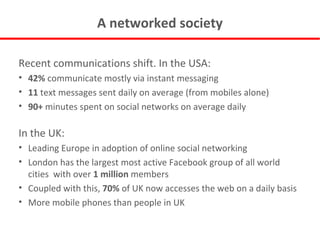
A networked society Recent communications shift. In the USA: 42%  communicate mostly via instant messaging 11  text messages sent daily on average (from mobiles alone) 90+  minutes spent on social networks on average daily In the UK: Leading Europe in adoption of online social networking London has the largest most active Facebook group of all world cities  with over  1 million  members Coupled with this,  70%  of UK now accesses the web on a daily basis More mobile phones than people in UK
Employee and customer expectations For the first time, employees are now bringing ideas and expectations into the workplace based on experiences at home of how relationships (including with companies – and now also government!) should be… Customers increasingly want (expect) councils to exist in their in ‘networked’ world (online platforms such as Facebook for instance) But Government is lagging consumer and employee expectation on the communications and technology curve – so how can they keep up?
The response
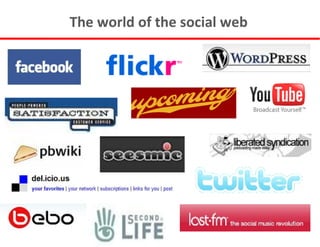
The world of the social web
Introducing the social web Web 2.0 means different things to different people but in essence: Web based tools that emphasise user/customer involvement and voice (‘participatory web’) Enables blogging, tagging, comment Allows the participants to choose how they want to engage as everyone is different Enables the harnessing of collective intelligence through knowledge sharing e.g. wikipedia
User contributions via the web Content Blogs Photos Online community contributions Wikis Audio and video Annotations Comments Tags/bookmarking Ratings
Web 2.0: the benefits From satisfaction surveys to meaningful conversations Drive greater democratic engagement, transparency and trust Encourage involvement, service coproduction and peer to peer support opportunities Enable behaviour change Meet changing (and increasing) customer expectation in terms of the council’s online presence Get closer to and better understand the needs and wants of customers and adapt accordingly Proactive intelligence gathering – views and expectations of residents (‘no surprises’ approach) Drive brand loyalty (vital in public sector as well as private) Cross-(LSP) partner collaborative planning and implementation Join up a dispersed workforce (multiple sites, home workers)
About FutureGov
FutureGov: our focus Collaboration Enterprise 2.0 (knowledge sharing and cross-silo working) Joined up working within and across organisations Effective organisational communications Customer service Coproduction of services Feedback and peer support Driving brand loyalty and engagement Community engagement Two way communications Democratic engagement Consultation through conversation
FutureGov: the team Dominic Campbell Background in local government organisational strategy and IT change management First Social Media Manager in local government, working with LB Barnet to implement online collaboration and engagement for staff and community Co-founder of online social start ups  Enabled by Design  and  AccessCity Justin Kerr-Stevens Background in strategic communications and marketing Author of first social media strategy for government while interim Head of New Media at the Department of Innovation, Universities and Skills (DIUS) Public sector expertise includes Health, Justice, Environment and Taxation Michelle Lyons Background in strategic engagement and participation Experience as Department of Innovation, Universities and Skills as Community Manager running engagement on “Innovation Nation” white paper and Department of Justice as e-participation manager

About FutureGov

  • 1.
    New Media andEngagement Strategies for Government Collaboration Customer service Community engagement © //bwr via Flickr
  • 2.
  • 3.
    Governing in theworld of wikinomics “ We are entering a new age where people participate in the economy like never before. This new participation has reached a tipping point where new forms of mass collaboration are changing how goods and services are invented, produced, marketed, and distributed on a global scale. This change presents far-reaching opportunities for every company and for every person who gets connected” Wikinomics , Tapscott and Williams (2006)
  • 4.
    Getting closer tothe people you serve Policy led reviews all highlighting the importance of getting closer to and knowing your customers through high quality interactions: Empowerment White Paper (and up coming strategy on role of the web) Lyons (place shaping) Councillors Commission (democratic engagement) Comprehensive Area Assessments (CAA), area-based intelligence and risk-led intervention Singh (integration and cohesion) Local area agreements (LAAs) Varney review of customer service
  • 5.
    The policy imperativeA new national and local policy direction has emerged around: Choice and personalisation Improving democratic engagement User focus Meeting diverse needs Value for money services Targeted services Customer service Intelligence-led service provision
  • 6.
    A networked societyRecent communications shift. In the USA: 42% communicate mostly via instant messaging 11 text messages sent daily on average (from mobiles alone) 90+ minutes spent on social networks on average daily In the UK: Leading Europe in adoption of online social networking London has the largest most active Facebook group of all world cities with over 1 million members Coupled with this, 70% of UK now accesses the web on a daily basis More mobile phones than people in UK
  • 7.
    Employee and customerexpectations For the first time, employees are now bringing ideas and expectations into the workplace based on experiences at home of how relationships (including with companies – and now also government!) should be… Customers increasingly want (expect) councils to exist in their in ‘networked’ world (online platforms such as Facebook for instance) But Government is lagging consumer and employee expectation on the communications and technology curve – so how can they keep up?
  • 8.
  • 9.
    The world ofthe social web
  • 10.
    Introducing the socialweb Web 2.0 means different things to different people but in essence: Web based tools that emphasise user/customer involvement and voice (‘participatory web’) Enables blogging, tagging, comment Allows the participants to choose how they want to engage as everyone is different Enables the harnessing of collective intelligence through knowledge sharing e.g. wikipedia
  • 11.
    User contributions viathe web Content Blogs Photos Online community contributions Wikis Audio and video Annotations Comments Tags/bookmarking Ratings
  • 12.
    Web 2.0: thebenefits From satisfaction surveys to meaningful conversations Drive greater democratic engagement, transparency and trust Encourage involvement, service coproduction and peer to peer support opportunities Enable behaviour change Meet changing (and increasing) customer expectation in terms of the council’s online presence Get closer to and better understand the needs and wants of customers and adapt accordingly Proactive intelligence gathering – views and expectations of residents (‘no surprises’ approach) Drive brand loyalty (vital in public sector as well as private) Cross-(LSP) partner collaborative planning and implementation Join up a dispersed workforce (multiple sites, home workers)
  • 13.
  • 14.
    FutureGov: our focusCollaboration Enterprise 2.0 (knowledge sharing and cross-silo working) Joined up working within and across organisations Effective organisational communications Customer service Coproduction of services Feedback and peer support Driving brand loyalty and engagement Community engagement Two way communications Democratic engagement Consultation through conversation
  • 15.
    FutureGov: the teamDominic Campbell Background in local government organisational strategy and IT change management First Social Media Manager in local government, working with LB Barnet to implement online collaboration and engagement for staff and community Co-founder of online social start ups Enabled by Design and AccessCity Justin Kerr-Stevens Background in strategic communications and marketing Author of first social media strategy for government while interim Head of New Media at the Department of Innovation, Universities and Skills (DIUS) Public sector expertise includes Health, Justice, Environment and Taxation Michelle Lyons Background in strategic engagement and participation Experience as Department of Innovation, Universities and Skills as Community Manager running engagement on “Innovation Nation” white paper and Department of Justice as e-participation manager