Community & Grassroots Section
Panel: Social Media and Networking in
Civil Society and Civic Activism
Nov. 19, 2010
Page  2
Personal Background
• Public administration
• Government
• Consultant
• Software Technology (Web 2.0)
• Public Policy
• Non-profits and community foundations
• Member of the “Gov2.0ld” generation (emails: .gov .com .org)
Director of online strategies - Leveraging the Web, social media and electronic
devices to enhance and deliver our programs and services that enable and engage
our staff, customers, citizens and stakeholders.
The Collins Center for Public Policy
• Governance/Civic Engagement
• Community/Economic Development
• Health Care
• Mediation (home foreclosure)
• Sustainability
Page  3
1. What are the opportunities for civil society & civic
activism using So-Me & networking technologies today?
Easily connect to people, information and
communication cost-effectively
Develop and sustain relationships
Activism - mobilize people, voices and votes
More informed decision making (among and for
the collective)
Page  4
Results & Observations: Balancing new media with
conventional methodologies
1.  A transformation is underway around peoples’ 
preferences and expectations for communicating and 
for accessing and sharing information. 
2.  The expanding chasm between citizens and 
government cannot be narrowed through conventional 
or traditional forms of engagement.
3.  Public policy issues, and decision making processes 
grow in complexity. 
Page  5
Results & Observations: Balancing new media with
conventional methodologies
4.  Citizens are too distracted, and competition for their 
attention and time hamper their interest, opportunity, 
or ability to participate in their government.
5.  Special interest dominance and influence pervade 
public policy making; and will only accelerate and 
amplify with the Internet and Web 2.0.
Page  6
Results & Observations: Balancing new media with
conventional methodologies
6.  The expanding diversification of our population paired with the 
shrinking curriculum of civics education diminishes knowledge and 
understanding of our democratic foundation and governance 
processes.  
7.  Social media enables us to advance from online communication as 
transactional (one-to-one), to online collaboration as interactional 
(one-to-many/many-to-many). 
8. Capturing traditional informal and formal conversation can now be 
replicated through social media either as discussions or as public 
comment. 
Page  7
Results & Observations: Balancing new media with
conventional methodologies
9. Legal definitions and traditional forms of “public
comment” may eventually be redefined due to the
Internet.
10. The cart before the horse: Online democracy, also
known as Gov 2.0/Open Government, resembles a
reinvention instead of a replication of its historical
structure and conventional standards.
Page  8
2. Potential negativenegative outcomes associated with soc-net &
so-me technologies for civil society and civic activism.
Lack of structure, standards, processes and procedures
Anonymity vs. Attribution (and from anywhere)
Polarization, fragmentation, and isolation (e.g., The
“Daily Me” and “Bubble Filters”)
Uninformed & self-serving decision making
Page  9
3. Vision of a desired future for a socially networked civil
society? How to get there; obstacles to be cleared.
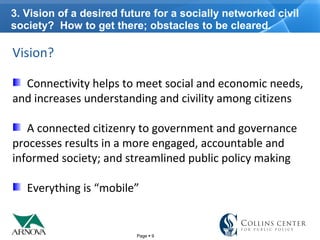
Vision?
Connectivity helps to meet social and economic needs,
and increases understanding and civility among citizens
A connected citizenry to government and governance
processes results in a more engaged, accountable and
informed society; and streamlined public policy making
Everything is “mobile”
Page  10
3. Vision of a desired future for a socially networked civil
society? How to get there; obstacles to be cleared.
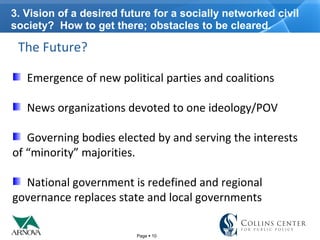
The Future?
Emergence of new political parties and coalitions
News organizations devoted to one ideology/POV
Governing bodies elected by and serving the interests
of “minority” majorities.
National government is redefined and regional
governance replaces state and local governments
Page  11
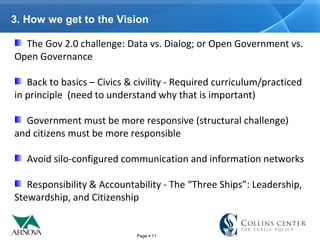
3. How we get to the Vision
The Gov 2.0 challenge: Data vs. Dialog; or Open Government vs.
Open Governance
Back to basics – Civics & civility - Required curriculum/practiced
in principle (need to understand why that is important)
Government must be more responsive (structural challenge)
and citizens must be more responsible
Avoid silo-configured communication and information networks
Responsibility & Accountability - The “Three Ships”: Leadership,
Stewardship, and Citizenship
Thank You
Page  12
@dbevarly
dbevarly
www.aheadofideas.co
m

Arnova nov2010

  • 1.
    Community & GrassrootsSection Panel: Social Media and Networking in Civil Society and Civic Activism Nov. 19, 2010
  • 2.
    Page  2 PersonalBackground • Public administration • Government • Consultant • Software Technology (Web 2.0) • Public Policy • Non-profits and community foundations • Member of the “Gov2.0ld” generation (emails: .gov .com .org) Director of online strategies - Leveraging the Web, social media and electronic devices to enhance and deliver our programs and services that enable and engage our staff, customers, citizens and stakeholders. The Collins Center for Public Policy • Governance/Civic Engagement • Community/Economic Development • Health Care • Mediation (home foreclosure) • Sustainability
  • 3.
    Page  3 1.What are the opportunities for civil society & civic activism using So-Me & networking technologies today? Easily connect to people, information and communication cost-effectively Develop and sustain relationships Activism - mobilize people, voices and votes More informed decision making (among and for the collective)
  • 4.
    Page  4 Results& Observations: Balancing new media with conventional methodologies 1.  A transformation is underway around peoples’  preferences and expectations for communicating and  for accessing and sharing information.  2.  The expanding chasm between citizens and  government cannot be narrowed through conventional  or traditional forms of engagement. 3.  Public policy issues, and decision making processes  grow in complexity. 
  • 5.
    Page  5 Results& Observations: Balancing new media with conventional methodologies 4.  Citizens are too distracted, and competition for their  attention and time hamper their interest, opportunity,  or ability to participate in their government. 5.  Special interest dominance and influence pervade  public policy making; and will only accelerate and  amplify with the Internet and Web 2.0.
  • 6.
    Page  6 Results& Observations: Balancing new media with conventional methodologies 6.  The expanding diversification of our population paired with the  shrinking curriculum of civics education diminishes knowledge and  understanding of our democratic foundation and governance  processes.   7.  Social media enables us to advance from online communication as  transactional (one-to-one), to online collaboration as interactional  (one-to-many/many-to-many).  8. Capturing traditional informal and formal conversation can now be  replicated through social media either as discussions or as public  comment. 
  • 7.
    Page  7 Results& Observations: Balancing new media with conventional methodologies 9. Legal definitions and traditional forms of “public comment” may eventually be redefined due to the Internet. 10. The cart before the horse: Online democracy, also known as Gov 2.0/Open Government, resembles a reinvention instead of a replication of its historical structure and conventional standards.
  • 8.
    Page  8 2.Potential negativenegative outcomes associated with soc-net & so-me technologies for civil society and civic activism. Lack of structure, standards, processes and procedures Anonymity vs. Attribution (and from anywhere) Polarization, fragmentation, and isolation (e.g., The “Daily Me” and “Bubble Filters”) Uninformed & self-serving decision making
  • 9.
    Page  9 3.Vision of a desired future for a socially networked civil society? How to get there; obstacles to be cleared. Vision? Connectivity helps to meet social and economic needs, and increases understanding and civility among citizens A connected citizenry to government and governance processes results in a more engaged, accountable and informed society; and streamlined public policy making Everything is “mobile”
  • 10.
    Page  10 3.Vision of a desired future for a socially networked civil society? How to get there; obstacles to be cleared. The Future? Emergence of new political parties and coalitions News organizations devoted to one ideology/POV Governing bodies elected by and serving the interests of “minority” majorities. National government is redefined and regional governance replaces state and local governments
  • 11.
    Page  11 3.How we get to the Vision The Gov 2.0 challenge: Data vs. Dialog; or Open Government vs. Open Governance Back to basics – Civics & civility - Required curriculum/practiced in principle (need to understand why that is important) Government must be more responsive (structural challenge) and citizens must be more responsible Avoid silo-configured communication and information networks Responsibility & Accountability - The “Three Ships”: Leadership, Stewardship, and Citizenship
  • 12.
    Thank You Page 12 @dbevarly dbevarly www.aheadofideas.co m