Doing better with less Why is the social networks phenomenon relevant to business? London,  22 nd  October 2003
Agenda Context, purpose, objectives Why is the social networks phenomenon relevant to business? What does this mean for you? Discussion, Q&A
The law firm group History Recently worked on Metrotwin – social utility British Airways Recommendation engine Carphone Warehouse Social, eCommerce strategy Working on User generated viral video Food brand Web syndication engine Transactions in the ‘long tail’ Insurance industry
The Big Picture – Arrival of the Network Economy
The Big Picture – Hierarchy to Network Open Source Slime mould, Swarms & Emergent behaviour Peer production proven to outperform conventional command & control organisation SourceForge: 180k projects, 1.9m users Yochai Benkler –  Linux and the nature of the firm Open Source Census Europe shows the highest usage with the United States lagging behind US Law: Open Source mandated for IT healthcare systems The rise of Ubuntu (& the fall of Microsoft?)
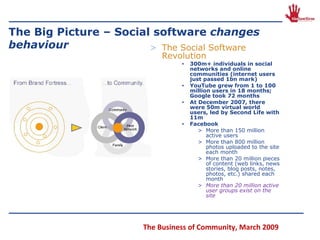
The Big Picture – Social software  changes behaviour The Social Software Revolution 300m+ individuals in social networks and online communities (internet users just passed 1bn mark) YouTube grew from 1 to 100 million users in 18 months; Google took 72 months At December 2007, there were 50m virtual world users, led by Second Life with 11m Facebook More than 150 million active users More than 800 million photos uploaded to the site each month More than 20 million pieces of content (web links, news stories, blog posts, notes, photos, etc.) shared each month More than 20 million active user groups exist on the site
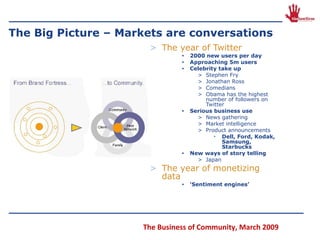
The Big Picture – Markets are conversations The year of Twitter 2000 new users per day Approaching 5m users Celebrity take up Stephen Fry Jonathan Ross Comedians Obama has the highest number of followers on Twitter Serious business use News gathering Market intelligence Product announcements Dell, Ford, Kodak, Samsung, Starbucks New ways of story telling Japan The year of monetizing data  ‘ Sentiment engines’
So what?
So what? Classes of Business Benefit Intangible Tangible Source of contribution Customer Loyalty & Brand Awareness Direct Revenue Lower Operational Expense Comment Customer/Member profile √   √ Customer intelligence & extending market reach at low cost Advocacy/pass through revenue √ √ √ Sales channel for complimentary products/services Group Discounts √ √   Special offers to subscribers Affiliation √ √   Viral sales Member-Member commerce √ √   Packaging brand products to serve customer's own network Offline events √ √   Forms deeper relationships Competitive research √ √ √ Access to opinions using polls/surveys Product development & feedback √ √ √ Lower service development costs Peer-to-peer self-help √ √ √ Reduces contact centre traffic Membership √ √ √ Friends invitations.  Member get member
How? The implications of the end user supplying itself are  far reaching Small pieces loosely joined Simple, lightweight tools (‘doing better with less’) Mashups, widgets Web 1.0 vs Web 2.0 1.0 Centralised.  People come to you (pull) 2.0 De-centralised.  Go to where people are (push) Imaginative use of ‘ Cloud  Web services’ Smarter organisation Re-use of excess capacity ‘ Bioteams’ Swarm behaviour From Intranets to social networks
Network statistics “ People have figured out they get far better information and support from one another than the companies that are supposed to serve them”.
Discovery of unmet needs
Discuss, Q&A L’Oreal – Write a priceless ad McDonald’s Global Casting  Nokia – Share your idea Muji  “ make and send us an object for a place in your home we don’t have a product for”

Doing Better with Less

  • 1.
    Doing better withless Why is the social networks phenomenon relevant to business? London, 22 nd October 2003
  • 2.
    Agenda Context, purpose,objectives Why is the social networks phenomenon relevant to business? What does this mean for you? Discussion, Q&A
  • 3.
    The law firmgroup History Recently worked on Metrotwin – social utility British Airways Recommendation engine Carphone Warehouse Social, eCommerce strategy Working on User generated viral video Food brand Web syndication engine Transactions in the ‘long tail’ Insurance industry
  • 4.
    The Big Picture– Arrival of the Network Economy
  • 5.
    The Big Picture– Hierarchy to Network Open Source Slime mould, Swarms & Emergent behaviour Peer production proven to outperform conventional command & control organisation SourceForge: 180k projects, 1.9m users Yochai Benkler – Linux and the nature of the firm Open Source Census Europe shows the highest usage with the United States lagging behind US Law: Open Source mandated for IT healthcare systems The rise of Ubuntu (& the fall of Microsoft?)
  • 6.
    The Big Picture– Social software changes behaviour The Social Software Revolution 300m+ individuals in social networks and online communities (internet users just passed 1bn mark) YouTube grew from 1 to 100 million users in 18 months; Google took 72 months At December 2007, there were 50m virtual world users, led by Second Life with 11m Facebook More than 150 million active users More than 800 million photos uploaded to the site each month More than 20 million pieces of content (web links, news stories, blog posts, notes, photos, etc.) shared each month More than 20 million active user groups exist on the site
  • 7.
    The Big Picture– Markets are conversations The year of Twitter 2000 new users per day Approaching 5m users Celebrity take up Stephen Fry Jonathan Ross Comedians Obama has the highest number of followers on Twitter Serious business use News gathering Market intelligence Product announcements Dell, Ford, Kodak, Samsung, Starbucks New ways of story telling Japan The year of monetizing data ‘ Sentiment engines’
  • 8.
  • 9.
    So what? Classesof Business Benefit Intangible Tangible Source of contribution Customer Loyalty & Brand Awareness Direct Revenue Lower Operational Expense Comment Customer/Member profile √   √ Customer intelligence & extending market reach at low cost Advocacy/pass through revenue √ √ √ Sales channel for complimentary products/services Group Discounts √ √   Special offers to subscribers Affiliation √ √   Viral sales Member-Member commerce √ √   Packaging brand products to serve customer's own network Offline events √ √   Forms deeper relationships Competitive research √ √ √ Access to opinions using polls/surveys Product development & feedback √ √ √ Lower service development costs Peer-to-peer self-help √ √ √ Reduces contact centre traffic Membership √ √ √ Friends invitations. Member get member
  • 10.
    How? The implicationsof the end user supplying itself are far reaching Small pieces loosely joined Simple, lightweight tools (‘doing better with less’) Mashups, widgets Web 1.0 vs Web 2.0 1.0 Centralised. People come to you (pull) 2.0 De-centralised. Go to where people are (push) Imaginative use of ‘ Cloud Web services’ Smarter organisation Re-use of excess capacity ‘ Bioteams’ Swarm behaviour From Intranets to social networks
  • 11.
    Network statistics “People have figured out they get far better information and support from one another than the companies that are supposed to serve them”.
  • 12.
  • 13.
    Discuss, Q&A L’Oreal– Write a priceless ad McDonald’s Global Casting Nokia – Share your idea Muji “ make and send us an object for a place in your home we don’t have a product for”