
Social Media and  Digital Engagement Imedia Summit Nick Jones, Director, Interactive Services, COI
Our Conversation today What the heck is COI? Defining social media and digital engagement Background and wider context Review of our use of social media to date The drivers that made it happen The benefits and risks The role of policy, guidance, standards
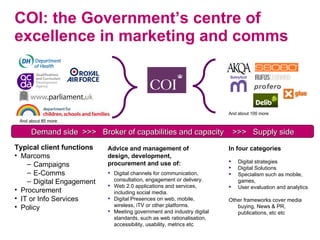
COI: the Government’s centre of excellence in marketing and comms And about 100 more Demand side  >>>  Broker of capabilities and capacity  >>>  Supply side Typical client functions Marcoms Campaigns  E-Comms Digital Engagement Procurement IT or Info Services Policy In four categories Digital strategies Digital Solutions Specialism such as mobile, games,  User evaluation and analytics Other frameworks cover media buying, News & PR, publications, etc etc And about 85 more Digital channels for communication, consultation, engagement or delivery.  Web 2.0 applications and services, including social media.  Digital Presences on web, mobile, wireless, iTV or other platforms.  Meeting government and industry digital standards, such as web rationalisation, accessibility, usability, metrics etc Advice and management of design, development, procurement and use of:
Defining social media ‘ Online technologies  and practices  that are used to share opinions and information, promote discussion and build relationships.’ “ It's a fusion of sociology and technology, transforming monologues (one to many) into dialogues (many to many) and is the democratization of information, transforming people from content readers into publishers.” Source: Wikipedia Does it allow you to  create, connect and share  more easily?
The flip-side: digital engagement Engagement dialogue : moving from broadcast to conversation; not only  listening  but responding; two way  collaboration  sharing information, data, opinion, discussion; building and sustaining rational and emotional  relationships moving audience from awareness to  action . Digital the leverage of  digital  media technologies the use of  interactive  techniques to improve service delivery and information provision.
What’s happening and wider context Review of Government use of social media to increase digital engagement The policy drivers
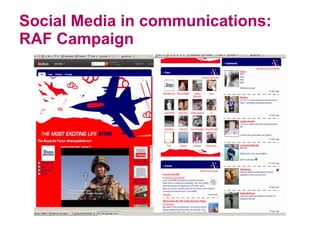
Social Media in communications: RAF Campaign
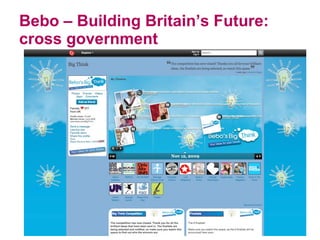
Bebo – Building Britain’s Future: cross government
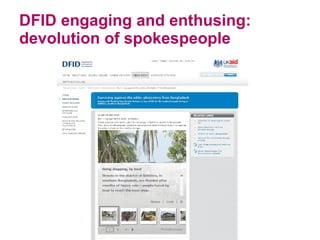
DFID engaging and enthusing: devolution of spokespeople
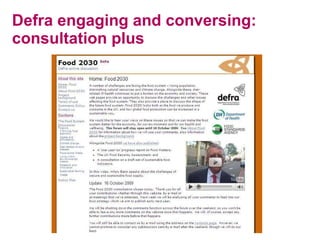
Defra engaging and conversing: consultation plus
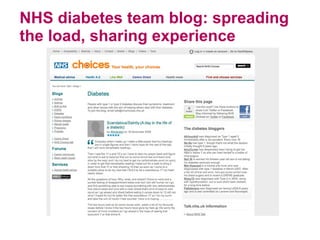
NHS diabetes team blog: spreading the load, sharing experience
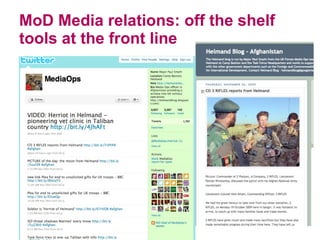
MoD Media relations: off the shelf tools at the front line
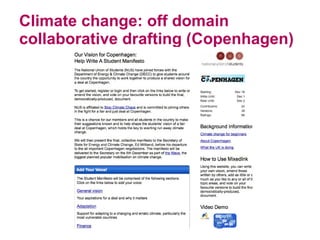
Climate change: off domain collaborative drafting (Copenhagen)
CivilSuite: internal collaboration tools for the Civil Service
Act On Co2
Act On Co2
Plus many others Royal Navy Engineer Challenge iphone app http://itunes.apple.com/gb/app/royal-navy-engineer-officer-challenge/id339491226?mt=8     Balance the Bobby, North Wales Police, participatory budgeting http://www.north-wales.police.uk/balanceyourbobbies/ Cyberbullying, Facebook page, 100,000 fans in a month  http://www.facebook.com/EndCyberbullying?v=wall
Wider context; the policy drivers that made it happen so far
2.0 Policy: four guiding principles formed the vision Open information  To have an effective voice, people need to be able to understand what is going on in their public services; government will publish information about public services in ways that are easy to find, use, and re-use. Open feedback The public should have opportunities to have a fair say about their services and contribute toward their ongoing development. Open conversation We will promote greater engagement through more interactive online consultation and collaboration. We will also empower people to be active on online peer-support networks. Open innovation  We will promote innovation in online public services to respond to changing expectations and bringing the concepts into mainstream government practice.  Helped frame  Working Together: Public Services on Your Side  and  Digital Engagement: Update on Power of Information  :
Policy needed explicit green light to let staff participate Be credible Be accurate, fair, thorough and transparent.  Be consistent Encourage constructive criticism and deliberation. Be cordial, honest and professional at all times.  Be responsive Share insight and create a dialogue Be integrated Make it part of something bigger, not just an add-on Be a civil servant  Remember that you are an ambassador for your organisation. Wherever possible, tell people who you are Principles for Online Participation. Part of the Civil Service Code http://www.civilservice.gov.uk/about/resources/participation-online.aspx :
The benefits and risks
Benefits of using social media Promote conversation to: Improve reputation and influence  Promote transparency Listen to feedback and improve service/ brand/ product   Empower users, stakeholders and partners Change behaviour  Enhance search engine performance Provide a new channel to: Augment traditional channels Increase reach and accessibility  Reflect   communication preferences Enable staff (communications, policy and delivery) Enhance qualitative and quantitative data
Risks Enhance qualitative and quantitative data Loss of ‘control’ Our unfamiliarity with format Absence of standards IT limitations in departments Elasticity of time and place Low levels of efficacy and trust – earn it Level of commitment required to manage  Failure to feedback Government trying to be cool
The role of policy, guidance, standards Policy – what can be done Guidance – how can I do it Standards - how can it be done well
Policy achievement: drivers and inhibitors on the way Triple whammy of drivers Ministerial drive Big-hitters’ buy-in Grass roots enthusiasm Inhibitors are the usual show-slowers Traditional comms control  IT control Resourcing implications Policy need to structure the approach to these issues and the risks “ If you can let police walk the streets with guns you can manage the risks of letting them use Facebook.” William Perrin, Policing 2.0 conference, National Policing Improvement Agency
Social media strategies… Start life… As an add-on to campaign activity With part-time resourcing In the tool-sheds Powered by enthusiasm
…  Should nest within wider digital comms strategies… Such strategies…  Integrate all digital comms activity Content: reuse, sharing, signposting Cooperation across paid, owned, earned channels Conversion: pull towards action goals Feature full-time resourcing Tools and time Powered by the comms plan
…  and contribute to digital engagement Strategies Integrated beyond traditional comms function Public participation  Data Enabling the workforce Resourcing from beyond comms Operations  Delivery  Tools and  time are applied in a system Powered by the business plan
COI Web Standards: helping us do it really well Usability Toolkit Cost, Usage, Quality Naming Mobile Digigov blog http://coi.gov.uk/blogs/digigov/ http://www.coi.gov.uk/guidance.php?page=188
Thank you [email_address] Twitter.com/nickjonesCOI COI is the UK Government's centre of marketing excellence. The Interactive Services team consists of 40 staff with over 350 collective years of digital industry experience. It delivers digital projects and assets for about 90 public sector clients. Working with a framework of about 100 digital suppliers, they deliver anything from widgets, sites and campaigns through to social media engagement and digital communications strategies. The team is also involved in writing guidance and cross-government standard setting on the use of social media, mobile and digital engagement. Clients range from the armed forces, through the education and health sectors to environmental and transport departments.  http://www.coi.gov.uk/services.php?page=109

COI presentation

  • 1.
    Social Media and Digital Engagement Imedia Summit Nick Jones, Director, Interactive Services, COI
  • 2.
    Our Conversation todayWhat the heck is COI? Defining social media and digital engagement Background and wider context Review of our use of social media to date The drivers that made it happen The benefits and risks The role of policy, guidance, standards
  • 3.
    COI: the Government’scentre of excellence in marketing and comms And about 100 more Demand side >>> Broker of capabilities and capacity >>> Supply side Typical client functions Marcoms Campaigns E-Comms Digital Engagement Procurement IT or Info Services Policy In four categories Digital strategies Digital Solutions Specialism such as mobile, games, User evaluation and analytics Other frameworks cover media buying, News & PR, publications, etc etc And about 85 more Digital channels for communication, consultation, engagement or delivery. Web 2.0 applications and services, including social media. Digital Presences on web, mobile, wireless, iTV or other platforms. Meeting government and industry digital standards, such as web rationalisation, accessibility, usability, metrics etc Advice and management of design, development, procurement and use of:
  • 4.
    Defining social media‘ Online technologies and practices that are used to share opinions and information, promote discussion and build relationships.’ “ It's a fusion of sociology and technology, transforming monologues (one to many) into dialogues (many to many) and is the democratization of information, transforming people from content readers into publishers.” Source: Wikipedia Does it allow you to create, connect and share more easily?
  • 5.
    The flip-side: digitalengagement Engagement dialogue : moving from broadcast to conversation; not only listening but responding; two way collaboration sharing information, data, opinion, discussion; building and sustaining rational and emotional relationships moving audience from awareness to action . Digital the leverage of digital media technologies the use of interactive techniques to improve service delivery and information provision.
  • 6.
    What’s happening andwider context Review of Government use of social media to increase digital engagement The policy drivers
  • 7.
    Social Media incommunications: RAF Campaign
  • 8.
    Bebo – BuildingBritain’s Future: cross government
  • 9.
    DFID engaging andenthusing: devolution of spokespeople
  • 10.
    Defra engaging andconversing: consultation plus
  • 11.
    NHS diabetes teamblog: spreading the load, sharing experience
  • 12.
    MoD Media relations:off the shelf tools at the front line
  • 13.
    Climate change: offdomain collaborative drafting (Copenhagen)
  • 14.
    CivilSuite: internal collaborationtools for the Civil Service
  • 15.
  • 16.
  • 17.
    Plus many othersRoyal Navy Engineer Challenge iphone app http://itunes.apple.com/gb/app/royal-navy-engineer-officer-challenge/id339491226?mt=8   Balance the Bobby, North Wales Police, participatory budgeting http://www.north-wales.police.uk/balanceyourbobbies/ Cyberbullying, Facebook page, 100,000 fans in a month http://www.facebook.com/EndCyberbullying?v=wall
  • 18.
    Wider context; thepolicy drivers that made it happen so far
  • 19.
    2.0 Policy: fourguiding principles formed the vision Open information To have an effective voice, people need to be able to understand what is going on in their public services; government will publish information about public services in ways that are easy to find, use, and re-use. Open feedback The public should have opportunities to have a fair say about their services and contribute toward their ongoing development. Open conversation We will promote greater engagement through more interactive online consultation and collaboration. We will also empower people to be active on online peer-support networks. Open innovation We will promote innovation in online public services to respond to changing expectations and bringing the concepts into mainstream government practice. Helped frame Working Together: Public Services on Your Side and Digital Engagement: Update on Power of Information :
  • 20.
    Policy needed explicitgreen light to let staff participate Be credible Be accurate, fair, thorough and transparent. Be consistent Encourage constructive criticism and deliberation. Be cordial, honest and professional at all times. Be responsive Share insight and create a dialogue Be integrated Make it part of something bigger, not just an add-on Be a civil servant Remember that you are an ambassador for your organisation. Wherever possible, tell people who you are Principles for Online Participation. Part of the Civil Service Code http://www.civilservice.gov.uk/about/resources/participation-online.aspx :
  • 21.
  • 22.
    Benefits of usingsocial media Promote conversation to: Improve reputation and influence Promote transparency Listen to feedback and improve service/ brand/ product Empower users, stakeholders and partners Change behaviour Enhance search engine performance Provide a new channel to: Augment traditional channels Increase reach and accessibility Reflect communication preferences Enable staff (communications, policy and delivery) Enhance qualitative and quantitative data
  • 23.
    Risks Enhance qualitativeand quantitative data Loss of ‘control’ Our unfamiliarity with format Absence of standards IT limitations in departments Elasticity of time and place Low levels of efficacy and trust – earn it Level of commitment required to manage Failure to feedback Government trying to be cool
  • 24.
    The role ofpolicy, guidance, standards Policy – what can be done Guidance – how can I do it Standards - how can it be done well
  • 25.
    Policy achievement: driversand inhibitors on the way Triple whammy of drivers Ministerial drive Big-hitters’ buy-in Grass roots enthusiasm Inhibitors are the usual show-slowers Traditional comms control IT control Resourcing implications Policy need to structure the approach to these issues and the risks “ If you can let police walk the streets with guns you can manage the risks of letting them use Facebook.” William Perrin, Policing 2.0 conference, National Policing Improvement Agency
  • 26.
    Social media strategies…Start life… As an add-on to campaign activity With part-time resourcing In the tool-sheds Powered by enthusiasm
  • 27.
    … Shouldnest within wider digital comms strategies… Such strategies… Integrate all digital comms activity Content: reuse, sharing, signposting Cooperation across paid, owned, earned channels Conversion: pull towards action goals Feature full-time resourcing Tools and time Powered by the comms plan
  • 28.
    … andcontribute to digital engagement Strategies Integrated beyond traditional comms function Public participation Data Enabling the workforce Resourcing from beyond comms Operations Delivery Tools and time are applied in a system Powered by the business plan
  • 29.
    COI Web Standards:helping us do it really well Usability Toolkit Cost, Usage, Quality Naming Mobile Digigov blog http://coi.gov.uk/blogs/digigov/ http://www.coi.gov.uk/guidance.php?page=188
  • 30.
    Thank you [email_address]Twitter.com/nickjonesCOI COI is the UK Government's centre of marketing excellence. The Interactive Services team consists of 40 staff with over 350 collective years of digital industry experience. It delivers digital projects and assets for about 90 public sector clients. Working with a framework of about 100 digital suppliers, they deliver anything from widgets, sites and campaigns through to social media engagement and digital communications strategies. The team is also involved in writing guidance and cross-government standard setting on the use of social media, mobile and digital engagement. Clients range from the armed forces, through the education and health sectors to environmental and transport departments. http://www.coi.gov.uk/services.php?page=109

Editor's Notes

  • #4 THIS SLIDE BUILDS Top half illustrates the clients who demand and the supplier who supply Second click reveals details about each of these CLIENTS Mostly or clients are from the marcoms function. However, procurment is often involved and increasingly we have to work with IT and policy functions COI We give advice and project manage. Suppliers We explain the frameworks we own and the other COI frameworks Perhaps worth veribly noting the paid-for digital activity is managed through CIM