










THE ICFAI UNIVERSITY
DEHRADUN
A PRESENTATION
OF
TRANSPORTATION
ENGINEERING
NAME –ABHISHEKSAGAR
GUIDEDBY: MR. AMIT BERASIR
MARSHAL STABILITY TEST ON
BITUMIN
WHAT IS MARSHAL STABILITY .
 The mix design (wet-mix) determines the optimum bitumen content. This is
preceded by the dry mix design. There are many methods available for mix
design which vary in the size of the test specimen , compaction and other test
specification.
 Marshall method of mix design is the most popular one and is discussed
below.
MARSHAL MIX DESIGN
 The Marshall stability and test provides the performance prediction measure
for the Marshall mix design method.
 The stability portion of the test measures the maximum load supported by
the test specimen at a loading rate of 50.8 mm/minute. Load is applied to
the specimen till failure, and the maximum load is designated as stability.
During the loading, an attached dial gauge measures the specimen's plastic
(deformation) due to the loading. The value is recorded in 0.25 mm (0.01
inch) increments at the same time when the maximum load is recorded. The
important steps involved in marshal mix design are summarized next.
PREPARATION OF MIX – DESIGN.
 Approximately 1200gm of aggregates and filler is heated to a temperature of 175-
190 DEGREE. Bitumen is heated to a temperature of 121-125 DEGREE with the First
trial percentage of bitumen (say 3.5 or 4% by weight of the mineral aggregates).
 The heated aggregates and bitumen are thoroughly mixed at a temperature of 154
􀀀 160oC. The
 mix is placed in a preheated mould and compacted by a rammer with 50 blows on
either side at temperature
 of 138oC to 149oC. The weight of mixed aggregates taken for the preparation of
the specimen may be suitably
 altered to obtain a compacted thickness of 63.5+/-3 mm. Vary the bitumen
content in the next trial by +0:5%
 and repeat the above procedure. Number of trials are predetermined.
Properities of mix design-
 The properties that are of interest include the theoretical specific
gravity Gt, the bulk specific gravity of the mix (Gm), percent air voids
Vv, percent volume of bitumen (Vb), percent void in mixed aggregate
VMA and percent voids with bitumen VFB
Phase diagram of bitumen mix
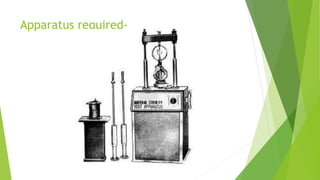
Apparatus required-
Description about the apparatus .
 Breaking Head - the breaking head shall consist of upper and lower
cylindrical segments or test heads having an inside radius of curvature of 50.8
mm accurately machined. The lower segment shall be mounted on a base having
two perpendicular guide rods or posts extending upward. Guide sleeves in the
upper segment shall be in such a position as to direct the two segments together
without appreciable binding or lose motion on the guide rods.
 Loading Jack - the loading jack shall consist of a screw jack mounted in
a testing frame and shall produce a uniform vertical movement of 50.8
mm/minute. An electric motor may be attached to the jacking mechanism. Ring
Dynamometer Assembly or Electronic Equivalent - one ring dynamometer of 2267
kg capacity and sensitivity of 4.536 kg up to 453.6 kg and 11.34 kg between
453.6 and 2267 kg shall be equipped with a micrometer dial. The micrometer
dial shall be graduated in 0.0025 mm. Upper and lower ring dynamometer
attachments are required.
 Flow meter - the flow meter shall consist of a guide sleeve and a
gauge. The activating pin of the gauge shall slide inside the guide sleeve with
a slight amount of frictional resistance. The guide sleeve shall slide freely
over the guide rod of the breaking head. The flow meter gauge shall be
adjusted to zero when placed in position on the breaking head when each
individual test specimen is inserted between the breaking head segments.
 Water Bath - the water bath shall be at least 152 mm deep and
shall be thermostatically controlled so as to maintain the bath at 60 ± 1o C.
The tank shall have a perforated false bottom or be equipped with a shelf for
supporting specimens 51 mm above the bottom of the bath.
Procedure-
 Bring the specimens prepared with bitumen cement to the specified
temperature by immersing in a water bath 30 minutes. Maintain the bath or
oven temperature at 60 ± 1oC for bitumen cement specimens. Bring the
specimens prepared with bitumin cutback to the specified temperature by
placing them in the air bath for a minimum of 2 hours. Maintain the air bath
temperature at 25 ± 1o C.
 The testing head temperature shall be maintained between 20 to 38o C.
Remove the specimen from the water bath, oven or air bath and place in the
lower segment at the breaking head. Place the upper segment of the breaking
head on the specimen and place the complete assembly in position on the
testing machine. Place the flow-meter, where used, in position over one of
the guide rods and adjust the flow-meter to zero while holding the sleeve
firmly against the upper segment of the breaking head.
 Hold the flow meter sleeve firmly against the upper segment of the breaking
head while the test load is being applied. Apply the load to the specimen by
means of the constant rate of movement of the load jack or testing machine
head of 50.8 mm/minute until the maximum load is reached and the load
decreases as indicated by the dial. Record the maximum load noted on the
testing machine or converted from the maximum micro meter dial reading.
Release the flow meter sleeve or note the micro meter dial reading, where
used, the instant the maximum load begins to decrease. Note and record the
indicated flow value or equivalent units in mm if a micro meter dial is used to
measure the flow. The elapsed time for the test from removal of the test
specimen from the water bath to the maximum load determinations shall not
exceed 30 seconds..
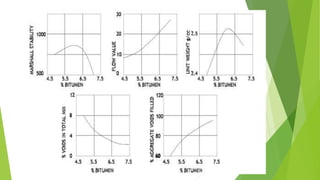
Graphical plots
 The average value of the above properties are determined for each
mix with different bitumen content and the following graphical plots
are prepared:
 1. Binder content versus corrected Marshall stability
 2. Binder content versus Marshall ow
 3. Binder content versus percentage of void (Vv) in the total mix
 4. Binder content versus voids filled with bitumen (V FB)
 5. Binder content versus unit weight or bulk specific gravity (Gm)
Abhishek sagar 121vc00235

Abhishek sagar 121vc00235

  • 1.
    THE ICFAI UNIVERSITY DEHRADUN APRESENTATION OF TRANSPORTATION ENGINEERING NAME –ABHISHEKSAGAR GUIDEDBY: MR. AMIT BERASIR
  • 2.
  • 3.
    WHAT IS MARSHALSTABILITY .
  • 4.
     The mixdesign (wet-mix) determines the optimum bitumen content. This is preceded by the dry mix design. There are many methods available for mix design which vary in the size of the test specimen , compaction and other test specification.  Marshall method of mix design is the most popular one and is discussed below.
  • 5.
    MARSHAL MIX DESIGN The Marshall stability and test provides the performance prediction measure for the Marshall mix design method.  The stability portion of the test measures the maximum load supported by the test specimen at a loading rate of 50.8 mm/minute. Load is applied to the specimen till failure, and the maximum load is designated as stability. During the loading, an attached dial gauge measures the specimen's plastic (deformation) due to the loading. The value is recorded in 0.25 mm (0.01 inch) increments at the same time when the maximum load is recorded. The important steps involved in marshal mix design are summarized next.
  • 6.
    PREPARATION OF MIX– DESIGN.  Approximately 1200gm of aggregates and filler is heated to a temperature of 175- 190 DEGREE. Bitumen is heated to a temperature of 121-125 DEGREE with the First trial percentage of bitumen (say 3.5 or 4% by weight of the mineral aggregates).  The heated aggregates and bitumen are thoroughly mixed at a temperature of 154 􀀀 160oC. The  mix is placed in a preheated mould and compacted by a rammer with 50 blows on either side at temperature  of 138oC to 149oC. The weight of mixed aggregates taken for the preparation of the specimen may be suitably  altered to obtain a compacted thickness of 63.5+/-3 mm. Vary the bitumen content in the next trial by +0:5%  and repeat the above procedure. Number of trials are predetermined.
  • 7.
    Properities of mixdesign-  The properties that are of interest include the theoretical specific gravity Gt, the bulk specific gravity of the mix (Gm), percent air voids Vv, percent volume of bitumen (Vb), percent void in mixed aggregate VMA and percent voids with bitumen VFB Phase diagram of bitumen mix
  • 8.
  • 9.
    Description about theapparatus .  Breaking Head - the breaking head shall consist of upper and lower cylindrical segments or test heads having an inside radius of curvature of 50.8 mm accurately machined. The lower segment shall be mounted on a base having two perpendicular guide rods or posts extending upward. Guide sleeves in the upper segment shall be in such a position as to direct the two segments together without appreciable binding or lose motion on the guide rods.  Loading Jack - the loading jack shall consist of a screw jack mounted in a testing frame and shall produce a uniform vertical movement of 50.8 mm/minute. An electric motor may be attached to the jacking mechanism. Ring Dynamometer Assembly or Electronic Equivalent - one ring dynamometer of 2267 kg capacity and sensitivity of 4.536 kg up to 453.6 kg and 11.34 kg between 453.6 and 2267 kg shall be equipped with a micrometer dial. The micrometer dial shall be graduated in 0.0025 mm. Upper and lower ring dynamometer attachments are required.
  • 10.
     Flow meter- the flow meter shall consist of a guide sleeve and a gauge. The activating pin of the gauge shall slide inside the guide sleeve with a slight amount of frictional resistance. The guide sleeve shall slide freely over the guide rod of the breaking head. The flow meter gauge shall be adjusted to zero when placed in position on the breaking head when each individual test specimen is inserted between the breaking head segments.  Water Bath - the water bath shall be at least 152 mm deep and shall be thermostatically controlled so as to maintain the bath at 60 ± 1o C. The tank shall have a perforated false bottom or be equipped with a shelf for supporting specimens 51 mm above the bottom of the bath.
  • 11.
    Procedure-  Bring thespecimens prepared with bitumen cement to the specified temperature by immersing in a water bath 30 minutes. Maintain the bath or oven temperature at 60 ± 1oC for bitumen cement specimens. Bring the specimens prepared with bitumin cutback to the specified temperature by placing them in the air bath for a minimum of 2 hours. Maintain the air bath temperature at 25 ± 1o C.  The testing head temperature shall be maintained between 20 to 38o C. Remove the specimen from the water bath, oven or air bath and place in the lower segment at the breaking head. Place the upper segment of the breaking head on the specimen and place the complete assembly in position on the testing machine. Place the flow-meter, where used, in position over one of the guide rods and adjust the flow-meter to zero while holding the sleeve firmly against the upper segment of the breaking head.
  • 12.
     Hold theflow meter sleeve firmly against the upper segment of the breaking head while the test load is being applied. Apply the load to the specimen by means of the constant rate of movement of the load jack or testing machine head of 50.8 mm/minute until the maximum load is reached and the load decreases as indicated by the dial. Record the maximum load noted on the testing machine or converted from the maximum micro meter dial reading. Release the flow meter sleeve or note the micro meter dial reading, where used, the instant the maximum load begins to decrease. Note and record the indicated flow value or equivalent units in mm if a micro meter dial is used to measure the flow. The elapsed time for the test from removal of the test specimen from the water bath to the maximum load determinations shall not exceed 30 seconds..
  • 13.
    Graphical plots  Theaverage value of the above properties are determined for each mix with different bitumen content and the following graphical plots are prepared:  1. Binder content versus corrected Marshall stability  2. Binder content versus Marshall ow  3. Binder content versus percentage of void (Vv) in the total mix  4. Binder content versus voids filled with bitumen (V FB)  5. Binder content versus unit weight or bulk specific gravity (Gm)