1
JOB MIX FORMULA (JMF)
PRSENTED BY: NISSAR AHMED
2
INTRODUCTION
 Basically, its just a recipe for
making hot mix.
That would be the asphalt
cement.
That would be the aggregate.

3
ASPHALT CONCRETE
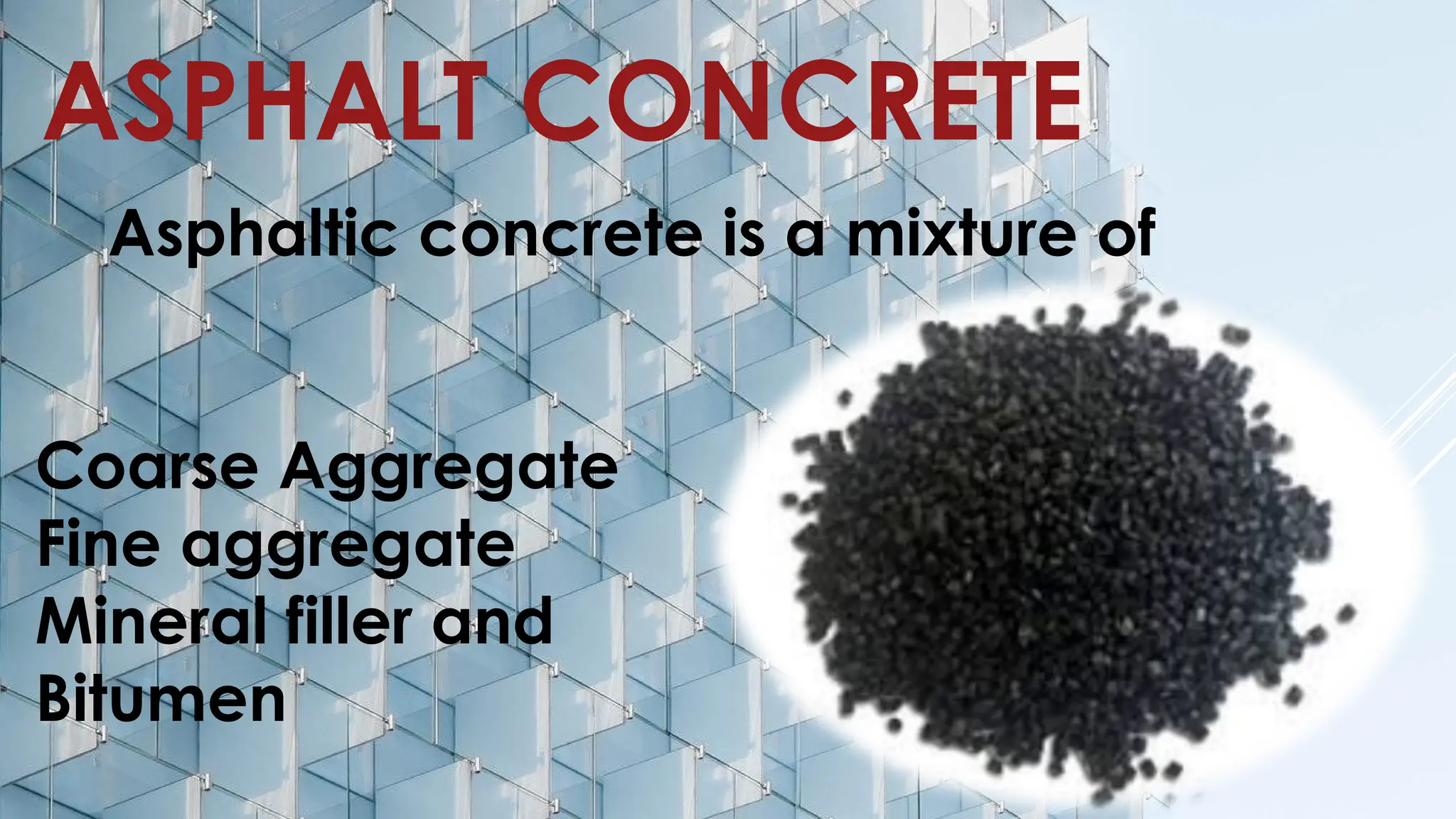
Asphaltic concrete is a mixture of
Coarse Aggregate
Fine aggregate
Mineral filler and
Bitumen
ASPHALT BINDER
 The main purpose of the binder is to completely coat the surface
area of the aggregate. This will waterproof the aggregate.
 Too little AC in the mix can leave portions of the aggregate
uncoated. This results in a lack of durability and strength, and can
lead to raveling or stripping.
 Too much AC in the mix results in a needlessly expensive mix, rich
spots or bleeding, lowered skid resistance, and rutting or shoving of
the pavement. In other words, the performance of the pavement
depends on how much asphalt binder is in the mix. 5
BITUMEN
The residue of crude oil in a distillation
process is called bitumen.
6
It is brown and black in
color.
 It is uses as a binder
material.
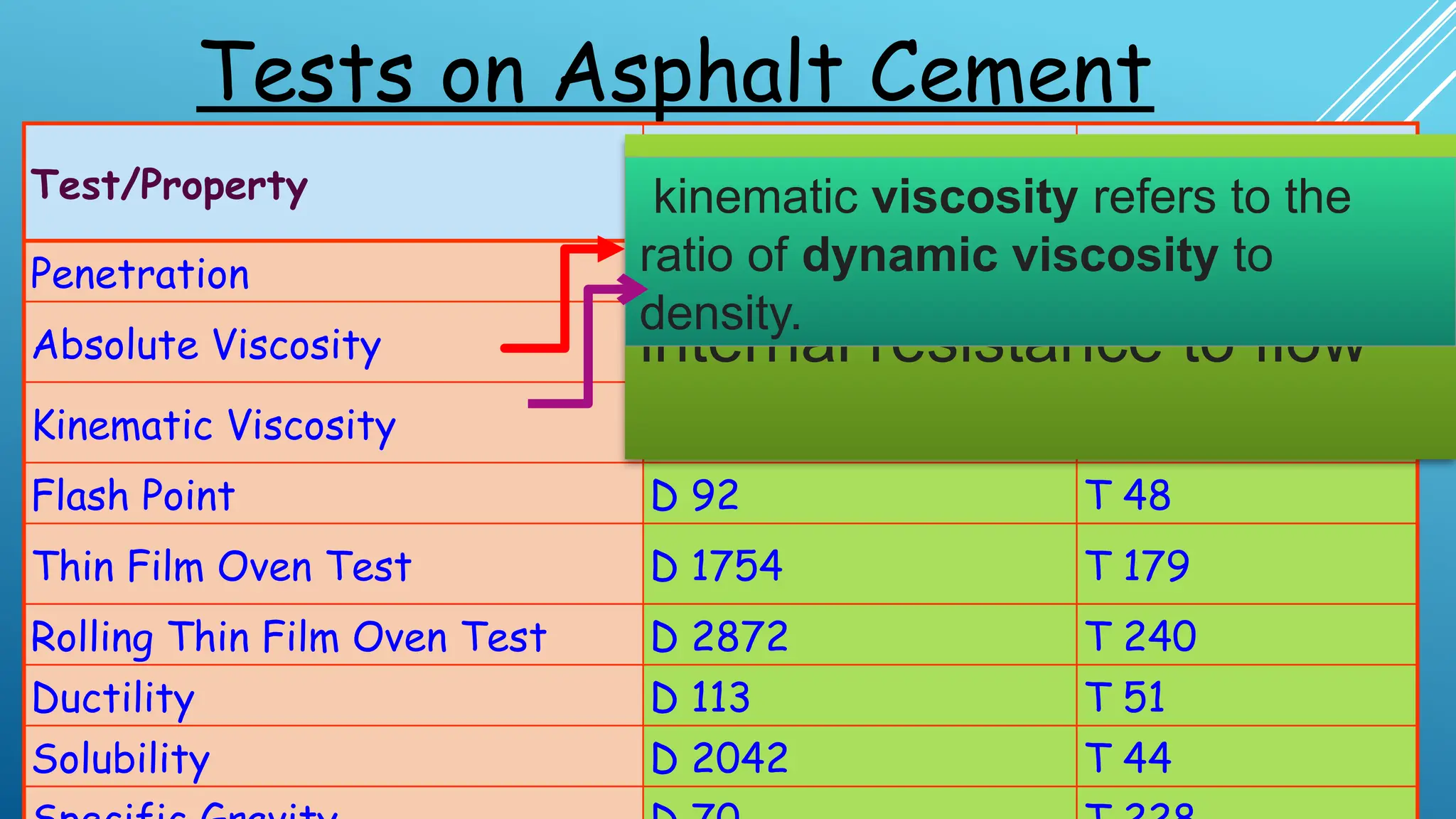
Tests on Asphalt Cement
Test/Property ASTM Designation
AASHTO
Designation
Penetration D 5 T 49
Absolute Viscosity D 2171 T 202
Kinematic Viscosity D 2170 T 201
Flash Point D 92 T 48
Thin Film Oven Test D 1754 T 179
Rolling Thin Film Oven Test D 2872 T 240
Ductility D 113 T 51
Solubility D 2042 T 44
Absolute viscosity is the
measurement of the fluid's
internal resistance to flow
kinematic viscosity refers to the
ratio of dynamic viscosity to
density.
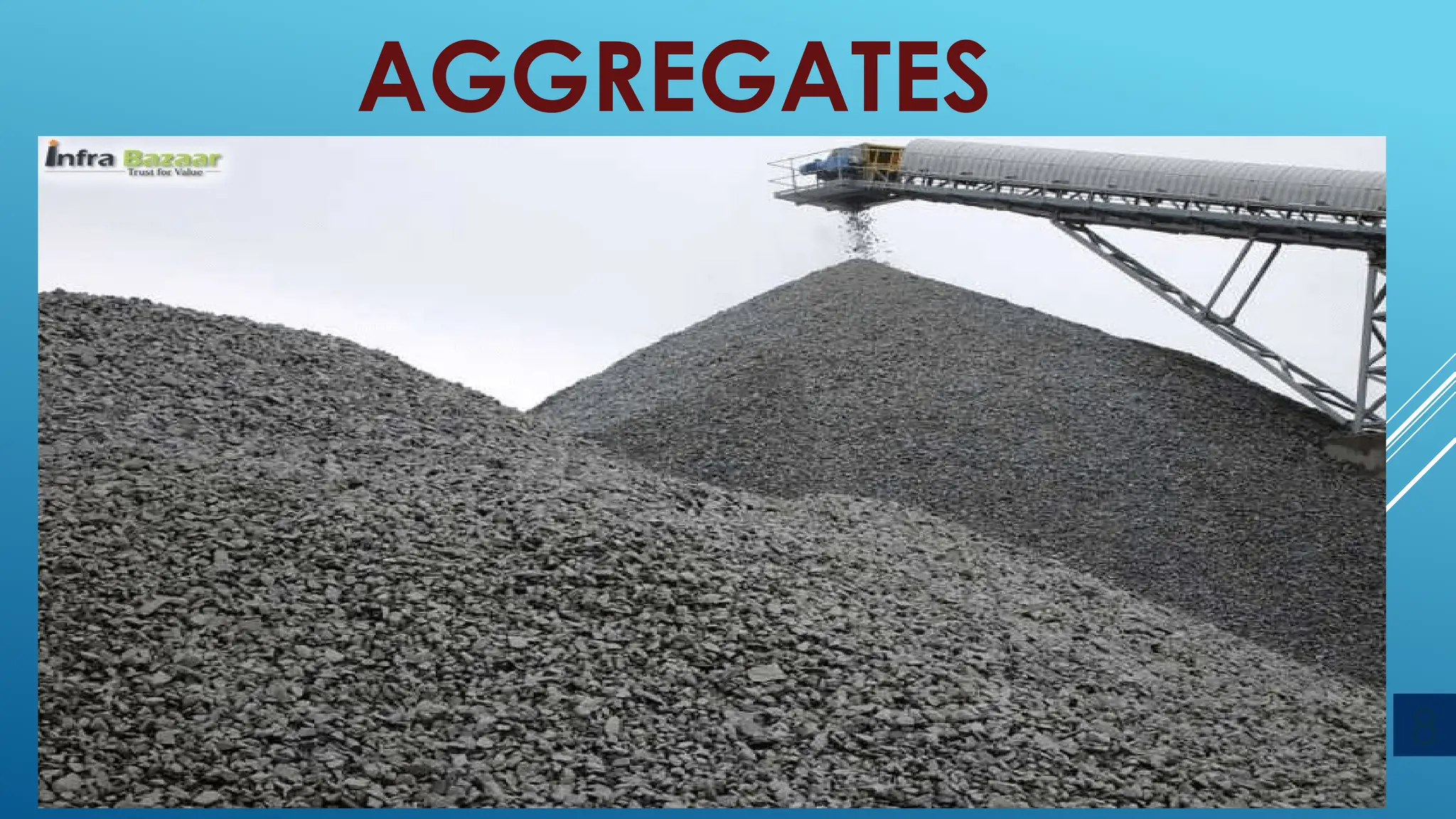
AGGREGATES
 “aggregate”, is a broad category of coarse particulate
material used in construction, including sand, gravel,
crushed stone, slag, recycled concrete and
geosynthetic aggregates. ...
 Aggregates are also used as base material under
foundations,
8
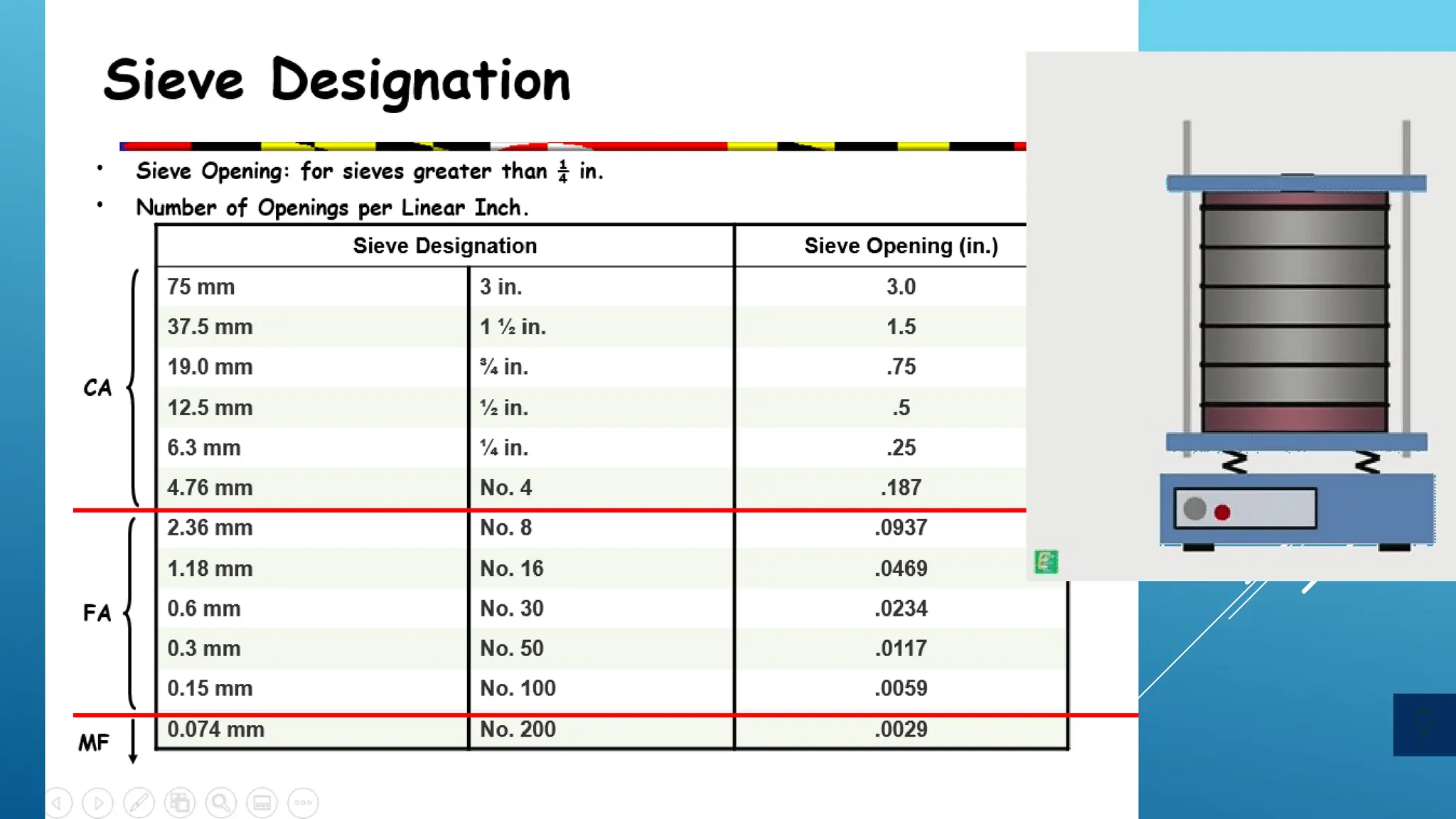
 The basic property of the aggregate
is its grain size distribution or
gradation
9
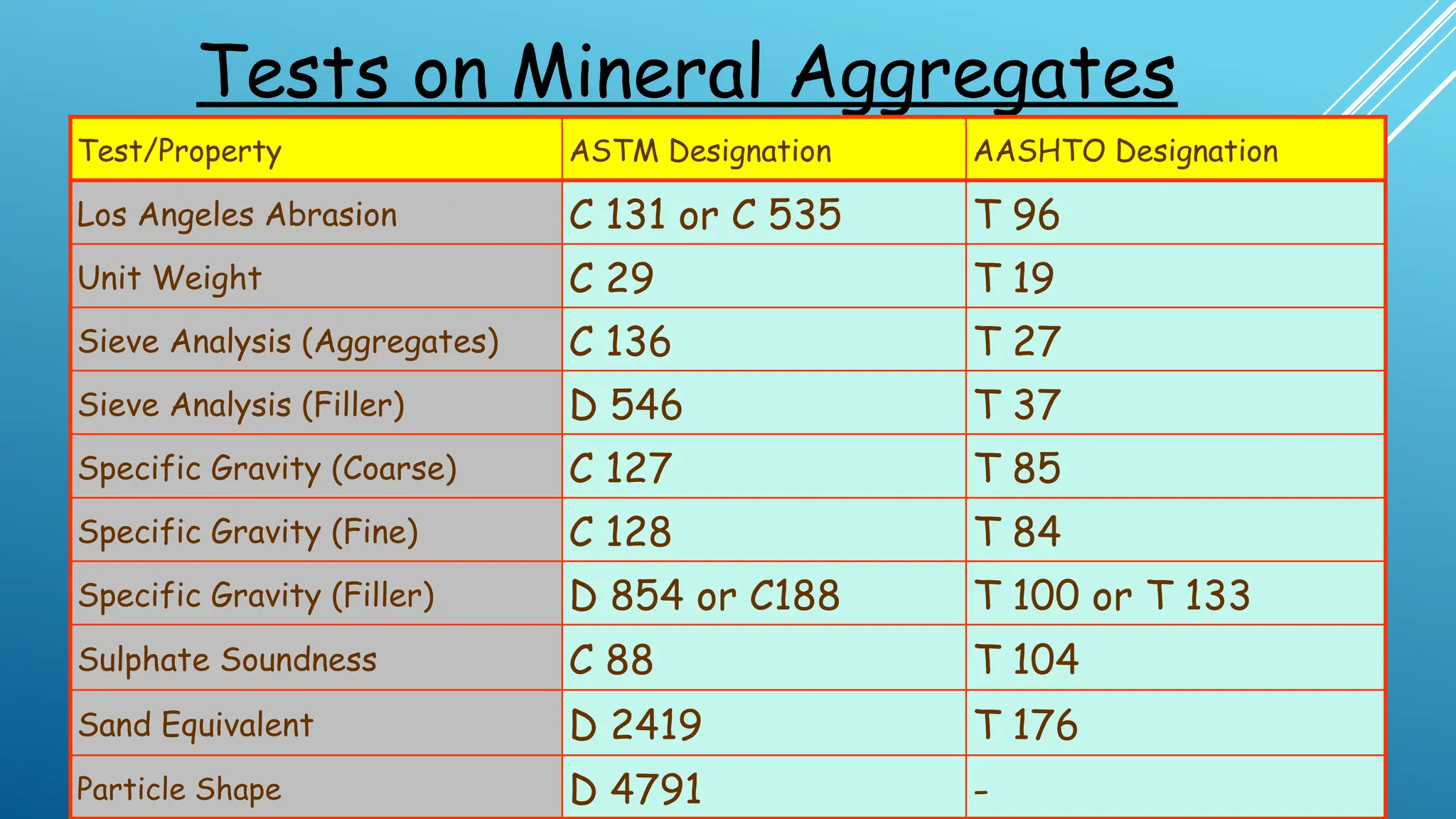
Tests on Mineral Aggregates
Test/Property ASTM Designation AASHTO Designation
Los Angeles Abrasion C 131 or C 535 T 96
Unit Weight C 29 T 19
Sieve Analysis (Aggregates) C 136 T 27
Sieve Analysis (Filler) D 546 T 37
Specific Gravity (Coarse) C 127 T 85
Specific Gravity (Fine) C 128 T 84
Specific Gravity (Filler) D 854 or C188 T 100 or T 133
Sulphate Soundness C 88 T 104
Sand Equivalent D 2419 T 176
Particle Shape D 4791 -
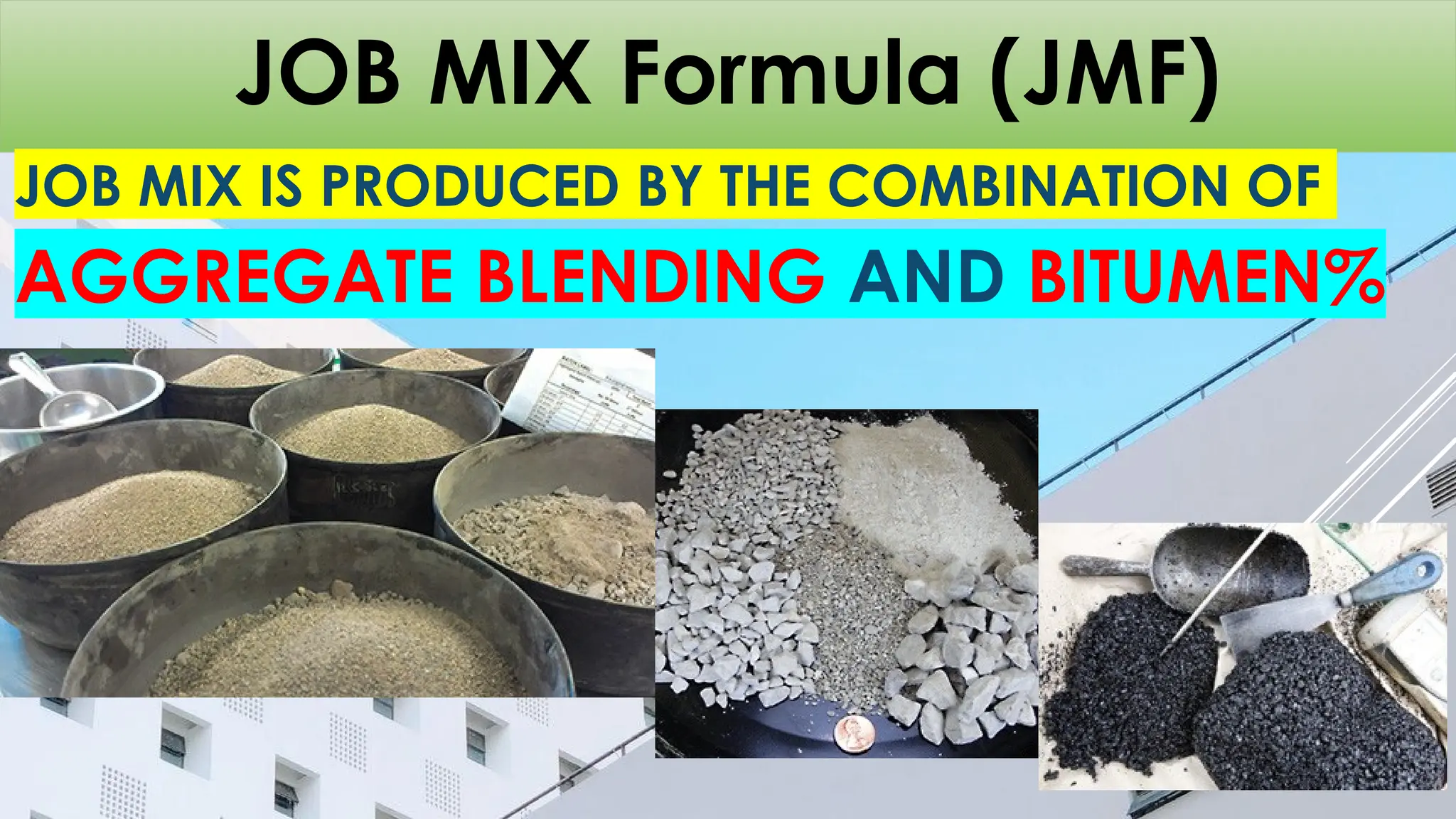
JOB MIX Formula (JMF)
JOB MIX IS PRODUCED BY THE COMBINATION OF
AGGREGATE BLENDING AND BITUMEN%
12
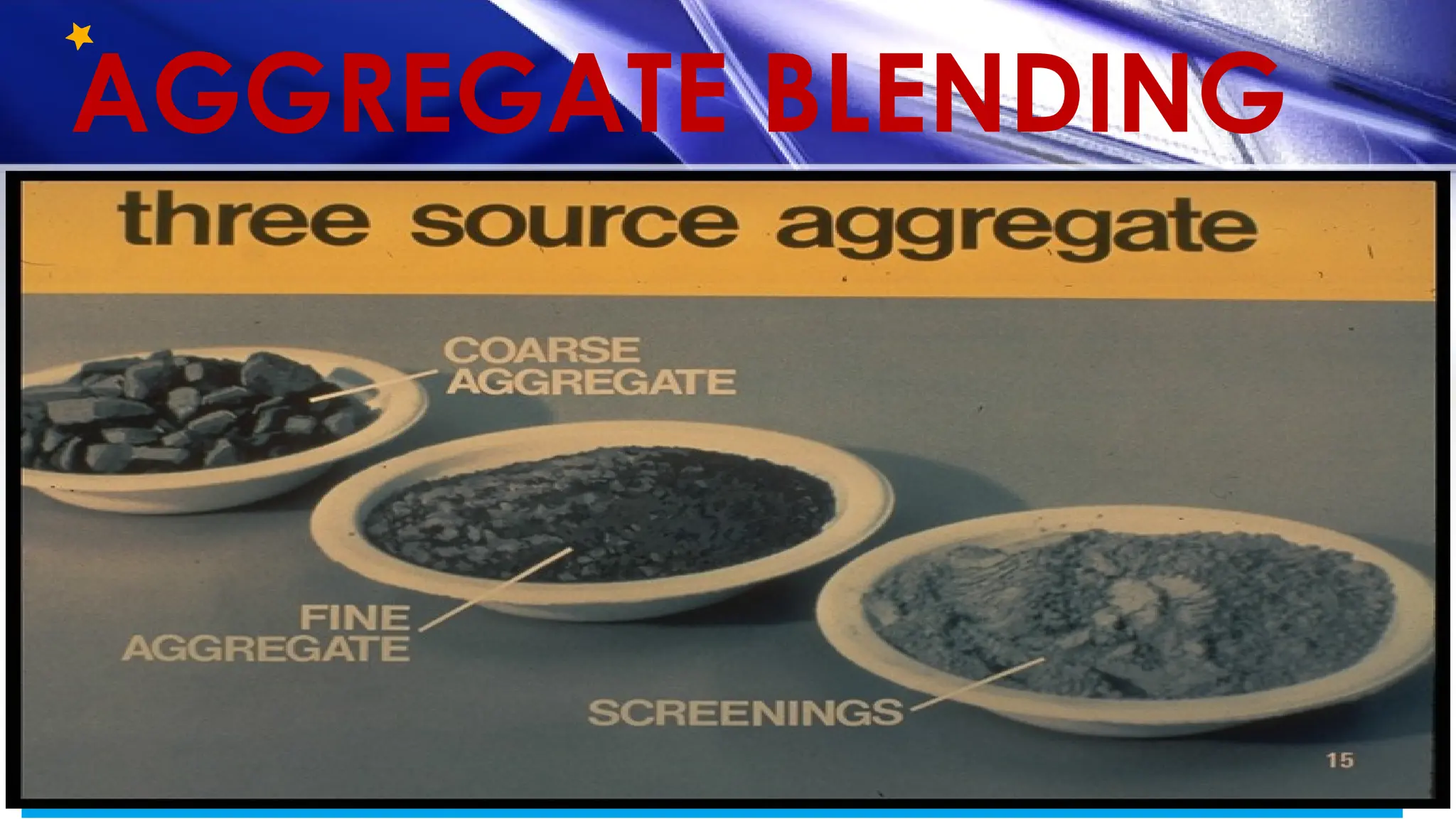
AGGREGATE BLENDING
Basic Formula
P = Aa + Bb + Cc
P = the percentage of material passing a given sieve for
the combined aggregates A, B, C, etc.;
A, B, C, etc. = percentages of material passing a given
sieve for aggregates A, B, C, etc
a, b, c, etc. = proportions of aggregates, A, B, C, etc. used
in the combination and where the total =1.00.
AGGREGATE BLENDING
P = Aa + Bb + Cc
a = –
𝑷 𝑩/ –
𝑨 𝑩
b = –
𝑷 𝑨/ –
𝑩 𝑨
a + b + c= 1
b + c = 1 – a
AGGREGATE BLENDING
Sieve analysis
GRADING SPECIFICATION AND GRADATIONS
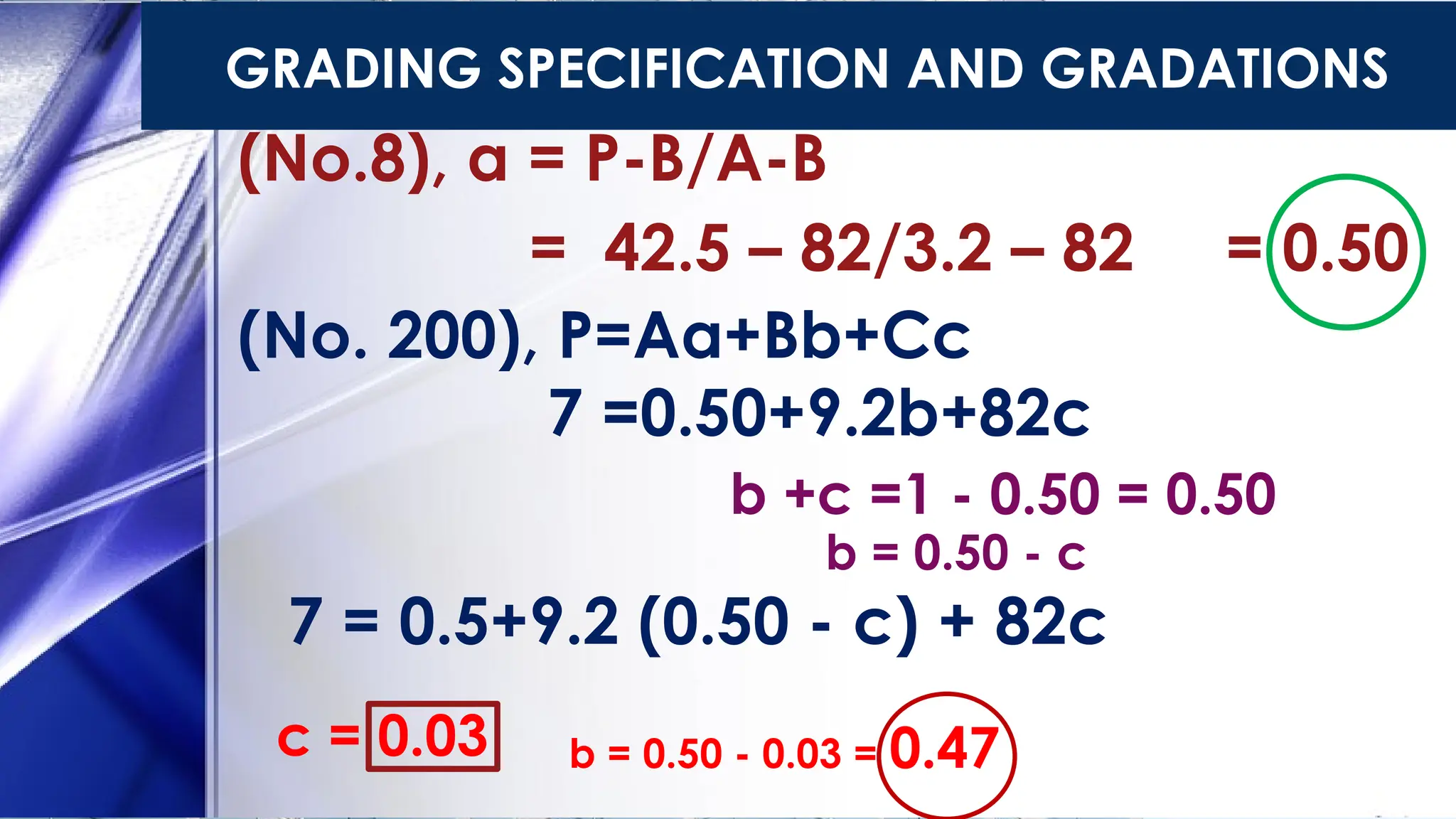
(No.8), a = P-B/A-B
= 42.5 – 82/3.2 – 82 = 0.50
(No. 200), P=Aa+Bb+Cc
7 =0.50+9.2b+82c
b +c =1 - 0.50 = 0.50
b = 0.50 - c
7 = 0.5+9.2 (0.50 - c) + 82c
c = 0.03 b = 0.50 - 0.03 = 0.47
1
6
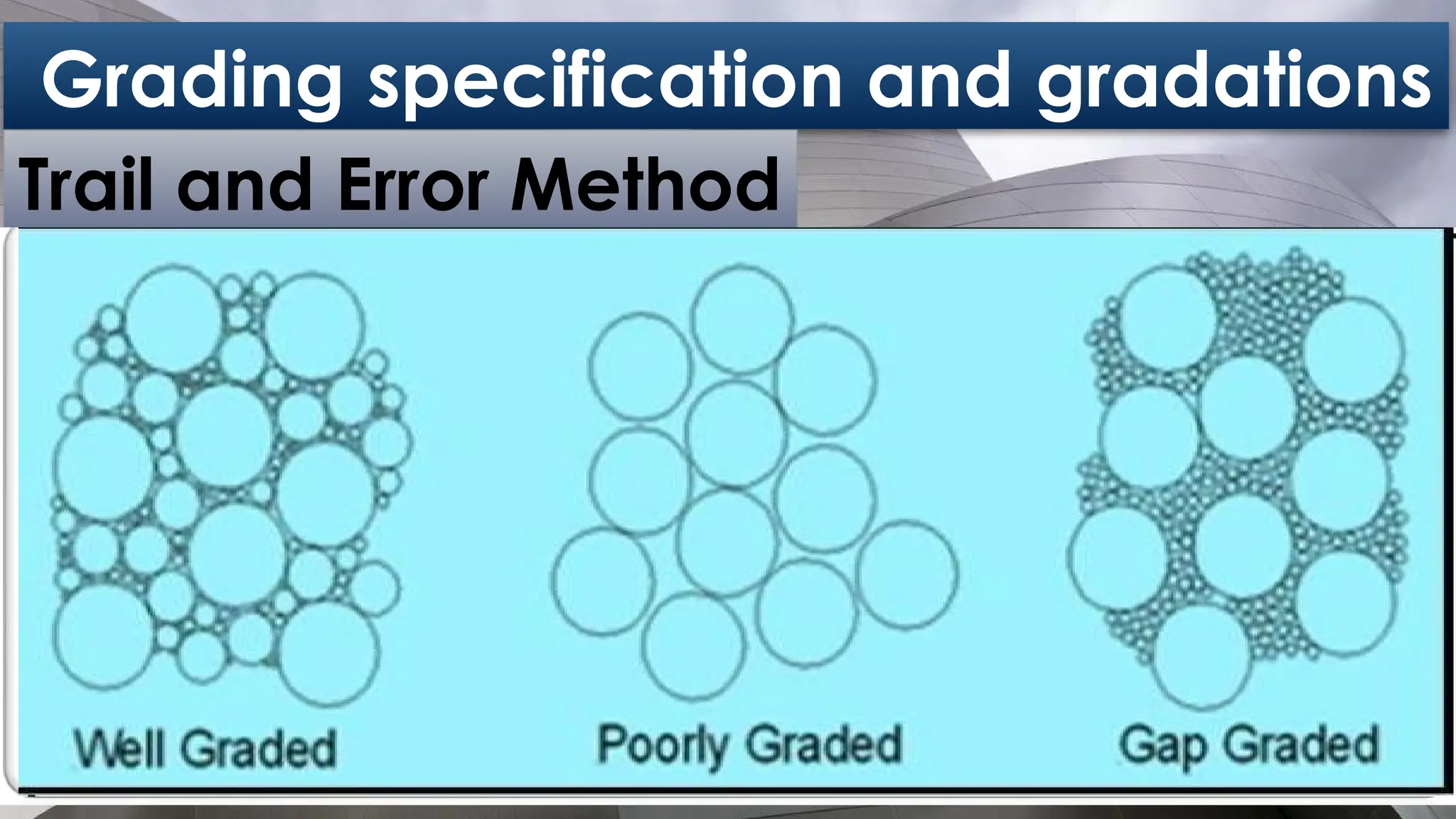
Grading specification and gradations
Trail and Error Method
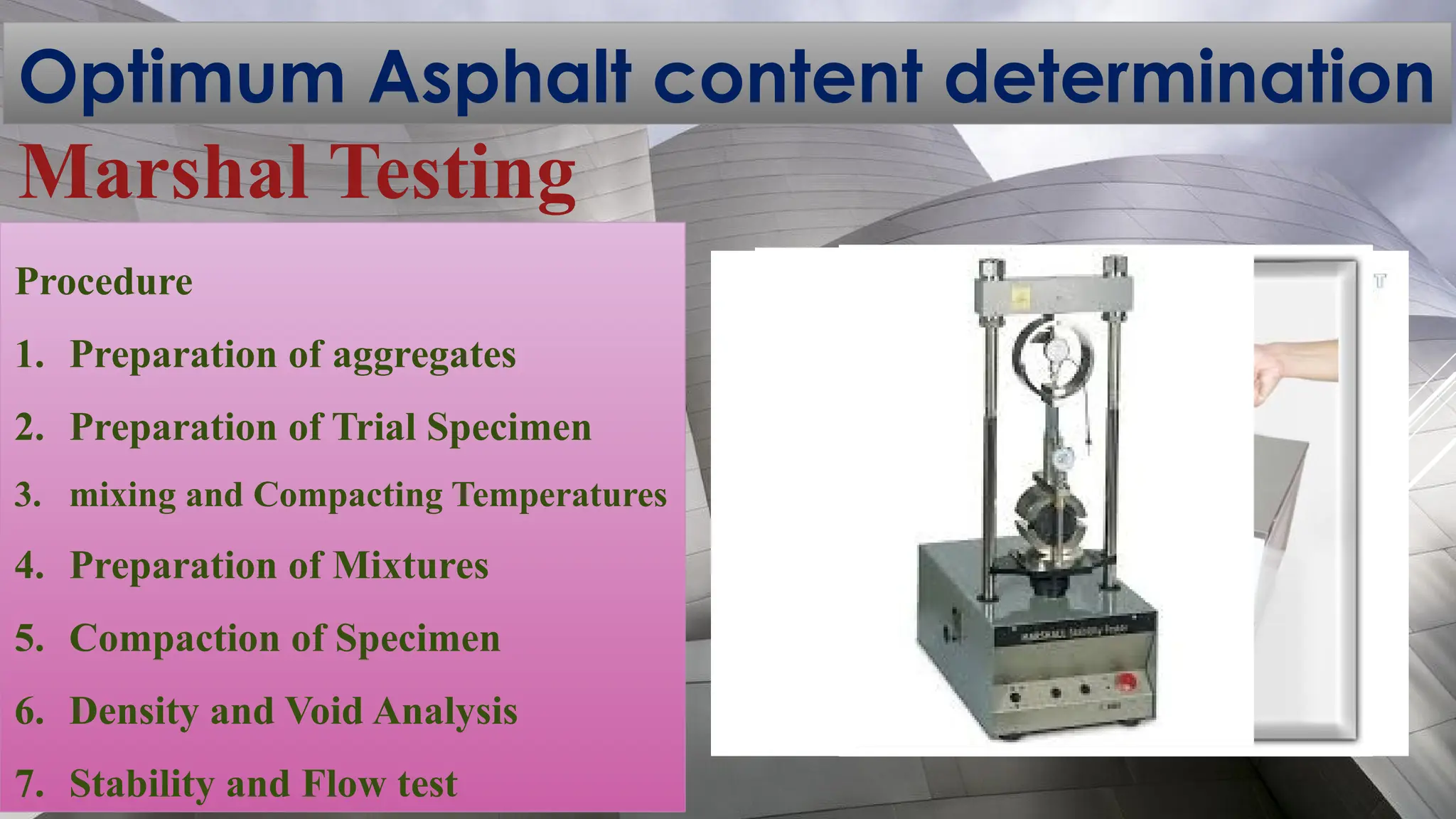
Optimum Asphalt content determination
Marshal Testing
Procedure
1. Preparation of aggregates
2. Preparation of Trial Specimen
3. mixing and Compacting Temperatures
4. Preparation of Mixtures
5. Compaction of Specimen
6. Density and Void Analysis
7. Stability and Flow test
OPTIMUM ASPHALT CONTENT DETERMINATION
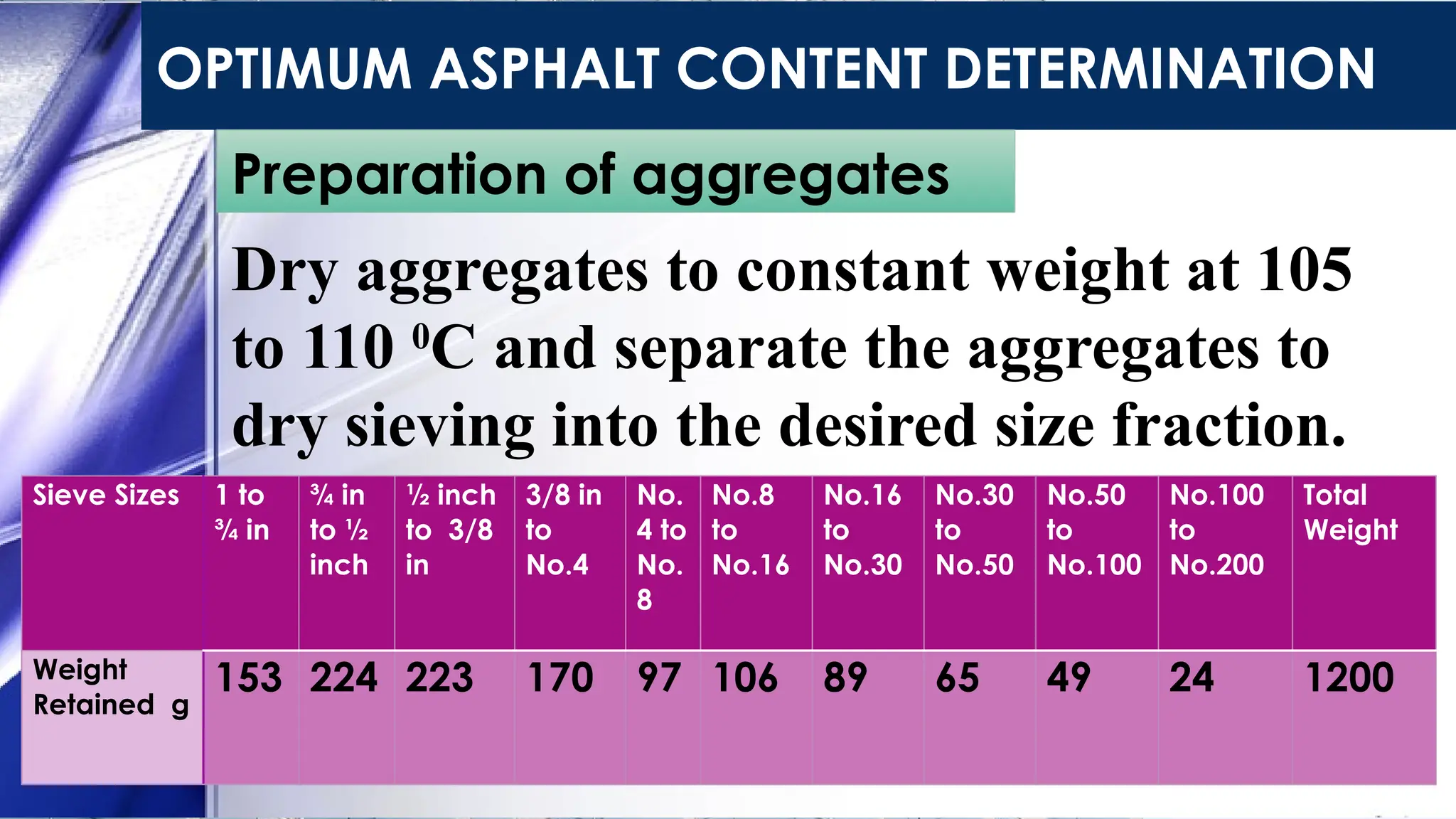
Preparation of aggregates
Sieve Sizes 1 to
¾ in
¾ in
to ½
inch
½ inch
to 3/8
in
3/8 in
to
No.4
No.
4 to
No.
8
No.8
to
No.16
No.16
to
No.30
No.30
to
No.50
No.50
to
No.100
No.100
to
No.200
Total
Weight
Weight
Retained g
153 224 223 170 97 106 89 65 49 24 1200
Dry aggregates to constant weight at 105
to 110 0
C and separate the aggregates to
dry sieving into the desired size fraction.
OPTIMUM ASPHALT CONTENT DETERMINATION
 Prepare19 specimen, these specimens are
prepared by half percent increment.
 First specimen is prepared to find out the time
required it is then discarded.
 Prepared the specimen starting with 3.0% then
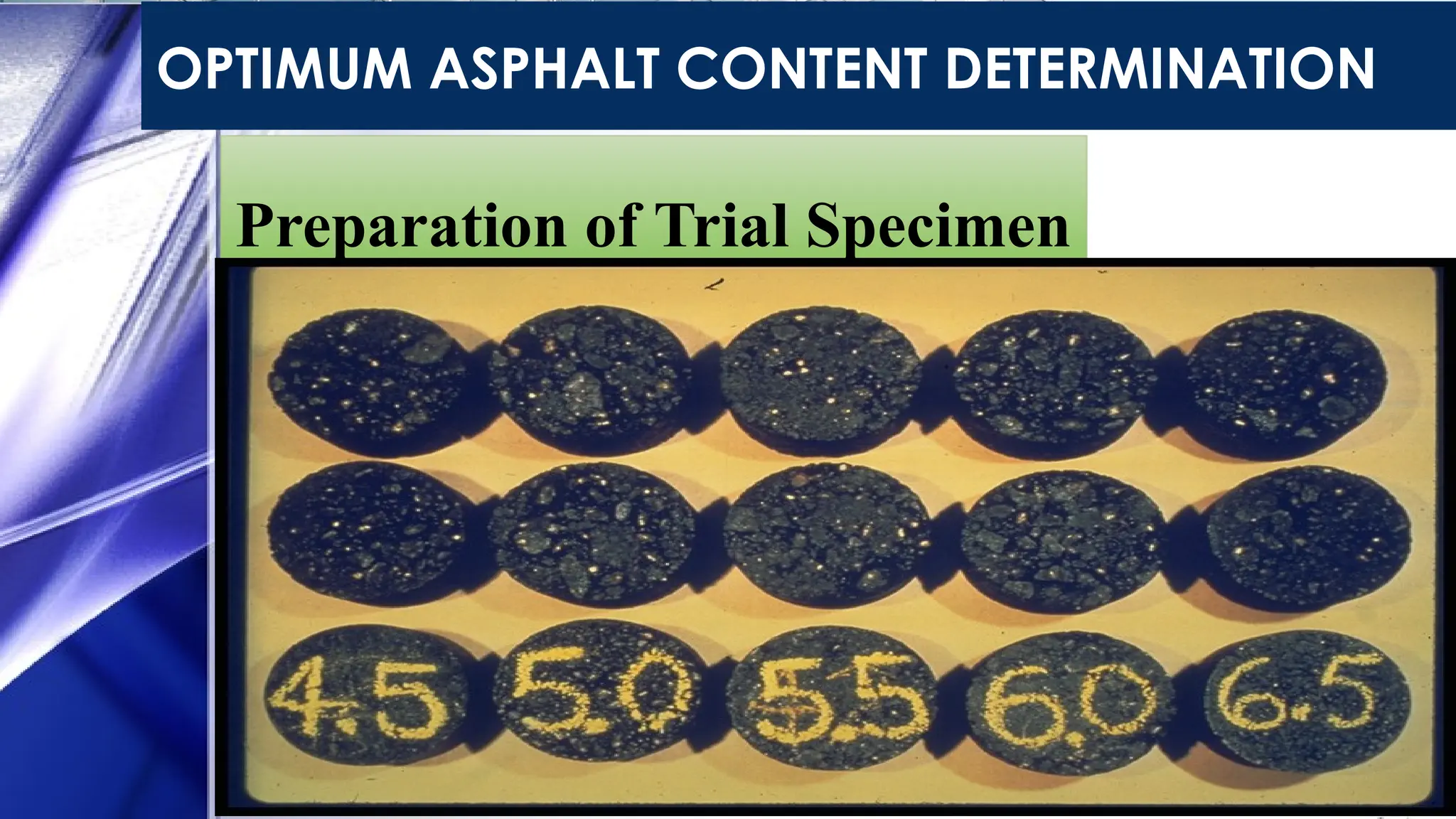
3.5%, 4. 0%, 4.5 %, and 5.0 % asphalt
respectively.
Preparation of Trial Specimen
OPTIMUM ASPHALT CONTENT DETERMINATION
Determination of mixing and Compacting Temperatures
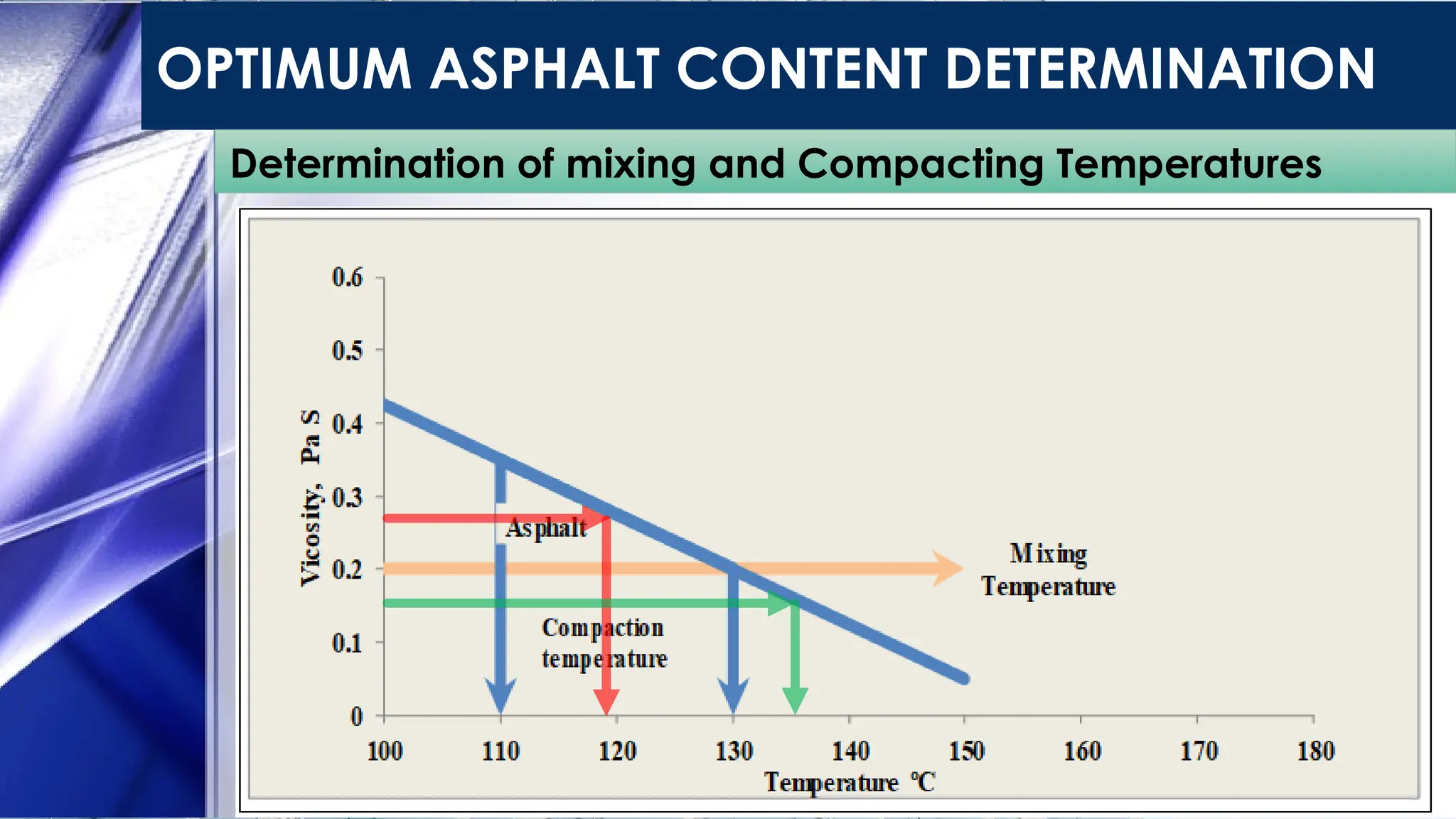
1. The temperature to which asphalt cement must be
heated to produce a viscosity of 170 ± 20 CST shall
be the mixing temperature.(170/1000= 0.17 P s)
2. The temperature to which asphalt cement must be
heated to produce a viscosity of 280 ± 30 CST shall be
the compacting temperature.(280/1000 = 0.28 P s)
OPTIMUM ASPHALT CONTENT DETERMINATION
 Weigh into separate pans for each specimen
 Place the pans on the hot plate or in an oven
and heat to a temperature not exceeding the
mixing temperature.
 Charge the mixing bowls with heated
aggregates and dry mix thoroughly.
 Form a crater in the dry blended aggregate,
place it on the balance, note the weight and
start pouring Asphalt.
 Mix the aggregate and bituminous material
rapidly until thoroughly coated.
OPTIMUM ASPHALT CONTENT DETERMINATION
Compaction of Specimen
1. Thoroughly clean the specimen mold assembly and the face compaction
hammer and heat them on the hot pate to a temperature between 93.3
and 148.9.
2. Place a piece of filter paper or paper toweling cut to size in the
bottom of the mold before the mixture is introduced.
3. Place the entire batch in the mold, spade the mixture vigorously
with a heated spatula or trowel 15 times around the perimeter
and 10 times over the interior.
OPTIMUM ASPHALT CONTENT DETERMINATION
Compaction of Specimen
5. place the mold assembly on compaction pedestal, in the mold holder
and unless otherwise specified
6. Apply required blows (check with Specification) with the compaction
hammer with a free fall of 18 inch.
7. Remove the base plate and collar, and reverse and reassemble the mold
8. Apply the same number of compaction blows to the face of the reversed
specimen
9.After compaction, remove the base plate and place the sample extractor
on the end of the specimen
10. Carefully transfer the specimen to a smooth, flat surface and allow it to
stand overnight at room temperature.
OPTIMUM ASPHALT CONTENT DETERMINATION
Density and Void Analysis
After the specimen has cooled to Room
temperature, measure the height of specimen
from three sides and take average.
Weigh and record the mass of specimen in air,
water and saturated surface dry conditions
OPTIMUM ASPHALT CONTENT DETERMINATION
Stability and Flow test
1. Bring the specimens prepared with asphalt
cement to the specified temperature of 60o
C by
immersing in the water bath 30 to 40 minutes.
2. Remove the specimen from the water bath, and place in
the lower segment of the breaking head.
3. Place the complete assembly in position over on of the guide
rods and adjust the flow meter to zero.
4. Apply the load to the specimen, 2inch/minute till the maximum
load is reached, and the load decreases as indicated by the dial
OPTIMUM ASPHALT CONTENT DETERMINATION
Stability and Flow test
5. Record the maximum load noted on the testing machine or converted
from the maximum meter dial reading.
6. Note and record the indicated flow value or equivalent units in
hundredths of an inch (25 hun dredths of a millimeter) if a micrometer
dial is used to measure the flow.
7. The elapsed time for the test from removal of the test specimen from
the water bath to the maximum load determination shall not exceed 30
seconds.
8. The stability values are made equivalent by applying correlation
factors, if the height of specimen is not 2.5 inch.
9. The compaction does not simulate with actual field condition because
we are giving impact load but in field there is instantaneous movement,
so the test results may not be very curate.
OPTIMUM ASPHALT CONTENT DETERMINATION
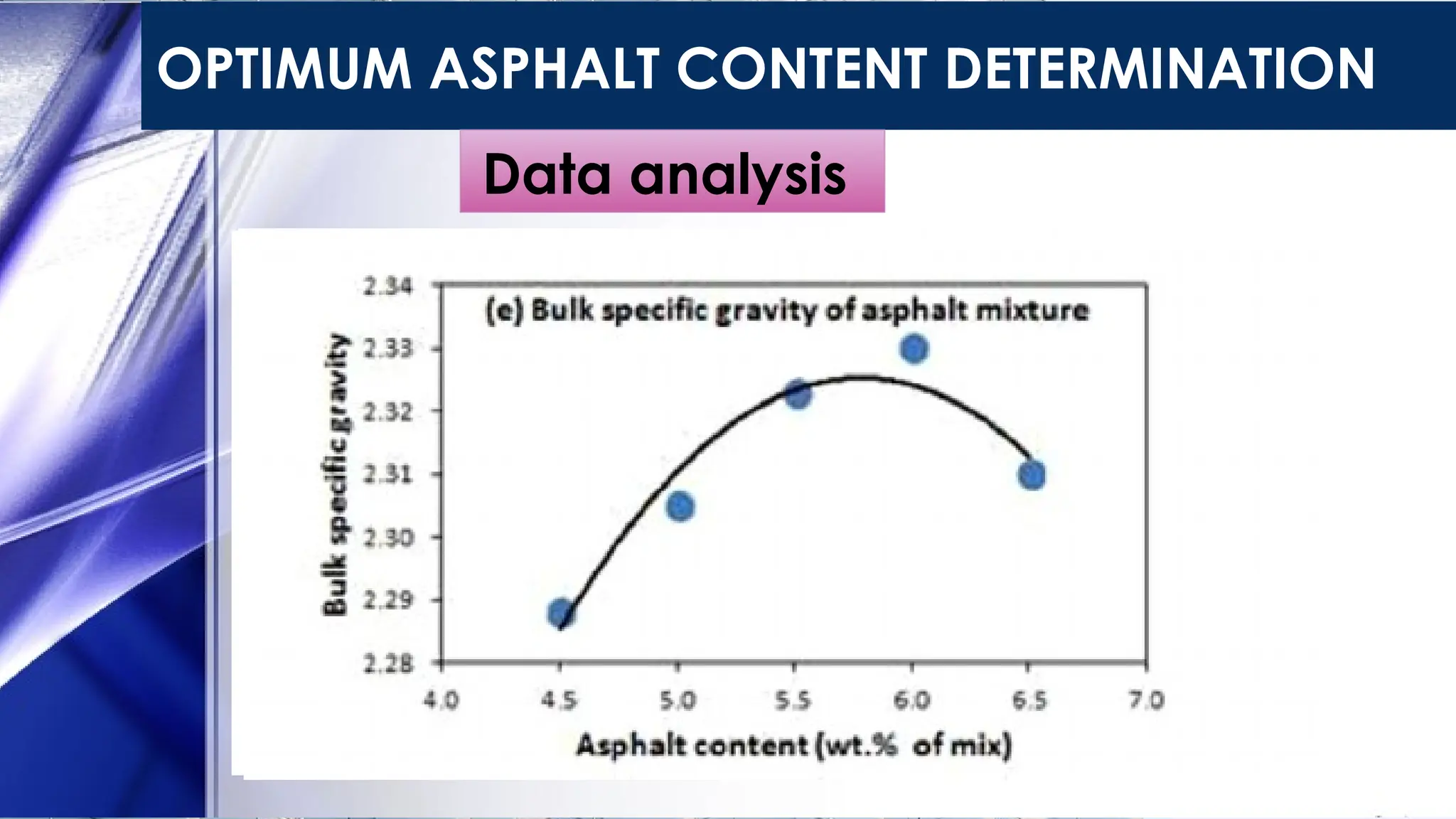
Data analysis
1. Draw the graphs for: % AC vs. Percentage air voids, %
AC vs. Stability, % AC vs. Flow, % AC vs. Unit weight
and % AC vs. Voids in Mineral Aggregate
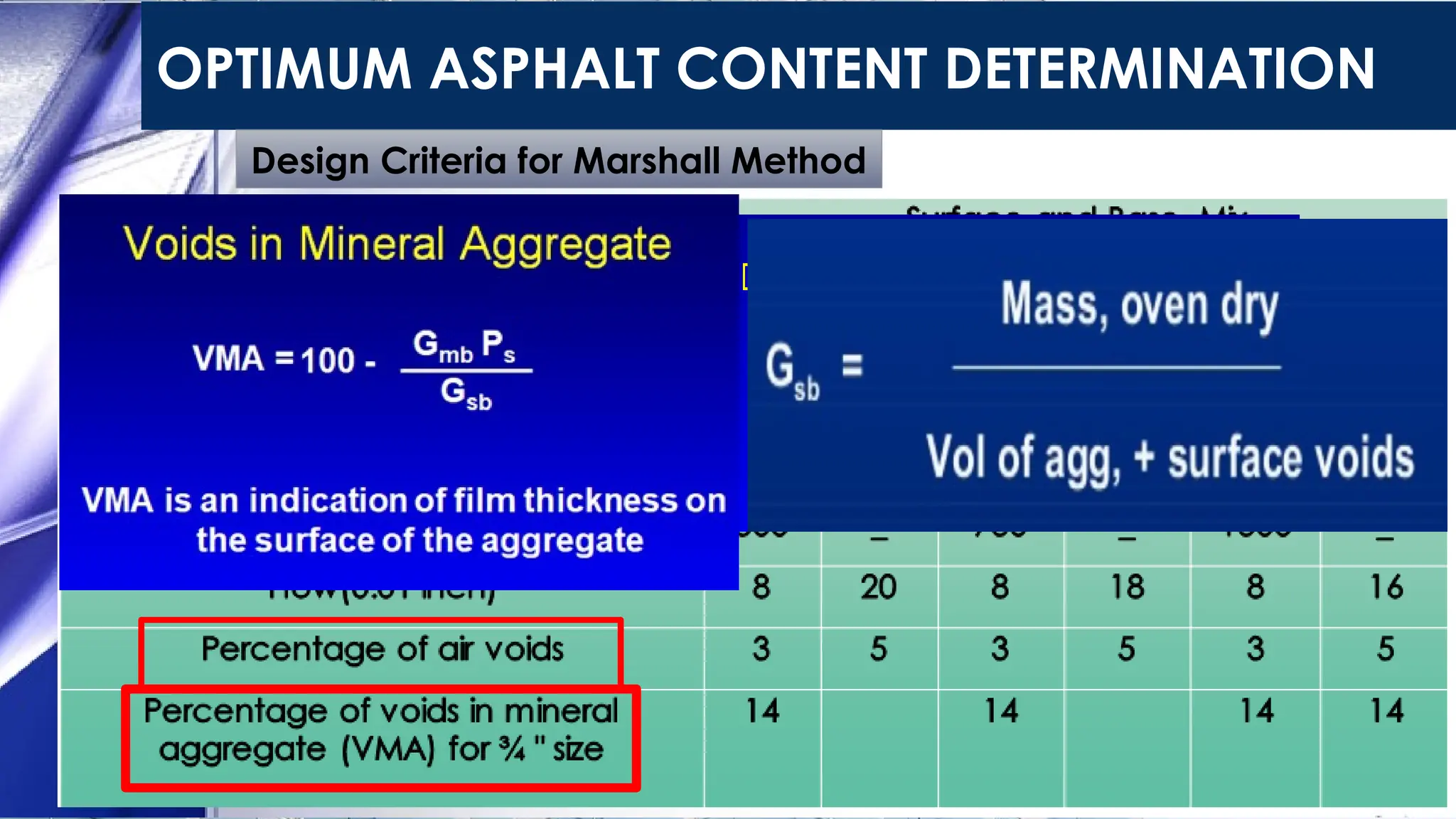
2. Check for the minimum and maximum values as required
by Marshall criteria in Table.
3. Summarize all the values calculated in step 2 above in the
form, as illustrated below.
4. Draw a perpendicular line that will satisfy all the criteria
OPTIMUM ASPHALT CONTENT DETERMINATION
Design Criteria for Marshall Method
29
3
0
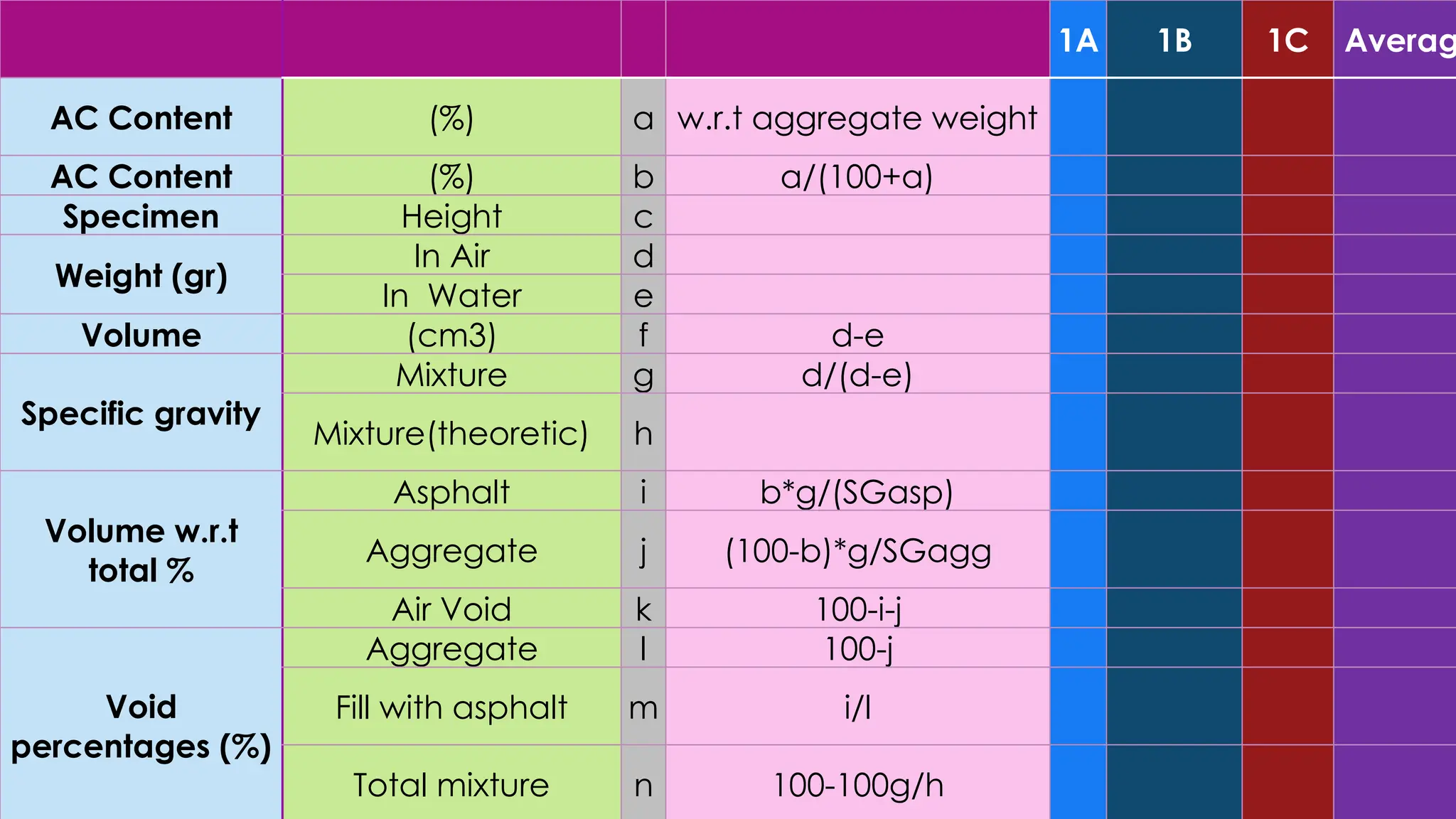
1A 1B 1C Averag
AC Content (%) a w.r.t aggregate weight
AC Content (%) b a/(100+a)
Specimen Height c
Weight (gr)
In Air d
In Water e
Volume (cm3) f d-e
Specific gravity
Mixture g d/(d-e)
Mixture(theoretic) h
Volume w.r.t
total %
Asphalt i b*g/(SGasp)
Aggregate j (100-b)*g/SGagg
Air Void k 100-i-j
Void
percentages (%)
Aggregate l 100-j
Fill with asphalt m i/l
Total mixture n 100-100g/h
OPTIMUM ASPHALT CONTENT DETERMINATION
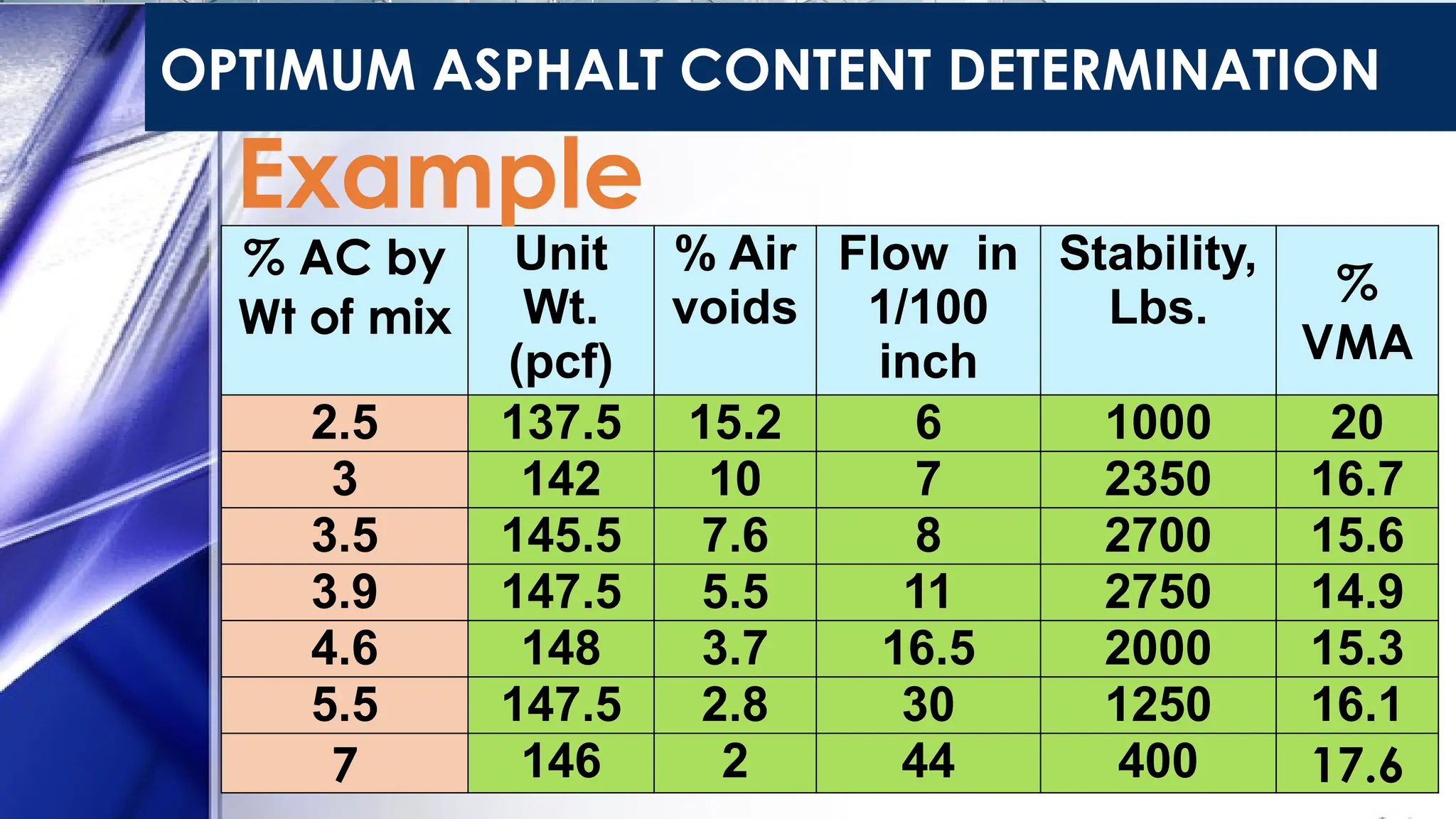
% AC by
Wt of mix
Unit
Wt.
(pcf)
% Air
voids
Flow in
1/100
inch
Stability,
Lbs. %
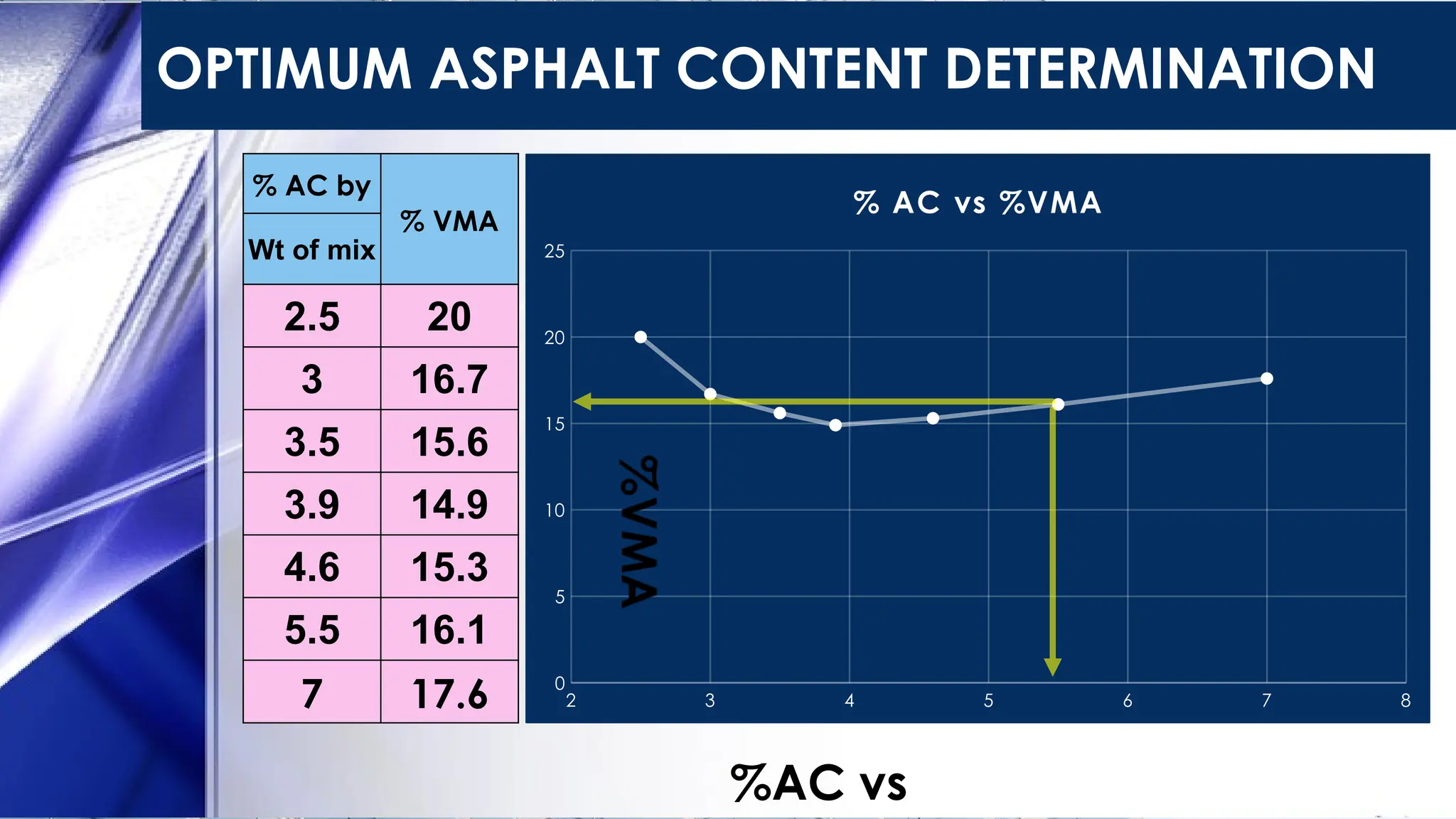
VMA
2.5 137.5 15.2 6 1000 20
3 142 10 7 2350 16.7
3.5 145.5 7.6 8 2700 15.6
3.9 147.5 5.5 11 2750 14.9
4.6 148 3.7 16.5 2000 15.3
5.5 147.5 2.8 30 1250 16.1
7 146 2 44 400 17.6
Example
OPTIMUM ASPHALT CONTENT DETERMINATION
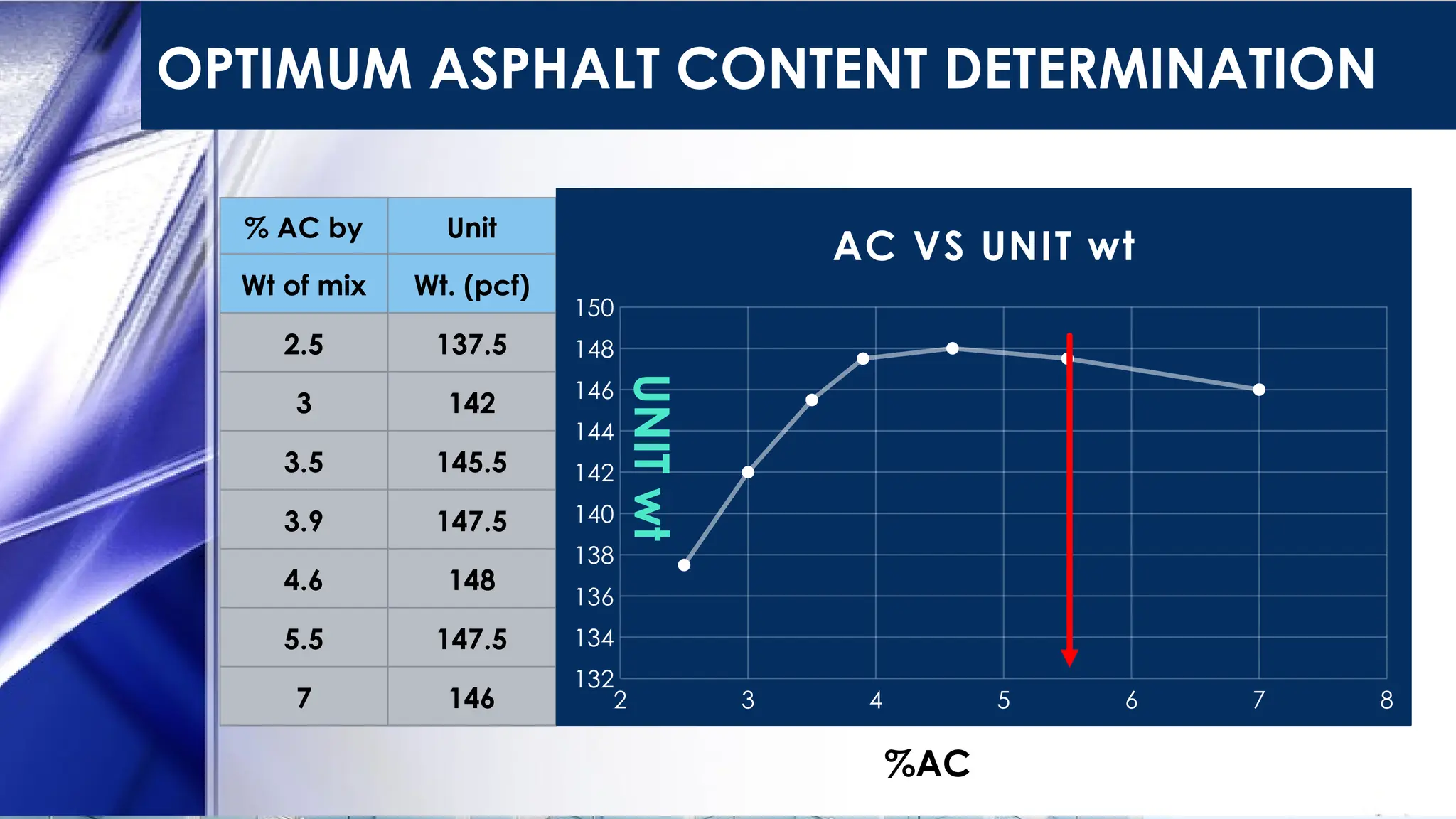
% AC by Unit
Wt of mix Wt. (pcf)
2.5 137.5
3 142
3.5 145.5
3.9 147.5
4.6 148
5.5 147.5
7 146 2 3 4 5 6 7 8
132
134
136
138
140
142
144
146
148
150
AC VS UNIT wt
%AC
UNIT
wt
OPTIMUM ASPHALT CONTENT DETERMINATION
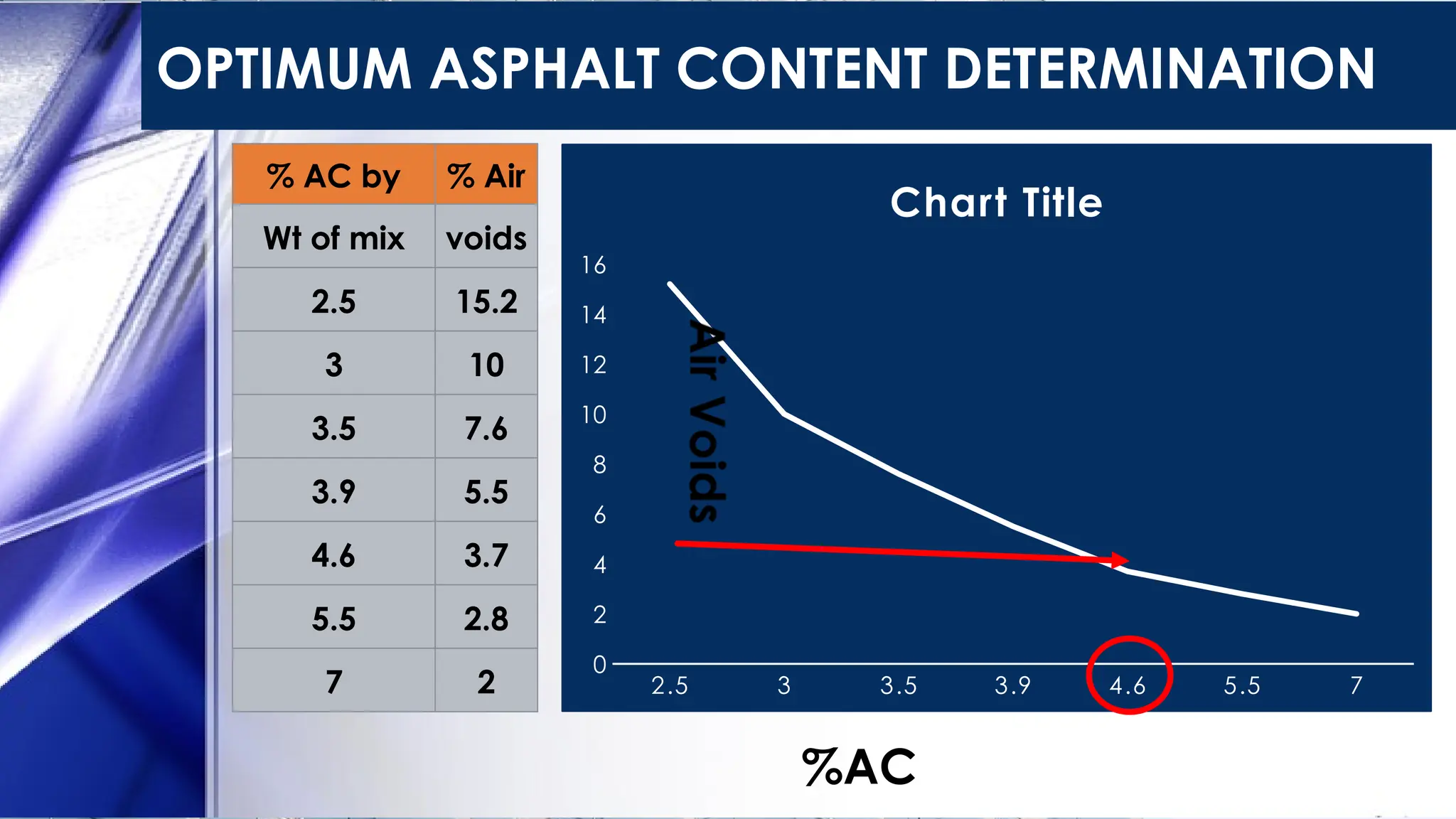
%AC
% AC by % Air
Wt of mix voids
2.5 15.2
3 10
3.5 7.6
3.9 5.5
4.6 3.7
5.5 2.8
7 2 2.5 3 3.5 3.9 4.6 5.5 7
0
2
4
6
8
10
12
14
16
Chart Title
OPTIMUM ASPHALT CONTENT DETERMINATION
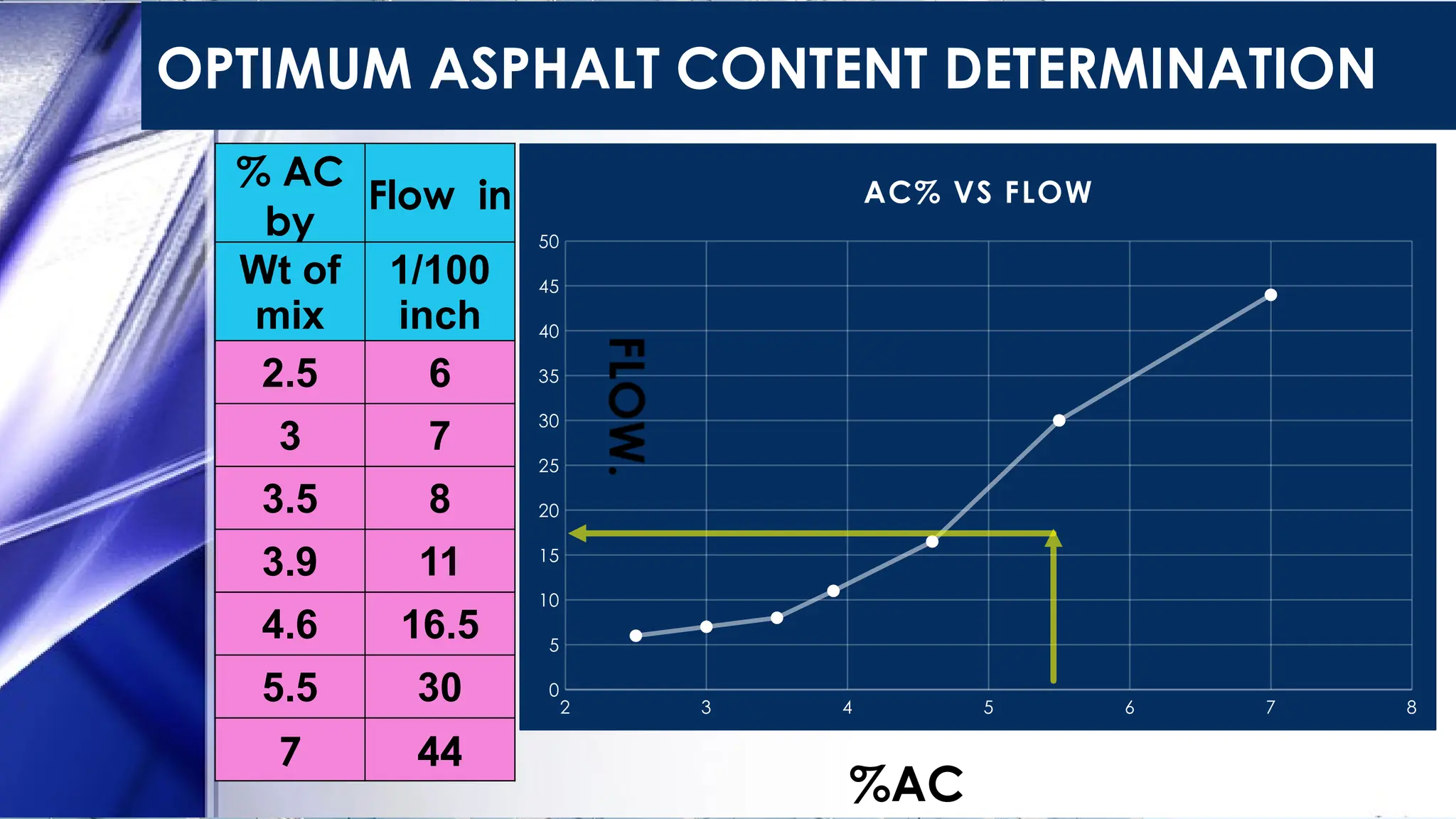
%AC
% AC
by
Flow in
Wt of
mix
1/100
inch
2.5 6
3 7
3.5 8
3.9 11
4.6 16.5
5.5 30
7 44
2 3 4 5 6 7 8
0
5
10
15
20
25
30
35
40
45
50
AC% VS FLOW
OPTIMUM ASPHALT CONTENT DETERMINATION
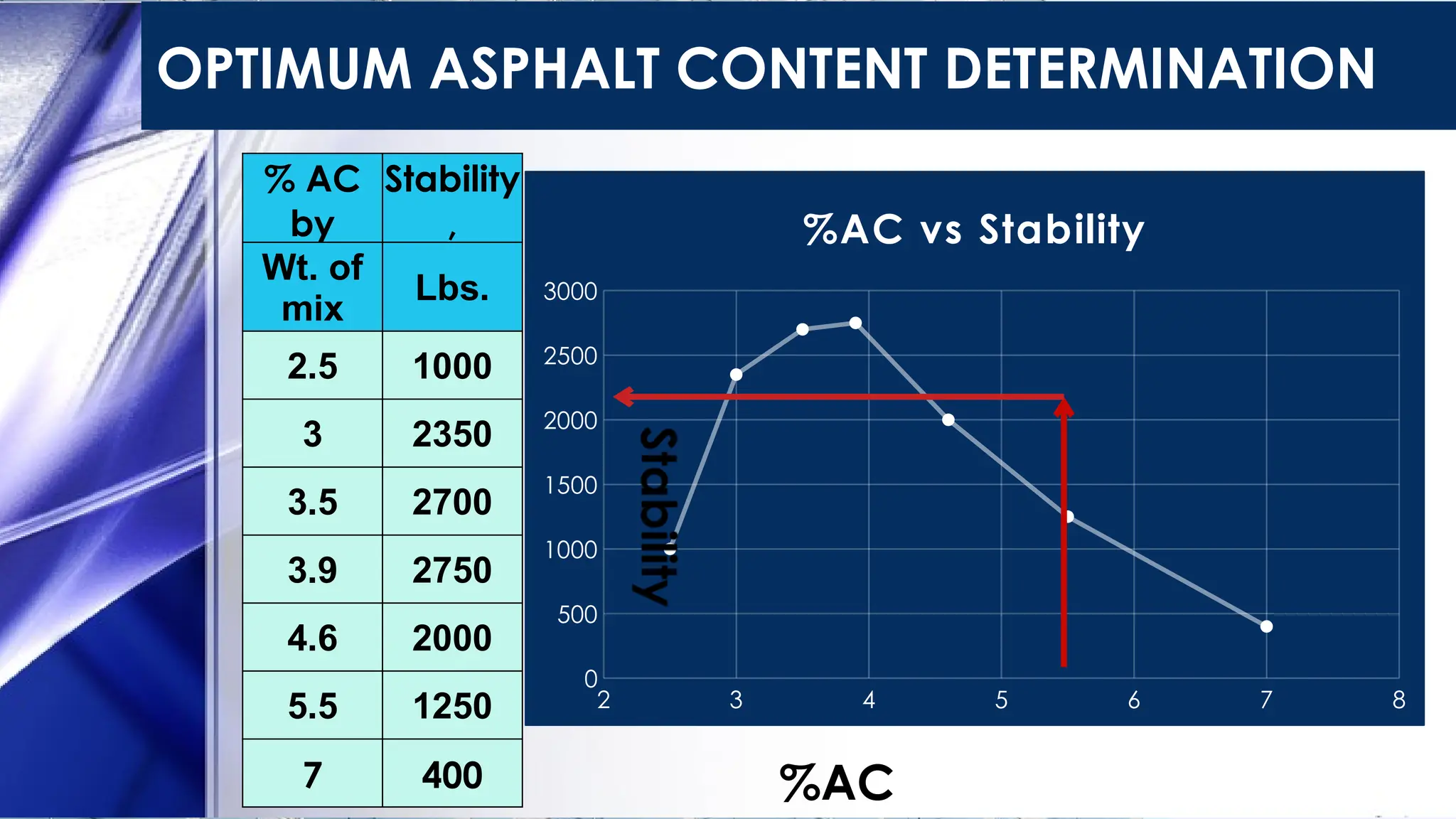
%AC
% AC
by
Stability
,
Wt. of
mix
Lbs.
2.5 1000
3 2350
3.5 2700
3.9 2750
4.6 2000
5.5 1250
7 400
2 3 4 5 6 7 8
0
500
1000
1500
2000
2500
3000
%AC vs Stability
OPTIMUM ASPHALT CONTENT DETERMINATION
%AC vs
% AC by
% VMA
Wt of mix
2.5 20
3 16.7
3.5 15.6
3.9 14.9
4.6 15.3
5.5 16.1
7 17.6 2 3 4 5 6 7 8
0
5
10
15
20
25
% AC vs %VMA
CONCLUSION
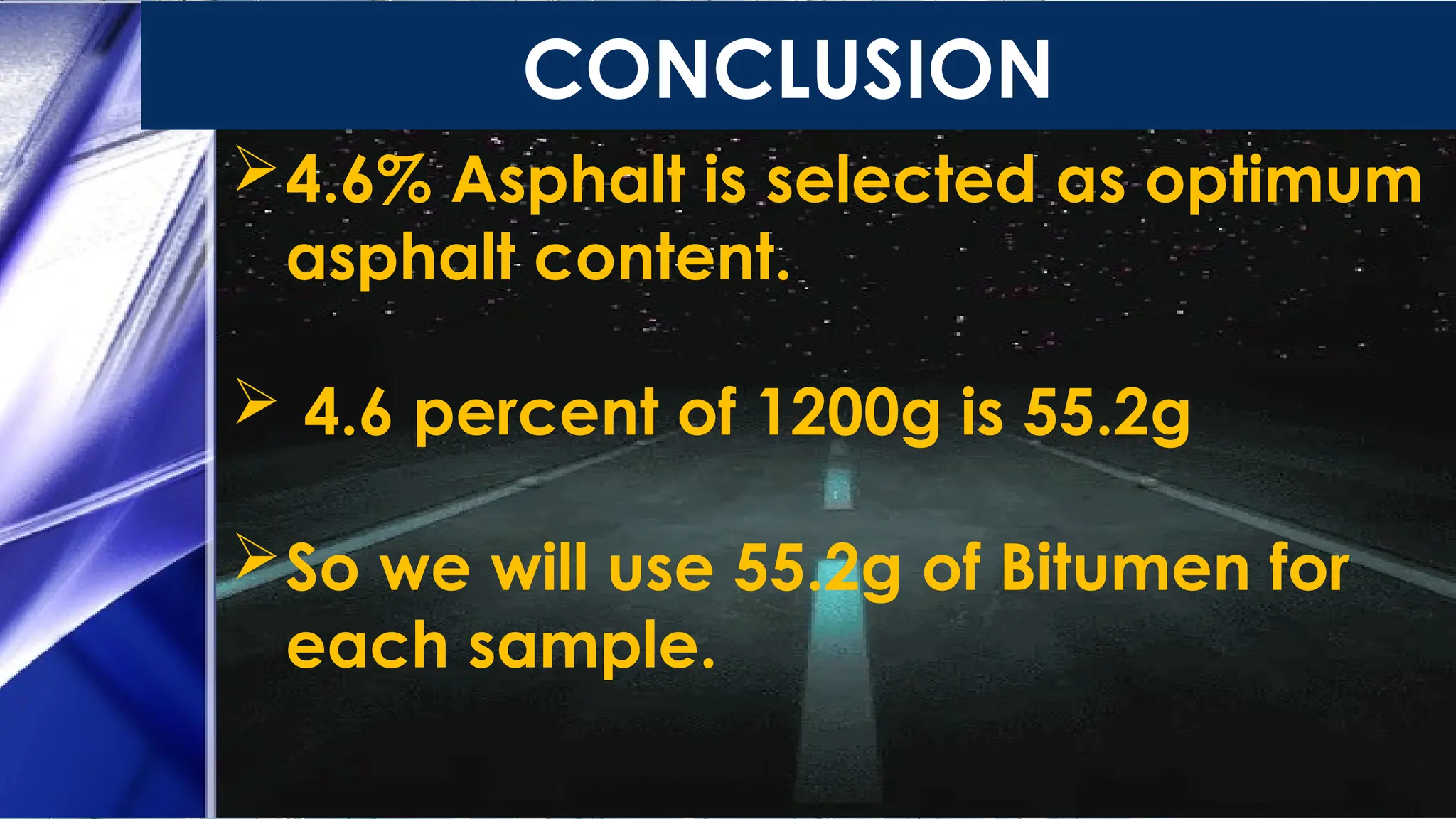
4.6% Asphalt is selected as optimum
asphalt content.
 4.6 percent of 1200g is 55.2g
So we will use 55.2g of Bitumen for
each sample.
3
8
THANKS!

Complete Guide to Job Mix Formula (JMF) and Marshall Stability Test for HMA Layers

  • 1.
  • 2.
    JOB MIX FORMULA(JMF) PRSENTED BY: NISSAR AHMED 2
  • 3.
    INTRODUCTION  Basically, itsjust a recipe for making hot mix. That would be the asphalt cement. That would be the aggregate. 3
  • 4.
    ASPHALT CONCRETE Asphaltic concreteis a mixture of Coarse Aggregate Fine aggregate Mineral filler and Bitumen
  • 5.
    ASPHALT BINDER  Themain purpose of the binder is to completely coat the surface area of the aggregate. This will waterproof the aggregate.  Too little AC in the mix can leave portions of the aggregate uncoated. This results in a lack of durability and strength, and can lead to raveling or stripping.  Too much AC in the mix results in a needlessly expensive mix, rich spots or bleeding, lowered skid resistance, and rutting or shoving of the pavement. In other words, the performance of the pavement depends on how much asphalt binder is in the mix. 5
  • 6.
    BITUMEN The residue ofcrude oil in a distillation process is called bitumen. 6 It is brown and black in color.  It is uses as a binder material.
  • 7.
    Tests on AsphaltCement Test/Property ASTM Designation AASHTO Designation Penetration D 5 T 49 Absolute Viscosity D 2171 T 202 Kinematic Viscosity D 2170 T 201 Flash Point D 92 T 48 Thin Film Oven Test D 1754 T 179 Rolling Thin Film Oven Test D 2872 T 240 Ductility D 113 T 51 Solubility D 2042 T 44 Absolute viscosity is the measurement of the fluid's internal resistance to flow kinematic viscosity refers to the ratio of dynamic viscosity to density.
  • 8.
    AGGREGATES  “aggregate”, isa broad category of coarse particulate material used in construction, including sand, gravel, crushed stone, slag, recycled concrete and geosynthetic aggregates. ...  Aggregates are also used as base material under foundations, 8  The basic property of the aggregate is its grain size distribution or gradation
  • 9.
  • 10.
    Tests on MineralAggregates Test/Property ASTM Designation AASHTO Designation Los Angeles Abrasion C 131 or C 535 T 96 Unit Weight C 29 T 19 Sieve Analysis (Aggregates) C 136 T 27 Sieve Analysis (Filler) D 546 T 37 Specific Gravity (Coarse) C 127 T 85 Specific Gravity (Fine) C 128 T 84 Specific Gravity (Filler) D 854 or C188 T 100 or T 133 Sulphate Soundness C 88 T 104 Sand Equivalent D 2419 T 176 Particle Shape D 4791 -
  • 11.
    JOB MIX Formula(JMF) JOB MIX IS PRODUCED BY THE COMBINATION OF AGGREGATE BLENDING AND BITUMEN%
  • 12.
    12 AGGREGATE BLENDING Basic Formula P= Aa + Bb + Cc P = the percentage of material passing a given sieve for the combined aggregates A, B, C, etc.; A, B, C, etc. = percentages of material passing a given sieve for aggregates A, B, C, etc a, b, c, etc. = proportions of aggregates, A, B, C, etc. used in the combination and where the total =1.00.
  • 13.
    AGGREGATE BLENDING P =Aa + Bb + Cc a = – 𝑷 𝑩/ – 𝑨 𝑩 b = – 𝑷 𝑨/ – 𝑩 𝑨 a + b + c= 1 b + c = 1 – a
  • 14.
  • 15.
    GRADING SPECIFICATION ANDGRADATIONS (No.8), a = P-B/A-B = 42.5 – 82/3.2 – 82 = 0.50 (No. 200), P=Aa+Bb+Cc 7 =0.50+9.2b+82c b +c =1 - 0.50 = 0.50 b = 0.50 - c 7 = 0.5+9.2 (0.50 - c) + 82c c = 0.03 b = 0.50 - 0.03 = 0.47
  • 16.
    1 6 Grading specification andgradations Trail and Error Method
  • 17.
    Optimum Asphalt contentdetermination Marshal Testing Procedure 1. Preparation of aggregates 2. Preparation of Trial Specimen 3. mixing and Compacting Temperatures 4. Preparation of Mixtures 5. Compaction of Specimen 6. Density and Void Analysis 7. Stability and Flow test
  • 18.
    OPTIMUM ASPHALT CONTENTDETERMINATION Preparation of aggregates Sieve Sizes 1 to ¾ in ¾ in to ½ inch ½ inch to 3/8 in 3/8 in to No.4 No. 4 to No. 8 No.8 to No.16 No.16 to No.30 No.30 to No.50 No.50 to No.100 No.100 to No.200 Total Weight Weight Retained g 153 224 223 170 97 106 89 65 49 24 1200 Dry aggregates to constant weight at 105 to 110 0 C and separate the aggregates to dry sieving into the desired size fraction.
  • 19.
    OPTIMUM ASPHALT CONTENTDETERMINATION  Prepare19 specimen, these specimens are prepared by half percent increment.  First specimen is prepared to find out the time required it is then discarded.  Prepared the specimen starting with 3.0% then 3.5%, 4. 0%, 4.5 %, and 5.0 % asphalt respectively. Preparation of Trial Specimen
  • 20.
    OPTIMUM ASPHALT CONTENTDETERMINATION Determination of mixing and Compacting Temperatures 1. The temperature to which asphalt cement must be heated to produce a viscosity of 170 ± 20 CST shall be the mixing temperature.(170/1000= 0.17 P s) 2. The temperature to which asphalt cement must be heated to produce a viscosity of 280 ± 30 CST shall be the compacting temperature.(280/1000 = 0.28 P s)
  • 21.
    OPTIMUM ASPHALT CONTENTDETERMINATION  Weigh into separate pans for each specimen  Place the pans on the hot plate or in an oven and heat to a temperature not exceeding the mixing temperature.  Charge the mixing bowls with heated aggregates and dry mix thoroughly.  Form a crater in the dry blended aggregate, place it on the balance, note the weight and start pouring Asphalt.  Mix the aggregate and bituminous material rapidly until thoroughly coated.
  • 22.
    OPTIMUM ASPHALT CONTENTDETERMINATION Compaction of Specimen 1. Thoroughly clean the specimen mold assembly and the face compaction hammer and heat them on the hot pate to a temperature between 93.3 and 148.9. 2. Place a piece of filter paper or paper toweling cut to size in the bottom of the mold before the mixture is introduced. 3. Place the entire batch in the mold, spade the mixture vigorously with a heated spatula or trowel 15 times around the perimeter and 10 times over the interior.
  • 23.
    OPTIMUM ASPHALT CONTENTDETERMINATION Compaction of Specimen 5. place the mold assembly on compaction pedestal, in the mold holder and unless otherwise specified 6. Apply required blows (check with Specification) with the compaction hammer with a free fall of 18 inch. 7. Remove the base plate and collar, and reverse and reassemble the mold 8. Apply the same number of compaction blows to the face of the reversed specimen 9.After compaction, remove the base plate and place the sample extractor on the end of the specimen 10. Carefully transfer the specimen to a smooth, flat surface and allow it to stand overnight at room temperature.
  • 24.
    OPTIMUM ASPHALT CONTENTDETERMINATION Density and Void Analysis After the specimen has cooled to Room temperature, measure the height of specimen from three sides and take average. Weigh and record the mass of specimen in air, water and saturated surface dry conditions
  • 25.
    OPTIMUM ASPHALT CONTENTDETERMINATION Stability and Flow test 1. Bring the specimens prepared with asphalt cement to the specified temperature of 60o C by immersing in the water bath 30 to 40 minutes. 2. Remove the specimen from the water bath, and place in the lower segment of the breaking head. 3. Place the complete assembly in position over on of the guide rods and adjust the flow meter to zero. 4. Apply the load to the specimen, 2inch/minute till the maximum load is reached, and the load decreases as indicated by the dial
  • 26.
    OPTIMUM ASPHALT CONTENTDETERMINATION Stability and Flow test 5. Record the maximum load noted on the testing machine or converted from the maximum meter dial reading. 6. Note and record the indicated flow value or equivalent units in hundredths of an inch (25 hun dredths of a millimeter) if a micrometer dial is used to measure the flow. 7. The elapsed time for the test from removal of the test specimen from the water bath to the maximum load determination shall not exceed 30 seconds. 8. The stability values are made equivalent by applying correlation factors, if the height of specimen is not 2.5 inch. 9. The compaction does not simulate with actual field condition because we are giving impact load but in field there is instantaneous movement, so the test results may not be very curate.
  • 27.
    OPTIMUM ASPHALT CONTENTDETERMINATION Data analysis 1. Draw the graphs for: % AC vs. Percentage air voids, % AC vs. Stability, % AC vs. Flow, % AC vs. Unit weight and % AC vs. Voids in Mineral Aggregate 2. Check for the minimum and maximum values as required by Marshall criteria in Table. 3. Summarize all the values calculated in step 2 above in the form, as illustrated below. 4. Draw a perpendicular line that will satisfy all the criteria
  • 28.
    OPTIMUM ASPHALT CONTENTDETERMINATION Design Criteria for Marshall Method
  • 29.
  • 30.
    3 0 1A 1B 1CAverag AC Content (%) a w.r.t aggregate weight AC Content (%) b a/(100+a) Specimen Height c Weight (gr) In Air d In Water e Volume (cm3) f d-e Specific gravity Mixture g d/(d-e) Mixture(theoretic) h Volume w.r.t total % Asphalt i b*g/(SGasp) Aggregate j (100-b)*g/SGagg Air Void k 100-i-j Void percentages (%) Aggregate l 100-j Fill with asphalt m i/l Total mixture n 100-100g/h
  • 31.
    OPTIMUM ASPHALT CONTENTDETERMINATION % AC by Wt of mix Unit Wt. (pcf) % Air voids Flow in 1/100 inch Stability, Lbs. % VMA 2.5 137.5 15.2 6 1000 20 3 142 10 7 2350 16.7 3.5 145.5 7.6 8 2700 15.6 3.9 147.5 5.5 11 2750 14.9 4.6 148 3.7 16.5 2000 15.3 5.5 147.5 2.8 30 1250 16.1 7 146 2 44 400 17.6 Example
  • 32.
    OPTIMUM ASPHALT CONTENTDETERMINATION % AC by Unit Wt of mix Wt. (pcf) 2.5 137.5 3 142 3.5 145.5 3.9 147.5 4.6 148 5.5 147.5 7 146 2 3 4 5 6 7 8 132 134 136 138 140 142 144 146 148 150 AC VS UNIT wt %AC UNIT wt
  • 33.
    OPTIMUM ASPHALT CONTENTDETERMINATION %AC % AC by % Air Wt of mix voids 2.5 15.2 3 10 3.5 7.6 3.9 5.5 4.6 3.7 5.5 2.8 7 2 2.5 3 3.5 3.9 4.6 5.5 7 0 2 4 6 8 10 12 14 16 Chart Title
  • 34.
    OPTIMUM ASPHALT CONTENTDETERMINATION %AC % AC by Flow in Wt of mix 1/100 inch 2.5 6 3 7 3.5 8 3.9 11 4.6 16.5 5.5 30 7 44 2 3 4 5 6 7 8 0 5 10 15 20 25 30 35 40 45 50 AC% VS FLOW
  • 35.
    OPTIMUM ASPHALT CONTENTDETERMINATION %AC % AC by Stability , Wt. of mix Lbs. 2.5 1000 3 2350 3.5 2700 3.9 2750 4.6 2000 5.5 1250 7 400 2 3 4 5 6 7 8 0 500 1000 1500 2000 2500 3000 %AC vs Stability
  • 36.
    OPTIMUM ASPHALT CONTENTDETERMINATION %AC vs % AC by % VMA Wt of mix 2.5 20 3 16.7 3.5 15.6 3.9 14.9 4.6 15.3 5.5 16.1 7 17.6 2 3 4 5 6 7 8 0 5 10 15 20 25 % AC vs %VMA
  • 37.
    CONCLUSION 4.6% Asphalt isselected as optimum asphalt content.  4.6 percent of 1200g is 55.2g So we will use 55.2g of Bitumen for each sample.
  • 38.

Editor's Notes

  • #5 Mix design methods are generally distinguished by the way in which they determine the optimum asphalt binder content. The general process can be subdivided into: Make several trial mixes with different asphalt binder contents. Compact these trial mixes in the lab. This compaction is meant to be a rough simulation of field conditions. Run lab tests to determine key sample characteristics. Pick the asphalt binder content that best satisfies the mix design objectives.