PRESENTED BY – DR. KUMAR KESHAV CHANDRA
MODERATOR – DR. AKHILESH KUMAR
 Introduction
 Indications
 Precautions
 Selection and preparation of the site
 Effect of common errors on interpretation of ABG
analysis
 Terminologies
 ABG Interpretation
 Arterial blood gas (ABG) analysis and its interpretation
is an integral part of intensive care management.
 ABG is the test that measures arterial oxygen tension
(PO2), carbon dioxide tension (PCO2), and acidity
(pH).
 Other parameters like HCO3- , standard bicarbonate
concentration (SBC) , base excess (BE) , standard base
excess(SBE) and SaO2 are measured indirectly.
 To evaluate the adequacy of ventilation (PaCO2) ,
acid base (pH and PaCO2) status, and the oxygen
carrying capacity of blood
 To monitor patients on ventilator and assist in
weaning
 To assess acid base imbalance in critical illness
 To assess response to therapeutic interventions and
mechanical ventilation
 Evidence of infection or peripheral vascular disease
involving the selected limb.
 Negative result of a modified Allen test
 A Coagulopathy / medium to high dose anticoagulant
therapy.
 Arterial puncture should not be performed through a
lesion or distal to a surgical shunt.
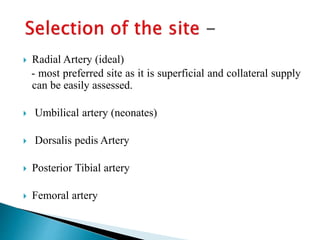
 Radial Artery (ideal)
- most preferred site as it is superficial and collateral supply
can be easily assessed.
 Umbilical artery (neonates)
 Dorsalis pedis Artery
 Posterior Tibial artery
 Femoral artery
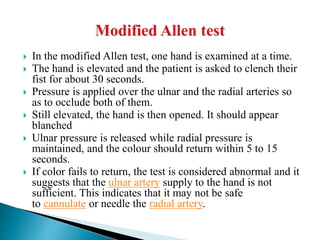
 In the modified Allen test, one hand is examined at a time.
 The hand is elevated and the patient is asked to clench their
fist for about 30 seconds.
 Pressure is applied over the ulnar and the radial arteries so
as to occlude both of them.
 Still elevated, the hand is then opened. It should appear
blanched
 Ulnar pressure is released while radial pressure is
maintained, and the colour should return within 5 to 15
seconds.
 If color fails to return, the test is considered abnormal and it
suggests that the ulnar artery supply to the hand is not
sufficient. This indicates that it may not be safe
to cannulate or needle the radial artery.
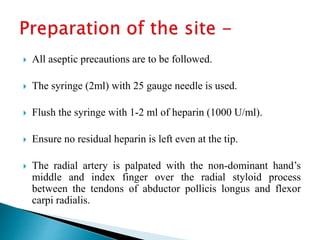
 All aseptic precautions are to be followed.
 The syringe (2ml) with 25 gauge needle is used.
 Flush the syringe with 1-2 ml of heparin (1000 U/ml).
 Ensure no residual heparin is left even at the tip.
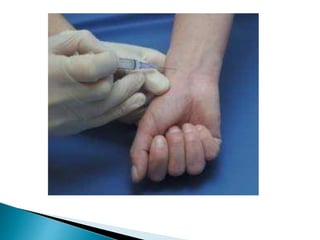
 The radial artery is palpated with the non-dominant hand’s
middle and index finger over the radial styloid process
between the tendons of abductor pollicis longus and flexor
carpi radialis.
 The site is cleaned with alcohol followed by chlorhexidine /
idophor .
 Hand is kept hyper extended.
 It is pricked just proximal to the palpating fingers using the
dominant hand.
 Needle is kept at 45 degree angle with the bevel up.
 Allow the syringe to fill itself after the artery is pricked.
 After taking sample , eliminate visible gas bubble, record date
, time, temperature, PR, RR ,ventilator settings.
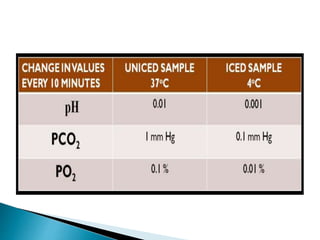
 Sample should be placed on crushed ice if not analyzed
immediately (within 15 min) to slow down metabolic process
& before processing, warm it back to body temperature.
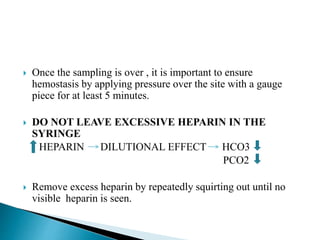
 Once the sampling is over , it is important to ensure
hemostasis by applying pressure over the site with a gauge
piece for at least 5 minutes.
 DO NOT LEAVE EXCESSIVE HEPARIN IN THE
SYRINGE
HEPARIN DILUTIONAL EFFECT HCO3
PCO2
 Remove excess heparin by repeatedly squirting out until no
visible heparin is seen.
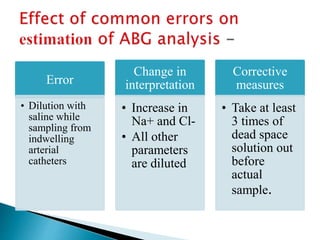
Error
• Dilution with
saline while
sampling from
indwelling
arterial
catheters
Change in
interpretation
• Increase in
Na+ and Cl-
• All other
parameters
are diluted
Corrective
measures
• Take at least
3 times of
dead space
solution out
before
actual
sample.
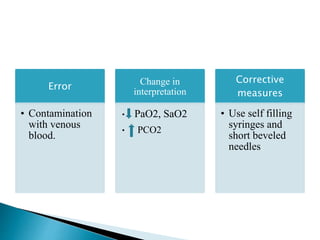
Error
• Contamination
with venous
blood.
Change in
interpretation
• PaO2, SaO2
• PCO2
Corrective
measures
• Use self filling
syringes and
short beveled
needles
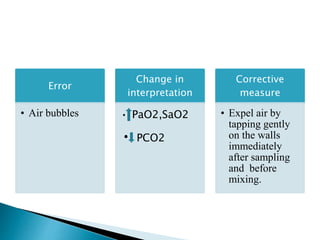
Error
• Air bubbles
Change in
interpretation
• PaO2,SaO2
• PCO2
Corrective
measure
• Expel air by
tapping gently
on the walls
immediately
after sampling
and before
mixing.
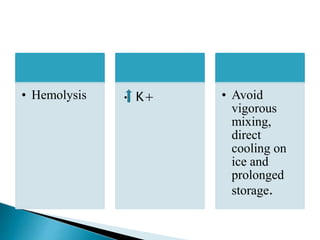
• Hemolysis • K+ • Avoid
vigorous
mixing,
direct
cooling on
ice and
prolonged
storage.
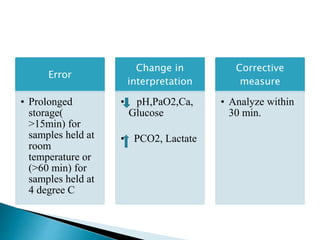
Error
• Prolonged
storage(
>15min) for
samples held at
room
temperature or
(>60 min) for
samples held at
4 degree C
Change in
interpretation
• pH,PaO2,Ca,
Glucose
• PCO2, Lactate
Corrective
measure
• Analyze within
30 min.
 Buffer system in the body consists of weak acids and their
salts.
 Their function is to resist any change in the pH when acid
and base are added to the body
 Best buffers are those weak acids whose equilibrium
constant is close to the body pH.
 Bicarbonate is the most effective buffer in the body.
 Non bicarbonate buffers include proteins (albumin & Hb ),
phosphates and bone.
pH = -log(H+) =log(1/H+)
At a pH of 7.4 H+ ion conc = 40 mmol/L
Henderson–Hasselbach equation:-
 The bicarbonate buffer system is routinely monitored clinically.
CO2 +H2O ↔H+ +HCO3
−
The pK of this reaction is 6.1
pH = 6.1+ log[HCO3
− ]/[CO2]=
= 6.1+ log [24/40×0.03] = 6.1+ log [20 ] = 6.1+1.3= 7.4
pH of less than 6.8 or greater than 7.8 is considered incompatible with
life.
 =base/ acid =log[HCO3
− ]/[CO2] = 24/0.03×40 = 20:1
 Buffer ratio is 20 :1 for HCO3 / H2CO3 BUFFER.
 as long as the buffer ratio is maintained the pH will
not change, even though the amount of hydrogen
changes.
Actual Bicarbonate (ABC/ HCO3 act) -
 Sum total of the actual bicarbonate
concentration.
 This is a derived value.
 Analyzer derives this from pH and PCO2
values.
 Influenced by temperature and PCO2 in the
patient.
 PCO2 falls by about 4.5% and pH rises by
0.015 per degree celsius fall in temperature.
 Standard Bicarbonate –HCO3 (std)
Bicarbonate concentration nullifying the effects of temperature
and PCO2 assuming a temperature of 37 degree celsius and
PCO2 of 40 mm of Hg.
Reflects the true metabolic state of the body.
 Buffer Base (BB) –
Sum total of all the body store of buffer.
48 mmol/l
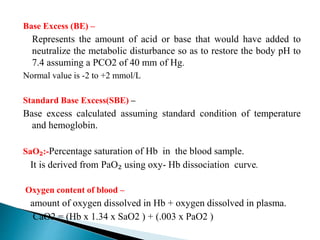
Base Excess (BE) –
Represents the amount of acid or base that would have added to
neutralize the metabolic disturbance so as to restore the body pH to
7.4 assuming a PCO2 of 40 mm of Hg.
Normal value is -2 to +2 mmol/L
Standard Base Excess(SBE) –
Base excess calculated assuming standard condition of temperature
and hemoglobin.
SaO₂:-Percentage saturation of Hb in the blood sample.
It is derived from PaO₂ using oxy- Hb dissociation curve.
Oxygen content of blood –
amount of oxygen dissolved in Hb + oxygen dissolved in plasma.
CaO2 = (Hb x 1.34 x SaO2 ) + (.003 x PaO2 )
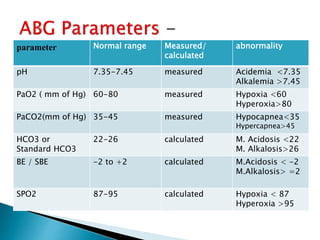
parameter Normal range Measured/
calculated
abnormality
pH 7.35-7.45 measured Acidemia <7.35
Alkalemia >7.45
PaO2 ( mm of Hg) 60-80 measured Hypoxia <60
Hyperoxia>80
PaCO2(mm of Hg) 35-45 measured Hypocapnea<35
Hypercapnea>45
HCO3 or
Standard HCO3
22-26 calculated M. Acidosis <22
M. Alkalosis>26
BE / SBE -2 to +2 calculated M.Acidosis < -2
M.Alkalosis> =2
SPO2 87-95 calculated Hypoxia < 87
Hyperoxia >95
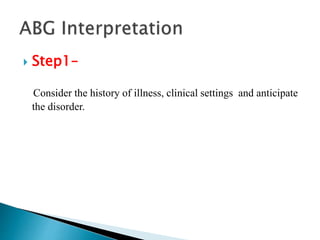
 Step1–
Consider the history of illness, clinical settings and anticipate
the disorder.
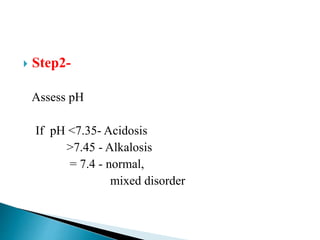
 Step2-
Assess pH
If pH <7.35- Acidosis
>7.45 - Alkalosis
= 7.4 - normal,
mixed disorder
 Step3-
If acidosis or alkalosis, then decide primary respiratory or
metabolic cause.
Look at PaCO2
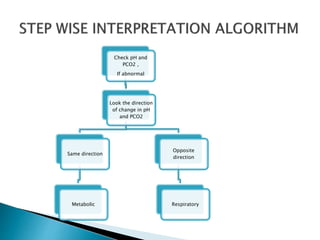
If pH & PaCO2 move in opposite direction, then
respiratory cause.
If pH & PaCO2 move in the same direction, then
metabolic cause.
 Step4–
In simple disorder, HCO3 and PaCO2 move in same
direction.
If HCO3 and PaCO2 move in opposite direction,
think for mixed disorder.
 Step5–
Look for compensation
Aim to keep pH in normal range.
Patient can be uncompensated, partially compensated or fully
compensated but never overcompensated.
 Metabolic acidosis
 PCO2↓ 1.25mm Hg/1mmol/L↓ HCO3
 Expected PCO₂ = [1.5xHCO3] + (8 ± 2)
(Winter’s equation)
 Metabolic alkalosis
 PCO2↑ 0.75mm Hg/1mmol/L↑ HCO3
 Expected PCO2 = ( 0.7 x HCO3 ) +(21 +/- 2)
Expected compensation:-
 Respiratory acidosis
 Acute: HCO3↑ 1mmol/L per 10mmHg↑ in PaCO2
 Chronic: HCO3↑ 3.5 mmol/L per10mmHg↑inPaCO2
 Respiratory Alkalosis
 Acute: HCO3↓ 2mmol/L per 10mmHg↓ in PaCO2
 Chronic: HCO3↓ 4mmol/L pre 10mmHg↓ in PaCO2
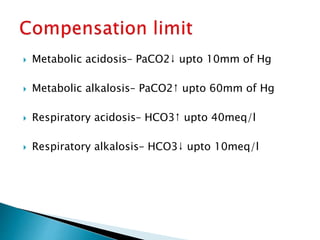
 Metabolic acidosis– PaCO2↓ upto 10mm of Hg
 Metabolic alkalosis– PaCO2↑ upto 60mm of Hg
 Respiratory acidosis– HCO3↑ upto 40meq/l
 Respiratory alkalosis– HCO3↓ upto 10meq/l
 Characterized by pH , due to either HCO₃- or H+;
body tries to compensate by RR & washing out
CO₂.
 Expected PCO₂ = [1.5xHCO3-] + 8±2
(Winters equation)
 Interpretation of measured PaCO₂
1. Measured PaCO2 = Expected
:- Met. Acidosis with appropriate Compensation
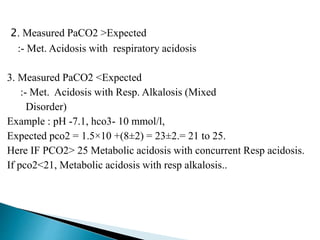
2. Measured PaCO2 >Expected
:- Met. Acidosis with respiratory acidosis
3. Measured PaCO2 <Expected
:- Met. Acidosis with Resp. Alkalosis (Mixed
Disorder)
Example : pH -7.1, hco3- 10 mmol/l,
Expected pco2 = 1.5×10 +(8±2) = 23±2.= 21 to 25.
Here IF PCO2> 25 Metabolic acidosis with concurrent Resp acidosis.
If pco2<21, Metabolic acidosis with resp alkalosis..
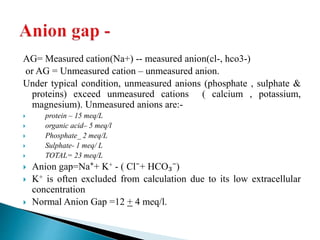
AG= Measured cation(Na+) -- measured anion(cl-, hco3-)
or AG = Unmeasured cation – unmeasured anion.
Under typical condition, unmeasured anions (phosphate , sulphate &
proteins) exceed unmeasured cations ( calcium , potassium,
magnesium). Unmeasured anions are:-
 protein – 15 meq/L
 organic acid– 5 meq/l
 Phosphate_ 2 meq/L
 Sulphate- 1 meq/ L
 TOTAL= 23 meq/L
 Anion gap=Na⁺+ K+ - ( Cl⁻+ HCO₃⁻)
 K+ is often excluded from calculation due to its low extracellular
concentration
 Normal Anion Gap =12 + 4 meq/l.
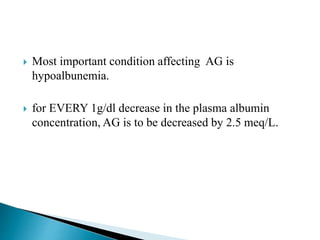
 Most important condition affecting AG is
hypoalbunemia.
 for EVERY 1g/dl decrease in the plasma albumin
concentration, AG is to be decreased by 2.5 meq/L.
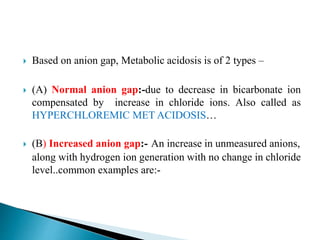
 Based on anion gap, Metabolic acidosis is of 2 types –
 (A) Normal anion gap:-due to decrease in bicarbonate ion
compensated by increase in chloride ions. Also called as
HYPERCHLOREMIC MET ACIDOSIS…
 (B) Increased anion gap:- An increase in unmeasured anions,
along with hydrogen ion generation with no change in chloride
level..common examples are:-
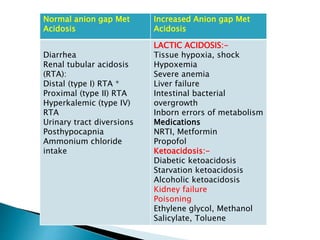
Normal anion gap Met
Acidosis
Increased Anion gap Met
Acidosis
Diarrhea
Renal tubular acidosis
(RTA):
Distal (type I) RTA *
Proximal (type II) RTA
Hyperkalemic (type IV)
RTA
Urinary tract diversions
Posthypocapnia
Ammonium chloride
intake
LACTIC ACIDOSIS:-
Tissue hypoxia, shock
Hypoxemia
Severe anemia
Liver failure
Intestinal bacterial
overgrowth
Inborn errors of metabolism
Medications
NRTI, Metformin
Propofol
Ketoacidosis:-
Diabetic ketoacidosis
Starvation ketoacidosis
Alcoholic ketoacidosis
Kidney failure
Poisoning
Ethylene glycol, Methanol
Salicylate, Toluene
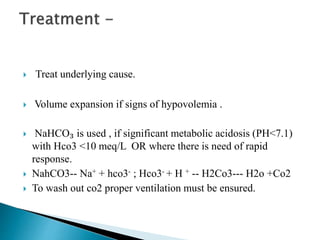
 Treat underlying cause.
 Volume expansion if signs of hypovolemia .
 NaHCO₃ is used , if significant metabolic acidosis (PH<7.1)
with Hco3 <10 meq/L OR where there is need of rapid
response.
 NahCO3-- Na+ + hco3- ; Hco3- + H + -- H2Co3--- H2o +Co2
 To wash out co2 proper ventilation must be ensured.
 Desired bicarbonate level is usually taken as 15 meq/L to tide
over critical situation.
 Hco3 defict = [ Hco3( desired)- Hco3 act] × wt(kg) × 0.3
 Half of the calculated dose is administered in 1-4 hr.
 Further requirement will depend upon clinicalassessment and
repeat meaurement.
 Objective is to maintain pH slightly above 7.2.
 Inj sodabicarb may be given as bolus at dose of 1 meq/kg.
 Injection sodabicarb (8.4%) - 1meq/ml.
 osmolarity 2000mosm/L.
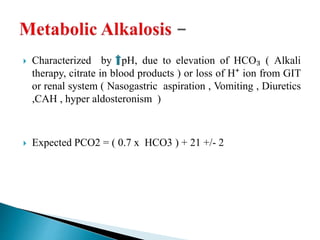
 Characterized by pH, due to elevation of HCO₃ ( Alkali
therapy, citrate in blood products ) or loss of H⁺ ion from GIT
or renal system ( Nasogastric aspiration , Vomiting , Diuretics
,CAH , hyper aldosteronism )
 Expected PCO2 = ( 0.7 x HCO3 ) + 21 +/- 2
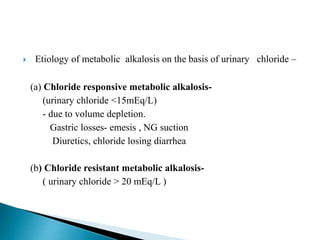
 Etiology of metabolic alkalosis on the basis of urinary chloride –
(a) Chloride responsive metabolic alkalosis-
(urinary chloride <15mEq/L)
- due to volume depletion.
Gastric losses- emesis , NG suction
Diuretics, chloride losing diarrhea
(b) Chloride resistant metabolic alkalosis-
( urinary chloride > 20 mEq/L )
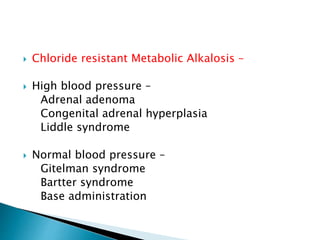
 Chloride resistant Metabolic Alkalosis –
 High blood pressure –
Adrenal adenoma
Congenital adrenal hyperplasia
Liddle syndrome
 Normal blood pressure –
Gitelman syndrome
Bartter syndrome
Base administration
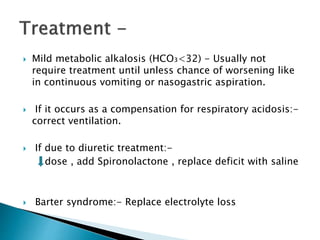
 Mild metabolic alkalosis (HCO₃<32) - Usually not
require treatment until unless chance of worsening like
in continuous vomiting or nasogastric aspiration.
 If it occurs as a compensation for respiratory acidosis:-
correct ventilation.
 If due to diuretic treatment:-
dose , add Spironolactone , replace deficit with saline
 Barter syndrome:- Replace electrolyte loss
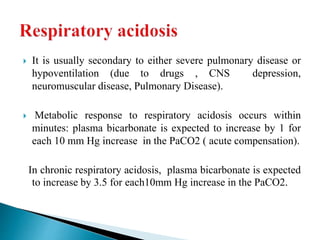
 It is usually secondary to either severe pulmonary disease or
hypoventilation (due to drugs , CNS depression,
neuromuscular disease, Pulmonary Disease).
 Metabolic response to respiratory acidosis occurs within
minutes: plasma bicarbonate is expected to increase by 1 for
each 10 mm Hg increase in the PaCO2 ( acute compensation).
In chronic respiratory acidosis, plasma bicarbonate is expected
to increase by 3.5 for each10mm Hg increase in the PaCO2.
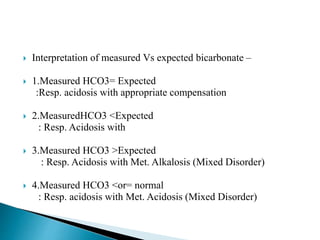
 Interpretation of measured Vs expected bicarbonate –
 1.Measured HCO3= Expected
:Resp. acidosis with appropriate compensation
 2.MeasuredHCO3 <Expected
: Resp. Acidosis with
 3.Measured HCO3 >Expected
: Resp. Acidosis with Met. Alkalosis (Mixed Disorder)
 4.Measured HCO3 <or= normal
: Resp. acidosis with Met. Acidosis (Mixed Disorder)
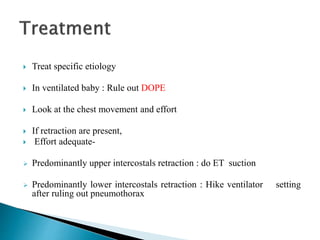
 Treat specific etiology
 In ventilated baby : Rule out DOPE
 Look at the chest movement and effort
 If retraction are present,
 Effort adequate-
 Predominantly upper intercostals retraction : do ET suction
 Predominantly lower intercostals retraction : Hike ventilator setting
after ruling out pneumothorax
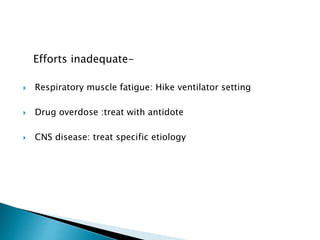
Efforts inadequate-
 Respiratory muscle fatigue: Hike ventilator setting
 Drug overdose :treat with antidote
 CNS disease: treat specific etiology
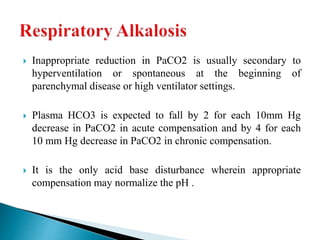
 Inappropriate reduction in PaCO2 is usually secondary to
hyperventilation or spontaneous at the beginning of
parenchymal disease or high ventilator settings.
 Plasma HCO3 is expected to fall by 2 for each 10mm Hg
decrease in PaCO2 in acute compensation and by 4 for each
10 mm Hg decrease in PaCO2 in chronic compensation.
 It is the only acid base disturbance wherein appropriate
compensation may normalize the pH .
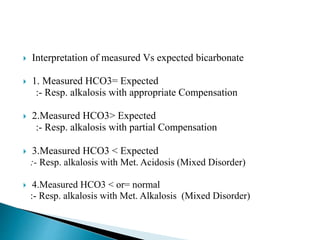
 Interpretation of measured Vs expected bicarbonate
 1. Measured HCO3= Expected
:- Resp. alkalosis with appropriate Compensation
 2.Measured HCO3> Expected
:- Resp. alkalosis with partial Compensation
 3.Measured HCO3 < Expected
:- Resp. alkalosis with Met. Acidosis (Mixed Disorder)
 4.Measured HCO3 < or= normal
:- Resp. alkalosis with Met. Alkalosis (Mixed Disorder)
 Seldom need for specific therapy of respiratory alkalosis.
 Mechanical ventilator setting is adjusted to correct iatrogenic
respiratory alkalosis by reducing alveolar ventilation.
 Step6 –
Is more than one disorder present ?
Clues for mixed acid based disorder -
Clinical History.
pH Normal and abnormal PaCo2,HCO3.
PaCo2 and HCO3 moving in opposite direction.
Degree of compensation for primary disorder is
inappropriate.
Find delta gap
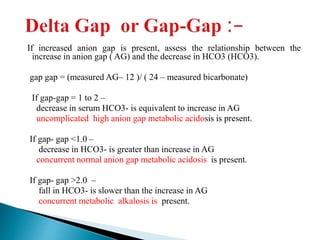
If increased anion gap is present, assess the relationship between the
increase in anion gap ( AG) and the decrease in HCO3 (HCO3).
gap gap = (measured AG– 12 )/ ( 24 – measured bicarbonate)
If gap-gap = 1 to 2 –
decrease in serum HCO3- is equivalent to increase in AG
uncomplicated high anion gap metabolic acidosis is present.
If gap- gap <1.0 –
decrease in HCO3- is greater than increase in AG
concurrent normal anion gap metabolic acidosis is present.
If gap- gap >2.0 –
fall in HCO3- is slower than the increase in AG
concurrent metabolic alkalosis is present.
Check pH and
PCO2 ,
If abnormal
Look the direction
of change in pH
and PCO2
Same direction
Metabolic
Opposite
direction
Respiratory
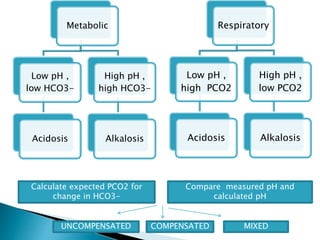
Metabolic
Low pH ,
low HCO3-
Acidosis
High pH ,
high HCO3-
Alkalosis
Calculate expected PCO2 for
change in HCO3-
Respiratory
Low pH ,
high PCO2
Acidosis
High pH ,
low PCO2
Alkalosis
Compare measured pH and
calculated pH
UNCOMPENSATED COMPENSATED MIXED
Abg interpretation  keshav

Abg interpretation keshav

  • 1.
    PRESENTED BY –DR. KUMAR KESHAV CHANDRA MODERATOR – DR. AKHILESH KUMAR
  • 2.
     Introduction  Indications Precautions  Selection and preparation of the site  Effect of common errors on interpretation of ABG analysis  Terminologies  ABG Interpretation
  • 3.
     Arterial bloodgas (ABG) analysis and its interpretation is an integral part of intensive care management.  ABG is the test that measures arterial oxygen tension (PO2), carbon dioxide tension (PCO2), and acidity (pH).  Other parameters like HCO3- , standard bicarbonate concentration (SBC) , base excess (BE) , standard base excess(SBE) and SaO2 are measured indirectly.
  • 4.
     To evaluatethe adequacy of ventilation (PaCO2) , acid base (pH and PaCO2) status, and the oxygen carrying capacity of blood  To monitor patients on ventilator and assist in weaning  To assess acid base imbalance in critical illness  To assess response to therapeutic interventions and mechanical ventilation
  • 5.
     Evidence ofinfection or peripheral vascular disease involving the selected limb.  Negative result of a modified Allen test  A Coagulopathy / medium to high dose anticoagulant therapy.  Arterial puncture should not be performed through a lesion or distal to a surgical shunt.
  • 6.
     Radial Artery(ideal) - most preferred site as it is superficial and collateral supply can be easily assessed.  Umbilical artery (neonates)  Dorsalis pedis Artery  Posterior Tibial artery  Femoral artery
  • 9.
     In themodified Allen test, one hand is examined at a time.  The hand is elevated and the patient is asked to clench their fist for about 30 seconds.  Pressure is applied over the ulnar and the radial arteries so as to occlude both of them.  Still elevated, the hand is then opened. It should appear blanched  Ulnar pressure is released while radial pressure is maintained, and the colour should return within 5 to 15 seconds.  If color fails to return, the test is considered abnormal and it suggests that the ulnar artery supply to the hand is not sufficient. This indicates that it may not be safe to cannulate or needle the radial artery.
  • 10.
     All asepticprecautions are to be followed.  The syringe (2ml) with 25 gauge needle is used.  Flush the syringe with 1-2 ml of heparin (1000 U/ml).  Ensure no residual heparin is left even at the tip.  The radial artery is palpated with the non-dominant hand’s middle and index finger over the radial styloid process between the tendons of abductor pollicis longus and flexor carpi radialis.
  • 11.
     The siteis cleaned with alcohol followed by chlorhexidine / idophor .  Hand is kept hyper extended.  It is pricked just proximal to the palpating fingers using the dominant hand.  Needle is kept at 45 degree angle with the bevel up.  Allow the syringe to fill itself after the artery is pricked.
  • 12.
     After takingsample , eliminate visible gas bubble, record date , time, temperature, PR, RR ,ventilator settings.  Sample should be placed on crushed ice if not analyzed immediately (within 15 min) to slow down metabolic process & before processing, warm it back to body temperature.
  • 13.
     Once thesampling is over , it is important to ensure hemostasis by applying pressure over the site with a gauge piece for at least 5 minutes.  DO NOT LEAVE EXCESSIVE HEPARIN IN THE SYRINGE HEPARIN DILUTIONAL EFFECT HCO3 PCO2  Remove excess heparin by repeatedly squirting out until no visible heparin is seen.
  • 14.
    Error • Dilution with salinewhile sampling from indwelling arterial catheters Change in interpretation • Increase in Na+ and Cl- • All other parameters are diluted Corrective measures • Take at least 3 times of dead space solution out before actual sample.
  • 15.
    Error • Contamination with venous blood. Changein interpretation • PaO2, SaO2 • PCO2 Corrective measures • Use self filling syringes and short beveled needles
  • 16.
    Error • Air bubbles Changein interpretation • PaO2,SaO2 • PCO2 Corrective measure • Expel air by tapping gently on the walls immediately after sampling and before mixing.
  • 17.
    • Hemolysis •K+ • Avoid vigorous mixing, direct cooling on ice and prolonged storage.
  • 18.
    Error • Prolonged storage( >15min) for samplesheld at room temperature or (>60 min) for samples held at 4 degree C Change in interpretation • pH,PaO2,Ca, Glucose • PCO2, Lactate Corrective measure • Analyze within 30 min.
  • 20.
     Buffer systemin the body consists of weak acids and their salts.  Their function is to resist any change in the pH when acid and base are added to the body  Best buffers are those weak acids whose equilibrium constant is close to the body pH.  Bicarbonate is the most effective buffer in the body.  Non bicarbonate buffers include proteins (albumin & Hb ), phosphates and bone.
  • 21.
    pH = -log(H+)=log(1/H+) At a pH of 7.4 H+ ion conc = 40 mmol/L Henderson–Hasselbach equation:-  The bicarbonate buffer system is routinely monitored clinically. CO2 +H2O ↔H+ +HCO3 − The pK of this reaction is 6.1 pH = 6.1+ log[HCO3 − ]/[CO2]= = 6.1+ log [24/40×0.03] = 6.1+ log [20 ] = 6.1+1.3= 7.4 pH of less than 6.8 or greater than 7.8 is considered incompatible with life.
  • 22.
     =base/ acid=log[HCO3 − ]/[CO2] = 24/0.03×40 = 20:1  Buffer ratio is 20 :1 for HCO3 / H2CO3 BUFFER.  as long as the buffer ratio is maintained the pH will not change, even though the amount of hydrogen changes.
  • 23.
    Actual Bicarbonate (ABC/HCO3 act) -  Sum total of the actual bicarbonate concentration.  This is a derived value.  Analyzer derives this from pH and PCO2 values.  Influenced by temperature and PCO2 in the patient.  PCO2 falls by about 4.5% and pH rises by 0.015 per degree celsius fall in temperature.
  • 24.
     Standard Bicarbonate–HCO3 (std) Bicarbonate concentration nullifying the effects of temperature and PCO2 assuming a temperature of 37 degree celsius and PCO2 of 40 mm of Hg. Reflects the true metabolic state of the body.  Buffer Base (BB) – Sum total of all the body store of buffer. 48 mmol/l
  • 25.
    Base Excess (BE)– Represents the amount of acid or base that would have added to neutralize the metabolic disturbance so as to restore the body pH to 7.4 assuming a PCO2 of 40 mm of Hg. Normal value is -2 to +2 mmol/L Standard Base Excess(SBE) – Base excess calculated assuming standard condition of temperature and hemoglobin. SaO₂:-Percentage saturation of Hb in the blood sample. It is derived from PaO₂ using oxy- Hb dissociation curve. Oxygen content of blood – amount of oxygen dissolved in Hb + oxygen dissolved in plasma. CaO2 = (Hb x 1.34 x SaO2 ) + (.003 x PaO2 )
  • 26.
    parameter Normal rangeMeasured/ calculated abnormality pH 7.35-7.45 measured Acidemia <7.35 Alkalemia >7.45 PaO2 ( mm of Hg) 60-80 measured Hypoxia <60 Hyperoxia>80 PaCO2(mm of Hg) 35-45 measured Hypocapnea<35 Hypercapnea>45 HCO3 or Standard HCO3 22-26 calculated M. Acidosis <22 M. Alkalosis>26 BE / SBE -2 to +2 calculated M.Acidosis < -2 M.Alkalosis> =2 SPO2 87-95 calculated Hypoxia < 87 Hyperoxia >95
  • 27.
     Step1– Consider thehistory of illness, clinical settings and anticipate the disorder.
  • 28.
     Step2- Assess pH IfpH <7.35- Acidosis >7.45 - Alkalosis = 7.4 - normal, mixed disorder
  • 29.
     Step3- If acidosisor alkalosis, then decide primary respiratory or metabolic cause. Look at PaCO2 If pH & PaCO2 move in opposite direction, then respiratory cause. If pH & PaCO2 move in the same direction, then metabolic cause.
  • 30.
     Step4– In simpledisorder, HCO3 and PaCO2 move in same direction. If HCO3 and PaCO2 move in opposite direction, think for mixed disorder.
  • 31.
     Step5– Look forcompensation Aim to keep pH in normal range. Patient can be uncompensated, partially compensated or fully compensated but never overcompensated.
  • 32.
     Metabolic acidosis PCO2↓ 1.25mm Hg/1mmol/L↓ HCO3  Expected PCO₂ = [1.5xHCO3] + (8 ± 2) (Winter’s equation)  Metabolic alkalosis  PCO2↑ 0.75mm Hg/1mmol/L↑ HCO3  Expected PCO2 = ( 0.7 x HCO3 ) +(21 +/- 2)
  • 33.
    Expected compensation:-  Respiratoryacidosis  Acute: HCO3↑ 1mmol/L per 10mmHg↑ in PaCO2  Chronic: HCO3↑ 3.5 mmol/L per10mmHg↑inPaCO2  Respiratory Alkalosis  Acute: HCO3↓ 2mmol/L per 10mmHg↓ in PaCO2  Chronic: HCO3↓ 4mmol/L pre 10mmHg↓ in PaCO2
  • 34.
     Metabolic acidosis–PaCO2↓ upto 10mm of Hg  Metabolic alkalosis– PaCO2↑ upto 60mm of Hg  Respiratory acidosis– HCO3↑ upto 40meq/l  Respiratory alkalosis– HCO3↓ upto 10meq/l
  • 35.
     Characterized bypH , due to either HCO₃- or H+; body tries to compensate by RR & washing out CO₂.  Expected PCO₂ = [1.5xHCO3-] + 8±2 (Winters equation)  Interpretation of measured PaCO₂ 1. Measured PaCO2 = Expected :- Met. Acidosis with appropriate Compensation
  • 36.
    2. Measured PaCO2>Expected :- Met. Acidosis with respiratory acidosis 3. Measured PaCO2 <Expected :- Met. Acidosis with Resp. Alkalosis (Mixed Disorder) Example : pH -7.1, hco3- 10 mmol/l, Expected pco2 = 1.5×10 +(8±2) = 23±2.= 21 to 25. Here IF PCO2> 25 Metabolic acidosis with concurrent Resp acidosis. If pco2<21, Metabolic acidosis with resp alkalosis..
  • 37.
    AG= Measured cation(Na+)-- measured anion(cl-, hco3-) or AG = Unmeasured cation – unmeasured anion. Under typical condition, unmeasured anions (phosphate , sulphate & proteins) exceed unmeasured cations ( calcium , potassium, magnesium). Unmeasured anions are:-  protein – 15 meq/L  organic acid– 5 meq/l  Phosphate_ 2 meq/L  Sulphate- 1 meq/ L  TOTAL= 23 meq/L  Anion gap=Na⁺+ K+ - ( Cl⁻+ HCO₃⁻)  K+ is often excluded from calculation due to its low extracellular concentration  Normal Anion Gap =12 + 4 meq/l.
  • 38.
     Most importantcondition affecting AG is hypoalbunemia.  for EVERY 1g/dl decrease in the plasma albumin concentration, AG is to be decreased by 2.5 meq/L.
  • 39.
     Based onanion gap, Metabolic acidosis is of 2 types –  (A) Normal anion gap:-due to decrease in bicarbonate ion compensated by increase in chloride ions. Also called as HYPERCHLOREMIC MET ACIDOSIS…  (B) Increased anion gap:- An increase in unmeasured anions, along with hydrogen ion generation with no change in chloride level..common examples are:-
  • 40.
    Normal anion gapMet Acidosis Increased Anion gap Met Acidosis Diarrhea Renal tubular acidosis (RTA): Distal (type I) RTA * Proximal (type II) RTA Hyperkalemic (type IV) RTA Urinary tract diversions Posthypocapnia Ammonium chloride intake LACTIC ACIDOSIS:- Tissue hypoxia, shock Hypoxemia Severe anemia Liver failure Intestinal bacterial overgrowth Inborn errors of metabolism Medications NRTI, Metformin Propofol Ketoacidosis:- Diabetic ketoacidosis Starvation ketoacidosis Alcoholic ketoacidosis Kidney failure Poisoning Ethylene glycol, Methanol Salicylate, Toluene
  • 41.
     Treat underlyingcause.  Volume expansion if signs of hypovolemia .  NaHCO₃ is used , if significant metabolic acidosis (PH<7.1) with Hco3 <10 meq/L OR where there is need of rapid response.  NahCO3-- Na+ + hco3- ; Hco3- + H + -- H2Co3--- H2o +Co2  To wash out co2 proper ventilation must be ensured.
  • 42.
     Desired bicarbonatelevel is usually taken as 15 meq/L to tide over critical situation.  Hco3 defict = [ Hco3( desired)- Hco3 act] × wt(kg) × 0.3  Half of the calculated dose is administered in 1-4 hr.  Further requirement will depend upon clinicalassessment and repeat meaurement.  Objective is to maintain pH slightly above 7.2.  Inj sodabicarb may be given as bolus at dose of 1 meq/kg.  Injection sodabicarb (8.4%) - 1meq/ml.  osmolarity 2000mosm/L.
  • 43.
     Characterized bypH, due to elevation of HCO₃ ( Alkali therapy, citrate in blood products ) or loss of H⁺ ion from GIT or renal system ( Nasogastric aspiration , Vomiting , Diuretics ,CAH , hyper aldosteronism )  Expected PCO2 = ( 0.7 x HCO3 ) + 21 +/- 2
  • 44.
     Etiology ofmetabolic alkalosis on the basis of urinary chloride – (a) Chloride responsive metabolic alkalosis- (urinary chloride <15mEq/L) - due to volume depletion. Gastric losses- emesis , NG suction Diuretics, chloride losing diarrhea (b) Chloride resistant metabolic alkalosis- ( urinary chloride > 20 mEq/L )
  • 45.
     Chloride resistantMetabolic Alkalosis –  High blood pressure – Adrenal adenoma Congenital adrenal hyperplasia Liddle syndrome  Normal blood pressure – Gitelman syndrome Bartter syndrome Base administration
  • 46.
     Mild metabolicalkalosis (HCO₃<32) - Usually not require treatment until unless chance of worsening like in continuous vomiting or nasogastric aspiration.  If it occurs as a compensation for respiratory acidosis:- correct ventilation.  If due to diuretic treatment:- dose , add Spironolactone , replace deficit with saline  Barter syndrome:- Replace electrolyte loss
  • 47.
     It isusually secondary to either severe pulmonary disease or hypoventilation (due to drugs , CNS depression, neuromuscular disease, Pulmonary Disease).  Metabolic response to respiratory acidosis occurs within minutes: plasma bicarbonate is expected to increase by 1 for each 10 mm Hg increase in the PaCO2 ( acute compensation). In chronic respiratory acidosis, plasma bicarbonate is expected to increase by 3.5 for each10mm Hg increase in the PaCO2.
  • 48.
     Interpretation ofmeasured Vs expected bicarbonate –  1.Measured HCO3= Expected :Resp. acidosis with appropriate compensation  2.MeasuredHCO3 <Expected : Resp. Acidosis with  3.Measured HCO3 >Expected : Resp. Acidosis with Met. Alkalosis (Mixed Disorder)  4.Measured HCO3 <or= normal : Resp. acidosis with Met. Acidosis (Mixed Disorder)
  • 49.
     Treat specificetiology  In ventilated baby : Rule out DOPE  Look at the chest movement and effort  If retraction are present,  Effort adequate-  Predominantly upper intercostals retraction : do ET suction  Predominantly lower intercostals retraction : Hike ventilator setting after ruling out pneumothorax
  • 50.
    Efforts inadequate-  Respiratorymuscle fatigue: Hike ventilator setting  Drug overdose :treat with antidote  CNS disease: treat specific etiology
  • 51.
     Inappropriate reductionin PaCO2 is usually secondary to hyperventilation or spontaneous at the beginning of parenchymal disease or high ventilator settings.  Plasma HCO3 is expected to fall by 2 for each 10mm Hg decrease in PaCO2 in acute compensation and by 4 for each 10 mm Hg decrease in PaCO2 in chronic compensation.  It is the only acid base disturbance wherein appropriate compensation may normalize the pH .
  • 52.
     Interpretation ofmeasured Vs expected bicarbonate  1. Measured HCO3= Expected :- Resp. alkalosis with appropriate Compensation  2.Measured HCO3> Expected :- Resp. alkalosis with partial Compensation  3.Measured HCO3 < Expected :- Resp. alkalosis with Met. Acidosis (Mixed Disorder)  4.Measured HCO3 < or= normal :- Resp. alkalosis with Met. Alkalosis (Mixed Disorder)
  • 53.
     Seldom needfor specific therapy of respiratory alkalosis.  Mechanical ventilator setting is adjusted to correct iatrogenic respiratory alkalosis by reducing alveolar ventilation.
  • 54.
     Step6 – Ismore than one disorder present ? Clues for mixed acid based disorder - Clinical History. pH Normal and abnormal PaCo2,HCO3. PaCo2 and HCO3 moving in opposite direction. Degree of compensation for primary disorder is inappropriate. Find delta gap
  • 55.
    If increased aniongap is present, assess the relationship between the increase in anion gap ( AG) and the decrease in HCO3 (HCO3). gap gap = (measured AG– 12 )/ ( 24 – measured bicarbonate) If gap-gap = 1 to 2 – decrease in serum HCO3- is equivalent to increase in AG uncomplicated high anion gap metabolic acidosis is present. If gap- gap <1.0 – decrease in HCO3- is greater than increase in AG concurrent normal anion gap metabolic acidosis is present. If gap- gap >2.0 – fall in HCO3- is slower than the increase in AG concurrent metabolic alkalosis is present.
  • 56.
    Check pH and PCO2, If abnormal Look the direction of change in pH and PCO2 Same direction Metabolic Opposite direction Respiratory
  • 57.
    Metabolic Low pH , lowHCO3- Acidosis High pH , high HCO3- Alkalosis Calculate expected PCO2 for change in HCO3- Respiratory Low pH , high PCO2 Acidosis High pH , low PCO2 Alkalosis Compare measured pH and calculated pH UNCOMPENSATED COMPENSATED MIXED