
ABDM4233 ENTREPRENEURSHIP

     E-Commerce
         and
     Entrepreneur


              by
         Stephen Ong


Principal Lecturer (Specialist)
 Visiting Professor, Shenzhen
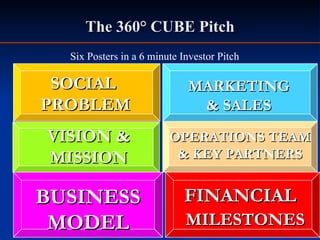
The 360° CUBE Pitch
  Six Posters in a 6 minute Investor Pitch

 SOCIAL                      MARKETING
PROBLEM                       & SALES
VISION &                 OPERATIONS TEAM
MISSION                   & KEY PARTNERS


BUSINESS                    FINANCIAL
 MODEL                       MILESTONES
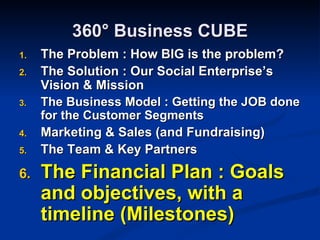
360° Business CUBE
1.   The Problem : How BIG is the problem?
2.   The Solution : Our Social Enterprise’s
     Vision & Mission
3.   The Business Model : Getting the JOB done
     for the Customer Segments
4.   Marketing & Sales (and Fundraising)
5.   The Team & Key Partners
6.   The Financial Plan : Goals
     and objectives, with a
     timeline (Milestones)
The Internet: Changing the
        Face of Business
   Successful companies embrace the Internet
    as a mechanism for transforming their
    companies and for changing everything
    about the way they do business.
   Business basics still apply online.
   In the world of e-commerce,
    company size matters less
    than speed and flexibility.
The Internet: Changing the
        Face of Business
   Study: By 2011, the Internet will influence
    more that $1 billion in offline sales.
   Neilsen study: 86% of the world’s online
    population has used the Internet to make a
    purchase.
   Items purchased most often online include
    computer hardware and software, tickets,
    books, music, movies, gift cards, toys and
    video games, and baby products.
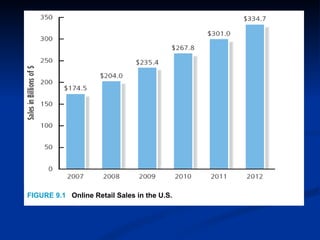
FIGURE 9.1 Online Retail Sales in the U.S.
Benefits of Selling on the Web
   Opportunity to increase revenues and
    profits
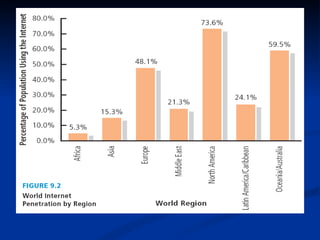
   Ability to expand into global markets
   Ability to remain open 24 hours a day,
    seven days a week
   Capacity to use the Web’s interactive
    nature to enhance customer service
   Power to educate and inform
Benefits of Selling on the Web
                     (continued)


   Ability to lower the cost of doing business
   Ability to spot new business opportunities
    and capitalize on them
   Ability to grow faster
   Power to track sales results
    Conversion                rate –
      the percentage of customers
      to a Web site who actually make a purchase.
Online Business Models
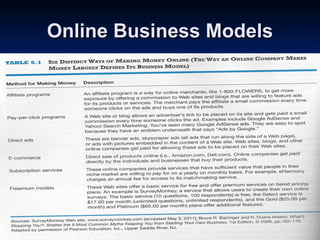
   Affliate programs
   Pay-per-click programs
   Direct Ads
   E-commerce
   Subcription services
   Freemium models
Online Business Models
E-Commerce
   The Small Business Research Board
    reports:
     57.3% of small business owners in the
      U.S. have a Web site
     56.1% of those sites engage in online
      sales.
   Barriers:
     Not knowing how or where to start
     Cost and time concerns
Factors to Consider Before
    Launching into E-Commerce
   How a company exploits the Web’s
    interconnectivity and the opportunities it
    creates to transform relationships with
    suppliers, customers, and others is
    crucial to its success.
   Web success requires a company to
    develop a plan for integrating
    the Web into its overall strategy.
Factors to Consider Before
    Launching into E-Commerce
                     (continued)


   Developing deep, lasting relationships with
    customers takes on even greater importance.
   Creating a meaningful presence on the Web
    requires an ongoing investment of resources
    – time, money, energy, and talent.
   Measuring the success of a Web-based sales
    effort is essential to remaining relevant to
    customers whose tastes, needs, and
    preferences constantly change.
Assessing You Company’s
       Online Potential
1. Does your product have broad appeal to
   customers everywhere?
2. Do you want to sell your product to
   customers outside of your immediate
   geographic area?
3. Can the product you sell be delivered
   conveniently and economically?
4. Can your company realize significant cost
   advantages by going online?
5. Can you draw customers to your company’s
   Web site with a reasonable investment?
Case : Sevenly – E-commerce
     by Weekly Campaign
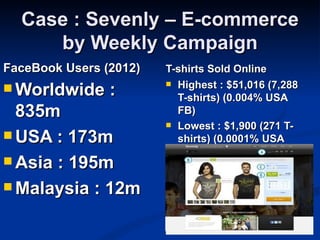
FaceBook Users (2012)   T-shirts Sold Online
                         Highest : $51,016 (7,288
 Worldwide     :         T-shirts) (0.004% USA
  835m                    FB)
                         Lowest : $1,900 (271 T-
 USA : 173m              shirts) (0.0001% USA
                          FB)
 Asia : 195m

 Malaysia : 12m
10 Myths of E-Commerce
Myth 1:     Online customers are easy to please.
Myth 2:     If I launch a site, customers will flock to it.
Myth 3:     Making money on the Web is easy.
Myth 4:     Privacy is not an important issue.
Myth 5:     The most important part of an e-commerce
  effort is technology.
Myth 6:     I don’t need a strategy to sell online.
Myth 7:     Customer service is not important.
Myth 8:     Flashy Web sites are better than simple
  ones.
Myth 9:     It’s what’s up front that counts.
Myth 10: Its too late to get on the Web.
10 Myths of E-Commerce

Myth 1: Online customers are easy to please.

 Experienced online shoppers tend to be
 unforgiving and quick click to another site
 if their shopping experience is subpar or
 they cannot find the products and
 information they want.
10 Myths of E-Commerce
                  (continued)


Myth 1: Online customers are easy to
        please.
Myth 2: If I launch a site, customers will
        flock to it.
Promotion Is the Key!
   Include your URL on everything related to
    your business
   Provide phone and e-mail contact
    information
   Create Web-based newsletters
   Write articles that link to your company’s
    Web site
   Sponsor online contests
   Establish a blog
10 Myths of E-Commerce
                 (continued)


Myth 1: Online customers are easy to
        please.
Myth 2: If I launch a site, customers will
        flock to it.
Myth 3: Making money on the Web is easy.
10 Myths of E-Commerce
                 (continued)


Myth 1: Online customers are easy to
 please.
Myth 2: If I launch a site, customers will
 flock to it.
Myth 3: Making money on the Web is easy.
Myth 4: Privacy is not an important issue.
Myth 4: Privacy Online
             (continued)


Pew Internet Report:
 If online companies were able to
 alleviate customers’ online
 privacy and security issues, the
 percentage of online buyers
 would increase from 66% to 73%.
10 Myths of E-Commerce
                    (continued)


Myth 5: The most important part of an
 e-commerce effort is technology.
     Understand the underlying business...
     …then use technology to develop an
      online business model that provides
      customer value in a profitable way.
10 Myths of E-Commerce
                     (continued)


Myth 6: I don’t need a strategy.
     An online strategy is critical to success
     Define the target audience
     Understand customers’ needs and
      wants
     Create a strategy to set
      your site apart from others
Myth 7: The Importance of
Customer Service on the Web
Myth 7: Customer service is not important.
   Study: 22% of online shoppers expect higher
    levels of customer service than they do offline.
   Concern:
       Nearly 90% of online shopper reported they have
        had problems completing an online transaction.
       84% of these shoppers said they would share their
        negative online shopping experience with others!
Myth 7: The Importance of
Customer Service on the Web
   Study: 58% of Web shoppers who fill their
    online shopping cars abandon them without
    checking out.
   Reasons:
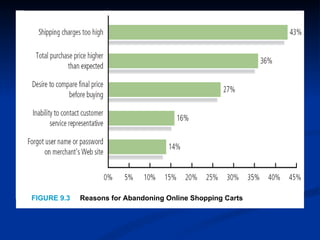
       Shipping and handling charges too high
       Total purchase higher than expected
       Desire to compare final price before buying
       Inability to contact customer service
        representative
       Forgot use name or password for Web site
FIGURE 9.3   Reasons for Abandoning Online Shopping Carts
10 Myths of E-Commerce
                     (continued)


Myth 8: Flashy Web site are better than
       simple sites.
     Fast download times increase sales
      potential
Myth 9: It’s what’s up front that counts.
     Order systems and support are critical
Myth 10: Its too late to get on the Web.
     Web opportunities still exist
Strategies for E-Success
   Focus on a market niche.
   Develop a community.
   Attract visitors by giving away
    “freebies.”
   Make creative use of e-mail, but avoid
    becoming a “spammer.”
   Make sure your Web site
    says “credibility.”
Strategies for E-Success
                   (continued)


   Make the most of the Web’s global
    reach.
   Use Web 2.0 tools to attract and retain
    customers.
   Promote your site online and offline.
   Develop an effective search
    engine optimization (SEO)
    strategy.
Search Engine Strategies
   Natural (organic) Listings –
    Arise as a result of “spiders,” powerful
    programs search engines use to crawl
    around the Web.
   Paid (sponsored) Listings –
    Short text ads with links to the sponsoring
    company’s Web site.
   Paid Inclusion –
    When a company pays a search engine for
    the right to submit either selected pages
    or its entire Web site content for listing.
Designing a Killer Web Site
   Understand your target customer.
   Give customers what they want.
   Select an intuitive domain name that is
    consistent with the image you want to
    create for your company and register it.
     Short
     Memorable
     Indicative of a company’s business
     Easy to spell
   Make your Web site easy to navigate.
Designing a Killer Web Site
                   (continued)


   Add wish list capability.
   Use online videos.
   Create a gift idea center.
   Build loyalty by giving online customers
    a reason to return to your Web site.
   Establish hyperlinks with other
    businesses, preferably those
    selling complementary products.
Designing a Killer Web Site
                   (continued)


   Include an e-mail option an a telephone
    number on your site.
   Give shoppers the ability to track their
    orders online.
   Offer Web shoppers a special all their
    own.
   Follow a simple design.
   Create a fast, simple
    checkout process.
Designing a Killer Web Site
                   (continued)


   Assure customers that online transactions
    are secure.
   Establish reasonable shipping and
    handling charges and post them up front.
   Confirm transactions.
   Keep your site updated.
   Test your site often.
   Consider hiring a professional
    to design your site
Tracking Web Results
   Web Analytics – tools that measure a Web
    site’s ability to attract customers, generate
    sales, and keep customers coming back.
   Only about 40% of e-businesses use
    Web analytics strategically to refashion
    their Web sites.
     Commerce metrics
     Visitor segmentation measurements
     Content reports
     Process measurements
Measuring Online Performance
    Recency –
     The length of time between
     customers’ visits to a Web site.
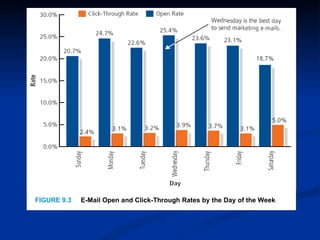
    Click-through Rate (CTR) –
     The proportion of people who
     see a company’s ad online and
     actually click on it.
FIGURE 9.3   E-Mail Open and Click-Through Rates by the Day of the Week
Measuring Online Performance
                    (continued)


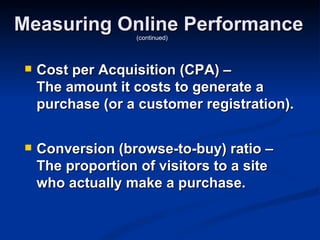
    Cost per Acquisition (CPA) –
     The amount it costs to generate a
     purchase (or a customer registration).

    Conversion (browse-to-buy) ratio –
     The proportion of visitors to a site
     who actually make a purchase.
Ensuring Web Privacy
   Take an inventory of the customer data
    collected.
   Develop a company policy for the
    information you collect.
   Post your company’s privacy policy
    prominently on your
    Web site and follow it.
Ensuring Web Security

   Virus detection software
   Intrusion detection software
   Firewall
Conclusion
   Know what you need to know before
    launching into e-commerce
   Assess the basic strategies to follow
   Know what works on Web sites
   Track results and
    listen to customers
Further Reading
   Scarborough, Norman, M. 2011. Essentials of
    Entrepreneurship and Small Business
    Management. 6th edition. Pearson.
   Brooks, Arthur C. (2006) Social Entrepreneurship :
    A Modern Approach to Social Value Creation.
    Pearson
   Barringer, Bruce R. & Ireland, R. Duane, 2011
    Entrepreneurship – Successfully launching new
    ventures 4th edition, Pearson.
   Schaper, M., Volery, T., Weber, P. & Lewis, K. 2011.
    Entrepreneurship and Small Business. 3rd Asia
    Pacific edition. John Wiley.

Abdm4223 lecture week 12 200712

  • 1.
    ABDM4233 ENTREPRENEURSHIP E-Commerce and Entrepreneur by Stephen Ong Principal Lecturer (Specialist) Visiting Professor, Shenzhen
  • 2.
    The 360° CUBEPitch Six Posters in a 6 minute Investor Pitch SOCIAL MARKETING PROBLEM & SALES VISION & OPERATIONS TEAM MISSION & KEY PARTNERS BUSINESS FINANCIAL MODEL MILESTONES
  • 3.
    360° Business CUBE 1. The Problem : How BIG is the problem? 2. The Solution : Our Social Enterprise’s Vision & Mission 3. The Business Model : Getting the JOB done for the Customer Segments 4. Marketing & Sales (and Fundraising) 5. The Team & Key Partners 6. The Financial Plan : Goals and objectives, with a timeline (Milestones)
  • 4.
    The Internet: Changingthe Face of Business  Successful companies embrace the Internet as a mechanism for transforming their companies and for changing everything about the way they do business.  Business basics still apply online.  In the world of e-commerce, company size matters less than speed and flexibility.
  • 5.
    The Internet: Changingthe Face of Business  Study: By 2011, the Internet will influence more that $1 billion in offline sales.  Neilsen study: 86% of the world’s online population has used the Internet to make a purchase.  Items purchased most often online include computer hardware and software, tickets, books, music, movies, gift cards, toys and video games, and baby products.
  • 6.
    FIGURE 9.1 OnlineRetail Sales in the U.S.
  • 7.
    Benefits of Sellingon the Web  Opportunity to increase revenues and profits  Ability to expand into global markets  Ability to remain open 24 hours a day, seven days a week  Capacity to use the Web’s interactive nature to enhance customer service  Power to educate and inform
  • 8.
    Benefits of Sellingon the Web (continued)  Ability to lower the cost of doing business  Ability to spot new business opportunities and capitalize on them  Ability to grow faster  Power to track sales results Conversion rate – the percentage of customers to a Web site who actually make a purchase.
  • 10.
    Online Business Models  Affliate programs  Pay-per-click programs  Direct Ads  E-commerce  Subcription services  Freemium models
  • 11.
  • 12.
    E-Commerce  The Small Business Research Board reports:  57.3% of small business owners in the U.S. have a Web site  56.1% of those sites engage in online sales.  Barriers:  Not knowing how or where to start  Cost and time concerns
  • 13.
    Factors to ConsiderBefore Launching into E-Commerce  How a company exploits the Web’s interconnectivity and the opportunities it creates to transform relationships with suppliers, customers, and others is crucial to its success.  Web success requires a company to develop a plan for integrating the Web into its overall strategy.
  • 14.
    Factors to ConsiderBefore Launching into E-Commerce (continued)  Developing deep, lasting relationships with customers takes on even greater importance.  Creating a meaningful presence on the Web requires an ongoing investment of resources – time, money, energy, and talent.  Measuring the success of a Web-based sales effort is essential to remaining relevant to customers whose tastes, needs, and preferences constantly change.
  • 15.
    Assessing You Company’s Online Potential 1. Does your product have broad appeal to customers everywhere? 2. Do you want to sell your product to customers outside of your immediate geographic area? 3. Can the product you sell be delivered conveniently and economically? 4. Can your company realize significant cost advantages by going online? 5. Can you draw customers to your company’s Web site with a reasonable investment?
  • 17.
    Case : Sevenly– E-commerce by Weekly Campaign FaceBook Users (2012) T-shirts Sold Online  Highest : $51,016 (7,288  Worldwide : T-shirts) (0.004% USA 835m FB)  Lowest : $1,900 (271 T-  USA : 173m shirts) (0.0001% USA FB)  Asia : 195m  Malaysia : 12m
  • 18.
    10 Myths ofE-Commerce Myth 1: Online customers are easy to please. Myth 2: If I launch a site, customers will flock to it. Myth 3: Making money on the Web is easy. Myth 4: Privacy is not an important issue. Myth 5: The most important part of an e-commerce effort is technology. Myth 6: I don’t need a strategy to sell online. Myth 7: Customer service is not important. Myth 8: Flashy Web sites are better than simple ones. Myth 9: It’s what’s up front that counts. Myth 10: Its too late to get on the Web.
  • 19.
    10 Myths ofE-Commerce Myth 1: Online customers are easy to please. Experienced online shoppers tend to be unforgiving and quick click to another site if their shopping experience is subpar or they cannot find the products and information they want.
  • 20.
    10 Myths ofE-Commerce (continued) Myth 1: Online customers are easy to please. Myth 2: If I launch a site, customers will flock to it.
  • 21.
    Promotion Is theKey!  Include your URL on everything related to your business  Provide phone and e-mail contact information  Create Web-based newsletters  Write articles that link to your company’s Web site  Sponsor online contests  Establish a blog
  • 22.
    10 Myths ofE-Commerce (continued) Myth 1: Online customers are easy to please. Myth 2: If I launch a site, customers will flock to it. Myth 3: Making money on the Web is easy.
  • 23.
    10 Myths ofE-Commerce (continued) Myth 1: Online customers are easy to please. Myth 2: If I launch a site, customers will flock to it. Myth 3: Making money on the Web is easy. Myth 4: Privacy is not an important issue.
  • 24.
    Myth 4: PrivacyOnline (continued) Pew Internet Report: If online companies were able to alleviate customers’ online privacy and security issues, the percentage of online buyers would increase from 66% to 73%.
  • 25.
    10 Myths ofE-Commerce (continued) Myth 5: The most important part of an e-commerce effort is technology.  Understand the underlying business...  …then use technology to develop an online business model that provides customer value in a profitable way.
  • 26.
    10 Myths ofE-Commerce (continued) Myth 6: I don’t need a strategy.  An online strategy is critical to success  Define the target audience  Understand customers’ needs and wants  Create a strategy to set your site apart from others
  • 27.
    Myth 7: TheImportance of Customer Service on the Web Myth 7: Customer service is not important.  Study: 22% of online shoppers expect higher levels of customer service than they do offline.  Concern:  Nearly 90% of online shopper reported they have had problems completing an online transaction.  84% of these shoppers said they would share their negative online shopping experience with others!
  • 28.
    Myth 7: TheImportance of Customer Service on the Web  Study: 58% of Web shoppers who fill their online shopping cars abandon them without checking out.  Reasons:  Shipping and handling charges too high  Total purchase higher than expected  Desire to compare final price before buying  Inability to contact customer service representative  Forgot use name or password for Web site
  • 29.
    FIGURE 9.3 Reasons for Abandoning Online Shopping Carts
  • 30.
    10 Myths ofE-Commerce (continued) Myth 8: Flashy Web site are better than simple sites.  Fast download times increase sales potential Myth 9: It’s what’s up front that counts.  Order systems and support are critical Myth 10: Its too late to get on the Web.  Web opportunities still exist
  • 31.
    Strategies for E-Success  Focus on a market niche.  Develop a community.  Attract visitors by giving away “freebies.”  Make creative use of e-mail, but avoid becoming a “spammer.”  Make sure your Web site says “credibility.”
  • 32.
    Strategies for E-Success (continued)  Make the most of the Web’s global reach.  Use Web 2.0 tools to attract and retain customers.  Promote your site online and offline.  Develop an effective search engine optimization (SEO) strategy.
  • 33.
    Search Engine Strategies  Natural (organic) Listings – Arise as a result of “spiders,” powerful programs search engines use to crawl around the Web.  Paid (sponsored) Listings – Short text ads with links to the sponsoring company’s Web site.  Paid Inclusion – When a company pays a search engine for the right to submit either selected pages or its entire Web site content for listing.
  • 34.
    Designing a KillerWeb Site  Understand your target customer.  Give customers what they want.  Select an intuitive domain name that is consistent with the image you want to create for your company and register it.  Short  Memorable  Indicative of a company’s business  Easy to spell  Make your Web site easy to navigate.
  • 35.
    Designing a KillerWeb Site (continued)  Add wish list capability.  Use online videos.  Create a gift idea center.  Build loyalty by giving online customers a reason to return to your Web site.  Establish hyperlinks with other businesses, preferably those selling complementary products.
  • 36.
    Designing a KillerWeb Site (continued)  Include an e-mail option an a telephone number on your site.  Give shoppers the ability to track their orders online.  Offer Web shoppers a special all their own.  Follow a simple design.  Create a fast, simple checkout process.
  • 37.
    Designing a KillerWeb Site (continued)  Assure customers that online transactions are secure.  Establish reasonable shipping and handling charges and post them up front.  Confirm transactions.  Keep your site updated.  Test your site often.  Consider hiring a professional to design your site
  • 38.
    Tracking Web Results  Web Analytics – tools that measure a Web site’s ability to attract customers, generate sales, and keep customers coming back.  Only about 40% of e-businesses use Web analytics strategically to refashion their Web sites.  Commerce metrics  Visitor segmentation measurements  Content reports  Process measurements
  • 39.
    Measuring Online Performance  Recency – The length of time between customers’ visits to a Web site.  Click-through Rate (CTR) – The proportion of people who see a company’s ad online and actually click on it.
  • 40.
    FIGURE 9.3 E-Mail Open and Click-Through Rates by the Day of the Week
  • 41.
    Measuring Online Performance (continued)  Cost per Acquisition (CPA) – The amount it costs to generate a purchase (or a customer registration).  Conversion (browse-to-buy) ratio – The proportion of visitors to a site who actually make a purchase.
  • 42.
    Ensuring Web Privacy  Take an inventory of the customer data collected.  Develop a company policy for the information you collect.  Post your company’s privacy policy prominently on your Web site and follow it.
  • 43.
    Ensuring Web Security  Virus detection software  Intrusion detection software  Firewall
  • 44.
    Conclusion  Know what you need to know before launching into e-commerce  Assess the basic strategies to follow  Know what works on Web sites  Track results and listen to customers
  • 45.
    Further Reading  Scarborough, Norman, M. 2011. Essentials of Entrepreneurship and Small Business Management. 6th edition. Pearson.  Brooks, Arthur C. (2006) Social Entrepreneurship : A Modern Approach to Social Value Creation. Pearson  Barringer, Bruce R. & Ireland, R. Duane, 2011 Entrepreneurship – Successfully launching new ventures 4th edition, Pearson.  Schaper, M., Volery, T., Weber, P. & Lewis, K. 2011. Entrepreneurship and Small Business. 3rd Asia Pacific edition. John Wiley.

Editor's Notes

  • #2 This "Deco" border was drawn on the Slide master using PowerPoint's Rectangle and Line tools. A smaller version was placed on the Notes Master by selecting all of the elements (using Select All from the Edit menu), deselecting the unwanted elements such as the Title (holding down the Shift key and clicking on the unwanted elements), and then using Paste as Picture from the Edit menu to place the border on the Notes Master. After pasting as a picture, we used the resize handles (with Shift to maintain the proportions) to reduce it to the size you see. Be sure to delete this word processing box before using this template for your own presentation.