By
Ravish Kumar
1EW09CV053
Under the Guidance of
Mr. Nagraj Gupta MS
Associate Professor
Dept. of Civil Engineering
East West Institute of Technology
Bangalore-560091
New Techniques
of wastewater Management
What is wastewater management?
 Wastewater management is the process by which all
waste water (waste from showers, toilets, sinks, both
residential and most commercial) is treated and
returned back to a receiving stream for reuse.
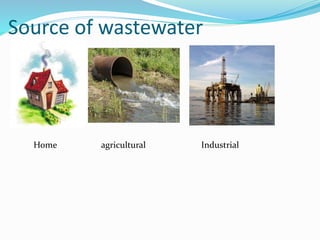
Source of wastewater
Home agricultural Industrial
Methodlogy
Ion Exchange
Reverse osmosis
Distillation
Electro Coagulation
Ion exchange
 Ion exchange is an exchange of ions between two
electrolytes or between an electrolyte solution and a
complex.
 It is used to denote the processes of purification,
separation, and decontamination of aqueous and other
ion-containing solutions with solid polymeric or
mineralic 'ion exchangers'.
Electrocoagulation: New method in
wastewater treatment
 Electrocoagulation is an advanced and economical
water treatment technology. It effectively removes
suspended solids to sub-micrometre levels
 Electrocoagulation is the process of destabilizing
suspended, emulsified, or dissolved contaminants in
an aqueous medium by introducing an electrical
current into the medium.
Requirements of EC
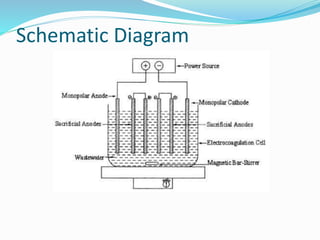
 EC reactor is made up of an electrolytic cell with one
anode and one cathode. EC system essentially consists
of pairs of conductive metal plates in parallel, which
act as monopolar electrodes. It also required sacrificial
anodes. The requirements to operate EC are
a. Direct current power source
b. Resistance Box
c. Multimeter
Schematic Diagram
EC setup
Working
Advantages
 Removes suspended and colloidal solids
 Breaks oil emulsions in water
 Removes fats, oil, and grease
 Removes complex organics
 Destroys and removes bacteria, viruses and cysts
 Color removal up to 95%
 BOD removal > 60%
 COD removal > 70%
Benefits
 Supplied as a skid mounted unit, fully assembled for
inlet/outlet and backwash connections
 Low operating costs
 Low power requirements
 Minimal chemical additions
 Low maintenance
Disadvantages
 The ‘sacrificial electrodes’ are dissolved into
wastewater streams as a result of oxidation, and need
to be regularly replaced.
 The use of electricity may be expensive in many
places.
 High conductivity of the wastewater suspension is
required.
Applications
 Ground Water Cleanup
 Surface Water Cleanup
 Sewage Treatment
Reclamation and Reuse of treated
water
 Irrigation
 Industrial use
 Recreational uses
 Groundwater recharge
 Potable reuse
Reverse osmosis
 Reverse osmosis (RO) is a water purification
technology that uses a semipermeable membrane to
remove larger particles from drinking water.
 Reverse osmosis can remove many types of molecules
and ions from solutions, including bacteria, and is
used in both industrial processes and the production
of potable water.
Schematic Diagram RO
Distillation
 Distillation is a chemical process where a mixture
made of two or more liquids (called "components")
with different boiling points can be separated from
each other.
 Distillation is a unit operation of practically universal
importance, but it is a physical separation process and
not a chemical reaction.
Schematic Diagram Distillation
Reference
 Metcalf; Eddy (1972). Wastewater Engineering. New
York: McGraw-Hill Book Company.
 Kemmer, Frank N. (1979). The Nalco Water Handbook.
New York: McGraw-Hill Book Company.
 Hammer, Mark J. (1975). Water and Waste-Water
Technology. New York: John Wiley & Sons.
New Techniques  of wastewater Management

New Techniques of wastewater Management

  • 1.
    By Ravish Kumar 1EW09CV053 Under theGuidance of Mr. Nagraj Gupta MS Associate Professor Dept. of Civil Engineering East West Institute of Technology Bangalore-560091 New Techniques of wastewater Management
  • 2.
    What is wastewatermanagement?  Wastewater management is the process by which all waste water (waste from showers, toilets, sinks, both residential and most commercial) is treated and returned back to a receiving stream for reuse.
  • 3.
    Source of wastewater Homeagricultural Industrial
  • 4.
  • 5.
    Ion exchange  Ionexchange is an exchange of ions between two electrolytes or between an electrolyte solution and a complex.  It is used to denote the processes of purification, separation, and decontamination of aqueous and other ion-containing solutions with solid polymeric or mineralic 'ion exchangers'.
  • 6.
    Electrocoagulation: New methodin wastewater treatment  Electrocoagulation is an advanced and economical water treatment technology. It effectively removes suspended solids to sub-micrometre levels  Electrocoagulation is the process of destabilizing suspended, emulsified, or dissolved contaminants in an aqueous medium by introducing an electrical current into the medium.
  • 7.
    Requirements of EC EC reactor is made up of an electrolytic cell with one anode and one cathode. EC system essentially consists of pairs of conductive metal plates in parallel, which act as monopolar electrodes. It also required sacrificial anodes. The requirements to operate EC are a. Direct current power source b. Resistance Box c. Multimeter
  • 8.
  • 9.
  • 10.
  • 11.
    Advantages  Removes suspendedand colloidal solids  Breaks oil emulsions in water  Removes fats, oil, and grease  Removes complex organics  Destroys and removes bacteria, viruses and cysts  Color removal up to 95%  BOD removal > 60%  COD removal > 70%
  • 12.
    Benefits  Supplied asa skid mounted unit, fully assembled for inlet/outlet and backwash connections  Low operating costs  Low power requirements  Minimal chemical additions  Low maintenance
  • 13.
    Disadvantages  The ‘sacrificialelectrodes’ are dissolved into wastewater streams as a result of oxidation, and need to be regularly replaced.  The use of electricity may be expensive in many places.  High conductivity of the wastewater suspension is required.
  • 14.
    Applications  Ground WaterCleanup  Surface Water Cleanup  Sewage Treatment
  • 15.
    Reclamation and Reuseof treated water  Irrigation  Industrial use  Recreational uses  Groundwater recharge  Potable reuse
  • 16.
    Reverse osmosis  Reverseosmosis (RO) is a water purification technology that uses a semipermeable membrane to remove larger particles from drinking water.  Reverse osmosis can remove many types of molecules and ions from solutions, including bacteria, and is used in both industrial processes and the production of potable water.
  • 17.
  • 18.
    Distillation  Distillation isa chemical process where a mixture made of two or more liquids (called "components") with different boiling points can be separated from each other.  Distillation is a unit operation of practically universal importance, but it is a physical separation process and not a chemical reaction.
  • 19.
  • 20.
    Reference  Metcalf; Eddy(1972). Wastewater Engineering. New York: McGraw-Hill Book Company.  Kemmer, Frank N. (1979). The Nalco Water Handbook. New York: McGraw-Hill Book Company.  Hammer, Mark J. (1975). Water and Waste-Water Technology. New York: John Wiley & Sons.