A2 Art Exam Theme
TRUTH, FANTASY OR FICTION
12 hour exam
EDEXCEL Externally Set
Assignment
A2
10 weeks Preparatory Study
Period
12 hours Timed Exam
+ 1 Week of Half Term and 2
Weeks at Easter
Some of you lost easy marks as you did not make the most of the start
of your previous project:
- not thinking independently about your ideas
- not fully exploring your mind map
- not fully exploring your initial artists
- not completing a full contact sheet for each idea
It is imperative that you pick a subtheme or subject matter you are
happy to explore in more than one way. Then choose the direction you
are most keen on and have a variety of ideas for.
Stay up-to-date with all set tasks and make sure you come to each
lesson prepared with necessary materials and images (NO MORE
SCREEN SHOTS!)
You bring the ideas! – the exam unit is far more personal, fast paced,
and ambitious than your coursework unit! Be brave!
Learning from before?
You are still responding to the 4 Assessment
Objectives
• AO1 - Develop your ideas through investigations informed by
contextual and other sources demonstrating analytical and
cultural understanding
• AO2 - Refine your ideas through experimenting and selecting
appropriate resources, media, materials, techniques and
processes.
• AO3 - Record ideas, observations and insights relevant to your
intentions in visual and/or other forms.
• AO4 - Present a personal, informed and meaningful response
demonstrating analytical and critical understanding, realising
intentions and where appropriate, making connections between
visual, written, oral or other elements.
40% of final A2 mark
AO1: Developing ideas
•Research should never stop.
•Always look for new and/or more detail
•Make sure you use all resources given
AO2: Experiment and Refine
•Confidently use media that is appropriate to the theme/artist
•Do it over and over to prove a developing skill in more than just
one media. One task a week is not enough!
•The more you produce, the better informed you will be in terms
of skill, and the more developed your work will be.
What top tips can you think of
for each objective?
AO3: Recording and technical skills
•Make every contact sheet and enlargement count – think about
your formal elements, composition, exposure, camera settings
•Every mistake can drag your marks down so make these your
strongest photos yet!
•Presentation can help hide flaws and weaknesses –
enlargements should be your best images, fill blank spaces on
your weebly, etc.
AO4: Personal response
•Try not to repeat similar ideas to what you have already created.
•Be ambitious!
•Leave yourself enough time and get organised at least 2 weeks before
the exam date.
What top tips can you think of
for each objective?
TRUTH, FANTASY OR
FICTION
Some sub-categories to help you with your research and
brainstorm:
life, death, interrogation, torture, war, intolerance
• discovery, dissection, archaeology, astronomy, astrology
• magnifying glasses, microscopes, binoculars, computers
• mirrors, reflective surfaces, lights
• love, trust, marriage, divorce, conciliations
• synagogues, churches, mosques, cathedrals
• conspiracy, slavery, politics, corruption, money, power
• detectives, police, law, justice
• science, maths, theories, measuring instruments,
calculators, books
• folk tales, myths, sagas, poems, tapestries
Truth
Richard Avedon Complex
truths
beneath
the
beautiful
facade
Jill Greenberg – real emotions
Martin Parr
Obsessive pursuit of a
“truthful”
representation of
British culture
Jenny Saville
Xu Zhen – “In just a blink of an
eye”
• Migrants in Manhattan’s China Town trapped in a suspension
between two different societies
Lorenzo Vitturi – “Dalston Anatomy”
Sam Taylor-Wood
Born March 4, 1967
Ansel Adams
Majesty of nature
Part of “Group f/64” which was
about relishing in the truth of
photography
Irving Penn
Extraordinary in the mundane – changing
our expectations and perceptions, Irving
Penn’s still life images of cigarette butts
and other discarded items, elevating
objects from mundane to worthy of
admiration.
Fantasy – “Human kind can only bear
so much reality” TS Elliot
Perhaps we all eventually retreat towards a fantasy
world, especially during times of stress.
Rene Magritte – “This is not a
pipe”
Art is not truth. It is a lie that makes us realise truth. It is
not reality but instead art models and examines what is
Paula Rego - psychological dramas
Filip Dujarden –
Impossible Architecture
Anna Schuleit
Chrisse Macdonald
Jerry Ulesmann – surrealism and
alternate realities
Erwin Blumenfeld – plays with perception and
toys with our expectations
Duane Michals
Childhood
Phobias
“The
Boogeyman”
Jan Von Holleben – “dream of flying”
What did you dream of being as a child? Has it
changed?
Stephen Gill
Blemises and mistakes,
degenerating visual
effects rather than
photoshopping or
airbrushing. There’s a
truth to this process.
Jack Deane
Beth Thompson
Yin Yang
Sam Taylor Wood
Unknown
Yowa Yowa
Riccardo Bevilacqua
Chris Scarborough
fiction
James
Casbere
Fictional landscapes that are
built and lit in a studio
Thomas Demand
Aaron Siskind
Ironic charm in cracked
surfaces – inspired by
Abstract Expressionism
Roman/ Greek sculptors
Depicting only
perfections,
ignoring flaws
Body Works Exhibition
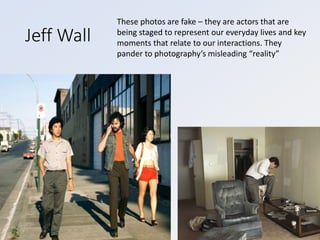
Jeff Wall
These photos are fake – they are actors that are
being staged to represent our everyday lives and key
moments that relate to our interactions. They
pander to photography’s misleading “reality”
Rita Berstein Distressed weathered
surfaces symbolise
human relationships
Cornelia Parker Twenty Years of Tarnish
(wedding Presents) –
pun to connote failing
relationships
Gillian Wearing
Aban Grosdidier David Ryle Hector Sos
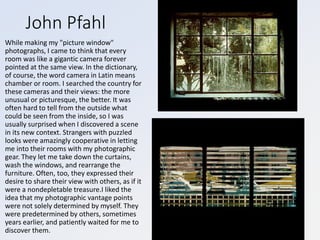
John Pfahl
While making my "picture window"
photographs, I came to think that every
room was like a gigantic camera forever
pointed at the same view. In the dictionary,
of course, the word camera in Latin means
chamber or room. I searched the country for
these cameras and their views: the more
unusual or picturesque, the better. It was
often hard to tell from the outside what
could be seen from the inside, so I was
usually surprised when I discovered a scene
in its new context. Strangers with puzzled
looks were amazingly cooperative in letting
me into their rooms with my photographic
gear. They let me take down the curtains,
wash the windows, and rearrange the
furniture. Often, too, they expressed their
desire to share their view with others, as if it
were a nondepletable treasure.I liked the
idea that my photographic vantage points
were not solely determined by myself. They
were predetermined by others, sometimes
years earlier, and patiently waited for me to
discover them.
William Henry Fox
Talbot –
Latticed window at
Lacock Abbey,
August 1835
The oldest
photographic
image ever found
A recurrent theme in the work of American artist Edward
Hopper is the representation of both the inside and
outside world in his paintings, perhaps alluding to
something about the relationship between our ‘interior’
and ‘exterior’ lives & emotions.

A2 truth--fantasy-or-fiction-2016

  • 1.
    A2 Art ExamTheme TRUTH, FANTASY OR FICTION 12 hour exam
  • 2.
    EDEXCEL Externally Set Assignment A2 10weeks Preparatory Study Period 12 hours Timed Exam + 1 Week of Half Term and 2 Weeks at Easter
  • 3.
    Some of youlost easy marks as you did not make the most of the start of your previous project: - not thinking independently about your ideas - not fully exploring your mind map - not fully exploring your initial artists - not completing a full contact sheet for each idea It is imperative that you pick a subtheme or subject matter you are happy to explore in more than one way. Then choose the direction you are most keen on and have a variety of ideas for. Stay up-to-date with all set tasks and make sure you come to each lesson prepared with necessary materials and images (NO MORE SCREEN SHOTS!) You bring the ideas! – the exam unit is far more personal, fast paced, and ambitious than your coursework unit! Be brave! Learning from before?
  • 4.
    You are stillresponding to the 4 Assessment Objectives • AO1 - Develop your ideas through investigations informed by contextual and other sources demonstrating analytical and cultural understanding • AO2 - Refine your ideas through experimenting and selecting appropriate resources, media, materials, techniques and processes. • AO3 - Record ideas, observations and insights relevant to your intentions in visual and/or other forms. • AO4 - Present a personal, informed and meaningful response demonstrating analytical and critical understanding, realising intentions and where appropriate, making connections between visual, written, oral or other elements. 40% of final A2 mark
  • 5.
    AO1: Developing ideas •Researchshould never stop. •Always look for new and/or more detail •Make sure you use all resources given AO2: Experiment and Refine •Confidently use media that is appropriate to the theme/artist •Do it over and over to prove a developing skill in more than just one media. One task a week is not enough! •The more you produce, the better informed you will be in terms of skill, and the more developed your work will be. What top tips can you think of for each objective?
  • 6.
    AO3: Recording andtechnical skills •Make every contact sheet and enlargement count – think about your formal elements, composition, exposure, camera settings •Every mistake can drag your marks down so make these your strongest photos yet! •Presentation can help hide flaws and weaknesses – enlargements should be your best images, fill blank spaces on your weebly, etc. AO4: Personal response •Try not to repeat similar ideas to what you have already created. •Be ambitious! •Leave yourself enough time and get organised at least 2 weeks before the exam date. What top tips can you think of for each objective?
  • 7.
    TRUTH, FANTASY OR FICTION Somesub-categories to help you with your research and brainstorm: life, death, interrogation, torture, war, intolerance • discovery, dissection, archaeology, astronomy, astrology • magnifying glasses, microscopes, binoculars, computers • mirrors, reflective surfaces, lights • love, trust, marriage, divorce, conciliations • synagogues, churches, mosques, cathedrals • conspiracy, slavery, politics, corruption, money, power • detectives, police, law, justice • science, maths, theories, measuring instruments, calculators, books • folk tales, myths, sagas, poems, tapestries
  • 8.
  • 9.
  • 10.
    Jill Greenberg –real emotions
  • 13.
    Martin Parr Obsessive pursuitof a “truthful” representation of British culture
  • 14.
  • 15.
    Xu Zhen –“In just a blink of an eye” • Migrants in Manhattan’s China Town trapped in a suspension between two different societies
  • 16.
    Lorenzo Vitturi –“Dalston Anatomy”
  • 17.
  • 18.
    Ansel Adams Majesty ofnature Part of “Group f/64” which was about relishing in the truth of photography
  • 19.
    Irving Penn Extraordinary inthe mundane – changing our expectations and perceptions, Irving Penn’s still life images of cigarette butts and other discarded items, elevating objects from mundane to worthy of admiration.
  • 20.
    Fantasy – “Humankind can only bear so much reality” TS Elliot Perhaps we all eventually retreat towards a fantasy world, especially during times of stress.
  • 21.
    Rene Magritte –“This is not a pipe” Art is not truth. It is a lie that makes us realise truth. It is not reality but instead art models and examines what is
  • 22.
    Paula Rego -psychological dramas
  • 25.
  • 26.
  • 27.
  • 28.
    Jerry Ulesmann –surrealism and alternate realities
  • 29.
    Erwin Blumenfeld –plays with perception and toys with our expectations
  • 30.
  • 31.
  • 32.
    Jan Von Holleben– “dream of flying” What did you dream of being as a child? Has it changed?
  • 33.
    Stephen Gill Blemises andmistakes, degenerating visual effects rather than photoshopping or airbrushing. There’s a truth to this process.
  • 34.
  • 35.
  • 36.
  • 37.
  • 38.
  • 39.
  • 40.
  • 41.
  • 42.
  • 43.
    James Casbere Fictional landscapes thatare built and lit in a studio
  • 46.
  • 47.
    Aaron Siskind Ironic charmin cracked surfaces – inspired by Abstract Expressionism
  • 48.
    Roman/ Greek sculptors Depictingonly perfections, ignoring flaws
  • 49.
  • 50.
    Jeff Wall These photosare fake – they are actors that are being staged to represent our everyday lives and key moments that relate to our interactions. They pander to photography’s misleading “reality”
  • 51.
    Rita Berstein Distressedweathered surfaces symbolise human relationships
  • 52.
    Cornelia Parker TwentyYears of Tarnish (wedding Presents) – pun to connote failing relationships
  • 53.
  • 54.
    Aban Grosdidier DavidRyle Hector Sos
  • 55.
    John Pfahl While makingmy "picture window" photographs, I came to think that every room was like a gigantic camera forever pointed at the same view. In the dictionary, of course, the word camera in Latin means chamber or room. I searched the country for these cameras and their views: the more unusual or picturesque, the better. It was often hard to tell from the outside what could be seen from the inside, so I was usually surprised when I discovered a scene in its new context. Strangers with puzzled looks were amazingly cooperative in letting me into their rooms with my photographic gear. They let me take down the curtains, wash the windows, and rearrange the furniture. Often, too, they expressed their desire to share their view with others, as if it were a nondepletable treasure.I liked the idea that my photographic vantage points were not solely determined by myself. They were predetermined by others, sometimes years earlier, and patiently waited for me to discover them.
  • 56.
    William Henry Fox Talbot– Latticed window at Lacock Abbey, August 1835 The oldest photographic image ever found
  • 57.
    A recurrent themein the work of American artist Edward Hopper is the representation of both the inside and outside world in his paintings, perhaps alluding to something about the relationship between our ‘interior’ and ‘exterior’ lives & emotions.