Search For Extraterrestrial Life By:Craig Gantt Snieburn SC104 K001 AMU
What Are We Looking For? Bacteria, signs of bacteria. For most of the earth’s history Bacteria has been the predominate form of life. Is it behaving and evolving the same way it does here on earth?
A Good Starting Place Planets that have or show signs of at one point having water. Water is essential for life as we know it. Organics, the building blocks of life, molecules that contain carbon. All life as we know it is carbon based. This makes looking for carbon logical in looking for life. Planets orbiting stars in solar systems similar to our own.
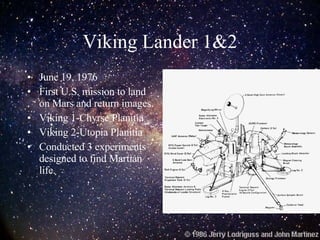
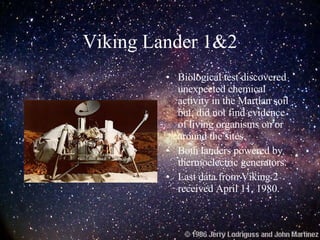
Viking Lander 1&2 June 19, 1976 First U.S. mission to land on Mars and return images. Viking 1-Chyrse Planitia Viking 2-Utopia Planitia Conducted 3 experiments designed to find Martian life.
Viking Lander 1&2 Biological test discovered unexpected chemical activity in the Martian soil but, did not find evidence of living organisms on or around the sites. Both landers powered by thermoelectric generators. Last data from Viking 2 received April 11, 1980.
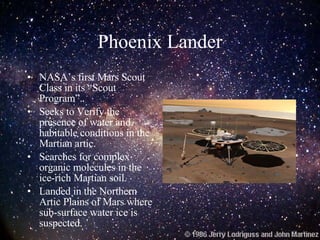
Phoenix Lander NASA’s first Mars Scout Class in its “Scout Program”. Seeks to Verify the presence of water and habitable conditions in the Martian artic. Searches for complex organic molecules in the ice-rich Martian soil. Landed in the Northern Artic Plains of Mars where sub-surface water ice is suspected.
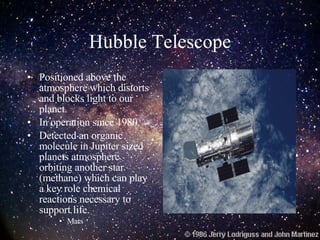
Hubble Telescope Positioned above the atmosphere which distorts and blocks light to our planet. In operation since 1980. Detected an organic molecule in Jupiter sized planets atmosphere orbiting another star (methane) which can play a key role chemical reactions necessary to support life. Mars
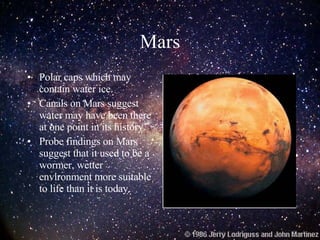
Mars Polar caps which may contain water ice. Canals on Mars suggest water may have been there at one point in its history. Probe findings on Mars suggest that it used to be a wormer, wetter environment more suitable to life than it is today.
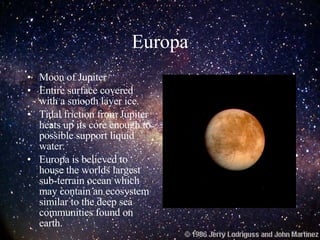
Europa Moon of Jupiter Entire surface covered with a smooth layer ice. Tidal friction from Jupiter heats up its core enough to possible support liquid water. Europa is believed to house the worlds largest sub-terrain ocean which may contain an ecosystem similar to the deep sea communities found on earth.
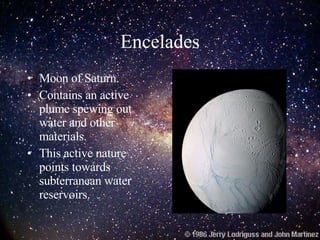
Encelades Moon of Saturn. Contains an active plume spewing out water and other materials. This active nature points towards subterranean water reservoirs.
Resources Nasa.gov Space.com Foxnews.com Esa.int Marsprogram.jpl.nasa.gov

Search For Extraterrestrial Life

  • 1.
    Search For ExtraterrestrialLife By:Craig Gantt Snieburn SC104 K001 AMU
  • 2.
    What Are WeLooking For? Bacteria, signs of bacteria. For most of the earth’s history Bacteria has been the predominate form of life. Is it behaving and evolving the same way it does here on earth?
  • 3.
    A Good StartingPlace Planets that have or show signs of at one point having water. Water is essential for life as we know it. Organics, the building blocks of life, molecules that contain carbon. All life as we know it is carbon based. This makes looking for carbon logical in looking for life. Planets orbiting stars in solar systems similar to our own.
  • 4.
    Viking Lander 1&2June 19, 1976 First U.S. mission to land on Mars and return images. Viking 1-Chyrse Planitia Viking 2-Utopia Planitia Conducted 3 experiments designed to find Martian life.
  • 5.
    Viking Lander 1&2Biological test discovered unexpected chemical activity in the Martian soil but, did not find evidence of living organisms on or around the sites. Both landers powered by thermoelectric generators. Last data from Viking 2 received April 11, 1980.
  • 6.
    Phoenix Lander NASA’sfirst Mars Scout Class in its “Scout Program”. Seeks to Verify the presence of water and habitable conditions in the Martian artic. Searches for complex organic molecules in the ice-rich Martian soil. Landed in the Northern Artic Plains of Mars where sub-surface water ice is suspected.
  • 7.
    Hubble Telescope Positionedabove the atmosphere which distorts and blocks light to our planet. In operation since 1980. Detected an organic molecule in Jupiter sized planets atmosphere orbiting another star (methane) which can play a key role chemical reactions necessary to support life. Mars
  • 8.
    Mars Polar capswhich may contain water ice. Canals on Mars suggest water may have been there at one point in its history. Probe findings on Mars suggest that it used to be a wormer, wetter environment more suitable to life than it is today.
  • 9.
    Europa Moon ofJupiter Entire surface covered with a smooth layer ice. Tidal friction from Jupiter heats up its core enough to possible support liquid water. Europa is believed to house the worlds largest sub-terrain ocean which may contain an ecosystem similar to the deep sea communities found on earth.
  • 10.
    Encelades Moon ofSaturn. Contains an active plume spewing out water and other materials. This active nature points towards subterranean water reservoirs.
  • 11.
    Resources Nasa.gov Space.comFoxnews.com Esa.int Marsprogram.jpl.nasa.gov