MEJORA DE LA COMPETENCIA
COMUNICATIVA
WHY?
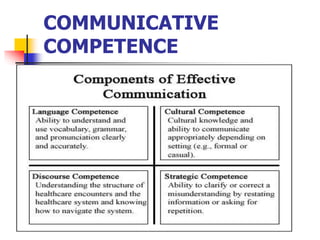
COMMUNICATIVE
COMPETENCE
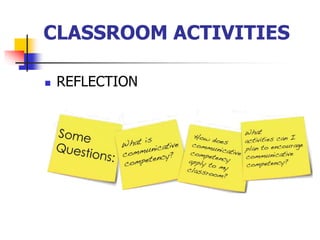
CLASSROOM ACTIVITIES
 REFLECTION
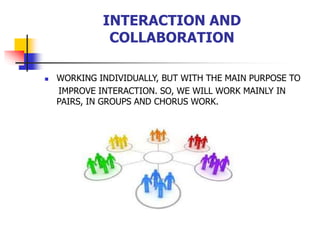
INTERACTION AND
COLLABORATION
 WORKING INDIVIDUALLY, BUT WITH THE MAIN PURPOSE TO
IMPROVE INTERACTION. SO, WE WILL WORK MAINLY IN
PAIRS, IN GROUPS AND CHORUS WORK.
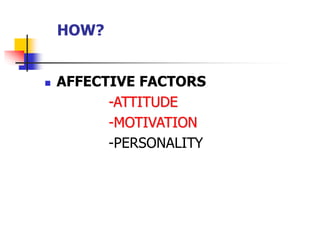
HOW?
 AFFECTIVE FACTORS
-ATTITUDE
-MOTIVATION
-PERSONALITY
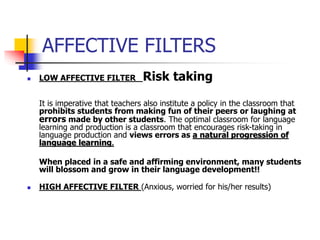
AFFECTIVE FILTERS
 LOW AFFECTIVE FILTER Risk taking
It is imperative that teachers also institute a policy in the classroom that
prohibits students from making fun of their peers or laughing at
errors made by other students. The optimal classroom for language
learning and production is a classroom that encourages risk-taking in
language production and views errors as a natural progression of
language learning.
When placed in a safe and affirming environment, many students
will blossom and grow in their language development!!
 HIGH AFFECTIVE FILTER (Anxious, worried for his/her results)
LOVE IS THE ONLY WAY
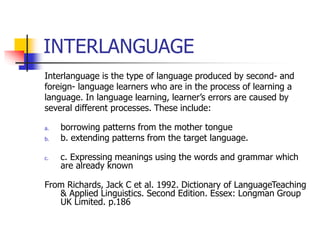
INTERLANGUAGE
Interlanguage is the type of language produced by second- and
foreign- language learners who are in the process of learning a
language. In language learning, learner’s errors are caused by
several different processes. These include:
a. borrowing patterns from the mother tongue
b. b. extending patterns from the target language.
c. c. Expressing meanings using the words and grammar which
are already known
From Richards, Jack C et al. 1992. Dictionary of LanguageTeaching
& Applied Linguistics. Second Edition. Essex: Longman Group
UK Limited. p.186
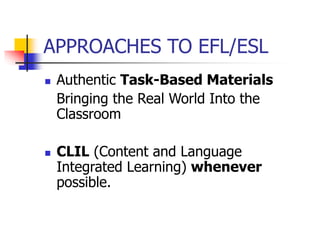
APPROACHES TO EFL/ESL
 Authentic Task-Based Materials
Bringing the Real World Into the
Classroom
 CLIL (Content and Language
Integrated Learning) whenever
possible.
STRUCTURE OF THE SESSIONS
 5’ WARM-UP QUESTIONS (Reflection
on session.Self-Assessment Sheet)
 The 4 skills with its correspondent
microskills; reading, writing, listening,
speaking. Integrated or separated.
 5’ END-UP QUESTIONS (Reflection
on session.Self-Assessment Sheet)
WHY?
METALANGUAGE
 Meta-language is the language teachers and learners use to talk
about the English language, learning and teaching.
 Example
Words and phrases such as 'verb', 'noun', 'present perfect
continuous', 'phrasal verb' and 'reported speech' are all
examples of common classroom meta-language.
 In the classroom
Certain classroom teaching materials rely on the learner
knowing an extensive range of meta-language and teachers
sometimes spend time teaching learners some of the more
common terms.
FIRST SESSION CONTENTS
 RESOURCES TO BE USED:
-BOOKLET
-BLOG
-BOOKS
 CLASSROOM LANGUAGE IMPORTANCE.
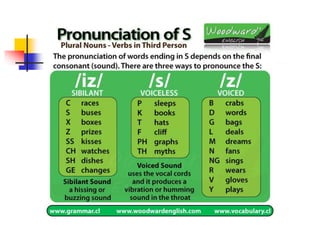
 PHONETICS
 KNOW OUR TEACHER
 KNOWING EACH OTHER
 GLOGSTER TASK
PHONEMIC CHART
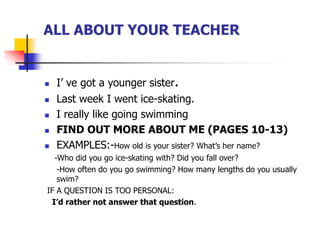
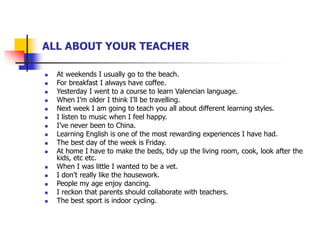
ALL ABOUT YOUR TEACHER
 I’ ve got a younger sister.
 Last week I went ice-skating.
 I really like going swimming
 FIND OUT MORE ABOUT ME (PAGES 10-13)
 EXAMPLES:-How old is your sister? What’s her name?
-Who did you go ice-skating with? Did you fall over?
-How often do you go swimming? How many lengths do you usually
swim?
IF A QUESTION IS TOO PERSONAL:
I’d rather not answer that question.
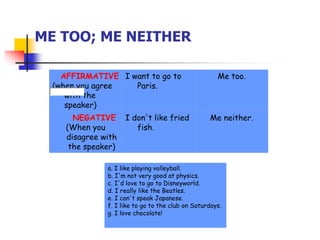
ME TOO; ME NEITHER
AFFIRMATIVE
(when you agree
with the
speaker)
I want to go to
Paris.
Me too.
NEGATIVE
(When you
disagree with
the speaker)
I don't like fried
fish.
Me neither.
a. I like playing volleyball.
b. I'm not very good at physics.
c. I'd love to go to Disneyworld.
d. I really like the Beatles.
e. I can't speak Japanese.
f. I like to go to the club on Saturdays.
g. I love chocolate!
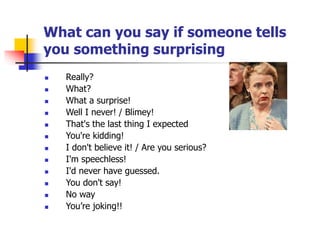
What can you say if someone tells
you something surprising
 Really?
 What?
 What a surprise!
 Well I never! / Blimey!
 That's the last thing I expected
 You're kidding!
 I don't believe it! / Are you serious?
 I'm speechless!
 I'd never have guessed.
 You don't say!
 No way
 You’re joking!!
ALL ABOUT YOUR TEACHER
 At weekends I usually go to the beach.
 For breakfast I always have coffee.
 Yesterday I went to a course to learn Valencian language.
 When I’m older I think I’ll be travelling.
 Next week I am going to teach you all about different learning styles.
 I listen to music when I feel happy.
 I’ve never been to China.
 Learning English is one of the most rewarding experiences I have had.
 The best day of the week is Friday.
 At home I have to make the beds, tidy up the living room, cook, look after the
kids, etc etc.
 When I was little I wanted to be a vet.
 I don’t really like the housework.
 People my age enjoy dancing.
 I reckon that parents should collaborate with teachers.
 The best sport is indoor cycling.
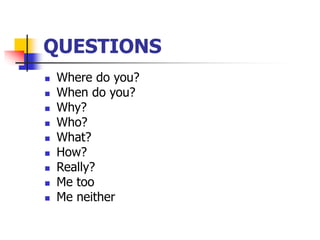
QUESTIONS
 Where do you?
 When do you?
 Why?
 Who?
 What?
 How?
 Really?
 Me too
 Me neither
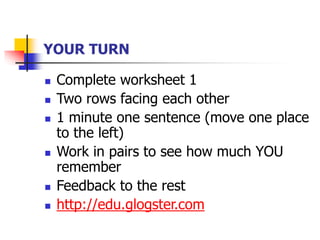
YOUR TURN
 Complete worksheet 1
 Two rows facing each other
 1 minute one sentence (move one place
to the left)
 Work in pairs to see how much YOU
remember
 Feedback to the rest
 http://edu.glogster.com

FIRST SESSION.ppt

  • 2.
    MEJORA DE LACOMPETENCIA COMUNICATIVA WHY?
  • 3.
  • 4.
  • 5.
    INTERACTION AND COLLABORATION  WORKINGINDIVIDUALLY, BUT WITH THE MAIN PURPOSE TO IMPROVE INTERACTION. SO, WE WILL WORK MAINLY IN PAIRS, IN GROUPS AND CHORUS WORK.
  • 6.
  • 7.
    AFFECTIVE FILTERS  LOWAFFECTIVE FILTER Risk taking It is imperative that teachers also institute a policy in the classroom that prohibits students from making fun of their peers or laughing at errors made by other students. The optimal classroom for language learning and production is a classroom that encourages risk-taking in language production and views errors as a natural progression of language learning. When placed in a safe and affirming environment, many students will blossom and grow in their language development!!  HIGH AFFECTIVE FILTER (Anxious, worried for his/her results)
  • 8.
    LOVE IS THEONLY WAY
  • 9.
    INTERLANGUAGE Interlanguage is thetype of language produced by second- and foreign- language learners who are in the process of learning a language. In language learning, learner’s errors are caused by several different processes. These include: a. borrowing patterns from the mother tongue b. b. extending patterns from the target language. c. c. Expressing meanings using the words and grammar which are already known From Richards, Jack C et al. 1992. Dictionary of LanguageTeaching & Applied Linguistics. Second Edition. Essex: Longman Group UK Limited. p.186
  • 10.
    APPROACHES TO EFL/ESL Authentic Task-Based Materials Bringing the Real World Into the Classroom  CLIL (Content and Language Integrated Learning) whenever possible.
  • 11.
    STRUCTURE OF THESESSIONS  5’ WARM-UP QUESTIONS (Reflection on session.Self-Assessment Sheet)  The 4 skills with its correspondent microskills; reading, writing, listening, speaking. Integrated or separated.  5’ END-UP QUESTIONS (Reflection on session.Self-Assessment Sheet) WHY?
  • 12.
    METALANGUAGE  Meta-language isthe language teachers and learners use to talk about the English language, learning and teaching.  Example Words and phrases such as 'verb', 'noun', 'present perfect continuous', 'phrasal verb' and 'reported speech' are all examples of common classroom meta-language.  In the classroom Certain classroom teaching materials rely on the learner knowing an extensive range of meta-language and teachers sometimes spend time teaching learners some of the more common terms.
  • 13.
    FIRST SESSION CONTENTS RESOURCES TO BE USED: -BOOKLET -BLOG -BOOKS  CLASSROOM LANGUAGE IMPORTANCE.  PHONETICS  KNOW OUR TEACHER  KNOWING EACH OTHER  GLOGSTER TASK
  • 14.
  • 16.
    ALL ABOUT YOURTEACHER  I’ ve got a younger sister.  Last week I went ice-skating.  I really like going swimming  FIND OUT MORE ABOUT ME (PAGES 10-13)  EXAMPLES:-How old is your sister? What’s her name? -Who did you go ice-skating with? Did you fall over? -How often do you go swimming? How many lengths do you usually swim? IF A QUESTION IS TOO PERSONAL: I’d rather not answer that question.
  • 17.
    ME TOO; MENEITHER AFFIRMATIVE (when you agree with the speaker) I want to go to Paris. Me too. NEGATIVE (When you disagree with the speaker) I don't like fried fish. Me neither. a. I like playing volleyball. b. I'm not very good at physics. c. I'd love to go to Disneyworld. d. I really like the Beatles. e. I can't speak Japanese. f. I like to go to the club on Saturdays. g. I love chocolate!
  • 18.
    What can yousay if someone tells you something surprising  Really?  What?  What a surprise!  Well I never! / Blimey!  That's the last thing I expected  You're kidding!  I don't believe it! / Are you serious?  I'm speechless!  I'd never have guessed.  You don't say!  No way  You’re joking!!
  • 19.
    ALL ABOUT YOURTEACHER  At weekends I usually go to the beach.  For breakfast I always have coffee.  Yesterday I went to a course to learn Valencian language.  When I’m older I think I’ll be travelling.  Next week I am going to teach you all about different learning styles.  I listen to music when I feel happy.  I’ve never been to China.  Learning English is one of the most rewarding experiences I have had.  The best day of the week is Friday.  At home I have to make the beds, tidy up the living room, cook, look after the kids, etc etc.  When I was little I wanted to be a vet.  I don’t really like the housework.  People my age enjoy dancing.  I reckon that parents should collaborate with teachers.  The best sport is indoor cycling.
  • 20.
    QUESTIONS  Where doyou?  When do you?  Why?  Who?  What?  How?  Really?  Me too  Me neither
  • 21.
    YOUR TURN  Completeworksheet 1  Two rows facing each other  1 minute one sentence (move one place to the left)  Work in pairs to see how much YOU remember  Feedback to the rest  http://edu.glogster.com