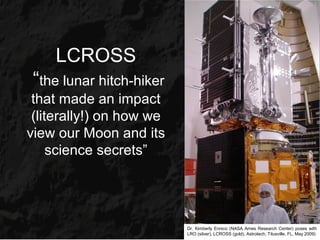
LCROSS
 “the lunar hitch-hiker
 that made an impact
 (literally!) on how we
view our Moon and its
     science secrets”


                          Dr. Kimberly Ennico (NASA Ames Research Center) poses with
                          LRO (silver), LCROSS (gold), Astrotech, Titusville, FL, May 2009)
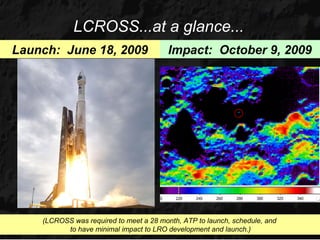
LCROSS...at a glance...
Launch: June 18, 2009                    Impact: October 9, 2009


    (LCROSS was required to meet a 28 month, ATP to launch, schedule, and
          to have minimal impact to LRO development and launch.)
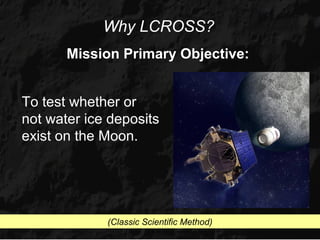
Why LCROSS?
       Mission Primary Objective:


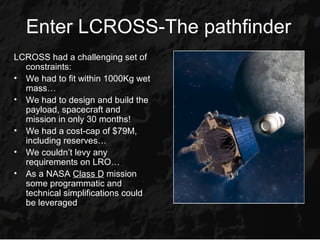
To test whether or
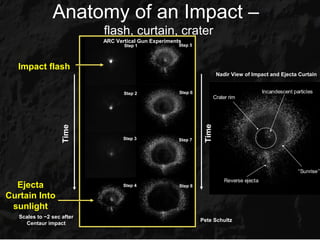
not water ice deposits
exist on the Moon.


             (Classic Scientific Method)
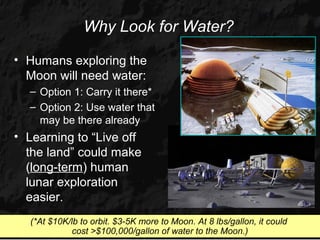
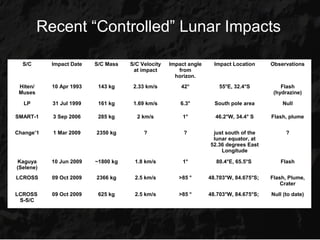
Why Look for Water?

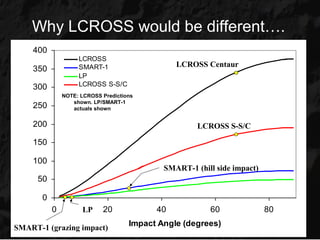
• Humans exploring the
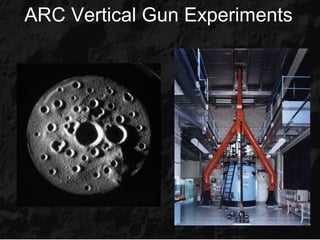
  Moon will need water:
  – Option 1: Carry it there*
  – Option 2: Use water that
    may be there already
• Learning to “Live off
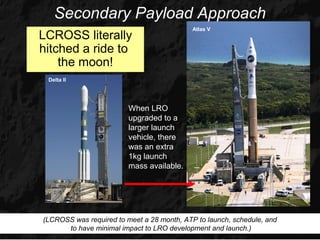
  the land” could make
  (long-term) human
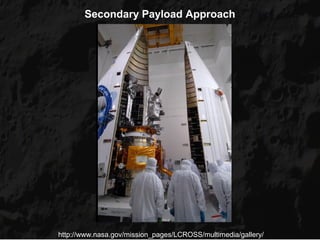
  lunar exploration
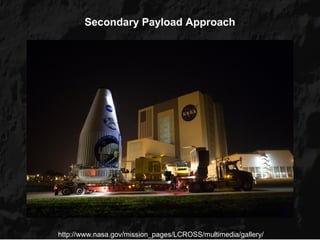
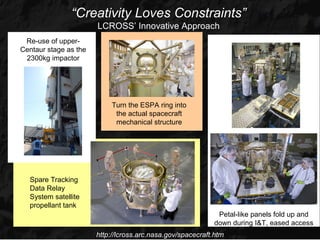
  easier.
  (*At $10K/lb to orbit. $3-5K more to Moon. At 8 lbs/gallon, it could
             cost >$100,000/gallon of water to the Moon.)
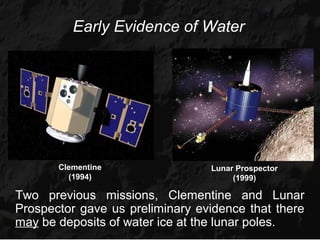
Early Evidence of Water


       Clementine                Lunar Prospector
         (1994)                       (1999)

Two previous missions, Clementine and Lunar
Prospector gave us preliminary evidence that there
may be deposits of water ice at the lunar poles.
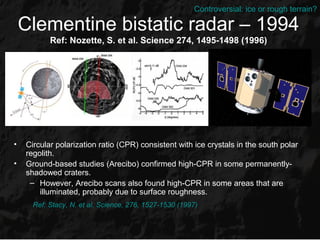
Controversial: ice or rough terrain?

    Clementine bistatic radar – 1994
           Ref: Nozette, S. et al. Science 274, 1495-1498 (1996)


•   Circular polarization ratio (CPR) consistent with ice crystals in the south polar
    regolith.
•   Ground-based studies (Arecibo) confirmed high-CPR in some permanently-
    shadowed craters.
     – However, Arecibo scans also found high-CPR in some areas that are
        illuminated, probably due to surface roughness.
      Ref: Stacy, N. et al. Science, 276, 1527-1530 (1997)
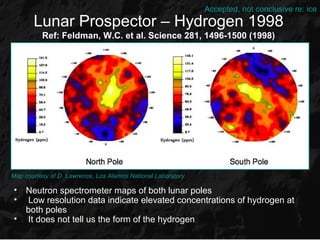
Accepted, not conclusive re: ice
       Lunar Prospector – Hydrogen 1998
          Ref: Feldman, W.C. et al. Science 281, 1496-1500 (1998)


Map courtesy of D. Lawrence, Los Alamos National Laboratory.

•    Neutron spectrometer maps of both lunar poles
•    Low resolution data indicate elevated concentrations of hydrogen at
     both poles
•    It does not tell us the form of the hydrogen
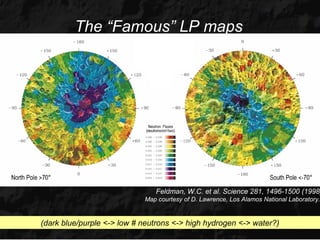
The “Famous” LP maps


                               Feldman, W.C. et al. Science 281, 1496-1500 (1998)
                            Map courtesy of D. Lawrence, Los Alamos National Laboratory.


(dark blue/purple <-> low # neutrons <-> high hydrogen <-> water?)
Evidence against ice lakes at poles
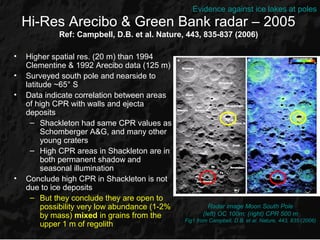
    Hi-Res Arecibo & Green Bank radar – 2005
             Ref: Campbell, D.B. et al. Nature, 443, 835-837 (2006)

•   Higher spatial res. (20 m) than 1994
    Clementine & 1992 Arecibo data (125 m)
•   Surveyed south pole and nearside to
    latitude ~65° S
•   Data indicate correlation between areas
    of high CPR with walls and ejecta
    deposits
      – Shackleton had same CPR values as
         Schomberger A&G, and many other
         young craters
      – High CPR areas in Shackleton are in
         both permanent shadow and
         seasonal illumination
•   Conclude high CPR in Shackleton is not
    due to ice deposits
      – But they conclude they are open to
         possibility very low abundance (1-2%            Radar image Moon South Pole
         by mass) mixed in grains from the             (left) OC 100m; (right) CPR 500 m
                                                Fig1 from Campbell, D.B. et al. Nature, 443, 835 (2006)
         upper 1 m of regolith
Evidence against ice lakes at poles; temperature is cold enough to support ice
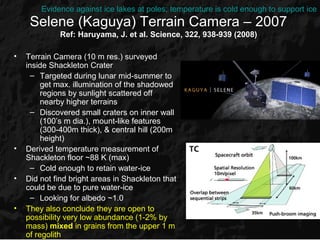
     Selene (Kaguya) Terrain Camera – 2007
              Ref: Haruyama, J. et al. Science, 322, 938-939 (2008)

•   Terrain Camera (10 m res.) surveyed
    inside Shackleton Crater
      – Targeted during lunar mid-summer to
         get max. illumination of the shadowed
         regions by sunlight scattered off
         nearby higher terrains
      – Discovered small craters on inner wall
         (100’s m dia.), mount-like features
         (300-400m thick), & central hill (200m
         height)
•   Derived temperature measurement of
    Shackleton floor ~88 K (max)
      – Cold enough to retain water-ice
•   Did not find bright areas in Shackleton that
    could be due to pure water-ice
      – Looking for albedo ~1.0
•   They also conclude they are open to
    possibility very low abundance (1-2% by
    mass) mixed in grains from the upper 1 m
    of regolith
How could there be water at
                the lunar poles?
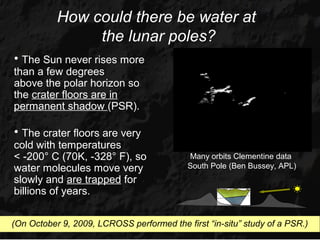
• The Sun never rises more
than a few degrees
above the polar horizon so
the crater floors are in
permanent shadow (PSR).

• The crater floors are very
cold with temperatures
< -200° C (70K, -328° F), so               Many orbits Clementine data
water molecules move very                  South Pole (Ben Bussey, APL)
slowly and are trapped for
billions of years.


(On October 9, 2009, LCROSS performed the first “in-situ” study of a PSR.)
Where could water ice come from?


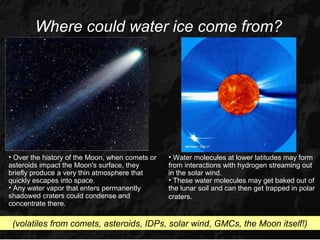
• Over the history of the Moon, when comets or   • Water molecules at lower latitudes may form
asteroids impact the Moon's surface, they        from interactions with hydrogen streaming out
briefly produce a very thin atmosphere that      in the solar wind.
quickly escapes into space.                      • These water molecules may get baked out of
• Any water vapor that enters permanently        the lunar soil and can then get trapped in polar
shadowed craters could condense and              craters.
concentrate there.

 (volatiles from comets, asteroids, IDPs, solar wind, GMCs, the Moon itself!)
How much water could there be?
• There is ~12,500 km2 of
  permanently shadowed
  terrain on the Moon.
• If the top 1 meter of this area
  were to hold 1% water (by
  mass)*, that would be
  equivalent to about 4.1 x 10¹¹
  liters of water!
• This is approximately 2% the
  volume of the Great Salt Lake
  in Utah.


     (*The Sahara desert is 1.2% water (by mass) in its top 20cm,
                        with 2.5-4.5% at 3m.)
Enter LCROSS-The pathfinder
LCROSS had a challenging set of
  constraints:
• We had to fit within 1000Kg wet
  mass…
• We had to design and build the
  payload, spacecraft and
  mission in only 30 months!
• We had a cost-cap of $79M,
  including reserves…
• We couldn’t levy any
  requirements on LRO…
• As a NASA Class D mission
  some programmatic and
  technical simplifications could
  be leveraged
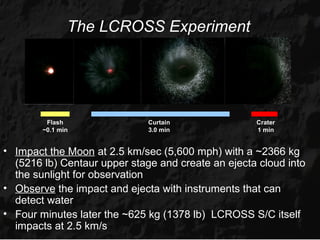
The LCROSS Experiment


         Flash                Curtain               Crater
        ~0.1 min              3.0 min               1 min


• Impact the Moon at 2.5 km/sec (5,600 mph) with a ~2366 kg
  (5216 lb) Centaur upper stage and create an ejecta cloud into
  the sunlight for observation
• Observe the impact and ejecta with instruments that can
  detect water
• Four minutes later the ~625 kg (1378 lb) LCROSS S/C itself
  impacts at 2.5 km/s
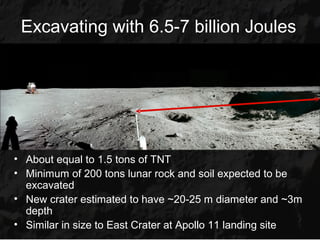
Excavating with 6.5-7 billion Joules


• About equal to 1.5 tons of TNT
• Minimum of 200 tons lunar rock and soil expected to be
  excavated
• New crater estimated to have ~20-25 m diameter and ~3m
  depth
• Similar in size to East Crater at Apollo 11 landing site
Anatomy of an Impact –
                            flash, curtain, crater
                            ARC Vertical Gun Experiments
                                   Step 1              Step 5


   Impact flash
                                                                         Nadir View of Impact and Ejecta Curtain


                                   Step 2              Step 6                                Incandescent particles
                                                                        Crater rim


                                                                 Time
                   Time


                                   Step 3              Step 7


                                                                                                            “Sunrise”
                                                                            Reverse ejecta
  Ejecta                           Step 4              Step 8

Curtain Into
 sunlight
   Scales to ~2 sec after
                                                                Pete Schultz
     Centaur impact
Recent “Controlled” Lunar Impacts

  S/C       Impact Date   S/C Mass   S/C Velocity   Impact angle     Impact Location     Observations
                                      at impact        from
                                                      horizon.
 Hiten/     10 Apr 1993    143 kg     2.33 km/s         42°            55°E, 32.4°S          Flash
 Muses                                                                                    (hydrazine)

  LP        31 Jul 1999    161 kg     1.69 km/s         6.3°         South pole area         Null

SMART-1     3 Sep 2006     285 kg      2 km/s            1°          46.2°W, 34.4° S     Flash, plume


Change’1    1 Mar 2009    2350 kg         ?              ?          just south of the          ?
                                                                    lunar equator, at
                                                                   52.36 degrees East
                                                                       Longitude

Kaguya      10 Jun 2009   ~1800 kg    1.8 km/s           1°          80.4°E, 65.5°S          Flash
(Selene)
LCROSS      09 Oct 2009   2366 kg     2.5 km/s         >85 °       48.703°W, 84.675°S;   Flash, Plume,
                                                                                             Crater

LCROSS      09 Oct 2009    625 kg     2.5 km/s         >85 °       48.703°W, 84.675°S;   Null (to date)
 S-S/C
Why LCROSS would be different….
    400
                    LCROSS
                    SMART-1                     LCROSS Centaur
    350
                    LP
    300             LCROSS S-S/C
               NOTE: LCROSS Predictions
                  shown. LP/SMART-1
    250           actuals shown


    200                                               LCROSS S-S/C

    150

    100
                                             SMART-1 (hill side impact)
  Ejecta Mass (Metric Tones)
     50

       0
           0         LP     20             40            60               80
                                     Impact Angle (degrees)
SMART-1 (grazing impact)
ARC Vertical Gun Experiments
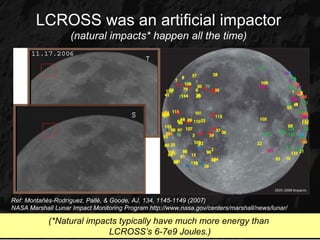
LCROSS was an artificial impactor
                    (natural impacts* happen all the time)


Ref: Montañés-Rodríguez, Pallé, & Goode, AJ, 134, 1145-1149 (2007)
NASA Marshall Lunar Impact Monitoring Program http://www.nasa.gov/centers/marshall/news/lunar/

            (*Natural impacts typically have much more energy than
                           LCROSS’s 6-7e9 Joules.)
The LCROSS Mission Recipe
• Step 1: Hitch a ride to the Moon
       • (Thanks LRO)
• Step 2: Part with LRO, but hang onto that rocket!
       • (we’ll use it later)
•   Step 3: Tug it around the Earth
•   Step 4: Point it toward our crater
•   Step 5: Let go!
•   Step 6: Slow-down & watch what kicks-up
•   Step 7: Send pics & data back to Earth
•   Step 8: Say good-bye
       • (Taste regolith!)
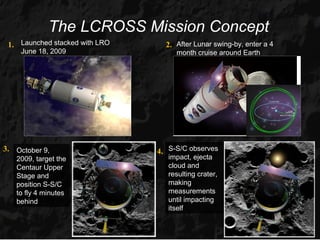
The LCROSS Mission Concept
 1. Launched stacked with LRO     2. After Lunar swing-by, enter a 4
    June 18, 2009                    month cruise around Earth


3. October 9,                   4. S-S/C observes
   2009, target the                impact, ejecta
   Centaur Upper                   cloud and
   Stage and                       resulting crater,
   position S-S/C                  making
   to fly 4 minutes                measurements
   behind                          until impacting
                                   itself
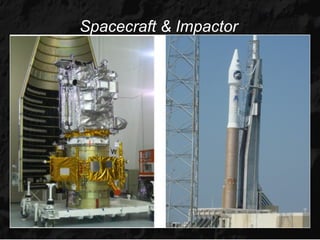
Spacecraft & Impactor
Secondary Payload Approach
                                            Atlas V
LCROSS literally
hitched a ride to
    the moon!
 Delta II


                         When LRO
                         upgraded to a
                         larger launch
                         vehicle, there
                         was an extra
                         1kg launch
                         mass available.


(LCROSS was required to meet a 28 month, ATP to launch, schedule, and
      to have minimal impact to LRO development and launch.)
Secondary Payload Approach


http://www.nasa.gov/mission_pages/LCROSS/multimedia/gallery/
Secondary Payload Approach


http://www.nasa.gov/mission_pages/LCROSS/multimedia/gallery/
“Creativity Loves Constraints”
                       LCROSS’ Innovative Approach
 Re-use of upper-
Centaur stage as the
 2300kg impactor


                            Turn the ESPA ring into
                             the actual spacecraft
                             mechanical structure


  Spare Tracking
  Data Relay
  System satellite
  propellant tank
                                                             Petal-like panels fold up and
                                                            down during I&T, eased access
                       http://lcross.arc.nasa.gov/spacecraft.htm
“Creativity Loves Constraints”
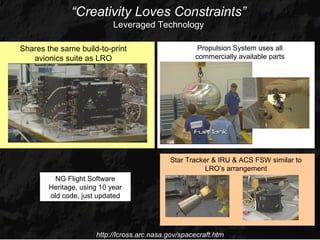
                            Leveraged Technology

Shares the same build-to-print                        Propulsion System uses all
   avionics suite as LRO                             commercially available parts


                                             Star Tracker & IRU & ACS FSW similar to
                                                        LRO’s arrangement
          NG Flight Software
        Heritage, using 10 year
        old code, just updated


                      http://lcross.arc.nasa.gov/spacecraft.htm
“Creativity Loves Constraints”
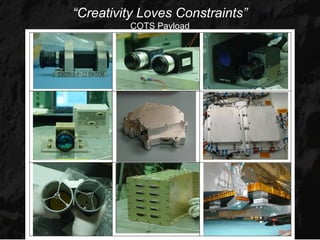
         COTS Payload
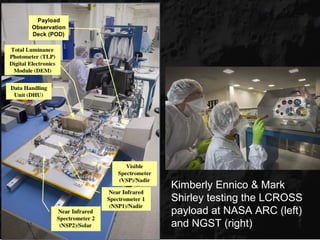
Kimberly Ennico & Mark
Shirley testing the LCROSS
payload at NASA ARC (left)
and NGST (right)
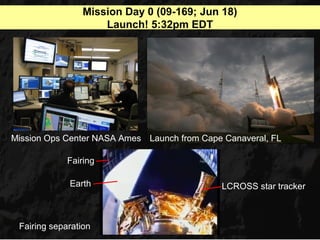
Mission Day 0 (09-169; Jun 18)
                     Launch! 5:32pm EDT


Mission Ops Center NASA Ames Launch from Cape Canaveral, FL

             Fairing

             Earth                           LCROSS star tracker


 Fairing separation
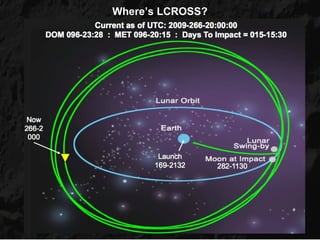
Where’s LCROSS?
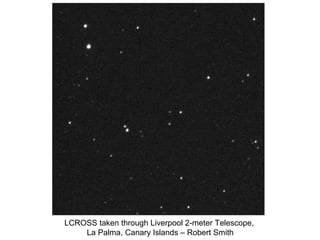
LCROSS taken through Liverpool 2-meter Telescope,
    La Palma, Canary Islands – Robert Smith
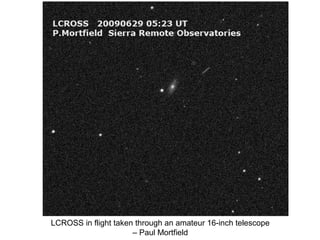
LCROSS in flight taken through an amateur 16-inch telescope
                      – Paul Mortfield
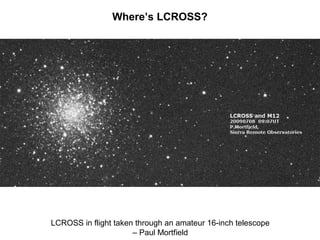
Where’s LCROSS?


LCROSS in flight taken through an amateur 16-inch telescope
                      – Paul Mortfield
Where’s LCROSS?
Where’s LCROSS?


http://www.lewislearning.org/
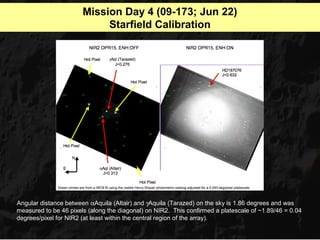
Mission Day 4 (09-173; Jun 22)
                            Starfield Calibration


Angular distance between αAquila (Altair) and γAquila (Tarazed) on the sky is 1.86 degrees and was
measured to be 46 pixels (along the diagonal) on NIR2. This confirmed a platescale of ~1.89/46 = 0.04
degrees/pixel for NIR2 (at least within the central region of the array).
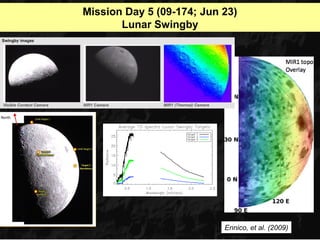
Mission Day 5 (09-174; Jun 23)
       Lunar Swingby


                           Ennico, et al. (2009)
Mission Day 5 (09-174; Jun 23)
                                Lunar Swingby


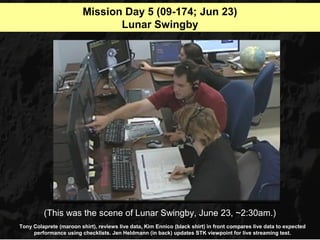
         (This was the scene of Lunar Swingby, June 23, ~2:30am.)
Tony Colaprete (maroon shirt), reviews live data, Kim Ennico (black shirt) in front compares live data to expected
     performance using checklists. Jen Heldmann (in back) updates STK viewpoint for live streaming test.
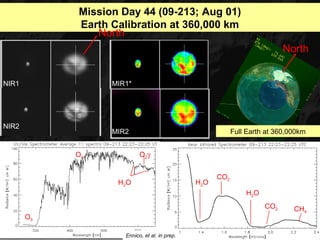
Mission Day 44 (09-213; Aug 01)
            Earth Calibration at 360,000 km
               North
                                                                           North


NIR1              MIR1*


NIR2
                  MIR2                                     Full Earth at 360,000km


            O3             O2γ


                                                     CO2
                   H2O                         H2O
                                                               H2O
                                                                     CO2      CH4
       O3

                     Ennico, et al. in prep.
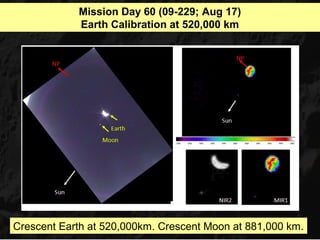
Mission Day 60 (09-229; Aug 17)
            Earth Calibration at 520,000 km


Crescent Earth at 520,000km. Crescent Moon at 881,000 km.
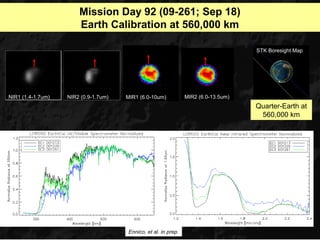
Mission Day 92 (09-261; Sep 18)
                       Earth Calibration at 560,000 km

                                                                                    STK Boresight Map


NIR1 (1.4-1.7um)   NIR2 (0.9-1.7um)   MIR1 (6.0-10um)           MIR2 (6.0-13.5um)
                                                                                    Quarter-Earth at
                                                                                     560,000 km


                                      Ennico, et al. in prep.
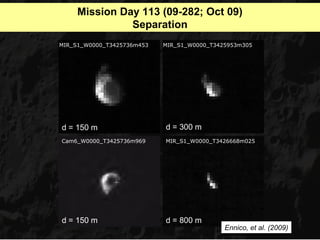
Mission Day 113 (09-282; Oct 09)
               Separation
MIR_S1_W0000_T3425736m453   MIR_S1_W0000_T3425953m305


d = 150 m                   d = 300 m
Cam6_W0000_T3425736m969     MIR_S1_W0000_T3426668m025


d = 150 m                   d = 800 m
                                             Ennico, et al. (2009)
Mission Day 113 (09-282; Oct 09)
                                         Separation


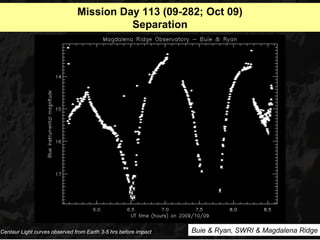
Centaur Light curves observed from Earth 3-5 hrs before impact   Buie & Ryan, SWRI & Magdalena Ridge
Mission Day 113 (09-282; Oct 09)
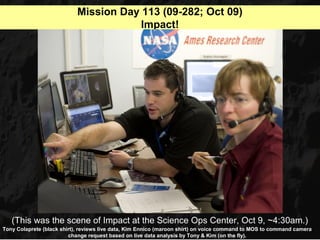
                                        Impact!


   (This was the scene of Impact at the Science Ops Center, Oct 9, ~4:30am.)
Tony Colaprete (black shirt), reviews live data, Kim Ennico (maroon shirt) on voice command to MOS to command camera
                         change request based on live data analysis by Tony & Kim (on the fly).
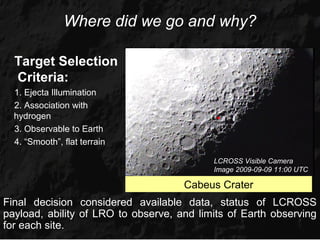
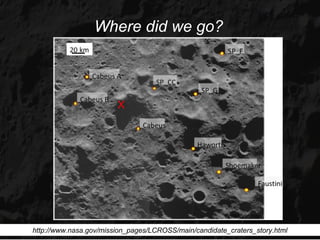
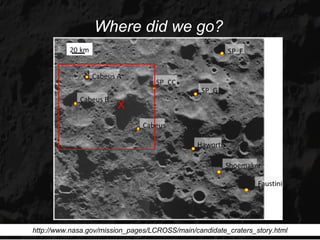
Where did we go and why?

  Target Selection
  Criteria:
  1. Ejecta Illumination
  2. Association with
  hydrogen                                  •
  3. Observable to Earth
  4. “Smooth”, flat terrain

                                           LCROSS Visible Camera
                                           Image 2009-09-09 11:00 UTC

                                     Cabeus Crater
Final decision considered available data, status of LCROSS
payload, ability of LRO to observe, and limits of Earth observing
for each site.
Where did we go?


                        X


                                                       Goldstone map

http://www.nasa.gov/mission_pages/LCROSS/main/candidate_craters_story.html
Where did we go?


                        X


                                                       Goldstone map

http://www.nasa.gov/mission_pages/LCROSS/main/candidate_craters_story.html
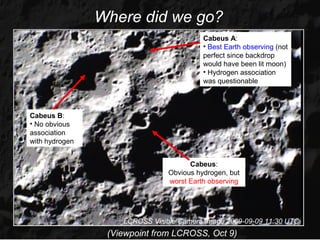
Where did we go?
                                          Cabeus A:
                                          • Best Earth observing (not
                                          perfect since backdrop
                                          would have been lit moon)
                                          • Hydrogen association
                                          was questionable


Cabeus B:
• No obvious
association
with hydrogen


                                      Cabeus:
                                Obvious hydrogen, but
                                worst Earth observing


                    LCROSS Visible Camera Image 2009-09-09 11:30 UTC
                 (Viewpoint from LCROSS, Oct 9)
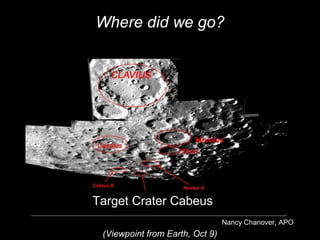
Where did we go?


 Target Crater Cabeus
Target Crater Cabeus
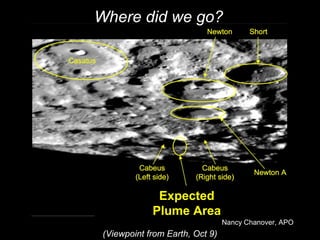
                                 Nancy Chanover, APO
 (Viewpoint from Earth, Oct 9)
Where did we go?


              Expected
             Plume Area
                                 Nancy Chanover, APO
 (Viewpoint from Earth, Oct 9)
Where did we go?


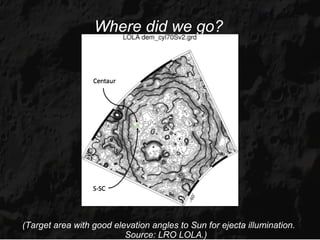
(Target area with good elevation angles to Sun for ejecta illumination.
                          Source: LRO LOLA.)
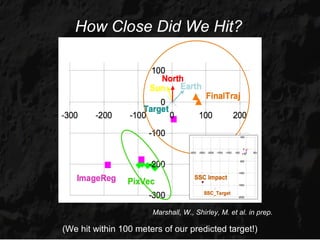
How Close Did We Hit?


                       Marshall, W., Shirley, M. et al. in prep.

(We hit within 100 meters of our predicted target!)
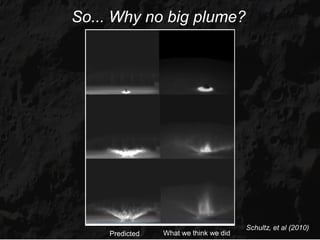
So... Why no big plume?


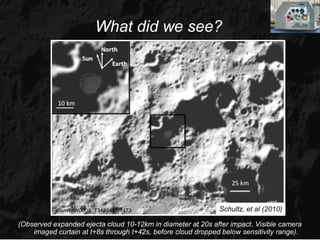
                                        Schultz, et al (2010)
     Predicted   What we think we did
What did we see?


           Cam1_W0000_T3460421m473                            Schultz, et al (2010)

(Observed expanded ejecta cloud 10-12km in diameter at 20s after impact. Visible camera
    imaged curtain at t+8s through t+42s, before cloud dropped below sensitivity range).
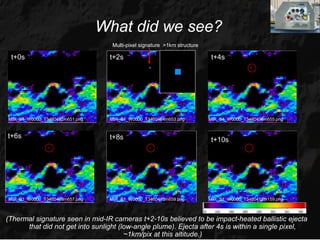
What did we see?
                                  Multi-pixel signature >1km structure

 t+0s                            t+2s                                     t+4s


MIR_S1_W0000_T3460402m651.png    MIR_S1_W0000_T3460404m653.png           MIR_S1_W0000_T3460406m655.png


t+6s                             t+8s                                     t+10s


MIR_S1_W0000_T3460408m657.png    MIR_S1_W0000_T3460410m659.png           MIR_S1_W0000_T3460412m159.png


(Thermal signature seen in mid-IR cameras t+2-10s believed to be impact-heated ballistic ejecta
      that did not get into sunlight (low-angle plume). Ejecta after 4s is within a single pixel,
                                       ~1km/pix at this altitude.)
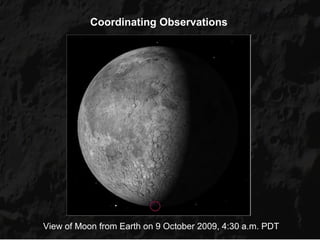
Coordinating Observations


View of Moon from Earth on 9 October 2009, 4:30 a.m. PDT
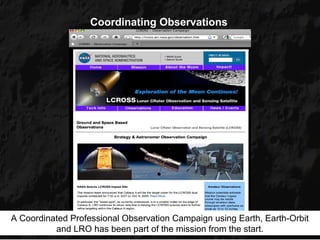
Coordinating Observations


A Coordinated Professional Observation Campaign using Earth, Earth-Orbit
          and LRO has been part of the mission from the start.
Coordinating Observations


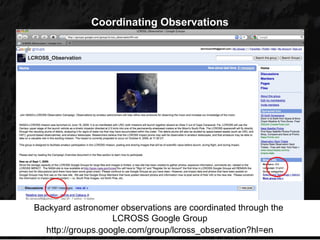
Backyard astronomer observations are coordinated through the
                   LCROSS Google Group
  http://groups.google.com/group/lcross_observation?hl=en
Other Eyes
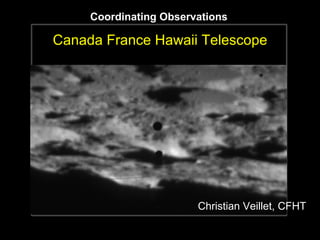
Canada France Hawaii Telescope (Hawaii)
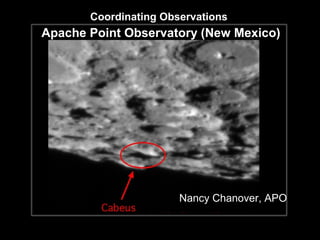
Apache Point Observatory (New Mexico)
Infrared Telescope Facility (IRTF, Hawaii)
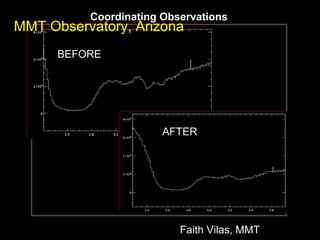
MMT Observatory (Arizona)
Magdalena Ridge Observatory (New Mexico)
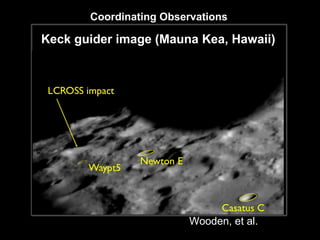
Keck (Hawaii)
Gemini North (Hawaii)
Subaru Telescope (Hawaii)
Korea Astronomy & Space Science Institute (Arizona & Korea)
Mount Wilson (California)
Air Force AEOS Telescope (Hawaii)
Allen Telescope Array (California)
Palomar Observatory (California)
Lick Observatory (California)

Hubble Space Telescope, Lunar Reconnaissance Orbiter
Odin, IKONOS, GeoEye-1


                      LCROS EBOC Campaign
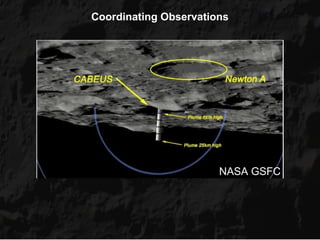
Coordinating Observations


                       NASA GSFC
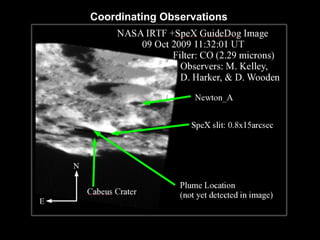
Coordinating Observations
Apache Point Observatory (New Mexico)


                       Nancy Chanover, APO
Coordinating Observations

Keck guider image (Mauna Kea, Hawaii)


                         Wooden, et al.
Coordinating Observations

Canada France Hawaii Telescope


                        Christian Veillet, CFHT
Coordinating Observations
MMT Observatory, Arizona
      BEFORE


                       AFTER


                          Faith Vilas, MMT
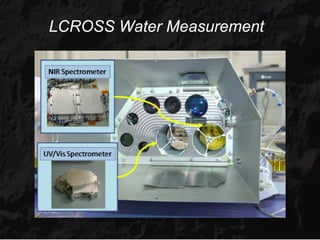
LCROSS Water Measurement
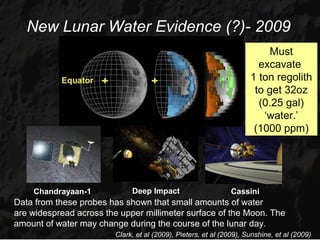
New Lunar Water Evidence (?)- 2009
                                                                           Must
                                                                        excavate
                                                                      1 ton regolith
                                                                       to get 32oz
                                                                        (0.25 gal)
                                                                         ‘water.’
                                                                       (1000 ppm)


    Chandrayaan-1             Deep Impact                       Cassini
Data from these probes has shown that small amounts of water
are widespread across the upper millimeter surface of the Moon. The
amount of water may change during the course of the lunar day.
                         Clark, et al (2009), Pieters, et al (2009), Sunshine, et al (2009)
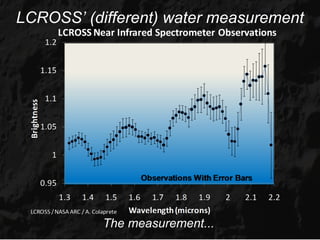
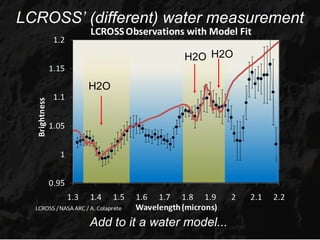
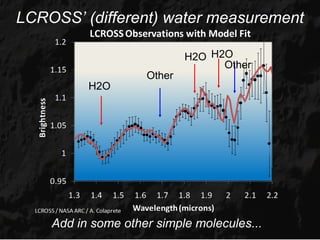
LCROSS’ (different) water measurement


           The measurement...
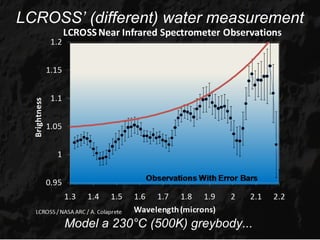
LCROSS’ (different) water measurement


      Model a 230°C (500K) greybody...
LCROSS’ (different) water measurement

                          H2O H2O

         H2O


         Add to it a water model...
LCROSS’ (different) water measurement

                            H2O H2O
                                  Other
                    Other
          H2O


    Add in some other simple molecules...
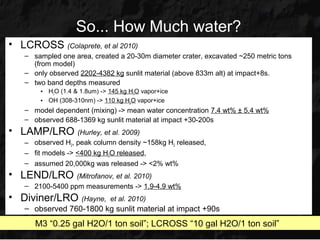
So... How Much water?
• LCROSS (Colaprete, et al 2010)
    – sampled one area, created a 20-30m diameter crater, excavated ~250 metric tons
      (from model)
    – only observed 2202-4382 kg sunlit material (above 833m alt) at impact+8s.
    – two band depths measured
        • H2O (1.4 & 1.8um) -> 145 kg H2O vapor+ice
        • OH (308-310nm) -> 110 kg H2O vapor+ice
    – model dependent (mixing) -> mean water concentration 7.4 wt% ± 5.4 wt%
    – observed 688-1369 kg sunlit material at impact +30-200s
• LAMP/LRO (Hurley, et al. 2009)
    – observed H2, peak column density ~158kg H2 released,
    – fit models -> <400 kg H2O released,
    – assumed 20,000kg was released -> <2% wt%
• LEND/LRO (Mitrofanov, et al. 2010)
    – 2100-5400 ppm measurements -> 1.9-4.9 wt%
• Diviner/LRO (Hayne,          et al. 2010)
    – observed 760-1800 kg sunlit material at impact +90s
       M3 “0.25 gal H2O/1 ton soil”; LCROSS “10 gal H2O/1 ton soil”
In Summary (1 of 3)

•   LCROSS proved that a new class of mission (NASA Class D) high
    science payoff at low cost/high risk is possible
•   Tight schedule & budget constraints (or you would lose your ride)
    forced proactive and rigorous project management with very visible
    risk management
•    Lifecycle of “cradle to grave” in <3 years excellent training
    experience
•   Design engineers used as part of ops team was essential in quick
    turn-around response to anomalies and events
•    Ruggedized-COTS instruments did perform well in space (~5-10 hrs
    operation time), high performance at low cost
•   Never underestimate the importance of on-orbit calibration data
    (saved our bacon)
In Summary (2 of 3)

•   Impact appears to have occurred in a volatile rich area:
        • Water …and other stuff!! (e.g., CH4, CO2, SO2, NH3, Na, K, CO, NH2)
          possibly observed…work occurring now to get unique identification
•   Band depths and OH emission strengths indicate significant amounts of
    water (>150 kg vapor and ice)
     – Reported concentration: 7.4 wt% ± 5.4 wt% (Colaprete, et al. 2010)
     – From LEND: ~ 1.9 - 4.9 wt% (for 3 cm dry layer) (Mitrofanov, et al. 2010)
     – Remember, ESMD requirement for moon base was 1 wt%
•    The amount and types of volatiles suggest:
     – The very cold temperatures sequester all sorts of volatiles (see Zhang &
       Paige, 2009)
     – Need multiple source model (see Lucey, 2000)
In Summary (3 of 3)
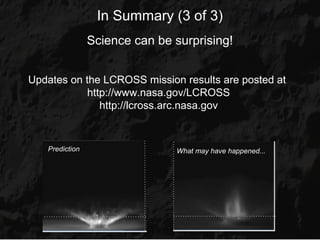
                Science can be surprising!


Updates on the LCROSS mission results are posted at
            http://www.nasa.gov/LCROSS
               http://lcross.arc.nasa.gov


   Prediction                  What may have happened...
LCROSS Papers/Presentations

Lunar Exploration Analysis Group (LEAG), November 17-19, 2009, Houston, TX (Impact +1 m)
             Colaprete et al.,
             Schultz et al.,
             Heldmann et al.,
             Wooden et al.,

American Geophysical Union (AGU), December 12-16, 2009, San Francisco, CA (Impact +2 m)
           Colaprete et al.,
           Schultz et al.,
           Chin et al.,
           McClanahan et al.,
           Hermalyn et al.,
           Ennico et al.,
           Heldmann et al.,
           Wooden et al.,
           Hurley et al.,

Submitted to Science, Jan 2010 (Impact + 3m)
    Colaprete et al.,
             Schultz et al.,
             Hayne, et al.
    Goldstone et al.
    Mitrofanov, et al.

Lunar and Planetary Science Conference, March 1-5, 2010, Houston , TX (Impact +5 m)
             Seven (7) oral and eleven (11) poster presentations in Special Session: “A New Moon: LCROSS,
                Chandrayaan Chang'E-1 Results”

LCROSS Mission Overview & Results (

  • 1.
    LCROSS “the lunarhitch-hiker that made an impact (literally!) on how we view our Moon and its science secrets” Dr. Kimberly Ennico (NASA Ames Research Center) poses with LRO (silver), LCROSS (gold), Astrotech, Titusville, FL, May 2009)
  • 2.
    LCROSS...at a glance... Launch:June 18, 2009 Impact: October 9, 2009 (LCROSS was required to meet a 28 month, ATP to launch, schedule, and to have minimal impact to LRO development and launch.)
  • 3.
    Why LCROSS? Mission Primary Objective: To test whether or not water ice deposits exist on the Moon. (Classic Scientific Method)
  • 4.
    Why Look forWater? • Humans exploring the Moon will need water: – Option 1: Carry it there* – Option 2: Use water that may be there already • Learning to “Live off the land” could make (long-term) human lunar exploration easier. (*At $10K/lb to orbit. $3-5K more to Moon. At 8 lbs/gallon, it could cost >$100,000/gallon of water to the Moon.)
  • 5.
    Early Evidence ofWater Clementine Lunar Prospector (1994) (1999) Two previous missions, Clementine and Lunar Prospector gave us preliminary evidence that there may be deposits of water ice at the lunar poles.
  • 6.
    Controversial: ice orrough terrain? Clementine bistatic radar – 1994 Ref: Nozette, S. et al. Science 274, 1495-1498 (1996) • Circular polarization ratio (CPR) consistent with ice crystals in the south polar regolith. • Ground-based studies (Arecibo) confirmed high-CPR in some permanently- shadowed craters. – However, Arecibo scans also found high-CPR in some areas that are illuminated, probably due to surface roughness. Ref: Stacy, N. et al. Science, 276, 1527-1530 (1997)
  • 7.
    Accepted, not conclusivere: ice Lunar Prospector – Hydrogen 1998 Ref: Feldman, W.C. et al. Science 281, 1496-1500 (1998) Map courtesy of D. Lawrence, Los Alamos National Laboratory. • Neutron spectrometer maps of both lunar poles • Low resolution data indicate elevated concentrations of hydrogen at both poles • It does not tell us the form of the hydrogen
  • 8.
    The “Famous” LPmaps Feldman, W.C. et al. Science 281, 1496-1500 (1998) Map courtesy of D. Lawrence, Los Alamos National Laboratory. (dark blue/purple <-> low # neutrons <-> high hydrogen <-> water?)
  • 9.
    Evidence against icelakes at poles Hi-Res Arecibo & Green Bank radar – 2005 Ref: Campbell, D.B. et al. Nature, 443, 835-837 (2006) • Higher spatial res. (20 m) than 1994 Clementine & 1992 Arecibo data (125 m) • Surveyed south pole and nearside to latitude ~65° S • Data indicate correlation between areas of high CPR with walls and ejecta deposits – Shackleton had same CPR values as Schomberger A&G, and many other young craters – High CPR areas in Shackleton are in both permanent shadow and seasonal illumination • Conclude high CPR in Shackleton is not due to ice deposits – But they conclude they are open to possibility very low abundance (1-2% Radar image Moon South Pole by mass) mixed in grains from the (left) OC 100m; (right) CPR 500 m Fig1 from Campbell, D.B. et al. Nature, 443, 835 (2006) upper 1 m of regolith
  • 10.
    Evidence against icelakes at poles; temperature is cold enough to support ice Selene (Kaguya) Terrain Camera – 2007 Ref: Haruyama, J. et al. Science, 322, 938-939 (2008) • Terrain Camera (10 m res.) surveyed inside Shackleton Crater – Targeted during lunar mid-summer to get max. illumination of the shadowed regions by sunlight scattered off nearby higher terrains – Discovered small craters on inner wall (100’s m dia.), mount-like features (300-400m thick), & central hill (200m height) • Derived temperature measurement of Shackleton floor ~88 K (max) – Cold enough to retain water-ice • Did not find bright areas in Shackleton that could be due to pure water-ice – Looking for albedo ~1.0 • They also conclude they are open to possibility very low abundance (1-2% by mass) mixed in grains from the upper 1 m of regolith
  • 11.
    How could therebe water at the lunar poles? • The Sun never rises more than a few degrees above the polar horizon so the crater floors are in permanent shadow (PSR). • The crater floors are very cold with temperatures < -200° C (70K, -328° F), so Many orbits Clementine data water molecules move very South Pole (Ben Bussey, APL) slowly and are trapped for billions of years. (On October 9, 2009, LCROSS performed the first “in-situ” study of a PSR.)
  • 12.
    Where could waterice come from? • Over the history of the Moon, when comets or • Water molecules at lower latitudes may form asteroids impact the Moon's surface, they from interactions with hydrogen streaming out briefly produce a very thin atmosphere that in the solar wind. quickly escapes into space. • These water molecules may get baked out of • Any water vapor that enters permanently the lunar soil and can then get trapped in polar shadowed craters could condense and craters. concentrate there. (volatiles from comets, asteroids, IDPs, solar wind, GMCs, the Moon itself!)
  • 13.
    How much watercould there be? • There is ~12,500 km2 of permanently shadowed terrain on the Moon. • If the top 1 meter of this area were to hold 1% water (by mass)*, that would be equivalent to about 4.1 x 10¹¹ liters of water! • This is approximately 2% the volume of the Great Salt Lake in Utah. (*The Sahara desert is 1.2% water (by mass) in its top 20cm, with 2.5-4.5% at 3m.)
  • 14.
    Enter LCROSS-The pathfinder LCROSShad a challenging set of constraints: • We had to fit within 1000Kg wet mass… • We had to design and build the payload, spacecraft and mission in only 30 months! • We had a cost-cap of $79M, including reserves… • We couldn’t levy any requirements on LRO… • As a NASA Class D mission some programmatic and technical simplifications could be leveraged
  • 15.
    The LCROSS Experiment Flash Curtain Crater ~0.1 min 3.0 min 1 min • Impact the Moon at 2.5 km/sec (5,600 mph) with a ~2366 kg (5216 lb) Centaur upper stage and create an ejecta cloud into the sunlight for observation • Observe the impact and ejecta with instruments that can detect water • Four minutes later the ~625 kg (1378 lb) LCROSS S/C itself impacts at 2.5 km/s
  • 16.
    Excavating with 6.5-7billion Joules • About equal to 1.5 tons of TNT • Minimum of 200 tons lunar rock and soil expected to be excavated • New crater estimated to have ~20-25 m diameter and ~3m depth • Similar in size to East Crater at Apollo 11 landing site
  • 17.
    Anatomy of anImpact – flash, curtain, crater ARC Vertical Gun Experiments Step 1 Step 5 Impact flash Nadir View of Impact and Ejecta Curtain Step 2 Step 6 Incandescent particles Crater rim Time Time Step 3 Step 7 “Sunrise” Reverse ejecta Ejecta Step 4 Step 8 Curtain Into sunlight Scales to ~2 sec after Pete Schultz Centaur impact
  • 18.
    Recent “Controlled” LunarImpacts S/C Impact Date S/C Mass S/C Velocity Impact angle Impact Location Observations at impact from horizon. Hiten/ 10 Apr 1993 143 kg 2.33 km/s 42° 55°E, 32.4°S Flash Muses (hydrazine) LP 31 Jul 1999 161 kg 1.69 km/s 6.3° South pole area Null SMART-1 3 Sep 2006 285 kg 2 km/s 1° 46.2°W, 34.4° S Flash, plume Change’1 1 Mar 2009 2350 kg ? ? just south of the ? lunar equator, at 52.36 degrees East Longitude Kaguya 10 Jun 2009 ~1800 kg 1.8 km/s 1° 80.4°E, 65.5°S Flash (Selene) LCROSS 09 Oct 2009 2366 kg 2.5 km/s >85 ° 48.703°W, 84.675°S; Flash, Plume, Crater LCROSS 09 Oct 2009 625 kg 2.5 km/s >85 ° 48.703°W, 84.675°S; Null (to date) S-S/C
  • 19.
    Why LCROSS wouldbe different…. 400 LCROSS SMART-1 LCROSS Centaur 350 LP 300 LCROSS S-S/C NOTE: LCROSS Predictions shown. LP/SMART-1 250 actuals shown 200 LCROSS S-S/C 150 100 SMART-1 (hill side impact) Ejecta Mass (Metric Tones) 50 0 0 LP 20 40 60 80 Impact Angle (degrees) SMART-1 (grazing impact)
  • 20.
    ARC Vertical GunExperiments
  • 21.
    LCROSS was anartificial impactor (natural impacts* happen all the time) Ref: Montañés-Rodríguez, Pallé, & Goode, AJ, 134, 1145-1149 (2007) NASA Marshall Lunar Impact Monitoring Program http://www.nasa.gov/centers/marshall/news/lunar/ (*Natural impacts typically have much more energy than LCROSS’s 6-7e9 Joules.)
  • 22.
    The LCROSS MissionRecipe • Step 1: Hitch a ride to the Moon • (Thanks LRO) • Step 2: Part with LRO, but hang onto that rocket! • (we’ll use it later) • Step 3: Tug it around the Earth • Step 4: Point it toward our crater • Step 5: Let go! • Step 6: Slow-down & watch what kicks-up • Step 7: Send pics & data back to Earth • Step 8: Say good-bye • (Taste regolith!)
  • 23.
    The LCROSS MissionConcept 1. Launched stacked with LRO 2. After Lunar swing-by, enter a 4 June 18, 2009 month cruise around Earth 3. October 9, 4. S-S/C observes 2009, target the impact, ejecta Centaur Upper cloud and Stage and resulting crater, position S-S/C making to fly 4 minutes measurements behind until impacting itself
  • 24.
  • 25.
    Secondary Payload Approach Atlas V LCROSS literally hitched a ride to the moon! Delta II When LRO upgraded to a larger launch vehicle, there was an extra 1kg launch mass available. (LCROSS was required to meet a 28 month, ATP to launch, schedule, and to have minimal impact to LRO development and launch.)
  • 26.
  • 27.
  • 28.
    “Creativity Loves Constraints” LCROSS’ Innovative Approach Re-use of upper- Centaur stage as the 2300kg impactor Turn the ESPA ring into the actual spacecraft mechanical structure Spare Tracking Data Relay System satellite propellant tank Petal-like panels fold up and down during I&T, eased access http://lcross.arc.nasa.gov/spacecraft.htm
  • 29.
    “Creativity Loves Constraints” Leveraged Technology Shares the same build-to-print Propulsion System uses all avionics suite as LRO commercially available parts Star Tracker & IRU & ACS FSW similar to LRO’s arrangement NG Flight Software Heritage, using 10 year old code, just updated http://lcross.arc.nasa.gov/spacecraft.htm
  • 30.
  • 31.
    Kimberly Ennico &Mark Shirley testing the LCROSS payload at NASA ARC (left) and NGST (right)
  • 32.
    Mission Day 0(09-169; Jun 18) Launch! 5:32pm EDT Mission Ops Center NASA Ames Launch from Cape Canaveral, FL Fairing Earth LCROSS star tracker Fairing separation
  • 33.
  • 34.
    LCROSS taken throughLiverpool 2-meter Telescope, La Palma, Canary Islands – Robert Smith
  • 35.
    LCROSS in flighttaken through an amateur 16-inch telescope – Paul Mortfield
  • 36.
    Where’s LCROSS? LCROSS inflight taken through an amateur 16-inch telescope – Paul Mortfield
  • 37.
  • 38.
  • 39.
    Mission Day 4(09-173; Jun 22) Starfield Calibration Angular distance between αAquila (Altair) and γAquila (Tarazed) on the sky is 1.86 degrees and was measured to be 46 pixels (along the diagonal) on NIR2. This confirmed a platescale of ~1.89/46 = 0.04 degrees/pixel for NIR2 (at least within the central region of the array).
  • 40.
    Mission Day 5(09-174; Jun 23) Lunar Swingby Ennico, et al. (2009)
  • 41.
    Mission Day 5(09-174; Jun 23) Lunar Swingby (This was the scene of Lunar Swingby, June 23, ~2:30am.) Tony Colaprete (maroon shirt), reviews live data, Kim Ennico (black shirt) in front compares live data to expected performance using checklists. Jen Heldmann (in back) updates STK viewpoint for live streaming test.
  • 42.
    Mission Day 44(09-213; Aug 01) Earth Calibration at 360,000 km North North NIR1 MIR1* NIR2 MIR2 Full Earth at 360,000km O3 O2γ CO2 H2O H2O H2O CO2 CH4 O3 Ennico, et al. in prep.
  • 43.
    Mission Day 60(09-229; Aug 17) Earth Calibration at 520,000 km Crescent Earth at 520,000km. Crescent Moon at 881,000 km.
  • 44.
    Mission Day 92(09-261; Sep 18) Earth Calibration at 560,000 km STK Boresight Map NIR1 (1.4-1.7um) NIR2 (0.9-1.7um) MIR1 (6.0-10um) MIR2 (6.0-13.5um) Quarter-Earth at 560,000 km Ennico, et al. in prep.
  • 45.
    Mission Day 113(09-282; Oct 09) Separation MIR_S1_W0000_T3425736m453 MIR_S1_W0000_T3425953m305 d = 150 m d = 300 m Cam6_W0000_T3425736m969 MIR_S1_W0000_T3426668m025 d = 150 m d = 800 m Ennico, et al. (2009)
  • 46.
    Mission Day 113(09-282; Oct 09) Separation Centaur Light curves observed from Earth 3-5 hrs before impact Buie & Ryan, SWRI & Magdalena Ridge
  • 47.
    Mission Day 113(09-282; Oct 09) Impact! (This was the scene of Impact at the Science Ops Center, Oct 9, ~4:30am.) Tony Colaprete (black shirt), reviews live data, Kim Ennico (maroon shirt) on voice command to MOS to command camera change request based on live data analysis by Tony & Kim (on the fly).
  • 48.
    Where did wego and why? Target Selection Criteria: 1. Ejecta Illumination 2. Association with hydrogen • 3. Observable to Earth 4. “Smooth”, flat terrain LCROSS Visible Camera Image 2009-09-09 11:00 UTC Cabeus Crater Final decision considered available data, status of LCROSS payload, ability of LRO to observe, and limits of Earth observing for each site.
  • 49.
    Where did wego? X Goldstone map http://www.nasa.gov/mission_pages/LCROSS/main/candidate_craters_story.html
  • 50.
    Where did wego? X Goldstone map http://www.nasa.gov/mission_pages/LCROSS/main/candidate_craters_story.html
  • 51.
    Where did wego? Cabeus A: • Best Earth observing (not perfect since backdrop would have been lit moon) • Hydrogen association was questionable Cabeus B: • No obvious association with hydrogen Cabeus: Obvious hydrogen, but worst Earth observing LCROSS Visible Camera Image 2009-09-09 11:30 UTC (Viewpoint from LCROSS, Oct 9)
  • 52.
    Where did wego? Target Crater Cabeus Target Crater Cabeus Nancy Chanover, APO (Viewpoint from Earth, Oct 9)
  • 53.
    Where did wego? Expected Plume Area Nancy Chanover, APO (Viewpoint from Earth, Oct 9)
  • 54.
    Where did wego? (Target area with good elevation angles to Sun for ejecta illumination. Source: LRO LOLA.)
  • 55.
    How Close DidWe Hit? Marshall, W., Shirley, M. et al. in prep. (We hit within 100 meters of our predicted target!)
  • 56.
    So... Why nobig plume? Schultz, et al (2010) Predicted What we think we did
  • 57.
    What did wesee? Cam1_W0000_T3460421m473 Schultz, et al (2010) (Observed expanded ejecta cloud 10-12km in diameter at 20s after impact. Visible camera imaged curtain at t+8s through t+42s, before cloud dropped below sensitivity range).
  • 58.
    What did wesee? Multi-pixel signature >1km structure t+0s t+2s t+4s MIR_S1_W0000_T3460402m651.png MIR_S1_W0000_T3460404m653.png MIR_S1_W0000_T3460406m655.png t+6s t+8s t+10s MIR_S1_W0000_T3460408m657.png MIR_S1_W0000_T3460410m659.png MIR_S1_W0000_T3460412m159.png (Thermal signature seen in mid-IR cameras t+2-10s believed to be impact-heated ballistic ejecta that did not get into sunlight (low-angle plume). Ejecta after 4s is within a single pixel, ~1km/pix at this altitude.)
  • 59.
    Coordinating Observations View ofMoon from Earth on 9 October 2009, 4:30 a.m. PDT
  • 60.
    Coordinating Observations A CoordinatedProfessional Observation Campaign using Earth, Earth-Orbit and LRO has been part of the mission from the start.
  • 61.
    Coordinating Observations Backyard astronomerobservations are coordinated through the LCROSS Google Group http://groups.google.com/group/lcross_observation?hl=en
  • 62.
    Other Eyes Canada FranceHawaii Telescope (Hawaii) Apache Point Observatory (New Mexico) Infrared Telescope Facility (IRTF, Hawaii) MMT Observatory (Arizona) Magdalena Ridge Observatory (New Mexico) Keck (Hawaii) Gemini North (Hawaii) Subaru Telescope (Hawaii) Korea Astronomy & Space Science Institute (Arizona & Korea) Mount Wilson (California) Air Force AEOS Telescope (Hawaii) Allen Telescope Array (California) Palomar Observatory (California) Lick Observatory (California) Hubble Space Telescope, Lunar Reconnaissance Orbiter Odin, IKONOS, GeoEye-1 LCROS EBOC Campaign
  • 63.
  • 64.
  • 65.
    Coordinating Observations Apache PointObservatory (New Mexico) Nancy Chanover, APO
  • 66.
    Coordinating Observations Keck guiderimage (Mauna Kea, Hawaii) Wooden, et al.
  • 67.
    Coordinating Observations Canada FranceHawaii Telescope Christian Veillet, CFHT
  • 68.
    Coordinating Observations MMT Observatory,Arizona BEFORE AFTER Faith Vilas, MMT
  • 69.
  • 70.
    New Lunar WaterEvidence (?)- 2009 Must excavate 1 ton regolith to get 32oz (0.25 gal) ‘water.’ (1000 ppm) Chandrayaan-1 Deep Impact Cassini Data from these probes has shown that small amounts of water are widespread across the upper millimeter surface of the Moon. The amount of water may change during the course of the lunar day. Clark, et al (2009), Pieters, et al (2009), Sunshine, et al (2009)
  • 71.
    LCROSS’ (different) watermeasurement The measurement...
  • 72.
    LCROSS’ (different) watermeasurement Model a 230°C (500K) greybody...
  • 73.
    LCROSS’ (different) watermeasurement H2O H2O H2O Add to it a water model...
  • 74.
    LCROSS’ (different) watermeasurement H2O H2O Other Other H2O Add in some other simple molecules...
  • 75.
    So... How Muchwater? • LCROSS (Colaprete, et al 2010) – sampled one area, created a 20-30m diameter crater, excavated ~250 metric tons (from model) – only observed 2202-4382 kg sunlit material (above 833m alt) at impact+8s. – two band depths measured • H2O (1.4 & 1.8um) -> 145 kg H2O vapor+ice • OH (308-310nm) -> 110 kg H2O vapor+ice – model dependent (mixing) -> mean water concentration 7.4 wt% ± 5.4 wt% – observed 688-1369 kg sunlit material at impact +30-200s • LAMP/LRO (Hurley, et al. 2009) – observed H2, peak column density ~158kg H2 released, – fit models -> <400 kg H2O released, – assumed 20,000kg was released -> <2% wt% • LEND/LRO (Mitrofanov, et al. 2010) – 2100-5400 ppm measurements -> 1.9-4.9 wt% • Diviner/LRO (Hayne, et al. 2010) – observed 760-1800 kg sunlit material at impact +90s M3 “0.25 gal H2O/1 ton soil”; LCROSS “10 gal H2O/1 ton soil”
  • 76.
    In Summary (1of 3) • LCROSS proved that a new class of mission (NASA Class D) high science payoff at low cost/high risk is possible • Tight schedule & budget constraints (or you would lose your ride) forced proactive and rigorous project management with very visible risk management • Lifecycle of “cradle to grave” in <3 years excellent training experience • Design engineers used as part of ops team was essential in quick turn-around response to anomalies and events • Ruggedized-COTS instruments did perform well in space (~5-10 hrs operation time), high performance at low cost • Never underestimate the importance of on-orbit calibration data (saved our bacon)
  • 77.
    In Summary (2of 3) • Impact appears to have occurred in a volatile rich area: • Water …and other stuff!! (e.g., CH4, CO2, SO2, NH3, Na, K, CO, NH2) possibly observed…work occurring now to get unique identification • Band depths and OH emission strengths indicate significant amounts of water (>150 kg vapor and ice) – Reported concentration: 7.4 wt% ± 5.4 wt% (Colaprete, et al. 2010) – From LEND: ~ 1.9 - 4.9 wt% (for 3 cm dry layer) (Mitrofanov, et al. 2010) – Remember, ESMD requirement for moon base was 1 wt% • The amount and types of volatiles suggest: – The very cold temperatures sequester all sorts of volatiles (see Zhang & Paige, 2009) – Need multiple source model (see Lucey, 2000)
  • 78.
    In Summary (3of 3) Science can be surprising! Updates on the LCROSS mission results are posted at http://www.nasa.gov/LCROSS http://lcross.arc.nasa.gov Prediction What may have happened...
  • 79.
    LCROSS Papers/Presentations Lunar ExplorationAnalysis Group (LEAG), November 17-19, 2009, Houston, TX (Impact +1 m) Colaprete et al., Schultz et al., Heldmann et al., Wooden et al., American Geophysical Union (AGU), December 12-16, 2009, San Francisco, CA (Impact +2 m) Colaprete et al., Schultz et al., Chin et al., McClanahan et al., Hermalyn et al., Ennico et al., Heldmann et al., Wooden et al., Hurley et al., Submitted to Science, Jan 2010 (Impact + 3m) Colaprete et al., Schultz et al., Hayne, et al. Goldstone et al. Mitrofanov, et al. Lunar and Planetary Science Conference, March 1-5, 2010, Houston , TX (Impact +5 m) Seven (7) oral and eleven (11) poster presentations in Special Session: “A New Moon: LCROSS, Chandrayaan Chang'E-1 Results”

Editor's Notes

  • #9 Neutrons are produced in lunar surface by galactic cosmic rays interacting with nuclei in lunar materials. Hydrogen is good at removing energy from neutrons. Area of high-Hydrogen &lt;-&gt; low epithermal neutron counts. The dark blue and purple areas indicate low counting rates and are consistent with hydrogen-rich deposits covered by desiccated regolith. Explanation: Hydrogen acts as a excellent “neutron tracer” since mass of H is similar to that of a neutron. Neutrons are produced in lunar surface by galactic cosmic rays interacting with nuclei in lunar materials. This interaction produces HIGH-energy neutrons (&gt;100skeV) which are scattered away &amp; lose energy with each scatter. The hydrogen nucleus is good at removing energy from neutrons. So in areas of HIGH HYDROGEN, neutrons of low energy (epithermal) will BE DEPLETED (less of them) than in areas of low-hydrogen.
  • #22 Impactors range in mass from 100 g to 1000 kg Current meteoroid models indicate that the moon is struck by a meteoroid with a mass greater than 1 kg (2 lbs) over 260 times per year The slowest impact velocities are 20 km/sec (4500 mph) The fastest impact velocities are over 72 km/sec (160,000 mph) At such speeds even a small meteoroid has incredible energy -- one with a mass of only 5 kg (10 lbs) can excavate a crater over 9 meters (30 ft) across, hurling 75 metric tons (165,000 lbs) of lunar soil and rock on ballistic trajectories above the lunar surface.
  • #56 (b) Centaur impact’s actual location derivation by multiple approaches on a 500 m x 400 m grid (Note: meter scale). North/South runs along vertical axis. The target supplied by the science team is placed at origin (large blue X). Estimates using trajectory propagation are shown by orange triangles. Their 1-  errors are represented by large orange circle (156 m radius). Magenta squares are bundle-adjusted image registration against LOLA terrain. Forward propagation from S-S/C trajectory using LCROSS MIR1 imagery produced the green diamonds. Their 1-  errors are shown by green ellipse 3 m by 75 m (semi axis). Vectors to Sun and Earth are shown. Inset at lower right shows comparison of S-S/C impact location, derived from trajectory analysis, to its planned target location.