CONTOLL YOUR ANGER
• GET 20 DOLLARS
• GET TAN JACKET
• GET PURPLE SHIRT
• MAKE 4 COPIES –PRINT 48 TIMES
• GETFOOD 9/3
SANITY CHECK
• 1. CLOTHES- OK-NEED TAN JACKET-NEED TO WASH JEANS
• 2. HAVE PANTS AT MEDGAR-4 PAIRS-GET THEM
• 3. 9/16- SEE DAUGHTER NIKKI
• 4. 9/3-GET FOOD SUNDAY??
• 5. GET COPIES-BIG DAY ON TUESDAY-CHECK STATUS OF REGISTRATION
• 6. HAVE FIN AID APPOINTMENT 9/5
• 7. GOTO FORDHAM-EARLY –ROOM 416-PRINT –ISOTOPE SHEET
• 8. PRINT KWL SHEET- 48 TIMES COPY IT-ISOTOPE SHEET
• 9. SEPT 6TH WEB QUEST 48 TIME
• 10 ** YOU MUST UPLOAD THE WEBS QUESTS-4 OF THEM
• 12. SHAMEKA-METRO CARDS-TUES 9/5
• 13. FINANCIAL AID 9/5
• 14. REGISTRATION 9/5
• 15. DO YOU HAVE FOOD? 9/5
• 16. CAN YOU TRAVEL?
• 17. SOAP AND CLOTHES
• 18. DID YOU MAKE COPIES 9/5-CHANGE FIN AID TO LATTER IN DAY
• 19. can you wash socks??
• 20. blue shirt-black pants, vivarin, tan jacket
• 21 . Exam is almost done
• 22. hiedi-wouldemail exams
• 23. can you pay bill for class?
• 24. can you get a laptop
• 25. njcu-was fucked up
ASSHOLE
AN ASSHOLE
AYLEEN AND SHAYLAH
YOU GROUP TALK-ALL 4 PEOPLR TALK-OR CAN
DEMO SOMETHING
• IF YOU USE A WEB SITE-JUST SAY
•
• MY GROUP ADAPTED FROM: https://www.space.com/18377-new-
horizons.html
• *I DO NOT CARE IF YOU USE THE WHOLE WEB SITE
• *REF SLIDES
• I NEED YOU TO BE INDEPTH-I WILL GIVE YOU TIME-20 MIN 30 MIN
WHAT EVER—I need you to tell me everything about the satellite
• (Wikipedia sites-are ok-then find something extra)
WHAT WAS
• 1. THE SATELLITTE
• 2. MIISION
• 3. THE DATA
• 4, THE INSTRUMENT ON IT**
• 5. PROBLEMS
• 6. THINGS THAT WENT WELL
• 7. ITS-FUTURE
• 8. MAKE A MODEL-DO A DEMO
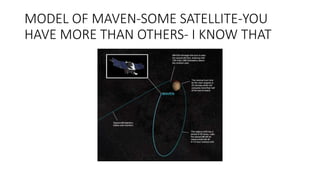
MODEL OF MAVEN-SOME SATELLITE-YOU
HAVE MORE THAN OTHERS- I KNOW THAT
LEGO maven Mission to Mars NASA Exclusive
• https://www.youtube.com/watch?v=Hy32TeqaJw8
LEGO 7469 - Discovery - Mission To Mars
• https://www.youtube.com/watch?v=h6pkclEGeaA
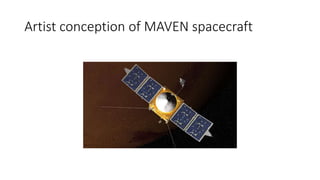
Artist conception of MAVEN spacecraft
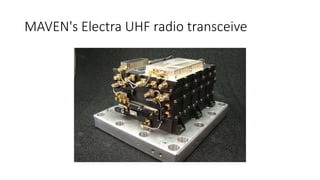
MAVEN's Electra UHF radio transceive
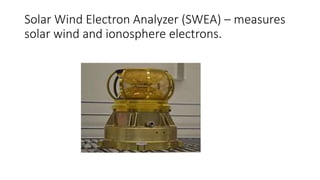
Solar Wind Electron Analyzer (SWEA) – measures
solar wind and ionosphere electrons.
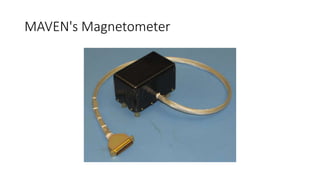
MAVEN's Magnetometer
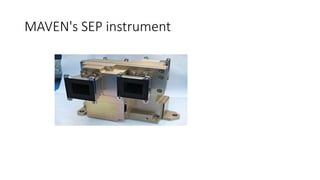
MAVEN's SEP instrument
IDEA-INCLUDE A PICTURE-MAKE A PHYSICAL
MODEL-REFER TO A VIDEO – IN TALK
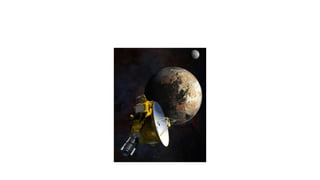
• New Horizons is a NASA spacecraft that was the first to visit dwarf
planet Pluto in July 2015. Its pictures of the dwarf planet's icy surface,
as well as observations of Pluto's moon Charon, are revolutionizing
our understanding of solar system objects far from the sun.
DISPLAY DATA-A PAST TREND
• The mission is now en route to an object deeper in the Kuiper Belt,
called 2014 MU69. It will reach this object on Jan. 1, 2019.
AUDIENCE-UNAWARE OF YOUR TOPIC
KNOW PAST MISSIONS-
• The spacecraft's extreme distance from Earth makes it only the fifth
to venture so far from home (the other ones being Pioneer 10 and
Pioneer 11, and Voyager 1 and Voyager 2, which are either in the
outer solar system or in the case of Voyager 1, interstellar space.)
NICE INFO-”DID YOU KNOW . .ETC”
• Pluto's distance — about 3 billion miles (5 billion kilometers) from
Earth — presented power challenges for New Horizon's designers,
since the sun's rays are too weak to generate power. There are also
long communications delays for those staying in touch with the 1,054-
lb. (478 kilograms) spacecraft; at Pluto, it took 4.5 hours for a one-
way message to get there from Earth.
• Further, our understanding of the Pluto system keeps changing. The
planet was discovered in 1930 by astronomer Clyde Tombaugh at the
Lowell Observatory. (New Horizons carries some of Tombaugh's
ashes.) Since then, we've discovered new moons around Pluto —
which can also be seen as dangerous obstacles for a spacecraft, if not
accounted for.
SOME THING A I MIGHT KNOW-AN ACCESS
POINT
• There are also ongoing debates about whether Pluto is a planet or
not. The International Astronomical Union voted to change its status
to “dwarf planet” in 2006, following the discovery of several similarly
sized objects in the Kuiper Belt.
• However, New Horizons principal investigator Alan Stern has
repeatedly said he is not in favor of the decision – especially after the
flyby revealed more a more complex formation history than initially
anticipated. Stern and others argued that such complexity is more
representative of a planet, and plan to make a formal submission to
the IAU explaining that in 2017.
Zipping by Jupiter
• Spacecraft typically have a set design lifetime, similar to warranties on
electronics or cars. Over time, solar particles,cosmic rays and other
phenomena can degrade the surface of the spacecraft or mess up the
electronics. This makes long missions such as New Horizons especially
challenging, requiring backup systems and a source of power (nuclear
power) to keep the spacecraft alive far away from the sun.
Wikipedia site
• New Horizons launched Jan. 19, 2006, on an Atlas V rocket from Cape
Canaveral Air Force Station in Florida. A power outage and high winds
delayed two previous launch attempts, but New Horizons made it
safely into space on the third try.
• The spacecraft's first destination was Jupiter, in February and March
2007. New Horizons passed by less than 1.4 million miles (2.4 million
km) of the solar system's largest planet, making it the first spacecraft
to swing by since the Galileo probe finished its mission at Jupiter in
2003.
• Among New Horizons' first pictures were some of Io, Jupiter's volcanic
moon. The spacecraft captured the clearest pictures ever of the
Tvashtar volcano on Io, showing volcanic fallout that was bigger than
the state of Texas.
• Additionally, the spacecraft flew through a stream of charged
particles swirling behind Jupiter. It found large bubbles of charged
particles, or plasma, and also revealed variations in the stream
• At the time, astronomers said the observations could help with
understanding the environment around "hot Jupiter" planets found at
other stars.
• To conserve energy and lessen the chance of anything breaking,
controllers kept the spacecraft in hibernation save for periodic
wakeups for navigation and systems checks. It emerged from
hibernation in December 2014 to get it ready for the Pluto encounter
and sending data back to Earth afterwards.
Pluto encounter
• New Horizons was so busy gathering data in its July 2015 encounter
that, as planned, the spacecraft didn't communicate with Earth during
its closest approach to Pluto and Charon. Controllers celebrated when
New Horizons phoned home and they knew that data was on the way
• Early pictures from New Horizons showed a surprisingly young
surface, with a mountain range on Pluto as high as 11,000 feet (3,500
meters). Believed to be about 100 million years old at most, this
range likely pointed to recent geological activity on the surface, but
how was a mystery
• “This may cause us to rethink what powers geological activity on
many other icy worlds,” said John Spencer, New Horizons geology,
geophysics and imaging team deputy leader, in a statement shortly
after the encounter.
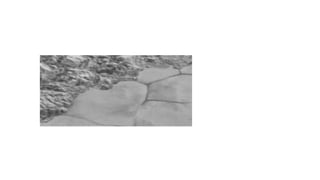
• More youthful terrain — a huge plain bereft of craters, just north of
the mountainous range — popped up in pictures sent back in mid-
July. The zone has been informally named Sputnik Planum and is a
region of intense scrutiny, given that geologists are still trying to
figure out what caused this.
• This high-resolution image from New Horizons shows the “shoreline”
of Sputnik Planum on Pluto.
• Credit: NASA/JHUAPL/SWRI
• Evidence of ionized gas tens of thousands of miles beyond Pluto
found around the same time po
• pointed to the planet's atmosphere being lost to space after the solar
wind crashes into it. Later in July, team members presented evidence
of a haze above Pluto's surface — another surprise. At the time, the
models they had suggested the haze is created when sunlight breaks
up methane in Pluto's atmosphere.
• From time to time, New Horizons still does periodic data dumps back
to Earth, revealing new insights about Pluto and Charon. Among
them: evidence of a past subsurface ocean on Charon, and strange
water ice hills on Pluto floating in frozen nitrogen. Some scientists
have also suggested that Pluto could have the ingredients for life on
its surface, even at its great distance from the sun.
Pluto's planetary status changes
• Ten years can be a long time in planetary science, and that is
particularly true of Pluto. Since New Horizons left our planet in 2006,
we've discovered another moon near Pluto. Planners have made
course corrections to keep the spacecraft away from Pluto's moons.
• Further, Pluto was demoted from its position as the ninth planet in
our solar system. In August 2006, members of the International
Astronomical Union (IAU) — the global body that governs astronomy
names and other matters — met in a general assembly to decide on
the definition of a planet.
WIKI PEDIA SITE
• New Horizons is an interplanetary space probe that was launched as a
part of NASA's New Frontiers program.[2] Engineered by the Johns
Hopkins University Applied Physics Laboratory (APL) and the
Southwest Research Institute (SwRI), with a team led by S. Alan
Stern,[3] the spacecraft was launched in 2006 with the primary
mission to perform a flyby study of the Pluto system in 2015, and a
secondary mission to fly by and study one or more other Kuiper belt
objects (KBOs) in the decade to follow.[4][5][6][7][8]
• On January 19, 2006, New Horizons was launched from Cape
Canaveral Air Force Station directly into an Earth-and-solar escape
trajectory with a speed of about 16.26 kilometers per second
(58,536 km/h; 36,373 mph). After a brief encounter with asteroid
132524 APL, New Horizons proceeded to Jupiter, making its closest
approach on February 28, 2007, at a distance of 2.3 million kilometers
(1.4 million miles). The Jupiter flyby provided a gravity assist that
increased New Horizons' speed; the flyby also enabled a general test
of New Horizons' scientific capabilities, returning data about the
planet's atmosphere, moons, and magnetosphere
• Most of the post-Jupiter voyage was spent in hibernation mode to
preserve on-board systems, except for brief annual checkouts.[9] On
December 6, 2014, New Horizons was brought back online for the
Pluto encounter, and instrument check-out began.[10] On January 15,
2015, the New Horizons spacecraft began its approach phase to Pluto.
• On July 14, 2015, at 11:49 UTC, it flew 12,500 km (7,800 mi) above
the surface of Pluto,[11][12] making it the first spacecraft to explore the
dwarf planet.[7][13] On October 25, 2016, at 21:48 UTC, the last of the
recorded data from the Pluto flyby was received from New
Horizons.[14] Having completed its flyby of Pluto,[15] New Horizons has
maneuvered for a flyby of Kuiper belt object (486958) 2014
MU69,[16][17][18] expected to take place on January 1, 2019, when it
will be 43.4 AU from the Sun.[16][1
HISTORY
• In August 1992, JPL scientist Robert Staehle called Pluto discoverer
Clyde Tombaugh, requesting permission to visit his planet. "I told him
he was welcome to it," Tombaugh later remembered, "though he's
got to go one long, cold trip."[19] The call eventually led to a series of
proposed Pluto missions, leading up to New Horizons
• Stamatios "Tom" Krimigis, head of the Applied Physics Laboratory's
space division, one of many entrants in the New Frontiers Program
competition, formed the New Horizons team with Alan Stern in
December 2000. Appointed as the project's principal investigator,
Stern was described by Krimigis as "the personification of the Pluto
mission".[20] New Horizons was based largely on Stern's work since
Pluto 350 and involved most of the team from Pluto Kuiper Express.[21]
• The New Horizons proposal was one of five that were officially
submitted to NASA. It was later selected as one of two finalists to be
subject to a three-month concept study, in June 2001. The other
finalist, POSSE (Pluto and Outer Solar System Explorer), was a
separate, but similar Pluto mission concept by the University of
Colorado Boulder, led by principal investigator Larry W. Esposito, and
supported by the JPL, Lockheed Martin and the University of
California.[22]
• However, the APL, in addition to being supported by Pluto Kuiper
Express developers at the Goddard Space Flight Center and Stanford
University,[22] were at an advantage; they had recently developed
NEAR Shoemaker for NASA, which had successfully entered orbit
around 433 Eros earlier in the year, and would later land on the
asteroid to scientific and engineering fanfare.[23]
• In November 2001, New Horizons was officially selected for funding
as part of the New Frontiers program.[24] However, the new NASA
Administrator appointed by the Bush Administration, Sean O'Keefe,
was not supportive of New Horizons, and effectively cancelled it by
not including it in NASA's budget for 2003.
• NASA's Associate Administrator for the Science Mission Directorate
Ed Weiler prompted Stern to lobby for the funding of New Horizons in
hopes of the mission appearing in the Planetary Science Decadal
Survey; a prioritized "wish list", compiled by the United States
National Research Council, that reflects the opinions of the scientific
community. After an intense campaign to gain support for New
Horizons, the Planetary Science Decadal Survey of 2003–2013 was
published in the summer of 2002.
• NASA's Associate Administrator for the Science Mission Directorate
Ed Weiler prompted Stern to lobby for the funding of New Horizons in
hopes of the mission appearing in the Planetary Science Decadal
Survey; a prioritized "wish list", compiled by the United States
National Research Council, that reflects the opinions of the scientific
community. After an intense campaign to gain support for New
Horizons, the Planetary Science Decadal Survey of 2003–2013 was
published in the summer of 2002.
Mission profile
• New Horizons is the first mission in NASA's New Frontiers mission
category, larger and more expensive than the Discovery missions but
smaller than the Flagship Program. The cost of the mission (including
spacecraft and instrument development, launch vehicle, mission
operations, data analysis, and education/public outreach) is
approximately $700 million over 15 years (2001–2016).[26] The
spacecraft was built primarily by Southwest Research Institute (SwRI)
and the Johns Hopkins Applied Physics Laboratory.
• New Horizons is the first mission in NASA's New Frontiers mission
category, larger and more expensive than the Discovery missions but
smaller than the Flagship Program. The cost of the mission (including
spacecraft and instrument development, launch vehicle, mission
operations, data analysis, and education/public outreach) is
approximately $700 million over 15 years (2001–2016).[26] The
spacecraft was built primarily by Southwest Research Institute (SwRI)
and the Johns Hopkins Applied Physics Laboratory.
• The mission's principal investigator is Alan Stern of the Southwest
Research Institute (formerly NASA Associate Administrator).
• After separation from the launch vehicle, overall control was taken by
Mission Operations Center (MOC) at the Applied Physics Laboratory in
Howard County, Maryland. The science instruments are operated at
Clyde Tombaugh Science Operations Center (T-SOC) in Boulder,
Colorado.[27]
•
• Navigation is performed at various contractor facilities, whereas the
navigational positional data and related celestial reference frames are
provided by the Naval Observatory Flagstaff Station through
Headquarters NASA and JPL; KinetX is the lead on the New Horizons
navigation team and is responsible for planning trajectory
adjustments as the spacecraft speeds toward the outer Solar System.
• Coincidentally the Naval Observatory Flagstaff Station was where the
photographic plates were taken for the discovery of Pluto's moon
Charon; and the Naval Observatory is itself not far from the Lowell
Observatory where Pluto was discovered.
• New Horizons was originally planned as a voyage to the only
unexplored planet in the Solar System. When the spacecraft was
launched, Pluto was still classified as a planet, later to be reclassified
as a dwarf planet by the International Astronomical Union (IAU).
Some members of the New Horizons team, including Alan Stern,
disagree with the IAU definition and still describe Pluto as the ninth
planet.[28] Pluto's satellites Nix and Hydra also have a connection with
the spacecraft: the first letters of their names (N and H) are the
initials of New Horizons. The moons' discoverers chose these names
for this reason, plus Nix and Hydra's relationship to the mythological
Pluto.[29]
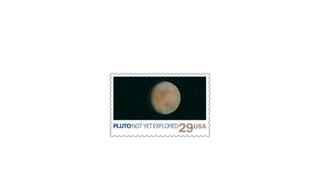
• In addition to the science equipment, there are several cultural
artifacts traveling with the spacecraft. These include a collection of
434,738 names stored on a compact disc,[30] a piece of Scaled
Composites's SpaceShipOne,[31] a "Not Yet Explored" USPS
stamp,[32][33] and a Flag of the United States, along with other
mementos.[34]
• About 30 grams (1 oz) of Clyde Tombaugh's ashes are aboard the
spacecraft, to commemorate his discovery of Pluto in 1930.[35][36] A
Florida-state quarter coin, whose design commemorates human
exploration, is included, officially as a trim weight.[37] One of the
science packages (a dust counter) is named after Venetia Burney,
who, as a child, suggested the name "Pluto" after its discovery.
Goal
• The goal of the mission is to understand the formation of the Pluto
system, the Kuiper belt, and the transformation of the early Solar
System.[38] The spacecraft collected data on the atmospheres,
surfaces, interiors, and environments of Pluto and its moons. It will
also study other objects in the Kuiper belt.[39] "By way of comparison,
New Horizons gathered 5,000 times as much data at Pluto as Mariner
did at the Red Planet."[40]
• Some of the questions the mission attempts to answer are: What is
Pluto's atmosphere made of and how does it behave? What does its
surface look like? Are there large geological structures? How do solar
wind particles interact with Pluto's atmosphere?[41]
• Specifically, the mission's science objectives are to:[42]
• map the surface composition of Pluto and Charon
• characterize the geology and morphology of Pluto and Charon
• characterize the neutral atmosphere of Pluto and its escape rate
• search for an atmosphere around Charon
• map surface temperatures on Pluto and Charon
• search for rings and additional satellites around Pluto
• conduct similar investigations of one or more Kuiper belt object
Design and construction
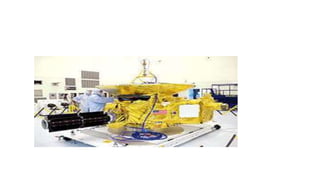
• The spacecraft is comparable in size and general shape to a grand
piano and has been compared to a piano glued to a cocktail bar-sized
satellite dish.[43] As a point of departure, the team took inspiration
from the Ulysses spacecraft,[44] which also carried a radioisotope
thermoelectric generator (RTG) and dish on a box-in-box structure
through the outer Solar System. Many subsystems and components
have flight heritage from APL's CONTOUR spacecraft, which in turn
had heritage from APL's TIMED spacecraft.
• New Horizons' body forms a triangle, almost 0.76 m (2.5 ft) thick. (The
Pioneers have hexagonal bodies, whereas the Voyagers, Galileo, and
Cassini–Huygens have decagonal, hollow bodies.) A 7075 aluminium
alloy tube forms the main structural column, between the launch
vehicle adapter ring at the "rear," and the 2.1 m (6 ft 11 in) radio dish
antenna affixed to the "front" flat side. The titanium fuel tank is in
this tube.
•
• The RTG attaches with a 4-sided titanium mount resembling a gray
pyramid or stepstool. Titanium provides strength and thermal
isolation. The rest of the triangle is primarily sandwich panels of thin
aluminium facesheet (less than 1⁄64 in or 0.40 mm) bonded to
aluminium honeycomb core. The structure is larger than strictly
necessary, with empty space inside.
• The structure is designed to act as shielding, reducing electronics
errors caused by radiation from the RTG. Also, the mass distribution
required for a spinning spacecraft demands a wider triangle.
• The interior structure is painted black to equalize temperature by
radiative heat transfer. Overall, the spacecraft is thoroughly blanketed
to retain heat. Unlike the Pioneers and Voyagers, the radio dish is also
enclosed in blankets that extend to the body.
• The heat from the RTG adds warmth to the spacecraft while it is in
the outer Solar System. While in the inner Solar System, the
spacecraft must prevent overheating, hence electronic activity is
limited, power is diverted to shunts with attached radiators, and
louvers are opened to radiate excess heat. While the spacecraft is
cruising inactively in the cold outer Solar System, the louvers are
closed, and the shunt regulator reroutes power to electric heaters
Propulsion and attitude control
•
• Propulsion and attitude control
Propulsion and attitude control
• New Horizons has both spin-stabilized (cruise) and three-axis
stabilized (science) modes controlled entirely with hydrazine
monopropellant. Additional post launch delta-v of over 290 m/s
(1,000 km/h; 650 mph) is provided by a 77 kg (170 lb) internal tank.
Helium is used as a pressurant, with an elastomeric diaphragm
assisting expulsion. The spacecraft's on-orbit mass including fuel is
over 470 kg (1,040 lb) on the Jupiter flyby trajectory, but would have
been only 445 kg (981 lb) for the backup direct flight option to Pluto.
Significantly, had the backup option been taken, this would have
meant less fuel for later Kuiper belt operations.
• There are 16 thrusters on New Horizons: four 4.4 N (1.0 lbf) and
twelve 0.9 N (0.2 lbf) plumbed into redundant branches. The larger
thrusters are used primarily for trajectory corrections, and the small
ones (previously used on Cassini and the Voyager spacecraft) are used
primarily for attitude control and spinup/spindown maneuvers. Two
star cameras are used to measure the spacecraft attitude.
•
• They are mounted on the face of the spacecraft and provide attitude
information while in spin-stabilized or 3-axis mode. In between the
time of star camera readings, spacecraft orientation is provided by
dual redundant miniature inertial measurement units. Each unit
contains three solid-state gyroscopes and three accelerometers. Two
Adcole Sun sensors provide attitude determination. One detects the
angle to the Sun, whereas the other measures spin rate and clocking.
Power
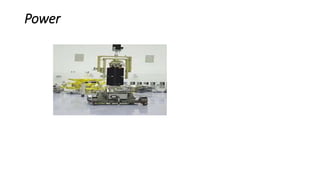
• A cylindrical radioisotope thermoelectric generator (RTG) protrudes in
the plane of the triangle from one vertex of the triangle. The RTG
provided 245.7 W of power at launch, and was predicted to drop
approximately 5% every 4 years, decaying to 200 W by the time of its
encounter with the Plutonian system in 2015 and will decay too far to
power the transmitters in the 2030s.[3] There are no onboard
batteries. RTG output is relatively predictable; load transients are
handled by a capacitor bank and fast circuit breakers.
• The RTG, model "GPHS-RTG," was originally a spare from the Cassini
mission. The RTG contains 9.75 kg (21.5 lb) of plutonium-238 oxide
pellets.[21] Each pellet is clad in iridium, then encased in a graphite
shell. It was developed by the U.S. Department of Energy at the
Materials and Fuels Complex, a part of the Idaho National
Laboratory.[45] The original RTG design called for 10.9 kg (24 lb) of
plutonium, but a unit less powerful than the original design goal was
produced because of delays at the United States Department of
Energy, including security activities, that delayed plutonium
production.[46]
•
• The mission parameters and observation sequence had to be
modified for the reduced wattage; still, not all instruments can
operate simultaneously. The Department of Energy transferred the
space battery program from Ohio to Argonne in 2002 because of
security concerns.
• The amount of radioactive plutonium in the RTG is about one-third
the amount on board the Cassini–Huygens probe when it launched in
1997. That Cassini launch was protested by some. The United States
Department of Energy estimated the chances of a New Horizons
launch accident that would release radiation into the atmosphere at 1
in 350, and monitored the launch[47] as it always does when RTGs are
involved. It was estimated that a worst-case scenario of total dispersal
of on-board plutonium would spread the equivalent radiation of 80%
the average annual dosage in North America from background
radiation over an area with a radius of 105 km (65 mi)
Flight computer
• The spacecraft carries two computer systems: the Command and Data
Handling system and the Guidance and Control processor. Each of the two
systems is duplicated for redundancy, for a total of four computers. The
processor used for its flight computers is the Mongoose-V, a 12 MHz
radiation-hardened version of the MIPS R3000 CPU. Multiple redundant
clocks and timing routines are implemented in hardware and software to
help prevent faults and downtime. To conserve heat and mass, spacecraft
and instrument electronics are housed together in IEMs (integrated
electronics modules). There are two redundant IEMs. Including other
functions such as instrument and radio electronics, each IEM contains
9 boards.[49] The software of the probe runs on Nucleus RTOS operating
system
• There have been two "safing" events, that sent the spacecraft into
safe mode:
• On March 19, 2007 the Command and Data Handling computer
experienced an uncorrectable memory error and rebooted itself,
causing the spacecraft to go into safe mode. The craft fully recovered
within two days, with some data loss on Jupiter's magnetotail. No
impact on the subsequent mission was expected.[51]
• On July 4, 2015 there was a CPU safing event caused by over
assignment of commanded science operation
Telecommunications and data handling
• Communication with the spacecraft is via X band. The craft had a
communication rate of 38 kbit/s at Jupiter; at Pluto's distance, a rate
of approximately 1 kbit/s per transmitter is expected. Besides the low
data rate, Pluto's distance also causes a latency of about 4.5 hours
(one-way). The 70 m (230 ft) NASA Deep Space Network (DSN) dishes
are used to relay commands once it is beyond Jupiter. The spacecraft
uses dual modular redundancy transmitters and receivers, and either
right- or left-hand circular polarization
• The downlink signal is amplified by dual redundant 12-watt traveling-
wave tube amplifiers (TWTAs) mounted on the body under the dish.
The receivers are new, low-power designs. The system can be
controlled to power both TWTAs at the same time, and transmit a
dual-polarized downlink signal to the DSN that nearly doubles the
downlink rate. DSN tests early in the mission with this dual
polarization combining technique were successful, and the capability
is now considered operational (when the spacecraft power budget
permits both TWTAs to be powered).
• In addition to the high-gain antenna, there are two backup low-gain
antennas and a medium-gain dish. The high-gain dish has a
Cassegrain reflector layout, composite construction, and a 2.1-meter
(7 ft) diameter providing over 42 dBi of gain, has a half-power beam
width of about a degree.
• The prime-focus, medium-gain antenna, with a 0.3-meter (1 ft)
aperture and 10° half-power beam width, is mounted to the back of
the high-gain antenna's secondary reflector. The forward low-gain
antenna is stacked atop the feed of the medium-gain antenna. The aft
low-gain antenna is mounted within the launch adapter at the rear of
the spacecraft. This antenna was used only for early mission phases
near Earth, just after launch and for emergencies if the spacecraft had
lost attitude control.
• New Horizons recorded scientific instrument data to its solid-state
memory buffer at each encounter, then transmitted the data to Earth.
Data storage is done on two low-power solid-state recorders (one
primary, one backup) holding up to 8 gigabytes each.
• Because of the extreme distance from Pluto and the Kuiper belt, only
one buffer load at those encounters can be saved. This is because
New Horizons will require approximately 16 months after it has left
the vicinity of Pluto to transmit the buffer load back to Earth.[54] At
Pluto's distance, transmissions from the space probe back to Earth
took four hours and 25 minutes to traverse 4.7 billion km of space.[55]
• Part of the reason for the delay between the gathering of and
transmission of data is that all of the New Horizons instrumentation is
body-mounted. In order for the cameras to record data, the entire
probe must turn, and the one-degree-wide beam of the high-gain
antenna was not pointing toward Earth
• Previous spacecraft, such as the Voyager program probes, had a
rotatable instrumentation platform (a "scan platform") that could
take measurements from virtually any angle without losing radio
contact with Earth. New Horizons' elimination of excess mechanisms
was implemented to save weight, shorten the schedule, and improve
reliability during its 15-year
• The Voyager 2 spacecraft experienced platform jamming at Saturn;
the demands of long time exposures at Uranus led to modifications of
the mission such that the entire probe was rotated to make the time
exposure photos at Uranus and Neptune, similar to how New
Horizons rotated.
•
Science payload
• New Horizons carries seven instruments: three optical instruments,
two plasma instruments, a dust sensor and a radio science
receiver/radiometer. The instruments are to be used to investigate
the global geology, surface composition, surface temperature,
atmospheric pressure, atmospheric temperature Solar Wind At Pluto
(SWAP)
• SWAP—Solar Wind At Pluto
• Solar Wind At Pluto (SWAP) is a toroidal electrostatic analyzer and
retarding potential analyzer (RPA), that makes up one of the two
instruments comprising New Horizons' Plasma and high-energy
particle spectrometer suite (PAM), the other being PEPSSI. SWAP
measures particles of up to 6.5 keV and, because of the tenuous solar
wind at Pluto's distance, the instrument is designed with the largest
aperture of any such instrument ever flown
• Pluto Energetic Particle Spectrometer Science Investigation (PEPSSI)
• Pluto Energetic Particle Spectrometer Science Investigation (PEPSSI) is
a time of flight ion and electron sensor that makes up one of the two
instruments comprising New Horizons' plasma and high-energy
particle spectrometer suite (PAM), the other being SWAP. Unlike
SWAP, which measures particles of up to 6.5 keV, PEPSSI goes up to
1 MeV
• and escape rate of Pluto and its moons. The rated power is 21 watts,
though not all instruments operate simultaneously.[56] In addition,
New Horizons has an Ultrastable Oscillator subsystem, which may be
used to study and test the Pioneer anomaly towards the end of the
spacecraft's life
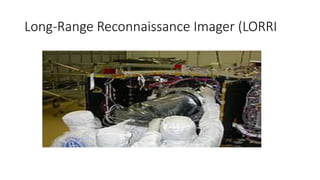
Long-Range Reconnaissance Imager (LORRI
• The Long-Range Reconnaissance Imager (LORRI) is a long-focal-length
imager designed for high resolution and responsivity at visible
wavelengths. The instrument is equipped with a 1024×1024 pixel by
12-bits-per-pixel monochromatic CCD imager with a 208.3 mm
(8.20 in) aperture giving a resolution of 5 μrad (~1 arcsec).[58]
• The CCD is chilled far below freezing by a passive radiator on the
antisolar face of the spacecraft. This temperature differential requires
insulation, and isolation from the rest of the structure. The Ritchey–
Chretien mirrors and metering structure are made of silicon carbide,
to boost stiffness, reduce weight, and prevent warping at low
temperatures
• The optical elements sit in a composite light shield, and mount with
titanium and fiberglass for thermal isolation. Overall mass is 8.6 kg
(19 lb), with the optical tube assembly (OTA) weighing about 5.6 kg
(12 lb),[59] for one of the largest silicon-carbide telescopes flown at
the time (now surpassed by Herschel). For viewing on public web
sites the 12-bit per pixel LORRI images are converted to 8-bit per pixel
JPEG images.[58] These public images do not contain the full dynamic
range of brightness information available from the raw LORRI images
file
• Alice
• Alice is an ultraviolet imaging spectrometer that is one of two
photographic instruments comprising New Horizons' Pluto
Exploration Remote Sensing Investigation (PERSI); the other being the
Ralph telescope. It resolves 1,024 wavelength bands in the far and
extreme ultraviolet (from 50–180 nm), over 32 view fields. Its goal is
to determine the composition of Pluto's atmosphere. This Alice
instrument is derived from another Alice aboard ESA's Rosetta
spacecraft
• Ralph telescope
• The Ralph telescope, 6 cm (2.4 in) in aperture, is one of two
photographic instruments that make up New Horizons' Pluto
Exploration Remote Sensing Investigation (PERSI), with the other
being the Alice instrument. Ralph has two separate channels: MVIC
(Multispectral Visible Imaging Camera), a visible-light CCD imager
with broadband and color channels; and LEISA (Linear Etalon Imaging
Spectral Array), a near-infrared imaging spectrometer. LEISA is derived
from a similar instrument on the Earth Observing-1 spacecraft. Ralph
was named after Alice's husband on The Honeymooners, and was
designed after Alice

An example2 fifthe element

  • 2.
    CONTOLL YOUR ANGER •GET 20 DOLLARS • GET TAN JACKET • GET PURPLE SHIRT • MAKE 4 COPIES –PRINT 48 TIMES • GETFOOD 9/3
  • 3.
    SANITY CHECK • 1.CLOTHES- OK-NEED TAN JACKET-NEED TO WASH JEANS • 2. HAVE PANTS AT MEDGAR-4 PAIRS-GET THEM • 3. 9/16- SEE DAUGHTER NIKKI • 4. 9/3-GET FOOD SUNDAY?? • 5. GET COPIES-BIG DAY ON TUESDAY-CHECK STATUS OF REGISTRATION • 6. HAVE FIN AID APPOINTMENT 9/5 • 7. GOTO FORDHAM-EARLY –ROOM 416-PRINT –ISOTOPE SHEET • 8. PRINT KWL SHEET- 48 TIMES COPY IT-ISOTOPE SHEET • 9. SEPT 6TH WEB QUEST 48 TIME • 10 ** YOU MUST UPLOAD THE WEBS QUESTS-4 OF THEM
  • 4.
    • 12. SHAMEKA-METROCARDS-TUES 9/5 • 13. FINANCIAL AID 9/5 • 14. REGISTRATION 9/5 • 15. DO YOU HAVE FOOD? 9/5 • 16. CAN YOU TRAVEL? • 17. SOAP AND CLOTHES • 18. DID YOU MAKE COPIES 9/5-CHANGE FIN AID TO LATTER IN DAY
  • 5.
    • 19. canyou wash socks?? • 20. blue shirt-black pants, vivarin, tan jacket • 21 . Exam is almost done • 22. hiedi-wouldemail exams • 23. can you pay bill for class? • 24. can you get a laptop • 25. njcu-was fucked up
  • 8.
  • 9.
  • 10.
  • 11.
    YOU GROUP TALK-ALL4 PEOPLR TALK-OR CAN DEMO SOMETHING • IF YOU USE A WEB SITE-JUST SAY • • MY GROUP ADAPTED FROM: https://www.space.com/18377-new- horizons.html • *I DO NOT CARE IF YOU USE THE WHOLE WEB SITE • *REF SLIDES • I NEED YOU TO BE INDEPTH-I WILL GIVE YOU TIME-20 MIN 30 MIN WHAT EVER—I need you to tell me everything about the satellite • (Wikipedia sites-are ok-then find something extra)
  • 12.
    WHAT WAS • 1.THE SATELLITTE • 2. MIISION • 3. THE DATA • 4, THE INSTRUMENT ON IT** • 5. PROBLEMS • 6. THINGS THAT WENT WELL • 7. ITS-FUTURE • 8. MAKE A MODEL-DO A DEMO
  • 13.
    MODEL OF MAVEN-SOMESATELLITE-YOU HAVE MORE THAN OTHERS- I KNOW THAT
  • 14.
    LEGO maven Missionto Mars NASA Exclusive • https://www.youtube.com/watch?v=Hy32TeqaJw8
  • 15.
    LEGO 7469 -Discovery - Mission To Mars • https://www.youtube.com/watch?v=h6pkclEGeaA
  • 16.
    Artist conception ofMAVEN spacecraft
  • 17.
    MAVEN's Electra UHFradio transceive
  • 18.
    Solar Wind ElectronAnalyzer (SWEA) – measures solar wind and ionosphere electrons.
  • 19.
  • 20.
  • 21.
    IDEA-INCLUDE A PICTURE-MAKEA PHYSICAL MODEL-REFER TO A VIDEO – IN TALK • New Horizons is a NASA spacecraft that was the first to visit dwarf planet Pluto in July 2015. Its pictures of the dwarf planet's icy surface, as well as observations of Pluto's moon Charon, are revolutionizing our understanding of solar system objects far from the sun.
  • 22.
    DISPLAY DATA-A PASTTREND • The mission is now en route to an object deeper in the Kuiper Belt, called 2014 MU69. It will reach this object on Jan. 1, 2019.
  • 23.
    AUDIENCE-UNAWARE OF YOURTOPIC KNOW PAST MISSIONS- • The spacecraft's extreme distance from Earth makes it only the fifth to venture so far from home (the other ones being Pioneer 10 and Pioneer 11, and Voyager 1 and Voyager 2, which are either in the outer solar system or in the case of Voyager 1, interstellar space.)
  • 24.
    NICE INFO-”DID YOUKNOW . .ETC” • Pluto's distance — about 3 billion miles (5 billion kilometers) from Earth — presented power challenges for New Horizon's designers, since the sun's rays are too weak to generate power. There are also long communications delays for those staying in touch with the 1,054- lb. (478 kilograms) spacecraft; at Pluto, it took 4.5 hours for a one- way message to get there from Earth.
  • 25.
    • Further, ourunderstanding of the Pluto system keeps changing. The planet was discovered in 1930 by astronomer Clyde Tombaugh at the Lowell Observatory. (New Horizons carries some of Tombaugh's ashes.) Since then, we've discovered new moons around Pluto — which can also be seen as dangerous obstacles for a spacecraft, if not accounted for.
  • 26.
    SOME THING AI MIGHT KNOW-AN ACCESS POINT • There are also ongoing debates about whether Pluto is a planet or not. The International Astronomical Union voted to change its status to “dwarf planet” in 2006, following the discovery of several similarly sized objects in the Kuiper Belt.
  • 27.
    • However, NewHorizons principal investigator Alan Stern has repeatedly said he is not in favor of the decision – especially after the flyby revealed more a more complex formation history than initially anticipated. Stern and others argued that such complexity is more representative of a planet, and plan to make a formal submission to the IAU explaining that in 2017.
  • 28.
    Zipping by Jupiter •Spacecraft typically have a set design lifetime, similar to warranties on electronics or cars. Over time, solar particles,cosmic rays and other phenomena can degrade the surface of the spacecraft or mess up the electronics. This makes long missions such as New Horizons especially challenging, requiring backup systems and a source of power (nuclear power) to keep the spacecraft alive far away from the sun.
  • 30.
    Wikipedia site • NewHorizons launched Jan. 19, 2006, on an Atlas V rocket from Cape Canaveral Air Force Station in Florida. A power outage and high winds delayed two previous launch attempts, but New Horizons made it safely into space on the third try.
  • 31.
    • The spacecraft'sfirst destination was Jupiter, in February and March 2007. New Horizons passed by less than 1.4 million miles (2.4 million km) of the solar system's largest planet, making it the first spacecraft to swing by since the Galileo probe finished its mission at Jupiter in 2003.
  • 32.
    • Among NewHorizons' first pictures were some of Io, Jupiter's volcanic moon. The spacecraft captured the clearest pictures ever of the Tvashtar volcano on Io, showing volcanic fallout that was bigger than the state of Texas. • Additionally, the spacecraft flew through a stream of charged particles swirling behind Jupiter. It found large bubbles of charged particles, or plasma, and also revealed variations in the stream
  • 33.
    • At thetime, astronomers said the observations could help with understanding the environment around "hot Jupiter" planets found at other stars. • To conserve energy and lessen the chance of anything breaking, controllers kept the spacecraft in hibernation save for periodic wakeups for navigation and systems checks. It emerged from hibernation in December 2014 to get it ready for the Pluto encounter and sending data back to Earth afterwards.
  • 34.
    Pluto encounter • NewHorizons was so busy gathering data in its July 2015 encounter that, as planned, the spacecraft didn't communicate with Earth during its closest approach to Pluto and Charon. Controllers celebrated when New Horizons phoned home and they knew that data was on the way
  • 35.
    • Early picturesfrom New Horizons showed a surprisingly young surface, with a mountain range on Pluto as high as 11,000 feet (3,500 meters). Believed to be about 100 million years old at most, this range likely pointed to recent geological activity on the surface, but how was a mystery
  • 36.
    • “This maycause us to rethink what powers geological activity on many other icy worlds,” said John Spencer, New Horizons geology, geophysics and imaging team deputy leader, in a statement shortly after the encounter.
  • 37.
    • More youthfulterrain — a huge plain bereft of craters, just north of the mountainous range — popped up in pictures sent back in mid- July. The zone has been informally named Sputnik Planum and is a region of intense scrutiny, given that geologists are still trying to figure out what caused this.
  • 39.
    • This high-resolutionimage from New Horizons shows the “shoreline” of Sputnik Planum on Pluto. • Credit: NASA/JHUAPL/SWRI
  • 40.
    • Evidence ofionized gas tens of thousands of miles beyond Pluto found around the same time po • pointed to the planet's atmosphere being lost to space after the solar wind crashes into it. Later in July, team members presented evidence of a haze above Pluto's surface — another surprise. At the time, the models they had suggested the haze is created when sunlight breaks up methane in Pluto's atmosphere.
  • 41.
    • From timeto time, New Horizons still does periodic data dumps back to Earth, revealing new insights about Pluto and Charon. Among them: evidence of a past subsurface ocean on Charon, and strange water ice hills on Pluto floating in frozen nitrogen. Some scientists have also suggested that Pluto could have the ingredients for life on its surface, even at its great distance from the sun.
  • 42.
    Pluto's planetary statuschanges • Ten years can be a long time in planetary science, and that is particularly true of Pluto. Since New Horizons left our planet in 2006, we've discovered another moon near Pluto. Planners have made course corrections to keep the spacecraft away from Pluto's moons. • Further, Pluto was demoted from its position as the ninth planet in our solar system. In August 2006, members of the International Astronomical Union (IAU) — the global body that governs astronomy names and other matters — met in a general assembly to decide on the definition of a planet.
  • 45.
  • 49.
    • New Horizonsis an interplanetary space probe that was launched as a part of NASA's New Frontiers program.[2] Engineered by the Johns Hopkins University Applied Physics Laboratory (APL) and the Southwest Research Institute (SwRI), with a team led by S. Alan Stern,[3] the spacecraft was launched in 2006 with the primary mission to perform a flyby study of the Pluto system in 2015, and a secondary mission to fly by and study one or more other Kuiper belt objects (KBOs) in the decade to follow.[4][5][6][7][8]
  • 50.
    • On January19, 2006, New Horizons was launched from Cape Canaveral Air Force Station directly into an Earth-and-solar escape trajectory with a speed of about 16.26 kilometers per second (58,536 km/h; 36,373 mph). After a brief encounter with asteroid 132524 APL, New Horizons proceeded to Jupiter, making its closest approach on February 28, 2007, at a distance of 2.3 million kilometers (1.4 million miles). The Jupiter flyby provided a gravity assist that increased New Horizons' speed; the flyby also enabled a general test of New Horizons' scientific capabilities, returning data about the planet's atmosphere, moons, and magnetosphere
  • 51.
    • Most ofthe post-Jupiter voyage was spent in hibernation mode to preserve on-board systems, except for brief annual checkouts.[9] On December 6, 2014, New Horizons was brought back online for the Pluto encounter, and instrument check-out began.[10] On January 15, 2015, the New Horizons spacecraft began its approach phase to Pluto.
  • 52.
    • On July14, 2015, at 11:49 UTC, it flew 12,500 km (7,800 mi) above the surface of Pluto,[11][12] making it the first spacecraft to explore the dwarf planet.[7][13] On October 25, 2016, at 21:48 UTC, the last of the recorded data from the Pluto flyby was received from New Horizons.[14] Having completed its flyby of Pluto,[15] New Horizons has maneuvered for a flyby of Kuiper belt object (486958) 2014 MU69,[16][17][18] expected to take place on January 1, 2019, when it will be 43.4 AU from the Sun.[16][1
  • 53.
    HISTORY • In August1992, JPL scientist Robert Staehle called Pluto discoverer Clyde Tombaugh, requesting permission to visit his planet. "I told him he was welcome to it," Tombaugh later remembered, "though he's got to go one long, cold trip."[19] The call eventually led to a series of proposed Pluto missions, leading up to New Horizons
  • 54.
    • Stamatios "Tom"Krimigis, head of the Applied Physics Laboratory's space division, one of many entrants in the New Frontiers Program competition, formed the New Horizons team with Alan Stern in December 2000. Appointed as the project's principal investigator, Stern was described by Krimigis as "the personification of the Pluto mission".[20] New Horizons was based largely on Stern's work since Pluto 350 and involved most of the team from Pluto Kuiper Express.[21]
  • 55.
    • The NewHorizons proposal was one of five that were officially submitted to NASA. It was later selected as one of two finalists to be subject to a three-month concept study, in June 2001. The other finalist, POSSE (Pluto and Outer Solar System Explorer), was a separate, but similar Pluto mission concept by the University of Colorado Boulder, led by principal investigator Larry W. Esposito, and supported by the JPL, Lockheed Martin and the University of California.[22]
  • 56.
    • However, theAPL, in addition to being supported by Pluto Kuiper Express developers at the Goddard Space Flight Center and Stanford University,[22] were at an advantage; they had recently developed NEAR Shoemaker for NASA, which had successfully entered orbit around 433 Eros earlier in the year, and would later land on the asteroid to scientific and engineering fanfare.[23]
  • 57.
    • In November2001, New Horizons was officially selected for funding as part of the New Frontiers program.[24] However, the new NASA Administrator appointed by the Bush Administration, Sean O'Keefe, was not supportive of New Horizons, and effectively cancelled it by not including it in NASA's budget for 2003.
  • 58.
    • NASA's AssociateAdministrator for the Science Mission Directorate Ed Weiler prompted Stern to lobby for the funding of New Horizons in hopes of the mission appearing in the Planetary Science Decadal Survey; a prioritized "wish list", compiled by the United States National Research Council, that reflects the opinions of the scientific community. After an intense campaign to gain support for New Horizons, the Planetary Science Decadal Survey of 2003–2013 was published in the summer of 2002.
  • 59.
    • NASA's AssociateAdministrator for the Science Mission Directorate Ed Weiler prompted Stern to lobby for the funding of New Horizons in hopes of the mission appearing in the Planetary Science Decadal Survey; a prioritized "wish list", compiled by the United States National Research Council, that reflects the opinions of the scientific community. After an intense campaign to gain support for New Horizons, the Planetary Science Decadal Survey of 2003–2013 was published in the summer of 2002.
  • 60.
    Mission profile • NewHorizons is the first mission in NASA's New Frontiers mission category, larger and more expensive than the Discovery missions but smaller than the Flagship Program. The cost of the mission (including spacecraft and instrument development, launch vehicle, mission operations, data analysis, and education/public outreach) is approximately $700 million over 15 years (2001–2016).[26] The spacecraft was built primarily by Southwest Research Institute (SwRI) and the Johns Hopkins Applied Physics Laboratory.
  • 61.
    • New Horizonsis the first mission in NASA's New Frontiers mission category, larger and more expensive than the Discovery missions but smaller than the Flagship Program. The cost of the mission (including spacecraft and instrument development, launch vehicle, mission operations, data analysis, and education/public outreach) is approximately $700 million over 15 years (2001–2016).[26] The spacecraft was built primarily by Southwest Research Institute (SwRI) and the Johns Hopkins Applied Physics Laboratory.
  • 62.
    • The mission'sprincipal investigator is Alan Stern of the Southwest Research Institute (formerly NASA Associate Administrator).
  • 63.
    • After separationfrom the launch vehicle, overall control was taken by Mission Operations Center (MOC) at the Applied Physics Laboratory in Howard County, Maryland. The science instruments are operated at Clyde Tombaugh Science Operations Center (T-SOC) in Boulder, Colorado.[27]
  • 64.
    • • Navigation isperformed at various contractor facilities, whereas the navigational positional data and related celestial reference frames are provided by the Naval Observatory Flagstaff Station through Headquarters NASA and JPL; KinetX is the lead on the New Horizons navigation team and is responsible for planning trajectory adjustments as the spacecraft speeds toward the outer Solar System.
  • 65.
    • Coincidentally theNaval Observatory Flagstaff Station was where the photographic plates were taken for the discovery of Pluto's moon Charon; and the Naval Observatory is itself not far from the Lowell Observatory where Pluto was discovered.
  • 66.
    • New Horizonswas originally planned as a voyage to the only unexplored planet in the Solar System. When the spacecraft was launched, Pluto was still classified as a planet, later to be reclassified as a dwarf planet by the International Astronomical Union (IAU). Some members of the New Horizons team, including Alan Stern, disagree with the IAU definition and still describe Pluto as the ninth planet.[28] Pluto's satellites Nix and Hydra also have a connection with the spacecraft: the first letters of their names (N and H) are the initials of New Horizons. The moons' discoverers chose these names for this reason, plus Nix and Hydra's relationship to the mythological Pluto.[29]
  • 67.
    • In additionto the science equipment, there are several cultural artifacts traveling with the spacecraft. These include a collection of 434,738 names stored on a compact disc,[30] a piece of Scaled Composites's SpaceShipOne,[31] a "Not Yet Explored" USPS stamp,[32][33] and a Flag of the United States, along with other mementos.[34]
  • 68.
    • About 30grams (1 oz) of Clyde Tombaugh's ashes are aboard the spacecraft, to commemorate his discovery of Pluto in 1930.[35][36] A Florida-state quarter coin, whose design commemorates human exploration, is included, officially as a trim weight.[37] One of the science packages (a dust counter) is named after Venetia Burney, who, as a child, suggested the name "Pluto" after its discovery.
  • 69.
    Goal • The goalof the mission is to understand the formation of the Pluto system, the Kuiper belt, and the transformation of the early Solar System.[38] The spacecraft collected data on the atmospheres, surfaces, interiors, and environments of Pluto and its moons. It will also study other objects in the Kuiper belt.[39] "By way of comparison, New Horizons gathered 5,000 times as much data at Pluto as Mariner did at the Red Planet."[40]
  • 70.
    • Some ofthe questions the mission attempts to answer are: What is Pluto's atmosphere made of and how does it behave? What does its surface look like? Are there large geological structures? How do solar wind particles interact with Pluto's atmosphere?[41]
  • 71.
    • Specifically, themission's science objectives are to:[42] • map the surface composition of Pluto and Charon • characterize the geology and morphology of Pluto and Charon • characterize the neutral atmosphere of Pluto and its escape rate • search for an atmosphere around Charon • map surface temperatures on Pluto and Charon • search for rings and additional satellites around Pluto • conduct similar investigations of one or more Kuiper belt object
  • 72.
    Design and construction •The spacecraft is comparable in size and general shape to a grand piano and has been compared to a piano glued to a cocktail bar-sized satellite dish.[43] As a point of departure, the team took inspiration from the Ulysses spacecraft,[44] which also carried a radioisotope thermoelectric generator (RTG) and dish on a box-in-box structure through the outer Solar System. Many subsystems and components have flight heritage from APL's CONTOUR spacecraft, which in turn had heritage from APL's TIMED spacecraft.
  • 73.
    • New Horizons'body forms a triangle, almost 0.76 m (2.5 ft) thick. (The Pioneers have hexagonal bodies, whereas the Voyagers, Galileo, and Cassini–Huygens have decagonal, hollow bodies.) A 7075 aluminium alloy tube forms the main structural column, between the launch vehicle adapter ring at the "rear," and the 2.1 m (6 ft 11 in) radio dish antenna affixed to the "front" flat side. The titanium fuel tank is in this tube.
  • 74.
    • • The RTGattaches with a 4-sided titanium mount resembling a gray pyramid or stepstool. Titanium provides strength and thermal isolation. The rest of the triangle is primarily sandwich panels of thin aluminium facesheet (less than 1⁄64 in or 0.40 mm) bonded to aluminium honeycomb core. The structure is larger than strictly necessary, with empty space inside. • The structure is designed to act as shielding, reducing electronics errors caused by radiation from the RTG. Also, the mass distribution required for a spinning spacecraft demands a wider triangle.
  • 75.
    • The interiorstructure is painted black to equalize temperature by radiative heat transfer. Overall, the spacecraft is thoroughly blanketed to retain heat. Unlike the Pioneers and Voyagers, the radio dish is also enclosed in blankets that extend to the body.
  • 76.
    • The heatfrom the RTG adds warmth to the spacecraft while it is in the outer Solar System. While in the inner Solar System, the spacecraft must prevent overheating, hence electronic activity is limited, power is diverted to shunts with attached radiators, and louvers are opened to radiate excess heat. While the spacecraft is cruising inactively in the cold outer Solar System, the louvers are closed, and the shunt regulator reroutes power to electric heaters
  • 78.
    Propulsion and attitudecontrol • • Propulsion and attitude control
  • 79.
    Propulsion and attitudecontrol • New Horizons has both spin-stabilized (cruise) and three-axis stabilized (science) modes controlled entirely with hydrazine monopropellant. Additional post launch delta-v of over 290 m/s (1,000 km/h; 650 mph) is provided by a 77 kg (170 lb) internal tank. Helium is used as a pressurant, with an elastomeric diaphragm assisting expulsion. The spacecraft's on-orbit mass including fuel is over 470 kg (1,040 lb) on the Jupiter flyby trajectory, but would have been only 445 kg (981 lb) for the backup direct flight option to Pluto. Significantly, had the backup option been taken, this would have meant less fuel for later Kuiper belt operations.
  • 80.
    • There are16 thrusters on New Horizons: four 4.4 N (1.0 lbf) and twelve 0.9 N (0.2 lbf) plumbed into redundant branches. The larger thrusters are used primarily for trajectory corrections, and the small ones (previously used on Cassini and the Voyager spacecraft) are used primarily for attitude control and spinup/spindown maneuvers. Two star cameras are used to measure the spacecraft attitude. •
  • 81.
    • They aremounted on the face of the spacecraft and provide attitude information while in spin-stabilized or 3-axis mode. In between the time of star camera readings, spacecraft orientation is provided by dual redundant miniature inertial measurement units. Each unit contains three solid-state gyroscopes and three accelerometers. Two Adcole Sun sensors provide attitude determination. One detects the angle to the Sun, whereas the other measures spin rate and clocking.
  • 82.
  • 83.
    • A cylindricalradioisotope thermoelectric generator (RTG) protrudes in the plane of the triangle from one vertex of the triangle. The RTG provided 245.7 W of power at launch, and was predicted to drop approximately 5% every 4 years, decaying to 200 W by the time of its encounter with the Plutonian system in 2015 and will decay too far to power the transmitters in the 2030s.[3] There are no onboard batteries. RTG output is relatively predictable; load transients are handled by a capacitor bank and fast circuit breakers.
  • 84.
    • The RTG,model "GPHS-RTG," was originally a spare from the Cassini mission. The RTG contains 9.75 kg (21.5 lb) of plutonium-238 oxide pellets.[21] Each pellet is clad in iridium, then encased in a graphite shell. It was developed by the U.S. Department of Energy at the Materials and Fuels Complex, a part of the Idaho National Laboratory.[45] The original RTG design called for 10.9 kg (24 lb) of plutonium, but a unit less powerful than the original design goal was produced because of delays at the United States Department of Energy, including security activities, that delayed plutonium production.[46]
  • 85.
    • • The missionparameters and observation sequence had to be modified for the reduced wattage; still, not all instruments can operate simultaneously. The Department of Energy transferred the space battery program from Ohio to Argonne in 2002 because of security concerns.
  • 86.
    • The amountof radioactive plutonium in the RTG is about one-third the amount on board the Cassini–Huygens probe when it launched in 1997. That Cassini launch was protested by some. The United States Department of Energy estimated the chances of a New Horizons launch accident that would release radiation into the atmosphere at 1 in 350, and monitored the launch[47] as it always does when RTGs are involved. It was estimated that a worst-case scenario of total dispersal of on-board plutonium would spread the equivalent radiation of 80% the average annual dosage in North America from background radiation over an area with a radius of 105 km (65 mi)
  • 87.
    Flight computer • Thespacecraft carries two computer systems: the Command and Data Handling system and the Guidance and Control processor. Each of the two systems is duplicated for redundancy, for a total of four computers. The processor used for its flight computers is the Mongoose-V, a 12 MHz radiation-hardened version of the MIPS R3000 CPU. Multiple redundant clocks and timing routines are implemented in hardware and software to help prevent faults and downtime. To conserve heat and mass, spacecraft and instrument electronics are housed together in IEMs (integrated electronics modules). There are two redundant IEMs. Including other functions such as instrument and radio electronics, each IEM contains 9 boards.[49] The software of the probe runs on Nucleus RTOS operating system
  • 88.
    • There havebeen two "safing" events, that sent the spacecraft into safe mode: • On March 19, 2007 the Command and Data Handling computer experienced an uncorrectable memory error and rebooted itself, causing the spacecraft to go into safe mode. The craft fully recovered within two days, with some data loss on Jupiter's magnetotail. No impact on the subsequent mission was expected.[51] • On July 4, 2015 there was a CPU safing event caused by over assignment of commanded science operation
  • 89.
    Telecommunications and datahandling • Communication with the spacecraft is via X band. The craft had a communication rate of 38 kbit/s at Jupiter; at Pluto's distance, a rate of approximately 1 kbit/s per transmitter is expected. Besides the low data rate, Pluto's distance also causes a latency of about 4.5 hours (one-way). The 70 m (230 ft) NASA Deep Space Network (DSN) dishes are used to relay commands once it is beyond Jupiter. The spacecraft uses dual modular redundancy transmitters and receivers, and either right- or left-hand circular polarization
  • 90.
    • The downlinksignal is amplified by dual redundant 12-watt traveling- wave tube amplifiers (TWTAs) mounted on the body under the dish. The receivers are new, low-power designs. The system can be controlled to power both TWTAs at the same time, and transmit a dual-polarized downlink signal to the DSN that nearly doubles the downlink rate. DSN tests early in the mission with this dual polarization combining technique were successful, and the capability is now considered operational (when the spacecraft power budget permits both TWTAs to be powered).
  • 91.
    • In additionto the high-gain antenna, there are two backup low-gain antennas and a medium-gain dish. The high-gain dish has a Cassegrain reflector layout, composite construction, and a 2.1-meter (7 ft) diameter providing over 42 dBi of gain, has a half-power beam width of about a degree.
  • 92.
    • The prime-focus,medium-gain antenna, with a 0.3-meter (1 ft) aperture and 10° half-power beam width, is mounted to the back of the high-gain antenna's secondary reflector. The forward low-gain antenna is stacked atop the feed of the medium-gain antenna. The aft low-gain antenna is mounted within the launch adapter at the rear of the spacecraft. This antenna was used only for early mission phases near Earth, just after launch and for emergencies if the spacecraft had lost attitude control.
  • 93.
    • New Horizonsrecorded scientific instrument data to its solid-state memory buffer at each encounter, then transmitted the data to Earth. Data storage is done on two low-power solid-state recorders (one primary, one backup) holding up to 8 gigabytes each.
  • 94.
    • Because ofthe extreme distance from Pluto and the Kuiper belt, only one buffer load at those encounters can be saved. This is because New Horizons will require approximately 16 months after it has left the vicinity of Pluto to transmit the buffer load back to Earth.[54] At Pluto's distance, transmissions from the space probe back to Earth took four hours and 25 minutes to traverse 4.7 billion km of space.[55]
  • 95.
    • Part ofthe reason for the delay between the gathering of and transmission of data is that all of the New Horizons instrumentation is body-mounted. In order for the cameras to record data, the entire probe must turn, and the one-degree-wide beam of the high-gain antenna was not pointing toward Earth
  • 96.
    • Previous spacecraft,such as the Voyager program probes, had a rotatable instrumentation platform (a "scan platform") that could take measurements from virtually any angle without losing radio contact with Earth. New Horizons' elimination of excess mechanisms was implemented to save weight, shorten the schedule, and improve reliability during its 15-year
  • 97.
    • The Voyager2 spacecraft experienced platform jamming at Saturn; the demands of long time exposures at Uranus led to modifications of the mission such that the entire probe was rotated to make the time exposure photos at Uranus and Neptune, similar to how New Horizons rotated. •
  • 98.
    Science payload • NewHorizons carries seven instruments: three optical instruments, two plasma instruments, a dust sensor and a radio science receiver/radiometer. The instruments are to be used to investigate the global geology, surface composition, surface temperature, atmospheric pressure, atmospheric temperature Solar Wind At Pluto (SWAP)
  • 99.
    • SWAP—Solar WindAt Pluto • Solar Wind At Pluto (SWAP) is a toroidal electrostatic analyzer and retarding potential analyzer (RPA), that makes up one of the two instruments comprising New Horizons' Plasma and high-energy particle spectrometer suite (PAM), the other being PEPSSI. SWAP measures particles of up to 6.5 keV and, because of the tenuous solar wind at Pluto's distance, the instrument is designed with the largest aperture of any such instrument ever flown
  • 100.
    • Pluto EnergeticParticle Spectrometer Science Investigation (PEPSSI)
  • 101.
    • Pluto EnergeticParticle Spectrometer Science Investigation (PEPSSI) is a time of flight ion and electron sensor that makes up one of the two instruments comprising New Horizons' plasma and high-energy particle spectrometer suite (PAM), the other being SWAP. Unlike SWAP, which measures particles of up to 6.5 keV, PEPSSI goes up to 1 MeV
  • 102.
    • and escaperate of Pluto and its moons. The rated power is 21 watts, though not all instruments operate simultaneously.[56] In addition, New Horizons has an Ultrastable Oscillator subsystem, which may be used to study and test the Pioneer anomaly towards the end of the spacecraft's life
  • 103.
  • 104.
    • The Long-RangeReconnaissance Imager (LORRI) is a long-focal-length imager designed for high resolution and responsivity at visible wavelengths. The instrument is equipped with a 1024×1024 pixel by 12-bits-per-pixel monochromatic CCD imager with a 208.3 mm (8.20 in) aperture giving a resolution of 5 μrad (~1 arcsec).[58]
  • 105.
    • The CCDis chilled far below freezing by a passive radiator on the antisolar face of the spacecraft. This temperature differential requires insulation, and isolation from the rest of the structure. The Ritchey– Chretien mirrors and metering structure are made of silicon carbide, to boost stiffness, reduce weight, and prevent warping at low temperatures
  • 106.
    • The opticalelements sit in a composite light shield, and mount with titanium and fiberglass for thermal isolation. Overall mass is 8.6 kg (19 lb), with the optical tube assembly (OTA) weighing about 5.6 kg (12 lb),[59] for one of the largest silicon-carbide telescopes flown at the time (now surpassed by Herschel). For viewing on public web sites the 12-bit per pixel LORRI images are converted to 8-bit per pixel JPEG images.[58] These public images do not contain the full dynamic range of brightness information available from the raw LORRI images file
  • 107.
  • 108.
    • Alice isan ultraviolet imaging spectrometer that is one of two photographic instruments comprising New Horizons' Pluto Exploration Remote Sensing Investigation (PERSI); the other being the Ralph telescope. It resolves 1,024 wavelength bands in the far and extreme ultraviolet (from 50–180 nm), over 32 view fields. Its goal is to determine the composition of Pluto's atmosphere. This Alice instrument is derived from another Alice aboard ESA's Rosetta spacecraft
  • 109.
  • 110.
    • The Ralphtelescope, 6 cm (2.4 in) in aperture, is one of two photographic instruments that make up New Horizons' Pluto Exploration Remote Sensing Investigation (PERSI), with the other being the Alice instrument. Ralph has two separate channels: MVIC (Multispectral Visible Imaging Camera), a visible-light CCD imager with broadband and color channels; and LEISA (Linear Etalon Imaging Spectral Array), a near-infrared imaging spectrometer. LEISA is derived from a similar instrument on the Earth Observing-1 spacecraft. Ralph was named after Alice's husband on The Honeymooners, and was designed after Alice