Download to read offline
![Modeling Liquid Terminal Operation and Service System in a Port Using Linier Matrix Algebraic
www.iosrjournals.org 2 | Page
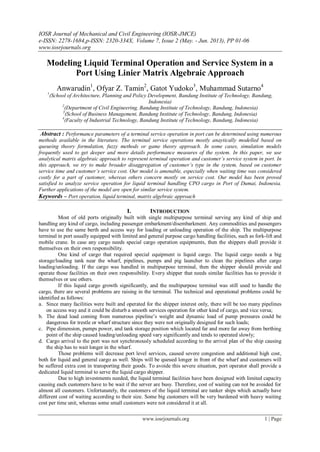
The customers of the liquid terminal could be divided into three categories based on their costs in the
port. First, there are small ships that loaded or unloaded a low volume of liquid cargo. Due to their small size,
the waiting costs of ships are low and they have served fastest in the system. Therefore, their cost are smallest
comparing to other classes. Second, on the contrary, there are big ships with high volume of liquid cargo. Of
course they have very high waiting cost due to their big size and a lot of volume cargo that they should be
carried. Unfortunately, this kind of shipper have to be served longest since they brought much more cargo.
Hence, their cost in port are very high because they have to pay more both on cargo operations and ship waiting
cost. The last category, are the ships in between.
In order to serve all class of the customers, the service system require a server that can serve with
different mean service time for each class of customer. In this paper, we develop the model also to represents a
server that could served two customers simultanously. Hence, we have a server with two service stations. The
most important characteristic of the server is that each of the two service station has several phases with
different service time and different service cost to served each class of customers.
II. LITERATUR REVIEW
In queueing theory, a model of server with quantification of customer behavior was started by Naor [1]
which show induction of tolls as a mechanism of customer arrival control to the queuing system. Naor said that
each customer will only consider his waiting time when decide to enter the system. He proved that they will not
taking account to the impact of their decision to the next customers which will experienced longer waiting time.
Stidham [2] said that Naor’s model is a shifting paradigm since it introduces a consideration of feed-
back on queuing system. An arrival process of customers that normally treats as exogenous process could be
affected by congestion within the system itself. Naor’s model also gives a brightening idea on customer’s
adaptive behavior to optimize their utility within the system which in turn leads to the idea of controlling the
system through pricing mechanism. Knudsen [3] broadens Naor’s work for multi-server system and nonlinear
waiting cost function. Bradford [4] discussed a controlling mechanism that involves pricing and policy to assign
customers to the server in a congested system. If customers owned private information regarding their waiting
cost, system administrator that wants to maximize the benefit of his facilities could be use incentive compatible
pricing schemes. Bradford model introduced incentive compatible pricing and route scheme for server capacity
allocation.
Brouns [5] studied similar but simpler models with routing and admission control approach and single
customer class. Recent work came from Ahn and Lewis [6] that considers joint routing and allocation policies in
a two station parallel of queuing network. Their model includes routing costs and expansion for super-additive
or sub-additive collaboration service rates. Within super-additive case, they found that optimal policy is exactly
follow general intuition which should be done with clearing the higher cost first and never routing the customer
to the high cost. In other case (sub-additive) they found that there is an inherent trade-off between serving faster
and reducing costs at a high cost station. This trade-off and the fact that the routing can balance the workload
will complicate the structure of optimal policy of the system.
Lipsky [7] has modeling two servers worked in a closed system using linier algebraic queueing theory
approach. The system consists of two servers with different characteristics. The main server has two service
stations and each of them has similar number of phases representing different service time distributions, whereas
the other is simply a single exponential server which worked as a feeder for the main server. Our model was a
modification of Lipsky system with several important characteristic discrepancies. First, we are working on
open system with infinite customers instead of closed system with limited unchanged population number of
customers. Second, we assumed that each customer, upon completion of service in one phase, will leave the
system permanently. Even if the same customer returns into the system later, he acts as a different customer
entity. In this case, we can eliminate state transition matrices that required on Lipsky’s. In that view, our model
is simpler. Third, we have single server, while there are two series of servers in Lipsky’s work. Although our
system has many different characteristics, we use similar approach and notation on his paper for consistency.
III. MODEL FORMULATIONS
We derived our problem to a model of a queueing system. The system consists of a service system with
two different groups of server and two different kinds of customer. The service time in this server are assumed
to be exponentially distributed. By assuming liquid shipper come to the port can be described with Poisson
distribution, they will be separated and created two different Poisson distribution.
In order to get analytic solutions, we defined that the server in the system have two service station.
Hence, it can serve two customers simultaneously. We assumed that the number of customers for each class
follow Poisson distributions, while service time on all server assumed to be exponentially distributed. Every
group of customers has their own service time distributions. The mean service time distributions for each group](https://image.slidesharecdn.com/a0720106-150115230924-conversion-gate01/85/Modeling-Liquid-Terminal-Operation-and-Service-System-in-a-Port-Using-Linier-Matrix-Algebraic-Approach-2-320.jpg)
![Modeling Liquid Terminal Operation and Service System in a Port Using Linier Matrix Algebraic
www.iosrjournals.org 3 | Page
of customers will be represented by phases in each service station. All service station will have the same phases.
Hence, customers are serve in the same phases on the same server, regadless which service station he uses.
In order to get steady state solution of the system, first we have to define all notations, vectors and
matrices that will be used in this model in following definitions:
1. An entrance vector, denoted by a row vector p, is representing the probabilities that a customer, upon
entering the system will go to any phase i, where i represent one phase available in the system. The
probabilities of a customer to enter each phase i will be represented by each element of p, denoted by pi.
2. The dimension of state space Ξ1 in the system, representing the number of phases in the system when there
are n1 customer, will be denoted by D(1) := m. Whereas the number of elements of state space Ξ2,
represents the system state probabilities when there are n2 customers in the system, will be defined as D(2)
:= m (m + 1)/2.
3. The column vectors 1'ε and 2'ε are vectors which all entries 1. The dimension of the vectors are D(1) and
D(2) respectively.
4. The completion matrix M2 is a matrix where the i-th diagonal elements, denoted by [M2]ii, represents the
probability rate of leaving state i by a service completion in the system, whereas all others entries in the
matrix will be zero. All diagonal elements will be formulated as [M2]ii := i1 + i2. The completion matrix for
state space Ξ1, represents the service completion in the system when there are n1 customer, is denoted by
M1 and formulated as [M1]i := i. The dimension of M1 and M2 completion matrices will be D(1) x D(1) and
D(2) x D(2) respectively.
5. Q2 defined as a state demotion matrix that has a dimension of D(2) x D(1). The matrix represents
probabilities to put the system into internal state with one customer, upon customer leaving off the system,
given that it has two customers previously. The state demotion matrix with 4 phases in each service station
will be in following formulation:
000
00
000
00
00
000
00
00
00
000
:
4
43
33
43
44
3
42
22
42
44
32
22
32
33
2
41
11
41
44
31
11
31
33
21
11
21
22
1
2
q
qq
q
qq
qq
q
qq
qq
qq
q
Q (1)
6. R2 defined as a state promotion matrix that has a dimension of D(1) x D(2). The matrix represents the
probabilities to put the system in internal state with two customers, upon arrival of a customer into the
system, given that it has one customer previously. The state promotion matrix for any system with 4 phases
in each service station will be in following formulation:
43
43
2
4
2
32
1
4
1
3
1
21
2
0
0
0
0
0
0
0
0
0
0
0
0
0
0
0
0
0
0
0
0
0
0
0
0
:
pp
pp
p
p
p
pp
p
p
p
p
p
pp
R (2)
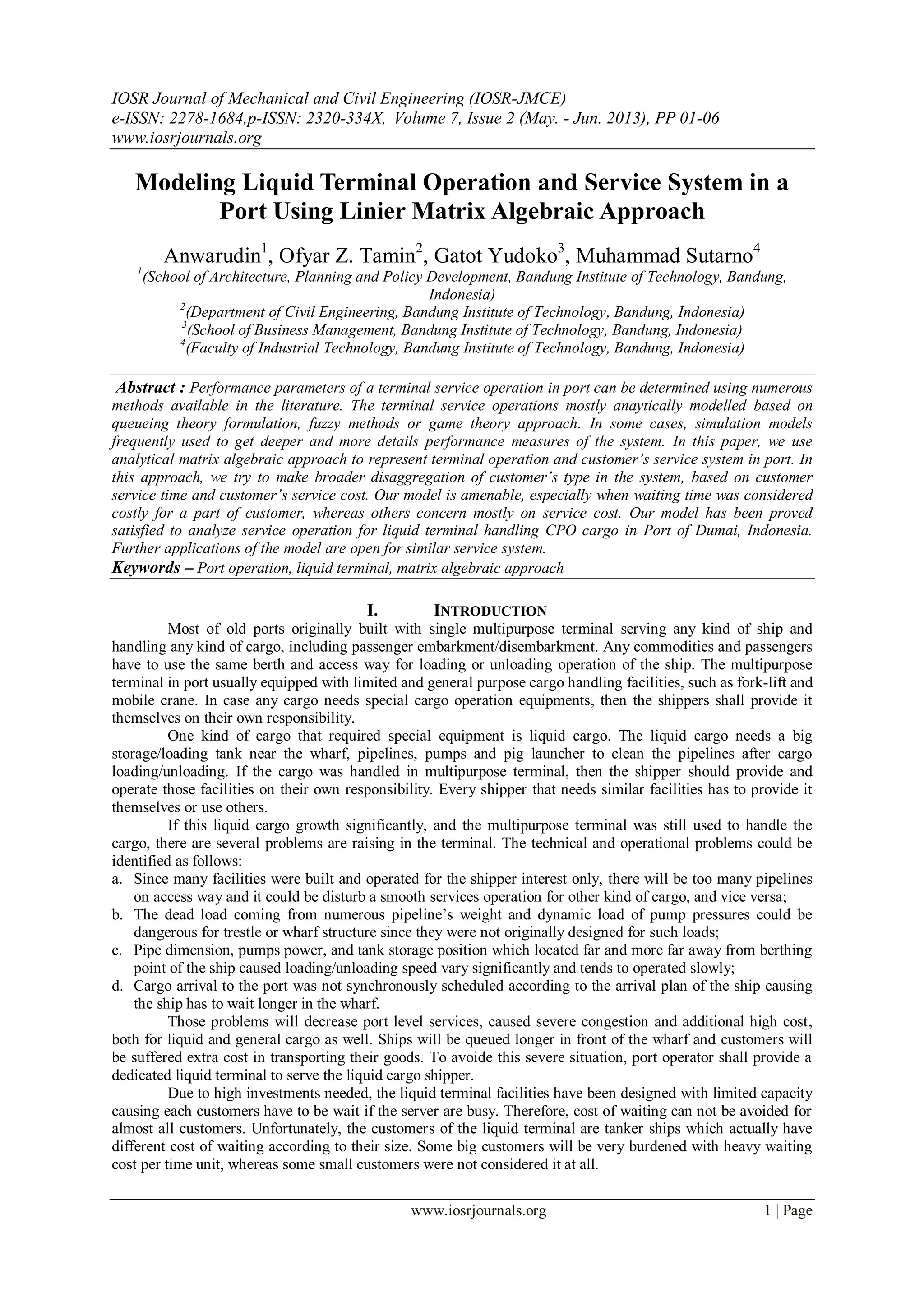
7. The state transition matrices, denoted by U1(N) and U2(n), represent state transitions of the system for state
spaces Ξ1 and state space Ξ1 respectively. The matrices could be listed as follows:
1
2222111 2-
1
:
QMURMIU NN
(3)
1
22222 -
1
:1
RQMIU
(4)](https://image.slidesharecdn.com/a0720106-150115230924-conversion-gate01/85/Modeling-Liquid-Terminal-Operation-and-Service-System-in-a-Port-Using-Linier-Matrix-Algebraic-Approach-3-320.jpg)
![Modeling Liquid Terminal Operation and Service System in a Port Using Linier Matrix Algebraic
www.iosrjournals.org 4 | Page
1
2222222 2
1
-
1
:
RQMUMIU Nn
(5)
We can compute the probabilities of system state when there are n customers in the system as follow:
ε'KRUp1
UUUURUp
221
21
NN
NNN
n
2
2222
2
0132
(6)
The cummulative matrix, denoted as K2(N), could be define recursively using following formula:
01
:
2222
2222222
UU3-U2-U
-U2-U3-U2-U2-UIK
NN
nNNNNNN
(7)
where N represent an estimated maximum number of customers in the system, whereas n := 0, 1, 2, ... N.
The scalar probabilities to represent system state when there are n2 customers and n1 customers,
associated for vectors 2(n) and 1(n) respectively, are defined as follow:
22 ': επ nnr (8)
11 ': επ nnr (9)
Finally, the steady state average number of customers in the system can be calculated using the
following formula:
1
:
n
s nrnq (10)
Using all above formulas, we can compute queue length of the system and counting average waiting
cost for all customers. In this paper, we use the model to analyze service operation for liquid terminal handling
CPO cargo in Port of Dumai, Indonesia. Table 1 show observed data during period of August 2010– July 2011.
Table 1. Customer Characteristics of Liquid Terminal
Ship
Class
Ship Length
(M)
Deadweight Tonnage
(Tons)
Average
Dwt
Mean Service
Time (Hour)
No. Of
Ships
I 200 - 250 58.000 - 124.500 81.820 118,67 10
Ii 150 - 200 21.900 - 58.000 39.859 68,91 186
Iii 100 - 150 5.500 - 21.900 12.358 57,43 215
Iv 50 - 100 500 - 5.500 3.326 47,75 122
Using data available on Table 1, as an example, we can define the entrance vector as follows:
p = [ 0,0068 0,2237 0,4909 0,2785 ] .
Using (1), we can compute the following state demotion matrix:
0.27850.00000.00000.0000
0.22280.15210.00000.0000
0.00000.49090.00000.0000
0.09160.00000.16450.0000
0.00000.10170.26770.0000
0.00000.00000.22370.0000
0.00200.00000.00000.1986
0.00000.00220.00000.3308
0.00000.00000.00250.1415
0.00000.00000.00000.0068
Q2 .
Whereas the state promotion matrix can be calculate using (2):](https://image.slidesharecdn.com/a0720106-150115230924-conversion-gate01/85/Modeling-Liquid-Terminal-Operation-and-Service-System-in-a-Port-Using-Linier-Matrix-Algebraic-Approach-4-320.jpg)
![Modeling Liquid Terminal Operation and Service System in a Port Using Linier Matrix Algebraic
www.iosrjournals.org 6 | Page
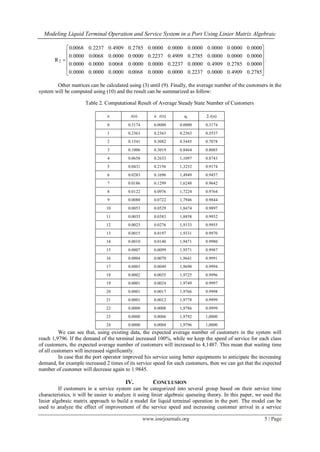
facility. Using the model we have been succeed to analyze service operation for liquid terminal handling CPO
cargo in the port.
In this paper, we defined a server consist of two service stations. Further extension of the model to
represent three or more service stations are widely opened, including a formulation for flexible number of
service stations to represent terminal operations that can handle different number of customers in a wide
variations of shipsize. Further applications of the model are open also for similar service system which exists in
other fields, such as manufacturing process, airport chek-in counter, or other public service system.
REFERENCES
[1] Naor, Paul , On the Regulation of Queue Size by Levying Tolls, Econometrica, 37, 1969, 15-24.
[2] Stidham, Shaler JR., Analysis, Design, and Control of Queueing Systems, Operation Research, 50(1), 2002, 197-216.
[3] Knudsen, Niels Chr., Individual and Social Optimization in a Multiserver Queue with a General Cost-Benefit Structure,
Econometrica, 40(3), 1972, 515-528.
[4] Bradford, R., Pricing, routing, and incentive compatibility in multiserver queues, European Journal of Operational Research, 1996,
226-236.
[5] Brouns, Gido A.J.F., Queueing Models with Admission and Termination Control: Monotonicity and Threshold Result, doctoral diss.,
Universiteitsdrukkerij Technische Universiteit, Eindhoven, The Netherlands, 2003.
[6] Ahn, Hyun-soo, and Mark E. Lewis, Flexible Server Allocation and Customer Routing Policies for Two Parallel Queues when Service
Rates are not Additive, 2011.
[7] Lipsky, L., Queueing Theory - A Linear Algebraic Approach - Second Edition (NY: Springer Science + Business Media, 2009).](https://image.slidesharecdn.com/a0720106-150115230924-conversion-gate01/85/Modeling-Liquid-Terminal-Operation-and-Service-System-in-a-Port-Using-Linier-Matrix-Algebraic-Approach-6-320.jpg)

This document presents a model for analyzing the service operations of a liquid cargo terminal in a port using a linear matrix algebraic approach. The model represents the terminal as having a single server with two service stations that can serve two customers simultaneously. Customers are divided into three categories based on ship size and associated waiting costs. The service time and costs for each customer class varies across different phases of service represented by the model. The matrices defined in the model account for customer arrival rates, service completion probabilities, and state transitions to determine the steady state probabilities of the terminal service system. The model is applied to analyze liquid cargo handling for crude palm oil at the port of Dumai, Indonesia.


