Petar Getsov et al Int. Journal of Engineering Research and Applications www.ijera.com 
ISSN : 2248-9622, Vol. 4, Issue 7( Version 5), July 2014, pp.01-07 
www.ijera.com 1 | P a g e 
Unmanned Airplane Autopilot Tuning 
Petar Getsov, Dimitar Yordanov, Svetoslav Zabunov 
Abstract 
This article considers different approaches for autopilot controller gain values adjustment. The correct autopilot 
performance is tested using modeling methods. A variant of land-based autopilot is considered. Examined are 
scenarios of UAV airplanes in level flight. The latter are applicable to tasks such as remote sensing, controlled 
area surveillance, etc. 
KEYWORDS: flight control, autopilot, safety. 
I. INTRODUCTION 
The main mode of unmanned airplane operation is the horizontal flight at a given altitude aiming at earth 
surface surveillance of certain objects and areas. Another purpose of using UAV airplanes in level flight is to 
fulfill remote sensing applications dealing with study of phenomena, geophysical activities, etc. Such a flight is 
usually an autonomous one and is controlled by an onboard computer. Also such flight is usually taking place in 
the zone beyond direct line-of-sight. The autopilot sustains predefined flight route in the presence of 
disturbances. For the qualities of mission being executed one can measure flight trajectory in the ground control 
station. Direct line-of-sight flight may be conducted even without an onboard computer, but instead using a 
land-based computer connected to the ground control station. The land-based computer implements an autopilot 
that controls the flight over a predefined route. This variant is preferred in the discussed setup used for modeling 
of the direct line-of-sight flight. The utilized airplane possesses the following aerodynamic and 
mass/dimensional data: 
Mass = 50 kg; 
Cy =4.72, Cz=-0.31, Czδn=-0.14, mz 
Cy =-0.13 , mx 
 =-0.058, my 
 =-0.12, 
mz 
z =-8.99, mx 
x=-0.33, my 
y=-0.1 , mx 
y=-0.11 , my 
x=0.11, mz 
 
=-4.3, 
mz 
v=-1.09, mx 
e=-0.24 , my 
n =-0.07 , mx 
n=-0.01, 
Sroll= 2.14 m2; lroll =5.06 m; broll=0.42 m; Ix=21.4 kg.m2; Iy=29.3 kg.m2; Iz 
= 12.4 kg.m2 
Flight altitude is from 10 m to 500 m, speed – 100 km/h. 
II. Autopilot for turning maneuver 
The most suitable autopilot model for the horizontal plane trajectory control is the roll control, according to 
which the turns are carried out using the ailerons and performing banking maneuvers. The aileron deflection law 
can be described as follows: 
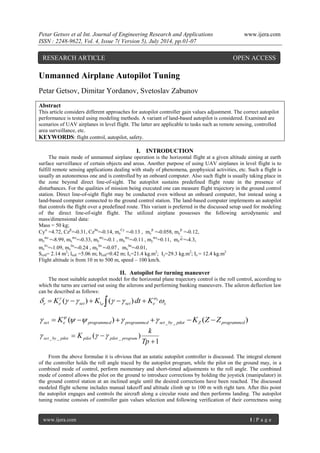
e e set е set е x 
 K   K   dt K x    (  )   (  )  1 
( ) ( ) set e programmed programmed set _by _ pilot Z programmed   K     K Z Z  
1 
( ) _ _ _  
  
Тp 
k 
K set by pilot pilot pilot program    
From the above formulae it is obvious that an astatic autopilot controller is discussed. The integral element 
of the controller holds the roll angle traced by the autopilot program, while the pilot on the ground may, in a 
combined mode of control, perform momentary and short-timed adjustments to the roll angle. The combined 
mode of control allows the pilot on the ground to introduce corrections by holding the joystick (manipulator) in 
the ground control station at an inclined angle until the desired corrections have been reached. The discussed 
modeled flight scheme includes manual takeoff and altitude climb up to 100 m with right turn. After this point 
the autopilot engages and controls the aircraft along a circular route and then performs landing. The autopilot 
tuning routine consists of controller gain values selection and following verification of their correctness using 
RESEARCH ARTICLE OPEN ACCESS
Petar Getsov et al Int. Journal of Engineering Research and Applications www.ijera.com 
ISSN : 2248-9622, Vol. 4, Issue 7( Version 5), July 2014, pp.01-07 
www.ijera.com 2 | P a g e 
modeling of transient processes and modeling of the whole flight. The theory [1] gives tentative formulae for 
choosing the controller gains e e e e z K , K K x , K , K 1 , 
   
. 
The gain figures 
 
e K , x 
e K 
and 1e, K are defined by time treg of the roll transient process and an 
admissible small overshoot. The results of the theoretical calculations of the gain values are verified using 
modeling methods. Systems that include an integral part apply for the law with speed feedback [1 – p.382-383]. 
This law may be transformed as follows: 
( ) 2 
e e e e set p  p   p  i   
( ) 
1 
e e e e set р 
  p     i   
These laws are transformed into a more popular form of the gain figures: 
x 
e e K   ; 
  e e  K ; e e i K1  
The roll transient process regulation time is chosen at treg=5s. 
If the controlled airplane‟s mass/dimensional and aerodynamic values are known the gain figures may be 
calculated 
 
e K , x 
e K 
and 1e, K using the following formulae: 
53.55 
2 
1.125 28 2.14 5.06 
21.4 
0.24 
2 
2 2 
3  
   
 
 
     
V Sl 
I 
m 
b 
x 
x 
v   
(1/s2) 
The integral element gain has the measure of (1/s): 
0.18 
53.55 5 
1218 1218 
3 3 
3 
1  
 
  
reg 
e b t 
K 
The proportional element gain has no measure: 
0.34 
2.67 
0.18 5 
2.67 
1  
 
  e reg 
e 
K t 
K 
6.65 
4 
1.125 28 2.14 5.06 
21.4 
0.33 
4 
2 2 
1  
   
 
 
     
VSl 
I 
m 
b 
x 
x 
x   
(1/s) 
0.035 
53.55 5 
42.7 42.7 6.65 5 
3 
1  
 
  
 
 
 
reg 
reg 
e b t 
b t 
Kx 
(s) 
If the calculated value for x 
e K 
is negative that means the aircraft in this mode has good damping and we may 
set x  0 
e K 
. Then only a rudder dumping will be enough for stabilizing the airplane‟s yaw motion. The yaw 
damping will affect both channels, because, due to the interconnection between yaw and roll rotations, damping 
the yaw motion will damp the roll motion too. 
The yaw gain is [1 – p. 130]: 
3 
2 1 4 (0.4 0.8) ( ) 
a 
a a a 
K y 
y 
   
  
, where 
y 
y 
I 
m V S 
a 
y 
2 
2 
1 
   
  , 
y 
y 
I 
m V S 
a 
2 
2 
2 
   
  ,
Petar Getsov et al Int. Journal of Engineering Research and Applications www.ijera.com 
ISSN : 2248-9622, Vol. 4, Issue 7( Version 5), July 2014, pp.01-07 
www.ijera.com 3 | P a g e 
y 
y 
I 
m V S 
a 
y 
2 
2 
3 
   
  
m 
c V S 
a z 
2 4 
  
  
After substitution with the characteristic quantities for the studies aircraft (taking into account that 
V 
y 
y 2 
  
  ), 
it follows: 
 0.0080.16 y 
y K 
(s) 
Fig.1. „Simulink‟ results of the transient process after setting a desired roll angle in the astatic autopilot 
The gain figures 
 
e K and 
Z 
e K for the simplest control law are derived using equations from the theory [1 – 
p.397], while the course settling time for a small unmanned airplane may be chosen at tstl =25...35s. Pitch 
control over horizontal maneuvers with speed of 28 m/s (100 km/h) is about 
0  6 10 avg  . 
 
 
cos 
9.48 
stl 
e gt 
V 
K  
For t=25…35s it is accepted 1 0.78 
9.81 0.985 (25 35) 
9.48 28 
  
   
 
  
e K 
0.11 0.2 
9.81 0.985 (25 35) 
22.468 57.3 
cos 
22.468 57.3 
2 2   
   
 
 
 
 
 reg 
Z 
e gt 
K (deg/m)
Petar Getsov et al Int. Journal of Engineering Research and Applications www.ijera.com 
ISSN : 2248-9622, Vol. 4, Issue 7( Version 5), July 2014, pp.01-07 
www.ijera.com 4 | P a g e 
The command ( ) set Z programmed   К Z  Z is switched on only under boundary conditions of the Z 
coordinate, defined by the model. Approaching landing this command is engaged when Z<400m. This 
command is defined in the flight program in the ground control station. 
Using modeling approach, the transient process is verified, i.e. the deflections of the ailerons and rudder in 
the presence of typical signal (step-shaped roll angle signal setting). Fig.1 presents the results of the transient 
process modeling of the lateral motion with mutually conditioned roll and slipping angular motions. 
Overshoot of the desired roll angle in the beginning of the transient process (about t≈2,5s) is due to the 
integral part. When modeling isolated roll motion using integral part in the controller a monotonous process is 
obtained with gradual approach to the desired value without overshoot, but the static error during constant roll 
disturbances. 
III. Autopilot for control and stabilization of the flight altitude 
Automatic control and stabilization of the major coordinate is the deviation of the airplane mass center 
along the vertical axis. This deviation in the real aviation is measured by a barometric altimeter, radio-altimeter 
or an inertial system. In the modeling process the altitude is obtained by integrating of the differential equations. 
The longitudinal control channel (pitch control PΔН achieved using the elevator) is maintained satisfactorily 
by the autopilot under most practical disturbances even when implemented using the simplest law: 
( ) ( ) set 
Н 
v v set v z v   K    K z  K Н Н   
Under constant disturbances the statistical errors depend on the magnitude of the major coordinate gain 
H 
e K . The theory [1 – p.292] gives the following optimal gain figure for subsonic unmanned airplanes. This 
figure is appropriate for smooth rate of climb and altitude stabilization of such airplanes: 
 0,18 H 
e opt K (deg/m) 
During modeling, the elevator autopilot adjustment requires at least three gains to be estimated in the 
control law: 
Н 
v v v K , K z , K   
The theory presents formulae [1 – p.135] to calculate the gain z 
v K 
: 
      2 K z a a 
v 
The calculations show that the latter equation has several cases: 
1. Two roots, a negative and positive one. The positive root is used z  0 
v К 
; 
2. Two negative roots – a very good self-damping of the airplane ( need airplane   ) or a small reserve of 
balance along the longitudinal axis (excessive aft center of gravity) or neutrality – we assume z  0 
v К  
; 
3. Two complex roots – instability under overload (such case with the unmanned aircraft is not considered). 
Using the recommended algorithm we set the needed value of the relative damping of the oscillations about 
the ОZ axis to   0.75 1 . Using the equation       2 K z a a 
v two possible values are derived 
(usually one positive and one negative value) and the positive value is chosen. In this equation 
3 
1 4 5 4 2 
c 
c c c c 
a need     
 ; 
2 
3 
1 4 2 
2 
1 4 5 ( ) 4 ( ) 
c 
c c c c c c need     
 
 

Petar Getsov et al Int. Journal of Engineering Research and Applications www.ijera.com 
ISSN : 2248-9622, Vol. 4, Issue 7( Version 5), July 2014, pp.01-07 
www.ijera.com 5 | P a g e 
Coefficients c1, с2 , c3, c4, c5, c6 are determined by the following table using the chosen aerodynamic and 
mass/dimensional characteristics of the unmanned airplane [appendix 2 in 1 – p.432]: 
Coefficient c1 [1/s] ≈ 4,3 
z 
a 
z 
z 
I 
m VSb c 1 2 
2   
  
Coefficient c2 [1/s2] ≈19.6 
z 
z a 
I 
m V Sb c 2 2 
2   
 
z 
y a 
Cy 
z 
I 
m C V Sb 
2 
2   
  
Coefficient c3 [1/s2] ≈34 
z 
a 
в 
z 
I 
m V Sb c 3 2 
2   
 
Coefficient c4 [1/s] ≈3.2 
m 
cy cx VS c 2 
( ) 
4 
   
 m 
cy VS 
2 
  
 
Coefficient c5 [1/s] ≈2.06 
z 
z a 
I 
m VSb c 5 2 
2   
 
Coefficient c6 [m/s.deg] ≈0.49 
5 57.3 
c  V 
Coefficients a  0.09 ;  0.0345 
0.116 2       K z a a 
v s 
The gain figure multiplied by the pitch angle signal is obtained according to formulae [1 – p.193..195]: 
1 
(0.9 1) 4  
 
 
c 
v opt k 
c 
K 
, where 
2.8 
1 4 2 3 4 
3 4  
  
 
c c c K c c 
c c 
k 
z 
v 
c  
Under modeling, the increase of this figure leads to oscillations in the middle of the process, while its 
decrease prolongs the process duration. For the considered unmanned airplane according to modeling data, best 
results are  0.751  
v opt K . 
On the basis of the conducted calculations and modeling, the ensemble of gain figures of the autopilot APΔН 
is: 
 0.18 H 
e opt K (deg/m);  0.751  
v opt K ; K z s 
v  0.116  
. 
IV. Modeling of flight “over a circle” 
The flight over a circle is a typical maneuver during takeoff and landing tutoring. In the current case a 
maneuver similar to a “flight in a circle” is modeled using manual takeoff with turn to the right, automatic 
course change with two right turns of 1800 and climb up to 300 m, descent and landing in the direction of 
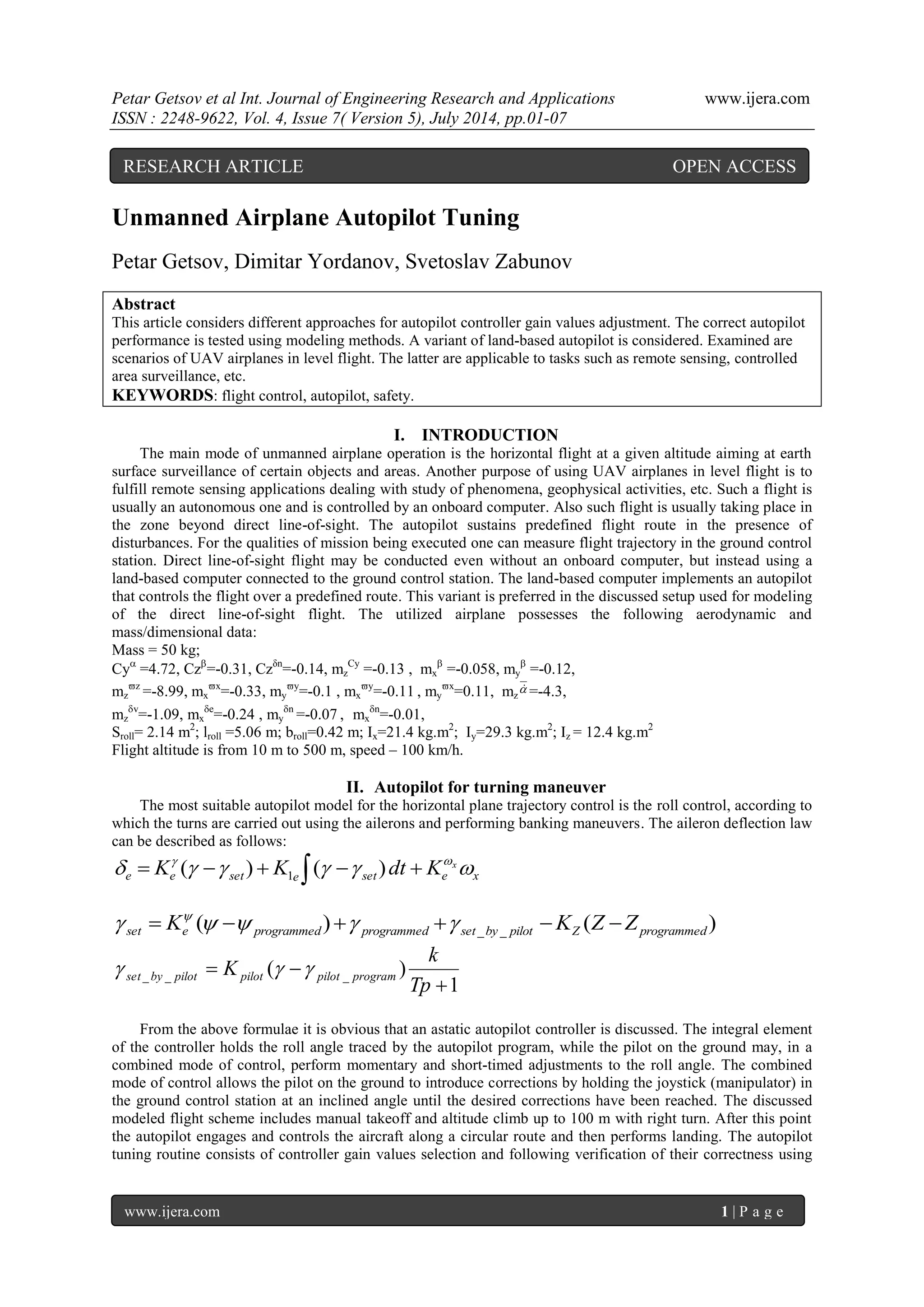
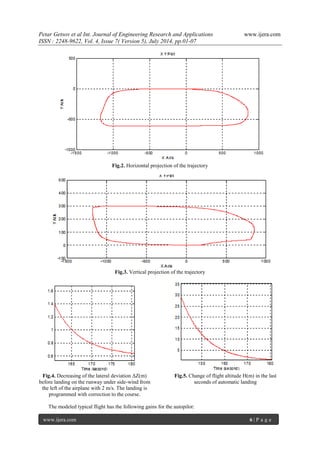
takeoff with minimal deviation of the Z coordinate. The trajectory results are shown on Fig.2-5.
Petar Getsov et al Int. Journal of Engineering Research and Applications www.ijera.com 
ISSN : 2248-9622, Vol. 4, Issue 7( Version 5), July 2014, pp.01-07 
www.ijera.com 6 | P a g e 
Fig.2. Horizontal projection of the trajectory Fig.3. Vertical projection of the trajectory 
Fig.4. Decreasing of the lateral deviation ΔZ(m) before landing on the runway under side-wind from the left of the airplane with 2 m/s. The landing is programmed with correction to the course. 
Fig.5. Change of flight altitude H(m) in the last seconds of automatic landing The modeled typical flight has the following gains for the autopilot:
Petar Getsov et al Int. Journal of Engineering Research and Applications www.ijera.com 
ISSN : 2248-9622, Vol. 4, Issue 7( Version 5), July 2014, pp.01-07 
www.ijera.com 7 | P a g e 
 0.9  
e K ,  0.11 Z 
e K deg/m, K x s 
e  0.035  
, K s y 
н  0.16  
,  0.34  
e K , 0.18 1  e K , 
 0.18 H 
e opt K deg/m; , 1  
v opt K , K z s 
v  0.11  
. 
When the signal line from the ground control station to the airplane is interrupted it is advisory to have an 
emergency mode of the autopilot. This may be for example restoration of the course and altitude of flight as it 
was before signal drop. 
For the correct work of the autopilot it is required during the modeling process that the angles of attack and 
normal overloads to be verified while executing the flight program. The safe values should not be exceeded. 
Generally, the presence of one inertial element with time constant of 2 s at the output of the flight program is 
enough to fool proof the normal overloads and angles of attack (the autopilot works “softly”). 
V. Conclusions 
 The carried out flight modeling confirms the correct choice of gain figures for the autopilot. 
 When the range of flight altitudes and speeds is narrow (as with the unmanned airplanes of the discussed 
class – 50 kg), we may keep the gain figures constant during flight. 
References 
[1] Mihalev I.A., B.N. Okoemov, I.G. Pavlina, M.S. Chikulaev, N.M. Eidinov. Automatic airplane control 
systems – methods for analysis and synthesis, ”Mashinostroenie” publ., Moscow 1971

Unmanned Airplane Autopilot Tuning

  • 1.
    Petar Getsov etal Int. Journal of Engineering Research and Applications www.ijera.com ISSN : 2248-9622, Vol. 4, Issue 7( Version 5), July 2014, pp.01-07 www.ijera.com 1 | P a g e Unmanned Airplane Autopilot Tuning Petar Getsov, Dimitar Yordanov, Svetoslav Zabunov Abstract This article considers different approaches for autopilot controller gain values adjustment. The correct autopilot performance is tested using modeling methods. A variant of land-based autopilot is considered. Examined are scenarios of UAV airplanes in level flight. The latter are applicable to tasks such as remote sensing, controlled area surveillance, etc. KEYWORDS: flight control, autopilot, safety. I. INTRODUCTION The main mode of unmanned airplane operation is the horizontal flight at a given altitude aiming at earth surface surveillance of certain objects and areas. Another purpose of using UAV airplanes in level flight is to fulfill remote sensing applications dealing with study of phenomena, geophysical activities, etc. Such a flight is usually an autonomous one and is controlled by an onboard computer. Also such flight is usually taking place in the zone beyond direct line-of-sight. The autopilot sustains predefined flight route in the presence of disturbances. For the qualities of mission being executed one can measure flight trajectory in the ground control station. Direct line-of-sight flight may be conducted even without an onboard computer, but instead using a land-based computer connected to the ground control station. The land-based computer implements an autopilot that controls the flight over a predefined route. This variant is preferred in the discussed setup used for modeling of the direct line-of-sight flight. The utilized airplane possesses the following aerodynamic and mass/dimensional data: Mass = 50 kg; Cy =4.72, Cz=-0.31, Czδn=-0.14, mz Cy =-0.13 , mx  =-0.058, my  =-0.12, mz z =-8.99, mx x=-0.33, my y=-0.1 , mx y=-0.11 , my x=0.11, mz  =-4.3, mz v=-1.09, mx e=-0.24 , my n =-0.07 , mx n=-0.01, Sroll= 2.14 m2; lroll =5.06 m; broll=0.42 m; Ix=21.4 kg.m2; Iy=29.3 kg.m2; Iz = 12.4 kg.m2 Flight altitude is from 10 m to 500 m, speed – 100 km/h. II. Autopilot for turning maneuver The most suitable autopilot model for the horizontal plane trajectory control is the roll control, according to which the turns are carried out using the ailerons and performing banking maneuvers. The aileron deflection law can be described as follows: e e set е set е x  K   K   dt K x    (  )   (  )  1 ( ) ( ) set e programmed programmed set _by _ pilot Z programmed   K     K Z Z  1 ( ) _ _ _    Тp k K set by pilot pilot pilot program    From the above formulae it is obvious that an astatic autopilot controller is discussed. The integral element of the controller holds the roll angle traced by the autopilot program, while the pilot on the ground may, in a combined mode of control, perform momentary and short-timed adjustments to the roll angle. The combined mode of control allows the pilot on the ground to introduce corrections by holding the joystick (manipulator) in the ground control station at an inclined angle until the desired corrections have been reached. The discussed modeled flight scheme includes manual takeoff and altitude climb up to 100 m with right turn. After this point the autopilot engages and controls the aircraft along a circular route and then performs landing. The autopilot tuning routine consists of controller gain values selection and following verification of their correctness using RESEARCH ARTICLE OPEN ACCESS
  • 2.
    Petar Getsov etal Int. Journal of Engineering Research and Applications www.ijera.com ISSN : 2248-9622, Vol. 4, Issue 7( Version 5), July 2014, pp.01-07 www.ijera.com 2 | P a g e modeling of transient processes and modeling of the whole flight. The theory [1] gives tentative formulae for choosing the controller gains e e e e z K , K K x , K , K 1 ,    . The gain figures  e K , x e K and 1e, K are defined by time treg of the roll transient process and an admissible small overshoot. The results of the theoretical calculations of the gain values are verified using modeling methods. Systems that include an integral part apply for the law with speed feedback [1 – p.382-383]. This law may be transformed as follows: ( ) 2 e e e e set p  p   p  i   ( ) 1 e e e e set р   p     i   These laws are transformed into a more popular form of the gain figures: x e e K   ;   e e  K ; e e i K1  The roll transient process regulation time is chosen at treg=5s. If the controlled airplane‟s mass/dimensional and aerodynamic values are known the gain figures may be calculated  e K , x e K and 1e, K using the following formulae: 53.55 2 1.125 28 2.14 5.06 21.4 0.24 2 2 2 3            V Sl I m b x x v   (1/s2) The integral element gain has the measure of (1/s): 0.18 53.55 5 1218 1218 3 3 3 1     reg e b t K The proportional element gain has no measure: 0.34 2.67 0.18 5 2.67 1     e reg e K t K 6.65 4 1.125 28 2.14 5.06 21.4 0.33 4 2 2 1            VSl I m b x x x   (1/s) 0.035 53.55 5 42.7 42.7 6.65 5 3 1        reg reg e b t b t Kx (s) If the calculated value for x e K is negative that means the aircraft in this mode has good damping and we may set x  0 e K . Then only a rudder dumping will be enough for stabilizing the airplane‟s yaw motion. The yaw damping will affect both channels, because, due to the interconnection between yaw and roll rotations, damping the yaw motion will damp the roll motion too. The yaw gain is [1 – p. 130]: 3 2 1 4 (0.4 0.8) ( ) a a a a K y y      , where y y I m V S a y 2 2 1      , y y I m V S a 2 2 2      ,
  • 3.
    Petar Getsov etal Int. Journal of Engineering Research and Applications www.ijera.com ISSN : 2248-9622, Vol. 4, Issue 7( Version 5), July 2014, pp.01-07 www.ijera.com 3 | P a g e y y I m V S a y 2 2 3      m c V S a z 2 4     After substitution with the characteristic quantities for the studies aircraft (taking into account that V y y 2     ), it follows:  0.0080.16 y y K (s) Fig.1. „Simulink‟ results of the transient process after setting a desired roll angle in the astatic autopilot The gain figures  e K and Z e K for the simplest control law are derived using equations from the theory [1 – p.397], while the course settling time for a small unmanned airplane may be chosen at tstl =25...35s. Pitch control over horizontal maneuvers with speed of 28 m/s (100 km/h) is about 0  6 10 avg  .   cos 9.48 stl e gt V K  For t=25…35s it is accepted 1 0.78 9.81 0.985 (25 35) 9.48 28         e K 0.11 0.2 9.81 0.985 (25 35) 22.468 57.3 cos 22.468 57.3 2 2           reg Z e gt K (deg/m)
  • 4.
    Petar Getsov etal Int. Journal of Engineering Research and Applications www.ijera.com ISSN : 2248-9622, Vol. 4, Issue 7( Version 5), July 2014, pp.01-07 www.ijera.com 4 | P a g e The command ( ) set Z programmed   К Z  Z is switched on only under boundary conditions of the Z coordinate, defined by the model. Approaching landing this command is engaged when Z<400m. This command is defined in the flight program in the ground control station. Using modeling approach, the transient process is verified, i.e. the deflections of the ailerons and rudder in the presence of typical signal (step-shaped roll angle signal setting). Fig.1 presents the results of the transient process modeling of the lateral motion with mutually conditioned roll and slipping angular motions. Overshoot of the desired roll angle in the beginning of the transient process (about t≈2,5s) is due to the integral part. When modeling isolated roll motion using integral part in the controller a monotonous process is obtained with gradual approach to the desired value without overshoot, but the static error during constant roll disturbances. III. Autopilot for control and stabilization of the flight altitude Automatic control and stabilization of the major coordinate is the deviation of the airplane mass center along the vertical axis. This deviation in the real aviation is measured by a barometric altimeter, radio-altimeter or an inertial system. In the modeling process the altitude is obtained by integrating of the differential equations. The longitudinal control channel (pitch control PΔН achieved using the elevator) is maintained satisfactorily by the autopilot under most practical disturbances even when implemented using the simplest law: ( ) ( ) set Н v v set v z v   K    K z  K Н Н   Under constant disturbances the statistical errors depend on the magnitude of the major coordinate gain H e K . The theory [1 – p.292] gives the following optimal gain figure for subsonic unmanned airplanes. This figure is appropriate for smooth rate of climb and altitude stabilization of such airplanes:  0,18 H e opt K (deg/m) During modeling, the elevator autopilot adjustment requires at least three gains to be estimated in the control law: Н v v v K , K z , K   The theory presents formulae [1 – p.135] to calculate the gain z v K :       2 K z a a v The calculations show that the latter equation has several cases: 1. Two roots, a negative and positive one. The positive root is used z  0 v К ; 2. Two negative roots – a very good self-damping of the airplane ( need airplane   ) or a small reserve of balance along the longitudinal axis (excessive aft center of gravity) or neutrality – we assume z  0 v К  ; 3. Two complex roots – instability under overload (such case with the unmanned aircraft is not considered). Using the recommended algorithm we set the needed value of the relative damping of the oscillations about the ОZ axis to   0.75 1 . Using the equation       2 K z a a v two possible values are derived (usually one positive and one negative value) and the positive value is chosen. In this equation 3 1 4 5 4 2 c c c c c a need      ; 2 3 1 4 2 2 1 4 5 ( ) 4 ( ) c c c c c c c need       
  • 5.
    Petar Getsov etal Int. Journal of Engineering Research and Applications www.ijera.com ISSN : 2248-9622, Vol. 4, Issue 7( Version 5), July 2014, pp.01-07 www.ijera.com 5 | P a g e Coefficients c1, с2 , c3, c4, c5, c6 are determined by the following table using the chosen aerodynamic and mass/dimensional characteristics of the unmanned airplane [appendix 2 in 1 – p.432]: Coefficient c1 [1/s] ≈ 4,3 z a z z I m VSb c 1 2 2     Coefficient c2 [1/s2] ≈19.6 z z a I m V Sb c 2 2 2    z y a Cy z I m C V Sb 2 2     Coefficient c3 [1/s2] ≈34 z a в z I m V Sb c 3 2 2    Coefficient c4 [1/s] ≈3.2 m cy cx VS c 2 ( ) 4     m cy VS 2    Coefficient c5 [1/s] ≈2.06 z z a I m VSb c 5 2 2    Coefficient c6 [m/s.deg] ≈0.49 5 57.3 c  V Coefficients a  0.09 ;  0.0345 0.116 2       K z a a v s The gain figure multiplied by the pitch angle signal is obtained according to formulae [1 – p.193..195]: 1 (0.9 1) 4    c v opt k c K , where 2.8 1 4 2 3 4 3 4     c c c K c c c c k z v c  Under modeling, the increase of this figure leads to oscillations in the middle of the process, while its decrease prolongs the process duration. For the considered unmanned airplane according to modeling data, best results are  0.751  v opt K . On the basis of the conducted calculations and modeling, the ensemble of gain figures of the autopilot APΔН is:  0.18 H e opt K (deg/m);  0.751  v opt K ; K z s v  0.116  . IV. Modeling of flight “over a circle” The flight over a circle is a typical maneuver during takeoff and landing tutoring. In the current case a maneuver similar to a “flight in a circle” is modeled using manual takeoff with turn to the right, automatic course change with two right turns of 1800 and climb up to 300 m, descent and landing in the direction of takeoff with minimal deviation of the Z coordinate. The trajectory results are shown on Fig.2-5.
  • 6.
    Petar Getsov etal Int. Journal of Engineering Research and Applications www.ijera.com ISSN : 2248-9622, Vol. 4, Issue 7( Version 5), July 2014, pp.01-07 www.ijera.com 6 | P a g e Fig.2. Horizontal projection of the trajectory Fig.3. Vertical projection of the trajectory Fig.4. Decreasing of the lateral deviation ΔZ(m) before landing on the runway under side-wind from the left of the airplane with 2 m/s. The landing is programmed with correction to the course. Fig.5. Change of flight altitude H(m) in the last seconds of automatic landing The modeled typical flight has the following gains for the autopilot:
  • 7.
    Petar Getsov etal Int. Journal of Engineering Research and Applications www.ijera.com ISSN : 2248-9622, Vol. 4, Issue 7( Version 5), July 2014, pp.01-07 www.ijera.com 7 | P a g e  0.9  e K ,  0.11 Z e K deg/m, K x s e  0.035  , K s y н  0.16  ,  0.34  e K , 0.18 1  e K ,  0.18 H e opt K deg/m; , 1  v opt K , K z s v  0.11  . When the signal line from the ground control station to the airplane is interrupted it is advisory to have an emergency mode of the autopilot. This may be for example restoration of the course and altitude of flight as it was before signal drop. For the correct work of the autopilot it is required during the modeling process that the angles of attack and normal overloads to be verified while executing the flight program. The safe values should not be exceeded. Generally, the presence of one inertial element with time constant of 2 s at the output of the flight program is enough to fool proof the normal overloads and angles of attack (the autopilot works “softly”). V. Conclusions  The carried out flight modeling confirms the correct choice of gain figures for the autopilot.  When the range of flight altitudes and speeds is narrow (as with the unmanned airplanes of the discussed class – 50 kg), we may keep the gain figures constant during flight. References [1] Mihalev I.A., B.N. Okoemov, I.G. Pavlina, M.S. Chikulaev, N.M. Eidinov. Automatic airplane control systems – methods for analysis and synthesis, ”Mashinostroenie” publ., Moscow 1971