Benjamin Springgate MD, MPH
Tulane School of Medicine
RAND Corporation, REACH NOLA
PCORI Board of Governors
November 14, 2011
What is patient-centered research?
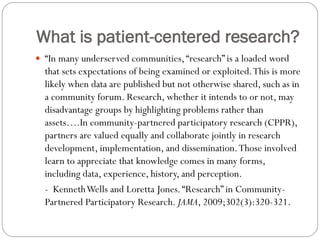
 “In many underserved communities,“research” is a loaded word
that sets expectations of being examined or exploited.This is more
likely when data are published but not otherwise shared, such as in
a community forum. Research, whether it intends to or not, may
disadvantage groups by highlighting problems rather than
assets….In community-partnered participatory research (CPPR),
partners are valued equally and collaborate jointly in research
development, implementation, and dissemination.​Those involved
learn to appreciate that knowledge comes in many forms,
including data, experience, history, and perception.
- KennethWells and Loretta Jones.“Research” in Community-
Partnered Participatory Research. JAMA, 2009;302(3):320-321.
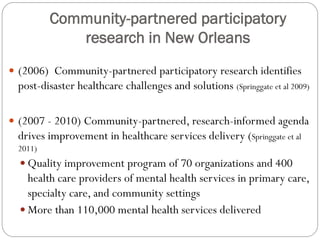
Community-partnered participatory
research in New Orleans
 (2006) Community-partnered participatory research identifies
post-disaster healthcare challenges and solutions (Springgate et al 2009)
 (2007 - 2010) Community-partnered, research-informed agenda
drives improvement in healthcare services delivery (Springgate et al
2011)
 Quality improvement program of 70 organizations and 400
health care providers of mental health services in primary care,
specialty care, and community settings
 More than 110,000 mental health services delivered
What is patient-centered research?
 Shares a number of similarities with CPPR in terms of
opportunities and challenges
 PCORI faces a number of concurrent opportunities and
challenges
 Limitations of information use
 Building trust
 Sustained and equitable engagement
 Results that are actionable, understandable, responsive
to needs
 Accountability in desire for input and feedback
 Who do we mean?
What is patient-centered research?
 PCORI – multiple statutory limitations on use of its
evidence and findings, as well as on measures that can be
considered;
 Whether at the patient level, or at a provider level, health
and health care decision-making, or engagement and
research, optimally is not conducted in environments that
operate with a priori limitations on how materially
relevant information and products of research can be used
What is patient-centered research?
 PCORI: Seeks to “produce information that patients and
their health care providers can trust”
 Partnered approaches to research may foster trust and
advance rigor
 UCLA/RAND NIMH Partnered Research Center for
Quality Care offers an excellent prototype for high
quality, partnered research
 Emphasis on practical information and transparent
products of research may also enhance trust
What is patient-centered research?
 PCORI: Patients “tell us what health care outcomes they
value”
 Opportunity to hear about patients’ values may require
committed engagement with particular attention to:
 Times, locations, language, and resources that permit
sustained participation of diverse groups of patients and
stakeholders;
 Equitable division of research program and infrastructure
funding;
 Use of systems that reliably exchange information with
large numbers of patients, such as modified Delphi
methods or social media applications (Dalal et al 2011; Goodman
et al 2011)
What is patient-centered research?
 PCORI: “Results of research are provided to patients
and clinicians in ways that are responsive to their needs
and interests and easy to understand”
 Responsive and understandable products of research –
should this be an requirement for research proposals to
be funded?
 Would it be useful for researcher teams have to identify
in advance which end-users (e.g. patient advocacy
groups, physician groups, or hospital systems) agree to
use the products of the research in daily practice?
What is patient-centered research?
 PCORI: “Obtain public input and feedback prior to
adoption of priorities, agendas, methodological standards,
peer review processes or dissemination strategies”
 Is such “input and feedback” sufficiently patient-centered to
be meaningful?Will it occur at critical decision-making
junctures at the highest levels of PCORI itself?
 Should patients have real (veto) authority on patient-led or
co-led institutional review boards and research teams for
every PCORI-funded project? On every PCORI review
committee?
What is patient-centered research?
 PCORI :
 “Given my personal characteristics, conditions and preferences,
what should I expect will happen to me?”
 “What are my options and what are the benefits and harms of
those options?”
 “What can I do to improve the outcomes that are most
important to me?”
 “How can the health care system improve my chances of
achieving the outcomes I prefer?”
 WHO does PCORI mean? How convinced areTHEY that
you mean it?
References
 Dalal S, Khodyakov D, Srinivasan R, Straus S,Adams J. ExpertLens:A system
for eliciting opinions from a large pool of non-collocated experts with diverse
knowledge. Technological Forecasting & Social Change.2011; 78:1426–1444.
 Goodman J,Wennerstrom A, Springgate B. Participatory and social media to engage
hard-to reach populations: from the Obama campaign to public health practice.
Ethnicity and Disease.2011; 21(3 Supplement 1): 94-99.
 Springgate B,Allen C, Jones C, Lovera S, Meyers D, Campbell L, Palinkas L,Wells
K.A rapid community participatory assessment of healthcare access in post-Katrina
New Orleans. American Journal of Preventive Medicine. 2009; 37 (6S1), S237-S243
 Springgate B,Wennerstrom A, Meyers D,Allen C,Vannoy S, BenthamW,Wells K.
Building community resilience through mental health infrastructure and training in
post-Katrina New Orleans. Ethnicity and Disease.2011; 21(3 Supplement 1): 20-29.
 Wells, K and Jones, L.“Research” in Community-Partnered Participatory Research.
JAMA, 2009;302(3):320-321.
Thank you.
Please enjoy
New Orleans.
Contact: benspringgate@gmail.com
1
EdwardTrapido, Sc.D., F.A.C.E.
Professor of Epidemiology and Associate Dean of Research
LSU School of Public Health
Wendell Gauthier Chair for Cancer Epidemiology
Stanley S. Scott Cancer Center
LSU Health Sciences Center, New Orleans, Louisiana
President Elect, American College of Epidemiology
11/13/11 New Orleans, LA
 Identified on the basis of
 Changes in population
 Changes in disease rates
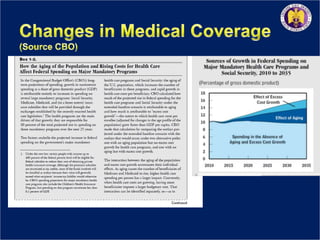
 Changes in medical coverage (unclear at the
present)
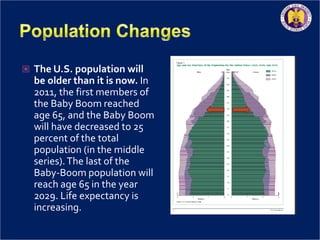
 The U.S. population will
be older than it is now. In
2011, the first members of
the Baby Boom reached
age 65, and the Baby Boom
will have decreased to 25
percent of the total
population (in the middle
series).The last of the
Baby-Boom population will
reach age 65 in the year
2029. Life expectancy is
increasing.
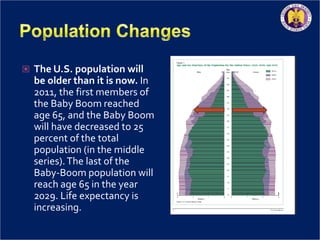
 The U.S. population will
be older than it is now. In
2011, the first members of
the Baby Boom reached
age 65, and the Baby Boom
will have decreased to 25
percent of the total
population (in the middle
series).The last of the
Baby-Boom population will
reach age 65 in the year
2029. Life expectancy is
increasing.
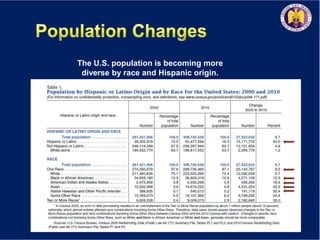
The U.S. population is becoming more
diverse by race and Hispanic origin.
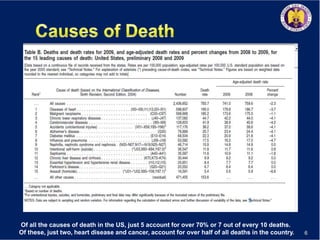
6
Of all the causes of death in the US, just 5 account for over 70% or 7 out of every 10 deaths.
Of these, just two, heart disease and cancer, account for over half of all deaths in the country.
 Background:
 Guidelines for diagnosing and treating most health
problems exist
 Applying guidelines is often infeasible for large, uninsured,
low SES, limited education, or minority populations , due to
limited dollars, capacity, available providers, access, etc.
 e.g., too few gastroenterologists to perform colonoscopy on
everyone over 50 in the populations seen in medical care systems
that treat these populations, like the LSU Patient Electronic Health
Information and Care Network (which will reach 500,000 unique
patients per year who visit the system’s public hospitals and
affiliated clinics)
 Patient concerns:
 Access to services
 Connectivity between services
 Time delays
 Effectiveness of alternative approaches, drawbacks of
using an alternative approach, or adherence to a regimen?
 Will there be side effects afterwards that are worse than
the recommended approach?
 PCORI’s potential role:
 Could support either existing or new surveillance
programs that adequately identify gaps in services
being available and accessed, or test whether
alternative approaches are effective.
 Support development and testing of programs that
assist uninsured, low SES, limited education, or
minority populations in increasing their knowledge
and comfort with asking questions and/or raising
concerns about medical treatments being offered.
 PCORI’s potential role:
 Could support funding of post-marketing drug or
procedure outcomes among more diverse
population groups (i.e., than were included in pre-
market testing)
 Could support research to identify programs to
increase capacity for self- and collective care.
Background:
 As the population ages, cancer, stroke,
diabetes and heart disease will be increasingly
common.The proportion of the very old will
increase.
 The experiences with medications (doses,
interactions), risks of surgical procedures,
(accounting for comorbidity and concurrent
medications) is documented only at the local
institutional level.
Background:
 Furthermore, the health care system (and
most current methods of reimbursement) are
not designed for managing chronic diseases
optimally; they may fail to meet the needs
both of patients and physicians in coordinating
caregivers, information, interventions, and
providing incentives to physicians.
http://www.qualityprofiles.org/leadership_series/diabetes/diabetes_addressing_qual
ity_gaps.asp
Patient Concerns:
 Desired patient centered outcomes (PCO) change over
time. Return to “normalcy” as a desired outcome may be
replaced by return to merely being functional. With age,
a return to being independent may be displaced by
merely a desire to be without pain.
 When there is accompanying cognitive impairment or
dementia, PCO become hard to elicit.
 For those considering various procedures, PCOs include
how much pain they will feel during/after the procedure,
what will be result of the medication or procedure, what will
be the outcomes (good and bad), and what kind of support
they will need afterwards.
Patient Concerns:
 Patients may not know what to ask providers, or may feel
uncomfortable about “challenging” providers. [Patients
must overcome their personal barriers to managing their
disease successfully, which they may perceive as severe
and numerous.]
http://www.qualityprofiles.org/leadership_series/diabete
s/diabetes_addressing_quality_gaps.asp
 Older patients’ health problems do not occur only during
“office hours” (i.e., Monday-Friday, 9am-5pm). Older
patients are usually told to go to an emergency room on
Friday, Saturday, or Sunday, which is less than ideal.
 PCORI’s potential role:
 Document
 the sequential expectations of older individuals, and develop/ enhance
shared databases from providers who serve large older populations on
patient health, treatments, reported symptoms, outcomes.
 the direct and support service needs of older patients.
 Support
 development and testing of programs that assist older patients in
increasing their knowledge and comfort with asking questions and/or
raising concerns about medical treatments being offered.
 exploration of a government directed national Senior Health Information
Service, which would run 24/7.
 Identification of best practices for older patients following discharge from
hospital- e.g., stroke patients.
 better communication strategies with, and support for caregivers.
 Background:
 Palliative care strategies are rarely included in overall
healthcare discussions.Training for palliative care is rarely
included in healthcare education curricula. Institutions that
provide palliative and end-of-life care often rely on volunteer
or charitable status.
 There is a general underuse of painkilling drugs for a variety
of reasons, including concerns of illicit use.The result often is
more pain for the patient, and more for their families.
 Background:
 The inclusion of palliative care into broader health policy, and
the development/improvement of standards of end-of-life
care—raising the “quality of death”—will also yield significant
gains for humanity’s quality of life
(http://www.eiu.com/site_info.asp?info_name=qualityofdeath_lienfounda
tion&page=noads&rf=0#)
 Many of the people who could benefit from palliative and
end-of-life care do not receive it . It is often left to patients,
their families and a loosely knit community of volunteer
organizations to sort through the myriad of physical,
psychological, spiritual and ethical choices. http://www.cihr-
irsc.gc.ca/e/36889.html
 Patient concerns:
 What is the expected course of the remainder of life? How much pain
will there be? If medication is taken to stop pain, will there be a
consequent disconnection from reality?Will it be hard on my family or
friends?
 PCORI’s potential role:
 Develop common data definitions for palliative care. Determine clinical
quality profiles.
 Develop a palliative care surveillance system, similar to that set up in
several provinces in Canada. Establish epidemiologic profiles of survival.
 Support development of research to determine the best practices in
palliative care medicine, particularly as related to end of life.
 Determine how personal, social and environmental factors affect care.
 One method of prioritizing PCORI’s focus is to look at
 population distribution and the medical issues related to the population,
 some measure of disease occurrence, and
 recognizing that changes in medical services will likely be more guideline-
(and cost-) driven in the future.
 Using this approach, the older populations’ expected burden i.e., chronic
debilitating and ultimately fatal diseases, requires determination of
existing practices, comparison of effectiveness, and increasing public
awareness about options and their associated outcomes.
 Analogously, there are populations for whom recommended guidelines
are infeasible.Yet, these populations receive treatment and care (and
dollars are being spent).
 Evaluation of the effectiveness of care and treatment needs to be performed
 Existing databases used for indentifying alternative approaches to education,
prevention, diagnosis, treatment, and palliation.
21
EdwardTrapido, Sc.D., F.A.C.E.
etrapi@lsuhsc.edu
www.publichealth.lsuhsc.edu
22

Board of Governors Meeting, New Orleans

  • 1.
    Benjamin Springgate MD,MPH Tulane School of Medicine RAND Corporation, REACH NOLA PCORI Board of Governors November 14, 2011 What is patient-centered research?
  • 2.
    What is patient-centeredresearch?  “In many underserved communities,“research” is a loaded word that sets expectations of being examined or exploited.This is more likely when data are published but not otherwise shared, such as in a community forum. Research, whether it intends to or not, may disadvantage groups by highlighting problems rather than assets….In community-partnered participatory research (CPPR), partners are valued equally and collaborate jointly in research development, implementation, and dissemination.​Those involved learn to appreciate that knowledge comes in many forms, including data, experience, history, and perception. - KennethWells and Loretta Jones.“Research” in Community- Partnered Participatory Research. JAMA, 2009;302(3):320-321.
  • 3.
    Community-partnered participatory research inNew Orleans  (2006) Community-partnered participatory research identifies post-disaster healthcare challenges and solutions (Springgate et al 2009)  (2007 - 2010) Community-partnered, research-informed agenda drives improvement in healthcare services delivery (Springgate et al 2011)  Quality improvement program of 70 organizations and 400 health care providers of mental health services in primary care, specialty care, and community settings  More than 110,000 mental health services delivered
  • 4.
    What is patient-centeredresearch?  Shares a number of similarities with CPPR in terms of opportunities and challenges  PCORI faces a number of concurrent opportunities and challenges  Limitations of information use  Building trust  Sustained and equitable engagement  Results that are actionable, understandable, responsive to needs  Accountability in desire for input and feedback  Who do we mean?
  • 5.
    What is patient-centeredresearch?  PCORI – multiple statutory limitations on use of its evidence and findings, as well as on measures that can be considered;  Whether at the patient level, or at a provider level, health and health care decision-making, or engagement and research, optimally is not conducted in environments that operate with a priori limitations on how materially relevant information and products of research can be used
  • 6.
    What is patient-centeredresearch?  PCORI: Seeks to “produce information that patients and their health care providers can trust”  Partnered approaches to research may foster trust and advance rigor  UCLA/RAND NIMH Partnered Research Center for Quality Care offers an excellent prototype for high quality, partnered research  Emphasis on practical information and transparent products of research may also enhance trust
  • 7.
    What is patient-centeredresearch?  PCORI: Patients “tell us what health care outcomes they value”  Opportunity to hear about patients’ values may require committed engagement with particular attention to:  Times, locations, language, and resources that permit sustained participation of diverse groups of patients and stakeholders;  Equitable division of research program and infrastructure funding;  Use of systems that reliably exchange information with large numbers of patients, such as modified Delphi methods or social media applications (Dalal et al 2011; Goodman et al 2011)
  • 8.
    What is patient-centeredresearch?  PCORI: “Results of research are provided to patients and clinicians in ways that are responsive to their needs and interests and easy to understand”  Responsive and understandable products of research – should this be an requirement for research proposals to be funded?  Would it be useful for researcher teams have to identify in advance which end-users (e.g. patient advocacy groups, physician groups, or hospital systems) agree to use the products of the research in daily practice?
  • 9.
    What is patient-centeredresearch?  PCORI: “Obtain public input and feedback prior to adoption of priorities, agendas, methodological standards, peer review processes or dissemination strategies”  Is such “input and feedback” sufficiently patient-centered to be meaningful?Will it occur at critical decision-making junctures at the highest levels of PCORI itself?  Should patients have real (veto) authority on patient-led or co-led institutional review boards and research teams for every PCORI-funded project? On every PCORI review committee?
  • 10.
    What is patient-centeredresearch?  PCORI :  “Given my personal characteristics, conditions and preferences, what should I expect will happen to me?”  “What are my options and what are the benefits and harms of those options?”  “What can I do to improve the outcomes that are most important to me?”  “How can the health care system improve my chances of achieving the outcomes I prefer?”  WHO does PCORI mean? How convinced areTHEY that you mean it?
  • 11.
    References  Dalal S,Khodyakov D, Srinivasan R, Straus S,Adams J. ExpertLens:A system for eliciting opinions from a large pool of non-collocated experts with diverse knowledge. Technological Forecasting & Social Change.2011; 78:1426–1444.  Goodman J,Wennerstrom A, Springgate B. Participatory and social media to engage hard-to reach populations: from the Obama campaign to public health practice. Ethnicity and Disease.2011; 21(3 Supplement 1): 94-99.  Springgate B,Allen C, Jones C, Lovera S, Meyers D, Campbell L, Palinkas L,Wells K.A rapid community participatory assessment of healthcare access in post-Katrina New Orleans. American Journal of Preventive Medicine. 2009; 37 (6S1), S237-S243  Springgate B,Wennerstrom A, Meyers D,Allen C,Vannoy S, BenthamW,Wells K. Building community resilience through mental health infrastructure and training in post-Katrina New Orleans. Ethnicity and Disease.2011; 21(3 Supplement 1): 20-29.  Wells, K and Jones, L.“Research” in Community-Partnered Participatory Research. JAMA, 2009;302(3):320-321.
  • 12.
    Thank you. Please enjoy NewOrleans. Contact: benspringgate@gmail.com
  • 13.
    1 EdwardTrapido, Sc.D., F.A.C.E. Professorof Epidemiology and Associate Dean of Research LSU School of Public Health Wendell Gauthier Chair for Cancer Epidemiology Stanley S. Scott Cancer Center LSU Health Sciences Center, New Orleans, Louisiana President Elect, American College of Epidemiology 11/13/11 New Orleans, LA
  • 14.
     Identified onthe basis of  Changes in population  Changes in disease rates  Changes in medical coverage (unclear at the present)
  • 15.
     The U.S.population will be older than it is now. In 2011, the first members of the Baby Boom reached age 65, and the Baby Boom will have decreased to 25 percent of the total population (in the middle series).The last of the Baby-Boom population will reach age 65 in the year 2029. Life expectancy is increasing.
  • 16.
     The U.S.population will be older than it is now. In 2011, the first members of the Baby Boom reached age 65, and the Baby Boom will have decreased to 25 percent of the total population (in the middle series).The last of the Baby-Boom population will reach age 65 in the year 2029. Life expectancy is increasing.
  • 17.
    The U.S. populationis becoming more diverse by race and Hispanic origin.
  • 18.
    6 Of all thecauses of death in the US, just 5 account for over 70% or 7 out of every 10 deaths. Of these, just two, heart disease and cancer, account for over half of all deaths in the country.
  • 20.
     Background:  Guidelinesfor diagnosing and treating most health problems exist  Applying guidelines is often infeasible for large, uninsured, low SES, limited education, or minority populations , due to limited dollars, capacity, available providers, access, etc.  e.g., too few gastroenterologists to perform colonoscopy on everyone over 50 in the populations seen in medical care systems that treat these populations, like the LSU Patient Electronic Health Information and Care Network (which will reach 500,000 unique patients per year who visit the system’s public hospitals and affiliated clinics)
  • 21.
     Patient concerns: Access to services  Connectivity between services  Time delays  Effectiveness of alternative approaches, drawbacks of using an alternative approach, or adherence to a regimen?  Will there be side effects afterwards that are worse than the recommended approach?
  • 22.
     PCORI’s potentialrole:  Could support either existing or new surveillance programs that adequately identify gaps in services being available and accessed, or test whether alternative approaches are effective.  Support development and testing of programs that assist uninsured, low SES, limited education, or minority populations in increasing their knowledge and comfort with asking questions and/or raising concerns about medical treatments being offered.
  • 23.
     PCORI’s potentialrole:  Could support funding of post-marketing drug or procedure outcomes among more diverse population groups (i.e., than were included in pre- market testing)  Could support research to identify programs to increase capacity for self- and collective care.
  • 24.
    Background:  As thepopulation ages, cancer, stroke, diabetes and heart disease will be increasingly common.The proportion of the very old will increase.  The experiences with medications (doses, interactions), risks of surgical procedures, (accounting for comorbidity and concurrent medications) is documented only at the local institutional level.
  • 25.
    Background:  Furthermore, thehealth care system (and most current methods of reimbursement) are not designed for managing chronic diseases optimally; they may fail to meet the needs both of patients and physicians in coordinating caregivers, information, interventions, and providing incentives to physicians. http://www.qualityprofiles.org/leadership_series/diabetes/diabetes_addressing_qual ity_gaps.asp
  • 26.
    Patient Concerns:  Desiredpatient centered outcomes (PCO) change over time. Return to “normalcy” as a desired outcome may be replaced by return to merely being functional. With age, a return to being independent may be displaced by merely a desire to be without pain.  When there is accompanying cognitive impairment or dementia, PCO become hard to elicit.  For those considering various procedures, PCOs include how much pain they will feel during/after the procedure, what will be result of the medication or procedure, what will be the outcomes (good and bad), and what kind of support they will need afterwards.
  • 27.
    Patient Concerns:  Patientsmay not know what to ask providers, or may feel uncomfortable about “challenging” providers. [Patients must overcome their personal barriers to managing their disease successfully, which they may perceive as severe and numerous.] http://www.qualityprofiles.org/leadership_series/diabete s/diabetes_addressing_quality_gaps.asp  Older patients’ health problems do not occur only during “office hours” (i.e., Monday-Friday, 9am-5pm). Older patients are usually told to go to an emergency room on Friday, Saturday, or Sunday, which is less than ideal.
  • 28.
     PCORI’s potentialrole:  Document  the sequential expectations of older individuals, and develop/ enhance shared databases from providers who serve large older populations on patient health, treatments, reported symptoms, outcomes.  the direct and support service needs of older patients.  Support  development and testing of programs that assist older patients in increasing their knowledge and comfort with asking questions and/or raising concerns about medical treatments being offered.  exploration of a government directed national Senior Health Information Service, which would run 24/7.  Identification of best practices for older patients following discharge from hospital- e.g., stroke patients.  better communication strategies with, and support for caregivers.
  • 29.
     Background:  Palliativecare strategies are rarely included in overall healthcare discussions.Training for palliative care is rarely included in healthcare education curricula. Institutions that provide palliative and end-of-life care often rely on volunteer or charitable status.  There is a general underuse of painkilling drugs for a variety of reasons, including concerns of illicit use.The result often is more pain for the patient, and more for their families.
  • 30.
     Background:  Theinclusion of palliative care into broader health policy, and the development/improvement of standards of end-of-life care—raising the “quality of death”—will also yield significant gains for humanity’s quality of life (http://www.eiu.com/site_info.asp?info_name=qualityofdeath_lienfounda tion&page=noads&rf=0#)  Many of the people who could benefit from palliative and end-of-life care do not receive it . It is often left to patients, their families and a loosely knit community of volunteer organizations to sort through the myriad of physical, psychological, spiritual and ethical choices. http://www.cihr- irsc.gc.ca/e/36889.html
  • 31.
     Patient concerns: What is the expected course of the remainder of life? How much pain will there be? If medication is taken to stop pain, will there be a consequent disconnection from reality?Will it be hard on my family or friends?  PCORI’s potential role:  Develop common data definitions for palliative care. Determine clinical quality profiles.  Develop a palliative care surveillance system, similar to that set up in several provinces in Canada. Establish epidemiologic profiles of survival.  Support development of research to determine the best practices in palliative care medicine, particularly as related to end of life.  Determine how personal, social and environmental factors affect care.
  • 32.
     One methodof prioritizing PCORI’s focus is to look at  population distribution and the medical issues related to the population,  some measure of disease occurrence, and  recognizing that changes in medical services will likely be more guideline- (and cost-) driven in the future.  Using this approach, the older populations’ expected burden i.e., chronic debilitating and ultimately fatal diseases, requires determination of existing practices, comparison of effectiveness, and increasing public awareness about options and their associated outcomes.  Analogously, there are populations for whom recommended guidelines are infeasible.Yet, these populations receive treatment and care (and dollars are being spent).  Evaluation of the effectiveness of care and treatment needs to be performed  Existing databases used for indentifying alternative approaches to education, prevention, diagnosis, treatment, and palliation.
  • 33.
  • 34.