A	
  TECHINICAL	
  REPORT	
  ON	
  STUDENT	
  INDUSTRIAL	
  WORK	
  EXPERIENCE	
  SCHEME	
  
ATTACHED	
  AT	
  
CONCAST	
  GEOLOGICAL	
  NIGERIA	
  LIMITED	
  
BUKAN-­‐SIDI,	
  JOS	
  ROAD	
  
LAFIA,	
  NASARAWA	
  STATE.	
  
BY	
  	
  
ADAMU	
  BELLO	
  SULEIMAN	
  
U12GL1032	
  
SUBMITTED	
  TO	
  	
  
GEOLOGY	
  DEPARTMENT	
  
FACULTY	
  OF	
  SCIENCE	
  
AHMADU	
  BELLO	
  UNIVERSITY,	
  ZARIA-­‐KADUNA	
  
INSTITUTE	
  BASE	
  SUPERVISORS:	
  
•   DR	
  T.	
  NAJIME	
  
•   DR	
  S.	
  A.	
  ALAGBE	
  
FROM	
  	
  
FEBRUARY	
  2015	
  TO	
  DECEMBER	
  2015	


ABSTRACT
Nigeria has abundant groundwater resources. Some of which have been exploited through
wells and boreholes dug by the Federal, State and Local Governments, private individuals,
other organizations and corporate bodies such as the World Bank, UNDP and UNICEF in the
past four decades under different programs. However, despite the huge amount of money
expended on these projects, many of these boreholes often break down within short period of
usage. During my industrial training experience at Concast Geological Nigeria limited; I had
the opportunity to be practically involved in geophysical data acquisition and its modeling for
groundwater studies. I have also gained experience in bore hole drilling and well completion.
This experience has given me insights into why many borehole programs initiated by the
different governments as well as private individuals and corporate organizations have failed.
Most boreholes fail for many reasons including improper construction and design. For an
effective borehole to be achieved, a systematic approach involving the use of geophysical
survey, an appropriate design criterion, pumping test to know the yield of the hole and
development techniques should be carried out in order to obtain sustainable groundwater
supply in general.
Key	
  words	
  
Boreholes	
  
Geophysical	
  survey	
  
Drilling	
  
Groundwater	


CHAPTER ONE
INTRODUCTION
1.1: PURPOSE OF REPORT
The Industrial Attachment program fulfils part of the requirement in pursuing the degree of
B.sc Geology in Ahmadu Bello University Zaria. This report serves to summarize the activities
and experience gained with concast Geophysical Nigeria Limited lafia Nasarawa State.
1.2: HISTORY OF SIWES
The Government’s decree No. 47 of 8th
Oct; 1971 as amended in 1990, highlighted the capacity
building of human resources in industry, commerce and Government through training and re-
training of workers in order to effectively provide the much needed high quality, goods and
services in a dynamic economy as ours (Jemerigbo, 2003). This decree led to the establishment
of Industrial Training Fund (ITF) in 1973/1974.
The governing concern among our industrialists that graduates of our institutions of higher
learning lack adequate practical background studies preparatory for employment in industries
led to the formation of the Students’ Industrial Work Experience Scheme (SIWES) by ITF in
1993/1994 (Information And Guideline For SIWES,2002). ITF has one of its key functions; to

work as cooperative entity with industry and commerce where students in institutions of higher
learning can undertake mid-career work experience attachment in industries which are
compatible with students’ area of study (Okorie 2002, Asikadi 2003).
The student Industrial Work Experience Scheme (SIWES) is a skill training program designed
to expose and prepare students of Agriculture, Technology, Environmental Sciences, Medical
Sciences and Pure and Applied Sciences for the industrial work situation which they are likely
to meet after graduation. Duration of SIWES is four months in Polytechnics at the end of
National Diploma(ND), four months in Colleges of education at the end of National Certificate
Exams (NCE II) and six months in the universities at the end of 300/400/500 levels depending
on the discipline.(Information And Guideline For SIWES 2002).
1.3: AIMS AND OBJECTIVES OF SIWES
i.   To provide an avenue for students in institutions of higher learning to acquire industrial
skills and experience in their approved course of study.
ii.   To prepare students for the industrial work situation which they are likely to meet after
graduation.
iii.   To expose students to work methods and techniques in handling equipment and
machinery not available in their institutions.
iv.   To provide students with the opportunity of applying their knowledge in real work
situation, thereby bridging the gap between theories and practices.
v.   Enlist and strengthen employers’ involvement in the entire educational process and
prepare students for employment in industry and commerce (Information and Guideline
for SIWES, 2002).
1.4: BODIES INVOLVED IN THE MANAGEMENT OF SIWES
The bodies involved are the Federal Government, Industrial Trust Fund (ITF). Other
supervising agencies are National University Commission (NUC), National Board of Technical
Education (NBTE) and National Council for Colleges of Education (NCCE).
The functions of the afore-mentioned agencies include among others to:
i.   Ensure adequate funding of the scheme.
ii.   Establish SIWES and accredit SIWES units in approved institutions.
iii.  Formulate polices and guidelines for participating bodies and institutions as well as
appointing SIWES coordinators and supporting staff.
iv.   Supervise students at their places of attachment and sign their log books and ITF
forms.
v.   Vet and process students’ log books and forward same to ITF Area office.
vi.   Ensure payment of allowances for the students and supervisors.
Therefore, the success or otherwise of SIWES depends on the efficiency of the ministries,
ITF, institutions, employers of labor and the general public involved in the articulation and
management of the program. Thus, the evaluation of SIWES in tertiary institutions in
meeting up with the needs for the establishment of the program is necessary. (Information
and Guideline for SIWES, 2002).
1.5: ATTACHMENT COMPANY BACKGROUND
Attached to Concast Geologisical Nigeria Limited Opp. Aisha Sandaji Plaza,Lafia Nasarawa
State.
Following the need to solve the problem of water scarcity in Africa as part of the millennium
development goals (MDG), this company, CONCAST GEOLOGICAL Nig. Ltd was registered
in February, 2005 as the initiative of one man, Mr AHMED KANA, (a renowned Hydro
geologist). Concast Geophysical Nigeria Limited is an indigenous geophysical and hydro
geological firm. It is made up of highly experienced Geologists, Hydro-geologists,
Geophysicists and Water Engineers engaged in water well and dam construction, foundation
engineering and mineral exploration business in various parts of the State. Currently, it has
permanent staff strength often. Other workers are casual and are usually sourced from the
locality where projects are located. It is a well-organized network of specialized associates
committed to professional excellence and speedy execution of projects.
The company’s head office is located at No.2 Bukan Sidi jos road Lafia, Nasarawa State.And
is equipped with the latest computer softwares for interpretation and modeling. The company
has recently undertaken specialized projects related to water supply especially in the following
areas:
i.   Geophysical surveys to determine suitable sites for borehole drilling in all states in
Nigeria.
ii.   Drilling of water boreholes in both sedimentary and basement areas.
iii.   Water boreholes development and rehabilitation.
iv.   Construction and installation of both ground and overhead tanks.
v.   Pump installation and maintenance.


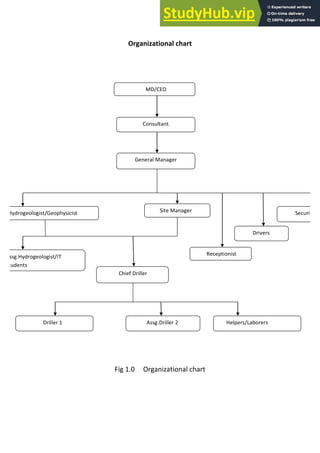
Organizational	
  chart	


Fig	
  1.0	


  Organizational	
  chart	


  MD/CEO	


  Consultant	


  General	
  Manager	


  Hydrogeologist/Geophysicist	


  Site	
  Manager	


  Drivers	


  Receptionist	


  Security


  Chief	
  Driller	
  
Assg.Hydrogeologist/IT	
  
Students	


  Driller	
  1	


  Assg.Driller	
  2	


  Helpers/Laborers	
  
1.6: OVERVIEW
This report is organized in the following order:
Chapter One: Introduction.
This chapter explains the purpose of the report. It also describes briefly the history and
objectives of SIWES. It goes further to describe the brief history of establishment of the
company, its location and the organization structure of the company.
Chapter Two: General Review on Activities Carried out.
This chapter discusses the training which I received, such as in geophysical survey and drilling.
Chapter Three: This chapter talks about the experience gained by me and problems
encountered.
Chapter Four: Summary, Conclusion and Recommendations:
This chapter gives the summary of all other experience gained and skills acquired, overall
conclusion of the industrial attachment and further recommendations for improvement.
CHAPTER TWO
2.1: INTRODUCTION AND GENERAL REVIEW ON ACTIVITIES CARRIED OUT
The services rendered by the company are:
a)   Geophysical Survey
b)   Borehole Drilling
c)   Pump Installation
d)   Well Logging
e)   Water Quality Analysis
f)   Pumping Test
g)   Borehole Rehabilitation
I participated actively in Geophysical Survey, drilling, logging and Pump Installation. And
passively in Water Quality Analysis, Borehole Rehabilitation and pumping test.
2.2: WATER EXPLORATION
The exploration for water requires several important steps in order to get adequate and portable
water for consumption and other domestic significants. Therefore, before any borehole
construction is done, a geophysical survey should be carried out on the site to know the most
suitable point and depth where the borehole should be drilled in order to have maximum ground
water potential. Hence, a geophysical survey tells whether a proposed borehole site should be
approved or abandoned.
2.3: GEOPHYSICAL SURVEY
Geophysical techniques are non-invasive technologies that measure the variations in the
physical characteristics of the surface and subsurface geology either NATURAL OR
ARTIFICIAL generated within the earth crust. Such variation result from differences in
physical characteristic such as density, elasticity, magnetism, and electric resistivity etc.
2.3.1: METHODOLOGY
In an attempt to identify a suitable site for the drilling and construction of a productive
borehole, a geophysical survey is usually carried out.
There are various methods used in conducting Geophysical survey. These include: Electrical
Resistivity method, Magnetic/Electromagnetic method, Seismic Method and other geophysical
survey method that can be applied in groundwater investigation, in special situations include
gravity method, induced polarization (IP), Self Potential (SP), Out of the afore-mentioned
methods, the Electrical Resistivity method is mostly employed by this company and is the
method I was introduced to.
2.3.2: ELECTRICAL RESISTIVITY METHOD
The resistivity method employs the use of Terrameter Signal Averaging System (SAS) 300C,
four electrodes consisting of two inner potential electrodes (P1 (M) and P2 (N)) and two outer
current electrodes (C1, (A) and C2, (B)) which are arranged linearly about a central point. The
electrodes are driven into the earth using hammers so that they go dip down into the ground,
about three-quarters dip to ensure that they make full contact with the earth.
The resistivity method comprises the vertical electrical sounding (VES) and the horizontal
profiling (HP). In VES, we are concerned with measuring the variations in the physical
characteristics of the sub-surface as we go down the earth while for HP; we are interested in
the lateral variations in the physical characteristics of a particular layer of the earth.
Two	
  electrode	
  arrangement	
  or	
  arrays	
  are	
  of	
  particular	
  interest	
  in	
  resistivity	
  surveys.	
  
1)	
   The	
  Wenner	
  array-­‐	
  all	
  electrode	
  are	
  equally	
  spaced.	
  	
  
2)	
   The	
  Schlumberger	
  array-­‐	
  the	
  electrode	
  are	
  not	
  equally	
  spaced.	


  The	
  Wenner	
  array	
  comprises	
  four	
  equally	
  spaced	
  electrodes	
  and	
  is	
  characterized	
  simply	
  
electrode	
  spacing	
  ‘a’.	
  
The	
  Schlumberger	
  array	
  is	
  similar	
  except	
  that	
  the	
  inner	
  (potential)	
  electrodes	
  are	
  more	
  
closely	
  spaced.	
  	
  
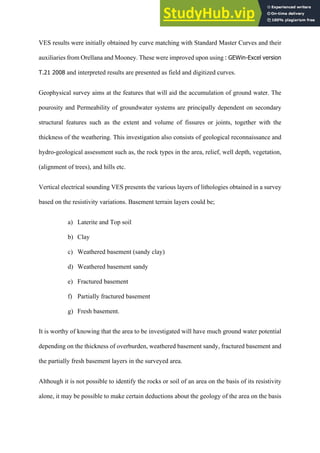
I was particularly introduced to VES during my period of SIWES which involved the use
of Schlumberger configuration as shown in Fig. 1.1.
2.3.3: VERTICAL ELECTRICAL SOUNDING (VES)
In the VES, with the electrodes linearly arranged, direct current is sent into the ground between
the various pairs of electrodes and the resistance offered is calculated and displayed by the
Terrameter using the principle of Ohm’s law;
V=IR ……………………………….. (i)
Where V is the potential difference,
I the current and,
R is the resistance.
The resistance reading is then multiplied by a geometric factor which is a function of the
electrode spacing to obtain the apparent resistivity (Pa). Hence,
Pa= KR …………………………….. (ii)
Where K is the geometric factor and
R is the resistance.
The geometric factor, K is given by the formula:


  𝐾 =	
  
$% & '( )* & '
)*
	
  𝑥	
  𝜋	
   ………………………….. (iii)
Where 𝜋 = 3.142, AB is the distance between the current electrodes, while MN is the distance
between the potential electrodes.
Fig 1.1: Schlumberger Configuration
The electrode spacing is progressively increased, keeping the central point of the array fixed
until the desired length of array is obtained. This will increase the depth of penetration within
the separation AB. The best general guide to use in the field is to plot the apparent resistivity
curve as the survey progresses, so that it can be judged whether the asymptotic phase of the
curve has been reached. Thus, the varying resistivity measured when the electrode array is
varied in an in-homogenous medium, such as the earth is termed as apparent resistivity (pa).
The apparent resistivity readings are collected for a given site and afterwards, a geo-electric
section (GES) of the resistivity profile is constructed with advanced computer modeling
software and interpreted to reveal subsurface features of interest. VES is often done between
60 m and 100 m but some could go as much as 150 m.
2.3.4: Result and Data Interpretation
Resistivity VES data can be interpreted quantitatively (i.e. manually) by examining the curve
shapes or qualitatively by using curve matching or computer modeling. VES data curves are
interpreted by plotting apparent resistivity data against electrode spacing on a Log-Log graph
scale.
VES results were initially obtained by curve matching with Standard Master Curves and their
auxiliaries from Orellana and Mooney. These were improved upon using :  GEWin-­Excel  version  
T.21  2008 and interpreted results are presented as field and digitized curves.
Geophysical survey aims at the features that will aid the accumulation of ground water. The
pourosity and Permeability of groundwater systems are principally dependent on secondary
structural features such as the extent and volume of fissures or joints, together with the
thickness of the weathering. This investigation also consists of geological reconnaissance and
hydro-geological assessment such as, the rock types in the area, relief, well depth, vegetation,
(alignment of trees), and hills etc.
Vertical electrical sounding VES presents the various layers of lithologies obtained in a survey
based on the resistivity variations. Basement terrain layers could be;
a)   Laterite and Top soil
b)   Clay
c)   Weathered basement (sandy clay)
d)   Weathered basement sandy
e)   Fractured basement
f)   Partially fractured basement
g)   Fresh basement.
It is worthy of knowing that the area to be investigated will have much ground water potential
depending on the thickness of overburden, weathered basement sandy, fractured basement and
the partially fresh basement layers in the surveyed area.
Although it is not possible to identify the rocks or soil of an area on the basis of its resistivity
alone, it may be possible to make certain deductions about the geology of the area on the basis
of a resistivity survey, interpreted along with other information such as a fore-knowledge about
the hydrogeology of the area. For example, since water is a good conductor, a formation with
high resistivity is very unlikely to be an aquifer, as it probably contains virtually no water
trapped in isolated pores and a formation with extremely low resistivity may well be an aquifer
since its conductivity would be high. These conclusions are drawn from the fact that
conductivity is inversely proportional to resistivity;
	
  𝑅 =
./
$
…………………………………. (iv)
Where R is the resistance
	
  𝜌 is the resistivity,	
  𝐿	
  𝑖𝑠	
  𝑡ℎ𝑒	
  𝑙𝑒𝑛𝑔𝑡ℎ	
  𝑎𝑛𝑑, 𝐴 is the area.
The best target for drilling is a formation with moderately low resistivity.
The geophysical survey is aimed at:
a)   Determining the depth to bedrock where applicable.
b)   Geophysical delineation of the various lithologies within the overburden.
c)   Determining the structural disposition of the formation in the area.
d)   Estimating the approximate depth of the proposed borehole (Emelis, 2012).
2.4: CASE STUDY OF A SURVEYED AREA: MARMARA FARM NASARAWA,
NASARAWA STATE.
The  survey  area  falls  within  the  Precambrian  Basement  Complex  of  the  North  Central  Nigerian.  
The  surveyed  site  is  located  at  a  farm,  off  Keffi-­Nasarawa  road,  Marmara,  Nasarawa  LGA,  
Nasarawa  State.  The  survey  was  conducted  on  a  larger  part  of  the  farm.  
2.4.1: SURVEY METHOD
The geophysical investigation made use of the resistivity method comprising of the vertical
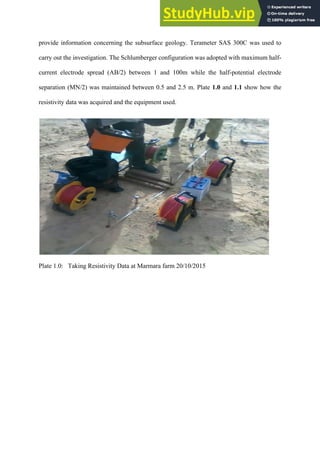
electrical sounding VES using  OMEGA-­GEOPULSE  digital  resistivity  meter. This was done to
provide information concerning the subsurface geology. Terameter SAS 300C was used to
carry out the investigation. The Schlumberger configuration was adopted with maximum half-
current electrode spread (AB/2) between 1 and 100m while the half-potential electrode
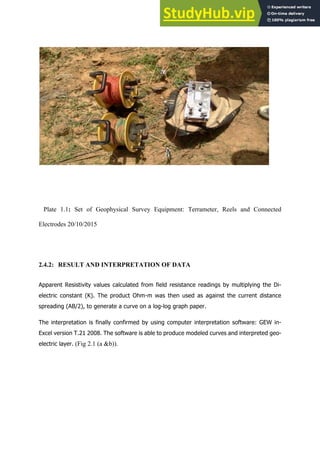
separation (MN/2) was maintained between 0.5 and 2.5 m. Plate 1.0 and 1.1 show how the
resistivity data was acquired and the equipment used.
Plate 1.0: Taking Resistivity Data at Marmara farm 20/10/2015
Plate 1.1: Set of Geophysical Survey Equipment: Terrameter, Reels and Connected
Electrodes 20/10/2015
2.4.2: RESULT AND INTERPRETATION OF DATA
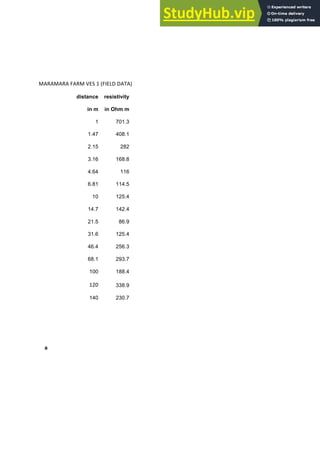
Apparent  Resistivity  values  calculated  from  field  resistance  readings  by  multiplying  the  Di-­
electric   constant   (K).   The   product   Ohm-­m   was   then   used   as   against   the   current   distance  
spreading  (AB/2),  to  generate  a  curve  on  a  log-­log  graph  paper.  
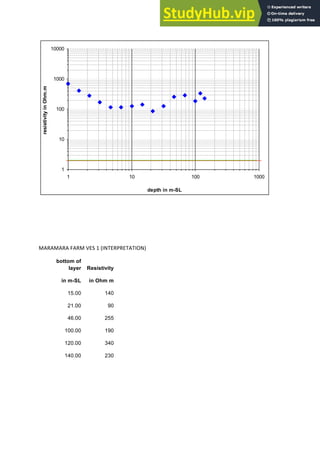
The  interpretation  is  finally  confirmed  by  using  computer  interpretation  software:  GEW  in-­
Excel  version  T.21  2008.  The  software  is  able  to  produce  modeled  curves  and  interpreted  geo-­
electric  layer. (Fig 2.1 (a &b)).


MARAMARA	
  FARM	
  VES	
  1	
  (FIELD	
  DATA)	
  
distance   resistivity  
in  m   in  Ohm  m  
1   701.3  
1.47   408.1  
2.15   282  
3.16   168.8  
4.64   116  
6.81   114.5  
10   125.4  
14.7   142.4  
21.5   86.9  
31.6   125.4  
46.4   256.3  
68.1   293.7  
100   188.4  
120	
   338.9  
140   230.7  


a     


MARAMARA	
  FARM	
  VES	
  1	
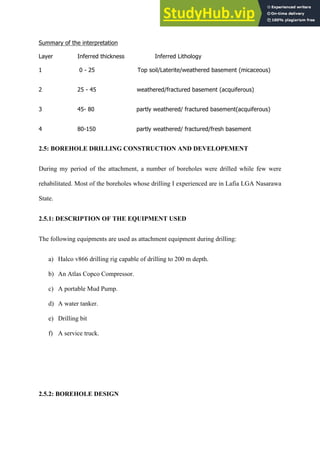
  (INTERPRETATION)	
  
bottom  of  
layer   Resistivity  
in  m-­SL   in  Ohm  m  
15.00   140  
21.00   90  
46.00   255  
100.00   190  
120.00   340  
140.00   230  


1
10
100
1000
10000
1 10 100 1000
depth  in  m-­SL
resistivity  in  Ohm.m
 
b  
Fig1.2:	
  Marmara farm VES1 (INTERPRETATION)
2.4.3 CONCLUSION AND RECOMMENDATIONS
                    the area is delineated for electrical resistivity survey after extensive Electromagnetic
survey across the farm. VES was taken to between 120- 150m. The relatively low
resistivity values and anomalies indicate occurrence of fractures and consequently high
groundwater potential. The boreholes should be drilled at the VES points indicated to
a depth of about 100-120m or until satisfactory recharge is gotten. Use of down-the-
hole hammer would be required. To avoid missing of crucial aquifer especially water
bearing litho logical units/fracture bearing zones, proper litho-logging is recommended
after drilling and the aquifer should be adequately screened to achieve maximum yield.
  
  
1
10
100
1000
10000
1 10 100 1000
depth  in  m-­SL
resistivity  in  Ohm.m
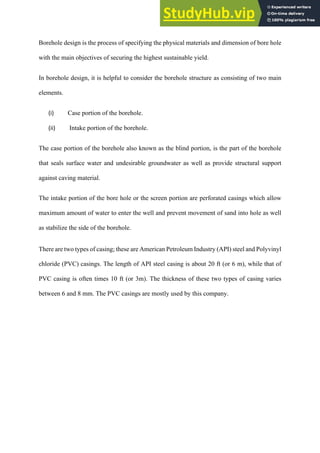
Summary  of  the  interpretation  
Layer      Inferred  thickness      Inferred  Lithology  
1        0  -­  25                                              Top  soil/Laterite/weathered  basement  (micaceous)  
2      25  -­  45                                            weathered/fractured  basement  (acquiferous)  
3      45-­  80                           partly  weathered/  fractured  basement(acquiferous)  
4      80-­150                           partly  weathered/  fractured/fresh  basement  
2.5: BOREHOLE DRILLING CONSTRUCTION AND DEVELOPEMENT
During my period of the attachment, a number of boreholes were drilled while few were
rehabilitated. Most of the boreholes whose drilling I experienced are in Lafia LGA Nasarawa
State.
2.5.1: DESCRIPTION OF THE EQUIPMENT USED
The following equipments are used as attachment equipment during drilling:
a)   Halco v866 drilling rig capable of drilling to 200 m depth.
b)   An Atlas Copco Compressor.
c)   A portable Mud Pump.
d)   A water tanker.
e)   Drilling bit
f)   A service truck.
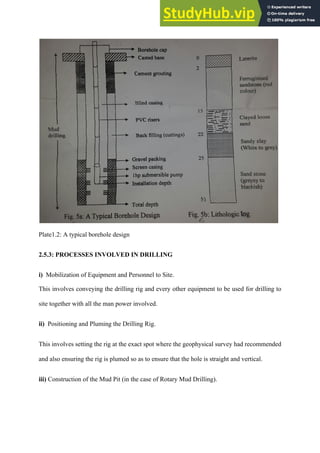
2.5.2: BOREHOLE DESIGN
Borehole design is the process of specifying the physical materials and dimension of bore hole
with the main objectives of securing the highest sustainable yield.
In borehole design, it is helpful to consider the borehole structure as consisting of two main
elements.
(i)   Case portion of the borehole.
(ii)   Intake portion of the borehole.
The case portion of the borehole also known as the blind portion, is the part of the borehole
that seals surface water and undesirable groundwater as well as provide structural support
against caving material.
The intake portion of the bore hole or the screen portion are perforated casings which allow
maximum amount of water to enter the well and prevent movement of sand into hole as well
as stabilize the side of the borehole.
There are two types of casing; these are American Petroleum Industry (API) steel and Polyvinyl
chloride (PVC) casings. The length of API steel casing is about 20 ft (or 6 m), while that of
PVC casing is often times 10 ft (or 3m). The thickness of these two types of casing varies
between 6 and 8 mm. The PVC casings are mostly used by this company.
Plate1.2: A typical borehole design
2.5.3: PROCESSES INVOLVED IN DRILLING
i) Mobilization of Equipment and Personnel to Site.
This involves conveying the drilling rig and every other equipment to be used for drilling to
site together with all the man power involved.
ii) Positioning and Pluming the Drilling Rig.
This involves setting the rig at the exact spot where the geophysical survey had recommended
and also ensuring the rig is plumed so as to ensure that the hole is straight and vertical.
iii) Construction of the Mud Pit (in the case of Rotary Mud Drilling).
This involves the digging of two pits; one in which cutting materials settle (Storage pit) and
the other from which water is pumped and re-pumped to the hole through the drilling rig
(Suction pit).
iv) Drilling to the required depth.
2.5.4: DRILLING METHOD
A large variety of methods and equipment are available for excavating holes in the earth. The
technique used in a particular situation in the field depends on a number of factors including
availability of equipment and majorly, the mode of occurrence of ground water in the area.
The method of drilling which was employed during my period of attachment was the rotary
method of drilling method.
The rotary drilling method is one of the fastest methods of drilling wells and is particularly
adapted in the drilling of large size holes. The drilling process involves boring a hole by using
a rotating bit to which a downward force is applied. I was exposed to two types of rotary drilling
during the period of my attachment, these are;
a)   Rotary-mud drilling and
b)   Rotary-air drilling
2.5.5: ROTARY-MUD DRILLING
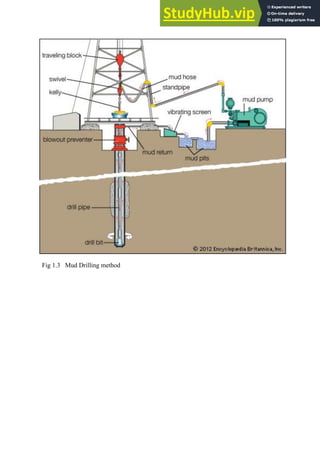
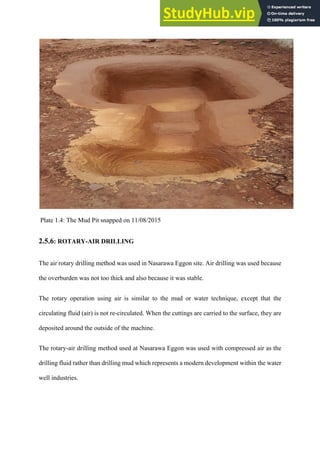
In rotary-mud drilling, the first activity usually carried out is digging of the storage and suction
pit which are together referred to as the mud pit. Afterwards, drilling is commenced using
drilling fluids. Cuttings of rocks are achieved by rotary bits of various types. The power is
delivered to the rotary bits by a rotary halo-steel tube or drilling pipe attached to the drilling
rig. Pre-mixed mud is forced down the drill pipe and out of the bits. The cuttings are removed
by continuous circulation of the drill fluid (mud) as the bits penetrate the formation.
The role of the mud is to minimize fluid loss into the aquifers and to cool the drilling bits during
the drilling process; it also carries the rock cuttings upward and then deposits them in the mud
pit. The storage and suction pits are dug in such a way that the fluid from the former overflows
into the latter from where it is then pumped back through the drill pipe and the circle is repeated
(See Plate 2.6). The heavy cuttings settle in the storage pit while the tiny ones flow into the
suction pit. This kind of drilling takes place where the overburden is thick, to do away with the
mud before proceeding to air-drilling.
The drilling mud consists of Suspension of Water, Bentonite, Extender, Polypulus,
(Carboxylmethylcellulose) (CMC).
Fig 1.3 Mud Drilling method
Plate 1.4: The Mud Pit snapped on 11/08/2015
2.5.6: ROTARY-AIR DRILLING
The air rotary drilling method was used in Nasarawa Eggon site. Air drilling was used because
the overburden was not too thick and also because it was stable.
The rotary operation using air is similar to the mud or water technique, except that the
circulating fluid (air) is not re-circulated. When the cuttings are carried to the surface, they are
deposited around the outside of the machine.
The rotary-air drilling method used at Nasarawa Eggon was used with compressed air as the
drilling fluid rather than drilling mud which represents a modern development within the water
well industries.
Air was circulated through the drill pipe out through the pores in the drill bits and upward in
the annular space around the drill pipe. Air moving at high velocity in the annular space carried
the cuttings to the surface. This process continued until the required depth was reached. Air
drilling offers a number of advantages over water or mud method of rotary drilling.
a. Removal of cuttings from the face of the bits is often faster resulting in less regrinding or
cutting and decrease in penetration rate.
b. Water that enters the hole from the formation being penetrated is almost immediately flushed
to the surface and is easy to see. Hence, it is easier to determine when a good aquifer is
encountered.
2.5.7: DATA COLLECTION DURING DRILLING
During the drilling process, required data should be collected as accurate as possible.
The following items are used in the collection of samples at drilling sites:
i)   Plastic box for storing cutting samples.
ii)   Marker pens.
iii)  Set of sieves.
iv)  Sufficient copies of the form to record drilling and penetration rate, particle size
analysis, cutting sample description.
v)   Semi log graph paper.
2.5.8: OBSERVATION PROCESS DURING DRILLING
The most obvious observation during the drilling which gives a clue to the lithology of the
formation is the speed of penetration.
a)   Slower penetration rates were observed in hard consolidated rocks than loose sand.
b)   Clay or shale layers tend to slow down penetration where the bits tooth is not suited.
c)   A slowing down of penetration in the basement zone was observed as the fresh rock
was approached.
d)   The lower part of the weathered zone consists essentially of blocks of decomposed
rocks set in a matrix of weathered products. Typical rates in a weathered zone are
between 1-10 minutes. But in the lower parts, are as slow as 15-20 minutes.
e)   Once down the hole hammer is used, penetration is very fast between 1-10 minutes
per range.
f)   A good indication that fresh basement rock has been reached was jerky rotation of
the drilling string.
However, an accurate penetration log is very helpful in the identification of drilled strata, so
the logs are kept.
2.5.9: LOGGING AND SAMPLE COLLECTION
well logging also known as borehole logging is the practice of making a detailed record of
geology formation penetrated by a borehole. The log may be based either on visual inspection
of samples brought to surface or on physical measurements made by instruments lowered into
the hole (geophysical logs). Well logging is performed in borehole drilled for the oil and gas,
ground water, mineral and geothermal exploration. In Concast Geological Nigeria Limited, we
normally used well logging in borehole drilled for ground water to determine the position of
aquifer.
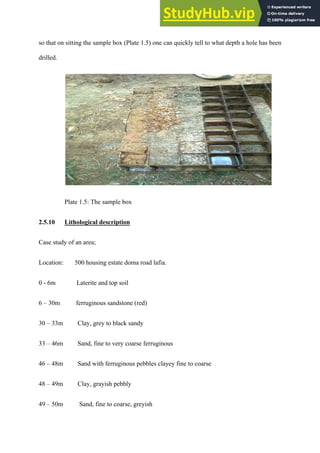
The samples are collected in a plastic container, sieved, washed, and then analyzed
before being put in the sample box. Samples are usually collected after every meter of drilling,
so that on sitting the sample box (Plate 1.5) one can quickly tell to what depth a hole has been
drilled.
Plate 1.5: The sample box
2.5.10 Lithological description
Case study of an area;
Location: 500 housing estate doma road lafia.
0 - 6m Laterite and top soil
6 – 30m ferruginous sandstone (red)
30 – 33m Clay, grey to black sandy
33 – 46m Sand, fine to very coarse ferruginous
46 – 48m Sand with ferruginous pebbles clayey fine to coarse
48 – 49m Clay, grayish pebbly
49 – 50m Sand, fine to coarse, greyish
50 – 58m Clay, grey to black, sandy
58 – 65m Sand with brown ferruginous pebbles at 59-60m.
Bottom of hole
2.6: WELL COMPLETION
This is the next stage after drilling a borehole. It involves flushing, casing, gravel packing and
grouting.
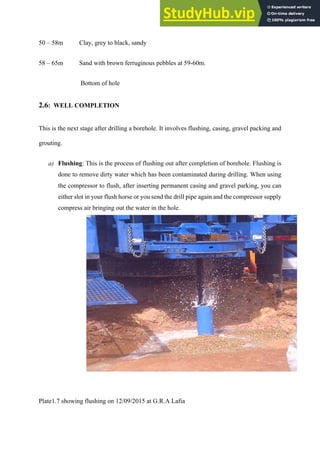
a)   Flushing: This is the process of flushing out after completion of borehole. Flushing is
done to remove dirty water which has been contaminated during drilling. When using
the compressor to flush, after inserting permanent casing and gravel parking, you can
either slot in your flush horse or you send the drill pipe again and the compressor supply
compress air bringing out the water in the hole.
Plate1.7 showing flushing on 12/09/2015 at G.R.A Lafia
b)   Casing: This entails the lowering and connection of PVC pipes
both screens and blinds into the borehole in accordance with the borehole design. The
blinds are usually cylindrical materials with both ends open and prevent dirty particles
in the ground from in-filtrating the hole.
The screens are also cylindrical materials but perforated. They are often placed in the
hole where the aquifer is so that ground water can filter through it to the hole.
The borehole is flushed again before gravel packing/sand packing. This is done to make the
hole clean.
c) Gravel/Sand Packing: This involves placing of coarse sand or fine gravel chippings in-
between the wall and the casing of the borehole. The boreholes are gravel packed to;
i)   Provide a zone of high permeability.
ii)   Stabilize the aquifer.
iii)   Minimize sand pumping.
iv)   Hold the blinds and screen firmly to the ground.
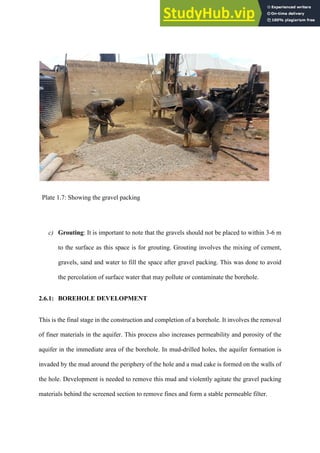
Plate 1.7: Showing the gravel packing
c)   Grouting: It is important to note that the gravels should not be placed to within 3-6 m
to the surface as this space is for grouting. Grouting involves the mixing of cement,
gravels, sand and water to fill the space after gravel packing. This was done to avoid
the percolation of surface water that may pollute or contaminate the borehole.
2.6.1: BOREHOLE DEVELOPMENT
This is the final stage in the construction and completion of a borehole. It involves the removal
of finer materials in the aquifer. This process also increases permeability and porosity of the
aquifer in the immediate area of the borehole. In mud-drilled holes, the aquifer formation is
invaded by the mud around the periphery of the hole and a mud cake is formed on the walls of
the hole. Development is needed to remove this mud and violently agitate the gravel packing
materials behind the screened section to remove fines and form a stable permeable filter.
The following are borehole development methods;
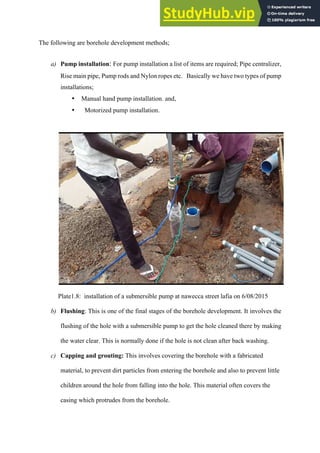
a)   Pump installation: For pump installation a list of items are required; Pipe centralizer,
Rise main pipe, Pump rods and Nylon ropes etc. Basically we have two types of pump
installations;
•   Manual hand pump installation. and,
•   Motorized pump installation.
Plate1.8: installation of a submersible pump at nawecca street lafia on 6/08/2015
b)   Flushing: This is one of the final stages of the borehole development. It involves the
flushing of the hole with a submersible pump to get the hole cleaned there by making
the water clear. This is normally done if the hole is not clean after back washing.
c)   Capping and grouting: This involves covering the borehole with a fabricated
material, to prevent dirt particles from entering the borehole and also to prevent little
children around the hole from falling into the hole. This material often covers the
casing which protrudes from the borehole.
d)   Pump	
   maintainance:	
   Both	
   manual	
   hand	
   pump	
   and	
   submersible	
   pumps	
   often	
  
undergoes	
  maintenance	
  to	
  keep	
  them	
  in	
  good	
  shape	
  and	
  easy	
  to	
  repair	
  when	
  break	
  
down.	
  Maintenance	
  is	
  a	
  simple	
  which	
  involves	
  the	
  following	
  steps;	
  
Understand	
  the	
  case	
  of	
  the	
  break	
  down	
  and	
  determine	
  the	
  remedy	
  needed.	
  Flush	
  the	
  
borehole	
  to	
  reduce	
  colloid	
  and	
  suspension	
  of	
  dust	
  and	
  dirt.	
  Remove	
  the	
  plunger	
  and	
  
wash	
  it	
  thoroughly	
  in	
  the	
  case	
  of	
  manual	
  hand	
  pump.	
  Assemble	
  the	
  pump	
  back.	


CHAPTER THREE
EXPERIENCE GAINED AND PROBLEMS ENCOUNTERED
3.1: EXPERIENCED GAINED
The period of my SIWES really exposed me to practical aspects of some of the theories I learnt
in school. For example, the importance of resistivity, conductivity and ohm’s law in
geophysical survey, which is very important tool in the exploration of ground water.
My period of SIWES at Concast Geological Nigeria Limited helped me to gain a lot of
experience in the following areas:
i)   Geophysical Survey.
ii)   Borehole-Drilling and well development.
iii)   Pumping test.
I can confidently carryout the geophysical survey data acquisition process which involves the
connection of the terrameter to the potential and current electrodes, laying out the electrodes,
taking the terrameter readings of various distances from the central point and plotting VES
curves of the data collected from the geophysical survey carried out on site on a log-log graph
manually. Also, I have gained experience on how rotary-mud and rotary-air drillings are carried
out. I have also acquired skills on how to install and un-install a submersible pump into a
borehole during pumping test, measure SWL and DWL of a bore hole as well as its pumping
and recovery rates.
3.2: PROBLEMS ENCOUNTERED
Problems encountered include those in geophysical survey, drilling and pumping test.
3.2.1: PROBLEMS ENCOUNTERED IN GEOPHYSICAL SURVEY
i) Wrong Interpretation of Data: When there was wrong interpretation of data, the required
depth for drilling was missed and this could lead to the hole not being productive.
ii) High Tension Cable: A survey conducted under high tension cables had errors in its reading
as the cables interfered with the readings.
iii) Error One, Two and Twelve: Error one occurred when the current electrodes made partial
contact with the terrameter and is often displayed ‘Error one’ on the terrameter. Error two
normally occurred when there was partial contact in the connection between the terrameter and
the electrodes or the ground and is normally displayed ‘Error two’ on the terrameter. Error
twelve occurred when the battery was not well-charged i.e., its voltage was less than 12 volts.
In such a case, the battery was charged so that the voltage was greater than or equal to 12 volts.
3.2.2: PROBLEMS ENCONTERED DURING DRILLING PROCESS
During the process of drilling, some technical problems were encountered. Below are the
problems and how they were solved:
Residual Cuttings in the borehole.
Correction:
i)   Up hole velocity of the drilling fluid was increased to force the cuttings out of
the hole.
ii)   The viscosity of the drilling fluid was also increased by adding bentonite.
a)   Stuck pipe.
Correction:
i)   The drill string was suspended above the bottom of the hole.
ii)   Circulation of the drilling fluid was ensured until the hole became relatively free of
all formation materials.
3.2.3: PROBLEMS ENCOUNTERED IN PUMPING TEST
a) Blocked pump: There were instances where the submersible pump used in the
pumping test was blocked by tiny particles in the hole.
Correction:
The pump was uninstalled, loosened and blown with air pressure to force the particles
out.
b) Intertwining of the dip meter cable on the riser pipes. In such cases, the accurate
depth of water level was not obtained from the dip meter.
Correction:
The dip meter was withdrawn from the hole and released back into the hole in such a
way that it did not intertwine on the riser pipes.
CHAPTER FOUR
SUMMARY, CONCLUSION AND RECOMMENDATION
4.1: SUMMARY
My training period really equipped me with more knowledge and skills in the area of
groundwater exploration such as geophysical survey, drilling, pump installation, borehole
maintenance and pumping test. Also, the training has improved my ability in interacting with
other people such as peers and superiors. It was fun to deal with these people, especially when
they were willing to offer assistance and guidance in challenging areas.
I judge my SIWES period spent at Concast Geological Nigerian Limited, as being one of the
most interesting, productive, instructive and challenging experience in my life.
4.2: CONCLUSION
Concast Geological Nig. Ltd. is a ground water investigation and exploitation company. My
SIWES period in this company was very interesting, instructive and challenging. The training
has helped me to bridge the gap between theory and practice in the aspect of geophysics,
hydrogeology, and engineering which are employed to hardness ground water for the optimal
utilization of man.
All of this valuable experience and knowledge that I have gained were not only acquired
through the direct involvement in task given but also through other aspects of the training such
as work observation, interaction with colleagues, superiors and other people related to the field.
From what I have undergone, I am very sure that the industrial training program has achieved
its primary objectives. It’s also the best way to prepare students for the real working life.
From the foregoing discussion it can be seen that there is a connection between geophysics,
hydrogeology and engineering. It is also apparent that the role of a geophysicist in the ground
water sector cannot be over emphasized.
4.3: RECOMMENDATION
For a good borehole to be constructed in order to cater for the need of water supply in any
environment there is need to carryout a detailed geophysical survey in order to avoid the waste
of resources and man power.
All clients wanting to construct a good borehole should consult a specialist to carry out detailed
subsurface investigation before drilling may commence. And the report of the geophysical
survey should be adhered to strictly by drillers while drilling a proposed hole.
Sophisticated machines such as drilling rigs and compressors of modern technology like those
used abroad should be employed in the exploration and exploitation of ground water.
To improve the general standard of SIWES attachment to Nigerian students, I will wish to
recommend that;
a)   ITF should do well by the payment of a befitting student allowance during the SIWES
period and not after, to enable them cover transportation and feeding expenses during
the SIWES program.
b)   Sending students specifically to establishments where the aims and objectives of
SIWES would be achieved.
REFERENCES
Asikadi, E. (2003). Restructuring SIWES to meet the National Development Plan in
Educational System.National conference of National Association for Research
Development Asaba; 2003 pp 1 and 2.
Ayodeji, A. (2010): INDUSTRIAL Training Fund Corporation, unpublished.
Emelis, E. (2013): MevHydrosearch and Engineering Services Ltd ESSPIN PROJECTS,
unpublished.
Information and Guideline for SIWES, Review 2002 pp 1-41.
Jerigbo, H. I. (2003). NECA/ITF Interractive Forum July 14, 2003 p.3.
Martin, E., Emelis E. (2011): MevHydrosearch and Engineering Services Ltd Office Profile,
unpublished.
Martin, E., Timothy O. O., Hassan A., Bilkisu H. (2011): Training on Water Well Drilling.
National Water Resources Manual Kaduna.Pp.18-20, 22-26.
Mohammed, A. (2013): IT Report on Water Well Drilling, unpublished.
Philip, K. (2001): The New Penguine Dictionary of Geology, 2nd
Edition. Pearson Education
Ltd.
Todd, D. K. (1980): Ground Water Hydrology. John Wiley and Sons Inc., New York.Pp.336.
Whiteman, W. E. Jalinoos, F., Sirles, P., and Henna, K. (2003) “Application of Geophysical
Methods to Highway Related Problems” Federal Highway Administration, Central
Federal Lands Highway Division, Lakewood, CO Publication No. FHWA-IF-04-021,
September 2003.
Young, F. (2004), University Physics, Addison Wesley.


A TECHINICAL REPORT ON STUDENT INDUSTRIAL WORK EXPERIENCE SCHEME.Pdf

  • 1.
    A  TECHINICAL  REPORT  ON  STUDENT  INDUSTRIAL  WORK  EXPERIENCE  SCHEME   ATTACHED  AT   CONCAST  GEOLOGICAL  NIGERIA  LIMITED   BUKAN-­‐SIDI,  JOS  ROAD   LAFIA,  NASARAWA  STATE.   BY     ADAMU  BELLO  SULEIMAN   U12GL1032   SUBMITTED  TO     GEOLOGY  DEPARTMENT   FACULTY  OF  SCIENCE   AHMADU  BELLO  UNIVERSITY,  ZARIA-­‐KADUNA   INSTITUTE  BASE  SUPERVISORS:   •   DR  T.  NAJIME   •   DR  S.  A.  ALAGBE   FROM     FEBRUARY  2015  TO  DECEMBER  2015            
  • 2.
      ABSTRACT Nigeria has abundantgroundwater resources. Some of which have been exploited through wells and boreholes dug by the Federal, State and Local Governments, private individuals, other organizations and corporate bodies such as the World Bank, UNDP and UNICEF in the past four decades under different programs. However, despite the huge amount of money expended on these projects, many of these boreholes often break down within short period of usage. During my industrial training experience at Concast Geological Nigeria limited; I had the opportunity to be practically involved in geophysical data acquisition and its modeling for groundwater studies. I have also gained experience in bore hole drilling and well completion. This experience has given me insights into why many borehole programs initiated by the different governments as well as private individuals and corporate organizations have failed. Most boreholes fail for many reasons including improper construction and design. For an effective borehole to be achieved, a systematic approach involving the use of geophysical survey, an appropriate design criterion, pumping test to know the yield of the hole and development techniques should be carried out in order to obtain sustainable groundwater supply in general. Key  words   Boreholes   Geophysical  survey   Drilling   Groundwater    
  • 3.
    CHAPTER ONE INTRODUCTION 1.1: PURPOSEOF REPORT The Industrial Attachment program fulfils part of the requirement in pursuing the degree of B.sc Geology in Ahmadu Bello University Zaria. This report serves to summarize the activities and experience gained with concast Geophysical Nigeria Limited lafia Nasarawa State. 1.2: HISTORY OF SIWES The Government’s decree No. 47 of 8th Oct; 1971 as amended in 1990, highlighted the capacity building of human resources in industry, commerce and Government through training and re- training of workers in order to effectively provide the much needed high quality, goods and services in a dynamic economy as ours (Jemerigbo, 2003). This decree led to the establishment of Industrial Training Fund (ITF) in 1973/1974. The governing concern among our industrialists that graduates of our institutions of higher learning lack adequate practical background studies preparatory for employment in industries led to the formation of the Students’ Industrial Work Experience Scheme (SIWES) by ITF in 1993/1994 (Information And Guideline For SIWES,2002). ITF has one of its key functions; to work as cooperative entity with industry and commerce where students in institutions of higher learning can undertake mid-career work experience attachment in industries which are compatible with students’ area of study (Okorie 2002, Asikadi 2003). The student Industrial Work Experience Scheme (SIWES) is a skill training program designed to expose and prepare students of Agriculture, Technology, Environmental Sciences, Medical Sciences and Pure and Applied Sciences for the industrial work situation which they are likely to meet after graduation. Duration of SIWES is four months in Polytechnics at the end of
  • 4.
    National Diploma(ND), fourmonths in Colleges of education at the end of National Certificate Exams (NCE II) and six months in the universities at the end of 300/400/500 levels depending on the discipline.(Information And Guideline For SIWES 2002). 1.3: AIMS AND OBJECTIVES OF SIWES i.   To provide an avenue for students in institutions of higher learning to acquire industrial skills and experience in their approved course of study. ii.   To prepare students for the industrial work situation which they are likely to meet after graduation. iii.   To expose students to work methods and techniques in handling equipment and machinery not available in their institutions. iv.   To provide students with the opportunity of applying their knowledge in real work situation, thereby bridging the gap between theories and practices. v.   Enlist and strengthen employers’ involvement in the entire educational process and prepare students for employment in industry and commerce (Information and Guideline for SIWES, 2002). 1.4: BODIES INVOLVED IN THE MANAGEMENT OF SIWES The bodies involved are the Federal Government, Industrial Trust Fund (ITF). Other supervising agencies are National University Commission (NUC), National Board of Technical Education (NBTE) and National Council for Colleges of Education (NCCE). The functions of the afore-mentioned agencies include among others to: i.   Ensure adequate funding of the scheme. ii.   Establish SIWES and accredit SIWES units in approved institutions.
  • 5.
    iii.  Formulate policesand guidelines for participating bodies and institutions as well as appointing SIWES coordinators and supporting staff. iv.   Supervise students at their places of attachment and sign their log books and ITF forms. v.   Vet and process students’ log books and forward same to ITF Area office. vi.   Ensure payment of allowances for the students and supervisors. Therefore, the success or otherwise of SIWES depends on the efficiency of the ministries, ITF, institutions, employers of labor and the general public involved in the articulation and management of the program. Thus, the evaluation of SIWES in tertiary institutions in meeting up with the needs for the establishment of the program is necessary. (Information and Guideline for SIWES, 2002). 1.5: ATTACHMENT COMPANY BACKGROUND Attached to Concast Geologisical Nigeria Limited Opp. Aisha Sandaji Plaza,Lafia Nasarawa State. Following the need to solve the problem of water scarcity in Africa as part of the millennium development goals (MDG), this company, CONCAST GEOLOGICAL Nig. Ltd was registered in February, 2005 as the initiative of one man, Mr AHMED KANA, (a renowned Hydro geologist). Concast Geophysical Nigeria Limited is an indigenous geophysical and hydro geological firm. It is made up of highly experienced Geologists, Hydro-geologists, Geophysicists and Water Engineers engaged in water well and dam construction, foundation engineering and mineral exploration business in various parts of the State. Currently, it has permanent staff strength often. Other workers are casual and are usually sourced from the locality where projects are located. It is a well-organized network of specialized associates committed to professional excellence and speedy execution of projects.
  • 6.
    The company’s headoffice is located at No.2 Bukan Sidi jos road Lafia, Nasarawa State.And is equipped with the latest computer softwares for interpretation and modeling. The company has recently undertaken specialized projects related to water supply especially in the following areas: i.   Geophysical surveys to determine suitable sites for borehole drilling in all states in Nigeria. ii.   Drilling of water boreholes in both sedimentary and basement areas. iii.   Water boreholes development and rehabilitation. iv.   Construction and installation of both ground and overhead tanks. v.   Pump installation and maintenance.            
  • 7.
    Organizational  chart                                       Fig  1.0          Organizational  chart                                                                                                                                      MD/CEO                                  Consultant                      General  Manager      Hydrogeologist/Geophysicist                  Site  Manager                      Drivers                    Receptionist                      Security                          Chief  Driller   Assg.Hydrogeologist/IT   Students                                    Driller  1                          Assg.Driller  2              Helpers/Laborers  
  • 8.
    1.6: OVERVIEW This reportis organized in the following order: Chapter One: Introduction. This chapter explains the purpose of the report. It also describes briefly the history and objectives of SIWES. It goes further to describe the brief history of establishment of the company, its location and the organization structure of the company. Chapter Two: General Review on Activities Carried out. This chapter discusses the training which I received, such as in geophysical survey and drilling. Chapter Three: This chapter talks about the experience gained by me and problems encountered. Chapter Four: Summary, Conclusion and Recommendations: This chapter gives the summary of all other experience gained and skills acquired, overall conclusion of the industrial attachment and further recommendations for improvement.
  • 9.
    CHAPTER TWO 2.1: INTRODUCTIONAND GENERAL REVIEW ON ACTIVITIES CARRIED OUT The services rendered by the company are: a)   Geophysical Survey b)   Borehole Drilling c)   Pump Installation d)   Well Logging e)   Water Quality Analysis f)   Pumping Test g)   Borehole Rehabilitation I participated actively in Geophysical Survey, drilling, logging and Pump Installation. And passively in Water Quality Analysis, Borehole Rehabilitation and pumping test. 2.2: WATER EXPLORATION
  • 10.
    The exploration forwater requires several important steps in order to get adequate and portable water for consumption and other domestic significants. Therefore, before any borehole construction is done, a geophysical survey should be carried out on the site to know the most suitable point and depth where the borehole should be drilled in order to have maximum ground water potential. Hence, a geophysical survey tells whether a proposed borehole site should be approved or abandoned. 2.3: GEOPHYSICAL SURVEY Geophysical techniques are non-invasive technologies that measure the variations in the physical characteristics of the surface and subsurface geology either NATURAL OR ARTIFICIAL generated within the earth crust. Such variation result from differences in physical characteristic such as density, elasticity, magnetism, and electric resistivity etc. 2.3.1: METHODOLOGY In an attempt to identify a suitable site for the drilling and construction of a productive borehole, a geophysical survey is usually carried out. There are various methods used in conducting Geophysical survey. These include: Electrical Resistivity method, Magnetic/Electromagnetic method, Seismic Method and other geophysical survey method that can be applied in groundwater investigation, in special situations include gravity method, induced polarization (IP), Self Potential (SP), Out of the afore-mentioned methods, the Electrical Resistivity method is mostly employed by this company and is the method I was introduced to. 2.3.2: ELECTRICAL RESISTIVITY METHOD
  • 11.
    The resistivity methodemploys the use of Terrameter Signal Averaging System (SAS) 300C, four electrodes consisting of two inner potential electrodes (P1 (M) and P2 (N)) and two outer current electrodes (C1, (A) and C2, (B)) which are arranged linearly about a central point. The electrodes are driven into the earth using hammers so that they go dip down into the ground, about three-quarters dip to ensure that they make full contact with the earth. The resistivity method comprises the vertical electrical sounding (VES) and the horizontal profiling (HP). In VES, we are concerned with measuring the variations in the physical characteristics of the sub-surface as we go down the earth while for HP; we are interested in the lateral variations in the physical characteristics of a particular layer of the earth. Two  electrode  arrangement  or  arrays  are  of  particular  interest  in  resistivity  surveys.   1)   The  Wenner  array-­‐  all  electrode  are  equally  spaced.     2)   The  Schlumberger  array-­‐  the  electrode  are  not  equally  spaced.                  The  Wenner  array  comprises  four  equally  spaced  electrodes  and  is  characterized  simply   electrode  spacing  ‘a’.   The  Schlumberger  array  is  similar  except  that  the  inner  (potential)  electrodes  are  more   closely  spaced.     I was particularly introduced to VES during my period of SIWES which involved the use of Schlumberger configuration as shown in Fig. 1.1. 2.3.3: VERTICAL ELECTRICAL SOUNDING (VES) In the VES, with the electrodes linearly arranged, direct current is sent into the ground between the various pairs of electrodes and the resistance offered is calculated and displayed by the Terrameter using the principle of Ohm’s law;
  • 12.
    V=IR ……………………………….. (i) WhereV is the potential difference, I the current and, R is the resistance. The resistance reading is then multiplied by a geometric factor which is a function of the electrode spacing to obtain the apparent resistivity (Pa). Hence, Pa= KR …………………………….. (ii) Where K is the geometric factor and R is the resistance. The geometric factor, K is given by the formula:                        𝐾 =   $% & '( )* & ' )*  𝑥  𝜋   ………………………….. (iii) Where 𝜋 = 3.142, AB is the distance between the current electrodes, while MN is the distance between the potential electrodes.
  • 13.
    Fig 1.1: SchlumbergerConfiguration The electrode spacing is progressively increased, keeping the central point of the array fixed until the desired length of array is obtained. This will increase the depth of penetration within the separation AB. The best general guide to use in the field is to plot the apparent resistivity curve as the survey progresses, so that it can be judged whether the asymptotic phase of the curve has been reached. Thus, the varying resistivity measured when the electrode array is varied in an in-homogenous medium, such as the earth is termed as apparent resistivity (pa). The apparent resistivity readings are collected for a given site and afterwards, a geo-electric section (GES) of the resistivity profile is constructed with advanced computer modeling software and interpreted to reveal subsurface features of interest. VES is often done between 60 m and 100 m but some could go as much as 150 m. 2.3.4: Result and Data Interpretation Resistivity VES data can be interpreted quantitatively (i.e. manually) by examining the curve shapes or qualitatively by using curve matching or computer modeling. VES data curves are interpreted by plotting apparent resistivity data against electrode spacing on a Log-Log graph scale.
  • 14.
    VES results wereinitially obtained by curve matching with Standard Master Curves and their auxiliaries from Orellana and Mooney. These were improved upon using :  GEWin-­Excel  version   T.21  2008 and interpreted results are presented as field and digitized curves. Geophysical survey aims at the features that will aid the accumulation of ground water. The pourosity and Permeability of groundwater systems are principally dependent on secondary structural features such as the extent and volume of fissures or joints, together with the thickness of the weathering. This investigation also consists of geological reconnaissance and hydro-geological assessment such as, the rock types in the area, relief, well depth, vegetation, (alignment of trees), and hills etc. Vertical electrical sounding VES presents the various layers of lithologies obtained in a survey based on the resistivity variations. Basement terrain layers could be; a)   Laterite and Top soil b)   Clay c)   Weathered basement (sandy clay) d)   Weathered basement sandy e)   Fractured basement f)   Partially fractured basement g)   Fresh basement. It is worthy of knowing that the area to be investigated will have much ground water potential depending on the thickness of overburden, weathered basement sandy, fractured basement and the partially fresh basement layers in the surveyed area. Although it is not possible to identify the rocks or soil of an area on the basis of its resistivity alone, it may be possible to make certain deductions about the geology of the area on the basis
  • 15.
    of a resistivitysurvey, interpreted along with other information such as a fore-knowledge about the hydrogeology of the area. For example, since water is a good conductor, a formation with high resistivity is very unlikely to be an aquifer, as it probably contains virtually no water trapped in isolated pores and a formation with extremely low resistivity may well be an aquifer since its conductivity would be high. These conclusions are drawn from the fact that conductivity is inversely proportional to resistivity;  𝑅 = ./ $ …………………………………. (iv) Where R is the resistance  𝜌 is the resistivity,  𝐿  𝑖𝑠  𝑡ℎ𝑒  𝑙𝑒𝑛𝑔𝑡ℎ  𝑎𝑛𝑑, 𝐴 is the area. The best target for drilling is a formation with moderately low resistivity. The geophysical survey is aimed at: a)   Determining the depth to bedrock where applicable. b)   Geophysical delineation of the various lithologies within the overburden. c)   Determining the structural disposition of the formation in the area. d)   Estimating the approximate depth of the proposed borehole (Emelis, 2012). 2.4: CASE STUDY OF A SURVEYED AREA: MARMARA FARM NASARAWA, NASARAWA STATE. The  survey  area  falls  within  the  Precambrian  Basement  Complex  of  the  North  Central  Nigerian.   The  surveyed  site  is  located  at  a  farm,  off  Keffi-­Nasarawa  road,  Marmara,  Nasarawa  LGA,   Nasarawa  State.  The  survey  was  conducted  on  a  larger  part  of  the  farm.   2.4.1: SURVEY METHOD The geophysical investigation made use of the resistivity method comprising of the vertical electrical sounding VES using  OMEGA-­GEOPULSE  digital  resistivity  meter. This was done to
  • 16.
    provide information concerningthe subsurface geology. Terameter SAS 300C was used to carry out the investigation. The Schlumberger configuration was adopted with maximum half- current electrode spread (AB/2) between 1 and 100m while the half-potential electrode separation (MN/2) was maintained between 0.5 and 2.5 m. Plate 1.0 and 1.1 show how the resistivity data was acquired and the equipment used. Plate 1.0: Taking Resistivity Data at Marmara farm 20/10/2015
  • 17.
    Plate 1.1: Setof Geophysical Survey Equipment: Terrameter, Reels and Connected Electrodes 20/10/2015 2.4.2: RESULT AND INTERPRETATION OF DATA Apparent  Resistivity  values  calculated  from  field  resistance  readings  by  multiplying  the  Di-­ electric   constant   (K).   The   product   Ohm-­m   was   then   used   as   against   the   current   distance   spreading  (AB/2),  to  generate  a  curve  on  a  log-­log  graph  paper.   The  interpretation  is  finally  confirmed  by  using  computer  interpretation  software:  GEW  in-­ Excel  version  T.21  2008.  The  software  is  able  to  produce  modeled  curves  and  interpreted  geo-­ electric  layer. (Fig 2.1 (a &b)).                
  • 18.
          MARAMARA  FARM  VES  1  (FIELD  DATA)   distance   resistivity   in  m   in  Ohm  m   1   701.3   1.47   408.1   2.15   282   3.16   168.8   4.64   116   6.81   114.5   10   125.4   14.7   142.4   21.5   86.9   31.6   125.4   46.4   256.3   68.1   293.7   100   188.4   120   338.9   140   230.7         a    
  • 19.
            MARAMARA  FARM  VES  1  (INTERPRETATION)   bottom  of   layer   Resistivity   in  m-­SL   in  Ohm  m   15.00   140   21.00   90   46.00   255   100.00   190   120.00   340   140.00   230           1 10 100 1000 10000 1 10 100 1000 depth  in  m-­SL resistivity  in  Ohm.m
  • 20.
      b   Fig1.2:  Marmarafarm VES1 (INTERPRETATION) 2.4.3 CONCLUSION AND RECOMMENDATIONS                    the area is delineated for electrical resistivity survey after extensive Electromagnetic survey across the farm. VES was taken to between 120- 150m. The relatively low resistivity values and anomalies indicate occurrence of fractures and consequently high groundwater potential. The boreholes should be drilled at the VES points indicated to a depth of about 100-120m or until satisfactory recharge is gotten. Use of down-the- hole hammer would be required. To avoid missing of crucial aquifer especially water bearing litho logical units/fracture bearing zones, proper litho-logging is recommended after drilling and the aquifer should be adequately screened to achieve maximum yield.     1 10 100 1000 10000 1 10 100 1000 depth  in  m-­SL resistivity  in  Ohm.m
  • 21.
    Summary  of  the interpretation   Layer     Inferred  thickness     Inferred  Lithology   1      0  -­  25                                              Top  soil/Laterite/weathered  basement  (micaceous)   2     25  -­  45                                            weathered/fractured  basement  (acquiferous)   3     45-­  80                          partly  weathered/  fractured  basement(acquiferous)   4     80-­150                          partly  weathered/  fractured/fresh  basement   2.5: BOREHOLE DRILLING CONSTRUCTION AND DEVELOPEMENT During my period of the attachment, a number of boreholes were drilled while few were rehabilitated. Most of the boreholes whose drilling I experienced are in Lafia LGA Nasarawa State. 2.5.1: DESCRIPTION OF THE EQUIPMENT USED The following equipments are used as attachment equipment during drilling: a)   Halco v866 drilling rig capable of drilling to 200 m depth. b)   An Atlas Copco Compressor. c)   A portable Mud Pump. d)   A water tanker. e)   Drilling bit f)   A service truck. 2.5.2: BOREHOLE DESIGN
  • 22.
    Borehole design isthe process of specifying the physical materials and dimension of bore hole with the main objectives of securing the highest sustainable yield. In borehole design, it is helpful to consider the borehole structure as consisting of two main elements. (i)   Case portion of the borehole. (ii)   Intake portion of the borehole. The case portion of the borehole also known as the blind portion, is the part of the borehole that seals surface water and undesirable groundwater as well as provide structural support against caving material. The intake portion of the bore hole or the screen portion are perforated casings which allow maximum amount of water to enter the well and prevent movement of sand into hole as well as stabilize the side of the borehole. There are two types of casing; these are American Petroleum Industry (API) steel and Polyvinyl chloride (PVC) casings. The length of API steel casing is about 20 ft (or 6 m), while that of PVC casing is often times 10 ft (or 3m). The thickness of these two types of casing varies between 6 and 8 mm. The PVC casings are mostly used by this company.
  • 23.
    Plate1.2: A typicalborehole design 2.5.3: PROCESSES INVOLVED IN DRILLING i) Mobilization of Equipment and Personnel to Site. This involves conveying the drilling rig and every other equipment to be used for drilling to site together with all the man power involved. ii) Positioning and Pluming the Drilling Rig. This involves setting the rig at the exact spot where the geophysical survey had recommended and also ensuring the rig is plumed so as to ensure that the hole is straight and vertical. iii) Construction of the Mud Pit (in the case of Rotary Mud Drilling).
  • 24.
    This involves thedigging of two pits; one in which cutting materials settle (Storage pit) and the other from which water is pumped and re-pumped to the hole through the drilling rig (Suction pit). iv) Drilling to the required depth. 2.5.4: DRILLING METHOD A large variety of methods and equipment are available for excavating holes in the earth. The technique used in a particular situation in the field depends on a number of factors including availability of equipment and majorly, the mode of occurrence of ground water in the area. The method of drilling which was employed during my period of attachment was the rotary method of drilling method. The rotary drilling method is one of the fastest methods of drilling wells and is particularly adapted in the drilling of large size holes. The drilling process involves boring a hole by using a rotating bit to which a downward force is applied. I was exposed to two types of rotary drilling during the period of my attachment, these are; a)   Rotary-mud drilling and b)   Rotary-air drilling 2.5.5: ROTARY-MUD DRILLING In rotary-mud drilling, the first activity usually carried out is digging of the storage and suction pit which are together referred to as the mud pit. Afterwards, drilling is commenced using drilling fluids. Cuttings of rocks are achieved by rotary bits of various types. The power is delivered to the rotary bits by a rotary halo-steel tube or drilling pipe attached to the drilling
  • 25.
    rig. Pre-mixed mudis forced down the drill pipe and out of the bits. The cuttings are removed by continuous circulation of the drill fluid (mud) as the bits penetrate the formation. The role of the mud is to minimize fluid loss into the aquifers and to cool the drilling bits during the drilling process; it also carries the rock cuttings upward and then deposits them in the mud pit. The storage and suction pits are dug in such a way that the fluid from the former overflows into the latter from where it is then pumped back through the drill pipe and the circle is repeated (See Plate 2.6). The heavy cuttings settle in the storage pit while the tiny ones flow into the suction pit. This kind of drilling takes place where the overburden is thick, to do away with the mud before proceeding to air-drilling. The drilling mud consists of Suspension of Water, Bentonite, Extender, Polypulus, (Carboxylmethylcellulose) (CMC).
  • 26.
    Fig 1.3 MudDrilling method
  • 27.
    Plate 1.4: TheMud Pit snapped on 11/08/2015 2.5.6: ROTARY-AIR DRILLING The air rotary drilling method was used in Nasarawa Eggon site. Air drilling was used because the overburden was not too thick and also because it was stable. The rotary operation using air is similar to the mud or water technique, except that the circulating fluid (air) is not re-circulated. When the cuttings are carried to the surface, they are deposited around the outside of the machine. The rotary-air drilling method used at Nasarawa Eggon was used with compressed air as the drilling fluid rather than drilling mud which represents a modern development within the water well industries.
  • 28.
    Air was circulatedthrough the drill pipe out through the pores in the drill bits and upward in the annular space around the drill pipe. Air moving at high velocity in the annular space carried the cuttings to the surface. This process continued until the required depth was reached. Air drilling offers a number of advantages over water or mud method of rotary drilling. a. Removal of cuttings from the face of the bits is often faster resulting in less regrinding or cutting and decrease in penetration rate. b. Water that enters the hole from the formation being penetrated is almost immediately flushed to the surface and is easy to see. Hence, it is easier to determine when a good aquifer is encountered. 2.5.7: DATA COLLECTION DURING DRILLING During the drilling process, required data should be collected as accurate as possible. The following items are used in the collection of samples at drilling sites: i)   Plastic box for storing cutting samples. ii)   Marker pens. iii)  Set of sieves. iv)  Sufficient copies of the form to record drilling and penetration rate, particle size analysis, cutting sample description. v)   Semi log graph paper. 2.5.8: OBSERVATION PROCESS DURING DRILLING
  • 29.
    The most obviousobservation during the drilling which gives a clue to the lithology of the formation is the speed of penetration. a)   Slower penetration rates were observed in hard consolidated rocks than loose sand. b)   Clay or shale layers tend to slow down penetration where the bits tooth is not suited. c)   A slowing down of penetration in the basement zone was observed as the fresh rock was approached. d)   The lower part of the weathered zone consists essentially of blocks of decomposed rocks set in a matrix of weathered products. Typical rates in a weathered zone are between 1-10 minutes. But in the lower parts, are as slow as 15-20 minutes. e)   Once down the hole hammer is used, penetration is very fast between 1-10 minutes per range. f)   A good indication that fresh basement rock has been reached was jerky rotation of the drilling string. However, an accurate penetration log is very helpful in the identification of drilled strata, so the logs are kept. 2.5.9: LOGGING AND SAMPLE COLLECTION well logging also known as borehole logging is the practice of making a detailed record of geology formation penetrated by a borehole. The log may be based either on visual inspection of samples brought to surface or on physical measurements made by instruments lowered into the hole (geophysical logs). Well logging is performed in borehole drilled for the oil and gas, ground water, mineral and geothermal exploration. In Concast Geological Nigeria Limited, we normally used well logging in borehole drilled for ground water to determine the position of aquifer. The samples are collected in a plastic container, sieved, washed, and then analyzed before being put in the sample box. Samples are usually collected after every meter of drilling,
  • 30.
    so that onsitting the sample box (Plate 1.5) one can quickly tell to what depth a hole has been drilled. Plate 1.5: The sample box 2.5.10 Lithological description Case study of an area; Location: 500 housing estate doma road lafia. 0 - 6m Laterite and top soil 6 – 30m ferruginous sandstone (red) 30 – 33m Clay, grey to black sandy 33 – 46m Sand, fine to very coarse ferruginous 46 – 48m Sand with ferruginous pebbles clayey fine to coarse 48 – 49m Clay, grayish pebbly 49 – 50m Sand, fine to coarse, greyish
  • 31.
    50 – 58mClay, grey to black, sandy 58 – 65m Sand with brown ferruginous pebbles at 59-60m. Bottom of hole 2.6: WELL COMPLETION This is the next stage after drilling a borehole. It involves flushing, casing, gravel packing and grouting. a)   Flushing: This is the process of flushing out after completion of borehole. Flushing is done to remove dirty water which has been contaminated during drilling. When using the compressor to flush, after inserting permanent casing and gravel parking, you can either slot in your flush horse or you send the drill pipe again and the compressor supply compress air bringing out the water in the hole. Plate1.7 showing flushing on 12/09/2015 at G.R.A Lafia
  • 32.
    b)   Casing:This entails the lowering and connection of PVC pipes both screens and blinds into the borehole in accordance with the borehole design. The blinds are usually cylindrical materials with both ends open and prevent dirty particles in the ground from in-filtrating the hole. The screens are also cylindrical materials but perforated. They are often placed in the hole where the aquifer is so that ground water can filter through it to the hole. The borehole is flushed again before gravel packing/sand packing. This is done to make the hole clean. c) Gravel/Sand Packing: This involves placing of coarse sand or fine gravel chippings in- between the wall and the casing of the borehole. The boreholes are gravel packed to; i)   Provide a zone of high permeability. ii)   Stabilize the aquifer. iii)   Minimize sand pumping. iv)   Hold the blinds and screen firmly to the ground.
  • 33.
    Plate 1.7: Showingthe gravel packing c)   Grouting: It is important to note that the gravels should not be placed to within 3-6 m to the surface as this space is for grouting. Grouting involves the mixing of cement, gravels, sand and water to fill the space after gravel packing. This was done to avoid the percolation of surface water that may pollute or contaminate the borehole. 2.6.1: BOREHOLE DEVELOPMENT This is the final stage in the construction and completion of a borehole. It involves the removal of finer materials in the aquifer. This process also increases permeability and porosity of the aquifer in the immediate area of the borehole. In mud-drilled holes, the aquifer formation is invaded by the mud around the periphery of the hole and a mud cake is formed on the walls of the hole. Development is needed to remove this mud and violently agitate the gravel packing materials behind the screened section to remove fines and form a stable permeable filter.
  • 34.
    The following areborehole development methods; a)   Pump installation: For pump installation a list of items are required; Pipe centralizer, Rise main pipe, Pump rods and Nylon ropes etc. Basically we have two types of pump installations; •   Manual hand pump installation. and, •   Motorized pump installation. Plate1.8: installation of a submersible pump at nawecca street lafia on 6/08/2015 b)   Flushing: This is one of the final stages of the borehole development. It involves the flushing of the hole with a submersible pump to get the hole cleaned there by making the water clear. This is normally done if the hole is not clean after back washing. c)   Capping and grouting: This involves covering the borehole with a fabricated material, to prevent dirt particles from entering the borehole and also to prevent little children around the hole from falling into the hole. This material often covers the casing which protrudes from the borehole.
  • 35.
    d)   Pump   maintainance:   Both   manual   hand   pump   and   submersible   pumps   often   undergoes  maintenance  to  keep  them  in  good  shape  and  easy  to  repair  when  break   down.  Maintenance  is  a  simple  which  involves  the  following  steps;   Understand  the  case  of  the  break  down  and  determine  the  remedy  needed.  Flush  the   borehole  to  reduce  colloid  and  suspension  of  dust  and  dirt.  Remove  the  plunger  and   wash  it  thoroughly  in  the  case  of  manual  hand  pump.  Assemble  the  pump  back.                                                    
  • 36.
      CHAPTER THREE EXPERIENCE GAINEDAND PROBLEMS ENCOUNTERED 3.1: EXPERIENCED GAINED The period of my SIWES really exposed me to practical aspects of some of the theories I learnt in school. For example, the importance of resistivity, conductivity and ohm’s law in geophysical survey, which is very important tool in the exploration of ground water. My period of SIWES at Concast Geological Nigeria Limited helped me to gain a lot of experience in the following areas: i)   Geophysical Survey. ii)   Borehole-Drilling and well development. iii)   Pumping test. I can confidently carryout the geophysical survey data acquisition process which involves the connection of the terrameter to the potential and current electrodes, laying out the electrodes, taking the terrameter readings of various distances from the central point and plotting VES curves of the data collected from the geophysical survey carried out on site on a log-log graph manually. Also, I have gained experience on how rotary-mud and rotary-air drillings are carried out. I have also acquired skills on how to install and un-install a submersible pump into a borehole during pumping test, measure SWL and DWL of a bore hole as well as its pumping and recovery rates.
  • 37.
    3.2: PROBLEMS ENCOUNTERED Problemsencountered include those in geophysical survey, drilling and pumping test. 3.2.1: PROBLEMS ENCOUNTERED IN GEOPHYSICAL SURVEY i) Wrong Interpretation of Data: When there was wrong interpretation of data, the required depth for drilling was missed and this could lead to the hole not being productive. ii) High Tension Cable: A survey conducted under high tension cables had errors in its reading as the cables interfered with the readings. iii) Error One, Two and Twelve: Error one occurred when the current electrodes made partial contact with the terrameter and is often displayed ‘Error one’ on the terrameter. Error two normally occurred when there was partial contact in the connection between the terrameter and the electrodes or the ground and is normally displayed ‘Error two’ on the terrameter. Error twelve occurred when the battery was not well-charged i.e., its voltage was less than 12 volts. In such a case, the battery was charged so that the voltage was greater than or equal to 12 volts. 3.2.2: PROBLEMS ENCONTERED DURING DRILLING PROCESS During the process of drilling, some technical problems were encountered. Below are the problems and how they were solved: Residual Cuttings in the borehole. Correction:
  • 38.
    i)   Uphole velocity of the drilling fluid was increased to force the cuttings out of the hole. ii)   The viscosity of the drilling fluid was also increased by adding bentonite. a)   Stuck pipe. Correction: i)   The drill string was suspended above the bottom of the hole. ii)   Circulation of the drilling fluid was ensured until the hole became relatively free of all formation materials. 3.2.3: PROBLEMS ENCOUNTERED IN PUMPING TEST a) Blocked pump: There were instances where the submersible pump used in the pumping test was blocked by tiny particles in the hole. Correction: The pump was uninstalled, loosened and blown with air pressure to force the particles out. b) Intertwining of the dip meter cable on the riser pipes. In such cases, the accurate depth of water level was not obtained from the dip meter. Correction: The dip meter was withdrawn from the hole and released back into the hole in such a way that it did not intertwine on the riser pipes. CHAPTER FOUR SUMMARY, CONCLUSION AND RECOMMENDATION
  • 39.
    4.1: SUMMARY My trainingperiod really equipped me with more knowledge and skills in the area of groundwater exploration such as geophysical survey, drilling, pump installation, borehole maintenance and pumping test. Also, the training has improved my ability in interacting with other people such as peers and superiors. It was fun to deal with these people, especially when they were willing to offer assistance and guidance in challenging areas. I judge my SIWES period spent at Concast Geological Nigerian Limited, as being one of the most interesting, productive, instructive and challenging experience in my life. 4.2: CONCLUSION Concast Geological Nig. Ltd. is a ground water investigation and exploitation company. My SIWES period in this company was very interesting, instructive and challenging. The training has helped me to bridge the gap between theory and practice in the aspect of geophysics, hydrogeology, and engineering which are employed to hardness ground water for the optimal utilization of man. All of this valuable experience and knowledge that I have gained were not only acquired through the direct involvement in task given but also through other aspects of the training such as work observation, interaction with colleagues, superiors and other people related to the field. From what I have undergone, I am very sure that the industrial training program has achieved its primary objectives. It’s also the best way to prepare students for the real working life. From the foregoing discussion it can be seen that there is a connection between geophysics, hydrogeology and engineering. It is also apparent that the role of a geophysicist in the ground water sector cannot be over emphasized.
  • 40.
    4.3: RECOMMENDATION For agood borehole to be constructed in order to cater for the need of water supply in any environment there is need to carryout a detailed geophysical survey in order to avoid the waste of resources and man power. All clients wanting to construct a good borehole should consult a specialist to carry out detailed subsurface investigation before drilling may commence. And the report of the geophysical survey should be adhered to strictly by drillers while drilling a proposed hole. Sophisticated machines such as drilling rigs and compressors of modern technology like those used abroad should be employed in the exploration and exploitation of ground water. To improve the general standard of SIWES attachment to Nigerian students, I will wish to recommend that; a)   ITF should do well by the payment of a befitting student allowance during the SIWES period and not after, to enable them cover transportation and feeding expenses during the SIWES program. b)   Sending students specifically to establishments where the aims and objectives of SIWES would be achieved.
  • 41.
    REFERENCES Asikadi, E. (2003).Restructuring SIWES to meet the National Development Plan in Educational System.National conference of National Association for Research Development Asaba; 2003 pp 1 and 2. Ayodeji, A. (2010): INDUSTRIAL Training Fund Corporation, unpublished. Emelis, E. (2013): MevHydrosearch and Engineering Services Ltd ESSPIN PROJECTS, unpublished. Information and Guideline for SIWES, Review 2002 pp 1-41. Jerigbo, H. I. (2003). NECA/ITF Interractive Forum July 14, 2003 p.3. Martin, E., Emelis E. (2011): MevHydrosearch and Engineering Services Ltd Office Profile, unpublished.
  • 42.
    Martin, E., TimothyO. O., Hassan A., Bilkisu H. (2011): Training on Water Well Drilling. National Water Resources Manual Kaduna.Pp.18-20, 22-26. Mohammed, A. (2013): IT Report on Water Well Drilling, unpublished. Philip, K. (2001): The New Penguine Dictionary of Geology, 2nd Edition. Pearson Education Ltd. Todd, D. K. (1980): Ground Water Hydrology. John Wiley and Sons Inc., New York.Pp.336. Whiteman, W. E. Jalinoos, F., Sirles, P., and Henna, K. (2003) “Application of Geophysical Methods to Highway Related Problems” Federal Highway Administration, Central Federal Lands Highway Division, Lakewood, CO Publication No. FHWA-IF-04-021, September 2003. Young, F. (2004), University Physics, Addison Wesley.