See discussions, stats, andauthor profiles for thispublication at: https://www.researchgate.net/publication/344253637
AN UNDERGRADUATE INTERNSHIP REPORT ON CONCRETE PAVEMENT
CONSTRUCTION IN BENIN CITY, EDO STATE, NIGERIA.
Article · September 2020
CITATIONS
0
1 author:
READS
10,077
Goodnews Amieghemen
University ofAlabama at Birmingham
1 PUBLICATION 0 CITATIONS
SEE PROFILE
All content following this page was uploaded by Goodnews Amieghemen on 15 September 2020.
The userhas requested enhancement ofthe downloaded file.
CHAPTER ONE
INTRODUCTION
INTRODUCTION:
The programme (SIWES) came into existence with the establishment of the Industrial
Training Fund (ITF) under decree 47 of 1971 in a bid to boost professionalism in the
construction industry. The fund in its policystatement No. 1 published in 1973 inserted a clause
dealing with the same issue of practical skills. The fund will seek to work out cooperative
machinerywith industry, where students in institution of higher learning may require industrial
training or mid-career attachment by contributions to the allowance payable to the student.
SIWES is therefore a skilled training programme designed to expose and prepare students of
higher educational learning to practical work on site; this scheme is for student studying
practical and professional jobs.
However, in 1979 ITF withdrew the funding been benefit of students of polytechnics and
colleges of education, it also went ahead to notify all university students that the funding will
be cut from Jan. 1980. In view of this the National UniversityCommission took up the financial
responsibility of the programme for engineering and technology students of Nigeria
Universities, while the National Bodies for Technical Education (NBTE) assume financial
responsibility for the programme in polytechnics and colleges of education.
The administration of the programme was still a Herculean task and was not without a myriad
of operational problems so the Federal Government agreed on the funding of the scheme in the
year 1985. By July 1985, ITF assured the administration of SIWES programme and some of
the parastatal of the Government that are involved in the management of SIWES programmes.
The Federal Government Industrial Training Fund (ITF), Institutions of higher learning,
Employers of students and coordinating agencies. The National University Commission
(NUC), The National Board for Technical Education (NBTE) and The National Council for
Colleges of Education.
Student industrial work experience scheme (SIWES) has been considered as the accepted skill
training programme. It forms part of the approved minimum academic standard in various
degree programm es in all Nigerian Universities. It is an effort to bridge the gap existing
1
between theory and practice of various professions whereby at the end, the main quest of such
schem e is achieved.
The SIWES is a programme involving students, the university and the labour industry. It is
founded by the Federal government of Nigeria and jointly coordinated by the Industrial training
fund (ITF) and the National Universities Commission (NUC).
SIWES has basically aimed at exposing students to machinery, professional work methods,
ways of safe guarding the work areas, workers in industries and organizations.
1.1 AIMS OF SIWES
The aim of SIWES is primarily to bridge the gap existing between theory and practice of
engineering and technology, science, agriculture, medical management and other professional
courses in Nigerian Universities. Expose students to various plants and machineries in their
field of study. It provides an avenue for students to apply the skills they acquired at school into
practice. Enhance and strengthen employer’s involvement in the entire educational process and
provides an opportunity for jobs in the industrial sector. To expose students to skills acquisition
and their ability to learn managerial services. To boost student interest in their area of
discipline.
1.2 OBJECTIVES OF SIWES
1. To provide an avenue for students in Nigerian universities to acquire industrial skills and
experience in their courses of study.
2. To prepare students for the work situation they are likely to meet after graduation.
3. To expose students to work methods and to acquire techniques in handling equipment and
machinery that may not be available in the universities.
4. To make the transition from the university to the world of work easier and enhance student
contacts for later job placem ent.
5. To provide students with an opportunity to apply their knowledge in real work situation
thereby bringing the gap between university work and actual practice.
2
6. To enlist and strengthen employers involvement in the entire educational process of
preparing university graduates for employm ent in the industry.
1.3 GROWTH OF THE SCHEME
Since the culmination of the scheme, the number of participating institution has increased
from 11 in 1975 to 32 in 1978 and the corresponding increase in number of students
participating in the programme from 784 in 1974 to 4173 in 1978. Reliable figure could not be
collected due to operational difficulties. The number of participating institutions increased
from 58 in 1985 with student’s population of 16912 to 101 institutions in 1990 with student
population of 32526, since the inception of the management of the scheme about 136927
students benefitted from the programme from 1985-1995, and to date (estimate) about 342318
students.
1.4 SPECIFICATIONS FOR CIVIL ENGINEERING STUDENTS ON SIWES
SCHEME
The trainee familiarises himself with the offices and working environment including
organizational structure, rules and regulations, codes and conducts as well as objectives of the
company.
Development of new structures, materials procurement, and accessibility of structure
components and materials, the knowledge of building surveying, maintenance, technology and
maintenance are very vital to the trainee. These items are not complete without the knowledge
of project management, construction management, structure material procurement and
strategies, management of construction, plant designs and building system, maintenance and
management of direct labour project, estimation and billing among others.
1.5 CONTRIBUTION OF THE SCHEME
The scheme makes a vital impact on the National economy and technological development and
human resources, it include:
3
-
-
-
-
The improvement of technical comm unication for student
It improves the quality of a skilled manpower in Nigeria and the professional world
at large.
Establishment of the various ties between institutions and industries.
Opportunity of employment for students
1.6 PROBLEMS AFFECTING THE SCHEME
Recently problems are identified in the management of the SIWES scheme which has
depressingly affected the growth and development of the scheme, some of the problems
include:
-
-
-
-
Inadequate funding of the scheme
Negligence arising from the institution coordinators of the schem e.
Lack of cooperation from employees/trainees
Insufficient professionals in the schem e.
1.7 NATURE OF THE COMPANY
Macfrankyln Engineering Services Limited is a privately owned engineering company
that specialises in rendering civil engineering services. The Civil engineering services includes
both construction as well as maintenance of structures and the collection and disposal of waste
(Waste Management).
The project manager, who generally is in charge of every project to be executed, has the
responsibility of planning, procuring and executing everyproject. He oversees the activities of
every engineering (construction) work. He ensures the quality of all projects carried out meet
required standards and specification. He relates directly with field engineers who ensures all is
executed as designed and instructed and make sure the plan on paper is accurately transferred
to ground while following all given specifications. The field engineers makes certain that the
site workers are properly supervised while all site activities are ongoing.
4
1.8 ADMINISTRATIVE SET-UP
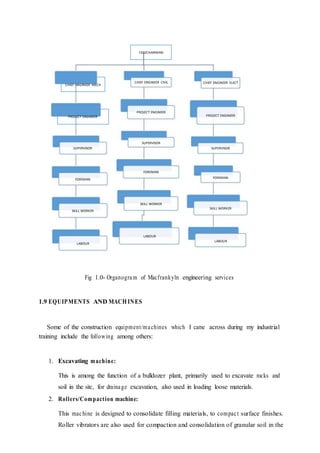
Like any professional organization, the Chief executor officer of the company relates directly
with the chief engineers who relate with the project manager, who assigns and overseas duties
of the various departments. Having qualified engineers in field of road construction, they all
work collaboratively.
The project manager, who heads the civil engineering division, relates directly with the
project manager of the other divisions (Mechanical and Electrical Engineering division) for the
smooth running of the company operations and projects.
The project manager communicates directly with the specific project engineer, who is in
charge of the site activities. The project engineer directs and co-ordinates the activities of the
supervisor on site. The site supervisor co-ordinates all ongoing work and activities on site right
from the beginning of the work to the end of it.
Directly beneath the site supervisor is the foreman who is in charge of the working crew. He
acts as the mediator between the supervisor and the work men, he usually relates information
from the site supervisor to the other work men on how exactly a job should be carried out.
The foreman relates with the labour; the service men, the bricklayers, iron benders,
plumbers. They do the manual work like digging out dirt, cleansing of drain amongst others.
5
Fig 1.0- Organogram of Macfrankyln engineering services
1.9 EQUIPMENTS AND MACHINES
Some of the construction equipment/machines which I came across during my industrial
training include the following among others:
1. Excavating machine:
This is among the function of a bulldozer plant, primarily used to excavate rocks and
soil in the site, for drainage excavation, also used in loading loose materials.
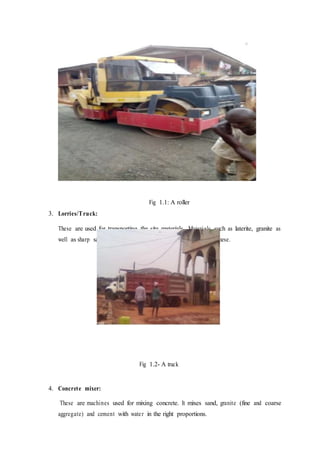
2. Rollers/Compaction machine:
This machine is designed to consolidate filling materials, to compact surface finishes.
Roller vibrators are also used for compaction and consolidation of granular soil in the
CEO/CHAIRMAN
CHIEF ENGINEER MECH
PROJECT ENGINEER
SUPERVISOR
FOREMAN
SKILL WORKER
LABOUR
CHIEF ENGINEER CIVIL
PROJECT ENGINEER
SUPERVISOR
FOREMAN
SKILL WORKER
LABOUR
CHIEF ENGINEER ELECT
PROJECT ENGINEER
SUPERVISOR
FOREMAN
SKILL WORKER
LABOUR
site.
6
Fig 1.1: A roller
3. Lorries/Truck:
These are used for transporting the site materials. Materials such as laterite, granite as
well as sharp sand are transported to and away from site with these.
Fig 1.2- A truck
4. Concrete mixer:
These are machines used for mixing concrete. It mixes sand, granite (fine and coarse
aggregate) and cement with water in the right proportions.
7
Fig 1.3- Concrete mixer
5. Water Tankers:
These trucks are used for the transportation of water to the site when the need arises.
6. Wheel barrow:
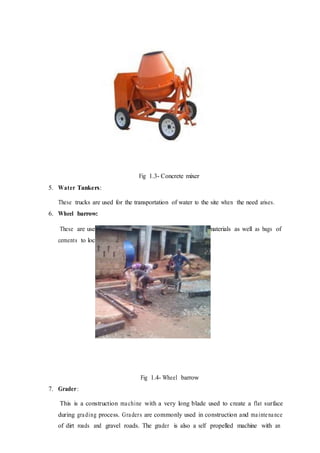
These are used to convey already mixed concrete, loose materials as well as bags of
cements to locations where they are needed on site.
Fig 1.4- Wheel barrow
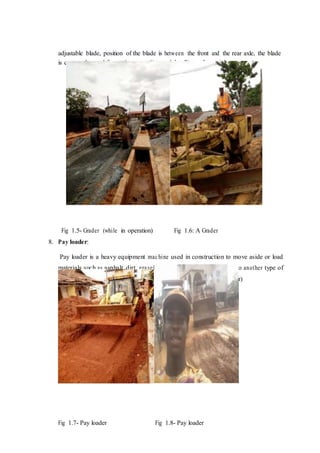
7. Grader:
This is a construction machine with a very long blade used to create a flat surface
during grading process. Graders are commonly used in construction and maintenance
of dirt roads and gravel roads. The grader is also a self propelled machine with an
8
adjustable blade, position of the blade is between the front and the rear axle, the blade
is commonly used for cutting, spreading and levelling of materials.
Fig 1.5- Grader (while in operation) Fig 1.6: A Grader
8. Pay loader:
Pay loader is a heavy equipment machine used in construction to move aside or load
materials such as asphalt, dirt, gravel, logs, rock, sand etc into or onto another type of
machinery (such as dump truck, conveyor, feed-hopper or rail road car)
Fig 1.7- Pay loader Fig 1.8- Pay loader
9
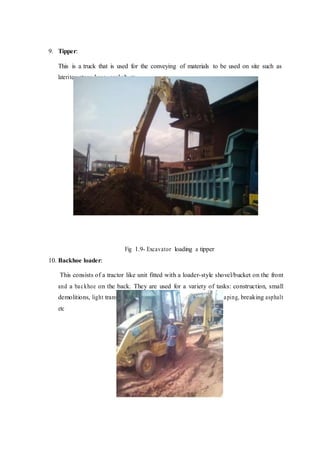
9. Tipper:
This is a truck that is used for the conveying of materials to be used on site such as
laterite, stone-base, asphalt etc
Fig 1.9- Excavator loading a tipper
10. Backhoe loader:
This consists of a tractor like unit fitted with a loader-style shovel/bucket on the front
and a backhoe on the back. They are used for a variety of tasks: construction, small
demolitions, light transportation of materials, excavation, landscaping, breaking asphalt
etc
Fig 1.10- Backhoe
10
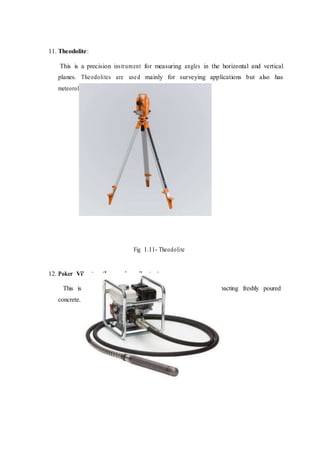
11. Theodolite:
This is a precision instrument for measuring angles in the horizontal and vertical
planes. Theodolites are used mainly for surveying applications but also has
meteorological functions.
Fig 1.11- Theodolite
12. Poker Vibrator (Immersion vibrator)
This is also known as needle vibrator, it is used for compacting freshly poured
concrete.
Fig 1.12- Poker vibrator
11
13. Pumping machine
This is used in pumping out flood from where they are so as to ensure smooth
construction. It uses the principle of pressure to ‘suck out’ water or flood from where
they are. In the course of our construction, rain happened to cause a lot of flood every
now and then during construction, so the pumping machine served its purpose during
this period.
1.10 SUMMARY OF MY ROLE AND RESPONSIBILITIES AT THE
ORGANIZATION
During my industrial training at Macfrankyln Engineering Service Company Limited,
the major objective was to have hands on job experience and also be equipped with various
non-technical skills. To achieving this, I was actively a part of the construction of a concrete
pavement – a construction project awarded to the company. Some of the activities that I
participated in during the course of my internship with the company include but not limited to:
Project Supervision and managem ent
Hiring of Grader and Grader operator
Taking care of the equipment store room
Giving out and collection of construction of equipment to hired labourers mornings
and evenings respectively
Support roles of transportation of construction materials and equipment
12
CHAPTER TWO
DETAILED INTERN’S ROLE/ RESPONSIBILITY AND DAILY ACTIVITIES
INTRODUCTION
During my Industrial Training at Macfrankyln Engineering Services Company Limited, I
was actively and effectively a member of the construction team which did some few
construction projects. These projects included:
Construction of concrete pavem ent of Ogiefa Street, Ogiefa Lane, Amadasun Street,
Mission Road, Benin City, Edo State.
Stone-basing of Oba Akenzua 2 Cultural Centre
2.0 CONSTRUCTION OF CONCRETE PAVEMENT OF OGIEFA STREET, OGIEFA
LANE,AMADASUN STREET, MISSION ROAD, BENIN CITY.
Fig 2.1- The plan
13
2.1 DRAINAGE CONSTRUCTION PROCESS
2.1.1 Site clearance:
This was the very first stage; it involves the removal of all unwanted structures already
existing onsite which would hinder construction work. It involves the demolition of structures,
clearance of grasses, shrubs, trees and even shifting of electric poles which stood on the to-be
constructed road. The clearance is done by the use of machines.
2.1.2 Excavation of drainage:
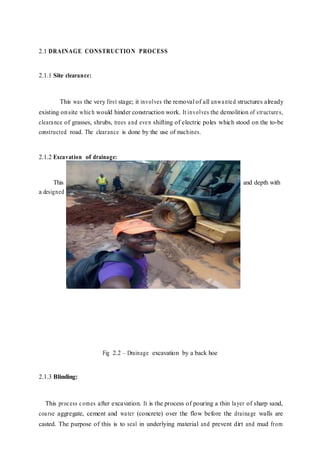
This involves the digging and removal of the dug soil to a specified width and depth with
a designed slope.
Fig 2.2 – Drainage excavation by a back hoe
2.1.3 Blinding:
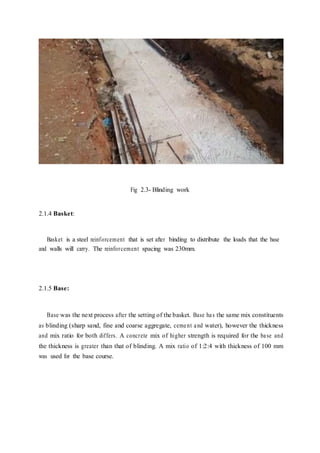
This process comes after excavation. It is the process of pouring a thin layer of sharp sand,
coarse aggregate, cement and water (concrete) over the flow before the drainage walls are
casted. The purpose of this is to seal in underlying material and prevent dirt and mud from
interfering with the structure. The thickness of the blinding is 50mm and width of 1360mm.
The concrete mix ratio of the blinding mixture was 1:3:6.
14
Fig 2.3- Blinding work
2.1.4 Basket:
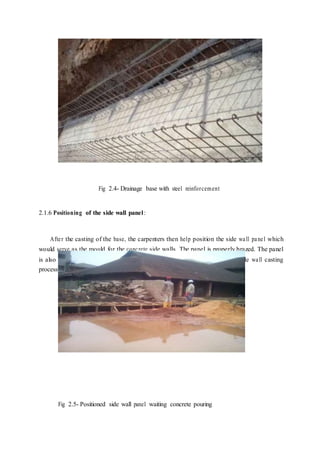
Basket is a steel reinforcement that is set after binding to distribute the loads that the base
and walls will carry. The reinforcement spacing was 230mm.
2.1.5 Base:
Base was the next process after the setting of the basket. Base has the same mix constituents
as blinding (sharp sand, fine and coarse aggregate, cement and water), however the thickness
and mix ratio for both differs. A concrete mix of higher strength is required for the base and
the thickness is greater than that of blinding. A mix ratio of 1:2:4 with thickness of 100 mm
was used for the base course.
15
Fig 2.4- Drainage base with steel reinforcement
2.1.6 Positioning of the side wall panel:
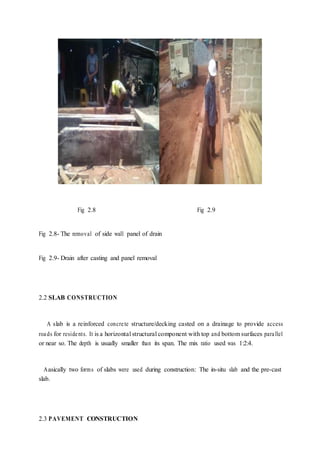
After the casting of the base, the carpenters then help position the side wall panel which
would serve as the mould for the concrete side walls. The panel is properly brazed. The panel
is also painted so that they can be easily removed and re-used during the side wall casting
process. The panel was then clipped and prepared to accept the concrete.
Fig 2.5- Positioned side wall panel waiting concrete pouring
2.1.7 Casting of Drainage side walls :
This involves the pouring of a concrete mix of 1:2:4 into the positioned panel.
16
Fig 2.6- Drain immediately after concrete was poured into the form work
After casting and setting, the panel was then removed and concrete cured.
Fig 2.7: Double reinforcem ent entrance for heavy duty vehicles
17
Fig 2.8 Fig 2.9
Fig 2.8- The removal of side wall panel of drain
Fig 2.9- Drain after casting and panel removal
2.2 SLAB CONSTRUCTION
A slab is a reinforced concrete structure/decking casted on a drainage to provide access
roads for residents. It is a horizontal structural component with top and bottom surfaces parallel
or near so. The depth is usually smaller than its span. The mix ratio used was 1:2:4.
Aasically two forms of slabs were used during construction: The in-situ slab and the pre-cast
slab.
2.3 PAVEMENT CONSTRUCTION
A road pavement is a structure whose primary aim is to support traffic loads and transmit
them to the basement soil after reducing the stresses below the level that can be supported by
the soil. There are fundamentally two types of pavements based on design considerations, they
are: flexible and rigid pavement.
18
The pavement construction we executed was the construction of concrete pavement
alternatively called rigid pavement. A concrete pavement (rigid pavement) is constructed from
cement concrete. The design is based on providing a structural cement concrete slab of
sufficient strength to resists the loads from traffic. The rigid pavement has rigidity and high
modulus of elasticity to distribute the load over a relatively wide area of soil. Minor variations
in sub-grade strength have little influence on the structural capacityof a rigid pavement. In the
design of a rigid pavement, the flexural strength is the major factor and not the strength of sub
grade. Due to this property of pavement, when the sub-grade deflects beneath the rigid
pavement, the concrete slab is able to bridge over the localized failures and areas of inadequate
support from sub-grade because of slab action.
It is worthy of note that concrete has the following advantages which are quite a plus on it’s
use for pavement construction. It has many environmental advantages, including durability,
longevity, heat storage capability, and chemical inertness.
-
-
-
-
-
-
-
-
-
-
Ability to be Cast
Fire resistant
On-site fabrication
Aesthetic properties.
The raw materials used in cement production are widely available in great
quantities.
Needs little or no finish or final treatments.
Chemically inert concrete doesn't require paint to achieve a given colour; natural -
mineral pigments and colouring agents can be added at the mixing to provide a
rainbow of options.
Low maintenance.
Can be reused or recycled.
Concrete can be reused with bituminous asphalt as road base materials, can be
recycled and reused by crushing into aggregates for new concrete or as fill material
for road beds or site works.
The construction of concrete pavement in Edo State (the State of my internship) is not so
popular. Our project is one of the very first concrete pavement constructions in the state, this
afforded me to witness and participate first hand in a not so common project in the State. The
whole involved in the construction are thus:
19
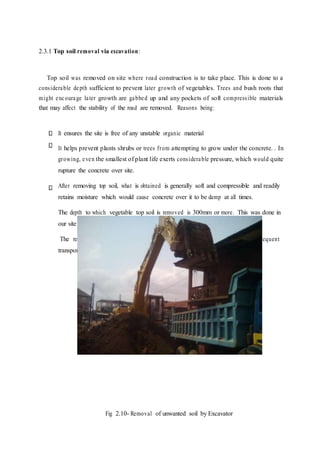
2.3.1 Top soil removal via excavation:
Top soil was removed on site where road construction is to take place. This is done to a
considerable depth sufficient to prevent later growth of vegetables. Trees and bush roots that
might encourage later growth are gabbed up and any pockets of soft compressible materials
that may affect the stability of the road are removed. Reasons being:
It ensures the site is free of any unstable organic material
It helps prevent plants shrubs or trees from attempting to grow under the concrete. . In
growing, even the smallest of plant life exerts considerable pressure, which would quite
rupture the concrete over site.
After removing top soil, what is obtained is generally soft and compressible and readily
retains moisture which would cause concrete over it to be damp at all times.
The depth to which vegetable top soil is removed is 300mm or more. This was done in
our site with the use of the excavator.
The removal of all unwanted soils to a considerable depth and the consequent
transportation of it to an off-site location.
Fig 2.10- Removal of unwanted soil by Excavator
20
2.3.2 Backfilling :
After the excavation of the soil to a considerable depth, fresh soil is brought in to replace
the excavated organically rich soil. The new soil has engineering and economic properties with
which would enable it to be a part of the sub-grade. Because of the richness in Iron and
Aluminium, laterite is brought in to fill. In this part of Nigeria, laterite is very common, hence
it’s economically friendly.
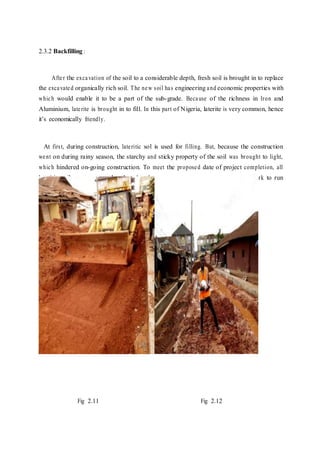
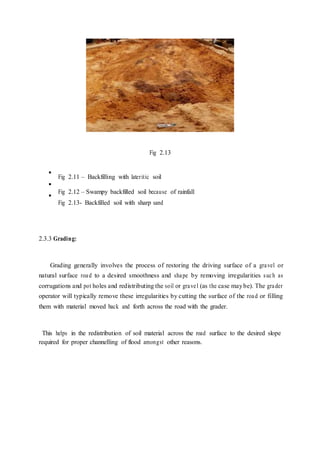
At first, during construction, lateritic sol is used for filling. But, because the construction
went on during rainy season, the starchy and sticky property of the soil was brought to light,
which hindered on-going construction. To meet the proposed date of project completion, all
lateritic soils were removed and replaced with sharp sand which enabled the work to run
smoothly even during the rainy period.
Fig 2.11 Fig 2.12
21



Fig 2.13
Fig 2.11 – Backfilling with lateritic soil
Fig 2.12 – Swampy backfilled soil because of rainfall
Fig 2.13- Backfilled soil with sharp sand
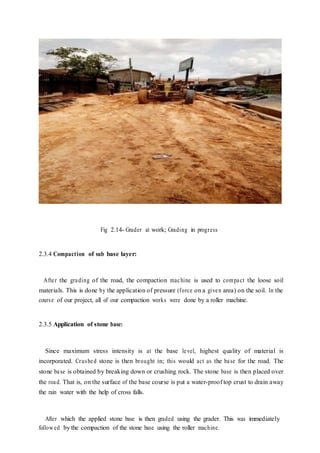
2.3.3 Grading:
Grading generally involves the process of restoring the driving surface of a gravel or
natural surface road to a desired smoothness and shape by removing irregularities such as
corrugations and pot holes and redistributing the soil or gravel (as the case maybe). The grader
operator will typically remove these irregularities by cutting the surface of the road or filling
them with material moved back and forth across the road with the grader.
This helps in the redistribution of soil material across the road surface to the desired slope
required for proper channelling of flood amongst other reasons.
22
Fig 2.14- Grader at work; Grading in progress
2.3.4 Compaction of sub base layer:
After the grading of the road, the compaction machine is used to compact the loose soil
materials. This is done by the application of pressure (force on a given area) on the soil. In the
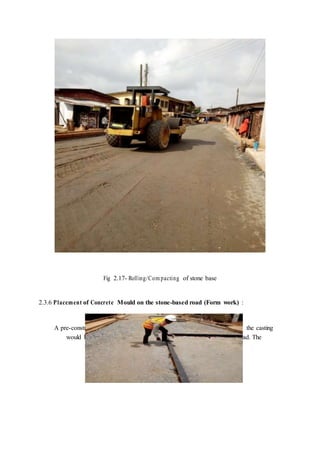
course of our project, all of our compaction works were done by a roller machine.
2.3.5 Application of stone base:
Since maximum stress intensity is at the base level, highest quality of material is
incorporated. Crushed stone is then brought in; this would act as the base for the road. The
stone base is obtained by breaking down or crushing rock. The stone base is then placed over
the road. That is, on the surface of the base course is put a water-proof top crust to drain away
the rain water with the help of cross falls.
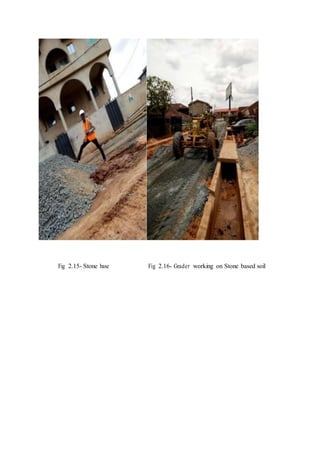
After which the applied stone base is then graded using the grader. This was immediately
followed by the compaction of the stone base using the roller machine.
23
Fig 2.15- Stone base Fig 2.16- Grader working on Stone based soil
24
Fig 2.17- Rolling/Com pacting of stone base
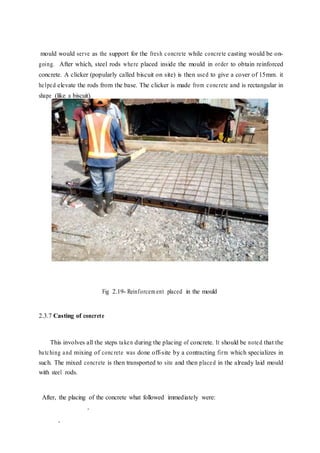
2.3.6 Placement of Concrete Mould on the stone-based road (Form work) :
A pre-constructed concrete mould was brought on site. Mould with which the casting
would be done. The concrete moulds were then placed across the road. The
Fig 2.18- concrete pavement formwork (mould)
25
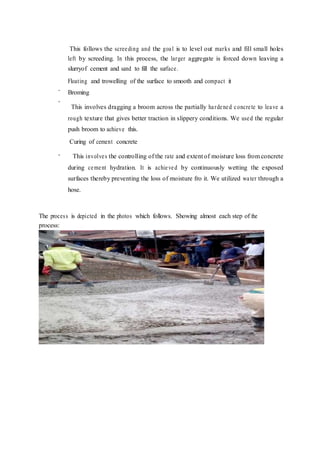
mould would serve as the support for the fresh concrete while concrete casting would be on-
going. After which, steel rods where placed inside the mould in order to obtain reinforced
concrete. A clicker (popularly called biscuit on site) is then used to give a cover of 15mm. it
helped elevate the rods from the base. The clicker is made from concrete and is rectangular in
shape (like a biscuit).
Fig 2.19- Reinforcem ent placed in the mould
2.3.7 Casting of concrete
This involves all the steps taken during the placing of concrete. It should be noted that the
batching and mixing of concrete was done off-site by a contracting firm which specializes in
such. The mixed concrete is then transported to site and then placed in the already laid mould
with steel rods.
After, the placing of the concrete what followed immediately were:
-
-
-
Screeding
This levels the concrete with the top of the forms and begins the process of forcing
the larger aggregate below the surface.
Darby
26
-
-
-
This follows the screeding and the goal is to level out marks and fill small holes
left by screeding. In this process, the larger aggregate is forced down leaving a
slurryof cement and sand to fill the surface.
Floating and trowelling of the surface to smooth and compact it
Broming
This involves dragging a broom across the partially hardened concrete to leave a
rough texture that gives better traction in slippery conditions. We used the regular
push broom to achieve this.
Curing of cement concrete
This involves the controlling of the rate and extent of moisture loss from concrete
during cement hydration. It is achieved by continuously wetting the exposed
surfaces thereby preventing the loss of moisture fro it. We utilized water through a
hose.
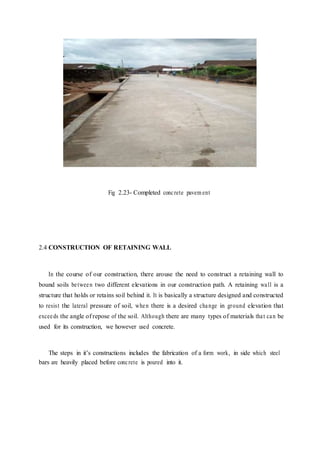
The process is depicted in the photos which follows. Showing almost each step of the
process:
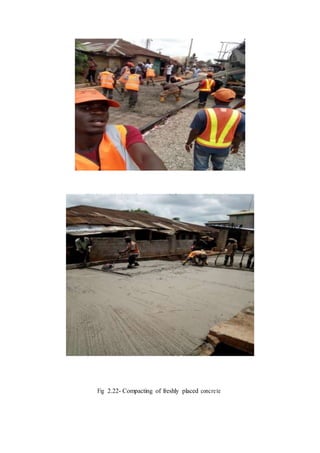
Fig 2.20 – Placing of Concrete into the mould
27
Fig 2.21- Placing of concrete as it flows through the chute
Fig 2.22- Compacting of freshly placed concrete
28
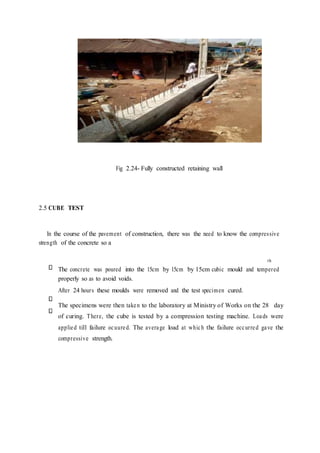
Fig 2.23- Completed concrete pavem ent
2.4 CONSTRUCTION OF RETAINING WALL
In the course of our construction, there arouse the need to construct a retaining wall to
bound soils between two different elevations in our construction path. A retaining wall is a
structure that holds or retains soil behind it. It is basically a structure designed and constructed
to resist the lateral pressure of soil, when there is a desired change in ground elevation that
exceeds the angle of repose of the soil. Although there are many types of materials that can be
used for its construction, we however used concrete.
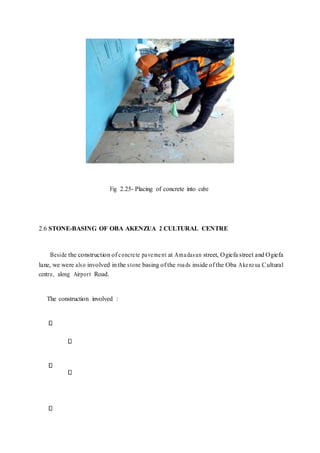
The steps in it’s constructions includes the fabrication of a form work, in side which steel
bars are heavily placed before concrete is poured into it.
29
Fig 2.24- Fully constructed retaining wall
2.5 CUBE TEST
In the course of the pavement of construction, there was the need to know the compressive
strength of the concrete so a
The concrete was poured into the 15cm by 15cm by 15cm cubic mould and tempered
properly so as to avoid voids.
After 24 hours these moulds were removed and the test specimen cured.
The specimens were then taken to the laboratory at Ministry of Works on the 28 day
of curing. There, the cube is tested by a compression testing machine. Loads were
applied till failure ocuured. The average load at which the failure occurred gave the
compressive strength.
th
30
Fig 2.25- Placing of concrete into cube
2.6 STONE-BASING OF OBA AKENZUA 2 CULTURAL CENTRE
Beside the construction of concrete pavement at Amadasun street, Ogiefa street and Ogiefa
lane, we were also involved in the stone basing of the roads inside of the Oba Akenzua Cultural
centre, along Airport Road.
The construction involved :
Site
clear
ance
Th
is
invo
lved
the
rem
oval
of
unw
ante
d
vege
tatio
n
and
struc
tures
whic
h
were
prev
iousl
y on
the
site.
Exca
vatio
n of
drain
age
T
he
drai
nage path was marked first using the peg and the line, after which the payloader
helped excavate the soil in the marked path to a considerable depth. Blinding
Concrete was poured on the soil to follow the line placed on the soil so as to obtain
the required gradient for the drain.
Placement of the reinforcement steel
To support the concrete, reinforcing steel was placed by the iron bender.
Casting of drains side walls
31
The side walls were then cast after the form work was placed by the carpenter and the
iron bender –his rod. The concrete mix used for the concrete was 1:2:4 meaning one
bag of cement to 4 head pan of sand (fine aggregate) to 8 head pans of gravel (coarse
aggregate)
Cleaning and de-silting of already existing drainage
There were already existing drains which were blocked, these drains were cleansed and
de-silted so it could easily be connected to the new drains and for effective flow of
flood.
Top soil removal
The payloader was used in removing the existing soil to a considerable depth, this
helps helps in the disposal of unstable organic material.
Backfilling with laterite
Lateritic soil is then used to replace the removed unstable organic soil. Latrerite soil
is suitable especisally in this part of the country.
Grading and compaction of soil
Stonebasing
Grading and rolling of stone based soil
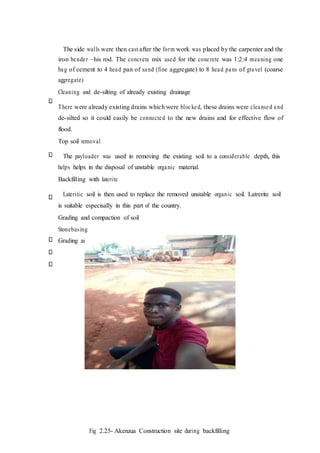
Fig 2.25- Akenzua Construction site during backfilling
32
CHAPTER THREE
DISCUSSION, ANALYSIS AND EVALUATION
3.1 PAVEMENT
Pavement is the actual travel surface especially made durable and serviceable to withstand
the traffic load commuting upon it. Pavement grants friction for the vehicles thus providing
comfort to the driver and transfers the traffic load from the upper surface to the natural soil. It
could also be described as an open, public way for the passage or transport of vehicles, people
and animals.
Pavements are primarily to be used by vehicles and pedestrains. Storm water drainage and
environmental conditions are a major concern in the designing of a pavement. The first of the
constructed roads date back to 4000 BC and consisted of stone paved streets or timber roads.
The roads of the earlier times depended solely on stone, gravel and sand for construction and
water was used as a binding agent to level and give a finished look to the surface. All hard road
pavements usually fall into two broad categories namely;
1. Flexible Pavem ent
2. Rigid Pavem ent
Flexible pavement:
These are those pavements which reflect the deformation of subgrade and the subsequent
layers to the surface. Flexible, usually asphalt, is laid with no reinforcement or with a
specialized fabric reinforcement that permits limited flow or repositioning of the roadbed under
ground changes. The design of flexible pavement is based on load distributing characteristics
of the component layers. The black top pavement including water and gravel bound macadam
fall in this category. Flexible pavement on the whole has low or negligible flexible strength
flexible in their structural action. The flexible pavement layers transmit the vertical or
compressive stresses to the lower layers by grain transfer through contact process of granular
structure.
The vertical compressive stress is maximum on the pavement surface directly under the
wheel load and is equal to contact pressure under the wheels. Due to the ability to distribute
the stress to large area in the shape of truncated cone the stresses get decreased in the lower
layer. As such the flexible pavement may be constructed in a number of layers and the top layer
33
has to be strongest as the highest compressive stresses. To be substained by this layer, in
addition to wear and tear, the lower layer have to take up only lesser magnitude of stress as
there is no direct wearing action due to traffic loads, therefore inferior material with lower cast
can be used in the lowr layers.
Rigid Pavement:
The rigid characteristic of the pavement are associated with rigidity or flexural strength or
slab action so the load is distributed over a wide area of subgrade soil. Rigid pavement is laid
in slabs with real reinforcement. The rigid pavements are made from cement concrete either
plan, reinforced or prestressed concrete. Critical condition of stress in the rigid pavement is the
maximum flexural stress occuring in the slab due to the wheel loiad and the temperature
changes.
Advantages of Rigid Pavement
Rigid lasts much, much longer i.e 30+ years comparred to 5-10 years of flexible
pavements.
In the long run, it is about half the cost to install and maintain. But the initial costs are
somewhat high
Rigid pavem ent has the ability to bridge small imperfections inn the sub-grade.
Less maintenance cost and continuous traffic and flow
High efficiency in terms of functionality
Difference between flexible and rigid pavement
1. Flexible pavement differs from rigid pavement in terms of load distribution. In flexible
pavements load distribution is primarily based on layered system. While, in case of
rigid pavemens most of the load is carried by the slab itself and slight load goes to the
underlying strata.
2. Structural capacity of flexible pavement depends on the characteristics of each single
layer. While, the structural capacity of rigid pavements is only dependent on the
characteristics of concrete slab. This is so, because of low bearing soil capacity of
underlying soil.
3. In flexible pavements, load intensity increases in depth because of the spreading of
loading in each single layer. While, in case of rigid pavement maximum intensity of
load carries by slab itself, because of the weak underlying layer.
34
4. In flexible pavement, deflection basin is very deep, because of its dependency on the
underlying layers. While in case of rigid pavement, deflection basin is shallow. This is
because of the independency of rigid pavement on the underlying layers.
5. Flexible pavement has very low modulus of elasticity (less strength). Modulus of
elasticityof rigid pavement is very high because of the high strength concrete and more
load bearing capacity of the pavement itself. Than compared to flexible pavements.
6. In flexible pavements, underlying layers play very important role. Therefore, more role
are playing only underlying layers. In case of rigid pavements, slight funcction of
underlyling layers. Maximum role is played by the top layer (that is the slab) by itself.
Therefore, minute part is taken by the sub-layers.
7. Flexible pavement can be damaged by oils and certain chemicals but the rigid pavement
is not
8. For the flexible pavement, road can be used for traffic within 24 hours whiloe for the
rigid pavement, road cannot be used until 14 days of curing.
9. Flexible pavem ent has low completion cost but high repairing cost while for the rigid
pavement, it has a low repairing cost but completion cost is high.
10. No thermal stresses are induced as the pavement have the ability to contract and
expand freely in flexible pavements, however that’s not the case in rigid pavements as
thermal stresses are more likely to be induced as the ability to contract and expand is
very less in concrete.
11. Expansion joints are absent in flexible pavement but present in rigid pavements
because of thermal stresses that can be induced in it.
12. Rolling of the surfacing is done in the construction of a flexible pavement but in
rigid pavement, it is not needed.
3.2 CEMENT CONCRETE
A composite material that consists essentially of a binding medium, such as a mixture of
Portland cement and water, within which are embedded particles or fragments of aggregate,
usually a combination of fine and coarse aggregate. Concrete is by far the most versatile and
most widely used construction material worldwide. It can be engineered to satisfy a wide range
of performance specifications, unlike other building materials, such as natural stone or steel,
which generally have to be used as they are. Because the tensile strength of concrete is much
35
lower than its compressive strength, it is typically reinforced with steel bars, in which case it
is known as reinforced concrete.
Composite materials: Its composite materials are:
Cement
Fine Aggregate
Coarse aggregate
Admixture
Reinforcing steel
i. Cement
There are many different kinds of cements. In concrete, the most commonly used is
Portland cement, hydraulic cement which sets and hardens by chemical reaction with water
and is capable of doing so under water. Cement is the “glue” that binds the concrete
ingredients together and is instrumental for the strength of the composite. Although cements
and concrete have beenaround for thousands of years, modern Portland cement was invented
in 1824 by Joseph Aspdin of Leeds, England. The name derives from its resemblance of the
natural building stone quarried in Portland, England.
Fig 3.1- Portland cement
ii. Aggregate
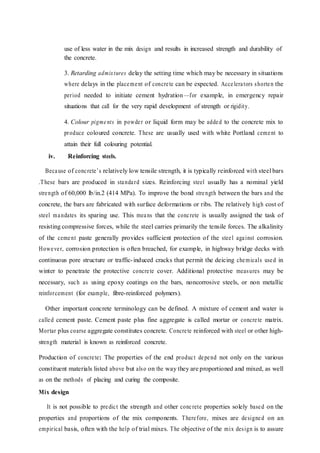
The aggregate is a granular material, such as sand, gravel, crushed stone, or iron-blast furnace
slag. It is graded by passing it through a set of sieves with progressively smaller mesh sizes.
All material that passes through sieve #4 [0.187 in. (4.75 mm) openings] is conventionally
referred to as fine aggregate or sand, while all material that is retained on the #4 sieve is referred
to as coarse aggregate, gravel, or stone. By carefully grading the material and selecting an
36
optimal particle size distribution, a maximum packing density can be achieved, where the
smaller particles fill the void spaces between the larger particles. Such dense packing
minimizes the amount of cement paste needed and generally leads to improved mechanical and
durability properties of the concrete. The aggregate constitutes typically 75% of the concrete
volume, or more, and therefore its properties largely determine the properties of the concrete.
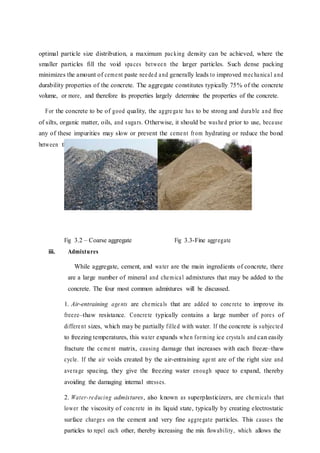
For the concrete to be of good quality, the aggregate has to be strong and durable and free
of silts, organic matter, oils, and sugars. Otherwise, it should be washed prior to use, because
any of these impurities may slow or prevent the cement from hydrating or reduce the bond
between the cement paste and the aggregate particles.
Fig 3.2 – Coarse aggregate Fig 3.3-Fine aggregate
iii. Admixtures
While aggregate, cement, and water are the main ingredients of concrete, there
are a large number of mineral and chemical admixtures that may be added to the
concrete. The four most common admixtures will be discussed.
1. Air-entraining agents are chemicals that are added to concrete to improve its
freeze–thaw resistance. Concrete typically contains a large number of pores of
different sizes, which may be partially filled with water. If the concrete is subjected
to freezing temperatures, this water expands when forming ice crystals and can easily
fracture the cement matrix, causing damage that increases with each freeze–thaw
cycle. If the air voids created by the air-entraining agent are of the right size and
average spacing, they give the freezing water enough space to expand, thereby
avoiding the damaging internal stresses.
2. Water-reducing admixtures, also known as superplasticizers, are chemicals that
lower the viscosity of concrete in its liquid state, typically by creating electrostatic
surface charges on the cement and very fine aggregate particles. This causes the
particles to repel each other, thereby increasing the mix flowability, which allows the
37
use of less water in the mix design and results in increased strength and durability of
the concrete.
3. Retarding admixtures delay the setting time which may be necessary in situations
where delays in the placement of concrete can be expected. Accelerators shorten the
period needed to initiate cement hydration—for example, in emergency repair
situations that call for the very rapid development of strength or rigidity.
4. Colour pigments in powder or liquid form may be added to the concrete mix to
produce coloured concrete. These are usually used with white Portland cement to
attain their full colouring potential.
iv. Reinforcing steels.
Because of concrete’s relatively low tensile strength, it is typically reinforced with steel bars
.These bars are produced in standard sizes. Reinforcing steel usually has a nominal yield
strength of 60,000 lb/in.2 (414 MPa). To improve the bond strength between the bars and the
concrete, the bars are fabricated with surface deformations or ribs. The relatively high cost of
steel mandates its sparing use. This means that the concrete is usually assigned the task of
resisting compressive forces, while the steel carries primarily the tensile forces. The alkalinity
of the cement paste generally provides sufficient protection of the steel against corrosion.
However, corrosion protection is often breached, for example, in highway bridge decks with
continuous pore structure or traffic-induced cracks that permit the deicing chemicals used in
winter to penetrate the protective concrete cover. Additional protective measures may be
necessary, such as using epoxy coatings on the bars, noncorrosive steels, or non metallic
reinforcement (for example, fibre-reinforced polymers).
Other important concrete terminology can be defined. A mixture of cement and water is
called cement paste. Cement paste plus fine aggregate is called mortar or concrete matrix.
Mortar plus coarse aggregate constitutes concrete. Concrete reinforced with steel or other high-
strength material is known as reinforced concrete.
Production of concrete: The properties of the end product depend not only on the various
constituent materials listed above but also on the way they are proportioned and mixed, as well
as on the methods of placing and curing the composite.
Mix design
It is not possible to predict the strength and other concrete properties solely based on the
properties and proportions of the mix components. Therefore, mixes are designed on an
empirical basis, often with the help of trial mixes. The objective of the mix design is to assure
that the product has specified properties in both the fresh and hardened state. The most
38
important mix design variable is the weight ratio between water and cement, referred to as the
w/c ratio. There is a theoretical minimum amount of water needed for the cement to completely
hydrate, which canbe determined using the equations of hydration chemistry. Any excess water
creates pores which, together with any air-filled pores, do not contribute to the material
strength. The result is a drastic decrease in strength as a function of increasing the w/c ratio.
On the other hand, too low w/c ratios cause poor workability of the concrete. For practical
reasons, the w/c ratio typically varies between 0.4 and 0.6.
The other important mix design variables are the cement-to-aggregate ratio and the fine-to-
coarse aggregate ratio. Also, the maximum aggregate size is of importance. And since cement
is the most expensive bulk ingredient, the mix design will generally aim at the least amount of
cement necessary to achieve the design objectives.
Construction practice:
The material obtained immediately upon mixing of the various concrete ingredients is called
fresh concrete, while hardened concrete results when the cement hydration process has
advanced sufficiently to give the material mechanical strength. Concrete that is batched and
mixed in a plant and then transported by truck in its fresh, or plastic, state to the construction
site for final placement is called ready-mixed concrete. If the resulting structure or highway
pavement, for example, remains in place after placement, the concrete is referred to as cast-in-
place concrete, whether mixed on-site or off-site. Precast concrete refers to any structure or
component that is produced at one site, typically in a precasting plant, and then transported in
its hardened state to its final destination. The controlled environment of a precasting plant
generally permits higher quality control of the product than is possible with cast-in-place
concrete produced at a construction site.
Properties of hardened concrete
By far, the most important property of hardened concrete is its compressive strength. Since
this strength continues to increase with continuing cement hydration, it is a function of age
which is the time after casting. In the United States, the strength is determined 28 days after
casting by loading standardized test cylinders up to failure. In Europe, test cubes are often used.
Most commercially produced concrete has compressive strengths between 3000 and 6000
lb/in.2 (20 and 40 MPa). If loaded in tension, the material fails at a stress much lower than that,
typically of the order of 10% of the compressive strength. Because of this low (and unreliable)
tensile strength, concrete is usually reinforced with steel bars.
During hydration and especially if allowed to dry after hardening, the concrete volume
decreases by a small amount because of shrinkage. If this shrinkage is restrained somehow, it
39
can lead to cracking. Shrinkage deformations caused by drying can be reversed only partially
upon wetting. A concrete member or structure subjected to external load will undergo
deformations which, up to a point, are proportional to the amount of applied load. If these loads
remain in place for an appreciable time (months or years), these deformations will increase due
to a material property called creep. Even for regular concrete mixes, creep deformations can
be two or three times as high as the initial elastic deformations, especially if the concrete is
loaded at a very young age. When designing concrete structures, such creep and shrinkage
deformations must be accounted for.
Durability:
Durability is the ability of a material (or structure) to maintain its various properties
throughout its design or service life. Some concrete structures built by the Romans served for
over 2000 years. A material that loses its strength in time, for whatever reason, cannot be
considered durable. There can be numerous causes for loss of durability or deterioration of
concrete structures. The most common one is an excessive amount of cracking or pore
structure. Most concrete structures contain numerous cracks. But as long as these remain small
(of the order of 0.25 mm or less), they are generally invisible to the naked eye, and the concrete
remains basically impermeable to salts and other aggressive agents, so that it can continue to
protect the reinforcing steel against corrosion. Larger cracks provide easy access for such
agents to the steel, thereby promoting corrosion. Since the steel corrosion products occupy a
larger volume than sound steel, they produce internal pressure during expansion and can spall
off the protective concrete cover, the loss of which may render the structure unsafe to resist
loads.
The concrete itself may deteriorate or weather, especially if subjected to many cycles of
freezing and thawing, during which the pressure created by the freezing water progressively
increases the extent of internal cracking. In addition, carbon in the atmosphere can react
chemically with the cement hydration products. This process is known as carbonation. It lowers
the pH of the concrete matrix to the point where it can no longer protect the steel against
corrosion.
Most types of aggregate used for concrete production are inert; that is, they do not react
chemically with the cement or hydration products. However, there are various aggregate types,
including those containing amorphous silica such as common glass, which react chemically
with the alkali in the cement. In the presence of moisture, the alkali–aggregate reaction
products can swell and cause considerable damage. The deterioration of numerous major
structures and highway pavements has been attributed to such reactions, especially alkali –silica
40
reaction, often after years of seemingly satisfactory service. Other common causes of chemical
attack are sulphates found in soils, chlorides in seawater, acid rain, and other industrial
pollutants.
Generally, structures built with well-designed concrete mixes, having low porosity or high
density and minimal cracking, are likely to resist most causes of chemical attack, although for
service in particularly aggressive environments special countermeasures may have to be taken.
Under repeated load applications, structures can experience fatigue failure, as each successive
load cycle increases the degree of cracking and material deterioration to the point where the
material itself may gradually lose its strength or the increased extent of cracking is the source
of loss of durability.
Thermal and other properties
The heavy weight of concrete [its specific gravity is typically 2.4 g/cm3 (145 lb/ft3)] is the
source of large thermal mass. For this reason, massive concrete walls and roof and floor slabs
are well suited for storing thermal energy. Because of this heat capacity of concrete, together
with its reasonably low thermal conductivity, concrete structures can moderate extreme
temperature cycles and increase the comfort of occupants. Well designed concrete mixes are
impermeable to liquids and therefore suitable for storage tanks without the need for
impermeable membranes or liners. Although steel reinforcing bars conduct electricity and
influence magnetic fields, the concrete itself does neither.
Batching of Concrete:
Batching is the process of measuring concrete mix ingredients by either mass or volume and
introducing them into the mixer. To produce concrete of uniform quality, the ingredients must
be measured accurately for each batch. Most specifications require that batching be done by
mass rather than by volume (ASTM C 94 or AASHTO M 157). Water and liquid admixtures
can be measured accurately by either volume or mass. Volumetric batching (ASTM C 685 or
AASHT O M 241) is used for concrete mixed in continuous mixers. Specifications generally
require that materials be measured for individual batches within the following percentages of
accuracy: cementation material: l% aggregates: 2%, water: l%, and admixtures: 3%.
Mixing of concrete:
All concrete should be mixed thoroughly until it is uniform in appearance, with all ingredients
evenly distributed. Mixers should not be loaded above their rated capacities and should be
operated at the mixing speed recommended by the manufacturer. Increased output should be
obtained by using a larger mixer or additional mixes, rather than byspeeding up or overloading
the equipm ent on hand. If the blades of a mixer become worn or coated with hardened concrete,
41
mixing action will be less efficient. These conditions should be corrected. If concrete has been
adequately mixed, samples taken from different portions of a batch will have essentially the
same density, air content, slump, and coarse-aggregate content.
Stationary mixing:
Concrete is sometimes mixed at the jobsite in a stationary mixer or a paving mixer .
Stationary mixers include both onsite mixers and central mixers in ready mix plants. They are
available in sizes up to 9.0 m’ (12 yd3) and can be of the tilting or non tilting type or the open-
top revolving blade or paddle type. All types may be equipped with loading skips and some are
equipped with a swinging discharge chute. Many stationary mixers have timing devices, some
of which can be set for a given mixing time and locked so that the batch cannot be discharged
until the designated mixing time has elapsed.
Ready-mixed concrete:
Ready mixed concrete is proportioned and mixed off the project site and is delivered to the
construction area in a freshly mixed and unhardened state. It can be manufactured by any of
the following methods:
1. Central-mixed concrete is mixed completely in a stationary mixer and is delivered either in
a truck agitator, a truck mixer operating at agitating speed, or a non agitating truck.
2. Shrink-mixed concrete is mixed partially in a stationary mixer and completed in a truck
mixer.
3. Truck-m ixed concrete is mixed completely in a truck mixer.
ASTM C 94 (AAS HTO M 157) notes that when a truck mixer is used for complete mixing,
70 to 100 revolutions of the drum or blades at the rate of rotation designated by the
manufacturer as mixing speed are usually required to produce the specified uniformity of
concrete. All revolutions after 100 should be at a rate of rotation designated by the manufacturer
agitating speed. Agitating speed is normally about 2 to 6 rpm, and mixing speed is generally
about 6 to 18 rpm. Mixing at high speeds for long periods of time, about 1 or more hours can
result in concrete strength loss, temperature rise, excessive loss of entrained air, and accelerated
slump loss.
42
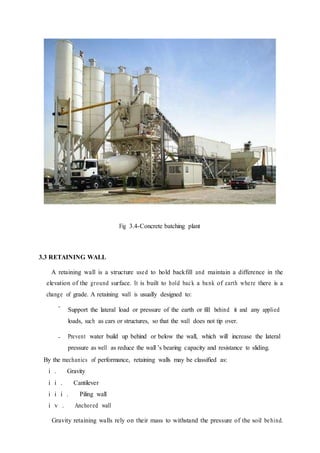
Fig 3.4-Concrete batching plant
3.3 RETAINING WALL
A retaining wall is a structure used to hold backfill and maintain a difference in the
elevation of the ground surface. It is built to hold back a bank of earth where there is a
change of grade. A retaining wall is usually designed to:
-
-
Support the lateral load or pressure of the earth or fill behind it and any applied
loads, such as cars or structures, so that the wall does not tip over.
Prevent water build up behind or below the wall, which will increase the lateral
pressure as well as reduce the wall ’s bearing capacity and resistance to sliding.
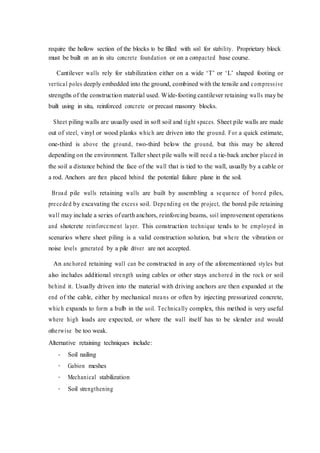
By the mechanics of performance, retaining walls may be classified as:
i . Gravity
i i . Cantilever
i i i . Piling wall
i v . Anchored wall
Gravity retaining walls rely on their mass to withstand the pressure of the soil behind.
They may be constructed from concrete or stone or a combination, or using a proprietary,
pre-cast concrete block system. Proprietary systems either consist of interlocking blocks or
43
require the hollow section of the blocks to be filled with soil for stability. Proprietary block
must be built on an in situ concrete foundation or on a compacted base course.
Cantilever walls rely for stabilization either on a wide ‘T’ or ‘L’ shaped footing or
vertical poles deeply embedded into the ground, combined with the tensile and compressive
strengths of the construction material used. Wide-footing cantilever retaining walls may be
built using in situ, reinforced concrete or precast masonry blocks.
Sheet piling walls are usually used in soft soil and tight spaces. Sheet pile walls are made
out of steel, vinyl or wood planks which are driven into the ground. For a quick estimate,
one-third is above the ground, two-third below the ground, but this may be altered
depending on the environment. Taller sheet pile walls will need a tie-back anchor placed in
the soil a distance behind the face of the wall that is tied to the wall, usually by a cable or
a rod. Anchors are then placed behind the potential failure plane in the soil.
Broad pile walls retaining walls are built by assembling a sequence of bored piles,
preceded by excavating the excess soil. Depending on the project, the bored pile retaining
wall may include a series of earth anchors, reinforcing beams, soil improvement operations
and shotcrete reinforcement layer. This construction technique tends to be employed in
scenarios where sheet piling is a valid construction solution, but where the vibration or
noise levels generated by a pile driver are not accepted.
An anchored retaining wall can be constructed in any of the aforementioned styles but
also includes additional strength using cables or other stays anchored in the rock or soil
behind it. Usually driven into the material with driving anchors are then expanded at the
end of the cable, either by mechanical means or often by injecting pressurized concrete,
which expands to form a bulb in the soil. Technically complex, this method is very useful
where high loads are expected, or where the wall itself has to be slender and would
otherwise be too weak.
Alternative retaining techniques include:
-
-
-
-
Soil nailing
Gabion meshes
Mechanical stabilization
Soil strengthening
44
Fig 3.5- Simplified explanation of typical retaining walls
3.4 CUBE TEST
Compressive strength of concrete cube test provides an idea about all the characteristics of
concrete. By this single test one judge that whether concreting has been done properly or not.
Compressive strength of concrete depends on many factors such as water-cement ratio,
cement strength, quality of concrete material, and quality control during productionof concrete
etc.
Procedure:
For cube tests two types of specimens either cubes of 15cm by 15cm by 15cm or 10cm by
10cm by 10cm depending upon the size of aggregate used. For most of the works cubical
moulds of size 15cm by 15cm by 15cm are commonly used.
The concrete is poured in the mould and tempered properly so as not to have any voids. After
24 hours these moulds are removed and test specimens are put in water for curing. The top
surface of this specimen should be made even and smooth. This is done byputting cement paste
and spreading smoothly on whole area of specimen.
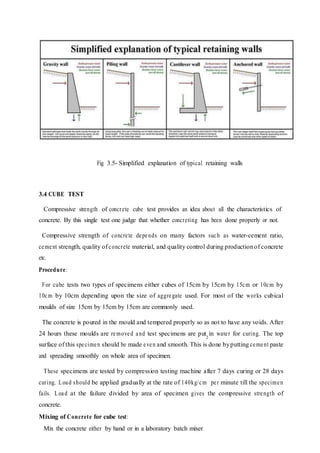
These specimens are tested by compression testing machine after 7 days curing or 28 days
curing. Load should be applied gradually at the rate of 140kg/cm per minute till the specimen
fails. Load at the failure divided by area of specimen gives the compressive strength of
concrete.
Mixing of Concrete for cube test:
Mix the concrete either by hand or in a laboratory batch mixer
2
Hand mixing
45
i. Mix the cement and fine aggregate on a water tight none-absorbent platform until
the mixture is thoroughly blended and is of uniform colour
ii. Add the coarse aggregate and mix with cement and fine aggregate until the coarse
aggregate is uniformly distributed throughout the batch.
iii. Add water and mix it until the concrete appears to be homogenous and of the desired
consistency
Sampling of cubes for test
i . Clean the moulds and apply oil
i i . Fill the concrete in the moulds in layers approximately 5cm thick
i i i . Compact each layer with not less than 35 strokes per layer using a tamping
rod
(steel bar 16mm long, bullet painted at the lower end)
iv. Level the top surface and smoothen it with a trowel
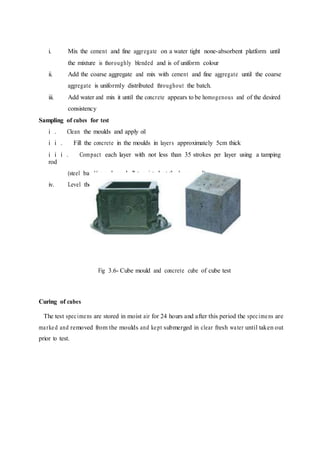
Fig 3.6- Cube mould and concrete cube of cube test
Curing of cubes
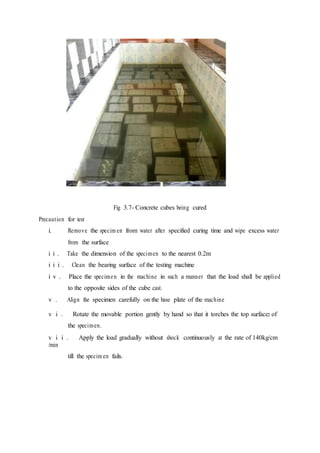
The test specimens are stored in moist air for 24 hours and after this period the specimens are
marked and removed from the moulds and kept submerged in clear fresh water until taken out
prior to test.
46
Fig 3.7- Concrete cubes being cured
Precaution for test
i. Remove the specim en from water after specified curing time and wipe excess water
from the surface
i i . Take the dimension of the specimen to the nearest 0.2m
i i i . Clean the bearing surface of the testing machine
i v . Place the specimen in the machine in such a manner that the load shall be applied
to the opposite sides of the cube cast.
v . Align the specimen carefully on the base plate of the machine
v i . Rotate the movable portion gently by hand so that it torches the top surface of
the specimen.
v i i . Apply the load gradually without shock continuously at the rate of 140kg/cm
/min
till the specim en fails.
2
47
Fig 3.8- Compression testing machine
It should be noted that a minimum of three specimens is usually tested at each selected age.
If strength of any specimen varies by more than 15% of average strength, results of such
specimen are disregarded. Average of three specimens gives the crushing strength of concrete;
the strength requirement of concrete.
Compressive strength of concrete at various ages
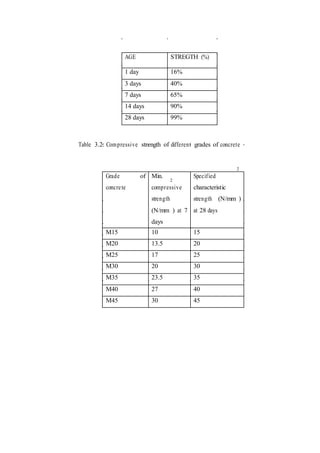
The strength of concrete increases with age. The table below shows the strength of concrete
at different ages in comparison with the strength at 28 days after casting.
Table 3.1: Strength of concrete at different ages
48
AGE STREGTH (%)
1 day 16%
3 days 40%
7 days 65%
14 days 90%
28 days 99%
Table 3.2: Compressive strength of different grades of concrete
Grade of
concrete
Min.
compressive
strength
(N/mm ) at 7
days
Specified
characteristic
strength (N/mm )
at 28 days
M15 10 15
M20 13.5 20
M25 17 25
M30 20 30
M35 23.5 35
M40 27 40
M45 30 45
2
2
49
CHAPTER FOUR
EXPEREIENCE GAINED, LIMITATIONS, RECOMMENDATIONS AND
CONCLUSION
4.1 EXPERIENCE GAINED
The past six months of my industrial training has indeed been rewarding. I was fortunate to
have gained diverse practical skills in road construction, field test application of theoretical
knowledge in fieldwork and human relationship. Basically, the experience I gained includes:
I was able to acquire knowledge of what Road construction and maintenance entails.
I was able to acquire knowledge in a lot of processes associated with concrete.
I also acquired knowledge in the steps, activities and processes involved in the actual
execution of a project.
I was opportune to participate in a lot of decision making meetings in the course of road
construction which helped me enhance my mental ability and gave me insight to real
life problem solving scenario.
I was able to have practical knowledge in cost estimation and cost minimization in the
course of construction.
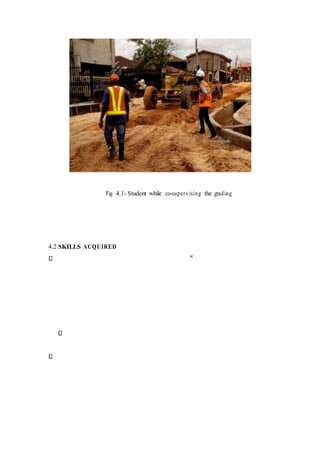
I also had to opportunity to actually supervise an ongoing project. I obtained a practical
knowledge of project supervision and management.
I witnessed the actual construction of a rigid pavement (which is quite rare in this part
of our country) from start to finish.
I was able to obtain a practical perspective in the rental and purchase of construction
equipment.
I was also able to understand more clearly the various functions of work men (masons,
service men, iron benders, carpenter etc) and their corresponding day pay.
50
Fig 4.1- Student while co-supervising the grading
4.2 SKILLS ACQUIRED
st
G
o
o
d
c
o
m
m
u
n
i
c
a
ti
o
n
B
e
f
o
r
e
t
h
e
c
o
m
m
e
n
c
e
m
e
n
t
o
f
m
y internship, I have always heard how good communication is a very important
skill for the 21 century engineer, during my time at Macfrankyln Engineering
Services, I was able to experience this because communication is the
foundation for every societal relationship; it is through it one relates with the
Project Manager, the Carpenters, the Foreman and even with my colleagues, been
able to pass information back and forth could mean the difference between a job
well done and a poorly finished job.
Leadership
During the course of my internship, I sometimes (because of the absence of the
engineers on ground) would take charge of the supervision. It meant me being the
leader, to bring the best out of every worker in order to get the work fully done to
specification within the assigned time. I learnt a lifelong experience from this; that
being a leader has nothing to do with age but everything to do with working with others
effectively.
Punctuality
51
The ability to keep to time has being something I have being working on, but as the
days went by during my industrial training, I saw myself keeping to time and this made
punctuality an amazing thing to me; this I am very proud of.
Observation
Something might look real, but in reality it’s fake. Sometimes, the work done by a
worker would seem nearly okay but nearly isn’t the same as okay. In the course of my
internship, I learnt the difference between nearly okay and okay through observation.
Observation was what was needed to spot out the little difference between good and
perfect.
Team work
An engineer’s ability to work with other people from different backgrounds is
essential because at the end of the day, achieving the set target collectively as a team is
what matters and not self-glory of ‘I did it all alone’. So this was also another learning
point for me.
4.3 PROBLEMS ENCOUNTERED (LIMITATIONS)
I would be telling lies if I said mu industrial training was hitch free. It was fraught with both
seen and unseen problems which include:
The
yout
hs
of
the
com
mun
ity
were
not
very
coop
erati
ve
as
they
were
dem
andi
ng
for
“dev
elop
ment
fee”
and
m
oney
for
beer
almo
st on
a
daily
basi
s.
The heavy downpour of rain during the course of the construction work made work
really difficult. As it would get so heavy that work would have to be suspended until it
subsides. It even made the lateritic soil used to be highly sticky which prevented it’s
use causing additional cost in the removal of already placed laterite and its replacement
with sharp sand.
Transportation issues. The distance between Eyaen (my residential area) and Ogiefa
lane (construction site) was much, causing a very long and boring journey to work on
a daily basis. Also, the cost of transportation incurred everyday considering the fact that
I was also not being paid monthly salary or allowances, was really on the high side.
Another challenge/ problem encountered was the fact that I was working with a lot of
instructors. Due to the fact that I have never worked or been exposed to a working
environment where a lot of people are, during my first few weeks I had problem coping
52
with a lot of instructors/engineers. Sometimes, they usually had conflicting views,
opinions and say concerning an issue and this usually made me confused. However, as
the training progressed I was able to cope with it, thereby making me stronger and
helped improve my interpersonal relationships with everyone around me.
Because it was site work, there was usually little or no time to sit down; it was always
work under sun as long as work was ongoing. This initially was vey exhausting for me
as I was always tired, but with time I mastered the act of standing and walking for hours
while work was going on.
4.4 RECOMMENDATION
Based on my experience during the SIWES programme, I recommend that the trainees
should be allowed monthly packages in their place of work as they do other employees.
I also recommend that both the school as an institution and the company should give
the students a thorough orientation and job specification before the official
comm encement of the training.
Training periods could be extended to enable students obtain broader knowledge in
their field of study.
I also recommend that SIWES and ITF officials should be in charge of giving students
internship placement at available companies/ firms. This would help each student
secure a space and do so right on time with little or no stress.
I also recomm end there be an enhanced relationship between the company of each
student training and the school.
Due to the lackadaisical attitude of some students, the institution should do a routine
supervision on each student during the course of the training.
I also recommend to students who will do their industrial training soon or later in the
future, to be very inquisitive about every aspect of the site operation, so they could be
well inform ed and not assume some critical aspects of the operation.
4.5 CONCLUSION
The internship has really helped my career as an undergraduate student aiming to acquire
the Bachelor of Civil Engineering Degree. During the course of my internship, I had the
opportunity to work directly with civil engineers with several years of field experience. I
53
was opportune to witness an actual construction and not just witness it but be an active part
of the concrete pavement construction in Edo state; a form of pavement construction which
is not quite common in this part of the country.
The internship has helped me to put theories and concepts that I have learnt in my
theoretical class to practice. Truth be told, it was interesting seeing what I learnt in my class
work in real life.
I want to use this opportunity to thank the Federal Ministry of Science and Technology
of the Federal Republic of Nigeria for the innovation of the SIWES and the Management
of Nigeria University Commission (NUC) for introducing this program into our
institutions. Other thanks goes to the management of our great school, University of Benin,
for creating SIWES unit that is taking care industrial training related issues.
54
REFERENCE
-
-
-
-
-
ACI Committee 304, Guide for Measuring, Mixing, Transporting, and Placing
Concrete, ACI 304R-00, ACI Committee 304 Report, American Concrete Institute,
Farmington Hills, Michigan, 2ooO.
ACI Committee 304, Placing Concrete byPumping Methods, ACI 304.2R-96, ACI
Committee 304 Report, American Concrete Institute, Farmington Hills, Michigan,
1996.
ACI Committee 304, Placing Concrete with Belt Conveyors, ACI 304.4R-95, ACI
Committee 304 Report, American Conme Institute, Farmington Ws, Michigan,
1995.
http://www.engineeringintro.com/transportation/road-pavement/
http://en.m.wikipedia.org/wiki/Portland_cement
55
V
Vi
ie
ew
w p
pu
ub
bl
li
ic
ca
at
ti
io
on
n s
st
ta
at
ts
s

ITREPORTC (1).docx

  • 1.
    See discussions, stats,andauthor profiles for thispublication at: https://www.researchgate.net/publication/344253637 AN UNDERGRADUATE INTERNSHIP REPORT ON CONCRETE PAVEMENT CONSTRUCTION IN BENIN CITY, EDO STATE, NIGERIA. Article · September 2020 CITATIONS 0 1 author: READS 10,077 Goodnews Amieghemen University ofAlabama at Birmingham 1 PUBLICATION 0 CITATIONS SEE PROFILE All content following this page was uploaded by Goodnews Amieghemen on 15 September 2020. The userhas requested enhancement ofthe downloaded file.
  • 2.
    CHAPTER ONE INTRODUCTION INTRODUCTION: The programme(SIWES) came into existence with the establishment of the Industrial Training Fund (ITF) under decree 47 of 1971 in a bid to boost professionalism in the construction industry. The fund in its policystatement No. 1 published in 1973 inserted a clause dealing with the same issue of practical skills. The fund will seek to work out cooperative machinerywith industry, where students in institution of higher learning may require industrial training or mid-career attachment by contributions to the allowance payable to the student. SIWES is therefore a skilled training programme designed to expose and prepare students of higher educational learning to practical work on site; this scheme is for student studying practical and professional jobs. However, in 1979 ITF withdrew the funding been benefit of students of polytechnics and colleges of education, it also went ahead to notify all university students that the funding will be cut from Jan. 1980. In view of this the National UniversityCommission took up the financial responsibility of the programme for engineering and technology students of Nigeria Universities, while the National Bodies for Technical Education (NBTE) assume financial responsibility for the programme in polytechnics and colleges of education. The administration of the programme was still a Herculean task and was not without a myriad of operational problems so the Federal Government agreed on the funding of the scheme in the year 1985. By July 1985, ITF assured the administration of SIWES programme and some of the parastatal of the Government that are involved in the management of SIWES programmes. The Federal Government Industrial Training Fund (ITF), Institutions of higher learning, Employers of students and coordinating agencies. The National University Commission (NUC), The National Board for Technical Education (NBTE) and The National Council for Colleges of Education.
  • 3.
    Student industrial workexperience scheme (SIWES) has been considered as the accepted skill training programme. It forms part of the approved minimum academic standard in various degree programm es in all Nigerian Universities. It is an effort to bridge the gap existing 1
  • 4.
    between theory andpractice of various professions whereby at the end, the main quest of such schem e is achieved. The SIWES is a programme involving students, the university and the labour industry. It is founded by the Federal government of Nigeria and jointly coordinated by the Industrial training fund (ITF) and the National Universities Commission (NUC). SIWES has basically aimed at exposing students to machinery, professional work methods, ways of safe guarding the work areas, workers in industries and organizations. 1.1 AIMS OF SIWES The aim of SIWES is primarily to bridge the gap existing between theory and practice of engineering and technology, science, agriculture, medical management and other professional courses in Nigerian Universities. Expose students to various plants and machineries in their field of study. It provides an avenue for students to apply the skills they acquired at school into practice. Enhance and strengthen employer’s involvement in the entire educational process and provides an opportunity for jobs in the industrial sector. To expose students to skills acquisition and their ability to learn managerial services. To boost student interest in their area of discipline. 1.2 OBJECTIVES OF SIWES 1. To provide an avenue for students in Nigerian universities to acquire industrial skills and experience in their courses of study. 2. To prepare students for the work situation they are likely to meet after graduation. 3. To expose students to work methods and to acquire techniques in handling equipment and machinery that may not be available in the universities.
  • 5.
    4. To makethe transition from the university to the world of work easier and enhance student contacts for later job placem ent. 5. To provide students with an opportunity to apply their knowledge in real work situation thereby bringing the gap between university work and actual practice. 2
  • 6.
    6. To enlistand strengthen employers involvement in the entire educational process of preparing university graduates for employm ent in the industry. 1.3 GROWTH OF THE SCHEME Since the culmination of the scheme, the number of participating institution has increased from 11 in 1975 to 32 in 1978 and the corresponding increase in number of students participating in the programme from 784 in 1974 to 4173 in 1978. Reliable figure could not be collected due to operational difficulties. The number of participating institutions increased from 58 in 1985 with student’s population of 16912 to 101 institutions in 1990 with student population of 32526, since the inception of the management of the scheme about 136927 students benefitted from the programme from 1985-1995, and to date (estimate) about 342318 students. 1.4 SPECIFICATIONS FOR CIVIL ENGINEERING STUDENTS ON SIWES SCHEME The trainee familiarises himself with the offices and working environment including organizational structure, rules and regulations, codes and conducts as well as objectives of the company. Development of new structures, materials procurement, and accessibility of structure components and materials, the knowledge of building surveying, maintenance, technology and maintenance are very vital to the trainee. These items are not complete without the knowledge of project management, construction management, structure material procurement and strategies, management of construction, plant designs and building system, maintenance and management of direct labour project, estimation and billing among others. 1.5 CONTRIBUTION OF THE SCHEME
  • 7.
    The scheme makesa vital impact on the National economy and technological development and human resources, it include: 3
  • 8.
    - - - - The improvement oftechnical comm unication for student It improves the quality of a skilled manpower in Nigeria and the professional world at large. Establishment of the various ties between institutions and industries. Opportunity of employment for students 1.6 PROBLEMS AFFECTING THE SCHEME Recently problems are identified in the management of the SIWES scheme which has depressingly affected the growth and development of the scheme, some of the problems include: - - - - Inadequate funding of the scheme Negligence arising from the institution coordinators of the schem e. Lack of cooperation from employees/trainees Insufficient professionals in the schem e. 1.7 NATURE OF THE COMPANY Macfrankyln Engineering Services Limited is a privately owned engineering company that specialises in rendering civil engineering services. The Civil engineering services includes both construction as well as maintenance of structures and the collection and disposal of waste (Waste Management). The project manager, who generally is in charge of every project to be executed, has the responsibility of planning, procuring and executing everyproject. He oversees the activities of every engineering (construction) work. He ensures the quality of all projects carried out meet required standards and specification. He relates directly with field engineers who ensures all is executed as designed and instructed and make sure the plan on paper is accurately transferred to ground while following all given specifications. The field engineers makes certain that the
  • 9.
    site workers areproperly supervised while all site activities are ongoing. 4
  • 10.
    1.8 ADMINISTRATIVE SET-UP Likeany professional organization, the Chief executor officer of the company relates directly with the chief engineers who relate with the project manager, who assigns and overseas duties of the various departments. Having qualified engineers in field of road construction, they all work collaboratively. The project manager, who heads the civil engineering division, relates directly with the project manager of the other divisions (Mechanical and Electrical Engineering division) for the smooth running of the company operations and projects. The project manager communicates directly with the specific project engineer, who is in charge of the site activities. The project engineer directs and co-ordinates the activities of the supervisor on site. The site supervisor co-ordinates all ongoing work and activities on site right from the beginning of the work to the end of it. Directly beneath the site supervisor is the foreman who is in charge of the working crew. He acts as the mediator between the supervisor and the work men, he usually relates information from the site supervisor to the other work men on how exactly a job should be carried out. The foreman relates with the labour; the service men, the bricklayers, iron benders, plumbers. They do the manual work like digging out dirt, cleansing of drain amongst others.
  • 11.
  • 12.
    Fig 1.0- Organogramof Macfrankyln engineering services 1.9 EQUIPMENTS AND MACHINES Some of the construction equipment/machines which I came across during my industrial training include the following among others: 1. Excavating machine: This is among the function of a bulldozer plant, primarily used to excavate rocks and soil in the site, for drainage excavation, also used in loading loose materials. 2. Rollers/Compaction machine: This machine is designed to consolidate filling materials, to compact surface finishes. Roller vibrators are also used for compaction and consolidation of granular soil in the CEO/CHAIRMAN CHIEF ENGINEER MECH PROJECT ENGINEER SUPERVISOR FOREMAN SKILL WORKER LABOUR CHIEF ENGINEER CIVIL PROJECT ENGINEER SUPERVISOR FOREMAN SKILL WORKER LABOUR CHIEF ENGINEER ELECT PROJECT ENGINEER SUPERVISOR FOREMAN SKILL WORKER LABOUR
  • 13.
  • 14.
    Fig 1.1: Aroller 3. Lorries/Truck: These are used for transporting the site materials. Materials such as laterite, granite as well as sharp sand are transported to and away from site with these. Fig 1.2- A truck 4. Concrete mixer: These are machines used for mixing concrete. It mixes sand, granite (fine and coarse aggregate) and cement with water in the right proportions.
  • 15.
  • 16.
    Fig 1.3- Concretemixer 5. Water Tankers: These trucks are used for the transportation of water to the site when the need arises. 6. Wheel barrow: These are used to convey already mixed concrete, loose materials as well as bags of cements to locations where they are needed on site. Fig 1.4- Wheel barrow 7. Grader: This is a construction machine with a very long blade used to create a flat surface during grading process. Graders are commonly used in construction and maintenance of dirt roads and gravel roads. The grader is also a self propelled machine with an
  • 17.
  • 18.
    adjustable blade, positionof the blade is between the front and the rear axle, the blade is commonly used for cutting, spreading and levelling of materials. Fig 1.5- Grader (while in operation) Fig 1.6: A Grader 8. Pay loader: Pay loader is a heavy equipment machine used in construction to move aside or load materials such as asphalt, dirt, gravel, logs, rock, sand etc into or onto another type of machinery (such as dump truck, conveyor, feed-hopper or rail road car) Fig 1.7- Pay loader Fig 1.8- Pay loader
  • 19.
  • 20.
    9. Tipper: This isa truck that is used for the conveying of materials to be used on site such as laterite, stone-base, asphalt etc Fig 1.9- Excavator loading a tipper 10. Backhoe loader: This consists of a tractor like unit fitted with a loader-style shovel/bucket on the front and a backhoe on the back. They are used for a variety of tasks: construction, small demolitions, light transportation of materials, excavation, landscaping, breaking asphalt etc
  • 21.
  • 22.
    11. Theodolite: This isa precision instrument for measuring angles in the horizontal and vertical planes. Theodolites are used mainly for surveying applications but also has meteorological functions. Fig 1.11- Theodolite 12. Poker Vibrator (Immersion vibrator) This is also known as needle vibrator, it is used for compacting freshly poured concrete.
  • 23.
    Fig 1.12- Pokervibrator 11
  • 24.
    13. Pumping machine Thisis used in pumping out flood from where they are so as to ensure smooth construction. It uses the principle of pressure to ‘suck out’ water or flood from where they are. In the course of our construction, rain happened to cause a lot of flood every now and then during construction, so the pumping machine served its purpose during this period. 1.10 SUMMARY OF MY ROLE AND RESPONSIBILITIES AT THE ORGANIZATION During my industrial training at Macfrankyln Engineering Service Company Limited, the major objective was to have hands on job experience and also be equipped with various non-technical skills. To achieving this, I was actively a part of the construction of a concrete pavement – a construction project awarded to the company. Some of the activities that I participated in during the course of my internship with the company include but not limited to: Project Supervision and managem ent Hiring of Grader and Grader operator Taking care of the equipment store room Giving out and collection of construction of equipment to hired labourers mornings and evenings respectively Support roles of transportation of construction materials and equipment
  • 25.
  • 26.
    CHAPTER TWO DETAILED INTERN’SROLE/ RESPONSIBILITY AND DAILY ACTIVITIES INTRODUCTION During my Industrial Training at Macfrankyln Engineering Services Company Limited, I was actively and effectively a member of the construction team which did some few construction projects. These projects included: Construction of concrete pavem ent of Ogiefa Street, Ogiefa Lane, Amadasun Street, Mission Road, Benin City, Edo State. Stone-basing of Oba Akenzua 2 Cultural Centre 2.0 CONSTRUCTION OF CONCRETE PAVEMENT OF OGIEFA STREET, OGIEFA LANE,AMADASUN STREET, MISSION ROAD, BENIN CITY.
  • 27.
    Fig 2.1- Theplan 13
  • 28.
    2.1 DRAINAGE CONSTRUCTIONPROCESS 2.1.1 Site clearance: This was the very first stage; it involves the removal of all unwanted structures already existing onsite which would hinder construction work. It involves the demolition of structures, clearance of grasses, shrubs, trees and even shifting of electric poles which stood on the to-be constructed road. The clearance is done by the use of machines. 2.1.2 Excavation of drainage: This involves the digging and removal of the dug soil to a specified width and depth with a designed slope. Fig 2.2 – Drainage excavation by a back hoe 2.1.3 Blinding: This process comes after excavation. It is the process of pouring a thin layer of sharp sand, coarse aggregate, cement and water (concrete) over the flow before the drainage walls are casted. The purpose of this is to seal in underlying material and prevent dirt and mud from
  • 29.
    interfering with thestructure. The thickness of the blinding is 50mm and width of 1360mm. The concrete mix ratio of the blinding mixture was 1:3:6. 14
  • 30.
    Fig 2.3- Blindingwork 2.1.4 Basket: Basket is a steel reinforcement that is set after binding to distribute the loads that the base and walls will carry. The reinforcement spacing was 230mm. 2.1.5 Base: Base was the next process after the setting of the basket. Base has the same mix constituents as blinding (sharp sand, fine and coarse aggregate, cement and water), however the thickness and mix ratio for both differs. A concrete mix of higher strength is required for the base and the thickness is greater than that of blinding. A mix ratio of 1:2:4 with thickness of 100 mm was used for the base course.
  • 31.
  • 32.
    Fig 2.4- Drainagebase with steel reinforcement 2.1.6 Positioning of the side wall panel: After the casting of the base, the carpenters then help position the side wall panel which would serve as the mould for the concrete side walls. The panel is properly brazed. The panel is also painted so that they can be easily removed and re-used during the side wall casting process. The panel was then clipped and prepared to accept the concrete. Fig 2.5- Positioned side wall panel waiting concrete pouring
  • 33.
    2.1.7 Casting ofDrainage side walls : This involves the pouring of a concrete mix of 1:2:4 into the positioned panel. 16
  • 34.
    Fig 2.6- Drainimmediately after concrete was poured into the form work After casting and setting, the panel was then removed and concrete cured. Fig 2.7: Double reinforcem ent entrance for heavy duty vehicles
  • 35.
  • 36.
    Fig 2.8 Fig2.9 Fig 2.8- The removal of side wall panel of drain Fig 2.9- Drain after casting and panel removal 2.2 SLAB CONSTRUCTION A slab is a reinforced concrete structure/decking casted on a drainage to provide access roads for residents. It is a horizontal structural component with top and bottom surfaces parallel or near so. The depth is usually smaller than its span. The mix ratio used was 1:2:4. Aasically two forms of slabs were used during construction: The in-situ slab and the pre-cast slab. 2.3 PAVEMENT CONSTRUCTION
  • 37.
    A road pavementis a structure whose primary aim is to support traffic loads and transmit them to the basement soil after reducing the stresses below the level that can be supported by the soil. There are fundamentally two types of pavements based on design considerations, they are: flexible and rigid pavement. 18
  • 38.
    The pavement constructionwe executed was the construction of concrete pavement alternatively called rigid pavement. A concrete pavement (rigid pavement) is constructed from cement concrete. The design is based on providing a structural cement concrete slab of sufficient strength to resists the loads from traffic. The rigid pavement has rigidity and high modulus of elasticity to distribute the load over a relatively wide area of soil. Minor variations in sub-grade strength have little influence on the structural capacityof a rigid pavement. In the design of a rigid pavement, the flexural strength is the major factor and not the strength of sub grade. Due to this property of pavement, when the sub-grade deflects beneath the rigid pavement, the concrete slab is able to bridge over the localized failures and areas of inadequate support from sub-grade because of slab action. It is worthy of note that concrete has the following advantages which are quite a plus on it’s use for pavement construction. It has many environmental advantages, including durability, longevity, heat storage capability, and chemical inertness. - - - - - - - - - - Ability to be Cast Fire resistant On-site fabrication Aesthetic properties. The raw materials used in cement production are widely available in great quantities. Needs little or no finish or final treatments. Chemically inert concrete doesn't require paint to achieve a given colour; natural - mineral pigments and colouring agents can be added at the mixing to provide a rainbow of options. Low maintenance. Can be reused or recycled. Concrete can be reused with bituminous asphalt as road base materials, can be recycled and reused by crushing into aggregates for new concrete or as fill material for road beds or site works. The construction of concrete pavement in Edo State (the State of my internship) is not so popular. Our project is one of the very first concrete pavement constructions in the state, this afforded me to witness and participate first hand in a not so common project in the State. The

  • 39.
    whole involved inthe construction are thus: 19
  • 40.
    2.3.1 Top soilremoval via excavation: Top soil was removed on site where road construction is to take place. This is done to a considerable depth sufficient to prevent later growth of vegetables. Trees and bush roots that might encourage later growth are gabbed up and any pockets of soft compressible materials that may affect the stability of the road are removed. Reasons being: It ensures the site is free of any unstable organic material It helps prevent plants shrubs or trees from attempting to grow under the concrete. . In growing, even the smallest of plant life exerts considerable pressure, which would quite rupture the concrete over site. After removing top soil, what is obtained is generally soft and compressible and readily retains moisture which would cause concrete over it to be damp at all times. The depth to which vegetable top soil is removed is 300mm or more. This was done in our site with the use of the excavator. The removal of all unwanted soils to a considerable depth and the consequent transportation of it to an off-site location. Fig 2.10- Removal of unwanted soil by Excavator
  • 41.
  • 42.
    2.3.2 Backfilling : Afterthe excavation of the soil to a considerable depth, fresh soil is brought in to replace the excavated organically rich soil. The new soil has engineering and economic properties with which would enable it to be a part of the sub-grade. Because of the richness in Iron and Aluminium, laterite is brought in to fill. In this part of Nigeria, laterite is very common, hence it’s economically friendly. At first, during construction, lateritic sol is used for filling. But, because the construction went on during rainy season, the starchy and sticky property of the soil was brought to light, which hindered on-going construction. To meet the proposed date of project completion, all lateritic soils were removed and replaced with sharp sand which enabled the work to run smoothly even during the rainy period. Fig 2.11 Fig 2.12

  • 43.
  • 44.
       Fig 2.13 Fig 2.11– Backfilling with lateritic soil Fig 2.12 – Swampy backfilled soil because of rainfall Fig 2.13- Backfilled soil with sharp sand 2.3.3 Grading: Grading generally involves the process of restoring the driving surface of a gravel or natural surface road to a desired smoothness and shape by removing irregularities such as corrugations and pot holes and redistributing the soil or gravel (as the case maybe). The grader operator will typically remove these irregularities by cutting the surface of the road or filling them with material moved back and forth across the road with the grader. This helps in the redistribution of soil material across the road surface to the desired slope required for proper channelling of flood amongst other reasons.
  • 45.
  • 46.
    Fig 2.14- Graderat work; Grading in progress 2.3.4 Compaction of sub base layer: After the grading of the road, the compaction machine is used to compact the loose soil materials. This is done by the application of pressure (force on a given area) on the soil. In the course of our project, all of our compaction works were done by a roller machine. 2.3.5 Application of stone base: Since maximum stress intensity is at the base level, highest quality of material is incorporated. Crushed stone is then brought in; this would act as the base for the road. The stone base is obtained by breaking down or crushing rock. The stone base is then placed over the road. That is, on the surface of the base course is put a water-proof top crust to drain away the rain water with the help of cross falls. After which the applied stone base is then graded using the grader. This was immediately followed by the compaction of the stone base using the roller machine.
  • 47.
  • 48.
    Fig 2.15- Stonebase Fig 2.16- Grader working on Stone based soil
  • 49.
  • 50.
    Fig 2.17- Rolling/Compacting of stone base 2.3.6 Placement of Concrete Mould on the stone-based road (Form work) : A pre-constructed concrete mould was brought on site. Mould with which the casting would be done. The concrete moulds were then placed across the road. The
  • 51.
    Fig 2.18- concretepavement formwork (mould) 25
  • 52.
    mould would serveas the support for the fresh concrete while concrete casting would be on- going. After which, steel rods where placed inside the mould in order to obtain reinforced concrete. A clicker (popularly called biscuit on site) is then used to give a cover of 15mm. it helped elevate the rods from the base. The clicker is made from concrete and is rectangular in shape (like a biscuit). Fig 2.19- Reinforcem ent placed in the mould 2.3.7 Casting of concrete This involves all the steps taken during the placing of concrete. It should be noted that the batching and mixing of concrete was done off-site by a contracting firm which specializes in such. The mixed concrete is then transported to site and then placed in the already laid mould with steel rods. After, the placing of the concrete what followed immediately were: - -
  • 53.
    - Screeding This levels theconcrete with the top of the forms and begins the process of forcing the larger aggregate below the surface. Darby 26
  • 54.
    - - - This follows thescreeding and the goal is to level out marks and fill small holes left by screeding. In this process, the larger aggregate is forced down leaving a slurryof cement and sand to fill the surface. Floating and trowelling of the surface to smooth and compact it Broming This involves dragging a broom across the partially hardened concrete to leave a rough texture that gives better traction in slippery conditions. We used the regular push broom to achieve this. Curing of cement concrete This involves the controlling of the rate and extent of moisture loss from concrete during cement hydration. It is achieved by continuously wetting the exposed surfaces thereby preventing the loss of moisture fro it. We utilized water through a hose. The process is depicted in the photos which follows. Showing almost each step of the process: Fig 2.20 – Placing of Concrete into the mould
  • 55.
  • 56.
    Fig 2.21- Placingof concrete as it flows through the chute Fig 2.22- Compacting of freshly placed concrete
  • 57.
  • 58.
    Fig 2.23- Completedconcrete pavem ent 2.4 CONSTRUCTION OF RETAINING WALL In the course of our construction, there arouse the need to construct a retaining wall to bound soils between two different elevations in our construction path. A retaining wall is a structure that holds or retains soil behind it. It is basically a structure designed and constructed to resist the lateral pressure of soil, when there is a desired change in ground elevation that exceeds the angle of repose of the soil. Although there are many types of materials that can be used for its construction, we however used concrete. The steps in it’s constructions includes the fabrication of a form work, in side which steel bars are heavily placed before concrete is poured into it.
  • 59.
  • 60.
    Fig 2.24- Fullyconstructed retaining wall 2.5 CUBE TEST In the course of the pavement of construction, there was the need to know the compressive strength of the concrete so a The concrete was poured into the 15cm by 15cm by 15cm cubic mould and tempered properly so as to avoid voids. After 24 hours these moulds were removed and the test specimen cured. The specimens were then taken to the laboratory at Ministry of Works on the 28 day of curing. There, the cube is tested by a compression testing machine. Loads were applied till failure ocuured. The average load at which the failure occurred gave the compressive strength. th
  • 61.
  • 62.
    Fig 2.25- Placingof concrete into cube 2.6 STONE-BASING OF OBA AKENZUA 2 CULTURAL CENTRE Beside the construction of concrete pavement at Amadasun street, Ogiefa street and Ogiefa lane, we were also involved in the stone basing of the roads inside of the Oba Akenzua Cultural centre, along Airport Road. The construction involved :
  • 63.
    Site clear ance Th is invo lved the rem oval of unw ante d vege tatio n and struc tures whic h were prev iousl y on the site. Exca vatio n of drain age T he drai nagepath was marked first using the peg and the line, after which the payloader helped excavate the soil in the marked path to a considerable depth. Blinding Concrete was poured on the soil to follow the line placed on the soil so as to obtain the required gradient for the drain. Placement of the reinforcement steel To support the concrete, reinforcing steel was placed by the iron bender. Casting of drains side walls 31
  • 64.
    The side wallswere then cast after the form work was placed by the carpenter and the iron bender –his rod. The concrete mix used for the concrete was 1:2:4 meaning one bag of cement to 4 head pan of sand (fine aggregate) to 8 head pans of gravel (coarse aggregate) Cleaning and de-silting of already existing drainage There were already existing drains which were blocked, these drains were cleansed and de-silted so it could easily be connected to the new drains and for effective flow of flood. Top soil removal The payloader was used in removing the existing soil to a considerable depth, this helps helps in the disposal of unstable organic material. Backfilling with laterite Lateritic soil is then used to replace the removed unstable organic soil. Latrerite soil is suitable especisally in this part of the country. Grading and compaction of soil Stonebasing Grading and rolling of stone based soil Fig 2.25- Akenzua Construction site during backfilling
  • 65.
  • 66.
    CHAPTER THREE DISCUSSION, ANALYSISAND EVALUATION 3.1 PAVEMENT Pavement is the actual travel surface especially made durable and serviceable to withstand the traffic load commuting upon it. Pavement grants friction for the vehicles thus providing comfort to the driver and transfers the traffic load from the upper surface to the natural soil. It could also be described as an open, public way for the passage or transport of vehicles, people and animals. Pavements are primarily to be used by vehicles and pedestrains. Storm water drainage and environmental conditions are a major concern in the designing of a pavement. The first of the constructed roads date back to 4000 BC and consisted of stone paved streets or timber roads. The roads of the earlier times depended solely on stone, gravel and sand for construction and water was used as a binding agent to level and give a finished look to the surface. All hard road pavements usually fall into two broad categories namely; 1. Flexible Pavem ent 2. Rigid Pavem ent Flexible pavement: These are those pavements which reflect the deformation of subgrade and the subsequent layers to the surface. Flexible, usually asphalt, is laid with no reinforcement or with a specialized fabric reinforcement that permits limited flow or repositioning of the roadbed under ground changes. The design of flexible pavement is based on load distributing characteristics of the component layers. The black top pavement including water and gravel bound macadam fall in this category. Flexible pavement on the whole has low or negligible flexible strength flexible in their structural action. The flexible pavement layers transmit the vertical or compressive stresses to the lower layers by grain transfer through contact process of granular structure.
  • 67.
    The vertical compressivestress is maximum on the pavement surface directly under the wheel load and is equal to contact pressure under the wheels. Due to the ability to distribute the stress to large area in the shape of truncated cone the stresses get decreased in the lower layer. As such the flexible pavement may be constructed in a number of layers and the top layer 33
  • 68.
    has to bestrongest as the highest compressive stresses. To be substained by this layer, in addition to wear and tear, the lower layer have to take up only lesser magnitude of stress as there is no direct wearing action due to traffic loads, therefore inferior material with lower cast can be used in the lowr layers. Rigid Pavement: The rigid characteristic of the pavement are associated with rigidity or flexural strength or slab action so the load is distributed over a wide area of subgrade soil. Rigid pavement is laid in slabs with real reinforcement. The rigid pavements are made from cement concrete either plan, reinforced or prestressed concrete. Critical condition of stress in the rigid pavement is the maximum flexural stress occuring in the slab due to the wheel loiad and the temperature changes. Advantages of Rigid Pavement Rigid lasts much, much longer i.e 30+ years comparred to 5-10 years of flexible pavements. In the long run, it is about half the cost to install and maintain. But the initial costs are somewhat high Rigid pavem ent has the ability to bridge small imperfections inn the sub-grade. Less maintenance cost and continuous traffic and flow High efficiency in terms of functionality Difference between flexible and rigid pavement 1. Flexible pavement differs from rigid pavement in terms of load distribution. In flexible pavements load distribution is primarily based on layered system. While, in case of rigid pavemens most of the load is carried by the slab itself and slight load goes to the underlying strata. 2. Structural capacity of flexible pavement depends on the characteristics of each single layer. While, the structural capacity of rigid pavements is only dependent on the
  • 69.
    characteristics of concreteslab. This is so, because of low bearing soil capacity of underlying soil. 3. In flexible pavements, load intensity increases in depth because of the spreading of loading in each single layer. While, in case of rigid pavement maximum intensity of load carries by slab itself, because of the weak underlying layer. 34
  • 70.
    4. In flexiblepavement, deflection basin is very deep, because of its dependency on the underlying layers. While in case of rigid pavement, deflection basin is shallow. This is because of the independency of rigid pavement on the underlying layers. 5. Flexible pavement has very low modulus of elasticity (less strength). Modulus of elasticityof rigid pavement is very high because of the high strength concrete and more load bearing capacity of the pavement itself. Than compared to flexible pavements. 6. In flexible pavements, underlying layers play very important role. Therefore, more role are playing only underlying layers. In case of rigid pavements, slight funcction of underlyling layers. Maximum role is played by the top layer (that is the slab) by itself. Therefore, minute part is taken by the sub-layers. 7. Flexible pavement can be damaged by oils and certain chemicals but the rigid pavement is not 8. For the flexible pavement, road can be used for traffic within 24 hours whiloe for the rigid pavement, road cannot be used until 14 days of curing. 9. Flexible pavem ent has low completion cost but high repairing cost while for the rigid pavement, it has a low repairing cost but completion cost is high. 10. No thermal stresses are induced as the pavement have the ability to contract and expand freely in flexible pavements, however that’s not the case in rigid pavements as thermal stresses are more likely to be induced as the ability to contract and expand is very less in concrete. 11. Expansion joints are absent in flexible pavement but present in rigid pavements because of thermal stresses that can be induced in it. 12. Rolling of the surfacing is done in the construction of a flexible pavement but in rigid pavement, it is not needed. 3.2 CEMENT CONCRETE A composite material that consists essentially of a binding medium, such as a mixture of Portland cement and water, within which are embedded particles or fragments of aggregate, usually a combination of fine and coarse aggregate. Concrete is by far the most versatile and most widely used construction material worldwide. It can be engineered to satisfy a wide range
  • 71.
    of performance specifications,unlike other building materials, such as natural stone or steel, which generally have to be used as they are. Because the tensile strength of concrete is much 35
  • 72.
    lower than itscompressive strength, it is typically reinforced with steel bars, in which case it is known as reinforced concrete. Composite materials: Its composite materials are: Cement Fine Aggregate Coarse aggregate Admixture Reinforcing steel i. Cement There are many different kinds of cements. In concrete, the most commonly used is Portland cement, hydraulic cement which sets and hardens by chemical reaction with water and is capable of doing so under water. Cement is the “glue” that binds the concrete ingredients together and is instrumental for the strength of the composite. Although cements and concrete have beenaround for thousands of years, modern Portland cement was invented in 1824 by Joseph Aspdin of Leeds, England. The name derives from its resemblance of the natural building stone quarried in Portland, England. Fig 3.1- Portland cement ii. Aggregate The aggregate is a granular material, such as sand, gravel, crushed stone, or iron-blast furnace slag. It is graded by passing it through a set of sieves with progressively smaller mesh sizes. All material that passes through sieve #4 [0.187 in. (4.75 mm) openings] is conventionally
  • 73.
    referred to asfine aggregate or sand, while all material that is retained on the #4 sieve is referred to as coarse aggregate, gravel, or stone. By carefully grading the material and selecting an 36
  • 74.
    optimal particle sizedistribution, a maximum packing density can be achieved, where the smaller particles fill the void spaces between the larger particles. Such dense packing minimizes the amount of cement paste needed and generally leads to improved mechanical and durability properties of the concrete. The aggregate constitutes typically 75% of the concrete volume, or more, and therefore its properties largely determine the properties of the concrete. For the concrete to be of good quality, the aggregate has to be strong and durable and free of silts, organic matter, oils, and sugars. Otherwise, it should be washed prior to use, because any of these impurities may slow or prevent the cement from hydrating or reduce the bond between the cement paste and the aggregate particles. Fig 3.2 – Coarse aggregate Fig 3.3-Fine aggregate iii. Admixtures While aggregate, cement, and water are the main ingredients of concrete, there are a large number of mineral and chemical admixtures that may be added to the concrete. The four most common admixtures will be discussed. 1. Air-entraining agents are chemicals that are added to concrete to improve its freeze–thaw resistance. Concrete typically contains a large number of pores of different sizes, which may be partially filled with water. If the concrete is subjected to freezing temperatures, this water expands when forming ice crystals and can easily fracture the cement matrix, causing damage that increases with each freeze–thaw cycle. If the air voids created by the air-entraining agent are of the right size and average spacing, they give the freezing water enough space to expand, thereby avoiding the damaging internal stresses. 2. Water-reducing admixtures, also known as superplasticizers, are chemicals that lower the viscosity of concrete in its liquid state, typically by creating electrostatic surface charges on the cement and very fine aggregate particles. This causes the particles to repel each other, thereby increasing the mix flowability, which allows the
  • 75.
  • 76.
    use of lesswater in the mix design and results in increased strength and durability of the concrete. 3. Retarding admixtures delay the setting time which may be necessary in situations where delays in the placement of concrete can be expected. Accelerators shorten the period needed to initiate cement hydration—for example, in emergency repair situations that call for the very rapid development of strength or rigidity. 4. Colour pigments in powder or liquid form may be added to the concrete mix to produce coloured concrete. These are usually used with white Portland cement to attain their full colouring potential. iv. Reinforcing steels. Because of concrete’s relatively low tensile strength, it is typically reinforced with steel bars .These bars are produced in standard sizes. Reinforcing steel usually has a nominal yield strength of 60,000 lb/in.2 (414 MPa). To improve the bond strength between the bars and the concrete, the bars are fabricated with surface deformations or ribs. The relatively high cost of steel mandates its sparing use. This means that the concrete is usually assigned the task of resisting compressive forces, while the steel carries primarily the tensile forces. The alkalinity of the cement paste generally provides sufficient protection of the steel against corrosion. However, corrosion protection is often breached, for example, in highway bridge decks with continuous pore structure or traffic-induced cracks that permit the deicing chemicals used in winter to penetrate the protective concrete cover. Additional protective measures may be necessary, such as using epoxy coatings on the bars, noncorrosive steels, or non metallic reinforcement (for example, fibre-reinforced polymers). Other important concrete terminology can be defined. A mixture of cement and water is called cement paste. Cement paste plus fine aggregate is called mortar or concrete matrix. Mortar plus coarse aggregate constitutes concrete. Concrete reinforced with steel or other high- strength material is known as reinforced concrete. Production of concrete: The properties of the end product depend not only on the various constituent materials listed above but also on the way they are proportioned and mixed, as well as on the methods of placing and curing the composite. Mix design It is not possible to predict the strength and other concrete properties solely based on the properties and proportions of the mix components. Therefore, mixes are designed on an empirical basis, often with the help of trial mixes. The objective of the mix design is to assure
  • 77.
    that the producthas specified properties in both the fresh and hardened state. The most 38
  • 78.
    important mix designvariable is the weight ratio between water and cement, referred to as the w/c ratio. There is a theoretical minimum amount of water needed for the cement to completely hydrate, which canbe determined using the equations of hydration chemistry. Any excess water creates pores which, together with any air-filled pores, do not contribute to the material strength. The result is a drastic decrease in strength as a function of increasing the w/c ratio. On the other hand, too low w/c ratios cause poor workability of the concrete. For practical reasons, the w/c ratio typically varies between 0.4 and 0.6. The other important mix design variables are the cement-to-aggregate ratio and the fine-to- coarse aggregate ratio. Also, the maximum aggregate size is of importance. And since cement is the most expensive bulk ingredient, the mix design will generally aim at the least amount of cement necessary to achieve the design objectives. Construction practice: The material obtained immediately upon mixing of the various concrete ingredients is called fresh concrete, while hardened concrete results when the cement hydration process has advanced sufficiently to give the material mechanical strength. Concrete that is batched and mixed in a plant and then transported by truck in its fresh, or plastic, state to the construction site for final placement is called ready-mixed concrete. If the resulting structure or highway pavement, for example, remains in place after placement, the concrete is referred to as cast-in- place concrete, whether mixed on-site or off-site. Precast concrete refers to any structure or component that is produced at one site, typically in a precasting plant, and then transported in its hardened state to its final destination. The controlled environment of a precasting plant generally permits higher quality control of the product than is possible with cast-in-place concrete produced at a construction site. Properties of hardened concrete By far, the most important property of hardened concrete is its compressive strength. Since this strength continues to increase with continuing cement hydration, it is a function of age which is the time after casting. In the United States, the strength is determined 28 days after casting by loading standardized test cylinders up to failure. In Europe, test cubes are often used. Most commercially produced concrete has compressive strengths between 3000 and 6000 lb/in.2 (20 and 40 MPa). If loaded in tension, the material fails at a stress much lower than that, typically of the order of 10% of the compressive strength. Because of this low (and unreliable) tensile strength, concrete is usually reinforced with steel bars. During hydration and especially if allowed to dry after hardening, the concrete volume
  • 79.
    decreases by asmall amount because of shrinkage. If this shrinkage is restrained somehow, it 39
  • 80.
    can lead tocracking. Shrinkage deformations caused by drying can be reversed only partially upon wetting. A concrete member or structure subjected to external load will undergo deformations which, up to a point, are proportional to the amount of applied load. If these loads remain in place for an appreciable time (months or years), these deformations will increase due to a material property called creep. Even for regular concrete mixes, creep deformations can be two or three times as high as the initial elastic deformations, especially if the concrete is loaded at a very young age. When designing concrete structures, such creep and shrinkage deformations must be accounted for. Durability: Durability is the ability of a material (or structure) to maintain its various properties throughout its design or service life. Some concrete structures built by the Romans served for over 2000 years. A material that loses its strength in time, for whatever reason, cannot be considered durable. There can be numerous causes for loss of durability or deterioration of concrete structures. The most common one is an excessive amount of cracking or pore structure. Most concrete structures contain numerous cracks. But as long as these remain small (of the order of 0.25 mm or less), they are generally invisible to the naked eye, and the concrete remains basically impermeable to salts and other aggressive agents, so that it can continue to protect the reinforcing steel against corrosion. Larger cracks provide easy access for such agents to the steel, thereby promoting corrosion. Since the steel corrosion products occupy a larger volume than sound steel, they produce internal pressure during expansion and can spall off the protective concrete cover, the loss of which may render the structure unsafe to resist loads. The concrete itself may deteriorate or weather, especially if subjected to many cycles of freezing and thawing, during which the pressure created by the freezing water progressively increases the extent of internal cracking. In addition, carbon in the atmosphere can react chemically with the cement hydration products. This process is known as carbonation. It lowers the pH of the concrete matrix to the point where it can no longer protect the steel against corrosion. Most types of aggregate used for concrete production are inert; that is, they do not react chemically with the cement or hydration products. However, there are various aggregate types, including those containing amorphous silica such as common glass, which react chemically with the alkali in the cement. In the presence of moisture, the alkali–aggregate reaction products can swell and cause considerable damage. The deterioration of numerous major structures and highway pavements has been attributed to such reactions, especially alkali –silica
  • 81.
  • 82.
    reaction, often afteryears of seemingly satisfactory service. Other common causes of chemical attack are sulphates found in soils, chlorides in seawater, acid rain, and other industrial pollutants. Generally, structures built with well-designed concrete mixes, having low porosity or high density and minimal cracking, are likely to resist most causes of chemical attack, although for service in particularly aggressive environments special countermeasures may have to be taken. Under repeated load applications, structures can experience fatigue failure, as each successive load cycle increases the degree of cracking and material deterioration to the point where the material itself may gradually lose its strength or the increased extent of cracking is the source of loss of durability. Thermal and other properties The heavy weight of concrete [its specific gravity is typically 2.4 g/cm3 (145 lb/ft3)] is the source of large thermal mass. For this reason, massive concrete walls and roof and floor slabs are well suited for storing thermal energy. Because of this heat capacity of concrete, together with its reasonably low thermal conductivity, concrete structures can moderate extreme temperature cycles and increase the comfort of occupants. Well designed concrete mixes are impermeable to liquids and therefore suitable for storage tanks without the need for impermeable membranes or liners. Although steel reinforcing bars conduct electricity and influence magnetic fields, the concrete itself does neither. Batching of Concrete: Batching is the process of measuring concrete mix ingredients by either mass or volume and introducing them into the mixer. To produce concrete of uniform quality, the ingredients must be measured accurately for each batch. Most specifications require that batching be done by mass rather than by volume (ASTM C 94 or AASHTO M 157). Water and liquid admixtures can be measured accurately by either volume or mass. Volumetric batching (ASTM C 685 or AASHT O M 241) is used for concrete mixed in continuous mixers. Specifications generally require that materials be measured for individual batches within the following percentages of accuracy: cementation material: l% aggregates: 2%, water: l%, and admixtures: 3%. Mixing of concrete: All concrete should be mixed thoroughly until it is uniform in appearance, with all ingredients evenly distributed. Mixers should not be loaded above their rated capacities and should be operated at the mixing speed recommended by the manufacturer. Increased output should be obtained by using a larger mixer or additional mixes, rather than byspeeding up or overloading
  • 83.
    the equipm enton hand. If the blades of a mixer become worn or coated with hardened concrete, 41
  • 84.
    mixing action willbe less efficient. These conditions should be corrected. If concrete has been adequately mixed, samples taken from different portions of a batch will have essentially the same density, air content, slump, and coarse-aggregate content. Stationary mixing: Concrete is sometimes mixed at the jobsite in a stationary mixer or a paving mixer . Stationary mixers include both onsite mixers and central mixers in ready mix plants. They are available in sizes up to 9.0 m’ (12 yd3) and can be of the tilting or non tilting type or the open- top revolving blade or paddle type. All types may be equipped with loading skips and some are equipped with a swinging discharge chute. Many stationary mixers have timing devices, some of which can be set for a given mixing time and locked so that the batch cannot be discharged until the designated mixing time has elapsed. Ready-mixed concrete: Ready mixed concrete is proportioned and mixed off the project site and is delivered to the construction area in a freshly mixed and unhardened state. It can be manufactured by any of the following methods: 1. Central-mixed concrete is mixed completely in a stationary mixer and is delivered either in a truck agitator, a truck mixer operating at agitating speed, or a non agitating truck. 2. Shrink-mixed concrete is mixed partially in a stationary mixer and completed in a truck mixer. 3. Truck-m ixed concrete is mixed completely in a truck mixer. ASTM C 94 (AAS HTO M 157) notes that when a truck mixer is used for complete mixing, 70 to 100 revolutions of the drum or blades at the rate of rotation designated by the manufacturer as mixing speed are usually required to produce the specified uniformity of concrete. All revolutions after 100 should be at a rate of rotation designated by the manufacturer agitating speed. Agitating speed is normally about 2 to 6 rpm, and mixing speed is generally about 6 to 18 rpm. Mixing at high speeds for long periods of time, about 1 or more hours can result in concrete strength loss, temperature rise, excessive loss of entrained air, and accelerated slump loss.
  • 85.
  • 86.
    Fig 3.4-Concrete batchingplant 3.3 RETAINING WALL A retaining wall is a structure used to hold backfill and maintain a difference in the elevation of the ground surface. It is built to hold back a bank of earth where there is a change of grade. A retaining wall is usually designed to: - - Support the lateral load or pressure of the earth or fill behind it and any applied loads, such as cars or structures, so that the wall does not tip over. Prevent water build up behind or below the wall, which will increase the lateral pressure as well as reduce the wall ’s bearing capacity and resistance to sliding. By the mechanics of performance, retaining walls may be classified as: i . Gravity i i . Cantilever i i i . Piling wall i v . Anchored wall Gravity retaining walls rely on their mass to withstand the pressure of the soil behind.
  • 87.
    They may beconstructed from concrete or stone or a combination, or using a proprietary, pre-cast concrete block system. Proprietary systems either consist of interlocking blocks or 43
  • 88.
    require the hollowsection of the blocks to be filled with soil for stability. Proprietary block must be built on an in situ concrete foundation or on a compacted base course. Cantilever walls rely for stabilization either on a wide ‘T’ or ‘L’ shaped footing or vertical poles deeply embedded into the ground, combined with the tensile and compressive strengths of the construction material used. Wide-footing cantilever retaining walls may be built using in situ, reinforced concrete or precast masonry blocks. Sheet piling walls are usually used in soft soil and tight spaces. Sheet pile walls are made out of steel, vinyl or wood planks which are driven into the ground. For a quick estimate, one-third is above the ground, two-third below the ground, but this may be altered depending on the environment. Taller sheet pile walls will need a tie-back anchor placed in the soil a distance behind the face of the wall that is tied to the wall, usually by a cable or a rod. Anchors are then placed behind the potential failure plane in the soil. Broad pile walls retaining walls are built by assembling a sequence of bored piles, preceded by excavating the excess soil. Depending on the project, the bored pile retaining wall may include a series of earth anchors, reinforcing beams, soil improvement operations and shotcrete reinforcement layer. This construction technique tends to be employed in scenarios where sheet piling is a valid construction solution, but where the vibration or noise levels generated by a pile driver are not accepted. An anchored retaining wall can be constructed in any of the aforementioned styles but also includes additional strength using cables or other stays anchored in the rock or soil behind it. Usually driven into the material with driving anchors are then expanded at the end of the cable, either by mechanical means or often by injecting pressurized concrete, which expands to form a bulb in the soil. Technically complex, this method is very useful where high loads are expected, or where the wall itself has to be slender and would otherwise be too weak. Alternative retaining techniques include: - - - - Soil nailing Gabion meshes Mechanical stabilization Soil strengthening
  • 89.
  • 90.
    Fig 3.5- Simplifiedexplanation of typical retaining walls 3.4 CUBE TEST Compressive strength of concrete cube test provides an idea about all the characteristics of concrete. By this single test one judge that whether concreting has been done properly or not. Compressive strength of concrete depends on many factors such as water-cement ratio, cement strength, quality of concrete material, and quality control during productionof concrete etc. Procedure: For cube tests two types of specimens either cubes of 15cm by 15cm by 15cm or 10cm by 10cm by 10cm depending upon the size of aggregate used. For most of the works cubical moulds of size 15cm by 15cm by 15cm are commonly used. The concrete is poured in the mould and tempered properly so as not to have any voids. After 24 hours these moulds are removed and test specimens are put in water for curing. The top surface of this specimen should be made even and smooth. This is done byputting cement paste and spreading smoothly on whole area of specimen. These specimens are tested by compression testing machine after 7 days curing or 28 days curing. Load should be applied gradually at the rate of 140kg/cm per minute till the specimen fails. Load at the failure divided by area of specimen gives the compressive strength of concrete. Mixing of Concrete for cube test: Mix the concrete either by hand or in a laboratory batch mixer 2
  • 91.
  • 92.
    i. Mix thecement and fine aggregate on a water tight none-absorbent platform until the mixture is thoroughly blended and is of uniform colour ii. Add the coarse aggregate and mix with cement and fine aggregate until the coarse aggregate is uniformly distributed throughout the batch. iii. Add water and mix it until the concrete appears to be homogenous and of the desired consistency Sampling of cubes for test i . Clean the moulds and apply oil i i . Fill the concrete in the moulds in layers approximately 5cm thick i i i . Compact each layer with not less than 35 strokes per layer using a tamping rod (steel bar 16mm long, bullet painted at the lower end) iv. Level the top surface and smoothen it with a trowel Fig 3.6- Cube mould and concrete cube of cube test Curing of cubes The test specimens are stored in moist air for 24 hours and after this period the specimens are marked and removed from the moulds and kept submerged in clear fresh water until taken out prior to test.
  • 93.
  • 94.
    Fig 3.7- Concretecubes being cured Precaution for test i. Remove the specim en from water after specified curing time and wipe excess water from the surface i i . Take the dimension of the specimen to the nearest 0.2m i i i . Clean the bearing surface of the testing machine i v . Place the specimen in the machine in such a manner that the load shall be applied to the opposite sides of the cube cast. v . Align the specimen carefully on the base plate of the machine v i . Rotate the movable portion gently by hand so that it torches the top surface of the specimen. v i i . Apply the load gradually without shock continuously at the rate of 140kg/cm /min till the specim en fails. 2
  • 95.
  • 96.
    Fig 3.8- Compressiontesting machine It should be noted that a minimum of three specimens is usually tested at each selected age. If strength of any specimen varies by more than 15% of average strength, results of such specimen are disregarded. Average of three specimens gives the crushing strength of concrete; the strength requirement of concrete. Compressive strength of concrete at various ages The strength of concrete increases with age. The table below shows the strength of concrete at different ages in comparison with the strength at 28 days after casting. Table 3.1: Strength of concrete at different ages
  • 97.
  • 98.
    AGE STREGTH (%) 1day 16% 3 days 40% 7 days 65% 14 days 90% 28 days 99% Table 3.2: Compressive strength of different grades of concrete Grade of concrete Min. compressive strength (N/mm ) at 7 days Specified characteristic strength (N/mm ) at 28 days M15 10 15 M20 13.5 20 M25 17 25 M30 20 30 M35 23.5 35 M40 27 40 M45 30 45 2 2
  • 99.
  • 100.
    CHAPTER FOUR EXPEREIENCE GAINED,LIMITATIONS, RECOMMENDATIONS AND CONCLUSION 4.1 EXPERIENCE GAINED The past six months of my industrial training has indeed been rewarding. I was fortunate to have gained diverse practical skills in road construction, field test application of theoretical knowledge in fieldwork and human relationship. Basically, the experience I gained includes: I was able to acquire knowledge of what Road construction and maintenance entails. I was able to acquire knowledge in a lot of processes associated with concrete. I also acquired knowledge in the steps, activities and processes involved in the actual execution of a project. I was opportune to participate in a lot of decision making meetings in the course of road construction which helped me enhance my mental ability and gave me insight to real life problem solving scenario. I was able to have practical knowledge in cost estimation and cost minimization in the course of construction. I also had to opportunity to actually supervise an ongoing project. I obtained a practical knowledge of project supervision and management. I witnessed the actual construction of a rigid pavement (which is quite rare in this part of our country) from start to finish. I was able to obtain a practical perspective in the rental and purchase of construction equipment. I was also able to understand more clearly the various functions of work men (masons, service men, iron benders, carpenter etc) and their corresponding day pay.
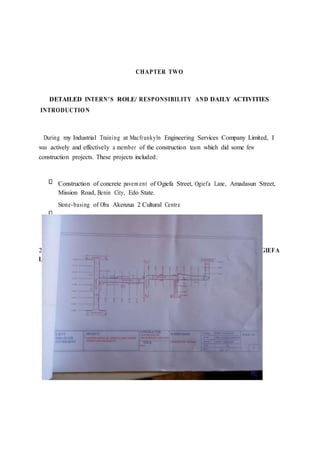
  • 101.
  • 102.
    Fig 4.1- Studentwhile co-supervising the grading 4.2 SKILLS ACQUIRED st
  • 103.
    G o o d c o m m u n i c a ti o n B e f o r e t h e c o m m e n c e m e n t o f m y internship, Ihave always heard how good communication is a very important skill for the 21 century engineer, during my time at Macfrankyln Engineering Services, I was able to experience this because communication is the foundation for every societal relationship; it is through it one relates with the Project Manager, the Carpenters, the Foreman and even with my colleagues, been able to pass information back and forth could mean the difference between a job well done and a poorly finished job. Leadership During the course of my internship, I sometimes (because of the absence of the engineers on ground) would take charge of the supervision. It meant me being the leader, to bring the best out of every worker in order to get the work fully done to specification within the assigned time. I learnt a lifelong experience from this; that being a leader has nothing to do with age but everything to do with working with others effectively. Punctuality 51
  • 104.
    The ability tokeep to time has being something I have being working on, but as the days went by during my industrial training, I saw myself keeping to time and this made punctuality an amazing thing to me; this I am very proud of. Observation Something might look real, but in reality it’s fake. Sometimes, the work done by a worker would seem nearly okay but nearly isn’t the same as okay. In the course of my internship, I learnt the difference between nearly okay and okay through observation. Observation was what was needed to spot out the little difference between good and perfect. Team work An engineer’s ability to work with other people from different backgrounds is essential because at the end of the day, achieving the set target collectively as a team is what matters and not self-glory of ‘I did it all alone’. So this was also another learning point for me. 4.3 PROBLEMS ENCOUNTERED (LIMITATIONS) I would be telling lies if I said mu industrial training was hitch free. It was fraught with both seen and unseen problems which include:
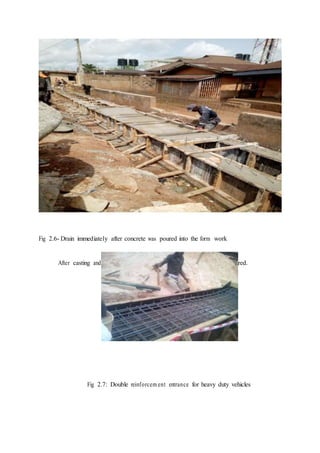
  • 105.
    The yout hs of the com mun ity were not very coop erati ve as they were dem andi ng for “dev elop ment fee” and m oney for beer almo st on a daily basi s. The heavydownpour of rain during the course of the construction work made work really difficult. As it would get so heavy that work would have to be suspended until it subsides. It even made the lateritic soil used to be highly sticky which prevented it’s use causing additional cost in the removal of already placed laterite and its replacement with sharp sand. Transportation issues. The distance between Eyaen (my residential area) and Ogiefa lane (construction site) was much, causing a very long and boring journey to work on a daily basis. Also, the cost of transportation incurred everyday considering the fact that I was also not being paid monthly salary or allowances, was really on the high side. Another challenge/ problem encountered was the fact that I was working with a lot of instructors. Due to the fact that I have never worked or been exposed to a working environment where a lot of people are, during my first few weeks I had problem coping 52
  • 106.
    with a lotof instructors/engineers. Sometimes, they usually had conflicting views, opinions and say concerning an issue and this usually made me confused. However, as the training progressed I was able to cope with it, thereby making me stronger and helped improve my interpersonal relationships with everyone around me. Because it was site work, there was usually little or no time to sit down; it was always work under sun as long as work was ongoing. This initially was vey exhausting for me as I was always tired, but with time I mastered the act of standing and walking for hours while work was going on. 4.4 RECOMMENDATION Based on my experience during the SIWES programme, I recommend that the trainees should be allowed monthly packages in their place of work as they do other employees. I also recommend that both the school as an institution and the company should give the students a thorough orientation and job specification before the official comm encement of the training. Training periods could be extended to enable students obtain broader knowledge in their field of study. I also recommend that SIWES and ITF officials should be in charge of giving students internship placement at available companies/ firms. This would help each student secure a space and do so right on time with little or no stress. I also recomm end there be an enhanced relationship between the company of each student training and the school. Due to the lackadaisical attitude of some students, the institution should do a routine supervision on each student during the course of the training. I also recommend to students who will do their industrial training soon or later in the future, to be very inquisitive about every aspect of the site operation, so they could be well inform ed and not assume some critical aspects of the operation. 4.5 CONCLUSION

  • 107.

    The internship hasreally helped my career as an undergraduate student aiming to acquire the Bachelor of Civil Engineering Degree. During the course of my internship, I had the opportunity to work directly with civil engineers with several years of field experience. I 53
  • 108.
    was opportune towitness an actual construction and not just witness it but be an active part of the concrete pavement construction in Edo state; a form of pavement construction which is not quite common in this part of the country. The internship has helped me to put theories and concepts that I have learnt in my theoretical class to practice. Truth be told, it was interesting seeing what I learnt in my class work in real life. I want to use this opportunity to thank the Federal Ministry of Science and Technology of the Federal Republic of Nigeria for the innovation of the SIWES and the Management of Nigeria University Commission (NUC) for introducing this program into our institutions. Other thanks goes to the management of our great school, University of Benin, for creating SIWES unit that is taking care industrial training related issues.
  • 109.
  • 110.
    REFERENCE - - - - - ACI Committee 304,Guide for Measuring, Mixing, Transporting, and Placing Concrete, ACI 304R-00, ACI Committee 304 Report, American Concrete Institute, Farmington Hills, Michigan, 2ooO. ACI Committee 304, Placing Concrete byPumping Methods, ACI 304.2R-96, ACI Committee 304 Report, American Concrete Institute, Farmington Hills, Michigan, 1996. ACI Committee 304, Placing Concrete with Belt Conveyors, ACI 304.4R-95, ACI Committee 304 Report, American Conme Institute, Farmington Ws, Michigan, 1995. http://www.engineeringintro.com/transportation/road-pavement/ http://en.m.wikipedia.org/wiki/Portland_cement
  • 111.