1
A Synergistic Approach to Information Systems Project
Management
Linda L.S. Lai
Department of Information Systems
City University of Hong Kong
Tat Chee Avenue
Kowloon, Hong Kong
Phone: (852) 2788-7492
Fax: (852) 2788-8694
E-Mail: islsllai@cityu.edu.hk
Abstract
This paper studies synergism in information systems project management. Both
qualitative and quantitative effects of I.S. project team synergy have been assessed.
The quantitative output from group synergy is a structured and on-task team with
synchronized productivity. Qualitative factors in group synergy include: morale,
supportiveness, participation, co-ordination, integration and commitment. It is
believed that both qualitative and quantitative aspects of group synergy are of equal
importance to successful systems development. They are complementary to each
other and together can generate greater effectiveness in I.S. project management.
On the basis of a substantial literature review, the author formulated a model
of group synergy in I.S. project management. In scholarly terms, the suggested
model provides greater understanding of how technical and organizational factors
inhibit/facilitate the success of information systems development. Practically, the
qualitative and quantitative aspects of I.S. project management are brought together
in a complementary manner under the umbrella of synergism. Being equipped with
a broader framework, I.S. professionals can perform a better job in the field of
systems development.
2
'More than 70 percent of all information systems developed within Canadian companies today
are never implemented' (Canadian Manager, p.18, Fall 1992).
'The five-years' development effort of the Taurus trading system of London Stock
Exchange , which sources estimated cost hundreds of millions of dollars, was
termed a disaster, and the project was abandoned in March 1993. ... Meanwhile the
London Ambulance Service was forced to abandoned its emergency system after it
performed disastrously on delivery' (Software Magazine, p.34-35, Aug. 1993).
1. SYSTEMS PROJECT MANAGEMENT - WHERE DO WE START?
Project failure is probably one of the most serious concerns of the information
systems community. During the past decades, numerous tools, techniques and
methodologies such as project evaluation & review technique (PERT), critical path
method (CPM), statistical process control (SPC), structured systems analysis &
design methodology (SSADM), work breakdown structure (WBS), linear
responsibility chart (LRC), computer-aided software engineering (CASE), etc. have
been developed and used to improve the chances of successful information systems
(IS) development. Project managers are challenged to solve a very fundamental
problem from an 'alphabet soup of solutions' (Goldratt & Fox 1986) as shown in
Figure 1.
PERT CPM LOB
SSADM WBS LRC SOW
Systems Project Management - Where do we start?
MBWA SPC CASE MBO
ZBB HRM TQM
3
CASE - Computer-Aided Software Engineering CPM - Critical Path Method
HRM - Human Resource Matrix LOB - Line of Balance
LRC - Linear Responsibility Chart MBO - Management by Objectives
MBWA - Management by Walking Around SOB - Statement of Work
SPC - Statistical Process Control WBS - Work Breakdown Structure
PERT - Project Evaluation & Review Technique
SSADM - Structured Systems Analysis & Design Methodology
TQM - Total Quality Management ZBB - Zero-Based Budgeting
Figure 1 - Possible solutions to problems of I.S. Project Management
However the tremendous advance in technology and the availability of project
management tools, on their own, seem to be to be inadequate to put an I.S. project
on a safe track. 'Even when diligent about thorough project plans, budgets,
schedules, progress reports and so forth, consistent project successes still prove
elusive' (Culp & Smith 1992). Why? What can I.S. professionals bring to a systems
project to make it a success? An exact formula for project success is non-existent.
However, the path to effective systems project management, perhaps, starts with an
understanding of the ends (objectives) and means (necessary conditions to achieve
objectives) of I.S. projects.
2. GOAL & CONDITIONS OF SYSTEMS PROJECT MANAGEMENT (WHAT)
A project is 'a complex effort to achieve a specific objective' (Cleland & King, 1983).
It is 'any activity that results in a deliverable or a product' (Rakos 1990). What are
the 'objectives', 'deliverables' or 'products' of a systems project? An I.S. project aims
to deliver a satisfactory system to users. In order to achieve this goal, crucial
dimensions of systems development must be managed. Project management is
about the 'planning, organizing, directing and controlling of resources' (Kerzner
4
1992) to maintain several necessary conditions of project development so that the
target systems can be delivered successfully.
Three conditions that are generally used to evaluate the effectiveness of
project management are 'performance, time and cost' (Kerzner 1992, Rakos 1990,
Cleland & King 1983, etc.). Performance-time-cost (figure 2) is regarded as a
'magic combination' (Kerzner 1992) that is continuously pursued by project
managers throughout the life cycle of their projects.
Time Cost
Performance
RESOURCES
Figure 2: Project Management - Performance-Time-Cost Combination (Kerzner, 1992)
2.1 Performance
Performance is assessed by the degree to which the product meets the specification
set for it. It is the key determinant of systems project success. For any I.S.
development, certain requirements as to 'major functions, inputs/outputs, operation
& environment, human interface, storage capability, speed, reliability, growth,
maintenance & support, documentation & training' (Rakos 1990) must be defined at
the start of the project. The degree to which a particular task in the development
cycle meets these requirements is an assessment of the performance dimension.
Most systems that fail go astray because the project team does not know and/or
meet the user performance requirements.
5
2.2 Cost
Cost refers to the resources being expended to turn user requirements into a
workable system. It includes direct costs such as salary of analysts/programmers,
computer time, special equipment and overheads, e.g., heat, rent, administration,
clerical support, etc. Project cost management is not only monitoring of costs and
recording perhaps massive quantities of data, but also analyzing the data in order to
take corrective action before it is too late. It is 'dependent on a well-thought-out and
well-defined work scope, the time to implement the project plan, and a managed
change control program' (Werderitsch 1990).
2.3 Time
Time refers to the timeliness of progress in terms of a schedule which has been set
up. Most systems development contracts include the time requirement and specify
damages that the owner will seek if completion dates are not met. Project time
management starts with a schedule of 'direct time' (numbers of person-days of effort
that are required to accomplish the project) and 'elapsed time' (calendar duration
given by mapping direct time onto a real calendar). A project manager reviews the
schedule 'for completeness and critical interface points among the various parties
involved on the project. ... She determines if a target has been established and
how effectively the schedule is being followed' (Werderitsch 1990).
2.4 Interrelationship of Performance, Time & Cost
What is the one thing that can make a project fail-free? That answer perhaps is to
stay within the performance-time-cost triangle of Figure 2. Systems project
management is designed to manage resources on a given project within time, within
cost and within performance.
Unfortunately, many systems projects eventually stumble on crises where this
balance necessary to attain the desired performance within time and cost changes.
6
This is shown in Figure 3 where the ∆s represent deviations from the original
estimates (Kerzner 1992). The time and cost deviations are normally overruns,
whereas the performance error will be an underrun.
In response to deviations, project managers very often juggle the three
constraints and come up with a trade-off depending on some sorts of priorities
placed on the three constraints. Trade-offs are commonly accepted as part of
project management. As the saying goes, 'You can have it good (performance),
cheap (cost) or fast (time): pick two'.
Time Cost
Performance
T C
p
T, C, P
Deviations from
orginal estimate
Figure 3: Deviations of performance, time, cost during project development (Kerzner, 1992)
However, it should be noted that is not possible to sacrifice one of the three
conditions without affecting the others. The following are some possible causes and
effects of performance, time and cost trade-offs.
a) Reducing time will increase cost (especially if overtime is required) and have
negative impacts on performance.
b) Reducing costs will delay schedule and have negative impacts on
performance.
c) Measures (as fire-fighting actions) to enhance performance will increase time
and cost.
d) Lowering performance standards may not pull the project back on schedule
and within budget. A low performance standard very often leads to inadequate
7
quality which in turn results in excessive testing, rework and maintenance. This will
delay delivery dates and decrease productivity and therefore increase cost.
e) Putting extra resources in an ongoing project does not necessarily reduce the
task's duration or enhance the overall performance. One significant point is that the
additional unit (human or non-human resource) may not be able to integrate with
other established units as an organized whole (project team) and thus effectiveness
will in fact fall.
f) Delaying completion dates of a project may not enhance performance and
reduce cost. Information systems development is a manpower
(analyst/programmer) intensive project and thus 'time is money'. As the duration of
a task increases, so cost growth usually occurs. There is also no evidence to
suggest that the longer the time an analyst/programmer takes to finish a task, so the
better performance is the result.
The above points illustrate how performance, time and cost each
continuously influences and is influenced by the other two. A former NASA
(National Aeronautics & Space Administration, US) official compared the conditions
of project management to a 'three-legged milk stool consisting of performance, time
and cost. If any of the legs are missing, the stool will collapse' (Werderitsch 1990).
This is very true in cases of I.S. development. A systems project completed on time
and within budget, yet not meeting performance requirements, will not be accepted
and paid for by the users. Similarly, a late and cost overrun system, even if it meets
performance requirements, is still a failure because it comes in too late and is too
expensive.
If we take a closer look, we find that systems project management is a whole,
a single entity with three dimensions. Every managerial action thus must be
evaluated not according to its impact on any one dimension but on the whole entity.
If we can manage performance, time and cost simultaneously, we are in the right
direction towards successful project management.
8
3. MECHANICAL ASPECTS OF SYSTEMS PROJECT MANAGEMENT (HOW)
While the performance-time-cost parameter is sufficient to determine if a project is
following the right direction, it is, by itself, inadequate to measure the effectiveness
and efficiency of specific operation actions throughout the systems development. A
project manager has to address to issues such as: 'Will the use of computer
hardware/software cause cost overruns?' 'Does the delay of a task change the
completion day?' 'Can these two modules be coded at the same time?' 'Does this
program meet the requirements elicited in the functional specification?'. We clearly
need some mechanisms to ensure every smallest activity move towards the ultimate
goal - successful project completion.
A project manager today is not short of these technical mechanisms. When
properly applied, the tools and techniques shown in Figure 4 contribute to lower
development cost and quicker delivery of a quality system.
Cost Performance Time
Budgeting & Variance Analysis Quality Assurance Process Scheduling
IRD, WBS, LRC
Structured design
Structured programming
Structured walkthrough
Reviews, Tesings
PERT
CPM
GANTT chart
Milestones chart
Budget Formulas
(e.g. COCOMO)
BCWS, BCWP, ACWP
CV, CVP, SV, SVP, EAC
Figure 4: Tools & techniques to optimize performance, time & cost
3.1 Time Control - Scheduling
Schedule commitment and total project target schedule are the bases for time
control. The following are some familiar project scheduling tools:
a) Program Evaluation & Review Technique (PERT) is used to describe the
sequences of activities and identify which activities will be going on simultaneously.
9
b) Critical Path Method (CPM) defines the duration of a project. It also illustrates
which activities to watch and which activities may be crashed.
c) GANTT chart is a time bar chart giving us a quick overview of project status. It
shows which task is ahead or behind schedule.
d) Milestones chart is constructed by tabulating the completion dates and persons
responsible for major events crucial to project progress.
3.2 Cost Control - Budgeting & Variance Analysis
Cost control can be made more effective by applying certain mechanisms, such as:
a) Budget formulas. One of the best known budget formulas is called COCOMO
(Boehm 1981). It is used to estimate project cost, effort (person months), schedule
(months) and staffing (number of staff) for each phase of the systems development
life cycle.
b) Variance and earned value. There are three basic variables for the calculation of
variances and earned values (Archibald 1976):
- Budget cost for work scheduled (BCWS) or planned earned value (PEV),
- Budget cost for work performed (BCWP) or actual earned value (AEV).
- Actual cost for work performed (ACWP)
Using these definitions, useful operation indicators could be obtained:
- Cost variance (CV) = BCWP - ACWP
- Schedule variance (SV) = BCWP - BCWS
- Cost variance % (CVP) = CV/BCWP
- Schedule variance % (SVP) = SV/BCWS
- Estimate at completion (EAC) = (ACWP/BCWP) x total budget
3.3 Performance Control - Quality Assurance Process
Performance is most difficult to quantify. There is no unit of performance. So
system developers opt for measuring speed and cost only - and this is one of the
most common reasons for project failure. Quality assurance is a series of
10
systematic measures to ensure that the quality of the development project is kept
within limits. Typical quality assurance processes (Davis & Olson 1986) are:
- Information requirements determination (IRD) processes to ensure complete
and correct requirements;
- Work breakdown structure (WBS) to define proper decomposition of a project
and the relationships among modules;
- Linear responsibility charts (LRC) to identify participants and to what degree
an activity will be performed or a decision will be made;
- Program development procedures for quality control. These include
structured design, structured programming, structured walkthrough, independent
review of program logic and systems testing;
- Sign-offs at each phase of development to ensure adequate review and
agreement on the system to that point;
- Conventional installation testing.
3.4 Tools Alone are not Enough
We are now back to a fundamental question - why do we still have a high
percentage of project failure in spite of the wide application of powerful tools and
techniques in systems project management? The answer is, 'tools alone won't make
it happen'. It is as if asking 'Will the piano play great music?' We have heard it said
before, 'it is not the piano that make music, it's the musician. People make the
difference.' Similarly, techniques don't manage projects, people do.
Systems project management is often considered to be both an art and a
science. It is an art because of the strong need for interpersonal and people skill,
and the planning and control mechanisms attempt to convert parts of the art into a
science (Kerzner 1992). Tools can only speed up some mechanical activities of the
job. It is people that do the projects. Project success comes when technical skills
are combined with effective people skills; people skills more often cause a project to
fail than does the lack of technical skills (Culp & Smith 1992).
11
4. HUMAN ASPECTS OF SYSTEMS PROJECT MANAGEMENT - (WHO)
The human factors are especially important for I.S. development. The tasks of
systems development are complex and specialized. The project environment is in a
continual state of both cyclical and structural changes (Todryk 1990). New
products, applications, technology, downsizing and corporate acquisitions are all
dynamic elements that will disturb our performance-time-cost equilibrium.
Disturbances and Murphy (i.e. nature always side with the hidden flaw) are part of
systems development. In order to response and react to turbulent environment and
ever-changing requirements, project managers have to reply on a more dynamic
resource - people.
Cost Performance Time
BETTER QUICKER
CHEAPER
TEAMWORK
Triple C Concepts - Complementarities, Communication, Commitment
Figure 5: Human side of performance-time-cost parameter
Let us take a step deeper. There is a more human side of the performance-
time-cost parameter. It is a means to achieve personal objectives at a higher level -
the ultimate goal of being better, quicker and more cost-effective for most
professionals (Figure 5). Systems personnel commonly regard an ability to develop
better, quicker and cheaper systems as a key determinant of their career success.
Project management is about actions as well as visions.
To be quicker, people must be able to respond more rapidly to sudden and
complex problems. When the project schedule starts to slip, we have to bring out
extra efforts that gets the late activity done on time. This means that systems
12
developers should have both the freedom and the right to make their own decisions,
instead of waiting for the project manager to act.
To develop a cheaper system, people must not only focus on their own line
items in a project budget. They need to be flexible enough to move resources from
one part of the project to another to manage resources as a project evolves, in order
to optimize the end result (Culp & Smith 1992). Cost saving is a shared
responsibility.
Better quality systems result from involved people. One cannot inject quality
into a project. The quality of an information system must be addressed during its
creation and is an integral part of the development process (Chroust, Goldmann &
Gschwandtner 1990). This implies that developers must be self-regulated, self-
directed and make amendments as soon as standards of their tasks deviate from the
required level.
What do we call a phenomenon that exhibits characteristics such as
participative decision-making, shared responsibilities and self-directed action? It is
teamwork.
4.1 Project Managers as Team Builders
True teamwork occurs in situations where members are performance-dependent on
each other. It is not the summation of works from a group or collection of individuals
(see Figure 6).
A team is 'able to focus energy, respond rapidly to opportunities, and share
responsibilities and rewards. Teams are purpose-centered: members not only
understand the purpose but are committed to it and use the purpose to guide
actions and decisions' (Buchholz & Roth 1987).
It is believed that the implementation of an effective team-building process in
a systems project management environment will significantly reduce delays and cost
overruns while improving product performance (Todryk 1990). Yet how can a
project manager create an effective team from 'diverse personalities, in a temporary
13
environment and obtaining commitment over which she may not have direct control'
(Graham 1985).
Team building involves a whole spectrum of people skills, and again there is
no exact prescription for its success. However, a triple C (complementarity,
communication and commitment) concept may provide some meaningful guidelines
to project managers.
Collection of
Individuals
Group Team
Effectiveness
Team - uses common purpose
- two-way communication
- collaborative efforts
Group - recognizes common purpose
- one way sharing of responsibility
- co-operative work
- the whole is greater than
the sum of the parts
Collection of Individuals
- lacks common purpose
- does not share responsibility
Figure 6: A team, group & collection of individuals (Buchholz & Roth, 1987)
4.1.1 Complementarity
The complex tasks involved in systems development require the pooling of multiple
human resources. Each member on the project team has a specific job to do and a
specific role to play (Rakos 1990). Analysts/programmers analyze/program and
should be chosen for their analyzing/programming ability and experience with a
particular application. The project leader is expected to provide technical
supervision and solve any systems problem, so the most suitable expert should be
chosen. The project manager is there to provide leadership and handle all
14
communication between project team and the outside world. She needs to possess
excellent people skills supplemented by technical expertise.
A heterogeneous project team composition is useful to get several
perspectives on the issue of information systems development. Contrary opinions
among team members should be encouraged and utilized. Conflicts must be
managed rather than avoided. A team builder aims to achieve unity through
diversity and avoid 'groupthink' (Janis 1972, a phenomenon where a group of similar
thinking people develops blind spots). Complementarities arise when team
members 'recognize and reinforce each other's strength ' (Buchholz & Roth 1987).
4.1.2 Communication
Systems professionals are highly achievement oriented and need the feedback that
a team provides (Stokes 1990). On a project team, everyone should know what is
going on. Information must be held by all so that constructive feedback can occur
and appropriate adjustments be made. A team builder should not only provide
downward communication (project manager to team members), but also upward
communication (team members to project manager) and horizontal communication
(among team members).
According to Buchholz & Roth (1987), 'communication transmits energy.
What you say has the potential to energize others'. What you say also creates an
obligation to your work. Managers who create and maintain a high level of
communication in their work units can enhance teamwork. It is logical to suggest
that systems project have a higher chance of success if team members and the
project managers are open with each other, exchanging ideas in an environment
where they feel safe to speak freely.
4.1.3 Commitment
For a team to become a team and stay as a team, members have to perceive that
their needs are being met through the team experience. A team builder should
15
know as much as possible about what motivates their members and then structure
experience that will help meet those needs (Stokes 1990). When individual goals
align with project goals and members feel that their contributions to the project are
contributing to their personal goals, they turn their contributions to commitment.
They are committed to the direction and outcome of the team. While there may be
different points of views, team members are willing to set those differences aside in
pursuit of a common purpose or goal.
A corporate group is transformed into a collaborative team. Stokes (1990)
states, 'when project members take responsibilities to treat each other
straightforwardly and are dedicated to their performance as individuals and as a
whole, they begin to earn the right to be called a collaborative team'. Collaborative
team efforts emerge as a force to counteract disturbances that arise throughout the
systems development process.
4.2 Does Teamwork Necessarily Lead to Project Success?
One of the most important aspects of systems projects management is thus the
nature of project team (Brown, Klastorin & Valluzzi, 1990). A major responsibility of
the project manager is team building. She should understand the proper makeup
and behavior of effective teams. Group attributes such as complementarity,
communication and commitment are believed to be possible indicators of teamwork
which consequently lead to higher project success.
However a recent research (Brown, Klastorin & Valluzzi, 1990) suggests that
project teams with positive characteristics may not necessarily bring a project to
fruition. Then, what makes an effective project team fail?
5. PUTTING IT ALL TOGETHER - A SYNERGISTIC APPROACH
The management of a systems project is one of the most difficult tasks that an I.S.
professional may face. It involves 'exercising capabilities in defining the project and
analyzing work; in planning for and wisely using resources; in setting performance
16
objectives, priorities, and standards; in developing a budget, getting it funded, and
supervising expenditure; in establishing necessary controls and meaningful
supervision; in facilitating adequate communication, reporting and evaluation
systems, etc'. (Harris & Harris 1989). All of these functions must be performed
properly by the project manager and project members, for the project to be a
success.
One very crucial but often overlooked concept is that local success does not
add up to the success of the whole project. An ability to analyze the whole project
rather than the individual parts, is the first prerequisite for successful systems
project management. The interconnections and interactions between components
(people or tasks) of a project are often more important than the separate
components themselves. In the I.S. development context, a project manager must
not only ensure that separate elements perform effectively, but must also create a
situation where all work units function towards a common purpose and accomplish
what none of the work units could achieve singly. The conceptual term for this
phenomenon is synergy.
5.1. What is Synergy and a Synergistic Approach?
Synergy, according to Fuller (1981), 'is the behavior of whole systems that cannot
be predicted by the behavior of any parts taken separately. ... In order to really
understand what is going on, we have to abandon starting with parts, and we must
work instead from whole to particular'. It is 'the simultaneous actions of separate
entities, which together have greater total effects than the sum of their individual
effects' (Buchholz & Roth 1987). The belief is that 'the whole is greater than the
sum of its parts' (Aristotle). Basically, synergism is focusing on a system's effort so
that 2+2 >4. The '>4' is an 'emergent property' that only exists in the whole but has
no meaning in terms of its parts.
A synergistic approach involves 'a new way of thinking which help to free one
from outdated patterns and can break the shell of permitted ignorance' (Burger &
17
Bass 1979). With a new way of thinking, we may regard systems project
management as a team of interdependent elements working together synergistically
to achieve a common goal - the delivery of a successful system. The adopted
approach should look at the 'total picture' 'work from whole to particular' and
consider all the 'interaction necessary between various elements of the parties',
including people and machines.
5.1.1 Start from the Performance-Time-Cost Combination
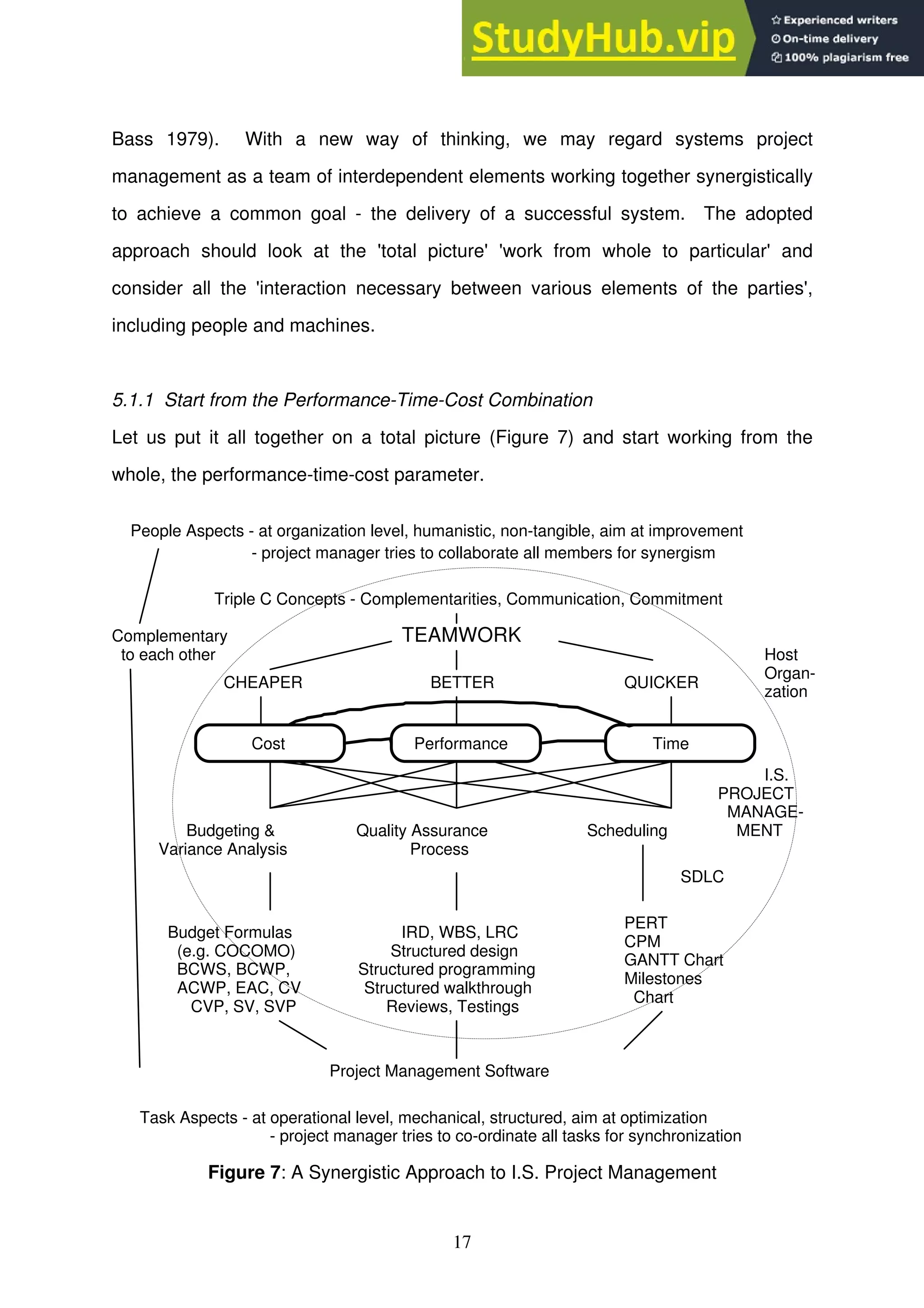
Let us put it all together on a total picture (Figure 7) and start working from the
whole, the performance-time-cost parameter.
Cost Performance Time
BETTER QUICKER
CHEAPER
TEAMWORK
Triple C Concepts - Complementarities, Communication, Commitment
Budgeting & Quality Assurance Scheduling
Budget Formulas
(e.g. COCOMO)
BCWS, BCWP,
CVP, SV, SVP
IRD, WBS, LRC
Structured design
Structured programming
Structured walkthrough
Reviews, Testings
PERT
CPM
GANTT Chart
Milestones
Project Management Software
Task Aspects - at operational level, mechanical, structured, aim at optimization
- project manager tries to co-ordinate all tasks for synchronization
People Aspects - at organization level, humanistic, non-tangible, aim at improvement
- project manager tries to collaborate all members for synergism
Complementary
to each other Host
Organ-
SDLC
zation
ACWP, EAC, CV
Variance Analysis Process
Chart
I.S.
PROJECT
MANAGE-
MENT
Figure 7: A Synergistic Approach to I.S. Project Management
18
Performance-time-cost is a whole with three parts. Like any other whole, its
parts are interdependent and with unequal strengths and weaknesses. Synergism
is built on achieving simultaneous success of all parts, and if one part fails, the
whole project fails. The strength of a project may thus be determined by the
strength of its most delicate part - the weakest leg which is most vulnerable to
disturbance and causes the whole 'three-legged milk stool' (Werderitsch 1990) to
collapse.
A synergistic view recognizes all project elements' strengths/weaknesses and
facilitates supporting co-operative actions to counterbalance the weakness of any
part at any time throughout the systems development. Practical concerns are:
- Identifying the most delicate part of the performance-time-cost parameter at a
given point in time and under a particular development environment;
- Collaborating all efforts to protect the most delicate part (and thus protect the
project). When the delicate part is safe, loop back and analyze the situation again.
The above processes are iterative and never ending as the most delicate part
may change throughout the project life cycle.
A way to distinguish the most delicate leg of the performance-time-cost
triangle is by analyzing a project's internal variables (phases of systems
development life cycle) and external environment (the organization that an
information system serves).
5.1.1.1 Constraints from the host organization
The nature of an information system is to serve an organization (Checkland 1982,
Wilson 1984). The host organization of an information system is thus an external
force that may determine which one of performance, cost and time is most crucial to
the overall success of an I.S. project. The decision is situation-oriented. Appendix
1 illustrates the relative importance of performance, cost and time to different
industries in the 1980s.
19
Generally speaking, time is most critical to projects developed for the
commercial and financial sectors. For systems to support research and
development, performance should never be compromised. Cost overrun is normally
unacceptable to non-profit making organizations that derive their incomes from
donations and/or governments. However, every project environment is unique and
project managers must know how to make their own decisions.
5.1.1.2 Constraints from phases of the development life cycle
The cruciality of performance, time, cost also depends upon the life cycle phases of
a given systems project.
Performance is of top priority one during the early definition stage. The
quality of its outputs, such as requirements document and functional specification,
is very difficult to control (Rakos 1990). Errors, which are not easily detected in
analysis and logical design phases, may cause dreadful damage to the final
product.
Most tedious jobs (such as physical design, programming, testing , etc.) are done in
the development stage. During these phases, the schedule tends to slip
unnoticeably, perhaps one day at a time. Timeliness is very vulnerable and should
be protected by maximum efforts.
As a project moves towards its operational stage, cost becomes increasingly
critical. The cost of numerous structural, procedural and attitudinal changes
(Checkland 1982) involved in the conversion and implementation phases is difficult
(if not impossible) to estimate. There must be considerable contingency measures
to offset potential damages of cost overrun.
By examining the external and internal conditions of a systems development,
a project manager (together with team members) should be able to make a decision
on which is the weakest element, when, and how it can be protected. Once a
decision is reached, all works units must function synergistically towards the target.
Synergy might be established at both people and task levels.
20
5.1.2 Tasks are co-ordinated to achieve synchronization
At the operation level, a project manager plays the role of a co-ordinator. She aims
to synchronize all activities with respect to the performance-time-cost constraint.
Activities such as adding extra floats and contingency to a job, crashing a task,
testing and/or retesting a program are geared towards the optimum of the identified
critical part of the project (and thus the project as a whole).
5.1.3 People collaborate to create synergy
At the organization level, a project manager plays the role of a collaborator. She
endeavors to create an environment where members are committed to a common
goal, and moved to being interdependent. Team members help each other to
become better, quicker and more cost-effective systems developers. Individuals'
talents come together synergistically to keep the project within a performance-time-
cost equilibrium.
5.1.4 Task and people effectiveness are complementary to each other
A synergistic approach also focuses on creating complementarity between task and
organization effectiveness.
Project managers should use group dynamics to increase productivity. Peer
pressure is as powerful as any highly technical mechanisms to stop the project
slacking off. People are also more dedicated to the tasks whose budget, schedule,
checkpoint and quality assurance measures are designed by themselves.
Project management tools such as PERT/CPM and milestone charts can be
excellent means to team building. For example, network charts show the
interdependencies of tasks in a very personal manner because people know exactly
who is dependent on whom. This personal knowledge facilitates commitment from
team members to each other and to the project.
21
5.2 Multi-Roles of a Synergistic Project Manager
With the synergistic approach, a systems project manager has an even more difficult
task. She should take up several essential responsibilities at one time. These
include:
- to analyze the relationship between an I.S. project and its host organization
as well as the development life cycle phases;
- to co-ordinate all project tasks for synchronization;
- to collaborate all project team members for synergism;
- to complement task productivity with people effectiveness, and vice versa.
While the above processes of project management can entail difficulties and
frustration on concerned systems professionals, the reward is great. The challenge
is to create a work situation where all work units perform as if they were
experiencing greater energy than they were supplying by individually - synergism.
6. CONCLUSION
Based on the above analyses, it could be comfortably assumed that there is a close
relationship between synergy and the design, development and implementation of
successful management information systems. A synergistic approach to information
systems development aims to build up a project team where members take energy
from one another for synergy. The management effective can be assessed by its
outputs of both quantitative and qualitative nature.
The quantitative outcome is a structured on-task work force with
synchronized productivity. Results in qualitative aspects include: team morale,
supportiveness, participation, integration, commitment and creativity.
A combination of all the above competencies is likely to bring a greater
success in the information systems development process.
22
7. REFERENCES
Adedeji, B & Badiru, P.E. (1990) A Systems Approach to Total Quality Management,
Industrial Engineering, 7, 4, 58-66.
Adler, N.J. (1986) International Dimensions of Organizational Behavior, Kent
Publishing Co.: Boston, Mass.
Black, G (1993) Fail-safe Advice, Software Magazine, 13, 12, 34-35.
Boehm, B.W. (1981) Software Engineering Economics, Prentice Hall: Englewood
Cliffs, N.J.
Bolman, L.G. & Deal, T.E. (1991) Reframing Organizations: Artistry, Choice and
Leadership, Jossey-Bass: San Francisco, CA.
Brown, K.A., Klastorin, T.D. & Valluzzi J.L. (1990) Project Performance and the
Liability of Group Harmony, IEEE Transactions On Engineering Management,
37, 2, 117-125.
Buchholz, S. & Roth, T. (1987) Creating the High-Performance Team, John Wiley,
New York.
Cash, C. & Fox, R. (1992) Elements of Successful Project Management, Journal of
Systems Management, 4, 10-12.
Burger, P. & Bass, B.M. (1979) Assessment of Managers: An International
Comparison, New York: Free Press.
Checkland, P.B. & Scholes, J. (1991) Soft Systems Methodology in Action, John
Wiley: Chichester.
Checkland, P.B. (1982) Systems Thinking, Systems Practice, John Wiley:
Chichester.
Chroust, G., Goldmann, H. & Gschwandtner, O. (1990) The Role of Work
Management in Application, IRM Systems Journal, 29, 2, 189-208.
Cleland, D.I. & King W.R. (1983) Systems Analysis and Project Management,
McGraw-Hill New York.
Culp, G. Smith, A (1992) Managing People for Project Success, Van Nostrand
Reinhold New York.
Davis, G.B. & Olson, M. H. (1984) Management Information Systems, McGraw-Hill
Inc., New York.
23
Fuller, R.B. (1981) Critical Path, St. Martin's Press/World Future Society:
Washington, D.C.
Goldratt, E.M. & Fox, R.E. (1986) The Race, North River Press Inc.: New York.
Goldratt, E.M. (1992) The Haystack Syndrome, North River Press, Inc.: New York.
Graham, R.J. (1985) Project Management: Combining Technical and Behavioral
Approaches for Effective Implementation, Van Nostrand Reinhold: New York.
Harris, P.R. & Harris D.L. (1989) High Performance Team Management, Leadership
& Organization Development Journal, 10, 4, 28-32.
Janis, I.L. (1972) Victims of Groupthink: A Psychological Study of Foreign Policy
Decisions and Fiascoes, Houghton Mifflin: Boston, M.A.
Kerzner, H. (1992) Project Management: A Systems Approach to Planning,
Scheduling and Controlling, Van Nostrand Reinhold: New York.
Raheb, S.E. (1992) There's No Excuse For Failure, Canadian Manager, 2, 18-19.
Rakos, J.J. (1990) Software Project Management for Small to Medium Sized
Projects, Prentice Hall: Englewood Cliffs, NJ.
Stokes, S.L. (1990) Building Effective Project Teams, Journal of Information
Systems Management, 7, 3, 38-45.
Todryk L. (1990) The Project Manager As Team Builder: Creating An Effective
Team, Project Management Journal, 21, 4, 17-32.
Werderitsch, A.J. (1990) Project Management Oversight: An Independent Project
Assessment, Cost Engineering, 32, 7, 19-25.
Weston, F.C. T. (1991) Functional Goals Are Often In Conflict With Each Other,
Industrial Engineering, 3, 25-29.
Wilson, B. (1984) Systems Concepts: Methodologies and Applications, John Wiley:
Chichester.
24
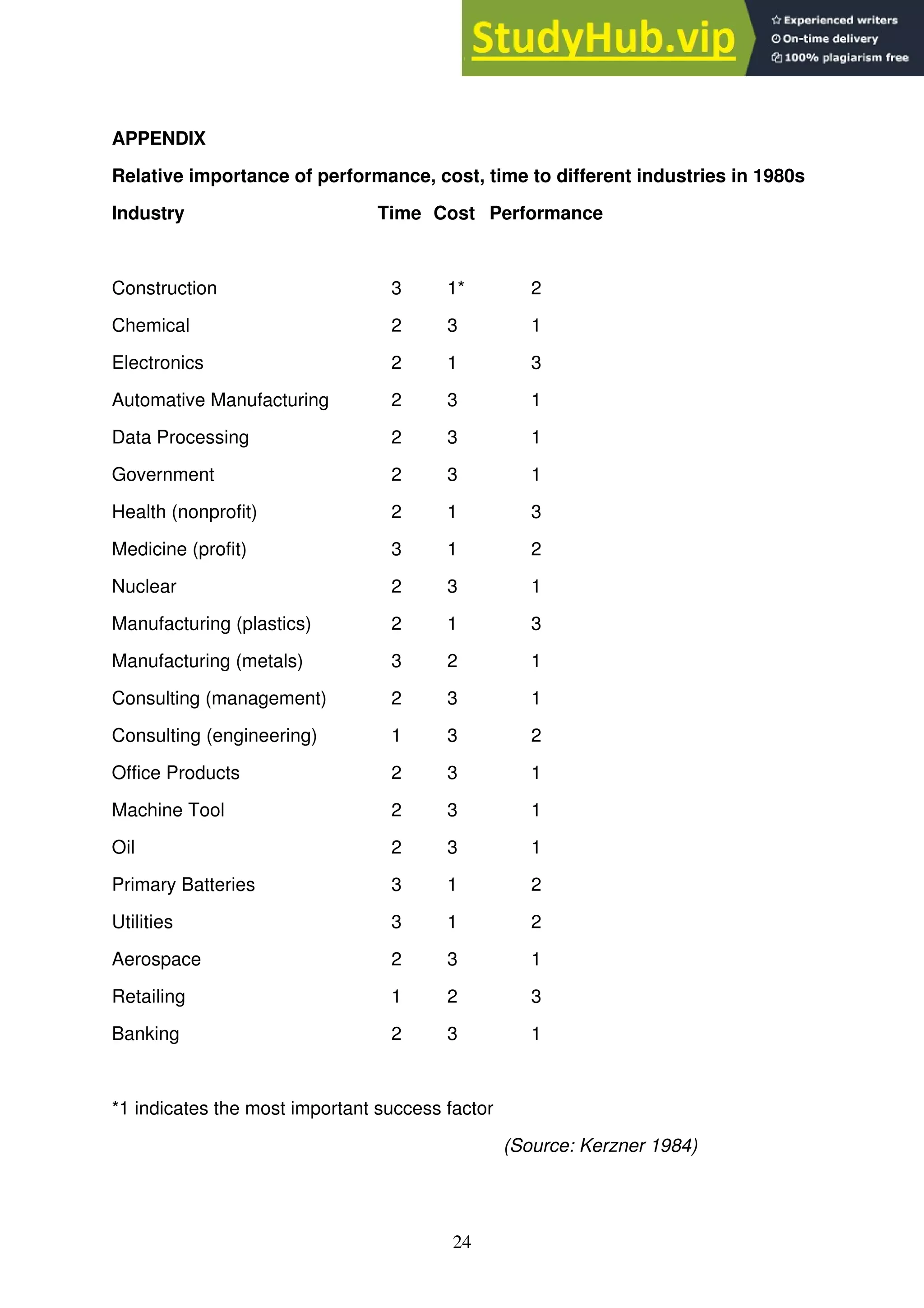
APPENDIX
Relative importance of performance, cost, time to different industries in 1980s
Industry Time Cost Performance
Construction 3 1* 2
Chemical 2 3 1
Electronics 2 1 3
Automative Manufacturing 2 3 1
Data Processing 2 3 1
Government 2 3 1
Health (nonprofit) 2 1 3
Medicine (profit) 3 1 2
Nuclear 2 3 1
Manufacturing (plastics) 2 1 3
Manufacturing (metals) 3 2 1
Consulting (management) 2 3 1
Consulting (engineering) 1 3 2
Office Products 2 3 1
Machine Tool 2 3 1
Oil 2 3 1
Primary Batteries 3 1 2
Utilities 3 1 2
Aerospace 2 3 1
Retailing 1 2 3
Banking 2 3 1
*1 indicates the most important success factor
(Source: Kerzner 1984)

A Synergistic Approach To Information Systems Project Management

  • 1.
    1 A Synergistic Approachto Information Systems Project Management Linda L.S. Lai Department of Information Systems City University of Hong Kong Tat Chee Avenue Kowloon, Hong Kong Phone: (852) 2788-7492 Fax: (852) 2788-8694 E-Mail: islsllai@cityu.edu.hk Abstract This paper studies synergism in information systems project management. Both qualitative and quantitative effects of I.S. project team synergy have been assessed. The quantitative output from group synergy is a structured and on-task team with synchronized productivity. Qualitative factors in group synergy include: morale, supportiveness, participation, co-ordination, integration and commitment. It is believed that both qualitative and quantitative aspects of group synergy are of equal importance to successful systems development. They are complementary to each other and together can generate greater effectiveness in I.S. project management. On the basis of a substantial literature review, the author formulated a model of group synergy in I.S. project management. In scholarly terms, the suggested model provides greater understanding of how technical and organizational factors inhibit/facilitate the success of information systems development. Practically, the qualitative and quantitative aspects of I.S. project management are brought together in a complementary manner under the umbrella of synergism. Being equipped with a broader framework, I.S. professionals can perform a better job in the field of systems development.
  • 2.
    2 'More than 70percent of all information systems developed within Canadian companies today are never implemented' (Canadian Manager, p.18, Fall 1992). 'The five-years' development effort of the Taurus trading system of London Stock Exchange , which sources estimated cost hundreds of millions of dollars, was termed a disaster, and the project was abandoned in March 1993. ... Meanwhile the London Ambulance Service was forced to abandoned its emergency system after it performed disastrously on delivery' (Software Magazine, p.34-35, Aug. 1993). 1. SYSTEMS PROJECT MANAGEMENT - WHERE DO WE START? Project failure is probably one of the most serious concerns of the information systems community. During the past decades, numerous tools, techniques and methodologies such as project evaluation & review technique (PERT), critical path method (CPM), statistical process control (SPC), structured systems analysis & design methodology (SSADM), work breakdown structure (WBS), linear responsibility chart (LRC), computer-aided software engineering (CASE), etc. have been developed and used to improve the chances of successful information systems (IS) development. Project managers are challenged to solve a very fundamental problem from an 'alphabet soup of solutions' (Goldratt & Fox 1986) as shown in Figure 1. PERT CPM LOB SSADM WBS LRC SOW Systems Project Management - Where do we start? MBWA SPC CASE MBO ZBB HRM TQM
  • 3.
    3 CASE - Computer-AidedSoftware Engineering CPM - Critical Path Method HRM - Human Resource Matrix LOB - Line of Balance LRC - Linear Responsibility Chart MBO - Management by Objectives MBWA - Management by Walking Around SOB - Statement of Work SPC - Statistical Process Control WBS - Work Breakdown Structure PERT - Project Evaluation & Review Technique SSADM - Structured Systems Analysis & Design Methodology TQM - Total Quality Management ZBB - Zero-Based Budgeting Figure 1 - Possible solutions to problems of I.S. Project Management However the tremendous advance in technology and the availability of project management tools, on their own, seem to be to be inadequate to put an I.S. project on a safe track. 'Even when diligent about thorough project plans, budgets, schedules, progress reports and so forth, consistent project successes still prove elusive' (Culp & Smith 1992). Why? What can I.S. professionals bring to a systems project to make it a success? An exact formula for project success is non-existent. However, the path to effective systems project management, perhaps, starts with an understanding of the ends (objectives) and means (necessary conditions to achieve objectives) of I.S. projects. 2. GOAL & CONDITIONS OF SYSTEMS PROJECT MANAGEMENT (WHAT) A project is 'a complex effort to achieve a specific objective' (Cleland & King, 1983). It is 'any activity that results in a deliverable or a product' (Rakos 1990). What are the 'objectives', 'deliverables' or 'products' of a systems project? An I.S. project aims to deliver a satisfactory system to users. In order to achieve this goal, crucial dimensions of systems development must be managed. Project management is about the 'planning, organizing, directing and controlling of resources' (Kerzner
  • 4.
    4 1992) to maintainseveral necessary conditions of project development so that the target systems can be delivered successfully. Three conditions that are generally used to evaluate the effectiveness of project management are 'performance, time and cost' (Kerzner 1992, Rakos 1990, Cleland & King 1983, etc.). Performance-time-cost (figure 2) is regarded as a 'magic combination' (Kerzner 1992) that is continuously pursued by project managers throughout the life cycle of their projects. Time Cost Performance RESOURCES Figure 2: Project Management - Performance-Time-Cost Combination (Kerzner, 1992) 2.1 Performance Performance is assessed by the degree to which the product meets the specification set for it. It is the key determinant of systems project success. For any I.S. development, certain requirements as to 'major functions, inputs/outputs, operation & environment, human interface, storage capability, speed, reliability, growth, maintenance & support, documentation & training' (Rakos 1990) must be defined at the start of the project. The degree to which a particular task in the development cycle meets these requirements is an assessment of the performance dimension. Most systems that fail go astray because the project team does not know and/or meet the user performance requirements.
  • 5.
    5 2.2 Cost Cost refersto the resources being expended to turn user requirements into a workable system. It includes direct costs such as salary of analysts/programmers, computer time, special equipment and overheads, e.g., heat, rent, administration, clerical support, etc. Project cost management is not only monitoring of costs and recording perhaps massive quantities of data, but also analyzing the data in order to take corrective action before it is too late. It is 'dependent on a well-thought-out and well-defined work scope, the time to implement the project plan, and a managed change control program' (Werderitsch 1990). 2.3 Time Time refers to the timeliness of progress in terms of a schedule which has been set up. Most systems development contracts include the time requirement and specify damages that the owner will seek if completion dates are not met. Project time management starts with a schedule of 'direct time' (numbers of person-days of effort that are required to accomplish the project) and 'elapsed time' (calendar duration given by mapping direct time onto a real calendar). A project manager reviews the schedule 'for completeness and critical interface points among the various parties involved on the project. ... She determines if a target has been established and how effectively the schedule is being followed' (Werderitsch 1990). 2.4 Interrelationship of Performance, Time & Cost What is the one thing that can make a project fail-free? That answer perhaps is to stay within the performance-time-cost triangle of Figure 2. Systems project management is designed to manage resources on a given project within time, within cost and within performance. Unfortunately, many systems projects eventually stumble on crises where this balance necessary to attain the desired performance within time and cost changes.
  • 6.
    6 This is shownin Figure 3 where the ∆s represent deviations from the original estimates (Kerzner 1992). The time and cost deviations are normally overruns, whereas the performance error will be an underrun. In response to deviations, project managers very often juggle the three constraints and come up with a trade-off depending on some sorts of priorities placed on the three constraints. Trade-offs are commonly accepted as part of project management. As the saying goes, 'You can have it good (performance), cheap (cost) or fast (time): pick two'. Time Cost Performance T C p T, C, P Deviations from orginal estimate Figure 3: Deviations of performance, time, cost during project development (Kerzner, 1992) However, it should be noted that is not possible to sacrifice one of the three conditions without affecting the others. The following are some possible causes and effects of performance, time and cost trade-offs. a) Reducing time will increase cost (especially if overtime is required) and have negative impacts on performance. b) Reducing costs will delay schedule and have negative impacts on performance. c) Measures (as fire-fighting actions) to enhance performance will increase time and cost. d) Lowering performance standards may not pull the project back on schedule and within budget. A low performance standard very often leads to inadequate
  • 7.
    7 quality which inturn results in excessive testing, rework and maintenance. This will delay delivery dates and decrease productivity and therefore increase cost. e) Putting extra resources in an ongoing project does not necessarily reduce the task's duration or enhance the overall performance. One significant point is that the additional unit (human or non-human resource) may not be able to integrate with other established units as an organized whole (project team) and thus effectiveness will in fact fall. f) Delaying completion dates of a project may not enhance performance and reduce cost. Information systems development is a manpower (analyst/programmer) intensive project and thus 'time is money'. As the duration of a task increases, so cost growth usually occurs. There is also no evidence to suggest that the longer the time an analyst/programmer takes to finish a task, so the better performance is the result. The above points illustrate how performance, time and cost each continuously influences and is influenced by the other two. A former NASA (National Aeronautics & Space Administration, US) official compared the conditions of project management to a 'three-legged milk stool consisting of performance, time and cost. If any of the legs are missing, the stool will collapse' (Werderitsch 1990). This is very true in cases of I.S. development. A systems project completed on time and within budget, yet not meeting performance requirements, will not be accepted and paid for by the users. Similarly, a late and cost overrun system, even if it meets performance requirements, is still a failure because it comes in too late and is too expensive. If we take a closer look, we find that systems project management is a whole, a single entity with three dimensions. Every managerial action thus must be evaluated not according to its impact on any one dimension but on the whole entity. If we can manage performance, time and cost simultaneously, we are in the right direction towards successful project management.
  • 8.
    8 3. MECHANICAL ASPECTSOF SYSTEMS PROJECT MANAGEMENT (HOW) While the performance-time-cost parameter is sufficient to determine if a project is following the right direction, it is, by itself, inadequate to measure the effectiveness and efficiency of specific operation actions throughout the systems development. A project manager has to address to issues such as: 'Will the use of computer hardware/software cause cost overruns?' 'Does the delay of a task change the completion day?' 'Can these two modules be coded at the same time?' 'Does this program meet the requirements elicited in the functional specification?'. We clearly need some mechanisms to ensure every smallest activity move towards the ultimate goal - successful project completion. A project manager today is not short of these technical mechanisms. When properly applied, the tools and techniques shown in Figure 4 contribute to lower development cost and quicker delivery of a quality system. Cost Performance Time Budgeting & Variance Analysis Quality Assurance Process Scheduling IRD, WBS, LRC Structured design Structured programming Structured walkthrough Reviews, Tesings PERT CPM GANTT chart Milestones chart Budget Formulas (e.g. COCOMO) BCWS, BCWP, ACWP CV, CVP, SV, SVP, EAC Figure 4: Tools & techniques to optimize performance, time & cost 3.1 Time Control - Scheduling Schedule commitment and total project target schedule are the bases for time control. The following are some familiar project scheduling tools: a) Program Evaluation & Review Technique (PERT) is used to describe the sequences of activities and identify which activities will be going on simultaneously.
  • 9.
    9 b) Critical PathMethod (CPM) defines the duration of a project. It also illustrates which activities to watch and which activities may be crashed. c) GANTT chart is a time bar chart giving us a quick overview of project status. It shows which task is ahead or behind schedule. d) Milestones chart is constructed by tabulating the completion dates and persons responsible for major events crucial to project progress. 3.2 Cost Control - Budgeting & Variance Analysis Cost control can be made more effective by applying certain mechanisms, such as: a) Budget formulas. One of the best known budget formulas is called COCOMO (Boehm 1981). It is used to estimate project cost, effort (person months), schedule (months) and staffing (number of staff) for each phase of the systems development life cycle. b) Variance and earned value. There are three basic variables for the calculation of variances and earned values (Archibald 1976): - Budget cost for work scheduled (BCWS) or planned earned value (PEV), - Budget cost for work performed (BCWP) or actual earned value (AEV). - Actual cost for work performed (ACWP) Using these definitions, useful operation indicators could be obtained: - Cost variance (CV) = BCWP - ACWP - Schedule variance (SV) = BCWP - BCWS - Cost variance % (CVP) = CV/BCWP - Schedule variance % (SVP) = SV/BCWS - Estimate at completion (EAC) = (ACWP/BCWP) x total budget 3.3 Performance Control - Quality Assurance Process Performance is most difficult to quantify. There is no unit of performance. So system developers opt for measuring speed and cost only - and this is one of the most common reasons for project failure. Quality assurance is a series of
  • 10.
    10 systematic measures toensure that the quality of the development project is kept within limits. Typical quality assurance processes (Davis & Olson 1986) are: - Information requirements determination (IRD) processes to ensure complete and correct requirements; - Work breakdown structure (WBS) to define proper decomposition of a project and the relationships among modules; - Linear responsibility charts (LRC) to identify participants and to what degree an activity will be performed or a decision will be made; - Program development procedures for quality control. These include structured design, structured programming, structured walkthrough, independent review of program logic and systems testing; - Sign-offs at each phase of development to ensure adequate review and agreement on the system to that point; - Conventional installation testing. 3.4 Tools Alone are not Enough We are now back to a fundamental question - why do we still have a high percentage of project failure in spite of the wide application of powerful tools and techniques in systems project management? The answer is, 'tools alone won't make it happen'. It is as if asking 'Will the piano play great music?' We have heard it said before, 'it is not the piano that make music, it's the musician. People make the difference.' Similarly, techniques don't manage projects, people do. Systems project management is often considered to be both an art and a science. It is an art because of the strong need for interpersonal and people skill, and the planning and control mechanisms attempt to convert parts of the art into a science (Kerzner 1992). Tools can only speed up some mechanical activities of the job. It is people that do the projects. Project success comes when technical skills are combined with effective people skills; people skills more often cause a project to fail than does the lack of technical skills (Culp & Smith 1992).
  • 11.
    11 4. HUMAN ASPECTSOF SYSTEMS PROJECT MANAGEMENT - (WHO) The human factors are especially important for I.S. development. The tasks of systems development are complex and specialized. The project environment is in a continual state of both cyclical and structural changes (Todryk 1990). New products, applications, technology, downsizing and corporate acquisitions are all dynamic elements that will disturb our performance-time-cost equilibrium. Disturbances and Murphy (i.e. nature always side with the hidden flaw) are part of systems development. In order to response and react to turbulent environment and ever-changing requirements, project managers have to reply on a more dynamic resource - people. Cost Performance Time BETTER QUICKER CHEAPER TEAMWORK Triple C Concepts - Complementarities, Communication, Commitment Figure 5: Human side of performance-time-cost parameter Let us take a step deeper. There is a more human side of the performance- time-cost parameter. It is a means to achieve personal objectives at a higher level - the ultimate goal of being better, quicker and more cost-effective for most professionals (Figure 5). Systems personnel commonly regard an ability to develop better, quicker and cheaper systems as a key determinant of their career success. Project management is about actions as well as visions. To be quicker, people must be able to respond more rapidly to sudden and complex problems. When the project schedule starts to slip, we have to bring out extra efforts that gets the late activity done on time. This means that systems
  • 12.
    12 developers should haveboth the freedom and the right to make their own decisions, instead of waiting for the project manager to act. To develop a cheaper system, people must not only focus on their own line items in a project budget. They need to be flexible enough to move resources from one part of the project to another to manage resources as a project evolves, in order to optimize the end result (Culp & Smith 1992). Cost saving is a shared responsibility. Better quality systems result from involved people. One cannot inject quality into a project. The quality of an information system must be addressed during its creation and is an integral part of the development process (Chroust, Goldmann & Gschwandtner 1990). This implies that developers must be self-regulated, self- directed and make amendments as soon as standards of their tasks deviate from the required level. What do we call a phenomenon that exhibits characteristics such as participative decision-making, shared responsibilities and self-directed action? It is teamwork. 4.1 Project Managers as Team Builders True teamwork occurs in situations where members are performance-dependent on each other. It is not the summation of works from a group or collection of individuals (see Figure 6). A team is 'able to focus energy, respond rapidly to opportunities, and share responsibilities and rewards. Teams are purpose-centered: members not only understand the purpose but are committed to it and use the purpose to guide actions and decisions' (Buchholz & Roth 1987). It is believed that the implementation of an effective team-building process in a systems project management environment will significantly reduce delays and cost overruns while improving product performance (Todryk 1990). Yet how can a project manager create an effective team from 'diverse personalities, in a temporary
  • 13.
    13 environment and obtainingcommitment over which she may not have direct control' (Graham 1985). Team building involves a whole spectrum of people skills, and again there is no exact prescription for its success. However, a triple C (complementarity, communication and commitment) concept may provide some meaningful guidelines to project managers. Collection of Individuals Group Team Effectiveness Team - uses common purpose - two-way communication - collaborative efforts Group - recognizes common purpose - one way sharing of responsibility - co-operative work - the whole is greater than the sum of the parts Collection of Individuals - lacks common purpose - does not share responsibility Figure 6: A team, group & collection of individuals (Buchholz & Roth, 1987) 4.1.1 Complementarity The complex tasks involved in systems development require the pooling of multiple human resources. Each member on the project team has a specific job to do and a specific role to play (Rakos 1990). Analysts/programmers analyze/program and should be chosen for their analyzing/programming ability and experience with a particular application. The project leader is expected to provide technical supervision and solve any systems problem, so the most suitable expert should be chosen. The project manager is there to provide leadership and handle all
  • 14.
    14 communication between projectteam and the outside world. She needs to possess excellent people skills supplemented by technical expertise. A heterogeneous project team composition is useful to get several perspectives on the issue of information systems development. Contrary opinions among team members should be encouraged and utilized. Conflicts must be managed rather than avoided. A team builder aims to achieve unity through diversity and avoid 'groupthink' (Janis 1972, a phenomenon where a group of similar thinking people develops blind spots). Complementarities arise when team members 'recognize and reinforce each other's strength ' (Buchholz & Roth 1987). 4.1.2 Communication Systems professionals are highly achievement oriented and need the feedback that a team provides (Stokes 1990). On a project team, everyone should know what is going on. Information must be held by all so that constructive feedback can occur and appropriate adjustments be made. A team builder should not only provide downward communication (project manager to team members), but also upward communication (team members to project manager) and horizontal communication (among team members). According to Buchholz & Roth (1987), 'communication transmits energy. What you say has the potential to energize others'. What you say also creates an obligation to your work. Managers who create and maintain a high level of communication in their work units can enhance teamwork. It is logical to suggest that systems project have a higher chance of success if team members and the project managers are open with each other, exchanging ideas in an environment where they feel safe to speak freely. 4.1.3 Commitment For a team to become a team and stay as a team, members have to perceive that their needs are being met through the team experience. A team builder should
  • 15.
    15 know as muchas possible about what motivates their members and then structure experience that will help meet those needs (Stokes 1990). When individual goals align with project goals and members feel that their contributions to the project are contributing to their personal goals, they turn their contributions to commitment. They are committed to the direction and outcome of the team. While there may be different points of views, team members are willing to set those differences aside in pursuit of a common purpose or goal. A corporate group is transformed into a collaborative team. Stokes (1990) states, 'when project members take responsibilities to treat each other straightforwardly and are dedicated to their performance as individuals and as a whole, they begin to earn the right to be called a collaborative team'. Collaborative team efforts emerge as a force to counteract disturbances that arise throughout the systems development process. 4.2 Does Teamwork Necessarily Lead to Project Success? One of the most important aspects of systems projects management is thus the nature of project team (Brown, Klastorin & Valluzzi, 1990). A major responsibility of the project manager is team building. She should understand the proper makeup and behavior of effective teams. Group attributes such as complementarity, communication and commitment are believed to be possible indicators of teamwork which consequently lead to higher project success. However a recent research (Brown, Klastorin & Valluzzi, 1990) suggests that project teams with positive characteristics may not necessarily bring a project to fruition. Then, what makes an effective project team fail? 5. PUTTING IT ALL TOGETHER - A SYNERGISTIC APPROACH The management of a systems project is one of the most difficult tasks that an I.S. professional may face. It involves 'exercising capabilities in defining the project and analyzing work; in planning for and wisely using resources; in setting performance
  • 16.
    16 objectives, priorities, andstandards; in developing a budget, getting it funded, and supervising expenditure; in establishing necessary controls and meaningful supervision; in facilitating adequate communication, reporting and evaluation systems, etc'. (Harris & Harris 1989). All of these functions must be performed properly by the project manager and project members, for the project to be a success. One very crucial but often overlooked concept is that local success does not add up to the success of the whole project. An ability to analyze the whole project rather than the individual parts, is the first prerequisite for successful systems project management. The interconnections and interactions between components (people or tasks) of a project are often more important than the separate components themselves. In the I.S. development context, a project manager must not only ensure that separate elements perform effectively, but must also create a situation where all work units function towards a common purpose and accomplish what none of the work units could achieve singly. The conceptual term for this phenomenon is synergy. 5.1. What is Synergy and a Synergistic Approach? Synergy, according to Fuller (1981), 'is the behavior of whole systems that cannot be predicted by the behavior of any parts taken separately. ... In order to really understand what is going on, we have to abandon starting with parts, and we must work instead from whole to particular'. It is 'the simultaneous actions of separate entities, which together have greater total effects than the sum of their individual effects' (Buchholz & Roth 1987). The belief is that 'the whole is greater than the sum of its parts' (Aristotle). Basically, synergism is focusing on a system's effort so that 2+2 >4. The '>4' is an 'emergent property' that only exists in the whole but has no meaning in terms of its parts. A synergistic approach involves 'a new way of thinking which help to free one from outdated patterns and can break the shell of permitted ignorance' (Burger &
  • 17.
    17 Bass 1979). Witha new way of thinking, we may regard systems project management as a team of interdependent elements working together synergistically to achieve a common goal - the delivery of a successful system. The adopted approach should look at the 'total picture' 'work from whole to particular' and consider all the 'interaction necessary between various elements of the parties', including people and machines. 5.1.1 Start from the Performance-Time-Cost Combination Let us put it all together on a total picture (Figure 7) and start working from the whole, the performance-time-cost parameter. Cost Performance Time BETTER QUICKER CHEAPER TEAMWORK Triple C Concepts - Complementarities, Communication, Commitment Budgeting & Quality Assurance Scheduling Budget Formulas (e.g. COCOMO) BCWS, BCWP, CVP, SV, SVP IRD, WBS, LRC Structured design Structured programming Structured walkthrough Reviews, Testings PERT CPM GANTT Chart Milestones Project Management Software Task Aspects - at operational level, mechanical, structured, aim at optimization - project manager tries to co-ordinate all tasks for synchronization People Aspects - at organization level, humanistic, non-tangible, aim at improvement - project manager tries to collaborate all members for synergism Complementary to each other Host Organ- SDLC zation ACWP, EAC, CV Variance Analysis Process Chart I.S. PROJECT MANAGE- MENT Figure 7: A Synergistic Approach to I.S. Project Management
  • 18.
    18 Performance-time-cost is awhole with three parts. Like any other whole, its parts are interdependent and with unequal strengths and weaknesses. Synergism is built on achieving simultaneous success of all parts, and if one part fails, the whole project fails. The strength of a project may thus be determined by the strength of its most delicate part - the weakest leg which is most vulnerable to disturbance and causes the whole 'three-legged milk stool' (Werderitsch 1990) to collapse. A synergistic view recognizes all project elements' strengths/weaknesses and facilitates supporting co-operative actions to counterbalance the weakness of any part at any time throughout the systems development. Practical concerns are: - Identifying the most delicate part of the performance-time-cost parameter at a given point in time and under a particular development environment; - Collaborating all efforts to protect the most delicate part (and thus protect the project). When the delicate part is safe, loop back and analyze the situation again. The above processes are iterative and never ending as the most delicate part may change throughout the project life cycle. A way to distinguish the most delicate leg of the performance-time-cost triangle is by analyzing a project's internal variables (phases of systems development life cycle) and external environment (the organization that an information system serves). 5.1.1.1 Constraints from the host organization The nature of an information system is to serve an organization (Checkland 1982, Wilson 1984). The host organization of an information system is thus an external force that may determine which one of performance, cost and time is most crucial to the overall success of an I.S. project. The decision is situation-oriented. Appendix 1 illustrates the relative importance of performance, cost and time to different industries in the 1980s.
  • 19.
    19 Generally speaking, timeis most critical to projects developed for the commercial and financial sectors. For systems to support research and development, performance should never be compromised. Cost overrun is normally unacceptable to non-profit making organizations that derive their incomes from donations and/or governments. However, every project environment is unique and project managers must know how to make their own decisions. 5.1.1.2 Constraints from phases of the development life cycle The cruciality of performance, time, cost also depends upon the life cycle phases of a given systems project. Performance is of top priority one during the early definition stage. The quality of its outputs, such as requirements document and functional specification, is very difficult to control (Rakos 1990). Errors, which are not easily detected in analysis and logical design phases, may cause dreadful damage to the final product. Most tedious jobs (such as physical design, programming, testing , etc.) are done in the development stage. During these phases, the schedule tends to slip unnoticeably, perhaps one day at a time. Timeliness is very vulnerable and should be protected by maximum efforts. As a project moves towards its operational stage, cost becomes increasingly critical. The cost of numerous structural, procedural and attitudinal changes (Checkland 1982) involved in the conversion and implementation phases is difficult (if not impossible) to estimate. There must be considerable contingency measures to offset potential damages of cost overrun. By examining the external and internal conditions of a systems development, a project manager (together with team members) should be able to make a decision on which is the weakest element, when, and how it can be protected. Once a decision is reached, all works units must function synergistically towards the target. Synergy might be established at both people and task levels.
  • 20.
    20 5.1.2 Tasks areco-ordinated to achieve synchronization At the operation level, a project manager plays the role of a co-ordinator. She aims to synchronize all activities with respect to the performance-time-cost constraint. Activities such as adding extra floats and contingency to a job, crashing a task, testing and/or retesting a program are geared towards the optimum of the identified critical part of the project (and thus the project as a whole). 5.1.3 People collaborate to create synergy At the organization level, a project manager plays the role of a collaborator. She endeavors to create an environment where members are committed to a common goal, and moved to being interdependent. Team members help each other to become better, quicker and more cost-effective systems developers. Individuals' talents come together synergistically to keep the project within a performance-time- cost equilibrium. 5.1.4 Task and people effectiveness are complementary to each other A synergistic approach also focuses on creating complementarity between task and organization effectiveness. Project managers should use group dynamics to increase productivity. Peer pressure is as powerful as any highly technical mechanisms to stop the project slacking off. People are also more dedicated to the tasks whose budget, schedule, checkpoint and quality assurance measures are designed by themselves. Project management tools such as PERT/CPM and milestone charts can be excellent means to team building. For example, network charts show the interdependencies of tasks in a very personal manner because people know exactly who is dependent on whom. This personal knowledge facilitates commitment from team members to each other and to the project.
  • 21.
    21 5.2 Multi-Roles ofa Synergistic Project Manager With the synergistic approach, a systems project manager has an even more difficult task. She should take up several essential responsibilities at one time. These include: - to analyze the relationship between an I.S. project and its host organization as well as the development life cycle phases; - to co-ordinate all project tasks for synchronization; - to collaborate all project team members for synergism; - to complement task productivity with people effectiveness, and vice versa. While the above processes of project management can entail difficulties and frustration on concerned systems professionals, the reward is great. The challenge is to create a work situation where all work units perform as if they were experiencing greater energy than they were supplying by individually - synergism. 6. CONCLUSION Based on the above analyses, it could be comfortably assumed that there is a close relationship between synergy and the design, development and implementation of successful management information systems. A synergistic approach to information systems development aims to build up a project team where members take energy from one another for synergy. The management effective can be assessed by its outputs of both quantitative and qualitative nature. The quantitative outcome is a structured on-task work force with synchronized productivity. Results in qualitative aspects include: team morale, supportiveness, participation, integration, commitment and creativity. A combination of all the above competencies is likely to bring a greater success in the information systems development process.
  • 22.
    22 7. REFERENCES Adedeji, B& Badiru, P.E. (1990) A Systems Approach to Total Quality Management, Industrial Engineering, 7, 4, 58-66. Adler, N.J. (1986) International Dimensions of Organizational Behavior, Kent Publishing Co.: Boston, Mass. Black, G (1993) Fail-safe Advice, Software Magazine, 13, 12, 34-35. Boehm, B.W. (1981) Software Engineering Economics, Prentice Hall: Englewood Cliffs, N.J. Bolman, L.G. & Deal, T.E. (1991) Reframing Organizations: Artistry, Choice and Leadership, Jossey-Bass: San Francisco, CA. Brown, K.A., Klastorin, T.D. & Valluzzi J.L. (1990) Project Performance and the Liability of Group Harmony, IEEE Transactions On Engineering Management, 37, 2, 117-125. Buchholz, S. & Roth, T. (1987) Creating the High-Performance Team, John Wiley, New York. Cash, C. & Fox, R. (1992) Elements of Successful Project Management, Journal of Systems Management, 4, 10-12. Burger, P. & Bass, B.M. (1979) Assessment of Managers: An International Comparison, New York: Free Press. Checkland, P.B. & Scholes, J. (1991) Soft Systems Methodology in Action, John Wiley: Chichester. Checkland, P.B. (1982) Systems Thinking, Systems Practice, John Wiley: Chichester. Chroust, G., Goldmann, H. & Gschwandtner, O. (1990) The Role of Work Management in Application, IRM Systems Journal, 29, 2, 189-208. Cleland, D.I. & King W.R. (1983) Systems Analysis and Project Management, McGraw-Hill New York. Culp, G. Smith, A (1992) Managing People for Project Success, Van Nostrand Reinhold New York. Davis, G.B. & Olson, M. H. (1984) Management Information Systems, McGraw-Hill Inc., New York.
  • 23.
    23 Fuller, R.B. (1981)Critical Path, St. Martin's Press/World Future Society: Washington, D.C. Goldratt, E.M. & Fox, R.E. (1986) The Race, North River Press Inc.: New York. Goldratt, E.M. (1992) The Haystack Syndrome, North River Press, Inc.: New York. Graham, R.J. (1985) Project Management: Combining Technical and Behavioral Approaches for Effective Implementation, Van Nostrand Reinhold: New York. Harris, P.R. & Harris D.L. (1989) High Performance Team Management, Leadership & Organization Development Journal, 10, 4, 28-32. Janis, I.L. (1972) Victims of Groupthink: A Psychological Study of Foreign Policy Decisions and Fiascoes, Houghton Mifflin: Boston, M.A. Kerzner, H. (1992) Project Management: A Systems Approach to Planning, Scheduling and Controlling, Van Nostrand Reinhold: New York. Raheb, S.E. (1992) There's No Excuse For Failure, Canadian Manager, 2, 18-19. Rakos, J.J. (1990) Software Project Management for Small to Medium Sized Projects, Prentice Hall: Englewood Cliffs, NJ. Stokes, S.L. (1990) Building Effective Project Teams, Journal of Information Systems Management, 7, 3, 38-45. Todryk L. (1990) The Project Manager As Team Builder: Creating An Effective Team, Project Management Journal, 21, 4, 17-32. Werderitsch, A.J. (1990) Project Management Oversight: An Independent Project Assessment, Cost Engineering, 32, 7, 19-25. Weston, F.C. T. (1991) Functional Goals Are Often In Conflict With Each Other, Industrial Engineering, 3, 25-29. Wilson, B. (1984) Systems Concepts: Methodologies and Applications, John Wiley: Chichester.
  • 24.
    24 APPENDIX Relative importance ofperformance, cost, time to different industries in 1980s Industry Time Cost Performance Construction 3 1* 2 Chemical 2 3 1 Electronics 2 1 3 Automative Manufacturing 2 3 1 Data Processing 2 3 1 Government 2 3 1 Health (nonprofit) 2 1 3 Medicine (profit) 3 1 2 Nuclear 2 3 1 Manufacturing (plastics) 2 1 3 Manufacturing (metals) 3 2 1 Consulting (management) 2 3 1 Consulting (engineering) 1 3 2 Office Products 2 3 1 Machine Tool 2 3 1 Oil 2 3 1 Primary Batteries 3 1 2 Utilities 3 1 2 Aerospace 2 3 1 Retailing 1 2 3 Banking 2 3 1 *1 indicates the most important success factor (Source: Kerzner 1984)