


Biyani's Think Tank
            Concept based notes

Project Management
                      MBA


                   Ms. Rachna
               Department of MBA
Biyani Institute of science & Management, Jaipur


      For more detail: - http://www.gurukpo.com
Published by :
Think Tanks
Biyani Group of Colleges


Concept & Copyright :
  Biyani Shikshan Samiti
Sector-3, Vidhyadhar Nagar,
Jaipur-302 023 (Rajasthan)
Ph : 0141-2338371, 2338591-95 Fax : 0141-2338007
E-mail : acad@biyanicolleges.org
Website :www.gurukpo.com; www.biyanicolleges.org


First Edition : 2011


   While every effort is taken to avoid errors or omissions in this Publication, any mistake or
   omission that may have crept in is not intentional. It may be taken note of that neither the
   publisher nor the author will be responsible for any damage or loss of any kind arising to
   anyone in any manner on account of such errors and omissions.


Leaser Type Setted by :
Biyani College Printing Department


                        For more detail: - http://www.gurukpo.com
Preface

    I    am glad to present this book, especially designed to serve the needs of
the students. The book has been written keeping in mind the general weakness in
understanding the fundamental concepts of the topics. The book is self-
explanatory and adopts the “Teach Yourself” style. It is based on question-
answer pattern. The language of book is quite easy and understandable based on
scientific approach.
     Any further improvement in the contents of the book by making
corrections, omission and inclusion is keen to be achieved based on suggestions
from the readers for which the author shall be obliged.
     I acknowledge special thanks to Mr. Rajeev Biyani, Chairman & Dr. Sanjay
Biyani, Director (Acad.) Biyani Group of Colleges, who are the backbones and
main concept provider and also have been constant source of motivation
throughout this Endeavour. They played an active role in coordinating the
various stages of this Endeavour and spearheaded the publishing work.
     I look forward to receiving valuable suggestions from professors of various
educational institutions, other faculty members and students for improvement of
the quality of the book. The reader may feel free to send in their comments and
suggestions to the under mentioned address.
                                                                        Author


                    For more detail: - http://www.gurukpo.com
Unit:1
       Introduction to Project Management

Q1 What is Project management?

Ans. Project management is the discipline of planning, organizing, securing and
   managing resources to bring about the successful completion of specific project
   goals and objectives. It is sometimes conflicted with program management,
   however technically that is actually a higher level construction: a group of
   related and somehow interdependent engineering projects.

   A project is a temporary endeavor, having a defined beginning and end (usually
   constrained by date, but can be by funding or deliverables), undertaken to meet
   unique goals and objectives usually to bring about beneficial change or added
   value. The temporary nature of projects stands in contrast to business as usual
   (or operations) which are repetitive, permanent or semi-permanent functional
   work to produce products or services. In practice, the management of these two
   systems is often found to be quite different, and as such requires the
   development of distinct technical skills and the adoption of separate
   management.

   The primary challenge of project management is to achieve all of the engineering
   project goals and objectives while honoring the preconceived project constraints.
   Typical constraints are scope, time, and budget the secondary—and more
   ambitious—challenge is to optimize the allocation and integration of inputs
   necessary to meet pre-defined objectives.

Q.2 Explain the Evolution of project management.

Ans. The importance of Project Management is an important topic because all
  organizations, because they small or large, at one time or other, are involved in
  implementing new undertakings. These undertakings may be diverse, such as,
  the development of a new product or service; the establishment of a new
  production line in a manufacturing enterprise; a public relations promotion
  campaign; or a major building program.

   On a macro level organizations are motivated to implement project management
   techniques to ensure that their undertakings (small or major) are delivered on
   time, within the cost budget and to the stipulated quality. On a micro level,


                       For more detail: - http://www.gurukpo.com
project management combined with an appropriate information management
system has the objectives of: (a) reducing project overhead costs; (b) customizing
the project workplace to fit the operational style of the project teams and
respective team members; (c) proactively informing the executive management
strata of the strategic projects on a real-time basis; (d) ensuring that project team
members share accurate, meaningful and timely project documents; and (e)
ensuring that critical task deadlines are met. Whilst the motivation and objectives
to apply project management in organizations is commendable, they do not
assure project success.

   1) Prior to 1958: Craft system to human relations. During this time, the
      evolution of technology, such as, automobiles and telecommunications
      shortened the project schedule. For instance, automobiles allowed
      effective resource allocation and mobility, whilst the telecommunication
      system increased the speed of communication

   2) 1958-1979: Application of Management Science. Significant technology
      advancement took place between 1958 and 1979, such as, the first
      automatic plain-paper copier by Xerox in 1959. Between 1956 and 1958
      several core project management tools including CPM and PERT were
      introduced. However, this period was characterized by the rapid
      development of computer technology.

   3) 1980-1994: Production Centre Human Resources. The 1980s and 1990's are
      characterized by the revolutionary development in the information
      management sector with the introduction of the personal computer (PC)
      and associated computer communications networking facilities. This
      development resulted in having low cost multitasking PCs that had high
      efficiency in managing and controlling complex project schedules.

   4) 1995-Present: Creating a New Environment. This period is dominated by
      the developments related to the Internet that changed dramatically
      business practices in the mid 1990's.

       This allows automatic uploading of data so that anyone around the globe
       with a standard browser can: (a) input the most recent status of their
       assigned tasks; (b) find out how the overall project is doing; (c) be
       informed of any delays or advances in the schedule; and (d) stay "in the
       loop" for their project role, while working independently at a remote site.


                     For more detail: - http://www.gurukpo.com
Q3 What is the system approaches in project management?

Ans. A project is a temporary, one-time endeavor undertaken to solve a problem or
  take advantage of an opportunity. It usually has a customer or customers (either
  internal or external to the organization that is doing the project), a budget or a set
  of scarce resources that must be managed and some kind of
  timeframe/constraint for completion or operation. Before one can undertake a
  project to solve a problem one must first understand the problem. Not only
  understand the details of the problem but also understand who has the problem
  and the context and environment that must be taken into consideration in
  addressing the problem.

   The system approach is a framework for conceptualizing problems as systems
   and for doing things such as solving problems and designing systems.

   CONCEPT OF SYSTEM APPROACH:

       1)   The objectives and performance system
       2)   The environment and constraints of the system
       3)   The resources of the system
       4)   The element of the system and their function
       5)   The management of the system

   The objectives and performance system:

   The system approach mandate a practical thinking about the real objective of the
   system and real ways to measure it project management uses this kind of
   thinking.

   The environment and constraints of the system:

   The environment of the system i.e. relevent subsystem, groups and the persons
   who affect or affected by t5he system, must also be identified.

   The resources of the system:

   In accomplishing system goals, internal system resources such as capital, labour,
   material must also be identified. Most of the system resources are exhaustible.
   The system is free to utilize them.

   The element of the system and their function:


                         For more detail: - http://www.gurukpo.com
The system approach to a project considers the project in terms of many element
  .each having performance measure directly related to performance of the overall
  project.

  The management of the system:

  The system approaches plays explicit attention to the management of the system.
  Management is the function which takes into consideration all of the other aspect
  of the system such as objectives, environment and constraints, resources and
  elements.

Q4 Explain system analysis and system development.

Ans. System analysis
  The goal of system analysis is to determine where the problem is in an attempt to
  fix the system. This step involve breaking down the system in different pieces to
  analyze the situation, analyzing project goals, breaking down what needs to be
  created and attempting to engage users so that definite requirements can be
  defined. Requirement analysis sometimes requires individuals/teams from client
  as well as service provider sides to get detailed and accurate requirements. Often
  there has to be a lot of communication to and from to understand these
  requirements.

  System development life cycle:

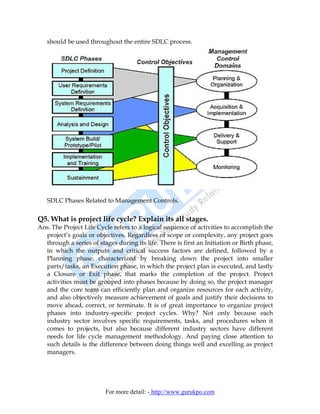
  The Systems Development Life Cycle (SDLC) phases serve as a programmatic
  guide to project activity and provide a flexible but consistent way to conduct
  projects to a depth matching the scope of the project. Each of the SDLC phase
  objectives are described in this section with key deliverables, a description of
  recommended tasks, and a summary of related control objectives for effective
  management. It is critical for the project manager to establish and monitor
  control objectives during each SDLC phase while executing projects. Control
  objectives help to provide a clear statement of the desired result or purpose and


                       For more detail: - http://www.gurukpo.com
should be used throughout the entire SDLC process.


   SDLC Phases Related to Management Controls.

Q5. What is project life cycle? Explain its all stages.
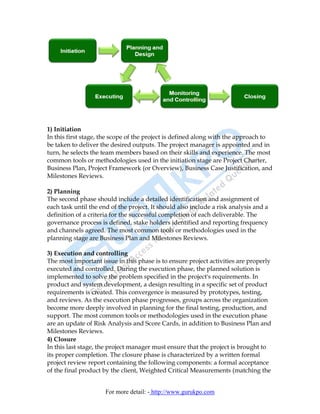
Ans. The Project Life Cycle refers to a logical sequence of activities to accomplish the
  project’s goals or objectives. Regardless of scope or complexity, any project goes
  through a series of stages during its life. There is first an Initiation or Birth phase,
  in which the outputs and critical success factors are defined, followed by a
  Planning phase, characterized by breaking down the project into smaller
  parts/tasks, an Execution phase, in which the project plan is executed, and lastly
  a Closure or Exit phase, that marks the completion of the project. Project
  activities must be grouped into phases because by doing so, the project manager
  and the core team can efficiently plan and organize resources for each activity,
  and also objectively measure achievement of goals and justify their decisions to
  move ahead, correct, or terminate. It is of great importance to organize project
  phases into industry-specific project cycles. Why? Not only because each
  industry sector involves specific requirements, tasks, and procedures when it
  comes to projects, but also because different industry sectors have different
  needs for life cycle management methodology. And paying close attention to
  such details is the difference between doing things well and excelling as project
  managers.


                         For more detail: - http://www.gurukpo.com
1) Initiation
In this first stage, the scope of the project is defined along with the approach to
be taken to deliver the desired outputs. The project manager is appointed and in
turn, he selects the team members based on their skills and experience. The most
common tools or methodologies used in the initiation stage are Project Charter,
Business Plan, Project Framework (or Overview), Business Case Justification, and
Milestones Reviews.

2) Planning
The second phase should include a detailed identification and assignment of
each task until the end of the project. It should also include a risk analysis and a
definition of a criteria for the successful completion of each deliverable. The
governance process is defined, stake holders identified and reporting frequency
and channels agreed. The most common tools or methodologies used in the
planning stage are Business Plan and Milestones Reviews.

3) Execution and controlling
The most important issue in this phase is to ensure project activities are properly
executed and controlled. During the execution phase, the planned solution is
implemented to solve the problem specified in the project's requirements. In
product and system development, a design resulting in a specific set of product
requirements is created. This convergence is measured by prototypes, testing,
and reviews. As the execution phase progresses, groups across the organization
become more deeply involved in planning for the final testing, production, and
support. The most common tools or methodologies used in the execution phase
are an update of Risk Analysis and Score Cards, in addition to Business Plan and
Milestones Reviews.
4) Closure
In this last stage, the project manager must ensure that the project is brought to
its proper completion. The closure phase is characterized by a written formal
project review report containing the following components: a formal acceptance
of the final product by the client, Weighted Critical Measurements (matching the


                      For more detail: - http://www.gurukpo.com
initial requirements specified by the client with the final delivered product),
   rewarding the team, a list of lessons learned, releasing project resources, and a
   formal project closure notification to higher management. No special tool or
   methodology is needed during the closure phase.

Q6. What is project contracting? Explain.
Ans. Since a substantial portion of a project is typically executed through contracts,
   the proper management of contracts is critical to the successful implementation
   of the project. In this context, the following should be done.
       • The competence and capability of all the contractors must be ensured. One
          weak link can affect the timely performance of the contract.
       • Proper discipline must be enforced among contractors and suppliers by
          insisting that they should develop realistic and detailed resource and time
          plans that are matching with the project plan.
       • Penalties may be imposed for failure to meet contractual obligations.
          Likewise, incentives may be offered for good performance.
       • Help should be extended to contractors and suppliers when they have
          genuine problems.
       • Project authorities must retain independence to off-load contracts
          (partially or wholly) to other parties where delays are anticipated.

   Q7. Explain the various types of project contractor.
   Ans.the various types of project contractors are:
         Traditional Contract: All project specifications are provided to a contractor
         who purchases and installs equipment at cost plus a mark-up or fixed price.

          Extended Technical Guarantee/Service: The contractor offers extended
          guarantees on the performance of selected equipment and / or
          service/maintenance agreements.

          Extended Financing Terms: The contractor provides the option of an
          extended lease or other financing vehicle in which the payment schedule can
          be based on the expected savings

          Guaranteed Saving Performance Contract: All or part of savings is
          guaranteed by the contractor, and all or part of the costs of equipment and/or
          services is paid down out of savings as they are achieved.


                         For more detail: - http://www.gurukpo.com
Unit-2:
                  Project Feasibility Study

Q1 What is project feasibility analysis?

Ans. Feasibility studies aim to objectively and rationally uncover the strengths and
  weaknesses of the existing business or proposed venture, opportunities and
  threats as presented by the environment, the resources required to carry through,
  and ultimately the prospects for success.

   Five common factors (TELOS)

   Technology and system feasibility

   The assessment is based on an outline design of system requirements in terms of
   Input, Processes, Output, Fields, Programs, and Procedures. This can be
   quantified in terms of volumes of data, trends, frequency of updating, etc. in
   order to estimate whether the new system will perform adequately or not.
   Technological feasibility is carried out to determine whether the company has
   the capability, in terms of software, hardware, personnel and expertise, to handle
   the completion of the project

   Economic feasibility

   Economic analysis is the most frequently used method for evaluating the
   effectiveness of a new system. More commonly known as cost/benefit analysis,
   the procedure is to determine the benefits and savings that are expected from a
   candidate system and compare them with costs. If benefits outweigh costs, then
   the decision is made to design and implement the system. An entrepreneur must
   accurately weigh the cost versus benefits before taking an action.

   Cost-based study: It is important to identify cost and benefit factors, which can
   be categorized as follows: 1. Development costs; and 2. Operating costs. This is
   an analysis of the costs to be incurred in the system and the benefits derivable
   out of the system.

   Time-based study: This is an analysis of the time required to achieve a return on
   investments. The future value of a project is also a factor.


                        For more detail: - http://www.gurukpo.com
Legal feasibility

   Determines whether the proposed system conflicts with legal requirements, e.g. a
   data processing system must comply with the local Data Protection Acts.

   Operational feasibility

   Operational feasibility is a measure of how well a proposed system solves the
   problems, and takes advantage of the opportunities identified during scope
   definition and how it satisfies the requirements identified in the requirements
   analysis phase of system development.

   Schedule feasibility

   A project will fail if it takes too long to be completed before it is useful. Typically
   this means estimating how long the system will take to develop, and if it can be
   completed in a given time period using some methods like payback period.
   Schedule feasibility is a measure of how reasonable the project timetable is.
   Given our technical expertise, are the project deadlines reasonable? Some
   projects are initiated with specific deadlines. You need to determine whether the
   deadlines are mandatory or desirable.

Q2 What is Pre Project feasibility analysis?

Ans. In Pre Project feasibility analysis the user in evaluating a variety of
       Scenarios:
             •   Unlimited, user-defined baseline scenarios
             •   3 scenario capability built-in
             •   Values for carbon credits
             •   Discount rates
             •   Other financial and technical variables, such as
             •   Loan terms
             •   Electricity price
             •   Capacity factor, etc.

   The pre-feasibility of the project should include the following preliminary
   analysis:

      – Needs and options analysis
      – Legal feasibility
      – Technical feasibility


                         For more detail: - http://www.gurukpo.com
– Scoping social/environment safeguards analysis
      – Preliminary financial viability including expectations of required
        Government financial support
      – Institutional capability analysis

      – Identification of next steps required

Q3. Explain the objectives of pre feasibility analysis.

Ans. The Prefeasibility Analysis as proposed has these objectives:

      •   to obtain needed information about the logistic infrastructure on the site
      •   to gain some knowledge of potential cost factors which would impinge on
          the soccer camp project
      •   to evaluate the potential logistic problems of the project and discuss the
          possibility of using other local farmers in a satellite tourism concept
      •    to develop the basic guidelines that will be required for the feasibility
          study preparation
      •   to get all needed information packaged in a usable document that can
          provide your group with a preliminary project proposal, concerning profit
          and loss
      •   to evaluate on a preliminary basis, possible soccer camps schedules and
          levels and total project concept
      •   to gain insights on needed government officials who will be concerned
          with the project
      •   to gain an understanding of the budget, equipment, supply and cost
          factors of the project
      •   to understand the possible return on investment for the project
      •   to investigate on a preliminary basis, markets for the products of the
          project
      •   to prepare a usable working document for use in planning and funding
          requirements for the project
      •   To establish the Letter of Intent for developing the feasibility study and
          working agreement between our group and your organization
      •   To provide you with complete working guidelines so you can develop
          your own successful, lucrative soccer camp project.

Q4 Give an outline of pre feasibility study report in pre feasibility
  analysis?
Ans. A PFR reveals an overview of the project’s proposal through the feasibility
  report. A PFR is normally prepared to articulate the ideas and objectives set forth
  for the project .


                        For more detail: - http://www.gurukpo.com
The PFR is expected to incorporate the following aspect and the structure of
   presentation.
      1) Introduction- What is proposed project about and why the need has
         arisen?
      2) Objectives- define what the project aim?
      3) Demand Analysis- the findings of such surveys is presented in a proper
         manner.
      4) Location of the project- the consideration made for selection of location
         with comparative advantage and disadvantage.
      5) Technology proposed to be adopted- adequate justificxationb be stated for
         adopted technology.
      6) Capital facility required-
      7) Cost estimation
      8) Sources of raw material, components, bought out material.
      9) study of environmental factors .
      10)Conclusion and recommendation.

Q.5 Explain the project appraisal. Explain the different techniques of
  project appraisal.
Ans. Project appraisal is a generic term that refers to the process of assessing, in a
  structured way, the case for proceeding with a project or proposal. In short,
  project appraisal is the effort of calculating a project's viability It often involves
  comparing various options, using economic appraisal or some other decision
  analysis technique.

   Types of appraisal

       1) Financial
             • Cost-benefit analysis
       2) Economic appraisalhttp://en.wikipedia.org/wiki/Project_appraisal - cite_note-6
             • Cost-effectiveness analysis
             • Scoring and weighting


Q6 What is market and technical analysis of a project?

Ans. No project should be undertaken without detailed cost estimates and scope
  controls. Even if a project is already underway, feasibility analysis can
  determine likely outcomes well ahead of time, giving stakeholders room to make
  good decisions. The following is a brief outline of the feasibility process.

   Constraints:

   There are four constraints to project success:


                          For more detail: - http://www.gurukpo.com
1.   Cost
   2.   Quality
   3.   Time
   4.   Scope

One can control three of the four. The fourth variable is independent.
Furthermore, each variable must be evaluated separately and collectively to
determine the right strategy for a project.

Cost-Effectiveness:

Cost-effectiveness analysis can include the following:

   •    Estimate direct costs, such as contractors and software and indirect costs,
        such as staff time, training and long-term overhead
   •    Analyze and quantify hard benefits such as increasing sales, saving
        person-hours, and soft benefits such as improving morale
   •    Evaluate the impact on existing systems and business processes.

Risk Analysis:

Project success depends on meeting the following requirements:

   •    Project Manager / user / team experience; technical knowledge
   •    Appropriate project methodology
   •    Good estimate of cost and schedule; realistic expectations
   •    Strong project management procedures
   •    Thorough Requirements Definition
   •    Methods for learning new technologies
   •    Contingency plans

Complexity Analysis:

Evaluate task estimates as the product of complexity multiplied by the
experience and job knowledge of participants.

Return on Investment (ROI):

Calculate ROI over the proposed system’s life cycle. Factor in costs, savings,
strategic advantage and uncertainties.


                      For more detail: - http://www.gurukpo.com
Q7. Explain Social cost benefit analysis?

Ans. It refers to the study of feasibility of a project in terms of its total economic cost
  and total economic benefits. it means to compare total cost with total benefit if
  we add external cost with private cost, it’s called total social cost if we add
  external benefit with private benefit, called total social benefit.

   Cost-benefit analysis is a process for evaluating the merits of a particular project
   or
   Course of action in a systematic and rigorous way. Social cost-bene_t analysis
   refers to
   Cases where the project has a broad impact across society { and, as such, is
   usually carried out by the government.

Q8. Explain the objectives of SCBA.
Ans. SCBA aims to appraise the total impact that a project will have on an economy.
       1)   Contribution of the project to GDP of the Economy.
       2)   Contribution of the project in poorer section of the society
       3)   Justification of the uses of scarce resources.
       4)   Contribution of the project in improving the environmental condition.
       5)   Justification for the risk undertaken to implement and sacrifices made in the
            process.


Q9. What are the different approaches of SCBA? Explain all.
Ans. There are two approaches in SCBA
       1) UNIDO APPROACH
       2) LITTLE AND MIRRLEES APPROACH

   UNIDO Approach- It stands for united national industrial development
   organization.
   It has five stages:
       1)   Measurement of financial profitability
       2)   Net benefits in terms of shadow prices
       3)   Impact of project on savings and investment
       4)   Impact of project on distribution of income
       5)   Impact of project on merit and demerit goods

   L-M Approach- it describe the practical application of SCBA
   It has 3 stages
    1) Calculating accounting rate or shadow prices particularly for foreign exchange
       savings
    2) Use of conversion factor
    3) Use of DCF analysis


                           For more detail: - http://www.gurukpo.com
Unit-3:
                           Project planning

Q1. What is project planning?

Ans. Project planning is part of project management, which relates to the use of
  schedules such as Gantt charts to plan and subsequently report progress within
  the project environment.

   Initially, the project scope is defined and the appropriate methods for completing
   the project are determined. Following this step, the durations for the various
   tasks necessary to complete the work are listed and grouped into a work
   breakdown structure. The logical dependencies between tasks are defined using
   an activity network diagram that enables identification of the critical path. Float
   or slack time in the schedule can be calculated using project management
   softwareThen the necessary resources can be estimated and costs for each
   activity can be allocated to each resource, giving the total project cost. At this
   stage, the project plan may be optimized to achieve the appropriate balance
   between resource usage and project duration to comply with the project
   objectives. Once established and agreed, the plan becomes what is known as the
   baseline. Progress will be measured against the baseline throughout the life of
   the project. Analyzing progress compared to the baseline is known as earned
   value management.

Q2. Explain the stages of project planning.

Ans. 1) Identification of the Problem
    The first step in project planning is identifying the problem.

   2) Planning
    In the planning stage, the project team will come up with ideas on how to solve
   the problem, along with cost estimates, deadlines and target goals for the end
   result.

   3) Implementation
   During the implementation phase, the plans to solve the problem that you came
   up with in Step 2 will be enacted.
    4) Evaluation and Live Operations


                        For more detail: - http://www.gurukpo.com
During this stage, the response to the problem that the project team came up with is
      monitored, with support provided to customers. You will also do an analysis of the
      entire process to this point, evaluating how the project team responded to the
      problem, including whether or not they were able to complete the project on-time
      and on- or under-budget.
    5) Future Planning:
     The final step is future planning. In this step, you'll determine if the project
    needs to be continued or if it can be ended, if a project needs to be developed to
    succeed this project, and if this project needs to be re-evaluated at a point in
    time in the future or at regular intervals.
Q3. What are the different tools of project planning?
Ans. There are various tools of project planning
      1) Work break down structure
      2) Work packages
      3) Proiject scheduling
      4) Responsibility matrix
      5) Budgeting
      6) Forcasting

Q4. Explain the work breakdown structure in project planning

Ans. A work breakdown structure (WBS) in project management and systems
  engineering, is a tool used to define and group a project's discrete work elements
  in a way that helps organize and define the total work scope of the project.

   A work breakdown structure element may be a product, data, a service, or any
   combination. A WBS also provides the necessary framework for detailed cost
   estimating and control along with providing guidance for schedule development
   and control. Additionally the WBS is a dynamic tool and can be revised and
   updated as needed by the project manager.

   Example of work breakdown structure in aircraft system


                         For more detail: - http://www.gurukpo.com
Q5. Explain the utility of WBS.

Ans. WBS in an important document and can be tailored to use in a
   number of different way.

      1) It serves as an effective means of communication to integrate
         the objectives and activities of all the internal and external
         organizations involves in the project
      2) It represent separate sequential and parallel activities assigned
         to different groups who will schedule, measure and control
         their own performance
      3) It reflects the procurement strategy during the various stages of
         the project life cycle.
      4) It may illustrate how each piece of the project contribute to the
         whole in terms of performance.

Q6 Explain the market analysis in project management.
Ans. Market and demand analysis is an integrated approach to generate market
   power by critical analysis of the market logistically.Although the terms
   "marketing" and "marketing analysis" can both be described as games of
   information, they are not to be confused. Marketing encompasses all of the
   activities that go into promoting a product or service. A marketing analysis is the
   actual assessment of the target population, competition and needs for marketing
   that product or service.

   The marketing analysis process can be broken down into six steps:

      1. Defining the problem
      2. Analysis of the situation
      3. Obtaining data that is specific to the problem
      4. Analysis and interpreting the data
      5. Fostering ideas and problem solving
      6. Designing a plan

Q7. Explain briefly the whole process of market analysis.

Ans. 1) .Defining The Problem

   Defining the problem is crucial to conducting a successful marketing analysis.
   This may require a great deal of time but it is well worth the time and energy
   expended. Defining the objectives is tantamount to a successful marketing


                        For more detail: - http://www.gurukpo.com
campaign. Many individuals waste valuable time performing good research on
the wrong problem.

2) Analysis Of The Situation

An analysis of the situation is an informal survey of what information is
available in the problem area. The analysis will help define the problem and
ascertain the need for additional information. This process entails informal talks
with informed people. Informed individuals can be others in the company or
outsiders with knowledge about the industry or product. In some instances,
customers are contacted to provide information.

3) Obtaining Data Specific To The Problem

The next step requires gathering primary research and performing a formal
research project. Many approaches can be used to collect primary data. The
purpose is for the research to identify what customers think about some topic or
behavior patterns. Research can be done in person or through a survey.
Questioning can be qualitative or quantitative. Another research option is to use
observation of customers and their purchases or utilization of a product or
service.

4) Data Analysis and Interpretation

Data analysis and interpretation is critical in analyzing the market. What does
this information mean? Can one use the data in a constructive way to define the
problem and then establish a plan? In quantitative research, this step most often
involves statistics. In the marketplace one can find many statistical packages
(computer-based) to analyze the data.

5) Fostering Ideas and Problem Solving

In this step, the research results are used to make marketing decisions. The
findings should be applied in marketing planning. If the research doesn't provide
the information necessary to make these decisions, the company, whether small
or large, has wasted its time, money and manpower on unnecessary data. The
final step must be anticipated throughout the entire process

6) Marketing Plan

This six-step process of market analysis is critical in designing a marketing plan
that is tailored to your specific product or service. The process can be extremely
helpful in disclosing a significant but previously unrecognized problem. By


                     For more detail: - http://www.gurukpo.com
finding and focusing on the real problem, the researcher and business owner can
   move quickly to a useful solution.

   A marketing plan shows the specifics of how you will market or attempt to sell
   your product or service. To reiterate the purpose of this discussion, the
   marketing plan is to provide you with guidance in analyzing your market.

Q8. What are the different methods to collect market information?

Ans. There are two methods to collect market information

      1) Primary sources
      2) Secondary sources

   1) Primary sources: primary data is the data which is collected by the researcher
   directly from his own observations and experiences. For example, if the
   researcher conducts a survey for the collected of data then it is known as primary
   data
   Sources are:
       1) questionnaire
       2) interview

   2) Secondary sources: There are various sources of secondary data like research
   papers, periodicals, encyclopedias, published researches, database companies
   etc. The four major sources of secondary data collection include International
   Data source, which provides data related to economics and politics.

Q9. Explain the different methods of Demand Forecasting.
Ans. Demand forecasting is the activity of estimating the quantity of a product or
  service that consumers will purchase. Demand forecasting involves techniques
  including both informal methods, such as educated guesses, and quantitative
  methods, such as the use of historical sales data or current data from test markets

   Methods that rely on qualitative assessment

   Forecasting demand based on expert opinion. Some of the types in this method
   are,

      •   Unaided judgment
      •   Delphi Technique
      •   Game theory
      •   Judgmental bootstrapping
      •   Simulated interaction


                        For more detail: - http://www.gurukpo.com
•   Intentions and expectations surveys

    Methods that rely on quantitative data

      •   Discrete Event Simulation
      •   Extrapolation
      •   Quantitative analogies
      •   Rule-based forecasting
      •   Segmentation

Q10. Explain Delphi Technique in Demand Forecasting.

Ans. The Delphi method is a structured communication technique, originally
  developed as a systematic, interactive forecasting method which relies on a panel
  of experts.

   In the standard version, the experts answer questionnaires in two or more
   rounds. After each round, a facilitator provides an anonymous summary of the
   experts’ forecasts from the previous round as well as the reasons they provided
   for their judgments. Thus, experts are encouraged to revise their earlier answers
   in light of the replies of other members of their panel. It is believed that during
   this process the range of the answers will decrease and the group will converge
   towards the "correct" answer. Finally, the process is stopped after a pre-defined
   stop criterion (e.g. number of rounds, achievement of consensus, stability of
   results) and the mean or median scores of the final rounds determine the results.

Q11. Explain the concept of Technical analysis.

Ans. Technical analysis of a project idea includes designing the various processes,
  installing equipment, specifying material and prototype testing. The project
  manager has to be careful in finalizing the technical aspects of the project as the
  decision is irreversible and the investments involved may be high. The project
  manager has to select the technology required in consultation with technical
  experts and consultants.

   Technical Analysis

   Technology Selection
   Input Requirements and Utilities
   Product Mix
   Plant Capacity and Functional Layout
   Location of the Project


                         For more detail: - http://www.gurukpo.com
Machinery and Equipment
   Consideration of Alternatives

Q12. Explain the concept of Financial Analysis.

Ans. The primary objective of any project is to earn reasonable returns for the
  investment made. The project manager must examine the financial feasibility of
  projects when selecting a project for implementation. In this process, the project
  manager first estimates the total cost of the project and then identifies various
  means for financing the project. Share capital, term loans, debenture capital,
  deferred credit are some of the means for financing a project. Then the project
  manager identifies the working capital needs of the project and the means for
  financing the needs.

   Steps in financial analysis

             1) To identify project cost
             2) Identify means of project financing i.e. a) share capital b) term loan
                c) debenture capital etc,
             3) Working capital requirement and financing.


Q13.: No project is acceptable unless the yield is 10%. Cash inflows of a certain
  project along with cash outflows are given below:

   Year          0             1             2               3            4
          5
   Outflows (Rs.)       1, 50,000     30,000         -              -            -
          -
   Inflows (Rs.) -             20,000        30,000          60,000       80,000
          30,000
   The Salvage value at the end of the 5th year is Rs. 40,000. Calculate net present
   value.
   The present value of Re. 1 for five years at 10% discount factor is .909, .826, .751,
   .683 and .621 respectively.
   Solution
                    Calculation of present value of Cash Outflows
      Year            Outflows              P.V. factor at 10%          Present Value
                         Rs.                                                 Rs.
       0              1,50,000                      1                    1,50,000
       1                30,000                     .909                     27,270


                         For more detail: - http://www.gurukpo.com
1,77,270


                       Calculation of Present Value of Cash Inflows
         Year          Cash Inflows          P.V. factor at 10%     Present Value
                           Rs.                                           Rs.
        1                20,000                     .909               18,180
        2                30,000                     .826               24,780
        3                60,000                     .751               45,060
        4                80,000                     .683               54,640
        5                30,000                     .621               18,630
        5                40,000                     .621               24,840
    (Salvage)
                                                                           1,86,130

  Net Present Value = Total Present Value – Initial Investment
                    = Rs. 1, 86,130 – Rs. 1, 77,270 = Rs. 8,860
Q14.: After conducting a survey that cost Rs. 2, 00,000, X Ltd., decided to undertake
  a project for placing a new product on the market. The Company’s cut-off rate is
  12%. It was estimated that the project would cost Rs. 40, 00,000 in plant and
  machinery in addition to working capital of Rs. 10, 00,000. The scrap value of
  plant and machinery at the end of 5 years was estimated at Rs. 5, 00,000. After
  providing for depreciation on straight line basis, profits after tax were estimated
  as follows:
  Year           1               2              3                 4            5
  Rs.            3,00,000        8,00,000       13,00,000         5,00,000
          4,00,000

   The present value factors at 12% per annum are given below:
   Year          1            2             3                   4              5
   PV Factor     0.8929       0.7972        0.7118              0.6355         0.5674
   Ascertain the Net Present Value of the project.
   Solution
   Statement of Net present Value
   Year Profit after tax    Depreciation    Cash Inflows P.V. Factor        Present
                (A)              (B)           (A+B)        at 12%          Value of
                                                                          Cash Inflows
                   Rs.             Rs.             Rs.                        Rs.
     1          3,00,000        7,40,000        10,40,000       0.8929     9,28,616
     2          8,00,000        7,40,000        15,40,000       0.7972      12,27,688
     3            13,00,000     7,40,000        20,40,000       0.7118      14,52,072
     4          5,00,000        7,40,000        12,40,000       0.6355     7,88,020
     5          4,00,000        7,40,000        11,40,000       0.5674     6,46,836


                          For more detail: - http://www.gurukpo.com
50,43,232

   Scrap Value at the end of 5 Years                 5, 00,000             0.5674
   2, 83,700
   Working Capital at the end of 5 Years                    10, 00,000               0.5674
   5, 67,400
   Total Present Value of Cash Inflows
   58, 94,332
   Less : Initial Outlay 2 + 40 + 10 (in lakhs )
                  52,00,000
   NPV
   6, 94,332

   Working Note :
   Calculation of Depreciation:                                       Rs.
   Cost of Survey                                                     2, 00,000
   Plant & Machinery                                                  40, 00,000
                                                                      42, 00,000
   Less : Scrap                                                       5,00,000
   Total Depreciation for 5 years                                     37, 00,000
   Annual Depreciation = 37, 00,000 / 5 = Rs. 7, 40,000


Q15 : The initial cash outlay of a project is Rs. 50,000 and its generates cash
   inflows of Rs. 20,000, Rs. 15,000, Rs. 25,000 and Rs. 10,000 in first four years.
   Using present value index method, appraise profitability of proposed
   investment assuming 10% rate of discount.
   The present value of Re. 1 at 10% discount factor for four years is .909, .826,
   .751 and .683.
   Solution
                    Calculation of present Value and Profitability Index

      Year             Cash Inflows          P.V. factor at 10%           Present Value
                           Rs.                                                 Rs.
        1                20,000                    .909                      18,180
        2                15,000                    .826                      12,390
        3                25,000                    .751                      18,775
        4                10,000                    .683                       6,830


                          For more detail: - http://www.gurukpo.com
Total                   56,175

  Net Present Value = Total Present Value – Initial Outlay
                         = Rs. 56,175 – Rs. 50,000 = Rs. 6,175
  Profitability Index or PVI = Present Value of Cash Inflows / Initial Cash Out
  flows
                         = Rs. 56,175 / Rs. 50,000 = 1.1235
  As profitability index is more than 1, the proposal can be accepted.
  Net Profitability Or NPVI = Net Present Value / Initial Cash Outflows
                         = Rs. 6,175 / Rs. 50,000 = 1235
  Or              NPI    = 1.1235 – 1 = 0.1235


  As net profitability index is positive, the proposal may be accepted.

Q16. Explain the concept of risk analysis.

  Ans. Risk may be defined as the variability which may likely to accrue in future
  between the estimated project returns and actual returns

  There are various kinds of project risk

       1)   Resource risk
       2)   Price risk
       3)   Technology risk
       4)   Interest rate risk
       5)   Exchange Rate risk
       6)   Project completion Risk
       7)   Political risk

Q17. What is Sensitivity analysis?

  Ans. Sensitivity analysis (SA) is the study of how the variation (uncertainty) in
  the output of a mathematical model can be apportioned, qualitatively or
  quantitatively, to different sources of variation in the input of the model.. Put
  another way, it is a technique for systematically changing parameters in a model
  to determine the effects of such changes.


                         For more detail: - http://www.gurukpo.com
In more general terms uncertainty and sensitivity analysis investigate the
   robustness of a study when the study includes some form of mathematical
   modeling. Sensitivity analysis can be useful to computer modelers for a range of
   purposes, including:

       •   support decision making or the development of recommendations for
           decision makers (e.g. testing the robustness of a result);
       •   enhancing communication from modelers to decision makers (e.g. by
           making recommendations more credible, understandable, compelling or
           persuasive);
       •   increased understanding or quantification of the system (e.g.
           understanding relationships between input and output variables); and
       •   Model development (e.g. searching for errors in the model).

Q18. Explain the procedure in sensitivity analysis.

Ans. 1) Selling and listing of key variable: list all the basic underlying variable which
  have an impact on project’s profitability.

       3) Estimating the range of variation: estimate the range of variation and the most
          likely values of e4ach of the basic underlying variable and predict the most likely
          level of profit
       4) Studying the effect of variation on NPV
       5) Drawing Conclusion

Q19. Where Sensitivity analysis can be used?

Ans. Sensitivity analysis can be used

       •   To simplify models

       •   To investigate the robustness of the model predictions

       •   To play what-if analysis exploring the impact of varying input
           assumptions and scenarios

       •   As an element of quality assurance (unexpected factors sensitivities may
           be associated to coding errors or misspecifications).

   It provides as well information on:

       •   Factors that mostly contribute to the output variability


                          For more detail: - http://www.gurukpo.com
•   The region in the space of input factors for which the model output is
          either maximum or minimum or within pre-defined bounds (see Monte
          Carlo filtering above)
      •   Optimal — or instability — regions within the space of factors for use in a
          subsequent calibration study
      •   Interaction between factors .


Q20. What is simulation Analysis ?
Ans. In simulation analysis, we create a mathematical model or a system or process,
  usually on a computer, and we explore the behavior of the model by running a
  simulation. A simulation consists of many -- often thousands of -- trials. Each
  trial is an experiment where we supply numerical values for input variables,
  evaluate the model to compute numerical values for outcomes of interest, and
  collect these values for later analysis.

Q21. What are the limitations of Social cost benefit analysis?
Ans. The cocept of SCBA is very attractive and significant therebut there are some
  limitations of SCBA i.e.
             1) No standerd mathods or technique
             2) Accuracy and reliability of forecast
             3) Problem of measurement of Social cost and benefit
             4) Government policy
             5) The cost of SCBA

Q22. Explain the concept of work packages.

Ans. In project management, a work package is a subset of a project that can be
  assigned to a specific party for execution. Because of the similarity, work
  packages are often misidentified as projects.

   Similar to a work breakdown structure, a work package is part of a Plan
   Breakdown Structure, representing a collection of work actions necessary to
   create a specific result. The work package is the lowest level of the WBS where
   both the cost and the duration can be reliably estimated.

   Work packages are defined by brief statements of Activity Description, Activity
   Resources of Skill and Expertise, Activity Estimates of Effort and Duration,
   Activity Schedule, Activity Risks, and Activity Budget. Work Packages are
   assigned a Work Authorization or Control Account.


                        For more detail: - http://www.gurukpo.com
Estimates of work packages are used in Earned Value Management to calculate
   the Planned Value. Progress made in the work package is used to calculate the
   Earned Value. Actual costs charged to the work package are used in variance
   analysis.

Q23. Explain the various stages in developing a project plan.

Ans. Step One: Define Activities

   The goal of the activity definition step is to identify all the tasks required to
   accomplish the product. This frequently results in identifying all the work
   products and deliverables that comprise the project. These deliverables are found
   as the components of a Work Break Down structure (WBS). The project schedule
   further decomposes these deliverables into the actual activities required to
   complete the work.

   Step Two: Sequence Activities

   At this point you've entered all the task names and have further decomposed the
   deliverables listed in the WBS. The next step is to sequence the activities with
   dependencies. During this step, you'll identify any dependencies of related tasks
   and document them in the project schedule

   Step Three: Estimate Activity Resources

   The next step is to identify the resources and their availability to your project.
   Remember that not all team members will be 100% available to your project as
   some team members will be working on multiple projects. In this step, you'll also
   assign resources to each of the tasks

   Step Four: Estimate Activity Durations

   With resources assigned, the next step is to estimate each task's duration. The
   activity's duration is the number of working periods required to complete the
   task. In Microsoft Project, this can be defined in days, weeks, and even months! It
   is also important to understand the difference of the different duration types
   including Fixed Work, Fixed Duration and Fixed Units. Selecting the correct
   duration type impacts the resource availability and the forecasted task end date

   Step Five: Develop Schedule

   The next step is to analyze the project schedule and examine the sequences,
   durations, resources and inevitable scheduling constraints. The goal of this step
   is to validate the project schedule correctly models the planned work. In this step


                        For more detail: - http://www.gurukpo.com
you'll not only validate the duration estimates are accurate, but validate the
   resource allocations are correct.

   Resource leveling is a key step in ensuring the project dates are realistic and the
   resources are appropriately assigned. Microsoft Project has an automatic
   resource leveling feature but I recommend against using it.


                                         Unit-3:

                          Project Scheduling


Q1. What is the concept of project schedule?

Ans. Scheduling is an inexact process in that it tries to predict the future. While it is
  not possible to know with certainty how long a project will take, there are
  techniques that can increase your likelihood of being close. If you are close in
  your planning and estimating, you can manage the project to achieve the
  schedule by accelerating some efforts or modifying approaches to meet required
  deadlines.

   One key ingredient in the scheduling process is experience in the project area;
   another is experience with scheduling in general. In every industry area there
   will be a body of knowledge that associates the accomplishment of known work
   efforts with a time duration. In some industries, there are books recording
   industry standards for use by cost and schedule estimators. Interviewing those
   who have had experience with similar projects is the best way to determine how
   long things will really take.

   When preparing a schedule estimate, consider that transition between activities
   often takes time. Organizations or resources outside your direct control may not
   share your sense of schedule urgency, and their work may take longer to
   complete. Beware of all external dependency relationships. Uncertain resources
   of talent, equipment, or data will likely result in extending the project schedule.

   Experience teaches that things usually take longer than we think they will, and
   that giving away schedule margin in the planning phase is a sure way to ensure
   a highly stressed project effort. People tend to be optimistic in estimating
   schedules and, on average, estimate only 80% of the time actually required.


                          For more detail: - http://www.gurukpo.com
Failure to meet schedule goals is most often due to unrealistic deadlines, passive
   project execution, unforeseen problems, or things overlooked in the plan.

Q2. Explain different methods used in project Scheduling.

Ans. 1) Gantt Chart : Taking its name from early project management innovator
  Henry L. Gantt, the basic Gantt chart is an easy way to document schedules. It is
  a horizontal-bar schedule showing activity start, duration, and completion. It
  shows the connection between events and the calendar, and provides a graphical
  analog of the activity duration.

   The Gantt schedule can illustrate the relationship between work activities having
   duration, events without duration that indicate a significant completion, and
   milestones that represent major achievements or decision points. Various
   annotations can be used to communicate the progress of the project effort
   compared to the baseline plan, as well to depict in a graphical way areas where
   there are modified expectations from the baseline plan.

   2) Resource Leveling:

   Projects will often be confronted by time and organizational constraints that limit
   their ability to obtain human resources. Sometimes staff can be supplemented
   through temporary help from technical service agencies. When staffing
   requirements are identified and constraints are understood, work plans can
   sometimes be adjusted to fit requirements to available resources.

   Resource scheduling is one of the greatest challenges for projects without access
   to large organizational or job-market resource pools. Project planning should
   address such issues as redundancy of critical resources, resource capacity, bench
   strength in vital areas, and contingency plans to handle departures of key
   personnel.

   3) Crashing:

   Efforts to accelerate a project schedule are commonly grouped under the term
   "crashing" the schedule. Maybe this term was coined to suggest that there is
   always some price for driving a project to completion sooner than normal. There
   are a number of ways to improve the schedule when your boss says, I need it
   sooner!

   1. Add people to the schedule. Additional staff must be added early in a project
   or they will slow it down while learning the ropes. If you add people, you may
   also need to add staff for supervision and coordination, so staff are fully applied.


                        For more detail: - http://www.gurukpo.com
2. Improve productivity and work longer hours. A good team atmosphere with
   management support can help make this happen. Without positive nourishment
   of this process, you could lose your team to attrition.

   3. Review schedule dependencies and look for opportunities to overlap tasks or
   make serial tasks concurrent or parallel activities. This requires greater
   coordination and sometimes involves increased risks which need to be managed
   carefully.

   4. Review the project scope and remove or delay features or functionality from
   the project critical path.

   5. Consider innovative approaches such as a different development
   methodology, alternative technologies, or out-sourcing options.

Q3. What are the benefits of project scheduling?

Ans. 1) Forces detailed thinking and planning
  This is the biggest benefit! Brainstorming with the team on what needs to be
  done when and by whom can be a very enlightening exercise. A few months
  ago I was assisting a project manager and his team as they were developing their
  plan. As we were loading the tasks into the project schedule (again, could have
  easily been a napkin), I kept asking about predecessors and successors. This
  would be followed by a long pause as the team members pondered the concept,
  then discussion and sometimes, additional tasks would surface. About 3/4 of
  the way through the exercise the project manager stated "So now I see why we
  should do it this way!"

   2) Improves communication
   A completed / current version of the schedule keeps all team members "singing
   from the same page of the hymn book". When the team knows what is supposed
   to occur when and by whom, this makes managing the rest of the project a little
   easier. Communicating with management, the customer, and other stakeholders
   is also much easier with a schedule.

   3) Provides a goal
   Whether it is the short term goals of tasks for the week, the mid range goals of a
   deliverable or milestone, or the overall project finish date, this information is all
   contained within the schedule. And providing you are following the tip of
   communicating, all team members should be aware of these goals.


                        For more detail: - http://www.gurukpo.com
4) Lets you know when you are off track
Just like when you take a trip; the schedule is the roadmap that tells you how to
get from point A to point Z. There even may be times when you experience
potholes or detours, but if you did not have a roadmap, how would you get back
on track? Monitoring the baseline or original schedule allows you to know when
you get off track. It will tell you just how far off track your project is, and allow
you to experiment with what-if scenario's for getting back on track.

5) Reduces delivery time
There are a couple of ways a schedule helps here.
Once your original schedule is complete, you now have the abilitiy to step back
and determine what tasks could be started early or completed in parallel with
other tasks (Fast Tracking).
Secondly, by tying dates and durations to tasks creates a sense of urgency that
might not otherwise be there. Without these dates, a team member may
postpone working on an activity that could cause a delay in downstream
milestones.

6) Reduces costs
You may think that developing and managing a schedule would increase costs.
It is more work right? Here are a few examples of how a schedule reduces cost.
Reduces rework - Imagine someone starting to develop the code for a new
application without all the requirements.
Eliminates duplicate work - Imagine person A and person B heading off to
perform the same task when only person A was assigned.
Return resources sooner - Whether renting a bulldozer, or contracting a team of
people, the longer those resources are on the project, the more costly it becomes.
A schedule will enable the project manager to return those resources as soon as
possible.

7)Increases productivity
By examining the sequence of tasks and the resources assigned, perhaps periods
can be found where resources are under-utilized. Assigning them to additional
tasks or changing the logic of when the tasks should be performed will make the
team more productive.

    8) See problems early
Whether it is an issue with a milestone date slipping or resources being over-
allocated a month from now, having an up-to-date schedule can help you see
these problems before they become true issues impacting your project. You can
leverage the schedule for what-if scenarios to find a solution or raise the issue to
the proper stakeholders well in advance.


                     For more detail: - http://www.gurukpo.com
9) Enables project manager to control the project instead of the project having
   control of them
   This one is probably debatable by many project managers who currently have a
   detailed schedule but still find themselves struggling each day just to stay afloat.
   But imagine where you would be without that plan.


Q4. What is project organization Structure?

Ans. Project organization is a temporary thing. It will only exist from the projects
  start until its end. All the project team members are coming from different
   organizations of part of the organization. They will all have a temporary
   assignment to the project. An organizational structure consists of activities such
   as task allocation, coordination and supervision, which are directed towards the
   achievement of organizational aims. It can also be considered as the viewing
   glass or perspective through which individuals see their organization and its
   environment

   The project organization should be a result from the project strategy, it should be
   constructed in such a way that the strategy can be implemented within the
   environment of the project . The project team that does the work should be as
   small as possible. Small is beautiful, and effective. The project organization can
   be used to satisfy some wishes of stakeholders to create the much needed win-
   win situations.


Q5 . Explain the different types of project organizational structure?
Ans. Three primary structures have become the foundation for how an organization is run:
   functional; projectized; and matrix

   1) Functional Structure
    A functional organization is the most common type of the three. It works best in
   small organizations in which the different sections are geographically close
   together and which provide only a small number of goods and/or services. In a
   functional structure, the organization is broken into different sections based
   upon specialty. For example, there may be one area for sales, one for customer
   service and one for the supervisors who deal with escalated problems. The
   project manager's role is to ensure smooth execution of processes and projects;


                          For more detail: - http://www.gurukpo.com
however, the functional manager has the most power and makes the final
decisions


Advantages and Disadvantages of a Functional Structure
 An advantage to the functional structure is the role of the functional manager,
which means there's only one boss. This reduces or prevents conflicts of interest
and makes it easier to manage specialists. A disadvantage of this type of
structure is that the project manager has limited authority and a limited career
path.

2)Projectized Structure
In a projectized structure, all the work is looked at as a project. The project
manager has complete control, unlike in the functional structure, and all team
members report directly to the project manager. Sometimes these team members
are permanent, and sometimes they are hired as temporary workers to help with
the project until its completion. If the organization takes on a large project, it will
have all the necessary resources available to sustain the project and will act as a
small, self-contained company.

Advantages and Disadvantages of a Projectized Structure
 Advantages to the projectized structure include the project manager's
opportunity for career progression. In addition, because good communication
exists within the project work, the team members tend to be more committed to,
and excel in, their responsibilities. The disadvantage of a projectized structure is
that, because the team breaks up and disperses after the completion of the
project, there are no long-term goals or sense of job security for the rest of the
workers. Another disadvantage is that the organization has to essentially clone
the same resources for each project (project manager, work area, administrator).

3)Matrix Structure
The matrix structure combines both the functional and projectized structures.
Each team member has two bosses; they report both to the functional manager
and the project manager. If the matrix is strong, the power resides more with the
project manager. If the matrix is weak, the power resides more with the
functional manager. The key is to find a balance in which the power is shared
equally. Because of its complexity, this type of structure can lead to problems if it
is not used carefully and properly. Good communication is essential for success.

Advantages and Disadvantages of Matrix Structure
 An advantage to the matrix structure lies in the efficient use of resources
because of ease of access. This structure also demonstrates efficient


                      For more detail: - http://www.gurukpo.com
communication both vertically and horizontally. Because of this, once the
     projects have ended, the team members are likely to receive a job elsewhere in
     the organization. A disadvantage of the matrix structure is complexity, which
     can be difficult to manage. For example, if the functional manager and the project
     manager do not communicate well, the team members can be caught in the
     middle, causing confusion.

Q6. Explain responsibility matrix for a project.
Ans. The purpose of the responsibility matrix is to identify early on which
  departmental roles or individuals will be assigned to complete certain categories
  of activities. Next, define the extent of responsibility and and the relationships
  among groups. Complete this matrix in the early planning stages before your
  commit to more detailed resourcing or scheduling.

     For complicated scenarios involving many people, it can be helpful to have a
     Responsibility Matrix. This helps set expectations and ensures people know what
     is expected from them. For instance, you need to know whether the members of
     the Steering Committee need to approve the Business Requirements document.
     The matrix can lay it all out.

     On the matrix, the different roles appear as columns, with the deliverables listed
     as rows. If you know who the people are that are filling each role, you can place
     the actual names on the matrix. Then, use the intersecting points to describe each
     role's (or person's) responsibility for each deliverable. A simple matrix follows.

                            Project    Project      Project    Project Team    Steering
                           Sponsor     Director     Manager                   Committee


      Project Definition      A           A            C               R         A


       Communication          A           R            C               R         A
           Plan


         Business             A           R            R               C         A
       Requirements


       Status Reports         R           R            C               R         R


     The letters are interpreted as follows:

 •          A means that the person (or role) approves the deliverable.
 •          R means that the person (or role) reviews the deliverable.


                           For more detail: - http://www.gurukpo.com
•         C means that the person (or role) creates the deliverable. (Usually there is
      only one person who is responsible for creating a deliverable, although many
      people may provide input.)


     In the table above, the Project Definition document is created by the project
     manager; reviewed by the project team and approved by the project sponsor,
     project director and the steering committee. The Business Requirements are
     created by the project team; reviewed by the project manager and the project
     director; and approved by the project sponsor and steering committee.

Q7 Explain the causes of project failure.
Ans. There are various causes of project failure
    1. Lack of clear links between the project and the organisation's key strategic
   priorities,including agreed measures of success.
   2. Lack of clear senior management and Ministerial ownership and leadership.
   3. Lack of effective engagement with stakeholders.
   4. Lack of skills and proven approach to project management and risk
   management.
   5. Too little attention to breaking development and implementation into
   manageable steps.
   6. Evaluation of proposals driven by initial price rather than long-term value for
   money
   7. Lack of understanding of, and contact with the supply industry at senior levels
   in the organisation.
   8. Lack of effective project team integration between clients, the supplier team
   and the supply chain.


                                         Unit-4:
      PERT,CPM And Network Techniques

Q1. Explain the concept of network technique.

Ans. Network Techniques helps managers to plan when to start various tasks to
  allocate resources so that the task can be carried out within schedule.


                          For more detail: - http://www.gurukpo.com
The network diagram may be defined as a graphical representation of the
   projects activities showing the planned sequence of work. There are various
   terminology which is used in nework Technique

              1) Event or Node: An event is a specific instant of time which marks
                 the start and end of the activity.
              2) Dummy Activity: it is hat activity which is accomplished in zero
                 time and no consuming resources.

Q2. Explain CPM Technique in network technique.

Ans. CPM - Critical Path Method

   DuPont developed a Critical Path Method (CPM) designed to address the challenge
   of shutting down chemical plants for maintenance and then restarting the plants
   once the maintenance had been completed.

   Complex project, like the above example, require a series of activities, some of which
   must be performed sequentially and others that can be performed in parallel with
   other activities. This collection of series and parallel tasks can be modeled as a
   network.

   CPM models the activities and events of a project as a network. Activities are shown
   as nodes on the network and events that signify the beginning or ending of activities
   are shown as arcs or lines between the nodes


Q3. The following table gives data on normal time, and cost and crash time and
   cost for a project.
                                   Normal                              Crash
      Activity           Time (Weeks)      Cost (Rs.)     Time (Weeks)         Cost (Rs.)
        1–2                   3               300               2                 400
        2–3                   3               30                3                       30


                           For more detail: - http://www.gurukpo.com
3–4                   7                 420                 5                  580
     2–5                   9                 720                 7                  810
     3–5                   5                 250                 4                  300
     4–5                   0                  0                  0                   0
     5–6                   6                 320                 4                  410
     6–7                   4                 400                 3                  470
     6–8                  13                 780                 10                 900
     7–8                  10                1,000                9                 1,200
Indirect cost is Rs. 50 per week.
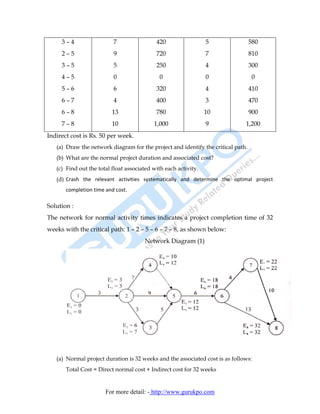
   (a) Draw the network diagram for the project and identify the critical path.
   (b) What are the normal project duration and associated cost?
   (c) Find out the total float associated with each activity.
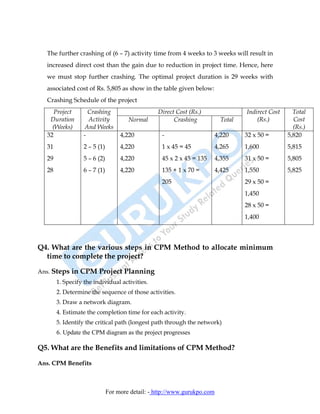
   (d) Crash  the  relevant  activities  systematically  and  determine  the  optimal  project 
       completion time and cost. 

Solution :
The network for normal activity times indicates a project completion time of 32
weeks with the critical path: 1 – 2 – 5 – 6 – 7 – 8, as shown below:
                                        Network Diagram (1)


   (a) Normal project duration is 32 weeks and the associated cost is as follows:
       Total Cost = Direct normal cost + Indirect cost for 32 weeks


                       For more detail: - http://www.gurukpo.com
= 4,220 + 50 x 32 = Rs. 5,820
   (b) Calculations for total float associated with each activity are shown in following
         table:
                                                              Total Float
                      Activity                                (Li –Ei) - ti
                       1–2               (3 – 0) - 10 = 0
                       2–3               (7 – 3) - 7 = 1
                       2–4               (12 – 3) - 7 = 2
                       2–5               (12 – 3) - 9 = 0
                       3–5               (12 – 6) - 5 = 1
                       4–5               (12 -10) – 0 = 2
                       5–6               (18 – 12) – 6 = 0
                       6–7               (22 – 18) - 4 = 0
                       6–8               (32 – 18) - 13 = 1
                       7–8               (32– 22) – 10 = 0
   (c)


   (d) For Critical activities, crash cost-slope is given in the following table:
                  Critical Activity                   Crash Cost per Week (Rs.)
                       1–2               400 – 300 / 3 – 2 = 100
                       2–5               810 – 720 / 9 – 7 = 45
                       5–6               410 x 320 / 6 – 4 = 45
                       6- 7              470 – 400 / 4 – 3 = 70
                        7-8              1200 – 1000 / 10 – 9 = 200


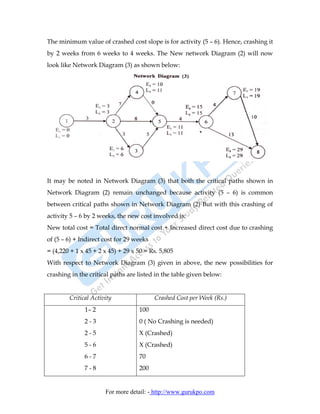
The minimum value of crash cost per week is for activity (2 – 5) and (5 – 6).
Hence, crashing activity (2 – 5) by 2 from 6 weeks to 7 weeks, But the time should
be reduced by I week only otherwise another path 1 - 2 - 3 - 5                      6- 7 - 8
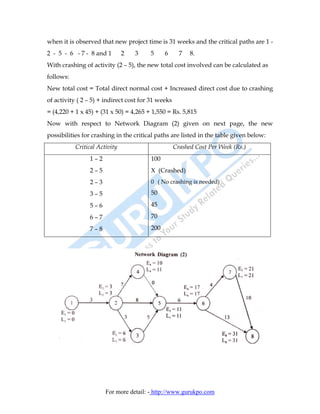
become a parallel path. Network Digram (2) shown on next page is developed


                            For more detail: - http://www.gurukpo.com
when it is observed that new project time is 31 weeks and the critical paths are 1 -
2 - 5 - 6 - 7 - 8 and 1        2   3    5     6       7   8.
With crashing of activity (2 – 5), the new total cost involved can be calculated as
follows:
New total cost = Total direct normal cost + Increased direct cost due to crashing
of activity ( 2 – 5) + indirect cost for 31 weeks
= (4,220 + 1 x 45) + (31 x 50) = 4,265 + 1,550 = Rs. 5,815
Now with respect to Network Diagram (2) given on next page, the new
possibilities for crashing in the critical paths are listed in the table given below:
           Critical Activity                        Crashed Cost Per Week (Rs.)
                1–2                     100
                2–5                     X (Crashed)
                2–3                     0 ( No crashing is needed)

                3–5                     50

                5–6                     45

                6–7                     70

                7–8                     200


                       For more detail: - http://www.gurukpo.com
The minimum value of crashed cost slope is for activity (5 – 6). Hence, crashing it
by 2 weeks from 6 weeks to 4 weeks. The New network Diagram (2) will now
look like Network Diagram (3) as shown below:


It may be noted in Network Diagram (3) that both the critical paths shown in
Network Diagram (2) remain unchanged because activity (5 – 6) is common
between critical paths shown in Network Diagram (2) But with this crashing of
activity 5 – 6 by 2 weeks, the new cost involved is:
New total cost = Total direct normal cost + Increased direct cost due to crashing
of (5 – 6) + Indirect cost for 29 weeks
= (4,220 + 1 x 45 + 2 x 45) + 29 x 50 = Rs. 5,805
With respect to Network Diagram (3) given in above, the new possibilities for
crashing in the critical paths are listed in the table given below:


        Critical Activity                 Crashed Cost per Week (Rs.)
              1– 2                 100
              2-3                  0 ( No Crashing is needed)
              2-5                  X (Crashed)
              5-6                  X (Crashed)
              6-7                  70
              7-8                  200


                      For more detail: - http://www.gurukpo.com
The further crashing of (6 – 7) activity time from 4 weeks to 3 weeks will result in
  increased direct cost than the gain due to reduction in project time. Hence, here
  we must stop further crashing. The optimal project duration is 29 weeks with
  associated cost of Rs. 5,805 as show in the table given below:
  Crashing Schedule of the project
     Project        Crashing                     Direct Cost (Rs.)                  Indirect Cost     Total
   Duration         Activity          Normal           Crashing             Total       (Rs.)         Cost
    (Weeks)       And Weeks                                                                           (Rs.)
  32              -                4,220           -                      4,220     32 x 50 =       5,820
  31              2 – 5 (1)        4,220           1 x 45 = 45            4,265     1,600           5,815
  29              5 – 6 (2)        4,220           45 x 2 x 45 = 135      4,355     31 x 50 =       5,805
  28              6 – 7 (1)        4,220           135 + 1 x 70 =         4,425     1,550           5,825
                                                   205                              29 x 50 =
                                                                                    1,450
                                                                                    28 x 50 =
                                                                                    1,400


Q4. What are the various steps in CPM Method to allocate minimum
  time to complete the project?

Ans. Steps   in CPM Project Planning
       1. Specify the individual activities.
       2. Determine the sequence of those activities.
       3. Draw a network diagram.
       4. Estimate the completion time for each activity.
       5. Identify the critical path (longest path through the network)
       6. Update the CPM diagram as the project progresses

Q5. What are the Benefits and limitations of CPM Method?

Ans. CPM Benefits


                              For more detail: - http://www.gurukpo.com
• Provides a graphical view of the project.

       • Predicts the time required to complete the project.
       • Shows which activities are critical to maintaining the schedule and which
          are not.

   CPM Limitations
   While CPM is easy to understand and use, it does not consider the time
   variations that can have a great impact on the completion time of a complex
   project. CPM was developed for complex but fairly routine projects with
   minimum uncertainty in the project completion times. For less routine projects
   there is more uncertainty in the completion times, and this uncertainty limits its
   usefulness.


Q6. Explain about PERT Technique in network analysis.
Ans. The Program Evaluation and Review Technique (PERT) is a network model that
  allows for randomness in activity completion times. PERT was developed in the late
  1950's for the U.S. Navy's Polaris project having thousands of contractors. It has the
  potential to reduce both the time and cost required to complete a project.

   The Network Diagram

   In a project, an activity is a task that must be performed and an event is a milestone
   marking the completion of one or more activities. Before an activity can begin, all of
   its predecessor activities must be completed. Project network models represent
   activities and milestones by arcs and nodes. PERT is typically represented as an
   activity on arc network, in which the activities are represented on the lines and
   milestones on the nodes.


   There are three times have to be calculated:
             3) Most likely times
             4) Optimistic times
             5) Pessimistic time


                         For more detail: - http://www.gurukpo.com
Q7. Explain various steps in PERT Technique.

Ans. Steps in the PERT Planning Process

   PERT planning involves the following steps:

       1. Identify the specific activities and milestones.
       2. Determine the proper sequence of the activities.
       3. Construct a network diagram.
       4. Estimate the time required for each activity.
       5. Determine the critical path.
       6. Update the PERT chart as the project progresses.


Q8. Explain about Estimated times in PERT Technique.
Ans. Estimate activity times

   Weeks are a commonly used unit of time for activity completion, but any consistent
   unit of time can be used.

   A distinguishing feature of PERT is its ability to deal with uncertainty in activity
   completion times. For each activity, the model usually includes three time estimates:


   • Optimistic time (OT) - generally the shortest time in which the activity can be
   completed.

   • Most likely time (MT) - the completion time having the highest probability. This is
   different from expected time. Seasoned managers have an amazing way of
   estimating very close to actual data from prior estimation errors.

   • Pessimistic time (PT) - the longest time that an activity might require.

   The expected time for each activity can be approximated using the following
   weighted average:

          Expected time = (OT + 4 x MT+ PT) / 6

   This expected time might be displayed on the network diagram.


                         For more detail: - http://www.gurukpo.com
Variance for each activity is given by:

                                        2
                         [(PT - OT) / 6]

Q9. What are the banafits and limitations of PERT Technique?

Ans. Benefits of PERT

   PERT is useful because it provides the following information:

      • Expected project completion time.

      • Probability of completion before a specified date.

      • The critical path activities that directly impact the completion time.

      • The activities that have slack time and that can lend resources to critical
         path activities.

      • Activities start and end dates.

   Limitations of PERT

   The following are some of PERT's limitations:

      •   The activity time estimates are somewhat subjective and depend on judgment. In
          cases where there is little experience in performing an activity, the numbers may
          be only a guess. In other cases, if the person or group performing the activity
          estimates the time there may be bias in the estimate.
      •   The underestimation of the project completion time due to alternate paths
          becoming critical is perhaps the most serious .
          Unit-5: Project Management Information System
Q10 Explain about project management information system.

Ans. A Project Management Information System (PMIS) is a part of Management
  Information Systems (MIS) and manage information of a project centric
  organization. These electronic systems "help [to] plan, execute, and close project
  management goals."[PMIS systems differ in scope, design and features
  depending upon an organization’s operational requirements.

   A Project Management System(PM) could be a part of a PMIS or sometimes an
   external tool beside project management information system. What a PMIS does


                         For more detail: - http://www.gurukpo.com
is to manage all stakeholders in a project such as Project Owner, Client,
Contractors, Sub-Contractors, Company persons, Workers, Managers and etc.

PMIS Project Management Information System (PMIS) An information system
consisting of the tools and techniques used to gather, integrate, and disseminate
the outputs of project management processes. It is used to support all aspects of
the project from initiating through closing, and can include both manual and
automated systems.

Project Management Information System (PMIS) [Tool]. An information system
consisting of the tools and techniques used to gather, integrate, and disseminate
the outputs of project management processes. It is used to support all aspects of
the project from initiating through closing, and can include both manual and
automated systems


      Shared Savings Performance Contract: The contractor provides the financing
      and is paid an agreed fraction of actual savings as they are achieved. This
      payment is used to pay down the debt costs of equipment and/or services.


                      Send your requisition at
                         info@biyanicolleges.org


                    For more detail: - http://www.gurukpo.com

150

  • 1.
    Biyani's Think Tank Concept based notes Project Management MBA Ms. Rachna Department of MBA Biyani Institute of science & Management, Jaipur For more detail: - http://www.gurukpo.com
  • 2.
    Published by : ThinkTanks Biyani Group of Colleges Concept & Copyright : Biyani Shikshan Samiti Sector-3, Vidhyadhar Nagar, Jaipur-302 023 (Rajasthan) Ph : 0141-2338371, 2338591-95 Fax : 0141-2338007 E-mail : acad@biyanicolleges.org Website :www.gurukpo.com; www.biyanicolleges.org First Edition : 2011 While every effort is taken to avoid errors or omissions in this Publication, any mistake or omission that may have crept in is not intentional. It may be taken note of that neither the publisher nor the author will be responsible for any damage or loss of any kind arising to anyone in any manner on account of such errors and omissions. Leaser Type Setted by : Biyani College Printing Department For more detail: - http://www.gurukpo.com
  • 3.
    Preface I am glad to present this book, especially designed to serve the needs of the students. The book has been written keeping in mind the general weakness in understanding the fundamental concepts of the topics. The book is self- explanatory and adopts the “Teach Yourself” style. It is based on question- answer pattern. The language of book is quite easy and understandable based on scientific approach. Any further improvement in the contents of the book by making corrections, omission and inclusion is keen to be achieved based on suggestions from the readers for which the author shall be obliged. I acknowledge special thanks to Mr. Rajeev Biyani, Chairman & Dr. Sanjay Biyani, Director (Acad.) Biyani Group of Colleges, who are the backbones and main concept provider and also have been constant source of motivation throughout this Endeavour. They played an active role in coordinating the various stages of this Endeavour and spearheaded the publishing work. I look forward to receiving valuable suggestions from professors of various educational institutions, other faculty members and students for improvement of the quality of the book. The reader may feel free to send in their comments and suggestions to the under mentioned address. Author For more detail: - http://www.gurukpo.com
  • 4.
    Unit:1 Introduction to Project Management Q1 What is Project management? Ans. Project management is the discipline of planning, organizing, securing and managing resources to bring about the successful completion of specific project goals and objectives. It is sometimes conflicted with program management, however technically that is actually a higher level construction: a group of related and somehow interdependent engineering projects. A project is a temporary endeavor, having a defined beginning and end (usually constrained by date, but can be by funding or deliverables), undertaken to meet unique goals and objectives usually to bring about beneficial change or added value. The temporary nature of projects stands in contrast to business as usual (or operations) which are repetitive, permanent or semi-permanent functional work to produce products or services. In practice, the management of these two systems is often found to be quite different, and as such requires the development of distinct technical skills and the adoption of separate management. The primary challenge of project management is to achieve all of the engineering project goals and objectives while honoring the preconceived project constraints. Typical constraints are scope, time, and budget the secondary—and more ambitious—challenge is to optimize the allocation and integration of inputs necessary to meet pre-defined objectives. Q.2 Explain the Evolution of project management. Ans. The importance of Project Management is an important topic because all organizations, because they small or large, at one time or other, are involved in implementing new undertakings. These undertakings may be diverse, such as, the development of a new product or service; the establishment of a new production line in a manufacturing enterprise; a public relations promotion campaign; or a major building program. On a macro level organizations are motivated to implement project management techniques to ensure that their undertakings (small or major) are delivered on time, within the cost budget and to the stipulated quality. On a micro level, For more detail: - http://www.gurukpo.com
  • 5.
    project management combinedwith an appropriate information management system has the objectives of: (a) reducing project overhead costs; (b) customizing the project workplace to fit the operational style of the project teams and respective team members; (c) proactively informing the executive management strata of the strategic projects on a real-time basis; (d) ensuring that project team members share accurate, meaningful and timely project documents; and (e) ensuring that critical task deadlines are met. Whilst the motivation and objectives to apply project management in organizations is commendable, they do not assure project success. 1) Prior to 1958: Craft system to human relations. During this time, the evolution of technology, such as, automobiles and telecommunications shortened the project schedule. For instance, automobiles allowed effective resource allocation and mobility, whilst the telecommunication system increased the speed of communication 2) 1958-1979: Application of Management Science. Significant technology advancement took place between 1958 and 1979, such as, the first automatic plain-paper copier by Xerox in 1959. Between 1956 and 1958 several core project management tools including CPM and PERT were introduced. However, this period was characterized by the rapid development of computer technology. 3) 1980-1994: Production Centre Human Resources. The 1980s and 1990's are characterized by the revolutionary development in the information management sector with the introduction of the personal computer (PC) and associated computer communications networking facilities. This development resulted in having low cost multitasking PCs that had high efficiency in managing and controlling complex project schedules. 4) 1995-Present: Creating a New Environment. This period is dominated by the developments related to the Internet that changed dramatically business practices in the mid 1990's. This allows automatic uploading of data so that anyone around the globe with a standard browser can: (a) input the most recent status of their assigned tasks; (b) find out how the overall project is doing; (c) be informed of any delays or advances in the schedule; and (d) stay "in the loop" for their project role, while working independently at a remote site. For more detail: - http://www.gurukpo.com
  • 6.
    Q3 What isthe system approaches in project management? Ans. A project is a temporary, one-time endeavor undertaken to solve a problem or take advantage of an opportunity. It usually has a customer or customers (either internal or external to the organization that is doing the project), a budget or a set of scarce resources that must be managed and some kind of timeframe/constraint for completion or operation. Before one can undertake a project to solve a problem one must first understand the problem. Not only understand the details of the problem but also understand who has the problem and the context and environment that must be taken into consideration in addressing the problem. The system approach is a framework for conceptualizing problems as systems and for doing things such as solving problems and designing systems. CONCEPT OF SYSTEM APPROACH: 1) The objectives and performance system 2) The environment and constraints of the system 3) The resources of the system 4) The element of the system and their function 5) The management of the system The objectives and performance system: The system approach mandate a practical thinking about the real objective of the system and real ways to measure it project management uses this kind of thinking. The environment and constraints of the system: The environment of the system i.e. relevent subsystem, groups and the persons who affect or affected by t5he system, must also be identified. The resources of the system: In accomplishing system goals, internal system resources such as capital, labour, material must also be identified. Most of the system resources are exhaustible. The system is free to utilize them. The element of the system and their function: For more detail: - http://www.gurukpo.com
  • 7.
    The system approachto a project considers the project in terms of many element .each having performance measure directly related to performance of the overall project. The management of the system: The system approaches plays explicit attention to the management of the system. Management is the function which takes into consideration all of the other aspect of the system such as objectives, environment and constraints, resources and elements. Q4 Explain system analysis and system development. Ans. System analysis The goal of system analysis is to determine where the problem is in an attempt to fix the system. This step involve breaking down the system in different pieces to analyze the situation, analyzing project goals, breaking down what needs to be created and attempting to engage users so that definite requirements can be defined. Requirement analysis sometimes requires individuals/teams from client as well as service provider sides to get detailed and accurate requirements. Often there has to be a lot of communication to and from to understand these requirements. System development life cycle: The Systems Development Life Cycle (SDLC) phases serve as a programmatic guide to project activity and provide a flexible but consistent way to conduct projects to a depth matching the scope of the project. Each of the SDLC phase objectives are described in this section with key deliverables, a description of recommended tasks, and a summary of related control objectives for effective management. It is critical for the project manager to establish and monitor control objectives during each SDLC phase while executing projects. Control objectives help to provide a clear statement of the desired result or purpose and For more detail: - http://www.gurukpo.com
  • 8.
    should be usedthroughout the entire SDLC process. SDLC Phases Related to Management Controls. Q5. What is project life cycle? Explain its all stages. Ans. The Project Life Cycle refers to a logical sequence of activities to accomplish the project’s goals or objectives. Regardless of scope or complexity, any project goes through a series of stages during its life. There is first an Initiation or Birth phase, in which the outputs and critical success factors are defined, followed by a Planning phase, characterized by breaking down the project into smaller parts/tasks, an Execution phase, in which the project plan is executed, and lastly a Closure or Exit phase, that marks the completion of the project. Project activities must be grouped into phases because by doing so, the project manager and the core team can efficiently plan and organize resources for each activity, and also objectively measure achievement of goals and justify their decisions to move ahead, correct, or terminate. It is of great importance to organize project phases into industry-specific project cycles. Why? Not only because each industry sector involves specific requirements, tasks, and procedures when it comes to projects, but also because different industry sectors have different needs for life cycle management methodology. And paying close attention to such details is the difference between doing things well and excelling as project managers. For more detail: - http://www.gurukpo.com
  • 9.
    1) Initiation In thisfirst stage, the scope of the project is defined along with the approach to be taken to deliver the desired outputs. The project manager is appointed and in turn, he selects the team members based on their skills and experience. The most common tools or methodologies used in the initiation stage are Project Charter, Business Plan, Project Framework (or Overview), Business Case Justification, and Milestones Reviews. 2) Planning The second phase should include a detailed identification and assignment of each task until the end of the project. It should also include a risk analysis and a definition of a criteria for the successful completion of each deliverable. The governance process is defined, stake holders identified and reporting frequency and channels agreed. The most common tools or methodologies used in the planning stage are Business Plan and Milestones Reviews. 3) Execution and controlling The most important issue in this phase is to ensure project activities are properly executed and controlled. During the execution phase, the planned solution is implemented to solve the problem specified in the project's requirements. In product and system development, a design resulting in a specific set of product requirements is created. This convergence is measured by prototypes, testing, and reviews. As the execution phase progresses, groups across the organization become more deeply involved in planning for the final testing, production, and support. The most common tools or methodologies used in the execution phase are an update of Risk Analysis and Score Cards, in addition to Business Plan and Milestones Reviews. 4) Closure In this last stage, the project manager must ensure that the project is brought to its proper completion. The closure phase is characterized by a written formal project review report containing the following components: a formal acceptance of the final product by the client, Weighted Critical Measurements (matching the For more detail: - http://www.gurukpo.com
  • 10.
    initial requirements specifiedby the client with the final delivered product), rewarding the team, a list of lessons learned, releasing project resources, and a formal project closure notification to higher management. No special tool or methodology is needed during the closure phase. Q6. What is project contracting? Explain. Ans. Since a substantial portion of a project is typically executed through contracts, the proper management of contracts is critical to the successful implementation of the project. In this context, the following should be done. • The competence and capability of all the contractors must be ensured. One weak link can affect the timely performance of the contract. • Proper discipline must be enforced among contractors and suppliers by insisting that they should develop realistic and detailed resource and time plans that are matching with the project plan. • Penalties may be imposed for failure to meet contractual obligations. Likewise, incentives may be offered for good performance. • Help should be extended to contractors and suppliers when they have genuine problems. • Project authorities must retain independence to off-load contracts (partially or wholly) to other parties where delays are anticipated. Q7. Explain the various types of project contractor. Ans.the various types of project contractors are: Traditional Contract: All project specifications are provided to a contractor who purchases and installs equipment at cost plus a mark-up or fixed price. Extended Technical Guarantee/Service: The contractor offers extended guarantees on the performance of selected equipment and / or service/maintenance agreements. Extended Financing Terms: The contractor provides the option of an extended lease or other financing vehicle in which the payment schedule can be based on the expected savings Guaranteed Saving Performance Contract: All or part of savings is guaranteed by the contractor, and all or part of the costs of equipment and/or services is paid down out of savings as they are achieved. For more detail: - http://www.gurukpo.com
  • 11.
    Unit-2: Project Feasibility Study Q1 What is project feasibility analysis? Ans. Feasibility studies aim to objectively and rationally uncover the strengths and weaknesses of the existing business or proposed venture, opportunities and threats as presented by the environment, the resources required to carry through, and ultimately the prospects for success. Five common factors (TELOS) Technology and system feasibility The assessment is based on an outline design of system requirements in terms of Input, Processes, Output, Fields, Programs, and Procedures. This can be quantified in terms of volumes of data, trends, frequency of updating, etc. in order to estimate whether the new system will perform adequately or not. Technological feasibility is carried out to determine whether the company has the capability, in terms of software, hardware, personnel and expertise, to handle the completion of the project Economic feasibility Economic analysis is the most frequently used method for evaluating the effectiveness of a new system. More commonly known as cost/benefit analysis, the procedure is to determine the benefits and savings that are expected from a candidate system and compare them with costs. If benefits outweigh costs, then the decision is made to design and implement the system. An entrepreneur must accurately weigh the cost versus benefits before taking an action. Cost-based study: It is important to identify cost and benefit factors, which can be categorized as follows: 1. Development costs; and 2. Operating costs. This is an analysis of the costs to be incurred in the system and the benefits derivable out of the system. Time-based study: This is an analysis of the time required to achieve a return on investments. The future value of a project is also a factor. For more detail: - http://www.gurukpo.com
  • 12.
    Legal feasibility Determines whether the proposed system conflicts with legal requirements, e.g. a data processing system must comply with the local Data Protection Acts. Operational feasibility Operational feasibility is a measure of how well a proposed system solves the problems, and takes advantage of the opportunities identified during scope definition and how it satisfies the requirements identified in the requirements analysis phase of system development. Schedule feasibility A project will fail if it takes too long to be completed before it is useful. Typically this means estimating how long the system will take to develop, and if it can be completed in a given time period using some methods like payback period. Schedule feasibility is a measure of how reasonable the project timetable is. Given our technical expertise, are the project deadlines reasonable? Some projects are initiated with specific deadlines. You need to determine whether the deadlines are mandatory or desirable. Q2 What is Pre Project feasibility analysis? Ans. In Pre Project feasibility analysis the user in evaluating a variety of Scenarios: • Unlimited, user-defined baseline scenarios • 3 scenario capability built-in • Values for carbon credits • Discount rates • Other financial and technical variables, such as • Loan terms • Electricity price • Capacity factor, etc. The pre-feasibility of the project should include the following preliminary analysis: – Needs and options analysis – Legal feasibility – Technical feasibility For more detail: - http://www.gurukpo.com
  • 13.
    – Scoping social/environmentsafeguards analysis – Preliminary financial viability including expectations of required Government financial support – Institutional capability analysis – Identification of next steps required Q3. Explain the objectives of pre feasibility analysis. Ans. The Prefeasibility Analysis as proposed has these objectives: • to obtain needed information about the logistic infrastructure on the site • to gain some knowledge of potential cost factors which would impinge on the soccer camp project • to evaluate the potential logistic problems of the project and discuss the possibility of using other local farmers in a satellite tourism concept • to develop the basic guidelines that will be required for the feasibility study preparation • to get all needed information packaged in a usable document that can provide your group with a preliminary project proposal, concerning profit and loss • to evaluate on a preliminary basis, possible soccer camps schedules and levels and total project concept • to gain insights on needed government officials who will be concerned with the project • to gain an understanding of the budget, equipment, supply and cost factors of the project • to understand the possible return on investment for the project • to investigate on a preliminary basis, markets for the products of the project • to prepare a usable working document for use in planning and funding requirements for the project • To establish the Letter of Intent for developing the feasibility study and working agreement between our group and your organization • To provide you with complete working guidelines so you can develop your own successful, lucrative soccer camp project. Q4 Give an outline of pre feasibility study report in pre feasibility analysis? Ans. A PFR reveals an overview of the project’s proposal through the feasibility report. A PFR is normally prepared to articulate the ideas and objectives set forth for the project . For more detail: - http://www.gurukpo.com
  • 14.
    The PFR isexpected to incorporate the following aspect and the structure of presentation. 1) Introduction- What is proposed project about and why the need has arisen? 2) Objectives- define what the project aim? 3) Demand Analysis- the findings of such surveys is presented in a proper manner. 4) Location of the project- the consideration made for selection of location with comparative advantage and disadvantage. 5) Technology proposed to be adopted- adequate justificxationb be stated for adopted technology. 6) Capital facility required- 7) Cost estimation 8) Sources of raw material, components, bought out material. 9) study of environmental factors . 10)Conclusion and recommendation. Q.5 Explain the project appraisal. Explain the different techniques of project appraisal. Ans. Project appraisal is a generic term that refers to the process of assessing, in a structured way, the case for proceeding with a project or proposal. In short, project appraisal is the effort of calculating a project's viability It often involves comparing various options, using economic appraisal or some other decision analysis technique. Types of appraisal 1) Financial • Cost-benefit analysis 2) Economic appraisalhttp://en.wikipedia.org/wiki/Project_appraisal - cite_note-6 • Cost-effectiveness analysis • Scoring and weighting Q6 What is market and technical analysis of a project? Ans. No project should be undertaken without detailed cost estimates and scope controls. Even if a project is already underway, feasibility analysis can determine likely outcomes well ahead of time, giving stakeholders room to make good decisions. The following is a brief outline of the feasibility process. Constraints: There are four constraints to project success: For more detail: - http://www.gurukpo.com
  • 15.
    1. Cost 2. Quality 3. Time 4. Scope One can control three of the four. The fourth variable is independent. Furthermore, each variable must be evaluated separately and collectively to determine the right strategy for a project. Cost-Effectiveness: Cost-effectiveness analysis can include the following: • Estimate direct costs, such as contractors and software and indirect costs, such as staff time, training and long-term overhead • Analyze and quantify hard benefits such as increasing sales, saving person-hours, and soft benefits such as improving morale • Evaluate the impact on existing systems and business processes. Risk Analysis: Project success depends on meeting the following requirements: • Project Manager / user / team experience; technical knowledge • Appropriate project methodology • Good estimate of cost and schedule; realistic expectations • Strong project management procedures • Thorough Requirements Definition • Methods for learning new technologies • Contingency plans Complexity Analysis: Evaluate task estimates as the product of complexity multiplied by the experience and job knowledge of participants. Return on Investment (ROI): Calculate ROI over the proposed system’s life cycle. Factor in costs, savings, strategic advantage and uncertainties. For more detail: - http://www.gurukpo.com
  • 16.
    Q7. Explain Socialcost benefit analysis? Ans. It refers to the study of feasibility of a project in terms of its total economic cost and total economic benefits. it means to compare total cost with total benefit if we add external cost with private cost, it’s called total social cost if we add external benefit with private benefit, called total social benefit. Cost-benefit analysis is a process for evaluating the merits of a particular project or Course of action in a systematic and rigorous way. Social cost-bene_t analysis refers to Cases where the project has a broad impact across society { and, as such, is usually carried out by the government. Q8. Explain the objectives of SCBA. Ans. SCBA aims to appraise the total impact that a project will have on an economy. 1) Contribution of the project to GDP of the Economy. 2) Contribution of the project in poorer section of the society 3) Justification of the uses of scarce resources. 4) Contribution of the project in improving the environmental condition. 5) Justification for the risk undertaken to implement and sacrifices made in the process. Q9. What are the different approaches of SCBA? Explain all. Ans. There are two approaches in SCBA 1) UNIDO APPROACH 2) LITTLE AND MIRRLEES APPROACH UNIDO Approach- It stands for united national industrial development organization. It has five stages: 1) Measurement of financial profitability 2) Net benefits in terms of shadow prices 3) Impact of project on savings and investment 4) Impact of project on distribution of income 5) Impact of project on merit and demerit goods L-M Approach- it describe the practical application of SCBA It has 3 stages 1) Calculating accounting rate or shadow prices particularly for foreign exchange savings 2) Use of conversion factor 3) Use of DCF analysis For more detail: - http://www.gurukpo.com
  • 17.
    Unit-3: Project planning Q1. What is project planning? Ans. Project planning is part of project management, which relates to the use of schedules such as Gantt charts to plan and subsequently report progress within the project environment. Initially, the project scope is defined and the appropriate methods for completing the project are determined. Following this step, the durations for the various tasks necessary to complete the work are listed and grouped into a work breakdown structure. The logical dependencies between tasks are defined using an activity network diagram that enables identification of the critical path. Float or slack time in the schedule can be calculated using project management softwareThen the necessary resources can be estimated and costs for each activity can be allocated to each resource, giving the total project cost. At this stage, the project plan may be optimized to achieve the appropriate balance between resource usage and project duration to comply with the project objectives. Once established and agreed, the plan becomes what is known as the baseline. Progress will be measured against the baseline throughout the life of the project. Analyzing progress compared to the baseline is known as earned value management. Q2. Explain the stages of project planning. Ans. 1) Identification of the Problem The first step in project planning is identifying the problem. 2) Planning In the planning stage, the project team will come up with ideas on how to solve the problem, along with cost estimates, deadlines and target goals for the end result. 3) Implementation During the implementation phase, the plans to solve the problem that you came up with in Step 2 will be enacted. 4) Evaluation and Live Operations For more detail: - http://www.gurukpo.com
  • 18.
    During this stage,the response to the problem that the project team came up with is monitored, with support provided to customers. You will also do an analysis of the entire process to this point, evaluating how the project team responded to the problem, including whether or not they were able to complete the project on-time and on- or under-budget. 5) Future Planning: The final step is future planning. In this step, you'll determine if the project needs to be continued or if it can be ended, if a project needs to be developed to succeed this project, and if this project needs to be re-evaluated at a point in time in the future or at regular intervals. Q3. What are the different tools of project planning? Ans. There are various tools of project planning 1) Work break down structure 2) Work packages 3) Proiject scheduling 4) Responsibility matrix 5) Budgeting 6) Forcasting Q4. Explain the work breakdown structure in project planning Ans. A work breakdown structure (WBS) in project management and systems engineering, is a tool used to define and group a project's discrete work elements in a way that helps organize and define the total work scope of the project. A work breakdown structure element may be a product, data, a service, or any combination. A WBS also provides the necessary framework for detailed cost estimating and control along with providing guidance for schedule development and control. Additionally the WBS is a dynamic tool and can be revised and updated as needed by the project manager. Example of work breakdown structure in aircraft system For more detail: - http://www.gurukpo.com
  • 19.
    Q5. Explain theutility of WBS. Ans. WBS in an important document and can be tailored to use in a number of different way. 1) It serves as an effective means of communication to integrate the objectives and activities of all the internal and external organizations involves in the project 2) It represent separate sequential and parallel activities assigned to different groups who will schedule, measure and control their own performance 3) It reflects the procurement strategy during the various stages of the project life cycle. 4) It may illustrate how each piece of the project contribute to the whole in terms of performance. Q6 Explain the market analysis in project management. Ans. Market and demand analysis is an integrated approach to generate market power by critical analysis of the market logistically.Although the terms "marketing" and "marketing analysis" can both be described as games of information, they are not to be confused. Marketing encompasses all of the activities that go into promoting a product or service. A marketing analysis is the actual assessment of the target population, competition and needs for marketing that product or service. The marketing analysis process can be broken down into six steps: 1. Defining the problem 2. Analysis of the situation 3. Obtaining data that is specific to the problem 4. Analysis and interpreting the data 5. Fostering ideas and problem solving 6. Designing a plan Q7. Explain briefly the whole process of market analysis. Ans. 1) .Defining The Problem Defining the problem is crucial to conducting a successful marketing analysis. This may require a great deal of time but it is well worth the time and energy expended. Defining the objectives is tantamount to a successful marketing For more detail: - http://www.gurukpo.com
  • 20.
    campaign. Many individualswaste valuable time performing good research on the wrong problem. 2) Analysis Of The Situation An analysis of the situation is an informal survey of what information is available in the problem area. The analysis will help define the problem and ascertain the need for additional information. This process entails informal talks with informed people. Informed individuals can be others in the company or outsiders with knowledge about the industry or product. In some instances, customers are contacted to provide information. 3) Obtaining Data Specific To The Problem The next step requires gathering primary research and performing a formal research project. Many approaches can be used to collect primary data. The purpose is for the research to identify what customers think about some topic or behavior patterns. Research can be done in person or through a survey. Questioning can be qualitative or quantitative. Another research option is to use observation of customers and their purchases or utilization of a product or service. 4) Data Analysis and Interpretation Data analysis and interpretation is critical in analyzing the market. What does this information mean? Can one use the data in a constructive way to define the problem and then establish a plan? In quantitative research, this step most often involves statistics. In the marketplace one can find many statistical packages (computer-based) to analyze the data. 5) Fostering Ideas and Problem Solving In this step, the research results are used to make marketing decisions. The findings should be applied in marketing planning. If the research doesn't provide the information necessary to make these decisions, the company, whether small or large, has wasted its time, money and manpower on unnecessary data. The final step must be anticipated throughout the entire process 6) Marketing Plan This six-step process of market analysis is critical in designing a marketing plan that is tailored to your specific product or service. The process can be extremely helpful in disclosing a significant but previously unrecognized problem. By For more detail: - http://www.gurukpo.com
  • 21.
    finding and focusingon the real problem, the researcher and business owner can move quickly to a useful solution. A marketing plan shows the specifics of how you will market or attempt to sell your product or service. To reiterate the purpose of this discussion, the marketing plan is to provide you with guidance in analyzing your market. Q8. What are the different methods to collect market information? Ans. There are two methods to collect market information 1) Primary sources 2) Secondary sources 1) Primary sources: primary data is the data which is collected by the researcher directly from his own observations and experiences. For example, if the researcher conducts a survey for the collected of data then it is known as primary data Sources are: 1) questionnaire 2) interview 2) Secondary sources: There are various sources of secondary data like research papers, periodicals, encyclopedias, published researches, database companies etc. The four major sources of secondary data collection include International Data source, which provides data related to economics and politics. Q9. Explain the different methods of Demand Forecasting. Ans. Demand forecasting is the activity of estimating the quantity of a product or service that consumers will purchase. Demand forecasting involves techniques including both informal methods, such as educated guesses, and quantitative methods, such as the use of historical sales data or current data from test markets Methods that rely on qualitative assessment Forecasting demand based on expert opinion. Some of the types in this method are, • Unaided judgment • Delphi Technique • Game theory • Judgmental bootstrapping • Simulated interaction For more detail: - http://www.gurukpo.com
  • 22.
    • Intentions and expectations surveys Methods that rely on quantitative data • Discrete Event Simulation • Extrapolation • Quantitative analogies • Rule-based forecasting • Segmentation Q10. Explain Delphi Technique in Demand Forecasting. Ans. The Delphi method is a structured communication technique, originally developed as a systematic, interactive forecasting method which relies on a panel of experts. In the standard version, the experts answer questionnaires in two or more rounds. After each round, a facilitator provides an anonymous summary of the experts’ forecasts from the previous round as well as the reasons they provided for their judgments. Thus, experts are encouraged to revise their earlier answers in light of the replies of other members of their panel. It is believed that during this process the range of the answers will decrease and the group will converge towards the "correct" answer. Finally, the process is stopped after a pre-defined stop criterion (e.g. number of rounds, achievement of consensus, stability of results) and the mean or median scores of the final rounds determine the results. Q11. Explain the concept of Technical analysis. Ans. Technical analysis of a project idea includes designing the various processes, installing equipment, specifying material and prototype testing. The project manager has to be careful in finalizing the technical aspects of the project as the decision is irreversible and the investments involved may be high. The project manager has to select the technology required in consultation with technical experts and consultants. Technical Analysis Technology Selection Input Requirements and Utilities Product Mix Plant Capacity and Functional Layout Location of the Project For more detail: - http://www.gurukpo.com
  • 23.
    Machinery and Equipment Consideration of Alternatives Q12. Explain the concept of Financial Analysis. Ans. The primary objective of any project is to earn reasonable returns for the investment made. The project manager must examine the financial feasibility of projects when selecting a project for implementation. In this process, the project manager first estimates the total cost of the project and then identifies various means for financing the project. Share capital, term loans, debenture capital, deferred credit are some of the means for financing a project. Then the project manager identifies the working capital needs of the project and the means for financing the needs. Steps in financial analysis 1) To identify project cost 2) Identify means of project financing i.e. a) share capital b) term loan c) debenture capital etc, 3) Working capital requirement and financing. Q13.: No project is acceptable unless the yield is 10%. Cash inflows of a certain project along with cash outflows are given below: Year 0 1 2 3 4 5 Outflows (Rs.) 1, 50,000 30,000 - - - - Inflows (Rs.) - 20,000 30,000 60,000 80,000 30,000 The Salvage value at the end of the 5th year is Rs. 40,000. Calculate net present value. The present value of Re. 1 for five years at 10% discount factor is .909, .826, .751, .683 and .621 respectively. Solution Calculation of present value of Cash Outflows Year Outflows P.V. factor at 10% Present Value Rs. Rs. 0 1,50,000 1 1,50,000 1 30,000 .909 27,270 For more detail: - http://www.gurukpo.com
  • 24.
    1,77,270 Calculation of Present Value of Cash Inflows Year Cash Inflows P.V. factor at 10% Present Value Rs. Rs. 1 20,000 .909 18,180 2 30,000 .826 24,780 3 60,000 .751 45,060 4 80,000 .683 54,640 5 30,000 .621 18,630 5 40,000 .621 24,840 (Salvage) 1,86,130 Net Present Value = Total Present Value – Initial Investment = Rs. 1, 86,130 – Rs. 1, 77,270 = Rs. 8,860 Q14.: After conducting a survey that cost Rs. 2, 00,000, X Ltd., decided to undertake a project for placing a new product on the market. The Company’s cut-off rate is 12%. It was estimated that the project would cost Rs. 40, 00,000 in plant and machinery in addition to working capital of Rs. 10, 00,000. The scrap value of plant and machinery at the end of 5 years was estimated at Rs. 5, 00,000. After providing for depreciation on straight line basis, profits after tax were estimated as follows: Year 1 2 3 4 5 Rs. 3,00,000 8,00,000 13,00,000 5,00,000 4,00,000 The present value factors at 12% per annum are given below: Year 1 2 3 4 5 PV Factor 0.8929 0.7972 0.7118 0.6355 0.5674 Ascertain the Net Present Value of the project. Solution Statement of Net present Value Year Profit after tax Depreciation Cash Inflows P.V. Factor Present (A) (B) (A+B) at 12% Value of Cash Inflows Rs. Rs. Rs. Rs. 1 3,00,000 7,40,000 10,40,000 0.8929 9,28,616 2 8,00,000 7,40,000 15,40,000 0.7972 12,27,688 3 13,00,000 7,40,000 20,40,000 0.7118 14,52,072 4 5,00,000 7,40,000 12,40,000 0.6355 7,88,020 5 4,00,000 7,40,000 11,40,000 0.5674 6,46,836 For more detail: - http://www.gurukpo.com
  • 25.
    50,43,232 Scrap Value at the end of 5 Years 5, 00,000 0.5674 2, 83,700 Working Capital at the end of 5 Years 10, 00,000 0.5674 5, 67,400 Total Present Value of Cash Inflows 58, 94,332 Less : Initial Outlay 2 + 40 + 10 (in lakhs ) 52,00,000 NPV 6, 94,332 Working Note : Calculation of Depreciation: Rs. Cost of Survey 2, 00,000 Plant & Machinery 40, 00,000 42, 00,000 Less : Scrap 5,00,000 Total Depreciation for 5 years 37, 00,000 Annual Depreciation = 37, 00,000 / 5 = Rs. 7, 40,000 Q15 : The initial cash outlay of a project is Rs. 50,000 and its generates cash inflows of Rs. 20,000, Rs. 15,000, Rs. 25,000 and Rs. 10,000 in first four years. Using present value index method, appraise profitability of proposed investment assuming 10% rate of discount. The present value of Re. 1 at 10% discount factor for four years is .909, .826, .751 and .683. Solution Calculation of present Value and Profitability Index Year Cash Inflows P.V. factor at 10% Present Value Rs. Rs. 1 20,000 .909 18,180 2 15,000 .826 12,390 3 25,000 .751 18,775 4 10,000 .683 6,830 For more detail: - http://www.gurukpo.com
  • 26.
    Total 56,175 Net Present Value = Total Present Value – Initial Outlay = Rs. 56,175 – Rs. 50,000 = Rs. 6,175 Profitability Index or PVI = Present Value of Cash Inflows / Initial Cash Out flows = Rs. 56,175 / Rs. 50,000 = 1.1235 As profitability index is more than 1, the proposal can be accepted. Net Profitability Or NPVI = Net Present Value / Initial Cash Outflows = Rs. 6,175 / Rs. 50,000 = 1235 Or NPI = 1.1235 – 1 = 0.1235 As net profitability index is positive, the proposal may be accepted. Q16. Explain the concept of risk analysis. Ans. Risk may be defined as the variability which may likely to accrue in future between the estimated project returns and actual returns There are various kinds of project risk 1) Resource risk 2) Price risk 3) Technology risk 4) Interest rate risk 5) Exchange Rate risk 6) Project completion Risk 7) Political risk Q17. What is Sensitivity analysis? Ans. Sensitivity analysis (SA) is the study of how the variation (uncertainty) in the output of a mathematical model can be apportioned, qualitatively or quantitatively, to different sources of variation in the input of the model.. Put another way, it is a technique for systematically changing parameters in a model to determine the effects of such changes. For more detail: - http://www.gurukpo.com
  • 27.
    In more generalterms uncertainty and sensitivity analysis investigate the robustness of a study when the study includes some form of mathematical modeling. Sensitivity analysis can be useful to computer modelers for a range of purposes, including: • support decision making or the development of recommendations for decision makers (e.g. testing the robustness of a result); • enhancing communication from modelers to decision makers (e.g. by making recommendations more credible, understandable, compelling or persuasive); • increased understanding or quantification of the system (e.g. understanding relationships between input and output variables); and • Model development (e.g. searching for errors in the model). Q18. Explain the procedure in sensitivity analysis. Ans. 1) Selling and listing of key variable: list all the basic underlying variable which have an impact on project’s profitability. 3) Estimating the range of variation: estimate the range of variation and the most likely values of e4ach of the basic underlying variable and predict the most likely level of profit 4) Studying the effect of variation on NPV 5) Drawing Conclusion Q19. Where Sensitivity analysis can be used? Ans. Sensitivity analysis can be used • To simplify models • To investigate the robustness of the model predictions • To play what-if analysis exploring the impact of varying input assumptions and scenarios • As an element of quality assurance (unexpected factors sensitivities may be associated to coding errors or misspecifications). It provides as well information on: • Factors that mostly contribute to the output variability For more detail: - http://www.gurukpo.com
  • 28.
    • The region in the space of input factors for which the model output is either maximum or minimum or within pre-defined bounds (see Monte Carlo filtering above) • Optimal — or instability — regions within the space of factors for use in a subsequent calibration study • Interaction between factors . Q20. What is simulation Analysis ? Ans. In simulation analysis, we create a mathematical model or a system or process, usually on a computer, and we explore the behavior of the model by running a simulation. A simulation consists of many -- often thousands of -- trials. Each trial is an experiment where we supply numerical values for input variables, evaluate the model to compute numerical values for outcomes of interest, and collect these values for later analysis. Q21. What are the limitations of Social cost benefit analysis? Ans. The cocept of SCBA is very attractive and significant therebut there are some limitations of SCBA i.e. 1) No standerd mathods or technique 2) Accuracy and reliability of forecast 3) Problem of measurement of Social cost and benefit 4) Government policy 5) The cost of SCBA Q22. Explain the concept of work packages. Ans. In project management, a work package is a subset of a project that can be assigned to a specific party for execution. Because of the similarity, work packages are often misidentified as projects. Similar to a work breakdown structure, a work package is part of a Plan Breakdown Structure, representing a collection of work actions necessary to create a specific result. The work package is the lowest level of the WBS where both the cost and the duration can be reliably estimated. Work packages are defined by brief statements of Activity Description, Activity Resources of Skill and Expertise, Activity Estimates of Effort and Duration, Activity Schedule, Activity Risks, and Activity Budget. Work Packages are assigned a Work Authorization or Control Account. For more detail: - http://www.gurukpo.com
  • 29.
    Estimates of workpackages are used in Earned Value Management to calculate the Planned Value. Progress made in the work package is used to calculate the Earned Value. Actual costs charged to the work package are used in variance analysis. Q23. Explain the various stages in developing a project plan. Ans. Step One: Define Activities The goal of the activity definition step is to identify all the tasks required to accomplish the product. This frequently results in identifying all the work products and deliverables that comprise the project. These deliverables are found as the components of a Work Break Down structure (WBS). The project schedule further decomposes these deliverables into the actual activities required to complete the work. Step Two: Sequence Activities At this point you've entered all the task names and have further decomposed the deliverables listed in the WBS. The next step is to sequence the activities with dependencies. During this step, you'll identify any dependencies of related tasks and document them in the project schedule Step Three: Estimate Activity Resources The next step is to identify the resources and their availability to your project. Remember that not all team members will be 100% available to your project as some team members will be working on multiple projects. In this step, you'll also assign resources to each of the tasks Step Four: Estimate Activity Durations With resources assigned, the next step is to estimate each task's duration. The activity's duration is the number of working periods required to complete the task. In Microsoft Project, this can be defined in days, weeks, and even months! It is also important to understand the difference of the different duration types including Fixed Work, Fixed Duration and Fixed Units. Selecting the correct duration type impacts the resource availability and the forecasted task end date Step Five: Develop Schedule The next step is to analyze the project schedule and examine the sequences, durations, resources and inevitable scheduling constraints. The goal of this step is to validate the project schedule correctly models the planned work. In this step For more detail: - http://www.gurukpo.com
  • 30.
    you'll not onlyvalidate the duration estimates are accurate, but validate the resource allocations are correct. Resource leveling is a key step in ensuring the project dates are realistic and the resources are appropriately assigned. Microsoft Project has an automatic resource leveling feature but I recommend against using it. Unit-3: Project Scheduling Q1. What is the concept of project schedule? Ans. Scheduling is an inexact process in that it tries to predict the future. While it is not possible to know with certainty how long a project will take, there are techniques that can increase your likelihood of being close. If you are close in your planning and estimating, you can manage the project to achieve the schedule by accelerating some efforts or modifying approaches to meet required deadlines. One key ingredient in the scheduling process is experience in the project area; another is experience with scheduling in general. In every industry area there will be a body of knowledge that associates the accomplishment of known work efforts with a time duration. In some industries, there are books recording industry standards for use by cost and schedule estimators. Interviewing those who have had experience with similar projects is the best way to determine how long things will really take. When preparing a schedule estimate, consider that transition between activities often takes time. Organizations or resources outside your direct control may not share your sense of schedule urgency, and their work may take longer to complete. Beware of all external dependency relationships. Uncertain resources of talent, equipment, or data will likely result in extending the project schedule. Experience teaches that things usually take longer than we think they will, and that giving away schedule margin in the planning phase is a sure way to ensure a highly stressed project effort. People tend to be optimistic in estimating schedules and, on average, estimate only 80% of the time actually required. For more detail: - http://www.gurukpo.com
  • 31.
    Failure to meetschedule goals is most often due to unrealistic deadlines, passive project execution, unforeseen problems, or things overlooked in the plan. Q2. Explain different methods used in project Scheduling. Ans. 1) Gantt Chart : Taking its name from early project management innovator Henry L. Gantt, the basic Gantt chart is an easy way to document schedules. It is a horizontal-bar schedule showing activity start, duration, and completion. It shows the connection between events and the calendar, and provides a graphical analog of the activity duration. The Gantt schedule can illustrate the relationship between work activities having duration, events without duration that indicate a significant completion, and milestones that represent major achievements or decision points. Various annotations can be used to communicate the progress of the project effort compared to the baseline plan, as well to depict in a graphical way areas where there are modified expectations from the baseline plan. 2) Resource Leveling: Projects will often be confronted by time and organizational constraints that limit their ability to obtain human resources. Sometimes staff can be supplemented through temporary help from technical service agencies. When staffing requirements are identified and constraints are understood, work plans can sometimes be adjusted to fit requirements to available resources. Resource scheduling is one of the greatest challenges for projects without access to large organizational or job-market resource pools. Project planning should address such issues as redundancy of critical resources, resource capacity, bench strength in vital areas, and contingency plans to handle departures of key personnel. 3) Crashing: Efforts to accelerate a project schedule are commonly grouped under the term "crashing" the schedule. Maybe this term was coined to suggest that there is always some price for driving a project to completion sooner than normal. There are a number of ways to improve the schedule when your boss says, I need it sooner! 1. Add people to the schedule. Additional staff must be added early in a project or they will slow it down while learning the ropes. If you add people, you may also need to add staff for supervision and coordination, so staff are fully applied. For more detail: - http://www.gurukpo.com
  • 32.
    2. Improve productivityand work longer hours. A good team atmosphere with management support can help make this happen. Without positive nourishment of this process, you could lose your team to attrition. 3. Review schedule dependencies and look for opportunities to overlap tasks or make serial tasks concurrent or parallel activities. This requires greater coordination and sometimes involves increased risks which need to be managed carefully. 4. Review the project scope and remove or delay features or functionality from the project critical path. 5. Consider innovative approaches such as a different development methodology, alternative technologies, or out-sourcing options. Q3. What are the benefits of project scheduling? Ans. 1) Forces detailed thinking and planning This is the biggest benefit! Brainstorming with the team on what needs to be done when and by whom can be a very enlightening exercise. A few months ago I was assisting a project manager and his team as they were developing their plan. As we were loading the tasks into the project schedule (again, could have easily been a napkin), I kept asking about predecessors and successors. This would be followed by a long pause as the team members pondered the concept, then discussion and sometimes, additional tasks would surface. About 3/4 of the way through the exercise the project manager stated "So now I see why we should do it this way!" 2) Improves communication A completed / current version of the schedule keeps all team members "singing from the same page of the hymn book". When the team knows what is supposed to occur when and by whom, this makes managing the rest of the project a little easier. Communicating with management, the customer, and other stakeholders is also much easier with a schedule. 3) Provides a goal Whether it is the short term goals of tasks for the week, the mid range goals of a deliverable or milestone, or the overall project finish date, this information is all contained within the schedule. And providing you are following the tip of communicating, all team members should be aware of these goals. For more detail: - http://www.gurukpo.com
  • 33.
    4) Lets youknow when you are off track Just like when you take a trip; the schedule is the roadmap that tells you how to get from point A to point Z. There even may be times when you experience potholes or detours, but if you did not have a roadmap, how would you get back on track? Monitoring the baseline or original schedule allows you to know when you get off track. It will tell you just how far off track your project is, and allow you to experiment with what-if scenario's for getting back on track. 5) Reduces delivery time There are a couple of ways a schedule helps here. Once your original schedule is complete, you now have the abilitiy to step back and determine what tasks could be started early or completed in parallel with other tasks (Fast Tracking). Secondly, by tying dates and durations to tasks creates a sense of urgency that might not otherwise be there. Without these dates, a team member may postpone working on an activity that could cause a delay in downstream milestones. 6) Reduces costs You may think that developing and managing a schedule would increase costs. It is more work right? Here are a few examples of how a schedule reduces cost. Reduces rework - Imagine someone starting to develop the code for a new application without all the requirements. Eliminates duplicate work - Imagine person A and person B heading off to perform the same task when only person A was assigned. Return resources sooner - Whether renting a bulldozer, or contracting a team of people, the longer those resources are on the project, the more costly it becomes. A schedule will enable the project manager to return those resources as soon as possible. 7)Increases productivity By examining the sequence of tasks and the resources assigned, perhaps periods can be found where resources are under-utilized. Assigning them to additional tasks or changing the logic of when the tasks should be performed will make the team more productive. 8) See problems early Whether it is an issue with a milestone date slipping or resources being over- allocated a month from now, having an up-to-date schedule can help you see these problems before they become true issues impacting your project. You can leverage the schedule for what-if scenarios to find a solution or raise the issue to the proper stakeholders well in advance. For more detail: - http://www.gurukpo.com
  • 34.
    9) Enables projectmanager to control the project instead of the project having control of them This one is probably debatable by many project managers who currently have a detailed schedule but still find themselves struggling each day just to stay afloat. But imagine where you would be without that plan. Q4. What is project organization Structure? Ans. Project organization is a temporary thing. It will only exist from the projects start until its end. All the project team members are coming from different organizations of part of the organization. They will all have a temporary assignment to the project. An organizational structure consists of activities such as task allocation, coordination and supervision, which are directed towards the achievement of organizational aims. It can also be considered as the viewing glass or perspective through which individuals see their organization and its environment The project organization should be a result from the project strategy, it should be constructed in such a way that the strategy can be implemented within the environment of the project . The project team that does the work should be as small as possible. Small is beautiful, and effective. The project organization can be used to satisfy some wishes of stakeholders to create the much needed win- win situations. Q5 . Explain the different types of project organizational structure? Ans. Three primary structures have become the foundation for how an organization is run: functional; projectized; and matrix 1) Functional Structure A functional organization is the most common type of the three. It works best in small organizations in which the different sections are geographically close together and which provide only a small number of goods and/or services. In a functional structure, the organization is broken into different sections based upon specialty. For example, there may be one area for sales, one for customer service and one for the supervisors who deal with escalated problems. The project manager's role is to ensure smooth execution of processes and projects; For more detail: - http://www.gurukpo.com
  • 35.
    however, the functionalmanager has the most power and makes the final decisions Advantages and Disadvantages of a Functional Structure An advantage to the functional structure is the role of the functional manager, which means there's only one boss. This reduces or prevents conflicts of interest and makes it easier to manage specialists. A disadvantage of this type of structure is that the project manager has limited authority and a limited career path. 2)Projectized Structure In a projectized structure, all the work is looked at as a project. The project manager has complete control, unlike in the functional structure, and all team members report directly to the project manager. Sometimes these team members are permanent, and sometimes they are hired as temporary workers to help with the project until its completion. If the organization takes on a large project, it will have all the necessary resources available to sustain the project and will act as a small, self-contained company. Advantages and Disadvantages of a Projectized Structure Advantages to the projectized structure include the project manager's opportunity for career progression. In addition, because good communication exists within the project work, the team members tend to be more committed to, and excel in, their responsibilities. The disadvantage of a projectized structure is that, because the team breaks up and disperses after the completion of the project, there are no long-term goals or sense of job security for the rest of the workers. Another disadvantage is that the organization has to essentially clone the same resources for each project (project manager, work area, administrator). 3)Matrix Structure The matrix structure combines both the functional and projectized structures. Each team member has two bosses; they report both to the functional manager and the project manager. If the matrix is strong, the power resides more with the project manager. If the matrix is weak, the power resides more with the functional manager. The key is to find a balance in which the power is shared equally. Because of its complexity, this type of structure can lead to problems if it is not used carefully and properly. Good communication is essential for success. Advantages and Disadvantages of Matrix Structure An advantage to the matrix structure lies in the efficient use of resources because of ease of access. This structure also demonstrates efficient For more detail: - http://www.gurukpo.com
  • 36.
    communication both verticallyand horizontally. Because of this, once the projects have ended, the team members are likely to receive a job elsewhere in the organization. A disadvantage of the matrix structure is complexity, which can be difficult to manage. For example, if the functional manager and the project manager do not communicate well, the team members can be caught in the middle, causing confusion. Q6. Explain responsibility matrix for a project. Ans. The purpose of the responsibility matrix is to identify early on which departmental roles or individuals will be assigned to complete certain categories of activities. Next, define the extent of responsibility and and the relationships among groups. Complete this matrix in the early planning stages before your commit to more detailed resourcing or scheduling. For complicated scenarios involving many people, it can be helpful to have a Responsibility Matrix. This helps set expectations and ensures people know what is expected from them. For instance, you need to know whether the members of the Steering Committee need to approve the Business Requirements document. The matrix can lay it all out. On the matrix, the different roles appear as columns, with the deliverables listed as rows. If you know who the people are that are filling each role, you can place the actual names on the matrix. Then, use the intersecting points to describe each role's (or person's) responsibility for each deliverable. A simple matrix follows. Project Project Project Project Team Steering Sponsor Director Manager Committee Project Definition A A C R A Communication A R C R A Plan Business A R R C A Requirements Status Reports R R C R R The letters are interpreted as follows: • A means that the person (or role) approves the deliverable. • R means that the person (or role) reviews the deliverable. For more detail: - http://www.gurukpo.com
  • 37.
    • C means that the person (or role) creates the deliverable. (Usually there is only one person who is responsible for creating a deliverable, although many people may provide input.) In the table above, the Project Definition document is created by the project manager; reviewed by the project team and approved by the project sponsor, project director and the steering committee. The Business Requirements are created by the project team; reviewed by the project manager and the project director; and approved by the project sponsor and steering committee. Q7 Explain the causes of project failure. Ans. There are various causes of project failure 1. Lack of clear links between the project and the organisation's key strategic priorities,including agreed measures of success. 2. Lack of clear senior management and Ministerial ownership and leadership. 3. Lack of effective engagement with stakeholders. 4. Lack of skills and proven approach to project management and risk management. 5. Too little attention to breaking development and implementation into manageable steps. 6. Evaluation of proposals driven by initial price rather than long-term value for money 7. Lack of understanding of, and contact with the supply industry at senior levels in the organisation. 8. Lack of effective project team integration between clients, the supplier team and the supply chain. Unit-4: PERT,CPM And Network Techniques Q1. Explain the concept of network technique. Ans. Network Techniques helps managers to plan when to start various tasks to allocate resources so that the task can be carried out within schedule. For more detail: - http://www.gurukpo.com
  • 38.
    The network diagrammay be defined as a graphical representation of the projects activities showing the planned sequence of work. There are various terminology which is used in nework Technique 1) Event or Node: An event is a specific instant of time which marks the start and end of the activity. 2) Dummy Activity: it is hat activity which is accomplished in zero time and no consuming resources. Q2. Explain CPM Technique in network technique. Ans. CPM - Critical Path Method DuPont developed a Critical Path Method (CPM) designed to address the challenge of shutting down chemical plants for maintenance and then restarting the plants once the maintenance had been completed. Complex project, like the above example, require a series of activities, some of which must be performed sequentially and others that can be performed in parallel with other activities. This collection of series and parallel tasks can be modeled as a network. CPM models the activities and events of a project as a network. Activities are shown as nodes on the network and events that signify the beginning or ending of activities are shown as arcs or lines between the nodes Q3. The following table gives data on normal time, and cost and crash time and cost for a project. Normal Crash Activity Time (Weeks) Cost (Rs.) Time (Weeks) Cost (Rs.) 1–2 3 300 2 400 2–3 3 30 3 30 For more detail: - http://www.gurukpo.com
  • 39.
    3–4 7 420 5 580 2–5 9 720 7 810 3–5 5 250 4 300 4–5 0 0 0 0 5–6 6 320 4 410 6–7 4 400 3 470 6–8 13 780 10 900 7–8 10 1,000 9 1,200 Indirect cost is Rs. 50 per week. (a) Draw the network diagram for the project and identify the critical path. (b) What are the normal project duration and associated cost? (c) Find out the total float associated with each activity. (d) Crash  the  relevant  activities  systematically  and  determine  the  optimal  project  completion time and cost.  Solution : The network for normal activity times indicates a project completion time of 32 weeks with the critical path: 1 – 2 – 5 – 6 – 7 – 8, as shown below: Network Diagram (1) (a) Normal project duration is 32 weeks and the associated cost is as follows: Total Cost = Direct normal cost + Indirect cost for 32 weeks For more detail: - http://www.gurukpo.com
  • 40.
    = 4,220 +50 x 32 = Rs. 5,820 (b) Calculations for total float associated with each activity are shown in following table: Total Float Activity (Li –Ei) - ti 1–2 (3 – 0) - 10 = 0 2–3 (7 – 3) - 7 = 1 2–4 (12 – 3) - 7 = 2 2–5 (12 – 3) - 9 = 0 3–5 (12 – 6) - 5 = 1 4–5 (12 -10) – 0 = 2 5–6 (18 – 12) – 6 = 0 6–7 (22 – 18) - 4 = 0 6–8 (32 – 18) - 13 = 1 7–8 (32– 22) – 10 = 0 (c) (d) For Critical activities, crash cost-slope is given in the following table: Critical Activity Crash Cost per Week (Rs.) 1–2 400 – 300 / 3 – 2 = 100 2–5 810 – 720 / 9 – 7 = 45 5–6 410 x 320 / 6 – 4 = 45 6- 7 470 – 400 / 4 – 3 = 70 7-8 1200 – 1000 / 10 – 9 = 200 The minimum value of crash cost per week is for activity (2 – 5) and (5 – 6). Hence, crashing activity (2 – 5) by 2 from 6 weeks to 7 weeks, But the time should be reduced by I week only otherwise another path 1 - 2 - 3 - 5 6- 7 - 8 become a parallel path. Network Digram (2) shown on next page is developed For more detail: - http://www.gurukpo.com
  • 41.
    when it isobserved that new project time is 31 weeks and the critical paths are 1 - 2 - 5 - 6 - 7 - 8 and 1 2 3 5 6 7 8. With crashing of activity (2 – 5), the new total cost involved can be calculated as follows: New total cost = Total direct normal cost + Increased direct cost due to crashing of activity ( 2 – 5) + indirect cost for 31 weeks = (4,220 + 1 x 45) + (31 x 50) = 4,265 + 1,550 = Rs. 5,815 Now with respect to Network Diagram (2) given on next page, the new possibilities for crashing in the critical paths are listed in the table given below: Critical Activity Crashed Cost Per Week (Rs.) 1–2 100 2–5 X (Crashed) 2–3 0 ( No crashing is needed) 3–5 50 5–6 45 6–7 70 7–8 200 For more detail: - http://www.gurukpo.com
  • 42.
    The minimum valueof crashed cost slope is for activity (5 – 6). Hence, crashing it by 2 weeks from 6 weeks to 4 weeks. The New network Diagram (2) will now look like Network Diagram (3) as shown below: It may be noted in Network Diagram (3) that both the critical paths shown in Network Diagram (2) remain unchanged because activity (5 – 6) is common between critical paths shown in Network Diagram (2) But with this crashing of activity 5 – 6 by 2 weeks, the new cost involved is: New total cost = Total direct normal cost + Increased direct cost due to crashing of (5 – 6) + Indirect cost for 29 weeks = (4,220 + 1 x 45 + 2 x 45) + 29 x 50 = Rs. 5,805 With respect to Network Diagram (3) given in above, the new possibilities for crashing in the critical paths are listed in the table given below: Critical Activity Crashed Cost per Week (Rs.) 1– 2 100 2-3 0 ( No Crashing is needed) 2-5 X (Crashed) 5-6 X (Crashed) 6-7 70 7-8 200 For more detail: - http://www.gurukpo.com
  • 43.
    The further crashingof (6 – 7) activity time from 4 weeks to 3 weeks will result in increased direct cost than the gain due to reduction in project time. Hence, here we must stop further crashing. The optimal project duration is 29 weeks with associated cost of Rs. 5,805 as show in the table given below: Crashing Schedule of the project Project Crashing Direct Cost (Rs.) Indirect Cost Total Duration Activity Normal Crashing Total (Rs.) Cost (Weeks) And Weeks (Rs.) 32 - 4,220 - 4,220 32 x 50 = 5,820 31 2 – 5 (1) 4,220 1 x 45 = 45 4,265 1,600 5,815 29 5 – 6 (2) 4,220 45 x 2 x 45 = 135 4,355 31 x 50 = 5,805 28 6 – 7 (1) 4,220 135 + 1 x 70 = 4,425 1,550 5,825 205 29 x 50 = 1,450 28 x 50 = 1,400 Q4. What are the various steps in CPM Method to allocate minimum time to complete the project? Ans. Steps in CPM Project Planning 1. Specify the individual activities. 2. Determine the sequence of those activities. 3. Draw a network diagram. 4. Estimate the completion time for each activity. 5. Identify the critical path (longest path through the network) 6. Update the CPM diagram as the project progresses Q5. What are the Benefits and limitations of CPM Method? Ans. CPM Benefits For more detail: - http://www.gurukpo.com
  • 44.
    • Provides agraphical view of the project. • Predicts the time required to complete the project. • Shows which activities are critical to maintaining the schedule and which are not. CPM Limitations While CPM is easy to understand and use, it does not consider the time variations that can have a great impact on the completion time of a complex project. CPM was developed for complex but fairly routine projects with minimum uncertainty in the project completion times. For less routine projects there is more uncertainty in the completion times, and this uncertainty limits its usefulness. Q6. Explain about PERT Technique in network analysis. Ans. The Program Evaluation and Review Technique (PERT) is a network model that allows for randomness in activity completion times. PERT was developed in the late 1950's for the U.S. Navy's Polaris project having thousands of contractors. It has the potential to reduce both the time and cost required to complete a project. The Network Diagram In a project, an activity is a task that must be performed and an event is a milestone marking the completion of one or more activities. Before an activity can begin, all of its predecessor activities must be completed. Project network models represent activities and milestones by arcs and nodes. PERT is typically represented as an activity on arc network, in which the activities are represented on the lines and milestones on the nodes. There are three times have to be calculated: 3) Most likely times 4) Optimistic times 5) Pessimistic time For more detail: - http://www.gurukpo.com
  • 45.
    Q7. Explain varioussteps in PERT Technique. Ans. Steps in the PERT Planning Process PERT planning involves the following steps: 1. Identify the specific activities and milestones. 2. Determine the proper sequence of the activities. 3. Construct a network diagram. 4. Estimate the time required for each activity. 5. Determine the critical path. 6. Update the PERT chart as the project progresses. Q8. Explain about Estimated times in PERT Technique. Ans. Estimate activity times Weeks are a commonly used unit of time for activity completion, but any consistent unit of time can be used. A distinguishing feature of PERT is its ability to deal with uncertainty in activity completion times. For each activity, the model usually includes three time estimates: • Optimistic time (OT) - generally the shortest time in which the activity can be completed. • Most likely time (MT) - the completion time having the highest probability. This is different from expected time. Seasoned managers have an amazing way of estimating very close to actual data from prior estimation errors. • Pessimistic time (PT) - the longest time that an activity might require. The expected time for each activity can be approximated using the following weighted average: Expected time = (OT + 4 x MT+ PT) / 6 This expected time might be displayed on the network diagram. For more detail: - http://www.gurukpo.com
  • 46.
    Variance for eachactivity is given by: 2 [(PT - OT) / 6] Q9. What are the banafits and limitations of PERT Technique? Ans. Benefits of PERT PERT is useful because it provides the following information: • Expected project completion time. • Probability of completion before a specified date. • The critical path activities that directly impact the completion time. • The activities that have slack time and that can lend resources to critical path activities. • Activities start and end dates. Limitations of PERT The following are some of PERT's limitations: • The activity time estimates are somewhat subjective and depend on judgment. In cases where there is little experience in performing an activity, the numbers may be only a guess. In other cases, if the person or group performing the activity estimates the time there may be bias in the estimate. • The underestimation of the project completion time due to alternate paths becoming critical is perhaps the most serious . Unit-5: Project Management Information System Q10 Explain about project management information system. Ans. A Project Management Information System (PMIS) is a part of Management Information Systems (MIS) and manage information of a project centric organization. These electronic systems "help [to] plan, execute, and close project management goals."[PMIS systems differ in scope, design and features depending upon an organization’s operational requirements. A Project Management System(PM) could be a part of a PMIS or sometimes an external tool beside project management information system. What a PMIS does For more detail: - http://www.gurukpo.com
  • 47.
    is to manageall stakeholders in a project such as Project Owner, Client, Contractors, Sub-Contractors, Company persons, Workers, Managers and etc. PMIS Project Management Information System (PMIS) An information system consisting of the tools and techniques used to gather, integrate, and disseminate the outputs of project management processes. It is used to support all aspects of the project from initiating through closing, and can include both manual and automated systems. Project Management Information System (PMIS) [Tool]. An information system consisting of the tools and techniques used to gather, integrate, and disseminate the outputs of project management processes. It is used to support all aspects of the project from initiating through closing, and can include both manual and automated systems Shared Savings Performance Contract: The contractor provides the financing and is paid an agreed fraction of actual savings as they are achieved. This payment is used to pay down the debt costs of equipment and/or services. Send your requisition at info@biyanicolleges.org For more detail: - http://www.gurukpo.com