Download to read offline
![Int. J. Advanced Networking and Applications
Volume: 08 Issue: 04 Pages: 3156-3160 (2017) ISSN: 0975-0290
3156
PBMAC – Position Based Channel Allocation for
Vehicular Ad Hoc Networks
M.Abhilash Kumar Reddy
Department of Computer Science and Engineering
Sri Venkateswara University College of Engineering
Tirupati, Andhra Pradesh, India
abhilash.svu@gmail.com
A. Rama Mohan Reddy
Department of Computer Science and Engineering
Sri Venkateswara University College of Engineering
Tirupati, Andhra Pradesh, India
ramamohansvu@yahoo.com
-------------------------------------------------------------------ABSTRACT---------------------------------------------------------------
In Vehicular ad hoc networks road safety and traffic management applications required stable communication
channel with minimum disturbances. In vanets vehicles used bandwidth to forward packets towards destination
with the help of relay nodes. While exchanging information there are chances of collisions due to improper
bandwidth allocation in a network. Some applications such as safety and traffic management required consistent
channel conditions. However the design of an efficient medium access control (MAC) is a challenging task due to
dynamic topology changes. The existing cluster based TDMA MAC protocols used traffic loads for bandwidth
allocation in such a manner position of vehicle in the cluster is not considered. As part of that, vehicles located at
end of cluster region can request for channel, as consequence the cluster head (CH) allocates bandwidth based on
traffic loads. In this case vehicles are not in a stage to use total reserved slot allocated for usage, because in short
span vehicles move to next cluster region, it shows inefficient allocation of channel. In this paper we proposed an
efficient approach for allocation of bandwidth which depends on vehicle position in cluster. Here vehicles at
starting position can get more bandwidth when compare to end position vehicles. The simulation shows position
based bandwidth allocation where the channel is allocated based on effective and reduces collisions as result
improves overall network performance.
Keywords -– Vanets, collision free, cluster and position based MAC, QoS, and Queue theory.
--------------------------------------------------------------------------------------------------------------------------------------------------
Date of Submission: Feb 06, 2017 Date of Acceptance: Feb 23, 2017
--------------------------------------------------------------------------------------------------------------------------------------------------
I. INTRODUCTION
Due to advancement in transport technology, VANETS
have attracted great interest from both industry and
research area. The key idea behind Vanets is to build
intelligent transport system to enhance safety driving,
entertainment services and traffic optimization [1].
VANET provides Vehicle-Vehicle (V2V) communication
and vehicle-infrastructure (V2I) communication and is
defined as a group of vehicles that are dynamically
establishing a network without any existing infrastructure.
The vanets consists of set of vehicles inbuilt
communication device called On-Board Units and Road-
Side Units, which is used to communicate with vehicles.
Another dimension of VANET uses Dedicated Short
Range Communication (DSRC) with 5.9 GHZ bandwidth
particularly for V2V and V2I [2]. Due to this dynamic
nature, there exists frequent disconnection of links
between vehicles, which leads to delay that affects
network performance. The Medium Access Control
(MAC) Protocol share common channel for sending and
receiving the data between nodes. However inefficient
usage of channel may lead to collisions, waste of
bandwidth and delay. In general MAC protocols are
broadly classified into two categories Contention-based
and Contention-free [3]. In Contention-based approach
every node requests for bandwidth to transmit data. In
Contention-free approach the channel is pre-allocated like
TDMA and FDMA where the medium becomes reserved
It is necessary to design an efficient MAC protocol which
plays major role that satisfies Quality of Service (QoS)
requirements. Several contention-free protocols have
been proposed which uses IEEE 802.11p standard with
different frequency band or time slots assigned to each
vehicle in a given channel. An interesting area of research
in the field of VANETs is TDMA based MAC protocols
where time slots are divided and distributed to all
vehicles. Only one vehicle must access channel at each
time slot. Existing MAC protocols like VESOMAC
[4],VC-MAC[5], and ACFMAC [8] used traffic load,
congestion and free slots information to allocate
bandwidth for nodes, all above protocols provides channel
access without collisions but still there are some issues to
consider because in cluster networks cluster head (CH) is
responsible for allocating bandwidth to members.CH
collects requirement from members and dynamically
assigns channel for their usage. However vehicle at end
position of cluster cannot use channel fairly. Bandwidth is
again re-allocated or wasted if vehicle moved to another
cluster. To address this issue we propose PBCMAC
system uses position information of vehicle in cluster i.e.
vehicles between starting to middle position in cluster](https://image.slidesharecdn.com/v8i4-5-170308062748/85/PBMAC-Position-Based-Channel-Allocation-for-Vehicular-Ad-Hoc-Networks-1-320.jpg)
![Int. J. Advanced Networking and Applications
Volume: 08 Issue: 04 Pages: 3156-3160 (2017) ISSN: 0975-0290
3156
PBMAC – Position Based Channel Allocation for
Vehicular Ad Hoc Networks
M.Abhilash Kumar Reddy
Department of Computer Science and Engineering
Sri Venkateswara University College of Engineering
Tirupati, Andhra Pradesh, India
abhilash.svu@gmail.com
A. Rama Mohan Reddy
Department of Computer Science and Engineering
Sri Venkateswara University College of Engineering
Tirupati, Andhra Pradesh, India
ramamohansvu@yahoo.com
-------------------------------------------------------------------ABSTRACT---------------------------------------------------------------
In Vehicular ad hoc networks road safety and traffic management applications required stable communication
channel with minimum disturbances. In vanets vehicles used bandwidth to forward packets towards destination
with the help of relay nodes. While exchanging information there are chances of collisions due to improper
bandwidth allocation in a network. Some applications such as safety and traffic management required consistent
channel conditions. However the design of an efficient medium access control (MAC) is a challenging task due to
dynamic topology changes. The existing cluster based TDMA MAC protocols used traffic loads for bandwidth
allocation in such a manner position of vehicle in the cluster is not considered. As part of that, vehicles located at
end of cluster region can request for channel, as consequence the cluster head (CH) allocates bandwidth based on
traffic loads. In this case vehicles are not in a stage to use total reserved slot allocated for usage, because in short
span vehicles move to next cluster region, it shows inefficient allocation of channel. In this paper we proposed an
efficient approach for allocation of bandwidth which depends on vehicle position in cluster. Here vehicles at
starting position can get more bandwidth when compare to end position vehicles. The simulation shows position
based bandwidth allocation where the channel is allocated based on effective and reduces collisions as result
improves overall network performance.
Keywords -– Vanets, collision free, cluster and position based MAC, QoS, and Queue theory.
--------------------------------------------------------------------------------------------------------------------------------------------------
Date of Submission: Feb 06, 2017 Date of Acceptance: Feb 23, 2017
--------------------------------------------------------------------------------------------------------------------------------------------------
I. INTRODUCTION
Due to advancement in transport technology, VANETS
have attracted great interest from both industry and
research area. The key idea behind Vanets is to build
intelligent transport system to enhance safety driving,
entertainment services and traffic optimization [1].
VANET provides Vehicle-Vehicle (V2V) communication
and vehicle-infrastructure (V2I) communication and is
defined as a group of vehicles that are dynamically
establishing a network without any existing infrastructure.
The vanets consists of set of vehicles inbuilt
communication device called On-Board Units and Road-
Side Units, which is used to communicate with vehicles.
Another dimension of VANET uses Dedicated Short
Range Communication (DSRC) with 5.9 GHZ bandwidth
particularly for V2V and V2I [2]. Due to this dynamic
nature, there exists frequent disconnection of links
between vehicles, which leads to delay that affects
network performance. The Medium Access Control
(MAC) Protocol share common channel for sending and
receiving the data between nodes. However inefficient
usage of channel may lead to collisions, waste of
bandwidth and delay. In general MAC protocols are
broadly classified into two categories Contention-based
and Contention-free [3]. In Contention-based approach
every node requests for bandwidth to transmit data. In
Contention-free approach the channel is pre-allocated like
TDMA and FDMA where the medium becomes reserved
It is necessary to design an efficient MAC protocol which
plays major role that satisfies Quality of Service (QoS)
requirements. Several contention-free protocols have
been proposed which uses IEEE 802.11p standard with
different frequency band or time slots assigned to each
vehicle in a given channel. An interesting area of research
in the field of VANETs is TDMA based MAC protocols
where time slots are divided and distributed to all
vehicles. Only one vehicle must access channel at each
time slot. Existing MAC protocols like VESOMAC
[4],VC-MAC[5], and ACFMAC [8] used traffic load,
congestion and free slots information to allocate
bandwidth for nodes, all above protocols provides channel
access without collisions but still there are some issues to
consider because in cluster networks cluster head (CH) is
responsible for allocating bandwidth to members.CH
collects requirement from members and dynamically
assigns channel for their usage. However vehicle at end
position of cluster cannot use channel fairly. Bandwidth is
again re-allocated or wasted if vehicle moved to another
cluster. To address this issue we propose PBCMAC
system uses position information of vehicle in cluster i.e.
vehicles between starting to middle position in cluster](https://image.slidesharecdn.com/v8i4-5-170308062748/75/PBMAC-Position-Based-Channel-Allocation-for-Vehicular-Ad-Hoc-Networks-1-2048.jpg)
![Int. J. Advanced Networking and Applications
Volume: 08 Issue: 04 Pages: 3156-3160 (2017) ISSN: 0975-0290
3157
allocated maximum requested bandwidth, whereas
vehicles between middle to end position get calculated
bandwidth based on duration in cluster.
II. STATE- OF-THE-ART
In research [4] VESOMAC self-organising MAC protocol
supports dynamic topology changes with fast slot
rescheduling. Such environment mainly applicable for
cooperative collision avoidance applications (CCA) (E.g.:
an accident). This protocol efficiently used for highway
safety applications. In research [5] VC-MAC a
cooperative information downloading network is formed
into group of clusters. These clusters depend on the
direction of vehicles used for large volumes of data
transmission. It contains cluster head and cluster members
where they can communicate directly to each other. Here,
nodes add acknowledgment after receiving message. If
any node fails to receive message, Node ID is added to a
list which contains nodes that have not received any
message. Finally, cluster head sends the message in ideal
slots. In research [6] DMMAC uses CCH time and is
divided into Adaptive Broadcast Frame (ABF),
Contention-based Reservation Period (CRP), and a node
dynamically reserves time slot. DMMAC uses a dynamic
TDMA mechanism for basic channel reservation. In
research [7] Vanets Coordinator is elected through a
transmit and listen method. Here, CBT provides nodes to
dynamically choose a slot for bandwidth request. Inter-
cluster communication is used to share information
between group of clusters and intra cluster communication
is used to share bandwidth, control signals and necessary
information with in cluster. In research [8] used adaptive
collision free MAC protocol based on time division
multiplexing access. ACFM guarantees fairness in packet
delivery ratio and network throughput. RSU allots slots
for vehicles dynamically based on its coverage. However,
when the traffic in a particular region is thin then ACFM
will minimise assignment of slots. On other side, if the
traffic is high the ACFM could expand the slots. ACFM
adaptively changes slot assignment according to the
density of vehicles in its coverage. In research [9]
VEMAC protocol also called multi-channel TDMA
protocol, which reduced the broadcast collisions due to
high node mobility using disjoint sets. VEMAC allots
disjoint sets of time intervals to vehicles moving in
opposite directions and to road side units. In research [10]
CAHMAC intermediate nodes used as co-operative nodes
to transfer packets to the destination using unreserved
time slots. It aimed to improve packet transmission
probability. If failure occurs between source and
destination an intermediate node takes responsibility to
carry the packet to the destination by using unreserved
time slot. Therefore, here efficient use of unreserved time
slots for retransmission improves network throughput.
In research [11] ATSA vehicles chooses a frame length
and compete for time slots available in its direction. It
uses binary tree algorithm to avoid collisions and
unbalanced traffic conditions. In research [12] STDMA
self-organising time division multi access used to support
highway traffic with periodic packets broadcasting. This
protocol provides fair and predictable way communication
channel. This decentralised approach contains
initialisation, network entry, and frame allocation,
operation phases for channel allocation uses position
information and uses four phases to allot the channel
Initialisation.
In research [13] HERMAC (Hybrid Efficient and
Reliable) used dynamic TDMA slot allotment. It uses both
TDMA and CSMA access methods. It provides safety
message broadcast with TDMA access method in the
reserved time slot to increase the reliability.
In research [14] VERMAC, priority is given to emergency
packets (EMG), this protocol increases the EMG
broadcast reliability. It uses control channel (CCH) and
six service channels (SCH) to enhance service throughput.
The VERMAC uses CCH during the SCHs for
broadcasting the EMG packet and each periodic or event
EMG packet is send twice to increase packet delivery
ratio.
In research [15] DTMAC used accurate geographic
position of the vehicle (direction, speed and time) and
vehicle synchronisation performed by using GPS. It also
added features VEMAC protocol such that the channel
time is divided into frames. Here the motivation is to
minimise access collision and achieve high throughput.
III. PROPOSED METHODOLOGY
In this section we present position aware bandwidth
assignment in cluster based vehicular ad hoc networks,
now a day’s cluster networks gains lot of attention for
vanets due to fair channel allocation between nodes and
also effectively handles dynamic topology changes.
In cluster one node is selected as coordinator that is
responsible for slots assignment and making coordination
inside cluster members.
Collision can occur while two nodes in cluster try to
access same channel at a time this happens when limited
bandwidth shared among multiple nodes, sometimes
bandwidth unused if node moves out of cluster without
utilizing given slot.
In contrast, proposed approach focused on position of
node for channel allocation.The main intention is to
analyse and assign optimal bandwidth for all nodes in
cluster depends on exact usage irrespective of the channel
request.
In such methodology, initially cluster head (CH) analyses
bandwidth which is needed for all members and same is
requested on RSU for bandwidth and then RSU connected
to base station.
Later CH efficiently shares channel among nodes that are
allotted by RSU, similarly all cluster heads can performs
the same.
In General for cluster with more vehicles time frame i
given as
CMax (i) = n-Ti * ([n/Ti]) (1)
CMax – no of clusters
Ti – Time frames
n – size of available bandwidth
cluster with less number of vehicles](https://image.slidesharecdn.com/v8i4-5-170308062748/85/PBMAC-Position-Based-Channel-Allocation-for-Vehicular-Ad-Hoc-Networks-2-320.jpg)
![Int. J. Advanced Networking and Applications
Volume: 08 Issue: 04 Pages: 3156-3160 (2017) ISSN: 0975-0290
3158
CMin (i) = Ti *( [n/Ti] )– n (2)
RSU allocates bandwidth to cluster head computed by (1)
and (2).Every node in vanets inbuilt with global
positioning system which provides accurate position,
direction and velocity information timely update the CH
table. Using table information CH take decisions. In our
approach cluster is divided into two zones namely green
and orange.
Fig.1 proposed system model.
TABLE 1. CH Table information.
Two queues are used and maintained by CH, in which
green queue stores information about vehicles in between
start position and middle position, similarly orange queue
maintains vehicles information in between middle
position and end position as shown in Fig 2. CH1 contains
3 Vehicles in green queue and 4 vehicles in orange queue.
Fig 2. Proposed system Queue Model.GQ –
green queue, OQ-orange queue, CH – cluster head.
Here our motive is to assign maximum slots for vehicles
in GQ than vehicles in OQ irrespective of their requests,
so that bandwidth would not waste. In such way, they stay
more time in cluster and uses slots efficiently when
compared with vehicles in OQ. So for optimal channel
allocation between cluster member’s combination of
round robin and priority scheduling algorithms are used.
Finally this method achieved acceptable performance and
computation also avoids drawbacks of existing timeslot
allocation techniques.
IV. ALGORITHM
/* fair round robin & priority technique
to allocate channel for all vehicles */
Var veh [max], BWreq [max] : initial vehicle vector.
Var Ti : Time slots index.
Var n : size of available
bandwidth.
Var GQ [max], OQ [max] : queues to store vehicles
based
on regions.
Var Bwreq, Bwassg : bandwidth request and assign.
Var CH : cluster head.
do
{
//CH stores all bandwidth requests BWreq [max] w.r.t
Veh [max].
For (i=1 to max) Initial slot allocation
{
Veh[i] = min slot..
}
// Calculating actual channel requirement
and assign slots for each vehicle.
While (1)
{
J=1;
If (pos[i] <MP)
// checking position of each vehicle in table given by
GPS.
{
GQ[j] =Veh[j].
//Assign two continuous channel slots.
Given Priority for vehicles in GQ.
}
else
{
OQ[j] =Veh[j].
// Assign one channel slot.
}
j++;
}
} While (end);
Node
ID
Zone Direction speed Required
bandwidth
2 orange right 13.56,2.92m/s 10MHz
3 orange right 14.56,2.92m/s 15MHz
4 green right 15.56,2.92m/s 9MHz
5 green right 12.56,2.92m/s 10MHz](https://image.slidesharecdn.com/v8i4-5-170308062748/85/PBMAC-Position-Based-Channel-Allocation-for-Vehicular-Ad-Hoc-Networks-3-320.jpg)
![Int. J. Advanced Networking and Applications
Volume: 08 Issue: 04 Pages: 3156-3160 (2017) ISSN: 0975-0290
3160
VII. CONCLUSION
Efficent channel utlization is required in VANETs
because node mobility is high also topology changes
frequently. In order to improve QOS requirements in this
paper we proposed position based slot assignment
protocol for cluster based vehicular Adhoc network,
which assigns bandwidth slots effectively based on
vehicle position in cluster.The simulation results shows
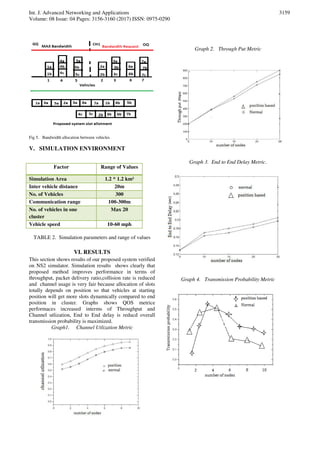
that the PB-MAC outperforms in aspects of channel
utlization,Throughput,End to End delay is reduced and
overall network performances is increased.
REFERENCES
[1] “Routing in vehicular Ad hoc networks”, IEEE
vehicular Technology magazine, June ,2007.
[2] Bhagirathi Patel, Kyushu shah “A survey vehicular
adhoc networks”, IOSR journal of computer engineering,
Dec,2013.
[3] Hadded , Laouiti , Zagrouba and Saidane “ TDMA-
Based MAC Protocols for VANETs: A survey ,Issues “,
IEEE 2015.
[4] F. Yu and S. Biswas “VESOMAC: A self-
reorganizing MAC protocol for inter-vehicle data transfer
applications in vehicular ad hoc networks” IEEE 2007.
[5] J. Zhang, Q. Zhang, and W. Jia “VC-MAC: A
Cooperative MAC Protocol in Vehicular Networks”
IEEE 2009.
[6] N. Lu, Y. Ji, F. Liu, and X.Wang “DMMAC: A
dedicated multi-channel MAC protocol design for
VANET with adaptive broadcasting “ ,IEEE 2010.
[7] Hang Su and Xi Zhang “Clustering-Based
Multichannel MAC Protocols for QoS Provisioning’s
Over Vehicular Ad Hoc Networks , 2012.
[8] WeijieGuo, Liusheng Huang, Long Chen, HongliXu,
and JietaoXie “ACFMAC: An Adaptive Collision-Free
MAC Protocol Based on TDMA for Inter-Vehicular
Communication”,IEE 2012.
[9] H. A. Omar, W. Zhuang, and L. Li “VEMAC: A
TDMA-based MAC protocol for reliable broadcast in
VANETs ” ,IEEE 2013.
[10] S.Bharati and W.Zhuang“CAHMAC: Cooperative
Ad hoc MAC for vehicular networks”,IEEE journals
2013.
[11] Y. Weidong, L. Pan, L. Yan, and Z. Hong song,”
ATSA: Adaptive TDMA slot assignment protocol for
vehicular ad-hoc networks” ,IEEE 2013.
[12] H. Yu, Z. He, and K. Niu “STDMA for vehicle-to-
vehicle communication in a highway scenario” ,IEEE
2013.
[13] D. N. M. Dang, H. N. Dang, V. Nguyen, Z. Htike,
and C. S. Hong " HERMAC: A hybrid efficient and
reliable MAC for vanets “ , IEEE 2014.
[14] Minhdang and Seon Hong “VERMAC: An efficient
and reliable MAC Protocol “ ,IEEE journals 2014.
[15] Mohamed Hadded, Anis Laouiti, Rachid Zagrouba
“DTMAC: A Fully Distributed TDMA based MAC
Protocol for Vehicular Ad Hoc Networks” , IEEE 2015.](https://image.slidesharecdn.com/v8i4-5-170308062748/85/PBMAC-Position-Based-Channel-Allocation-for-Vehicular-Ad-Hoc-Networks-5-320.jpg)

The document presents a position-based channel allocation method for Vehicular Ad Hoc Networks (VANETs) to improve communication efficiency by considering vehicle positions within a cluster. The proposed PBMAC system ensures better bandwidth usage by allocating more resources to vehicles closer to the cluster head, reducing collisions and enhancing overall network performance. Simulation results indicate significant improvements in throughput, channel utilization, and reductions in end-to-end delay.


