The 18th Wireless Telecommunications Symposium (WTS 2019)
A Network Selection Algorithm for supporting
Drone Services in 5G Network Architectures
Emmanouil Skondras1, Eirini Zoumi1, Angelos Michalas2,
Dimitrios D. Vergados1
1Department of Informatics, University of Piraeus, Piraeus, Greece
2Department of Informatics Engineering, Technological Education
Institute of Western Macedonia
1
The 18th Wireless Telecommunications Symposium (WTS 2019)
Outline
• Introduction.
• Disaster Management and Non-Disaster Management services.
• Fog Infrastructures and Ultra Dense Networks.
• Drones Connectivity.
• The Proposed Network Selection Algorithm.
• Simulation Setup.
• Experimental Results.
• Computational Complexity.
• Conclusions.
The 18th Wireless Telecommunications Symposium (WTS 2019)
Introduction
• Flying Ad-hoc Networks (FANETs).
– drones equipped with computational and network resources.
– communicate with each other through:
• Drone to Drone (D2D) communication.
• 5G network infrastructures - Drone to Infrastructure (D2I) communication.
• 5G key enabling technologies:
– Cloud Computing (CC).
– Software Defined Networking (SDN).
• Cloud infrastructures offer modern services to the FANET
through D2I communication.
– For both disaster and non-disaster management situations.
3
The 18th Wireless Telecommunications Symposium (WTS 2019)
Disaster Management and
Non-Disaster Management services
• Disaster Management (DM) services:
 Refer to the manipulation of natural disasters.
– Disaster-aware Information Gathering (DIG).
– Live Video Streaming for Emergency Manipulation (LVS-EM).
– Image Transmission for Emergency Manipulation (IMT-EM).
• Non-Disaster Management (nDM) services:
– Live Video Streaming (LVS).
– Image Transmission (IMT).
– 3D Scanning (3DS).
4
The 18th Wireless Telecommunications Symposium (WTS 2019)
Fog Infrastructures and Ultra Dense Networks
• Fog infrastructures.
– Improve the durability and the response latency of the 5G
architectures.
– Base stations are equipped with additional computational and storage
resources.
• Ultra Dense Networks (UDN).
– Dense deployments of access networks.
– Support the high data rates produced by an increased number of
users.
– A large number of small cells, such as Femtocells, is deployed inside
the network coverage area, in order to increase the overall capacity of
the access network.
5
The 18th Wireless Telecommunications Symposium (WTS 2019)
Fog Infrastructures and Ultra Dense Networks
• However, in a FANET environment drones obtain very high velocities.
– Femtocells are considered as an inappropriate solution.
• Due to the small time that each drone remains inside their coverage area.
– The densification of network access resources could be performed by applying
the operating principles of Massive Multiple Input Multiple Output (Massive
MIMO).
• Massive MIMO can be applied to an infrastructure of Macrocells.
– Instead of using dense deployments of Femtocells with few antennas installed in each.
• Regarding the Massive MIMO architectural design, 3GPP has specified the
Full-Dimension MIMO (FD-MIMO) as part of the LTE-A Pro technology.
– FD-MIMO enables the use of tens of antennas in each LTE-A Pro eNB.
6
The 18th Wireless Telecommunications Symposium (WTS 2019)
Drones Connectivity
• The drones should always obtain connectivity to the best network.
– To fulfill the requirements of their services.
• Therefore, the design of efficient network selection schemes is required.
• Multi Attribute Decision Making (MADM) methods are used to select the best
alternative among candidate networks given a set of criteria with different
importance weights.
– Widely used methods include:
• The Analytic Hierarchy Process (AHP).
• The Analytic network process (ANP).
• The Technique for Order Preference by Similarity to Ideal Solution (TOPSIS).
• The Trapezoidal Fuzzy TOPSIS (TFT).
• The Dynamic TOPSIS (DTOPSIS).
• The Simple Additive Weighting (SAW).
• The Fuzzy SAW (FSAW).
• The Multiplicative Exponential Weighting (MEW).
• The Fuzzy MEW (FMEW).
7
The 18th Wireless Telecommunications Symposium (WTS 2019)
The Proposed Network Selection
Algorithm
• In this work, a network selection algorithm for supporting
drone services in 5G network architectures through D2I
communications, is proposed.
• The algorithm is called Dynamic Trapezoidal Fuzzy Topsis with
Adaptive Criteria Weights (DTFT-ACW).
– It performs the network selection considering:
 The constraints of each service.
 The Disaster Severity Level (DSL) that each drone encounters in its area.
8
The 18th Wireless Telecommunications Symposium (WTS 2019)
The Proposed Network Selection
Algorithm
• The DTFT-ACW algorithm improves the TFT-ACW [skondras2018].
– In terms of computational complexity introduced during the network
selection.
– Resulting in the requirement of less computational resources.
• The network selection performed in time t takes into
consideration the previous network selection decision performed
in time tprev < t.
• In each time t:
– A list AL(t)={AL1(t),AL2(t), …,ALz(t)} is constructed determining the current
network alternatives.
9
[skondras2018] E. Skondras, A. Michalas, N. Tsolis, and D. D. Vergados, “A network selection scheme with adaptive
criteria weights for 5g vehicular systems,” in Information Intelligence Systems and Applications (IISA), 2018 IEEE
International Conference on. IEEE, 2018.
The 18th Wireless Telecommunications Symposium (WTS 2019)
The Proposed Network Selection
Algorithm
• If AL(t) = AL(tprev):
– The alternatives' ranks obtained at time tprev are considered
 Resulting in O(n) complexity for the proposed algorithm.
• Otherwise:
– The methods defined by TFT-ACW algorithm are performed.
– Resulting in O(n2) complexity.
• O(n2) complexity is introduced by the most network selection algorithms
described in the research literature.
10
The 18th Wireless Telecommunications Symposium (WTS 2019)
The Proposed Network Selection
Algorithm
• The DTFT-ACW assumes that the linguistic values of criteria attributes are
represented by Interval-Valued Trapezoidal Fuzzy Numbers (IVTFNs).
• An Interval-Valued Fuzzy Number (IVFN) is defined as
• consisting of the lower ãL and the upper ãU fuzzy numbers.
• IVFNs replace the crisp membership values by intervals in [0,1].
• They were proposed due to the fact that fuzzy information can be better
expressed by intervals than by single values.
11
The 18th Wireless Telecommunications Symposium (WTS 2019)
The Proposed Network Selection
Algorithm
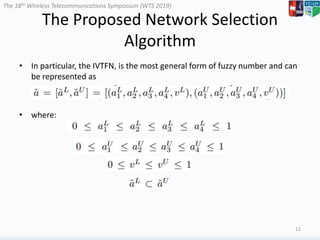
• In particular, the IVTFN, is the most general form of fuzzy number and can
be represented as
• where:
12
The 18th Wireless Telecommunications Symposium (WTS 2019)
The Proposed Network Selection
Algorithm
• A set of network selection criteria CR(t)=CR1(t),CR2(t), …,CRn(t)}
is considered,
– w1,w2,…,wn denote the importance weights of the respective criteria
• Obtained from the application of the Trapezoidal Fuzzy Adaptive Analytic Network
Process (TF-AANP) method described in [skondras2018].
• The TF-AANP method:
– Adapts the criteria weights:
• Considering the relative importance of the used services.
– Since some services could have higher importance from the other.
– Specifically, the relative importance of each service s is determined using a priority vector.
– Considers critical factors that affect the importance of each
criterion.
• Such as the severity level of a natural disaster.
13
[skondras2018] E. Skondras, A. Michalas, N. Tsolis, and D. D. Vergados, “A network selection scheme with adaptive
criteria weights for 5g vehicular systems,” in Information Intelligence Systems and Applications (IISA), 2018 IEEE
International Conference on. IEEE, 2018.
The 18th Wireless Telecommunications Symposium (WTS 2019)
The Proposed Network Selection
Algorithm
• The steps of the proposed network selection algorithm are as
follows:
– Construction of the decision matrix.
– Normalization of the decision matrix.
– Construction of the weighted normalized decision matrix..
– Determination of the positive and negative ideal solution
– Measurement of the distance of each alternative from the ideal
solutions.
– Calculation of the relative closeness.
– Alternatives ranking.
14
The 18th Wireless Telecommunications Symposium (WTS 2019)
Simulation Setup
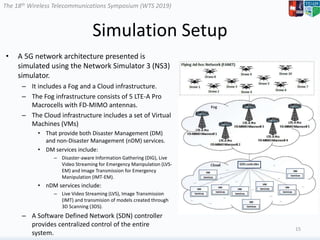
• A 5G network architecture presented is
simulated using the Network Simulator 3 (NS3)
simulator.
– It includes a Fog and a Cloud infrastructure.
– The Fog infrastructure consists of 5 LTE-A Pro
Macrocells with FD-MIMO antennas.
– The Cloud infrastructure includes a set of Virtual
Machines (VMs)
• That provide both Disaster Management (DM)
and non-Disaster Management (nDM) services.
• DM services include:
– Disaster-aware Information Gathering (DIG), Live
Video Streaming for Emergency Manipulation (LVS-
EM) and Image Transmission for Emergency
Manipulation (IMT-EM).
• nDM services include:
– Live Video Streaming (LVS), Image Transmission
(IMT) and transmision of models created through
3D Scanning (3DS).
– A Software Defined Network (SDN) controller
provides centralized control of the entire
system.
15
The 18th Wireless Telecommunications Symposium (WTS 2019)
Simulation Setup
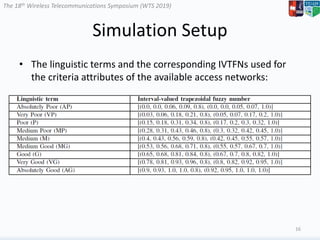
• The linguistic terms and the corresponding IVTFNs used for
the criteria attributes of the available access networks:
16
The 18th Wireless Telecommunications Symposium (WTS 2019)
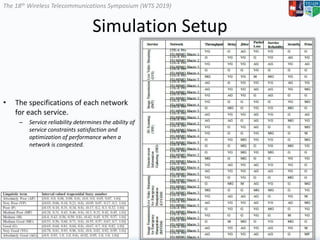
• The specifications of each network
for each service.
– Service reliability determines the ability of
service constraints satisfaction and
optimization of performance when a
network is congested.
17
Simulation Setup
The 18th Wireless Telecommunications Symposium (WTS 2019)
Simulation Setup
• The case where 10 drones are moving
inside the access network environment is
considered.
• Regarding the D2I communication.
– Each drone needs to be connected to a
network which satisfies the requirements
of its services.
• While at the same time complies with the
confronted Disaster Severity Level (DSL).
– The DSL that each drone encounters is
evaluated using the scale introduced in
[wex2014].
– This scale defines 5 severity levels, called
Low, Guarded, Elevated, High and Severe.
» The Low level refers to minimum
disaster effects, while the Severe
level refers to the highest ones.
18[wex2014] F. Wex, G. Schryen, S. Feuerriegel, and D. Neumann, “Emergency response in natural disaster management:
Allocation and scheduling of rescue units,” European Journal of Operational Research, vol. 235, no. 3, pp. 697–708, 2014.
The 18th Wireless Telecommunications Symposium (WTS 2019)
Simulation Setup
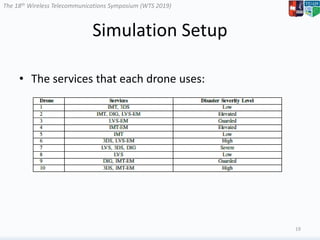
• The services that each drone uses:
19
The 18th Wireless Telecommunications Symposium (WTS 2019)
The Importance of each Service per
Disaster Severity Level (DSL)
• During the network selection process:
– Initially the relative importance of
each service is considered with
respect to the DSL.
– It is obtained using the TF-AANP
[skondras2018] method.
• As it can be observed, the importance
of DM services depends on the DSL.
• When the DSL becomes Severe.
– The DM services obtain higher
importance than the nDM services.
• When the DSL becomes Low.
– The relative importance of the
services is quite similar.
20
[skondras2018] E. Skondras, A. Michalas, N. Tsolis, and D. D. Vergados, “A network selection scheme with adaptive
criteria weights for 5g vehicular systems,” in Information Intelligence Systems and Applications (IISA), 2018 IEEE
International Conference on. IEEE, 2018.
The 18th Wireless Telecommunications Symposium (WTS 2019)
Criteria Weights for Disaster
Management Services
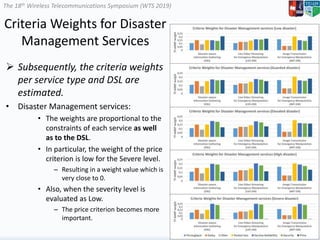
 Subsequently, the criteria weights
per service type and DSL are
estimated.
• Disaster Management services:
• The weights are proportional to the
constraints of each service as well
as to the DSL.
• In particular, the weight of the price
criterion is low for the Severe level.
– Resulting in a weight value which is
very close to 0.
• Also, when the severity level is
evaluated as Low.
– The price criterion becomes more
important.
21
The 18th Wireless Telecommunications Symposium (WTS 2019)
Criteria Weights for non-Disaster
Management Services
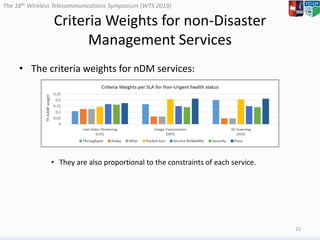
• The criteria weights for nDM services:
• They are also proportional to the constraints of each service.
22
The 18th Wireless Telecommunications Symposium (WTS 2019)
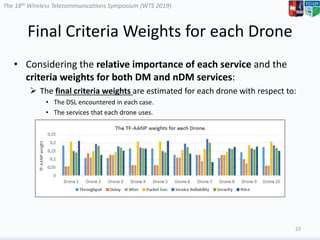
Final Criteria Weights for each Drone
• Considering the relative importance of each service and the
criteria weights for both DM and nDM services:
 The final criteria weights are estimated for each drone with respect to:
• The DSL encountered in each case.
• The services that each drone uses.
23
The 18th Wireless Telecommunications Symposium (WTS 2019)
Experimental Results
• Ranking of the networks alternatives is performed from the DTFT-ACW
algorithm.
– Using the aforementioned criteria weights for each drone.
• Subsequently, the experimental results of the DTFT-ACW method are
compared with the ones obtained from:
– The TFT [skondras2016].
– The DTOPSIS [bisio2014].
– The FSAW [roszkowska2016].
– The FMEW [maroua2016].
24
[skondras2016] E. Skondras, A. Sgora, A. Michalas, and D. D. Vergados, “An analytic network process and trapezoidal interval-valued fuzzy
technique for order preference by similarity to ideal solution network access selection method,” International Journal of Communication
Systems, vol. 29, no. 2, pp. 307–329, 2016.
[bisio2014] I. Bisio, C. Braccini, S. Delucchi, F. Lavagetto, and M. Marchese, “Dynamic multi-attribute network selection algorithm for vertical
handover procedures over mobile ad hoc networks,” in Communications (ICC), 2014 IEEE International Conference on. IEEE, 2014, pp. 342–347.
[roszkowska2016] E. Roszkowska and D. Kacprzak, “The fuzzy saw and fuzzy topsis procedures based on ordered fuzzy numbers,” Information
Sciences, vol.
369, pp. 564–584, 2016.
[maroua2016] D. A. Maroua Drissi, Mohammed Oumsis, “A fuzzy ahp approach to network selection improvement in heterogeneous wireless
networks,” Networked Systems, pp. 169–182, 2016.
The 18th Wireless Telecommunications Symposium (WTS 2019)
Experimental Results
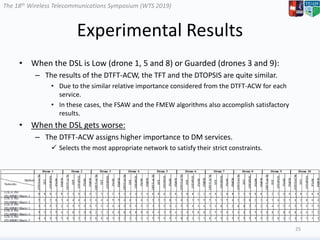
• When the DSL is Low (drone 1, 5 and 8) or Guarded (drones 3 and 9):
– The results of the DTFT-ACW, the TFT and the DTOPSIS are quite similar.
• Due to the similar relative importance considered from the DTFT-ACW for each
service.
• In these cases, the FSAW and the FMEW algorithms also accomplish satisfactory
results.
• When the DSL gets worse:
– The DTFT-ACW assigns higher importance to DM services.
 Selects the most appropriate network to satisfy their strict constraints.
25
The 18th Wireless Telecommunications Symposium (WTS 2019)
Experimental Results
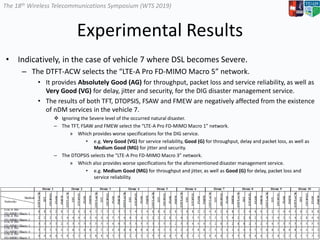
• Indicatively, in the case of vehicle 7 where DSL becomes Severe.
– The DTFT-ACW selects the “LTE-A Pro FD-MIMO Macro 5” network.
• It provides Absolutely Good (AG) for throughput, packet loss and service reliability, as well as
Very Good (VG) for delay, jitter and security, for the DIG disaster management service.
• The results of both TFT, DTOPSIS, FSAW and FMEW are negatively affected from the existence
of nDM services in the vehicle 7.
 Ignoring the Severe level of the occurred natural disaster.
– The TFT, FSAW and FMEW select the “LTE-A Pro FD-MIMO Macro 1” network.
» Which provides worse specifications for the DIG service.
• e.g. Very Good (VG) for service reliability, Good (G) for throughput, delay and packet loss, as well as
Medium Good (MG) for jitter and security.
– The DTOPSIS selects the “LTE-A Pro FD-MIMO Macro 3” network.
» Which also provides worse specifications for the aforementioned disaster management service.
• e.g. Medium Good (MG) for throughput and jitter, as well as Good (G) for delay, packet loss and
service reliability.
26
The 18th Wireless Telecommunications Symposium (WTS 2019)
Computational Complexity
• The DTFT-ACW and DTOPSIS succeed the most efficient
results.
– In both algorithms, during the first run the network selection process
introduces a O(n2) complexity,
• Due to the weighting and normalization of n x m decision matrices.
• Subsequently, for each next run where AL(t) = AL(tprev),
– Constant time is required for the completion of the network selection
» By performing simple checks to the results obtained during the tprev
time, resulting in O(n) complexity.
• On the contrary, the TFT, FSAW and FMEW algorithms always
result in O(n2) complexity.
– Since they manipulate n x m decision matrices, each time they
perform the network selection.
27
The 18th Wireless Telecommunications Symposium (WTS 2019)
Conclusions
• This paper proposes the DTFT-ACW network selection algorithm for
supporting drone services through 5G network architectures.
• The DTFT-ACW accomplishes optimal ranking of the candidate
networks, considering:
– The relative importance of each service.
– The weights of the selection criteria.
• The severity level of an occurred natural disaster is considered.
• Performance evaluation showed that the DTFT-ACW algorithm
outperforms existing network selection methods.
– By satisfying the strict constraints of disaster management services.
• In situations where an occurred natural disaster becomes severe.
• Also, the DTFT-ACW algorithm eliminates the computational
complexity.
– By considering past network selection decisions in cases where the list
of available access networks has not been changed.
28
The 18th Wireless Telecommunications Symposium (WTS 2019)
29

A Network Selection Algorithm for supporting Drone Services in 5G Network Architectures (presentation)

  • 1.
    The 18th WirelessTelecommunications Symposium (WTS 2019) A Network Selection Algorithm for supporting Drone Services in 5G Network Architectures Emmanouil Skondras1, Eirini Zoumi1, Angelos Michalas2, Dimitrios D. Vergados1 1Department of Informatics, University of Piraeus, Piraeus, Greece 2Department of Informatics Engineering, Technological Education Institute of Western Macedonia 1
  • 2.
    The 18th WirelessTelecommunications Symposium (WTS 2019) Outline • Introduction. • Disaster Management and Non-Disaster Management services. • Fog Infrastructures and Ultra Dense Networks. • Drones Connectivity. • The Proposed Network Selection Algorithm. • Simulation Setup. • Experimental Results. • Computational Complexity. • Conclusions.
  • 3.
    The 18th WirelessTelecommunications Symposium (WTS 2019) Introduction • Flying Ad-hoc Networks (FANETs). – drones equipped with computational and network resources. – communicate with each other through: • Drone to Drone (D2D) communication. • 5G network infrastructures - Drone to Infrastructure (D2I) communication. • 5G key enabling technologies: – Cloud Computing (CC). – Software Defined Networking (SDN). • Cloud infrastructures offer modern services to the FANET through D2I communication. – For both disaster and non-disaster management situations. 3
  • 4.
    The 18th WirelessTelecommunications Symposium (WTS 2019) Disaster Management and Non-Disaster Management services • Disaster Management (DM) services:  Refer to the manipulation of natural disasters. – Disaster-aware Information Gathering (DIG). – Live Video Streaming for Emergency Manipulation (LVS-EM). – Image Transmission for Emergency Manipulation (IMT-EM). • Non-Disaster Management (nDM) services: – Live Video Streaming (LVS). – Image Transmission (IMT). – 3D Scanning (3DS). 4
  • 5.
    The 18th WirelessTelecommunications Symposium (WTS 2019) Fog Infrastructures and Ultra Dense Networks • Fog infrastructures. – Improve the durability and the response latency of the 5G architectures. – Base stations are equipped with additional computational and storage resources. • Ultra Dense Networks (UDN). – Dense deployments of access networks. – Support the high data rates produced by an increased number of users. – A large number of small cells, such as Femtocells, is deployed inside the network coverage area, in order to increase the overall capacity of the access network. 5
  • 6.
    The 18th WirelessTelecommunications Symposium (WTS 2019) Fog Infrastructures and Ultra Dense Networks • However, in a FANET environment drones obtain very high velocities. – Femtocells are considered as an inappropriate solution. • Due to the small time that each drone remains inside their coverage area. – The densification of network access resources could be performed by applying the operating principles of Massive Multiple Input Multiple Output (Massive MIMO). • Massive MIMO can be applied to an infrastructure of Macrocells. – Instead of using dense deployments of Femtocells with few antennas installed in each. • Regarding the Massive MIMO architectural design, 3GPP has specified the Full-Dimension MIMO (FD-MIMO) as part of the LTE-A Pro technology. – FD-MIMO enables the use of tens of antennas in each LTE-A Pro eNB. 6
  • 7.
    The 18th WirelessTelecommunications Symposium (WTS 2019) Drones Connectivity • The drones should always obtain connectivity to the best network. – To fulfill the requirements of their services. • Therefore, the design of efficient network selection schemes is required. • Multi Attribute Decision Making (MADM) methods are used to select the best alternative among candidate networks given a set of criteria with different importance weights. – Widely used methods include: • The Analytic Hierarchy Process (AHP). • The Analytic network process (ANP). • The Technique for Order Preference by Similarity to Ideal Solution (TOPSIS). • The Trapezoidal Fuzzy TOPSIS (TFT). • The Dynamic TOPSIS (DTOPSIS). • The Simple Additive Weighting (SAW). • The Fuzzy SAW (FSAW). • The Multiplicative Exponential Weighting (MEW). • The Fuzzy MEW (FMEW). 7
  • 8.
    The 18th WirelessTelecommunications Symposium (WTS 2019) The Proposed Network Selection Algorithm • In this work, a network selection algorithm for supporting drone services in 5G network architectures through D2I communications, is proposed. • The algorithm is called Dynamic Trapezoidal Fuzzy Topsis with Adaptive Criteria Weights (DTFT-ACW). – It performs the network selection considering:  The constraints of each service.  The Disaster Severity Level (DSL) that each drone encounters in its area. 8
  • 9.
    The 18th WirelessTelecommunications Symposium (WTS 2019) The Proposed Network Selection Algorithm • The DTFT-ACW algorithm improves the TFT-ACW [skondras2018]. – In terms of computational complexity introduced during the network selection. – Resulting in the requirement of less computational resources. • The network selection performed in time t takes into consideration the previous network selection decision performed in time tprev < t. • In each time t: – A list AL(t)={AL1(t),AL2(t), …,ALz(t)} is constructed determining the current network alternatives. 9 [skondras2018] E. Skondras, A. Michalas, N. Tsolis, and D. D. Vergados, “A network selection scheme with adaptive criteria weights for 5g vehicular systems,” in Information Intelligence Systems and Applications (IISA), 2018 IEEE International Conference on. IEEE, 2018.
  • 10.
    The 18th WirelessTelecommunications Symposium (WTS 2019) The Proposed Network Selection Algorithm • If AL(t) = AL(tprev): – The alternatives' ranks obtained at time tprev are considered  Resulting in O(n) complexity for the proposed algorithm. • Otherwise: – The methods defined by TFT-ACW algorithm are performed. – Resulting in O(n2) complexity. • O(n2) complexity is introduced by the most network selection algorithms described in the research literature. 10
  • 11.
    The 18th WirelessTelecommunications Symposium (WTS 2019) The Proposed Network Selection Algorithm • The DTFT-ACW assumes that the linguistic values of criteria attributes are represented by Interval-Valued Trapezoidal Fuzzy Numbers (IVTFNs). • An Interval-Valued Fuzzy Number (IVFN) is defined as • consisting of the lower ãL and the upper ãU fuzzy numbers. • IVFNs replace the crisp membership values by intervals in [0,1]. • They were proposed due to the fact that fuzzy information can be better expressed by intervals than by single values. 11
  • 12.
    The 18th WirelessTelecommunications Symposium (WTS 2019) The Proposed Network Selection Algorithm • In particular, the IVTFN, is the most general form of fuzzy number and can be represented as • where: 12
  • 13.
    The 18th WirelessTelecommunications Symposium (WTS 2019) The Proposed Network Selection Algorithm • A set of network selection criteria CR(t)=CR1(t),CR2(t), …,CRn(t)} is considered, – w1,w2,…,wn denote the importance weights of the respective criteria • Obtained from the application of the Trapezoidal Fuzzy Adaptive Analytic Network Process (TF-AANP) method described in [skondras2018]. • The TF-AANP method: – Adapts the criteria weights: • Considering the relative importance of the used services. – Since some services could have higher importance from the other. – Specifically, the relative importance of each service s is determined using a priority vector. – Considers critical factors that affect the importance of each criterion. • Such as the severity level of a natural disaster. 13 [skondras2018] E. Skondras, A. Michalas, N. Tsolis, and D. D. Vergados, “A network selection scheme with adaptive criteria weights for 5g vehicular systems,” in Information Intelligence Systems and Applications (IISA), 2018 IEEE International Conference on. IEEE, 2018.
  • 14.
    The 18th WirelessTelecommunications Symposium (WTS 2019) The Proposed Network Selection Algorithm • The steps of the proposed network selection algorithm are as follows: – Construction of the decision matrix. – Normalization of the decision matrix. – Construction of the weighted normalized decision matrix.. – Determination of the positive and negative ideal solution – Measurement of the distance of each alternative from the ideal solutions. – Calculation of the relative closeness. – Alternatives ranking. 14
  • 15.
    The 18th WirelessTelecommunications Symposium (WTS 2019) Simulation Setup • A 5G network architecture presented is simulated using the Network Simulator 3 (NS3) simulator. – It includes a Fog and a Cloud infrastructure. – The Fog infrastructure consists of 5 LTE-A Pro Macrocells with FD-MIMO antennas. – The Cloud infrastructure includes a set of Virtual Machines (VMs) • That provide both Disaster Management (DM) and non-Disaster Management (nDM) services. • DM services include: – Disaster-aware Information Gathering (DIG), Live Video Streaming for Emergency Manipulation (LVS- EM) and Image Transmission for Emergency Manipulation (IMT-EM). • nDM services include: – Live Video Streaming (LVS), Image Transmission (IMT) and transmision of models created through 3D Scanning (3DS). – A Software Defined Network (SDN) controller provides centralized control of the entire system. 15
  • 16.
    The 18th WirelessTelecommunications Symposium (WTS 2019) Simulation Setup • The linguistic terms and the corresponding IVTFNs used for the criteria attributes of the available access networks: 16
  • 17.
    The 18th WirelessTelecommunications Symposium (WTS 2019) • The specifications of each network for each service. – Service reliability determines the ability of service constraints satisfaction and optimization of performance when a network is congested. 17 Simulation Setup
  • 18.
    The 18th WirelessTelecommunications Symposium (WTS 2019) Simulation Setup • The case where 10 drones are moving inside the access network environment is considered. • Regarding the D2I communication. – Each drone needs to be connected to a network which satisfies the requirements of its services. • While at the same time complies with the confronted Disaster Severity Level (DSL). – The DSL that each drone encounters is evaluated using the scale introduced in [wex2014]. – This scale defines 5 severity levels, called Low, Guarded, Elevated, High and Severe. » The Low level refers to minimum disaster effects, while the Severe level refers to the highest ones. 18[wex2014] F. Wex, G. Schryen, S. Feuerriegel, and D. Neumann, “Emergency response in natural disaster management: Allocation and scheduling of rescue units,” European Journal of Operational Research, vol. 235, no. 3, pp. 697–708, 2014.
  • 19.
    The 18th WirelessTelecommunications Symposium (WTS 2019) Simulation Setup • The services that each drone uses: 19
  • 20.
    The 18th WirelessTelecommunications Symposium (WTS 2019) The Importance of each Service per Disaster Severity Level (DSL) • During the network selection process: – Initially the relative importance of each service is considered with respect to the DSL. – It is obtained using the TF-AANP [skondras2018] method. • As it can be observed, the importance of DM services depends on the DSL. • When the DSL becomes Severe. – The DM services obtain higher importance than the nDM services. • When the DSL becomes Low. – The relative importance of the services is quite similar. 20 [skondras2018] E. Skondras, A. Michalas, N. Tsolis, and D. D. Vergados, “A network selection scheme with adaptive criteria weights for 5g vehicular systems,” in Information Intelligence Systems and Applications (IISA), 2018 IEEE International Conference on. IEEE, 2018.
  • 21.
    The 18th WirelessTelecommunications Symposium (WTS 2019) Criteria Weights for Disaster Management Services  Subsequently, the criteria weights per service type and DSL are estimated. • Disaster Management services: • The weights are proportional to the constraints of each service as well as to the DSL. • In particular, the weight of the price criterion is low for the Severe level. – Resulting in a weight value which is very close to 0. • Also, when the severity level is evaluated as Low. – The price criterion becomes more important. 21
  • 22.
    The 18th WirelessTelecommunications Symposium (WTS 2019) Criteria Weights for non-Disaster Management Services • The criteria weights for nDM services: • They are also proportional to the constraints of each service. 22
  • 23.
    The 18th WirelessTelecommunications Symposium (WTS 2019) Final Criteria Weights for each Drone • Considering the relative importance of each service and the criteria weights for both DM and nDM services:  The final criteria weights are estimated for each drone with respect to: • The DSL encountered in each case. • The services that each drone uses. 23
  • 24.
    The 18th WirelessTelecommunications Symposium (WTS 2019) Experimental Results • Ranking of the networks alternatives is performed from the DTFT-ACW algorithm. – Using the aforementioned criteria weights for each drone. • Subsequently, the experimental results of the DTFT-ACW method are compared with the ones obtained from: – The TFT [skondras2016]. – The DTOPSIS [bisio2014]. – The FSAW [roszkowska2016]. – The FMEW [maroua2016]. 24 [skondras2016] E. Skondras, A. Sgora, A. Michalas, and D. D. Vergados, “An analytic network process and trapezoidal interval-valued fuzzy technique for order preference by similarity to ideal solution network access selection method,” International Journal of Communication Systems, vol. 29, no. 2, pp. 307–329, 2016. [bisio2014] I. Bisio, C. Braccini, S. Delucchi, F. Lavagetto, and M. Marchese, “Dynamic multi-attribute network selection algorithm for vertical handover procedures over mobile ad hoc networks,” in Communications (ICC), 2014 IEEE International Conference on. IEEE, 2014, pp. 342–347. [roszkowska2016] E. Roszkowska and D. Kacprzak, “The fuzzy saw and fuzzy topsis procedures based on ordered fuzzy numbers,” Information Sciences, vol. 369, pp. 564–584, 2016. [maroua2016] D. A. Maroua Drissi, Mohammed Oumsis, “A fuzzy ahp approach to network selection improvement in heterogeneous wireless networks,” Networked Systems, pp. 169–182, 2016.
  • 25.
    The 18th WirelessTelecommunications Symposium (WTS 2019) Experimental Results • When the DSL is Low (drone 1, 5 and 8) or Guarded (drones 3 and 9): – The results of the DTFT-ACW, the TFT and the DTOPSIS are quite similar. • Due to the similar relative importance considered from the DTFT-ACW for each service. • In these cases, the FSAW and the FMEW algorithms also accomplish satisfactory results. • When the DSL gets worse: – The DTFT-ACW assigns higher importance to DM services.  Selects the most appropriate network to satisfy their strict constraints. 25
  • 26.
    The 18th WirelessTelecommunications Symposium (WTS 2019) Experimental Results • Indicatively, in the case of vehicle 7 where DSL becomes Severe. – The DTFT-ACW selects the “LTE-A Pro FD-MIMO Macro 5” network. • It provides Absolutely Good (AG) for throughput, packet loss and service reliability, as well as Very Good (VG) for delay, jitter and security, for the DIG disaster management service. • The results of both TFT, DTOPSIS, FSAW and FMEW are negatively affected from the existence of nDM services in the vehicle 7.  Ignoring the Severe level of the occurred natural disaster. – The TFT, FSAW and FMEW select the “LTE-A Pro FD-MIMO Macro 1” network. » Which provides worse specifications for the DIG service. • e.g. Very Good (VG) for service reliability, Good (G) for throughput, delay and packet loss, as well as Medium Good (MG) for jitter and security. – The DTOPSIS selects the “LTE-A Pro FD-MIMO Macro 3” network. » Which also provides worse specifications for the aforementioned disaster management service. • e.g. Medium Good (MG) for throughput and jitter, as well as Good (G) for delay, packet loss and service reliability. 26
  • 27.
    The 18th WirelessTelecommunications Symposium (WTS 2019) Computational Complexity • The DTFT-ACW and DTOPSIS succeed the most efficient results. – In both algorithms, during the first run the network selection process introduces a O(n2) complexity, • Due to the weighting and normalization of n x m decision matrices. • Subsequently, for each next run where AL(t) = AL(tprev), – Constant time is required for the completion of the network selection » By performing simple checks to the results obtained during the tprev time, resulting in O(n) complexity. • On the contrary, the TFT, FSAW and FMEW algorithms always result in O(n2) complexity. – Since they manipulate n x m decision matrices, each time they perform the network selection. 27
  • 28.
    The 18th WirelessTelecommunications Symposium (WTS 2019) Conclusions • This paper proposes the DTFT-ACW network selection algorithm for supporting drone services through 5G network architectures. • The DTFT-ACW accomplishes optimal ranking of the candidate networks, considering: – The relative importance of each service. – The weights of the selection criteria. • The severity level of an occurred natural disaster is considered. • Performance evaluation showed that the DTFT-ACW algorithm outperforms existing network selection methods. – By satisfying the strict constraints of disaster management services. • In situations where an occurred natural disaster becomes severe. • Also, the DTFT-ACW algorithm eliminates the computational complexity. – By considering past network selection decisions in cases where the list of available access networks has not been changed. 28
  • 29.
    The 18th WirelessTelecommunications Symposium (WTS 2019) 29