












Hello!
My name is Pedro De Bruyckere…
Twitter:
@thebandb
Website: TheEconomyOfMeaning.com
Book:
ç check
The follow up:
PEDRO DE BRUYCKERE
PAUL A. KIRSCHNER
CASPER D. HULSHOF
ISBN: 978-0-8153-5458-1
9 780815 354581
Cover image: © Getty Images
MORE
URBAN
MYTHS
ABOUT
LEARNING
AND
EDUCATION
Pedro
De
Bruyckere,
Paul
A.
Kirschner,
and
Casper
Hulshof
www.routledge.com/education
Routledge titles are available as eBook editions in a range of digital formats
an informa business
MORE URBAN
MYTHS
ABOUT LEARNING AND EDUCATION
Challenging Eduquacks, Extraordinary Claims,
and Alternative Facts
Twitter:
@thebandb
Website: TheEconomyOfMeaning.com
Book:
ç check
A science of learning teaching?
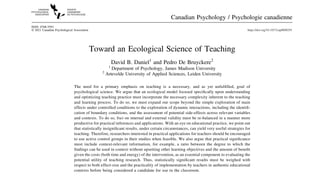
Toward an Ecological Science of Teaching
David B. Daniel1
and Pedro De Bruyckere2
1
Department of Psychology, James Madison University
2
Artevelde University of Applied Sciences, Leiden University
The need for a primary emphasis on teaching is a necessary, and as yet unfulfilled, goal of
psychological science. We argue that an ecological model focused specifically upon understanding
and optimizing teaching practice must incorporate the necessary complexity inherent to the teaching
and learning process. To do so, we must expand our scope beyond the simple exploration of main
effects under controlled conditions to the exploration of dynamic interactions, including the identifi-
cation of boundary conditions, and the assessment of potential side-effects across relevant variables
and contexts. To do so, foci on internal and external validity must be re-balanced in a manner more
productive for practical inferences and applications. With an eye on educational practice, we point out
that statistically insignificant results, under certain circumstances, can yield very useful strategies for
teaching. Therefore, researchers interested in practical applications for teachers should be encouraged
to use active control groups in their studies when feasible. We also argue that practical significance
must include context-relevant information, for example, a ratio between the degree to which the
findings can be used in context without upsetting other learning objectives and the amount of benefit
given the costs (both time and energy) of the intervention, as an essential component to evaluating the
potential utility of teaching research. Thus, statistically significant results must be weighed with
respect to both effect-size and the practicality of implementation by teachers in authentic educational
contexts before being considered a candidate for use in the classroom.
Canadian Psychology / Psychologie canadienne
ISSN: 0708-5591
© 2021 Canadian Psychological Association https://doi.org/10.1037/cap0000291
Cognitive psychology has taught us a lot!
How we learn!
Let’s switch this and we know…
How we should teach?
Not that simple!
Reason?
The differences between scientists and educators!
What do they have in common?
What are the main differences?
How to solve?
One more thing…
What do they have in common?
What are the main differences?
How to solve?
One more thing…
We all want better education!
Well, I hope so…
They both do not always agree
what better education means.
They both hate complexity.
But they react in different way!
What do they have in common?
What are the main differences?
How to solve?
One more thing…
1. Dealing with complexity?
Teachers?
Well, we have to deal with it.
Teachers ->
let’s look at this from different angels
and let’s not reduce children to one element.
Scientists?
Scientists
-> let’s look at one element and try tricks to
eliminated the complexity
Randomized controlled trials!
But this give an important limitation to research:
E.g. Growth Mindset
De Bruyckere, Kirschner, @ Hulshof, 2019
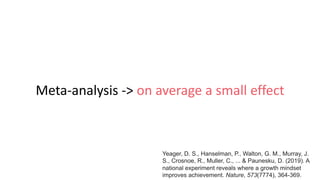
Meta-analysis -> on average a small effect
Yeager, D. S., Hanselman, P., Walton, G. M., Murray, J.
S., Crosnoe, R., Muller, C., ... & Paunesku, D. (2019). A
national experiment reveals where a growth mindset
improves achievement. Nature, 573(7774), 364-369.
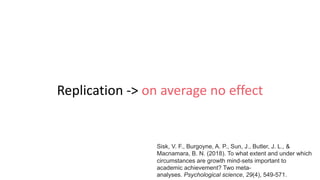
Replication -> on average no effect
Sisk, V. F., Burgoyne, A. P., Sun, J., Butler, J. L., &
Macnamara, B. N. (2018). To what extent and under which
circumstances are growth mind-sets important to
academic achievement? Two meta-
analyses. Psychological science, 29(4), 549-571.
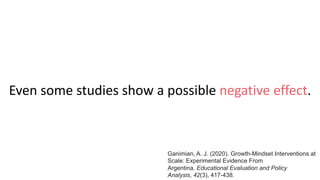
Even some studies show a possible negative effect.
Ganimian, A. J. (2020). Growth-Mindset Interventions at
Scale: Experimental Evidence From
Argentina. Educational Evaluation and Policy
Analysis, 42(3), 417-438.
2. Dealing with significance?
Second possible issue with RCT’s.
“Compared to what?”
New stuff versus business as usual?
Maybe better idea:
New stuff versus a known effective approach?
For scientists?
If you don’t find a significant difference?
Very hard to get published.
For teachers?
No significane?
Maybe this is as good!
What do they have in common?
What are the main differences?
How to solve?
One more thing…
More replications
-> why does it work here and less there?
Non-significant results should get published.
Stop looking for the “king of the mountain.”
What do they have in common?
What are the main differences?
How to solve?
One more thing…
What’s next?
The psychology of great teaching?
Psychology has been in replicationcrisis.
What is still standing.
Thanks!
@thebandb
www.TheEconomyOfMeaning.com
PEDRO DE BRUYCKERE
PAUL A. KIRSCHNER
CASPER D. HULSHOF
ISBN: 978-0-8153-5458-1
9 780815 354581
Cover image: © Getty Images
MORE
URBAN
MYTHS
ABOUT
LEARNING
AND
EDUCATION
Pedro
De
Bruyckere,
Paul
A.
Kirschner,
and
Casper
Hulshof
www.routledge.com/education
Routledge titles are available as eBook editions in a range of digital formats
an informa business
MORE URBAN
MYTHS
ABOUT LEARNING AND EDUCATION
Challenging Eduquacks, Extraordinary Claims,
and Alternative Facts

A science of (learning) teaching?

  • 1.
  • 2.
    My name isPedro De Bruyckere…
  • 3.
  • 4.
    The follow up: PEDRODE BRUYCKERE PAUL A. KIRSCHNER CASPER D. HULSHOF ISBN: 978-0-8153-5458-1 9 780815 354581 Cover image: © Getty Images MORE URBAN MYTHS ABOUT LEARNING AND EDUCATION Pedro De Bruyckere, Paul A. Kirschner, and Casper Hulshof www.routledge.com/education Routledge titles are available as eBook editions in a range of digital formats an informa business MORE URBAN MYTHS ABOUT LEARNING AND EDUCATION Challenging Eduquacks, Extraordinary Claims, and Alternative Facts
  • 5.
  • 6.
    A science oflearning teaching?
  • 7.
    Toward an EcologicalScience of Teaching David B. Daniel1 and Pedro De Bruyckere2 1 Department of Psychology, James Madison University 2 Artevelde University of Applied Sciences, Leiden University The need for a primary emphasis on teaching is a necessary, and as yet unfulfilled, goal of psychological science. We argue that an ecological model focused specifically upon understanding and optimizing teaching practice must incorporate the necessary complexity inherent to the teaching and learning process. To do so, we must expand our scope beyond the simple exploration of main effects under controlled conditions to the exploration of dynamic interactions, including the identifi- cation of boundary conditions, and the assessment of potential side-effects across relevant variables and contexts. To do so, foci on internal and external validity must be re-balanced in a manner more productive for practical inferences and applications. With an eye on educational practice, we point out that statistically insignificant results, under certain circumstances, can yield very useful strategies for teaching. Therefore, researchers interested in practical applications for teachers should be encouraged to use active control groups in their studies when feasible. We also argue that practical significance must include context-relevant information, for example, a ratio between the degree to which the findings can be used in context without upsetting other learning objectives and the amount of benefit given the costs (both time and energy) of the intervention, as an essential component to evaluating the potential utility of teaching research. Thus, statistically significant results must be weighed with respect to both effect-size and the practicality of implementation by teachers in authentic educational contexts before being considered a candidate for use in the classroom. Canadian Psychology / Psychologie canadienne ISSN: 0708-5591 © 2021 Canadian Psychological Association https://doi.org/10.1037/cap0000291
  • 8.
    Cognitive psychology hastaught us a lot!
  • 9.
  • 10.
    Let’s switch thisand we know…
  • 11.
  • 12.
  • 13.
  • 14.
    The differences betweenscientists and educators!
  • 15.
    What do theyhave in common? What are the main differences? How to solve? One more thing…
  • 16.
    What do theyhave in common? What are the main differences? How to solve? One more thing…
  • 17.
    We all wantbetter education!
  • 18.
  • 19.
    They both donot always agree what better education means.
  • 20.
    They both hatecomplexity.
  • 22.
    But they reactin different way!
  • 23.
    What do theyhave in common? What are the main differences? How to solve? One more thing…
  • 24.
    1. Dealing withcomplexity?
  • 25.
  • 26.
    Well, we haveto deal with it.
  • 27.
    Teachers -> let’s lookat this from different angels and let’s not reduce children to one element.
  • 28.
  • 30.
    Scientists -> let’s lookat one element and try tricks to eliminated the complexity
  • 31.
  • 32.
    But this givean important limitation to research:
  • 33.
    E.g. Growth Mindset DeBruyckere, Kirschner, @ Hulshof, 2019
  • 34.
    Meta-analysis -> onaverage a small effect Yeager, D. S., Hanselman, P., Walton, G. M., Murray, J. S., Crosnoe, R., Muller, C., ... & Paunesku, D. (2019). A national experiment reveals where a growth mindset improves achievement. Nature, 573(7774), 364-369.
  • 35.
    Replication -> onaverage no effect Sisk, V. F., Burgoyne, A. P., Sun, J., Butler, J. L., & Macnamara, B. N. (2018). To what extent and under which circumstances are growth mind-sets important to academic achievement? Two meta- analyses. Psychological science, 29(4), 549-571.
  • 36.
    Even some studiesshow a possible negative effect. Ganimian, A. J. (2020). Growth-Mindset Interventions at Scale: Experimental Evidence From Argentina. Educational Evaluation and Policy Analysis, 42(3), 417-438.
  • 37.
    2. Dealing withsignificance?
  • 38.
    Second possible issuewith RCT’s.
  • 39.
  • 40.
    New stuff versusbusiness as usual?
  • 41.
  • 42.
    New stuff versusa known effective approach?
  • 43.
  • 45.
    If you don’tfind a significant difference? Very hard to get published.
  • 46.
  • 47.
  • 48.
    What do theyhave in common? What are the main differences? How to solve? One more thing…
  • 49.
    More replications -> whydoes it work here and less there?
  • 50.
  • 51.
    Stop looking forthe “king of the mountain.”
  • 52.
    What do theyhave in common? What are the main differences? How to solve? One more thing…
  • 53.
  • 54.
    The psychology ofgreat teaching?
  • 55.
    Psychology has beenin replicationcrisis.
  • 56.
    What is stillstanding.
  • 57.
    Thanks! @thebandb www.TheEconomyOfMeaning.com PEDRO DE BRUYCKERE PAULA. KIRSCHNER CASPER D. HULSHOF ISBN: 978-0-8153-5458-1 9 780815 354581 Cover image: © Getty Images MORE URBAN MYTHS ABOUT LEARNING AND EDUCATION Pedro De Bruyckere, Paul A. Kirschner, and Casper Hulshof www.routledge.com/education Routledge titles are available as eBook editions in a range of digital formats an informa business MORE URBAN MYTHS ABOUT LEARNING AND EDUCATION Challenging Eduquacks, Extraordinary Claims, and Alternative Facts