International Journal of Computer Science, Engineering and Applications (IJCSEA) Vol.2, No.4, August 2012
DOI : 10.5121/ijcsea.2012.2407 63
A Robust DWT Digital Image Watermarking
Technique Basis On Scaling Factor
Heena Shaikh,Mohd.Imran Khan, Yashovardhan Kelkar
Department of Information Technology, MIT, Ujjain
heenushaikh@gmail.com , imran.khan@mitmandsaur.info,
yasho028@rediffmail.com
Abstract:
At the present time, the aptitude in contemplation of accessing as well as sharing images has become
progressively facile with the Internet allowing people to procure information remotely from anywhere in
the entire world. Moreover, there has been also an expansion with regard to the number of the still digital
images over the internet for the sake of the fact that a vast number of millions of people are capturing
digital photos. Fundamentally, the procedure of digital watermarking can be delineated as a method for
embedding information into another signal (a digital signal). In case of digital images, the embedded
information can be either visible or hidden from the user. In this project, we will concentrate on
imperceptible watermarks. The principal intention of digital watermarks is to provide copyright
protection for intellectual property that is in digital format. Typical usage scenarios for watermarking are
such as copyright protection and data authentication. In this paper, we describe an imperceptible and a
robust DWT digital Image Watermarking algorithm.The algorithm watermarks a given digital image using
a Discrete Wavelet Transform.
Keywords:
Digital watermarking, Discrete Wavelet Transform(DWT), Peak Signal to Noise Ratio, Scaling Factor,
Gaussian Noise, Salt and Pepper.
I. Introduction
The DWT transform, Wavelets are special functions which, in a form analogous to sines and
cosines in Fourier analysis, are used as basal functions for representing signals. For 2-D images,
applying DWT corresponds to processing the image by 2-D filters in each dimension. The
filters divide the input image into four non-overlapping multi-resolution sub-bands (LL1), (LH1),
(HL1) and (HH1). The sub-band (LL1) represents the coarse-scale DWT coefficients while the
sub-bands (LH1), (HL1) and (HH1) represent the fine scale of DWT coefficients[1]. To obtain the
next coarser scale of wavelet coefficients, the sub-band (LL1) is further processed until some final
scale “N” is reached. When “N” is reached we will have 3N+1 sub-bands consisting of the multi-
resolution sub-bands (LLN) and (LHX),(HLx) and (HHx) where “X” ranges from 1 until “N
”[1][2].Due to its excellent spatio-frequencylocalization properties, the FDWT is very suitable to
identify the areas in the host image. where a watermark can be embedded effectively. In
International Journal of Computer Science, Engineering and Applications (IJCSEA) Vol.2, No.4, August 2012
64
particular, this property allows the exploitation of the masking effect of the human visual
system such that if a DWT coefficient is modified, only the region corresponding to that
coefficient will be modified. In general most of the image energy is concentrated at the lower
frequency sub-bands (LLX) and therefore embedding watermarks in these sub bands may degrade
the image significantly[3].
Yes, No
Original It’s True It’s fake
Digital Image
Fig. I Digital image Watermarking
The embedding and detecting procedure for watermarking technique based on DWT
transform.[4]Computing PSNR function (peak single-to-noise ratio)based on scaling factor of the
resultant watermarked images from the techniques DWT for the purpose of measuring the
distinctive distortion between the cover image and the watermarked image.[5] Applying the
checkmark software by means of MSE function for the original watermarks and extracted
watermarks from the DWT technique.[5]
II. Proposed Watermarking Scheme
In the case of one dimensional signal, the signal itself is to be divided into two groups of
frequency components as low frequency components and high frequency components which are
mainly determined as the 1
st
pass of the low-pass and high-pass frequencies, While the high-band
frequency group would remain unchanged, the low-band frequency group will be then
divided up into two other inner groups of frequencies causing the 2
nd
pass of the low-pass and
high-pass frequencies. The same process is to be continued in such an arbitrary number of times
making the next passes by dividing the low-band frequency blocks. The decomposition process
can be simply constructed by applying the previous technique into the one-dimensional signal
X(N)[6].
However, the original signal X(N) can be also reconstructed by using the same frequency
coefficients which have been used through the decomposition process of the DWT. The
reconstruction process is determined as the inverse DWT (IDWT).[6][7]
The function of the DWT transform domain is based on the watermarking technology is
composed of two major parts which are the encoding and decoding procedures. Those two
procedures are plainly the key for implementing the embedding as well as the extracting system
by way of the DWT transform.[7].
Watermark
Embedding
Transmission Watermark
Extraction
Compare
emp
Watermark Attack Watermark
International Journal of Computer Science, Engineering and Applications (IJCSEA) Vol.2, No.4, August 2012
65
Fig. II Sketch Map of Image DWT Decomposed
II.I Embedding Technique for DWT
This technique will decompose the cover image of the two dimensional DWT into four frequency
bands through the first pass as (LL1), (LH1), (HL1) and (HH1) frequency coefficients. The
frequency bands where it has the lowest resolution of the 1
st
pass (LL1) can be also decomposed
into a 2
nd
level (pass). [6] Secondly, we are to apply the Gaussian Noise and can insert the
watermark signature into the reset of the available frequency bands which include the high
frequency coefficients without dealing with (LL) regions from all over the passes (levels). We
must add the signal of the bands where the large frequency components to the signal of the
Gaussian Noise and modifying them without
moderating the original signal which resides in the (LL) band; thereafter, the watermarked
image would be performed appropriately.[5]
Cover Image Test Image
Watermarked Image
Fig. III Embedding Technique for DWT
LL2 HL2
LH2 HH2
HL1
LH1 HH1
International Journal of Computer Science, Engineering and Applications (IJCSEA) Vol.2, No.4, August 2012
65
Fig. II Sketch Map of Image DWT Decomposed
II.I Embedding Technique for DWT
This technique will decompose the cover image of the two dimensional DWT into four frequency
bands through the first pass as (LL1), (LH1), (HL1) and (HH1) frequency coefficients. The
frequency bands where it has the lowest resolution of the 1
st
pass (LL1) can be also decomposed
into a 2
nd
level (pass). [6] Secondly, we are to apply the Gaussian Noise and can insert the
watermark signature into the reset of the available frequency bands which include the high
frequency coefficients without dealing with (LL) regions from all over the passes (levels). We
must add the signal of the bands where the large frequency components to the signal of the
Gaussian Noise and modifying them without
moderating the original signal which resides in the (LL) band; thereafter, the watermarked
image would be performed appropriately.[5]
Cover Image Test Image
Watermarked Image
Fig. III Embedding Technique for DWT
LL2 HL2
LH2 HH2
HL1
LH1 HH1
International Journal of Computer Science, Engineering and Applications (IJCSEA) Vol.2, No.4, August 2012
65
Fig. II Sketch Map of Image DWT Decomposed
II.I Embedding Technique for DWT
This technique will decompose the cover image of the two dimensional DWT into four frequency
bands through the first pass as (LL1), (LH1), (HL1) and (HH1) frequency coefficients. The
frequency bands where it has the lowest resolution of the 1
st
pass (LL1) can be also decomposed
into a 2
nd
level (pass). [6] Secondly, we are to apply the Gaussian Noise and can insert the
watermark signature into the reset of the available frequency bands which include the high
frequency coefficients without dealing with (LL) regions from all over the passes (levels). We
must add the signal of the bands where the large frequency components to the signal of the
Gaussian Noise and modifying them without
moderating the original signal which resides in the (LL) band; thereafter, the watermarked
image would be performed appropriately.[5]
Cover Image Test Image
Watermarked Image
Fig. III Embedding Technique for DWT
LL2 HL2
LH2 HH2
HL1
LH1 HH1
International Journal of Computer Science, Engineering and Applications (IJCSEA) Vol.2, No.4, August 2012
66
II. Extraction Technique for DWT
In contemplation of achieving this procedure, we should have the cover image and the
watermarked image readily applicable. Consequently, the DWT decoding technique will
decompose those two images into four frequency bands through the 1st pass as described
previously. Afterward, we are to select for instance one of those bands where the large
frequencies reside through one of the levels (passes) in the decomposed cover image and the
decomposed watermark. Let’s suppose the selected band from both decomposed images is (HH1),
we have then to compare the difference of the frequency coefficients in those bands of the
decomposed images and examine their cross correlation. Subsequently, if the cross correlation
has detected a peak, then the watermark signature will be extracted; if not, then the same
operation will continue on comparing the rest of the other bands consist the high frequency
components from both of the decomposed images and investigate their cross correlation until the
peak is detected; correspondingly, the watermark signature will be latterly recovered.[4]
Watermarked Image Retrieved Image
(No Attack)
Watermarked Image Retrieved Image
(Gaussian Noise)
Watermarked Image Retrieved Image
(Salt and Pepper)
Fig. IV Extraction Technique for DWT
International Journal of Computer Science, Engineering and Applications (IJCSEA) Vol.2, No.4, August 2012
67
III. Performance Evaluation
For testing the performance of this algorithm, the experiments is simulated with the software
MATLAB. In the following experiments, the gray-level image with size of 384*384 “Lena” is
used as host image to embed watermark. Another binary image with size of 196*210 “key” is as
the watermark. In order to test the performance, the watermarked image suffers some different
signal attacks, which includes filer, sharp enhancing, adding salt noise, image compression,
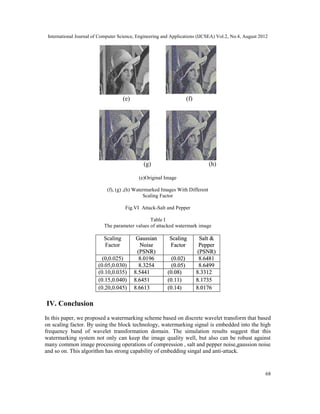
image cutting and rotation. The simulation results, including the watermarked image and distilled
watermark under different kinds of signal attack [9], The exact PSNR values of the processings
are shown in Tab. I. Simulation results suggest that this watermark algorithm can be robust
against many common different types of attacks such as adding salt and pepper noise, image
compression, Gaussian noise.
(a) (b)
(c) (d)
(a) Original Image
(b), (c), (d) Watermarked Image with different
Scaling Factor
Fig. V Attack-Gaussian Noise
International Journal of Computer Science, Engineering and Applications (IJCSEA) Vol.2, No.4, August 2012
67
III. Performance Evaluation
For testing the performance of this algorithm, the experiments is simulated with the software
MATLAB. In the following experiments, the gray-level image with size of 384*384 “Lena” is
used as host image to embed watermark. Another binary image with size of 196*210 “key” is as
the watermark. In order to test the performance, the watermarked image suffers some different
signal attacks, which includes filer, sharp enhancing, adding salt noise, image compression,
image cutting and rotation. The simulation results, including the watermarked image and distilled
watermark under different kinds of signal attack [9], The exact PSNR values of the processings
are shown in Tab. I. Simulation results suggest that this watermark algorithm can be robust
against many common different types of attacks such as adding salt and pepper noise, image
compression, Gaussian noise.
(a) (b)
(c) (d)
(a) Original Image
(b), (c), (d) Watermarked Image with different
Scaling Factor
Fig. V Attack-Gaussian Noise
International Journal of Computer Science, Engineering and Applications (IJCSEA) Vol.2, No.4, August 2012
67
III. Performance Evaluation
For testing the performance of this algorithm, the experiments is simulated with the software
MATLAB. In the following experiments, the gray-level image with size of 384*384 “Lena” is
used as host image to embed watermark. Another binary image with size of 196*210 “key” is as
the watermark. In order to test the performance, the watermarked image suffers some different
signal attacks, which includes filer, sharp enhancing, adding salt noise, image compression,
image cutting and rotation. The simulation results, including the watermarked image and distilled
watermark under different kinds of signal attack [9], The exact PSNR values of the processings
are shown in Tab. I. Simulation results suggest that this watermark algorithm can be robust
against many common different types of attacks such as adding salt and pepper noise, image
compression, Gaussian noise.
(a) (b)
(c) (d)
(a) Original Image
(b), (c), (d) Watermarked Image with different
Scaling Factor
Fig. V Attack-Gaussian Noise
International Journal of Computer Science, Engineering and Applications (IJCSEA) Vol.2, No.4, August 2012
68
(e) (f)
(g) (h)
(e)Original Image
(f), (g) ,(h) Watermarked Images With Different
Scaling Factor
Fig.VI Attack-Salt and Pepper
Table I
The parameter values of attacked watermark image
Scaling
Factor
Gaussian
Noise
(PSNR)
Scaling
Factor
Salt &
Pepper
(PSNR)
(0,0.025) 8.0196 (0.02) 8.6481
(0.05,0.030) 8.3254 (0.05) 8.6499
(0.10,0.035) 8.5441 (0.08) 8.3312
(0.15,0.040) 8.6451 (0.11) 8.1735
(0.20,0.045) 8.6613 (0.14) 8.0176
IV. Conclusion
In this paper, we proposed a watermarking scheme based on discrete wavelet transform that based
on scaling factor. By using the block technology, watermarking signal is embedded into the high
frequency band of wavelet transformation domain. The simulation results suggest that this
watermarking system not only can keep the image quality well, but also can be robust against
many common image processing operations of compression , salt and pepper noise,gaussion noise
and so on. This algorithm has strong capability of embedding singal and anti-attack.
International Journal of Computer Science, Engineering and Applications (IJCSEA) Vol.2, No.4, August 2012
68
(e) (f)
(g) (h)
(e)Original Image
(f), (g) ,(h) Watermarked Images With Different
Scaling Factor
Fig.VI Attack-Salt and Pepper
Table I
The parameter values of attacked watermark image
Scaling
Factor
Gaussian
Noise
(PSNR)
Scaling
Factor
Salt &
Pepper
(PSNR)
(0,0.025) 8.0196 (0.02) 8.6481
(0.05,0.030) 8.3254 (0.05) 8.6499
(0.10,0.035) 8.5441 (0.08) 8.3312
(0.15,0.040) 8.6451 (0.11) 8.1735
(0.20,0.045) 8.6613 (0.14) 8.0176
IV. Conclusion
In this paper, we proposed a watermarking scheme based on discrete wavelet transform that based
on scaling factor. By using the block technology, watermarking signal is embedded into the high
frequency band of wavelet transformation domain. The simulation results suggest that this
watermarking system not only can keep the image quality well, but also can be robust against
many common image processing operations of compression , salt and pepper noise,gaussion noise
and so on. This algorithm has strong capability of embedding singal and anti-attack.
International Journal of Computer Science, Engineering and Applications (IJCSEA) Vol.2, No.4, August 2012
68
(e) (f)
(g) (h)
(e)Original Image
(f), (g) ,(h) Watermarked Images With Different
Scaling Factor
Fig.VI Attack-Salt and Pepper
Table I
The parameter values of attacked watermark image
Scaling
Factor
Gaussian
Noise
(PSNR)
Scaling
Factor
Salt &
Pepper
(PSNR)
(0,0.025) 8.0196 (0.02) 8.6481
(0.05,0.030) 8.3254 (0.05) 8.6499
(0.10,0.035) 8.5441 (0.08) 8.3312
(0.15,0.040) 8.6451 (0.11) 8.1735
(0.20,0.045) 8.6613 (0.14) 8.0176
IV. Conclusion
In this paper, we proposed a watermarking scheme based on discrete wavelet transform that based
on scaling factor. By using the block technology, watermarking signal is embedded into the high
frequency band of wavelet transformation domain. The simulation results suggest that this
watermarking system not only can keep the image quality well, but also can be robust against
many common image processing operations of compression , salt and pepper noise,gaussion noise
and so on. This algorithm has strong capability of embedding singal and anti-attack.
International Journal of Computer Science, Engineering and Applications (IJCSEA) Vol.2, No.4, August 2012
69
V.References
[1] Jacquin, “A Image Coding Based on a Fractal Theroy of Iterated Contractive Image Transformation”,
IEEE Trans. J,I(I), pp.18-30, Image Processing, 1992.
[2] ChangHong Dong, “The use of MATLAB for imagery processing and applies” , Beijing: The
publishing of defence industry, 2004, pp. 33-37.
[3] Yen JC, “Watermark Embedded in Electronic Letters”,Xi’an:XiDian University Press, 2000, pp. 80-
81.
[4] Nikolaidis, “Copyright Protection of Images using Robust Digital Signatures”, ICIP, Conf, pp. 2168-
2171, 1999.
[5] GhoutiL, BouridaneA and Ibrahim MK, “Digital image watermarking using balanced multiwavelets”
, IEEE Transactions on Signal Processing, 54(4), pp. 1519-1536, 2006.
[6] Reddy AA, Chatterji BN, “A new wavelet based logowatermarking scheme” , Conf. Pattern
Recognition letters,26(7), pp. 1019-1027, 2005.
[7] J Jiang, A Armstrong, “Data hiding apporoach for efficient image indexing”, Electronics letters. 7th,
38(23), pp. 1424-1425, 2002.
[8] I. J. Cox, M. L. Miller, J. A. Bloom, "Digital Watermarking", Morgan Kaufmann Publishers, 2002.
[9] YiCheng, MingSheng Zhang, “Auto-adapter image watermark algorithm of DCT” , ShangHai:
Computer Engineering and Applications, 2005.
[10] Ejima, M. and A. Myazaki, 2001." On the evaluation of performance of digital watermarking In the
frequency domain,” in Proc.of IEEE int.conf.on Image processing,2 :546-549.
[11] Shital Gupta, Dr Sanjeev Jain A Robust Algorithm of Digital Image Watermarking Based on Discrete
Wavelet Transform. Published in Special Issue of IJCCT Vol.1 Issue 2, 3, 4; 2010 for International
Conference [ACCTA-2010], 3-5 August 2010.
[12] P. Bao and X. Ma, Image adaptive watermarking using wavelet domain singular value
decomposition," IEEE Transactions on Circuits and Systems for Video Technology, pp. 96{102,
2005.

A Robust DWT Digital Image Watermarking Technique Basis On Scaling Factor

  • 1.
    International Journal ofComputer Science, Engineering and Applications (IJCSEA) Vol.2, No.4, August 2012 DOI : 10.5121/ijcsea.2012.2407 63 A Robust DWT Digital Image Watermarking Technique Basis On Scaling Factor Heena Shaikh,Mohd.Imran Khan, Yashovardhan Kelkar Department of Information Technology, MIT, Ujjain heenushaikh@gmail.com , imran.khan@mitmandsaur.info, yasho028@rediffmail.com Abstract: At the present time, the aptitude in contemplation of accessing as well as sharing images has become progressively facile with the Internet allowing people to procure information remotely from anywhere in the entire world. Moreover, there has been also an expansion with regard to the number of the still digital images over the internet for the sake of the fact that a vast number of millions of people are capturing digital photos. Fundamentally, the procedure of digital watermarking can be delineated as a method for embedding information into another signal (a digital signal). In case of digital images, the embedded information can be either visible or hidden from the user. In this project, we will concentrate on imperceptible watermarks. The principal intention of digital watermarks is to provide copyright protection for intellectual property that is in digital format. Typical usage scenarios for watermarking are such as copyright protection and data authentication. In this paper, we describe an imperceptible and a robust DWT digital Image Watermarking algorithm.The algorithm watermarks a given digital image using a Discrete Wavelet Transform. Keywords: Digital watermarking, Discrete Wavelet Transform(DWT), Peak Signal to Noise Ratio, Scaling Factor, Gaussian Noise, Salt and Pepper. I. Introduction The DWT transform, Wavelets are special functions which, in a form analogous to sines and cosines in Fourier analysis, are used as basal functions for representing signals. For 2-D images, applying DWT corresponds to processing the image by 2-D filters in each dimension. The filters divide the input image into four non-overlapping multi-resolution sub-bands (LL1), (LH1), (HL1) and (HH1). The sub-band (LL1) represents the coarse-scale DWT coefficients while the sub-bands (LH1), (HL1) and (HH1) represent the fine scale of DWT coefficients[1]. To obtain the next coarser scale of wavelet coefficients, the sub-band (LL1) is further processed until some final scale “N” is reached. When “N” is reached we will have 3N+1 sub-bands consisting of the multi- resolution sub-bands (LLN) and (LHX),(HLx) and (HHx) where “X” ranges from 1 until “N ”[1][2].Due to its excellent spatio-frequencylocalization properties, the FDWT is very suitable to identify the areas in the host image. where a watermark can be embedded effectively. In
  • 2.
    International Journal ofComputer Science, Engineering and Applications (IJCSEA) Vol.2, No.4, August 2012 64 particular, this property allows the exploitation of the masking effect of the human visual system such that if a DWT coefficient is modified, only the region corresponding to that coefficient will be modified. In general most of the image energy is concentrated at the lower frequency sub-bands (LLX) and therefore embedding watermarks in these sub bands may degrade the image significantly[3]. Yes, No Original It’s True It’s fake Digital Image Fig. I Digital image Watermarking The embedding and detecting procedure for watermarking technique based on DWT transform.[4]Computing PSNR function (peak single-to-noise ratio)based on scaling factor of the resultant watermarked images from the techniques DWT for the purpose of measuring the distinctive distortion between the cover image and the watermarked image.[5] Applying the checkmark software by means of MSE function for the original watermarks and extracted watermarks from the DWT technique.[5] II. Proposed Watermarking Scheme In the case of one dimensional signal, the signal itself is to be divided into two groups of frequency components as low frequency components and high frequency components which are mainly determined as the 1 st pass of the low-pass and high-pass frequencies, While the high-band frequency group would remain unchanged, the low-band frequency group will be then divided up into two other inner groups of frequencies causing the 2 nd pass of the low-pass and high-pass frequencies. The same process is to be continued in such an arbitrary number of times making the next passes by dividing the low-band frequency blocks. The decomposition process can be simply constructed by applying the previous technique into the one-dimensional signal X(N)[6]. However, the original signal X(N) can be also reconstructed by using the same frequency coefficients which have been used through the decomposition process of the DWT. The reconstruction process is determined as the inverse DWT (IDWT).[6][7] The function of the DWT transform domain is based on the watermarking technology is composed of two major parts which are the encoding and decoding procedures. Those two procedures are plainly the key for implementing the embedding as well as the extracting system by way of the DWT transform.[7]. Watermark Embedding Transmission Watermark Extraction Compare emp Watermark Attack Watermark
  • 3.
    International Journal ofComputer Science, Engineering and Applications (IJCSEA) Vol.2, No.4, August 2012 65 Fig. II Sketch Map of Image DWT Decomposed II.I Embedding Technique for DWT This technique will decompose the cover image of the two dimensional DWT into four frequency bands through the first pass as (LL1), (LH1), (HL1) and (HH1) frequency coefficients. The frequency bands where it has the lowest resolution of the 1 st pass (LL1) can be also decomposed into a 2 nd level (pass). [6] Secondly, we are to apply the Gaussian Noise and can insert the watermark signature into the reset of the available frequency bands which include the high frequency coefficients without dealing with (LL) regions from all over the passes (levels). We must add the signal of the bands where the large frequency components to the signal of the Gaussian Noise and modifying them without moderating the original signal which resides in the (LL) band; thereafter, the watermarked image would be performed appropriately.[5] Cover Image Test Image Watermarked Image Fig. III Embedding Technique for DWT LL2 HL2 LH2 HH2 HL1 LH1 HH1 International Journal of Computer Science, Engineering and Applications (IJCSEA) Vol.2, No.4, August 2012 65 Fig. II Sketch Map of Image DWT Decomposed II.I Embedding Technique for DWT This technique will decompose the cover image of the two dimensional DWT into four frequency bands through the first pass as (LL1), (LH1), (HL1) and (HH1) frequency coefficients. The frequency bands where it has the lowest resolution of the 1 st pass (LL1) can be also decomposed into a 2 nd level (pass). [6] Secondly, we are to apply the Gaussian Noise and can insert the watermark signature into the reset of the available frequency bands which include the high frequency coefficients without dealing with (LL) regions from all over the passes (levels). We must add the signal of the bands where the large frequency components to the signal of the Gaussian Noise and modifying them without moderating the original signal which resides in the (LL) band; thereafter, the watermarked image would be performed appropriately.[5] Cover Image Test Image Watermarked Image Fig. III Embedding Technique for DWT LL2 HL2 LH2 HH2 HL1 LH1 HH1 International Journal of Computer Science, Engineering and Applications (IJCSEA) Vol.2, No.4, August 2012 65 Fig. II Sketch Map of Image DWT Decomposed II.I Embedding Technique for DWT This technique will decompose the cover image of the two dimensional DWT into four frequency bands through the first pass as (LL1), (LH1), (HL1) and (HH1) frequency coefficients. The frequency bands where it has the lowest resolution of the 1 st pass (LL1) can be also decomposed into a 2 nd level (pass). [6] Secondly, we are to apply the Gaussian Noise and can insert the watermark signature into the reset of the available frequency bands which include the high frequency coefficients without dealing with (LL) regions from all over the passes (levels). We must add the signal of the bands where the large frequency components to the signal of the Gaussian Noise and modifying them without moderating the original signal which resides in the (LL) band; thereafter, the watermarked image would be performed appropriately.[5] Cover Image Test Image Watermarked Image Fig. III Embedding Technique for DWT LL2 HL2 LH2 HH2 HL1 LH1 HH1
  • 4.
    International Journal ofComputer Science, Engineering and Applications (IJCSEA) Vol.2, No.4, August 2012 66 II. Extraction Technique for DWT In contemplation of achieving this procedure, we should have the cover image and the watermarked image readily applicable. Consequently, the DWT decoding technique will decompose those two images into four frequency bands through the 1st pass as described previously. Afterward, we are to select for instance one of those bands where the large frequencies reside through one of the levels (passes) in the decomposed cover image and the decomposed watermark. Let’s suppose the selected band from both decomposed images is (HH1), we have then to compare the difference of the frequency coefficients in those bands of the decomposed images and examine their cross correlation. Subsequently, if the cross correlation has detected a peak, then the watermark signature will be extracted; if not, then the same operation will continue on comparing the rest of the other bands consist the high frequency components from both of the decomposed images and investigate their cross correlation until the peak is detected; correspondingly, the watermark signature will be latterly recovered.[4] Watermarked Image Retrieved Image (No Attack) Watermarked Image Retrieved Image (Gaussian Noise) Watermarked Image Retrieved Image (Salt and Pepper) Fig. IV Extraction Technique for DWT
  • 5.
    International Journal ofComputer Science, Engineering and Applications (IJCSEA) Vol.2, No.4, August 2012 67 III. Performance Evaluation For testing the performance of this algorithm, the experiments is simulated with the software MATLAB. In the following experiments, the gray-level image with size of 384*384 “Lena” is used as host image to embed watermark. Another binary image with size of 196*210 “key” is as the watermark. In order to test the performance, the watermarked image suffers some different signal attacks, which includes filer, sharp enhancing, adding salt noise, image compression, image cutting and rotation. The simulation results, including the watermarked image and distilled watermark under different kinds of signal attack [9], The exact PSNR values of the processings are shown in Tab. I. Simulation results suggest that this watermark algorithm can be robust against many common different types of attacks such as adding salt and pepper noise, image compression, Gaussian noise. (a) (b) (c) (d) (a) Original Image (b), (c), (d) Watermarked Image with different Scaling Factor Fig. V Attack-Gaussian Noise International Journal of Computer Science, Engineering and Applications (IJCSEA) Vol.2, No.4, August 2012 67 III. Performance Evaluation For testing the performance of this algorithm, the experiments is simulated with the software MATLAB. In the following experiments, the gray-level image with size of 384*384 “Lena” is used as host image to embed watermark. Another binary image with size of 196*210 “key” is as the watermark. In order to test the performance, the watermarked image suffers some different signal attacks, which includes filer, sharp enhancing, adding salt noise, image compression, image cutting and rotation. The simulation results, including the watermarked image and distilled watermark under different kinds of signal attack [9], The exact PSNR values of the processings are shown in Tab. I. Simulation results suggest that this watermark algorithm can be robust against many common different types of attacks such as adding salt and pepper noise, image compression, Gaussian noise. (a) (b) (c) (d) (a) Original Image (b), (c), (d) Watermarked Image with different Scaling Factor Fig. V Attack-Gaussian Noise International Journal of Computer Science, Engineering and Applications (IJCSEA) Vol.2, No.4, August 2012 67 III. Performance Evaluation For testing the performance of this algorithm, the experiments is simulated with the software MATLAB. In the following experiments, the gray-level image with size of 384*384 “Lena” is used as host image to embed watermark. Another binary image with size of 196*210 “key” is as the watermark. In order to test the performance, the watermarked image suffers some different signal attacks, which includes filer, sharp enhancing, adding salt noise, image compression, image cutting and rotation. The simulation results, including the watermarked image and distilled watermark under different kinds of signal attack [9], The exact PSNR values of the processings are shown in Tab. I. Simulation results suggest that this watermark algorithm can be robust against many common different types of attacks such as adding salt and pepper noise, image compression, Gaussian noise. (a) (b) (c) (d) (a) Original Image (b), (c), (d) Watermarked Image with different Scaling Factor Fig. V Attack-Gaussian Noise
  • 6.
    International Journal ofComputer Science, Engineering and Applications (IJCSEA) Vol.2, No.4, August 2012 68 (e) (f) (g) (h) (e)Original Image (f), (g) ,(h) Watermarked Images With Different Scaling Factor Fig.VI Attack-Salt and Pepper Table I The parameter values of attacked watermark image Scaling Factor Gaussian Noise (PSNR) Scaling Factor Salt & Pepper (PSNR) (0,0.025) 8.0196 (0.02) 8.6481 (0.05,0.030) 8.3254 (0.05) 8.6499 (0.10,0.035) 8.5441 (0.08) 8.3312 (0.15,0.040) 8.6451 (0.11) 8.1735 (0.20,0.045) 8.6613 (0.14) 8.0176 IV. Conclusion In this paper, we proposed a watermarking scheme based on discrete wavelet transform that based on scaling factor. By using the block technology, watermarking signal is embedded into the high frequency band of wavelet transformation domain. The simulation results suggest that this watermarking system not only can keep the image quality well, but also can be robust against many common image processing operations of compression , salt and pepper noise,gaussion noise and so on. This algorithm has strong capability of embedding singal and anti-attack. International Journal of Computer Science, Engineering and Applications (IJCSEA) Vol.2, No.4, August 2012 68 (e) (f) (g) (h) (e)Original Image (f), (g) ,(h) Watermarked Images With Different Scaling Factor Fig.VI Attack-Salt and Pepper Table I The parameter values of attacked watermark image Scaling Factor Gaussian Noise (PSNR) Scaling Factor Salt & Pepper (PSNR) (0,0.025) 8.0196 (0.02) 8.6481 (0.05,0.030) 8.3254 (0.05) 8.6499 (0.10,0.035) 8.5441 (0.08) 8.3312 (0.15,0.040) 8.6451 (0.11) 8.1735 (0.20,0.045) 8.6613 (0.14) 8.0176 IV. Conclusion In this paper, we proposed a watermarking scheme based on discrete wavelet transform that based on scaling factor. By using the block technology, watermarking signal is embedded into the high frequency band of wavelet transformation domain. The simulation results suggest that this watermarking system not only can keep the image quality well, but also can be robust against many common image processing operations of compression , salt and pepper noise,gaussion noise and so on. This algorithm has strong capability of embedding singal and anti-attack. International Journal of Computer Science, Engineering and Applications (IJCSEA) Vol.2, No.4, August 2012 68 (e) (f) (g) (h) (e)Original Image (f), (g) ,(h) Watermarked Images With Different Scaling Factor Fig.VI Attack-Salt and Pepper Table I The parameter values of attacked watermark image Scaling Factor Gaussian Noise (PSNR) Scaling Factor Salt & Pepper (PSNR) (0,0.025) 8.0196 (0.02) 8.6481 (0.05,0.030) 8.3254 (0.05) 8.6499 (0.10,0.035) 8.5441 (0.08) 8.3312 (0.15,0.040) 8.6451 (0.11) 8.1735 (0.20,0.045) 8.6613 (0.14) 8.0176 IV. Conclusion In this paper, we proposed a watermarking scheme based on discrete wavelet transform that based on scaling factor. By using the block technology, watermarking signal is embedded into the high frequency band of wavelet transformation domain. The simulation results suggest that this watermarking system not only can keep the image quality well, but also can be robust against many common image processing operations of compression , salt and pepper noise,gaussion noise and so on. This algorithm has strong capability of embedding singal and anti-attack.
  • 7.
    International Journal ofComputer Science, Engineering and Applications (IJCSEA) Vol.2, No.4, August 2012 69 V.References [1] Jacquin, “A Image Coding Based on a Fractal Theroy of Iterated Contractive Image Transformation”, IEEE Trans. J,I(I), pp.18-30, Image Processing, 1992. [2] ChangHong Dong, “The use of MATLAB for imagery processing and applies” , Beijing: The publishing of defence industry, 2004, pp. 33-37. [3] Yen JC, “Watermark Embedded in Electronic Letters”,Xi’an:XiDian University Press, 2000, pp. 80- 81. [4] Nikolaidis, “Copyright Protection of Images using Robust Digital Signatures”, ICIP, Conf, pp. 2168- 2171, 1999. [5] GhoutiL, BouridaneA and Ibrahim MK, “Digital image watermarking using balanced multiwavelets” , IEEE Transactions on Signal Processing, 54(4), pp. 1519-1536, 2006. [6] Reddy AA, Chatterji BN, “A new wavelet based logowatermarking scheme” , Conf. Pattern Recognition letters,26(7), pp. 1019-1027, 2005. [7] J Jiang, A Armstrong, “Data hiding apporoach for efficient image indexing”, Electronics letters. 7th, 38(23), pp. 1424-1425, 2002. [8] I. J. Cox, M. L. Miller, J. A. Bloom, "Digital Watermarking", Morgan Kaufmann Publishers, 2002. [9] YiCheng, MingSheng Zhang, “Auto-adapter image watermark algorithm of DCT” , ShangHai: Computer Engineering and Applications, 2005. [10] Ejima, M. and A. Myazaki, 2001." On the evaluation of performance of digital watermarking In the frequency domain,” in Proc.of IEEE int.conf.on Image processing,2 :546-549. [11] Shital Gupta, Dr Sanjeev Jain A Robust Algorithm of Digital Image Watermarking Based on Discrete Wavelet Transform. Published in Special Issue of IJCCT Vol.1 Issue 2, 3, 4; 2010 for International Conference [ACCTA-2010], 3-5 August 2010. [12] P. Bao and X. Ma, Image adaptive watermarking using wavelet domain singular value decomposition," IEEE Transactions on Circuits and Systems for Video Technology, pp. 96{102, 2005.