A Road to Survival?1
by
Alton C. Thompson
Table of Contents
A Road to Survival?.........................................................................................................................2
A. Historical Background...........................................................................................................4
B. The Global Warming Threat..................................................................................................7
C. My “Plan of Attack”!............................................................................................................14
1. Comments on “Time to Panic”.........................................................................................14
2. Developing a Useful Perspective......................................................................................19
3. My Rationale for an Eco-Village Proliferation................................................................24
D. Concluding Remarks...........................................................................................................30
March 18, 2019 (my youngest brother’s birthday!2
)
1
The present paper probably has some similarity to the book, The Road to Survival (1948), by William
Vogt et al.; as I’ve never read that book, however, . . . . In addition, Ashley Dawson’s more recent
Extreme Cities: The Perils and Promise of Urban Life in the Age of Climate Change (2017)—which I’ve also
never read!—may also be somewhat related to the present paper.
2
Our sister is the oldest of us 5 siblings, but at 79, I’m the oldest of us 4 boys!
A Road to Survival?
You never change something by fighting the existing reality. To change something, build
a new model that makes the existing model obsolete.3
—Buckminster Fuller
Being the son of a carpenter, one might reasonably expect that I have acquired some building
skills from my dad. Although I did work with him and his partner4
from time to time, during the
summer months while a youth, I had (a) no interest in following his lead, nor did (b) I acquire
any of his skills (which became manifest especially after he had retired)!
Despite the fact that I never acquired his physical skills, I seem to have acquired from him a
“building mentality.” What I mean by that is that when I become aware of certain (but not all)
problems, I almost immediately begin to think of possible solutions to those problems. Which is
why I’ve chosen a quotation from the late Buckminster Fuller [1895 - 1983] as the epigraph to
this paper.
Lately, I’ve been thinking of where we humans are headed, and why, and believe that
explanatory knowledge of the direction in which we are headed will provide the intellectual
basis for changing that direction. That it needs changing I take as a “given”—for I am in full
agreement with this statement by Eugene Linden in his history of our species5
which concludes
(p. 178):
The consumer society continues to roll along despite the diminishing luster of its myths.
What this suggests is that we will continue on our present [downward!] course, and that the
probability of one or another of our proposed [in the book] disasters will rapidly increase until
some small event [the election of “sadopopulist” Donald Trump as President?!] triggers the
apocalypse of the consumer society.
This was an extremely prescient projection to make 40 years ago, in light of this statement made
by a climate scientist in May of 2017:
With little or no action taken on global warming, it appears that the Anthropocene will lead to
extinction of the very human beings after which the era is named, with the Anthropocene
possibly running from 1950 to 2021, i.e. a mere 71 years and much too short to constitute
3
Quoted in this article (2013).
4
I remember two of them—Reuben Luhm and Leo Sarnowski.
5
In his Affluence and Discontent: The Anatomy of Consumer Societies, 1979, on pp. 63 - 178.
2
an era. In that case a better name for the period would be the.Sixth Extinction Event . . . . [I
corrected the two “typos” in this statement.]
As that article ends with this sentence:
The situation is dire and calls for comprehensive and effective action as described in the
Climate Plan.
it’s safe to say that the author was not serious about the 2021 date; for if it’s certain that our
species will go extinct by 2021, why refer to a “Climate Plan” which would have absolutely no
chance of being implemented in time to “save” our species from extinction?!
Because I’m convinced that “explanatory knowledge of the direction in which we are headed
will provide the intellectual basis for changing that direction,” the logical starting point for this
paper is to discuss that “explanatory knowledge;” and as I would insist that it is historical
developments that explain our current situation, my first section here identifies what I believe to
be the key such developments.
In concluding this introduction, I should note that as global warming “progresses,” there will be
a need to try to adapt to the changes brought on by global warming. For example:
The Maldives [in the Indian Ocean] have already implemented several measures to combat
sea level rise [a result of global warming] including building a wall around the capital of Malé
and refurbishing local infrastructure, particularly ports.
Adaptation has its limits, however! Without preventive measures being taken (by those of us
living in societies with larger populations and more resources), adaptive measures are doomed to
failure—given that there’s no reason to believe that global warming will cease soon!
Inhabitants of the Maldives are victims of our actions, not theirs; and the fact that we may not be
aware of that fact does not excuse us from the harm that our actions are already inflicting on
others (to say nothing of ourselves)!
The time to act is now—with the primary question now before us being: What do we need to
do?
In the third section below (Section C) I present my ideas regarding this.
3
A. Historical Background
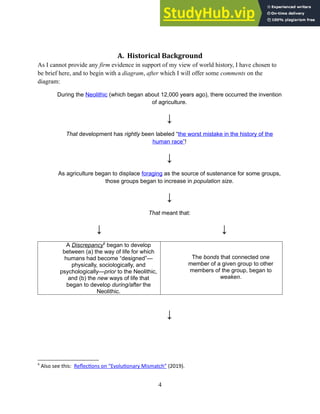
As I cannot provide any firm evidence in support of my view of world history, I have chosen to
be brief here, and to begin with a diagram, after which I will offer some comments on the
diagram:
During the Neolithic (which began about 12,000 years ago), there occurred the invention
of agriculture.
↓
That development has rightly been labeled “the worst mistake in the history of the
human race”!
↓
As agriculture began to displace foraging as the source of sustenance for some groups,
those groups began to increase in population size.
↓
That meant that:
↓ ↓
A Discrepancy6
began to develop
between (a) the way of life for which
humans had become “designed”—
physically, sociologically, and
psychologically—prior to the Neolithic,
and (b) the new ways of life that
began to develop during/after the
Neolithic.
The bonds that connected one
member of a given group to other
members of the group, began to
weaken.
↓
6
Also see this: Reflections on “Evolutionary Mismatch” (2019).
4
Those developments, interacting with the fact that humans are a sexually-reproducing
species,7
resulted in the activation of certain unconscious processes.8
↓
Those processes have determined human history since then!
↓
The direction of which has been “downhill”! (as Linden has argued; see p. 2 above)
The key concept mentioned in the above chart is the “Discrepancy,” a concept that I have traced
back to Thorstein Veblen (1857 - 1929), his The Instinct of Workmanship and the State of the
Industrial Arts (1914, p. 334) specifically:
Neither the manner of life imposed by the machine process, nor the manner of thought
inculcated by habituation to its logic, will fall in with the free movement of the human spirit, born, as it
is, to fit the conditions of savage life. So there comes an irrepressible—in a sense, congenital—
recrudescence of magic, occult science, telepathy, spiritualism, vitalism, pragmatism. [“Savage” is,
of course, an archaic term for our forager ancestors.]
The term that has, though, come into more common use (than “Discrepancy”) is “mismatch;” but
rather than it becoming a commonly-used term where it’s needed (for the purpose of “saving”
our species!)—i.e., Sociology, Anthropology, and History—it has become rather commonly used,
these days, in studies of health and disease. I will certainly not deny that it’s not now playing an
important role in those disciplines; my point, however, is this:
Of what value is good health if global warming has rendered one’s species extinct?!!
Given that we live in an Age of Specialization (so that there’s what Sheldon Ungar has termed a
“knowledge-ignorance paradox”), it’s not surprising that someone like Harvard Professor Daniel
E. Lieberman9
lacks any knowledge of the ramifications of “mismatch” beyond health and
disease.10
It’s certainly important, I agree, to know that there may be at least 49 “mismatch”
diseases (his Table 3, on p. 173 of The Story . . .). To repeat, however:
7
Which produces genetic variety.
8
I am unable to identify those processes, I frankly admit!
9
Author of, e.g., The Story of the Human Body: Evolution, Health, and Disease (2013).
10
He does mention “climate change” at numerous points in his book, but has nothing of significance to
say about the matter!
5
Of what value is good health if global warming has rendered one’s species extinct?!
Which is—obviously!—a rhetorical question!!
Although I would like to see a history that develops my point—my hypothesis, actually, of
course!—that:
Those processes have determined human history since then!
the fact of the matter is that that given the possible imminence of our species’s demise, it’s far
more important to develop a “plan of attack” to (try to!) prevent our species from joining the
many other species now going extinct (during this period of the sixth mass extinction!11
); and to
base that “plan” on a plausible explanation of why we are now in a perilous situation. I believe
that the “history” that I’ve provided above does provide the plan offered here with a solid
“foundation” (to pay homage to my late—and wonderful!—dad, Marvin Clifford Thompson
[1905 - 1987].12
Prior to presenting my “plan,” though, I must say a few words about global warming—beyond
the statement quoted on the bottom of page 2 above.
11
See this thorough summary of Elizabeth Kolbert’s The Sixth Extinction: An Unnatural History (2014).
12
Which is not to say, of course, that my mom—Inez Genevieve Hasselquist Thompson [1912 - 1987]—
was not also a wonderful person (who died 25 days after dad died). But it’s natural for a son to be more
influenced by his dad than by his mom!
6
B. The Global Warming Threat
Let me begin here by noting that “global warming” is not the most accurate name for the
phenomenon under discussion here—which fact led me to coin the term “Trendular Atmospheric
Depatternization” (TAD) several years ago, which term has not “caught on” since then, though!
I myself have come to conclude that that name is a “tad” cumbersome, so that I have not
“pushed” for the adoption of my name for the phenomenon! Thus, I continue to use “global
warming” below—and prefer that name to “climate change” because of the political origin of
that name.
This article explains the fact that climate scientists use both terms, but do not think of those two
terms as having the same meaning. Here’s the problem with “climate change” as commonly used
these days:
Last week [in 2013], Yale University released a study showing that people are more likely to
fear “global warming” and take part in a campaign to stop it than they are “climate change.”
Yale’s report echoed research by George W. Bush pollster Frank Luntz, who had argued
that the Bush White House should use climate change instead of global warming because it
sounded less scary. Polling also shows Democrats are more likely than Republicans to
believe the Earth is warming and human activity is the main cause.
For me, it’s not only sad, but criminal, to “play fast and loose” with these two terms! For if our
citizenry—which includes our “leaders”13
—doesn’t think that global warming is a serious
problem, it’s unlikely that they will demand actions to address the problem. But that’s not the
only problem; there are also the problems of “media silence”:
What has become most striking about the growing evidence that climate change is a clear
and present danger indeed an emerging existential threat is the simultaneous failure of the
U.S. news media to deal seriously with the issue, another sign of how the Right can
intimidate the mainstream into going silent.
We have seen this pattern before, as the Right sets the media agenda by bullying those who
threaten its ideological interests. Before the Iraq War, anyone who dared raise questions
about the Bush administration’s justifications could expect to be marginalized or worse. Just
ask Phil Donahue, Scott Ritter and the Dixie Chicks.
During Ronald Reagan’s presidency, his hard-nosed propagandists dubbed this tactic
“controversializing,” that is, anyone who got too much in the way could expect to be
subjected to systematic smears and professional deconstruction. With so many right-wing
voices willing to say almost anything, it wasn’t hard to intimidate people.
and media “denialism”:
13
I put this word in quotation marks for obvious reasons!
7
Emperor Nero may (or may not) have fiddled while Rome burned, but commercial U.S. TV
networks definitely fiddled last year on climate coverage while the Earth grew dangerously
hot.
An annual climate report issued this month [in 2017] by the World Meteorological
Organization confirms that average global temperatures and global sea levels continued
their inexorable rise in 2016, setting new records. Global sea ice dropped to an
“unprecedented” extent. Extreme weather conditions, probably aggravated by climate
disruption, displaced hundreds of thousands of people, left millions hungry, and caused
“severe economic damage.”
Yet in the midst of such frightening changes, and a national presidential campaign with
enormous consequences for U.S. climate policy, the four major broadcast networks — ABC,
CBS, NBC, and Fox News Sunday — significantly decreased their coverage of climate
issues on evening and Sunday news programs, according to a new analysis by Media
Matters. Television programs like these are the major source of news for 57 percent of adult
Americans.
THE PUBLIC IS BEING KEPT “IN THE DARK” ABOUT GLOBAL WARMING,
AND THAT IS NOT “GOOD NEWS”!
I suppose that I should apologize for getting “sidetracked” here, by writing about deception,
silence, and denialism; but I believe that those facts are of virtually equal importance to global
warming itself! For it is those facts which may very well prevent our supposedly wise (i.e., the
sapiens in Homo sapiens) species from continuing much longer! Let us not only hope that that’s
not our fate, but plan and work to (possibly) prevent it from happening!
In the next section I present my ideas regarding how to “save” I species; but I must now continue
with a discussion of global warming.
Global warming is a long-term rise in the average temperature of the Earth's climate
system, an aspect of climate change shown by temperature measurements and by multiple
effects of the warming.[2][3]
The term commonly refers to the mainly human-caused observed
warming since pre-industrial times and its projected continuation,[4]
though there were also
much earlier periods of global warming.[5]
In the modern context the terms global warming
and climate change are commonly used interchangeably,[6]
but climate change includes both
global warming and its effects, such as changes to precipitation and impacts that differ by
region.[7][8]
Many of the observed warming changes since the 1950s are unprecedented in
the instrumental temperature record, and in historical and paleoclimate proxy records of
climate change over thousands to millions of years.[2]
8
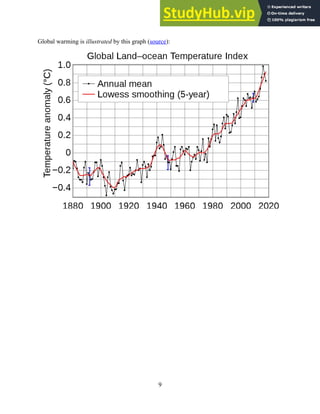
Global warming is illustrated by this graph (source):
9
This information accompanies the graph:
Global mean surface-temperature change from 1880 to 2018, relative to the 1951–1980
mean. The 1951–1980 mean is 14.19 °C (57.54 °F).[1]
The black line is the global annual
mean, and the red line is the five-year local regression line. The blue uncertainty bars show
a 95% confidence interval.
(Here’s a discussion of the “Lowess smoothing” on the graph.)
The key concept underlying the fact of global warming is “intensified greenhouse effect.”
Living on earth is analogous to living in a greenhouse in that just as the temperature and
humidity conditions in a greenhouse are artificially controlled by humans to be optimal for
whatever is being grown in the greenhouse, so does earth’s atmosphere play a similar role for us
humans. It may seem that our heat comes directly from the sun but this diagram (below, next
page) presents the basics regarding how our atmosphere is heated:
1. The short-wave heat energy from the sun heats earth’s land and water.
10
2. That heat energy, in the form now of long-wave radiation, is then re-radiated into the
lower atmosphere.
3. That heat energy would simply escape into space were it not for the presence of
“greenhouse” gases in the lower atmosphere.
4. Those gases—which include carbon dioxide (CO2), methane (CH4), nitrous oxide (N2O),
and fluorinated gases—“trap” enough of the heat energy being re-radiated from earth to
enable life on earth.
5. Earth being a system, it is “equipped” with positive and negative “feedback” mechanisms,
whose “job” is to maintain relative equilibrium.
Climate change feedback is important in the understanding of global warming
because feedback processes may amplify or diminish the effect of each climate
forcing, and so play an important part in determining the climate sensitivity and future
climate state. Feedback in general is the process in which changing one quantity
changes a second quantity, and the change in the second quantity in turn changes
the first. Positive feedback amplifies the change in the first quantity while negative
feedback reduces it.[2]
11
The term "forcing" means a change which may "push" the climate system in the
direction of warming or cooling.[3]
An example of a climate forcing is increased
atmospheric concentrations of greenhouse gases. By definition, forcings are
external to the climate system while feedbacks are internal; in essence, feedbacks
represent the internal processes of the system. Some feedbacks may act in relative
isolation to the rest of the climate system; others may be tightly coupled; hence it
may be difficult to tell just how much a particular process contributes.[4]
Note this sentence, in particular, in the above quotation:
An example of a climate forcing is increased atmospheric concentrations of greenhouse
gases.
A “forcing”—by definition—is an external “push,” and in the case of global warming that
“push” comes from human activities, especially our burning of fossil fuels and deforestation
activities. Although:
the fossil fuel coal had been used as a fuel since 1,000 B.C., it wasn’t until the arrival of the
Industrial Revolution from the mid-1700s through the 1800s that coal began to replace
biomass as the primary source of energy.
The Industrial Revolution also marks the beginning of an era when the world human
population started to explode. Indelibly tied together, both energy consumption and
population growth have experienced exponential growth with few exceptions since the
beginning of the Industrial Revolution. As the population increased, energy demands
increased with greater intensity.
For anyone living in the United States today, it’s virtually impossible to avoid being a
“contributor” the intensification of the “greenhouse effect” that results from the burning of fossil
fuels and deforestation activities, for:
1. Our homes, work places, and other structures are heated and cooled primarily by the
burning of fossil fuels (including for generating electricity!), and the wood used in the
construction of structures comes from the cutting of trees (duh!).
2. The vehicles that we use for transporting both people and goods typically burn fossil
fuels.
3. Their manufacture and the manufacture of virtually everything else that we consume,
involved both the burning of fossil fuels and deforestation. Regarding the latter, consider
all of the paper used in our society for packaging, labeling, writing, etc.!
4. Etc.
Our lives today are very much dependent on activities that “contribute” to global warming. But
why, you may ask, is that a problem? After all, did not Guy Stewart Callendar [1898 - 1964]—
12
the individual who first established that global warming was occurring14
—think that “this
warming would be beneficial, delaying a ‘return of the deadly glaciers.’[3]
?!
The problem with Callendar’s opinion is that he was not aware of the fact that Earth is a system,
and that as a system, “forcings”—which as noted above are external to a system—can seriously
affect a system in negative ways. As I stated earlier:
An example of a climate forcing is increased atmospheric concentrations of greenhouse
gases.
And as I also noted earlier, human activities are the primary culprit in the case of global
warming. It’s true, I will not deny, that cow farts (!) are also a cause of global warming. But
given that it’s us humans who are responsible for the world’s cow population, it’s us who are
ultimately responsible for cow farts!
In writing above that “forcings” can “seriously affect” Earth System in a negative manner, what I
mean is that if “forcings” continue to occur and are substantial enough, they can cause a “tipping
point” to be reached, and crossed—and that’s most certainly not desirable. This article, after
offering a rather thorough discussion of “tipping points,” concludes this way:
With a range of critical thresholds on the horizon, each tipping element demonstrates the
potential implications of allowing climate change to progress unchecked.
As tipping points loom ever closer, the urgency for emissions mitigation escalates in hopes
of sustaining the Earth as we know it.
The two major points that I would make regarding “tipping points” as they are related to global
warming are:
1. After a “tipping point” in global warming is “achieved” (!), warming is likely to
accelerate! And what’s scary about that is that this article asserts that global warming is
accelerating now!
2. Once warming begins to accelerate, it may be impossible to halt further warming!
3. Meaning that:
a. The many negative consequences associated with global warming in addition to the
warming per se (see this list of 19!), are likely to become increasingly intense—
resulting not only in a terrific amount of property damage/loss, but a huge loss of
human life!
14
The science behind global warming goes back especially to Swedish chemist Svante Arrhenius [1859 -
1927].
13
b. Once the new equilibrium is reached, it may be at a level such that Earth System can
no longer support human life (to say nothing of many other species)!
c. That is, by the time that an equilibrium is reached, our species may be extinct!
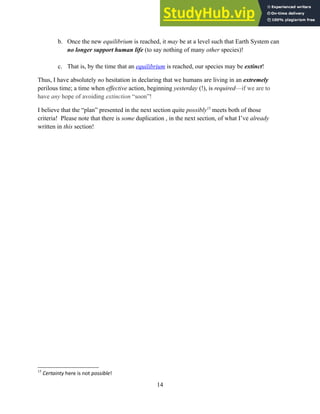
Thus, I have absolutely no hesitation in declaring that we humans are living in an extremely
perilous time; a time when effective action, beginning yesterday (!), is required—if we are to
have any hope of avoiding extinction “soon”!
I believe that the “plan” presented in the next section quite possibly15
meets both of those
criteria! Please note that there is some duplication , in the next section, of what I’ve already
written in this section!
15
Certainty here is not possible!
14
C. My “Plan of Attack”!
To be useful, an approach would need to:
1. Be capable of being implemented.
2. Be likely to be implemented.
3. Be implemented virtually immediately.
4. Have results that would be virtually immediate—and would achieve the intended results.
With those criteria in mind, I offer the following perspective as possibly meeting those criteria.
By way of introduction to my comments, though, I first make mention of an article sent to me
recently by a friend, titled “Time to Panic,” by David Wallace-Wells, “columnist and deputy
editor at New York magazine and the author of the forthcoming [just published, in fact!] The
Uninhabitable Earth: Life After Warming, from which this essay is adapted.”
The reason I offer these comments is that I believe it useful to begin here by doing so: It enables
me to provide some background to my ideas.
1. Comments on “Time to Panic”
1. A better title for an article on global warming written in 2019 would be “It’s Past Time
to Panic!”
2. Early on Wallace-Wells refers to a “Doomsday” report, issued in late 2018, by the UN’s
Intergovernmental Panel on Climate Change (IPCC), I have three problems with the
IPCC:
a. The “climate change” in its name has become a political—rather than scientific—
term. Republican political operative Frank Luntz made “climate change”
preferable to “global warming” for political reasons. “Yale’s report [here’s a link
to it] echoed research by George W. Bush pollster Frank Luntz, who had argued
that the Bush White House should use climate change instead of global warming
because it sounded less scary.” Wallace-Wells uses “climate change” throughout
his article, perhaps because of its use in “Intergovernmental Panel on Climate
Change.” [I supplied the italics!]
b. It is an excessively conservative—insanely cautious” might be more accurate!—
organization : Given that what’s ultimatelt at stake regarding global warming is
our continued existence as a species, being “conservative” could be a deadly
mistake!
15
c. The fact that it has a “Summary for Policymakers” indicates that its members
assume—incorrectly!—that only governmental units would (and should?) be
involved in addressing the problem of global warming. What I suggest in this
paper, rather, is a “project” to be undertaken by business leaders in particular!
3. I wish that Wallace-Wells had not used the word “just” in his the “world that has warmed
by just one degree Celsius (1.8 degrees Fahrenheit) since the late 1800s . . . .” At any
given location an increase/decrease of 1° C. would be barely noticeable—if at all.
However, a 1° C. increase in the global mean temperature represents a tremendous
amount of heat energy!
4. In the author’s “Scientists have felt this way,” “believed” would be more appropriate than
“felt”! “Belief” implies solid evidence; “felt” implies an emotional reaction. I do not
deny the importance of emotion—what motivates me, in fact, is the fact that my wife (of
53 years!) and I wish our 3 wonderful children and 5 beautiful grandchildren to have a
future! But I attempt to ground my ideas regarding how to address the problem of global
warming—in a useful way—in solid facts.
5. I would add to the “scientific reticence” problem mentioned by famous climate scientist
James Hansen, the problems of media silence about global warming, and even media
denialism! What’s so good to see about Wallace-Wells’s article is that it is breaking that
silence in a major newspaper: I wouldn’t expect to see such an article here in the
Milwaukee area!
6. As consequences of global warming, the author mentions “heat waves, water stress and
other climate events as the global mean temperature increases.” I would add that this
article by the Union of Concerned Scientists lists 19 consequences of global warming, in
addition to an increase in the global mean temperature!
7. The author states that “The emissions path we are on today is likely to take us to 1.5
degrees Celsius of warming by 2040 . . . .” Evidently this possibility was drawn from the
IPCC’s report, and he’s unaware of this article by John B. Davies (from September of
2013) which begins this way:
The world is probably at the start of a runaway Greenhouse Event which will end
most human life on Earth before 2040. This will occur because of a massive and
rapid increase in the carbon dioxide concentration in the air which has just
accelerated significantly. The increasing Greenhouse Gas concentration, the gases
which cause Global Warming, will very soon cause a rapid warming of the global
climate and a chaotic climate.
Or this even more ominous statement from May of 2017 (which I repeat here):
16
With little or no action taken on global warming, it appears that the Anthropocene will
lead to extinction of the very human beings after which the era is named, with the
Anthropocene possibly running from 1950 to 2021, i.e. a mere 71 years and much
too short to constitute an era. In that case a better name for the period would be the
Sixth Extinction Event . . . . [I corrected the two “typos” in this statement.]
In short, the statement quoted by Wallace-Wells is—to make an understatement here!—
excessively optimistic—because it’s derived from the IPCC report.
8. I am in full agreement with the author’s statement that “when it comes to climate change,
being alarmed is what the facts demand. Perhaps the only logical response.” Amen!
9. Wallace-Wells asserts that “complacency remains a much bigger political problem than
fatalism.” Given what I said under point 5 above, I would say that “silence” and
“denialism” on the part of the media have been even more significant problems.
10. The author states that “United Nations secretary-general, António Guterres, believes we
have only until 2020 to change course and get started.” Here’s a far better account of
what Guterres said. In September of last year:
António Guterres, the United Nations secretary general, told global leaders this week
that the world has less than two years to avoid “runaway climate change.”
“If we do not change course by 2020, we risk missing the point where we can avoid
runaway climate change,” Guterres said during a speech at the U.N. headquarters in
New York.
“Climate change is the defining issue of our time, and we are at a defining moment,”
he said. “Scientists have been telling us for decades. Over and over again. Far too
many leaders have refused to listen.”
“Runaway” is serious business! Were “runaway” to begin next year, this would mean
that global warming (a) would begin to accelerate (it may be accelerating already!), and
(b) be impossible to halt! With the possibility that when it reaches a new equilibrium,
our species will have joined the many other species now going extinct!
Why, I ask, did Wallace-Wells fail to mention the most important point that Mr. Guterres
made, that “runaway” could begin next year?!
11. The author claims that “Fear can mobilize, even change the world,” and refers to (the
late) Rachel Carson’s Silent Spring to prove his point. I’m not convinced!
12. Wallace-Wells asserts that “perhaps the strongest argument for the wisdom of [the]
catastrophic thinking [in which he’s been engaging in, in this article] is that all of our
mental reflexes run in the opposite direction, toward disbelief about the possibility of
very bad outcomes.” I agree with what he says about our “mental reflexes,” but don’t
17
necessarily agree with the premise that engaging in “catastrophic thinking” is the best
way to overcome those “reflexes.” In fact, what I offer herein is a behavioral response,
rather than a “thinking” one per se!
13. I have no problem with the author’s statement that: “The scroll of cognitive biases
identified by psychologists and fellow travelers over the past half-century can seem, like
a social media feed, bottomless, and they distort and distend our perception of a changing
climate. These optimistic prejudices, prophylactic biases and emotional reflexes form an
entire library of climate delusion.” However, (a) I’m not sure that those “biases” are
easily overcome, (b) I would add that “possession” by one or more ideologies is also a
problem—(c) and, then, there’s also my point 5 above.
14. I agree with Wallace-Wells that “We have a tendency to wait for others to act, rather than
acting ourselves; a preference for the present situation; a disinclination to change things;
and an excess of confidence that we can change things easily,” and would add that we
place an excess of confidence in technology to solve our problems.
15. I agree somewhat with the author’s statement that “The Lancet’s recent dietary
recommendations for those who want to eat to mitigate climate change” is an utterly
trivial “answer” to the global warming problem”! [I added the link.]
16. Wallace-Wells then goes on to say that “the effects of individual lifestyle choices [such as
dietary changes] are ultimately trivial compared with what politics can achieve.” And
then adds that “the purpose of politics . . . [is] that we can be and do better together than
we might manage as individuals.” (A statement with which young activist Greta
Thunberg also would accept, apparently.) He adds that “collective action . . . is what is
necessary.”
This is where I have my most serious disagreement with David Wallace-Wells, for the solution
that I would offer is an effort to create eco-villages. Here’s a definition of eco-village:
An ecovillage is a traditional or intentional community with the goal of becoming more
socially, culturally, economically, and ecologically sustainable. It is consciously designed
through locally owned, participatory processes to regenerate and restore its social and
natural environments. Most range from a population of 50 to 250 individuals, although some
are smaller, and traditional ecovillages are often much larger. Larger ecovillages often exist
as networks of smaller sub-communities. Some ecovillages have grown through like-
minded individuals, families, or other small groups—who are not members, at least at the
outset—settling on the ecovillage's periphery and participating de facto in the community.
And here’s a directory of existing such villages. Thus, many already exist here and elsewhere!
My concept of “eco-village” is slightly different from the above definition in that I recognize two
types of eco-village:
18
1. Those villages established by a group of individuals for themselves (essentially, the
above definition); what I will refer to as “independent” eco-villages.
2. “Company town” eco-villages, these being established as ones created on the basis of
sound ecological principles, but established by existing companies as a means to expand
their business (or, creating a new business) while doing so in an ecological sensitive
manner.
As I’m not aware of any eco-villages of the second type, I especially would like to see that type
established, for I believe that if our “salvation” as a species is to be achieved, it will result from a
rapid proliferation of such villages! I would like to think that if a few existing firms “get the ball
rolling” on this “project,” other firms will soon join in—and there would be a “domino effect”!
Let me add here my belief that were the “first domino” to be created here in the Milwaukee area
(I live in a suburb, the “garden city” of Greendale), this year, and given that the next Democratic
Convention is to be held here during July 13 - 16 of 2020, that “model” community could be
used to advertise this eco-village idea:16
Attendees could be made aware of that eco-village,
transportation to it could be arranged—with the possibility that enough of them would “take the
idea home with them,” this resulting in a proliferation of such villages in our country!
What I need to do in this paper, of course, is provide a rationale for the creation of eco-villages,
and I use the next section to provide background for my suggestion; in the section following that
section I then provide my arguments in favor of the eco-village.
An important point to make at this point, however, is that (to repeat!) the two major causes of
global warming are:17
1. The burning of fossil fuels.
2. Deforestation activities.
What the burning of fossil fuels does is transfer carbon which had been safely buried under the
earth’s surface to the lower atmosphere—thereby increasing the “greenhouse effect” provided by
the lower atmosphere. The fact that earth has a “greenhouse effect” is a factor that enables our
continued survival on earth; however, increasing the “greenhouse gas” content of the atmosphere
has a number of deleterious effects for us humans, not just a warming of the lower atmosphere.
As to deforestation, this article states:
16
There’s already one at Bay View, but I would prefer a “model” built fairly close to the Fiserv Forum,
where the convention will be held. Besides, bothering the folks in Bay View would not be advisable!
There’s also the Watersmeet village in Waukesha County just West of Milwaukee, but that’s even farther
away.
17
In addition, the size of the world’s population has great relevance.
19
Across the United States, in fact, land management can have a really big effect on the
climate. A new study examines the country’s potential to implement natural solutions—such
as growing taller trees, improving soil health, protecting grasslands and restoring coastal
wetlands—to increase carbon storage and reduce greenhouse gas pollution. Essentially,
turbo-charging nature to address global warming, while also providing natural benefits for
people, water and wildlife.
“Natural climate solutions for the United States,” a new study authored by The Nature
Conservancy and 21 institutional partners and published in the journal Science Advances,
investigates the potential of 21 different natural functions, from restoring forests and
grasslands to a range of agricultural practices.
This study also considers how carbon payments at various price levels could incentivize
action where low-cost opportunities exist. It is the first comprehensive assessment of land-
based climate solutions in the U.S., following on an earlier TNC-led study showing that,
worldwide, natural solutions could mitigate more than a third of the emissions needed to hit
global targets by 2030.
The main point of relevance in the above for the present paper is that forests act as carbon sinks,
and by decreasing the extent of those sinks, more and more carbon enters the lower atmosphere,
thereby contributing to global warming (etc.).
I’m not convinced that knowing the above about the causes of global warming is
very useful, however. Hence, my search for a more useful perspective—which I engage
in next.
2. Developing a Useful Perspective
Tentatively, I have come to conclude that a useful perspective on global warming (from the
standpoint of addressing it quickly and effectively) is one that:
1. Regards consumption activities as the central ones.
2. Perceives those activities as the result of our being a “mismatch” society.
Here’s a definition of the “mismatch” to which I am referring here:
Evolutionary mismatch, also known as mismatch theory or evolutionary trap, is a concept
in evolutionary biology that refers to evolved traits that were once advantageous but became
maladaptive due to changes in the environment. This can take place in humans and animals
and is often attributed to rapid environmental change.
Here’s my preferred definition, however:
1. Prior to the Neolithic (which began about 12,000 years ago) a co-development occurred
of (a) humans and (b) their forager-based way of life. During that period humans became
20
“designed”—physically, sociologically, psychologically—for a way of life dependent on
foraging for sustenance.
2. During the Neolithic agriculture began to displace foraging as the main source of
sustenance for some groups—that development being “the worst mistake in the history of
the human race,” per geographer Jared Diamond!
3. The reason it was a mistake (I would add) is that:
a. Group size began to increase for those groups that were adopting agriculture.
b. A result of that was that the social bonds that had connected one member of a
group to the other members began to weaken.
c. That fact, in conjunction with the fact that any sexually-reproducing species
contains genetic variety, created a situation conducive to some members of a
group beginning to exploit the other members of the group.
d. That exploitation led to the formation of social classes—and, therefore,
inequality.
e. Because as societal changes were occurring, human biology was not
(comparatively), a “mismatch” developed between:
1) The way of life for which humans had become “designed;” and
2) The actual way of life that they were now beginning to have.
David P. Barash has referred to societal change as the “hare” portion of
change, and “tortoise” as the (relative) non-biological change as societal
change was occurring!
That “mismatch,” in my considered opinion, became the dominant causal
factor in human history since it first developed; as an important causal
factor it has not, however, been given much scholarly attention (being
mainly related to health problems; see, e.g., this and this).
As to consumption activity as it relates (as a consequence) to the “mismatch” that began to
develop millennia ago, and focusing in particular on consumption in the United States at
present, I believe it useful to focus here on everyday consumption activities as they occur in the
United States, and to think of those activities—keeping in mind that their ultimate cause is
21
“mismatch”—are directly caused by three of the consequences that can be attributed to the
mismatch:
1. The dominant value system in this country: Values such as individualism, competition,
achievement, success, fame, celebrity, materialism, greed, selfishness, etc., with, then,
behaviors especially occurring that are consonant with that value system (e.g., “blaming
the victim,” and then not helping the victim).18
What’s so notable about that value system
is that it is so “out of touch” with the “love your neighbor” command of Leviticus 19:18
and the Good Samaritan parable that Christians supposedly (!) value!
2. The fact that the United States is a highly inegalitarian society.
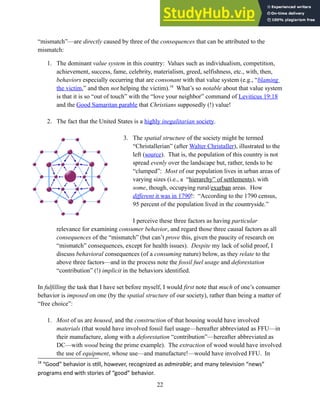
3. The spatial structure of the society might be termed
“Christallerian” (after Walter Christaller), illustrated to the
left (source). That is, the population of this country is not
spread evenly over the landscape but, rather, tends to be
“clumped”: Most of our population lives in urban areas of
varying sizes (i.e., a “hierarchy” of settlements), with
some, though, occupying rural/exurban areas. How
different it was in 1790!: “According to the 1790 census,
95 percent of the population lived in the countryside.”
I perceive these three factors as having particular
relevance for examining consumer behavior, and regard those three causal factors as all
consequences of the “mismatch” (but can’t prove this, given the paucity of research on
“mismatch” consequences, except for health issues). Despite my lack of solid proof, I
discuss behavioral consequences (of a consuming nature) below, as they relate to the
above three factors—and in the process note the fossil fuel usage and deforestation
“contribution” (!) implicit in the behaviors identified.
In fulfilling the task that I have set before myself, I would first note that much of one’s consumer
behavior is imposed on one (by the spatial structure of our society), rather than being a matter of
“free choice”:
1. Most of us are housed, and the construction of that housing would have involved
materials (that would have involved fossil fuel usage—hereafter abbreviated as FFU—in
their manufacture, along with a deforestation “contribution”—hereafter abbreviated as
DC—with wood being the prime example). The extraction of wood would have involved
the use of equipment, whose use—and manufacture!—would have involved FFU. In
18
“Good” behavior is still, however, recognized as admirable; and many television “news”
programs end with stories of “good” behavior.
22
addition, the transportation of the materials of the materials to the construction site
would have involved FFU, as would the transportation of workers to the site.
2. The construction process itself would have involved the use of tools—whose use,
manufacture, and transportation would have all involved FFU.
3. Once a given housing unit is occupied, its occupants would be using electricity (most of
which is generated by burning fossil fuels), and those units would likely have furnaces,
whose use would involve FFU.
4. One or more of the occupants is likely to be employed, with that employment involving
FFU in the manufacture and operation of the vehicle used to transport one to the place of
employment. Taking a form of public transport will lower one’s FFU “contribution,” but
not eliminate it. Some may be able to eliminate this sort of FFU “contribution” by
walking, of course.
5. Given that one will need to eat food to continue to survive, and likely will be unable to,
e.g., produce food in a garden for oneself (and one’s family), one will be forced to travel
to an establishment that sells food products, and make purchases for one’s needs
(thievery is not advisable!). That travel will involve FFU, unless one walks. (However,
given that walking involves shoe wear, and shoe manufacturing and purchasing both
involve FFU, even walking is not FFU-free!)
6. Other trips to satisfy one’s basic needs will be necessary, and will involve FFU, but will
tend to be less frequent. It should be added here that trip-making—by automobile, in
particular—exposes one to the possibility of accidents, such as the recent chain-reaction
accident near Neenah, WI, that involved 131 vehicles, 71 injuries, and one death!
7. Virtually all of the trips that one engages in for other than the satisfaction of basic needs
(going to a movie/play/concert, going to a tavern, going to a club/church, etc.) will
involve FFU.
8. A final point: With all businesses and other organizations there tends to be at least some
paperwork, which involves DC. Thus, even though it is a given business that’s the direct
user of paper, as a customer of a business, one acquires some DC responsibility.
So far, I’ve made note of the fact that much of one’s consumption in this society is forced on one
because of way the society is structured, spatially; and that even though one may resent this
forcing, it does make one responsible for both fossil fuel usage and deforestation activities!
One of the “mismatch”-induced problems in this society is poverty, and:
23
Most Americans will spend at least one year below the poverty line at some point between
ages 25 and 75.[3] Poverty rates are persistently higher in rural and inner city parts of the
country as compared to suburban areas.[4][5]
Estimates of the number of Americans living in poverty are nuanced. One organization
estimated that in 2015, 13.5% of Americans (43.1 million) lived in poverty.[6] Yet other
scholars underscore the number of Americans living in "near-poverty," putting the number at
around 100 million, or nearly a third of the U.S. population.[7] Starting in the 1930s, relative
poverty rates have consistently exceeded those of other wealthy nations.[8] The lowest
poverty rates are found in New Hampshire, Vermont, Minnesota and Nebraska, which have
between 8.7% and 9.1% of their population living in poverty.[9]
This is a disgraceful fact about this “advanced” (?) country, of course, but my point here is that
although everyone in our society engages in some “forced contribution” to both FFU and DC,
only those in poverty make minimal “contributions.” Members of our society vary, then, in their
degree of “contribution,” there being a positive correlation between the two variables.19
The fact, mentioned above, that the United States is a highly inegalitarian society is (I would
hypothesize) a consequence of the “mismatch” that began to develop millennia ago. I would
further hypothesize that the weakening of social bonding that I referred to earlier was harder to
adapt to by some than others; and that if one grows up in this country lacking in “adequate” such
bonding, one will be a candidate for looking beyond social relationships for one’s well-being,
and in doing so is most likely to (try to!) fill the “void” one feels by turning to materialism. This
“substitutionary” behavior helps “blot” out of one’s mind one’s feelings of loneliness,
inadequacy, etc., and helps one “prove” oneself. One can especially do so by not only acquiring
more and more, but displaying it ostentatiously, to allude to a concept made famous by Thorstein
Veblen.
Although there’s scientific evidence in support of the thesis that doing for others is also good for
oneself, either these pursuers of “conspicuous consumption” don’t know this, or something about
the “intellectual atmosphere” of this country—ultimately attributable to the “mismatch,” I
assume—is preventing them from learning this important point. One might very well think that
because of the historical importance of Christianity in this country, virtually anyone in our
society would know this latter fact. But given that Christianity developed with an orientation to
“facts” about Jesus, rather than striving to continue the religion of Jesus, the materialism being
referred to here is less of a mystery! Charles M. Sheldon’s famous attempt to change this (in his
In His Steps novel, published in 1896), has never gained much “traction” in this society; thus, it
appears that Christianity will continue to have an orientation to “correct belief” (orthodoxy) and
ritual, and not acquire an orientation to “correct behavior” (orthopraxy)!
The main point that I wish to make here, though, is that the value system in this society tends to
drive one in the direction of consumption, but that:
19
In 2016 I wrote this on the matter: Global Warming Responsibility: Toward a Useful Position.
24
1. Some in our society—given its monetized nature and spatial structure, combined with the
poverty of those to whom I’m now referring—are unable to consume beyond a minimal
level.
2. At the other extreme are those who for psychological reasons are driven to become
wealthy, and then consume, consume, consume.
3. Many in the middle who are (a) not “psychologically damaged,” (b) able to resist
advertiser’s pressures to consume ever more (“it’ll make you happy!), and (c) socially
engaged to an important degree, gain their sense of well-being from their social
interactions, and only in part from consumption.
In short, the nature of our society (in terms of spatial structure especially) forces everyone to be
FFU and DC “contributors” to some degree, but the nature of our society in other respects (e.g.,
its being a “psychological slum”!)—combined with a problematic upbringing and/or life
experiences—drives some in our society to become consumers far beyond what’s necessary for a
“good life”—and causes them, thereby, to become major “contributors” to FFU and DC!
What those facts would seem—obviously?!—to suggest is that our society is in need of some
degree of societal system change; what I recommend in this society is a proliferation of eco-
villages, to accomplish a degree of societal system change! Whether my proposal will gain
“traction,” and enough of it to have “salvific” value, remains to be seen, of course!
A final point to make in this section: As I envision the program advocated here as not only
having the capability of addressing the global warming problem, but some of our social
problems as well, as an entrepreneur is involved in selecting residents for an eco-village to be
created, my hope is that s/he would consider the possibility of including at least some veterans,
some unemployed, some homeless, and/or even some ex-cons as potential residents. Doing so
would make some small contribution to addressing the many social problems that afflict our
society.
3. My Rationale for an Eco-Village Proliferation
Eco-Villages are likely to vary one from another in a number of ways, and for a variety of
reasons. The principle that should be operative in all eco-villages, however, is:
Strive, through both direct and indirect means, to minimize the village’s impact
on Earth System.20
20
Note that acting on that principle would help diminish the demand for products in our society, and
thereby serve to diminish supply/production—and thereby reduce greenhouse gas emissions.
25
Before proceeding further, let me add this statement by Washington State Anthropology
professor John H. Bodley in (p. v) his Anthropology and Contemporary Human Problems
(1996): 21
The focus on culture scale [in this book] suggests that many solutions to contemporary
problems may be found by developing local communities supported by regional markets and
ecosystems, rather than by making the continued accumulation of finance capital the
dominant cultural process throughout the world.
I believe that my “proposal” here is perfectly consistent with Dr. Bodley’s comment on
“solutions”!
It will be recalled that earlier I identified two types of eco-village—the “company town” type,
and the “independent” eco-village—and my comments below apply to both types, except where
noted otherwise. And: I would advise both types of eco-village to go to an extreme in their
attempt to be “ecologically friendly”—to help compensate for the non-actions of the many in our
society!
The term “climate” means, briefly, “usual weather.” That is, the concept of “climate” is based on
the existence of a pattern of atmospheric phenomena (over a period of a year) at any given
location being repeated, rather closely, year after year. A reason why “global warming” is a
misleading term for what’s occurring presently is that “global warming” is just one of the results
of the increased presence of heat energy in the atmosphere. And to the first two consequences
listed by the Union of Concerned Scientists, I would add several more:
1. Longer and more damaging wildfire seasons [because of drought].
2. Heavier precipitation [with consequent] flooding
3. Larger, more, and more severe storms.
4. Increased deviation from the norm at most locations—meaning greater unpredictability.
Now if weather conditions are unpredictable at all locations, that means that nowhere on earth is
there a “climate”! The current trend is in that direction!
* * * * *
The above comments on the changing atmospheric conditions that are occurring would need to
be taken into consideration (!) both in choosing a location for an eco-village and planning the
structures to be built on the site and the activities planned for the site. As site conditions will
vary from location to location, my discussion here will largely ignore the above discussion, and
21
There’s a sixth edition of this book (2012), which I don’t have.
26
concentrate especially on how a given eco-village can, possibly, minimize its impact on Earth
System—organizing my discussion on the basis of the 8 points that I made in the previous
section.
Given, however, that in referring to the creation of communities I’m referring to new
communities, the starting point must, of course, be site selection. In the case of a “company
town” eco-village, the requirements of the village’s soon-to-be “economic base” would be the
primary consideration: It must be a site that would be “suitable,” in all respects, for the activities
involved with that “base.” Beyond that, the desires of the village’s future residents will govern
how much space is needed: Note here that I assume that even if the village is to be a “company
town,” the future residents of the town will be given a “say” in the additional activities to occur
in the town (e.g., the raising of some animals for milk and/or meat), so that their “inputs” as to
space requirements should be given consideration.
In the case of a “company town” eco-village, I assume that the owners/managers of the business
would want to establish their village close to existing facilities; the creators of an “independent”
village, however, would not face that restriction, of course—so that so long as a given site could
accommodate the activities that they wish to engage in, that site would be acceptable. The cost
of a site would also, of course, make a given site either “acceptable” or not!
A further point of relevance here is that the intellectual resources available to those desiring to
create an eco-village are abundant:
1. This Amazon site lists numerous books that are available.
2. Mother Earth News has been publishing for decades, and contains numerous articles,
advertisements for useful equipment, etc., and books. This site lists numerous relevant
other magazines, as does this listing of “simple living” magazines.
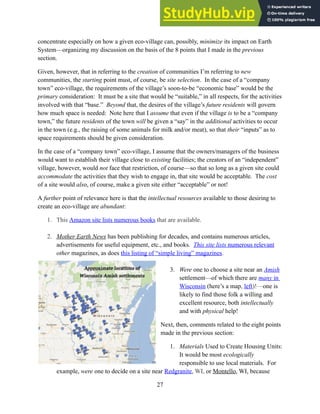
3. Were one to choose a site near an Amish
settlement—of which there are many in
Wisconsin (here’s a map, left)!—one is
likely to find those folk a willing and
excellent resource, both intellectually
and with physical help!
Next, then, comments related to the eight points
made in the previous section:
1. Materials Used to Create Housing Units:
It would be most ecologically
responsible to use local materials. For
example, were one to decide on a site near Redgranite, WI, or Montello, WI, because
27
both of those towns were formerly granite-quarrying sites, “waste” rocks from those
quarries are likely to be available for construction purposes.
An important point to keep in mind here is that one’s initial decision of how many
structures to build on the site—a single building to house all residents, separate buildings
for each family, a building to house all single female adults, etc.—would be among the
considerations to use in deciding on materials.
Wood would probably be the most commonly-chosen construction material; and although
cutting some of the trees on the property for that purpose might make some sense, it
would probably be more sensible to purchase most of the wood needed for construction
purposes: Having trees on the property would be desirable, and why cut trees
unnecessarily?!
Still another possibility at
many locations would be
the use of sod—as
illustrated by this Viking
structure at L’anse aux
Meadows,
an archaeological site
on the northernmost tip of the Great Northern Peninsula on the island of
Newfoundland in the Canadian province of Newfoundland and Labrador.
Archaeological evidence of a Norse presence was discovered at L'Anse aux
Meadows in the 1960s. It is the only confirmed Norse or Viking site in North America
outside of the settlements found in Greenland.[1][2]
The article goes on:
The remains of eight buildings (labeled from A–J) were found. They are believed to
have been constructed of sod placed over a wooden frame. Based on associated
artifacts, the buildings were identified as dwellings or workshops. The largest
dwelling (F) measured 28.8 m × 15.6 m (94 ft × 51 ft) and consisted of several
rooms.[21] Three small buildings (B, C, G) may have been workshops or living
quarters for lower-status crew or slaves. Workshops were identified as an iron
smithy (building J) containing a forge and iron slag,[22] a carpentry workshop
(building D), which generated wood debris and a specialized boat repair area
containing worn rivets.
Because a building using sod would—because of its insulating qualities—stay cool
during summer, and be easy to heat in winter, one could avoid fossil fuel usage for both
heating and cooling; and were one to use wood as one’s fuel, and do so at a natural
28
replenishment rate, one’s greenhouse gas “contribution” would be nonexistent! In
addition, structures with a basic design such as the one pictured above should be more
able to withstand serious storms than other designs. I have in mind, e.g., the terrible
damage that occurred in Alabama on the night of March 3, 2019.
2. The Construction Process: This process would likely involve the use of some purchased
tools (so that one would be responsible for the FFU involved in their manufacture and
transportation); but primarily that process would involve human labor, thus no FFU
“contribution”!
3. Electricity, etc.: Were the village created to be of the “company town” type, it might not
be able to be “off the grid.” However, by creating structures with minimal energy
requirements, making use of “passive solar,” wind energy, and solar energy, it would be
possible to minimize the FFU “contribution.” Also, unless the village would need to be
“on the grid” so far as sewage disposal is concerned, I would recommend the use of
composting toilets.
Doing without electricity might be possible—especially with an “independent” eco-
village—but such a village is unlikely to attract residents, so that not having electricity
would be inadvisable. Besides, given that the village would need a water supply—and it
would be most desirable to have well water available—electricity could be used to pump
that water. (I’m old enough, at 79, to be able to remember pumping water by hand!)
4. Trips to Work: As the “work” to be done would occur on-site (except for some possible
part-time work off-site?), there would be no “journey-to-work”! It does not follow from
that fact, though, that there would be no need for the village to have a vehicle, however:
Relatively short-distant trips would likely be necessary from time to time, necessitating
the village to own a vehicle (e.g., a small truck). Note that by minimizing this need for
trip-making, they would minimize the possibility of being in a vehicle accident!
5. Trips for Obtaining Food: If space and conditions (e.g., weather conditions) permit, I
assume that villagers would want to produce as much food as possible on-site (e.g.,
growing vegetables, herbs, vines—even raising animals, for their milk and meat). It’s
unlikely, though, that they would be able to satisfy all of their food needs and desires with
on-site production, and would need to travel to a nearby grocery for their other food
needs. A natural foods store, ideally!
6. Other Needs Trips: For needs other than food it might be possible to use local craftsmen
(if they exist!) to fulfill those needs; however, it’s certain that some trips to nearby
hardware, etc., stores would be necessary, from time to time.
29
7. Other Trips: I would like to think that village residents would strive to minimize—to the
point of elimination?!—trips in the “other” category! For example, insofar as they want
entertainment, why not provide their own?! (That’s not a rhetorical question, by the
way!)
8. Deforestation Impacts: I mentioned earlier that paper usage is a common feature of
firms in this country: I know this from personal experience: Before I retired in 2014
from a local avionics firm, I worked in Data Management, better termed Document
Management! As you might guess, the creation of documents involves paper usage!
Residents of an eco-village—especially those in an “independent” such village—would
likely have little requirement for paper (except for toilet paper, and for the writing such as
I’m now doing?!22
), and thus would make little DC “contribution”!
22
It’s being done on a computer!
30
D. Concluding Remarks
My reasons for writing this paper are that:
1. Global warming currently poses a serious threat to our species—a threat that because of
media silence—and even media denialism—not only is ignorance (“cluelessness,” I’m
prompted to say!) about global
warming common in our society, but
actual denial: Evidently people in the
latter category have never viewed a
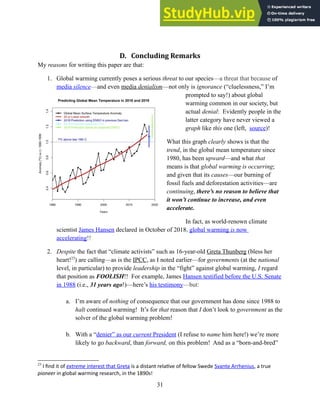
graph like this one (left, source)!
What this graph clearly shows is that the
trend, in the global mean temperature since
1980, has been upward—and what that
means is that global warming is occurring;
and given that its causes—our burning of
fossil fuels and deforestation activities—are
continuing, there’s no reason to believe that
it won’t continue to increase, and even
accelerate.
In fact, as world-renown climate
scientist James Hansen declared in October of 2018, global warming is now
accelerating!!
2. Despite the fact that “climate activists” such as 16-year-old Greta Thunberg (bless her
heart!23
) are calling—as is the IPCC, as I noted earlier—for governments (at the national
level, in particular) to provide leadership in the “fight” against global warming, I regard
that position as FOOLISH!! For example, James Hansen testified before the U.S. Senate
in 1988 (i.e., 31 years ago!)—here’s his testimony—but:
a. I’m aware of nothing of consequence that our government has done since 1988 to
halt continued warming! It’s for that reason that I don’t look to government as the
solver of the global warming problem!
b. With a “denier” as our current President (I refuse to name him here!) we’re more
likely to go backward, than forward, on this problem! And as a “born-and-bred”
23
I find it of extreme interest that Greta is a distant relative of fellow Swede Svante Arrhenius, a true
pioneer in global warming research, in the 1890s!
31
Wisconsinite—a state whose motto is “Forward”!—I, as a father of three, and
grandfather of five, want to move forward!!
3. This country prides itself in being a capitalistic society, meaning that it claims to have:
an economic system based on the private ownership of the means of production and
their operation for profit.[1][2][3][4] Characteristics central to capitalism include
private property, capital accumulation, wage labor, voluntary exchange, a price
system, and competitive markets.[5][6] In a capitalist market economy, decision-
making and investment are determined by every owner of wealth, property or
production ability in financial and capital markets, whereas prices and the distribution
of goods and services are mainly determined by competition in goods and services
markets.[7][8]
Given my conviction that it’s only individuals and/or organizations in the private sector
who/that will “save” our species from extinction (if, that is, that’s possible!), and if it’s
ideological blinders that are currently leading us in the direction of “environmental ruin,”
I suggest—no, demand!—that those individuals so handicapped remove them, post haste!
And if you, as a reader of this paper, know of individuals so “possessed,” please do your
duty and enlighten them!
What’s needed in addressing the problem of global warming (in this country, at least) is
not “tinkering” with the Existing Order (by governmental units), but change in that order;
and:
a. A proliferation of eco-villages in our society would24
accomplish that change.
b. That proliferation will occur only if our “leaders” in the private sphere stop
“Fiddlin’ while Rome burns,” and “wake up and smell the coffee;” what that
would involve, I believe, is recognizing point 1 above, and then acting on it! I
will not deny that there might be better ideas than the one presented in this paper;
but until those better ideas emerge, I suggest “going” with the eco-village idea
presented in this paper!
There’s still more to be said about my eco-village idea, of course, and I use the rest of this paper
to identify and discuss those “other” matters (hoping that my discussion is relatively complete!).
First, for any eco-village “program” to be “sufficiently” successful:
24
Possibly, but not necessarily: There’s no guarantee that our “salvation” as a species is actually
possible! “Common sense” tells us, though, that if we don’t make the effort to “save” ourselves, it’s
unlikely that we will avoid going extinct!
32
1. It needs entrepreneurs to initiate them. (Keep in mind that earlier I had identified two
types of eco-village, but had asserted that I put my “faith” in “company town” eco-
villages, especially.)
2. People to reside and work in them. I would hypothesize here—drawing upon the “push”
and “pull” concepts in migration theory—that the following possible categories of
inmates (I mean “residents” of course; the term “inmate” is more appropriately applied to
those living in the Existing Order!) can be identified:
a. Those pushed from the Existing Order by their current situation.
b. Those pushed from the Existing Order by their recognition that our species is in
danger of going extinct, and that their movement to an eco-village would be at
least a step in a possible “salvific” direction.
c. Those in both categories a and b.
d. Those pulled to the eco-village by a sincere desire to help create a better world,
and the conviction that they’ve acquired that migrating to an eco-village would
represent their chance to do something significant toward that end.
In trying to be realistic here, I would guess that there are more people in our society in
the first three categories, than the fourth one (!); but so what?! What’s important is that
entrepreneurs “step up to the plate” (opening day for the Milwaukee Brewers is
“sneaking up on us”!) and start initiating the process of eco-village proliferation; and that
some members of the advertising industry start doing some honest work, for a change (!),
and advertise the efforts of those entrepreneurs—just because it’s the right thing to do!
Advertising that work would—obviously!—help the process of proliferation so needed!
Those involved in initiating eco-villages should strive to make them as attractive as possible,
without compromising on their “eco-friendliness.” In addition, I suggest striving to make their
eco-communities unique, and for this reason (the “inner-advertising agent” portion of my
personality, I guess!): Unique eco-villages would attract publicity—even become “tourist traps”
(I mean sites that could attract tourists—I was confusing “trap” and “attract”!)—thereby further
increasing interest in the eco-village “movement” that was occurring!
I would like to think that the above discussion has fulfilled the four criteria that I set forth at the
beginning of this paper; it’s now time for entrepreneurs to “do their thing”—beginning here in
the Milwaukee area, I hope! If, though, you have additional ideas to the ones contained herein,
please express them on the internet!
33
I feel fortunate to be looking for intelligent/active/entrepreneurial people not honest ones—so
that I don’t have to live in a barrel, like Diogenes, and walk around carrying a lantern all day
long! (I’d rather be carrying a flashlight anyway!)
In writing this paper, I believe that I have been true to the statement by Buckminster Fuller that I
used as my epigraph for this paper:
You never change something by fighting the existing reality. To change something, build a
new model that makes the existing model obsolete.
If my “plan” is implemented, it will not necessarily make “the existing model obsolete,” but will
make important changes in the “old model”—perhaps enough changes to prevent our species
from going extinct!
The beginning; I don’t want this to be “the end”!
However, with the lack of meaningful interest that I observe regarding global warming, I
wouldn’t bet on our species surviving much longer!!
* * * * *
My focus here has obviously been on our society—and it’s certainly of importance that what’s
done, regarding global warming, in other societies is also significant. But until we “get our own
house in order,” we have no advice to give to those living elsewhere!
34

A Road To Survival

  • 1.
    A Road toSurvival?1 by Alton C. Thompson Table of Contents A Road to Survival?.........................................................................................................................2 A. Historical Background...........................................................................................................4 B. The Global Warming Threat..................................................................................................7 C. My “Plan of Attack”!............................................................................................................14 1. Comments on “Time to Panic”.........................................................................................14 2. Developing a Useful Perspective......................................................................................19 3. My Rationale for an Eco-Village Proliferation................................................................24 D. Concluding Remarks...........................................................................................................30 March 18, 2019 (my youngest brother’s birthday!2 ) 1 The present paper probably has some similarity to the book, The Road to Survival (1948), by William Vogt et al.; as I’ve never read that book, however, . . . . In addition, Ashley Dawson’s more recent Extreme Cities: The Perils and Promise of Urban Life in the Age of Climate Change (2017)—which I’ve also never read!—may also be somewhat related to the present paper. 2 Our sister is the oldest of us 5 siblings, but at 79, I’m the oldest of us 4 boys!
  • 2.
    A Road toSurvival? You never change something by fighting the existing reality. To change something, build a new model that makes the existing model obsolete.3 —Buckminster Fuller Being the son of a carpenter, one might reasonably expect that I have acquired some building skills from my dad. Although I did work with him and his partner4 from time to time, during the summer months while a youth, I had (a) no interest in following his lead, nor did (b) I acquire any of his skills (which became manifest especially after he had retired)! Despite the fact that I never acquired his physical skills, I seem to have acquired from him a “building mentality.” What I mean by that is that when I become aware of certain (but not all) problems, I almost immediately begin to think of possible solutions to those problems. Which is why I’ve chosen a quotation from the late Buckminster Fuller [1895 - 1983] as the epigraph to this paper. Lately, I’ve been thinking of where we humans are headed, and why, and believe that explanatory knowledge of the direction in which we are headed will provide the intellectual basis for changing that direction. That it needs changing I take as a “given”—for I am in full agreement with this statement by Eugene Linden in his history of our species5 which concludes (p. 178): The consumer society continues to roll along despite the diminishing luster of its myths. What this suggests is that we will continue on our present [downward!] course, and that the probability of one or another of our proposed [in the book] disasters will rapidly increase until some small event [the election of “sadopopulist” Donald Trump as President?!] triggers the apocalypse of the consumer society. This was an extremely prescient projection to make 40 years ago, in light of this statement made by a climate scientist in May of 2017: With little or no action taken on global warming, it appears that the Anthropocene will lead to extinction of the very human beings after which the era is named, with the Anthropocene possibly running from 1950 to 2021, i.e. a mere 71 years and much too short to constitute 3 Quoted in this article (2013). 4 I remember two of them—Reuben Luhm and Leo Sarnowski. 5 In his Affluence and Discontent: The Anatomy of Consumer Societies, 1979, on pp. 63 - 178. 2
  • 3.
    an era. Inthat case a better name for the period would be the.Sixth Extinction Event . . . . [I corrected the two “typos” in this statement.] As that article ends with this sentence: The situation is dire and calls for comprehensive and effective action as described in the Climate Plan. it’s safe to say that the author was not serious about the 2021 date; for if it’s certain that our species will go extinct by 2021, why refer to a “Climate Plan” which would have absolutely no chance of being implemented in time to “save” our species from extinction?! Because I’m convinced that “explanatory knowledge of the direction in which we are headed will provide the intellectual basis for changing that direction,” the logical starting point for this paper is to discuss that “explanatory knowledge;” and as I would insist that it is historical developments that explain our current situation, my first section here identifies what I believe to be the key such developments. In concluding this introduction, I should note that as global warming “progresses,” there will be a need to try to adapt to the changes brought on by global warming. For example: The Maldives [in the Indian Ocean] have already implemented several measures to combat sea level rise [a result of global warming] including building a wall around the capital of Malé and refurbishing local infrastructure, particularly ports. Adaptation has its limits, however! Without preventive measures being taken (by those of us living in societies with larger populations and more resources), adaptive measures are doomed to failure—given that there’s no reason to believe that global warming will cease soon! Inhabitants of the Maldives are victims of our actions, not theirs; and the fact that we may not be aware of that fact does not excuse us from the harm that our actions are already inflicting on others (to say nothing of ourselves)! The time to act is now—with the primary question now before us being: What do we need to do? In the third section below (Section C) I present my ideas regarding this. 3
  • 4.
    A. Historical Background AsI cannot provide any firm evidence in support of my view of world history, I have chosen to be brief here, and to begin with a diagram, after which I will offer some comments on the diagram: During the Neolithic (which began about 12,000 years ago), there occurred the invention of agriculture. ↓ That development has rightly been labeled “the worst mistake in the history of the human race”! ↓ As agriculture began to displace foraging as the source of sustenance for some groups, those groups began to increase in population size. ↓ That meant that: ↓ ↓ A Discrepancy6 began to develop between (a) the way of life for which humans had become “designed”— physically, sociologically, and psychologically—prior to the Neolithic, and (b) the new ways of life that began to develop during/after the Neolithic. The bonds that connected one member of a given group to other members of the group, began to weaken. ↓ 6 Also see this: Reflections on “Evolutionary Mismatch” (2019). 4
  • 5.
    Those developments, interactingwith the fact that humans are a sexually-reproducing species,7 resulted in the activation of certain unconscious processes.8 ↓ Those processes have determined human history since then! ↓ The direction of which has been “downhill”! (as Linden has argued; see p. 2 above) The key concept mentioned in the above chart is the “Discrepancy,” a concept that I have traced back to Thorstein Veblen (1857 - 1929), his The Instinct of Workmanship and the State of the Industrial Arts (1914, p. 334) specifically: Neither the manner of life imposed by the machine process, nor the manner of thought inculcated by habituation to its logic, will fall in with the free movement of the human spirit, born, as it is, to fit the conditions of savage life. So there comes an irrepressible—in a sense, congenital— recrudescence of magic, occult science, telepathy, spiritualism, vitalism, pragmatism. [“Savage” is, of course, an archaic term for our forager ancestors.] The term that has, though, come into more common use (than “Discrepancy”) is “mismatch;” but rather than it becoming a commonly-used term where it’s needed (for the purpose of “saving” our species!)—i.e., Sociology, Anthropology, and History—it has become rather commonly used, these days, in studies of health and disease. I will certainly not deny that it’s not now playing an important role in those disciplines; my point, however, is this: Of what value is good health if global warming has rendered one’s species extinct?!! Given that we live in an Age of Specialization (so that there’s what Sheldon Ungar has termed a “knowledge-ignorance paradox”), it’s not surprising that someone like Harvard Professor Daniel E. Lieberman9 lacks any knowledge of the ramifications of “mismatch” beyond health and disease.10 It’s certainly important, I agree, to know that there may be at least 49 “mismatch” diseases (his Table 3, on p. 173 of The Story . . .). To repeat, however: 7 Which produces genetic variety. 8 I am unable to identify those processes, I frankly admit! 9 Author of, e.g., The Story of the Human Body: Evolution, Health, and Disease (2013). 10 He does mention “climate change” at numerous points in his book, but has nothing of significance to say about the matter! 5
  • 6.
    Of what valueis good health if global warming has rendered one’s species extinct?! Which is—obviously!—a rhetorical question!! Although I would like to see a history that develops my point—my hypothesis, actually, of course!—that: Those processes have determined human history since then! the fact of the matter is that that given the possible imminence of our species’s demise, it’s far more important to develop a “plan of attack” to (try to!) prevent our species from joining the many other species now going extinct (during this period of the sixth mass extinction!11 ); and to base that “plan” on a plausible explanation of why we are now in a perilous situation. I believe that the “history” that I’ve provided above does provide the plan offered here with a solid “foundation” (to pay homage to my late—and wonderful!—dad, Marvin Clifford Thompson [1905 - 1987].12 Prior to presenting my “plan,” though, I must say a few words about global warming—beyond the statement quoted on the bottom of page 2 above. 11 See this thorough summary of Elizabeth Kolbert’s The Sixth Extinction: An Unnatural History (2014). 12 Which is not to say, of course, that my mom—Inez Genevieve Hasselquist Thompson [1912 - 1987]— was not also a wonderful person (who died 25 days after dad died). But it’s natural for a son to be more influenced by his dad than by his mom! 6
  • 7.
    B. The GlobalWarming Threat Let me begin here by noting that “global warming” is not the most accurate name for the phenomenon under discussion here—which fact led me to coin the term “Trendular Atmospheric Depatternization” (TAD) several years ago, which term has not “caught on” since then, though! I myself have come to conclude that that name is a “tad” cumbersome, so that I have not “pushed” for the adoption of my name for the phenomenon! Thus, I continue to use “global warming” below—and prefer that name to “climate change” because of the political origin of that name. This article explains the fact that climate scientists use both terms, but do not think of those two terms as having the same meaning. Here’s the problem with “climate change” as commonly used these days: Last week [in 2013], Yale University released a study showing that people are more likely to fear “global warming” and take part in a campaign to stop it than they are “climate change.” Yale’s report echoed research by George W. Bush pollster Frank Luntz, who had argued that the Bush White House should use climate change instead of global warming because it sounded less scary. Polling also shows Democrats are more likely than Republicans to believe the Earth is warming and human activity is the main cause. For me, it’s not only sad, but criminal, to “play fast and loose” with these two terms! For if our citizenry—which includes our “leaders”13 —doesn’t think that global warming is a serious problem, it’s unlikely that they will demand actions to address the problem. But that’s not the only problem; there are also the problems of “media silence”: What has become most striking about the growing evidence that climate change is a clear and present danger indeed an emerging existential threat is the simultaneous failure of the U.S. news media to deal seriously with the issue, another sign of how the Right can intimidate the mainstream into going silent. We have seen this pattern before, as the Right sets the media agenda by bullying those who threaten its ideological interests. Before the Iraq War, anyone who dared raise questions about the Bush administration’s justifications could expect to be marginalized or worse. Just ask Phil Donahue, Scott Ritter and the Dixie Chicks. During Ronald Reagan’s presidency, his hard-nosed propagandists dubbed this tactic “controversializing,” that is, anyone who got too much in the way could expect to be subjected to systematic smears and professional deconstruction. With so many right-wing voices willing to say almost anything, it wasn’t hard to intimidate people. and media “denialism”: 13 I put this word in quotation marks for obvious reasons! 7
  • 8.
    Emperor Nero may(or may not) have fiddled while Rome burned, but commercial U.S. TV networks definitely fiddled last year on climate coverage while the Earth grew dangerously hot. An annual climate report issued this month [in 2017] by the World Meteorological Organization confirms that average global temperatures and global sea levels continued their inexorable rise in 2016, setting new records. Global sea ice dropped to an “unprecedented” extent. Extreme weather conditions, probably aggravated by climate disruption, displaced hundreds of thousands of people, left millions hungry, and caused “severe economic damage.” Yet in the midst of such frightening changes, and a national presidential campaign with enormous consequences for U.S. climate policy, the four major broadcast networks — ABC, CBS, NBC, and Fox News Sunday — significantly decreased their coverage of climate issues on evening and Sunday news programs, according to a new analysis by Media Matters. Television programs like these are the major source of news for 57 percent of adult Americans. THE PUBLIC IS BEING KEPT “IN THE DARK” ABOUT GLOBAL WARMING, AND THAT IS NOT “GOOD NEWS”! I suppose that I should apologize for getting “sidetracked” here, by writing about deception, silence, and denialism; but I believe that those facts are of virtually equal importance to global warming itself! For it is those facts which may very well prevent our supposedly wise (i.e., the sapiens in Homo sapiens) species from continuing much longer! Let us not only hope that that’s not our fate, but plan and work to (possibly) prevent it from happening! In the next section I present my ideas regarding how to “save” I species; but I must now continue with a discussion of global warming. Global warming is a long-term rise in the average temperature of the Earth's climate system, an aspect of climate change shown by temperature measurements and by multiple effects of the warming.[2][3] The term commonly refers to the mainly human-caused observed warming since pre-industrial times and its projected continuation,[4] though there were also much earlier periods of global warming.[5] In the modern context the terms global warming and climate change are commonly used interchangeably,[6] but climate change includes both global warming and its effects, such as changes to precipitation and impacts that differ by region.[7][8] Many of the observed warming changes since the 1950s are unprecedented in the instrumental temperature record, and in historical and paleoclimate proxy records of climate change over thousands to millions of years.[2] 8
  • 9.
    Global warming isillustrated by this graph (source): 9
  • 10.
    This information accompaniesthe graph: Global mean surface-temperature change from 1880 to 2018, relative to the 1951–1980 mean. The 1951–1980 mean is 14.19 °C (57.54 °F).[1] The black line is the global annual mean, and the red line is the five-year local regression line. The blue uncertainty bars show a 95% confidence interval. (Here’s a discussion of the “Lowess smoothing” on the graph.) The key concept underlying the fact of global warming is “intensified greenhouse effect.” Living on earth is analogous to living in a greenhouse in that just as the temperature and humidity conditions in a greenhouse are artificially controlled by humans to be optimal for whatever is being grown in the greenhouse, so does earth’s atmosphere play a similar role for us humans. It may seem that our heat comes directly from the sun but this diagram (below, next page) presents the basics regarding how our atmosphere is heated: 1. The short-wave heat energy from the sun heats earth’s land and water. 10
  • 11.
    2. That heatenergy, in the form now of long-wave radiation, is then re-radiated into the lower atmosphere. 3. That heat energy would simply escape into space were it not for the presence of “greenhouse” gases in the lower atmosphere. 4. Those gases—which include carbon dioxide (CO2), methane (CH4), nitrous oxide (N2O), and fluorinated gases—“trap” enough of the heat energy being re-radiated from earth to enable life on earth. 5. Earth being a system, it is “equipped” with positive and negative “feedback” mechanisms, whose “job” is to maintain relative equilibrium. Climate change feedback is important in the understanding of global warming because feedback processes may amplify or diminish the effect of each climate forcing, and so play an important part in determining the climate sensitivity and future climate state. Feedback in general is the process in which changing one quantity changes a second quantity, and the change in the second quantity in turn changes the first. Positive feedback amplifies the change in the first quantity while negative feedback reduces it.[2] 11
  • 12.
    The term "forcing"means a change which may "push" the climate system in the direction of warming or cooling.[3] An example of a climate forcing is increased atmospheric concentrations of greenhouse gases. By definition, forcings are external to the climate system while feedbacks are internal; in essence, feedbacks represent the internal processes of the system. Some feedbacks may act in relative isolation to the rest of the climate system; others may be tightly coupled; hence it may be difficult to tell just how much a particular process contributes.[4] Note this sentence, in particular, in the above quotation: An example of a climate forcing is increased atmospheric concentrations of greenhouse gases. A “forcing”—by definition—is an external “push,” and in the case of global warming that “push” comes from human activities, especially our burning of fossil fuels and deforestation activities. Although: the fossil fuel coal had been used as a fuel since 1,000 B.C., it wasn’t until the arrival of the Industrial Revolution from the mid-1700s through the 1800s that coal began to replace biomass as the primary source of energy. The Industrial Revolution also marks the beginning of an era when the world human population started to explode. Indelibly tied together, both energy consumption and population growth have experienced exponential growth with few exceptions since the beginning of the Industrial Revolution. As the population increased, energy demands increased with greater intensity. For anyone living in the United States today, it’s virtually impossible to avoid being a “contributor” the intensification of the “greenhouse effect” that results from the burning of fossil fuels and deforestation activities, for: 1. Our homes, work places, and other structures are heated and cooled primarily by the burning of fossil fuels (including for generating electricity!), and the wood used in the construction of structures comes from the cutting of trees (duh!). 2. The vehicles that we use for transporting both people and goods typically burn fossil fuels. 3. Their manufacture and the manufacture of virtually everything else that we consume, involved both the burning of fossil fuels and deforestation. Regarding the latter, consider all of the paper used in our society for packaging, labeling, writing, etc.! 4. Etc. Our lives today are very much dependent on activities that “contribute” to global warming. But why, you may ask, is that a problem? After all, did not Guy Stewart Callendar [1898 - 1964]— 12
  • 13.
    the individual whofirst established that global warming was occurring14 —think that “this warming would be beneficial, delaying a ‘return of the deadly glaciers.’[3] ?! The problem with Callendar’s opinion is that he was not aware of the fact that Earth is a system, and that as a system, “forcings”—which as noted above are external to a system—can seriously affect a system in negative ways. As I stated earlier: An example of a climate forcing is increased atmospheric concentrations of greenhouse gases. And as I also noted earlier, human activities are the primary culprit in the case of global warming. It’s true, I will not deny, that cow farts (!) are also a cause of global warming. But given that it’s us humans who are responsible for the world’s cow population, it’s us who are ultimately responsible for cow farts! In writing above that “forcings” can “seriously affect” Earth System in a negative manner, what I mean is that if “forcings” continue to occur and are substantial enough, they can cause a “tipping point” to be reached, and crossed—and that’s most certainly not desirable. This article, after offering a rather thorough discussion of “tipping points,” concludes this way: With a range of critical thresholds on the horizon, each tipping element demonstrates the potential implications of allowing climate change to progress unchecked. As tipping points loom ever closer, the urgency for emissions mitigation escalates in hopes of sustaining the Earth as we know it. The two major points that I would make regarding “tipping points” as they are related to global warming are: 1. After a “tipping point” in global warming is “achieved” (!), warming is likely to accelerate! And what’s scary about that is that this article asserts that global warming is accelerating now! 2. Once warming begins to accelerate, it may be impossible to halt further warming! 3. Meaning that: a. The many negative consequences associated with global warming in addition to the warming per se (see this list of 19!), are likely to become increasingly intense— resulting not only in a terrific amount of property damage/loss, but a huge loss of human life! 14 The science behind global warming goes back especially to Swedish chemist Svante Arrhenius [1859 - 1927]. 13
  • 14.
    b. Once thenew equilibrium is reached, it may be at a level such that Earth System can no longer support human life (to say nothing of many other species)! c. That is, by the time that an equilibrium is reached, our species may be extinct! Thus, I have absolutely no hesitation in declaring that we humans are living in an extremely perilous time; a time when effective action, beginning yesterday (!), is required—if we are to have any hope of avoiding extinction “soon”! I believe that the “plan” presented in the next section quite possibly15 meets both of those criteria! Please note that there is some duplication , in the next section, of what I’ve already written in this section! 15 Certainty here is not possible! 14
  • 15.
    C. My “Planof Attack”! To be useful, an approach would need to: 1. Be capable of being implemented. 2. Be likely to be implemented. 3. Be implemented virtually immediately. 4. Have results that would be virtually immediate—and would achieve the intended results. With those criteria in mind, I offer the following perspective as possibly meeting those criteria. By way of introduction to my comments, though, I first make mention of an article sent to me recently by a friend, titled “Time to Panic,” by David Wallace-Wells, “columnist and deputy editor at New York magazine and the author of the forthcoming [just published, in fact!] The Uninhabitable Earth: Life After Warming, from which this essay is adapted.” The reason I offer these comments is that I believe it useful to begin here by doing so: It enables me to provide some background to my ideas. 1. Comments on “Time to Panic” 1. A better title for an article on global warming written in 2019 would be “It’s Past Time to Panic!” 2. Early on Wallace-Wells refers to a “Doomsday” report, issued in late 2018, by the UN’s Intergovernmental Panel on Climate Change (IPCC), I have three problems with the IPCC: a. The “climate change” in its name has become a political—rather than scientific— term. Republican political operative Frank Luntz made “climate change” preferable to “global warming” for political reasons. “Yale’s report [here’s a link to it] echoed research by George W. Bush pollster Frank Luntz, who had argued that the Bush White House should use climate change instead of global warming because it sounded less scary.” Wallace-Wells uses “climate change” throughout his article, perhaps because of its use in “Intergovernmental Panel on Climate Change.” [I supplied the italics!] b. It is an excessively conservative—insanely cautious” might be more accurate!— organization : Given that what’s ultimatelt at stake regarding global warming is our continued existence as a species, being “conservative” could be a deadly mistake! 15
  • 16.
    c. The factthat it has a “Summary for Policymakers” indicates that its members assume—incorrectly!—that only governmental units would (and should?) be involved in addressing the problem of global warming. What I suggest in this paper, rather, is a “project” to be undertaken by business leaders in particular! 3. I wish that Wallace-Wells had not used the word “just” in his the “world that has warmed by just one degree Celsius (1.8 degrees Fahrenheit) since the late 1800s . . . .” At any given location an increase/decrease of 1° C. would be barely noticeable—if at all. However, a 1° C. increase in the global mean temperature represents a tremendous amount of heat energy! 4. In the author’s “Scientists have felt this way,” “believed” would be more appropriate than “felt”! “Belief” implies solid evidence; “felt” implies an emotional reaction. I do not deny the importance of emotion—what motivates me, in fact, is the fact that my wife (of 53 years!) and I wish our 3 wonderful children and 5 beautiful grandchildren to have a future! But I attempt to ground my ideas regarding how to address the problem of global warming—in a useful way—in solid facts. 5. I would add to the “scientific reticence” problem mentioned by famous climate scientist James Hansen, the problems of media silence about global warming, and even media denialism! What’s so good to see about Wallace-Wells’s article is that it is breaking that silence in a major newspaper: I wouldn’t expect to see such an article here in the Milwaukee area! 6. As consequences of global warming, the author mentions “heat waves, water stress and other climate events as the global mean temperature increases.” I would add that this article by the Union of Concerned Scientists lists 19 consequences of global warming, in addition to an increase in the global mean temperature! 7. The author states that “The emissions path we are on today is likely to take us to 1.5 degrees Celsius of warming by 2040 . . . .” Evidently this possibility was drawn from the IPCC’s report, and he’s unaware of this article by John B. Davies (from September of 2013) which begins this way: The world is probably at the start of a runaway Greenhouse Event which will end most human life on Earth before 2040. This will occur because of a massive and rapid increase in the carbon dioxide concentration in the air which has just accelerated significantly. The increasing Greenhouse Gas concentration, the gases which cause Global Warming, will very soon cause a rapid warming of the global climate and a chaotic climate. Or this even more ominous statement from May of 2017 (which I repeat here): 16
  • 17.
    With little orno action taken on global warming, it appears that the Anthropocene will lead to extinction of the very human beings after which the era is named, with the Anthropocene possibly running from 1950 to 2021, i.e. a mere 71 years and much too short to constitute an era. In that case a better name for the period would be the Sixth Extinction Event . . . . [I corrected the two “typos” in this statement.] In short, the statement quoted by Wallace-Wells is—to make an understatement here!— excessively optimistic—because it’s derived from the IPCC report. 8. I am in full agreement with the author’s statement that “when it comes to climate change, being alarmed is what the facts demand. Perhaps the only logical response.” Amen! 9. Wallace-Wells asserts that “complacency remains a much bigger political problem than fatalism.” Given what I said under point 5 above, I would say that “silence” and “denialism” on the part of the media have been even more significant problems. 10. The author states that “United Nations secretary-general, António Guterres, believes we have only until 2020 to change course and get started.” Here’s a far better account of what Guterres said. In September of last year: António Guterres, the United Nations secretary general, told global leaders this week that the world has less than two years to avoid “runaway climate change.” “If we do not change course by 2020, we risk missing the point where we can avoid runaway climate change,” Guterres said during a speech at the U.N. headquarters in New York. “Climate change is the defining issue of our time, and we are at a defining moment,” he said. “Scientists have been telling us for decades. Over and over again. Far too many leaders have refused to listen.” “Runaway” is serious business! Were “runaway” to begin next year, this would mean that global warming (a) would begin to accelerate (it may be accelerating already!), and (b) be impossible to halt! With the possibility that when it reaches a new equilibrium, our species will have joined the many other species now going extinct! Why, I ask, did Wallace-Wells fail to mention the most important point that Mr. Guterres made, that “runaway” could begin next year?! 11. The author claims that “Fear can mobilize, even change the world,” and refers to (the late) Rachel Carson’s Silent Spring to prove his point. I’m not convinced! 12. Wallace-Wells asserts that “perhaps the strongest argument for the wisdom of [the] catastrophic thinking [in which he’s been engaging in, in this article] is that all of our mental reflexes run in the opposite direction, toward disbelief about the possibility of very bad outcomes.” I agree with what he says about our “mental reflexes,” but don’t 17
  • 18.
    necessarily agree withthe premise that engaging in “catastrophic thinking” is the best way to overcome those “reflexes.” In fact, what I offer herein is a behavioral response, rather than a “thinking” one per se! 13. I have no problem with the author’s statement that: “The scroll of cognitive biases identified by psychologists and fellow travelers over the past half-century can seem, like a social media feed, bottomless, and they distort and distend our perception of a changing climate. These optimistic prejudices, prophylactic biases and emotional reflexes form an entire library of climate delusion.” However, (a) I’m not sure that those “biases” are easily overcome, (b) I would add that “possession” by one or more ideologies is also a problem—(c) and, then, there’s also my point 5 above. 14. I agree with Wallace-Wells that “We have a tendency to wait for others to act, rather than acting ourselves; a preference for the present situation; a disinclination to change things; and an excess of confidence that we can change things easily,” and would add that we place an excess of confidence in technology to solve our problems. 15. I agree somewhat with the author’s statement that “The Lancet’s recent dietary recommendations for those who want to eat to mitigate climate change” is an utterly trivial “answer” to the global warming problem”! [I added the link.] 16. Wallace-Wells then goes on to say that “the effects of individual lifestyle choices [such as dietary changes] are ultimately trivial compared with what politics can achieve.” And then adds that “the purpose of politics . . . [is] that we can be and do better together than we might manage as individuals.” (A statement with which young activist Greta Thunberg also would accept, apparently.) He adds that “collective action . . . is what is necessary.” This is where I have my most serious disagreement with David Wallace-Wells, for the solution that I would offer is an effort to create eco-villages. Here’s a definition of eco-village: An ecovillage is a traditional or intentional community with the goal of becoming more socially, culturally, economically, and ecologically sustainable. It is consciously designed through locally owned, participatory processes to regenerate and restore its social and natural environments. Most range from a population of 50 to 250 individuals, although some are smaller, and traditional ecovillages are often much larger. Larger ecovillages often exist as networks of smaller sub-communities. Some ecovillages have grown through like- minded individuals, families, or other small groups—who are not members, at least at the outset—settling on the ecovillage's periphery and participating de facto in the community. And here’s a directory of existing such villages. Thus, many already exist here and elsewhere! My concept of “eco-village” is slightly different from the above definition in that I recognize two types of eco-village: 18
  • 19.
    1. Those villagesestablished by a group of individuals for themselves (essentially, the above definition); what I will refer to as “independent” eco-villages. 2. “Company town” eco-villages, these being established as ones created on the basis of sound ecological principles, but established by existing companies as a means to expand their business (or, creating a new business) while doing so in an ecological sensitive manner. As I’m not aware of any eco-villages of the second type, I especially would like to see that type established, for I believe that if our “salvation” as a species is to be achieved, it will result from a rapid proliferation of such villages! I would like to think that if a few existing firms “get the ball rolling” on this “project,” other firms will soon join in—and there would be a “domino effect”! Let me add here my belief that were the “first domino” to be created here in the Milwaukee area (I live in a suburb, the “garden city” of Greendale), this year, and given that the next Democratic Convention is to be held here during July 13 - 16 of 2020, that “model” community could be used to advertise this eco-village idea:16 Attendees could be made aware of that eco-village, transportation to it could be arranged—with the possibility that enough of them would “take the idea home with them,” this resulting in a proliferation of such villages in our country! What I need to do in this paper, of course, is provide a rationale for the creation of eco-villages, and I use the next section to provide background for my suggestion; in the section following that section I then provide my arguments in favor of the eco-village. An important point to make at this point, however, is that (to repeat!) the two major causes of global warming are:17 1. The burning of fossil fuels. 2. Deforestation activities. What the burning of fossil fuels does is transfer carbon which had been safely buried under the earth’s surface to the lower atmosphere—thereby increasing the “greenhouse effect” provided by the lower atmosphere. The fact that earth has a “greenhouse effect” is a factor that enables our continued survival on earth; however, increasing the “greenhouse gas” content of the atmosphere has a number of deleterious effects for us humans, not just a warming of the lower atmosphere. As to deforestation, this article states: 16 There’s already one at Bay View, but I would prefer a “model” built fairly close to the Fiserv Forum, where the convention will be held. Besides, bothering the folks in Bay View would not be advisable! There’s also the Watersmeet village in Waukesha County just West of Milwaukee, but that’s even farther away. 17 In addition, the size of the world’s population has great relevance. 19
  • 20.
    Across the UnitedStates, in fact, land management can have a really big effect on the climate. A new study examines the country’s potential to implement natural solutions—such as growing taller trees, improving soil health, protecting grasslands and restoring coastal wetlands—to increase carbon storage and reduce greenhouse gas pollution. Essentially, turbo-charging nature to address global warming, while also providing natural benefits for people, water and wildlife. “Natural climate solutions for the United States,” a new study authored by The Nature Conservancy and 21 institutional partners and published in the journal Science Advances, investigates the potential of 21 different natural functions, from restoring forests and grasslands to a range of agricultural practices. This study also considers how carbon payments at various price levels could incentivize action where low-cost opportunities exist. It is the first comprehensive assessment of land- based climate solutions in the U.S., following on an earlier TNC-led study showing that, worldwide, natural solutions could mitigate more than a third of the emissions needed to hit global targets by 2030. The main point of relevance in the above for the present paper is that forests act as carbon sinks, and by decreasing the extent of those sinks, more and more carbon enters the lower atmosphere, thereby contributing to global warming (etc.). I’m not convinced that knowing the above about the causes of global warming is very useful, however. Hence, my search for a more useful perspective—which I engage in next. 2. Developing a Useful Perspective Tentatively, I have come to conclude that a useful perspective on global warming (from the standpoint of addressing it quickly and effectively) is one that: 1. Regards consumption activities as the central ones. 2. Perceives those activities as the result of our being a “mismatch” society. Here’s a definition of the “mismatch” to which I am referring here: Evolutionary mismatch, also known as mismatch theory or evolutionary trap, is a concept in evolutionary biology that refers to evolved traits that were once advantageous but became maladaptive due to changes in the environment. This can take place in humans and animals and is often attributed to rapid environmental change. Here’s my preferred definition, however: 1. Prior to the Neolithic (which began about 12,000 years ago) a co-development occurred of (a) humans and (b) their forager-based way of life. During that period humans became 20
  • 21.
    “designed”—physically, sociologically, psychologically—fora way of life dependent on foraging for sustenance. 2. During the Neolithic agriculture began to displace foraging as the main source of sustenance for some groups—that development being “the worst mistake in the history of the human race,” per geographer Jared Diamond! 3. The reason it was a mistake (I would add) is that: a. Group size began to increase for those groups that were adopting agriculture. b. A result of that was that the social bonds that had connected one member of a group to the other members began to weaken. c. That fact, in conjunction with the fact that any sexually-reproducing species contains genetic variety, created a situation conducive to some members of a group beginning to exploit the other members of the group. d. That exploitation led to the formation of social classes—and, therefore, inequality. e. Because as societal changes were occurring, human biology was not (comparatively), a “mismatch” developed between: 1) The way of life for which humans had become “designed;” and 2) The actual way of life that they were now beginning to have. David P. Barash has referred to societal change as the “hare” portion of change, and “tortoise” as the (relative) non-biological change as societal change was occurring! That “mismatch,” in my considered opinion, became the dominant causal factor in human history since it first developed; as an important causal factor it has not, however, been given much scholarly attention (being mainly related to health problems; see, e.g., this and this). As to consumption activity as it relates (as a consequence) to the “mismatch” that began to develop millennia ago, and focusing in particular on consumption in the United States at present, I believe it useful to focus here on everyday consumption activities as they occur in the United States, and to think of those activities—keeping in mind that their ultimate cause is 21
  • 22.
    “mismatch”—are directly causedby three of the consequences that can be attributed to the mismatch: 1. The dominant value system in this country: Values such as individualism, competition, achievement, success, fame, celebrity, materialism, greed, selfishness, etc., with, then, behaviors especially occurring that are consonant with that value system (e.g., “blaming the victim,” and then not helping the victim).18 What’s so notable about that value system is that it is so “out of touch” with the “love your neighbor” command of Leviticus 19:18 and the Good Samaritan parable that Christians supposedly (!) value! 2. The fact that the United States is a highly inegalitarian society. 3. The spatial structure of the society might be termed “Christallerian” (after Walter Christaller), illustrated to the left (source). That is, the population of this country is not spread evenly over the landscape but, rather, tends to be “clumped”: Most of our population lives in urban areas of varying sizes (i.e., a “hierarchy” of settlements), with some, though, occupying rural/exurban areas. How different it was in 1790!: “According to the 1790 census, 95 percent of the population lived in the countryside.” I perceive these three factors as having particular relevance for examining consumer behavior, and regard those three causal factors as all consequences of the “mismatch” (but can’t prove this, given the paucity of research on “mismatch” consequences, except for health issues). Despite my lack of solid proof, I discuss behavioral consequences (of a consuming nature) below, as they relate to the above three factors—and in the process note the fossil fuel usage and deforestation “contribution” (!) implicit in the behaviors identified. In fulfilling the task that I have set before myself, I would first note that much of one’s consumer behavior is imposed on one (by the spatial structure of our society), rather than being a matter of “free choice”: 1. Most of us are housed, and the construction of that housing would have involved materials (that would have involved fossil fuel usage—hereafter abbreviated as FFU—in their manufacture, along with a deforestation “contribution”—hereafter abbreviated as DC—with wood being the prime example). The extraction of wood would have involved the use of equipment, whose use—and manufacture!—would have involved FFU. In 18 “Good” behavior is still, however, recognized as admirable; and many television “news” programs end with stories of “good” behavior. 22
  • 23.
    addition, the transportationof the materials of the materials to the construction site would have involved FFU, as would the transportation of workers to the site. 2. The construction process itself would have involved the use of tools—whose use, manufacture, and transportation would have all involved FFU. 3. Once a given housing unit is occupied, its occupants would be using electricity (most of which is generated by burning fossil fuels), and those units would likely have furnaces, whose use would involve FFU. 4. One or more of the occupants is likely to be employed, with that employment involving FFU in the manufacture and operation of the vehicle used to transport one to the place of employment. Taking a form of public transport will lower one’s FFU “contribution,” but not eliminate it. Some may be able to eliminate this sort of FFU “contribution” by walking, of course. 5. Given that one will need to eat food to continue to survive, and likely will be unable to, e.g., produce food in a garden for oneself (and one’s family), one will be forced to travel to an establishment that sells food products, and make purchases for one’s needs (thievery is not advisable!). That travel will involve FFU, unless one walks. (However, given that walking involves shoe wear, and shoe manufacturing and purchasing both involve FFU, even walking is not FFU-free!) 6. Other trips to satisfy one’s basic needs will be necessary, and will involve FFU, but will tend to be less frequent. It should be added here that trip-making—by automobile, in particular—exposes one to the possibility of accidents, such as the recent chain-reaction accident near Neenah, WI, that involved 131 vehicles, 71 injuries, and one death! 7. Virtually all of the trips that one engages in for other than the satisfaction of basic needs (going to a movie/play/concert, going to a tavern, going to a club/church, etc.) will involve FFU. 8. A final point: With all businesses and other organizations there tends to be at least some paperwork, which involves DC. Thus, even though it is a given business that’s the direct user of paper, as a customer of a business, one acquires some DC responsibility. So far, I’ve made note of the fact that much of one’s consumption in this society is forced on one because of way the society is structured, spatially; and that even though one may resent this forcing, it does make one responsible for both fossil fuel usage and deforestation activities! One of the “mismatch”-induced problems in this society is poverty, and: 23
  • 24.
    Most Americans willspend at least one year below the poverty line at some point between ages 25 and 75.[3] Poverty rates are persistently higher in rural and inner city parts of the country as compared to suburban areas.[4][5] Estimates of the number of Americans living in poverty are nuanced. One organization estimated that in 2015, 13.5% of Americans (43.1 million) lived in poverty.[6] Yet other scholars underscore the number of Americans living in "near-poverty," putting the number at around 100 million, or nearly a third of the U.S. population.[7] Starting in the 1930s, relative poverty rates have consistently exceeded those of other wealthy nations.[8] The lowest poverty rates are found in New Hampshire, Vermont, Minnesota and Nebraska, which have between 8.7% and 9.1% of their population living in poverty.[9] This is a disgraceful fact about this “advanced” (?) country, of course, but my point here is that although everyone in our society engages in some “forced contribution” to both FFU and DC, only those in poverty make minimal “contributions.” Members of our society vary, then, in their degree of “contribution,” there being a positive correlation between the two variables.19 The fact, mentioned above, that the United States is a highly inegalitarian society is (I would hypothesize) a consequence of the “mismatch” that began to develop millennia ago. I would further hypothesize that the weakening of social bonding that I referred to earlier was harder to adapt to by some than others; and that if one grows up in this country lacking in “adequate” such bonding, one will be a candidate for looking beyond social relationships for one’s well-being, and in doing so is most likely to (try to!) fill the “void” one feels by turning to materialism. This “substitutionary” behavior helps “blot” out of one’s mind one’s feelings of loneliness, inadequacy, etc., and helps one “prove” oneself. One can especially do so by not only acquiring more and more, but displaying it ostentatiously, to allude to a concept made famous by Thorstein Veblen. Although there’s scientific evidence in support of the thesis that doing for others is also good for oneself, either these pursuers of “conspicuous consumption” don’t know this, or something about the “intellectual atmosphere” of this country—ultimately attributable to the “mismatch,” I assume—is preventing them from learning this important point. One might very well think that because of the historical importance of Christianity in this country, virtually anyone in our society would know this latter fact. But given that Christianity developed with an orientation to “facts” about Jesus, rather than striving to continue the religion of Jesus, the materialism being referred to here is less of a mystery! Charles M. Sheldon’s famous attempt to change this (in his In His Steps novel, published in 1896), has never gained much “traction” in this society; thus, it appears that Christianity will continue to have an orientation to “correct belief” (orthodoxy) and ritual, and not acquire an orientation to “correct behavior” (orthopraxy)! The main point that I wish to make here, though, is that the value system in this society tends to drive one in the direction of consumption, but that: 19 In 2016 I wrote this on the matter: Global Warming Responsibility: Toward a Useful Position. 24
  • 25.
    1. Some inour society—given its monetized nature and spatial structure, combined with the poverty of those to whom I’m now referring—are unable to consume beyond a minimal level. 2. At the other extreme are those who for psychological reasons are driven to become wealthy, and then consume, consume, consume. 3. Many in the middle who are (a) not “psychologically damaged,” (b) able to resist advertiser’s pressures to consume ever more (“it’ll make you happy!), and (c) socially engaged to an important degree, gain their sense of well-being from their social interactions, and only in part from consumption. In short, the nature of our society (in terms of spatial structure especially) forces everyone to be FFU and DC “contributors” to some degree, but the nature of our society in other respects (e.g., its being a “psychological slum”!)—combined with a problematic upbringing and/or life experiences—drives some in our society to become consumers far beyond what’s necessary for a “good life”—and causes them, thereby, to become major “contributors” to FFU and DC! What those facts would seem—obviously?!—to suggest is that our society is in need of some degree of societal system change; what I recommend in this society is a proliferation of eco- villages, to accomplish a degree of societal system change! Whether my proposal will gain “traction,” and enough of it to have “salvific” value, remains to be seen, of course! A final point to make in this section: As I envision the program advocated here as not only having the capability of addressing the global warming problem, but some of our social problems as well, as an entrepreneur is involved in selecting residents for an eco-village to be created, my hope is that s/he would consider the possibility of including at least some veterans, some unemployed, some homeless, and/or even some ex-cons as potential residents. Doing so would make some small contribution to addressing the many social problems that afflict our society. 3. My Rationale for an Eco-Village Proliferation Eco-Villages are likely to vary one from another in a number of ways, and for a variety of reasons. The principle that should be operative in all eco-villages, however, is: Strive, through both direct and indirect means, to minimize the village’s impact on Earth System.20 20 Note that acting on that principle would help diminish the demand for products in our society, and thereby serve to diminish supply/production—and thereby reduce greenhouse gas emissions. 25
  • 26.
    Before proceeding further,let me add this statement by Washington State Anthropology professor John H. Bodley in (p. v) his Anthropology and Contemporary Human Problems (1996): 21 The focus on culture scale [in this book] suggests that many solutions to contemporary problems may be found by developing local communities supported by regional markets and ecosystems, rather than by making the continued accumulation of finance capital the dominant cultural process throughout the world. I believe that my “proposal” here is perfectly consistent with Dr. Bodley’s comment on “solutions”! It will be recalled that earlier I identified two types of eco-village—the “company town” type, and the “independent” eco-village—and my comments below apply to both types, except where noted otherwise. And: I would advise both types of eco-village to go to an extreme in their attempt to be “ecologically friendly”—to help compensate for the non-actions of the many in our society! The term “climate” means, briefly, “usual weather.” That is, the concept of “climate” is based on the existence of a pattern of atmospheric phenomena (over a period of a year) at any given location being repeated, rather closely, year after year. A reason why “global warming” is a misleading term for what’s occurring presently is that “global warming” is just one of the results of the increased presence of heat energy in the atmosphere. And to the first two consequences listed by the Union of Concerned Scientists, I would add several more: 1. Longer and more damaging wildfire seasons [because of drought]. 2. Heavier precipitation [with consequent] flooding 3. Larger, more, and more severe storms. 4. Increased deviation from the norm at most locations—meaning greater unpredictability. Now if weather conditions are unpredictable at all locations, that means that nowhere on earth is there a “climate”! The current trend is in that direction! * * * * * The above comments on the changing atmospheric conditions that are occurring would need to be taken into consideration (!) both in choosing a location for an eco-village and planning the structures to be built on the site and the activities planned for the site. As site conditions will vary from location to location, my discussion here will largely ignore the above discussion, and 21 There’s a sixth edition of this book (2012), which I don’t have. 26
  • 27.
    concentrate especially onhow a given eco-village can, possibly, minimize its impact on Earth System—organizing my discussion on the basis of the 8 points that I made in the previous section. Given, however, that in referring to the creation of communities I’m referring to new communities, the starting point must, of course, be site selection. In the case of a “company town” eco-village, the requirements of the village’s soon-to-be “economic base” would be the primary consideration: It must be a site that would be “suitable,” in all respects, for the activities involved with that “base.” Beyond that, the desires of the village’s future residents will govern how much space is needed: Note here that I assume that even if the village is to be a “company town,” the future residents of the town will be given a “say” in the additional activities to occur in the town (e.g., the raising of some animals for milk and/or meat), so that their “inputs” as to space requirements should be given consideration. In the case of a “company town” eco-village, I assume that the owners/managers of the business would want to establish their village close to existing facilities; the creators of an “independent” village, however, would not face that restriction, of course—so that so long as a given site could accommodate the activities that they wish to engage in, that site would be acceptable. The cost of a site would also, of course, make a given site either “acceptable” or not! A further point of relevance here is that the intellectual resources available to those desiring to create an eco-village are abundant: 1. This Amazon site lists numerous books that are available. 2. Mother Earth News has been publishing for decades, and contains numerous articles, advertisements for useful equipment, etc., and books. This site lists numerous relevant other magazines, as does this listing of “simple living” magazines. 3. Were one to choose a site near an Amish settlement—of which there are many in Wisconsin (here’s a map, left)!—one is likely to find those folk a willing and excellent resource, both intellectually and with physical help! Next, then, comments related to the eight points made in the previous section: 1. Materials Used to Create Housing Units: It would be most ecologically responsible to use local materials. For example, were one to decide on a site near Redgranite, WI, or Montello, WI, because 27
  • 28.
    both of thosetowns were formerly granite-quarrying sites, “waste” rocks from those quarries are likely to be available for construction purposes. An important point to keep in mind here is that one’s initial decision of how many structures to build on the site—a single building to house all residents, separate buildings for each family, a building to house all single female adults, etc.—would be among the considerations to use in deciding on materials. Wood would probably be the most commonly-chosen construction material; and although cutting some of the trees on the property for that purpose might make some sense, it would probably be more sensible to purchase most of the wood needed for construction purposes: Having trees on the property would be desirable, and why cut trees unnecessarily?! Still another possibility at many locations would be the use of sod—as illustrated by this Viking structure at L’anse aux Meadows, an archaeological site on the northernmost tip of the Great Northern Peninsula on the island of Newfoundland in the Canadian province of Newfoundland and Labrador. Archaeological evidence of a Norse presence was discovered at L'Anse aux Meadows in the 1960s. It is the only confirmed Norse or Viking site in North America outside of the settlements found in Greenland.[1][2] The article goes on: The remains of eight buildings (labeled from A–J) were found. They are believed to have been constructed of sod placed over a wooden frame. Based on associated artifacts, the buildings were identified as dwellings or workshops. The largest dwelling (F) measured 28.8 m × 15.6 m (94 ft × 51 ft) and consisted of several rooms.[21] Three small buildings (B, C, G) may have been workshops or living quarters for lower-status crew or slaves. Workshops were identified as an iron smithy (building J) containing a forge and iron slag,[22] a carpentry workshop (building D), which generated wood debris and a specialized boat repair area containing worn rivets. Because a building using sod would—because of its insulating qualities—stay cool during summer, and be easy to heat in winter, one could avoid fossil fuel usage for both heating and cooling; and were one to use wood as one’s fuel, and do so at a natural 28
  • 29.
    replenishment rate, one’sgreenhouse gas “contribution” would be nonexistent! In addition, structures with a basic design such as the one pictured above should be more able to withstand serious storms than other designs. I have in mind, e.g., the terrible damage that occurred in Alabama on the night of March 3, 2019. 2. The Construction Process: This process would likely involve the use of some purchased tools (so that one would be responsible for the FFU involved in their manufacture and transportation); but primarily that process would involve human labor, thus no FFU “contribution”! 3. Electricity, etc.: Were the village created to be of the “company town” type, it might not be able to be “off the grid.” However, by creating structures with minimal energy requirements, making use of “passive solar,” wind energy, and solar energy, it would be possible to minimize the FFU “contribution.” Also, unless the village would need to be “on the grid” so far as sewage disposal is concerned, I would recommend the use of composting toilets. Doing without electricity might be possible—especially with an “independent” eco- village—but such a village is unlikely to attract residents, so that not having electricity would be inadvisable. Besides, given that the village would need a water supply—and it would be most desirable to have well water available—electricity could be used to pump that water. (I’m old enough, at 79, to be able to remember pumping water by hand!) 4. Trips to Work: As the “work” to be done would occur on-site (except for some possible part-time work off-site?), there would be no “journey-to-work”! It does not follow from that fact, though, that there would be no need for the village to have a vehicle, however: Relatively short-distant trips would likely be necessary from time to time, necessitating the village to own a vehicle (e.g., a small truck). Note that by minimizing this need for trip-making, they would minimize the possibility of being in a vehicle accident! 5. Trips for Obtaining Food: If space and conditions (e.g., weather conditions) permit, I assume that villagers would want to produce as much food as possible on-site (e.g., growing vegetables, herbs, vines—even raising animals, for their milk and meat). It’s unlikely, though, that they would be able to satisfy all of their food needs and desires with on-site production, and would need to travel to a nearby grocery for their other food needs. A natural foods store, ideally! 6. Other Needs Trips: For needs other than food it might be possible to use local craftsmen (if they exist!) to fulfill those needs; however, it’s certain that some trips to nearby hardware, etc., stores would be necessary, from time to time. 29
  • 30.
    7. Other Trips:I would like to think that village residents would strive to minimize—to the point of elimination?!—trips in the “other” category! For example, insofar as they want entertainment, why not provide their own?! (That’s not a rhetorical question, by the way!) 8. Deforestation Impacts: I mentioned earlier that paper usage is a common feature of firms in this country: I know this from personal experience: Before I retired in 2014 from a local avionics firm, I worked in Data Management, better termed Document Management! As you might guess, the creation of documents involves paper usage! Residents of an eco-village—especially those in an “independent” such village—would likely have little requirement for paper (except for toilet paper, and for the writing such as I’m now doing?!22 ), and thus would make little DC “contribution”! 22 It’s being done on a computer! 30
  • 31.
    D. Concluding Remarks Myreasons for writing this paper are that: 1. Global warming currently poses a serious threat to our species—a threat that because of media silence—and even media denialism—not only is ignorance (“cluelessness,” I’m prompted to say!) about global warming common in our society, but actual denial: Evidently people in the latter category have never viewed a graph like this one (left, source)! What this graph clearly shows is that the trend, in the global mean temperature since 1980, has been upward—and what that means is that global warming is occurring; and given that its causes—our burning of fossil fuels and deforestation activities—are continuing, there’s no reason to believe that it won’t continue to increase, and even accelerate. In fact, as world-renown climate scientist James Hansen declared in October of 2018, global warming is now accelerating!! 2. Despite the fact that “climate activists” such as 16-year-old Greta Thunberg (bless her heart!23 ) are calling—as is the IPCC, as I noted earlier—for governments (at the national level, in particular) to provide leadership in the “fight” against global warming, I regard that position as FOOLISH!! For example, James Hansen testified before the U.S. Senate in 1988 (i.e., 31 years ago!)—here’s his testimony—but: a. I’m aware of nothing of consequence that our government has done since 1988 to halt continued warming! It’s for that reason that I don’t look to government as the solver of the global warming problem! b. With a “denier” as our current President (I refuse to name him here!) we’re more likely to go backward, than forward, on this problem! And as a “born-and-bred” 23 I find it of extreme interest that Greta is a distant relative of fellow Swede Svante Arrhenius, a true pioneer in global warming research, in the 1890s! 31
  • 32.
    Wisconsinite—a state whosemotto is “Forward”!—I, as a father of three, and grandfather of five, want to move forward!! 3. This country prides itself in being a capitalistic society, meaning that it claims to have: an economic system based on the private ownership of the means of production and their operation for profit.[1][2][3][4] Characteristics central to capitalism include private property, capital accumulation, wage labor, voluntary exchange, a price system, and competitive markets.[5][6] In a capitalist market economy, decision- making and investment are determined by every owner of wealth, property or production ability in financial and capital markets, whereas prices and the distribution of goods and services are mainly determined by competition in goods and services markets.[7][8] Given my conviction that it’s only individuals and/or organizations in the private sector who/that will “save” our species from extinction (if, that is, that’s possible!), and if it’s ideological blinders that are currently leading us in the direction of “environmental ruin,” I suggest—no, demand!—that those individuals so handicapped remove them, post haste! And if you, as a reader of this paper, know of individuals so “possessed,” please do your duty and enlighten them! What’s needed in addressing the problem of global warming (in this country, at least) is not “tinkering” with the Existing Order (by governmental units), but change in that order; and: a. A proliferation of eco-villages in our society would24 accomplish that change. b. That proliferation will occur only if our “leaders” in the private sphere stop “Fiddlin’ while Rome burns,” and “wake up and smell the coffee;” what that would involve, I believe, is recognizing point 1 above, and then acting on it! I will not deny that there might be better ideas than the one presented in this paper; but until those better ideas emerge, I suggest “going” with the eco-village idea presented in this paper! There’s still more to be said about my eco-village idea, of course, and I use the rest of this paper to identify and discuss those “other” matters (hoping that my discussion is relatively complete!). First, for any eco-village “program” to be “sufficiently” successful: 24 Possibly, but not necessarily: There’s no guarantee that our “salvation” as a species is actually possible! “Common sense” tells us, though, that if we don’t make the effort to “save” ourselves, it’s unlikely that we will avoid going extinct! 32
  • 33.
    1. It needsentrepreneurs to initiate them. (Keep in mind that earlier I had identified two types of eco-village, but had asserted that I put my “faith” in “company town” eco- villages, especially.) 2. People to reside and work in them. I would hypothesize here—drawing upon the “push” and “pull” concepts in migration theory—that the following possible categories of inmates (I mean “residents” of course; the term “inmate” is more appropriately applied to those living in the Existing Order!) can be identified: a. Those pushed from the Existing Order by their current situation. b. Those pushed from the Existing Order by their recognition that our species is in danger of going extinct, and that their movement to an eco-village would be at least a step in a possible “salvific” direction. c. Those in both categories a and b. d. Those pulled to the eco-village by a sincere desire to help create a better world, and the conviction that they’ve acquired that migrating to an eco-village would represent their chance to do something significant toward that end. In trying to be realistic here, I would guess that there are more people in our society in the first three categories, than the fourth one (!); but so what?! What’s important is that entrepreneurs “step up to the plate” (opening day for the Milwaukee Brewers is “sneaking up on us”!) and start initiating the process of eco-village proliferation; and that some members of the advertising industry start doing some honest work, for a change (!), and advertise the efforts of those entrepreneurs—just because it’s the right thing to do! Advertising that work would—obviously!—help the process of proliferation so needed! Those involved in initiating eco-villages should strive to make them as attractive as possible, without compromising on their “eco-friendliness.” In addition, I suggest striving to make their eco-communities unique, and for this reason (the “inner-advertising agent” portion of my personality, I guess!): Unique eco-villages would attract publicity—even become “tourist traps” (I mean sites that could attract tourists—I was confusing “trap” and “attract”!)—thereby further increasing interest in the eco-village “movement” that was occurring! I would like to think that the above discussion has fulfilled the four criteria that I set forth at the beginning of this paper; it’s now time for entrepreneurs to “do their thing”—beginning here in the Milwaukee area, I hope! If, though, you have additional ideas to the ones contained herein, please express them on the internet! 33
  • 34.
    I feel fortunateto be looking for intelligent/active/entrepreneurial people not honest ones—so that I don’t have to live in a barrel, like Diogenes, and walk around carrying a lantern all day long! (I’d rather be carrying a flashlight anyway!) In writing this paper, I believe that I have been true to the statement by Buckminster Fuller that I used as my epigraph for this paper: You never change something by fighting the existing reality. To change something, build a new model that makes the existing model obsolete. If my “plan” is implemented, it will not necessarily make “the existing model obsolete,” but will make important changes in the “old model”—perhaps enough changes to prevent our species from going extinct! The beginning; I don’t want this to be “the end”! However, with the lack of meaningful interest that I observe regarding global warming, I wouldn’t bet on our species surviving much longer!! * * * * * My focus here has obviously been on our society—and it’s certainly of importance that what’s done, regarding global warming, in other societies is also significant. But until we “get our own house in order,” we have no advice to give to those living elsewhere! 34