Life Style and Global Warming Dr. Renuka Rajasekaran
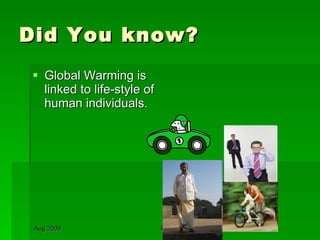
Did You know? Global Warming is linked to life-style of human individuals.
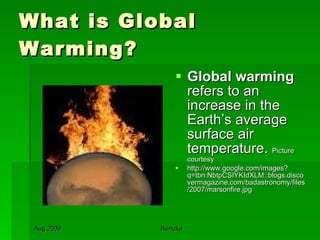
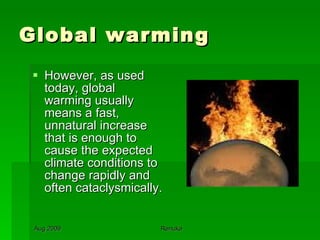
What is Global Warming? Global warming  refers to an increase in the Earth’s average surface air temperature.  Picture courtesy http://www.google.com/images?q=tbn:NbtpCSIYKIdXLM::blogs.discovermagazine.com/badastronomy/files/2007/marsonfire.jpg
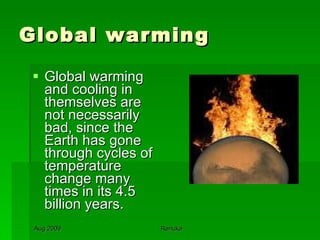
Global warming Global warming and cooling in themselves are not necessarily bad, since the Earth has gone through cycles of temperature change many times in its 4.5 billion years.
Global warming However, as used today, global warming usually means a fast, unnatural increase that is enough to cause the expected climate conditions to change rapidly and often cataclysmically.
Before we deal with this issue, first Let us see some facts about global warming Picture courtesy http://static.bigstockphoto.com/thumbs/0/1/3/large/3108251.jpg
When did Global Warming  start? Global warming, although only recently recognized as a major ecological issue, probably began near the end of the nineteenth century when carbon dioxide emissions from burning coal, gas, and oil were spewing into our atmosphere at  high rates.  Picture courtesy http://static.bigstockphoto.com/thumbs/1/6/1/large/1618324.jpg
Why does the globe warm? The carbon, which remains in the atmosphere for 100 years or more, traps more and more heat from the sun, creating a “greenhouse effect.” Subsequently, the earth’s temperatures rise, directly resulting in serious changes to our environment .
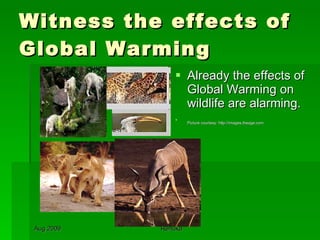
Witness the effects of Global Warming Already the effects of Global Warming on wildlife are alarming. Picture courtesy: http://images.theage.com
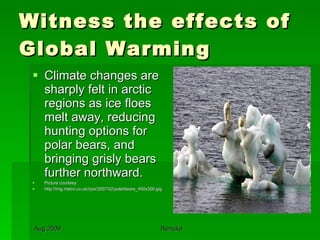
Witness the effects of Global Warming Climate changes are sharply felt in arctic regions as ice floes melt away, reducing hunting options for polar bears, and bringing grisly bears further northward.  Picture courtesy: http://img.metro.co.uk/i/pix/2007/02/polarbears_450x300.jpg
Witness the effects of Global Warming Creatures in all regions of the earth are affected as their habitats are altered by rising temperatures.   Picture courtesy: http://www.photographersdirect.com
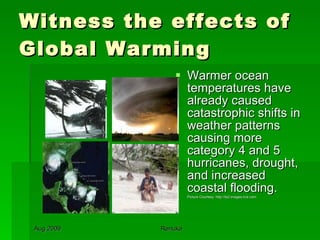
Witness the effects of Global Warming Warmer ocean temperatures have already caused catastrophic shifts in weather patterns causing more category 4 and 5 hurricanes, drought, and increased coastal flooding. Picture Courtesy: http://ts2.images.live.com
Sea Level Rise: Look at the Headlines ( Science Daily ) Sea Level Rise Of One Meter Within 100 Years  (Jan. 11, 2009) — New research indicates that the ocean could rise in the next 100 years to a meter higher than the current sea level -- which is three times higher than predictions from the UN's Intergovernmental ...  >  read more Carbon Dioxide Role In Past Climate Revealed  (Apr. 25, 2005) — Researchers at the British Antarctic Survey (BAS) and the University of California, Santa Cruz have discovered that Earth's last great global warming period, 3 million years ago, may have been caused ...  >  read more     Sea Level Rise Due To Global Warming Poses Threat To New York City  (Mar. 16, 2009) — Global warming is expected to cause the sea level along the northeastern US coast to rise almost twice as fast as global sea levels during this century, putting New York City at greater risk for ...  >  read more     Secrets Of The Deep May Hold Clue To Ancient Global Warming  (Feb. 26, 2006) — Global warming events 420 million years ago, comparable to those currently beginning to affect our planet, may have caused catastrophic environmental changes in an ancient ocean, threatening the life ...  >  read more NASA Study Finds World Warmth Edging Ancient Levels  (Sep. 26, 2006) — A new study by NASA climatologists finds that the world's temperature is reaching a level that has not been seen in thousands of ...  >  read more
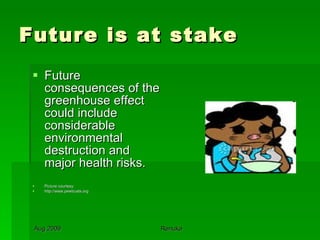
Future is at stake Future consequences of the greenhouse effect could include considerable environmental destruction and major health risks.  Picture courtesy: http://www.pewtrusts.org
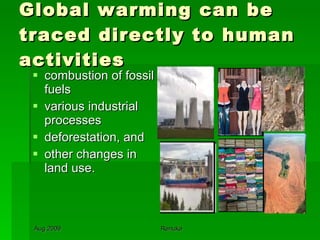
Global warming can be traced directly to human activities combustion of fossil fuels various industrial processes deforestation, and  other changes in land use.
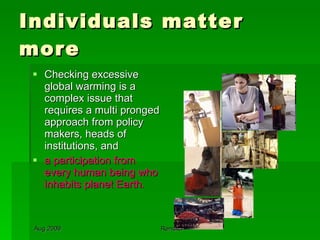
Individuals matter more Checking excessive global warming is a complex issue that requires a multi pronged approach from policy makers, heads of institutions, and  a participation from every human being who inhabits planet Earth.
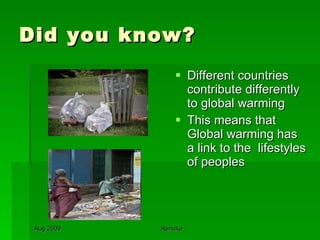
Did you know? Different countries contribute differently to global warming This means that Global warming has a link to the  lifestyles of peoples
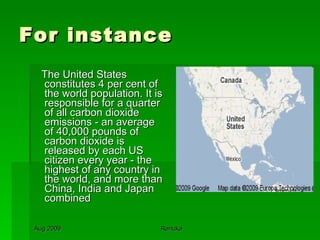
For instance The United States constitutes 4 per cent of the world population. It is responsible for a quarter of all carbon dioxide emissions - an average of 40,000 pounds of carbon dioxide is released by each US citizen every year - the highest of any country in the world, and more than China, India and Japan combined
Exploitation without inputs “ Man has been endowed with reason, with the power to create, so that he can add to what he's been given. But up to now he hasn't been a creator, only a destroyer. Forests keep disappearing, rivers dry up, wild life's become extinct, the climate's ruined and the land grows poorer and uglier every day.” [ Uncle Vanya , 1897]
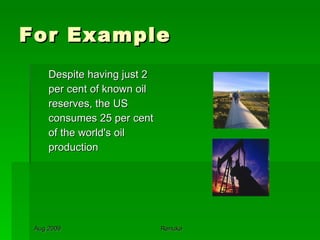
For Example Despite having just 2 per cent of known oil reserves, the US consumes 25 per cent of the world's oil production
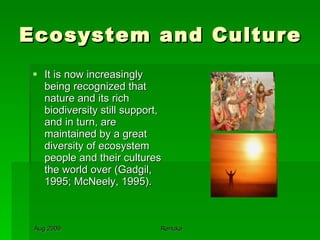
Ecosystem and Culture It is now increasingly being recognized that nature and its rich biodiversity still support, and in turn, are maintained by a great diversity of ecosystem people and their cultures the world over (Gadgil, 1995; McNeely, 1995).
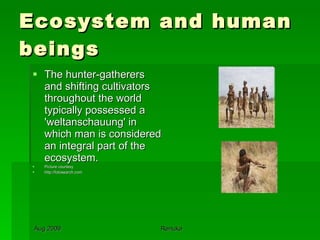
Ecosystem and human beings The hunter-gatherers and shifting cultivators throughout the world typically possessed a 'weltanschauung' in which man is considered an integral part of the ecosystem.  Picture courtesy http://fotosearch.com
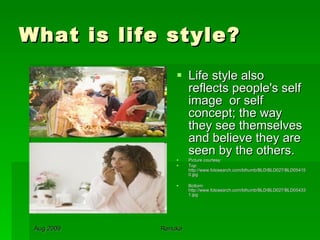
What is Life-Style? Way of living of individuals, families (households),  and societies, which they  manifest  in coping with their physical, psychological, social, and economic environments on a day-to-day basis. Lifestyle is expressed in both  work and leisure behavior patterns and (on an individual basis) in activities, attitudes, interests, opinions,  and allocation  of income.  Picture courtesy: http://www.fotosearch.com/bthumb/UNN/UNN821/u12014662.jpg
What is life style? Life style also reflects people's self image  or self concept; the way they see themselves and believe they are seen by the others. Picture courtesy: Top: http://www.fotosearch.com/bthumb/BLD/BLD027/BLD054150.jpg Bottom: http://www.fotosearch.com/bthumb/BLD/BLD027/BLD054331.jpg
Lifestyle is… Lifestyle is a composite of motivations, needs, and wants and is influenced by factors such as culture,, family, reference groups, and social class. Picture courtesy Top: http://www.fotosearch.com/bthumb/CSP/CSP017/k0175404.jpg Bottom: http://www.fotosearch.com/bthumb/UNE/UNE140/u16480073.jpg
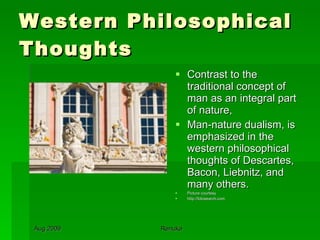
Western Philosophical Thoughts Contrast to the traditional concept of man as an integral part of nature,  Man-nature dualism, is emphasized in the western philosophical thoughts of Descartes, Bacon, Liebnitz, and many others.  Picture courtesy http://fotosearch.com
The East – West Contrast Many Western philosophers generally assume as a given that the individual is something distinct  from the entire universe, and  many Western philosophers  attempt to describe and categorize the universe from a detached, objective viewpoint. Many Eastern religions, on the other hand, typically hold that people are an intrinsic and inseparable part of the universe, and that attempts to discuss the universe from an objective viewpoint as though the individual speaking was something separate and detached from the whole are inherently absurd.  Picture courtesy http://www.fotosearch.com/bthumb/CSP/CSP116/k1160550.jpg
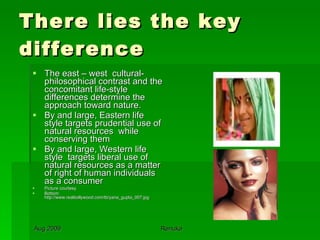
There lies the key difference The east – west  cultural-philosophical contrast and the concomitant life-style differences determine the approach toward nature. By and large, Eastern life style targets prudential use of natural resources  while conserving them By and large, Western life style  targets liberal use of natural resources as a matter of right of human individuals as a consumer Picture courtesy Bottom: http://www.realbollywood.com/tb/yana_gupta_007.jpg
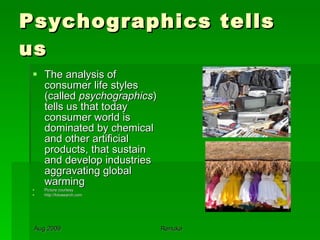
Psychographics tells us The analysis of consumer life styles (called  psychographics ) tells us that today consumer world is dominated by chemical and other artificial products, that sustain and develop industries aggravating global warming  Picture courtesy http://fotosearch.com
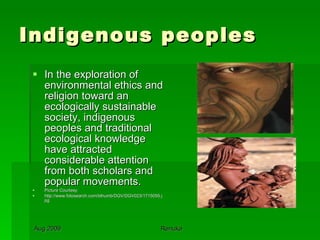
Indigenous peoples In the exploration of environmental ethics and religion toward an ecologically sustainable society, indigenous peoples and traditional ecological knowledge have attracted considerable attention from both scholars and popular movements.  Picture Courtesy: http://www.fotosearch.com/bthumb/DGV/DGV023/1715055.jpg
Indigenous Societies The 'organic cosmology' of the indigenous societies shaped an ecological ethic that stresses the importance of  saving the planet earth. Picture courtesy http://fotosearch.com
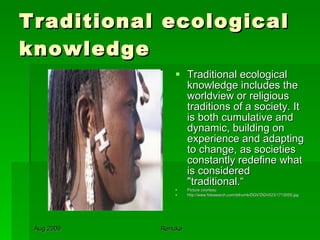
Traditional ecological knowledge Traditional ecological knowledge includes the worldview or religious traditions of a society. It is both cumulative and dynamic, building on experience and adapting to change, as societies constantly redefine what is considered "traditional.“ Picture courtesy: http://www.fotosearch.com/bthumb/DGV/DGV023/1715055.jpg
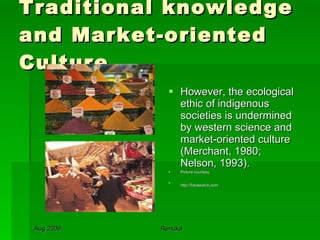
Traditional knowledge and Market-oriented Culture However, the ecological ethic of indigenous societies is undermined by western science and market-oriented culture (Merchant, 1980; Nelson, 1993). Picture courtesy http://fotosearch.com
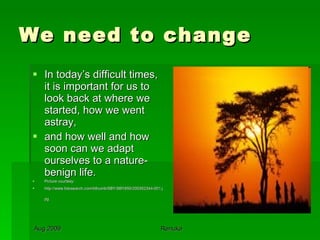
We need to change  In today’s difficult times, it is important for us to look back at where we started, how we went astray, and how well and how soon can we adapt  ourselves to a nature-benign life. Picture courtesy: http://www.fotosearch.com/bthumb/SBY/SBY850/200352344-001.jpg
Indigenous Cultures Nevertheless, those indigenous cultures that are still surviving retain their traditional ecological ethic, which now seems to have profound conservation implications (Gadgil and Guha, 1992).  Picture courtesy http://fotosearch.com
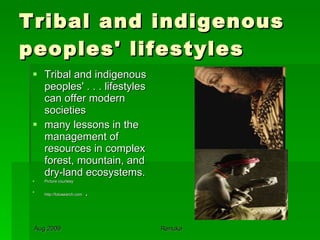
Tribal and indigenous peoples' lifestyles Tribal and indigenous peoples' . . . lifestyles can offer modern societies  many lessons in the management of resources in complex forest, mountain, and dry-land ecosystems. Picture courtesy http://fotosearch.com  .
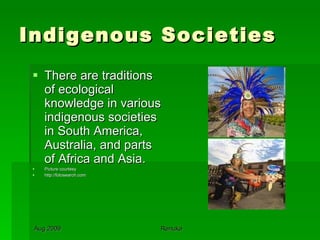
Indigenous Societies There are traditions of ecological knowledge in various indigenous societies in South America, Australia, and parts of Africa and Asia.  Picture courtesy http://fotosearch.com
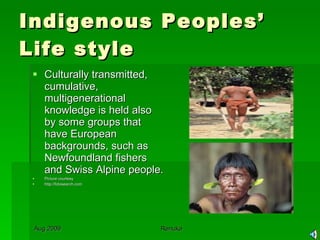
Indigenous Peoples’ Life style Culturally transmitted, cumulative, multigenerational knowledge is held also by some groups that have European backgrounds, such as Newfoundland fishers and Swiss Alpine people.  Picture courtesy http://fotosearch.com
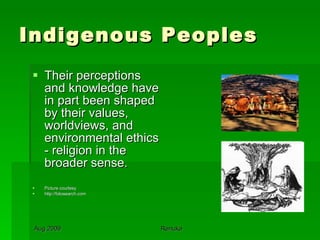
Indigenous Peoples Their perceptions and knowledge have in part been shaped by their values, worldviews, and environmental ethics - religion in the broader sense.  Picture courtesy http://fotosearch.com
Indigenous Mechanisms of Conservation of Environmental Health Establishment and maintenance of sacred groves. Tree worship Plant worship Animal worship Taboos in the harvesting and consumption of plants  Taboos in the hunting and consumption of  animals Rejection of  use of food and other materials of foreign origin in customs and rituals Environmental ethics in folklores and rituals
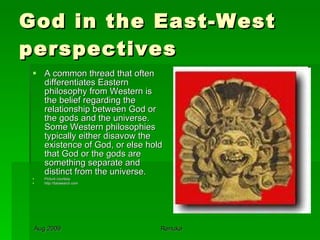
God in the East-West perspectives A common thread that often differentiates Eastern philosophy from Western is the belief regarding the relationship between God or the gods and the universe. Some Western philosophies typically either disavow the existence of God, or else hold that God or the gods are something separate and distinct from the universe.  Picture courtesy http://fotosearch.com
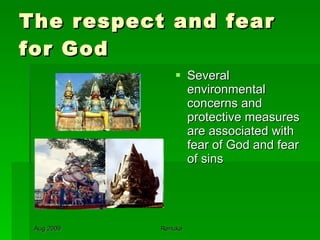
The respect and fear for God Several environmental concerns and protective measures are associated with fear of God and fear of sins
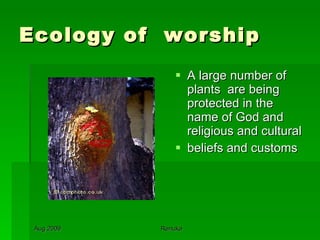
Ecology of  worship A large number of plants  are being  protected in the name of God and religious and cultural beliefs and customs
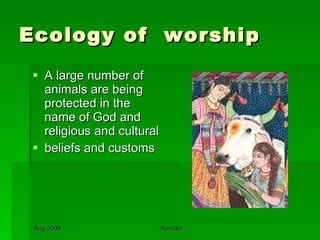
Ecology of  worship A large number of animals are being  protected in the name of God and religious and cultural beliefs and customs
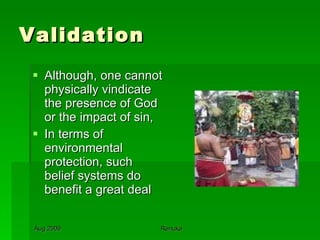
Validation Although, one cannot physically vindicate the presence of God or the impact of sin,  In terms of environmental protection, such belief systems do benefit a great deal
Example: Eating in Banana Leaves There are several benign practices in vogue even today. Let us all recognize them, document them, and cherish them
For Example: Clay Vessels instead of Plastic; native medicines instead of chemical-based pharmaceuticals
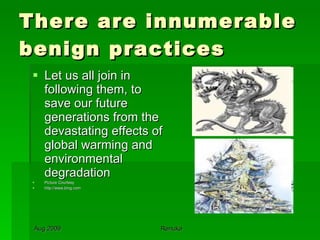
There are innumerable benign practices Let us all join in  following them, to save our future generations from the devastating effects of global warming and environmental degradation Picture Courtesy http://www.bing.com
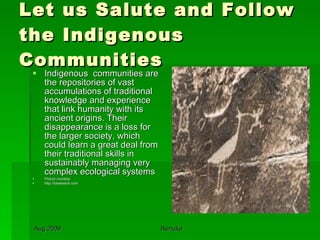
Let us Salute and Follow the Indigenous Communities Indigenous  communities are the repositories of vast accumulations of traditional knowledge and experience that link humanity with its ancient origins. Their disappearance is a loss for the larger society, which could learn a great deal from their traditional skills in sustainably managing very complex ecological systems  Picture courtesy http://fotosearch.com
References Gadgil, M. 1995. Prudence and profligacy: a human ecological perspective. In:  The Economics and Ecology of Biodiversity.  Decline (Ed. T.M. Swanson), pp. 99-110. Cambridge University Press, Cambridge. Gadgil, M. and Guha, R. 1992.  This Fissured Land . Oxford University Press. Delhi.  Merchant, C. 1980.  The Death of the Nature: Women, Ecology and the Scientific Revolution . Harper and Row, New York. Nelson, R. 1993. Searching for the lost arrow: physical and spiritual ecology in the hunter's world. In:  The Biophilia Hypothesis.  (Eds. S.R. Killert and E.O. Wilson), pp. 201-228.  Island Press, Washington, D.C.  Uncle Vanya , 1897   United Nations World  Commission on Environment and Development m Our Common Future  1987: 12,114-15

Global Warming

  • 1.
    Life Style andGlobal Warming Dr. Renuka Rajasekaran
  • 2.
    Did You know?Global Warming is linked to life-style of human individuals.
  • 3.
    What is GlobalWarming? Global warming refers to an increase in the Earth’s average surface air temperature. Picture courtesy http://www.google.com/images?q=tbn:NbtpCSIYKIdXLM::blogs.discovermagazine.com/badastronomy/files/2007/marsonfire.jpg
  • 4.
    Global warming Globalwarming and cooling in themselves are not necessarily bad, since the Earth has gone through cycles of temperature change many times in its 4.5 billion years.
  • 5.
    Global warming However,as used today, global warming usually means a fast, unnatural increase that is enough to cause the expected climate conditions to change rapidly and often cataclysmically.
  • 6.
    Before we dealwith this issue, first Let us see some facts about global warming Picture courtesy http://static.bigstockphoto.com/thumbs/0/1/3/large/3108251.jpg
  • 7.
    When did GlobalWarming start? Global warming, although only recently recognized as a major ecological issue, probably began near the end of the nineteenth century when carbon dioxide emissions from burning coal, gas, and oil were spewing into our atmosphere at high rates. Picture courtesy http://static.bigstockphoto.com/thumbs/1/6/1/large/1618324.jpg
  • 8.
    Why does theglobe warm? The carbon, which remains in the atmosphere for 100 years or more, traps more and more heat from the sun, creating a “greenhouse effect.” Subsequently, the earth’s temperatures rise, directly resulting in serious changes to our environment .
  • 9.
    Witness the effectsof Global Warming Already the effects of Global Warming on wildlife are alarming. Picture courtesy: http://images.theage.com
  • 10.
    Witness the effectsof Global Warming Climate changes are sharply felt in arctic regions as ice floes melt away, reducing hunting options for polar bears, and bringing grisly bears further northward. Picture courtesy: http://img.metro.co.uk/i/pix/2007/02/polarbears_450x300.jpg
  • 11.
    Witness the effectsof Global Warming Creatures in all regions of the earth are affected as their habitats are altered by rising temperatures.  Picture courtesy: http://www.photographersdirect.com
  • 12.
    Witness the effectsof Global Warming Warmer ocean temperatures have already caused catastrophic shifts in weather patterns causing more category 4 and 5 hurricanes, drought, and increased coastal flooding. Picture Courtesy: http://ts2.images.live.com
  • 13.
    Sea Level Rise:Look at the Headlines ( Science Daily ) Sea Level Rise Of One Meter Within 100 Years (Jan. 11, 2009) — New research indicates that the ocean could rise in the next 100 years to a meter higher than the current sea level -- which is three times higher than predictions from the UN's Intergovernmental ...  >  read more Carbon Dioxide Role In Past Climate Revealed (Apr. 25, 2005) — Researchers at the British Antarctic Survey (BAS) and the University of California, Santa Cruz have discovered that Earth's last great global warming period, 3 million years ago, may have been caused ...  >  read more Sea Level Rise Due To Global Warming Poses Threat To New York City (Mar. 16, 2009) — Global warming is expected to cause the sea level along the northeastern US coast to rise almost twice as fast as global sea levels during this century, putting New York City at greater risk for ...  >  read more Secrets Of The Deep May Hold Clue To Ancient Global Warming (Feb. 26, 2006) — Global warming events 420 million years ago, comparable to those currently beginning to affect our planet, may have caused catastrophic environmental changes in an ancient ocean, threatening the life ...  >  read more NASA Study Finds World Warmth Edging Ancient Levels (Sep. 26, 2006) — A new study by NASA climatologists finds that the world's temperature is reaching a level that has not been seen in thousands of ...  >  read more
  • 14.
    Future is atstake Future consequences of the greenhouse effect could include considerable environmental destruction and major health risks.  Picture courtesy: http://www.pewtrusts.org
  • 15.
    Global warming canbe traced directly to human activities combustion of fossil fuels various industrial processes deforestation, and other changes in land use.
  • 16.
    Individuals matter moreChecking excessive global warming is a complex issue that requires a multi pronged approach from policy makers, heads of institutions, and a participation from every human being who inhabits planet Earth.
  • 17.
    Did you know?Different countries contribute differently to global warming This means that Global warming has a link to the lifestyles of peoples
  • 18.
    For instance TheUnited States constitutes 4 per cent of the world population. It is responsible for a quarter of all carbon dioxide emissions - an average of 40,000 pounds of carbon dioxide is released by each US citizen every year - the highest of any country in the world, and more than China, India and Japan combined
  • 19.
    Exploitation without inputs“ Man has been endowed with reason, with the power to create, so that he can add to what he's been given. But up to now he hasn't been a creator, only a destroyer. Forests keep disappearing, rivers dry up, wild life's become extinct, the climate's ruined and the land grows poorer and uglier every day.” [ Uncle Vanya , 1897]
  • 20.
    For Example Despitehaving just 2 per cent of known oil reserves, the US consumes 25 per cent of the world's oil production
  • 21.
    Ecosystem and CultureIt is now increasingly being recognized that nature and its rich biodiversity still support, and in turn, are maintained by a great diversity of ecosystem people and their cultures the world over (Gadgil, 1995; McNeely, 1995).
  • 22.
    Ecosystem and humanbeings The hunter-gatherers and shifting cultivators throughout the world typically possessed a 'weltanschauung' in which man is considered an integral part of the ecosystem. Picture courtesy http://fotosearch.com
  • 23.
    What is Life-Style?Way of living of individuals, families (households), and societies, which they manifest in coping with their physical, psychological, social, and economic environments on a day-to-day basis. Lifestyle is expressed in both work and leisure behavior patterns and (on an individual basis) in activities, attitudes, interests, opinions, and allocation of income. Picture courtesy: http://www.fotosearch.com/bthumb/UNN/UNN821/u12014662.jpg
  • 24.
    What is lifestyle? Life style also reflects people's self image or self concept; the way they see themselves and believe they are seen by the others. Picture courtesy: Top: http://www.fotosearch.com/bthumb/BLD/BLD027/BLD054150.jpg Bottom: http://www.fotosearch.com/bthumb/BLD/BLD027/BLD054331.jpg
  • 25.
    Lifestyle is… Lifestyleis a composite of motivations, needs, and wants and is influenced by factors such as culture,, family, reference groups, and social class. Picture courtesy Top: http://www.fotosearch.com/bthumb/CSP/CSP017/k0175404.jpg Bottom: http://www.fotosearch.com/bthumb/UNE/UNE140/u16480073.jpg
  • 26.
    Western Philosophical ThoughtsContrast to the traditional concept of man as an integral part of nature, Man-nature dualism, is emphasized in the western philosophical thoughts of Descartes, Bacon, Liebnitz, and many others. Picture courtesy http://fotosearch.com
  • 27.
    The East –West Contrast Many Western philosophers generally assume as a given that the individual is something distinct from the entire universe, and many Western philosophers attempt to describe and categorize the universe from a detached, objective viewpoint. Many Eastern religions, on the other hand, typically hold that people are an intrinsic and inseparable part of the universe, and that attempts to discuss the universe from an objective viewpoint as though the individual speaking was something separate and detached from the whole are inherently absurd. Picture courtesy http://www.fotosearch.com/bthumb/CSP/CSP116/k1160550.jpg
  • 28.
    There lies thekey difference The east – west cultural-philosophical contrast and the concomitant life-style differences determine the approach toward nature. By and large, Eastern life style targets prudential use of natural resources while conserving them By and large, Western life style targets liberal use of natural resources as a matter of right of human individuals as a consumer Picture courtesy Bottom: http://www.realbollywood.com/tb/yana_gupta_007.jpg
  • 29.
    Psychographics tells usThe analysis of consumer life styles (called psychographics ) tells us that today consumer world is dominated by chemical and other artificial products, that sustain and develop industries aggravating global warming Picture courtesy http://fotosearch.com
  • 30.
    Indigenous peoples Inthe exploration of environmental ethics and religion toward an ecologically sustainable society, indigenous peoples and traditional ecological knowledge have attracted considerable attention from both scholars and popular movements. Picture Courtesy: http://www.fotosearch.com/bthumb/DGV/DGV023/1715055.jpg
  • 31.
    Indigenous Societies The'organic cosmology' of the indigenous societies shaped an ecological ethic that stresses the importance of saving the planet earth. Picture courtesy http://fotosearch.com
  • 32.
    Traditional ecological knowledgeTraditional ecological knowledge includes the worldview or religious traditions of a society. It is both cumulative and dynamic, building on experience and adapting to change, as societies constantly redefine what is considered "traditional.“ Picture courtesy: http://www.fotosearch.com/bthumb/DGV/DGV023/1715055.jpg
  • 33.
    Traditional knowledge andMarket-oriented Culture However, the ecological ethic of indigenous societies is undermined by western science and market-oriented culture (Merchant, 1980; Nelson, 1993). Picture courtesy http://fotosearch.com
  • 34.
    We need tochange In today’s difficult times, it is important for us to look back at where we started, how we went astray, and how well and how soon can we adapt ourselves to a nature-benign life. Picture courtesy: http://www.fotosearch.com/bthumb/SBY/SBY850/200352344-001.jpg
  • 35.
    Indigenous Cultures Nevertheless,those indigenous cultures that are still surviving retain their traditional ecological ethic, which now seems to have profound conservation implications (Gadgil and Guha, 1992). Picture courtesy http://fotosearch.com
  • 36.
    Tribal and indigenouspeoples' lifestyles Tribal and indigenous peoples' . . . lifestyles can offer modern societies many lessons in the management of resources in complex forest, mountain, and dry-land ecosystems. Picture courtesy http://fotosearch.com .
  • 37.
    Indigenous Societies Thereare traditions of ecological knowledge in various indigenous societies in South America, Australia, and parts of Africa and Asia. Picture courtesy http://fotosearch.com
  • 38.
    Indigenous Peoples’ Lifestyle Culturally transmitted, cumulative, multigenerational knowledge is held also by some groups that have European backgrounds, such as Newfoundland fishers and Swiss Alpine people. Picture courtesy http://fotosearch.com
  • 39.
    Indigenous Peoples Theirperceptions and knowledge have in part been shaped by their values, worldviews, and environmental ethics - religion in the broader sense. Picture courtesy http://fotosearch.com
  • 40.
    Indigenous Mechanisms ofConservation of Environmental Health Establishment and maintenance of sacred groves. Tree worship Plant worship Animal worship Taboos in the harvesting and consumption of plants Taboos in the hunting and consumption of animals Rejection of use of food and other materials of foreign origin in customs and rituals Environmental ethics in folklores and rituals
  • 41.
    God in theEast-West perspectives A common thread that often differentiates Eastern philosophy from Western is the belief regarding the relationship between God or the gods and the universe. Some Western philosophies typically either disavow the existence of God, or else hold that God or the gods are something separate and distinct from the universe. Picture courtesy http://fotosearch.com
  • 42.
    The respect andfear for God Several environmental concerns and protective measures are associated with fear of God and fear of sins
  • 43.
    Ecology of worship A large number of plants are being protected in the name of God and religious and cultural beliefs and customs
  • 44.
    Ecology of worship A large number of animals are being protected in the name of God and religious and cultural beliefs and customs
  • 45.
    Validation Although, onecannot physically vindicate the presence of God or the impact of sin, In terms of environmental protection, such belief systems do benefit a great deal
  • 46.
    Example: Eating inBanana Leaves There are several benign practices in vogue even today. Let us all recognize them, document them, and cherish them
  • 47.
    For Example: ClayVessels instead of Plastic; native medicines instead of chemical-based pharmaceuticals
  • 48.
    There are innumerablebenign practices Let us all join in following them, to save our future generations from the devastating effects of global warming and environmental degradation Picture Courtesy http://www.bing.com
  • 49.
    Let us Saluteand Follow the Indigenous Communities Indigenous communities are the repositories of vast accumulations of traditional knowledge and experience that link humanity with its ancient origins. Their disappearance is a loss for the larger society, which could learn a great deal from their traditional skills in sustainably managing very complex ecological systems Picture courtesy http://fotosearch.com
  • 50.
    References Gadgil, M.1995. Prudence and profligacy: a human ecological perspective. In: The Economics and Ecology of Biodiversity. Decline (Ed. T.M. Swanson), pp. 99-110. Cambridge University Press, Cambridge. Gadgil, M. and Guha, R. 1992. This Fissured Land . Oxford University Press. Delhi. Merchant, C. 1980. The Death of the Nature: Women, Ecology and the Scientific Revolution . Harper and Row, New York. Nelson, R. 1993. Searching for the lost arrow: physical and spiritual ecology in the hunter's world. In: The Biophilia Hypothesis. (Eds. S.R. Killert and E.O. Wilson), pp. 201-228. Island Press, Washington, D.C. Uncle Vanya , 1897 United Nations World Commission on Environment and Development m Our Common Future 1987: 12,114-15