© Copyright 2016 HP, Inc.
A RELATIONAL APPROACH TO COLOR
Peter Morovič
HP Inc.
24th Color & Imaging Conference
San Diego (CA), November 2016
[Redacted]
© Copyright 2016 HP, Inc.
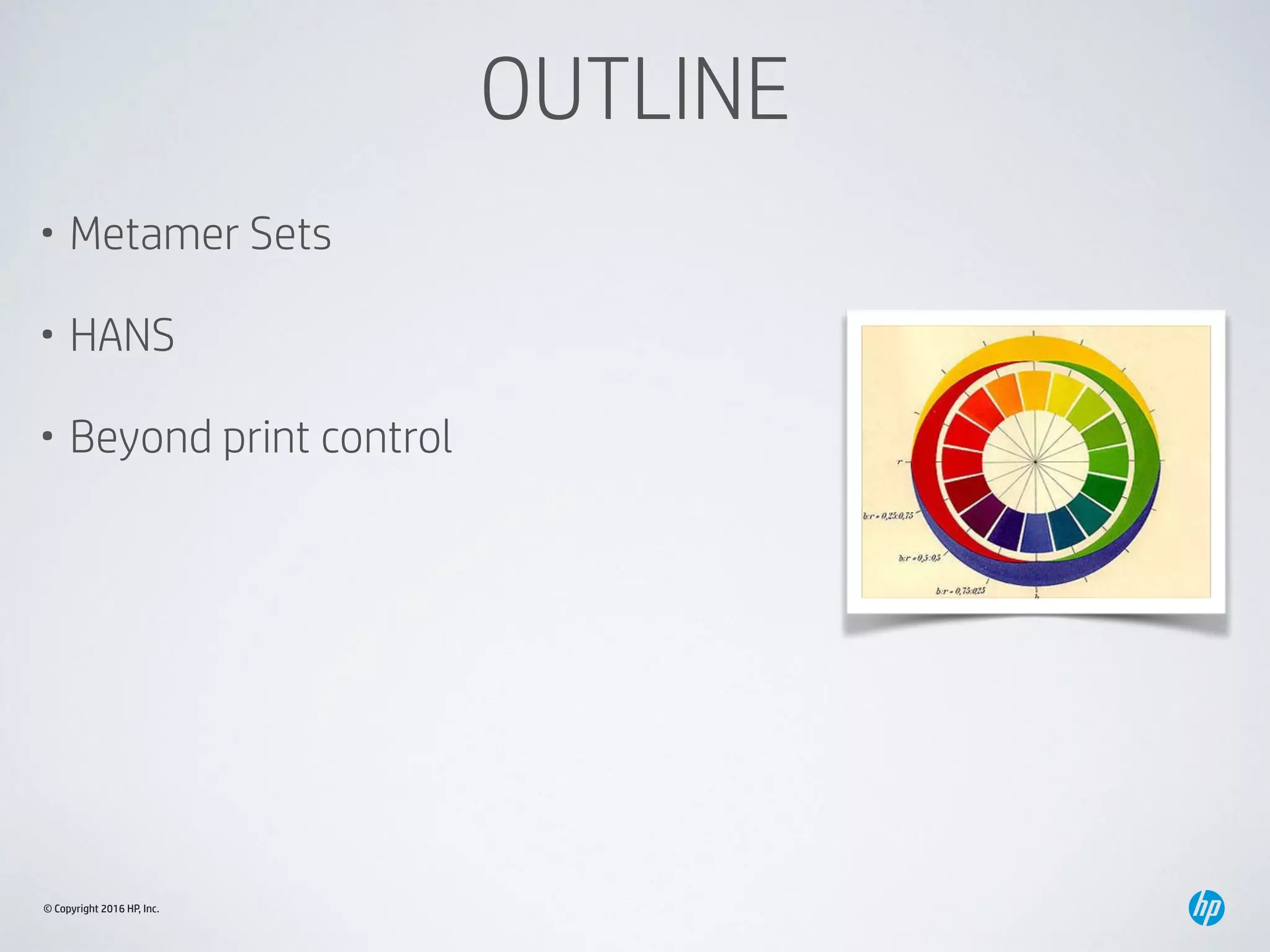
OUTLINE
• Metamer Sets
• HANS
• Beyond print control
© Copyright 2016 HP, Inc.
METAMER SETS
© Copyright 2016 HP, Inc.
COLOR FORMATION (RETINAL)
• Color is the result of the
relationship between light,
(a surface) and an observer

[necessary conditions for
color perception]
• Arbitrary* changes in any one
of the components results in
a change of the resulting XYZ
• However, possible to find S/
E/Xi so that XYZ doesn’t
change: metamerism
E(λ)
S(λ)
Xi(λ)
∫E(λ) S(λ) X1(λ) dλ = X1
∫E(λ) S(λ) X2(λ) dλ = X2
∫E(λ) S(λ) X3(λ) dλ = X3
© Copyright 2016 HP, Inc.
METAMERISM
5
Human Observer

under daylight
All reflectances that match:
Different observer,
camera or light
[...and vice versa]
XYZ
© Copyright 2016 HP, Inc.
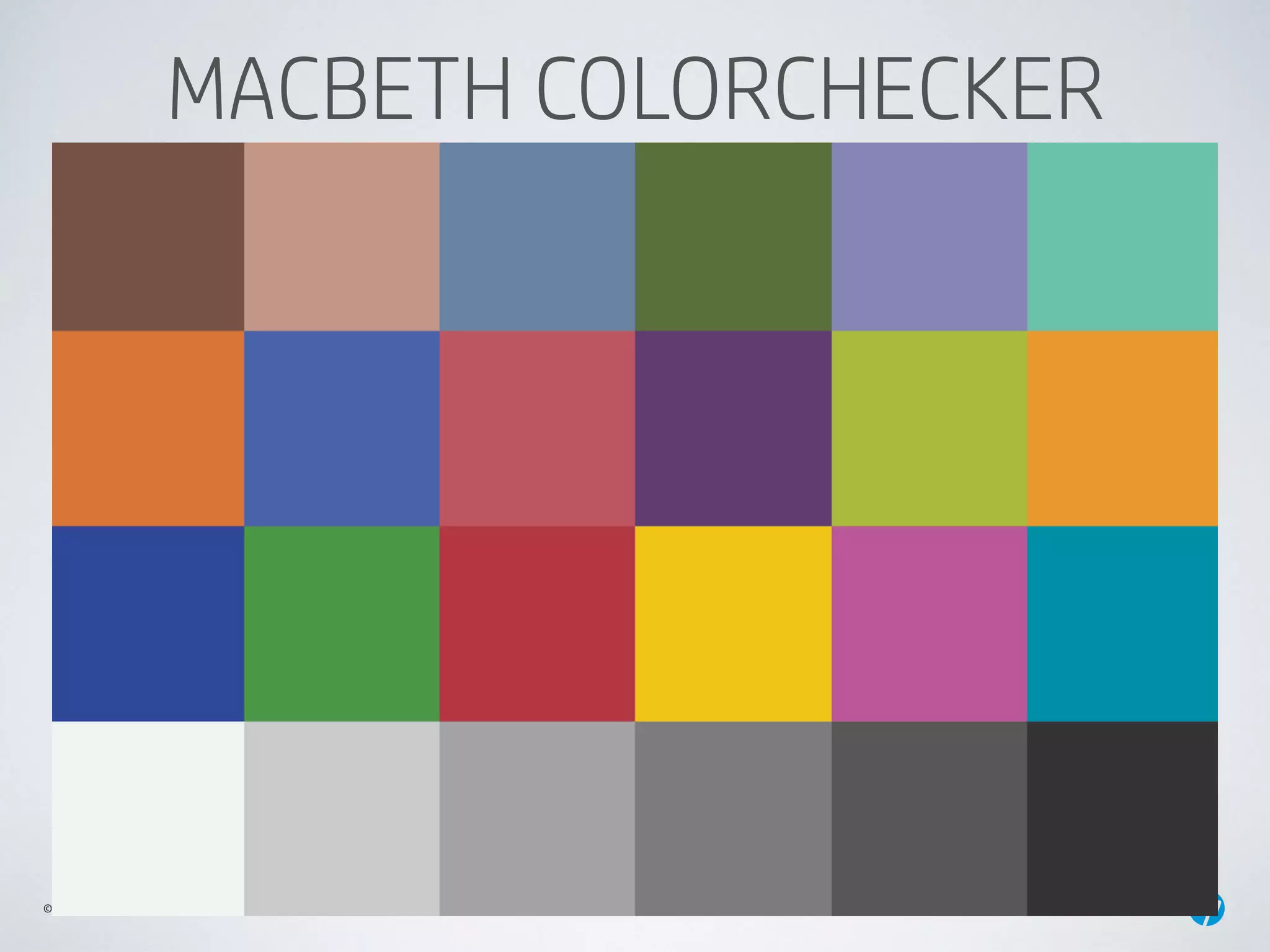
MACBETH COLORCHECKER
© Copyright 2016 HP, Inc.
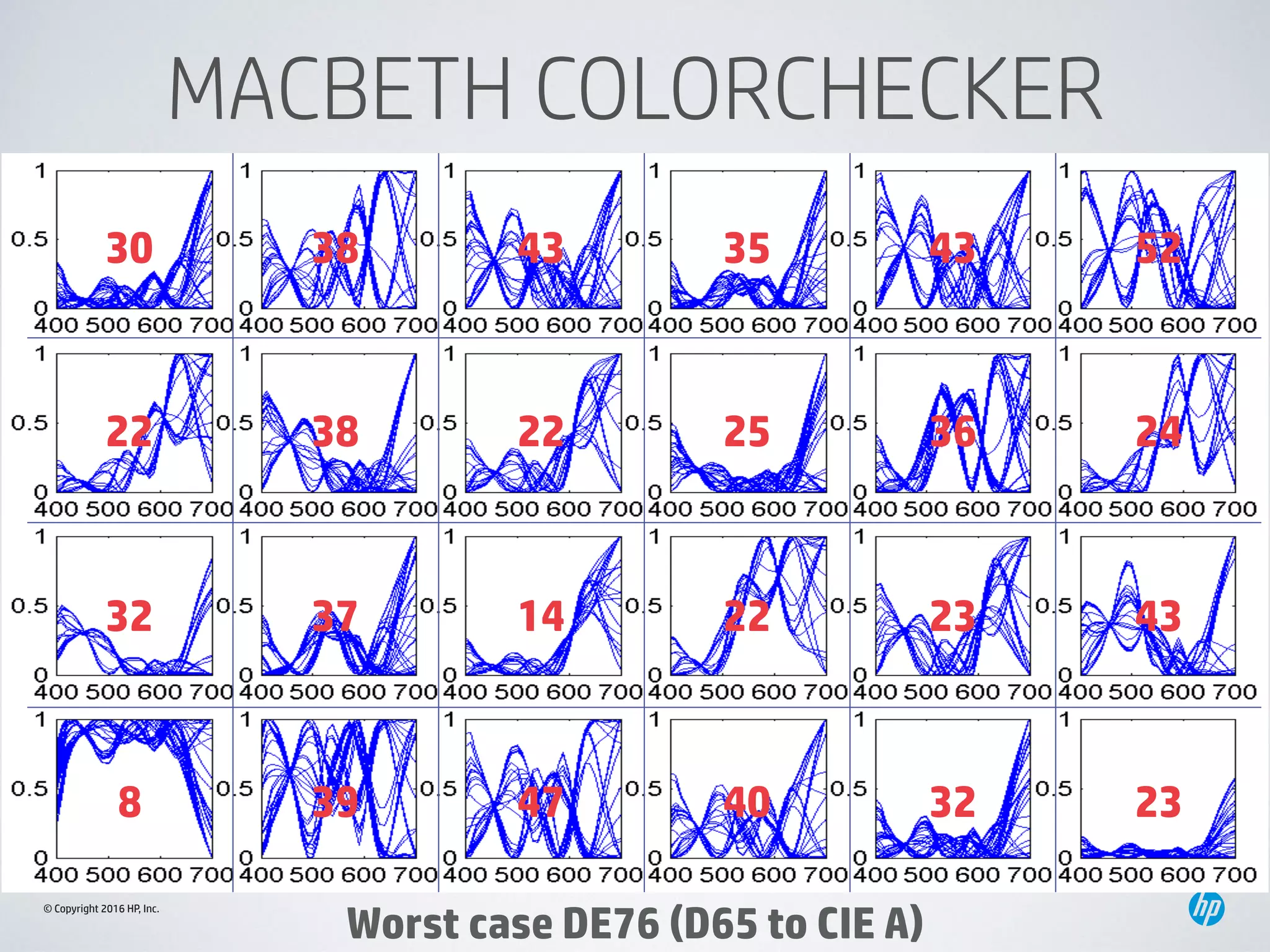
MACBETH COLORCHECKER
30 38 43 35 43 52
22 38 22 25 36 24
32 37 14 22 23 43
8 39 47 40 32 23
Worst case DE76 (D65 to CIE A)
© Copyright 2016 HP, Inc.
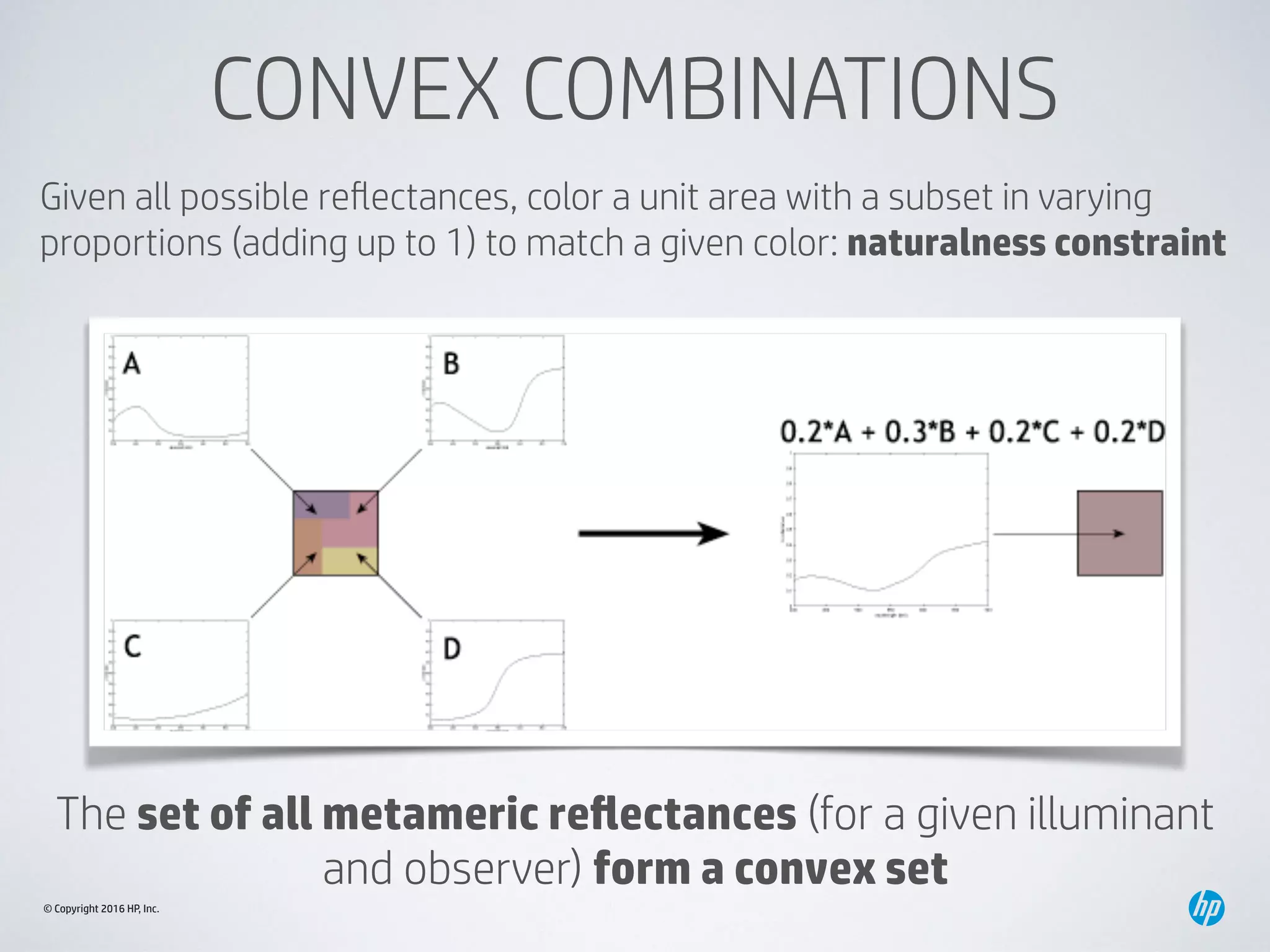
CONVEX COMBINATIONS
Given all possible reflectances, color a unit area with a subset in varying
proportions (adding up to 1) to match a given color: naturalness constraint
The set of all metameric reflectances (for a given illuminant
and observer) form a convex set
© Copyright 2016 HP, Inc.
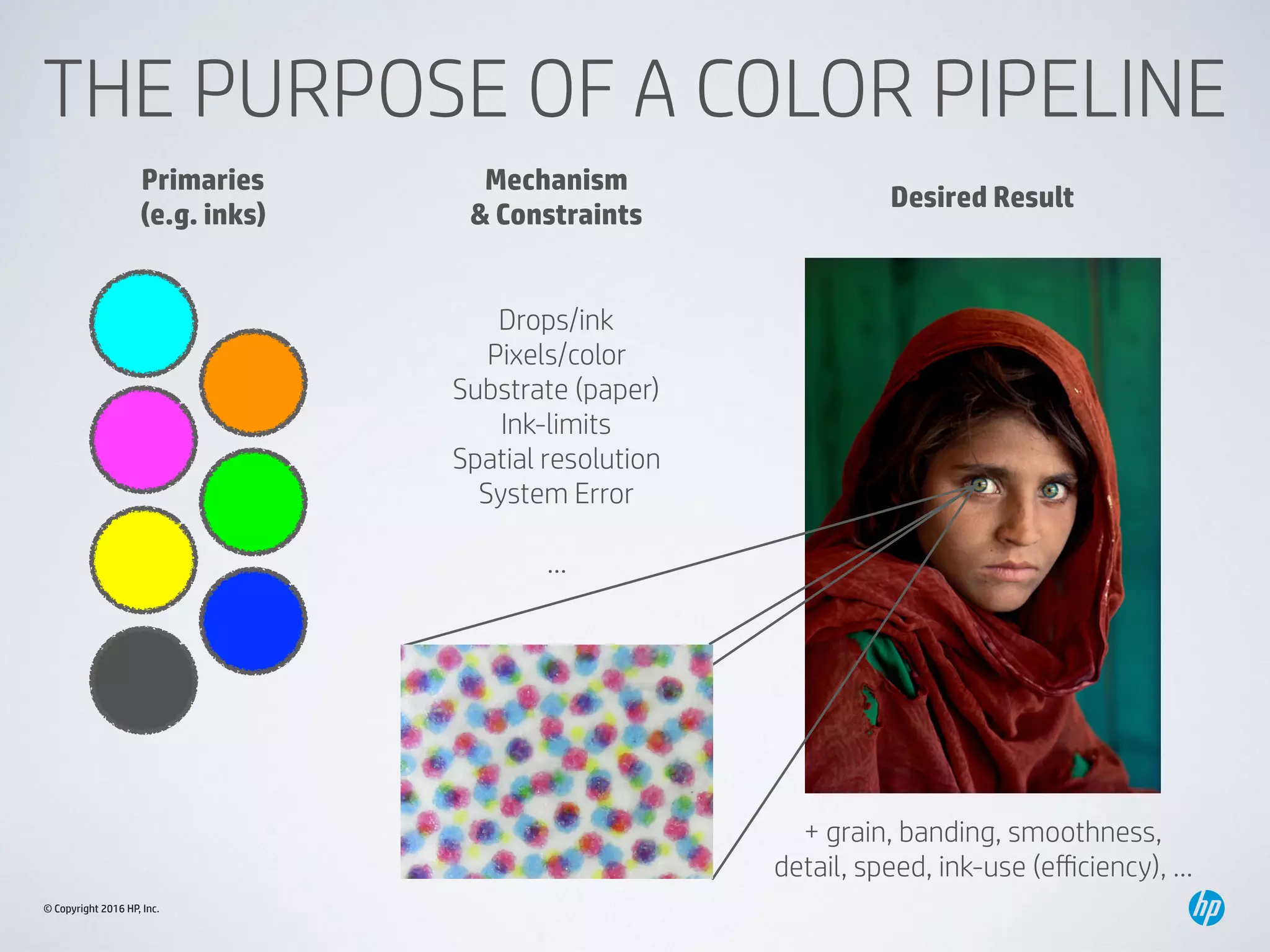
THE PURPOSE OF A COLOR PIPELINE
Primaries
(e.g. inks)
Mechanism
& Constraints
Drops/ink
Pixels/color
Substrate (paper)
Ink-limits
Spatial resolution
System Error
…
Desired Result
+ grain, banding, smoothness,

detail, speed, ink-use (efficiency), …
© Copyright 2016 HP, Inc.
HANS
Side view
Subtractive
Additive
Halftone Area Neugebauer Separation
Side view
Colorants
Substrate
Appearance
W
C M Y
Neugebauer primaries
Materials
Example halftone
C M Y CMY
+ + =
NP areas
W=1/9
C=1/9
M=2/9
CM=2/9
CY=1/9
MY=1/9
CMY=1/9Colorant vector
[C,M,Y]=[5/9, 6/9,3/9]
© Copyright 2016 HP, Inc.
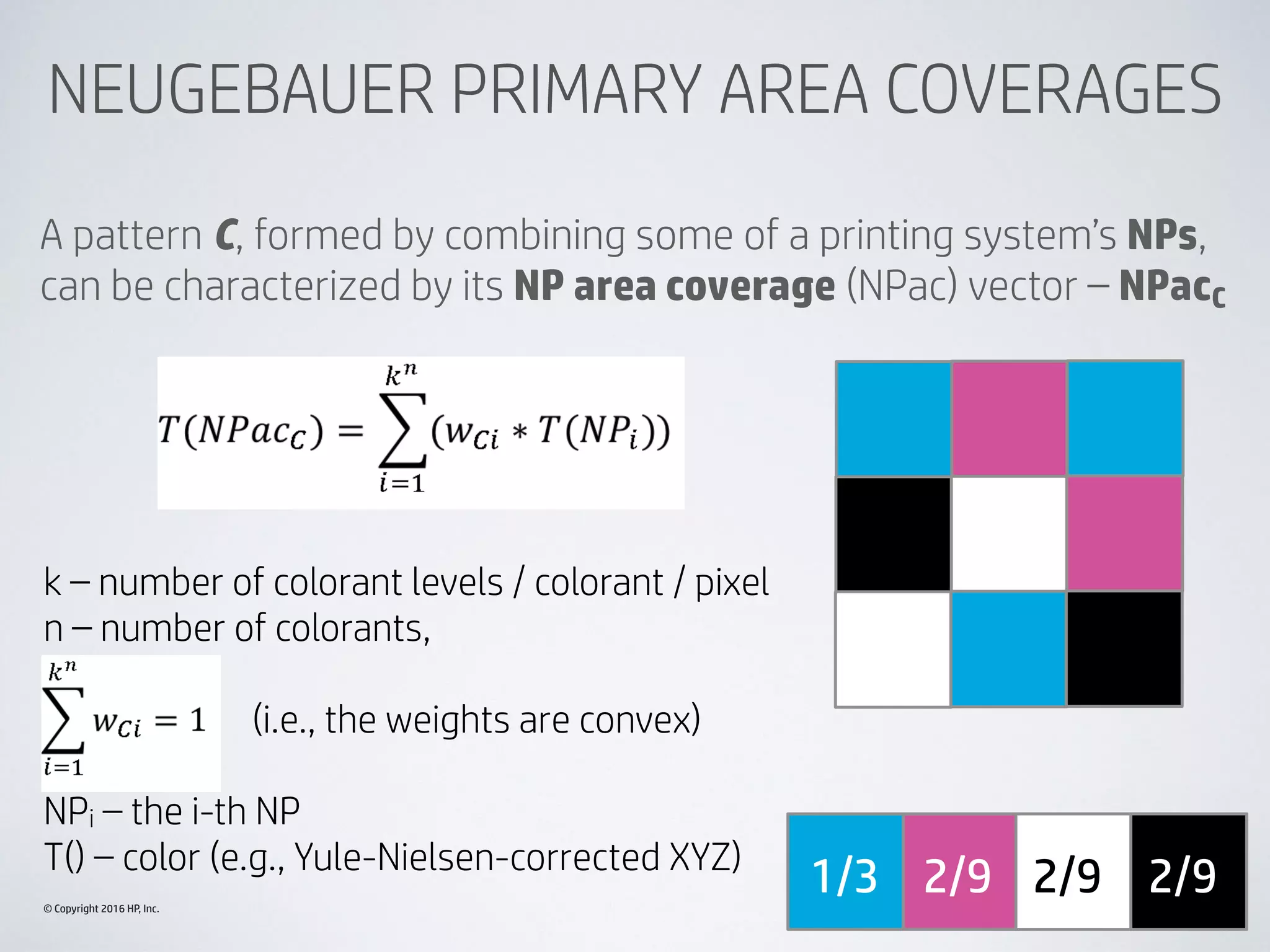
NEUGEBAUER PRIMARY AREA COVERAGES
A pattern C, formed by combining some of a printing system’s NPs,
can be characterized by its NP area coverage (NPac) vector – NPacC
1/3! 2/9! 2/9! 2/9!
k – number of colorant levels / colorant / pixel
n – number of colorants,
(i.e., the weights are convex)
NPi – the i-th NP
T() – color (e.g., Yule-Nielsen-corrected XYZ)
© Copyright 2016 HP, Inc.
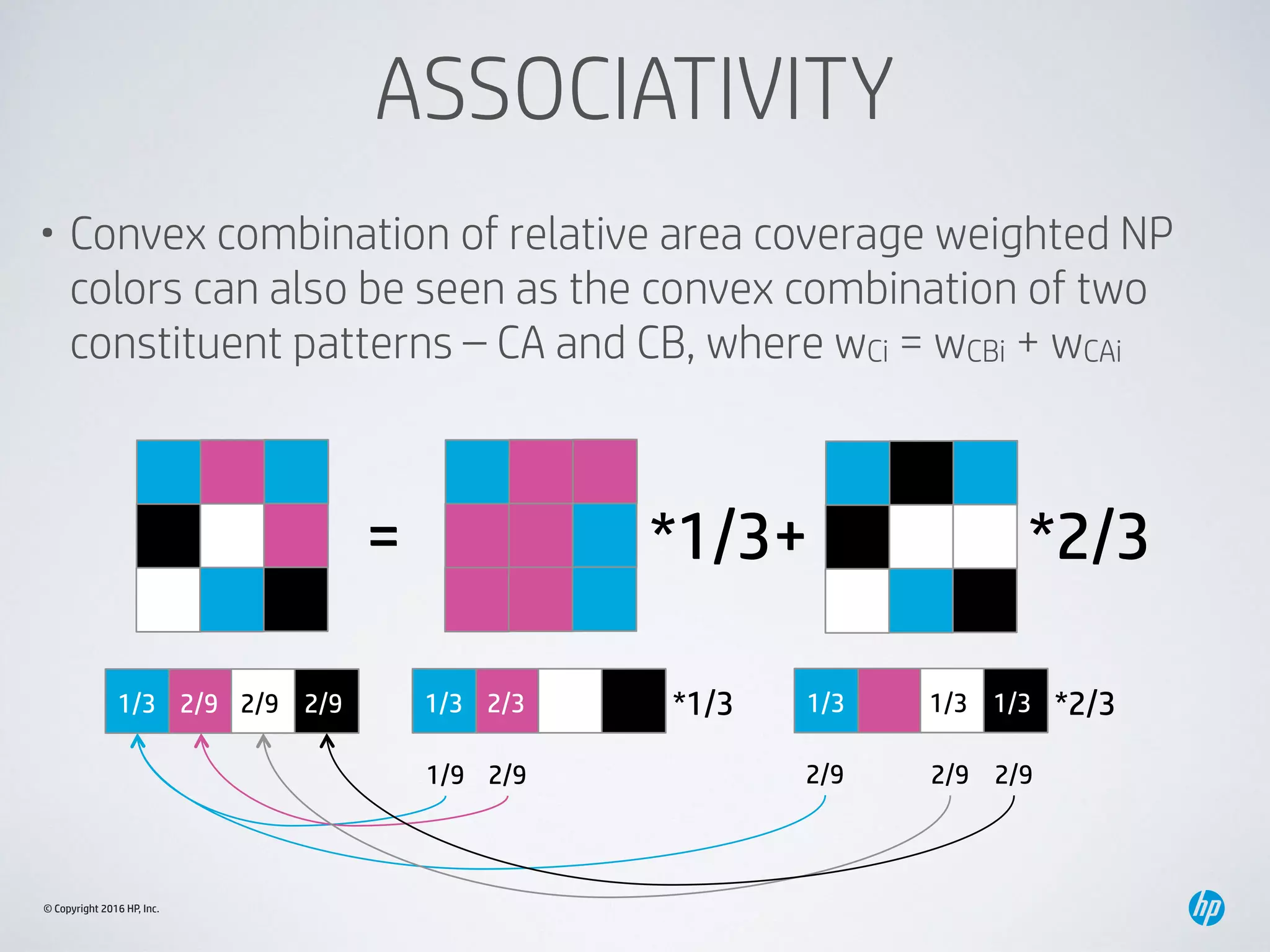
ASSOCIATIVITY
• Convex combination of relative area coverage weighted NP
colors can also be seen as the convex combination of two
constituent patterns – CA and CB, where wCi = wCBi + wCAi
=! *1/3+! *2/3!
1/3! 2/9! 2/9! 2/9! 1/3! 2/3! 1/3! 1/3! 1/3!
1/9! 2/9! 2/9! 2/9!2/9!
*1/3! *2/3!
© Copyright 2016 HP, Inc.
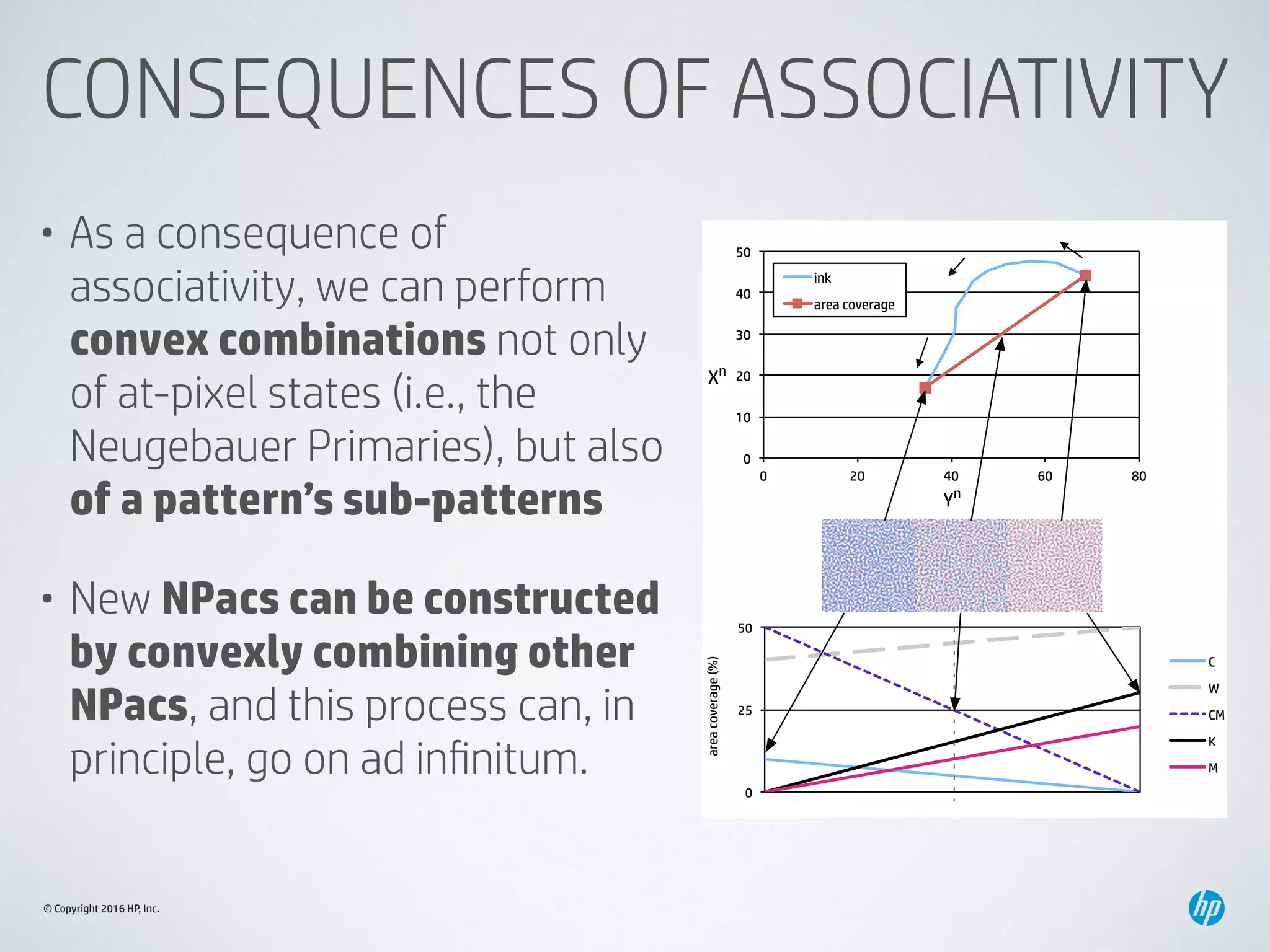
CONSEQUENCES OF ASSOCIATIVITY
• As a consequence of
associativity, we can perform
convex combinations not only
of at-pixel states (i.e., the
Neugebauer Primaries), but also
of a pattern’s sub-patterns
• New NPacs can be constructed
by convexly combining other
NPacs, and this process can, in
principle, go on ad infinitum.
0!
10!
20!
30!
40!
50!
0! 20! 40! 60! 80!
lightness!
chroma!
ink!
area coverage!
Yn
0!
25!
50!
areacoverage(%)!
C!
W!
CM!
K!
M!
Xn
© Copyright 2016 HP, Inc.
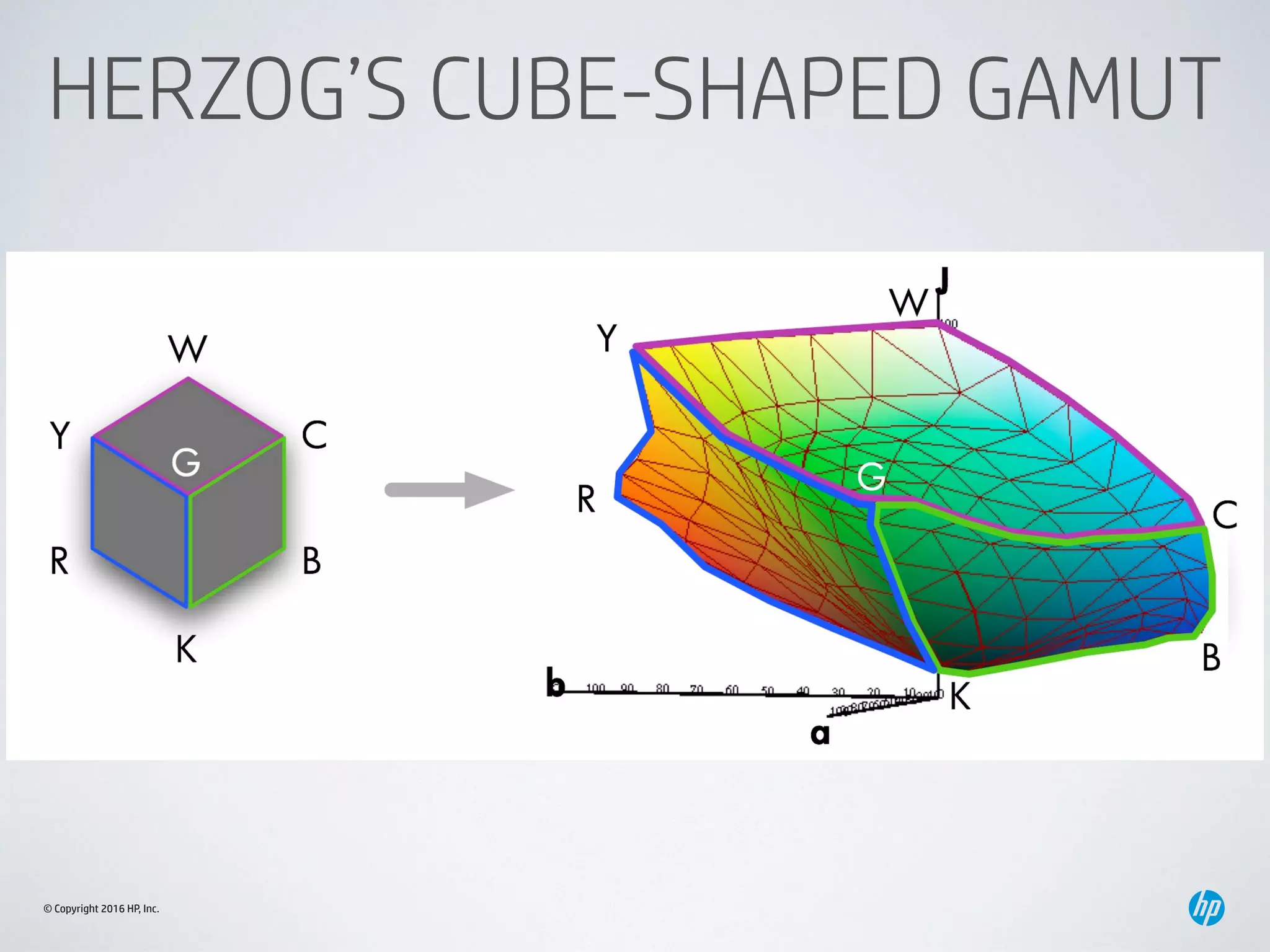
HERZOG’S CUBE-SHAPED GAMUT
© Copyright 2016 HP, Inc.
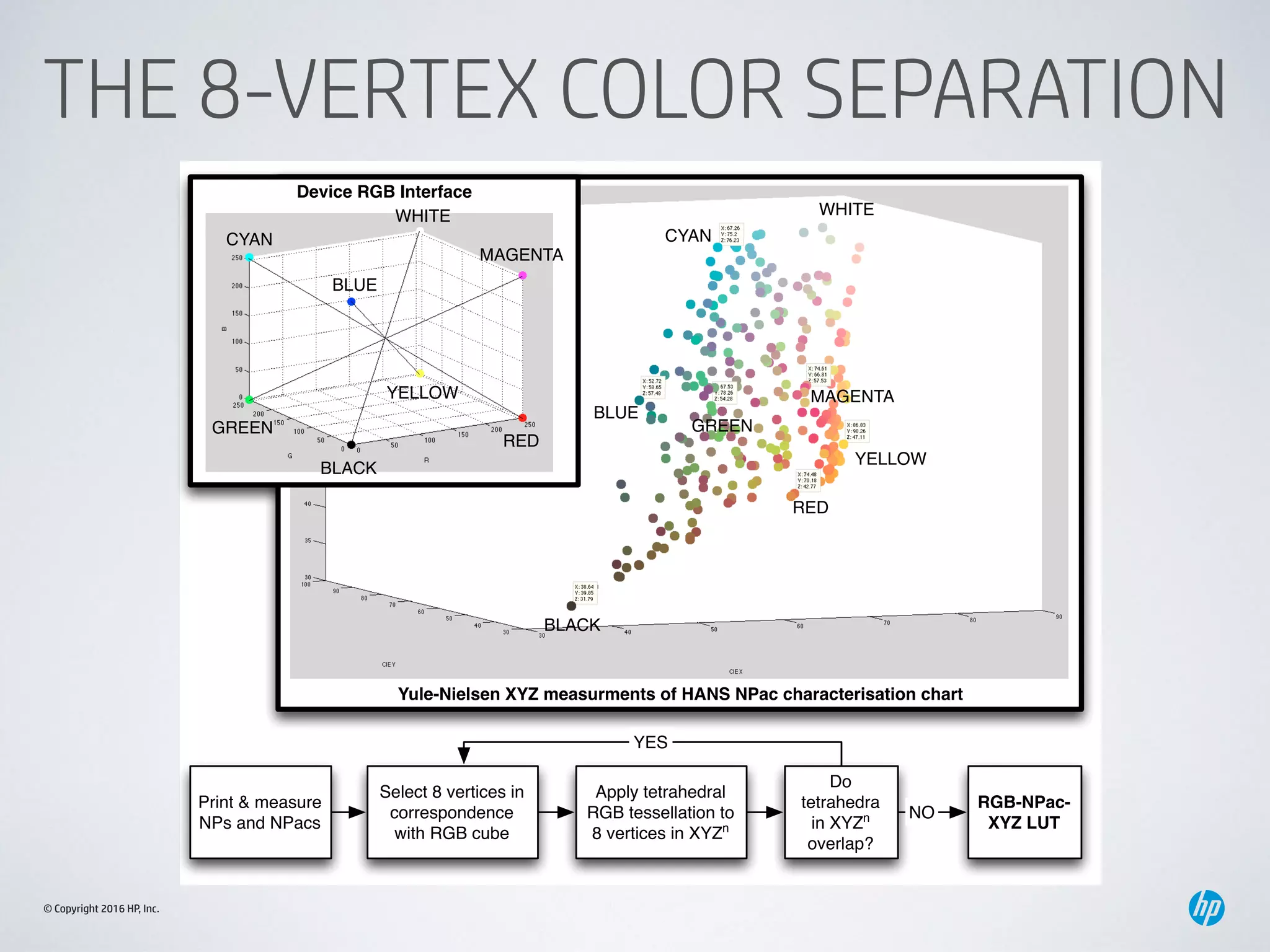
THE 8-VERTEX COLOR SEPARATION
BLACK
YELLOW
GREEN
BLUE
CYAN
RED
MAGENTA
WHITE
BLACK
RED
MAGENTA
WHITE
CYAN
GREEN
BLUE
YELLOW
Device RGB Interface
Yule-Nielsen XYZ measurments of HANS NPac characterisation chart
Print & measure
NPs and NPacs
Select 8 vertices in
correspondence
with RGB cube
Apply tetrahedral
RGB tessellation to
8 vertices in XYZn
Do
tetrahedra
in XYZn
overlap?
RGB-NPac-
XYZ LUT
YES
NO
© Copyright 2016 HP, Inc.
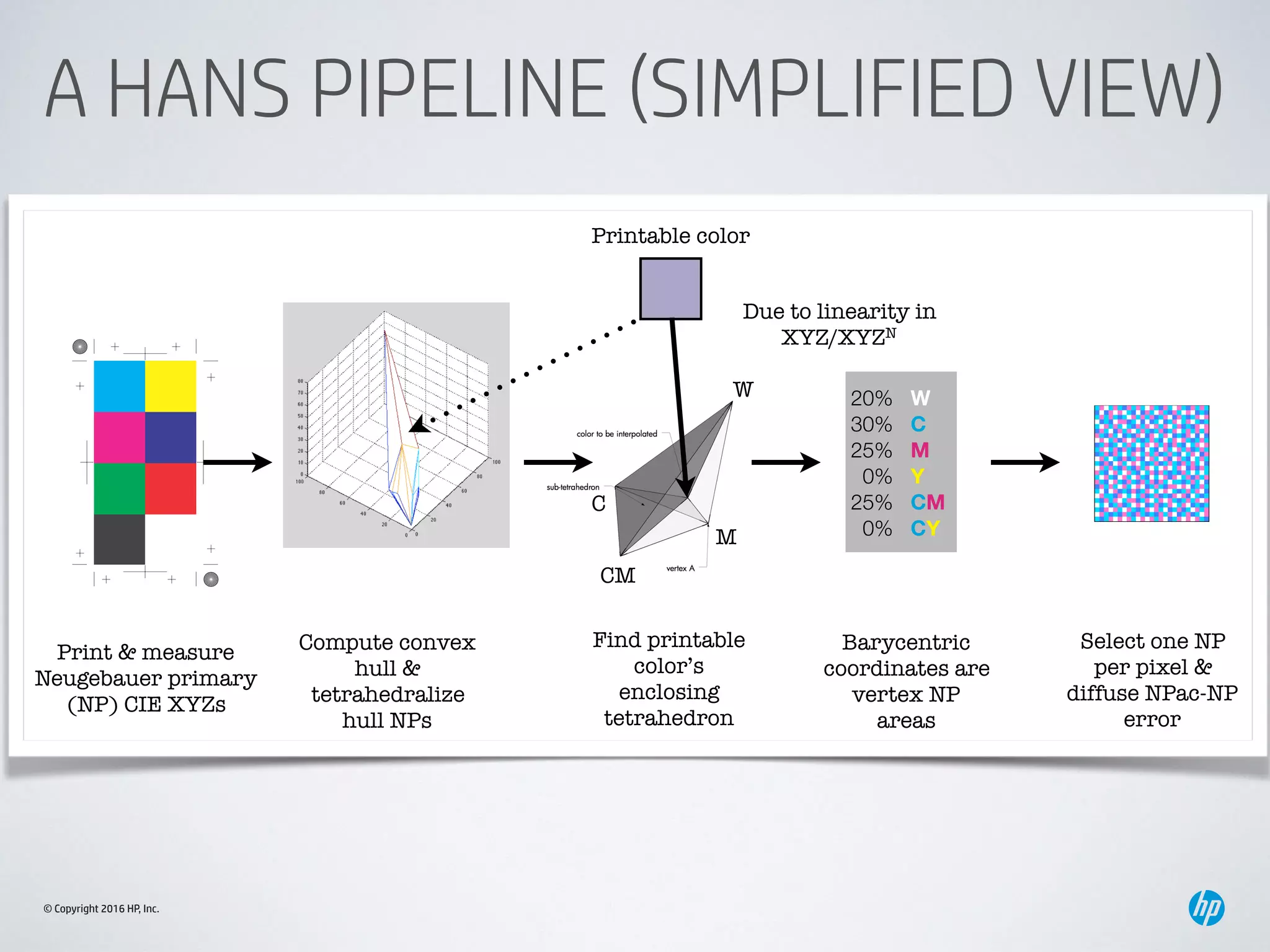
A HANS PIPELINE (SIMPLIFIED VIEW)
Print & measure
Neugebauer primary
(NP) CIE XYZs
Compute convex
hull &
tetrahedralize 

hull NPs
Find printable
color’s
enclosing
tetrahedron
Printable color
20% W
30% C
25% M
0% Y
25% CM
0% CY
Barycentric
coordinates are
vertex NP
areas
Select one NP
per pixel &
diffuse NPac-NP
error
Due to linearity in
XYZ/XYZN
W
C
CM
M
© Copyright 2016 HP, Inc.
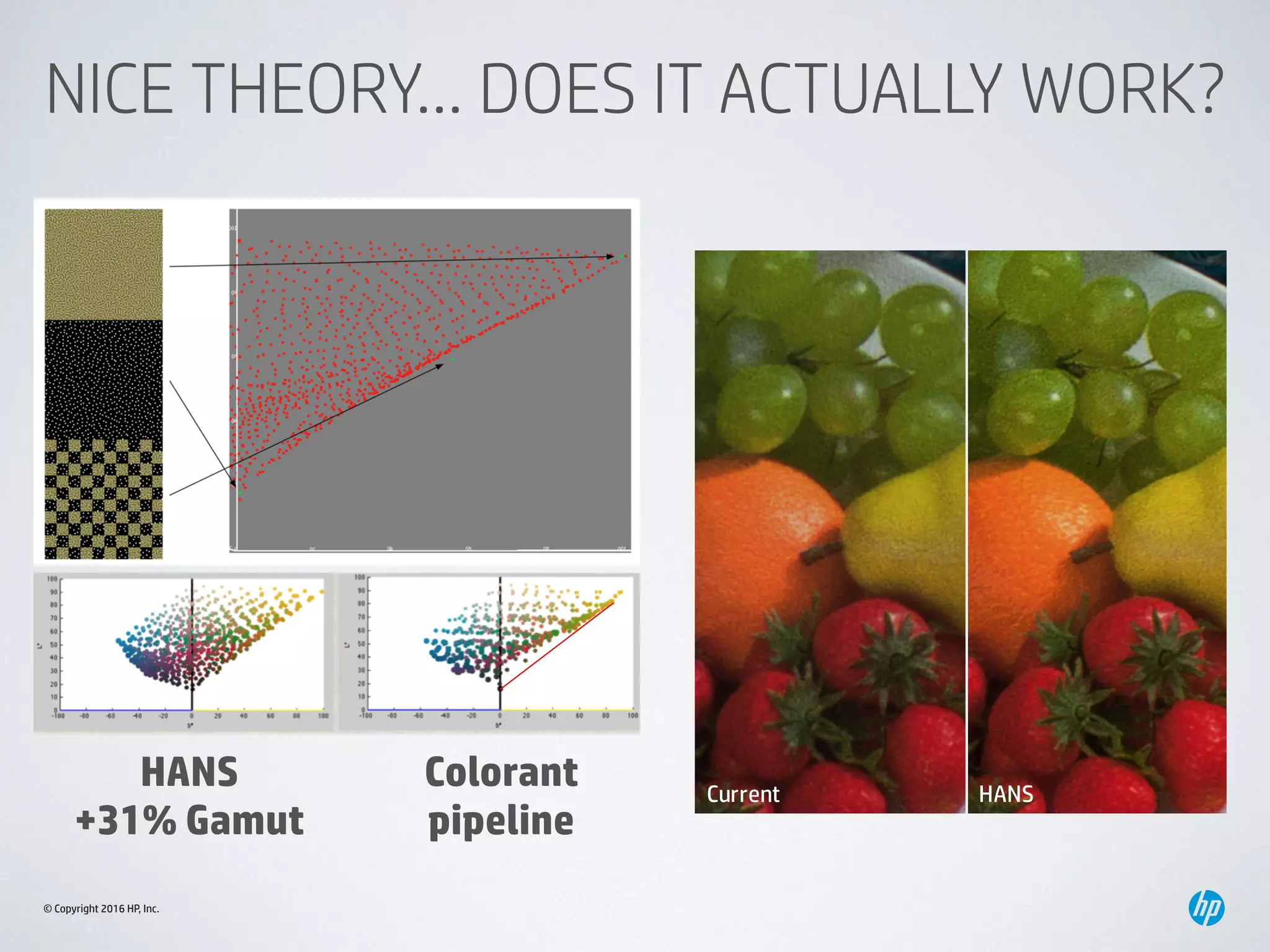
NICE THEORY… DOES IT ACTUALLY WORK?
HANS

+31% Gamut
Colorant

pipeline
Current HANS
© Copyright 2016 HP, Inc.
TESSELLATIONS
Points (NP colorimetries) Convex Hull
Example Tessellations
[triangular/rectangular/...]
42 possible polygons if we allow overlapping
• Tessellating NPs can be done in
different ways - not a unique solution
• A given XYZ (within the convex hull) is
contained in many tessella
• Each tessella gives rise to a new NP area
NP1
NP2
NP3
NP4
NP5
NP6
NP7
?
© Copyright 2016 HP, Inc.
COMBINATORIAL SOLUTION
• Given a set N NPs and their measured
XYZs there are

∑[ p=4 to N](N over p) polyhedra
• In the case of CMY, there are 70
tetrahedra, 56 pentahedra, 28
hexahedra, etc... = 163 polyhedra
Tetrahedra All polyhedra
CMYK@1dpp 1,820 64,839
CMYK@2dpp 1,663,740 ~1024
CMYKcm@2dpp A lot!
Even in CMY (8 NPs) there are many polyhedra,

leading to metamerism.
© Copyright 2016 HP, Inc.
• How many NPacs are there?
• Given a set of N NPs and an encoding precision d

(e.g. d=255 for 8bits), how many vectors w are there?

w = [w0, w1, w2, … wN-1]

such that SUM(wi) = d and all wi are

in the range of [0 … d]
• Solution: (N + (d-1)) choose N
• How many ink-vectors are there?
• For M inks there are d
M
ink vectors
NPAC SPACE CARDINALITY
Ink-vectors NPacs
CMY 1dpp 8bit 1.7 x 10⁷ 4.9 x 10¹⁴
CMYK 2dpp 8bit 4.2 x 10⁹ ~1.5 x 1079
CMYK 2dpp 12bit 2.8 x 10¹⁴ ~1.5 x 10172
© Copyright 2016 HP, Inc.
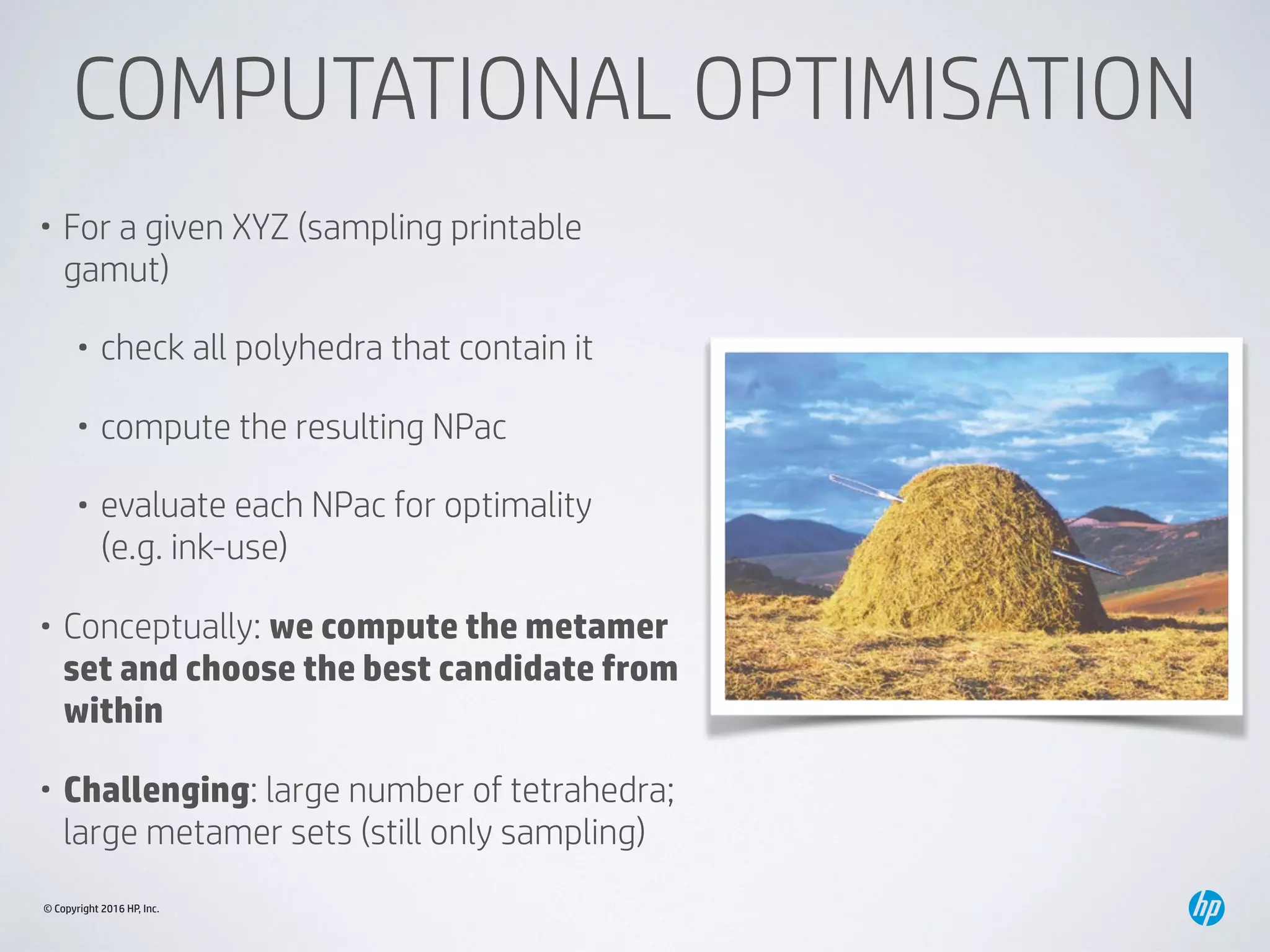
COMPUTATIONAL OPTIMISATION
• For a given XYZ (sampling printable
gamut)
• check all polyhedra that contain it
• compute the resulting NPac
• evaluate each NPac for optimality

(e.g. ink-use)
• Conceptually: we compute the metamer
set and choose the best candidate from
within
• Challenging: large number of tetrahedra;
large metamer sets (still only sampling)
© Copyright 2016 HP, Inc.
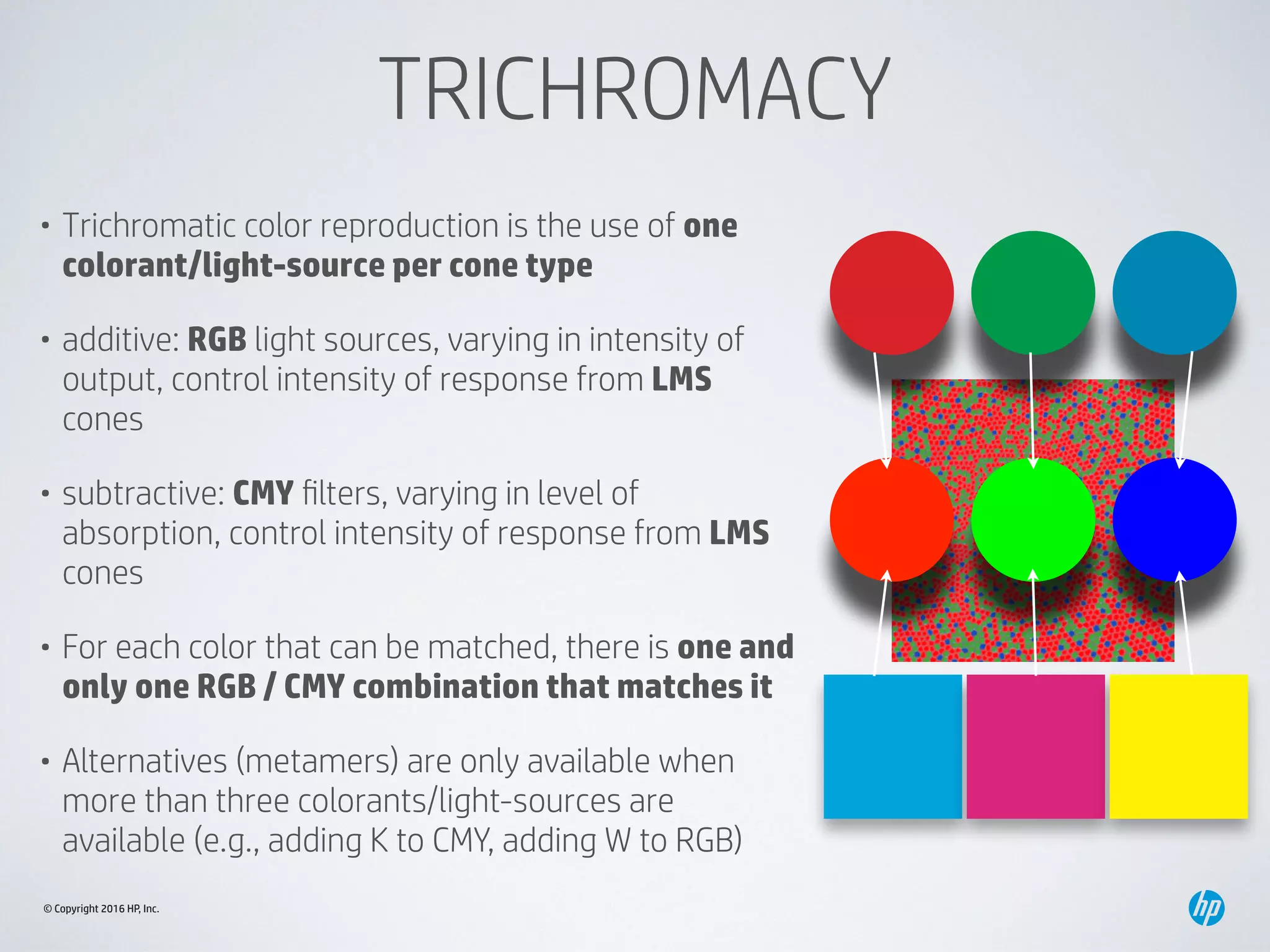
TRICHROMACY
• Trichromatic color reproduction is the use of one
colorant/light-source per cone type
• additive: RGB light sources, varying in intensity of
output, control intensity of response from LMS
cones
• subtractive: CMY filters, varying in level of
absorption, control intensity of response from LMS
cones
• For each color that can be matched, there is one and
only one RGB / CMY combination that matches it
• Alternatives (metamers) are only available when
more than three colorants/light-sources are
available (e.g., adding K to CMY, adding W to RGB)
© Copyright 2016 HP, Inc.
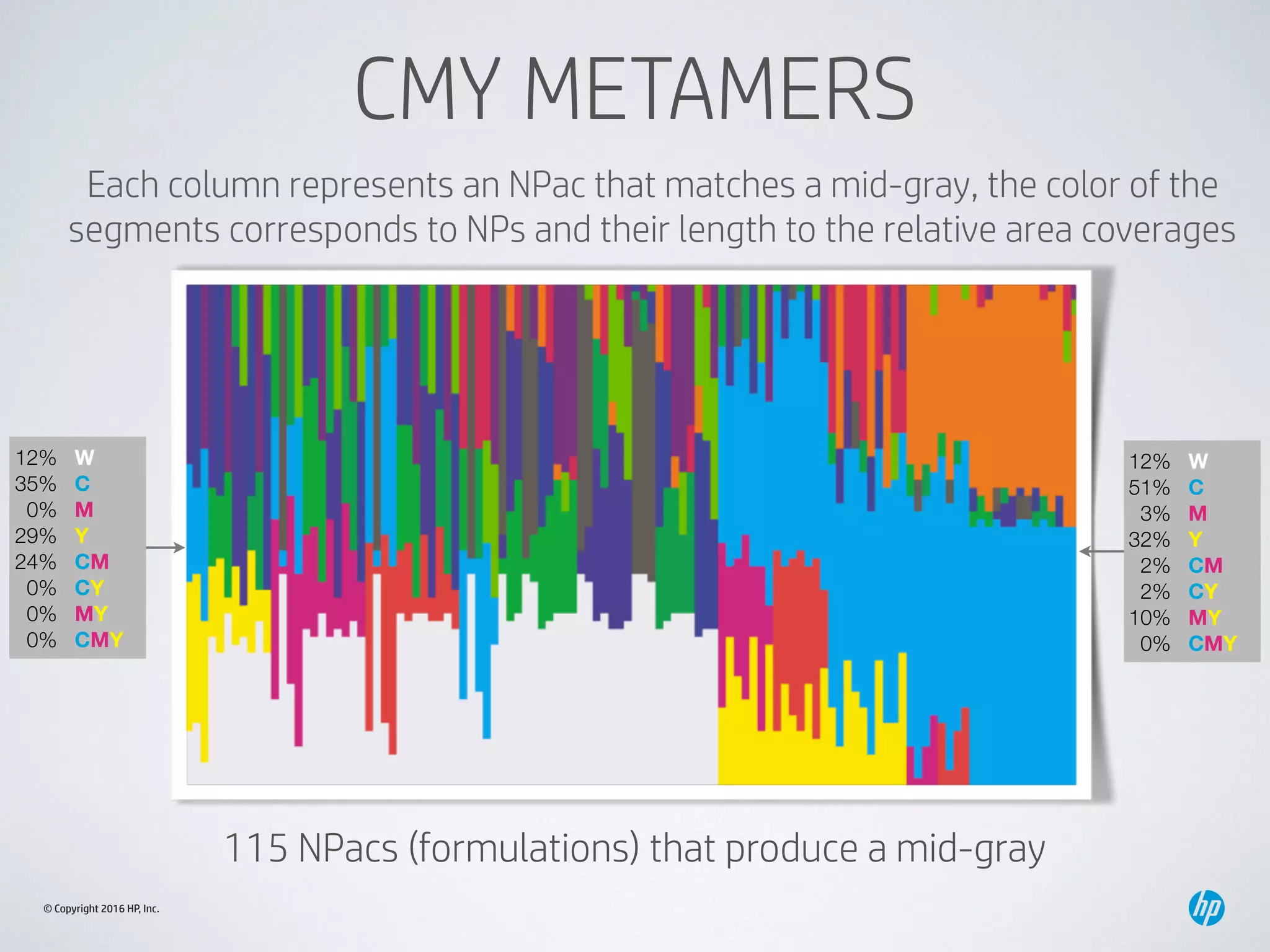
CMY METAMERS
115 NPacs (formulations) that produce a mid-gray
12% W
35% C
0% M
29% Y
24% CM
0% CY
0% MY
0% CMY
12% W
51% C
3% M
32% Y
2% CM
2% CY
10% MY
0% CMY
Each column represents an NPac that matches a mid-gray, the color of the
segments corresponds to NPs and their length to the relative area coverages
© Copyright 2016 HP, Inc.
TWO EXAMPLES (HALFTONES)
Two out of 115 metamers: left patch uses 11 base NPacs (out of
14) – right patch uses 5 base NPacs [shown in pseudo-color]
Target LAB
© Copyright 2016 HP, Inc.
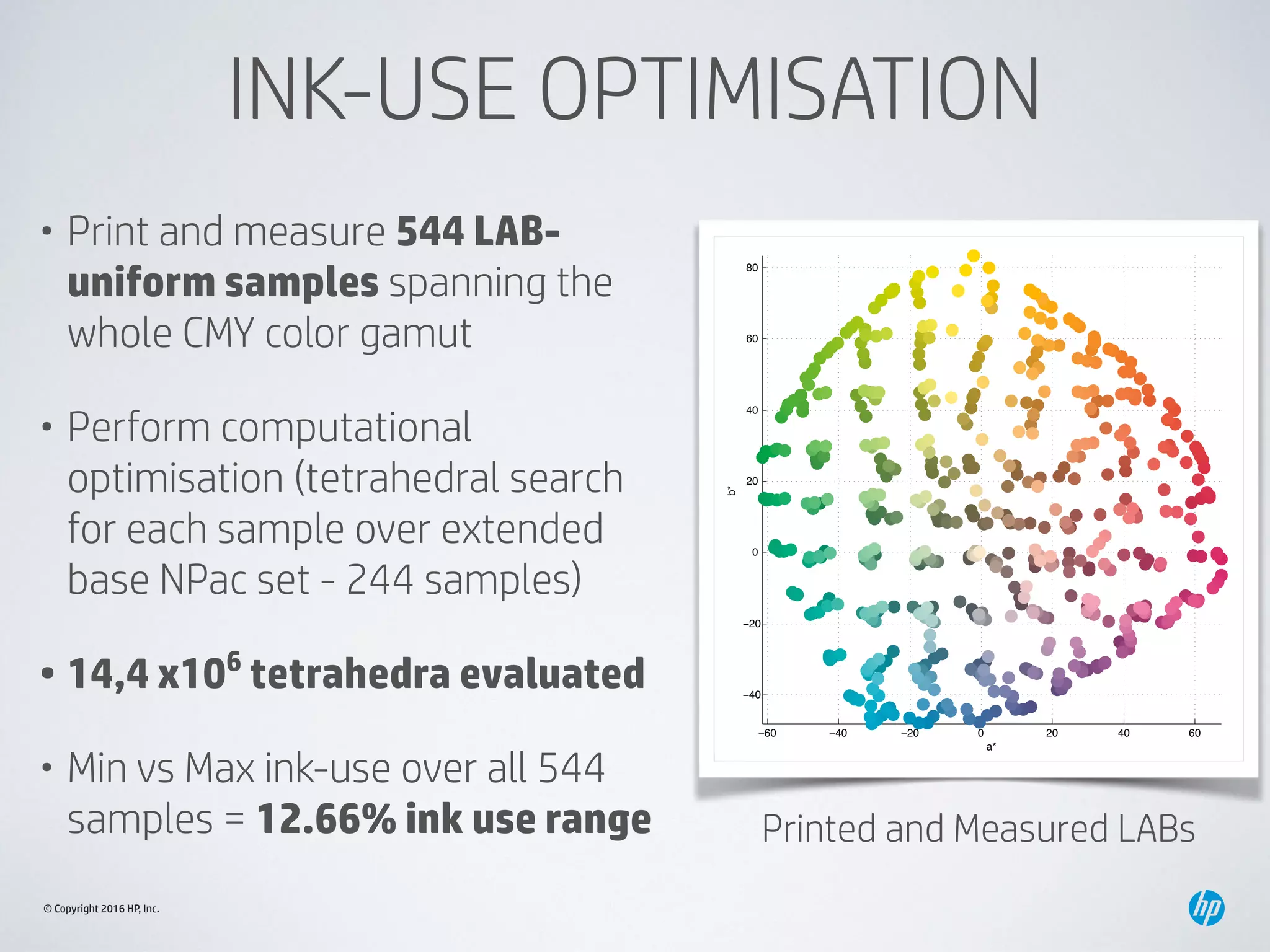
INK-USE OPTIMISATION
• Print and measure 544 LAB-
uniform samples spanning the
whole CMY color gamut
• Perform computational
optimisation (tetrahedral search
for each sample over extended
base NPac set - 244 samples)
• 14,4 x10⁶
tetrahedra evaluated
• Min vs Max ink-use over all 544
samples = 12.66% ink use range
−60 −40 −20 0 20 40 60
−40
−20
0
20
40
60
80
a*
b*
Printed and Measured LABs
© Copyright 2016 HP, Inc.
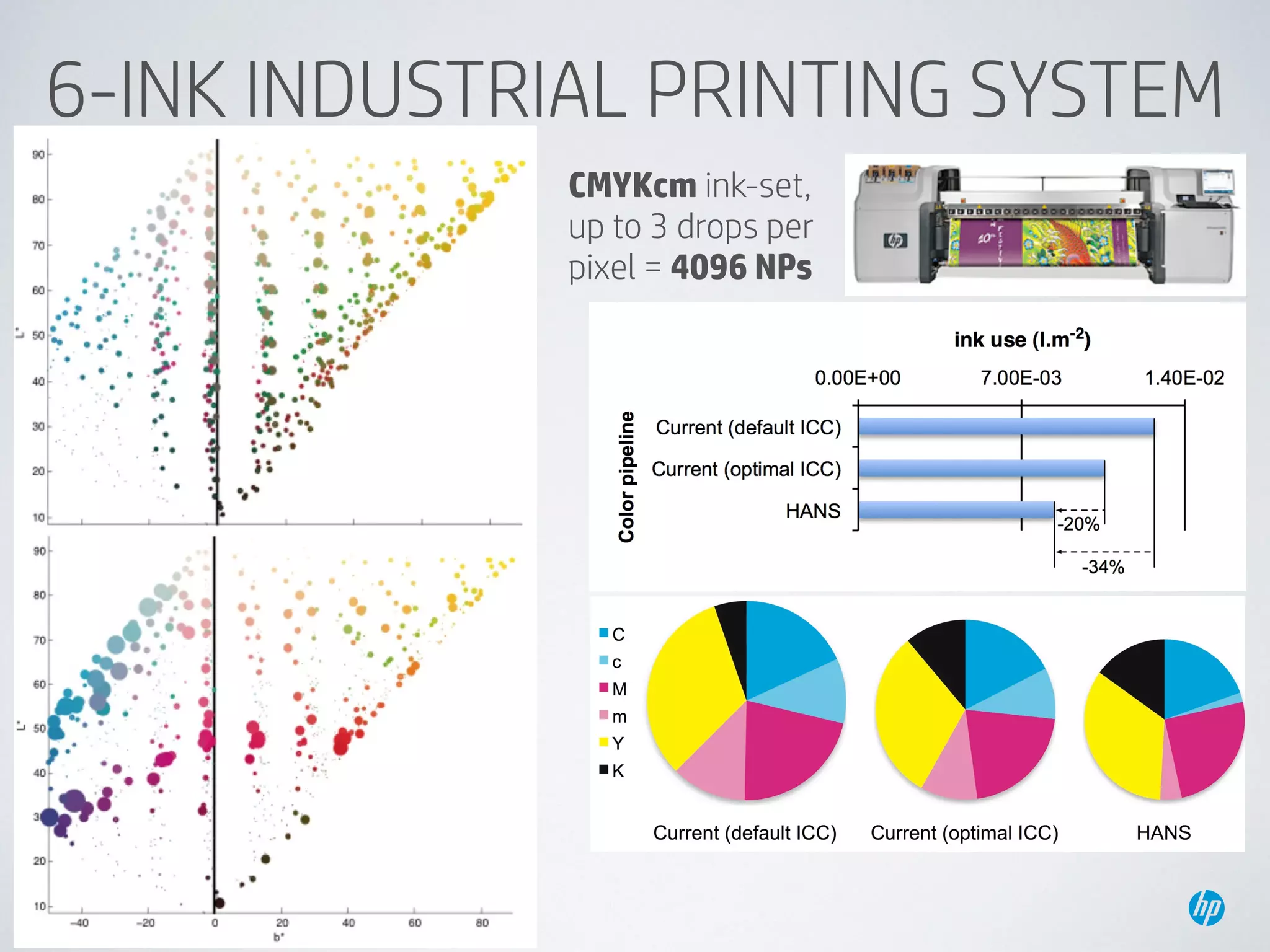
6-INK INDUSTRIAL PRINTING SYSTEM
CMYKcm ink-set,
up to 3 drops per
pixel = 4096 NPs
© Copyright 2016 HP, Inc.
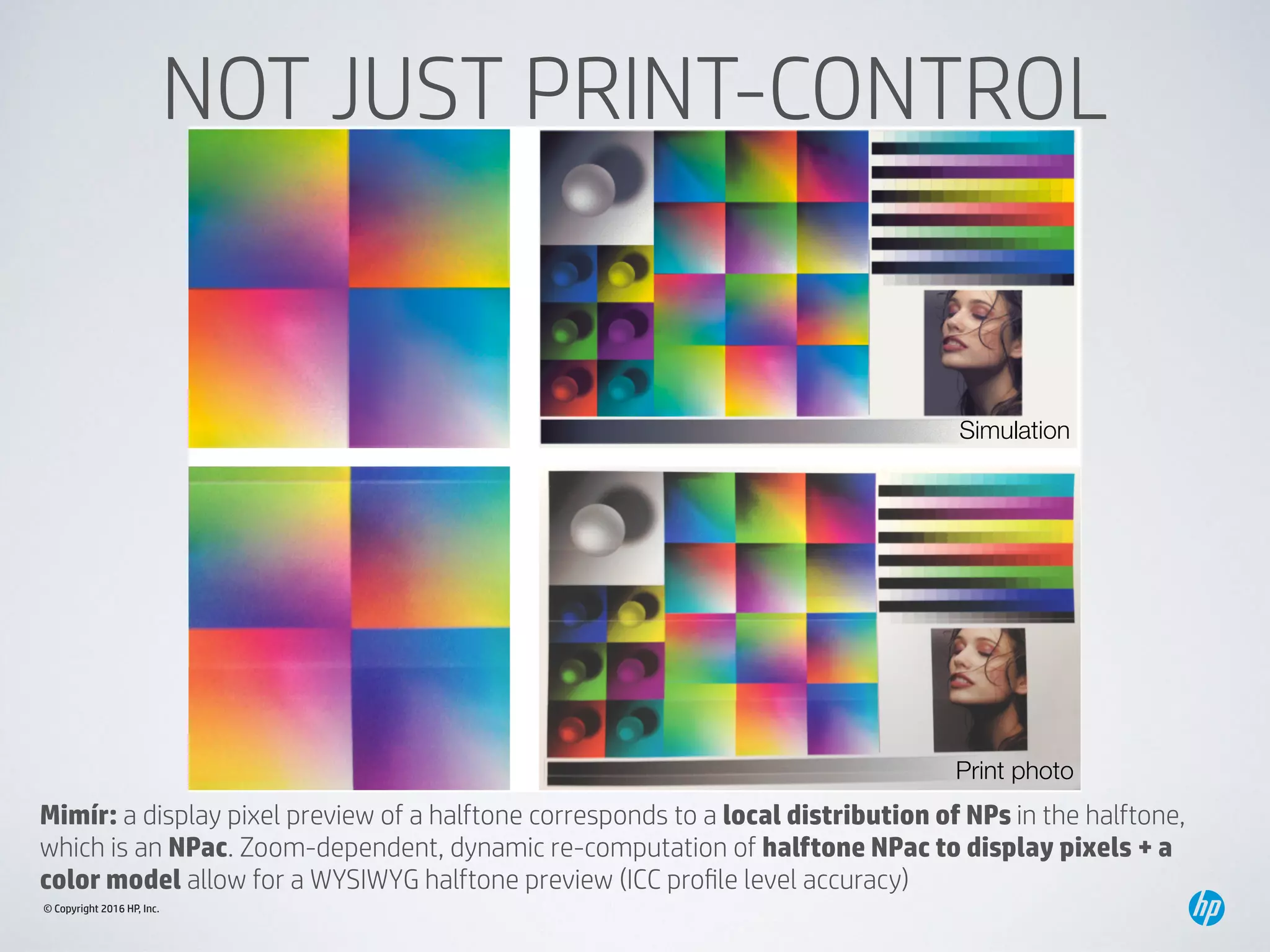
NOT JUST PRINT-CONTROL
Simulation
Print photo
Mimír: a display pixel preview of a halftone corresponds to a local distribution of NPs in the halftone,
which is an NPac. Zoom-dependent, dynamic re-computation of halftone NPac to display pixels + a
color model allow for a WYSIWYG halftone preview (ICC profile level accuracy)
© Copyright 2016 HP, Inc.
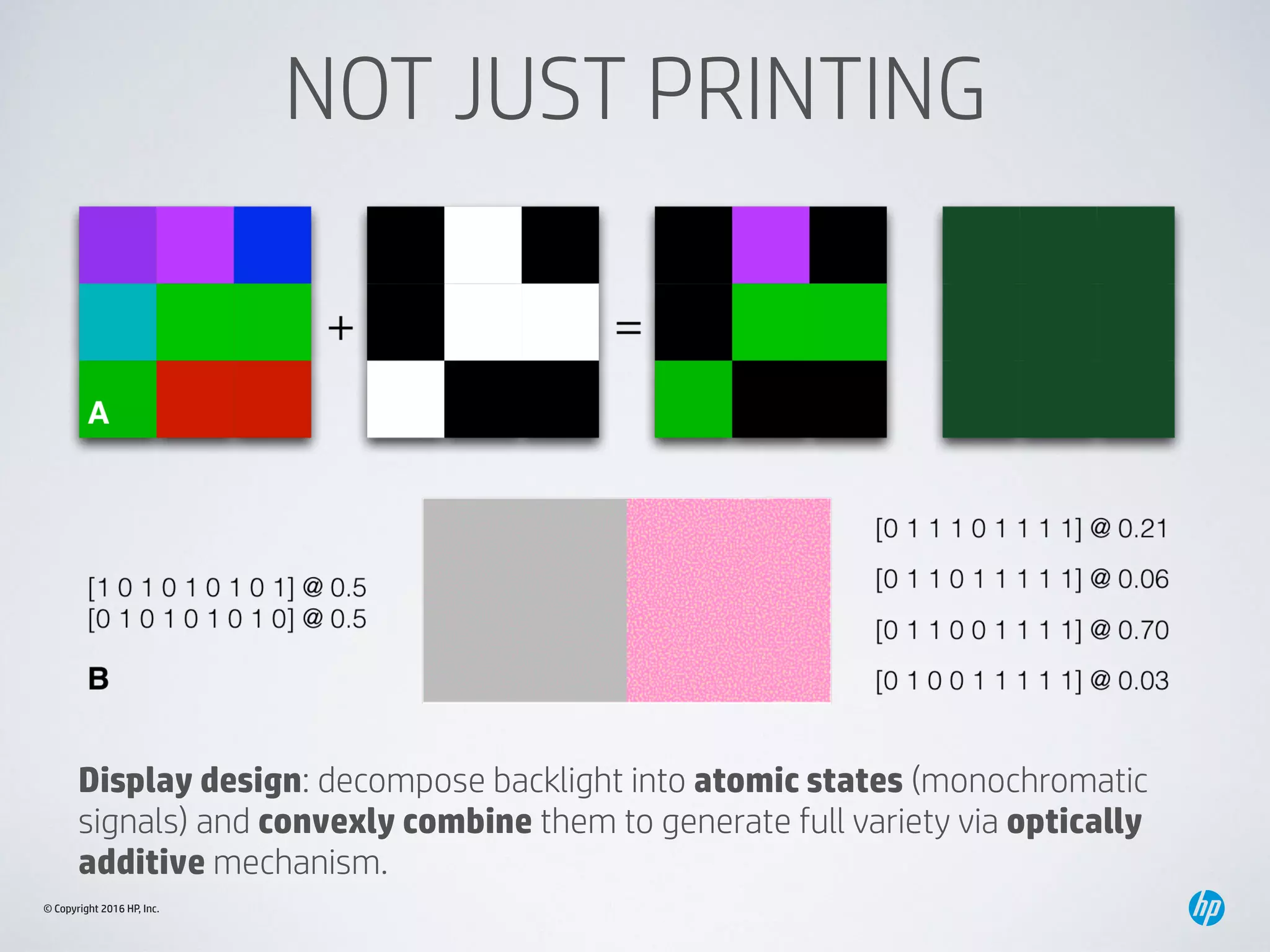
NOT JUST PRINTING
Display design: decompose backlight into atomic states (monochromatic
signals) and convexly combine them to generate full variety via optically
additive mechanism.
© Copyright 2016 HP, Inc.
THANK YOU ☺
Ján Morovič, Graham Finlayson, Jordi Arnabat, Juan
Manuel Garcia Reyero, Xavier Fariña, Hector Gomez,
Pere Gasparin, David Gaston, Annarosa Multari, Africa
Real, Rafael Gimenez, Albert Serra, Ramon Pastor

A relational approach to color

  • 1.
    © Copyright 2016HP, Inc. A RELATIONAL APPROACH TO COLOR Peter Morovič HP Inc. 24th Color & Imaging Conference San Diego (CA), November 2016 [Redacted]
  • 2.
    © Copyright 2016HP, Inc. OUTLINE • Metamer Sets • HANS • Beyond print control
  • 3.
    © Copyright 2016HP, Inc. METAMER SETS
  • 4.
    © Copyright 2016HP, Inc. COLOR FORMATION (RETINAL) • Color is the result of the relationship between light, (a surface) and an observer
 [necessary conditions for color perception] • Arbitrary* changes in any one of the components results in a change of the resulting XYZ • However, possible to find S/ E/Xi so that XYZ doesn’t change: metamerism E(λ) S(λ) Xi(λ) ∫E(λ) S(λ) X1(λ) dλ = X1 ∫E(λ) S(λ) X2(λ) dλ = X2 ∫E(λ) S(λ) X3(λ) dλ = X3
  • 5.
    © Copyright 2016HP, Inc. METAMERISM 5 Human Observer
 under daylight All reflectances that match: Different observer, camera or light [...and vice versa] XYZ
  • 6.
    © Copyright 2016HP, Inc. MACBETH COLORCHECKER
  • 7.
    © Copyright 2016HP, Inc. MACBETH COLORCHECKER 30 38 43 35 43 52 22 38 22 25 36 24 32 37 14 22 23 43 8 39 47 40 32 23 Worst case DE76 (D65 to CIE A)
  • 8.
    © Copyright 2016HP, Inc. CONVEX COMBINATIONS Given all possible reflectances, color a unit area with a subset in varying proportions (adding up to 1) to match a given color: naturalness constraint The set of all metameric reflectances (for a given illuminant and observer) form a convex set
  • 9.
  • 10.
    © Copyright 2016HP, Inc. THE PURPOSE OF A COLOR PIPELINE Primaries (e.g. inks) Mechanism & Constraints Drops/ink Pixels/color Substrate (paper) Ink-limits Spatial resolution System Error … Desired Result + grain, banding, smoothness,
 detail, speed, ink-use (efficiency), …
  • 11.
    © Copyright 2016HP, Inc. HANS Side view Subtractive Additive Halftone Area Neugebauer Separation Side view Colorants Substrate Appearance W C M Y Neugebauer primaries Materials Example halftone C M Y CMY + + = NP areas W=1/9 C=1/9 M=2/9 CM=2/9 CY=1/9 MY=1/9 CMY=1/9Colorant vector [C,M,Y]=[5/9, 6/9,3/9]
  • 12.
    © Copyright 2016HP, Inc. NEUGEBAUER PRIMARY AREA COVERAGES A pattern C, formed by combining some of a printing system’s NPs, can be characterized by its NP area coverage (NPac) vector – NPacC 1/3! 2/9! 2/9! 2/9! k – number of colorant levels / colorant / pixel n – number of colorants, (i.e., the weights are convex) NPi – the i-th NP T() – color (e.g., Yule-Nielsen-corrected XYZ)
  • 13.
    © Copyright 2016HP, Inc. ASSOCIATIVITY • Convex combination of relative area coverage weighted NP colors can also be seen as the convex combination of two constituent patterns – CA and CB, where wCi = wCBi + wCAi =! *1/3+! *2/3! 1/3! 2/9! 2/9! 2/9! 1/3! 2/3! 1/3! 1/3! 1/3! 1/9! 2/9! 2/9! 2/9!2/9! *1/3! *2/3!
  • 14.
    © Copyright 2016HP, Inc. CONSEQUENCES OF ASSOCIATIVITY • As a consequence of associativity, we can perform convex combinations not only of at-pixel states (i.e., the Neugebauer Primaries), but also of a pattern’s sub-patterns • New NPacs can be constructed by convexly combining other NPacs, and this process can, in principle, go on ad infinitum. 0! 10! 20! 30! 40! 50! 0! 20! 40! 60! 80! lightness! chroma! ink! area coverage! Yn 0! 25! 50! areacoverage(%)! C! W! CM! K! M! Xn
  • 15.
    © Copyright 2016HP, Inc. HERZOG’S CUBE-SHAPED GAMUT
  • 16.
    © Copyright 2016HP, Inc. THE 8-VERTEX COLOR SEPARATION BLACK YELLOW GREEN BLUE CYAN RED MAGENTA WHITE BLACK RED MAGENTA WHITE CYAN GREEN BLUE YELLOW Device RGB Interface Yule-Nielsen XYZ measurments of HANS NPac characterisation chart Print & measure NPs and NPacs Select 8 vertices in correspondence with RGB cube Apply tetrahedral RGB tessellation to 8 vertices in XYZn Do tetrahedra in XYZn overlap? RGB-NPac- XYZ LUT YES NO
  • 17.
    © Copyright 2016HP, Inc. A HANS PIPELINE (SIMPLIFIED VIEW) Print & measure Neugebauer primary (NP) CIE XYZs Compute convex hull & tetrahedralize 
 hull NPs Find printable color’s enclosing tetrahedron Printable color 20% W 30% C 25% M 0% Y 25% CM 0% CY Barycentric coordinates are vertex NP areas Select one NP per pixel & diffuse NPac-NP error Due to linearity in XYZ/XYZN W C CM M
  • 18.
    © Copyright 2016HP, Inc. NICE THEORY… DOES IT ACTUALLY WORK? HANS
 +31% Gamut Colorant
 pipeline Current HANS
  • 19.
    © Copyright 2016HP, Inc. TESSELLATIONS Points (NP colorimetries) Convex Hull Example Tessellations [triangular/rectangular/...] 42 possible polygons if we allow overlapping • Tessellating NPs can be done in different ways - not a unique solution • A given XYZ (within the convex hull) is contained in many tessella • Each tessella gives rise to a new NP area NP1 NP2 NP3 NP4 NP5 NP6 NP7 ?
  • 20.
    © Copyright 2016HP, Inc. COMBINATORIAL SOLUTION • Given a set N NPs and their measured XYZs there are
 ∑[ p=4 to N](N over p) polyhedra • In the case of CMY, there are 70 tetrahedra, 56 pentahedra, 28 hexahedra, etc... = 163 polyhedra Tetrahedra All polyhedra CMYK@1dpp 1,820 64,839 CMYK@2dpp 1,663,740 ~1024 CMYKcm@2dpp A lot! Even in CMY (8 NPs) there are many polyhedra,
 leading to metamerism.
  • 21.
    © Copyright 2016HP, Inc. • How many NPacs are there? • Given a set of N NPs and an encoding precision d
 (e.g. d=255 for 8bits), how many vectors w are there?
 w = [w0, w1, w2, … wN-1]
 such that SUM(wi) = d and all wi are
 in the range of [0 … d] • Solution: (N + (d-1)) choose N • How many ink-vectors are there? • For M inks there are d M ink vectors NPAC SPACE CARDINALITY Ink-vectors NPacs CMY 1dpp 8bit 1.7 x 10⁷ 4.9 x 10¹⁴ CMYK 2dpp 8bit 4.2 x 10⁹ ~1.5 x 1079 CMYK 2dpp 12bit 2.8 x 10¹⁴ ~1.5 x 10172
  • 22.
    © Copyright 2016HP, Inc. COMPUTATIONAL OPTIMISATION • For a given XYZ (sampling printable gamut) • check all polyhedra that contain it • compute the resulting NPac • evaluate each NPac for optimality
 (e.g. ink-use) • Conceptually: we compute the metamer set and choose the best candidate from within • Challenging: large number of tetrahedra; large metamer sets (still only sampling)
  • 23.
    © Copyright 2016HP, Inc. TRICHROMACY • Trichromatic color reproduction is the use of one colorant/light-source per cone type • additive: RGB light sources, varying in intensity of output, control intensity of response from LMS cones • subtractive: CMY filters, varying in level of absorption, control intensity of response from LMS cones • For each color that can be matched, there is one and only one RGB / CMY combination that matches it • Alternatives (metamers) are only available when more than three colorants/light-sources are available (e.g., adding K to CMY, adding W to RGB)
  • 24.
    © Copyright 2016HP, Inc. CMY METAMERS 115 NPacs (formulations) that produce a mid-gray 12% W 35% C 0% M 29% Y 24% CM 0% CY 0% MY 0% CMY 12% W 51% C 3% M 32% Y 2% CM 2% CY 10% MY 0% CMY Each column represents an NPac that matches a mid-gray, the color of the segments corresponds to NPs and their length to the relative area coverages
  • 25.
    © Copyright 2016HP, Inc. TWO EXAMPLES (HALFTONES) Two out of 115 metamers: left patch uses 11 base NPacs (out of 14) – right patch uses 5 base NPacs [shown in pseudo-color] Target LAB
  • 26.
    © Copyright 2016HP, Inc. INK-USE OPTIMISATION • Print and measure 544 LAB- uniform samples spanning the whole CMY color gamut • Perform computational optimisation (tetrahedral search for each sample over extended base NPac set - 244 samples) • 14,4 x10⁶ tetrahedra evaluated • Min vs Max ink-use over all 544 samples = 12.66% ink use range −60 −40 −20 0 20 40 60 −40 −20 0 20 40 60 80 a* b* Printed and Measured LABs
  • 27.
    © Copyright 2016HP, Inc. 6-INK INDUSTRIAL PRINTING SYSTEM CMYKcm ink-set, up to 3 drops per pixel = 4096 NPs
  • 28.
    © Copyright 2016HP, Inc. NOT JUST PRINT-CONTROL Simulation Print photo Mimír: a display pixel preview of a halftone corresponds to a local distribution of NPs in the halftone, which is an NPac. Zoom-dependent, dynamic re-computation of halftone NPac to display pixels + a color model allow for a WYSIWYG halftone preview (ICC profile level accuracy)
  • 29.
    © Copyright 2016HP, Inc. NOT JUST PRINTING Display design: decompose backlight into atomic states (monochromatic signals) and convexly combine them to generate full variety via optically additive mechanism.
  • 30.
    © Copyright 2016HP, Inc. THANK YOU ☺ Ján Morovič, Graham Finlayson, Jordi Arnabat, Juan Manuel Garcia Reyero, Xavier Fariña, Hector Gomez, Pere Gasparin, David Gaston, Annarosa Multari, Africa Real, Rafael Gimenez, Albert Serra, Ramon Pastor