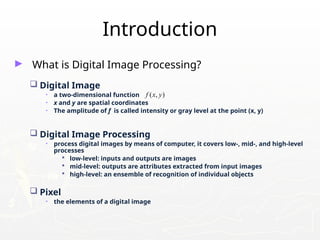
► What isDigital Image Processing?
Digital Image
• a two-dimensional function
• x and y are spatial coordinates
• The amplitude of f is called intensity or gray level at the point (x, y)
Digital Image Processing
• process digital images by means of computer, it covers low-, mid-, and high-level
processes
low-level: inputs and outputs are images
mid-level: outputs are attributes extracted from input images
high-level: an ensemble of recognition of individual objects
Pixel
• the elements of a digital image
Introduction
( , )
f x y
3.
3
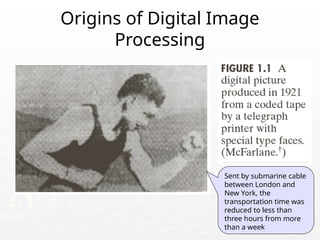
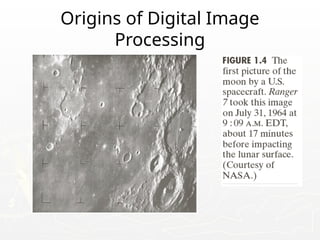
Origins of DigitalImage
Processing
Sent by submarine cable
between London and
New York, the
transportation time was
reduced to less than
three hours from more
than a week
Sources for Images
►Electromagnetic (EM) energy spectrum
► Acoustic
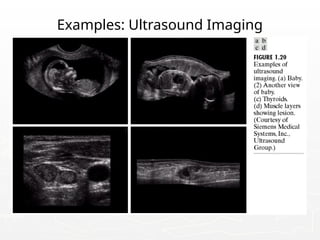
► Ultrasonic
► Electronic
► Synthetic images produced by computer
6.
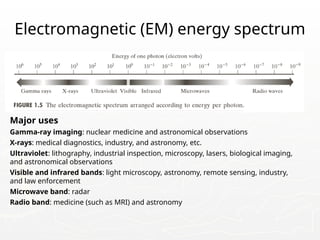
Electromagnetic (EM) energyspectrum
Major uses
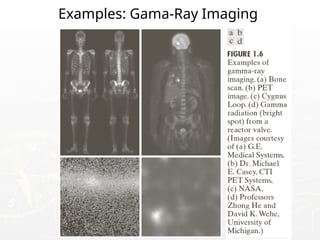
Gamma-ray imaging: nuclear medicine and astronomical observations
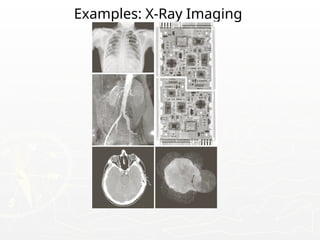
X-rays: medical diagnostics, industry, and astronomy, etc.
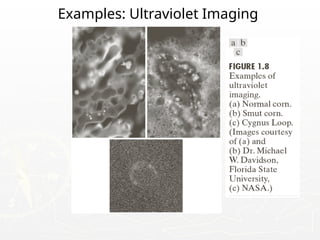
Ultraviolet: lithography, industrial inspection, microscopy, lasers, biological imaging,
and astronomical observations
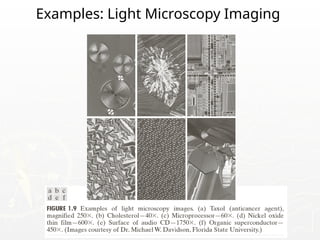
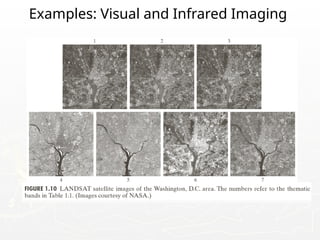
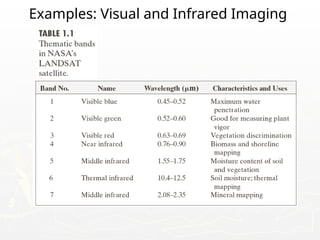
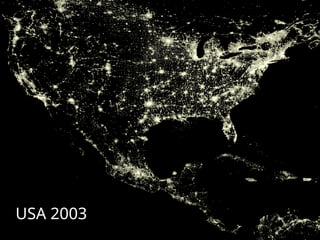
Visible and infrared bands: light microscopy, astronomy, remote sensing, industry,
and law enforcement
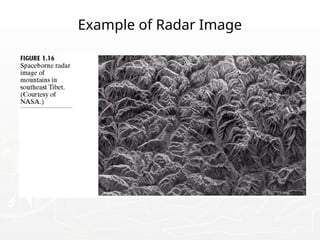
Microwave band: radar
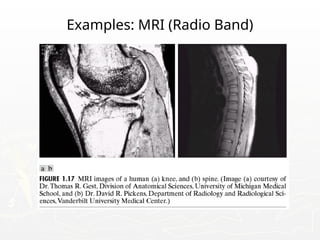
Radio band: medicine (such as MRI) and astronomy
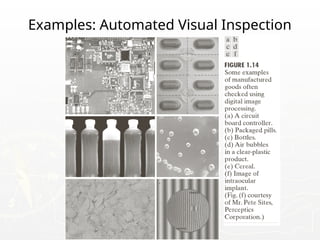
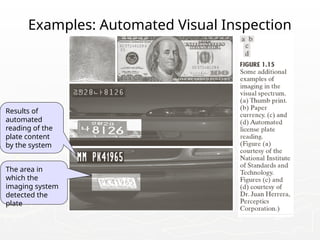
Examples: Automated VisualInspection
The area in
which the
imaging system
detected the
plate
Results of
automated
reading of the
plate content
by the system
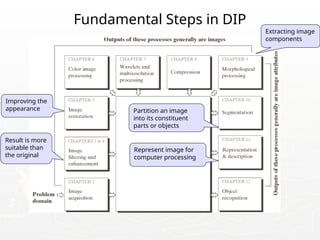
Fundamental Steps inDIP
Result is more
suitable than
the original
Improving the
appearance
Extracting image
components
Partition an image
into its constituent
parts or objects
Represent image for
computer processing
20.
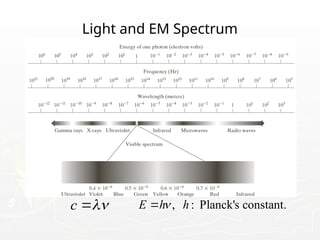
Light and EMSpectrum
c
, : Planck's constant.
E h h
21.
Light and EMSpectrum
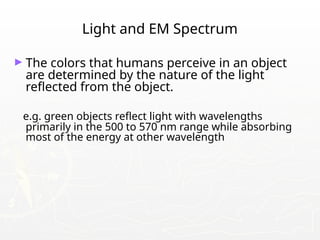
► The colors that humans perceive in an object
are determined by the nature of the light
reflected from the object.
e.g. green objects reflect light with wavelengths
primarily in the 500 to 570 nm range while absorbing
most of the energy at other wavelength
22.
Light and EMSpectrum
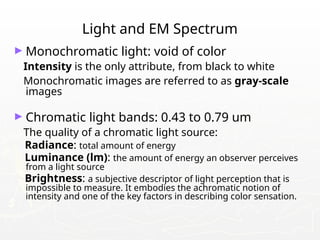
► Monochromatic light: void of color
Intensity is the only attribute, from black to white
Monochromatic images are referred to as gray-scale
images
► Chromatic light bands: 0.43 to 0.79 um
The quality of a chromatic light source:
Radiance: total amount of energy
Luminance (lm): the amount of energy an observer perceives
from a light source
Brightness: a subjective descriptor of light perception that is
impossible to measure. It embodies the achromatic notion of
intensity and one of the key factors in describing color sensation.
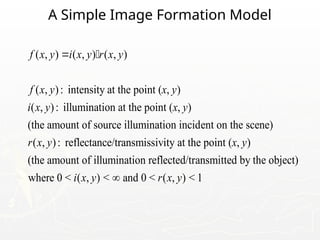
A Simple ImageFormation Model
( , ) ( , ) ( , )
( , ): intensity at the point ( , )
( , ): illumination at the point ( , )
(the amount of source illumination incident on the scene)
( , ): reflectance/transmissivity
f x y i x y r x y
f x y x y
i x y x y
r x y
at the point ( , )
(the amount of illumination reflected/transmitted by the object)
where 0 < ( , ) < and 0 < ( , ) < 1
x y
i x y r x y
28.
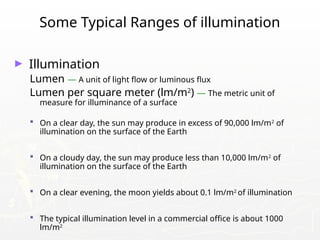
Some Typical Rangesof illumination
► Illumination
Lumen — A unit of light flow or luminous flux
Lumen per square meter (lm/m2
) — The metric unit of
measure for illuminance of a surface
On a clear day, the sun may produce in excess of 90,000 lm/m2
of
illumination on the surface of the Earth
On a cloudy day, the sun may produce less than 10,000 lm/m2
of
illumination on the surface of the Earth
On a clear evening, the moon yields about 0.1 lm/m2
of illumination
The typical illumination level in a commercial office is about 1000
lm/m2
29.
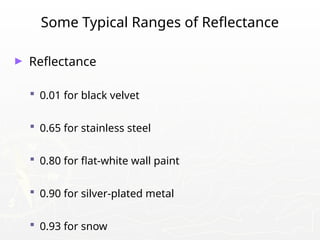
Some Typical Rangesof Reflectance
► Reflectance
0.01 for black velvet
0.65 for stainless steel
0.80 for flat-white wall paint
0.90 for silver-plated metal
0.93 for snow
30.
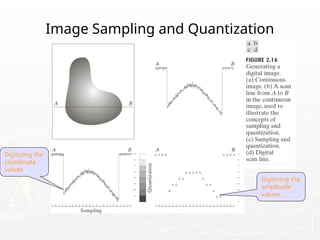
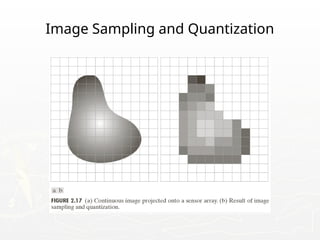
Image Sampling andQuantization
Digitizing the
coordinate
values
Digitizing the
amplitude
values
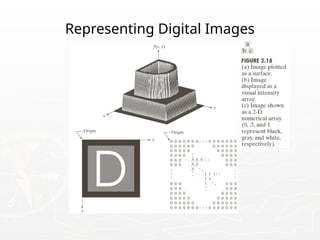
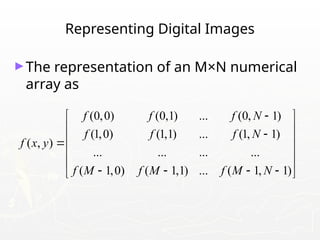
Representing Digital Images
►Therepresentation of an M×N numerical
array as
(0,0) (0,1) ... (0, 1)
(1,0) (1,1) ... (1, 1)
( , )
... ... ... ...
( 1,0) ( 1,1) ... ( 1, 1)
f f f N
f f f N
f x y
f M f M f M N
34.
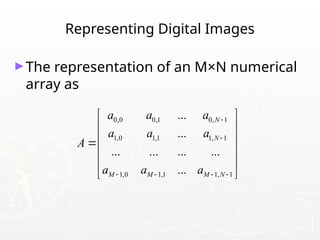
Representing Digital Images
►Therepresentation of an M×N numerical
array as
0,0 0,1 0, 1
1,0 1,1 1, 1
1,0 1,1 1, 1
...
...
... ... ... ...
...
N
N
M M M N
a a a
a a a
A
a a a
35.
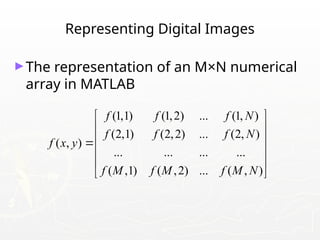
Representing Digital Images
►Therepresentation of an M×N numerical
array in MATLAB
(1,1) (1,2) ... (1, )
(2,1) (2,2) ... (2, )
( , )
... ... ... ...
( ,1) ( ,2) ... ( , )
f f f N
f f f N
f x y
f M f M f M N
36.
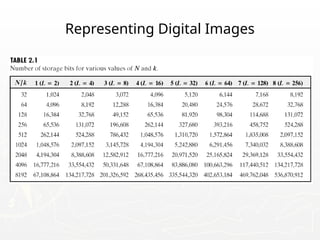
Representing Digital Images
►Discrete intensity interval [0, L-1], L=2k
► The number b of bits required to store a M × N
digitized image
b = M × N × k
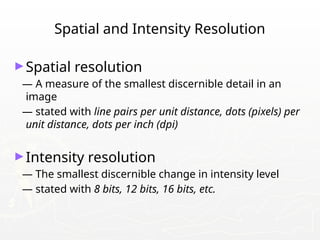
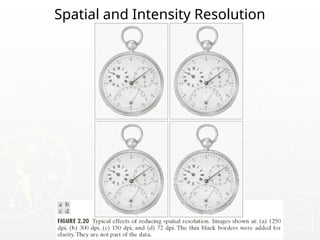
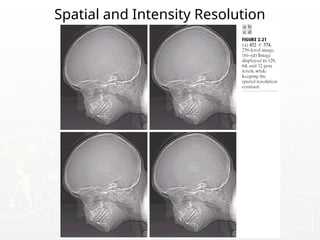
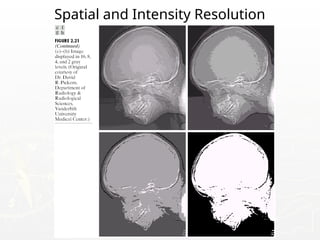
Spatial and IntensityResolution
►Spatial resolution
— A measure of the smallest discernible detail in an
image
— stated with line pairs per unit distance, dots (pixels) per
unit distance, dots per inch (dpi)
►Intensity resolution
— The smallest discernible change in intensity level
— stated with 8 bits, 12 bits, 16 bits, etc.
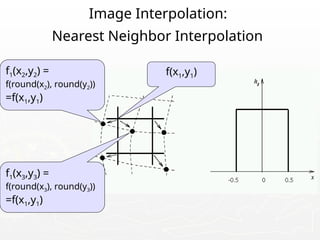
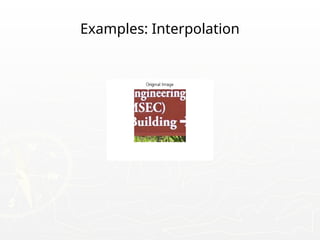
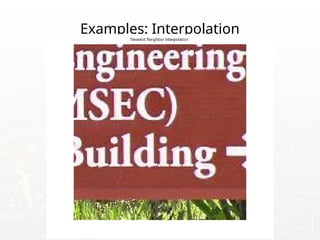
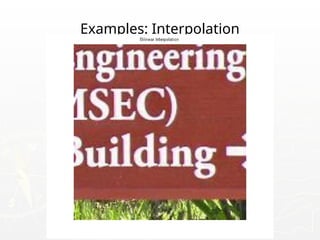
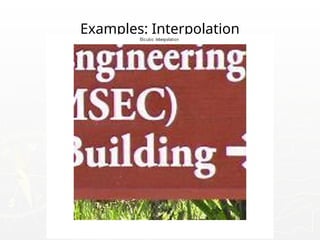
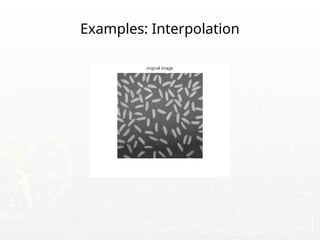
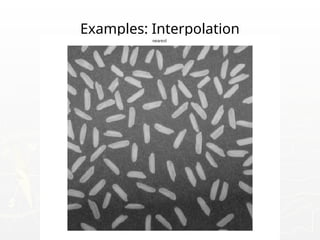
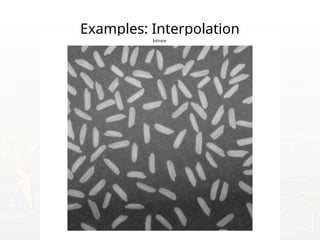
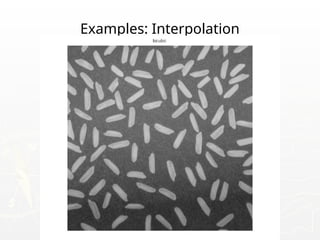
Image Interpolation
► Interpolation— Process of using known data
to estimate unknown values
e.g., zooming, shrinking, rotating, and geometric correction
► Interpolation (sometimes called resampling)
— an imaging method to increase (or decrease) the
number of pixels in a digital image.
Some digital cameras use interpolation to produce a larger image
than the sensor captured or to create digital zoom
http://www.dpreview.com/learn/?/key=interpolation
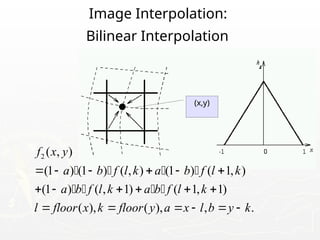
Image Interpolation:
Bilinear Interpolation
2( , )
(1 ) (1 ) ( , ) (1 ) ( 1, )
(1 ) ( , 1) ( 1, 1)
( ), ( ), , .
f x y
a b f l k a b f l k
a b f l k a b f l k
l floor x k floor y a x l b y k
(x,y)
45.
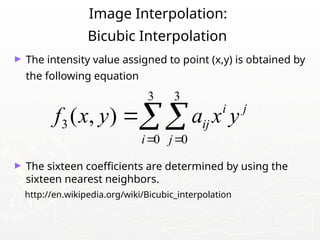
Image Interpolation:
Bicubic Interpolation
33
3
0 0
( , ) i j
ij
i j
f x y a x y
► The intensity value assigned to point (x,y) is obtained by
the following equation
► The sixteen coefficients are determined by using the
sixteen nearest neighbors.
http://en.wikipedia.org/wiki/Bicubic_interpolation
Basic Relationships BetweenPixels
► Neighborhood
► Adjacency
► Connectivity
► Paths
► Regions and boundaries
55.
Basic Relationships BetweenPixels
► Neighbors of a pixel p at coordinates (x,y)
4-neighbors of p, denoted by N4(p):
(x-1, y), (x+1, y), (x,y-1), and (x, y+1).
4 diagonal neighbors of p, denoted by ND(p):
(x-1, y-1), (x+1, y+1), (x+1,y-1), and (x-1, y+1).
8 neighbors of p, denoted N8(p)
N8(p) = N4(p) U ND(p)
56.
Basic Relationships BetweenPixels
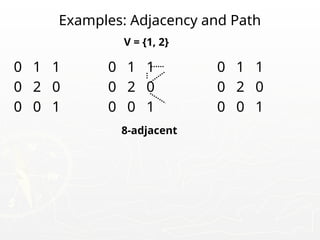
► Adjacency
Let V be the set of intensity values
4-adjacency: Two pixels p and q with values from V are
4-adjacent if q is in the set N4(p).
8-adjacency: Two pixels p and q with values from V are
8-adjacent if q is in the set N8(p).
57.
Basic Relationships BetweenPixels
► Adjacency
Let V be the set of intensity values
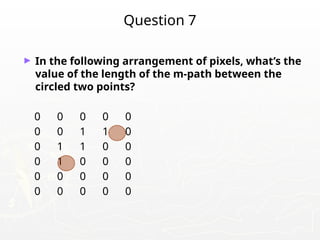
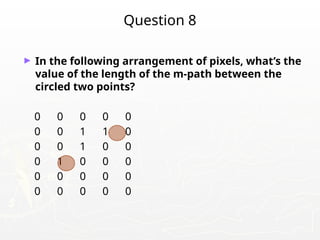
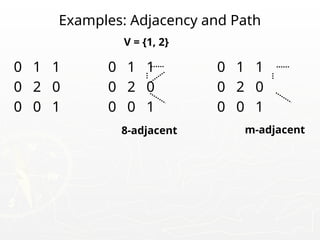
m-adjacency: Two pixels p and q with values from V are
m-adjacent if
(i) q is in the set N4(p), or
(ii) q is in the set ND(p) and the set N4(p) ∩ N4(p) has no pixels whose
values are from V.
58.
Basic Relationships BetweenPixels
► Path
A (digital) path (or curve) from pixel p with coordinates (x0, y0) to
pixel q with coordinates (xn, yn) is a sequence of distinct pixels with
coordinates
(x0, y0), (x1, y1), …, (xn, yn)
Where (xi, yi) and (xi-1, yi-1) are adjacent for 1 i n.
≤ ≤
Here n is the length of the path.
If (x0, y0) = (xn, yn), the path is closed path.
We can define 4-, 8-, and m-paths based on the type of adjacency
used.
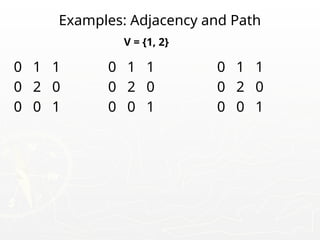
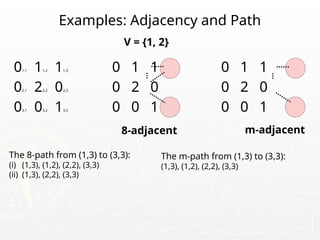
Examples: Adjacency andPath
01,1 11,2 11,3 0 1 1 0 1 1
02,1 22,2 02,3 0 2 0 0 2 0
03,1 03,2 13,3 0 0 1 0 0 1
V = {1, 2}
8-adjacent m-adjacent
The 8-path from (1,3) to (3,3):
(i) (1,3), (1,2), (2,2), (3,3)
(ii) (1,3), (2,2), (3,3)
The m-path from (1,3) to (3,3):
(1,3), (1,2), (2,2), (3,3)
63.
Basic Relationships BetweenPixels
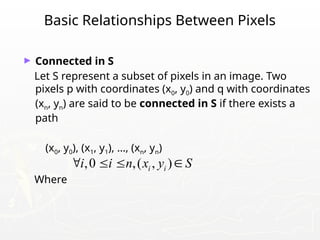
► Connected in S
Let S represent a subset of pixels in an image. Two
pixels p with coordinates (x0, y0) and q with coordinates
(xn, yn) are said to be connected in S if there exists a
path
(x0, y0), (x1, y1), …, (xn, yn)
Where
,0 ,( , )
i i
i i n x y S
64.
Basic Relationships BetweenPixels
Let S represent a subset of pixels in an image
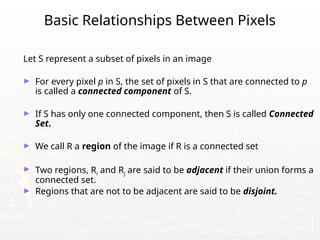
► For every pixel p in S, the set of pixels in S that are connected to p
is called a connected component of S.
► If S has only one connected component, then S is called Connected
Set.
► We call R a region of the image if R is a connected set
► Two regions, Ri and Rj are said to be adjacent if their union forms a
connected set.
► Regions that are not to be adjacent are said to be disjoint.
65.
Basic Relationships BetweenPixels
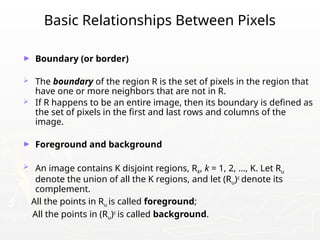
► Boundary (or border)
The boundary of the region R is the set of pixels in the region that
have one or more neighbors that are not in R.
If R happens to be an entire image, then its boundary is defined as
the set of pixels in the first and last rows and columns of the
image.
► Foreground and background
An image contains K disjoint regions, Rk, k = 1, 2, …, K. Let Ru
denote the union of all the K regions, and let (Ru)c
denote its
complement.
All the points in Ru is called foreground;
All the points in (Ru)c
is called background.
66.
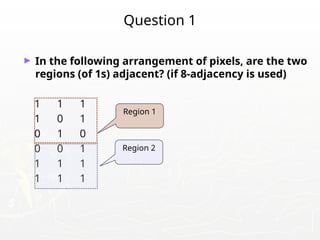
Question 1
► Inthe following arrangement of pixels, are the two
regions (of 1s) adjacent? (if 8-adjacency is used)
1 1 1
1 0 1
0 1 0
0 0 1
1 1 1
1 1 1
Region 1
Region 2
67.
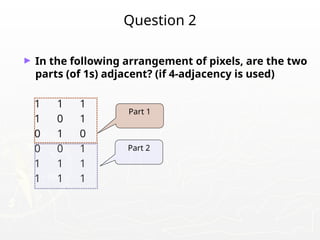
Question 2
► Inthe following arrangement of pixels, are the two
parts (of 1s) adjacent? (if 4-adjacency is used)
1 1 1
1 0 1
0 1 0
0 0 1
1 1 1
1 1 1
Part 1
Part 2
68.
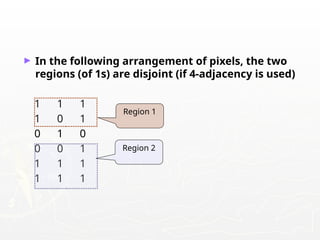
► In thefollowing arrangement of pixels, the two
regions (of 1s) are disjoint (if 4-adjacency is used)
1 1 1
1 0 1
0 1 0
0 0 1
1 1 1
1 1 1
Region 1
Region 2
69.
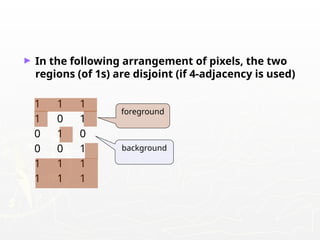
► In thefollowing arrangement of pixels, the two
regions (of 1s) are disjoint (if 4-adjacency is used)
1 1 1
1 0 1
0 1 0
0 0 1
1 1 1
1 1 1
foreground
background
70.
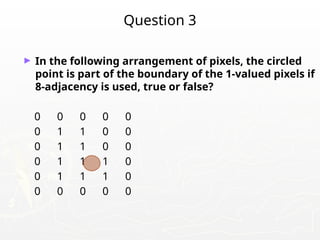
Question 3
► Inthe following arrangement of pixels, the circled
point is part of the boundary of the 1-valued pixels if
8-adjacency is used, true or false?
0 0 0 0 0
0 1 1 0 0
0 1 1 0 0
0 1 1 1 0
0 1 1 1 0
0 0 0 0 0
71.
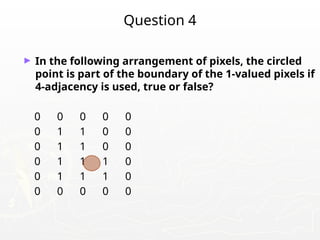
Question 4
► Inthe following arrangement of pixels, the circled
point is part of the boundary of the 1-valued pixels if
4-adjacency is used, true or false?
0 0 0 0 0
0 1 1 0 0
0 1 1 0 0
0 1 1 1 0
0 1 1 1 0
0 0 0 0 0
72.
Distance Measures
► Givenpixels p, q and z with coordinates (x, y), (s, t),
(u, v) respectively, the distance function D has
following properties:
a. D(p, q) 0 [D(p, q) = 0, iff p = q]
≥
b. D(p, q) = D(q, p)
c. D(p, z) D(p, q) + D(q, z)
≤
73.
Distance Measures
The followingare the different Distance measures:
a. Euclidean Distance :
De(p, q) = [(x-s)2
+ (y-t)2
]1/2
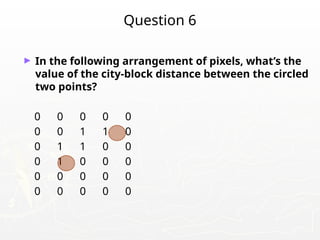
b. City Block Distance:
D4(p, q) = |x-s| + |y-t|
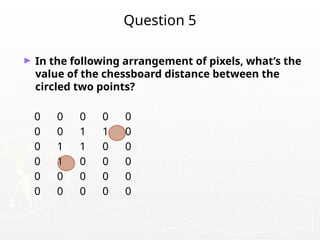
c. Chess Board Distance:
D8(p, q) = max(|x-s|, |y-t|)
74.
Question 5
► Inthe following arrangement of pixels, what’s the
value of the chessboard distance between the
circled two points?
0 0 0 0 0
0 0 1 1 0
0 1 1 0 0
0 1 0 0 0
0 0 0 0 0
0 0 0 0 0
75.
Question 6
► Inthe following arrangement of pixels, what’s the
value of the city-block distance between the circled
two points?
0 0 0 0 0
0 0 1 1 0
0 1 1 0 0
0 1 0 0 0
0 0 0 0 0
0 0 0 0 0
76.
Question 7
► Inthe following arrangement of pixels, what’s the
value of the length of the m-path between the
circled two points?
0 0 0 0 0
0 0 1 1 0
0 1 1 0 0
0 1 0 0 0
0 0 0 0 0
0 0 0 0 0
77.
Question 8
► Inthe following arrangement of pixels, what’s the
value of the length of the m-path between the
circled two points?
0 0 0 0 0
0 0 1 1 0
0 0 1 0 0
0 1 0 0 0
0 0 0 0 0
0 0 0 0 0
78.
Introduction to MathematicalOperations in
DIP
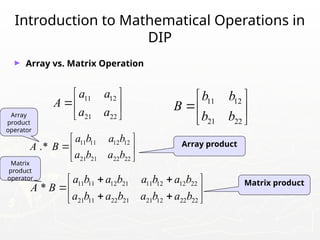
► Array vs. Matrix Operation
11 12
21 22
b b
B
b b
11 12
21 22
a a
A
a a
11 11 12 21 11 12 12 22
21 11 22 21 21 12 22 22
*
a b a b a b a b
A B
a b a b a b a b
11 11 12 12
21 21 22 22
.*
a b a b
A B
a b a b
Array product
Matrix product
Array
product
operator
Matrix
product
operator
79.
Introduction to MathematicalOperations in
DIP
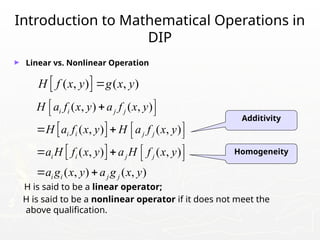
► Linear vs. Nonlinear Operation
H is said to be a linear operator;
H is said to be a nonlinear operator if it does not meet the
above qualification.
( , ) ( , )
H f x y g x y
Additivity
Homogeneity
( , ) ( , )
( , ) ( , )
( , ) ( , )
( , ) ( , )
i i j j
i i j j
i i j j
i i j j
H a f x y a f x y
H a f x y H a f x y
a H f x y a H f x y
a g x y a g x y
80.
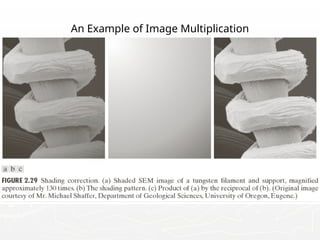
Arithmetic Operations
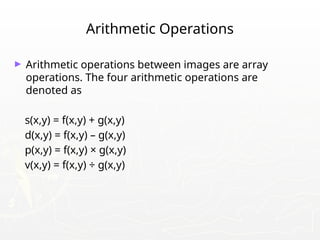
► Arithmeticoperations between images are array
operations. The four arithmetic operations are
denoted as
s(x,y) = f(x,y) + g(x,y)
d(x,y) = f(x,y) – g(x,y)
p(x,y) = f(x,y) × g(x,y)
v(x,y) = f(x,y) ÷ g(x,y)
81.
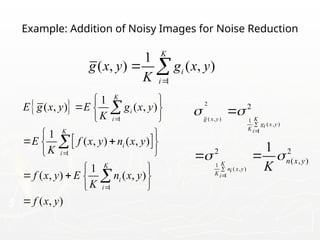
Example: Addition ofNoisy Images for Noise Reduction
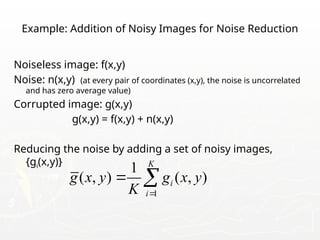
Noiseless image: f(x,y)
Noise: n(x,y) (at every pair of coordinates (x,y), the noise is uncorrelated
and has zero average value)
Corrupted image: g(x,y)
g(x,y) = f(x,y) + n(x,y)
Reducing the noise by adding a set of noisy images,
{gi(x,y)}
1
1
( , ) ( , )
K
i
i
g x y g x y
K
82.
Example: Addition ofNoisy Images for Noise Reduction
1
1
1
1
( , ) ( , )
1
( , ) ( , )
1
( , ) ( , )
( , )
K
i
i
K
i
i
K
i
i
E g x y E g x y
K
E f x y n x y
K
f x y E n x y
K
f x y
1
1
( , ) ( , )
K
i
i
g x y g x y
K
2
( , ) 1
( , )
1
1
( , )
1
2
2 2
( , )
1
g x y K
g x y
i
K i
K
n x y
i
K i
n x y
K
83.
Example: Addition ofNoisy Images for Noise Reduction
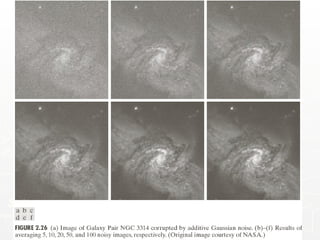
► In astronomy, imaging under very low light levels
frequently causes sensor noise to render single
images virtually useless for analysis.
► In astronomical observations, similar sensors for
noise reduction by observing the same scene over
long periods of time. Image averaging is then used
to reduce the noise.
85.
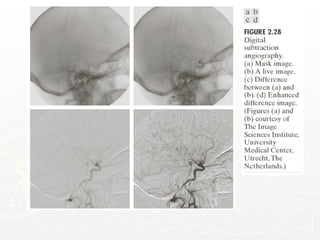
An Example ofImage Subtraction: Mask Mode
Radiography
Mask h(x,y): an X-ray image of a region of a patient’s body
Live images f(x,y): X-ray images captured at TV rates after injection
of the contrast medium
Enhanced detail g(x,y)
g(x,y) = f(x,y) - h(x,y)
The procedure gives a movie showing how the contrast medium
propagates through the various arteries in the area being
observed.
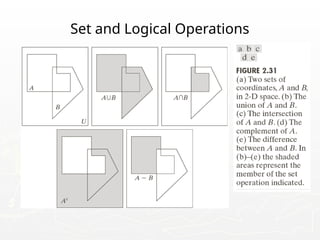
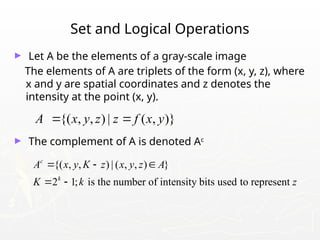
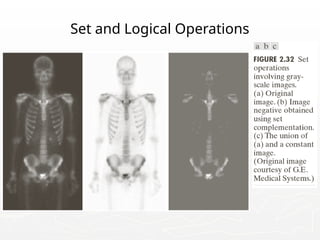
Set and LogicalOperations
► Let A be the elements of a gray-scale image
The elements of A are triplets of the form (x, y, z), where
x and y are spatial coordinates and z denotes the
intensity at the point (x, y).
► The complement of A is denoted Ac
{( , , ) | ( , , ) }
2 1; is the number of intensity bits used to represent
c
k
A x y K z x y z A
K k z
{( , , ) | ( , )}
A x y z z f x y
90.
Set and LogicalOperations
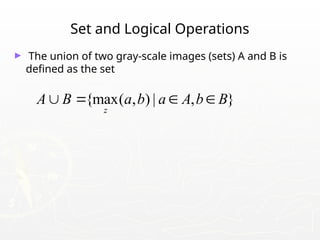
► The union of two gray-scale images (sets) A and B is
defined as the set
{max( , ) | , }
z
A B a b a A b B
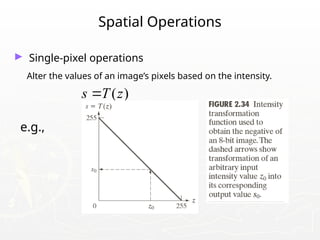
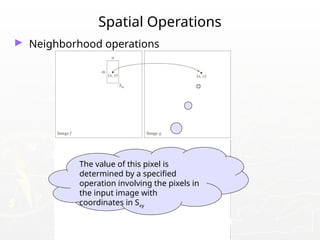
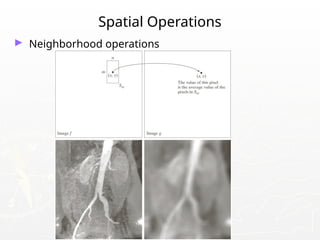
Spatial Operations
► Neighborhoodoperations
The value of this pixel is
determined by a specified
operation involving the pixels in
the input image with
coordinates in Sxy
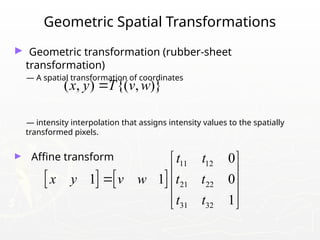
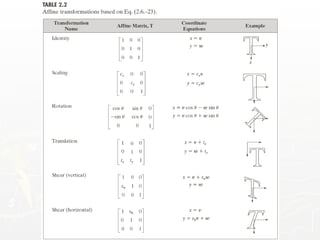
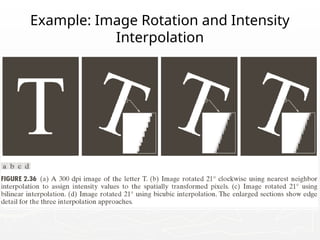
Geometric Spatial Transformations
►Geometric transformation (rubber-sheet
transformation)
— A spatial transformation of coordinates
— intensity interpolation that assigns intensity values to the spatially
transformed pixels.
► Affine transform
( , ) {( , )}
x y T v w
11 12
21 22
31 32
0
1 1 0
1
t t
x y v w t t
t t
98.
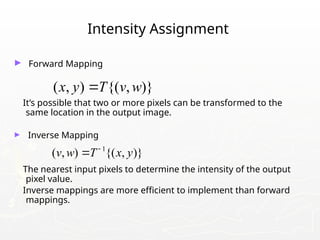
Intensity Assignment
► ForwardMapping
It’s possible that two or more pixels can be transformed to the
same location in the output image.
► Inverse Mapping
The nearest input pixels to determine the intensity of the output
pixel value.
Inverse mappings are more efficient to implement than forward
mappings.
( , ) {( , )}
x y T v w
1
( , ) {( , )}
v w T x y
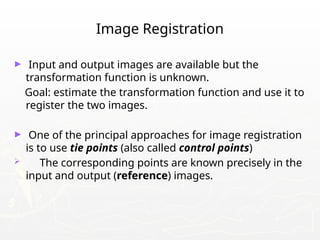
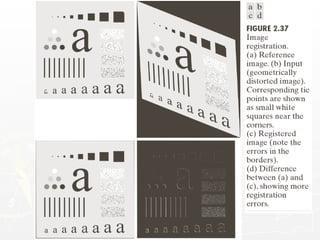
Image Registration
► Inputand output images are available but the
transformation function is unknown.
Goal: estimate the transformation function and use it to
register the two images.
► One of the principal approaches for image registration
is to use tie points (also called control points)
The corresponding points are known precisely in the
input and output (reference) images.
101.
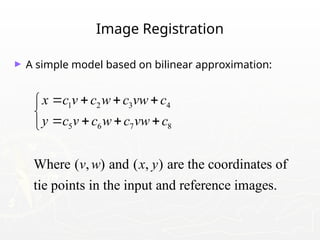
Image Registration
► Asimple model based on bilinear approximation:
1 2 3 4
5 6 7 8
Where ( , ) and ( , ) are the coordinates of
tie points in the input and reference images.
x c v c w c vw c
y c v c w c vw c
v w x y
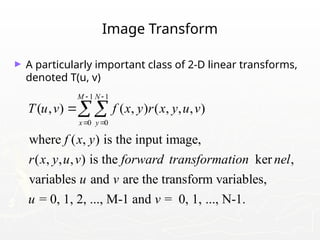
Image Transform
► Aparticularly important class of 2-D linear transforms,
denoted T(u, v)
1 1
0 0
( , ) ( , ) ( , , , )
where ( , ) is the input image,
( , , , ) is the ker ,
variables and are the transform variables,
= 0, 1, 2, ..., M-1 and = 0, 1,
M N
x y
T u v f x y r x y u v
f x y
r x y u v forward transformation nel
u v
u v
..., N-1.
104.
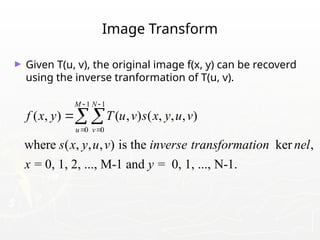
Image Transform
► GivenT(u, v), the original image f(x, y) can be recoverd
using the inverse tranformation of T(u, v).
1 1
0 0
( , ) ( , ) ( , , , )
where ( , , , ) is the ker ,
= 0, 1, 2, ..., M-1 and = 0, 1, ..., N-1.
M N
u v
f x y T u v s x y u v
s x y u v inverse transformation nel
x y
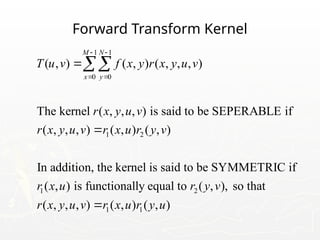
Forward Transform Kernel
11
0 0
1 2
1 2
( , ) ( , ) ( , , , )
The kernel ( , , , ) is said to be SEPERABLE if
( , , , ) ( , ) ( , )
In addition, the kernel is said to be SYMMETRIC if
( , ) is functionally equal to ( ,
M N
x y
T u v f x y r x y u v
r x y u v
r x y u v r x u r y v
r x u r y v
1 1
), so that
( , , , ) ( , ) ( , )
r x y u v r x u r y u
108.
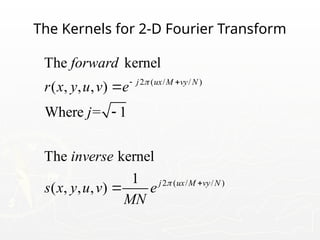
The Kernels for2-D Fourier Transform
2 ( / / )
2 ( / / )
The kernel
( , , , )
Where = 1
The kernel
1
( , , , )
j ux M vy N
j ux M vy N
forward
r x y u v e
j
inverse
s x y u v e
MN
109.
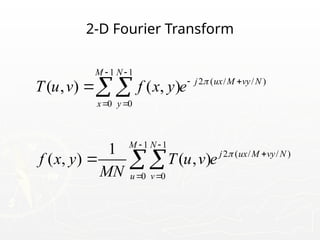
2-D Fourier Transform
11
2 ( / / )
0 0
1 1
2 ( / / )
0 0
( , ) ( , )
1
( , ) ( , )
M N
j ux M vy N
x y
M N
j ux M vy N
u v
T u v f x y e
f x y T u v e
MN
110.
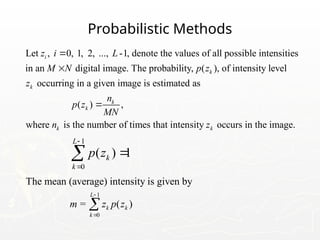
Probabilistic Methods
Let ,0, 1, 2, ..., -1, denote the values of all possible intensities
in an digital image. The probability, ( ), of intensity level
occurring in a given image is estimated as
i
k
k
z i L
M N p z
z
( ) ,
where is the number of times that intensity occurs in the image.
k
k
k k
n
p z
MN
n z
1
0
( ) 1
L
k
k
p z
1
0
The mean (average) intensity is given by
= ( )
L
k k
k
m z p z
111.
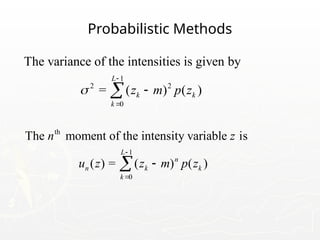
Probabilistic Methods
1
2 2
0
Thevariance of the intensities is given by
= ( ) ( )
L
k k
k
z m p z
th
1
0
The moment of the intensity variable is
( ) = ( ) ( )
L
n
n k k
k
n z
u z z m p z


![Representing Digital Images
► Discrete intensity interval [0, L-1], L=2k
► The number b of bits required to store a M × N
digitized image
b = M × N × k](https://image.slidesharecdn.com/cen454topic1-250722183813-76e008fd/85/computer-Vision-and-Machine-learning-Chapter-1-36-320.jpg)
![Distance Measures
► Given pixels p, q and z with coordinates (x, y), (s, t),
(u, v) respectively, the distance function D has
following properties:
a. D(p, q) 0 [D(p, q) = 0, iff p = q]
≥
b. D(p, q) = D(q, p)
c. D(p, z) D(p, q) + D(q, z)
≤](https://image.slidesharecdn.com/cen454topic1-250722183813-76e008fd/85/computer-Vision-and-Machine-learning-Chapter-1-72-320.jpg)
![Distance Measures
The following are the different Distance measures:
a. Euclidean Distance :
De(p, q) = [(x-s)2
+ (y-t)2
]1/2
b. City Block Distance:
D4(p, q) = |x-s| + |y-t|
c. Chess Board Distance:
D8(p, q) = max(|x-s|, |y-t|)](https://image.slidesharecdn.com/cen454topic1-250722183813-76e008fd/85/computer-Vision-and-Machine-learning-Chapter-1-73-320.jpg)