A RECORDING STUDIO
THE STUDIO
Design
• The desing of the recording studio, doesn’t have a fixed estructure
• The only things that you need are:
• Computer
• DAW (record/edit)
• Microphone
• Headphones
• Few speakers
COMPUTER DAW
MICROPHONE
HEADPHONES
SPEAKERS
Programs to edit and record
6. Audacity
1. Pro Tools
2. Cubase
3. Adobe Audition
4. Sonar 8
5. Fl Studio
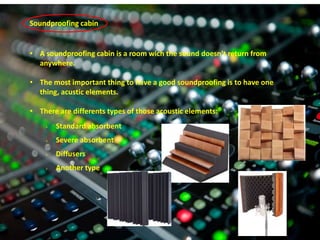
Soundproofing cabin
• A soundproofing cabin is a room wich the sound doesn’t return from
anywhere.
• The most important thing to have a good soundproofing is to have one
thing, acustic elements.
• There are differents types of those acoustic elements:
› Standard absorbent
› Severe absorbent
› Diffusers
› Another type
RECORDING
Record
Edit
Mixing
Mastering
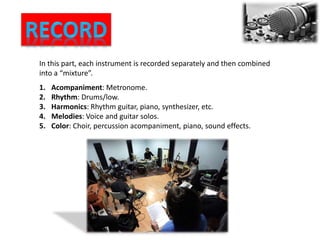
In this part, each instrument is recorded separately and then combined
into a “mixture”.
1. Acompaniment: Metronome.
2. Rhythm: Drums/low.
3. Harmonics: Rhythm guitar, piano, synthesizer, etc.
4. Melodies: Voice and guitar solos.
5. Color: Choir, percussion acompaniment, piano, sound effects.
To change any imperfection
or something else, we must
use the DAW.
1. Achieve a balance
2. Panning
3. Levelling
4. Compression
5. Reverb
6. Automation
1. Loudness
2. Maximizer
3. Balancing
4. Frequencies
5. Stereo extension
A recording studio

A recording studio

  • 1.
  • 2.
    THE STUDIO Design • Thedesing of the recording studio, doesn’t have a fixed estructure • The only things that you need are: • Computer • DAW (record/edit) • Microphone • Headphones • Few speakers
  • 3.
  • 4.
    Programs to editand record 6. Audacity 1. Pro Tools 2. Cubase 3. Adobe Audition 4. Sonar 8 5. Fl Studio
  • 5.
    Soundproofing cabin • Asoundproofing cabin is a room wich the sound doesn’t return from anywhere. • The most important thing to have a good soundproofing is to have one thing, acustic elements. • There are differents types of those acoustic elements: › Standard absorbent › Severe absorbent › Diffusers › Another type
  • 6.
  • 7.
    In this part,each instrument is recorded separately and then combined into a “mixture”. 1. Acompaniment: Metronome. 2. Rhythm: Drums/low. 3. Harmonics: Rhythm guitar, piano, synthesizer, etc. 4. Melodies: Voice and guitar solos. 5. Color: Choir, percussion acompaniment, piano, sound effects.
  • 8.
    To change anyimperfection or something else, we must use the DAW. 1. Achieve a balance 2. Panning 3. Levelling 4. Compression 5. Reverb 6. Automation 1. Loudness 2. Maximizer 3. Balancing 4. Frequencies 5. Stereo extension