Submitted by-
Binay ku. Tripathy
3rd year Civil Engg
VSSUT,BURLA
DIFFERENT ALTERNATIVE OPTION FOR GENERATING
ELECTRICITY FROM FAST MOVING VEHICLE :-
Now a days power from fast moving vehicle can be produced this
  ways:-
 Frictional energy generated by applying brake .
 By piezoelectric material from the movement in vehicle or
  pressure from vehicle.
 A fast moving vehicle compresses the air in the front of it and
  pushes the air from its sides thereby creating a vacuum at its rear and
  its sides as it moves forward.
 Induced rotational energy when a vehicle i.e train ,aero plane
  passes by the turbine.
 But here we will discuss about a method in which wind strike
  the turbine directly mounted on train.
WHY THIS?


 The fixed wind powered electricity generation systems in use, till
  now are dependent on wind direction and the force of the wind.


 But the wind is not available at all place and all time through out the
  year.


 Therefore, there exists an immense need of a system for generating
  electricity from wind induced by moving vehicles, trains or
  airplanes, which is available through out the year at various places
  and with sufficient force of wind.
Rotor and its alternatives
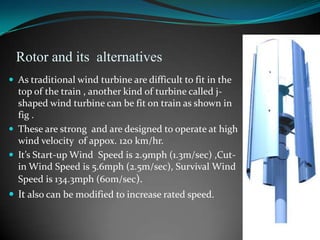
 As traditional wind turbine are difficult to fit in the
  top of the train , another kind of turbine called j-
  shaped wind turbine can be fit on train as shown in
  fig .
 These are strong and are designed to operate at high
  wind velocity of appox. 120 km/hr.
 It’s Start-up Wind Speed is 2.9mph (1.3m/sec) ,Cut-
  in Wind Speed is 5.6mph (2.5m/sec), Survival Wind
  Speed is 134.3mph (60m/sec).
 It also can be modified to increase rated speed.
Features and effect of this turbine:-
 Rotates regardless of the wind direction, and begins operation in
    a gentle breeze.
   Highly resistant to strong winds, and also robust enough to
    survive typhoons or hurricanes.
   Lightweight and simple structure designed for ease of
    transportation, construction and maintenance.
   Low-noise, low-vibration operation.
   Requires only a limited space to install.
   Resistant to lightning-induced damage thanks to the
    employment of aluminum blades.
   Mass production is possible.
   Highly customizable.
   Design helps to avoid bird strikes.
   All materials recyclable.
   Installation can be designed not to damage scenery.
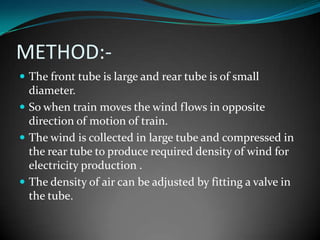
INSTALLATION OF TURBINE ON TRAIN:-
METHOD:-
 The front tube is large and rear tube is of small
  diameter.
 So when train moves the wind flows in opposite
  direction of motion of train.
 The wind is collected in large tube and compressed in
  the rear tube to produce required density of wind for
  electricity production .
 The density of air can be adjusted by fitting a valve in
  the tube.
Conversion of energy
 The generator is the unit of the wind turbine that transforms
  mechanical energy into electrical energy.
 The blades transfer the kinetic energy from the wind into rotational
  energy in the transmission system, and the generator is the next step
  in the supply of energy from the wind turbine to the electrical grid.
 The wind turbine may be connected to an electricity generator. The
  generated electricity may to be stored in batteries from which energy
  may be used as per the need.
Where it can be used?
 These can be designed to power small units like compartments of
  train, recharging batteries etc.
 It is also quite easy to imagine how a specially designed wind turbine
  like this could sit on top of the train or at front and power its engine
  as you cruise along on the rail/road.
 This wind turbine can be developed to be used as an alternative
  means to recharge communications equipment too.
 It can be connected to our national grid in every railway track.
conclusion
 There are 14,300 trains operating daily on 63,000 route kilometers of
  railway in India. This technique would be capable of producing
  1,481,000 megawatt of power in India .
 As wind is clean source of energy it will contribute to enviromental
  protection.

 Cost of production will be low.


 So we can still hope for a better future.

A method for generating electricity by fast moving by binay

  • 1.
    Submitted by- Binay ku.Tripathy 3rd year Civil Engg VSSUT,BURLA
  • 2.
    DIFFERENT ALTERNATIVE OPTIONFOR GENERATING ELECTRICITY FROM FAST MOVING VEHICLE :- Now a days power from fast moving vehicle can be produced this ways:-  Frictional energy generated by applying brake .  By piezoelectric material from the movement in vehicle or pressure from vehicle.  A fast moving vehicle compresses the air in the front of it and pushes the air from its sides thereby creating a vacuum at its rear and its sides as it moves forward.  Induced rotational energy when a vehicle i.e train ,aero plane passes by the turbine.  But here we will discuss about a method in which wind strike the turbine directly mounted on train.
  • 3.
    WHY THIS?  Thefixed wind powered electricity generation systems in use, till now are dependent on wind direction and the force of the wind.  But the wind is not available at all place and all time through out the year.  Therefore, there exists an immense need of a system for generating electricity from wind induced by moving vehicles, trains or airplanes, which is available through out the year at various places and with sufficient force of wind.
  • 4.
    Rotor and itsalternatives  As traditional wind turbine are difficult to fit in the top of the train , another kind of turbine called j- shaped wind turbine can be fit on train as shown in fig .  These are strong and are designed to operate at high wind velocity of appox. 120 km/hr.  It’s Start-up Wind Speed is 2.9mph (1.3m/sec) ,Cut- in Wind Speed is 5.6mph (2.5m/sec), Survival Wind Speed is 134.3mph (60m/sec).  It also can be modified to increase rated speed.
  • 5.
    Features and effectof this turbine:-  Rotates regardless of the wind direction, and begins operation in a gentle breeze.  Highly resistant to strong winds, and also robust enough to survive typhoons or hurricanes.  Lightweight and simple structure designed for ease of transportation, construction and maintenance.  Low-noise, low-vibration operation.  Requires only a limited space to install.  Resistant to lightning-induced damage thanks to the employment of aluminum blades.  Mass production is possible.  Highly customizable.  Design helps to avoid bird strikes.  All materials recyclable.  Installation can be designed not to damage scenery.
  • 6.
  • 7.
    METHOD:-  The fronttube is large and rear tube is of small diameter.  So when train moves the wind flows in opposite direction of motion of train.  The wind is collected in large tube and compressed in the rear tube to produce required density of wind for electricity production .  The density of air can be adjusted by fitting a valve in the tube.
  • 8.
    Conversion of energy The generator is the unit of the wind turbine that transforms mechanical energy into electrical energy.  The blades transfer the kinetic energy from the wind into rotational energy in the transmission system, and the generator is the next step in the supply of energy from the wind turbine to the electrical grid.  The wind turbine may be connected to an electricity generator. The generated electricity may to be stored in batteries from which energy may be used as per the need.
  • 9.
    Where it canbe used?  These can be designed to power small units like compartments of train, recharging batteries etc.  It is also quite easy to imagine how a specially designed wind turbine like this could sit on top of the train or at front and power its engine as you cruise along on the rail/road.  This wind turbine can be developed to be used as an alternative means to recharge communications equipment too.  It can be connected to our national grid in every railway track.
  • 10.
    conclusion  There are14,300 trains operating daily on 63,000 route kilometers of railway in India. This technique would be capable of producing 1,481,000 megawatt of power in India .  As wind is clean source of energy it will contribute to enviromental protection.  Cost of production will be low.  So we can still hope for a better future.