HAL Id: hal-00668975
https://hal.inria.fr/hal-00668975
Submitted on 26 Feb 2012
HAL is a multi-disciplinary open access
archive for the deposit and dissemination of sci-
entific research documents, whether they are pub-
lished or not. The documents may come from
teaching and research institutions in France or
abroad, or from public or private research centers.
L’archive ouverte pluridisciplinaire HAL, est
destinée au dépôt et à la diffusion de documents
scientifiques de niveau recherche, publiés ou non,
émanant des établissements d’enseignement et de
recherche français ou étrangers, des laboratoires
publics ou privés.
A Message-Passing Model for Service Oriented
Computing
Diana Allam, Rémi Douence, Hervé Grall, Jean-Claude Royer, Mario Südholt
To cite this version:
Diana Allam, Rémi Douence, Hervé Grall, Jean-Claude Royer, Mario Südholt. A Message-Passing
Model for Service Oriented Computing. WEBIST, 8th International Conference on Web Information
Systems and Technologies, Apr 2012, Porto, Portugal. pp.136-142. ฀hal-00668975฀
A Message-Passing Model for Service Oriented Computing∗
Diana Allam, Rémi Douence, Hervé Grall, Jean-Claude Royer and Mario Südholt
ASCOLA group; EMN-INRIA, LINA
Département Informatique, École des Mines de Nantes, Nantes, France
{first name.last name}@emn.fr
Keywords: Service-Oriented Computing, Message-Passing Model, Type Checking
Abstract: Web services can be built according to multiple service models and technologies. Although there is a clear
need for a model integrating them in multiple real-world contexts, no integrated model does (yet) exist. In
this paper, we introduce a model as a foundation for heterogeneous services, in particular, SOAP/WS* and
RESTful services. The model abstracts away from service implementations, composes services in a truly
concurrent manner and supports asynchronous message passing as well as mobility of typed channels.
1 INTRODUCTION
Web services can be built according to multiple
service models, technologies and protocols (Alonso
et al., 2004). Despite the different architectures un-
derlying these service models and the applications
they target, web service models have similar char-
acteristics and are often used together. In such a
heterogeneous system, despite existing security stan-
dards, sophisticated attacks regularly emerge (Lind-
strom, 2004). Most of these attacks are enabled by
weaknesses in web service security policies. A solu-
tion to this problem of heterogeneous service compo-
sitions can, in principle, be based an message-passing
models that mediate between different service mod-
els. There are some existing models in the market
satisfying this message-passing principle, like the En-
terprise Service Bus (ESB) that is available for differ-
ent service models and technologies. However, these
models are not systematically used: frequently, e.g.,
WS* services call RESTful services directly. Further-
more, ESB-based implementations are not amenable
to formal reasoning over properties of service compo-
sitions. In order to ensure properties over heteroge-
neous service compositions, a more general and rig-
orous abstract model is needed.
Actually, service models can be unified based on a
few concepts: distributed agents are built by means of
interacting distributed services that are composed in
a black-box manner using well-defined service inter-
faces. These agents provide services while requiring
∗This work has been supported by the CESSA ANR
project (see http://cessa.inria.gforge.fr).
other services that are consumed. Such a global ab-
straction based on the notion of black-boxes for SOAs
provides significant benefits for the management of
distributed services: their security properties, in par-
ticular, can then be specified through contracts at the
interaction level. A formal and unified model can then
be used to enforce security properties by means of a
security monitor that mediates between an encapsu-
lated agents and the network.
We propose a unified model as a foundation for
service compositions that represents services in terms
of an abstract pivot language that is independent from
the service model and corresponding implementation
technology. Once all distributed services are uni-
fied, the implementation and reasoning about secu-
rity properties can be performed at the message ex-
change level and enforced before the execution of ser-
vice compositions. In this paper, we motivate and in-
formally define such a unified model (respectively in
sections 2 and 3). We then illustrate by an example the
conversion of services interfaces conforming to the
WS* and RESTful service models into our language
(sec. 4). We then illustrate the benefits to the rea-
soning about service composition properties through
a simple application to service type checking (Sec. 5).
We show how well-typed services solve problems that
might occur because of programmer mistakes or lack
of information during runtime service discovery.
The formal account of the model and its appli-
cation to the verification of several security proper-
ties are provided in a companion report (Allam et al.,
2011).
Figure 1: Flight booking request: Relationship between WS*/RESTful
and our formal model
Figure 2: UML Diagram for Processes
2 MOTIVATION BY EXAMPLE
We motivate and illustrate our approach through
a running example, a service-based system for flight
reservation. We focus our illustration on the two most
competing models in web services: SOAP/WS* and
RESTful. We consider a two-step scenario: a client
agent first searches a flight travel from a source city
to a target one at a specific date; in a second step, it
receives a list of possible flights, makes its choice and
books a flight. We investigate two different imple-
mentations for this example, respectively using WS*
and RESTful services. Here, we aim to find the main
concepts allowing to define a unified abstract model
for both technologies: RESTful and WS*. In the fol-
lowing, we discuss three core concepts in light of the
flight service example: message exchange, black box
agent and channel mobility.
Message exchange. The first two rows of Figure 1
show message exchanges that are part of a flight book-
ing request. This request may hold a SOAP mes-
sage over a transport protocol (HTTP, FTP, SMTP or
others) governed by the WS* standards or a simple
HTTP message wrapping a payload for RESTful ser-
vices. Thus, an abstract formal model unifying these
two technologies must specify a message format com-
patible with both of them.
As illustrated in the bottom row of Figure 1,
our abstraction of message exchanges corresponds
to three communication rules : (i) [LOC]: abstracts
local executions that consume incoming messages
and produce messages to be sent over the network;
(ii) [OUT]: enables the passage of a message through-
out the agent interface to the network; and (iii) [IN]:
enables the receipt of a message from the network to
the designated agent throughout its interface.
Black Box Agent. The service-based implementa-
tion of the flight reservation process requires a whole
stack of different layers and business components:
data bases and associated access interfaces, business
processes that coordinate (e.g., using BPEL) the ex-
ecution of business components that implement en-
terprise functionalities and a suitable interfaces must
be defined that expose the business processes as ser-
vices. To specify such an interface, we can use WS-
Management WSDL (Web Services Description Lan-
guage) for the WS* implementation, a method more
expressive than a simple WSDL file. Typically inter-
action contracts based on exchanged SOAP messages
are defined using WS-Addressing, WS-Discovery,
WS-Policy, WS-Security and others. As for REST-
ful services, no standard exists that provides such in-
terface descriptions. For our example, we consider a
WADL (Web Services Application Language) file.
In accordance with the black-box principle, we are
interested in an abstraction that hides all the imple-
mentation details of web services. We model an ele-
mentary process as a composition of an interface and
an agent having an internal state which evolves during
its execution. The agent abstraction hides all imple-
mentation details for the data base access layer and
the business process layer. The interface is composed
of provided or required services. Each service is a set
of channels to receive incoming messages or to send
messages over the network. This abstraction is illus-
trated in Figure 1 for a client and a server on a channel
K refering to the ”book flight” service.
Channel Mobility. We describe two practical im-
portant aspects of this feature.
Request/Reply Mechanism. In the client/server
communication of the flight reservation scenario, the
server does not initially know the client. Thus for the
reply, the server uses the callback information con-
tained in the received message. Concretely, this infor-
mation could correspond to a source IP address and
port over a transport protocol (e.g. HTTP) or an end-
point reference (EPR) in the ReplyTo block of a WS-
Addressing header for a SOAP message or a specific
location in an HTTP message. This way, the call-
back mechanism can be performed synchronously,
usually over one session of the transport protocol, or
asynchronously over two distinguished client/server
sessions. Our formal model must therefore be ex-
pressive enough to represent both synchronous and
asynchronous communications. However, since syn-
chronous communication can be implemented with
message passing (Lamport and Lynch, 1990), our
model only supports asynchronous communication,
via one-way channels. A reply channel, correspond-
ing to a callback, must therefore be sent by the client.
Discovery Mechanism. Suppose that the client
does not know the location of the flight reservation
service while knowing its interface. Thus, at runtime,
before invoking the service, the client needs to dis-
cover a target location for the service. In case of WS*
technology, several techniques can be used for ser-
vice discovery. The UDDI standard can be used if
a centralized registry is appropriate to discover web
services. As part of an ad-hoc architecture, the WS-
Discovery standard provides endpoint references for
the flight service. In the case of a RESTful implemen-
tation, search engines, like Google, could be used for
getting the root resource URL. Then a RESTful ser-
vice could be ”self-discovery” by defining links be-
tween resources. Service discovery thus means look-
ing up a set of channels.
3 MODEL OVERVIEW
In this section we give an overview of the concepts
of our abstract model for unifying web services tech-
nologies. Our model belongs to the class of message-
passing models (Lamport and Lynch, 1990): agents
exchange messages by using a buffer and without
sharing memory or without synchronizing the send-
ing and the receiving of messages in a rendez-vous.
Communication is assumed to be completely
asynchronous. The buffer used to communicate mod-
els the network. We consider it as a finite multiset
of messages, with no bound and no order. Actually,
a message is defined as some content on a channel.
The channel determines the unique target of the mes-
sage. Initially, coordination is only possible between
agents that share a channel, for instance between a
server providing a channel and its clients, requiring
the same channel. Gradually, agents discover new
channels since messages can contain channels: chan-
nel mobility makes network topology evolve.
The two main requirements of our model, asyn-
chronous communication and true concurrency, has
led us to resort to a chemical model (Berry and
Boudol, 1992). Here, we describe the concepts us-
ing UML class diagrams and informally present the
main semantic rules.
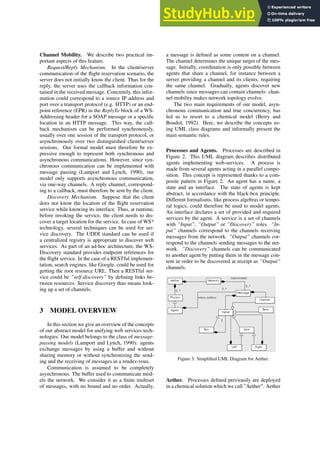
Processes and Agents. Processes are described in
Figure 2. This UML diagram describes distributed
agents implementing web-services. A process is
made from several agents acting in a parallel compo-
sition. This concept is represented thanks to a com-
posite pattern in Figure 2. An agent has a name, a
state and an interface. The state of agents is kept
abstract, in accordance with the black-box principle.
Different formalisms, like process algebras or tempo-
ral logics, could therefore be used to model agents.
An interface declares a set of provided and required
services by the agent. A service is a set of channels
with ”Input”, ”Output” or ”Discovery” roles. ”In-
put” channels correspond to the channels receiving
messages from the network. ”Output” channels cor-
respond to the channels sending messages to the net-
work. ”Discovery” channels can be communicated
to another agent by putting them in the message con-
tent in order to be discovered at receipt as ”Output”
channels.
Figure 3: Simplified UML Diagram for Aether.
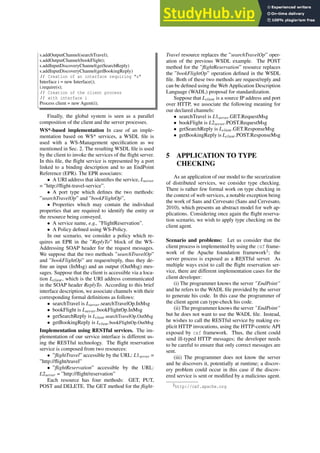
Aether. Processes defined previously are deployed
in a chemical solution which we call ”Aether”. Aether
represents the global state of the computing world of
processes. The UML diagram of the aether descrip-
tion is depicted in Figure 3. The aether is a set of par-
allel agents and a network which contains messages
in transit. An agent has two mailboxes associated re-
spectively to incoming (outgoing) messages from (to)
the network. A message is defined as a value on a
channel. As different messages can have exactly the
same form (same channel, same content), and, gen-
erally, emission ordering is not respected by commu-
nications, we use multisets to store messages. Dur-
ing aether’s evolution (by reduction), messages are
emitted by agents into the network or consumed from
the network. We abstract away message contents and
strictly consider constructions required with a black
box view of web service communications. Our aim
is to abstract important constructions in SOAP and
HTTP messages, which are the two most common
transport formats of messages in web services. In our
model, message values carried by channels support
base values, mobile channels, pairs of two values and
left and right injections associated to disjoint union of
values. The two abstract constructions, product and
sum, are common in data format like XML and JSON.
Informal Semantics. The formal semantics can be
given by using a chemical abstract machine as defined
by Berry and Boudol in (Berry and Boudol, 1992).
Here we informally describe the three specific rules
of the machine, corresponding to reaction rules: see
Figure 1.
[LOC]: An agent consumes a multiset, possibly
empty, of input messages, produces a multiset,
possibly empty, of output messages, creates dy-
namically new sessions and updates its current
state to a new state.
[OUT]: An agent sends message from its outbox
over the network via channels. If the sent message
contains channels, these channels must be ”Dis-
covery” channels known by the agent.
[IN]: An agent receives message in its inbox from the
network. The message channel must be declared
as an input channel by the agent. At receipt there
is dynamic discovery of unknown channels. The
agent upgrades its declaration of ”Output” chan-
nels by adding all the channels discovered in the
content of the message.
4 EXAMPLE REVISITED
We now show how to apply our unified model to
the flight reservation scenario of Sec. 2. We discuss,
in particular, the relation of the formal model with the
WS* and RESTful models. We use a java syntax to
represent this scenario in our model.
Processes initialization. The client/server system
of the flight reservation scenario requires the defini-
tion of four channels, as declared in the following:
/ / Channel for requesting trips from a
/ / source to a target city at a specific date
Channel searchTravel = new Channel(searchType);
/ / Channel for getting a list of trips
Channel getSearchReply = new Channel(searchReplyType);
/ / Channel for booking requests for a
/ / specific flight of a client
Channel bookFlight = new Channel(bookingType);
/ / Channel for getting a booking confirmation
Channel getBookingReply = new Channel(notifReplyType);
According to these channels declarations, now we
are able to define the server and the client processes.
The server provides the service named
”FlightReservation” composed of two ”Input”
channels: searchTravel and bookFlight. Now, we
give a declaration of the server process, according to
the UML description given in Sec. 3.
/ / Creation of the service with two
/ / input channels
Service s = new Service(”FlightReservation”);
s.addInputChannel(searchTravel);
s.addInputChannel(bookFlight);
/ / Creation of an interface providing "s"
Interface i = new Interface();
i.provide(s);
/ / Creation of the server process
/ / with interface i
Process server = new Agent(i);
As for the client process, it requires the ser-
vice provided by the server. The two channels
searchTravel and bookFlight are then declared as
”Output” channels. The client must declares the two
channels getSearchReply and getBookingReply
for getting replies from requests on searchTravel
and bookFlight respectively. The two channels,
getSearchReply and getBookingReply, are ”In-
put” channels. They have also the role of ”Discovery”
channels in the sense that these two channels can be
communicated to the server in order to get replies.
The client declaration is given in the following:
/ / Creation of the service with two
/ / output channels and two
/ / Input/Discovery channels
Service s = new Service(”FlightReservation”);
s.addOutputChannel(searchTravel);
s.addOutputChannel(bookFlight);
s.addInputDiscoveryChannel(getSearchReply)
s.addInputDiscoveryChannel(getBookingReply)
/ / Creation of an interface requiring "s"
Interface i = new Interface();
i.require(s);
/ / Creation of the client process
/ / with interface i
Process client = new Agent(i);
Finally, the global system is seen as a parallel
composition of the client and the server processes.
WS*-based implementation In case of an imple-
mentation based on WS* services, a WSDL file is
used with a WS-Management specification as we
mentioned in Sec. 2. The resulting WSDL file is used
by the client to invoke the services of the flight server.
In this file, the flight service is represented by a port
linked to a binding description and to an EndPoint
Reference (EPR). The EPR associates:
• A URI address that identifies the service, Lserver
= ”http://flight-travel-service”.
• A port type which defines the two methods:
”searchTravelOp” and ”bookFlightOp”,
• Properties which may contain the individual
properties that are required to identify the entity or
the resource being conveyed.
• A service name, e.g., ”FlightReservation”.
• A Policy defined using WS-Policy.
In our scenario, we consider a policy which re-
quires an EPR in the ”ReplyTo” block of the WS-
Addressing SOAP header for the request messages.
We suppose that the two methods ”searchTravelOp”
and ”bookFlightOp” are request/reply, thus they de-
fine an input (InMsg) and an output (OutMsg) mes-
sages. Suppose that the client is accessible via a loca-
tion Lclient, which is the URI address communicated
in the SOAP header ReplyTo. According to this brief
interface description, we associate channels with their
corresponding formal definitions as follows:
• searchTravel is Lserver.searchTravelOp.InMsg
• bookFlight is Lserver.bookFlightOp.InMsg
• getSearchReply is Lclient.searchTravelOp.OutMsg
• getBookingReply is Lclient.bookFlightOp.OutMsg
Implementation using RESTful services. The im-
plementation of our service interface is different us-
ing the RESTful technology. The flight reservation
service is composed from two resources:
• ”flightTravel” accessible by the URL: L1server =
”http://flight/travel”
• ”flightReservation” accessible by the URL:
L2server = ”http://flight/reservation”
Each resource has four methods: GET, PUT,
POST and DELETE. The GET method for the flight-
Travel resource replaces the ”searchTravelOp” oper-
ation of the previous WSDL example. The POST
method for the ”flightReservation” resource replaces
the ”bookFlightOp” operation defined in the WSDL
file. Both of these two methods are request/reply and
can be defined using the Web Application Description
Language (WADL) proposal for standardization.
Suppose that Lclient is a source IP address and port
over HTTP, we associate the following meaning for
our declared channels:
• searchTravel is L1server.GET.RequestMsg
• bookFlight is L2server.POST.RequestMsg
• getSearchReply is Lclient.GET.ResponseMsg
• getBookingReply is Lclient.POST.ResponseMsg
5 APPLICATION TO TYPE
CHECKING
As an application of our model to the securization
of distributed services, we consider type checking.
There is rather few formal work on type checking in
the context of web services, a notable exception being
the work of Sans and Cervesato (Sans and Cervesato,
2010), which presents an abstract model for web ap-
plications. Considering once again the flight reserva-
tion scenario, we wish to apply type checking on the
client agent.
Scenario and problems: Let us consider that the
client process is implemented by using the cxf frame-
work of the Apache foundation framework2; the
server process is exposed as a RESTful server. As
multiple ways exist to call the flight reservation ser-
vice, there are different implementation cases for the
client developer:
(i) The programmer knows the server ”EndPoint”
and he refers to the WADL file provided by the server
to generate his code. In this case the programmer of
the client agent can type-check his code.
(ii) The programmer knows the server ”EndPoint”
but he does not want to use the WADL file. Instead,
he wishes to call the RESTful service by making ex-
plicit HTTP invocations, using the HTTP-centric API
exposed by cxf framework. Thus, the client could
send ill-typed HTTP messages; the developer needs
to be careful to ensure that only correct messages are
sent.
(iii) The programmer does not know the server
and he discovers it, potentially at runtime; a discov-
ery problem could occur in this case if the discov-
ered service is sent or modified by a malicious agent.
2http://cxf.apache.org
For example, an agent could communicate with the
malicious one and believe, erroneously, that the lat-
ter one provides a particular service. Such an error
gives the opportunity to attackers on the network for
hacking web services by simply flooding servers with
erroneous messages.
Our proposed solution: To avoid all of these is-
sues, we propose to use a framework to represent the
client and the server agents in our abstract model, in
terms of the description given in Sec. 43. Before ex-
ecution, the two agent interfaces must be checked in
order to exclude typing errors. This check consists
in the evaluation whether each required channel has
a type compatible with the corresponding provided
channel. Moreover, if a discovery mechanism is re-
quired at run-time to probe for an ”EndPoint” ref-
erence, an authentication mechanism is required to
avoid discovering services with fake information sent
by hackers. If the system is not well typed, the imple-
mentation generates a set of typing errors. To cor-
rect this problem, the developer has two possibili-
ties: 1) he can modify statically his code to correct all
the type problems, or 2) type checking can be imple-
mented separately from the implemented agent, thus
the check will occur at runtime before emitting the
message or at the moment of reception if we allow
messages to be emitted by unchecked agents. Such
dynamic type checking can be assured, e.g., by a
proxy that wraps the local agent.
6 RELATED WORK
In the following we present related work for
black-box models. There is some interesting works,
like (Seehusen and Stolen, 2009; Keller et al., 2006).
In (Seehusen and Stolen, 2009), authors define a for-
mal and abstract model for services. The semantics
are based on a notion of trace which is a sequence of
events. The intent of this formalization is to abstract
message sequence chart as they are used in UML 2.
While in (Keller et al., 2006), authors use the notion
of abstract state space to specify the functional de-
scriptions of web services. The authors demonstrate
the applicability of the formal model by showing how
to define and determine realizability and semantic re-
finement. Comparing these two models to ours, there
is different abstraction interests. Our model con-
tributes mainly in the abstraction of existing standards
3For lack of space we only present a brief informal de-
scription of our typing method. A detailed account can be
found in (Allam et al., 2011).
and is applied to type soundness. While (Seehusen
and Stolen, 2009) presents an advanced formalization
of some confidentiality issues and (Keller et al., 2006)
focuses on a particular functional description without
a clear defined syntax. Another interesting work is
(Sans and Cervesato, 2010) where authors share with
us a general view of the web services interactions but
without parallelism and asynchrony. Their work cov-
ers code mobility which we do not address here, we
are only concerned with the remote procedure call.
7 CONCLUSION
In this paper, we have presented an abstract model
unifying web service composition in heterogeneous
environments, such as those requiring interaction be-
tween backend servers that use WS* services and mo-
bile appliances that use RESTful services. We have
illustrated the model in the context of a flight booking
example. Finally, we have briefly presented an appli-
cation of the model to type checking. We have shown
how to support the detection of security-critical type
errors, notably security flaws due to service discovery
attacks, an interesting topic for future work.
REFERENCES
Allam, D. et al. (2011). Extension of the service model for
security and aspects. Deliverable D1.3, CESSA ANR
project, no. 09-SEGI-002-01.
Alonso, G., Casati, F., Kuno, H., and Machiraju, V. (2004).
Web Services: Concepts, Architectures and Applica-
tions. Springer, Berlin.
Berry, G. and Boudol, G. (1992). The chemical abstract
machine. Theoretical Computer Science, 96(1).
Keller, U. et al. (2006). On the semantics of functional de-
scriptions of web services. In Sure, Y. and Domingue,
J., editors, The Semantic Web: Research and Appli-
cations, 3rd European Semantic Web Conference, vol-
ume 4011 of LNCS, pages 605–619. Springer.
Lamport, L. and Lynch, N. (1990). Distributed comput-
ing: models and methods. In Handbook of Theoretical
Computer Science vol B. Elsevier.
Lindstrom, P. (2004). Attacking and defending web ser-
vices. In A Spire Research Report.
Sans, T. and Cervesato, I. (2010). Qwesst for type-
safe web programming. 3rd International Workshop
on Logics, Agents, and Mobility (LAM’10) Edin-
burgh, Scotland, http://www.qatar.cmu.edu/ tsans/in-
dex.php?page=research.
Seehusen, F. and Stolen, K. (2009). Information flow secu-
rity, abstraction and composition. IETF Information
and Security, 3(1):9–33.

A Message-Passing Model For Service Oriented Computing

  • 1.
    HAL Id: hal-00668975 https://hal.inria.fr/hal-00668975 Submittedon 26 Feb 2012 HAL is a multi-disciplinary open access archive for the deposit and dissemination of sci- entific research documents, whether they are pub- lished or not. The documents may come from teaching and research institutions in France or abroad, or from public or private research centers. L’archive ouverte pluridisciplinaire HAL, est destinée au dépôt et à la diffusion de documents scientifiques de niveau recherche, publiés ou non, émanant des établissements d’enseignement et de recherche français ou étrangers, des laboratoires publics ou privés. A Message-Passing Model for Service Oriented Computing Diana Allam, Rémi Douence, Hervé Grall, Jean-Claude Royer, Mario Südholt To cite this version: Diana Allam, Rémi Douence, Hervé Grall, Jean-Claude Royer, Mario Südholt. A Message-Passing Model for Service Oriented Computing. WEBIST, 8th International Conference on Web Information Systems and Technologies, Apr 2012, Porto, Portugal. pp.136-142. ฀hal-00668975฀
  • 2.
    A Message-Passing Modelfor Service Oriented Computing∗ Diana Allam, Rémi Douence, Hervé Grall, Jean-Claude Royer and Mario Südholt ASCOLA group; EMN-INRIA, LINA Département Informatique, École des Mines de Nantes, Nantes, France {first name.last name}@emn.fr Keywords: Service-Oriented Computing, Message-Passing Model, Type Checking Abstract: Web services can be built according to multiple service models and technologies. Although there is a clear need for a model integrating them in multiple real-world contexts, no integrated model does (yet) exist. In this paper, we introduce a model as a foundation for heterogeneous services, in particular, SOAP/WS* and RESTful services. The model abstracts away from service implementations, composes services in a truly concurrent manner and supports asynchronous message passing as well as mobility of typed channels. 1 INTRODUCTION Web services can be built according to multiple service models, technologies and protocols (Alonso et al., 2004). Despite the different architectures un- derlying these service models and the applications they target, web service models have similar char- acteristics and are often used together. In such a heterogeneous system, despite existing security stan- dards, sophisticated attacks regularly emerge (Lind- strom, 2004). Most of these attacks are enabled by weaknesses in web service security policies. A solu- tion to this problem of heterogeneous service compo- sitions can, in principle, be based an message-passing models that mediate between different service mod- els. There are some existing models in the market satisfying this message-passing principle, like the En- terprise Service Bus (ESB) that is available for differ- ent service models and technologies. However, these models are not systematically used: frequently, e.g., WS* services call RESTful services directly. Further- more, ESB-based implementations are not amenable to formal reasoning over properties of service compo- sitions. In order to ensure properties over heteroge- neous service compositions, a more general and rig- orous abstract model is needed. Actually, service models can be unified based on a few concepts: distributed agents are built by means of interacting distributed services that are composed in a black-box manner using well-defined service inter- faces. These agents provide services while requiring ∗This work has been supported by the CESSA ANR project (see http://cessa.inria.gforge.fr). other services that are consumed. Such a global ab- straction based on the notion of black-boxes for SOAs provides significant benefits for the management of distributed services: their security properties, in par- ticular, can then be specified through contracts at the interaction level. A formal and unified model can then be used to enforce security properties by means of a security monitor that mediates between an encapsu- lated agents and the network. We propose a unified model as a foundation for service compositions that represents services in terms of an abstract pivot language that is independent from the service model and corresponding implementation technology. Once all distributed services are uni- fied, the implementation and reasoning about secu- rity properties can be performed at the message ex- change level and enforced before the execution of ser- vice compositions. In this paper, we motivate and in- formally define such a unified model (respectively in sections 2 and 3). We then illustrate by an example the conversion of services interfaces conforming to the WS* and RESTful service models into our language (sec. 4). We then illustrate the benefits to the rea- soning about service composition properties through a simple application to service type checking (Sec. 5). We show how well-typed services solve problems that might occur because of programmer mistakes or lack of information during runtime service discovery. The formal account of the model and its appli- cation to the verification of several security proper- ties are provided in a companion report (Allam et al., 2011).
  • 3.
    Figure 1: Flightbooking request: Relationship between WS*/RESTful and our formal model Figure 2: UML Diagram for Processes 2 MOTIVATION BY EXAMPLE We motivate and illustrate our approach through a running example, a service-based system for flight reservation. We focus our illustration on the two most competing models in web services: SOAP/WS* and RESTful. We consider a two-step scenario: a client agent first searches a flight travel from a source city to a target one at a specific date; in a second step, it receives a list of possible flights, makes its choice and books a flight. We investigate two different imple- mentations for this example, respectively using WS* and RESTful services. Here, we aim to find the main concepts allowing to define a unified abstract model for both technologies: RESTful and WS*. In the fol- lowing, we discuss three core concepts in light of the flight service example: message exchange, black box agent and channel mobility. Message exchange. The first two rows of Figure 1 show message exchanges that are part of a flight book- ing request. This request may hold a SOAP mes- sage over a transport protocol (HTTP, FTP, SMTP or others) governed by the WS* standards or a simple HTTP message wrapping a payload for RESTful ser- vices. Thus, an abstract formal model unifying these two technologies must specify a message format com- patible with both of them. As illustrated in the bottom row of Figure 1, our abstraction of message exchanges corresponds to three communication rules : (i) [LOC]: abstracts local executions that consume incoming messages and produce messages to be sent over the network; (ii) [OUT]: enables the passage of a message through- out the agent interface to the network; and (iii) [IN]: enables the receipt of a message from the network to the designated agent throughout its interface. Black Box Agent. The service-based implementa- tion of the flight reservation process requires a whole stack of different layers and business components: data bases and associated access interfaces, business processes that coordinate (e.g., using BPEL) the ex- ecution of business components that implement en- terprise functionalities and a suitable interfaces must be defined that expose the business processes as ser- vices. To specify such an interface, we can use WS- Management WSDL (Web Services Description Lan- guage) for the WS* implementation, a method more expressive than a simple WSDL file. Typically inter- action contracts based on exchanged SOAP messages are defined using WS-Addressing, WS-Discovery, WS-Policy, WS-Security and others. As for REST- ful services, no standard exists that provides such in- terface descriptions. For our example, we consider a WADL (Web Services Application Language) file. In accordance with the black-box principle, we are interested in an abstraction that hides all the imple- mentation details of web services. We model an ele- mentary process as a composition of an interface and an agent having an internal state which evolves during its execution. The agent abstraction hides all imple- mentation details for the data base access layer and the business process layer. The interface is composed of provided or required services. Each service is a set of channels to receive incoming messages or to send messages over the network. This abstraction is illus- trated in Figure 1 for a client and a server on a channel K refering to the ”book flight” service.
  • 4.
    Channel Mobility. Wedescribe two practical im- portant aspects of this feature. Request/Reply Mechanism. In the client/server communication of the flight reservation scenario, the server does not initially know the client. Thus for the reply, the server uses the callback information con- tained in the received message. Concretely, this infor- mation could correspond to a source IP address and port over a transport protocol (e.g. HTTP) or an end- point reference (EPR) in the ReplyTo block of a WS- Addressing header for a SOAP message or a specific location in an HTTP message. This way, the call- back mechanism can be performed synchronously, usually over one session of the transport protocol, or asynchronously over two distinguished client/server sessions. Our formal model must therefore be ex- pressive enough to represent both synchronous and asynchronous communications. However, since syn- chronous communication can be implemented with message passing (Lamport and Lynch, 1990), our model only supports asynchronous communication, via one-way channels. A reply channel, correspond- ing to a callback, must therefore be sent by the client. Discovery Mechanism. Suppose that the client does not know the location of the flight reservation service while knowing its interface. Thus, at runtime, before invoking the service, the client needs to dis- cover a target location for the service. In case of WS* technology, several techniques can be used for ser- vice discovery. The UDDI standard can be used if a centralized registry is appropriate to discover web services. As part of an ad-hoc architecture, the WS- Discovery standard provides endpoint references for the flight service. In the case of a RESTful implemen- tation, search engines, like Google, could be used for getting the root resource URL. Then a RESTful ser- vice could be ”self-discovery” by defining links be- tween resources. Service discovery thus means look- ing up a set of channels. 3 MODEL OVERVIEW In this section we give an overview of the concepts of our abstract model for unifying web services tech- nologies. Our model belongs to the class of message- passing models (Lamport and Lynch, 1990): agents exchange messages by using a buffer and without sharing memory or without synchronizing the send- ing and the receiving of messages in a rendez-vous. Communication is assumed to be completely asynchronous. The buffer used to communicate mod- els the network. We consider it as a finite multiset of messages, with no bound and no order. Actually, a message is defined as some content on a channel. The channel determines the unique target of the mes- sage. Initially, coordination is only possible between agents that share a channel, for instance between a server providing a channel and its clients, requiring the same channel. Gradually, agents discover new channels since messages can contain channels: chan- nel mobility makes network topology evolve. The two main requirements of our model, asyn- chronous communication and true concurrency, has led us to resort to a chemical model (Berry and Boudol, 1992). Here, we describe the concepts us- ing UML class diagrams and informally present the main semantic rules. Processes and Agents. Processes are described in Figure 2. This UML diagram describes distributed agents implementing web-services. A process is made from several agents acting in a parallel compo- sition. This concept is represented thanks to a com- posite pattern in Figure 2. An agent has a name, a state and an interface. The state of agents is kept abstract, in accordance with the black-box principle. Different formalisms, like process algebras or tempo- ral logics, could therefore be used to model agents. An interface declares a set of provided and required services by the agent. A service is a set of channels with ”Input”, ”Output” or ”Discovery” roles. ”In- put” channels correspond to the channels receiving messages from the network. ”Output” channels cor- respond to the channels sending messages to the net- work. ”Discovery” channels can be communicated to another agent by putting them in the message con- tent in order to be discovered at receipt as ”Output” channels. Figure 3: Simplified UML Diagram for Aether. Aether. Processes defined previously are deployed in a chemical solution which we call ”Aether”. Aether
  • 5.
    represents the globalstate of the computing world of processes. The UML diagram of the aether descrip- tion is depicted in Figure 3. The aether is a set of par- allel agents and a network which contains messages in transit. An agent has two mailboxes associated re- spectively to incoming (outgoing) messages from (to) the network. A message is defined as a value on a channel. As different messages can have exactly the same form (same channel, same content), and, gen- erally, emission ordering is not respected by commu- nications, we use multisets to store messages. Dur- ing aether’s evolution (by reduction), messages are emitted by agents into the network or consumed from the network. We abstract away message contents and strictly consider constructions required with a black box view of web service communications. Our aim is to abstract important constructions in SOAP and HTTP messages, which are the two most common transport formats of messages in web services. In our model, message values carried by channels support base values, mobile channels, pairs of two values and left and right injections associated to disjoint union of values. The two abstract constructions, product and sum, are common in data format like XML and JSON. Informal Semantics. The formal semantics can be given by using a chemical abstract machine as defined by Berry and Boudol in (Berry and Boudol, 1992). Here we informally describe the three specific rules of the machine, corresponding to reaction rules: see Figure 1. [LOC]: An agent consumes a multiset, possibly empty, of input messages, produces a multiset, possibly empty, of output messages, creates dy- namically new sessions and updates its current state to a new state. [OUT]: An agent sends message from its outbox over the network via channels. If the sent message contains channels, these channels must be ”Dis- covery” channels known by the agent. [IN]: An agent receives message in its inbox from the network. The message channel must be declared as an input channel by the agent. At receipt there is dynamic discovery of unknown channels. The agent upgrades its declaration of ”Output” chan- nels by adding all the channels discovered in the content of the message. 4 EXAMPLE REVISITED We now show how to apply our unified model to the flight reservation scenario of Sec. 2. We discuss, in particular, the relation of the formal model with the WS* and RESTful models. We use a java syntax to represent this scenario in our model. Processes initialization. The client/server system of the flight reservation scenario requires the defini- tion of four channels, as declared in the following: / / Channel for requesting trips from a / / source to a target city at a specific date Channel searchTravel = new Channel(searchType); / / Channel for getting a list of trips Channel getSearchReply = new Channel(searchReplyType); / / Channel for booking requests for a / / specific flight of a client Channel bookFlight = new Channel(bookingType); / / Channel for getting a booking confirmation Channel getBookingReply = new Channel(notifReplyType); According to these channels declarations, now we are able to define the server and the client processes. The server provides the service named ”FlightReservation” composed of two ”Input” channels: searchTravel and bookFlight. Now, we give a declaration of the server process, according to the UML description given in Sec. 3. / / Creation of the service with two / / input channels Service s = new Service(”FlightReservation”); s.addInputChannel(searchTravel); s.addInputChannel(bookFlight); / / Creation of an interface providing "s" Interface i = new Interface(); i.provide(s); / / Creation of the server process / / with interface i Process server = new Agent(i); As for the client process, it requires the ser- vice provided by the server. The two channels searchTravel and bookFlight are then declared as ”Output” channels. The client must declares the two channels getSearchReply and getBookingReply for getting replies from requests on searchTravel and bookFlight respectively. The two channels, getSearchReply and getBookingReply, are ”In- put” channels. They have also the role of ”Discovery” channels in the sense that these two channels can be communicated to the server in order to get replies. The client declaration is given in the following: / / Creation of the service with two / / output channels and two / / Input/Discovery channels Service s = new Service(”FlightReservation”);
  • 6.
    s.addOutputChannel(searchTravel); s.addOutputChannel(bookFlight); s.addInputDiscoveryChannel(getSearchReply) s.addInputDiscoveryChannel(getBookingReply) / / Creationof an interface requiring "s" Interface i = new Interface(); i.require(s); / / Creation of the client process / / with interface i Process client = new Agent(i); Finally, the global system is seen as a parallel composition of the client and the server processes. WS*-based implementation In case of an imple- mentation based on WS* services, a WSDL file is used with a WS-Management specification as we mentioned in Sec. 2. The resulting WSDL file is used by the client to invoke the services of the flight server. In this file, the flight service is represented by a port linked to a binding description and to an EndPoint Reference (EPR). The EPR associates: • A URI address that identifies the service, Lserver = ”http://flight-travel-service”. • A port type which defines the two methods: ”searchTravelOp” and ”bookFlightOp”, • Properties which may contain the individual properties that are required to identify the entity or the resource being conveyed. • A service name, e.g., ”FlightReservation”. • A Policy defined using WS-Policy. In our scenario, we consider a policy which re- quires an EPR in the ”ReplyTo” block of the WS- Addressing SOAP header for the request messages. We suppose that the two methods ”searchTravelOp” and ”bookFlightOp” are request/reply, thus they de- fine an input (InMsg) and an output (OutMsg) mes- sages. Suppose that the client is accessible via a loca- tion Lclient, which is the URI address communicated in the SOAP header ReplyTo. According to this brief interface description, we associate channels with their corresponding formal definitions as follows: • searchTravel is Lserver.searchTravelOp.InMsg • bookFlight is Lserver.bookFlightOp.InMsg • getSearchReply is Lclient.searchTravelOp.OutMsg • getBookingReply is Lclient.bookFlightOp.OutMsg Implementation using RESTful services. The im- plementation of our service interface is different us- ing the RESTful technology. The flight reservation service is composed from two resources: • ”flightTravel” accessible by the URL: L1server = ”http://flight/travel” • ”flightReservation” accessible by the URL: L2server = ”http://flight/reservation” Each resource has four methods: GET, PUT, POST and DELETE. The GET method for the flight- Travel resource replaces the ”searchTravelOp” oper- ation of the previous WSDL example. The POST method for the ”flightReservation” resource replaces the ”bookFlightOp” operation defined in the WSDL file. Both of these two methods are request/reply and can be defined using the Web Application Description Language (WADL) proposal for standardization. Suppose that Lclient is a source IP address and port over HTTP, we associate the following meaning for our declared channels: • searchTravel is L1server.GET.RequestMsg • bookFlight is L2server.POST.RequestMsg • getSearchReply is Lclient.GET.ResponseMsg • getBookingReply is Lclient.POST.ResponseMsg 5 APPLICATION TO TYPE CHECKING As an application of our model to the securization of distributed services, we consider type checking. There is rather few formal work on type checking in the context of web services, a notable exception being the work of Sans and Cervesato (Sans and Cervesato, 2010), which presents an abstract model for web ap- plications. Considering once again the flight reserva- tion scenario, we wish to apply type checking on the client agent. Scenario and problems: Let us consider that the client process is implemented by using the cxf frame- work of the Apache foundation framework2; the server process is exposed as a RESTful server. As multiple ways exist to call the flight reservation ser- vice, there are different implementation cases for the client developer: (i) The programmer knows the server ”EndPoint” and he refers to the WADL file provided by the server to generate his code. In this case the programmer of the client agent can type-check his code. (ii) The programmer knows the server ”EndPoint” but he does not want to use the WADL file. Instead, he wishes to call the RESTful service by making ex- plicit HTTP invocations, using the HTTP-centric API exposed by cxf framework. Thus, the client could send ill-typed HTTP messages; the developer needs to be careful to ensure that only correct messages are sent. (iii) The programmer does not know the server and he discovers it, potentially at runtime; a discov- ery problem could occur in this case if the discov- ered service is sent or modified by a malicious agent. 2http://cxf.apache.org
  • 7.
    For example, anagent could communicate with the malicious one and believe, erroneously, that the lat- ter one provides a particular service. Such an error gives the opportunity to attackers on the network for hacking web services by simply flooding servers with erroneous messages. Our proposed solution: To avoid all of these is- sues, we propose to use a framework to represent the client and the server agents in our abstract model, in terms of the description given in Sec. 43. Before ex- ecution, the two agent interfaces must be checked in order to exclude typing errors. This check consists in the evaluation whether each required channel has a type compatible with the corresponding provided channel. Moreover, if a discovery mechanism is re- quired at run-time to probe for an ”EndPoint” ref- erence, an authentication mechanism is required to avoid discovering services with fake information sent by hackers. If the system is not well typed, the imple- mentation generates a set of typing errors. To cor- rect this problem, the developer has two possibili- ties: 1) he can modify statically his code to correct all the type problems, or 2) type checking can be imple- mented separately from the implemented agent, thus the check will occur at runtime before emitting the message or at the moment of reception if we allow messages to be emitted by unchecked agents. Such dynamic type checking can be assured, e.g., by a proxy that wraps the local agent. 6 RELATED WORK In the following we present related work for black-box models. There is some interesting works, like (Seehusen and Stolen, 2009; Keller et al., 2006). In (Seehusen and Stolen, 2009), authors define a for- mal and abstract model for services. The semantics are based on a notion of trace which is a sequence of events. The intent of this formalization is to abstract message sequence chart as they are used in UML 2. While in (Keller et al., 2006), authors use the notion of abstract state space to specify the functional de- scriptions of web services. The authors demonstrate the applicability of the formal model by showing how to define and determine realizability and semantic re- finement. Comparing these two models to ours, there is different abstraction interests. Our model con- tributes mainly in the abstraction of existing standards 3For lack of space we only present a brief informal de- scription of our typing method. A detailed account can be found in (Allam et al., 2011). and is applied to type soundness. While (Seehusen and Stolen, 2009) presents an advanced formalization of some confidentiality issues and (Keller et al., 2006) focuses on a particular functional description without a clear defined syntax. Another interesting work is (Sans and Cervesato, 2010) where authors share with us a general view of the web services interactions but without parallelism and asynchrony. Their work cov- ers code mobility which we do not address here, we are only concerned with the remote procedure call. 7 CONCLUSION In this paper, we have presented an abstract model unifying web service composition in heterogeneous environments, such as those requiring interaction be- tween backend servers that use WS* services and mo- bile appliances that use RESTful services. We have illustrated the model in the context of a flight booking example. Finally, we have briefly presented an appli- cation of the model to type checking. We have shown how to support the detection of security-critical type errors, notably security flaws due to service discovery attacks, an interesting topic for future work. REFERENCES Allam, D. et al. (2011). Extension of the service model for security and aspects. Deliverable D1.3, CESSA ANR project, no. 09-SEGI-002-01. Alonso, G., Casati, F., Kuno, H., and Machiraju, V. (2004). Web Services: Concepts, Architectures and Applica- tions. Springer, Berlin. Berry, G. and Boudol, G. (1992). The chemical abstract machine. Theoretical Computer Science, 96(1). Keller, U. et al. (2006). On the semantics of functional de- scriptions of web services. In Sure, Y. and Domingue, J., editors, The Semantic Web: Research and Appli- cations, 3rd European Semantic Web Conference, vol- ume 4011 of LNCS, pages 605–619. Springer. Lamport, L. and Lynch, N. (1990). Distributed comput- ing: models and methods. In Handbook of Theoretical Computer Science vol B. Elsevier. Lindstrom, P. (2004). Attacking and defending web ser- vices. In A Spire Research Report. Sans, T. and Cervesato, I. (2010). Qwesst for type- safe web programming. 3rd International Workshop on Logics, Agents, and Mobility (LAM’10) Edin- burgh, Scotland, http://www.qatar.cmu.edu/ tsans/in- dex.php?page=research. Seehusen, F. and Stolen, K. (2009). Information flow secu- rity, abstraction and composition. IETF Information and Security, 3(1):9–33.