unite for
children
A LIFE-CYCLE APROACH TO SOCIAL
PROTECTION: EVIDENCE ON CHILDHOOD
AND ADOLESCENCE
Academy on Social Security
Turin, Italy
September 17, 2018
Tia Palermo, Ph.D.
Social Policy Specialist
UNICEF Office of Research - Innocenti
2
UNICEF’s focus on social protection
• Convention on the Rights of the Child (CRC) establishes children’s
right to social security and adequate standard of living
• UNICEF supports nationally-led, inclusive SP systems
•Remove economic & social barriers to promote equitable outcomes
•Promote linkages between SP & multi-sector outcomes
• Focus on 4 areas:
1. Social transfers (cash transfers, food transfers, public works, nutritional
supplementation)
2. Ensure access to services (cash transfers, birth registration, health
insurance, user fee abolition)
3. Social support and care
4. Legislation and policy reform ( remove inequalities in access to
services, livelihoods, economic opportunities and address issues of
exclusion, discrimination)
3
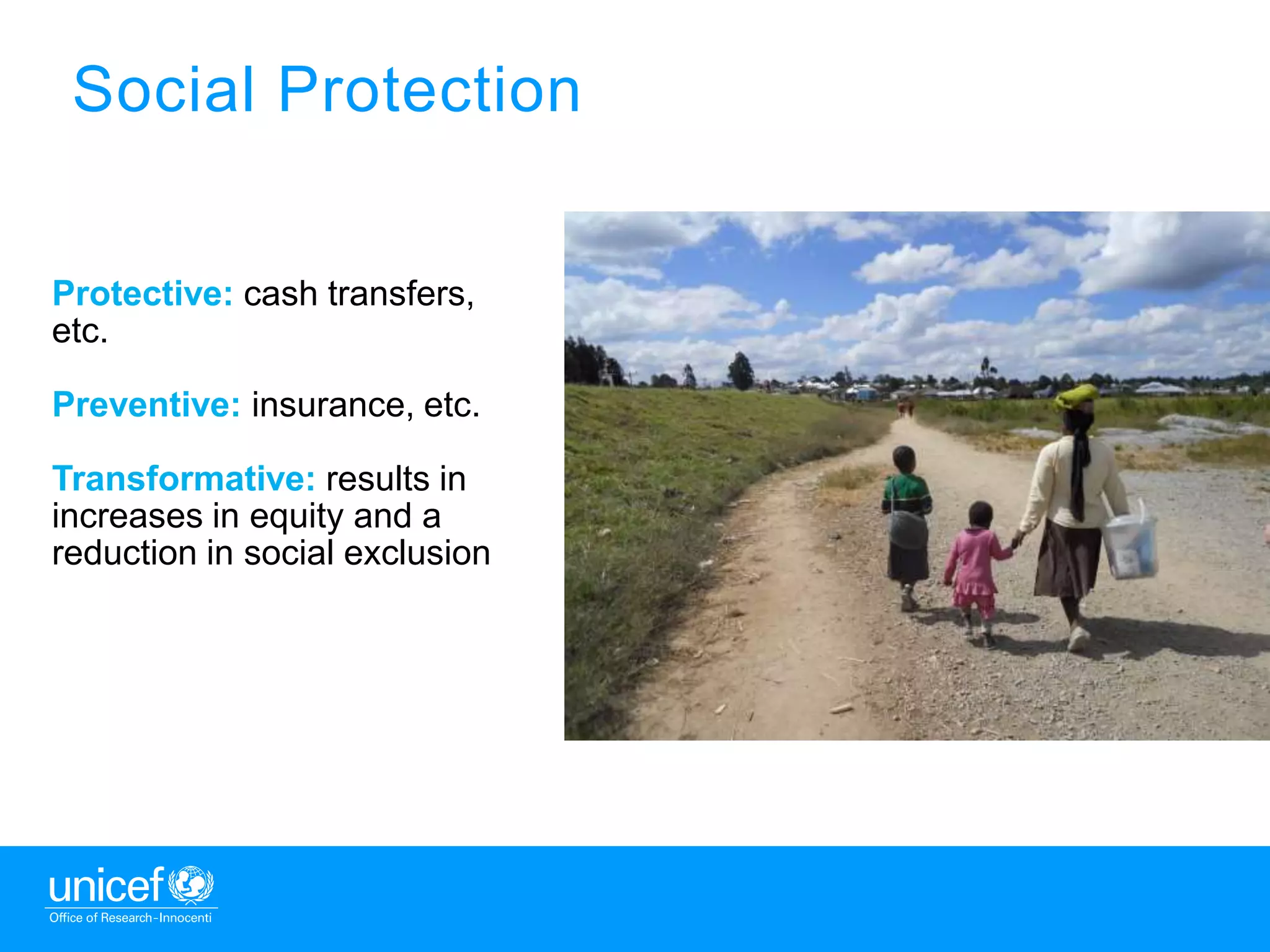
Social Protection
Protective: cash transfers,
etc.
Preventive: insurance, etc.
Transformative: results in
increases in equity and a
reduction in social exclusion
4
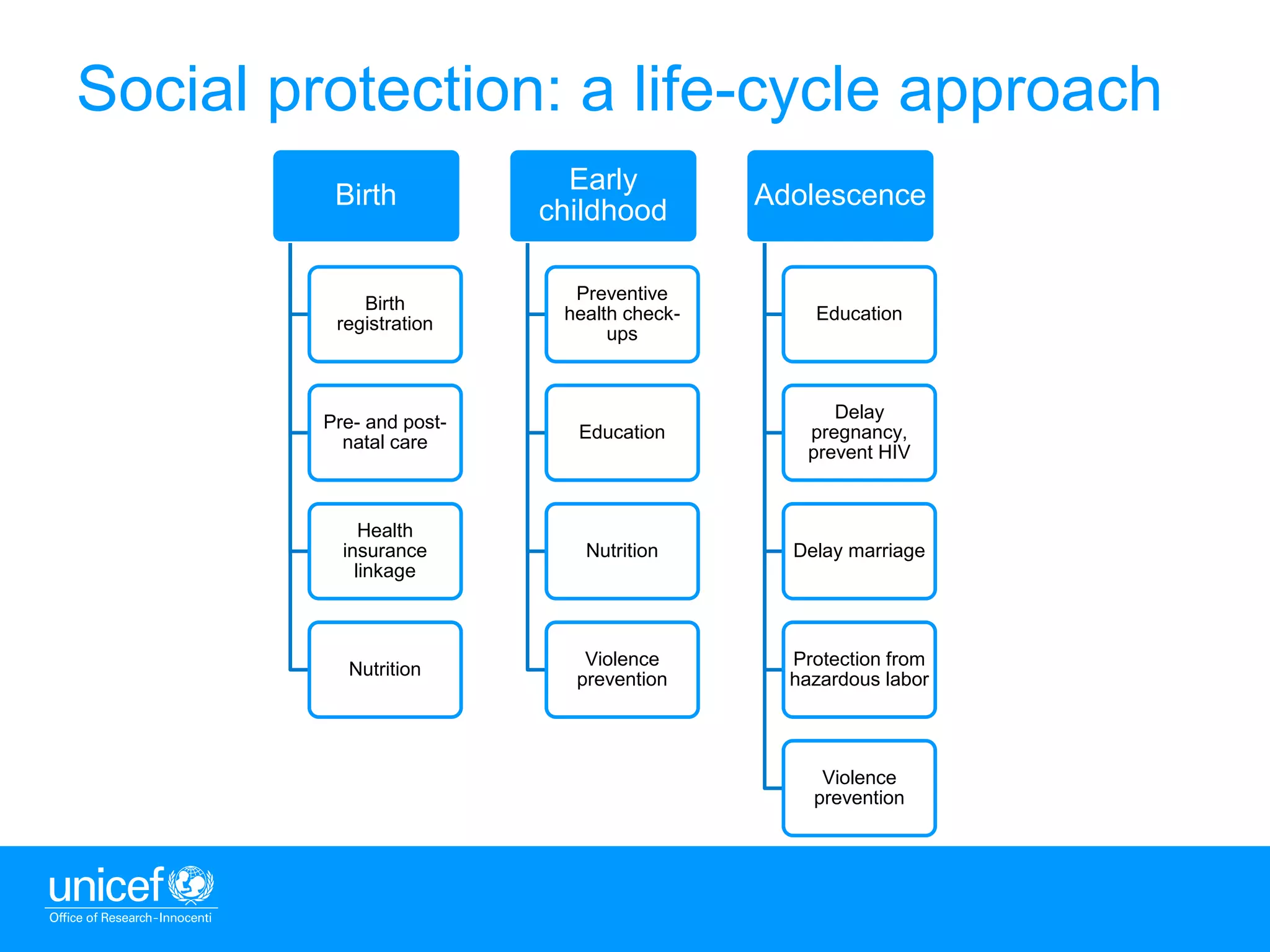
Social protection: a life-cycle approach
Birth
Birth
registration
Pre- and post-
natal care
Health
insurance
linkage
Nutrition
Early
childhood
Preventive
health check-
ups
Education
Nutrition
Violence
prevention
Adolescence
Education
Delay
pregnancy,
prevent HIV
Delay marriage
Protection from
hazardous labor
Violence
prevention
5
Theory
Increase household investment in:
 Education  Positive impact on school
enrolment
 Household productive activities 
Ambiguous impact on child labor
Evidence
 Education impacts: mostly positive, highest
for CCT (de Hoop & Rosati 2014)
 Child labor impacts: mixed, with CCT more
likely to reduce child labor compared to other
programs such as UCT, labor market
programs and micro-credit (Dammert et al.
2018)
 Gaps
 Impacts on worst forms of child labor (e.g.
work in hazardous industries/occupations)?
 Long-term effects?
 Impact of cash plus programs?
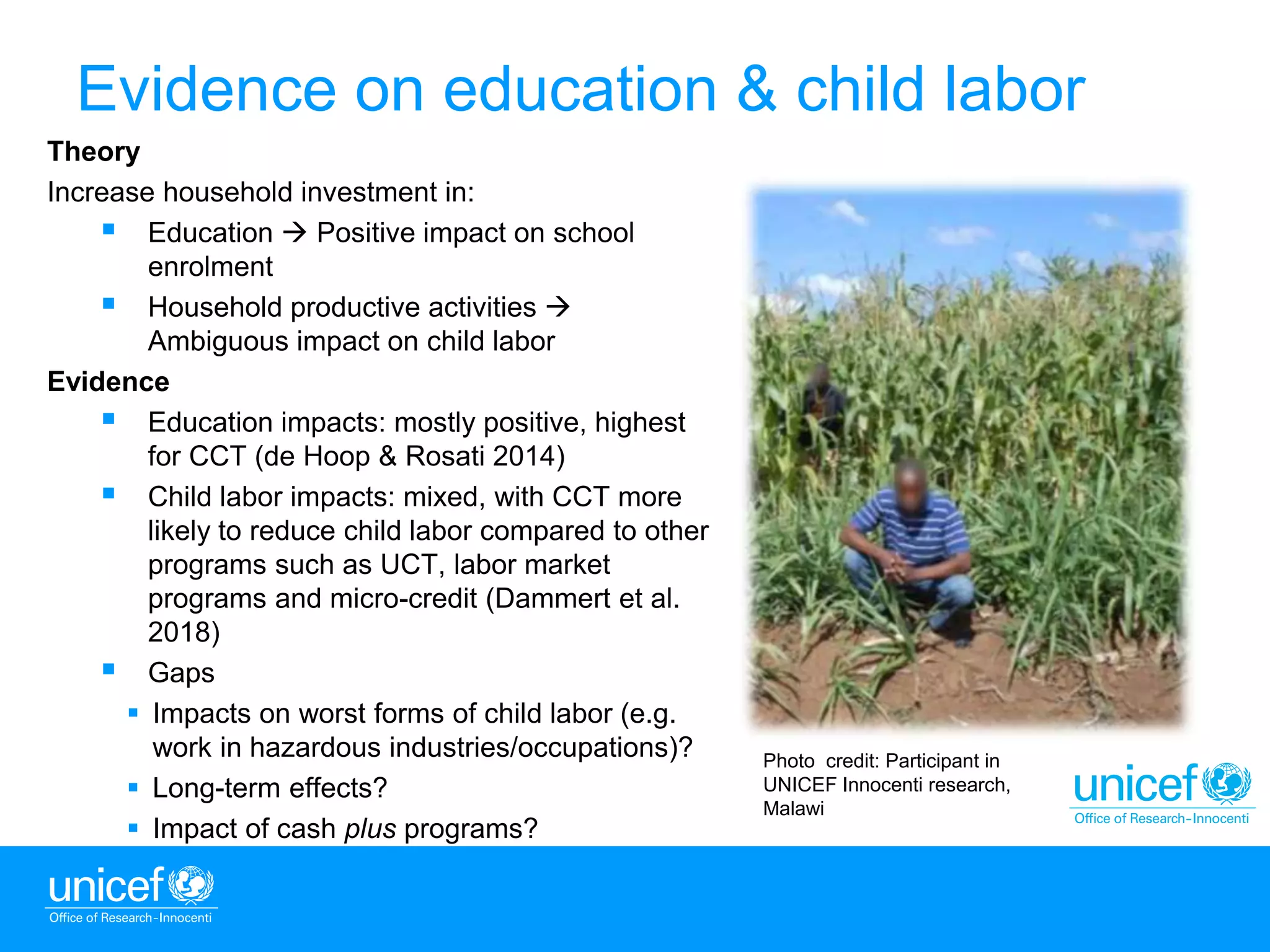
Photo credit: Participant in
UNICEF Innocenti research,
Malawi
Evidence on education & child labor
6
 Positive, but mixed (varies by context, gender) evidence that cash
transfers programs:
Delay sexual debut, marriage and childbearing, but not in all settings (Dake et al.
2018; Handa et al. 2014; Handa et al. 2015; Heinrich et al. 2017)
Reduce risky sexual behaviors (Cluver et al. 2013)
Improve mental health (Kilburn et al. 2016)
Reduce intimate partner violence (Pettifor et al. 2016)
 Transformative potential:
 Reduce gender disparities in secondary school enrolment;
 Challenge traditional attitudes around how girls are valued by their families and
communities
 Increase capacities, opportunities and economic inclusion
Evidence on safe transitions to
adulthood
7
 Economic growth & “demographic dividend”
 Period of rapid physiological, biological and
psychological change, heighted exposure to poverty and
vulnerabilities
 Transitions have long-term impacts on an individual’s
future health, well-being, and productivity
 Investments in adolescence: “triple dividend”
 Unique window of opportunity to:
 Enhance individual capabilities – access to
education, reduce skills deficit
 Improve opportunities constrained by gender
norms
Why invest in adolescents through SP?
8
 Traditionally, not the primary focus of government-run SP
Prioritization of early childhood development (ECD)
In SSA, targeting often includes large number of
adolescents, but multiple needs and vulnerabilities rarely
reflected in program design
 Gender lens rarely used for understanding exposure to risk
& vulnerability and informing design
 Many issues related to adolescence (eg. sexuality, SRH)
remain sensitive and not directly addressed, influencing
poverty trajectories
How are adolescents represented in SP
programming?
9
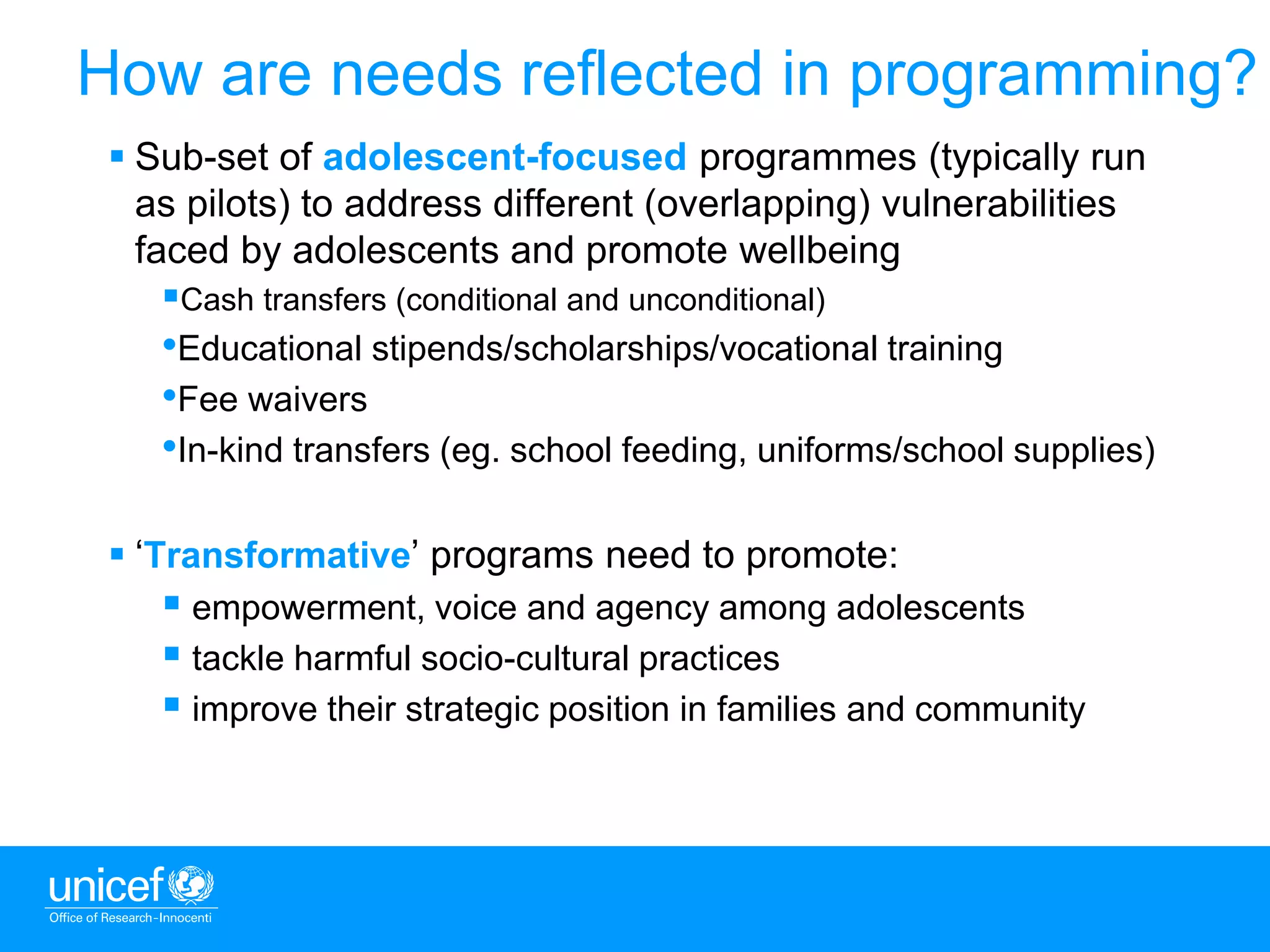
 Sub-set of adolescent-focused programmes (typically run
as pilots) to address different (overlapping) vulnerabilities
faced by adolescents and promote wellbeing
Cash transfers (conditional and unconditional)
•Educational stipends/scholarships/vocational training
•Fee waivers
•In-kind transfers (eg. school feeding, uniforms/school supplies)
 ‘Transformative’ programs need to promote:
 empowerment, voice and agency among adolescents
 tackle harmful socio-cultural practices
 improve their strategic position in families and community
How are needs reflected in programming?
10
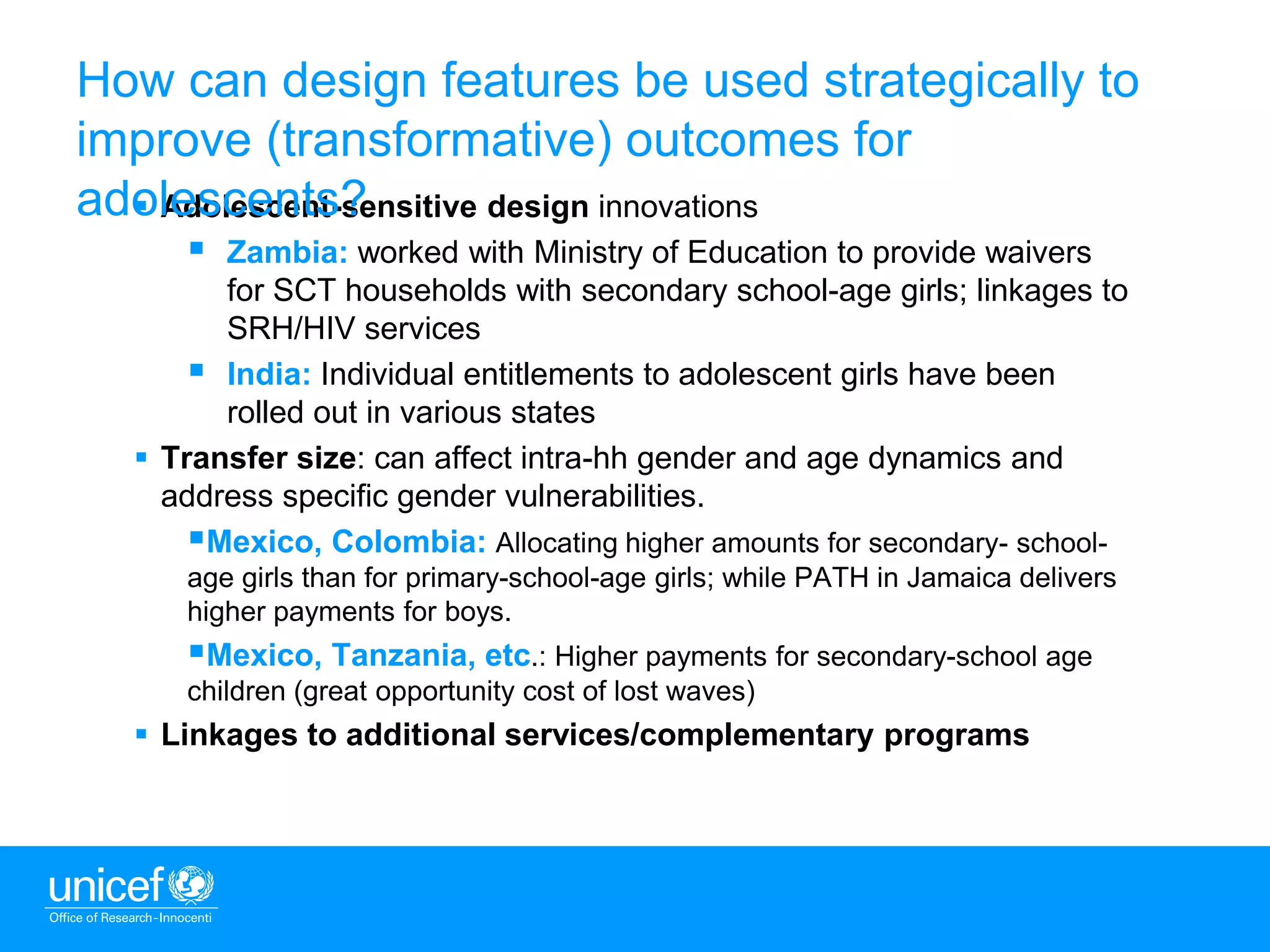
 Adolescent-sensitive design innovations
 Zambia: worked with Ministry of Education to provide waivers
for SCT households with secondary school-age girls; linkages to
SRH/HIV services
 India: Individual entitlements to adolescent girls have been
rolled out in various states
 Transfer size: can affect intra-hh gender and age dynamics and
address specific gender vulnerabilities.
Mexico, Colombia: Allocating higher amounts for secondary- school-
age girls than for primary-school-age girls; while PATH in Jamaica delivers
higher payments for boys.
Mexico, Tanzania, etc.: Higher payments for secondary-school age
children (great opportunity cost of lost waves)
 Linkages to additional services/complementary programs
How can design features be used strategically to
improve (transformative) outcomes for
adolescents?
11
12
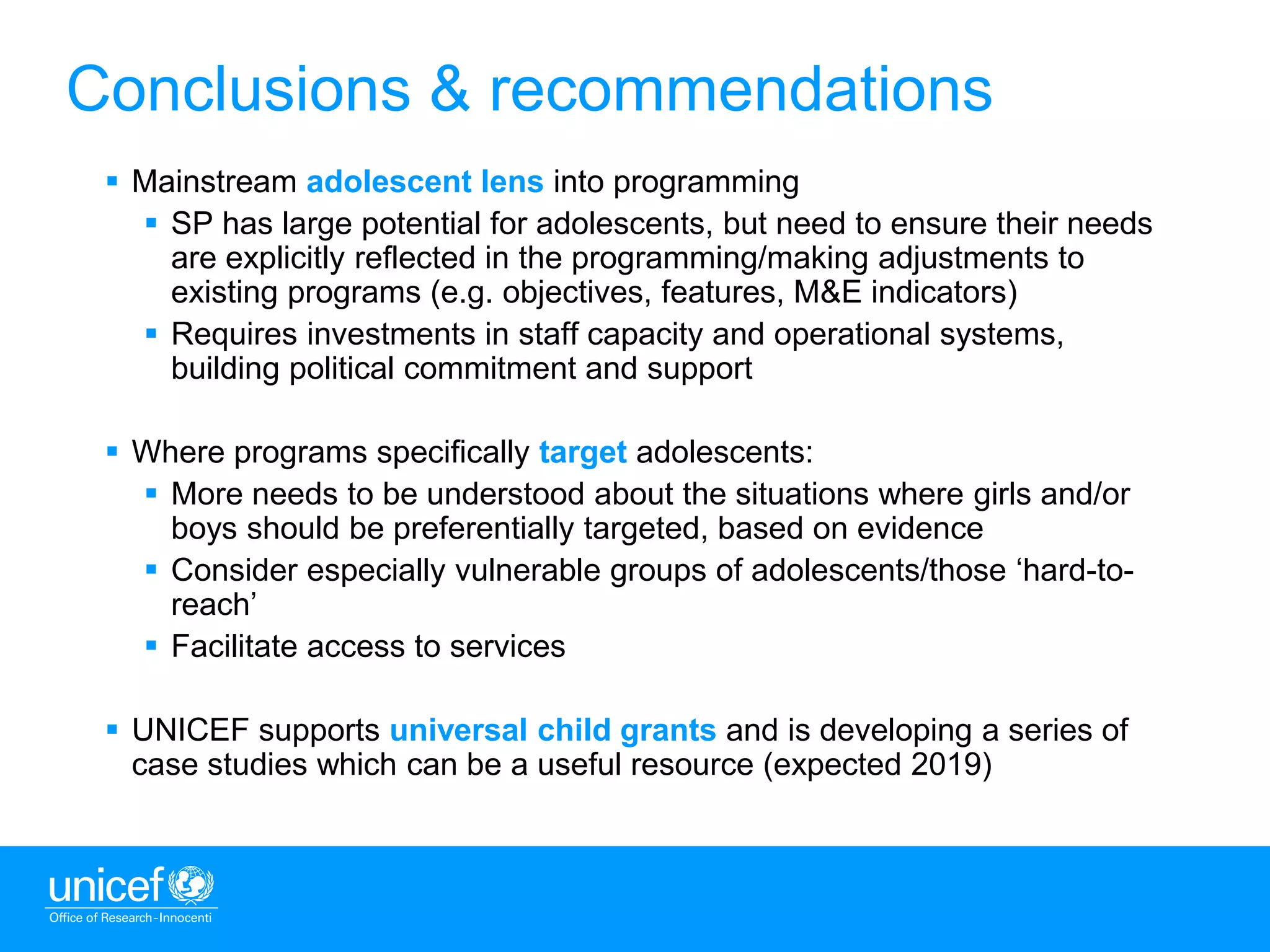
 Mainstream adolescent lens into programming
 SP has large potential for adolescents, but need to ensure their needs
are explicitly reflected in the programming/making adjustments to
existing programs (e.g. objectives, features, M&E indicators)
 Requires investments in staff capacity and operational systems,
building political commitment and support
 Where programs specifically target adolescents:
 More needs to be understood about the situations where girls and/or
boys should be preferentially targeted, based on evidence
 Consider especially vulnerable groups of adolescents/those ‘hard-to-
reach’
 Facilitate access to services
 UNICEF supports universal child grants and is developing a series of
case studies which can be a useful resource (expected 2019)
Conclusions & recommendations
13
References
• Baird, S., et al. (2014). "Conditional, unconditional and everything in between: a systematic review of the effects of
cash transfer programmes on schooling outcomes." Journal of Development Effectiveness 6(1): 1-43.
• Cluver, L., Boyes, M., Orkin, M., Pantelic, M., Molwena, T., & Sherr, L. (2013). Child-focused state cash transfers
and adolescent risk of HIV infection in South Africa: a propensity-score-matched case-control study. The Lancet
Global Health, 1(6), e362-e370.
• Dake, F., Natali, L., Angeles, G., De Hoop, J., Handa, S., & Peterman, A. (2018). Income transfers, early marriage
and fertility in Malawi and Zambia. Studies in family planning, in press.
• Dammert AC, de Hoop J, Mvukiyehe E, Rosati FC. (2018). Effects of public policy on child labor: Current knowledge,
gaps, and implications for program design. World Development, 110: 104-123.
• De Hoop, J. and F. Rosati (2013). Cash Transfers and Child Labor. IZA DP No. 7496. Bonn, Germany, Institute for
the Study of Labor.
• Handa, S., Halpern, C. T., Pettifor, A., & Thirumurthy, H. (2014). The government of Kenya's cash transfer program
reduces the risk of sexual debut among young people age 15-25. PLoS One, 9(1), e85473-e85473.
• Handa, S., Peterman, A., Huang, C., Halpern, C. T., Pettifor, A., & Thirumurthy, H. (2015). Impact of the Kenya Cash
Transfer for Orphans and Vulnerable Children on Early Pregnancy and Marriage of Adolescent Girls. Social Science
& Medicine, 141, 36-45.
• Heinrich, C. J., Hoddinott, J., & Samson, M. (2017). Reducing adolescent risky behaviors in a high-risk context: the
effects of unconditional cash transfers in South Africa. Economic Development and Cultural Change, 65(4), 619-652.
• Kilburn, K., Thirumurthy, H., Tucker Halpern, C., Pettifor, A., & Handa, S. (2016). Effects of a large-scale
unconditional cash transfer program on mental health outcomes of young people in Kenya: a cluster randomized
trial. Journal of Adolescent Health, 58(2), 223-229.
• Pettifor, A., et al. (2016). "The effect of a conditional cash transfer on HIV incidence in young women in rural South
Africa (HPTN 068): a phase 3, randomised controlled trial." The Lancet Global Health 4(12): e978-e988.
14
• Transfer Project website: www.cpc.unc.edu/projects/transfer
• Facebook: https://www.facebook.com/TransferProject
• Twitter: @TransferProjct Email: tmpalermo@unicef.org
For more information
©FAO/Ivan Grifi

A Life Cycle Approach to Social Protection

  • 1.
    unite for children A LIFE-CYCLEAPROACH TO SOCIAL PROTECTION: EVIDENCE ON CHILDHOOD AND ADOLESCENCE Academy on Social Security Turin, Italy September 17, 2018 Tia Palermo, Ph.D. Social Policy Specialist UNICEF Office of Research - Innocenti
  • 2.
    2 UNICEF’s focus onsocial protection • Convention on the Rights of the Child (CRC) establishes children’s right to social security and adequate standard of living • UNICEF supports nationally-led, inclusive SP systems •Remove economic & social barriers to promote equitable outcomes •Promote linkages between SP & multi-sector outcomes • Focus on 4 areas: 1. Social transfers (cash transfers, food transfers, public works, nutritional supplementation) 2. Ensure access to services (cash transfers, birth registration, health insurance, user fee abolition) 3. Social support and care 4. Legislation and policy reform ( remove inequalities in access to services, livelihoods, economic opportunities and address issues of exclusion, discrimination)
  • 3.
    3 Social Protection Protective: cashtransfers, etc. Preventive: insurance, etc. Transformative: results in increases in equity and a reduction in social exclusion
  • 4.
    4 Social protection: alife-cycle approach Birth Birth registration Pre- and post- natal care Health insurance linkage Nutrition Early childhood Preventive health check- ups Education Nutrition Violence prevention Adolescence Education Delay pregnancy, prevent HIV Delay marriage Protection from hazardous labor Violence prevention
  • 5.
    5 Theory Increase household investmentin:  Education  Positive impact on school enrolment  Household productive activities  Ambiguous impact on child labor Evidence  Education impacts: mostly positive, highest for CCT (de Hoop & Rosati 2014)  Child labor impacts: mixed, with CCT more likely to reduce child labor compared to other programs such as UCT, labor market programs and micro-credit (Dammert et al. 2018)  Gaps  Impacts on worst forms of child labor (e.g. work in hazardous industries/occupations)?  Long-term effects?  Impact of cash plus programs? Photo credit: Participant in UNICEF Innocenti research, Malawi Evidence on education & child labor
  • 6.
    6  Positive, butmixed (varies by context, gender) evidence that cash transfers programs: Delay sexual debut, marriage and childbearing, but not in all settings (Dake et al. 2018; Handa et al. 2014; Handa et al. 2015; Heinrich et al. 2017) Reduce risky sexual behaviors (Cluver et al. 2013) Improve mental health (Kilburn et al. 2016) Reduce intimate partner violence (Pettifor et al. 2016)  Transformative potential:  Reduce gender disparities in secondary school enrolment;  Challenge traditional attitudes around how girls are valued by their families and communities  Increase capacities, opportunities and economic inclusion Evidence on safe transitions to adulthood
  • 7.
    7  Economic growth& “demographic dividend”  Period of rapid physiological, biological and psychological change, heighted exposure to poverty and vulnerabilities  Transitions have long-term impacts on an individual’s future health, well-being, and productivity  Investments in adolescence: “triple dividend”  Unique window of opportunity to:  Enhance individual capabilities – access to education, reduce skills deficit  Improve opportunities constrained by gender norms Why invest in adolescents through SP?
  • 8.
    8  Traditionally, notthe primary focus of government-run SP Prioritization of early childhood development (ECD) In SSA, targeting often includes large number of adolescents, but multiple needs and vulnerabilities rarely reflected in program design  Gender lens rarely used for understanding exposure to risk & vulnerability and informing design  Many issues related to adolescence (eg. sexuality, SRH) remain sensitive and not directly addressed, influencing poverty trajectories How are adolescents represented in SP programming?
  • 9.
    9  Sub-set ofadolescent-focused programmes (typically run as pilots) to address different (overlapping) vulnerabilities faced by adolescents and promote wellbeing Cash transfers (conditional and unconditional) •Educational stipends/scholarships/vocational training •Fee waivers •In-kind transfers (eg. school feeding, uniforms/school supplies)  ‘Transformative’ programs need to promote:  empowerment, voice and agency among adolescents  tackle harmful socio-cultural practices  improve their strategic position in families and community How are needs reflected in programming?
  • 10.
    10  Adolescent-sensitive designinnovations  Zambia: worked with Ministry of Education to provide waivers for SCT households with secondary school-age girls; linkages to SRH/HIV services  India: Individual entitlements to adolescent girls have been rolled out in various states  Transfer size: can affect intra-hh gender and age dynamics and address specific gender vulnerabilities. Mexico, Colombia: Allocating higher amounts for secondary- school- age girls than for primary-school-age girls; while PATH in Jamaica delivers higher payments for boys. Mexico, Tanzania, etc.: Higher payments for secondary-school age children (great opportunity cost of lost waves)  Linkages to additional services/complementary programs How can design features be used strategically to improve (transformative) outcomes for adolescents?
  • 11.
  • 12.
    12  Mainstream adolescentlens into programming  SP has large potential for adolescents, but need to ensure their needs are explicitly reflected in the programming/making adjustments to existing programs (e.g. objectives, features, M&E indicators)  Requires investments in staff capacity and operational systems, building political commitment and support  Where programs specifically target adolescents:  More needs to be understood about the situations where girls and/or boys should be preferentially targeted, based on evidence  Consider especially vulnerable groups of adolescents/those ‘hard-to- reach’  Facilitate access to services  UNICEF supports universal child grants and is developing a series of case studies which can be a useful resource (expected 2019) Conclusions & recommendations
  • 13.
    13 References • Baird, S.,et al. (2014). "Conditional, unconditional and everything in between: a systematic review of the effects of cash transfer programmes on schooling outcomes." Journal of Development Effectiveness 6(1): 1-43. • Cluver, L., Boyes, M., Orkin, M., Pantelic, M., Molwena, T., & Sherr, L. (2013). Child-focused state cash transfers and adolescent risk of HIV infection in South Africa: a propensity-score-matched case-control study. The Lancet Global Health, 1(6), e362-e370. • Dake, F., Natali, L., Angeles, G., De Hoop, J., Handa, S., & Peterman, A. (2018). Income transfers, early marriage and fertility in Malawi and Zambia. Studies in family planning, in press. • Dammert AC, de Hoop J, Mvukiyehe E, Rosati FC. (2018). Effects of public policy on child labor: Current knowledge, gaps, and implications for program design. World Development, 110: 104-123. • De Hoop, J. and F. Rosati (2013). Cash Transfers and Child Labor. IZA DP No. 7496. Bonn, Germany, Institute for the Study of Labor. • Handa, S., Halpern, C. T., Pettifor, A., & Thirumurthy, H. (2014). The government of Kenya's cash transfer program reduces the risk of sexual debut among young people age 15-25. PLoS One, 9(1), e85473-e85473. • Handa, S., Peterman, A., Huang, C., Halpern, C. T., Pettifor, A., & Thirumurthy, H. (2015). Impact of the Kenya Cash Transfer for Orphans and Vulnerable Children on Early Pregnancy and Marriage of Adolescent Girls. Social Science & Medicine, 141, 36-45. • Heinrich, C. J., Hoddinott, J., & Samson, M. (2017). Reducing adolescent risky behaviors in a high-risk context: the effects of unconditional cash transfers in South Africa. Economic Development and Cultural Change, 65(4), 619-652. • Kilburn, K., Thirumurthy, H., Tucker Halpern, C., Pettifor, A., & Handa, S. (2016). Effects of a large-scale unconditional cash transfer program on mental health outcomes of young people in Kenya: a cluster randomized trial. Journal of Adolescent Health, 58(2), 223-229. • Pettifor, A., et al. (2016). "The effect of a conditional cash transfer on HIV incidence in young women in rural South Africa (HPTN 068): a phase 3, randomised controlled trial." The Lancet Global Health 4(12): e978-e988.
  • 14.
    14 • Transfer Projectwebsite: www.cpc.unc.edu/projects/transfer • Facebook: https://www.facebook.com/TransferProject • Twitter: @TransferProjct Email: tmpalermo@unicef.org For more information ©FAO/Ivan Grifi

Editor's Notes

  • #3 Final bullet: maternity leave, inheritance rights, employment guarantee schemes
  • #5 Promote inclusion by considering: Age- and gender-specific risks and vulnerabilities throughout the life cycle Intrahousehold dynamics and balance of power that may affect children Participation and accountability mechanisms Dimensions of exclusion and added vulnerabilities (gender, disability, ethnicity, HIV/AIDS status, etc.) Demand- and supply-side barriers Early childhood impacts: Strong impacts on food consumption, food security, hh diet diversity Use of health services Very limited effects on height for age and anthropometric measures
  • #6 THEORY Poor and credit constrained households underinvest both in the household productive activities and in education. Hence, a cash transfer will simultaneously increase both types of investments. School attendance will increase unambiguously. The impact of cash transfers on child labor is instead ambiguous a priory. Cash transfers may have competing effects on child labor. They increase hh income and asset, reducing demand for additional income from child labor. However, they may expand hh productive activities (eg livestock), which may require increased child labor (and/or increased child participation in household chores, if adults work more in economic activities). The same holds for labor market programs (such as public works programs or provision of training/capital to start up a business) and for microcredit programs. EVIDENCE The evidence on cash transfers and labor market programs is extended (especially on CCT). Impacts on education are positive, with CCT having the highest impacts (eg. Skoufias & Parker 2001 on PROGRESA in Mexico). Impacts on child labor are mixed. CCT mostly reduce child labor. UCT/other programs have mixed results: e.g. reduction in child participation in economic activities in Ecuador (Edmonds & Schady 2012); shift in economic activities from outside the household for pay to inside the household, with no impact on overall participation in Malawi (USDoL funded research at Innocenti); increase in child participation in economic activities in the context of Zambia (USDoL funded research at Innocenti). References Dammert, A., de Hoop, J., Mvukiyehe, E., and Rosati, F. C. (2018). Effects of Public Policy on Child Labor: Current Knowledge, Gaps, and Implications for Program Design. World Development, 110: 104-123. de Hoop, J., and Rosati, F. C. (2014). Cash Transfers and Child Labour. The World Bank Research Observer, 29(2): 202-234. Edmonds, E. V., and Schady, N. (2012). Poverty Alleviation and Child Labor. American Economic Journal: Economic Policy, 4(4): 100-124. Skoufias, E. and Parker., S. W. (2001). Conditional Cash Transfers and their Impact on Child Work and Schooling: Evidence from the PROGRESA Program in Mexico. Economía, 2(1): 45-96.
  • #7 Evidence indicates that CT programs keep adolescent students enrolled in school longer their risk of engaging in unsafe and harmful practices, including transactional sex, early marriage and childbearing. ADD evidence. I think this is too much – have removed: Recently, governments in SSA have been experimenting with using financial incentives to tackle health-related vulnerabilities (risky sexual behavior and exposure to HIV/STI infections). Examples: Malawi: a single cash reward after one year given to individuals who remained HIV-negative. Tanzania: cash awards of US $10 or US$20 every four months were conditional on receiving negative test results for a set of curable STIs. Lottery program in Lesotho There is an early indication, that programs in Tanzania and Lesotho, have been effective in controlling the spread of HIV/AIDS and STIs, among adolescents (Nyquist et.al, 2015). (Well known) examples: Malawi’s Zomba Cash Transfer, Mexico’s Prospera, Kenya education grants, school-feeding programmes in Ethiopia and Liberia with take-home rations for girls
  • #8 Can impact earning potential, agency in marriage, future experience of violence, and future children as well.
  • #9 (eg. role of global evidence creation and advocacy, evidence of positive role of CTs on safe transitions, acknowledgment of emerging policy problems related to early transitions, esp SSA) Innocenti’s research programme has been instrumental in shifting UNICEF’s and global attention to adolescence In some contexts, early transitions, including into marriage and pregnancy are an acknowledged problem positive evidence. Dake et al, 2017. There is increasing interest from the international community on the longer-term impacts of cash transfers and their ability to facilitate safe transition to adulthood. Because the programs target labor-constrained households, they are likely to include a large number of adolescent and youth populations. This particular demographic may be vulnerable to early transitions including early pregnancy and marriage. Address their needs.
  • #10 Removed from text to say out loud: The mutually reinforcing link between practical and strategic interests should not be underestimated. Third bullet: such as food, clothing, as well as educational and health-related expenses and girl’s empowerment curriculum aimed at increasing girls education, delaying marriage and childbearing By keeping them in school, the interventions aim at decreasing probabilities of sexual debut and risk of HIV/STI infections. Delaying marriage and childbearing. Tackle adolescent girls’ low school attendance and their risk of engaging in unsafe and harmful practices, including transactional sex, early marriage and childbearing. strong evidence indicates that CT programs keep adolescent students enrolled in school longer. that interventions led to decreased probabilities of sexual debut and HIV/STI infections
  • #11 South Africa, females in secondary school (aged 13 – 20 years at baseline) who received a cash transfer conditional on attendance in the HIV Prevention Trails Network (HPTN) 068 trial were found to have reduced past-year physical IPV after three years (Pettifor et al. 2016). It is unclear if and how a SCT targeted and transferred exclusively to adolescent girls (as compared to caregivers) would perform and operate on a larger scale, as evidence is missing.   Parents and children may have different views about when it is optimal for a child to invest in human capital; adolescents (compared to children) can more easily make their own decisions; providing individual entitlements can encouraging them to have a greater role in making individual choices and decisions, as well as enhancing their financial autonomy and reducing dependence on others. if some of the transfer is given directly to the girl, she may also be less likely to feel the need to earn her keep in the household or engage in transactional sex (Maganja et al., 2007). Kenya CT-OVC: in 21 percent and seven percent of cases, children and OVCs respectively were reported to be the beneficiaries of transfer money (dake, 2016).  Hh as a whole to benefit Transfers given to the head of the household and not to the young women or ado- lescents. it is plausible that since the transfer was ‘tagged’ as being for the OVC, households acted in a way that was consistent with this prioritization. School feeding programmes in Ethiopia, Liberia giving extra food rations to girls to promote their enrollment in school.
  • #13 UNICEF supports progressive realization of universal coverage. In practice, this translates into helping countries to identify and progressively expand programmes, policies and financing options most conducive to achieving universality, while also recognizing countries different capacities and contexts. Expansion of social protection coverage, including for children, is critical, given currently limited coverage. Potential countries with universal or near universal grants that may be considered include: Argentina, Armenia, Bangladesh, Belarus, Cambodia, Kyrgyz Republic, Lesotho, Malaysia, Mongolia, Nepal, Romania, S. Africa, Turkmenistan, Tunisia, Vietnam, Ukraine