The document presents a novel hybrid scheduling algorithm aimed at improving job processing efficiency in cloud computing environments by reducing waiting time and turnaround time. It critiques existing scheduling methods and introduces a technique that prioritizes job processes based on burst time, demonstrating enhanced performance through experimental results. The paper underscores the importance of effective resource allocation in cloud computing and provides a detailed evaluation of the proposed algorithm's effectiveness compared to traditional methods.
![International Journal of Electrical and Computer Engineering (IJECE)
Vol. 10, No. 2, April 2020, pp. 1387~1397
ISSN: 2088-8708, DOI: 10.11591/ijece.v10i2.pp1387-1397 1387
Journal homepage: http://ijece.iaescore.com/index.php/IJECE
A hybrid approach for scheduling applications in cloud
computing environment
Ahmed Subhi Abdalkafor1
, Khattab M. Ali Alheeti2
1
Career Development Center, University of Anbar, Anbar, Iraq
2
Computer Networking Systems Department, Computer Sciences and Information Technology College,
University of Anbar, Anbar, Iraq,
Article Info ABSTRACT
Article history:
Received Jun 28, 2019
Revised Oct 9, 2019
Accepted Oct 15, 2019
Cloud computing plays an important role in our daily life. It has direct and
positive impact on share and update data, knowledge, storage and scientific
resources between various regions. Cloud computing performance heavily
based on job scheduling algorithms that are utilized for queue waiting in
modern scientific applications. The researchers are considered cloud
computing a popular platform for new enforcements. These scheduling
algorithms help in design efficient queue lists in cloud as well as they play
vital role in reducing waiting for processing time in cloud computing.
A novel job scheduling is proposed in this paper to enhance performance of
cloud computing and reduce delay time in queue waiting for jobs.
The proposed algorithm tries to avoid some significant challenges that
throttle from developing applications of cloud computing. However, a smart
scheduling technique is proposed in our paper to improve performance
processing in cloud applications. Our experimental result of the proposed job
scheduling algorithm shows that the proposed schemes possess outstanding
enhancing rates with a reduction in waiting time for jobs in queue list.
Keywords:
Cloud computing
Task scheduling algorithm
priority
Copyright © 2020 Institute of Advanced Engineering and Science.
All rights reserved.
Corresponding Author:
Ahmed Subhi Abdalkafor,
Career Development Center,
University of Anbar, Anbar, Iraq.
Email: ahmed.abdalkafor@uoanbar.edu.iq
1. INTRODUCTION
Nowadays, modern technology is witnessing a wide range of development in scientific applications
and research areas. Cloud computing is considered one of the most important research fields that received
a lot of attention from developers and designers. It is an innovative technology that uses central remote
servers and internet networks to share information/applications and store important data to become available
for users [1, 2]. Cloud computing allows consumers to share and access for daily applications/sensitive
information without coordination and synchronization mode. These applications provide important data and
control information to users at suitable time and without any delay [3, 4].
Cloud computing utilizes computing resources and network terminals to provide important data,
information, and knowledge for users at the appropriate time. In other words, users can access the same
resource at different times and place i.e. share data. The main aspect of cloud computing does not need pre-
established communication for any request from resources. This aspect makes cloud computing occupy
a large area of scientific research and modern applications in our daily life. The cloud computing permits
access to several online services, social data, information and resources that can be utilized for exchange
between computer devices on demand. In order to allocate computing resources quickly and efficiently,
resource allocation tasks must be scheduled [5-8]. The basic structure of cloud computing is shown in
Figure 1.](https://image.slidesharecdn.com/v3115oct9oct28jun20557edbyez-201204070451/85/A-hybrid-approach-for-scheduling-applications-in-cloud-computing-environment-1-320.jpg)
![International Journal of Electrical and Computer Engineering (IJECE)
Vol. 10, No. 2, April 2020, pp. 1387~1397
ISSN: 2088-8708, DOI: 10.11591/ijece.v10i2.pp1387-1397 1387
Journal homepage: http://ijece.iaescore.com/index.php/IJECE
A hybrid approach for scheduling applications in cloud
computing environment
Ahmed Subhi Abdalkafor1
, Khattab M. Ali Alheeti2
1
Career Development Center, University of Anbar, Anbar, Iraq
2
Computer Networking Systems Department, Computer Sciences and Information Technology College,
University of Anbar, Anbar, Iraq,
Article Info ABSTRACT
Article history:
Received Jun 28, 2019
Revised Oct 9, 2019
Accepted Oct 15, 2019
Cloud computing plays an important role in our daily life. It has direct and
positive impact on share and update data, knowledge, storage and scientific
resources between various regions. Cloud computing performance heavily
based on job scheduling algorithms that are utilized for queue waiting in
modern scientific applications. The researchers are considered cloud
computing a popular platform for new enforcements. These scheduling
algorithms help in design efficient queue lists in cloud as well as they play
vital role in reducing waiting for processing time in cloud computing.
A novel job scheduling is proposed in this paper to enhance performance of
cloud computing and reduce delay time in queue waiting for jobs.
The proposed algorithm tries to avoid some significant challenges that
throttle from developing applications of cloud computing. However, a smart
scheduling technique is proposed in our paper to improve performance
processing in cloud applications. Our experimental result of the proposed job
scheduling algorithm shows that the proposed schemes possess outstanding
enhancing rates with a reduction in waiting time for jobs in queue list.
Keywords:
Cloud computing
Task scheduling algorithm
priority
Copyright © 2020 Institute of Advanced Engineering and Science.
All rights reserved.
Corresponding Author:
Ahmed Subhi Abdalkafor,
Career Development Center,
University of Anbar, Anbar, Iraq.
Email: ahmed.abdalkafor@uoanbar.edu.iq
1. INTRODUCTION
Nowadays, modern technology is witnessing a wide range of development in scientific applications
and research areas. Cloud computing is considered one of the most important research fields that received
a lot of attention from developers and designers. It is an innovative technology that uses central remote
servers and internet networks to share information/applications and store important data to become available
for users [1, 2]. Cloud computing allows consumers to share and access for daily applications/sensitive
information without coordination and synchronization mode. These applications provide important data and
control information to users at suitable time and without any delay [3, 4].
Cloud computing utilizes computing resources and network terminals to provide important data,
information, and knowledge for users at the appropriate time. In other words, users can access the same
resource at different times and place i.e. share data. The main aspect of cloud computing does not need pre-
established communication for any request from resources. This aspect makes cloud computing occupy
a large area of scientific research and modern applications in our daily life. The cloud computing permits
access to several online services, social data, information and resources that can be utilized for exchange
between computer devices on demand. In order to allocate computing resources quickly and efficiently,
resource allocation tasks must be scheduled [5-8]. The basic structure of cloud computing is shown in
Figure 1.](https://image.slidesharecdn.com/v3115oct9oct28jun20557edbyez-201204070451/75/A-hybrid-approach-for-scheduling-applications-in-cloud-computing-environment-1-2048.jpg)
![ ISSN: 2088-8708
Int J Elec & Comp Eng, Vol. 10, No. 2, April 2020 : 1387 - 1397
1388
Figure 1. Basic structure of cloud computing [9]
According to Figure 1, data storage, servers, operative system, and virtualization interface are main
components for any cloud computing system [9]. The difficulty of job scheduling requests is gradually
increased in cloud system. In more detail, the current algorithms become paralyzed in front of the pool
request of cloud web applications. As we know, scheduling in a cloud computing environment is most
important issue in modern technology. The task scheduling consists of the following: workflow, static and
dynamic cloud service scheduling, real-time scheduling, heuristic and opportunistic load balancing
scheduling [10, 11]. The computing environment consists of a number of sources. Therefore, task scheduling
is necessary technique to choose the best resources suitable for the implementation of various tasks.
The efficient scheduling scheme can reduce response time, low consumption power, and provide availability
for busy resources. In addition, scheduling methods have the ability to allocating computer machines with
the least time to accomplish depending on their priorities, so scheduling tasks are essential and influential in
this environment. For this reason, new scheduling algorithms are requested to overcome this problem.
In this paper, a novel scheduling algorithm is proposed to improve the performance of cloud
computing. Moreover, it has the ability to reduce the amount of delay in queue waiting. The proposed
algorithm in this research plays important role in allocating balance load between different resources.
Therefore, the resource-scheduling in cloud computing is difficult tasks [10, 11].
2. RELATED WORK
Recently, several scheduling algorithms have been proposed to distribute cloud applications. All of
these algorithms target to reduce waiting time of jobs in queue list, increase efficiency, decline number of
repeat request and balance between available resources. In this paper, we proposed new hybrid scheduling
algorithm to enhance performance of cloud computing. Sangwan et al. [12] proposed technique to improve
round-robin scheduling algorithm in cloud computing environments by reducing the average of waiting time
and total around time by changing the time quantum by keeping all the processes when arriving in CPU.
It defines average of mean (TQ powerfully) after selecting the mean of burst time according to the number of
processes. This proposed algorithm selects the first process then CPU is allocated for a temporary period
according to the mean time quantum. There are many studies that have been worked on task scheduling.
However, there is still a challenge for scheduling algorithms, such as minimum response time, maximum
throughput, best possible resource utilization, and reducing the overload [13]. Mittal and Singh present [14]
a proposed system to improve the algorithm for task scheduling in cloud computing. The authors can modify
round-robin by adding a new strategy of the period for request time quantum. In more detail, the proposed
algorithm obtains minimizes waiting time and maximize CPU usage. Kumar et al. [15] have tried to find
the best slot of time quantum in round-robin algorithm to avoid the frequent context switch. Integer
programming is utilized in create new CPU local scheduling named changeable time quantum (CTQ) to
overcome too large/too little of the time quantum. Moreover, it has the ability to gives the best throughput
rate of the system.
In [16], the authors proposed new scheme for reducing some of the drawbacks of round-robin
algorithm as well as getting better performance of CPU at the same time. In other words, the modification of](https://image.slidesharecdn.com/v3115oct9oct28jun20557edbyez-201204070451/85/A-hybrid-approach-for-scheduling-applications-in-cloud-computing-environment-2-320.jpg)
![Int J Elec & Comp Eng ISSN: 2088-8708
A hybrid approach for scheduling application ... (Ahmed S. Abdalkafor)
1389
algorithm plays important role in reducing average of waiting time, decline the amount of turnaround time
and decreases the difficult of starvation. Nayak et al. [17] have improved the round-robin algorithm
by organizing the processes in the ready queue. This modification can overcome the drawbacks of algorithm
by set optimal time quantum and select the shortest burst time. In [18], a starvation optimizing algorithm is
improved to fix one of the common problems that occur in shortest job first algorithm. This modification
plays vital role in enhancing CPU and input/output resources requirements that have a direct and positive
reflection on overall performance. It can increase throughput rate, reduce average waiting time and decline
turnaround time in cloud environment. When resources are overloaded the algorithm has redirected all
resources in virtual machines. The virtual machine in this system aims to get better response and processing
time. Ghanbari et al. [5], have proposed a new algorithm based on the analytical hierarchy process named
PJSC. It focuses on three matters which are consistency, complexity, and makes-pan. Consistency means
adjusting fundamentals of comparison matrix based on scheduling of priority algorithm. When complexity is
the number of jobs as well as it is calculating the priority vectors of evaluation matrixes. Agarwal et al. [19],
have presented a general priority algorithm for effective implementation for resource allocation in cloud
computing. It provides a better performance after applying in cloud sim toolkit environments and comparison
with round-robin and first come first serves algorithms.
A novel hybrid scheduling algorithm is proposed in this paper to overcome common problems of
the current scheduling algorithms. It plays a direct and positive impact on current methods via reducing
waiting time, turnaround time and increasing performance of cloud computing system. This algorithm has
the ability to establish balance for available resources. Thus, it will be providing sufficient transparency for
cloud users in different regions. The objective of this paper is to propose a new algorithm to enhance
performance of the round-robin algorithm via decreasing amount of waiting time and turnaround average
time. This enchantment is achieved by adding priority field to arrival time of job processes whether equal or
different.
3. CLOUD COMPUTING
The job scheduling algorithms in cloud computing are classified into two categories: batch mode
heuristic algorithm (BMHA) and online mode heuristic algorithm (OMHA) [5]. The BMHA collects and
queued in a set for arrive job processes at the waiting list. The time is fixed in this algorithm for jobs in cloud
computing. First come first served algorithm is considered one of the applications of BMHA. In addition,
round-robin, Max-Min, and Min-Min algorithms are also considered applications of BMHA. Whereas,
OMHA fetches and processes jobs from queue waiting directly [8, 20, 21]. The BMHA is considered one of
the most suitable algorithms for the cloud computing environment. In this approach, all arrived jobs apply
one of the methods below [22]:
3.1. First come first served (FCFS) 1
It is also named First in First Serves (FIFS) when the job process that arrived at queue waiting first
will be served. The serves perform by order in ready queue, and they do not process short or large.
The process in the queue must be waiting until all processes are complete. The processes waiting more time
to terminate from ready queue, so the waiting and turnaround are quite high [23].
3.2. Min-min algorithm
This algorithm determined all tasks and arranged it about large and small, the small tasks will be
executed, firstly while the large task delays for a long time. The drawback of this algorithm is to assign
the smaller processes to the resources with comparatively higher computational power [24].
3.3. Max-min algorithm
This algorithm also depends on small and large tasks. However, it changes to the Min-Min
algorithm whenever the task was too large. It will be executed as soon as and delay a small task for long-
time [25].
3.4. Round-robin algorithm
It is suitable for cloud computing applications. In addition, the most effective time-sharing systems,
it’s simplest and most widely used proportional share scheduling algorithm [11]. The average wait time (WT)
and average turned around time (TAT) are head points on system, so round-robin designed to give some
better responsive but the worst average output parameters (WT, TAT), it's not efficient enough to be
employed in real-time systems [5].](https://image.slidesharecdn.com/v3115oct9oct28jun20557edbyez-201204070451/85/A-hybrid-approach-for-scheduling-applications-in-cloud-computing-environment-3-320.jpg)
![ ISSN: 2088-8708
Int J Elec & Comp Eng, Vol. 10, No. 2, April 2020 : 1387 - 1397
1390
3.5. Priority scheduling algorithm
In this algorithm, the FCFS processes scheduled is applied when jobs have equal-priority. It has
a very important effect on performance of cloud computing in current applications.
3.6. The Shortest-Job-First (SJF) algorithm
It is a special case of the general priority scheduling algorithm [6], in computer science, queue
priority as the kind of abstract data, which is like a queue regularly or structure of the data stacked but where
additionally each element has a "priority" associated with it. This algorithm's work when each process has
high priority is executed before a low priority process. If two processes have the same priority, they are
executed according to their order in the queue [26]. The common types of scheduling algorithms that utilized
in cloud computing is shown in Figure 2.
Figure 2. Categories of scheduling algorithm
Workflows technique is utilized in this paper to determine the optimal distribution of their job processes
to available resources whether computational network. Application structures in workflows stage are analyzed to
select appropriate computational resources for tasks. In more detail, this step based on resource availability and
application characteristics for each task. Generate a satisfactory solution in slot time for tasks in cloud computing is
mainly based on workflow schedulers. The workflow technique in cloud computing is shown in Figure 3.
Figure 3. Workflow scheme in cloud computing [9]
The input and output data files are associated with each computer program represented by nodes. The role
of workflow schedulers easily notices with cloud computing in modern applications. In more detail, Figure 4
demonstrates interaction process of scheduler with workflow and cloud resources. The interaction process of
scheduling engine is represented in three layers as shown in Figure 4 which are workflow, scheduler, and cloud
resources. Three steps are accomplished in layer two which are task analysis, objectives optimization, and task
distribution. Allocated of cloud resource in layer three heavily depend on layer two.](https://image.slidesharecdn.com/v3115oct9oct28jun20557edbyez-201204070451/85/A-hybrid-approach-for-scheduling-applications-in-cloud-computing-environment-4-320.jpg)
![Int J Elec & Comp Eng ISSN: 2088-8708
A hybrid approach for scheduling application ... (Ahmed S. Abdalkafor)
1391
Figure 4. Scheduler interaction with cloud resources and workflow [9]
4. THE PROPOSED ALGORITHM
A novel scheduling algorithm is proposed in this paper to fix common problems of the traditional
round-robin algorithm employed in cloud computing. In more detail, it uses first come first serve algorithm to
schedule all arrived processes in queue waiting with fixed time quantum. However, waiting time and
turnaround time are criteria utilized in core work of the proposed algorithm. This algorithm is enhanced in
this paper by re-arranging processes via slapped priority filed. When processes arrive at ready queue,
the highest priority is allocated to the lowest process value of burst time. In this case, all arrived processes at
ready queue will yield to re-arranging technique. However, the new algorithm plays important role in
enhancing overall performance and throughput rate of cloud computing. Thus, it reduces the amount of
waiting time and turnaround time. The flowchart of the proposed algorithm is shown in Figure 5.
Figure 5. Block diagram of proposed algorithm](https://image.slidesharecdn.com/v3115oct9oct28jun20557edbyez-201204070451/85/A-hybrid-approach-for-scheduling-applications-in-cloud-computing-environment-5-320.jpg)
![ ISSN: 2088-8708
Int J Elec & Comp Eng, Vol. 10, No. 2, April 2020 : 1387 - 1397
1392
The principle work of the proposed scheduling technique is shown in the algorithm.
Algorithm 1 the Proposed Scheme
Input: N, BT, AT, Priority, TQ
Output: Gantt Chart, AWT, ATAT
1: Arrange all the processes in RQ in order of their highest priority to the lowest value of BT.
2: While RQ is not empty
3: For I =1 to N
4: Calculate the BT of the processes;
5: Delete the process from RQ if the BT=0;
6: If the new process arrived RQ go to Step 2;
7: Draw Gantt Chart and Calculate AWT, ATAT;
8: End while.
The steps of the proposed algorithm are listed in Algorithm1. The algorithm starts with the random
initialization of tasks:
Step 1: Allocate CPU to every process in the round-robin approach, new priorities are assigned to all arrived
processed according to give the highest priority to the lowest value of burst time with the same time quantum
time. Then each process gets the control of the CPU according to the new priorities based on the remaining
CPU bursts in case the ready queue is not reached to the null
Step 2: After finishing the first step, calculate the burst time of all processes and re-arranged the remaining
burst time with the new priorities until the value of a burst time reached zero.
5. SIMULATION RESULT AND DISCUSSION
To evaluate the performance of the proposed system, various job processes are applied to
the traditional round-robin algorithm and the proposed algorithm. All these scenarios are employed under
environment of virtual box of net framework. In more detail, five of jobs processes which are P1, P2, P3, P4,
p5 are integrated with CPU burst time. These values of burst time are 25, 30, 87, 13, 20 respectively. In this
paper, various priority values are utilized which are 2, 3, 4, 0, 1 respectively. The fixed time quantum in this
proposal is 20ms with equal and different arrival time in ready queue as shown in Table 1.
Table 1. Processes specifications
Process Name Arrival Time Burst Time Priority
P1 0 25 2
P2 0 30 3
P3 0 87 4
P4 0 13 0
P5 0 20 1
The performance metrics are considered a very important factor in evaluating the proposed system.
These metrics, such as turnaround time and waiting time [14]. Average of turnaround time (TAT) can be
calculated as:
Average ATA = Ʃ (Ti – AT of Pi)/N (1)
Average of waiting time (WT) can be calculated as:
Average WT= Ʃ (TAT of Pi – BT of Pi)/N (2)
In this paper, two scenarios are applied to test the efficiency of the proposed system.
On one hand, we assume all problem arrival at the same time in scenario I. In this case,
the traditional round-robin is built on distribution of the time quantum among the current processes i.e.
the algorithm handles all processes without feature of the priority. The processes distribution of traditional
round-robin algorithm is shown in Figure 6. Average of WT: 74.4ms; Average of TAT: 109.4ms.](https://image.slidesharecdn.com/v3115oct9oct28jun20557edbyez-201204070451/85/A-hybrid-approach-for-scheduling-applications-in-cloud-computing-environment-6-320.jpg)
![ ISSN: 2088-8708
Int J Elec & Comp Eng, Vol. 10, No. 2, April 2020 : 1387 - 1397
1394
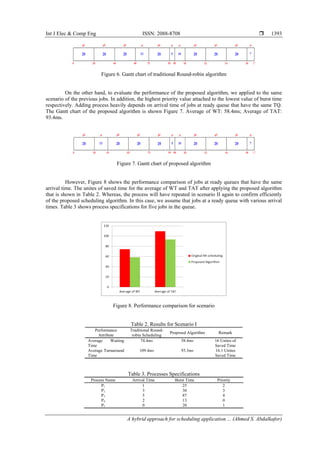
The number of jobs with their slot time for traditional round-robin is shown in Figure 9. Average of
WT: 53.6ms; Average of TAT: 88.6ms. The number of jobs with their slot time for the proposed algorithm is
shown in Figure 10. Whereas, Average of WT: 49.6ms; Average of TAT: 84.6ms. Performance comparison
in various arrival times is shown in Figure 11. To discusses the proposed algorithm, we need to compare our
algorithm with traditional to calculate the efficient rate of the algorithm. According to the result, we can
easily notice that the proposed algorithm more efficient from the traditional algorithm. Our proposal is
applied with the previous algorithm [12, 14-17] to measure its efficiency.
Figure 9. Gantt chart for round-robin algorithm
Figure 10. Gantt chart of the proposed algorithm
Figure 11. Performance comparison for scenario II
a. Improved round-robin scheduling in cloud computing [12]
Some performance metrics are utilised to evaluate efficacy of new scheduling method for clouding
computing that proposed [12]. Thus, Figure 12 shows improve rate of round-robin. Average of WT: 42.4ms;
Average of TAT: 62.4ms.
Figure 12. Gantt chart of improved round-robin scheduling
b. Enhanced round-robin [14]
In Figure 13, average of WT and average of TAT are calculated to measure improving rate of
the round-robin [14]. Average of WT: 64.2ms; Average of TAT: 112.4ms.](https://image.slidesharecdn.com/v3115oct9oct28jun20557edbyez-201204070451/85/A-hybrid-approach-for-scheduling-applications-in-cloud-computing-environment-8-320.jpg)
![Int J Elec & Comp Eng ISSN: 2088-8708
A hybrid approach for scheduling application ... (Ahmed S. Abdalkafor)
1395
Figure13. Gantt chart of enhanced round-robin
c. Integer programming [15]
In addition, average of WT and average of TAT are required to test integer programming for
the scheduling method that shown in Figure 14 [15]. Average of WT: 36ms; Average of TAT: 84.6ms.
Figure 14. Gantt chart of integer programming robin algorithm
d. Improved round-robin algorithm [17]
Nayak et al, have proposed scheduling algorithm to improve performance of round-robin method.
However, figure 15 shows efficiency of this algorithm. Average of WT: 84ms; Average of TAT: 141.6ms.
Figure 15. Gantt chart of improved round-robin algorithm
e. A priority-based round-robin [16]
Rajput et al [16], have presented some improvement process on round-robin algorithm as shown in
Figure 16. Average of WT: 24.4ms; Average of TAT: 35ms.
Figure 16. Gantt chart of priority-based round-robin algorithm
To distinguish our work from other, we need comparison study with the recent papers at the same research
area. Table 4 shows comparison study between various proposed algorithm on round-robin method.
The summary of the comparison between the previous scheduling algorithms with our proposal scheduling
algorithm is shown in Figure 17.
Table 4 comparison between various improve on round-robin.
Performa
nce Attribute
AWT
AWT After Applying the
proposed algorithm
ATAT
ATAT After Applying
the proposed algorithm
Sangwan et al. [12] 44.8ms 42.4ms 64.8ms 62.4ms
Mittal et al.[14] 68.8ms 64.2ms 117ms 112.4ms
Kumar et al.[15] 71.6ms 36ms 119.8ms 84.6ms
Rajput et al.[16] 28ms 24.4ms 40ms 35ms
Nayak et al.[17] 85.6ms 84ms 143.2ms 141.6ms](https://image.slidesharecdn.com/v3115oct9oct28jun20557edbyez-201204070451/85/A-hybrid-approach-for-scheduling-applications-in-cloud-computing-environment-9-320.jpg)
![ ISSN: 2088-8708
Int J Elec & Comp Eng, Vol. 10, No. 2, April 2020 : 1387 - 1397
1396
Figure 17. Comparison between previous algorithms with new algorithm
6. CONCLUSION
A novel scheduling algorithm for cloud computing is proposed in this paper to overcome common
problems of round-robin algorithm. It has the ability to create balance load between job processes in cloud
computing at ready queue. The propriety value attached to burst time plays a vital role in enhancing
performance of cloud computing scheduling. When compare our proposal with the previous algorithm,
we can easily notice that the proposed algorithm has a significant effect on performance of cloud computing.
Our experimental result of the proposed jobs scheduling algorithm shows that the proposed schemes possess
outstanding enhancing rates with a reduction in waiting time for jobs in queue list. In future work, this idea
will apply on another scheduling algorithm for cloud computing that targeted to reduce rate of waiting time
and turnaround time at ready queue with.
REFERENCES
[1] N. Kulkarni, S. V. N. L. Lalitha, and S. A. Deokar, “Real Time Control and Monitoring of Grid Power Systems
using Cloud Computing,” International Journal of Electrical and Computer Engineering, vol. 9, No. 2,
pp. 941-949, 2019.
[2] K. Bhagchandani and D. P. Augustine, “IoT Based Heart Monitoring and Alerting System with Cloud Computing
and Managing The Traffic for an Ambulance in India,” International Journal of Electrical and Computer
Engineering, vol. 9, no. 6, pp. 5068-5074, 2019.
[3] H. G. Tani, and C. El Amrani, “Cloud Computing CPU Allocation and Scheduling Algorithms using CloudSim
Simulator,” International Journal of Electrical and Computer Engineering, vol. 6, no. 4, pp. 1866-1879, 2016.
[4] W. Hussain, F. K. Hussain, O. K. Hussain, E. Damiani, and E. Chang, “Formulating and Managing Viable SLAs in
Cloud Computing from a Small to Medium Service Provider's Viewpoint: A State-of-the-Art Review,” Information
Systems, vol. 71, pp. 240-259, 2017.
[5] S. Ghanbari and M. Othman, “A Priority Based Job Scheduling Algorithm in Cloud Computing,” Procedia
Engineering, vol. 50, pp. 778-785, 2012.
[6] R. Nallakumar, “A Survey on Deadline Constrained Workflow Scheduling Algorithms in Cloud Environment,”
International Journal of Computer Science Trends and Technology (IJCST), vol. 2, no. 5, pp. 44-50, 2014. arXiv
preprint arXiv:1409.7916.
[7] T. Dillon, C. Wu, and E. Chang, “Cloud Computing: Issues and Challenges,” 2010 24th IEEE International
Conference on Advanced Information Networking and Applications, Australia, pp. 27-33, 2010.
[8] W. C. Wu and S. C. Yang, “Enhancing Image Security and Privacy in Cloud System using Steganography,” IEEE
International Conference on Consumer Electronics-Taiwan (ICCE-TW), pp. 321-322, June 2017.
[9] I. C. Lopez, “Scientific Workflow Scheduling for Cloud Computing Environments,” Doctoral Thesis,
The University of Sydney, 2016.
[10] Y. H. Lee, S. Leu, and R. S. Chang, “Improving Job Scheduling Algorithms in a Grid Environment,” Future
generation computer systems, vol. 27, no. 8, pp. 991-998, 2011.
[11] S. K. Panda and S. K. Bhoi, “An Effective Round-Robin Algorithm using Min-Max Dispersion Measure,”
International Journal on Computer Science and Engineering, 2014. arXiv preprint arXiv:1404.5869.
[12] P. Sangwan, M. Sharma, and A. Kumar, “Improved Round-robin Scheduling in Cloud Computing,” Advances in
Computational Sciences and Technology, vol. 10, no. 4, pp. 639-644, 2017.
[13] B. Maniyar, and B. Kanani, “Review on Round-Robin Algorithm for Task Scheduling in Cloud Computing,”
Journal of Emerging Technologies and Innovative Research, vol. 2, no. 3, 2015.
[14] S. Mittal, S. Singh, and R. Kaur, “Enhanced Round-robin Technique for Task Scheduling in Cloud Computing
Environment, International Journal of Engineering Research & Technology, pp. 525–529, 2016.](https://image.slidesharecdn.com/v3115oct9oct28jun20557edbyez-201204070451/85/A-hybrid-approach-for-scheduling-applications-in-cloud-computing-environment-10-320.jpg)
![Int J Elec & Comp Eng ISSN: 2088-8708
A hybrid approach for scheduling application ... (Ahmed S. Abdalkafor)
1397
[15] D. P. Kumar, T. S. Reddy, and A. Y. Reddy, “Finding Best Time Quantum for Round-robin Scheduling Algorithm
to Avoid Frequent Context Switch,” International Journal of Computer Science and Information Technologies, vol.
5, no. 5, 2014.
[16] I. S. Rajput and D. Gupta, “A Priority-Based Round-Robin CPU Scheduling Algorithm for real-Time Systems,”
International Journal of Innovations in Engineering and Technology, vol. 1, no. 3, pp. 1-11, 2012.
[17] D. Nayak, S. K. Malla, and D. Debadarshini, “Improved Round-Robin Scheduling using Dynamic Time Quantum,”
International Journal of Computer Applications, vol. 38, no. 5, pp. 34-38, 2012.
[18] E. S. Ahmad, E. I. Ahmad, and.E. S. Mirdha, “A Novel Dynamic Priority Based Job Scheduling Approach for
Cloud Environment,” International Research Journal of Engineering and Technology (IRJET), vol. 04,
pp. 518-522, 2017.
[19] D. Agarwal and S. Jain, “Efficient Optimal Algorithm of Task Scheduling in Cloud Computing Environment,”
International Journal of Computer Trends and Technology (IJCTT), vol. 9, no. 7, 2014. arXiv preprint
arXiv:1404.2076.
[20] D. D. H. Miriam, B. Prabha, and J. F. Lilian, “An Efficient Job Scheduling in Isometric HPCLOUD using ZBLA
Optimization,” Procedia Computer Science, vol. 50, pp. 307-315, 2015.
[21] P. Thakur and M. Mahajan, “Different Scheduling Algorithm in Cloud Computing: A Survey,” International
Journal of modern computer science, vol. 5(1), 2017.
[22] R. S. Chang, C. Y. Lin, and C. F. Lin, “An Adaptive Scoring Job Scheduling Algorithm for Grid Computing,”
Information Sciences, vol. 207, pp. 79-89, 2012.
[23] R. Kamal, M. A. Shah, N. Hafeez, and A. Hanif, “Enhanced User Preference Based Intelligent Scheduling
Algorithm (E-UPISA),” 23rd International Conference on Automation and Computing (ICAC), pp. 1-6, September
2017.
[24] Monika and A. Jindal, “Optimized Task Scheduling Algorithm for Cloud Computing,” In Information and
Communication Technology for Sustainable Development, Spinger Nature Singapore, vol. 9, pp. 431-439, 2018.
[25] K. Kaur, N. Kaur, and K. Kaur, “A Novel Context and Load-Aware Family Genetic Algorithm Based Task
Scheduling in Cloud Computing,” Data Engineering and Intelligent Computing. Advanced in Intelligent Systems
and Computing, Springer Nature Singapore, vol. 542, pp. 521-531, 2018.
[26] H. G.Tani, and C. El Amrani, “Smarter Round-Robin Scheduling Algorithm for Cloud Computing and Big Data,”
Journal of Data Mining and Digital Humanities, 2018.
BIOGRAPHIES OF AUTHORS
Ahmed Subhi Abdalkafor was born in Anbar-Iraq in 1988. He received his MSc. degree from
Computer Science Department in Middle East University, Jordan in 2016. The B.Sc. from Faculty
of Computer Science at Anbar University, Iraq. His research interests are, Image Processing,
Pattern Classification, Neural Network, Cloud Computing,
Khattab M. Ali Alheeti (S’14) received the M.Sc. (Hons.) Computer Networking and Information
in 2009, from the University of Al al-Bayt. Currently, Jordan. He is a Ph.D. researcher in
Computer Science and Electronic Engineering School, University of Essex, Colchester, UK.
His research interests are; security, self-driving vehicles, computer networking,
telecommunication.](https://image.slidesharecdn.com/v3115oct9oct28jun20557edbyez-201204070451/85/A-hybrid-approach-for-scheduling-applications-in-cloud-computing-environment-11-320.jpg)


